Posts Tagged ‘NICCOLO MACHIAVELLI’
2025 FEDERAL GOVERNMENT SHUTDOWN, ABC NEWS, AFFORDABLE CARE ACT, ALTERNET, AMERICABLOG, AP, BABY BOOMER RESISTANCE, BLOOMBERG, BUZZFEED, CAMILLUS, CBS NEWS, CHRISTOPHER SWANSON, CNN, CROOKS AND LIARS, DAILY KOS, DEREK CHAUVIN, DONALD TRUMP, FIVETHIRTYEIGHT, FLINT TOWNSHIP, GEORGE FLOYD, HARPER’S MAGAZINE, LOS ANGELES, MARCUS FURIUS, MEDIA MATTERS, MEDICARE, MOTHER JONES, MOVEON, MSNBC, NBC NEWS, NEW YORK CITY, NEWSWEEK, NICCOLO MACHIAVELLI, NPR, ONE BIG BEAUTIFUL BILL, PBS NEWSHOUR, POLITICO, POLITICUSUSA, RAW STORY, REPUBLICANS, REUTERS, SALON, SAN FRANCISCO, SEATTLE TIMES, SLATE, ST. JOHN’S CHURCH, TALKING POINTS MEMO, THE ATLANTIC, THE CHICAGO SUN-TIMES, THE CHICAGO TRIBUNE, THE DAILY BEAST, THE DAILY BLOG, THE DISCOURSES, THE GUARDIAN, THE HILL, THE HUFFINGTON POST, THE LOS ANGELES TIMES, THE NATION, THE NEW REPUBLIC, THE NEW YORK TIMES, THE VILLAGE VOICE, THE WASHINGTON POST, THINKPROGRESS, TIME, TRUTHDIG, TRUTHOUT, TWO POLITICAL JUNKIES, U.S. NEWS & WORLD REPORT, UPI, USA TODAY, WONKETTE, X
In Bureaucracy, History, Law Enforcement, Politics, Social commentary on September 25, 2026 at 12:05 am
Throughout his first term as President, “Do what I want—or I’ll destroy you!” proved Donald Trump’s go-to method of “negotiation.” And it has remained so since re-taking office on January 20, 2025.
On February 28, Trump—in concert with Israel—launched a series of devastating, unprovoked airstrikes against Iran.
Asked by a reporter how long the war would last, Trump arrogantly replied: “Any time I want it to end, it will end.”
But then Iran closed the Strait of Hormuz, through which 20% to 30% of the world’s total daily oil supply passes.
Gas prices in the United States immediately rose. Analysts warned that if the disruption continued, gasoline prices could exceed $5 per gallon.
Fearing this posed a direct threat to Repbublicans’ holding control of Congress in the upcoming midterm elections, on Easter Sunday Trump posted on his website, Truth Social:
“Tuesday [April 7] will be Power Plant Day, and Bridge Day, all wrapped in one, in Iran. There will be nothing like it!!! Open the Fuckin’ Strait, you crazy bastards, of you’ll be living in Hell – JUST WATCH! Praise be to Allah.”
Legal experts and international organizations such as Amnesty International warned that attacking civilian infrastructure would constitute war crimes under international law.
In less than 24 hours, American pilots would be forced to decide: “Do we want to become war criminals?”
But there are humane ways to wield power, and these usually leave feelings of lasting gratitude—if not reverence—for those who do.
Two examples follow.

Lesson #!: In Book Three, Chapter 22 of his classic masterwork, The Discourses, Niccolo Machiavelli offers the following: “An Act of Humanity Prevailed More With the Falacians Than All the Power of Rome.”
Marcus Furius Camillus, a Roman general, was besieging the city of the Faliscians, and had surrounded it. A teacher charged with educating the children of some of the city’s noblest families decided to ingratiate himself with Camillus by leading them into the Roman camp.
As Roman hostages, they could be used to compel the city to surrender.
Camillus not only declined the offer but went one step further. He ordered the teacher stripped and his hands tied behind his back. Then Camillus had a rod put into the hands of each of the children and directed them to whip the teacher all the way back to the city.
Upon learning this, the citizens of Faliscia were so much touched by the humanity and integrity of Camillus, that they surrendered the place to him without any further defense.
Summing up the meaning of this, Machiavelli writes: “This example shows that an act of humanity and benevolence will at all times have more influence over the minds of men than violence and ferocity. It also proves that provinces and cities which no armies…could conquer, have yielded to an act of humanity, benevolence, chastity or generosity.
“…History also shows us how much the people desire to find such virtues in great men, and how much they are extolled by historians and biographers of princes….Amongst these, Xenophon takes great pains to show how many victories, how much honor and fame, Cyrus gained by his humanity and affability, and by his not having exhibited a single instance of pride, cruelty or luxuriousness, nor of any of the other vices that are apt to stain the lives of men.”

Niccolo Machiavelli
This lesson—recorded by a master political scientist and practitioner of Realpolitik—remains highly relevant today.
Lesson #2: On May 25, 2020, George Floyd, a black unemployed restaurant security guard, was murdered by Derek Chauvin, a white Minneapolis police officer. While Floyd was handcuffed and lying face down on a city street during an arrest, Chauvin kept his knee on the right side of Floyd’s neck for eight minutes and 46 seconds.
Cities across the United States erupted in mass protests over Floyd’s death—and police killings of black victims generally. Most of these demonstrations proved peaceful.
But cities such as Los Angeles, San Francisco and New York City saw stores looted, vandalized and/or burned.
In response, President Donald Trump called for harsh policing, telling governors in a nationwide conference call that they must “dominate” protesters or be seen as “weak.”
To drive home his point, Trump ordered police and National Guard troops to violently remove peaceful protesters from Lafayette Square, which borders St. John’s Church near the White House.
The purpose of the removal: To allow Trump to have a photo opportunity outside the church.
Contrast that with the example of Sheriff Christopher Swanson of Genesee County, Michigan.

Sheriff Christopher Swanson
Confronting a mass of aroused demonstrators in Flint Township on May 30, Swanson responded: “We want to be with you all for real.”
So Swanson took his helmet off. His deputies laid their batons down.
“I want to make this a parade, not a protest. So, you tell us what you need to do.”
“Walk with us!” the protesters shouted.
“Let’s walk, let’s walk,” said Swanson.
Cheering and applause resounded.
“Let’s go, let’s go,” Swanson said as he and the cheering crowd proceeded. “Where do you want to walk? We’ll walk all night.”
And Swanson and his fellow officers walked in sympathy with the protesters.
No rioting followed.
ABC NEWS, ADOLF HITLER, ALTERNET, AMERICABLOG, AP, BABY BOOMER RESISTANCE, BBC, BLOOMBERG NEWS, BLUESKY, BUZZFEED, CANADA, CBS NEWS, CLAUDIA SHEINBAUM PARDO, CNN, CNN'S "STARTING POINT", CROOKS AND LIARS, CZECHOSLAVAKIA, DAILY KOS, DAVID BROOKS, DEPARTMENT OF HOMELAND SECURITY, DEPARTMENT OF JUSTICE, DONALD TRUMP, EXTORTION, FBI, FIVETHIRTYEIGHT, GREENLAND, HARPER’S MAGAZINE, HUFFINGTON POST, INSIDER, IRAN, IRAN WAR, JACK SMITH, JIMMY CARTER, JUSTIN TRUDEAU, MASTADON, MEDIA MATTERS, MEXICO, MOTHER JONES, MOVEON, MSNBC, MSNBC'S "HARDBALL", NAZI GERMANY, NBC NEWS, NEGOTIATING, NEVILLE CHAMBERLAIN, NEW REPUBLIC, NEWSDAY, NEWSWEEK, NEWT GINGRICH, NICCOLO MACHIAVELLI, NPR, PANAMA, PBS NEWSHOUR, POLAND, POLITICO, POLITICUSUSA, R.I.CO. ACT, RAW STORY, REPUBLICAN PARTY, REPUBLICANS, REUTERS, ROBERT MEULLER, SALON, SEATTLE TIMES, SLATE, STRAIT OF HORMUZ, TALKING POINTS MEMO, THE ATLANTIC, THE CHICAGO SUN-TIMES, THE CHICAGO TRIBUNE, THE DAILY BEAST, THE DAILY BLOG, THE GUARDIAN, THE HAMILTON PROJECT, THE HILL, THE HUFFINGTON POST, THE LOS ANGELES TIMES, THE NATION, THE NEW REPUBLIC, THE NEW YORK TIMES, THE NEW YORKER, THE PENTAGON, THE PRINCE, THE VILLAGE VOICE, THE WASHINGTON POST, THINKPROGRESS, TIME, TRUTHDIG, TRUTHOUT, TWO POLITICAL JUNKIES, U.S. NEWS & WORLD REPORT, UKRAINE, UPI, USA TODAY, VLADIMIR PUTIN, VOLODMYR ZELENSKY, WONKETTE, WORLD WAR 11, X
In Bureaucracy, Business, History, Military, Politics, Social commentary on September 4, 2026 at 12:10 am
The “negotiating” methods of German Fuhrer Adolf Hitler serve as a useful guide to what domestic and world leaders can expect from trying to reach an agreement with President Donald Trump.
In September, 1938, seven months after seizing Austria, Hitler gave another exhibition of his “negotiating” methods.
This time, the target of his aggression was Czechoslovakia. Once again, he opened “negotiations” with a lie: The Czechoslovak government was trying to exterminate 3.5 million Germans living in the “Sudetenland.”
Then he threatened war: Germany would protect its citizens and halt such “oppression.”
For British Prime Minister Neville Chamberlain, the thought of another European war erupting less than 20 years after the end of World War I was simply unthinkable.
He quickly sent Hitler a telegram, offering to help resolve the crisis: “I could come to you by air and am ready to leave tomorrow. Please inform me of earliest time you can receive me, and tell me the place of the meeting. I should be grateful for a very early reply.”
[Mistake #1: Showing his willingness to placate a brutal dictator. Such men see any concessions as weakness—leading to only greater demands. Trump, like Hitler, relishes attacking those weaker than himself.]
The two European leaders met in Berchtesgaden, Germany, on September 15, 1938.
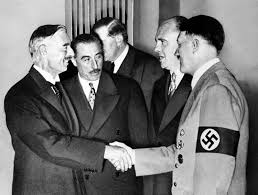
Neville Chamberlain and Adolf Hitler
Hitler denied that he had threatened war: “Force? Who speaks of force?“
Then, suddenly, he accused the Czechs of having mobilized their army in May. They had mobilized—in response to the mobilization of the German army.
“I shall not put up with this any longer,” shouted Hitler. “I shall settle this question in one way or another. I shall take matters in my own hands!”
Suddenly, Chamberlain seemed alarmed: “If I understood you right, you are determined to proceed against Czechoslovakia in any case. In the circumstances, it is best for me to return at once. Anything else now seems pointless.”
Hitler, taken aback, softened his tone and said they should consider the Sudetenland according to the principle of self-determination.
Chamberlain agreed to the cession of the Sudetenland. Three days later, French Prime Minister Edouard Daladier did the same. No Czechoslovak representative was invited to these discussions.
[Mistake #2: Instead of conceding to Hitler, which emboldened the dictator, Chamberlain should have pressed his advantage. When Hitler faced an opponent he couldn’t bribe or cow—such as British Prime Minister Winston Churchill or Soviet Premier Joseph Stalin—he raged and sulked.
[When Trump faces an opponent he can’t buy or intimidate—such as Special Counsel Jack Smith or Ayatollah Mojtaba Khamenei—he does the same.]
Chamberlain met Hitler again in Godesberg, Germany, on September 22 to confirm the agreements. But Hitler aimed to use the crisis as a pretext for war.
He now demanded not only the annexation of the Sudetenland but the immediate military occupation of the territories. This would give the Czechoslovak army no time to adapt their defense measures to the new borders.
To achieve a solution, Italian dictator Benito Mussolini suggested a conference of the major powers in Munich.
On September 29, Hitler, Daladier and Chamberlain met and agreed to Mussolini’s proposal. They signed the Munich Agreement, which accepted the immediate occupation of the Sudetenland.
The Czechoslovak government had not been a party to the talks. Nevertheless, it promised to abide by the agreement on September 30.
It actually had no choice. It faced the threat of an immediate German invasion after being deserted by its pledged allies: Britain, France and the Soviet Union.
[Mistake #3: Selling out an ally and making a concession to an insatiable dictator—and believing that Hitler could be trusted to keep his word.
[Just as Chamberlain sold out Czechoslovakia, Trump plans on selling out Ukraine to Russian dictator Vladimir Putin. He’s blamed Ukraine for starting the 2022 war—even though Russia invaded Ukraine.
He’s long wanted a Trump Tower in Moscow. Ukraine President Volodymyr Zelensky can’t give him that. Putin can.]
Chamberlain returned to England a hero. Holding aloft a copy of the worthless agreement he had signed with Hitler, he told cheering crowds in London: “I believe it is peace for our time.”

Neville Chamberlain
Hitler—still planning more conquests—knew better. In March, 1939, the German army occupied the rest of Czechoslovakia.
Chamberlain would soon be seen as a naive weakling—even before bombs started falling on London.
Believing himself invincible, Hitler turned his attention—and demands—to Poland.
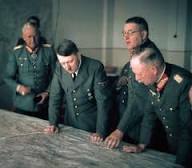
Adolf Hitler and his generals
Believing himself invincible, Trump now threatens violence against Canada, Greenland and Cuba.
Hitler ordered the invasion of Poland on September 1, 1939. To his surprise, France and England honored their pledges to support Poland—triggering World War II. Six years and 50-56 million deaths followed.
On February 28, 2026, Trump—in concert with Israel–attacked Iran without warning. To his surprise, the Iranians closed the Strait of Hormuz, through which 20-30% of the world’s oil total daily oil supply passes. This has triggered a global oil crisis and severely tightened international energy supplies.
Hitler couldn’t “turn off” the war he had started. He could only lash out as his enemies multiplied.
The same has proven true for Trump.
ABC NEWS, ADOLF HITLER, ALTERNET, AMERICABLOG, AP, AUSTRIA, BABY BOOMER RESISTANCE, BBC, BLOOMBERG NEWS, BLUESKY, BUZZFEED, CANADA, CBS NEWS, CLAUDIA SHEINBAUM PARDO, CNN, CNN'S "STARTING POINT", CROOKS AND LIARS, CZECHOSLAVAKIA, CZECHOSLOVAKIA, DAILY KOS, DAVID BROOKS, DEPARTMENT OF HOMELAND SECURITY, DEPARTMENT OF JUSTICE, DONALD TRUMP, EXTORTION, FBI, FIVETHIRTYEIGHT, FRANCE, GELI rAUBAL, GREECE, GREENLAND, HARPER’S MAGAZINE, HUFFINGTON POST, INSIDER, IRAN, IRAN WAR, JACK SMITH, JIMMY CARTER, JUSTIN TRUDEAU, MASTADON, MEDIA MATTERS, MEXICO, MOTHER JONES, MOVEON, MSNBC, MSNBC'S "HARDBALL", NAZI GERMANY, NBC NEWS, NEGOTIATING, NEVILLE CHAMBERLAIN, NEW REPUBLIC, NEWSDAY, NEWSWEEK, NEWT GINGRICH, NICCOLO MACHIAVELLI, NPR, PANAMA, PBS NEWSHOUR, POLAND, POLITICO, POLITICUSUSA, R.I.CO. ACT, RAW STORY, REPUBLICAN PARTY, REPUBLICANS, REUTERS, ROBERT MEULLER, SALON, SEATTLE TIMES, SLATE, STRAIT OF HORMUZ, TALKING POINTS MEMO, TARIFFS, THE ATLANTIC, THE CHICAGO SUN-TIMES, THE CHICAGO TRIBUNE, THE DAILY BEAST, THE DAILY BLOG, THE GUARDIAN, THE HAMILTON PROJECT, THE HILL, THE HUFFINGTON POST, THE LOS ANGELES TIMES, THE NATION, THE NEW REPUBLIC, THE NEW YORK TIMES, THE NEW YORKER, THE PENTAGON, THE PRINCE, THE VILLAGE VOICE, THE WASHINGTON POST, THINKPROGRESS, TIME, TRADE WARS, TRUTHDIG, TRUTHOUT, TWO POLITICAL JUNKIES, U.S. NEWS & WORLD REPORT, UKRAINE, UPI, USA TODAY, VLADIMIR PUTIN, VOLODMYR ZELENSKY, WONKETTE, WORLD WAR 11, X, YUGOSLAVIA
In Bureaucracy, Business, History, Military, Politics, Social commentary on September 3, 2026 at 12:10 am
To understand the “negotiating” style of Donald Trump, it’s essential to study that of Adolf Hitler.
Both men, dictatorial by nature, did/do not believe in compromise. Their idea of “compromise” was/is: “You do what I want—or I’ll destroy you.”
In Hitler’s case, his mania for absolute control began with the Nazi party and eventually extended to Germany. Then it reached to Austria, Czechoslovakia, Poland, Norway, Denmark, France, Greece, Yugoslavia and Russia. At least 50 million men, women and children perished in the wars he unleashed from 1939 to 1945.
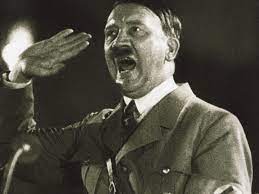
Adolf Hitler
Similarly, Trump’s mania for control started with building a real estate empire. Then it encompassed his “reality TV” show, The Apprentice—and finally politics.
He began dominating the Republican party by winning a series of Presidential primaries—and then the White House. Then came asserting control over the Justice Department and the judiciary—up to the Supreme Court.
Re-elected in 2024, he now seeks to dominate Americans, has asserted but failed to control Iran, attacks Mexico and Canada with trade wars, and threatened Greenland and Panama with invasion.
Much can be learned about Trump’s “negotiating” methods—and what it takes to counter them—by studying those of Germany’s Fuhrer.
Robert Payne, author of the bestselling biography, The Life and Death of Adolf Hitler (1973), described Hitler’s “negotiating” style thus:
“Although Hitler prized his own talents as a negotiator, a man always capable of striking a good bargain, he was totally lacking in finesse.
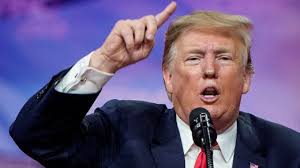
Donald Trump
“He was incapable of bargaining. He was like a man who goes up to a fruit peddler and threatens to blow his brains out if he does not sell his applies at the lowest possible price.”
What Payne writes about Hitler applies equally well to Trump.
Hitler revealed his “bargaining style” in 1938, when he invited Austrian Chancellor Kurt von Schuschnigg to his mountaintop retreat in Obersalzberg, Germany.
Hitler, an Austrian by birth, intended to annex his native land to Germany. Schuschnigg was aware of this, but felt secure in accepting the invitation. He had been assured that the question of Austrian sovereignty would not arise.
The meeting occurred on February 12, 1938.
Shuschnigg opened the discussion with a friendly compliment. Walking over to a large window, he admired the breathtaking view of the mountains.
HITLER: We haven’t come here to talk about the lovely view or the weather!
Austria has anyway never done anything which was of help to the German Reich….I am resolutely determined to make an end to all this business. The German Reich is a great power. Nobody can and nobody will interfere if it restores order on its frontiers.
[Like Hitler, Trump relies on insults and anger to put his victims on the defense.]
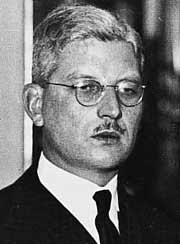
Kurt von Schuschnigg
SCHUSCHNIGG: We simply have to go on living alongside one another, the little state next to the big one. We have no other choice.
And that is why I ask you to tell me what your concrete complaints are. We will do all in our power to sort things out and establish a friendly relationship, as far as it is possible to do so.
HITLER: That’s what you say, Herr Schuschnigg. And I am telling you that I intend to clear up the whole of the so-called Austrian question—one way or another. Do you think I don’t know that you are fortifying Austria’s border with the Reich?
SCHUSCHNIGG: There can be no suggestion at all of that—
HITLER: Ridiculous explosive chambers are being built under bridges and roads—
This was a lie, and Hitler knew it was a lie. But it gave him an excuse to threaten to destroy Austria.
[For Trump, winning—not truth—is all that matters. During his first term as President, he told a documented 30,573 lies.]
HITLER: I have only to give one command and all this comic stuff on the border will be blown to pieces overnight. You don’t seriously think you could hold me up, even for half an hour, do you?
The S.A. [Hitler’s private army of Stormtroopers] and the [Condor] lLegion [which had bombed much of Spain into rubble during the Spanish Civil War] would come in after the troops and nobody—not even I—could stop them from wreaking vengeance.
Schnuschigg made a cardinal mistake in dealing with Hitler: He showed fear. And this was precisely what the Nazi dictator looked for in an opponent.
[Like Hitler, Trump relies on fear: “Real power is—I don’t even want to use the word—fear,” he said in March 2016 when still only a candidate for President.]
Contrary to popular belief, Hitler did not constantly rage at everyone. He used rage as a weapon, knowing that most people feel intimidated by it.
In the case of Schuschnigg, Hitler opened with insults and threats at the outset of their discussion. Then there was a period of calm, to convince the Austrian chancellor the worst was over.
Finally, he once again attacked—this time with so much fury that Schuschnigg was terrified into submission.
With one stroke of a pen, Austria became a vassal-state to Nazi Germany.
[Like Hitler, Trump threatens only those he feels are weak—thus his threats to use military force against Canada, Greenland and Panama.]
ADOLF HITLER, ALTERNET, AMERICABLOG, AP, BABY BOOMER RESISTANCE, BARACK OBAMA, BARBARA TUCHMAN, BBC, BLOOMBERG, BLUESKY, BUZZFEED, CANADA, CBS NEWS, CNN, CROOKS AND LIARS, DAILY KOS, DAN SCAVINO, DARLINE GRAHAM, DAVID AXELROD, DAVIS INGLE, DEMOCRATS, DOGE, DONALD TRUMP, ENGLAND, EPSTEIN FILES, FIVETHIRTYEIGHT, FREDERICK WELLMAN, GREENLAND, HARPER’S MAGAZINE, HEINZ GUDERIAN, HUFFINGTON POST, IMMIGRATION AND CUSTOMS ENFORCEMENT (ICE), IMPEACHMENT, IRAN, JAMES COMEY, JAMES TALARICO, JOHN F. KENNEDY, JON OSSOFF, Kamala Harris, KIM JONG-UN, LEE HARVEY OSWALD, LETITIA JAMES, LINIDSEY GRAM, MAGGIE HABERMAN, MARCO RUBIO, MEDIA MATTERS, MICHAEL WOLFF, MICHELLE OBAMA, MIKE JOHNSON, MOTHER JONES, MOVEON, MSNBC, NATALIE HARP, NBC NEWS, NEWSDAY, NEWSWEEK, NICCOLO MACHIAVELLI, NPR, PBS NEWSHOUR, POLITICO, POLITICUSUSA, RAFAEL "TED" CRUZ, RAW STORY, REGIME CHANGE (BOOK), REPUBLICANS, REUTERS, SALON, SCOTT BESSENT, SCOTT JENNINGS, SEATTLE TIMES, SLATE, STEPHEN MILLER, STEVEN CHEUNG, STRAIT OF HORMUZ, TALKING POINTS MEMO, THE ATLANTIC, THE CHICAGO SUN-TIMES, THE CHICAGO TRIBUNE, THE DAILY BEAST, THE DAILY BLOG, THE GUARDIAN, THE HILL, THE HUFFINGTON POST, THE INTERCEPT, THE LOS ANGELES TIMES, THE NATION, THE NEW REPUBLIC, THE NEW YORK TIMES, THE NEW YORKER, THE VILLAGE VOICE, THE WASHINGTON POST, THINKPROGRESS, TIME, TRUTHDIG, TRUTHOUT, TWO POLITICAL JUNKIES, U.S. NEWS & WORLD REPORT, UNITED STATES DEPARTMENT OF JUSTICE, UPI, USA TODAY, VICTORY ARCH, VLADIMIR PUTIN, WHITE HOUSE BALLROOM, X, XI JINPING
In Bureaucracy, Business, History, Medical, Military, Politics, Social commentary on September 2, 2026 at 12:10 am
President Donald Trump is haunted by the fear of a third impeachment action against him if Democrats retake the House of Representatives in the fast-approaching midterm elections scheduled for November 3.
Speaking at a rally in Myrtle Beach, South Carolina, to support Senate candidate Darline Graham, sister of the late Senator Lindsey Graham, Trump warned: “If we lose the midterms, I am going to be impeached. They are going to impeach me. They have no idea why!”
On the contrary: Democrats know well why they want to remove him from office. Among their reasons:
- Starting an unprovoked war with Iran.
- Attacking longtime American allies like Canada, England and Greenland.
- Cozying up to Communist dictators such as Vladimir Putin, Xi Jinping and Kim Jong-Un.
- Ordering the Justice Department to indict his critics such as New York Attorney General Letitia James and former FBI Director James Comey.
- Flooding Minneapolis and St. Paul, Minnesota, with 3,000 Immigration and Customs Enforcement (ICE) agents who terrorized (and murdered) both American citizens and illegal aliens.
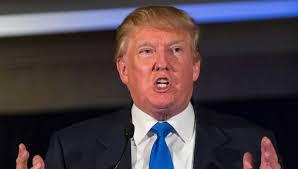
Donald Trump
Trump’s Republican accomplices in Congress fully understand the threat he faces—and what it poses for them. Thanks to his unprovoked war on Iran, oil shipments have been constrained worldwide—and Americans are furious at soaring prices for gas, food and housing.
Meanwhile, Trump arrogantly claims that “affordability” is a “Democratic hoax.” And, like Adolf Hitler contemplating architectural models while Nazi Germany neared destruction, he focuses on vanity projects like a 90,000 square foot White House ballroom and a towering “Victory Arch” overlooking Arlington Cemetery.
As a result, Trump’s current national approval rating hovers between 33% and 38%. And Republicans fear that his unpopularity will spell doom for their own re-election prospects.
On June 26, Mike Johnson (R-LA), Speaker of the House of Representatives, warned his colleagues:
“If we were to lose the midterms, heaven forbid, these Democrats, y’all, impeachment’s not even the biggest concern. They will turn every committee of Congress into an investigative body, and they’ll go after the president’s family, the Cabinet, his donors and friends—half of you in this room will be targeted.”

Mike Johnson
Frederick Wellman, the Democratic congressional candidate for Missouri’s 2nd District, was quick to agree:
“You’re damn right we will investigate crimes and corruption. Who moved $180 million in oil futures 15 minutes before Iran announcements? Who has gotten sole source contracts because of their connections to the Trump family?
“Where did our Social Security data go when DOGE downloaded it into portable hard drives? Where are the rest of the Epstein files? On and on this Congress has chosen covering up crimes instead of stopping them. That ends in November.”
Donald Trump is notorious for being thin-skinned. He has never displayed a sense of humor—nor an ability to laugh at himself. And he cannot abide listening to news that contradicts whatever he wants to do or believe.
The role that Natalie Harp plays in his life cannot be fully understood unless one accepts this fundamental truth: Trump, like Adolf Hitler, believes that if he just thinks positively, reality will bend to meet his wishes.
For this, he needs—and devours—a constant supply of “happy news” that confirms what he wants to believe. “News” that Harp is thrilled to constantly supply.
Thus, six months after launching a war he expected to be over in four to six weeks, Trump could say: “Right now, the situation is so good.”
Trump said this after leading reporters on a tour of the White House’s South Lawn to show off his latest renovations.
Presidents—and tyrants—who substitute “happy news” for hard truth usually come to a bad end. Hitler fired generals like Heinz Guderian—the architect of his sweeping victory over France in 1940—when they told him an offensive could not be continued or that their soldiers were needlessly dying for lack of supplies.
It did not win Hitler his war.
As Donald Trump lurches from one self-manufactured crisis to another, two warnings from Niccolo Machiavelli, the Florentine statesman and father of modern political science, take on special meaning:
“I must not omit an important subject, and mention of a mistake which princes can with difficulty avoid, if they are not very prudent, or if they do not make a good choice. And this is with regard to flatterers, of which courts are full, because men take pleasure in their own things and deceive themselves about them that they can with difficulty guard against this plague.”
And:
“It is an infallible rule that a prince who is not wise himself cannot be well advised, unless by chance he leaves himself entirely in the hands of one man who rules him in everything, and happens to be a very prudent man. In this case, he may doubtless be well governed, but it would not last long, for the governor would in a short time deprive him of the state.”
Noted historian Barbara Tuchman put it even more directly: “A great empire and little minds go ill together.”
ADOLF HITLER, ALTERNET, AMERICABLOG, AP, BABY BOOMER RESISTANCE, BARACK OBAMA, BARBARA TUCHMAN, BBC, BLOOMBERG, BLUESKY, BUZZFEED, CANADA, CBS NEWS, CNN, CROOKS AND LIARS, DAILY KOS, DAN SCAVINO, DARLINE GRAHAM, DAVID AXELROD, DAVIS INGLE, DEMOCRATS, DOGE, DONALD TRUMP, ENGLAND, EPSTEIN FILES, FIVETHIRTYEIGHT, FREDERICK WELLMAN, GREENLAND, HARPER’S MAGAZINE, HEINZ GUDERIAN, HUFFINGTON POST, IMMIGRATION AND CUSTOMS ENFORCEMENT (ICE), IMPEACHMENT, IRAN, JAMES COMEY, JAMES TALARICO, JOHN F. KENNEDY, JON OSSOFF, Kamala Harris, KIM JONG-UN, LEE HARVEY OSWALD, LETITIA JAMES, LINIDSEY GRAM, MAGGIE HABERMAN, MARCO RUBIO, MEDIA MATTERS, MICHAEL WOLFF, MICHELLE OBAMA, MIKE JOHNSON, MOTHER JONES, MOVEON, MSNBC, NATALIE HARP, NBC NEWS, NEWSDAY, NEWSWEEK, NICCOLO MACHIAVELLI, NPR, PBS NEWSHOUR, POLITICO, POLITICUSUSA, RAFAEL "TED" CRUZ, RAW STORY, REGIME CHANGE (BOOK), REPUBLICANS, REUTERS, SALON, SCOTT BESSENT, SCOTT JENNINGS, SEATTLE TIMES, SLATE, STEPHEN MILLER, STEVEN CHEUNG, STRAIT OF HORMUZ, TALKING POINTS MEMO, THE ATLANTIC, THE CHICAGO SUN-TIMES, THE CHICAGO TRIBUNE, THE DAILY BEAST, THE DAILY BLOG, THE GUARDIAN, THE HILL, THE HUFFINGTON POST, THE INTERCEPT, THE LOS ANGELES TIMES, THE NATION, THE NEW REPUBLIC, THE NEW YORK TIMES, THE NEW YORKER, THE VILLAGE VOICE, THE WASHINGTON POST, THINKPROGRESS, TIME, TRUTHDIG, TRUTHOUT, TWO POLITICAL JUNKIES, U.S. NEWS & WORLD REPORT, UNITED STATES DEPARTMENT OF JUSTICE, UPI, USA TODAY, VICTORY ARCH, VLADIMIR PUTIN, WHITE HOUSE BALLROOM, X, XI JINPING
In Bureaucracy, Business, History, Military, Politics, Social commentary on September 1, 2026 at 12:10 am
Michael Wolff, a longtime biographer of Donald Trump, recently published letters from White House aide Natalie Harp to the President in The Daily Beast.
Among their revelations:
“If there is anything else I have done to cause you trouble, please forgive me. I want things to always be right between us. I also know I’ve been distracted all week (forgetting to eat throughout the days, and even forgetting to sleep, and only catching a couple hours at a time).”
And
“I never want to bring you anything but joy. I’m sorry I lost my focus. You are all that matters to me. I don’t want to ever let you down. Thank you for being my Guardian and Protector in this life.”
On August 16, Georgia’s Democratic United States Senator, Jon Ossoff, said at a campaign rally in Atlanta:
“He golfs and trades stocks. See, he doesn’t want to do the job. He wants to build his ballroom and travel with Natalie on their apparently defenseless flying palace gifted by the Emir of Qatar.”
A clip of this remark was widely shared on social media.

Jon Ossoff
Ossoff didn’t accuse Trump and Harp of tripping the light fantastic, but the White House immediately and viciously reacted as if he had:
- White House Communications Director Steven Cheung: “Jon Jackoff has to be the biggest cuck loser in politics. Instead of denigrating hard working people serving their country, Jon should look deep into his soul and ask himself why he’s a miserable person who hates this country. It’s because he’s a radical, extremist Dumocrat.” [“Denigrating” actually means “insulting.” The word Cheung meant was “praising.”]
- Trump spokesman Davis Ingle: “A cringeworthy, feminine theatre kid cosplaying as Barack Obama.”
- Right-wing CNN pundit Scott Jennings: “A garbage human.”
- When a CNN reporter asked Trump about Ossoff’s remarks, a White House-run X account attacked her as “a disgraceful, humiliating embarrassment to her alleged profession.”
Even some Democrats feel that Ossoff went too far. One of these was David Axelrod, former advisor to President Barack Obama.
“No one has been more consistently eloquent or incisive in exposing @realDonaldTrump than @Ossoff. The paragraph from his weekend speech that has gotten so much attention was a brutal takedown. But two words in it, ‘with Natalie’ seemed gratuitous and unnecessary,” Axelrod wrote on X.

David Axelrod
This despite the fact that Trump has built his political career on countless brutal insults to both Republicans and Democrats.
The attacks on him haven’t fazed Ossoff: “It’s been amazing to watch this White House melt down over this all week,” he told MS NOW. “These White House staffers are adults, public officials paid by the taxpayer with immense power in positions of public trust.”
Even if there is no affair between the President and his adoring aide, their relationship underscores a fundamental Trumpian dilemma:
On one hand, he craves not simply loyalty but constant adoration. He must be repeatedly told he’s the most handsome, brilliant, powerful, beloved man on the planet.
On the other hand, his flagrant greed, egotism and constant attacks on a seemingly endless number of people—politicians, journalists, celebrities, ordinary Americans—ensure that the hatred he spews is returned in kind. And this makes him all the more desperate to feel adored.
Thus, enter Natalie Harp.
Ossoff’s comment has clearly touched a White House nerve. And it couldn’t have happened at a worse time for Trump.
He’s an 80-year-old, easily distracted man who repeatedly falls asleep in public events—such as during White House meetings or a World Cup game. He launched a losing war on Iran, predicted it would be over in four to six weeks, and has seen it spiral into six months with no end in sight.
Meanwhile, Iran continues to control the Strait of Hormuz, through which about 20 million barrels of oil used to pass each day. That flow has been reduced to between two million and six million barrels each day.

Strait of Hormuz
This has created a worldwide spiral in oil prices—and fueled inflation in the United States and other nations. But as prices for housing, energy and food soar in the United States, Trump claims that “affordability” is a “Democratic hoax.”
Like Adolf Hitler contemplating architectural models while Nazi Germany neared destruction, Trump focuses on vanity projects like a 90,000 square foot White House ballroom and a towering “Victory Arch” overlooking Arlington Cemetery.
Trump is haunted by the fear of a third impeachment action against him if Democrats retake the House of Representatives in the fast-approaching midterm elections scheduled for November 3.
Speaking at a rally in Myrtle Beach, South Carolina, to support Senate candidate Darline Graham, sister of the late Senator Lindsey Graham, Trump warned: “If we lose the midterms, I am going to be impeached. They are going to impeach me. They have no idea why!”
His Republican accomplices in Congress fully understand this as well. Most of them now hold their positions to his support—or by not daring to cross him in any way.
And they fear that his current unpopularity—at 33% to 39%—will upend their own chances for re-election.
ADOLF HITLER, ALTERNET, AMERICABLOG, AP, BABY BOOMER RESISTANCE, BARACK OBAMA, BARBARA TUCHMAN, BBC, BLOOMBERG, BLUESKY, BUZZFEED, CANADA, CBS NEWS, CNN, CROOKS AND LIARS, DAILY KOS, DAN SCAVINO, DARLINE GRAHAM, DAVID AXELROD, DAVIS INGLE, DEMOCRATS, DOGE, DONALD TRUMP, ENGLAND, EPSTEIN FILES, FIVETHIRTYEIGHT, FREDERICK WELLMAN, GREENLAND, HARPER’S MAGAZINE, HEINZ GUDERIAN, HUFFINGTON POST, IMMIGRATION AND CUSTOMS ENFORCEMENT (ICE), IMPEACHMENT, IRAN, JAMES COMEY, JAMES TALARICO, JOHN F. KENNEDY, JON OSSOFF, Kamala Harris, KIM JONG-UN, LEE HARVEY OSWALD, LETITIA JAMES, LINIDSEY GRAM, MAGGIE HABERMAN, MARCO RUBIO, MEDIA MATTERS, MICHAEL WOLFF, MICHELLE OBAMA, MIKE JOHNSON, MOTHER JONES, MOVEON, MSNBC, NATALIE HARP, NBC NEWS, NEWSDAY, NEWSWEEK, NICCOLO MACHIAVELLI, NPR, PBS NEWSHOUR, POLITICO, POLITICUSUSA, RAFAEL "TED" CRUZ, RAW STORY, REGIME CHANGE (BOOK), REPUBLICANS, REUTERS, SALON, SCOTT BESSENT, SCOTT JENNINGS, SEATTLE TIMES, SLATE, STEPHEN MILLER, STEVEN CHEUNG, STRAIT OF HORMUZ, TALKING POINTS MEMO, THE ATLANTIC, THE CHICAGO SUN-TIMES, THE CHICAGO TRIBUNE, THE DAILY BEAST, THE DAILY BLOG, THE GUARDIAN, THE HILL, THE HUFFINGTON POST, THE INTERCEPT, THE LOS ANGELES TIMES, THE NATION, THE NEW REPUBLIC, THE NEW YORK TIMES, THE NEW YORKER, THE VILLAGE VOICE, THE WASHINGTON POST, THINKPROGRESS, TIME, TRUTHDIG, TRUTHOUT, TWO POLITICAL JUNKIES, U.S. NEWS & WORLD REPORT, UNITED STATES DEPARTMENT OF JUSTICE, UPI, USA TODAY, VICTORY ARCH, VLADIMIR PUTIN, WHITE HOUSE BALLROOM, X, XI JINPING
In Bureaucracy, Business, History, Medical, Military, Politics, Social commentary on August 31, 2026 at 12:10 am
Letter #1: “I never want to bring you anything but joy. I’m sorry I lost my focus. You are all that matters to me. I don’t want to ever let you down. Thank you for being my Guardian and Protector in this Life.”
Letter #2: “I miss the days when you used to call, during my talkshow days, and we’d talk about everything and nothing. I want to get back to that synergy. We shouldn’t have to talk about work all the time! !
“And please, when I fail, will you tell me? You have the absolute right to cuss me out, if need be, when I deserve it, because no one knows or cares about me more.”
These weren’t the gushings of a starry-eyed high school girl toward a beloved object of affection.
They were the gushings of 35-year-old Natalie Harp, special assistant and executive assistant to the President of the United States since 2025. And the object of her affection is an 80-year-old married man with a notorious history of adultery.
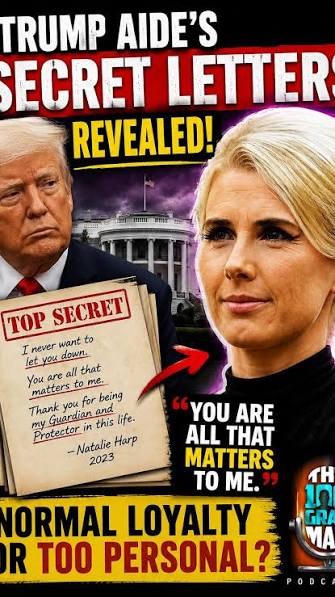
Natalie Harp was born in 1991 and raised in California. She graduated from Point Loma Nazarene University in 2012, and from Liberty University in 2015 with an MBA.
By 2017, Harp began suffering from chronic pain and complications incurred by a medical error involving intravenous therapy for stage II bone cancer.
In 2019, Harp praised then-President Trump for signing a federal right-to-try law which allowed her to access experimental treatments which she credited with saving her life.
Trump invited Harp to speak at the 2020 Republican National Convention She compared Trump to the sympathetic character, George Bailey, of It’s a Wonderful Life.
Trump also asked her to serve as a member of the advisory board for his 2020 Presidential campaign. Harp worked for the Right-wing television channel One America News Network from 2020 to 2022.
She later became an aide to Trump for his 2024 Presidential campaign as a key figure in his communications efforts.
In January 2025, Trump appointed Harp to the position of special assistant to the President and executive assistant to the President, with a government salary of $150,000.

Natalie Harp
She worked intimately with Trump and other national security figures for more than one year minus a security clearance. One national security official warned that this position gave her access to more sensitive information than any other Trump associate.
One White House staff member said that she “plays into the less productive and more troublesome parts of his nature, putting things in front of him that aren’t vetted.”
Dan Scavino, a political advisor and former golf club manager who had handled Trump’s social media accounts, largely gave control of Trump’s Truth Social account to Harp.
She used it to post a racist video depicting former President Barack Obama and First Lady Michelle Obama as apes. She also posted an AI-generated image of Trump as Jesus.
Among her duties: Posting remarks Trump dictates to Truth Social, texting on his behalf, and sporting a portable printer to feed him documents, praise and upbeat news articles. This last task has earned her the nickname: “The human printer.”
No doubt to Trump’s humiliation, Harp has also been dubbed as his “diaper nurse.” Some former associates and critics have claimed or joked that he uses adult diapers due to age or health. But there is no evidence that Harp serves in any nursing, medical or caregiving role.
Still, the rumors persist.

Donald Trump
And Trump appears flattered by her devotion. He calls her “sweetie” and “my Natalie.” And he’s told other aides that “Harp is the only one who loves him as much as his wife and children,” the New York Times reports.
Only recently has her role as Trump’s groupie-turned-government employee become widely known. And the man responsible is Georgia United States Senator Jon Ossoff.
At a campaign rally in Atlanta on August 16, Ossoff, a Democrat, said of Trump: “While the sailors on the [USS Abraham] Lincoln fight his war, while he fruitlessly drains our munitions and oil reserves, the president sleeps through his meetings.
“He golfs and trades stocks. See, he doesn’t want to do the job. He wants to build his ballroom and travel with Natalie on their apparently defenseless flying palace gifted by the Emir of Qatar.”
A clip of this remark was widely shared on social media.
Jon Ossoff
The week before the rally, Harp was among a small group of aides who joined Trump when he switched airplanes in Turkey to thwart a possible Iranian missile attack.
Those who were not allowed to board the decoy plane included:
- Secretary of State Marco Rubio;
- Treasury Secretary Scott Bessent;
- White House Deputy Chief of Staff for Policy Stephen Miller;
- White House Communications Director Steven Cheung.
Ossoff’s comment immediately brought Harp—and Trump—a burst of thoroughly unwelcome publicity.
Maggie Haberman, a New York Times reporter and the author of Regime Change, a scathing profile of the Trump administration, called her Trump’s “binky…a comfort blanket.”
Natalie’s estranged brother, Preston, laughed on CNN when he learned that his sister had jumped into the trunk of a Trump motorcade SUV when there wasn’t room for her to sit during a trip to court in 2023.
ABC NEWS, ALAMO, ALIEN-SMUGGLING RINGS, ALTERNET, ALVARO OBREGON, AMERICABLOG, AMNEXTY INTERNATIONAL, ANCHOR BABIES, ANTONIO LOPEZ DE SANTA ANNA, AP, ARIZONA, BABY BOOMER RESISTANCE, BARACK OBAMA, BARBARA LEE, BBC, BLOOMBERG, BLOOMBERG NEWS, BREXIT, BUREAU OF CUSTOMS AND BORDER PROTECTION, BUZZFEED, CALIFORNIA, CBS NEWS, CHICAGO, CNN, COLORADO, CORRUPTION, CROOKS AND LIARS, CUBA, DAILY KOS, DAVID CROCKETT, DEMOCRATIC PARTY, DEMOCRATS, DONALD TRUMP, DREAM ACT, DRUDGE REPORT, EMILIANO ZAPATA, ENGLISH LANGUAGE, ERIC ADAMS, EUROPEAN UNION (EU), FEDERATION FOR AMERICAN IMMIGRATION REFORM (FAIR), FELIPE CALDERON, FIVETHIRTYEIGHT, FLORIDA, FRANCISCO "PANCHO" VILLA, FRANCISCO MADERO, GOLIAD MASSACRE, GREG ABBOTT, HARPER’S MAGAZINE, HILLARY CLINTON, HISPANICS, HUFFINGTON POST, ILLEGAL ALIENS, illegal immigration, IMMIGRATIONS AND CUSTOMS ENFORCEMENT (ICE), JAMES BOWIE, JEFF SESSIONS, MEDI-CAL INSURANCE PROGRAM, MEDIA MATTERS, MEXICAN REVOLUTION, MEXICAN WAR, MEXICO, MEXICO CITY, MIGRANT CARRAVAN, MOSES AUSTIN, MOTHER JONES, MOVEON, MSNBC, NBC NEWS, NEVADA, NEW MEXICO, NEW REPUBLIC, NEW YORK CITY, NEWSDAY, NEWSWEEK, NEWT GINGRICH, NICARAGUA, NICCOLO MACHIAVELLI, NPR, PANCHO VILLA, PAUL RYAN, PBS NEWSHOUR, POLITICAL CORRECTNESS, POLITICO, POLITICUSUSA, RACIAL PROFILING, RAW STORY, REPUBLICAN PARTY, REPUBLICANS, REUTERS, ROBERT FROST, SALON, SAM HOUSTON, SAN JACINTO, SCHOOLS, SEATTLE TIMES, SLATE, SLAVERY, STEPHEN AUSTIN, TALKING POINTS MEMO, TEXAS, THE ATLANTIC, THE CHICAGO SUN-TIMES, THE CHICAGO TRIBUNE, THE DAILY BEAST, THE DAILY BLOG, THE DAILY MAIL, THE DISCOURSES, THE GUARDIAN, THE HILL, THE HUFFINGTON POST, THE INTERCEPT, THE LOS ANGELES TIMES, THE NATION, THE NEW REPUBLIC, THE NEW YORK TIMES, THE NEW YORKER, THE VILLAGE VOICE, THE WALL STREET JOURNAL, THE WASHINGTON POST, THINKPROGRESS, THOMAS HOMAN, TIJUANA, TIME, TRUTHDIG, TRUTHOUT, TWO POLITICAL JUNKIES, U.S. NEWS & WORLD REPORT, U.S. SUPREME COURT, UNITED KINGDOM (UK), UNITED STATES DEPARTMENT OF JUSTICE, UNITED STATES HEALTH AND HUMAN SERVICES DEPARTMENT, UPI, USA TODAY, UTAH, VENEZUELA, VENUSTIANO CARRANZA, WAL-MART, WASHINGTON D.C., WONKETTE
In Bureaucracy, Business, History, Law, Law Enforcement, Medical, Military, Politics, Social commentary on July 9, 2026 at 12:19 am
If Americans decide they truly want to control access to their own borders, there is a realistic way to accomplish this.
And it doesn’t involve building a wall along the Mexican border—which would prove ridiculously expensive and easily circumvented.

(1) The Justice Department should vigorously attack the “sanctuary movement” that officially thwarts the immigration laws of the United States.
Among the 31 “sanctuary cities” of this country: Washington, D.C.; New York City; Los Angeles; Chicago; San Francisco; Santa Ana; San Diego; Salt Lake City; Phoenix; Dallas; Houston; Austin; Detroit; Jersey City; Minneapolis; Miami; Denver; Baltimore; Seattle; Portland, Oregon; New Haven, Connecticut; and Portland, Maine.
These cities have adopted “sanctuary” ordinances that do not allow municipal funds or resources to be used to enforce federal immigration laws, usually by not allowing police or municipal employees to inquire about one’s immigration status.
(2) The most effective way to combat this movement: Indict the highest-ranking officials of those cities which have actively violated Federal immigration laws.
In San Francisco, for example, former District Attorney Kamala Harris—who was once Vice President of the United States—created a secret program called Back on Track, which provided training for jobs that illegal aliens could not legally hold.
She also prevented Immigration and Customs Enforcement (ICE) from deporting even those illegal aliens convicted of a felony.
(3) Indicting such officials would be comparable to the way that President Andres Jackson dealt with the threat South Carolinians once made to “nullify”—or ignore—any Federal laws they didn’t like.
Jackson quashed that threat by making one of his own: To lead an army into that State and purge all who dared defy the laws of the Federal Government.

(4) Even if some indicted officials escaped conviction, the results would prove worthwhile.
City officials would be forced to spend huge sums of their own money for attorneys and face months or even years of prosecution.
And this, in turn, would send a devastating warning to officials in other “sanctuary cities” that the same fate lies in store for them.
(5) CEOs whose companies—like Wal-Mart—systematically employ illegal aliens should be held directly accountable for the actions of their subordinates.
They should be indicted by the Justice Department under the Racketeer Influenced Corrupt Organizations (RICO) Act, the way Mafia bosses are prosecuted for ordering their own subordinates to commit crimes.
Upon conviction, the CEO should be sentenced to a mandatory prison term of at least twenty years.
This would prove a more effective remedy for combating illegal immigration than stationing tens of thousands of soldiers on the U.S./Mexican border. CEOs forced to account for their subordinates’ actions would take drastic steps to ensure that their companies strictly complied with Federal immigration laws.
Without employers luring illegal aliens at a fraction of the money paid to American workers, the flood of such illegal job-seekers would quickly dry up.
(6) The Government should stop granting automatic citizenship to “anchor babies” born to illegal aliens in the United States.
A comparable practice would be allowing bank robbers who had eluded the FBI to keep their illegally-obtained loot.
A person who violates the bank robbery laws of the United States is legally prosecutable for bank robbery, whether he’s immediately arrested or remains uncaught for years. The same should be true for those born illegally within this country.
If they’re not here legally at the time of birth, they should not be considered citizens and should—like their parents—be subject to deportation.
(7) The United States Government—from the President on down—should stop apologizing for the right to control the country’s national borders.
The Mexican Government doesn’t hesitate to apply strict laws to those immigrating to Mexico. And it feels no need to apologize for this.
Neither should we.
(8) Voting materials and ballots should be published in one language—English.
In Mexico, voting materials are published in one language—Spanish.
Throughout the United States, millions of Mexican illegals refuse to learn English and yet demand that voting materials and ballots be made available to them in Spanish.

(9) Those who are not legal citizens of the United States should not be allowed to vote in its elections.
In Mexico, those who are not Mexican citizens are not allowed to participate in the country’s elections.
The Mexican Government doesn’t consider itself racist for strictly enforcing its immigration laws.
The United States Government should not consider itself racist for insisting on the right to do the same.
(10) The United States should impose economic and even military sanctions against countries—such as China and Mexico—whose citizens make up the bulk of illegal aliens.
The Mexican government well remembers the 10-year Mexican Revolution (1910 – 1920) starring Francisco “Pancho” Villa, Emiliano Zapata and a host of other equally ruthless killers—and the one million dead men, women and children it produced.
So Mexico uses its American border to rid itself of those who might demand major reforms in the country’s political and economic institutions.
Such nations must learn that dumping their unwanteds on the United States now comes at an unaffordably high price. Otherwise those dumpings will continue.
ABC NEWS, ALAMO, ALIEN-SMUGGLING RINGS, ALTERNET, ALVARO OBREGON, AMERICABLOG, AMNEXTY INTERNATIONAL, ANCHOR BABIES, ANTONIO LOPEZ DE SANTA ANNA, AP, ARIZONA, BABY BOOMER RESISTANCE, BARACK OBAMA, BARBARA LEE, BBC, BLOOMBERG, BLOOMBERG NEWS, BREXIT, BUREAU OF CUSTOMS AND BORDER PROTECTION, BUZZFEED, CALIFORNIA, CBS NEWS, CHICAGO, CNN, COLORADO, CORRUPTION, CROOKS AND LIARS, CUBA, DAILY KOS, DAILY KOZ, DAVID CROCKETT, DEMOCRATIC PARTY, DEMOCRATS, DONALD TRUMP, DREAM ACT, DRUDGE REPORT, EMILIANO ZAPATA, ENGLISH LANGUAGE, ERIC ADAMS, EUROPEAN UNION (EU), FEDERATION FOR AMERICAN IMMIGRATION REFORM (FAIR), FELIPE CALDERON, FIVETHIRTYEIGHT, FLORIDA, FRANCISCO "PANCHO" VILLA, FRANCISCO MADERO, GOLIAD MASSACRE, GREG ABBOTT, HARPER’S MAGAZINE, HILLARY CLINTON, HISPANICS, HUFFINGTON POST, ILLEGAL ALIENS, illegal immigration, IMMIGRATIONS AND CUSTOMS ENFORCEMENT (ICE), JAMES BOWIE, JEFF SESSIONS, MEDI-CAL INSURANCE PROGRAM, MEDIA MATTERS, MEXICAN REVOLUTION, MEXICAN WAR, MEXICO, MEXICO CITY, MIGRANT CARRAVAN, MOSES AUSTIN, MOTHER JONES, MOVEON, MSNBC, NBC NEWS, NEVADA, NEW MEXICO, NEW REPUBLIC, NEW YORK CITY, NEWSDAY, NEWSWEEK, NEWT GINGRICH, NICARAGUA, NICCOLO MACHIAVELLI, NPR, PANCHO VILLA, PAUL RYAN, PBS NEWSHOUR, POLITICAL CORRECTNESS, POLITICO, POLITICUSUSA, RACIAL PROFILING, RAW STORY, REPUBLICAN PARTY, REPUBLICANS, REUTERS, ROBERT FROST, SALON, SAM HOUSTON, SAN JACINTO, SCHOOLS, SEATTLE TIMES, SLATE, SLAVERY, STEPHEN AUSTIN, TALKING POINTS MEMO, TEXAS, THE ATLANTIC, THE CHICAGO SUN-TIMES, THE CHICAGO TRIBUNE, THE DAILY BEAST, THE DAILY BLOG, THE DAILY MAIL, THE DISCOURSES, THE GUARDIAN, THE HILL, THE HUFFINGTON POST, THE INTERCEPT, THE LOS ANGELES TIMES, THE NATION, THE NEW REPUBLIC, THE NEW YORK TIMES, THE NEW YORKER, THE VILLAGE VOICE, THE WALL STREET JOURNAL, THE WASHINGTON POST, THINKPROGRESS, THOMAS HOMAN, TIJUANA, TIME, TRUTHDIG, TRUTHOUT, TWO POLITICAL JUNKIES, U.S. NEWS & WORLD REPORT, U.S. SUPREME COURT, UNITED KINGDOM (UK), UNITED STATES DEPARTMENT OF JUSTICE, UNITED STATES HEALTH AND HUMAN SERVICES DEPARTMENT, UPI, USA TODAY, UTAH, VENEZUELA, VENUSTIANO CARRANZA, WAL-MART, WASHINGTON D.C., WONKETTE
In Bureaucracy, Business, History, Law, Law Enforcement, Medical, Military, Politics, Social commentary on July 8, 2026 at 12:06 am
On May 8, 2018, United States Attorney General Jeff Sessions announced that a “zero-tolerance” policy toward people illegally entering the United States might separate families while parents are prosecuted.
“We don’t want to separate families, but we don’t want families to come to the border illegally and attempt to enter into this country improperly,” Sessions said. “The parents are subject to prosecution while children may not be. So, if we do our duty and prosecute those cases, then children inevitably for a period of time might be in different conditions.”
Children who were separated from their parents would be put under supervision of the U.S. Health and Human Services Department, Sessions said.
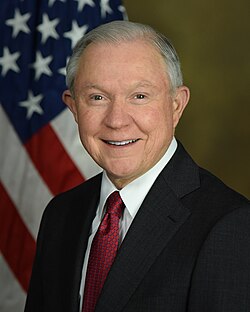
Jeff Sessions
Thomas Homan, U.S. Immigration and Customs Enforcement’s acting director, backed up Sessions’ “get tough” policy change: “Every law enforcement agency in this country separates parents from children when they’re arrested for a crime. There is no new policy. This has always been the policy.”
That policy soon went into effect. And it generated widespread outrage by
- Civil liberties organizations; and
- Those who believe the United States should not have—or enforce—its immigration laws.
“Criminalizing and stigmatizing parents who are only trying to keep their children from harm and give them a safe upbringing will cause untold damage to thousands of traumatized families who have already given up everything to flee terrible circumstances in their home countries,” said Erika Guevara-Rosas, Amnesty International’s Americas director.
In fact, alien-smugglers have increasingly used children as a wedge against American immigration laws. Their strategy: “Surely, Americans won’t arrest innocent children—or the adults who bring children with them.“
The Trump administration set out to prove them wrong.
This is typical behavior for law enforcement agencies: When criminals devise new ways to defeat existing police measures, the police devise new ways to counter those methods.
Meanwhile, those who believe the United States should throw open its doors to everyone who wants to enter are missing—or ignoring—a vital historical lesson.
Ironically, Mexico knows even better than the United States the perils of unchecked illegal immigration.
In 1821, Moses Austin sought a grant from Mexico to settle Texas. After he died in 1821, his son, Stephen, won recognition of the grant by Mexico.
The Mexican government had been unable to persuade large numbers of its own citizens to move to Texas, owing largely to raiding by such fierce Indian tribes as the Comanches.
The government saw the Anglo settlement of Texas as its best hope to tame an otherwise untamable frontier.

Stephen Austin
Austin convinced numerous American settlers to move to Texas, and by 1825 he had brought the first 300 American families into the territory.
Throughout the 1820s, Austin helped ensure the introduction of slavery into Texas, even though, under Mexican law, this was illegal. Tensions developed between unchecked numbers of Anglo settlers flooding into Texas and the Mexican authorities in charge there.
(“GTT”—“Gone to Texas”—was often carved on cabin doors by debt-ridden settlers who decided to seek their fortune in Texas. And some of the most notorious criminals on the frontier—such as slave-trader, land swindler and knife-fighter James Bowie—joined them.)
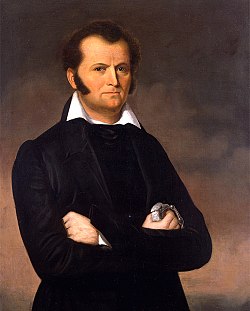
James Bowie
Eventually, the irresistible force of unlimited Anglo illegal immigration rebelled against the immovable object of Mexican legal/military authority.
The result:
- The battle of the Alamo: From February 23 to March 6, 1836, about 200 rebellious Texans withstood a 13-day siege in a former San Antonio mission, only to be slaughtered to the last man by an army of 2,000 Mexican soldiers commanded by President (actually, dictator) Antonio Lopez de Santa Anna. Among the victims: James Bowie and former Congressman David Crockett.
- The massacre at Goliad: On March 27, 1836, 425-445 Texans captured after the battle of Coleto were shot en masse by Mexican soldiers.
- The battle of San Jacinto: On April 21, 1836, Texans led by General Sam Houston won a surprise Texas victory over Mexican forces who were caught in a mid-afternoon siesta. Santa Anna—who had fled—was captured the next day.
Mexico was forced to give up all rights to Texas—which, nine years after winning its independence, became a state.
But ongoing conflicts between Mexico and the United States over Texas led to the Mexican war in 1846.
This, in turn, led to a series of devastating American victories over the Mexican army, and the capture of Mexico City itself.

Territory (in brown) that Mexico lost after the Mexican War
Mexico suffered the humiliation of both military defeat and the loss of its land holdings within the American Southwest—which, up to 1848, it had controlled.
This territory later became the states of California, New Mexico, Utah, Nevada, Arizona, Texas, and western Colorado.
And the United States finally spread “from sea to shining sea.”
So Mexico knows what it’s doing when it unloads millions of its own citizens—and those of other Latin and Central American countries—on the United States.
Mexico, in short, is a textbook case of what happens to a country that is unable to enforce its own immigration laws.
ABC NEWS, ALAMO, ALIEN-SMUGGLING RINGS, ALTERNET, ALVARO OBREGON, AMERICABLOG, AMNEXTY INTERNATIONAL, ANCHOR BABIES, ANTONIO LOPEZ DE SANTA ANNA, AP, ARIZONA, BABY BOOMER RESISTANCE, BARACK OBAMA, BARBARA LEE, BBC, BLOOMBERG, BLOOMBERG NEWS, BREXIT, BUREAU OF CUSTOMS AND BORDER PROTECTION, BUZZFEED, CALIFORNIA, CBS NEWS, CHICAGO, CNN, COLORADO, CORRUPTION, CROOKS AND LIARS, CUBA, DAILY KOS, DAVID CROCKETT, DEMOCRATIC PARTY, DEMOCRATS, DONALD TRUMP, DREAM ACT, DRUDGE REPORT, EMILIANO ZAPATA, ENGLISH LANGUAGE, ERIC ADAMS, EUROPEAN UNION (EU), FEDERATION FOR AMERICAN IMMIGRATION REFORM (FAIR), FELIPE CALDERON, FIVETHIRTYEIGHT, FLORIDA, FRANCISCO "PANCHO" VILLA, FRANCISCO MADERO, GOLIAD MASSACRE, GREG ABBOTT, HARPER’S MAGAZINE, HILLARY CLINTON, HISPANICS, HUFFINGTON POST, ILLEGAL ALIENS, illegal immigration, IMMIGRATIONS AND CUSTOMS ENFORCEMENT (ICE), JAMES BOWIE, JEFF SESSIONS, MEDI-CAL INSURANCE PROGRAM, MEDIA MATTERS, MEXICAN REVOLUTION, MEXICAN WAR, MEXICO, MEXICO CITY, MIGRANT CARRAVAN, MOSES AUSTIN, MOTHER JONES, MOVEON, MSNBC, NBC NEWS, NEVADA, NEW MEXICO, NEW REPUBLIC, NEW YORK CITY, NEWSDAY, NEWSWEEK, NEWT GINGRICH, NICARAGUA, NICCOLO MACHIAVELLI, NPR, PANCHO VILLA, PAUL RYAN, PBS NEWSHOUR, POLITICAL CORRECTNESS, POLITICO, POLITICUSUSA, RACIAL PROFILING, RAW STORY, REPUBLICAN PARTY, REPUBLICANS, REUTERS, ROBERT FROST, SALON, SAM HOUSTON, SAN JACINTO, SCHOOLS, SEATTLE TIMES, SLATE, SLAVERY, STEPHEN AUSTIN, TALKING POINTS MEMO, TEXAS, THE ATLANTIC, THE CHICAGO SUN-TIMES, THE CHICAGO TRIBUNE, THE DAILY BEAST, THE DAILY BLOG, THE DAILY MAIL, THE DISCOURSES, THE GUARDIAN, THE HILL, THE HUFFINGTON POST, THE INTERCEPT, THE LOS ANGELES TIMES, THE NATION, THE NEW REPUBLIC, THE NEW YORK TIMES, THE NEW YORKER, THE VILLAGE VOICE, THE WALL STREET JOURNAL, THE WASHINGTON POST, THINKPROGRESS, THOMAS HOMAN, TIJUANA, TIME, TRUTHDIG, TRUTHOUT, TWO POLITICAL JUNKIES, U.S. NEWS & WORLD REPORT, U.S. SUPREME COURT, UNITED KINGDOM (UK), UNITED STATES DEPARTMENT OF JUSTICE, UNITED STATES HEALTH AND HUMAN SERVICES DEPARTMENT, UPI, USA TODAY, UTAH, VENEZUELA, VENUSTIANO CARRANZA, WAL-MART, WASHINGTON D.C., WONKETTE, X
In Bureaucracy, Business, History, Law, Law Enforcement, Medical, Military, Politics, Social commentary on July 7, 2026 at 12:29 am
On January 31, 2020, the United Kingdom (UK) withdrew from the European Union (EU).
The United Kingdom—England, Scotland, Wales and Northern Ireland—had been a member state of the EU or its predecessor, the European Communities (EC), since January 1, 1973.
The vote had been a long time coming—and a major reason for it lay in the unrestricted immigration—legal and illegal—of Central and Eastern Europeans, who are allowed by EU regulations to freely live and work in any member state.
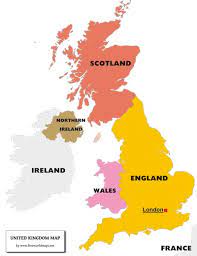
The United Kingdom
So the United Kingdom decided it would no longer be an EU member state.
Britons believed that migrants were clogging Britain’s health-care system and schools, while also depressing wages. By leaving the EU, Britons believed they could gain more control over their borders and drastically reduce immigration.
Immigration, the economy and health care had long been the top three issues on British voters’ minds.
The number of foreign-born people living in the UK went from 2.3 million in 1993 (when Britain joined the EU) to 8.2 million in 2014.
By 2020, the non-UK-born population was 9.5 million and the non-British population was 6.1 million. Most of these came from other EU countries: Cyprus, Malta, Croatia, Africa, the Middle East and Asia.
India, Pakistan and Bangladesh were the top three countries with the highest number of UK passport holders.
Critics of Brexit have blamed xenophobia for Britain’s leaving the EU. While that may have been true, it ignores a vital truth: People feel most comfortable around others like themselves.
In schools and prisons, it’s commonplace to see white sitting among whites, blacks sitting among blacks and Hispanics sitting among Hispanics.
In addition, people feel most comfortable among those who speak their own language. In the United States, there has been widespread resentment over having to “Push 1 for English” when calling government agencies.
Two factors are driving unprecedented levels of world migration:
- The world’s population at 8.1 billion, which puts unprecedented stress on available food, housing, medical care and other essential services; and
- The rapid escalation of climate change has brought drought/flooding to major parts of Africa, Asia and Latin and Central America.
Added to these must be an insight into human character offered by Niccolo Machiavelli, the sixteenth-century historian and political scientist, in his work, The Discourses:
Niccolo Machiavelli
It was a saying of ancient writers, that men afflict themselves in evil, and become weary of the good, and that both these dispositions produce the same effects.
For when men are no longer obliged to fight from necessity, they fight from ambition, which passion is so powerful in the hearts of men that it never leaves them, no matter to what height they may rise.
The reason for this is that nature has created men so that they desire everything, but are unable to attain it. Desire being thus always greater than the faculty of acquiring, discontent with what they have and dissatisfaction with themselves result from it.
This causes the changes in their fortunes—for as some men desire to have more, while others fear to lose what they have, enmities and war are the consequences. And this brings about the ruin of one province and the elevation of another.
In addition: Those who have spent their lives as law-abiding citizens resent it when immigrants—especially illegal aliens—gain advantage by breaking the law.
Such a case occurred on January 1, 2024.
That was when California became the first state to offer health insurance to all illegal aliens. All of these uninvited foreigners, regardless of age, now qualify for Medi-Cal, California’s version of the federal Medicaid program for people with low incomes.
Previously, illegal aliens could receive only emergency and pregnancy-related services under Medi-Cal as long as they met eligibility requirements, including income limits and California residency in 2014.
In 2015, then-Governor Jerry Brown allowed illegal alien children to receive coverage under Medi-Cal.
The final expansion starting January 1 will give full coverage to at least 700,000 illegal aliens who have no right to be in the country.
At the same time, about 3.2 million California citizens remained uninsured in 2022.
Meanwhile, California faces a record $68 billion budget deficit. Tax collections are off by $26 billion, combined with the economic slowdown California has been facing since 2022.
News stories announcing this taxpayers’ giveaway don’t refer to the recipients as “illegal aliens.” That’s because “illegal alien” is—for all its accuracy—Politically Incorrect.
Instead, those who defend the wanton violating of American immigration laws prefer the term “undocumented immigrant.”
As though these lawbreakers had valid citizenship documents but somehow lost them during their swim across the Rio Grande.
It’s entirely natural that those living in abject poverty—as millions do in Asia, Africa and Latin/Central America—want to escape it.
It’s also entirely natural that those who have escaped poverty want to hold on to all they have worked hard to attain.
The refusal of liberal politicians—in England, Italy, France, Germany and the United States—to accept these truths has led to the rise of authoritarian, Right-wing movements in those countries.
By refusing to address rising anger over such invasions, liberal politicians throughout the world are endangering the very democracies they cherish.
ABC NEWS, ALAMO, ALIEN-SMUGGLING RINGS, ALTERNET, ALVARO OBREGON, AMERICABLOG, AMNEXTY INTERNATIONAL, ANCHOR BABIES, ANTONIO LOPEZ DE SANTA ANNA, AP, ARIZONA, BABY BOOMER RESISTANCE, BARACK OBAMA, BARBARA LEE, BBC, BLOOMBERG, BLOOMBERG NEWS, BREXIT, BUREAU OF CUSTOMS AND BORDER PROTECTION, BUZZFEED, CALIFORNIA, CBS NEWS, CHICAGO, CNN, COLORADO, CORRUPTION, CROOKS AND LIARS, CUBA, DAILY KOS, DAVID CROCKETT, DEMOCRATIC PARTY, DEMOCRATS, DONALD TRUMP, DREAM ACT, DRUDGE REPORT, EMILIANO ZAPATA, ENGLISH LANGUAGE, ERIC ADAMS, EUROPEAN UNION (EU), FEDERATION FOR AMERICAN IMMIGRATION REFORM (FAIR), FELIPE CALDERON, FIVETHIRTYEIGHT, FLORIDA, FRANCISCO "PANCHO" VILLA, FRANCISCO MADERO, GOLIAD MASSACRE, GREG ABBOTT, HARPER’S MAGAZINE, HILLARY CLINTON, HISPANICS, HUFFINGTON POST, ILLEGAL ALIENS, illegal immigration, IMMIGRATIONS AND CUSTOMS ENFORCEMENT (ICE), JAMES BOWIE, JEFF SESSIONS, MEDI-CAL INSURANCE PROGRAM, MEDIA MATTERS, MEXICAN REVOLUTION, MEXICAN WAR, MEXICO, MEXICO CITY, MIGRANT CARRAVAN, MOSES AUSTIN, MOTHER JONES, MOVEON, MSNBC, NBC NEWS, NEVADA, NEW MEXICO, NEW REPUBLIC, NEW YORK CITY, NEWSDAY, NEWSWEEK, NEWT GINGRICH, NICARAGUA, NICCOLO MACHIAVELLI, NPR, PANCHO VILLA, PAUL RYAN, PBS NEWSHOUR, POLITICAL CORRECTNESS, POLITICO, POLITICUSUSA, RACIAL PROFILING, RAW STORY, REPUBLICAN PARTY, REPUBLICANS, REUTERS, ROBERT FROST, SALON, SAM HOUSTON, SAN JACINTO, SCHOOLS, SEATTLE TIMES, SLATE, SLAVERY, STEPHEN AUSTIN, TALKING POINTS MEMO, TEXAS, THE ATLANTIC, THE CHICAGO SUN-TIMES, THE CHICAGO TRIBUNE, THE DAILY BEAST, THE DAILY BLOG, THE DAILY MAIL, THE DISCOURSES, THE GUARDIAN, THE HILL, THE HUFFINGTON POST, THE INTERCEPT, THE LOS ANGELES TIMES, THE NATION, THE NEW REPUBLIC, THE NEW YORK TIMES, THE NEW YORKER, THE VILLAGE VOICE, THE WALL STREET JOURNAL, THE WASHINGTON POST, THINKPROGRESS, THOMAS HOMAN, TIJUANA, TIME, TRUTHDIG, TRUTHOUT, TWO POLITICAL JUNKIES, U.S. NEWS & WORLD REPORT, U.S. SUPREME COURT, UNITED KINGDOM (UK), UNITED STATES DEPARTMENT OF JUSTICE, UNITED STATES HEALTH AND HUMAN SERVICES DEPARTMENT, UPI, USA TODAY, UTAH, VENEZUELA, VENUSTIANO CARRANZA, WAL-MART, WASHINGTON D.C., WONKETTE
In Bureaucracy, Business, History, Law, Law Enforcement, Medical, Military, Politics, Social commentary on July 6, 2026 at 12:10 am
In May 20, 2010, Mexico’s then-President Felipe Calderon addressed a joint session of the United States Congress—and attacked a recently-enacted Arizona law that allowed law enforcement officials to detain anyone suspected of being in the country illegally.
According to Calderon, the law “introduces a terrible idea: Using racial profiling as a basis for law enforcement.
“I have said that Mexico does not stop at its border, that wherever there is a Mexican, there is Mexico.”
The hypocrisy of Calderon’s words was staggering. He was condemning the United States for doing what Mexico itself has long done: Strictly enforcing control of its own borders.

Felipe Calderon
World Economic ForumCopyright by World Economic Forum / Photo by Remy Steinegger
Mexico’s immigration laws state: Any foreigner that enters the country to stay less than six months is considered a visitor. To meet immigration requirements, you must:
- Have enough money to pay for your stay in the country;
- Have an invitation from a private or public interest organization.
If you want to stay more than 180 days, you must obtain a temporary residency visa in Mexico. This requires you to:
- Have a family relationship with a Mexican citizen.
- Have a job offer issued by a Mexican employer.
- Have an invitation from a private or public institution.
- Have enough money to pay for your stay in the country.
- Own real estate in Mexico.
- Have investments in Mexico.
After being a temporary resident for four years, you can apply for permanent residency. To obtain this, you must meet these requirements:
- Be a refugee or under the condition of political asylum.
- Have a family relationship with a Mexican citizen.
- To have been a temporary resident for four years.
- Be a pensioner with enough monthly income to pay for your stay in the country.
- Be related in a straight line up to the second degree to a Mexican by birth.
- To have been a temporary resident for two years in the case of a conjugal or concubine relationship with a Mexican citizen or permanent resident.
Eight years after Calderon demanded that Americans repeal their immigration laws, Mexicans suddenly discovered they hated illegal aliens, too.
On October 13, 2018, a caravan of at least 5,000 men, women and children from El Salvador, Guatemala and Honduras set out for the United States.
On October 18, President Donald Trump closed the U.S.-Mexico border to keep the caravan from entering the country.
By November 19, migrants had begun piling up in Tijuana, which borders San Diego.
Suddenly, Tijuana residents began carrying signs reading “No illegals,” “No to the invasion” and “Mexico First.” And marching in the streets wearing Mexico’s red, white and green national soccer jersey and vigorously waving Mexican flags.
“We want the caravan to go; they are invading us,” said Patricia Reyes, a 62-year-old protester. “They should have come into Mexico correctly, legally, but they came in like animals.”
The El Paso Times noted the resentment of many Mexicans toward the increasing numbers of Cuban illegal aliens in Juarez, which lies across from El Paso.
“They don’t get along with Mexican people,” said a burrito seller. “They get in a little group by themselves. A lot of people don’t like them here.”
And a business consultant complained, “There are people who are coming looking for a handout, who want us to help them, when they could also look for work.”
Over the weekend of October 12-13, 2019, a National Guard commander addressed his platoon before confronting the latest caravan: “No one will come to trample our country, our land!”
In the past, Mexicans comprised the largest group of illegal aliens entering the United States. But the Mexican economy has grown and developed to the point where fewer people see the need to emigrate.
Most illegals are now mostly from Guatemala, Honduras, and El Salvador. And there are growing numbers from Haiti, Cuba, various African countries, and even the Middle East.
During the first eight months of 2019, the number of asylum applications submitted to Mexico’s refugee agency (COMAR) more than tripled, compared to the same period in 2018. As a result, the refugee agency removed the how-to-apply video it once hosted on its website.
In the past, the Mexican Government refused to halt illegal immigration to the United States.
It remembered the bloody upheaval known as the Mexican Revolution. This lasted 10 years (1910-1920) and wiped out an estimated one to two million men, women and children.
Massacres were common on all sides, with men shot by the hundreds in bullrings or hung by the dozen on trees.
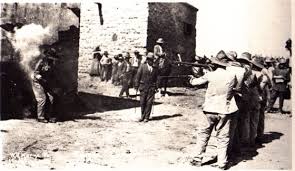
A Mexican Revolution firing squad
All of the major leaders of the Revolution—Francisco Madero, Emiliano Zapata, Venustiano Carranza, Francisco “Pancho” Villa, Alvaro Obregon—died in a hail of bullets.

Francisco “Pancho” Villa
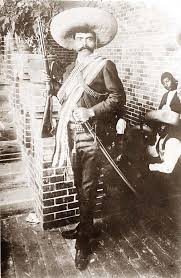
Emiliano Zapata
As a result, every successive Mexican Government lived in the shadow of another such wholesale bloodletting. These officials quietly decided to turn the United States border into a safety valve.
* * * * *
No other nation has ever allowed itself to become a dumping ground for the world’s unwanteds. And no law—religious or secular—obligates the United States to do so.
Space is limited in schools, hospitals and housing, and the more people who cram into limited spaces, the more frictions they inevitably create.
As native-born Mexicans are angrily finding out.


2025 FEDERAL GOVERNMENT SHUTDOWN, ABC NEWS, AFFORDABLE CARE ACT, ALTERNET, AMERICABLOG, AP, BABY BOOMER RESISTANCE, BLOOMBERG, BUZZFEED, CAMILLUS, CBS NEWS, CHRISTOPHER SWANSON, CNN, CROOKS AND LIARS, DAILY KOS, DEREK CHAUVIN, DONALD TRUMP, FIVETHIRTYEIGHT, FLINT TOWNSHIP, GEORGE FLOYD, HARPER’S MAGAZINE, LOS ANGELES, MARCUS FURIUS, MEDIA MATTERS, MEDICARE, MOTHER JONES, MOVEON, MSNBC, NBC NEWS, NEW YORK CITY, NEWSWEEK, NICCOLO MACHIAVELLI, NPR, ONE BIG BEAUTIFUL BILL, PBS NEWSHOUR, POLITICO, POLITICUSUSA, RAW STORY, REPUBLICANS, REUTERS, SALON, SAN FRANCISCO, SEATTLE TIMES, SLATE, ST. JOHN’S CHURCH, TALKING POINTS MEMO, THE ATLANTIC, THE CHICAGO SUN-TIMES, THE CHICAGO TRIBUNE, THE DAILY BEAST, THE DAILY BLOG, THE DISCOURSES, THE GUARDIAN, THE HILL, THE HUFFINGTON POST, THE LOS ANGELES TIMES, THE NATION, THE NEW REPUBLIC, THE NEW YORK TIMES, THE VILLAGE VOICE, THE WASHINGTON POST, THINKPROGRESS, TIME, TRUTHDIG, TRUTHOUT, TWO POLITICAL JUNKIES, U.S. NEWS & WORLD REPORT, UPI, USA TODAY, WONKETTE, X
HUMANITY CAN PREVAIL WHEN WAR CRIMES HAVE FAILED
In Bureaucracy, History, Law Enforcement, Politics, Social commentary on September 25, 2026 at 12:05 amThroughout his first term as President, “Do what I want—or I’ll destroy you!” proved Donald Trump’s go-to method of “negotiation.” And it has remained so since re-taking office on January 20, 2025.
On February 28, Trump—in concert with Israel—launched a series of devastating, unprovoked airstrikes against Iran.
Asked by a reporter how long the war would last, Trump arrogantly replied: “Any time I want it to end, it will end.”
But then Iran closed the Strait of Hormuz, through which 20% to 30% of the world’s total daily oil supply passes.
Gas prices in the United States immediately rose. Analysts warned that if the disruption continued, gasoline prices could exceed $5 per gallon.
Fearing this posed a direct threat to Repbublicans’ holding control of Congress in the upcoming midterm elections, on Easter Sunday Trump posted on his website, Truth Social:
“Tuesday [April 7] will be Power Plant Day, and Bridge Day, all wrapped in one, in Iran. There will be nothing like it!!! Open the Fuckin’ Strait, you crazy bastards, of you’ll be living in Hell – JUST WATCH! Praise be to Allah.”
Legal experts and international organizations such as Amnesty International warned that attacking civilian infrastructure would constitute war crimes under international law.
In less than 24 hours, American pilots would be forced to decide: “Do we want to become war criminals?”
But there are humane ways to wield power, and these usually leave feelings of lasting gratitude—if not reverence—for those who do.
Two examples follow.
Lesson #!: In Book Three, Chapter 22 of his classic masterwork, The Discourses, Niccolo Machiavelli offers the following: “An Act of Humanity Prevailed More With the Falacians Than All the Power of Rome.”
Marcus Furius Camillus, a Roman general, was besieging the city of the Faliscians, and had surrounded it. A teacher charged with educating the children of some of the city’s noblest families decided to ingratiate himself with Camillus by leading them into the Roman camp.
As Roman hostages, they could be used to compel the city to surrender.
Camillus not only declined the offer but went one step further. He ordered the teacher stripped and his hands tied behind his back. Then Camillus had a rod put into the hands of each of the children and directed them to whip the teacher all the way back to the city.
Upon learning this, the citizens of Faliscia were so much touched by the humanity and integrity of Camillus, that they surrendered the place to him without any further defense.
Summing up the meaning of this, Machiavelli writes: “This example shows that an act of humanity and benevolence will at all times have more influence over the minds of men than violence and ferocity. It also proves that provinces and cities which no armies…could conquer, have yielded to an act of humanity, benevolence, chastity or generosity.
“…History also shows us how much the people desire to find such virtues in great men, and how much they are extolled by historians and biographers of princes….Amongst these, Xenophon takes great pains to show how many victories, how much honor and fame, Cyrus gained by his humanity and affability, and by his not having exhibited a single instance of pride, cruelty or luxuriousness, nor of any of the other vices that are apt to stain the lives of men.”
Niccolo Machiavelli
This lesson—recorded by a master political scientist and practitioner of Realpolitik—remains highly relevant today.
Lesson #2: On May 25, 2020, George Floyd, a black unemployed restaurant security guard, was murdered by Derek Chauvin, a white Minneapolis police officer. While Floyd was handcuffed and lying face down on a city street during an arrest, Chauvin kept his knee on the right side of Floyd’s neck for eight minutes and 46 seconds.
Cities across the United States erupted in mass protests over Floyd’s death—and police killings of black victims generally. Most of these demonstrations proved peaceful.
But cities such as Los Angeles, San Francisco and New York City saw stores looted, vandalized and/or burned.
In response, President Donald Trump called for harsh policing, telling governors in a nationwide conference call that they must “dominate” protesters or be seen as “weak.”
To drive home his point, Trump ordered police and National Guard troops to violently remove peaceful protesters from Lafayette Square, which borders St. John’s Church near the White House.
The purpose of the removal: To allow Trump to have a photo opportunity outside the church.
Contrast that with the example of Sheriff Christopher Swanson of Genesee County, Michigan.
Sheriff Christopher Swanson
Confronting a mass of aroused demonstrators in Flint Township on May 30, Swanson responded: “We want to be with you all for real.”
So Swanson took his helmet off. His deputies laid their batons down.
“I want to make this a parade, not a protest. So, you tell us what you need to do.”
“Walk with us!” the protesters shouted.
“Let’s walk, let’s walk,” said Swanson.
Cheering and applause resounded.
“Let’s go, let’s go,” Swanson said as he and the cheering crowd proceeded. “Where do you want to walk? We’ll walk all night.”
And Swanson and his fellow officers walked in sympathy with the protesters.
No rioting followed.
Share this: