On December 18, 2025, The John F. Kennedy Memorial Center for the Performing Arts became The Donald Trump and John F. Kennedy Memorial Center for the Performing Arts.
And all that it took for this to happen was for Trump’s handpicked board overseeing the John F. Kennedy Center to declare: “We’re adding Trump’s name to this building.”
Specifically, White House Press Secretary Karoline Leavitt announced on X: “I have just been informed that the highly respected Board of the Kennedy Center, some of the most successful people from all parts of the world, have just voted unanimously to rename the Kennedy Center to the Trump-Kennedy Center, because of the unbelievable work President Trump has done over the last year in saving the building.”
Donald Trump
This totally ignored three vital truths:
First, in 1955, President Dwight D. Eisenhower established a commission for a new public auditorium to showcase the performing arts in the nation’s capital. It was to be called The National Cultural Center.
Second, in January, 1964, two months after the assassination of President John F. Kennedy, Congress passed and President Lyndon B. Johnson signed into law legislation renaming the Center as a “living memorial” in his honor: The John F. Kennedy Memorial Center for the Performing Arts.
Third, adding Trump’s name to the Center legally would require a similar act of Congress—which has not occurred.
Thus, putting Trump’s name on the building without a Congressional act carries all the legitimacy of a graffiti vandal spray-painting his name on the Center.
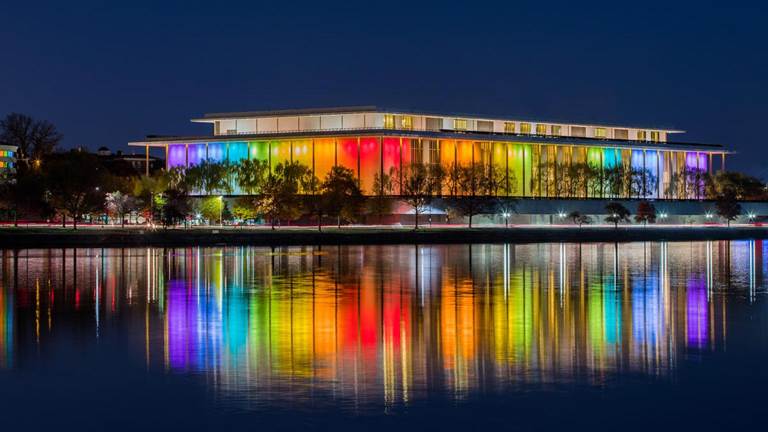
Trump spent most of 2025 putting his stamp on the Center. First he purged most of the board that governs the institution. Then he replaced its members with pliable ideologues and sycophants, capped by installing itself as the new chairman.
On December 18, his underlings blatantly renamed the center itself.
Given Trump’s well-known admiration for dictators such as Vladimir Putin, Xi Jinping and Kim Jong-Un, it was inevitable that he would seek to remake the arts in his own image.
In doing so, he’s following in the footsteps of propaganda-obsessed tyrants like Joseph Stalin and Adolf Hitler
Consider this blurb from the 2015 nonfiction book, Fear and the Muse Kept Watch: The Russian Masters from Akhmatova and Pasternak to Shostakovich and Eisenstein Under Stalin, by Andy McSmith:
“For those artists visible enough for Stalin to take an interest in them, it was Stalin himself who decided whether they lived in luxury or were sent to the Lubyanka, the headquarters of the secret police, to be tortured and sometimes even executed.
“McSmith brings together the stories of these artists―including [writer] Isaac Babel, [poet and novelist] Boris Pasternak, [composer] Dmitri Shostakovich, and many others―revealing how they pursued their art under Stalin’s regime and often at great personal risk.
“It was a world in which the poet Vladimir Mayakovsky, whose bright yellow tunic was considered a threat to public order under the tsars, struggled to make the communist authorities see the value of avant garde art; Babel publicly thanked the regime for allowing him the privilege of not writing; and Shostakovich’s career veered wildly between public disgrace and wealth and acclaim.”
Adolf Hitler similarly installed himself as the arbiter of culture in Nazi Germany.
In Hitler and the Power of Aesthetics, Frederic Spotts argues that Hitler saw the world corrupted by “evils” he must first destroy so he could re-create it to conform to his artistic ideals.
Hitler considered himself an unappreciated artist. At 18, he had applied for admission to the Academy of Fine Arts Vienna, but was rejected twice. If he had a friend, it was the architect Albert Speer, with whom he felt an artistic kinship.
Even as the Third Reich collapsed, he found time to pore over architectural models he intended to turn into gigantic buildings.
In Hitler’s Germany, culture was not only the end to power but the means of achieving it. His artistry—expressed in spectacles, festivities, parades, rallies and political dramas, as well as in architecture, painting and music—destroyed any sense of individuality and linked the German people with his own drives.
Like Hitler, Trump sees himself as an unrecognized artist. Of the 515 entities he owns, 268 of them—52%—bear his last name. He often refers to his properties as “the swankiest,” “the most beautiful.”
Upon his return to the Presidency in 2025, he turned his “artistic” gifts on the White House. On June 9, contractors began paving over the grass of the White House Rose Garden with stone tiles to create a patio.
Again like Hitler, Trump believes that “bigger is better” in architecture.
On July 31, 2025, the Trump administration announced that a 90,000 square feet addition would be made to the White House to incorporate a 650-person capacity ballroom. In October, Trump ordered the demolition of the White House’s historic East Wing to clear space for it.
The estimated cost has ballooned from $200 million to $400 million.
Trump has repeatedly pushed to enlarge the ballroom—from a 90,000-square-feet addition capable of seating 650 guests to one that can seat, first, 999 guests and then to 1,000 guests at formal dinners.
Tyrants always hail such projects as “gifts for the nation.” In reality, they are self-glorifying monuments to the dictator’s own ego.

 Bureaucracybuster's Blog
ABC NEWS, ALAMO, ALTERNET, AMERICABLOG, ANDREW JACKSON, AP, BABY BOOMER RESISTANCE, BUZZFEED, CAMERON JUDD, CBS NEWS, CNN, CROCKETT OF TENNESSEE, CROOKS AND LIARS, DAILY KOS, DAVID CROCKETT, DAVY CROCKETT: KING OF THE WILD FRONTIER, DONALD TRUMP, FIVETHIRTYEIGHT, INDIAN WARS, JAMES BOWIE, MITT ROMNEY, MOTHER JONES, MOVEON, MSNBC, NBC NEWS, NBCNEWS, NEWSWEEK, NPR, PBS NEWSHOUR, POLITICO, POLITICUSUSA, RAW STORY, REUTERS, SALON, SEATTLE TIMES, SLATE, TALKING POINTS MEMO, TEXAS REVOLUTION, THE ATLANTIC, THE CHICAGO SUN-TIMES, THE CHICAGO TRIBUNE, THE DAILY BEAST, THE DAILY BLOG, THE GUARDIAN, THE HILL, THE HUFFINGTON POST, THE LOS ANGELES TIMES, THE NATION, THE NEW YORK TIMES, THE WASHINGTON POST, THINKPROGRESS, TIME, TRUTHDIG, U.S. NEWS & WORLD REPORT, UPI, USA TODAY, WALT DISNEY, WILLIAM BARRETT TRAVIS, X
HEROISM VS. THUGISM
In Bureaucracy, Business, History, Military, Politics, Social commentary on January 16, 2026 at 12:10 amMarch 6, 2026, will mark the 190th anniversary of the fall of the Alamo, a crumbling former Spanish mission in the heart of San Antonio, Texas.
It’s been the subject of novels, movies, biographies, histories and TV dramas (most famously Walt Disney’s 1955 “Davy Crockett: King of the Wild Frontier” series).
Perhaps the most extraordinary scene of any Alamo movie or book occurs in the 1993 novel, Crockett of Tennessee, by Cameron Judd.
And it is no less affecting for its being—so far as we know—entirely fictional.
The Alamo
It’s March 5, 1836—the last night of life for the Alamo garrison. The next morning, 2,000 men of the Mexican Army will hurl themselves at the former mission and slaughter its 200 “Texian” defenders.
The fort’s commander, William Barrett Travis, has drawn his “line in the sand” and invited the garrison to choose: To surrender, to try to escape, or to stay and fight to the death.
And the garrison—except for one man—chooses to stay and fight.
An hour after deciding to stand and die in the Alamo, wrapped in the gloom of night, David Crockett is seized with paralyzing fear.
“We’re going to die here,” he chokes out to his longtime friend, Persius Tarr. “You understand that, Persius? We’re going to die!”
“I know, Davy. But there ain’t no news in that,” says Tarr. “We’re born to die. Every one of us. Only difference between us and most everybody else is we know when and where it’s going to be.”
“But I can’t be afraid—not me. I’m Crockett. I’m Canebrake Davy. I’m half-horse, half-alligator.”
“I know you are, Davy,” says Tarr. “So do all these men here. That’s why you’re going to get past this.
“You’re going to put that fear behind you and walk back out there and fight like the man you are. The fear’s come and now it’s gone. This is our time, Davy.”
And then Tarr delivers a sentiment wholly alien to money-obsessed men like Donald Trump—who comprise the richest and most privileged 1% of today’s Americans.
“There’s men out there with their eyes on you. You’re the only thing keeping the fear away from them. You’re joking and grinning and fiddling—it gives them courage they wouldn’t have had without you.
“Maybe that’s why you’re here, Davy—to make the little men and the scared men into big and brave men. You’ve always cared about the little men, Davy. Remember who you are.
“You’re Crockett of Tennessee, and your glory-time has come. Don’t you miss a bit of it.”
The next morning, the Mexicans assault the Alamo. Crockett embraces his glory-time—and becomes a legend for all-time.
David Crockett (center) at the fall of the Alamo
David Crockett (1786-1836) lived—and died—a poor man. But this did not prevent him from trying to better the lives of his family and fellow citizens—and even his former enemies.
During the war of 1812, he served as a scout under Andrew Jackson. His foes were the Creek Indians, who had massacred 500 settlers at Fort Mims, Alabama—and threatened to do the same to Crockett’s family and neighbors in Tennessee.
But as a Congressman from Tennessee, he opposed then-President Jackson’s efforts to force the same defeated Indians to depart the lands guaranteed them by treaty.
To Crockett, a promise was sacred—whether given by a single man or the United States Government.
David Crockett
And his presence during the 13-day siege of the Alamo did cheer the spirits of the vastly outnumbered defenders.
Crockett, with his fiddle—and a Scotsman named MacGregor, with his bagpipes—often staged musical “duels” to see who could make the most noise.
Contrast this devotion of Crockett to the rights of “the little men,” with the boasts of Donald Trump, the billionaire President of the United States:
Donald Trump
Unlike Crockett, who defended the weak, Trump boasted of his power:
Those who give their lives for others are rightly loved and remembered as heroes. Those who dedicate their lives solely to their wallets and egos are rightly despised and then forgotten.
Share this: