Posts Tagged ‘THE PRINCE’
A BRONX TALE, ABC NEWS, AFFORDABLE CARE ACT, AIR TRAFFIC CONTROLLERS STRIKE, ALTERNET, AMERICABLOG, ANWAR AL-AWLAKI, AP, BABY BOOMER RESISTANCE, BARACK OBAMA, BBC, BILL CLINTON, BLOOMBERG NEWS, BOB WOODWARD, BUZZFEED, CBS NEWS, CHAZZ PALMINTERI, CNN, COLUMBIA UNIVERSITY, CROOKS AND LIARS, DAILY KOZ, DAVID BARRON, DEAN ACHESON, DONALD TRUMP, FACEBOOK, FBI, FIVETHIRTYEIGHT, HARPER’S MAGAZINE, HARVARD LAW SCHOOL, HUFFINGTON POST, IRS, J. EDGAR HOOVER, JAMES HOFFA, JEFF SESSIONS, JOE BIDEN, JOHN F. KENNEDY, JOHN KELLY, LYNDON B. JOHNSON, MAFIA, MEDIA MATTERS, MOAMMAR KADAFFI, MONICA LEWINSKY, MOTHER JONES, MOVEON, MSNBC, NBC NEWS, NEW REPUBLIC, NEWSDAY, NEWSWEEK, NICCOLO MACHIAVELLI, NPR, PBS NEWSHOUR, POLITICO, POLITICUSUSA, RAND PAUL, RAW STORY, REINCE PREBIUS, REPUBLICAN PARTY, REUTERS, ROBERT F. KENNEDY, Ronald Reagan, SALON, SCREEN ACTORS GUILD, SEATTLE TIMES, SLATE, TALKING POINTS MEMO, THE ATLANTIC, THE CHICAGO SUN-TIMES, THE CHICAGO TRIBUNE, THE DAILY BEAST, THE DAILY BLOG, THE GUARDIAN, THE HILL, THE HUFFINGTON POST, THE LOS ANGELES TIMES, THE NATION, THE NEW REPUBLIC, THE NEW YORK TIMES, THE NEW YORKER, THE PRINCE, THE VILLAGE VOICE, THE WASHINGTON POST, THINKPROGRESS, TIME, TIMOTHY MCVEIGH, TRUTHDIG, TRUTHOUT, TWO POLITICAL JUNKIES, U.S. NEWS & WORLD REPORT, UPI, USA TODAY, WONKETTE, X
In Bureaucracy, History, Law Enforcement, Politics, Social commentary on May 1, 2025 at 12:14 am
Is it better to be loved or feared?
That was the question Florentine statesman Niccolo Machiavelli raised more than 500 years ago.
Presidents have struggled to answer this question—and have come to different conclusions.
LOVE ME, FEAR MY BROTHER
Most people felt irresistibly drawn to John F. Kennedy (1961-63). Even his political foe, Henry Luce, the conservative publisher of Time, once said, “He makes me feel like a whore.”
But JFK could afford to bask in the love of others—because his younger brother, Robert, was the one who inspired fear.
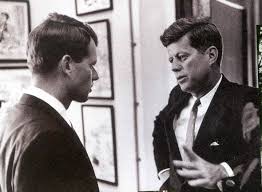
Robert F. Kennedy and John F. Kennedy
He had done so as Chief Counsel for the Senate Rackets Committee (1957-59), grilling Mafia bosses and corrupt union officials—most notably Teamsters President James Hoffa.
JFK appointed him Attorney General and he unleashed the FBI and the IRS on the Mafia. When the steel companies colluded in an inflationary rise in the price of steel in 1962, Bobby sicced the FBI on them.
In 1963, JFK’s cavorting with Ellen Rometsh threatened to destroy his Presidency. Rometsch, a Washington, D.C. call girl, was suspected by the FBI of being an East German spy.
With Republican Senators preparing to investigate the rumors, Bobby ordered Rometsch—a German citizen—deported immediately.
BEING LOVED AND FEARED
In the 1993 movie, A Bronx Tale, 17-year-old Calogero (Lillo Brancato) asks his idol, the local Mafia capo, Sonny (Chazz Palminteri): “Is it better to be loved or feared?”
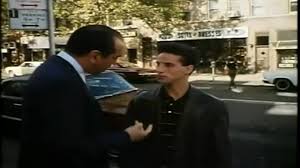
Sonny gives advice to his adopted son, Calogero
Sonny says if he had to choose, he would rather be feared. But he adds a warning straight out of Machiavelli: “The trick is not being hated. That’s why I treat my men good, but not too good.
“I give too much, then they don’t need me. I give them just enough where they need me, but they don’t hate me.”
Machiavelli, writing in The Prince, went further:
“Still a Prince should make himself feared in such a way that if he does not gain love, he at any rate avoids hatred, for fear and the absence of hatred may well go together.”
Many who quote Machiavelli in defense of being feared overlook this vital point: It’s essential to avoid becoming hated.
To establish a fearful reputation, a leader must act decisively and ruthlessly when the interests of the organization are threatened. Punitive action must be taken promptly and confidently.
One or two such actions can inspire more fear than a reign of terror.
In fact, it’s actually dangerous to constantly employ cruelties or punishments. Whoever does so, warns Machiavelli, “is always obliged to stand with knife in hand, and can never depend on his subjects, because they, owing to continually fresh injuries, are unable to depend upon him.”
The 20th century President who came closest to realizing Machiavelli’s “loved and feared” prince in himself was Ronald Reagan (1981-1989).
Always smiling, quick with a one-liner (especially at press conferences), seemingly unflappable, he projected a constantly optimistic view of his country and its citizens.
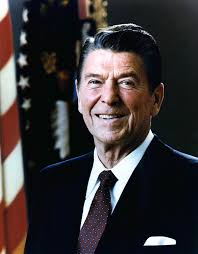
Ronald Reagan
In his acceptance speech at the 1980 Republican National Convention he declared: “[The Democrats] say that the United States…has passed its zenith. My fellow citizens, I utterly reject that view.”
But there was a steely, ruthless side to Reagan that appeared when he felt crossed.
On August 3, 1981, nearly 13,000 air traffic controllers walked out after contract talks with the Federal Aviation Administration collapsed. As a result, some 7,000 flights across the country were canceled on that day at the peak of the summer travel season.
Reagan branded the strike illegal. He threatened to fire any controller who failed to return to work within 48 hours.
On August 5, Reagan fired more than 11,000 air traffic controllers who hadn’t returned to work. The mass firing slowed commercial air travel, but it did not cripple the system as the strikers had forecast.
Reagan’s action stunned the American labor movement. Reagan was the only American President to have belonged to a union, the Screen Actors Guild. He had even been president of this—from 1947 to 1954.
There were no more strikes by Federal workers during Reagan’s tenure in office.
Similarly, Libya’s dictator, Moammar Kadaffi, learned that Reagan was not a man to cross.
On April 5, 1986, Libyan agents bombed a nightclub in West Berlin, killing three people, one a U.S. serviceman. The United States quickly learned that Libyan agents in East Germany were behind the attack.
On April 15, acting on Reagan’s orders, U.S. Air Force, Navy and Marine Corps bombers struck at several sites in Tripoli and Benghazi. Reportedly, Kaddafi himself narrowly missed becoming a casualty.
There were no more acts of Libyan terrorism against Americans for the rest of Reagan’s term.
PERCEIVED WEAKNESS INVITES CONTEMPT
American Presidents—like politicians everywhere–strive to be loved. There are two primary reasons for this.
First, even the vilest dictators want to believe they are good people—and that their goodness is rewarded by the love of their subjects.
Second, it’s universally recognized that a leader who’s beloved has greater clout than one who isn’t.
But those—like Barack Obama—who strive to avoid conflict often get treated with contempt and hostility by their adversaries.
A BRONX TALE, ABC NEWS, AFFORDABLE CARE ACT, AIR TRAFFIC CONTROLLERS STRIKE, ALTERNET, AMERICABLOG, ANWAR AL-AWLAKI, AP, BABY BOOMER RESISTANCE, BARACK OBAMA, BBC, BILL CLINTON, BLOOMBERG NEWS, BOB WOODWARD, BUZZFEED, CBS NEWS, CHAZZ PALMINTERI, CNN, COLUMBIA UNIVERSITY, CROOKS AND LIARS, DAILY KOZ, DAVID BARRON, DEAN ACHESON, DONALD TRUMP, FACEBOOK, FBI, FIVETHIRTYEIGHT, HARPER’S MAGAZINE, HARVARD LAW SCHOOL, HUFFINGTON POST, IRS, J. EDGAR HOOVER, JAMES HOFFA, JEFF SESSIONS, JOE BIDEN, JOHN F. KENNEDY, JOHN KELLY, LYNDON B. JOHNSON, MAFIA, MEDIA MATTERS, MOAMMAR KADAFFI, MONICA LEWINSKY, MOTHER JONES, MOVEON, MSNBC, NBC NEWS, NEW REPUBLIC, NEWSDAY, NEWSWEEK, NICCOLO MACHIAVELLI, NPR, PBS NEWSHOUR, POLITICO, POLITICUSUSA, RAND PAUL, RAW STORY, REINCE PREBIUS, REPUBLICAN PARTY, REUTERS, ROBERT F. KENNEDY, Ronald Reagan, SALON, SCREEN ACTORS GUILD, SEATTLE TIMES, SLATE, TALKING POINTS MEMO, THE ATLANTIC, THE CHICAGO SUN-TIMES, THE CHICAGO TRIBUNE, THE DAILY BEAST, THE DAILY BLOG, THE GUARDIAN, THE HILL, THE HUFFINGTON POST, THE LOS ANGELES TIMES, THE NATION, THE NEW REPUBLIC, THE NEW YORK TIMES, THE NEW YORKER, THE PRINCE, THE VILLAGE VOICE, THE WASHINGTON POST, THINKPROGRESS, TIME, TIMOTHY MCVEIGH, TRUTHDIG, TRUTHOUT, TWO POLITICAL JUNKIES, U.S. NEWS & WORLD REPORT, UPI, USA TODAY, WONKETTE, X
In Bureaucracy, History, Law Enforcement, Politics, Social commentary on April 30, 2025 at 12:08 am
In 1513, Niccolo Machiavelli, the father of political science, wrote his infamous book, The Prince. This may well be its most-quoted part:
“From this arises the question whether it is better to be loved than feared, or feared more than loved. The reply is, that one ought to be both feared and loved, but as it is difficult for the two to go together, it is much safer to be feared than loved.
“For it may be said of men in general that they are ungrateful, voluble, dissemblers, anxious to avoid danger and covetous of gain. As long as you benefit them, they are entirely yours….when the necessity is remote, but when it approaches, they revolt.
“And the prince who has relied solely on their words, without making other preparations, is ruined. For the friendship which is gained by purchase and not through grandeur and nobility of spirit is bought but not secured, and at a pinch is not to be expended in your service.
“And men have less scruple in offending one who makes himself loved than one who makes himself feared. For love is held by a chain of obligations which, men being selfish, is broken whenever it serves their purpose. But fear is maintained by a dread of punishment which never fails.”
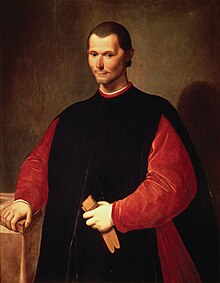
Niccolo Machiavelli
So—which is better: To be feared or loved?
In the 1993 film, A Bronx Tale, 17-year-old Calogero (Lillo Brancato) poses that question to his idol, the local Mafia capo, Sonny (Chazz Palminteri).
“That’s a good question,” Sonny replies. “It’s nice to be both, but it’s very difficult. But if I had my choice, I would rather be feared.
“Fear lasts longer than love. Friendships that are bought with money mean nothing. You see how it is around here. I make a joke, everybody laughs. I know I’m funny, but I’m not that funny. It’s fear that keeps them loyal to me.”
Presidents face the same dilemma as Mafia capos—and resolve it in their own ways.
LOVE ME BECAUSE I NEED TO BE LOVED
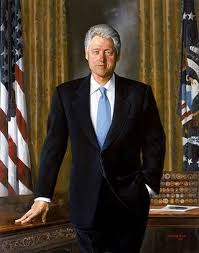
Bill Clinton (1993-2001) believed that he could win over his self-appointed Republican enemies through his sheer charm.
Part of this lay in self-confidence: He had won the 1992 and 1996 elections by convincing voters that “I feel your pain.”
Bill Clinton
And part of it lay in his need to be loved. He once said that if he were in a room with 100 people and 99 of them liked him but one didn’t, he would spend all his time with that one person, trying to win him over.
But while he could charm voters, he could not bring himself to retaliate against his sworn Republican enemies.
On April 19, 1995, Right-wing terrorist Timothy McVeigh drove a truck—packed with 5,000 pounds of ammonium nitrate and nitromethane—to the front of the Alfred P. Murrah Federal Building in Oklahoma City.
The explosion killed 168 people, including 19 children in the day care center on the second floor, and injured 684 others.
Suddenly, Republicans were frightened. Since the end of World War II, they had vilified the very Federal Government they belonged to. They had deliberately courted the Right-wing militia groups responsible for the bombing.
So Republicans feared Clinton would now turn their decades of hate against them.
They need not have worried. On April 23, Clinton presided over a memorial service for the victims of the bombing. He gave a moving eulogy—without condemning the hate-filled Republican rhetoric that had at least indirectly led to the slaughter.
Clinton further sought to endear himself to Republicans by:
- Adopting NAFTA—the Republican-sponsored North American Free Trade Act, which later proved so devastating to American workers;
- Siding with Republicans against poor Americans on welfare; and
- Championing the gutting of the Depression-era Glass-Steagall law, which barred investment banks from commercial banking activities.
The result: Republicans believed Clinton was weak—and could be rolled.
In 1998, House Republicans moved to impeach him over a sex scandal with White House intern Monica Lewinsky. But his Presidency survived when the Democratic Senate refused to convict.
LOVE ME BECAUSE I’LL HURT YOU IF YOU DON’T
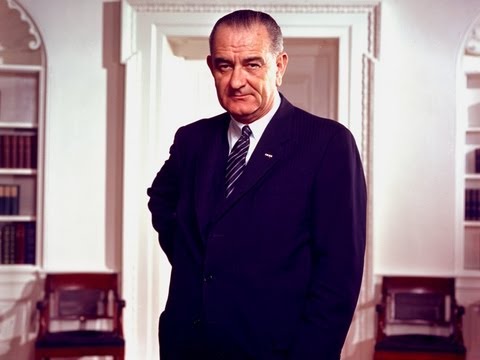
Lyndon Johnson (1963-1969) wanted desperately to be loved.
Once, he complained to Dean Acheson, the former Secretary of State under Harry S. Truman, about the ingratitude of American voters. He had passed far more legislation than his predecessor, John F. Kennedy, and yet Kennedy remained beloved, while he, Johnson, was not.
Why was that? Johnson demanded.
“You are not a very likable man,” said Acheson truthfully.
Lyndon B. Johnson
Johnson tried to force his subordinates to love him. He would humiliate a man, then give him an expensive gift—such a Cadillac. It was his way of binding the man to him.
He was on a first-name basis with J. Edgar Hoover, the longtime director of the FBI. He didn’t hesitate to request—and get—raw FBI files on his political opponents.
On at least one occasion, he told members of his Cabinet: No one would dare walk out on his administration—because if they did, two men would follow their ass to the end of the earth: Mr. J. Edgar Hoover and the head of the Internal Revenue Service.
ABC NEWS, ADOLF HITLER, ALTERNET, AMERICABLOG, AP, BABY BOOMER RESISTANCE, BBC, BLOOMBERG NEWS, BLUESKY, BUZZFEED, CANADA, CBS NEWS, CLAUDIA SHEINBAUM PARDO, CNN, CNN'S "STARTING POINT", CROOKS AND LIARS, CZECHOSLAVAKIA, DAILY KOS, DAVID BROOKS, DEPARTMENT OF HOMELAND SECURITY, DEPARTMENT OF JUSTICE, DONALD TRUMP, EXTORTION, FBI, FIVETHIRTYEIGHT, GREENLAND, HARPER’S MAGAZINE, HUFFINGTON POST, INSIDER, JACK SMITH, JIMMY CARTER, JUSTIN TRUDEAU, MASTADON, MEDIA MATTERS, MEXICO, MOTHER JONES, MOVEON, MSNBC, MSNBC'S "HARDBALL", NAZI GERMANY, NBC NEWS, NEGOTIATING, NEVILLE CHAMBERLAIN, NEW REPUBLIC, NEWSDAY, NEWSWEEK, NEWT GINGRICH, NICCOLO MACHIAVELLI, NPR, PANAMA, PBS NEWSHOUR, POLAND, POLITICO, POLITICUSUSA, R.I.CO. ACT, RAW STORY, REPUBLICAN PARTY, REPUBLICANS, REUTERS, ROBERT MEULLER, SALON, SEATTLE TIMES, SLATE, TALKING POINTS MEMO, THE ATLANTIC, THE CHICAGO SUN-TIMES, THE CHICAGO TRIBUNE, THE DAILY BEAST, THE DAILY BLOG, THE GUARDIAN, THE HAMILTON PROJECT, THE HILL, THE HUFFINGTON POST, THE LOS ANGELES TIMES, THE NATION, THE NEW REPUBLIC, THE NEW YORK TIMES, THE NEW YORKER, THE PENTAGON, THE PRINCE, THE VILLAGE VOICE, THE WASHINGTON POST, THINKPROGRESS, TIME, TRUTHDIG, TRUTHOUT, TWO POLITICAL JUNKIES, U.S. NEWS & WORLD REPORT, UKRAINE, UPI, USA TODAY, VLADIMIR PUTIN, VOLODMYR ZELENSKY, WONKETTE, WORLD WAR 11, X
In Bureaucracy, Business, History, Military, Politics, Social commentary on February 19, 2025 at 12:16 am
The “negotiating” methods of German Fuhrer Adolf Hitler serve as a useful guide to what domestic and world leaders can expect from trying to reach an agreement with President Donald Trump.
In September, 1938, seven months after seizing Austria, Hitler gave another exhibition of his “negotiating” methods.
This time, the target of his aggression was Czechoslovakia. Once again, he opened “negotiations” with a lie: The Czechoslovak government was trying to exterminate 3.5 million Germans living in the “Sudetenland.”
Then he threatened war: Germany would protect its citizens and halt such “oppression.”
For British Prime Minister Neville Chamberlain, the thought of another European war erupting less than 20 years after the end of World War I was simply unthinkable.
He quickly sent Hitler a telegram, offering to help resolve the crisis: “I could come to you by air and am ready to leave tomorrow. Please inform me of earliest time you can receive me, and tell me the place of the meeting. I should be grateful for a very early reply.”
[Mistake #1: Showing his willingness to placate a brutal dictator. Such men see any concessions as weakness—leading to only greater demands. Trump, like Hitler relishes attacking those weaker than himself.]
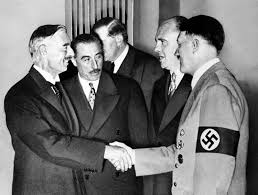
The two European leaders met in Berchtesgaden, Germany, on September 15, 1938.
Neville Chamberlain and Adolf Hitler
Hitler denied that he had threatened war: “Force? Who speaks of force?“
Then, suddenly, he accused the Czechs of having mobilized their army in May. They had mobilized—in response to the mobilization of the German army.
“I shall not put up with this any longer,” shouted Hitler. “I shall settle this question in one way or another. I shall take matters in my own hands!”
Suddenly, Chamberlain seemed alarmed: “If I understood you right, you are determined to proceed against Czechoslovakia in any case. In the circumstances, it is best for me to return at once. Anything else now seems pointless.”
Hitler, taken aback, softened his tone and said they should consider the Sudetenland according to the principle of self-determination.
Chamberlain agreed to the cession of the Sudetenland. Three days later, French Prime Minister Edouard Daladier did the same. No Czechoslovak representative was invited to these discussions.
[Mistake #2: Instead of conceding to Hitler, which emboldened the dictator, he should have pressed his advantage. When Hitler found himself facing an opponent who couldn’t be bribed or cowed—such as British Prime Minister Winston Churchill or Soviet Premier Joseph Stalin—he raged and sulked.
[When Trump has faced an opponent he can’t buy or intimidate—such as Special Counsels Robert Mueller and Jack Smith—he has done the same.]
Chamberlain met Hitler again in Godesberg, Germany, on September 22 to confirm the agreements. But Hitler aimed to use the crisis as a pretext for war.
He now demanded not only the annexation of the Sudetenland but the immediate military occupation of the territories. This would give the Czechoslovak army no time to adapt their defense measures to the new borders.
To achieve a solution, Italian dictator Benito Mussolini suggested a conference of the major powers in Munich.
On September 29, Hitler, Daladier and Chamberlain met and agreed to Mussolini’s proposal. They signed the Munich Agreement, which accepted the immediate occupation of the Sudetenland.
The Czechoslovak government had not been a party to the talks. Nevertheless, it promised to abide by the agreement on September 30.
It actually had no choice. It faced the threat of an immediate German invasion after being deserted by its pledged allies: Britain, France and the Soviet Union.
[Mistake #3: Selling out an ally and making a concession to an insatiable dictator—and believing that Hitler could be trusted to keep his word.
[Just as Chamberlain sold out Czechoslovakia, Trump plans on selling out Ukraine to Russian dictator Vladimir Putin. He’s blamed Ukraine for starting the 2022 war—even though Russia invaded Ukraine.
He’s also attacked Ukrainian President Volodymyr Zelensky—and repeatedly praised Putin. And he’s unilaterally announced that he will begin directing “peace talks” with Putin to end his war on Ukraine.]
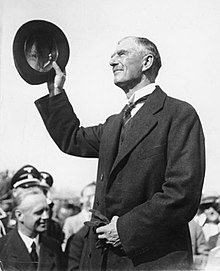
Chamberlain returned to England a hero. Holding aloft a copy of the worthless agreement he had signed with Hitler, he told cheering crowds in London: “I believe it is peace for our time.”
Neville Chamberlain
Winston Churchill knew better, predicting: “Britain and France had to choose between war and dishonor. They chose dishonor. They will have war.”
Hitler—still planning more conquests—also knew better. In March, 1939, the German army occupied the rest of Czechoslovakia.
Chamberlain would soon be seen as a naive weakling—even before bombs started falling on London.
Then Hitler turned his attention—and demands—to Poland.
When his generals balked, warning that an invasion would trigger a war with France and Britain, Hitler quickly brushed aside their fears: “Our enemies are little worms. I saw them at Munich.”
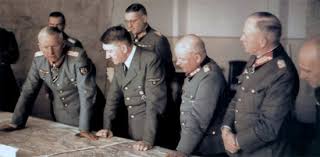
Adolf Hitler and his generals
Similarly, Trump drew the same lesson from his repeated escapes from American justice—that he was untouchable
Hitler ordered the invasion of Poland on September 1, 1939—unintentionally triggering World War II.
In time, historians and statesmen would regard Munich as an object lesson in the futility—and danger—in appeasing evil and aggression.
History has yet to record the all-but-certain disasters—foreign and domestic—of the Trump administration.
ABC NEWS, ADOLF HITLER, ALTERNET, AMERICABLOG, AP, AUSTRIA, BABY BOOMER RESISTANCE, BBC, BLOOMBERG NEWS, BLUESKY, BUZZFEED, CANADA, CBS NEWS, CLAUDIA SHEINBAUM PARDO, CNN, CNN'S "STARTING POINT", CROOKS AND LIARS, CZECHOSLAVAKIA, CZECHOSLOVAKIA, DAILY KOS, DAVID BROOKS, DEPARTMENT OF HOMELAND SECURITY, DEPARTMENT OF JUSTICE, DONALD TRUMP, EXTORTION, FBI, FIVETHIRTYEIGHT, FRANCE, GELI rAUBAL, GREENLAND, HARPER’S MAGAZINE, HUFFINGTON POST, INSIDER, JACK SMITH, JIMMY CARTER, JUSTIN TRUDEAU, MASTADON, MEDIA MATTERS, MEXICO, MOTHER JONES, MOVEON, MSNBC, MSNBC'S "HARDBALL", NAZI GERMANY, NBC NEWS, NEGOTIATING, NEVILLE CHAMBERLAIN, NEW REPUBLIC, NEWSDAY, NEWSWEEK, NEWT GINGRICH, NICCOLO MACHIAVELLI, NPR, PANAMA, PBS NEWSHOUR, POLAND, POLITICO, POLITICUSUSA, R.I.CO. ACT, RAW STORY, REPUBLICAN PARTY, REPUBLICANS, REUTERS, ROBERT MEULLER, SALON, SEATTLE TIMES, SLATE, TALKING POINTS MEMO, TARIFFS, THE ATLANTIC, THE CHICAGO SUN-TIMES, THE CHICAGO TRIBUNE, THE DAILY BEAST, THE DAILY BLOG, THE GUARDIAN, THE HAMILTON PROJECT, THE HILL, THE HUFFINGTON POST, THE LOS ANGELES TIMES, THE NATION, THE NEW REPUBLIC, THE NEW YORK TIMES, THE NEW YORKER, THE PENTAGON, THE PRINCE, THE VILLAGE VOICE, THE WASHINGTON POST, THINKPROGRESS, TIME, TRADE WARS, TRUTHDIG, TRUTHOUT, TWO POLITICAL JUNKIES, U.S. NEWS & WORLD REPORT, UKRAINE, UPI, USA TODAY, VLADIMIR PUTIN, VOLODMYR ZELENSKY, WONKETTE, WORLD WAR 11, X
In Bureaucracy, Business, History, Military, Politics, Social commentary on February 18, 2025 at 12:10 am
To understand the “negotiating” style of Donald Trump, it’s essential to study that of Adolf Hitler.
Both men, dictatorial by nature, did/do not believe in compromise. Their idea of “compromise” was/is: “You do what I want–or I’ll destroy you.”
In Hitler’s case, his mania for absolute control began with the Nazi party and eventually extended to Germany. Then it reached to Austria, Czechoslovakia, Poland, Norway, Denmark, France and Russia. At least 50 million men, women and children perished in the wars he unleashed from 1939 to 1945.
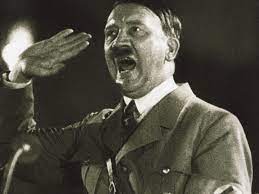
Adolf Hitler
Similarly, Trump’s mania for control started with building a real estate empire. Then it encompassed his “reality TV” show, The Apprentice—and finally politics.
He began dominating the Republican party by winning a series of Presidential primaries—and then the White House. Then came asserting control over the the Justice Department and the judiciary—up to the Supreme Court.
Re-elected in 2024, he now seeks to dominate Americans, demands military control over Gaza, threatens Mexico and Canada with trade wars, and Greenland and Panama with invasion.
Much can be learned about Trump’s “negotiating” methods—and what it takes to counter them—by studying those of Germany’s Fuhrer.
Robert Payne, author of the bestselling biography, The Life and Death of Adolf Hitler (1973), described Hitler’s “negotiating” style thus:
“Although Hitler prized his own talents as a negotiator, a man always capable of striking a good bargain, he was totally lacking in finesse.
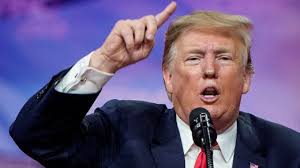
Donald Trump
“He was incapable of bargaining. He was like a man who goes up to a fruit peddler and threatens to blow his brains out if he does not sell his applies at the lowest possible price.”
A classic example of Hitler’s “bargaining style” came in 1938, when he invited Austrian Chancellor Kurt von Schuschnigg to his mountaintop retreat in Obersalzberg, Germany.
Hitler, an Austrian by birth, intended to annex his native land to Germany. Schuschnigg was aware of Hitler’s desire, but nevertheless felt secure in accepting the invitation. He had been assured that the question of Austrian sovereignty would not arise.
The meeting occurred on February 12, 1938.
Shuschnigg opened the discussion with a friendly compliment. Walking over to a large window, he admired the breathtaking view of the mountains.
HITLER: We haven’t come here to talk about the lovely view or the weather!
Austria has anyway never done anything which was of help to the German Reich….I am resolutely determined to make an end to all this business. The German Reich is a great power. Nobody can and nobody will interfere if it restores order on its frontiers.
[Like Hitler, Trump relies on insults and anger to put his victims on the defense.]
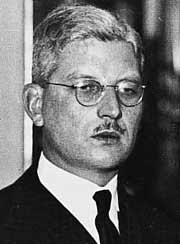
Kurt von Schuschnigg
SCHUSCHNIGG: We simply have to go on living alongside one another, the little state next to the big one. We have no other choice.
And that is why I ask you to tell me what your concrete complaints are. We will do all in our power to sort things out and establish a friendly relationship, as far as it is possible to do so.
HITLER: That’s what you say, Herr Schuschnigg. And I am telling you that I intend to clear up the whole of the so-called Austrian question—one way or another. Do you think I don’t know that you are fortifying Austria’s border with the Reich?
SCHUSCHNIGG: There can be no suggestion at all of that—
HITLER: Ridiculous explosive chambers are being built under bridges and roads—
This was a lie, and Hitler knew it was a lie. But it gave him an excuse to threaten to destroy Austria.
[For Trump, winning—not truth—is all that matters. During his first term as President, he told 30,573 lies.]
HITLER: I have only to give one command and all this comic stuff on the border will be blown to pieces overnight. You don’t seriously think you could hold me up, even for half an hour, do you?
The S.A. [Hitler’s private army of Stormtroopers] and the [Condor] lLegion [which had bombed much of Spain into rubble during the Spanish Civil War] would come in after the troops and nobody—not even I—could stop them from wreaking vengeance.
Schnuschigg made a cardinal mistake in dealing with Hitler: He showed fear. And this was precisely what the Nazi dictator looked for in an opponent.
[Like Hitler, Trump relies on fear: “Real power is—I don’t even want to use the word—fear,” he said in March 2016 when still only a candidate for President.]
Contrary to popular belief, Hitler did not constantly rage at everyone. He used rage as a weapon, knowing that most people feel intimidated by it.
In the case of Schuschnigg, Hitler opened with insults and threats at the outset of their discussion. Then there was a period of calm, to convince the Austrian chancellor the worst was over.
Finally, he once again attacked—this time with so much fury that Schuschnigg was terrified into submission.
With one stroke of a pen, Austria became a vassal-state to Nazi Germany.
[Like Hitler, Trump threatens only those he feels are weak—thus his threats to use military force against Canada, Greenland and Panama.]
.GOSPEL MUSIC, ABC NEWS, ADAM AND EVE, ALTERNET, AMERICABLOG, AP, ATHEISTS, BABY BOOMER RESISTANCE, BERNIE SANDERS, BUZZFEED, CBS NEWS, CHRISTIANITY, CNN, CROOKS AND LIARS, DAILY KOZ, DANIEL IN THE LION’S DEN, DONALD TRUMP, DRUDGE RETORT, DWIGHT D. EISENHOWER, FIVETHIRTYEIGHT, HARPER’S MAGAZINE, HILLARY CLINTON, IRRATIONALITY, JESUS CHRIST, JOHN F. KENNEDY, JOHN F. KENNEDY JR., JONAH, KING OF KINGS (MOVIE), LAZARUS, LOT’S WIFE, MARK ZUCKERBERG, MEDIA MATTERS, MOSES, MOTHER JONES, MOVEON, MSNBC, NBC NEWS, NEWSWEEK, NICCOLO MACHIAVELLIL, NOAH, NPR, PBS NEWSHOUR, POLITICO, POLITICUSUSA, QANON, RAW STORY, RESURRECTION, REUTERS, SALON, SAMSON AND DELILAH (MOVIE), SEATTLE TIMES, SLATE, TALKING POINTS MEMO, THE ATLANTIC, THE BIBLE, THE CHICAGO SUN-TIMES, THE CHICAGO TRIBUNE, THE DAILY BEAST, THE DAILY BLOG, THE GUARDIAN, THE HILL, THE HUFFINGTON POST, THE LOS ANGELES TIMES, THE NATION, THE NEW REPUBLIC, THE NEW YORK TIMES, THE PRINCE, THE TEN COMMANDMENTS (MOVIE), THE VILLAGE VOICE, THE WASHINGTON POST, THINKPROGRESS, TIME, TRUTHDIG, TRUTHOUT, TWITTER, TWO POLITICAL JUNKIES, U.S. NEWS & WORLD REPORT, UPI, USA TODAY
In Bureaucracy, History, Politics, RELIGION, Social commentary on February 17, 2025 at 12:22 am
Republicans learned long ago that most voters aren’t moved by appeals to their rationality. Instead, what counts with them is emotions. Especially the dark ones—Hate, Greed, Fear.
This is a lesson that liberal Democrats have refused to learn. And that is why Republicans won most Presidential elections of the 20th century.
There is no better example of the power of irrationality than a gathering of QAnon followers in Dallas, Texas, on November 2, 2021.
Hundreds of people from around the country gathered at the grassy knoll in Dallas’ Dealey Plaza, where President John F. Kennedy was assassinated in 1963.
The congregation wasn’t there to commemorate the death of the 35th President of the United States. They expected to see the return of his son, John F. Kennedy Jr.—who died in a plane crash on July 16, 1999.
QAnon logo
CC BY-SA 4.0 <https://creativecommons.org/licenses/by-sa/4.0>, via Wikimedia Commons
“Word on the street is Junior—JFK Jr.—will show up and introduce his parents,” one believer told a local news station. “He’ll (JFK Jr.) probably be the vice president with Trump.”
Most of the gathered crowd went home. But others stayed, waiting for months in Dallas for JFK Jr. to return.
It’s essential to understand how such thoroughly irrational beliefs can dominate the lives of millions. An excellent starting point are those beliefs embraced by Christians—from their first-century origins to the present day.
Among those beliefs:
- God creates Adam from dust. (This absolutely contradicts everything we know about how men and women reproduce. Would-be parents don’t throw dust into the air and see it instantly turn into newborn babies.)
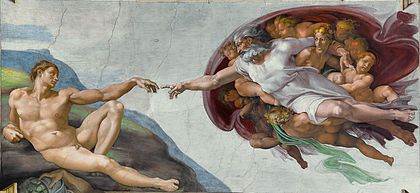
God creates Adam–as painted by Michelangelo
- Adam and Eve meet a talking snake. (Presumably it spoke Hebrew. When was the last time a zoologist had a serious discussion with a serpent?)
- Noah saves the world’s wildlife by stuffing them into an ark. (Sure—untrained wild animals are going to meekly walk, two-by-two, into a huge building. Then they’re going to let themselves be caged. And Noah and his family must store a huge variety of food for each type of animal for an indefinite period of time. And the sheer stench of all that animal urine and feces would have been horrific.)
- Moses parts the Red Sea. (Some scholars believe “Red” has been mistranslated from “Reed,” which is like upgrading “the White Quail” in Moby Dick to “the White Whale.”)
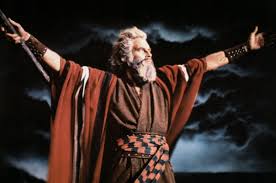
Moses (played by Charlton Heston) parts the Red Sea
- Lot’s wife becomes a pillar of salt. (A human being can be turned into ashes, but not salt.)
- Samson kills 1,000 Philistines with the jawbone of an ass. (Even Arnold Schwarzenegger at the height of his physical strength couldn’t kill so many men—except with a machinegun.)
- Daniel is thrown into a pit of lions—but survives because an angel closes their jaws. (This sounds inspiring—until you remember that didn’t happen when Christians were thrown to the lions by the Romans.)
- The will of God violates physical laws. (Jesus turns water into wine and raises Lazarus from the dead; Jonah lives inside a fish for three days; Noah dies at 950 years.)
- Jesus rises from the dead. (There have been near-death experiences, but there has never been a documented case of someone being certified as dead who came alive again.)
- Jesus will return more than 2,000 years after he died to wipe all evil from the earth and usher in a paradise for his faithful followers. (There has never been a case in recorded history of anyone returning from the dead decades or hundreds of years later—let alone more than 2,000 years later.)

“The Transfiguration of Jesus” as painted by Carl Bloch
So why do millions of people unquestioningly accept so many stories that totally contradict the most basic truths of common sense?
Like Muzak, these stories—and other Biblical tales—have been absorbed over time through several mediums:
- Countless parents have told them to their children.
- So have countless pastors and priests.
- From the 1940s to the 1960s, audiences reveled in such spectaculars as “Samson and Delilah,” “The Ten Commandments” and “King of Kings.” When people watch Biblical movies, they believe they’re seeing The Truth as it’s laid out in the Bible.
- The gospel music scene has produced mega-hits like: “Shall We Gather at the River?” “Take Me to the King,” “Down By the Riverside.”
It is not necessary to actually be religious to run for and win public office in the United States. But it is essential to claim to be. Donald Trump—totally lacking in humility and spirituality—became the darling of evangelicals in 2016 and 2024.
The reason: They expect Trump to sponsor legislation that will—by force of law—make their brand of Christianity supreme above all other religions. And this will give them the status of the Official Religion of the United States.
As Niccolo Machiavelli wrote in The Prince: “For men in general judge more by the eyes than by the hands, for every one can see, but very few have to feel. Everyone sees what you appear to be, few feel what you are, and those few will not dare to oppose themselves to the many.”
2020 PRESIDENTIAL ELECTION, ABC NEWS, ALEX VINDMAN, ALEXANDER VINDMAN, ALTERNET, AMERICABLOG, AP, BABY BOOMER RESISTANCE, BBC, BLOOMBERG NEWS, BUZZFEED, CBS NEWS, CNN, CROOKS AND LIARS, DAILY KOS, DAVID PRESSMAN, DEMOCRATS, DONALD TRUMP, DRUDGE RETORT, FACEBOOK, FIVETHIRTYEIGHT, GORDON SONDLAND, HARPER’S MAGAZINE, HUFFINGTON POST, JOHN ROOD, JOSEPH BIDEN, MARK ESPER, MEDIA MATTERS, MORNING JOE, MOTHER JONES, MOVEON, MSNBC, NBC NEWS, NEW REPUBLIC, NEWSDAY, NEWSWEEK, NICCOLO MACHIAVELLI, NPR, PBS NEWSHOUR, POLITICO, POLITICUSUSA, RAW STORY, REPUBLICANS, REUTERS, SALON, SEATTLE TIMES, SLATE, TALKING POINTS MEMO, THE ATLANTIC, THE CHICAGO SUN-TIMES, THE CHICAGO TRIBUNE, THE DAILY BEAST, THE DAILY BLOG, THE GUARDIAN, THE HILL, THE HUFFINGTON POST, THE INTERCEPT, THE LOS ANGELES TIMES, THE NATION, THE NEW REPUBLIC, THE NEW YORK TIMES, THE NEW YORKER, THE PENTAGON, THE PRINCE, THE VILLAGE VOICE, THE WASHINGTON POST, THINKPROGRESS, TIME, TRUTHDIG, TRUTHOUT, TWO POLITICAL JUNKIES, U.S. NEWS & WORLD REPORT, UKRAINE, UPI, USA TODAY, VOLODMYR ZELENSKY, WONKETTE, X, YEVGENEY VINDMAN
In Bureaucracy, History, Law, Military, Politics, Social commentary on February 14, 2025 at 12:05 am
“There is no other way of guarding oneself against flattery than by letting men understand that they will not offend you by speaking the truth. But when every one can tell you the truth, you lose their respect.
“A prudent prince must therefore take a third course, by choosing for his counsel wise men, and giving them alone full liberty to speak the truth to him, but only of those things that he asks and of nothing else.”
So wrote the Italian statesman Niccolo Machiavelli more than 500 years ago in his famous treatise on politics, The Prince. And he added:
“But he must be a great asker about everything and hear their opinions, and afterwards deliberate by himself in his own way, and in these counsels and with each of these men comport himself so that every one may see that the more freely he speaks, the more he will be acceptable.
“Beyond these he should listen to no one, go about the matter deliberately, and be determined in his decisions.”
Machiavelli’s words remain as true in our day as they were in his.
Especially for “a very stable genius,” as Donald J. Trump once referred to himself.
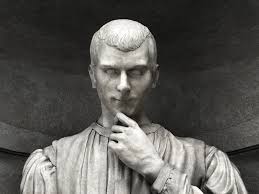
Niccolo Machiavelli
Asked on MSNBC’s “Morning Joe” who he consults about foreign policy, Trump replied; “I’m speaking with myself, number one, because I have a very good brain and I’ve said a lot of things.”
Machiavelli offers a related warning that especially applies to Trump: Unwise princes cannot be wisely advised:
“It is an infallible rule that a prince who is not wise himself cannot be well advised, unless by chance he leaves himself entirely in the hands of one man who rules him in everything, and happens to be a very prudent man. In this case, he may doubtless be well governed, but it would not last long, for the governor would in a short time deprive him of the state.”
Competent executives surround themselves with experts in diverse fields and pay attention to their expertise. They don’t feel threatened by it but rely on it to implement their agenda. Advisers whose counsel proves correct are to be retained and rewarded.
Machiavelli offers practical advice on this:
“The prince, in order to retain his fidelity, ought to think of his minister, honoring and enriching him, doing him kindnesses and conferring on him favors and responsible tasks, so that the great favors and riches bestowed on him cause him not to desire other honors and riches, and the offices he holds make him fearful of changes.”
But rewarding those who try to head off ruinous decision-making is not Trump’s way.
Consider the case of John Rood, the Pentagon’s top policy official until February 19, 2020. That was when he resigned, saying he was leaving at Trump’s request.
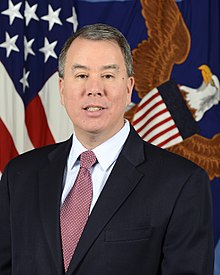
John Rood
Rood had certified in 2019 that Ukraine had made enough anti-corruption progress to justify the release of Congressionally-authorized aid for its efforts to thwart Russian aggression.
And that totally conflicted with Trump’s attempt to extort a “favor” from Ukrainian President Volodymyr Zelensky.
In July, 2019, Trump told his acting chief of staff, Mick Mulvaney, to withhold almost $400 million in promised military aid for Ukraine.
On July 25, Trump telephoned Zelensky to “request” a “favor”: Investigate presumed 2020 Democratic Presidential Candidate Joseph Biden and his son, Hunter, who had had business dealings in Ukraine.
The reason for such an investigation: To find embarrassing “dirt” on Biden.

Joe Biden
But then a CIA whistleblower filed a complaint about the extortion attempt—and this led directly to impeachment proceedings by the Democratically-controlled House for abuse of power and obstruction of Congress.
But the Republican-dominated Senate voted to acquit him.
Afterwards, Trump purged several officials he considered disloyal for cooperating with the impeachment hearings:
- Army Lt. Col. Alexander Vindman, from the National Security Council.
- White House Attorney Lt. Col. Yevgeny Vindman, Vindman’s twin brother.
- Gordon Sondland, Trump’s ambassador to the European Union.
“The truth has cost Lt. Col. Alexander Vindman his job, his career, and his privacy,” his attorney David Pressman, said in a statement.
For Trump, Rood had been “disloyal” on two occasions:
- He stated in a May 23, 2019 letter to Congress that the Pentagon had thoroughly assessed Ukraine’s anti-corruption actions. And he said that those reforms justified the authorized $400 million in aid.
- He told reporters last year: “In the weeks after signing the certification I did become aware that the aid had been held. I never received a very clear explanation other than there were concerns about corruption in Ukraine.”
Asked about Rood’s resignation, chief Pentagon spokesman Jonathan Hoffman declined to speculate on the reason for Trump’s decision.
According to Secretary of Defense Mark Esper, Rood played “a critical role” on issues such as nuclear deterrence, NATO, missile defense and the National Defense Strategy.
That did not protect him, however, from Trump’s vendetta against those who dared to reveal his crimes to Democratic impeachment committees.
All of which would lead Niccolo Machiavelli to warn, if he could witness American politics today: “This bodes ill for your Republic.”
ABC NEWS, ADOLF HITLER, ALTERNET, AMERICABLOG, AP, BABY BOOMER RESISTANCE, BARACK OBAMA, BBC, BILL CLINTON, BLOOMBERG NEWS, BUZZFEED, CBS NEWS, CHINA, CHRIS MATTHEWS, CNN, CNN'S "STARTING POINT", CROOKS AND LIARS, CZECHOSLAVAKIA, DAILY KOS, DARRELL ISSA, DAVID BROOKS, DEBT CEILING, DENMARK, EXECUTIVE ORDERS, EXTORTION, FIVETHIRTYEIGHT, GEORGE W. BUSH, GREENLAND, HARPER’S MAGAZINE, HOUSE SPEAKER JOHN BOEHNER, HUFFINGTON POST, immigration reform, INSIDER, IRAN, JANET YELLEN, JIMMY CARTER, JOSEPH BIDEN, MEDIA MATTERS, MITCH MCCONNELL, MOTHER JONES, MOVEON, MSNBC, MSNBC'S "HARDBALL", NANCY PELOSI, NAZI GERMANY, NBC NEWS, NEGOTIATING, NEVILLE CHAMBERLAIN, NEW REPUBLIC, NEWSDAY, NEWSWEEK, NEWT GINGRICH, NICCOLO MACHIAVELLI, NORTH KOREA, NPR, PAP SMEARS, PBS NEWSHOUR, PITUFFIK SPACE BASE, PLANNED PARENTHOOD, POLAND, POLITICO, POLITICUSUSA, R.I.CO. ACT, RAW STORY, REPUBLICAN PARTY, REPUBLICANS, REUTERS, Ronald Reagan, RUSSIA, SALON, SEATTLE TIMES, SLATE, TALKING POINTS MEMO, THE ATLANTIC, THE CHICAGO SUN-TIMES, THE CHICAGO TRIBUNE, THE DAILY BEAST, THE DAILY BLOG, THE GUARDIAN, THE HAMILTON PROJECT, THE HILL, THE HUFFINGTON POST, THE LOS ANGELES TIMES, THE NATION, THE NEW REPUBLIC, THE NEW YORK TIMES, THE NEW YORKER, THE PRINCE, THE VILLAGE VOICE, THE WASHINGTON POST, THINKPROGRESS, TIME, TITLE X, TRUTHDIG, TRUTHOUT, TWITTER, TWO POLITICAL JUNKIES, U.S. NEWS & WORLD REPORT, UPI, USA TODAY, WARREN BUFFET, WENDY EDELBERG, WINSTON CHURCHILL, WONKETTE, WORLD WAR 11, X
In Bureaucracy, Business, History, Law, Law Enforcement, Military, Politics, Social commentary on January 10, 2025 at 12:10 am
On September 15, 1938, British Prime Minister Neville Chamberlain met with German Chancellor Adolf Hitler in Berchtesgaden, Germany.
The reason: Hitler had threatened war with Czechoslovakia—and even with Great Britain—if the Czechs did not cede to Germany the “Sudetenland.” This consisted of the northern, southwest and western regions of Czechoslovakia, inhabited mostly by ethnic Germans.
Neville Chamberlain and Adolf Hitler
To Chamberlain’s surprise, Hitler denied he intended to use force to gain his ends.
Then, without warning, the Fuhrer switched to an aggressive mode: “I shall not put up with this any longer. I shall settle this question in one way or another. I shall take matters in my own hands!”
Suddenly, Chamberlain seemed alarmed—and possibly angry: “In the circumstances, it is best for me to return at once. Anything else now seems pointless.”
Hitler was taken aback by the unexpected show of defiance. He realized he was about to lose his chance to bully the British into accepting his latest demands.
So he offered to consider the Sudetenland according to the principle of self-determination.
Chamberlain said he must immediately return to England to consult with his colleagues “and then meet you again.” He then agreed to the cession of the Sudetenland.
Three days later, French Prime Minister Edouard Daladier did the same. No Czechoslovak representative was invited to these discussions.
Chamberlain met Hitler again in Godesberg, Germany, on September 22 to confirm the agreements. But Hitler aimed to use the crisis as a pretext for war.
He now demanded not only the annexation of the Sudetenland but the immediate military occupation of the territories. This would give the Czechoslovak army no time to adapt their defense measures to the new borders.
To achieve a solution, Italian dictator Benito Mussolini suggested a conference of the major powers in Munich.
On September 29, Hitler, Daladier and Chamberlain met and agreed to Mussolini’s proposal. They signed the Munich Agreement, which accepted the immediate occupation of the Sudetenland.
The Czechoslovak government had not been a party to the talks. Nevertheless, it promised to abide by the agreement on September 30.
It actually had no choice, having been deserted by its pledged allies: Britain, France and the Soviet Union.
Chamberlain returned to England a hero. Holding aloft a copy of the worthless agreement he had signed with Hitler, he told cheering crowds in London: “I believe it is peace for our time.”
Neville Chamberlain
Winston Churchill knew better, predicting: “Britain and France had to choose between war and dishonor. They chose dishonor. They will have war.”
Hitler—still planning more conquests—also knew better. In March, 1939, the German army occupied the rest of Czechoslovakia.
Chamberlain would soon be seen as a naive weakling—even before bombs started falling on London.
Hitler next turned his attention—and demands—to Poland.
When his generals balked, warning that an invasion would trigger a war with France and Britain, Hitler quickly brushed aside their fears: “Our enemies are little worms. I saw them at Munich.”
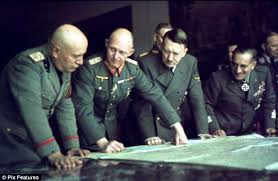
Adolf Hitler with his generals
Hitler ordered the invasion of Poland on September 1, 1939—unintentionally triggering World War II.
In time, historians and statesmen would regard Munich as an object lesson in the futility—and danger—in appeasing evil and aggression.
But for the postwar Republican party, Hitler’s my-way-or-else “negotiating” methods would become standard operating procedure. Latest case in point: President-elect Donald Trump’s aggressive moves toward Greenland.
“For purposes of National Security and Freedom throughout the World, the United States of America feels that the ownership and control of Greenland is an absolute necessity,” Trump wrote on Truth Social on December 23.
The next day, Greenland’s Prime Minister Mute Egede told Trump to back off: “Greenland is ours. We are not for sale and will never be for sale. We must not lose our long struggle for freedom.”
The Kingdom of Denmark holds control of the semiautonomous Greenland.
Trump had previously floated the idea of the U.S. buying Greenland in 2019, which the Danish prime minister at the time called “absurd.”
This is not a time for the United States to endanger its relationship with Greenland—which is more than the world’s biggest island.
It’s home to America’s Pituffik Space Base which “detects and reports attack assessments of sea-launched and intercontinental ballistic missile threats in support of strategic missile warning and missile defense,” according to the base’s website.
Greenland is strategically significant to the United States because it sits between Russia and the eastern coast of the United States, and is the fastest way from Europe to New York.
It’s also located beside the Norwegian Sea, which connects the Atlantic Ocean to the Arctic Ocean and the Barents Sea, where the Russian navy’s northern fleet operates.
Some critics have speculated that Trump is floating headline-getting assaults on other nations to divert attention from his domestic agenda—which includes deporting millions of men, women and children from Hispanic countries.
And while Trump picks needless fights with America’s longtime allies, China—the first peer competitor that can challenge America economically, militarily, and technologically—is deepening its ties with Russia, Iran, North Korea, and other countries that seek to weaken U.S. power.
ABC NEWS, ADOLF HITLER, ALTERNET, AMERICABLOG, AP, BABY BOOMER RESISTANCE, BARACK OBAMA, BBC, BILL CLINTON, BLOOMBERG NEWS, BUZZFEED, CBS NEWS, CHINA, CHRIS MATTHEWS, CNN, CNN'S "STARTING POINT", CROOKS AND LIARS, CZECHOSLAVAKIA, DAILY KOS, DARRELL ISSA, DAVID BROOKS, DEBT CEILING, DENMARK, EXECUTIVE ORDERS, EXTORTION, FIVETHIRTYEIGHT, GEORGE W. BUSH, GREENLAND, HARPER’S MAGAZINE, HOUSE SPEAKER JOHN BOEHNER, HUFFINGTON POST, immigration reform, INSIDER, IRAN, JANET YELLEN, JIMMY CARTER, JOSEPH BIDEN, MEDIA MATTERS, MITCH MCCONNELL, MOTHER JONES, MOVEON, MSNBC, MSNBC'S "HARDBALL", NANCY PELOSI, NAZI GERMANY, NBC NEWS, NEGOTIATING, NEVILLE CHAMBERLAIN, NEW REPUBLIC, NEWSDAY, NEWSWEEK, NEWT GINGRICH, NICCOLO MACHIAVELLI, NORTH KOREA, NPR, PAP SMEARS, PBS NEWSHOUR, PITUFFIK SPACE BASE, PLANNED PARENTHOOD, POLAND, POLITICO, POLITICUSUSA, R.I.CO. ACT, RAW STORY, REPUBLICAN PARTY, REPUBLICANS, REUTERS, Ronald Reagan, RUSSIA, SALON, SEATTLE TIMES, SLATE, TALKING POINTS MEMO, THE ATLANTIC, THE CHICAGO SUN-TIMES, THE CHICAGO TRIBUNE, THE DAILY BEAST, THE DAILY BLOG, THE GUARDIAN, THE HAMILTON PROJECT, THE HILL, THE HUFFINGTON POST, THE LOS ANGELES TIMES, THE NATION, THE NEW REPUBLIC, THE NEW YORK TIMES, THE NEW YORKER, THE PRINCE, THE VILLAGE VOICE, THE WASHINGTON POST, THINKPROGRESS, TIME, TITLE X, TRUTHDIG, TRUTHOUT, TWITTER, TWO POLITICAL JUNKIES, U.S. NEWS & WORLD REPORT, UPI, USA TODAY, WARREN BUFFET, WENDY EDELBERG, WINSTON CHURCHILL, WONKETTE, WORLD WAR 11, X
In Bureaucracy, Business, History, Law, Military, Politics, Social commentary on January 9, 2025 at 12:10 am
Contrary to popular belief, Adolf Hitler did not constantly rage at everyone. On the contrary: he could, when he desired, be charming, especially to women. He used rage as a weapon, knowing that most people feel intimidated by it.
In his “negotiations” for control of Austria with Austrian Chancellor Kurt von Schuschnigg. Hitler opened with insults and threats at the outset of their discussion. Then there was a period of calm, to convince the Austrian chancellor the worst was over.
Finally, he once again attacked—this time with so much fury that Schuschnigg was terrified into submission.
With one stroke of a pen, Austria became a vassal-state to Nazi Germany.
Seven months later, in September, 1938, Hitler turned his rage and aggression against Czechoslovakia.
Once again, he opened “negotiations” with a lie: The Czechoslovak government was trying to exterminate 3.5 million Germans living in the “Sudetenland.”
This consisted of the northern, southwest and western regions of Czechoslovakia, inhabited mostly by ethnic Germans.
Then he followed this up with the threat of war: Germany would protect its citizens and halt such “oppression.”
For British Prime Minister Neville Chamberlain, the thought of another European war erupting less than 20 years after the end of World War I was simply unthinkable.

The Cenotaph, in London, honoring the unknown British dead of World War 1
Something had to be done to prevent it. And he believed himself to be just the man to do it.
He quickly sent Hitler a telegram, offering to help resolve the crisis: “I could come to you by air and am ready to leave tomorrow. Please inform me of earliest time you can receive me, and tell me the place of the meeting. I should be grateful for a very early reply.”
Once again, another head-of-state was prepared to meet Hitler on his home ground. Again, Hitler took this concession as a sign of weakness. And Chamberlain’s use of such words as “please” and “grateful” only further convinced Hitler of another impending triumph.
Chamberlain was determined to grant Hitler’s every demand—so long as this meant avoiding a second world war.
As a political party, Democrats have generally copied this same “strategy” when dealing with Republicans.
On January 6, 2021, President Donald Trump—supported by at least 147 Republicans in the House and Senate—incited a treasonous coup to remain in office. This despite the overwhelming evidence that he had lost the 2020 election to former Vice President Joseph Biden.
By the time the Biden administration neared its end, not one Republican House or Senate member supporting such treason had been indicted for that infamy. Let alone tried, convicted and imprisoned.
Had this occurred, the Biden administration’s agenda would have been far more advanced than it is. Republicans who were raising funds for re-election campaigns would have been forced to raise them to pay huge legal bills.
They would have had far less time to plot to overthrow democracy. Instead, their attention would have been increasingly focused on their upcoming trials for treason.
Even more important: Donald Trump should have been indicted for treason by no later than mid-2021. Even then, the evidence was overwhelming that he had instigated the coup attempt.
Yet it wasn’t until November 18, 2022, that Jack Smith was appointed Special Counsel to oversee the criminal investigations into Trump’s role in the January 6 Capitol attack and his illegal storage of classified documents at his Mar-a-Lago estate.
And Smith allowed Trump-appointed Florida Judge Aileen Cannon to repeatedly postpone the stolen documents trial.
Meanwhile, Trump won repeated delays in his trial for inciting a violent attack on the Capitol. His victory on November 5 guarantees he will not be prosecuted for any of his crimes.

To bring down Mafia “boss of all bosses” John Gotti, the FBI waged a seven-year, $75 million campaign—which included the use of electronic bugs and recruitment of informants.
To date, there is no evidence that the Bureau applied such an effort against Trump—although he, unlike Gotti, threatens the very foundations of American democracy.
To avert war, British Prime Minister Neville Chamberlain met with German Chancellor Adolf Hitler in Berchtesgaden, Germany, on September 15, 1938.
Neville Chamberlain and Adolf Hitler
During their talks, Chamberlain said he had come to discuss German grievances. But, he added, it was necessary in all circumstances to exclude the use of force.
Hitler appeared to be shocked that he could be accused of such intentions: “Force? Who speaks of force?“
Then, without warning, he switched to an aggressive mode. He accused the Czechs of having mobilized their army in May. They had mobilized–in response to the mobilization of the German army.
“I shall not put up with this any longer,” shouted Hitler. “I shall settle this question in one way or another. I shall take matters in my own hands!”
Suddenly, Chamberlain seemed alarmed—and possibly angry: “If I understood you right, you are determined to proceed against Czechoslovakia in any case. If this is so, why did you let me come to Berchtesgaden?”
Hitler was taken aback by the unexpected show of defiance. He realized he was about to lose his chance to bully the British into accepting his latest demands.
ABC NEWS, ADOLF HITLER, ALTERNET, AMERICABLOG, AP, BABY BOOMER RESISTANCE, BARACK OBAMA, BBC, BILL CLINTON, BLOOMBERG NEWS, BUZZFEED, CANADA, CBS NEWS, CHINA, CHRIS MATTHEWS, CNN, CNN'S "STARTING POINT", CROOKS AND LIARS, CZECHOSLAVAKIA, DAILY KOS, DARRELL ISSA, DAVID BROOKS, DEBT CEILING, DENMARK, DONALD TRUMP, DRUG TRAFFICKING, EXECUTIVE ORDERS, EXTORTION, FIVETHIRTYEIGHT, GEORGE W. BUSH, GREENLAND, HARPER’S MAGAZINE, HOUSE SPEAKER JOHN BOEHNER, HUFFINGTON POST, ILLEGAL ALIENS, immigration reform, INSIDER, IRAN, JANET YELLEN, JIMMY CARTER, JOSEPH BIDEN, JUSTIN TRUDEAU, MEDIA MATTERS, MEXICO, MITCH MCCONNELL, MOTHER JONES, MOVEON, MSNBC, MSNBC'S "HARDBALL", NANCY PELOSI, NAZI GERMANY, NBC NEWS, NEGOTIATING, NEVILLE CHAMBERLAIN, NEW REPUBLIC, NEWSDAY, NEWSWEEK, NEWT GINGRICH, NICCOLO MACHIAVELLI, NORTH KOREA, NPR, PANAMA CANAL, PAP SMEARS, PBS NEWSHOUR, PITUFFIK SPACE BASE, PLANNED PARENTHOOD, POLAND, POLITICO, POLITICUSUSA, R.I.CO. ACT, RAW STORY, REPUBLICAN PARTY, REPUBLICANS, REUTERS, Ronald Reagan, RUSSIA, SALON, SEATTLE TIMES, SLATE, TALKING POINTS MEMO, TARIFFS, THE ATLANTIC, THE CHICAGO SUN-TIMES, THE CHICAGO TRIBUNE, THE DAILY BEAST, THE DAILY BLOG, THE GUARDIAN, THE HAMILTON PROJECT, THE HILL, THE HUFFINGTON POST, THE LOS ANGELES TIMES, THE NATION, THE NEW REPUBLIC, THE NEW YORK TIMES, THE NEW YORKER, THE PRINCE, THE VILLAGE VOICE, THE WASHINGTON POST, THINKPROGRESS, TIME, TITLE X, TRUTHDIG, TRUTHOUT, TWITTER, TWO POLITICAL JUNKIES, U.S. NEWS & WORLD REPORT, UPI, USA TODAY, WARREN BUFFET, WENDY EDELBERG, WINSTON CHURCHILL, WONKETTE, WORLD WAR 11, X
In Bureaucracy, Business, History, Law, Law Enforcement, Military, Politics, Social commentary on January 8, 2025 at 12:10 am
By studying the “negotiating” methods used by Adolf Hitler, Americans generally—and Democrats in particular—can learn much about the mindset and “negotiating” style of today’s Republican party.
Consider President-Elect Donald Trump’s recent threats against not only Canada but Panama—specifically, to retake control of the Panama Canal.
On December 25, Trump told a conservative conference in Arizona that Panama was charging US ships “ridiculous, highly unfair” fees to use its namesake canal.
The United States built the canal during the administration of President Theodore Roosevelt and opened it in 1914. It remained controlled by the United States until President Jimmy Carter signed a a 1977 agreement for its eventual handover to Panama in 1999.

Panama Canal (in white)
But this week, Trump threatened that if shipping rates were not lowered, “we will demand that the Panama Canal be returned to us, in full, quickly and without question.”
He accused China of operating the canal and lamented that the United States “puts in Billions of Dollars in ‘repair’ money, but will have absolutely nothing to say about ‘anything.’”
On December 25, Trump posted on his website, Truth Social: “Merry Christmas to all, including to the wonderful soldiers of China, who are lovingly, but illegally, operating the Panama Canal.”
“There is not a single Chinese soldier in the canal,” the president of Panama, José Raúl Mulino, told reporters the next day, adding that there is “absolutely no Chinese interference.”
Trump’s threats against Panama may be connected with the outstanding tax evasion case he faces in the country.
In 2019, the owners of a Panama City hotel tower that was previously managed and operated under the Trump brand accused the Trump Organization of pocketing money meant to pay taxes. According to a lawsuit, Trump’s companies simply kept the money, “intentionally evading taxes” and leaving the new owner liable for millions.
Yet the blunt truth remains: Unless Trump goes to war with Panama, his threat to take over the canal is effectively meaningless.
During the 2024 Presidential campaign, Trump denied reading Adolf Hitler’s notorious book, Mein Kampf (“My Struggle.”)
In the past, however, he has acknowledged owning a copy of it. And he has adopted the same “negotiating” style as the late Fuhrer: Do-as-I-say-or-I’ll-destroy-you.
A classic example of Hitler’s “bargaining style” came in 1938, when he invited Austrian Chancellor Kurt von Schuschnigg to his mountaintop retreat in Obersalzberg, Germany.

Kurt von Schuschnigg
Hitler, an Austrian by birth, intended to annex his native land to Germany. Schuschnigg was aware of Hitler’s desire, but nevertheless felt secure in accepting the invitation. He had been assured that the question of Austrian sovereignty would not arise.
The meeting occurred on February 12, 1938.
Shuschnigg opened the discussion with a friendly compliment. Walking over to a large window, he admired the breathtaking view of the mountains.
HITLER: We haven’t come here to talk about the lovely view or the weather!
Austria has anyway never done anything which was of help to the German Reich….I am resolutely determined to make an end to all this business. The German Reich is a great power. Nobody can and nobody will interfere if it restores order on its frontiers.
SCHUSCHNIGG: We simply have to go on living alongside one another, the little state next to the big one. We have no other choice.
And that is why I ask you to tell me what your concrete complaints are. We will do all in our power to sort things out and establish a friendly relationship, as far as it is possible to do so.
HITLER: That’s what you say, Herr Schuschnigg. And I am telling you that I intend to clear up the whole of the so-called Austrian question—one way or another. Do you think I don’t know that you are fortifying Austria’s border with the Reich?
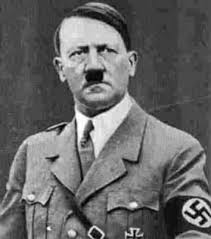
Adolf Hitler
SCHUSCHNIGG: There can be no suggestion at all of that—
HITLER: Ridiculous explosive chambers are being built under bridges and roads—
This was a lie, and Hitler knew it was a lie. But no matter. It gave him an excuse to threaten to destroy Austria—as he was to destroy so many other nations during the next seven years.
HITLER: I have only to give one command and all this comic stuff on the border will be blown to pieces overnight. You don’t seriously think you could hold me up, even for half an hour, do you?
Who knows—perhaps you will find me one morning in Vienna like a spring storm. Then you will go through something! I’d like to spare the Austrians that.
The S.A. [Hitler’s private army of Stormtroopers] and the [Condor] lLegion [which had bombed much of Spain into rubble during the three-year Spanish Civil War] would come in after the troops and nobody—not even I—could stop them from wreaking vengeance.
Schnuschigg made a cardinal mistake in dealing with Hitler: He showed fear. And this was precisely what the Nazi dictator looked for in an opponent.
Contrary to popular belief, Hitler did not constantly rage at everyone. On the contrary: he could, when he desired, be charming, especially to women. He used rage as a weapon, knowing that most people feel intimidated by it.
ABC NEWS, ADOLF HITLER, ALTERNET, AMERICABLOG, AP, BABY BOOMER RESISTANCE, BARACK OBAMA, BBC, BILL CLINTON, BLOOMBERG NEWS, BUZZFEED, CANADA, CBS NEWS, CHINA, CHRIS MATTHEWS, CNN, CNN'S "STARTING POINT", CROOKS AND LIARS, CZECHOSLAVAKIA, DAILY KOS, DARRELL ISSA, DAVID BROOKS, DEBT CEILING, DENMARK, DONALD TRUMP, DRUG TRAFFICKING, EXECUTIVE ORDERS, EXTORTION, FIVETHIRTYEIGHT, GEORGE W. BUSH, GREENLAND, HARPER’S MAGAZINE, HOUSE SPEAKER JOHN BOEHNER, HUFFINGTON POST, ILLEGAL ALIENS, immigration reform, INSIDER, IRAN, JANET YELLEN, JIMMY CARTER, JOSEPH BIDEN, JUSTIN TRUDEAU, MEDIA MATTERS, MEXICO, MITCH MCCONNELL, MOTHER JONES, MOVEON, MSNBC, MSNBC'S "HARDBALL", NANCY PELOSI, NAZI GERMANY, NBC NEWS, NEGOTIATING, NEVILLE CHAMBERLAIN, NEW REPUBLIC, NEWSDAY, NEWSWEEK, NEWT GINGRICH, NICCOLO MACHIAVELLI, NORTH KOREA, NPR, PAP SMEARS, PBS NEWSHOUR, PITUFFIK SPACE BASE, PLANNED PARENTHOOD, POLAND, POLITICO, POLITICUSUSA, R.I.CO. ACT, RAW STORY, REPUBLICAN PARTY, REPUBLICANS, REUTERS, Ronald Reagan, RUSSIA, SALON, SEATTLE TIMES, SLATE, TALKING POINTS MEMO, TARIFFS, THE ATLANTIC, THE CHICAGO SUN-TIMES, THE CHICAGO TRIBUNE, THE DAILY BEAST, THE DAILY BLOG, THE GUARDIAN, THE HAMILTON PROJECT, THE HILL, THE HUFFINGTON POST, THE LOS ANGELES TIMES, THE NATION, THE NEW REPUBLIC, THE NEW YORK TIMES, THE NEW YORKER, THE PRINCE, THE VILLAGE VOICE, THE WASHINGTON POST, THINKPROGRESS, TIME, TITLE X, TRUTHDIG, TRUTHOUT, TWITTER, TWO POLITICAL JUNKIES, U.S. NEWS & WORLD REPORT, UPI, USA TODAY, WARREN BUFFET, WENDY EDELBERG, WINSTON CHURCHILL, WONKETTE, WORLD WAR 11, X
In Bureaucracy, Business, History, Law, Law Enforcement, Military, Politics, Social commentary on January 7, 2025 at 12:10 am
Once again, Republicans are ruthlessly playing “chicken” with the nation’s financial and military security.
Even before taking the oath of office as President on January 20, 2025, Donald Trump has rushed to make an enemy of America’s longtime ally—Canada.
At a November 30 dinner at Mar-a-Lago, Trump’s estate in Palm Beach, Florida, he told Canadian Prime Minister Justin Trudeau that Canada could become the 51st state of the United States.
Canada’s Public Safety Minister Dominic LeBlanc, who attended the dinner, insisted that Trump was joking.
But on December 2, Trump threatened to impose a 25% tax on all products entering the United States from Canada and Mexico unless they stopped the flow of drugs and illegal aliens.
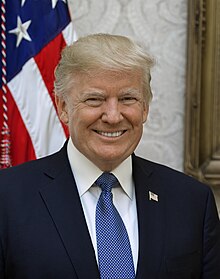
Donald Trump
And on December 3, Trump posted on his Truth Social platform an AI-generated image of himself standing on a mountain with a Canadian flag beside him. Its caption: “Oh Canada!”
Trudeau had requested the Mar-a-Lago meeting to convince Trump that the northern border is completely different from the southern one with Mexico.
“Less than one percent of migrants coming into the United States irregularly come from Canada and 0.2 percent of the fentanyl coming into the United States comes from Canada,” Trudeau said in Parliament.
During the last fiscal year, American customs agents seized 43 pounds of fentanyl at the Canadian border, compared with 21,100 pounds at the Mexican border.
Most of the fentanyl reaching the U.S. is made by Mexican drug cartels using precursor chemicals smuggled from Asia.
Utterly unmentioned in Trump’s demand: It’s America’s insatiable demand for illicit drugs that is the root cause of the drug trade.

Justin Trudeau
CC BY 3.0 <https://creativecommons.org/licenses/by/3.0>, via Wikimedia Commons
On immigration, the U.S. Border Patrol reported 1.53 million encounters with would-be illegal aliens at the Mexican border between October 2023 and September 2024. At the Canadian border, there were 23,721 such encounters.
Also unmentioned—if not deliberately ignored by Trump: Canada plays a substantial role as a U.S. trading partner. About 60% of U.S. crude oil imports are from Canada, and 85% of U.S. electricity imports as well.
Canada is also the largest foreign supplier of steel, aluminum and uranium to the U.S. and has 34 critical minerals and metals that the Pentagon eagerly desires. About 77% of Canada’s exports go to the U.S.
Trudeau pleaded with Trump not to impose the tariff because because it would “kill” Canada’s economy.
Trump responded: “So your country can’t survive unless it’s ripping off the US to the tune of $100 billion?”
His comments referred to the US trade deficit with Canada.
The U.S. had a $75 billion trade deficit with Canada last year but a third of what Canada sells into the U.S. is energy exports and prices have been high.
Trudeau left the meeting without reassurance that Trump would not impose a 25% tariff on products from Canada.
Republicans, in short, are one again utilizing the same “negotiating” strategy as Nazi Germany’s Fuhrer, Adolf Hitler.
And Democrats—out of cowardice or an ignorance of history—are once again refusing to publicly make this comparison.
By studying Adolf Hitler’s mindset and “negotiating” methods, we can learn much about the mindset and “negotiating” style of today’s Republican party.
Robert Payne, author of the bestselling biography, The Life and Death of Adolf Hitler (1973), described Hitler’s “negotiating” style thus:
“Although Hitler prized his own talents as a negotiator, a man always capable of striking a good bargain, he was totally lacking in finesse.
“He was incapable of bargaining. He was like a man who goes up to a fruit peddler and threatens to blow his brains out if he does not sell his applies at the lowest possible price.”
A classic example of Hitler’s “bargaining style” came in 1938, when he invited Austrian Chancellor Kurt von Schuschnigg to his mountaintop retreat in Obersalzberg, Germany.
Hitler, an Austrian by birth, intended to annex his native land to Germany. Schuschnigg was aware of Hitler’s desire, but nevertheless felt secure in accepting the invitation. He had been assured that the question of Austrian sovereignty would not arise.
Kurt von Schuschnigg
The meeting occurred on February 12, 1938.
Shuschnigg opened the discussion with a friendly compliment. Walking over to a large window, he admired the breathtaking view of the mountains.
HITLER: We haven’t come here to talk about the lovely view or the weather!
Austria has anyway never done anything which was of help to the German Reich….I am resolutely determined to make an end to all this business. The German Reich is a great power. Nobody can and nobody will interfere if it restores order on its frontiers.
SCHUSCHNIGG: I am aware of your attitude toward the Austrian question and toward Austrian history….As we Austrians see it, the whole of our history is a very essential and valuable part of German history….And Austria’s contribution is a considerable one.
HITLER: It is absolutely zero—that I can assure you! Every national impulse has been trampled underfoot by Austria….
I could call myself an Austrian with just the same right—indeed with even more right—than you, Herr Schuschnigg. Why don’t you once try a plebiscite in Austria in which you and I run against each other? Then you would see!


 Bureaucracybuster's Blog
A BRONX TALE, ABC NEWS, AFFORDABLE CARE ACT, AIR TRAFFIC CONTROLLERS STRIKE, ALTERNET, AMERICABLOG, ANWAR AL-AWLAKI, AP, BABY BOOMER RESISTANCE, BARACK OBAMA, BBC, BILL CLINTON, BLOOMBERG NEWS, BOB WOODWARD, BUZZFEED, CBS NEWS, CHAZZ PALMINTERI, CNN, COLUMBIA UNIVERSITY, CROOKS AND LIARS, DAILY KOZ, DAVID BARRON, DEAN ACHESON, DONALD TRUMP, FACEBOOK, FBI, FIVETHIRTYEIGHT, HARPER’S MAGAZINE, HARVARD LAW SCHOOL, HUFFINGTON POST, IRS, J. EDGAR HOOVER, JAMES HOFFA, JEFF SESSIONS, JOE BIDEN, JOHN F. KENNEDY, JOHN KELLY, LYNDON B. JOHNSON, MAFIA, MEDIA MATTERS, MOAMMAR KADAFFI, MONICA LEWINSKY, MOTHER JONES, MOVEON, MSNBC, NBC NEWS, NEW REPUBLIC, NEWSDAY, NEWSWEEK, NICCOLO MACHIAVELLI, NPR, PBS NEWSHOUR, POLITICO, POLITICUSUSA, RAND PAUL, RAW STORY, REINCE PREBIUS, REPUBLICAN PARTY, REUTERS, ROBERT F. KENNEDY, Ronald Reagan, SALON, SCREEN ACTORS GUILD, SEATTLE TIMES, SLATE, TALKING POINTS MEMO, THE ATLANTIC, THE CHICAGO SUN-TIMES, THE CHICAGO TRIBUNE, THE DAILY BEAST, THE DAILY BLOG, THE GUARDIAN, THE HILL, THE HUFFINGTON POST, THE LOS ANGELES TIMES, THE NATION, THE NEW REPUBLIC, THE NEW YORK TIMES, THE NEW YORKER, THE PRINCE, THE VILLAGE VOICE, THE WASHINGTON POST, THINKPROGRESS, TIME, TIMOTHY MCVEIGH, TRUTHDIG, TRUTHOUT, TWO POLITICAL JUNKIES, U.S. NEWS & WORLD REPORT, UPI, USA TODAY, WONKETTE, X
PRESIDENTS: THE LOVED, THE FEARED AND THE IGNORED: PART TWO (OF THREE)
In Bureaucracy, History, Law Enforcement, Politics, Social commentary on May 1, 2025 at 12:14 amIs it better to be loved or feared?
That was the question Florentine statesman Niccolo Machiavelli raised more than 500 years ago.
Presidents have struggled to answer this question—and have come to different conclusions.
LOVE ME, FEAR MY BROTHER
Most people felt irresistibly drawn to John F. Kennedy (1961-63). Even his political foe, Henry Luce, the conservative publisher of Time, once said, “He makes me feel like a whore.”
But JFK could afford to bask in the love of others—because his younger brother, Robert, was the one who inspired fear.
Robert F. Kennedy and John F. Kennedy
He had done so as Chief Counsel for the Senate Rackets Committee (1957-59), grilling Mafia bosses and corrupt union officials—most notably Teamsters President James Hoffa.
JFK appointed him Attorney General and he unleashed the FBI and the IRS on the Mafia. When the steel companies colluded in an inflationary rise in the price of steel in 1962, Bobby sicced the FBI on them.
In 1963, JFK’s cavorting with Ellen Rometsh threatened to destroy his Presidency. Rometsch, a Washington, D.C. call girl, was suspected by the FBI of being an East German spy.
With Republican Senators preparing to investigate the rumors, Bobby ordered Rometsch—a German citizen—deported immediately.
BEING LOVED AND FEARED
In the 1993 movie, A Bronx Tale, 17-year-old Calogero (Lillo Brancato) asks his idol, the local Mafia capo, Sonny (Chazz Palminteri): “Is it better to be loved or feared?”
Sonny gives advice to his adopted son, Calogero
Sonny says if he had to choose, he would rather be feared. But he adds a warning straight out of Machiavelli: “The trick is not being hated. That’s why I treat my men good, but not too good.
“I give too much, then they don’t need me. I give them just enough where they need me, but they don’t hate me.”
Machiavelli, writing in The Prince, went further:
“Still a Prince should make himself feared in such a way that if he does not gain love, he at any rate avoids hatred, for fear and the absence of hatred may well go together.”
Many who quote Machiavelli in defense of being feared overlook this vital point: It’s essential to avoid becoming hated.
To establish a fearful reputation, a leader must act decisively and ruthlessly when the interests of the organization are threatened. Punitive action must be taken promptly and confidently.
One or two such actions can inspire more fear than a reign of terror.
In fact, it’s actually dangerous to constantly employ cruelties or punishments. Whoever does so, warns Machiavelli, “is always obliged to stand with knife in hand, and can never depend on his subjects, because they, owing to continually fresh injuries, are unable to depend upon him.”
The 20th century President who came closest to realizing Machiavelli’s “loved and feared” prince in himself was Ronald Reagan (1981-1989).
Always smiling, quick with a one-liner (especially at press conferences), seemingly unflappable, he projected a constantly optimistic view of his country and its citizens.
Ronald Reagan
In his acceptance speech at the 1980 Republican National Convention he declared: “[The Democrats] say that the United States…has passed its zenith. My fellow citizens, I utterly reject that view.”
But there was a steely, ruthless side to Reagan that appeared when he felt crossed.
On August 3, 1981, nearly 13,000 air traffic controllers walked out after contract talks with the Federal Aviation Administration collapsed. As a result, some 7,000 flights across the country were canceled on that day at the peak of the summer travel season.
Reagan branded the strike illegal. He threatened to fire any controller who failed to return to work within 48 hours.
On August 5, Reagan fired more than 11,000 air traffic controllers who hadn’t returned to work. The mass firing slowed commercial air travel, but it did not cripple the system as the strikers had forecast.
Reagan’s action stunned the American labor movement. Reagan was the only American President to have belonged to a union, the Screen Actors Guild. He had even been president of this—from 1947 to 1954.
There were no more strikes by Federal workers during Reagan’s tenure in office.
Similarly, Libya’s dictator, Moammar Kadaffi, learned that Reagan was not a man to cross.
On April 5, 1986, Libyan agents bombed a nightclub in West Berlin, killing three people, one a U.S. serviceman. The United States quickly learned that Libyan agents in East Germany were behind the attack.
On April 15, acting on Reagan’s orders, U.S. Air Force, Navy and Marine Corps bombers struck at several sites in Tripoli and Benghazi. Reportedly, Kaddafi himself narrowly missed becoming a casualty.
There were no more acts of Libyan terrorism against Americans for the rest of Reagan’s term.
PERCEIVED WEAKNESS INVITES CONTEMPT
American Presidents—like politicians everywhere–strive to be loved. There are two primary reasons for this.
First, even the vilest dictators want to believe they are good people—and that their goodness is rewarded by the love of their subjects.
Second, it’s universally recognized that a leader who’s beloved has greater clout than one who isn’t.
But those—like Barack Obama—who strive to avoid conflict often get treated with contempt and hostility by their adversaries.
Share this: