Posts Tagged ‘MITT ROMNEY’
2012 PRESIDENTIAL RACE, ABC NEWS, AFFORDABLE CARE ACT, BARACK OBAMA, CBS NEWS, CNN, EMPLOYERS RESPONSIBILITY ACT, FACEBOOK, FUNDRAISING, GODFATHER'S PIZZA, HERMAN CAIN, LABOR DAY, MITT ROMNEY, NBC NEWS, OBAMACARE, PAPA JOHN'S PIZZA, THE CHICAGO SUN-TIMES, THE CHICAGO TRIBUNE, THE LOS ANGELES TIMES, THE NEW YORK TIMES, THE WASHINGTON POST, TWITTER, USA TODAY
In Bureaucracy, Business, History, Law, Law Enforcement, Politics, Social commentary on September 5, 2016 at 12:00 am
John Schnatter, the CEO of Papa John’s Pizza, doesn’t like the Affordable Care Act (ACA), better known as Obamacare.
And Schnatter bluntly warned his employees: When the Act took effect, Papa John’s Pizza would change in two ways.
First, it would be forced to do something it hadn’t done since its founding in 1984: Offer healthcare coverage to its 16,5000 employees or pay a penalty to the government.
Second, it would raise the prices of its pizzas.
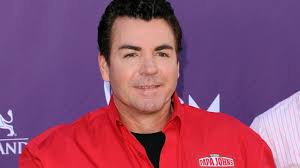
John Schnatter
How high would they go up?
By as much as eleven to fourteen cents price increase per pizza, or fifteen to twenty cents per order!
And Schnatter made it clear: He wasn’t going to take this lying down. He was determined to pass along those costs to his customers.
“If Obamacare is in fact not repealed,” Schnatter told Politico, “we will find tactics to shallow out any Obamacare costs and core strategies to pass that cost onto consumers in order to protect our shareholders’ best interests.”
After all, why should a multi-million-dollar company show any concern for those who make its profits a reality?
Consider:
- Papa John’s is the third-largest pizza takeout and delivery chain in the United States.
- Its full year 2014 revenues were $1.60 billion, an increase of 11.1% from 2013 revenues of $1.44 billion.
- Its full year 2014 net income was $73.3 million, compared to 2013 net income of $69.5 million.
Click here: Papa John’s Announces Fourth Quarter and Full Year 2014 Results (NASDAQ:PZZA)
Nor should anyone expect Schnatter to take a pay cut, just so his employees can obtain medical care when they need it.
Schnatter’s total calculated compensation for 2014 came to $3,456,146.
Click here: John H. Schnatter: Executive Profile & Biography – Businessweek
“We’re not supportive of Obamacare, like most businesses in our industry,” Schnatter–a supporter of Republican Presidential candidate Mitt Romney–admitted in a 2012 interview with Politico.
To demonstrate his opposition to providing medical insurance for all Americans, Schnatter hosted a fundraising event for Mitt Romney at his own Louisville, Kentucky mansion in May, 2012.
The luxurious setting for the fundraiser gave Romney a rush of pure, plutocratic ecstasy.
“What a home this is,” gushed Romney. “What grounds these are, the pool, the golf course.
“You know, if a Democrat were here he’d look around and say no one should live like this. Republicans come here and say everyone should live like this.”

John Schnatter’s estate
Of course, Romney conveniently ignored a brutally ugly fact:
For the vast majority of Papa John’s minimum-wage-earning employees–many of them working only part-time–the odds of their owning a comparable estate are non-existant.
In a typical demonstration of corporate thinking, Judy Nichols, a Papa John’s franchise owner in Beaumont, Texas, said:
“I have two options, I can stop offering coverage and pay the $2,000 fine, or I could keep my number of staff under 50 so the mandate doesn’t apply,” she told Legal Newsline.
In short: Defy the law, and employee healthcare needs be damned.
In fact, that’s exactly what Schnatter announced he would do: Reduce his workers’ hours–since Obamacare mandates that only employees working more than 30 hours per week are covered under their employers’ health insurance plan.
Nichols claimed that the the law might cost her $20,000 to $30,000 in taxes: “Obamacare is making me think about cutting jobs instead,” she said.
Translation: If you force me to behave responsibly, I’ll just have to take it it out on thousands of willing-to-work Americans.
So how can America cope with behavior that destroys not only lives but the economy as well?
By passing–and vigorously enforcing–a nationwide Employers Responsibility Act.
Among its provisions:
Employers would be required to provide full medical and pension benefits for all employees, regardless of their full-time or part-time status.
Increasingly, employers are replacing full-time workers with part-time ones–solely to avoid paying medical and pension benefits.
Requiring employers to act humanely and responsibly toward all their employees would encourage them to provide full-time positions–and hasten the death of this greed-based practice.
The seeking of “economic incentives” by companies in return for moving to or remaining in cities/states would be strictly forbidden.
Such “economic incentives” usually:
- allow employers to ignore existing laws protecting employees from unsafe working conditions;
- allow employers to ignore existing laws protecting the environment;
- allow employers to pay their employees the lowest acceptable wages, in return for the “privilege” of working at these companies; and/or
- allow employers to pay little or no business taxes, at the expense of communities who are required to make up for lost tax revenues.
Employers who continue to make such overtures would be prosecuted for attempted bribery or extortion:
- Bribery, if they offered to move to a city/state in return for “economic incentives,” or
- Extortion, if they threatened to move their companies from a city/state if they did not receive such “economic incentives.”
This would
- protect employees against artificially-depressed wages and unsafe working conditions;
- protect the environment in which these employees live; and
- protect cities/states from being pitted against one another at the expense of their economic prosperity.
It’s past time for America to protect employees who work for a living from CEOs who simply take credit for the work those employees do.
2012 PRESIDENTIAL ELECTION, 2016 PRESIDENTIAL RACE, ABC NEWS, AL GORE, ALTERNET, AMERICABLOG, ANDREW JACKSON, AP, BABY BOOMER RESISTANCE, BARACK OBAMA, BBC, BC NEWS, BLOOMBERG, BLUESKY, BUZZFEED, CBS NEWS, CNN, CROOKS AND LIARS, DAILY KOS, DONALD TRUMP, ELECTORAL COLLEGE, FACEBOOK, FIVETHIRTYEIGHT, GEORGE W. BUSH, HARPER’S MAGAZINE, HUFFINGTON POST, JOHN C. CALHOUN, MEDIA MATTERS, MITT ROMNEY, MOTHER JONES, MOVEON, MSNBC, NBC NEWS, NEW REPUBLIC, NEWSDAY, NEWSWEEK, NPR, PBS NEWSHOUR, POLITICO, POLITICUSUSA, RAW STORY, REPUBLICANS, REUTERS, SALON, SEATTLE TIMES, SLATE, TALKING POINTS MEMO, THE ATLANTIC, THE CHICAGO SUN-TIMES, THE CHICAGO TRIBUNE, THE DAILY BEAST, THE DAILY BLOG, THE GUARDIAN, THE HILL, THE HUFFINGTON POST, THE INTERCEPT, THE LOS ANGELES TIMES, THE NATION, THE NEW REPUBLIC, THE NEW YORK TIMES, THE NEW YORKER, THE VILLAGE VOICE, THE WALL STREET JOURNAL, THE WASHINGTON POST, THINKPROGRESS, TIME, TREASON, TRUTHDIG, TRUTHOUT, TWITTER, TWO POLITICAL JUNKIES, U.S. NEWS & WORLD REPORT, UPI, USA TODAY, X
In Bureaucracy, History, Law, Military, Politics, Social commentary on September 1, 2016 at 12:07 am
As the 2016 Presidential race gets ever closer to the finish, it’s well to consider Donald Trump’s ideas about democracy.
In 2011, as the 2012 Presidential race began heating up, Trump didn’t have a very high opinion of Mitt Romney, the man who then seemed the likely Republican nominee for President.
On April 17, 2011, toying with the idea of entering the Presidential race himself, the always self-promoting Trump said this about Romney, the former Massachusetts governor and GOP candidate:
“He’d buy companies. He’d close companies. He’d get rid of jobs. I’ve built a great company. I’m a much bigger businessman and have a much, much bigger net worth. I mean my net worth is many, many, many times Mitt Romney.
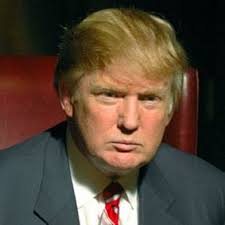
Donald Trump
“Mitt Romney is a basically small-business guy, if you really think about it. He was a hedge fund. He was a funds guy. He walked away with some money from a very good company that he didn’t create. He worked there. He didn’t create it.”
Trump added that Bain Capital, the hedge fund where Romney made millions of dollars before running for governor, didn’t create any jobs. Whereas Trump claimed that he—Trump—had created “hundreds of thousands of jobs.”
So Romney himself may have been puzzled when Trump announced, on February 2, 2012: “It’s my honor, real honor, and privilege to endorse Mitt Romney” for President.
“Mitt is tough, he’s smart, he’s sharp, he’s not going to allow bad things to continue to happen to this country that we all love. So, Governor Romney, go out and get ‘em. You can do it,” said Trump.
And Romney, in turn, had his own swooning-girl moment: “I’m so honored to have his endorsement….There are some things that you just can’t imagine in your life. This is one of them.”
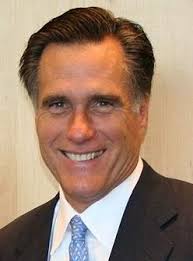
Mitt Romney
Throughout the 2012 Presidential race, Trump continued to “help” Romney—by repeatedly accusing President Barack Obama of not being an American citizen.
Had that been true, Obama would not have had the right to be President—since the Constitution says that only an American citizen can hold this position.
Of course, that was entirely what Trump wanted people to believe—that Obama was an illegitimate President, and deserved to be thrown out.
Come election night—and disaster for Romney. And Trump.
When it became clear that Romney was not going to be America’s 45th President, Trump went ballistic on Twitter. Among his tweets:
- More votes equals a loss…revolution!
- Lets fight like hell and stop this great and disgusting injustice! The world is laughing at us.
- We can’t let this happen. We should march on Washington and stop this travesty. Our nation is totally divided!
- The phoney electoral college made a laughing stock out of our nation. The loser one!
- He lost the popular vote by a lot and won the election. We should have a revolution in this country!
To put Trump’s rants into real-world perspective:
- According to Trump, the electoral process works when a Republican wins the Presidency. It only doesn’t work when a Democrat wins.
- “We should march on Washington” conjures up images of another Fascist–Benito Mussolini–marching on Rome at the head of his Blackshirts to seize power. Which, in a democracy, is treason.
- “The phoney electoral college made a laughing stock out of our nation. The loser one!”
This last is startling, on three counts:
First, the 2012 Republican Platform spoke lovingly about the need for preserving the Electoral College:
“We oppose the National Popular Vote Interstate Compact or any other scheme to abolish or distort the procedures of the Electoral College.
“We recognize that an unconstitutional effort to impose ‘national popular vote’ would be a mortal threat to our federal system and a guarantee of corruption as every ballot box in every state would become a chance to steal the presidency.”
Second, the loser didn’t win: He lost. With votes still being counted (as of November 8) Obama got 60,652,238. Romney got 57,810,407.
Third, in 2000, Al Gore won the popular vote (50,999,897) to George W. Bush’s 50,456,002. But Bush trounced Gore in the Electoral College (271 to 266).
Still, that meant Bush—not Gore—would head the country for the next eight years. And that was perfectly OK with right-wingers like Trump.
It was only when Obama won the Electoral College count by 332 to 206 that this was—according to Trump–a “travesty.”
And Trump’s solution if voters dare to elect someone other than Trump’s pet choice: “Revolution!”
This comes perilously close to advocating violent overthrow of the government. Otherwise known as treason–a crime traditionally punished by execution, or at least lengthy imprisonment.
When former President Andrew Jackson was close to death, he asked his doctor: What act of my administration will be most severely condemned by future Americans?

Andrew Jackson
The doctor threw out a couple of guesses.
“Not at all!” replied Jackson. “Posterity will condemn me more because I was persuaded not to hang John C. Calhoun [the South Carolina Senator who created the doctrine of “secession” that ultimately led to the Civil War] as a traitor than for any other act in my life!”
If Donald Trump inherits control of America’s nuclear weapons, future historians—if there are any—may feel that Barack Obama should have done the same for Trump.
ABC NEWS, ALAMO, ANDREW JACKSON, CAMERON JUDD, CBS NEWS, CNN, CROCKETT OF TENNESSEE, DAVID CROCKETT, DAVY CROCKETT: KING OF THE WILD FRONTIER, DONALD TRUMP, FACEBOOK, INDIAN WARS, JAMES BOWIE, MITT ROMNEY, NBCNEWS, TEXAS REVOLUTION, THE CHICAGO SUN-TIMES, THE CHICAGO TRIBUNE, THE LOS ANGELES TIMES, THE NEW YORK TIMES, THE WASHINGTON POST, TWITTER, WALT DISNEY, WILLIAM BARRET
In Business, History, Military, Politics, Social commentary on August 5, 2016 at 1:26 am
March 6, 2016, marked the 180th anniversary of the fall of the Alamo, a crumbling former Spanish mission in the heart of San Antonio, Texas.
It’s one of those battles like Thermopylae that have passed from history into legend.
It’s been the subject of novels, movies, biographies, histories and TV dramas (most notably Walt Disney’s 1955 “Davy Crockett: King of the Wild Frontier”).
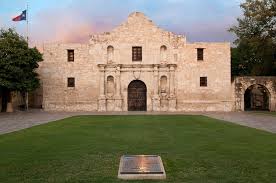
The Alamo
Perhaps the most extraordinary scene in any Alamo movie or book occurs in the 1993 novel, Crockett of Tennessee, by Cameron Judd.
And it is no less affecting for its being–so far as we know–entirely fictional.
It’s March 5, 1836–the last night of life for the Alamo garrison. The night before the 2,000 men of the Mexican Army hurl themselves at the former mission and slaughter its 200 “Texian” defenders.
The fort’s commander, William Barret Travis, has drawn his “line in the sand” and invited the garrison to choose: To surrender, to try to escape, or to stay and fight to the death.
And the garrison–except for one man–chooses to stay and fight.
For the garrison, immortality lies only hours away. Or does it?
An hour after deciding to stand and die in the Alamo, wrapped in the gloom of night, Crockett is seized with paralyzing fear.
“We’re going to die here,” he chokes out to his longtime friend, Persius Tarr. “You understand that, Persius? We’re going to die!”

“I know, Davy. But there ain’t no news in that,” says Tarr. “We’re born to die. Every one of us. Only difference between us and most everybody else is we know when and where it’s going to be.”
“But I can’t be afraid–not me. I’m Crockett. I’m Canebrake Davy. I’m half-horse, half-alligator.”
“I know you are, Davy,” says Tarr. “So do all these men here. That’s why you’re going to get past this.
“You’re going to put that fear behind you and walk back out there and fight like the man you are. The fear’s come and now it’s gone. This is our time, Davy.”
“The glory-time,” says Crockett.
“That’s right, David. The glory-time.”
And then Tarr delivers a sentiment wholly alien to money-obsessed men like Mitt Romney and Donald Trump–who comprise the richest and most privileged 1% of today’s Americans.
“There’s men out there with their eyes on you. You’re the only thing keeping the fear away from them. You’re joking and grinning and fiddling–it gives them courage they wouldn’t have had without you.
“Maybe that’s why you’re here, Davy–to make the little men and the scared men into big and brave men. You’ve always cared about the little men, Davy. Remember who you are.
“You’re Crockett of Tennessee, and your glory-time has come. Don’t you miss a bit of it.”
The next morning, the Mexicans assault the Alamo. Crockett embraces his glory-time–and becomes a legend for all-time.
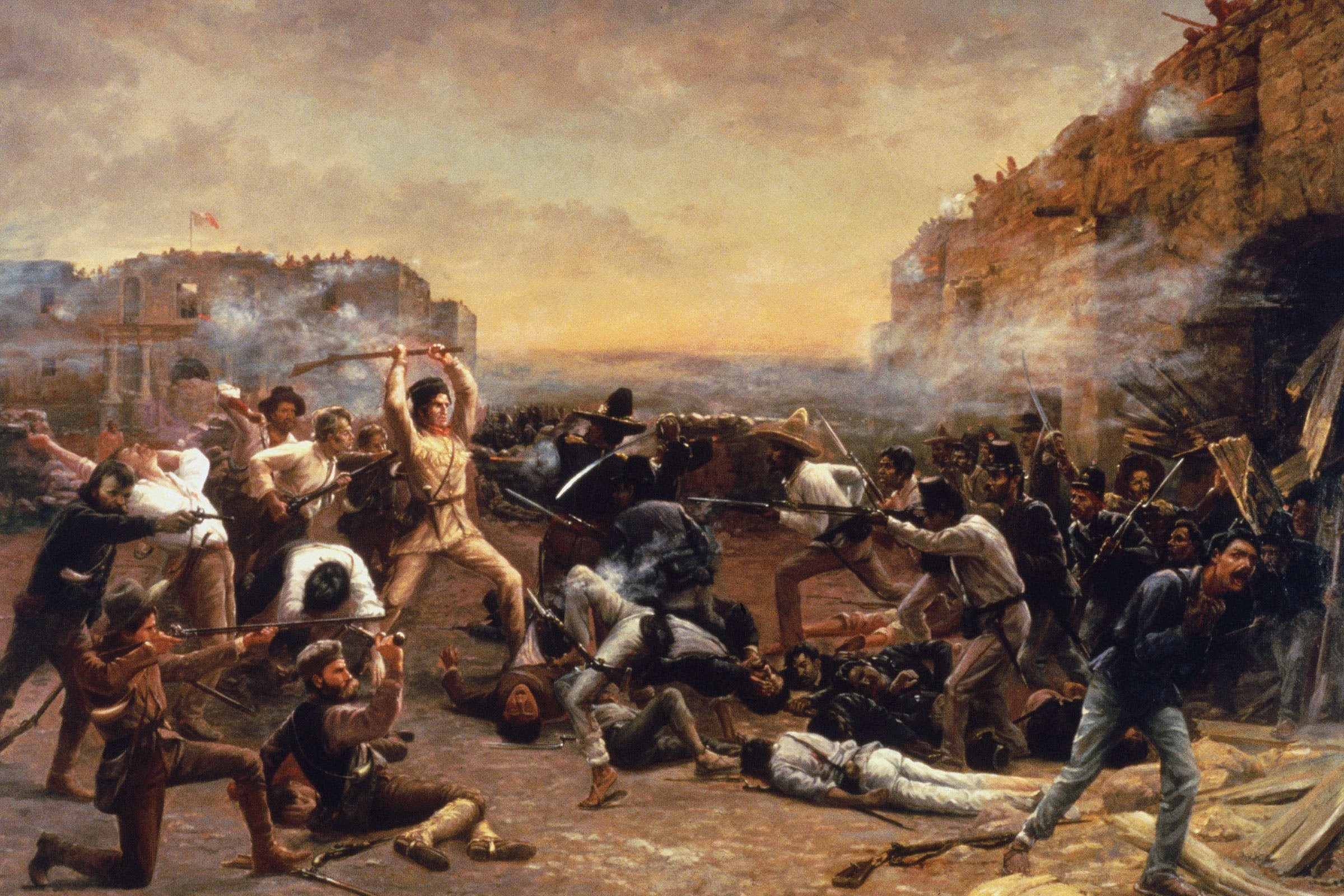
David Crockett (center) at the fall of the Alamo
David Crockett (1786-1836) lived–and died–a poor man. But this did not prevent him from trying to better the lives of his family and fellow citizens–and even his former enemies.

David Crockett
During the war of 1812, he served as a scout under Andrew Jackson. His foes were the Creek Indians, who had massacred 500 settlers at Fort Mims, Alabama–and threatened to do the same to Crockett’s family and neighbors in Tennessee.
As a Congressman from Tennessee, he championed the rights of poor whites. And he opposed then-President Jackson’s efforts to force the same defeated Indians to depart the lands guaranteed them by treaty.
To Crockett, a promise was sacred–whether given by a single man or the United States Government.
And his presence during the 13-day siege of the Alamo did cheer the spirits of the vastly outnumbered defenders. It’s a matter of historical record that he and a Scotsman named MacGregor often staged musical “duels” to see who could make the most noise.
It was MacGregor with his bagpipes against Crockett and his fiddle.
Contrast this devotion of Crockett to the rights of “the little men,” as Persius Tarr called them, with the attitude of Donald Trump, the 2016 Republican Presidential nominee.

Donald Trump
On June 16, 2015, while announcing his candidacy, Trump said:
- “…I don’t need anybody’s money. It’s nice. I don’t need anybody’s money. I’m using my own money. I’m not using lobbyists, I’m not using donors. I don’t care. I’m really rich.”
- “I did a lot of great deals and I did them early and young, and now I’m building all over the world….”
- “So I have a total net worth, and now with the increase, it’ll be well-over $10 billion.”
- “But here, a total net worth of–net worth, not assets, not–a net worth, after all debt, after all expenses, the greatest assets–Trump Tower, 1290 Avenue of the Americas, Bank of America building in San Francisco, 40 Wall Street, sometimes referred to as the Trump building right opposite the New York–many other places all over the world. So the total is $8,737,540,000.”
Those who give their lives for others are rightly loved and remembered as heroes. Those who dedicate their lives solely to their wallets and egos are rightly soon forgotten.
2016 ELECTION, ABC NEWS, BARACK OBAMA, BILL CLINTON, CBS NEWS, CHIANG KAI-SHEK, CHINA, CNN, CUBAN MISSILE CRISIS, DEMOCRATIC PARTY, DONALD TRUMP, DWIGHT D. EISENHOWER, FOX NEWS, GEORGE H.W. BUSH, GEORGE W. BUSH, HARRY S. TRUMAN, HILLARY CLINTON, JOHN F. KENNEDY, JOSEPH MCCARTHY, MAO TSE-TUNG, MITT ROMNEY, NAVY SEALS, NBC NEWS, NO EASY DAY, OSAMA BIN LADEN, PENTAGON, REPUBLICAN PARTY, RICHARD NIXON, Ronald Reagan, THE CHICAGO SUN-TIMES, THE CHICAGO TRIBUNE, THE LOS ANGELES TIMES, THE NEW YORK TIMES, THE NEW YORKER, THE WASHINGTONPOST, TREASON, U.S. NAVY SEALS, VLADIMIR PUTIN, WIKILEAKS
In Bureaucracy, History, Military, Politics, Social commentary on July 28, 2016 at 12:08 am
“Russia, if you’re listening, I hope you’re able to find the 30,000 emails that are missing. I think you will probably be rewarded mightily by our press.”
The speaker was Donald Trump, holding a July 27 press conference in Doral, Fla.
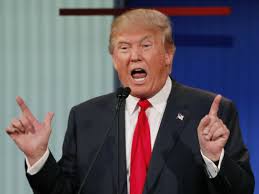
Donald Trump
And he was urging a foreign leader to hack into the private email server of his Presidential rival, Hillary Clinton.
Five days earlier, Wikileaks had released 19,252 emails and 8,034 attachments hacked from computers of the highest-ranking officials of the Democratic National Committee (DNC).
Cyber-security experts believe the hacking originated from Russia–and that Russian President Vladimir Putin may have authorized it.
Politicians on the Left and Right expressed outrage at Trump’s remarks.
But this is not the first time the Right has jeopardized American security.
During the 2012 Presidential campaign, supporters of Mitt Romney accused President Barack Obama of leaking top-secret details of the U.S. Navy SEALs raid on Osama bin Laden’s compound in Abbottabad, Pakistan.
The raid, launched on May 1, 2011, resulted in the death of the 9/11 mastermind and the capture of a treasury of highly sensitive Al Qaeda documents.
According to Right-wingers, Obama wanted to provide Hollywood screenwriters with material for a movie to glorify his role in authorizing the raid.
In August, 2012, the Right found its own secrets-leakers. And they operated under the name of the Fox News Network.
Their motive: To promote a book–No Easy Day: The Firsthand Account of the Mission That Killed Osama Bin Laden. It was slated to hit bookstores on September 11–the 11th anniversary of Al Qaeda’s attacks on the Pentagon and World Trade Center.
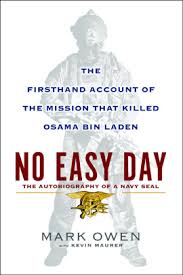
It had been penned under the pseudonym “Mark Owen.” But the real name of the author–a 36-year-old former Navy SEAL Team Six member who took part in the raid–was Matt Bissonnette, of Wrangell, Alaska.
Bissonnette’s real name became public after multiple sources leaked it to Fox News–who revealed it on August 23.
The Navy SEALs who killed bin Laden had previously been left unidentified.
Fox News had repeatedly accused President Obama and members of his administration of treasonously leaking military secrets to the media to glorify the President.
Many former and current SEAL members feared that the book would release information that could compromise future missions.
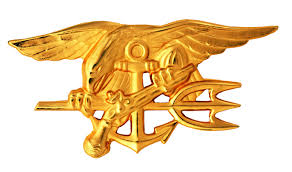
U.S. Navy SEALs insignia
One Navy SEAL told Fox News, “How do we tell our guys to stay quiet when this guy won’t?” Some SEALs called Bissonnette a “traitor.”
And Colonel Tim Nye, a Special Operations Command spokesman, said the author “put himself in danger” by writing the book.
“This individual came forward. He started the process. He had to have known where this would lead. He’s the one who started this, so he bears the ultimate responsibility for this.”
But Bissonnette placed more than his own life in jeopardy. He endangered the lives of every one of the men who participated in the bin Laden raid.
If Bissonnette fell into the hands of Al Qaeda terrorists or sympathizers, he could conceivably be tortured into revealing at least some of the names and locations of his former team members.
And Fox News not only revealed his true name but the town where he lived.

Even the liberal Nation magazine was appalled at the recklessness of this Right-wing propaganda outlet. Jeremy Scahill, a writer for Nation, tweeted:
“Why on earth would FOX News publish the alleged identity of one of the ST6 members who was in the OBL raid? Seriously.”
Millions of Right-wing Americans have been conditioned by decades of Fascistic propaganda to believe that:
- Democrats are all traitors–or at least potential traitors.
- Even those Democrats who aren’t traitors are too weak-kneed to protect the nation from its sworn enemies.
- Democrats (have betrayed) (are betraying) (intend to betray) national security secrets to the Soviet/Chinese Communists.
- Democrats have (betrayed/) (are betraying) (intend to betray) national security secrets to Islamic Jihadists.
- Only Republicans can be trusted to protect the nation.
Republicans blamed President Harry S. Truman for “losing China” to the forces of Mao Tse Tung in 1949. America could not have prevented a corrupt and incompetent Chiang Kai-Shek from being driven off the Chinese mainland by Mao’s overwhelmingly powerful armies.
Then, in 1950, Senator “Tail Gunner Joe” McCarthy charged that the State Department was infested by Communists–and that the Truman administration knew it but refused to take action. The charges were false.

Joseph R. McCarthy
During the 2008 Presidential campaign, Republicans charged that Barack Obama was really a Muslim non-citizen who intended to sell out America’s security to his Muslim “masters.”
Attacking the patriotism of their opponents has repeatedly elected Republicans:
- It elected Dwight Eisenhower President and turned Congress Republican in 1952 and 1956.
- It elected Richard Nixon President in 1968 and 1972.
- It elected Ronald Reagan President in 1980 and 1984.
- It elected George H.W. Bush President in 1988.
- It gave Republicans control of the Congress in 1994 (although Bill Clinton had been elected President in 1992).
- It elected George W. Bush President in 2000 and 2004.
- It gave control of the House to Republicans in 2010 and the Senate in 2014.
And now Republicans hope this appeal will elect a man who has openly called on Vladimir Putin to hack into American computers.
ABC NEWS, ASTROLOGY, BARACK OBAMA, BILL CLINTON, CBS NEWS, CNN, COMMUNIST CHINA, DONALD REGAN, DONALD TRUMP, EMPRESS ALEXANDRA, FACEBOOK, FBI, GEORGE W. BUSH, GERALD R. FORD, GRIGORY RASPUTIN, HILLARY CLINTON, HOUSE OF REPRESENTATIVES, JAMES COMEY, JIMMY CARTER, JOAN QUIGLEY, JODIE FOSTER, JOHN W. HINCKLEY, JUSTICE DEPARTMENT, KEVIN MCCARTHY, MERV GRIFFIN, MIKHAIL GORBACHEV, MITT ROMNEY, NANCY REAGAN, NBC NEWS, NICHOLAS II, PAUL RYAN, REPUBLICANS, Ronald Reagan, SOVIET UNION, SUPERSTITION, THE CHICAGO SUN-TIMES, THE CHICAGO TRIBUNE, THE LOS ANGELES TIMES, THE NEW YORK TIMES, THE WALL STREET JOURNAL, THE WASHINGTON POST, TWITTER, USA TODAY
In Bureaucracy, History, Military, Politics, Social commentary on July 7, 2016 at 12:16 am
On July 6, FBI Director James Comey recommended that the Justice Department not prosecute Hillary Clinton for using a private email server during her tenure as Secretary of State.
Almost immediately afterward, Donald Trump, the presumptive Republican nominee for President, responded on Twitter: “FBI director said Crooked Hillary compromised our national security. No charges. Wow! #RiggedSystem.”
Paul Ryan, the Republican Speaker of the House of Representatives, claimed to be similarly outraged: “Declining to prosecute Secretary Clinton for recklessly mishandling and transmitting national security information will set a terrible precedent.”
“What Director Comey’s statements made clear was that Hillary Clinton’s decision to use a personal unsecured server to send work-related emails while service as Secretary of State—including classified information—was extremely irresponsible,” said House Republican Majority leader Kevin McCarthy.
But 28 years ago, Republicans maintained a tight-lipped silence on another matter involving sensitive national security secrets. That was when news broke that Nancy Reagan, as First Lady, had shared these with a court astrologer.
When President Ronald Reagan wanted advice on whether to nuke the Soviet Union or meet with its leader, Mikhail Gorbachev, his most important adviser wasn’t the CIA or Pentagon.
It was Joan Quigley, a San Francisco-based astrologer.
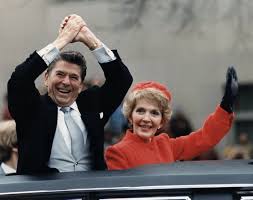
Ronald and Nancy Reagan
Nancy had met Quigley on “The Merve Griffin Show” in 1973. Quigley gave Nancy–and through her, Reagan himself—astrological advice during the latter’s campaign for the Republican Presidential nomination in 1976.
That effort failed to unseat President Gerald Ford–who was defeated by Jimmy Carter. But four years later, in 1980, Reagan defeated Carter to become the 40th President of the United States.
On March 30, 1981, a mentally-disturbed loner named John W. Hinckley shot and critically wounded Reagan. Fixated on actress Jodie Foster, he believed that by shooting the President he could gain her affection.
Shortly after the shooting, Merv Griffin told Nancy that Quigley had told him: If Nancy had called her on that fateful day, she–Quigley–could have warned that the President’s astrological charts had foretold a bad day.
From that moment on, Nancy regularly consulted Quigley on virtually everything that she and the President intended to do.
When Reagan learned of Nancy’s consultations with Quigley, he warned her: Be careful, because it might look odd if it came out.
Nancy may have been speaking on a scrambler-equipped phone. But Quigley–at her San Francisco office–was on an unsecured line. Thus, foreign powers–most notably the Soviet Union and Communist China–could have been privy to President Reagan’s most secret intentions.

Joan Quigley
Nancy passed on Quigley’s suggestions as commands to Donald Regan, chief of the White House staff.
As a result, Regan kept a color-coded calendar on his desk to remember when the astrological signs were good for the President to speak, travel, or negotiate with foreign leaders: Green ink highlighted “good” days; red ink “bad” days; yellow ink “iffy” days.
Donald Regan, no fan of Nancy’s, chafed under such restrictions: “Obviously, this list of dangerous or forbidden dates left very little latitude for scheduling,” he later wrote.
Forced out of the White House in 1987 by Nancy, Regan struck back in a 1988 tell-all memoir: For the Record: From Wall Street to Washington.
Regan’s book revealed, for the first time, how Ronald Reagan had actually made his Presidential decisions.
All–including decisions to risk nuclear war with the Soviet Union–were based on a court astrologer’s horoscopes. Rationality and the best military intelligence available played a lesser, secondary role.
The last major world leader to turn to the supernatural for advice had been Russian Czar Nicholas II. His adviser had been Grigori Rasputin, a Siberian peasant whom Empress Alexandra believed was the only man who could save her hemophiliac son–and heir to the throne.
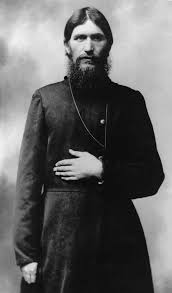
Grigori Rasputin
In 1990, Quigley confirmed the allegations in an autobiography, What Does Joan Say?: My Seven Years As White House Astrologer to Nancy and Ronald Reagan.
The title came from the question that Ronald Reagan asked Nancy before making important decisions–including those that could risk the destruction of the United States.
Bragged Quigley: “Not since the days of the Roman emperors–and never in the history of the United States Presidency—has an astrologer played such a significant role in the nation’s affairs of State.”
Among the successes Quigley took credit for:
- Strategies for winning the Presidential elections of 1980 and 1984;
- Helping Nancy Reagan overhaul her image as a spoiled rich girl;
- Defusing the controversy over Reagan’s visiting a graveyard for SS soldiers in Bitburg, Germany;
- Pursuing “Star Wars” as a major part of his strategy against the Soviet Union;
- The Intermediate-Range Nuclear Forces Treaty;
- Protecting Reagan from would-be assassins through timely warnings to Nancy; and
- Moving Reagan from seeing the Soviet Union as the “Evil Empire” to accepting Mikhail Gorbachev as a peace-seeking leader.
Thirty-five years after he became President, Ronald Reagan remains the most popular figure among Republicans. His deliberately-crafted myth is held up as the example of Presidential greatness by Right-wing candidates.
Curiously, however, none of them mention his approach to government-by-astrologer.
2016 PRESIDENTIAL CAMPAIGN, ABC NEWS, ADOLF HITLER, ANCIENT ROME, ANTONIN SCALIA, CAMPAIGN CONTRIBUTIONS, CBS NEWS, CITIZENS UNITED, CLEOPATRA, CNN, DONALD TRUMP, FACEBOOK, FORECLOSURES, GLADIATORS, JULIUS CAESAR, KIRK DOUGLAS, LAURENCE OLIVER, MARCUS CRASSUS, MEIN KAMPF, MITT ROMNEY, NBC NEWS, NEWT GINGRICH, SHELDON ADELSON, SPARTACUS, SUPREME COURT, THE CHICAGO SUN-TIMES, THE CHICAGO TRIBUNE, THE LOS ANGELES TIMES, THE NEW YORK TIMES, THE WASHINGTON POST, TWITTER
In Bureaucracy, Business, History, Law, Politics, Social commentary on May 24, 2016 at 12:56 am
The 1960 Kirk Douglas epic, Spartacus, may soon prove to be more than great entertainment. It may also turn out to be a prophecy of the end of the American Republic.
In the movie, Spartacus (Douglas), a Roman slave, entertains Marcus Crassus (Laurence Oliver) the richest man in Rome. He does so by fighting to the death as a gladiator.

Poster for Spartacus
While Spartacus and his fellow gladiator/friend, Draba, slash and stab at each other in the arena, Crassus idly chats with his crony, Marcus Glabrus.
Crassus has just secured Glabrus’ appointment as commander of the garrison of Rome. Glabrus is grateful, but curious as to how he did it.
After all, Gaius Gracchus, the leader of the Roman Senate, hates Crassus, and stands ever ready to oppose his every move.
“I fought fire with oil,” says Crassus. “I purchased the Senate behind his back.”
Draba defeats Spartacus in their gladiatorial bout, but refuses to kill him. Instead, he throws his spear at Crassus and is immediately slaughtered by Roman guards.
Soon afterward, Spartacus leads 70 other gladiators against their Roman masters, forms an army of freed slaves, and marches against Rome.
Just as Crassus bought the Roman Senate in Spartacus, so, too, are billionaires now buying the 2016 Presidential election.
In 2016, Newt Gingrich, former Speaker of the House of Representatives, ran as the pet candidate of casino billionaire Sheldon G. Adelson. Since 2007, Adelson had spent millions in support of Gingrich and his causes.
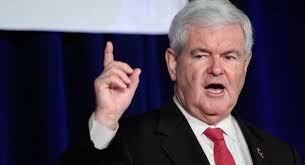
Newt Gingrich
Adelson put up seed money and, ultimately, $7.7 million between 2006 and 2010 for a nonprofit group that served as a precursor to Gingrich’s presidential campaign.
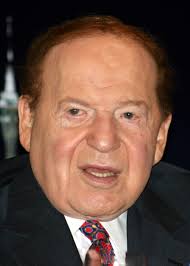
Sheldon Adelson
Such a contribution is no small amount to the average American. But Adelson is listed by Forbes as the eighth-wealthiest American, with a net worth of $21.5 billion.
Naturally, Adelson denied he had any selfish motives for shelling out so much money to a candidate for the most powerful office in the world:
“My motivation for helping Newt is simple and should not be mistaken for anything other than the fact that my wife Miriam and I hold our friendship with him very dear and are doing what we can as private citizens to support his candidacy.”
Unfortunately, Gingrich was not the only candidate of the rich, by the rich and for the rich seeking the Presidency.
Former Massachusetts Governor Mitt Romney relied heavily on a small group of millionaires and billionaires for support.
By February, 2012, a quarter of the money amassed by Romney’s campaign came from just 41 people. Each contributor gave more than $100,000, according to a Washington Post analysis of disclosure data. Nearly a dozen of the donors had contributed $1 million or more.
Some of Romney’s biggest supporters included executives at Bain Capital, his former firm; bankers at Goldman Sachs; and a hedge fund mogul who made billions betting on the housing crash.
Like Adelson, Bain has directly profited from the losses of others.
Fast forward to 2016:
In early May, Adelson met privately with Republican Presidential nominee-in-waiting Donald Trump. Nevertheless, at least this much has leaked:
Adelson promised to contribute more to secure Trump’s election than he had contributed to any previous campaign. This could exceed $100 million.
Meanwhile, Trump is bragging that he’s “not beholden” to any “special interests” because “I’m really rich.” This myth has been a main reason for his popularity as a candidate.

Donald Trump
All of this can be directly traced to the 2010 “Citizens United” decision by the U.S. Supreme Court that ended limits in corporate contributions to political campaigns. The decision is so named for the group that successfully sued over federal campaign finance laws.
The 5-4 decision led to the rise of Super PACs–outside groups affiliated with candidates that can take in unlimited contributions as long as they don’t directly coordinate with the candidate. The overwhelming majority of this money goes for negative ads–that slander opponents without saying anything about what a candidate proposes to do.
Former U.S. Supreme Court Justice Antonin Scalia brushed aside criticism of the corrupting role money played in politics: Change the channel or turn off the TV.
“I don’t care who is doing the speech–the more the merrier,” Scalia said. “People are not stupid. If they don’t like it, they’ll shut it off.”
On the contrary: A fundamental principle of propaganda holds that most people are stupid–or can be made to behave stupidly. If they are ceaselessly bombarded with mind-numbing lies, they will eventually substitute these for reality.
In Mein Kampf, Adolf Hitler laid out his formula for successful propaganda: “All effective propaganda must be confined to a few bare essentials.
“These must be expressed as far as possible in stereotypical formulas. These slogans should be persistently repeated until the very last individual has come to grasp the idea that has been put forward.”
During the early 1960s a series of movies about the Roman Empire–like Spartacus and Cleopatra–hit the big screen. In these, rich criminals like Marcus Crassus openly bought the favors of ambitious politicians like Julius Caesar.
No doubt millions of moviegoers thought, “Boy, I’m glad that couldn’t happen here.” But it has happened here–and it’s happening right now.
1984 NOVEL, 9/11, ABC NEWS, ADOLF HITLER, BARACK OBAMA, BILL CLINTON, BIRTH CONTROL, BLACKS, CBS NEWS, CNN, COMMUNISM, DENNIS HASTERT, DISABLED, DISCRIMINATION, DWIGHT D. EISENHOWER, EDWARD R. MURROW, ENVIRONMENTALISTS, FACEBOOK, FAMILY RESEARCH COUNCIL, FRANKLIN D. ROOSEVELT, GAYS, GEORGE C. MARSHALL, GEORGE H.W. BUSH, GEORGE ORWELL, GOP, GREAT SOCIETY, HARRY S. TRUMAN, HISPANICS, HIV MEDICATION, HOUSE OF REPRESENTATIVES, J. ROBERT OPPENHEIMER, JOHN BIRCH SOCIETY, JOHN F. KENNEDY, JOHN STEINBECK, JOSEPH R. MCCARTHY, JOSEPH STALIN, JOSH DUGGAR, KGB, LEE ATWATER, LEON TROTSKY, LESBIANS, LIBERALS, LUCILLE BALL, LYNDON B. JOHNSON, MEDICAL CARE, MEIN KAMPF, MICHAEL DUKAKIS, MICHELLE BACHMANN, MITT ROMNEY, MUSLIMS, NBC NEWS, PETE SEEGER, PROPAGANDA, RELIGION, REPUBLICANS, RICHARD NIXON, RICK SANTORUM, ROBERT WELCH, RODNEY KING RIOTS, SCAPEGOATING, SHARIA LAW, SOCIALISTS, SOVIET UNION, THE LOS ANGELES TIMES, THE NEW YORK TIMES, THE RELIGIOUS FREEDOM RESTORATION ACT, THE WASHINGTON POST, TRANSGENDERS, TWITTER, WILLIAM L. SHIRER, WOMEN, WORLD WAR ii
In Bureaucracy, History, Law, Politics, Social commentary on May 23, 2016 at 12:05 am
Republicans and their Rightist allies have repeatedly compared President Barack Obama to Adolf Hitler. But their propaganda campaign draws heavily on the Nazi leader’s own advice.
In Mein Kampf, Hitler laid out his formula for successful propaganda: “All effective propaganda must be confined to a few bare essentials.
“Those must be expressed as far as possible in stereotypical formulas. These slogans should be persistently repeated until the very last individual has come to grasp the idea that has been put forward.”

Adolf Hitler
Bundesarchiv, Bild 183-H1216-0500-002 / CC-BY-SA, CC BY-SA 3.0 DE <https://creativecommons.org/licenses/by-sa/3.0/de/deed.en>, via Wikimedia Commons
Consider the vocabulary Right-wingers use to describe their political adversaries:
“Liberals,” “radicals, “bankrupting,” “treason,” subversion,” “slander,” “terrorism,” “betrayal,” “catastrophe,” “shattering the American dream,” “leftists,” “Communists,” “government takeover,” “socialism,” “power grab,” “secularism,” “environmentalism.”
In recent years, the GOP has targeted gays and lesbians as America’s subversive enemies.These attacks have come as thinly disguised as efforts to “restore religious freedom.”
In December, 2014, Republicans in the Michgan House of Representatives passed “The Religious Freedom Restoration Act.”
The bill would allow public agencies and private businesses to refuse service to anyone under the claim that their “religious beliefs” had been affronted.
And the State government would be legally prevented from intervening if a person claimed that his/her “deeply-held religious beliefs” was the reason for acting–or not acting–in a certain way.
Thus:
- An emergency room doctor could refuse service to a gay or lesbian needing medical care.
- A pharmacist could refuse to fill a doctor’s prescription for birth control, or HIV medication.
- A DMV clerk could refuse to give a driver’s license to someone who’s divorced.
- An employer could deny equal pay to women.
The bill seems modeled on a proposed law that the Republican House and Senate in Arizona sent to Governor Jan Brewer in 2014.
Under threat of a nationwide boycott of Arizona if the bill became law, Brewer vetoed it.
Republicans have introduced similar “right-to-discriminate” legislation in other states as well:
- On March 26, 2015, its governor, Mike Pence, signed into law the Religious Freedom Restoration Act. This will allow any individual or corporation to cite its religious beliefs as a defense when sued by a private party.
- In Kansas, lawmakers voted to exempt individuals from providing any service that was “contrary to their sincerely held religious beliefs.”
- That bill passed the state’s House chamber on February 11, 2014, triggering national backlash. It stalled in the Senate and didn’t advance beyond that body.
- In January, 2014, South Dakota Republicans introduced a bill to let businesses refuse to serve same-sex couples on the grounds that “businesses are private and that their views on sexual orientation are protected to the same extent as the views of private citizens.”
- The South Dakota bill–which was killed in February, 2014–would have made it illegal for a gay person to file a lawsuit charging discrimination.
Republicans claim they want to “get the government off the backs of the people.” But their fixation on regulating the sexual lives of Americans ensures government intrusions of the most intimate kind.
Since 9/11, Republicans have warned that Muslims are trying to impose Sharia (Islamic law) on America.
Ironically, Right-wing legislators, in elevating religion above the secular law, may have laid the legal foundations for making that possible.
What will happen when some Muslims claim their right–guaranteed in Islamic religious law–to have as many as four wives?
And when they claim that the “religious freedom” laws protect that right?
Republicans have defended such legislation by equating gays with child predators.
In fact, the Child Molestation Research & Prevention Institute states that 90% of child molesters target children in their network of family and friends, and the majority are men married to women.
Yet Republicans and their Rightist allies have refused to condemn such heterosexual–and Right-wing–child molesters as Dennis Hastert and Josh Duggar.
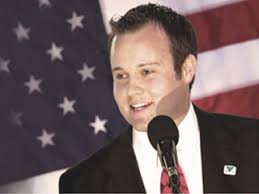
Josh Duggar, the “all-American” child molester
On May 21, 2015, responding to press leaks, Duggar resigned as director of the Family Research Council, a Right-wing organization dedicated to fighting sexually-oriented issues such as same-sex marriage, abortion and pornography.
In 2002-3, as a 14-15 year-old, Duggar had fondled the breasts and vaginas of five underage girls–four of whom were his own sisters.
And on October 28, 2015, Hastert–Speaker of the House of Representatives from 1999 to 2007–pleaded guilty to structuring money transactions in a way to avoid requirements to report where the money was going.

Dennis Hastert
The reason: To conceal the truth about his past as a child molester. Hastert had abused four young boys when he was their high school wrestling coach. One was only 14 years old.
Despite such setbacks, the politics of “smear and fear” have been good to Republicans–and their Right-wing allies.
The Republican “base” refuses to learn that those who portray themselves as morally superior are:
- Hypocrites, who are in effect saying: “Do as I say, not as I do,” or
- Fanatics, who intend to force their version of morality on others.
So long as millions of hate-filled Right-wingers support the endless succession of “two minute hates,” Republicans will continue to target an endless series of victims.
The good news: As blacks, Hispanics, women, gays and others become a significant political force, Republicans will stop attacking them and court them for votes.
The bad news: Republicans will move on to find other still-helpless scapegoats for America’s troubles.
1984 NOVEL, 9/11, ABC NEWS, ADOLF HITLER, BARACK OBAMA, BILL CLINTON, BIRTH CONTROL, BLACKS, CBS NEWS, CNN, COMMUNISM, DENNIS HASTERT, DISABLED, DISCRIMINATION, DWIGHT D. EISENHOWER, EDWARD R. MURROW, ENVIRONMENTALISTS, FACEBOOK, FAMILY RESEARCH COUNCIL, FRANKLIN D. ROOSEVELT, GAYS, GEORGE C. MARSHALL, GEORGE H.W. BUSH, GEORGE ORWELL, GOP, GREAT SOCIETY, HARRY S. TRUMAN, HISPANICS, HIV MEDICATION, HOUSE OF REPRESENTATIVES, J. ROBERT OPPENHEIMER, JOHN BIRCH SOCIETY, JOHN F. KENNEDY, JOHN STEINBECK, JOSEPH R. MCCARTHY, JOSEPH STALIN, JOSH DUGGAR, KGB, LEE ATWATER, LEON TROTSKY, LESBIANS, LIBERALS, LUCILLE BALL, LYNDON B. JOHNSON, MEDICAL CARE, MEIN KAMPF, MICHAEL DUKAKIS, MICHELLE BACHMANN, MITT ROMNEY, MUSLIMS, NBC NEWS, PETE SEEGER, PROPAGANDA, RELIGION, REPUBLICANS, RICHARD NIXON, RICK SANTORUM, ROBERT WELCH, RODNEY KING RIOTS, SCAPEGOATING, SHARIA LAW, SOCIALISTS, SOVIET UNION, THE LOS ANGELES TIMES, THE NEW YORK TIMES, THE RELIGIOUS FREEDOM RESTORATION ACT, THE WASHINGTON POST, TRANSGENDERS, TWITTER, WILLIAM L. SHIRER, WOMEN, WORLD WAR ii
In Bureaucracy, History, Law, Politics, Social commentary on May 20, 2016 at 12:01 am
In 1953, Red-baiting Wisconsin United States Senator Joseph R. McCarthy finally overstepped himself.
He attacked the leadership of the United States Army as “a hotbed of traitors” and convened an inquiry through the Senate Permanent Subcommittee on Investigations.
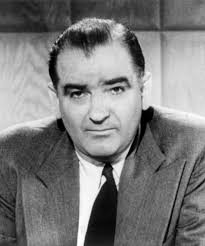
Joseph McCarthy
But the hearings backfired, exposing McCarthy as the bullying demagogue he was. A Senate committee voted to condemn his behavior, charging that he had “acted contrary to senatorial ethics and tended to bring the Senate into dishonor and disrepute.”
Although McCarthy remained in the Senate another two and a half years, his political influence had ended.
Yet even without McCarthy, Republicans rode the issue of anti-Communism to victory from 1948 to 1992.
After holding the White House for eight years under Dwight D. Eisenhower, they lost it in 1960 to John F. Kennedy and again in 1964 to Lyndon B. Johnson.
By 1968, with the nation mired in Vietnam and convulsed by antiwar demonstrations and race riots, Americans turned once more to those who preyed upon their fears and hates.
They elected Richard Nixon, who promised to end the Vietnam war and crack down on “uppity” blacks and antiwar demonstrators.
The same strategy re-elected him in 1972.
After Jimmy Carter won the Presidency in 1976 and lost it in 1980 to Ronald Reagan, Republicans held the White House until 1992.
During the 1970s and 1980s, they continued to accuse their opponents of being devious agents–or at least unwitting pawns–of “the Communist conspiracy.”
Even as late as 1992, President George H.W. Bush and the Republican establishment charged that Arkansas Governor Bill Clinton might be a KGB plant.
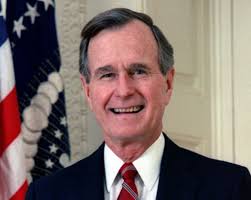
George H.W. Bush
Their evidence: During his tenure at Oxford University in 1969-70, Clinton had briefly visited Moscow.
Thus, the Republican charged that he might have been “programmed” as a real-life “Manchurian candidate” to become, first, Governor of Arkansas–one of America’s poorest states–and then President.
What made this charge all the more absurd: The Soviet Union had officially dissolved in December, 1991.
Republicans continued to accuse their opponents of being “Communists” and “traitors.” But these charges no longer carried the weight they had while the Soviet Union existed.
Right-wingers had to settle for attacking their opponents as “liberals” and “soft on crime.”
When riots flared in 1992 after the acquittal of LAPD officers who had savagely beaten Rodney King, President George H.W. Bush blamed the carnage on the “Great Society” programs of the 1960s.
Then, on September 11, 2001, Republicans–and their right-wing supporters–at last found a suitable replacement for the Red Menace.
Two highjacked jetliners slammed into the World Trade Center in New York and one struck the Pentagon in Washington, D.C.
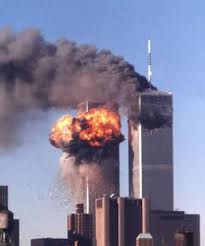
World Trade Center on September 11, 2001
Exit The Red Bogeyman. Enter The Maniacal Muslim.
Consider:
- Rep. Michelle Bachman (R-Minn.): On July 13, 2012, she sent letters to the Inspectors General of the Departments of Defense; State; Justice; and Homeland Security, demanding a “a multi-department investigation into potential Muslim Brotherhood infiltration into the United States Government.”
- Rick Santorum: On supporting the racial profiling of Muslims: “Obviously, Muslims would be someone you look at, absolutely.”
- Mitt Romney: “Based on the numbers of American Muslims in our population, I cannot see that a Cabinet position [for a Muslim] would be justified.
The 2008 election of Barack Obama pushed the Republican “treason chorus” to new heights of infamy.
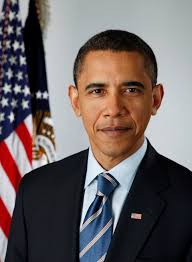
Barack Obama
Almost immediately after Obama took office, he came under attack by an industry of right-wing book authors such as Sean Hannity, Ann Coulter and Rush Limbaugh.
The following titles vividly reveal the hates, fears and ambitions of their authors–and audience:
- Conservative Victory: Defeating Obama’s Radical Agenda by Sean Hannity
- Obama Zombies: How the Liberal Machine Brainwashed My Generation by Jason Mattera
- How Barack Obama is Bankrupting the U.S. Economy by Stephen Moore
- The Manchurian President: Barack Obama’s Ties to Communists, Socialists and Other Anti-American Extremists by Aaron Klein
- The Blueprint: Obama’s Plan to Subvert the Constitution and Build an Imperial Presidency by Ken Blackwell
- Culture of Corruption: Obama and His Team of Tax Cheats, Crooks, and Cronies by Michelle Malkin
- Why Obama’s Government Takeover of Health Care Will Be a Disaster by David Gratzer
- To Save America: Stopping Obama’s Secular-Socialist Machine by Newt Gingrich
- Obama’s Radical Transformation of America: Year One by Joshua Muravchik
- Power Grab: How Obama’s Green Policicies Will Steal Your Freedom and Bankrupt America by Christopher C. Horner
- America’s March to Socialism: Why We’re One Step Closer to Giant Missile Parades by Glenn Beck
- The Obama Nation: Leftist Politics and the Cult of Personality by Jerome R. Corsi
- Censorship: The Threat to Silence Talk Radio by Brian Jennings
- The War On Success: How the Obama Agenda Is Shattering the American Dream by Tommy Newberry
- Green Hell: How Environmentalists Plan to Control Your Life and What You Can Do to Stop Them by Steven Milloy
- Liberalism is a Mental Disorder: Savage Solutions by Michael Savage
- Treason: Liberal Treachery from the Cold War to the War on Terrorism by Ann Coulter
- Slander: Liberal Lies About the American Right by Ann Coulter
- Catastrophe: How Obama, Congress and the Special Interests Are Transforming…a Slump into a Crash, Freedom Into Socialism and a Disaster into a Catastrophe….And How to Fight Back by Dick Morris
1984 NOVEL, 9/11, ABC NEWS, ADOLF HITLER, BARACK OBAMA, BILL CLINTON, BIRTH CONTROL, BLACKS, CBS NEWS, CNN, COMMUNISM, DENNIS HASTERT, DISABLED, DISCRIMINATION, DWIGHT D. EISENHOWER, EDWARD R. MURROW, ENVIRONMENTALISTS, FACEBOOK, FAMILY RESEARCH COUNCIL, FRANKLIN D. ROOSEVELT, GAYS, GEORGE C. MARSHALL, GEORGE H.W. BUSH, GEORGE ORWELL, GOP, GREAT SOCIETY, HARRY S. TRUMAN, HISPANICS, HIV MEDICATION, HOUSE OF REPRESENTATIVES, J. ROBERT OPPENHEIMER, JOHN BIRCH SOCIETY, JOHN F. KENNEDY, JOHN STEINBECK, JOSEPH R. MCCARTHY, JOSEPH STALIN, JOSH DUGGAR, KGB, LEE ATWATER, LEON TROTSKY, LESBIANS, LIBERALS, LUCILLE BALL, LYNDON B. JOHNSON, MEDICAL CARE, MEIN KAMPF, MICHAEL DUKAKIS, MICHELLE BACHMANN, MITT ROMNEY, MUSLIMS, NBC NEWS, PETE SEEGER, PROPAGANDA, RELIGION, REPUBLICANS, RICHARD NIXON, RICK SANTORUM, ROBERT WELCH, RODNEY KING RIOTS, SCAPEGOATING, SHARIA LAW, SOCIALISTS, SOVIET UNION, THE LOS ANGELES TIMES, THE NEW YORK TIMES, THE RELIGIOUS FREEDOM RESTORATION ACT, THE WASHINGTON POST, TRANSGENDERS, TWITTER, WILLIAM L. SHIRER, WOMEN, WORLD WAR ii
In Bureaucracy, History, Politics, Social commentary on May 19, 2016 at 12:01 am
The Right’s fixation on transgender “dangers” is only the latest in a long string of “enemies” painted by the Republican party.
During the 1960s and 1970s, the “enemy” was blacks. The key to winning votes of racist whites without appearing racist lay in what Republicans called “the Southern Strategy.”
It was this that won Richard Nixon the Presidency in 1968 and 1972 and the White House for George H.W. Bush in 1988.
In a now-infamous 1981 interview, Right-wing political consultant Lee Atwater explained how this worked:
“You start out in 1954 by saying, ‘Nigger, nigger, nigger.’ By 1968 you can’t say ‘nigger’—that hurts you, backfires.
“So you say stuff like, uh, forced busing, states’ rights, and all that stuff, and you’re getting so abstract.
“Now, you’re talking about cutting taxes, and all these things you’re talking about are totally economic things and a byproduct of them is, blacks get hurt worse than whites.…
“’We want to cut this,’ is much more abstract than even the busing thing, uh, and a hell of a lot more abstract than ‘Nigger, nigger.’
“So anyway you look at it, race is coming on the back burner.”

Lee Atwater
At the end of his life, Atwater recognized the monster he had helped unleash.
Like Reinhard Heydrich–the designer of the “Final Solution” who, on his deathbed, begged forgiveness for his crimes–Atwater, in a 1991 article for Life, apologized to former Democratic Presidential nominee Michael Dukakis for the “naked cruelty” of the 1988 campaign.
But blacks have by no means been the only targets–and victims–of Republican hate campaigns. A partial list of these would include:
- Liberals
- Women
- Socialists
- Secularists
- Disabled
- Environmentalists
- Hispanics
- Gays
- Lesbians
And now transgenders.
George Orwell’s classic 1949 novel, 1984, serves as a better guide to Republican electioneering than any official statement of the GOP.

1984 is set in a futuristic dictatorship called Oceania, whose constantly alternating mortal enemies are Eurasia and Eastasia.
A daily fixture of life in Oceania is the “Two Minutes Hate.” During this, Party members must watch a film depicting the Party’s enemies and express their hatred for them in exactly two minutes.
Chief among these is Emmanuel Goldstein, who is obviously based on Leon Trotsky, the longtime antagonist of Joseph Stalin, dictator of the Soviet Union for almost 30 years.
The “Two Minutes Hate” serves as a form of brainwashing, whose purpose is to whip ordinary citizens into a frenzy of hatred and loathing for whoever the Party designates as its–and their–mortal enemies.
Since the end of World War II, Republicans have regularly hurled the charge of “treason” against anyone who dared to run against them for office or think other than Republican-approved thoughts.
Republicans had been locked out of the White House from 1933 to 1952, during the administrations of Franklin D. Roosevelt and Harry S. Truman.
Determined to regain the Presidency by any means, they found that attacking the integrity of their fellow Americans a highly effective tactic.
During the 1950s, Wisconsin Senator Joseph R. McCarthy rode a wave of paranoia to national prominence–by attacking the patriotism of anyone who disagreed with him.
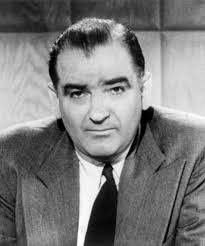
Joseph McCarthy
Elected to the Senate in 1946, he rose to national prominence on February 9, 1950, after giving a fiery speech in Wheeling, West Virginia:
“The State Department is infested with communists. I have here in my hand a list of 205—a list of names that were made known to the Secretary of State as being members of the Communist Party and who nevertheless are still working and shaping policy in the State Department.”
Americans were already growing increasingly fearful of Communism:
- Soviet dictator Joseph Stalin had not withdrawn the Red Army from the countries it had occupied in Eastern Europe during World War II.
- In 1948, the Soviet Union developed–and demonstrated–its own atomic bomb, an achievement U.S. scientists had claimed would not happen for at least a decade.
- In 1949, China fell to the triumphant armies of Mao Tse Tung.
But anti-communism as a lever to political advancement sharply accelerated following McCarthy’s speech. Republicans–resentful at being denied the White House since 1932–seized upon anti-communism as their passport to power.
No American–no matter how prominent–was safe from the accusation of being a Communist or a Communist sympathizer–”a Comsymp” or “fellow traveler” in the style of the era.
Among those accused:
- Secretary of State George C. Marshall, who had overseen America’s strategy for defeating Nazi Germany and Imperial Japan
- President Harry S. Truman
- Playwrights Lillian Hellman and Arthur Miller
- Actors Charlie Chaplin, Zero Mostel, Lloyd Bridges, Howard Da Silva, Edward G. Robinson and John Garfield
- Composers Arron Copland and Elmer Bernstein
- Physicist J. Robert Oppenheimer, who presided over the creation of America’s atomic bomb
- Actresses Lee Grant, Delores del Rio, Ruth Gordon and Lucille Ball
- Journalists Edward R. Murrow and William L. Shirer, who had chronicled the rise of Nazi Germany
- Folksinger Pete Seeger
- Writers Irwin Shaw, Howard Fast, John Steinbeck and Dashiell Hammett
Even “untouchable” Republicans became targets for such slander.
The most prominent of these was President Dwight D. Eisenhower–labeled ”a conscious, dedicated agent of the Communist Conspiracy” by Robert Welch, who founded the John Birch Society in 1958.
2016 PRESIDENTIAL RACE, ABC NEWS, ABRAHAM LINCOLN, ALTERNET, AMERICABLOG, AP, BABY BOOMER RESISTANCE, BARACK OBAMA, BBC, BLOOMBERG NEWS, BUZZFEED, CBS NEWS, CIVIL RIGHTS ACT OF 1964, CIVIL WAR, CNN, CROOKS AND LIARS, DAILY KOS, DANIEL DAY-LEWIS, DONALD TRUMP, EMANCIPATION PROCLAMATION, FACEBOOK, FIVETHIRTYEIGHT, HARPER’S MAGAZINE, HUFFINGTON POST, LYNDON B. JOHNSON, MEDIA MATTERS, MITT ROMNEY, MOTHER JONES, MOVEON, MOVIES, MSNBC, NBC NEWS, NEW REPUBLIC, NEWSDAY, NEWSWEEK, NPR, PBS NEWSHOUR, POLITICO, POLITICUSUSA, RAW STORY, REUTERS, SALON, SEATTLE TIMES, SLATE, SLAVERY, STEVEN SPIELBERG, TALKING POINTS MEMO, THE ATLANTIC, THE CHICAGO SUN-TIMES, THE CHICAGO TRIBUNE, THE DAILY BEAST, THE DAILY BLOG, THE GUARDIAN, THE HILL, THE HUFFINGTON POST, THE INTERCEPT, THE LOS ANGELES TIMES, THE NATION, THE NEW REPUBLIC, THE NEW YORK TIMES, THE NEW YORKER, THE VILLAGE VOICE, THE WASHINGTON POST, THINKPROGRESS, THIRTEENTH AMENDMENT, TIME, TRUTHDIG, TRUTHOUT, TWITTER, U.S. NEWS & WORLD REPORT, UPI, VOTER ID LAWS, VOTING RIGHTS ACT OF 1965
In Bureaucracy, Entertainment, History, Law, Military, Politics, Social commentary on March 17, 2016 at 12:36 pm
Steven Spielberg’s Lincoln is more than a mesmerizing history lesson.
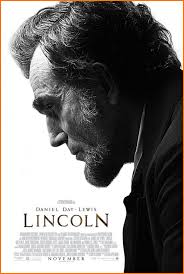
It’s a timely reminder that racism and repression are not confined to any one period or political party.
At the heart of the film: Abraham Lincoln (Daniel Day-Lewis) wants to win ratification of what will be the Thirteenth Amendment to the United States Constitution. An amendment that will forever ban slavery.
True, Lincoln, in 1862, had issued the Emancipation Proclamation. This—in theory—freed slaves held in the Confederate states that had seceded from the Union in 1861.
But Lincoln regards this as a temporary wartime measure. He fears that once the war ends, the Supreme Court may rule the Proclamation unconstitutional. This might allow Southerners to continue practicing slavery, even after losing the war.
To prevent this, Congress must pass an anti-slavery amendment.
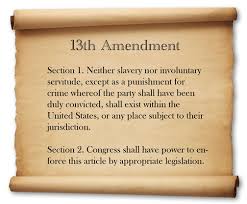
But winning Congressional passage of such an amendment won’t be easy.
The Senate had ratified its passage in 1864. But the amendment must secure approval from the House of Representatives to become law.
And the House is filled with men–there are no women menmbers during the 19th century–who seethe with hostility.
Some are hostile to Lincoln personally. One of them dubs him a dictator–Abraham Africanus.” Another accuses him of shifting his positions for the sake of expediency.
Other members–white men all–are hostile to the idea of “equality between the races.” To them, ending slavery means opening the door to interracial marriage–especially marriage between black men and white women.
Perhaps even worse, it means possibly giving blacks–or women–the the right to vote.
In fact, the possibility that blacks might win voting rights arises early in the movie. Lincoln is speaking to a couple of black Union soldiers, and one of them is unafraid to voice his discontent. He’s upset that black soldiers are paid less than white ones–and that they’re led only by white officers.
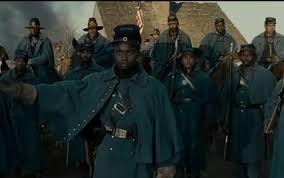
He says that, in time, maybe this will change. Maybe, in 100 years, he guesses, blacks will get the right to vote.
(To the shame of all Americans, that’s how long it will eventually take. Not until the passage of the Voting Rights Act of 1965 will blacks be guaranteed legal protection against discriminatory voting practices.)
To understand the Congressional debate over the Thirteenth Amendment, it’s necessary to remember this: In Lincoln’s time, the Republicans were the party of progressives.
The party was founded on an anti-slavery platform. Its members were thus reviled as “Black Republicans.” And until the 1960s, the South was solidly Democratic.
Democrats were the ones defending the status quo–slavery–and opposing freed blacks in the South of Reconstruction and long afterward.
In short, in the 18th century, Democrats in the South acted as Republicans do now. The South went Republican only after a Democratic President–Lyndon B. Johnson–rammed the Civil Rights Act of 1964 through Congress.
Watching this re-enactment of the 1865 debate in Lincoln is like watching the current Presidential campaign. The same mentalities are at work:
-
Those (in this case, slave-owners) who already have a great deal want to gain even more at the expense of others.
-
Those (slaves and freed blacks) who have little strive to gain more or at least hang onto what they have.
-
Those who defend the privileged wealthy refuse to allow their “social inferiors” to enjoy similar privileges (such as the right to vote).
During the 2012 Presidential race, Republicans tried to bar those likely to vote for President Barack Obama from getting into the voting booth. But their bogus “voter ID” restrictions were struck down in courts across the nation.
Listening to those opposing the amendment, one is reminded of Mitt Romney’s infamous comments about the “47%”:
“Well, there are 47% of the people who will vote for the president no matter what….
“Who are dependent upon government, who believe that–that they are victims, who believe that government has a responsibility to care for them, who believe that they’re entitled to healthcare, to food, to housing, to you name it. But that’s–it’s an entitlement. And the government should give it to them.”
Put another way: “Who says people have a right to obtain medical care, food and housing? If they can’t inherit unearned wealth the way I did, screw them.”
In the end, it’s Abraham Lincoln who has the final word–and leaves his nation the better for it. Through diplomacy and backroom dealings (trading political offices for votes) he wins passage of the anti-slavery amendment.
The ownership of human chattel is finally an ugly memory of the American past.
The movie closes with a historically-correct tribute to Lincoln’s generosity toward those who opposed him–in Congress and on the battlefield. It occurs during Lincoln’s Second Inaugural Address:
“With malice toward none, with charity for all….To bind up the nation’s wounds. To care for him who shall have bourne the battle, and for his widow and his orphan….”
This ending presents a vivid philosophical contrast with the increasingly mean-spirited rhetoric and policies of 2016’s Republican candidates for President–especially those of Donald Trump.
Watching Lincoln, you realize how incredibly lucky America was as a nation to have had such leadership when it was most urgently needed.
.


 Bureaucracybuster's Blog
2012 PRESIDENTIAL RACE, ABC NEWS, AFFORDABLE CARE ACT, BARACK OBAMA, CBS NEWS, CNN, EMPLOYERS RESPONSIBILITY ACT, FACEBOOK, FUNDRAISING, GODFATHER'S PIZZA, HERMAN CAIN, LABOR DAY, MITT ROMNEY, NBC NEWS, OBAMACARE, PAPA JOHN'S PIZZA, THE CHICAGO SUN-TIMES, THE CHICAGO TRIBUNE, THE LOS ANGELES TIMES, THE NEW YORK TIMES, THE WASHINGTON POST, TWITTER, USA TODAY
A LABOR DAY REMINDER: CEO GREED VS. EMPLOYEES NEED
In Bureaucracy, Business, History, Law, Law Enforcement, Politics, Social commentary on September 5, 2016 at 12:00 amJohn Schnatter, the CEO of Papa John’s Pizza, doesn’t like the Affordable Care Act (ACA), better known as Obamacare.
And Schnatter bluntly warned his employees: When the Act took effect, Papa John’s Pizza would change in two ways.
First, it would be forced to do something it hadn’t done since its founding in 1984: Offer healthcare coverage to its 16,5000 employees or pay a penalty to the government.
Second, it would raise the prices of its pizzas.
John Schnatter
How high would they go up?
By as much as eleven to fourteen cents price increase per pizza, or fifteen to twenty cents per order!
And Schnatter made it clear: He wasn’t going to take this lying down. He was determined to pass along those costs to his customers.
“If Obamacare is in fact not repealed,” Schnatter told Politico, “we will find tactics to shallow out any Obamacare costs and core strategies to pass that cost onto consumers in order to protect our shareholders’ best interests.”
After all, why should a multi-million-dollar company show any concern for those who make its profits a reality?
Consider:
Click here: Papa John’s Announces Fourth Quarter and Full Year 2014 Results (NASDAQ:PZZA)
Nor should anyone expect Schnatter to take a pay cut, just so his employees can obtain medical care when they need it.
Schnatter’s total calculated compensation for 2014 came to $3,456,146.
Click here: John H. Schnatter: Executive Profile & Biography – Businessweek
“We’re not supportive of Obamacare, like most businesses in our industry,” Schnatter–a supporter of Republican Presidential candidate Mitt Romney–admitted in a 2012 interview with Politico.
To demonstrate his opposition to providing medical insurance for all Americans, Schnatter hosted a fundraising event for Mitt Romney at his own Louisville, Kentucky mansion in May, 2012.
The luxurious setting for the fundraiser gave Romney a rush of pure, plutocratic ecstasy.
“What a home this is,” gushed Romney. “What grounds these are, the pool, the golf course.
“You know, if a Democrat were here he’d look around and say no one should live like this. Republicans come here and say everyone should live like this.”
John Schnatter’s estate
Of course, Romney conveniently ignored a brutally ugly fact:
For the vast majority of Papa John’s minimum-wage-earning employees–many of them working only part-time–the odds of their owning a comparable estate are non-existant.
In a typical demonstration of corporate thinking, Judy Nichols, a Papa John’s franchise owner in Beaumont, Texas, said:
“I have two options, I can stop offering coverage and pay the $2,000 fine, or I could keep my number of staff under 50 so the mandate doesn’t apply,” she told Legal Newsline.
In short: Defy the law, and employee healthcare needs be damned.
In fact, that’s exactly what Schnatter announced he would do: Reduce his workers’ hours–since Obamacare mandates that only employees working more than 30 hours per week are covered under their employers’ health insurance plan.
Nichols claimed that the the law might cost her $20,000 to $30,000 in taxes: “Obamacare is making me think about cutting jobs instead,” she said.
Translation: If you force me to behave responsibly, I’ll just have to take it it out on thousands of willing-to-work Americans.
So how can America cope with behavior that destroys not only lives but the economy as well?
By passing–and vigorously enforcing–a nationwide Employers Responsibility Act.
Among its provisions:
Employers would be required to provide full medical and pension benefits for all employees, regardless of their full-time or part-time status.
Increasingly, employers are replacing full-time workers with part-time ones–solely to avoid paying medical and pension benefits.
Requiring employers to act humanely and responsibly toward all their employees would encourage them to provide full-time positions–and hasten the death of this greed-based practice.
The seeking of “economic incentives” by companies in return for moving to or remaining in cities/states would be strictly forbidden.
Such “economic incentives” usually:
Employers who continue to make such overtures would be prosecuted for attempted bribery or extortion:
This would
It’s past time for America to protect employees who work for a living from CEOs who simply take credit for the work those employees do.
Share this: