In January, 2018, the White House of President Donald Trump banned the use of personal cell phones in the West Wing.
The official reason: National security.
The real reason: To stop staffers from leaking to reporters.
According to an anonymous White House source: “The cellphone ban is for when people are inside the West Wing, so it really doesn’t do all that much to prevent leaks. If they banned all personal cellphones from the entire [White House] grounds, all that would do is make reporters stay up later because they couldn’t talk to their sources until after 6:30 pm.”
Other sources believed that leaks wouldn’t end unless Trump started firing staffers. But that risked firing the wrong people. To protect themselves, those who leaked might well accuse tight-lipped co-workers.
Within the Soviet Union (especially during the reign of Joseph Stalin) fear of secret police surveillance was widespread—and absolutely justified.
According to the 2016 book, One Day We Will Live Without Fear: Everyday Lives Under the Soviet Police State, by Mark Harrison, the methods used to keep conversations secret included:
Turning on the TV or radio to full volume.
Turning on a water faucet at full blast.
Turning the dial of a rotary phone to the end—and sticking a pencil in one of the small holes for numbers.
Standing six to nine feet away from the hung-up receiver.
Going for “a walk in the woods.”
Saying nothing sensitive on the phone.
The secret police (known as the Cheka, the NKVD, the MGB, the KGB, and now the FSB) operated on seven working principles:
Your enemy is hiding.
Start from the usual suspects.
Study the young.
Stop the laughing.
Rebellion spreads like wildfire.
Stamp out every spark.
Order is created by appearance.
Trump has always ruled through bribery and fear. He’s bought off (or tried to) those who might cause him trouble—like porn actress Stormy Daniels.
He’s never been able to poke fun at himself—and he grows livid when anybody else does.
At Christmastime, 2018, “Saturday Night Live” aired a parody of the classic movie, “It’s a Wonderful Life.” Its title: “It’s a Wonderful Trump.”
In it, Trump (portrayed by actor Alec Baldwin) discovers what the United States would be like if he had never become President: A great deal better-off.
As usual, Trump expressed his resentment through Twitter: The Justice Department should stop investigating his administration and go after the real enemy: “SNL.”
“A REAL scandal is the one sided coverage, hour by hour, of networks like NBC & Democrat spin machines like Saturday Night Live. It is all nothing less than unfair news coverage and Dem commercials. Should be tested in courts, can’t be legal? Only defame & belittle! Collusion?”
By saying that, Trump showed his contempt for the role of the First Amendment in American history.
Cartoonists portrayed President Andrew Jackson (1829 -1837) wearing a king’s robes and crown, and holding a scepter. This thoroughly enraged Jackson—who had repulsed a British invasion in 1815 at the Battle of New Orleans. To call a man a monarchist in 1800s America was the same as calling him a Communist in the 1950s.
During the Civil War, President Abraham Lincoln was lampooned as an ape and a blood-stained tyrant. And Theodore Roosevelt proved a cartoonist’s delight, with attention given to his bushy mustache and thick-lensed glasses.
Thus, the odds are slight that an American court would even hear a case brought by Trump against “SNL.”
Such a case made its way through the courts in the late 1980s when the Reverend Jerry Falwell sued pornographer Larry Flyint over a satirical interview in Hustler magazine. In this, “Falwell” admitted that his first sexual encounter had been with his own mother.
In 1988, the United States Supreme Court, voting 8-0, ruled in Flynt’s favor, saying that the media had a First Amendment right to parody a celebrity.
“Despite their sometimes caustic nature, from the early cartoon portraying George Washington as an ass down to the present day, graphic depictions and satirical cartoons have played a prominent role in public and political debate,” Chief Justice William Rehnquist—an appointee of President Richard Nixon—wrote in his majority decision in the case.
Moreover, Trump would have been forced to take the stand in such a case. The attorneys for NBC and “SNL” would have insisted on it.
The results would have been:
Unprecedented legal exposure for Trump—who would have been forced to answer virtually any questions asked or drop his lawsuit; and
Unprecedented humiliation for a man who lives as much for his ego as his pocketbook. Tabloids and late-night comedians would have had a field-day with such a lawsuit.
And while Trump loves to sue those he hates, he does not relish taking the stand himself.
On October 12, 2016, The Palm Beach Post, The New York Times and People all published stories of women claiming to have been sexually assaulted by Trump.
He accused the Times of inventing accusations to hurt his Presidential candidacy. And he threatened to sue for libel if the Times reported the women’s stories. He also said he would sue the women making the accusations.
He never sued the Times, The Post, People—or the women.
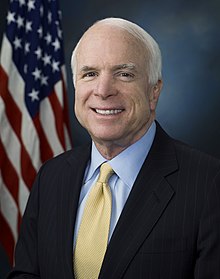
On May 10, 2018, The Hill reported that White House Special Assistant Kelly Sadler had joked derisively about dying Arizona United States Senator John McCain.
McCain, a Navy pilot during the Vietnam war, was shot down over Hanoi on October 26, 1967, and captured. He spent five and a half years as a POW in North Vietnam—and was often brutally tortured. He wasn’t released until March 14, 1973.
Recently, he had opposed the nomination of Gina Haspel as director of the CIA.
The reason: In 2002, Haspel had operated a “black” CIA site in Thailand where Islamic terrorists were often waterboarded to make them talk.
For John McCain, waterboarding wastorture, even if it didn’t leave its victims permanently scarred and disabled.
Aware that the 81-year-old McCain was dying of brain cancer, Sadler joked to intimates about the Senator’s opposition to Haspel: “It doesn’t matter. He’s dying anyway.”
John McCain
Leaked to CNN by an anonymous White House official, Sadler’s remark sparked fierce criticism—and demands for her firing.
South Carolina Republican Senator Lindsey Graham, a close friend of McCain, said: “Ms. Sadler, may I remind you that John McCain has a lot of friends in the United States Senate on both sides of the aisle. Nobody is laughing in the Senate.”
“People have wondered when decency would hit rock bottom with this administration. It happened yesterday,” said then-former Vice President Joe Biden.
“John McCain makes America great. Father, grandfather, Navy pilot, POW hero bound by honor, an incomparable and irrepressible statesman. Those who mock such greatness only humiliate themselves and their silent accomplices,” tweeted former Massachusetts governor and 2012 Republican Presidential candidate Mitt Romney.
Officially, White House Press Secretary Sarah Huckabee Sanders refused to confirm or deny Sadler’s joke:“I’m not going to get into a back and forth because people want to create issues of leaked staff meetings.”
Unofficially, Sanders was furious—not at the joke about a dying man, but that someone had leaked it. After assailing the White House communications team, she pouted: “I am sure this conversation is going to leak, too. And that’s just disgusting.”
Sarah Huckabee Sanders
No apology was offered by any official at the White House—including President Donald Trump.
In fact, Senior White House communications adviser Mercedes Schlapp reportedly expressed her support for Sadler: “I stand with Kelly Sadler.”
On May 11—the day after Sadler’s comment was reported—reporters asked Sanders if the tone set by Trump had caused Sadler to feel comfortable in telling such a joke.
“Certainly not!”predictably replied Sanders, adding: “We have a respect for all Americans, and that is what we try to put forward in everything we do, but in word and in action, focusing on doing things that help every American in this country every single day.”
On May 14, 2018, Trump revealed his “respect” for “all Americans”—especially those working in the White House.
“The so-called leaks coming out of the White House are a massive over exaggeration put out by the Fake News Media in order to make us look as bad as possible,”Trump tweeted.
“With that being said, leakers are traitors and cowards, and we will find out who they are!”
This from the man who, during the 2016 Presidential campaign, shouted: “WikiLeaks, I love WikiLeaks!”
Of course, that was when Russian Intelligence agents were exposing the secrets of Hillary Clinton, his Presidential opponent.
And, in a move that Joseph Stalin would have admired, Trump ordered an all-out investigation to find the person who leaked Sadler’s “joke.”
In January, 2018, the White House had banned the use of personal cell phones in the West Wing.
The official reason: National security.
The real reason: To stop staffers from leaking to reporters.
Officials now had two choices:
Leave their cell phones in their cars, or,
When they arrive for work, deposit them in lockers installed at West Wing entrances. They can reclaim their phones when they leave.
Several staffers huddled around the lockers throughout the day, checking messages they had missed. The lockers buzzed and chirped constantly from 6 a.m. to 8 p.m. Monday through Friday.
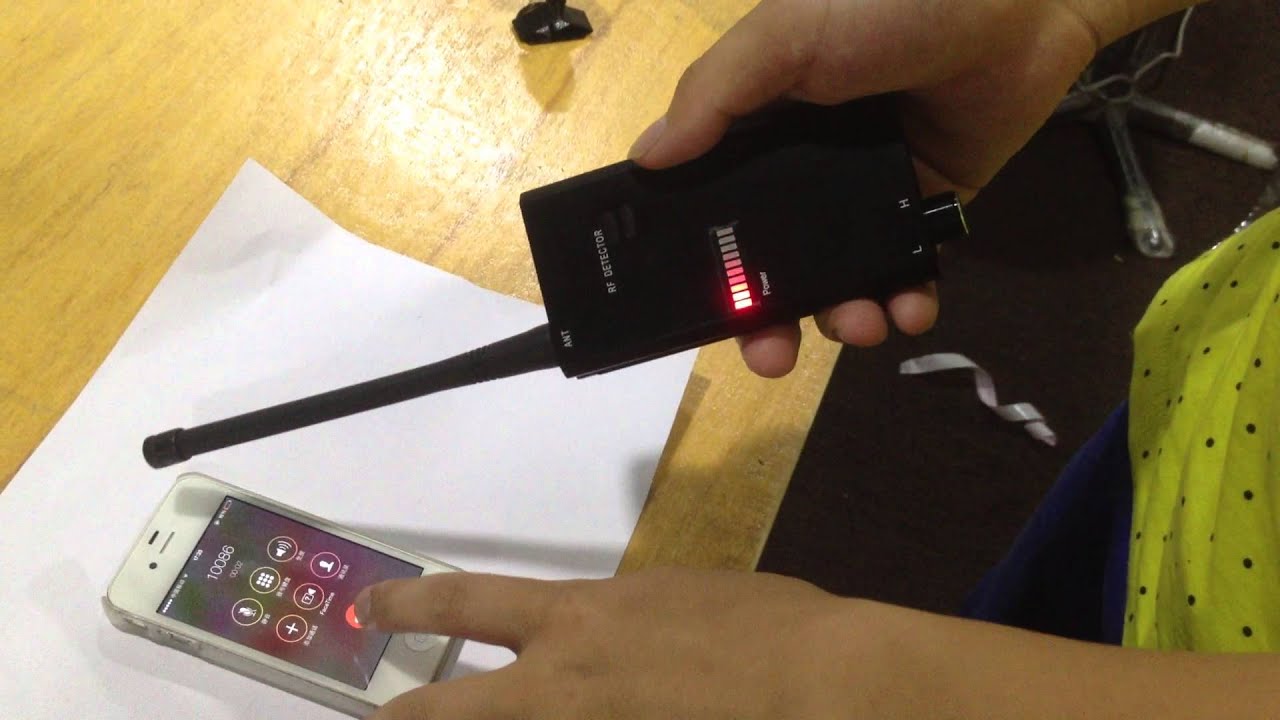
More ominously, well-suited men roamed the halls of the West Wing, carrying devices that pick up signals from phones that aren’t government-issued. “Did someone forget to put their phone away?” one of the men would ask if such a device was detected.
If no one said they have a phone, the detection team started searching the room.
Phone detector
The devices can tell which type of phone is in the room.
This is the sort of behavior Americans have traditionally—and correctly—associated with dictatorships
In his memo outlining the policy, former Chief of Staff John Kelly warned that anyone who violated the phone ban could be punished, including “being indefinitely prohibited from entering the White House complex.”
Yet even these draconian methods did not end White House leaks.
White House officials still spoke with reporters throughout the day and often aired their grievances, whether about annoying colleagues or competing policy priorities.
Aides with private offices sometimes called reporters on their desk phones. Others used their cell phones to call or text reporters during lunch breaks.
“Nothing funny about tired Saturday Night Live on Fake news NBC! Question is, how do the Networks get away with these total Republican hit jobs without retribution? Likewise for many other shows? Very unfair and should be looked into. This is the real Collusion!”
So tweeted President Donald J. Trump on February 17, 2019.
Less than nine hours earlier, “SNL” had once again opened with actor Alec Baldwin mocking the 45th President. In this skit, Baldwin/Trump gave a rambling press conference declaring: “We need wall. We have a tremendous amount of drugs flowing into this country from the southern border—or The Brown Line, as many people have asked me not to call it.”
Right-wingers denounce their critics as “snowflakes”—that is, emotional, easily offended and unable to tolerate opposing views.
Yet here was Donald Trump, who prides himself on his toughness, whining like a child bully who has just been told that other people have rights, too.
The answer is simple: Trump is a tyrant—and a longtime admirer of tyrants—including Communist ones.
Donald Trump
He has lavishly praised Russian dictator Vladimir Putin, such as during his appearance on the December 18, 2015 edition of MSNBC’s “Morning Joe”:
“He’s running his country, and at least he’s a leader, unlike what we have in this country”—-a reference to then-President Barack Obama.
During a February, 2017 interview with Fox News host Bill O’Reilly, Trump defended Putin’s killing of political opponents.
O’Reilly: “But he’s a killer.”
Trump:“There are a lot of killers. You think our country’s so innocent?”
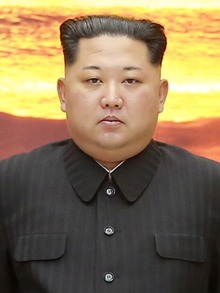
Asked by a Fox News reporter why he praised murderous North Korean dictator Kim Jong-Un, he replied: “He’s a tough guy. Hey, when you take over a country, tough country, tough people, and you take it over from your father…If you could do that at 27 years old, I mean, that’s one in 10,000 that could do that.”
In short: Kim must be doing something right because he’s in power. And it doesn’t matter how he came to power—or the price his country is paying for it.
Actually, for all their differences in appearance and nationality, Trump shares at least two similarities with Kim.
First, both of them got a big boost into wealth and power from their fathers.
Trump’s father, Fred Trump, a real estate mogul, reportedly gave Donald $200 million to enter the real estate business. It was this sum that formed the basis for Trump’s eventual rise to wealth and fame—and the Presidency.
Kim’s father was Kim Jong-Il, who ruled North Korea as dictator from 1994 to 2011. When his father died in 2011, Kim Jong-Un immediately succeeded him, having been groomed for years to do so.
Second, both Trump and Kim have brutally tried to stamp out any voices that contradict their own.
Trump has constantly attacked freedom of the press, even labeling it“the enemy of the American people.”
He also slandered his critics on Twitter—which refused to enforce its “Terms of Service” and revoke his account until he incited the January 6 attack on Congress.
Kim has attacked his critics with firing squads and prison camps. Amnesty International estimates that more than 200,000 North Koreans are now suffering in labor camps throughout the country.
Thus, Trump—-elected to lead the “free world”—believes, like all dictators:
People are evil everywhere—so who am I to judge who’s better or worse? All that counts is gaining and holding onto power.
And if you can do that, it doesn’t matter how you do so.
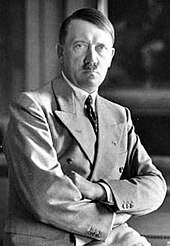
Actually, it’s not uncommon for dictators to admire one another—as the case of Joseph Stalin and Adolf Hitler nicely illustrates.
Joseph Stalin
After Hitler launched a blood-purge of his own private Stormtroopers army on June 30, 1934, Stalin exclaimed: “Hitler, what a great man! That is the way to deal with your political opponents!”
And Hitler was equally admiring of Stalin’s notorious ruthlessness: “After the victory over Russia,” he told his intimates, “it would be a good idea to get Stalin to run the country, with German oversight, of course. He knows better than anyone how to handle the Russians.”
One characteristic shared by all dictators is intolerance toward those whose opinions differ with their own. Especially those who dare to actually criticize or make fun of them.
All Presidents have thin skins. John F. Kennedy often phoned reporters and called them “sonofbitches” when he didn’t like stories they had written on him.
Richard Nixon went further, waging all-out war against the Washington Post for its stories about his criminality.
But Donald Trump took his hatred of dissidents to an entirely new—and dangerous—level.
On May 10, 2018, The Hill reported that White House Special Assistant Kelly Sadler had joked derisively about dying Arizona United States Senator John McCain.
Trump was outraged—not that one of his aides had joked about a man stricken with brain cancer, but that someone in the White House had leaked it.
On October 18, more than seven million Americans protested the dictatorial policies of President Donald J. Trump.
It was the second nationwide “No Kings” series of protest marches since he took office on January 20.
The first marches, on June 14, had drawn about five million people.
Republicans, knowing the marches were coming, tried to pre-empt their “I Hate Dictators” message with one of their own: That the intended marchers hated America.
Speaker of the House Mike Johnson: “You’re gonna bring together the Marxists, the socialists, the Antifa advocates, the anarchists, and the pro-Hamas wing of the far-left Democrat party.”
Mike Johnson
Other Republicans quickly joined his chorus.
Treasury Secretary Scott Bessent: “This crazy No Kings rally this weekend, which is gonna be the farthest left, the hardest-core, the most unhinged in the Democratic Party, which is a big title.”
Kansas Senator Roger Marshall warned that the protests would turn violent and have to be stopped by the national guard.
Attorney general Pam Bondi claimed, without proof, that the protests were an organized effort with dedicated funding: “You’re seeing people out there with thousands of signs that all match, pre-bought, pre-put together. They are organized, and someone is funding it.”
Pam Bondi
But, according to an October 19 opinion piece in The New Republic, such slanders were proven wrong:
“The atmosphere was extremely energetic and family friendly for both young and old.
“People walked slowly, often with kids in tow. Countless attendees wore large inflatable costumes, inspired by the Portland frog. There was live music, tabling, and speeches by Bill Nye, Mehdi Hasan, and Senators Bernie Sanders and Chris Murphy, among others.”
The greatest threat posed to the Trump administration didn’t come from the “No Kings” rallies. It came from no less a figure than President Donald J. Trump.
To show his utter contempt for those who oppose his policies and dictatorial rule, he posted an AI-generated video on his Truth Social account. It showed him wearing a crown and flying a jet labeled “King Trump” that dumps feces on protesters.
It’s set to the music of the 1986 Top Gun film song, “Danger Zone,” by Kenny Loggiins.
Loggins responded on NPR: “This is an unauthorized use of my performance of ‘Danger Zone.’ Nobody asked me for my permission, which I would have denied, and I request that my recording on this video is removed immediately.
“I can’t imagine why anybody would want their music used or associated with something created with the sole purpose of dividing us. Too many people are trying to tear us apart, and we need to find new ways to come together. We’re all Americans, and we’re all patriotic.
“There is no ‘us and them’ – that’s not who we are, nor is it what we should be. It’s all of us. We’re in this together, and it is my hope that we can embrace music as a way of celebrating and uniting each and every one of us.”
Owing to Logginis’ demand, many YouTube versions of this video don’t contain that music.
NPR contacted to the White House for a response to Loggins’ reaction.
White House spokesman Davis R. Ingle ignored NPR’s questions but contemptuously replied with an image from Top Gun of stars Tom Cruise and the late Val Kilmer, captioned: “I FEEL THE NEED FOR SPEED.”
Loggins could file a copyright infringement suit against Trump.
The Internet erupted with outrage:
“Can’t believe that’s a president of a country.”
“It tells you everything you need to know about what he thinks about the people of America who are, in fact, America.”
“Just to be clear, Americans, this is what Donald Trump thinks of you if you oppose him, protest, or simply ask questions.”
“Trump’s AI fantasy of crowning himself King & dumping shit from a fighter jet is the most honest thing he’s ever posted. He’s literally shitting on Americans because he doesn’t give a fuck about them. And the MAGA stupids will cheer it, calling it “patriotism.”
But these were tame compared to the warning issued by Niccolo Machiavelli, the Florentine statesman, more than 500 years ago.
Niccolo Machiavelli
In his best-known work, The Prince, he advised rulers to “mingle with [citizens] from time to time, and give them an example of his humanity and munificence, always upholding, however, the majesty of his dignity, which must never be allowed to fail in anything whatever.”
“…A prince need trouble little about conspiracies when the people are well disposed. But when they are hostile and hold him in hatred, then he must fear everything and everybody.
“….For whoever conspires always believes that he will satisfy the people by the death of the prince.
“…[The Roman Emperor Commodus], being of a cruel and bestial disposition, in order to…exercise his rapacity on the people, he sought to favor the soldiers and render them licentious. On the other hand, by not maintaining his dignity, by often descending into the theater to fight with gladiators and committing other contemptible actions…he became despicable in the eyes of the soldiers. And being hated on the one hand and despised on the other, he was conspired against and killed.”
But there are other ways a tyrant can be forced to give up power—such as Gaius Caligula, Adolf Hitler and—possibly—Joseph Stalin.
Joseph Stalin ruled as absolute dictator of the Soviet Union from January 21, 1924, to March 5, 1953—29 years.
Joseph Stalin
Throughout his nearly 30-year reign over the Soviet Union, at least 20 million men, women and children died—from executions, deportations, imprisonment in Gulag camps, and a man-made famine through the forced collection of harvests.
Robert Payne, the acclaimed British historian, vividly portrayed the crimes of this murderous tyrant in his brilliant 1965 biography, The Rise and Fall of Stalin.
According to Payne, Stalin was planning yet another purge during the last weeks of his life. This would be “a holocaust greater than any he had planned before.
“This time there would be a chistka [purge] to end all chistkas, a purging of the entire body of the state from top to bottom. No one, not even the highest officials, was to be spared.”
Then, on March 4, 1953, Moscow Radio announced: “During the night of March 1-2, while in his Moscow apartment, Comrade Stalin suffered a cerebral hemorrhage affecting vital areas of the brain.”
Stalin died on March 5, 1953. He was 73 and in poor health from a lifetime of smoking, drinking and little exercise.
But he could have died of unnatural causes.
In the 2004 book, Stalin’s Last Crime, Vladimir P. Naumov, a Russian historian, and Jonathan Brent, a Yale University Soviet scholar, assert that he might have been poisoned.
If this happened, the occasion was during a final dinner with four members of the Politburo. Two of these were Lavrenti P. Beria, chief of the secret police, and Nikita S. Khrushchev, who eventually succeeded Stalin.
The authors believe that, if Stalin was poisoned, the most likely suspect was Beria. The method: Slipping warfarin, a tasteless and colorless blood thinner also used as a rat killer, into his glass of wine.
In Nikita Khrushchev’s 1970 memoirs, he quotes Beria as telling Vyacheslav M. Molotov, another Politburo member, two months after Stalin’s death: “I did him in! I saved all of you.”
It’s entirely possible that Donald Trump’s “Presidency-for-Life” may end by natural causes.
He’s 79, and despite his repeated boastings that he’s the healthiest President in United States history, clearly he isn’t.
He is grotesquely overweight, doesn’t exercise, falls asleep in public appearances and slurs his words. Much of his diet consists of greasy, artery-clogging fast food—such as from McDonald’s and KFC.
He stays up late at night, pouring out his hatred for countless real and imagined enemies on his website, Truth Social.
But that is not the only way his reign could disappear.
Since retaking office on January 20, Trump has ruled as de-facto dictator. Among his outrages.
Turning Immigration and Customs Enforcement (ICE) into his personal Gestapo. Nearly 150,000 people—both illegal aliens and American-born citizens—were arrested between January and late July 2025.
Purging FBI agents who rightly investigated his illegally confiscating classified documents and inciting the January 6, 2021 attack on Congress.
Attacking CBS and ABC for their news departments’ accurately covering his litany of mistakes and crimes.
Ordering the Justice Department to indict former FBI director James Comey and New York Attorney General Letitia James for carrying out their legal responsibilities.
Forcing ABC to (temporarily) cancel Jimmy Kimmel Live! because the comedian made jokes about him.
Shutting down the Federal Government over Democrats’ refusal to back his gutting of Medicare and the Affordable Care Act (ACA) to give tax breaks to billionaires.
On June 14, more than five million Americans protested Trump’s rule with a “No Kings” march. And nearly seven million participated in the October 18 march. More are planned.
* * * * * * * * * *
Niccolo Machiavelli, the father of modern political science, offers a stern warning for Trump—a warning he has steadfastly ignored.
Niccolo Machiavelli
In his masterwork, The Discourses on Livy, Machiavelli notes how important it is for rulers to make themselves loved—or at least respected—by their fellow citizens:
“Note how much more praise those Emperors merited who, after Rome became an empire, conformed to her laws like good princes, than those who took the opposite course.
“Titus, Nerva, Trajan, Hadrian, Antoninus and Marcus Auelius did not require the Praetorians nor the multitudinous legions to defend them, because they were protected by their own good conduct, the good will of the people, and by the love of the Senate.
“On the other hand, neither the Eastern nor the Western armies saved Caligula, Nero, Vitellius and so many other wicked Emperors from the enemies which their bad conduct and evil lives had raised up against them.”
In his better-known work,The Prince, Machiavelli warns rulers who—like Donald Trump–are inclined to rule by fear:
“A prince should make himself feared in such a way that if he does not gain love, he at any rate avoids hatred: for fear and the absence of hatred may well go together.”
By Machiavelli’s standards, Trump has made himself the perfect target for a conspiracy:
“When a prince becomes universally hated, it is likely that he’s harmed some individuals—who thus seek revenge. This desire is increased by seeing that the prince is widely loathed.”
He became Emperor in 37 A.D. after succeeding the Emperor Tiberius, his uncle who had adopted him as a son after his father died.
Caligula’s reign began well—and popularly. He gave Tiberius a magnificent funeral—then recalled to Rome all those whom Tiberius had banished, and ignored all charges that Tiberius had leveled against them.
He gave bonuses to the military and allowed the magistrates unrestricted jurisdiction, without appeal to himself.
But in October 37 A.D. he fell seriously ill or perhaps was poisoned.
Caligula soon recovered but emerged a changed man. He began claiming to be a god, and killing or exiling anyone he saw as a threat. He ordered his victims tortured to death with many slight wounds: “Strike so that he may feel that he is dying.”
Among his litany of crimes, according to his biographer, Gaius Suetonius Tranquillus:
“He forced parents to attend the executions of their sons, sending a litter for one man who pleaded ill health, and inviting another to dinner immediately after witnessing the death, and trying to rouse him to gaiety and jesting by a great show of affability.”
For all his cruelty and egomania, the trait that finally destroyed Caligula was his joy in humiliating others.
His fatal mistake was to taunt Cassius Chaerea, a member of his own bodyguard. Caligula considered Chaerea effeminate because of a weak voice and mocked him with names like “Priapus” and “Venus.”
On January 22 41 A.D. Chaerea and several other bodyguards hacked Caligula to death with swords before other guards could save him.
Next up: Adolf Hitler, dictator of Nazi Germany from January 30, 1933, to April 30, 1945—12 years.
He was born on April 20, 1889, in Braunau am Inn in Austria-Hungary.
Adolf Hitler
He was appointed Chancellor—chief law enforcement officer—of Germany on January 30, 1933, by President Paul von Hindenburg. Upon Hindenburg’s death in 1934, Hitler assumed the Presidency and established himself as absolute dictator.
From 1933 to 1939 he presided over Germany’s rapid economic recovery from the Great Depression, the defiance of restrictions imposed on Germany after World War 1, and the annexation of Austria and Czechoslovakia, where millions of ethnic Germans lived.
These accomplishments won him widespread popular support.
But after absorbing Czechoslovakia in 1938, Hitler felt himself invincible. On September 1, 1939, his armies attacked Poland—and unintentionally ignited World War II.
After conquering Norway, Denmark, Holland, Belgium, France, Greece and Yugoslavia, he made his two greatest mistakes of the war: He invaded the far more powerful Soviet Union on June 22, 1941, and declared war on the equally more powerful United States on December 11.
Parallel to unleashing a war that slaughtered 50 million people, Hitler orchestrated the extermination of at least six million Jews during the Holocaust.
By April, 1945, Germany faced destruction from the advancing Russians on the East, and from the advancing Americans on the West.
On April 30, with Russian forces only blocks from his underground bunker, Hitler lifted a heavy 7.65mm Walther PPK pistol to his right temple, bit on a cyanide capsule, and pulled the trigger.
Just as Caligula’s mangled remains were hastily burned and buried in the Horti Lamiani gardens, Hitler’s body was hastily cremated in the Reich Chancellery garden.
Last up: Joseph Stalin, dictator of the Soviet Union from January 21, 1924, to March 5, 1953—29 years.
Born on December 18, 1878, in Georgia, Russia, he hated Czarist rule and in 1903 joined the Communist Bolsheviks party, led by Vladimir Lenin, to overthrow it.
Joseph Stalin
On November 7, 1917, Lenin overthrew the Provisional Government, which had taken power in February, after Czarist rule collapsed.
Stalin became a member of the new Soviet government, gradually working his way to the position of General Secretary. When Lenin died on January 21, 1924, Stalin outmaneuvered Leon Trotsky, his major rival for the succession, and became absolute dictator.
Starting in 1934, a series of massive purges followed—most notably between August, 1936, and March, 1938.
Throughout his nearly 30-year reign over the Soviet Union, at least 20 million men, women and children died—from executions, deportations, imprisonment in Gulag camps, and a man-made famine through the forced collection of harvests.
Robert Payne, the acclaimed British historian, vividly portrayed the crimes of this murderous tyrant in his brilliant 1965 biography, The Rise and Fall of Stalin.
According to Payne, Stalin was planning yet another purge during the last weeks of his life. This would be “a holocaust greater than any he had planned before.
“This time there would be a chistka [purge] to end all chistkas, a purging of the entire body of the state from top to bottom. No one, not even the highest officials, was to be spared.”
Yet Stalin did nothing to calm their fears. He often summoned his “comrades” to the Kremlin for late-night drinking bouts, where he freely humiliated them.
Long before he took office for the first time on January 20, 2017, Donald Trump never intended to rule as an ordinary President.
Under the Constitution, a President can hold office for—at most—eight years. But a “President-for-Life” can rule until he dies.
That was—and remains—his ambition.
In a closed-door speech to Republican donors on March 3, 2018, Trump revealed his ultimate intention: To overthrow America’s constitutional government.
He praised China’s President, Xi Jinping, for recently assuming full dictatorial powers: “He’s now president for life. President for life. No, he’s great. And look, he was able to do that. I think it’s great. Maybe we’ll have to give that a shot some day.”
The statement was greeted with cheers and laughter by Republican donors.
Xi Jinping
Upon taking office as the Nation’s 45th President, Trump attacked or undermined one public or private institution after another.
Among these:
American Intelligence: Even before taking office, Trump refused to accept the findings of the FBI, CIA and National Security Agency (NSA) that Russian Intelligence agents had intervened in the 2016 election to ensure his victory.
“I think it’s ridiculous,” he told “Fox News Sunday.” “I think it’s just another excuse. I don’t believe it….No, I don’t believe it at all.”
And when FBI Director James Comey dared to pursue a probe into “the Russia thing,” Trump fired him without warning.
American law enforcement agencies: Trump repeatedly attacked his own Attorney General, Jeff Sessions, for not “protecting” him from agents pursuing the Russia investigation.
On November 8, 2018, Trump abruptly fired him, following Democrats’ winning control of the House in the midterm elections.
He threatened to fire Rod J. Rosenstein, the deputy attorney general, who oversaw Special Counsel Robert Mueller’s investigation into Russian subversion of the 2016 election.
American military agencies:In 2018, Trump refused to visit an American cemetery near Paris and referred to U.S. Marines buried there as “losers” and “suckers.”
Trump regularly abused military officials, calling Chairman of the Joint Chief of Staff Mark Milley a “dumbass” and former Secretary of Defense James Mattis “the world’s most overrated general.”
Seal of the Department of Defense
The press: On February 17, 2017, Trump tweeted: “The FAKE NEWS media (failing@nytimes, @NBCNews, @ABC, @CBS, @CNN) is not my enemy, it is the enemy of the American People!”
Appearing before the Conservative Political Action Conference on February 24, 2017, Trump said: “I want you all to know that we are fighting the fake news. It’s fake, phony, fake….I’m against the people that make up stories and make up sources. They shouldn’t be allowed to use sources unless they use somebody’s name. Let their name be put out there.”
The judiciary: Trump repeatedly attacked Seattle US District Judge James Robart, who halted Trump’s first Muslim travel ban.
In one tweet, Trump claimed: “Just cannot believe a judge would put our country in such peril. If something happens blame him and court system. People pouring in. Bad!”
At Trump’s bidding, White House aide Stephen Miller attacked the Ninth Circuit Court of Appeals: “We have a judiciary that has taken far too much power and become, in many cases, a supreme branch of government.”
Donald Trump
Even after leaving the White House in 2021, Trump continued his attacks on one cherished American institution after another:
Facing 91 criminal counts in four cases, he discredited the judicial system, attacking judges, prosecutors, witnesses—and even their family members.
He attacked Independent Counsel Jack Smith as “deranged” and accused him of trying to invalidate his candidacy for President in 2024.
He attacked retired U.S. Army General Mark Milley for calling him “a wannabe dictator,” and said that Milley deserved execution as a traitor.
Milley had successfully averted war with China by calling his Chinese military counterparts in the final weeks of Trump’s administration to assure them that Trump was not planning to attack China.
He claimed voter fraud where none existed, casting doubt on the integrity of the electoral system.
He claimed himself to be the victim of “the deep state” inside the federal bureaucracy.
He attacked the integrity of the FBI—causing previously “law and order” Republicans to demand its defunding.
* * * * * * * * * *
Donald Trump isn’t crazy, as many of his critics charge. He knows exactly what he’s doing—and why.
He intends to strip every potential challenger to his authority—or his version of reality—of legitimacy with the public. If he succeeds, there will be:
No independent press to reveal his failures and crimes.
No independent law enforcement agencies to investigate his abuses of office.
No independent judiciary to hold him accountable.
No independent military to dissent as he recklessly hurtles toward a nuclear disaster.
No candidate—Democrat or Republican—to challenge him for re-election in 2028—or any other year..
No candidate—Democrat or Republican—to challenge his remaining in office as “President-for-Life.”
A dictator can die of illness or old age.
China’s Communist ruler, Mao Zedong died on September 9, 1976, at 82, from a series of heart attacks.
And Spain’s Fascist tyrant, Francisco Franco, died on November 20, 1975, at 82, of congestive heart failure.
But there are other ways a tyrant can be forced to give up power—such as the following three.
Donald Trump’s appearance at the Conservative Political Action Conference on March 2, 2019 was an occasion for rejoicing among his supporters.
But for those who prize rationality and decency in a President, it was a dismaying and frightening experience.
For two hours, Trump gave free reign to his anger and egomania.
Among his unhinged commentaries:
“We have people in Congress that hate our country.”
If you don’t agree 100% with Trump on everything, you’re a traitor.
“He called me up. He said, ‘You’re a great President. You’re doing a great job.’ He said, ‘I just want to tell you you’re a great President and you’re one of the smartest people I’ve ever met.'”
Trump attributed these remarks to California’s liberal governor, Gavin Newsom. On February 11, 2019, Newsom had announced he was withdrawing several hundred National Guardsmen from the state’s southern border with Mexico—defying Trump’s request for support from border states.
Donald Trump at CPAC
“You know if you remember my first major speech—you know the dishonest media they’ll say, ‘He didn’t get a standing ovation.’ You know why? Because everybody stood and nobody sat. They are the worst. They leave that out.”
Once again, he’s the persecuted victim of an unfair and totally unappreciative news media.
“And I love the First Amendment; nobody loves it better than me. Nobody. I mean, who use its more than I do? But the First Amendment gives all of us—it gives it to me, it gives it to you, it gives it to all Americans, the right to speak our minds freely. It gives you the right and me the right to criticize fake news and criticize it strongly.”
Trump has repeatedly called the nation’s free press “the enemy of the people”—a slander popularized by Soviet dictator Joseph Stalin. And while Trump brags about his usage of the First Amendment, he’s used Non-Disclosure agreements and threats of lawsuits to deny that right to others.
“For too long, we’ve traded away our jobs to other countries. So terrible.”
While this remark got rousing applause, he failed to mention that his own products are made overseas:
Ties:Made in China
Suits:Made in Indonesia
Trump Vodka: Made in the Netherlands, and later in Germany
Crystal glasses, decanters: Made in Slovenia
And the clothing and accessories lineof his daughter, Ivanka, is produced entirely in factories in Bangladesh, Indonesia and China.
“By the way, you folks are in here—this place is packed, there are lines that go back six blocks and I tell you that because you won’t read about it, OK.”
He’s obsessed with fear that the media won’t make him look popular.
“So we’re all part of this very historic movement, a movement the likes of which, actually, the world has never seen before. There’s never been anything like this. There’s been some movements, but there’s never been anything like this.”
Trump sees himself as the single greatest figure in history. So anything he’s involved with must be unprecedented.
“But I always say, Obamacare doesn’t work. And these same people two years ago and a year ago were complaining about Obamacare.”
In 2010, 48 million Americans lacked health insurance. By 2016, that number had been reduced to 28.6 million. So 20 million Americans now have access to medical care they previously couldn’t get.
“But we’re taking a firm, bold and decisive measure, we have to, to turn things around [with North Korea]. The era of empty talk is over, it’s over.”
Trump has boasted that he and North Korean dictator Kim Jong-Un “fell in love.” Then he met with Kim in Vietnam—and got stiffed on a deal for North Korea to give up its nuclear weapons.
On July 16, 2018, Trump attended a press conference in Helsinki, Finland, with Russian President Vladimir Putin. There he blamed American Intelligence agencies—such as the FBI and CIA—instead of Putin for Russia’s subversion of the 2016 Presidential election.
“I’ll tell you what they [agents of Immigration and Customs Enforcement] do, they came and endorsed me, ICE came and endorsed me. They never endorsed a presidential candidate before, they might not even be allowed to.”
Trump can’t stop boasting about how popular he is.
“These are hard-working, great, great Americans. These are unbelievable people who have not been treated fairly. Hillary called them deplorable. They’re not deplorable.”
On the contrary: “Deplorable” is exactly the word for those who vote their racism, ignorance, superstition and hatred of their fellow citizens.
A FINAL NOTE: Trump held himself up for adoration just three days after Michael Cohen, his longtime fixer:
Damned him as a racist, a conman and a cheat.
Revealed that Trump had cheated on his taxes and bought the silence of a porn “star” to prevent her revealing a 2006 tryst before the 2016 election.
Estimated he had stiffed, on Trump’s behalf, hundreds of workers Trump owed money to.
And, only two days earlier, Trump had returned from a much-ballyhooed meeting in Vietnam with North Korean dictator Kim Jong-Un. Trump hoped to get a Nobel Peace Prize by persuading Kim to give up his nuclear arsenal.
Instead, Trump got stiffed—and returned empty-handed.
“Is Donald Trump simply crazy, or is he crazy like a fox?”
That was the question that Bandy X. Lee, an assistant clinical psychiatry professor at the Yale School of Medicine, wanted to answer.
And she tried to do so as the editor of The Dangerous Case of Donald Trump: 27 Psychiatrists and Mental Health Experts Assess a President.
“It doesn’t take a psychiatrist to notice that our president is mentally compromised,” she and colleague Judith Lewis Herman asserted in the book’s prologue.
According to Dr. Craig Malkin, a Lecturer in Psychology for Harvard Medical School and a licensed psychologist, Trump is a pathological narcissist:
“Pathological narcissism begins,” Malkin writes, “when people become so addicted to feeling special that, just like with any drug, they’ll do anything to get their ‘high,’ including lie, steal, cheat, betray and even hurt those closest to them.
“When they can’t let go of their need to be admired or recognized, they have to bend or invent a reality in which they remain special despite all messages to the contrary. In point of fact, they become dangerously psychotic. It’s just not always obvious until it’s too late.”
Lance Dodes, a retired psychiatry professor at Harvard Medical School, believes that Trump is a sociopath: “The failure of normal empathy is central to sociopathy, which is marked by an absence of guilt, intentional manipulation and controlling or even sadistically harming others for personal power or gratification.”
But an observer didn’t need to be a psychiatrist to feel frightened by Trump’s behavior at the Conservative Political Action Conference (CPAC) on March 2, 2019.
For two hours, in National Harbor, Maryland, Trump delivered the longest address (so far) of his first term as President—and of any American President.
“You know, I’m totally off script right now,” Trump said early on. “This is how I got elected, by being off script.”
And from the moment he embraced an American flag as though he wanted to hump it, it was clear: He was “totally off script.”
“How many times did you hear, for months and months, ‘There is no way to 270?’ You know what that means, right? ‘There is no way to 270.'”
Once again, Trump reveals his obsession with his win in 2016—as if no one else had ever been elected President.
“If you tell a joke, if you’re sarcastic, if you’re having fun with the audience, if you’re on live television with millions of people and 25,000 people in an arena, and if you say something like, ‘Russia, please, if you can, get us Hillary Clinton’s emails. Please, Russia, please.'”
Here he’s trying to “spin” his infamous invitation to hackers in Vladimir Putin’s Russia to intervene in an American Presidential election by obtaining the emails of his campaign rival. Which they did that same day.
“So now we’re waiting for a report [from the office of Special Counsel Robert Mueller] and we’ll find out whether or not, and who we’re dealing with. We’re waiting for a report by people that weren’t elected.”
It doesn’t matter to Trump that America’s foremost enemy—Russia—tried to influence a Presidential election. What matters to him is that the report might end his Presidency.
“Those red hats—and white ones. The key is in the color. The key is what it says. ‘Make America Great Again’ is what it says. Right? Right?”
Color matters. Words, ideas don’t.
“Now, Robert Mueller never received a vote, and neither did the person that appointed him. And as you know, the attorney general says, ‘I’m going to recuse myself.'”
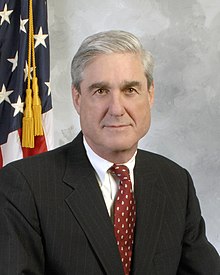
Special Counsel Robert S. Mueller and Assistant Attorney General Rod Rosenstein were career Justice Department officials. They weren’t voted into office.
Robert Mueller
“Number one, I’m in love, and you’re in love. We’re all in love together. There’s so much love in this room, it’s easy to talk. You can talk your heart out. You really could. There’s love in this room. You can talk your heart out. It’s easy. It’s easy. It’s easy.”
Trump apparently finds it easy to fall in love—with Right-wing audiences and Communist dictators such as Kim Jong-Un.
“And from the day we came down the escalator, I really don’t believe we’ve had an empty seat at any arena, at any stadium. They did the same thing at our big inauguration speech. You take a look at those crowds.”
Once again, he must brag about how popular he is and how many people want to listen to him.
“A few days ago I called the fake news the enemy of the people. And they are. They are the enemy of the people. Because they have no sources, they just make ’em up when there are none.”
By January 20, 2020, The Washington Post found that Trump had made “16,241 ‘false or misleading claims” in his first three years in office. He is in no position to talk about integrity.
“But we’re going to have regulation. It’s going to be really strong and really good and we’re going to protect our environment and we’re going to protect the safety of our people and our workers, OK?”
To “protect our environment,” Trump appointed Andrew R. Wheeler, a former coal company lobbyist, to head the Environmental Protection Agency.
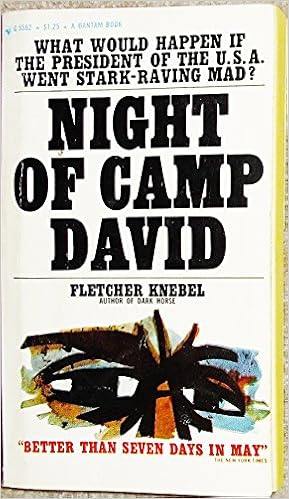
What would happen if the President of the United States went stark-raving mad?
That is the premise of the 1965 novel, Night at Camp David, by Fletcher Knebel.
At the time of its release, its plot was considered so over-the-top as to be worthy of science fiction:
Iowa Democratic Senator Jim MacVeagh is summoned to Camp David, the Presidential retreat, by President Mark Hollenbach. MacVeagh is expected to become Hollenbach’s next Vice President. But he becomes alarmed that Hollenbach is clearly suffering from intense paranoia.
Hollenbach wants to develop a closer relationship between the United States and Russia—while cutting ties with American allies in Europe. Moreover, he believes the American news media are conspiring against him with his political enemies.
Only one person possesses evidence that Hollenbach is losing his grip on sanity—his mistress, Rita. Desperate to retain his power, Hollenbach orders the FBI to investigate both MacVeagh and Rita.
So why was a 53-year-old novel re-released in 2018? The answer lay in two words: Donald Trump.
In a November 30, 2018 review of Night at Camp David, Tom McCarthy, national affairs correspondent for the British newspaper, The Guardian, wrote:
“The current president has seen crowds where none exist, deployed troops to answer no threat, attacked national institutions – the military, the justice department, the judiciary, the vote, the rule of law, the press – tried to prosecute his political enemies, elevated bigots, oppressed minorities, praised despots while insulting global allies and wreaked diplomatic havoc from North Korea to Canada.
“He stays up half the night watching TV and tweeting about it, then wakes up early to tweet some more, in what must be the most remarkable public diary of insecurity, petty vindictiveness, duplicity and scattershot focus by a major head of state in history.”
And the nightmare isn’t over.
Among the outrages Trump has committed since returning to power on January 20:
Pardoned about 1,500 of his followers who violently tried to overturn the outcome of the 2020 Presidential election in the January 6, 2021 attack on Congress. Move than 250 of those pardoned had been convicted of assaulting police.
Withdrew the United States from the World Health Organization (WHO).
Withdrew the United States from the Paris climate agreement.
Ordered the dismissal of 5,000 FBI agents who investigated his incitement of the January 6 riot and his illegal hoarding of classified documents at Mar-a-Lago.
Declared “a national emergency” targeting migrants—legal and illegal.
Tried to cancel birthright citizenship—enshrined within the United States Constitution— for U.S.-born children.
Demanded a military parade for his 79th birthday, poorly disguised as a salute to the 250th anniversary of the United States Army.
Fired without cause the director of the Consumer Financial Protection Bureau.
Angrily fired the Commissioner of the Bureau of Labor Statistics following a weak jobs report, triggering fears about his extortionate tariff policy.
Donald Trump
Demanded that the media refer to the Gulf of Mexico as “the Gulf of America” and banned the Associated Press from the White House for refusing to do so.
Ordered the closure of all Federal Diversity, Equity, Inclusion and Accessibility offices.
Fired the inspectors general from more than a dozen federal agencies.
Demanded that Canada become the 51st state and aggressively raised tariffs on Canadian goods.
Aggressively stated that he wanted the United States to acquire Greenland, its longtime ally.
Issued executive orders revoking the security clearance of Chris Krebs, former director of the Cybersecurity and Infrastructure Security Agency. Krebs’ “crime”: Preventing lies spread by Russians—and Americans—on social media platforms from swaying the 2020 Presidential election to Trump.
Threatened Harvard University with the loss of billions of dollars in federal funding, claiming that 2023 student protests about Gaza violated the civil rights of Jewish students.
Accepted a $400 million luxury jet from Qatar for his personal use, a violation of the Emoluments Clause of the Constitution.
Trump’s vindictiveness, his narcissism, his compulsive aggression, his complaints that his “enemies” in government and the press are trying to destroy him, have caused many to ask: Could the President of the United States be suffering from mental illness?
One who has dared to answer this question is John D. Gartner, a practicing psychotherapist.
John D. Gartner
Gartner graduated magna cum laude from Princeton University, received his Ph.D in clinical psychology from the University of Massachusetts, and served as a part-time assistant professor of psychiatry at Johns Hopkins University Medical School for 28 years.
During an interview by U.S. News & World Report (published on January 27, 2017), Gartner said: “Donald Trump is dangerously mentally ill and temperamentally incapable of being president.”
Gartner said that Trump suffers from “malignant narcissism,” whose symptoms include:
anti-social behavior
sadism
aggressiveness
paranoia
grandiosity.
“We’ve seen enough public behavior by Donald Trump now that we can make this diagnosis indisputably,” says Gartner, who admits he has not personally examined Trump.
More of that behavior was on full display on March 2, 2019 at the annual Conservative Political Action Conference (CPAC), held at the Gaylord National Resort & Convention Center, National Harbor, Maryland.
For more than two hours, Trump delivered the longest speech (so far) of his first term as President to his fanatically Right-wing audience.
Steffen White’s Email: Sparta480@aol.com Former reporter, legal investigator and troubleshooter. Columnist at Bureaucracybuster.com. Fighting political and bureaucratic arrogance, incompetence and/or indifference.
When making complaints in writing, carefully review your email or letter before sending it. Remove any words that are vulgar or profane. Don't make sweeping accusations: "Your agency is a waste."
Don't attribute motives to people you've had problems with, such as: "The postal clerk refused to help me because he's a drunk." If the person actually appeared to be drunk, then be precise in your description: "As he leaned over the counter I could smell beer on his breath. Behind him, in a waste basket, I saw an empty bottle of Coors beer."
Show how the failure of the official to address your problem reflects badly on the company or agency: "This is not the level of service your ads would lead potential customers to expect."
If necessary, note any regulatory agencies that can make life rough for the company or agency if your complaint isn't resolved. For the phone company, for example, cite the FCC or the PUC. But do this only after you have stated you hope your complaint can be settled amicably and privately within the company.





 Bureaucracybuster's Blog
2016 PRESIDENTIAL CAMPAIGN, ABC NEWS, ABRAHAM LINCOLN, ADOLF HITLER, ALEC BALDWIN, ALTERNET, ANDREW JACKSON, AP, BARACK OBAMA, BILL O'REILLY, BUZZFEED, CBS NEWS, CHEKA, CNN, CONCENTRATION CAMPS, CROOKS AND LIARS, DAILY KOZ, ELECTRONIC SURVEILLANCE, EXECUTIONS, FIRST AMENDMENT, FOX NEWS, FRED TRUMP, FREEDOM OF SPEECH, FREEDOM OF THE PRESS, FSB, HILLARY CLINTON, HUMOR, HUSTLER MAGAZINE, IT'S A WONDERFUL LIFE, JERRY FALWELL, JOE SCARBOROUGH, JOHN F. KENNEDY, JOHN MCCAIN, JOSEPH STALIN, KELLY SADLER, KGB, KIM JONG-II, KIM JONG-UN, LARRY FLYNT, MGB, MORNING JOE, MOTHER JONES, MOVEON, MSNBC, NAZI GERMANY, NBC NEWS, NEWSWEEK, NKVD, NORTH KOREA, NPR, ONE DAY WE WILL LIVE WITHOUT FEAR (BOOK), PARODY, POLITICO, RAW STORY, REUTERS, RICHARD NIXON, RUSSIA, SALON, SARAH HUCKABEE SANDERS, SATURDAY NIGHT LIVE, SEATTLE TIMES, SLATE, SOVIET UNION, STORMY DANIELS, THE ATLANTIC, THE CHICAGO SUN-TIMES, THE CHICAGO TRIBUNE, THE DAILY BEAST, THE GUARDIAN, THE HILL, THE HUFFINGTON POST, THE LOS ANGELES TIMES, THE NATION, THE NEW YORK TIMES, THE WASHINGTON POST, THEODORE ROOSEVELT, TIME, U.S. NEWS & WORLD REPORT, UNITED STATES SUPREME COURT, UPI, USA TODAY, VLADIMIR PUTIN, WILLIAM REHNQUIST, X
TYRANTS UNITED–TRUMP AND HIS COMMUNIST HEROES: PART THREE (END)
In Bureaucracy, History, Law, Law Enforcement, Military, Politics, Social commentary on November 10, 2025 at 12:10 amIn January, 2018, the White House of President Donald Trump banned the use of personal cell phones in the West Wing.
The official reason: National security.
The real reason: To stop staffers from leaking to reporters.
According to an anonymous White House source: “The cellphone ban is for when people are inside the West Wing, so it really doesn’t do all that much to prevent leaks. If they banned all personal cellphones from the entire [White House] grounds, all that would do is make reporters stay up later because they couldn’t talk to their sources until after 6:30 pm.”
Other sources believed that leaks wouldn’t end unless Trump started firing staffers. But that risked firing the wrong people. To protect themselves, those who leaked might well accuse tight-lipped co-workers.
Within the Soviet Union (especially during the reign of Joseph Stalin) fear of secret police surveillance was widespread—and absolutely justified.
According to the 2016 book, One Day We Will Live Without Fear: Everyday Lives Under the Soviet Police State, by Mark Harrison, the methods used to keep conversations secret included:
The secret police (known as the Cheka, the NKVD, the MGB, the KGB, and now the FSB) operated on seven working principles:
Trump has always ruled through bribery and fear. He’s bought off (or tried to) those who might cause him trouble—like porn actress Stormy Daniels.
He’s never been able to poke fun at himself—and he grows livid when anybody else does.
At Christmastime, 2018, “Saturday Night Live” aired a parody of the classic movie, “It’s a Wonderful Life.” Its title: “It’s a Wonderful Trump.”
In it, Trump (portrayed by actor Alec Baldwin) discovers what the United States would be like if he had never become President: A great deal better-off.
As usual, Trump expressed his resentment through Twitter: The Justice Department should stop investigating his administration and go after the real enemy: “SNL.”
“A REAL scandal is the one sided coverage, hour by hour, of networks like NBC & Democrat spin machines like Saturday Night Live. It is all nothing less than unfair news coverage and Dem commercials. Should be tested in courts, can’t be legal? Only defame & belittle! Collusion?”
By saying that, Trump showed his contempt for the role of the First Amendment in American history.
Cartoonists portrayed President Andrew Jackson (1829 -1837) wearing a king’s robes and crown, and holding a scepter. This thoroughly enraged Jackson—who had repulsed a British invasion in 1815 at the Battle of New Orleans. To call a man a monarchist in 1800s America was the same as calling him a Communist in the 1950s.
During the Civil War, President Abraham Lincoln was lampooned as an ape and a blood-stained tyrant. And Theodore Roosevelt proved a cartoonist’s delight, with attention given to his bushy mustache and thick-lensed glasses.
Thus, the odds are slight that an American court would even hear a case brought by Trump against “SNL.”
Such a case made its way through the courts in the late 1980s when the Reverend Jerry Falwell sued pornographer Larry Flyint over a satirical interview in Hustler magazine. In this, “Falwell” admitted that his first sexual encounter had been with his own mother.
In 1988, the United States Supreme Court, voting 8-0, ruled in Flynt’s favor, saying that the media had a First Amendment right to parody a celebrity.
“Despite their sometimes caustic nature, from the early cartoon portraying George Washington as an ass down to the present day, graphic depictions and satirical cartoons have played a prominent role in public and political debate,” Chief Justice William Rehnquist—an appointee of President Richard Nixon—wrote in his majority decision in the case.
Moreover, Trump would have been forced to take the stand in such a case. The attorneys for NBC and “SNL” would have insisted on it.
The results would have been:
And while Trump loves to sue those he hates, he does not relish taking the stand himself.
On October 12, 2016, The Palm Beach Post, The New York Times and People all published stories of women claiming to have been sexually assaulted by Trump.
He accused the Times of inventing accusations to hurt his Presidential candidacy. And he threatened to sue for libel if the Times reported the women’s stories. He also said he would sue the women making the accusations.
He never sued the Times, The Post, People—or the women.
Share this: