bureaucracybusters

Posts Tagged ‘CIVIL WAR’

A REMEDY FOR TREASON: PART ONE (OF TWO)

In History, Law, Politics, Social commentary on September 25, 2014 at 12:07 am

Scotland’s failed vote to withdraw from the United Kingdom has stirred fresh hopes in millions of Americans who want to see their states leave the Union.

Almost a quarter of Americans would like to see their states secede from the Union, a new Reuters/Ipsos poll found.

The poll–of 8,952 respondents from August 23 to September 16–found:

  • 23.9% of Americans strongly favored secession;
  • 53.3 % strongly opposed it.

Secessionist sentiment is highest among Republicans and those who live in rural Western states.  Democrats and Northerners take a far dimmer view.

Some of those polled blamed Washington gridlock for wanting to see their states go their own way.

Residents in more than 40 states have filed secession petitions to the Obama administration’s “We the People” program, which is featured on the White House website.

States whose residents have filed secession petitions include:

Alabama, Alaska, Arizona, Arkansas, California, Colorado, Connecticut, Delaware, Florida, Georgia, Hawaii, Idaho, Illinois, Indiana, Iowa, Kansas, Kentucky, Louisiana, Maine, Maryland, Massachusetts, Michigan, Minnesota, Mississippi, Missouri, Montana, Nebraska, New Hampshire, New Jersey, New Mexico, New York, Nevada, North Carolina, North Dakota, Ohio, Oklahoma, Oregon, Pennsylvania, Rhode Island, South Carolina, South Dakota, Tennessee, Texas, Utah, Virginia, Washington (state), West Virginia, Wisconsin and Wyoming.

“I don’t think it makes a whole lot of difference anymore which political party is running things. Nothing gets done,” said Roy Gustafson, 61, of Camden, South Carolina, who lives on disability payments. “The state would be better off handling things on its own.”

But by far the biggest reason for the rage to secede: Thousands–if not millions–of Americans can’t stomach the thought of a moderately-liberal black man winning a second term as President.

Texas GOP official Peter Morrison, treasurer of the Hardin County Republican party, recently called for an “amicable divorce” of Texas from the United States.

“Why should Vermont and Texas live under the same government?” he wrote in an Op-Ed in a Tea Party newsletter.

The Texas petition assails the federal government’s “neglect to reform domestic and foreign spending.”

And it argues that “it is practically feasible for Texas to withdraw from the union, and to do so would protect it’s citizens’ standard of living and re-secure their rights and liberties in accordance with the original ideas and beliefs of our founding fathers which are no longer being reflected by the federal government.”

So far, more than 84,000 people have signed the Texas petition and that number is going up.

And in a post on his Facebook page which has now been removed, Morrison wrote: “We must contest every single inch of ground and delay the baby-murdering, tax-raising socialists at every opportunity.

“But in due time, the maggots will have eaten every morsel of flesh off of the rotting corpse of the Republic, and therein lies our opportunity.”

Evoking the history of Confederate soldiers who refused to surrender after Gettysburg, Morrison, 33, called for Texans to fight “in hopes that Providence might shine upon our cause.”

Confederate flag

Morrison is particularly angry at Asian-Americans and Hispanics who backed Obama, accusing them of voting on an “ethnic basis.”

“‘They’ re-elected Obama,” Morrison wrote. “He is their president.”

Petitions to strip citizenship from–and then deport–those signing petitions to secede have also been filed with the White House website.

President Obama would do well to review how Andrew Jackson, America’s seventh President from 1829 to 1837, reacted to threats of secession.

Andrew Jackson

In 1830, South Carolina was threatening to secede from the Union.  A South Carolina Congressman who was returning home visited Jackson and asked: “Do you have a message you want me to give to your friends in the state?”

Jackson questioned him about the recent mass meetings in Charleston.

The friend warned him that South Carolina’s fire-eaters believed “the Army and Navy aren’t big enough to collect a penny” of Federal duties.

“Do they realize what their words mean?” asked Jackson.

“I’m afraid they do, General.”

“Then tell them from me that they can talk and write resolutions and print threats to their hearts’ content.

“But if one drop of blood is shed there in opposition to the laws of the United States, I will hang the first man I can lay my hands on engaged in such treasonable conduct, from the first tree I can reach.”

News of Jackson’s threat quickly spread throughout Washington, D.C.

Senator Robert Hayne of South Carolina told his fellow Senator, Thomas Hart Benton, of Missouri, that he couldn’t believe that Jackson would send an army to invade a sovereign state.

Benton replied: “I tell you, Hayne, when Jackson starts talking about hanging, they can begin to look for the ropes.”

Jackson later issued a proclamation to the people of South Carolina and threatened to hang Hayne’s successor, Senator John C. Calhoun.  He also warned that he would himself lead an army into the state to enforce Federal law.

The treasonous rumblings stopped–for the moment.

WHY THE POOR SUPPORT THE RICH: PART TWO (END)

In Bureaucracy, History, Law, Politics, Social commentary on August 1, 2014 at 10:53 am

Republicans have long tried to prevent or eliminate programs that aid the poor and middle-class, including:

  • Social Security – since it began in 1935
  • Medicare  – since it began in 1965
  • Food stamps – since it began in 1964
  • WIC (Women, Infants, Children) – since 1972
  • The Affordable Care Act (Obamacare) – since 2010

So why are so many poor Americans now flocking to this party’s banner?

Two reasons: Racism and greed.  There are historical parallels for both.

Racism:

In 1999, historian Victor Davis Hanson noted the huge gap in wealth between the aristocratic, slave-owning minority of the pre-Civil War South and the vast majority of poor white Southerners.

“Before the war in the counties Sherman would later ruin, the top 10% of the landowners controlled 40% of the assessed wealth.”

In contrast, “more than half of those who were lucky enough to own any property at all still possessed less than 15% of the area’s valuation.”

So Hanson asked: “Why did the millions of poor whites of the Confederacy fight at all?”

He supplied the answer in his brilliant work on military history, The Soul of Battle: From Ancient Times to the Present Day, How Three Great Liberators Vanquished Tyranny.

One of those liberators was General William Tecumseh Sherman, who led 62,000 Union troops in a victorious “March to the Sea” through the Confederacy in 1864.

So why did so many poor Southern whites literally lay down their lives for the wealthy planter class, which despised them?

According to Hanson: “Behind the entire social fabric of the South lay slavery.

“If slavery eroded the economic position of the poor free citizens, if slavery encouraged a society of haves and have-nots…then it alone offered one promise to the free white man–poor, ignorant and dispirited–that he was at least not black and not a slave.”

And the planter class and its allies in government easily fobbed off their poor white countrymen with cheap flattery.  Said Georgia Governor Joseph Brown:

“Among us the poor white laborer is respected as an equal.  His family is treated with kindness, consideration, and respect.  He does not belong to the menial class.  The negro is in no sense his equal.   He belongs to the only true aristocracy, the race of white men.”

The reality of slavery

Similarly, poor whites now flock to the Republican Party–which holds them in equal contempt– in large part to protest the 2008 election of the first black President of the United States.

According to a Pew Research Center study released on July 22, 2011: “Notably, the GOP gains have occurred only among white voters; a 2-point Republican edge among whites in 2008 (46% to 44%) has widened to a 13-point lead today (52% to 39%).”

GOP Makes Big Gains among White Voters | Pew Research Center for the People and the Press

Since the 1960s, Republicans have pursued a campaign policy of “divide and rule”–divide the nation along racial lines and reap the benefits at election time.

  • Republicans opposed the Civil Rights Act of 1964.
  • Republicans opposed the Voting Rights Act of 1965.
  • Republicans, with Richard Nixon as their Presidential candidate in 1968 and 1972, pursued what they called a “Southern strategy”: Use “code language” to stoke fear and hatred of blacks among whites.
  • Republicans have falsely identified welfare programs exclusively with non-whites.  (Of the six million Americans receiving food stamps, about 42 percent are white, 32 percent are black, and 22 percent are Latino—with the growth fastest among whites during the recession.)

Thus, in voting Republican, many of these poor whites believe they are “striking a blow for the white race.”

And they can do so in a more socially acceptable way than joining a certified hate group such as the American Nazi Party or Ku Klux Klan.

Greed:

In the hit play, 1776, on the creation and signing of the Declaration of Independence, there is a telling exchange between John Dickinson and John Hancock.  It comes during the song, “Cool, Cool, Considerate Men.”

Dickinson, the delegate from Pennsylvania, urges Hancock, president of the Second Continental Congress, “to join us in our minuet.”

By “us” he means his fellow conservatives who fear losing their property and exalted status by supporting American independence from Great Britain.

Hancock declines, saying: “Fortunately, there are not enough men of property in America to dictate policy.”

To which Dickinson replies:  “Perhaps not.  But don’t forget that most men with nothing would rather protect the possibility of becoming rich than face the reality of being poor.  And that is why they will follow us.”

Today, poor whites generally identify with the CEOs of powerful corporations.  They believe the Republican gospel that they can attain such wealth–if only the government will “get out of my way.”

They forget–or ignore–the brutal truth that government, for all its imperfections, is sometimes all that stands between them and a wide range of predators.

In return, the CEOs despise them as the privileged have always despised their social and economic “inferiors.”

Unless the Democratic Party can find ways to directly address these bitter, Politically Incorrect truths, it will continue its decline into insignificance.

WHY THE POOR SUPPORT THE RICH: PART ONE (OF TWO)

In Bureaucracy, History, Law, Politics, Social commentary on July 31, 2014 at 3:44 pm

On July 22, 2011, the Pew Foundation, analyzing voter identification, found that the GOP had gained strength among white voters, most specifically “the young and poor.”

A seven-point Democratic advantage among whites under age 30 three years earlier had turned into an 11-point GOP advantage.

And a 15-point Democratic advantage among whites earning less than $30,000 annually had swung to a slim four-point Republican edge.

In addition:

  • The GOP gains have occurred only among white voters.
  • Republicans have made sizable gains among white voters since 2008.
  • Fifty-two percent of white voters now call themselves Republicans or lean to the GOP, compared with 39% who affiliate with the Democratic Party or lean Democratic.
  • Democrats have lost their edge among lower income white voters.
  • In 2008, Democrats had a 15 point lead among white voters with family incomes less than $30,000.  Republicans now have a four-point edge among this group.
  • The GOP’s lead among middle income white voters also has grown since 2008, and Republicans hold a substantial advantage with higher income white voters.
  • Republicans have made gains among whites with a high school education or less.
  • The GOP’s advantage over Democrats grew from one point in 2008 to 17 points in 2011 among less educated whites.
  • Republicans have made smaller gains among whites voters who have college degrees.

What is fascinating about these findings is this: The Republicans have, since 1980, pursued a policy of gutting programs aimed at helping the poor–while repeatedly creating tax-breaks for the wealthiest 1% of the population.

For Republicans, the patron saint of this “love-the-rich-screw-the-poor” ideology remains Ronald Reagan.  Reagan served as governor of California (1967-1974) and President of the United States (1981-1989).

Ronald Reagan

Among those charting Reagan’s legacy as President was former CBS Correspondent David Schoenbrun In his bestselling autobiography, America Inside Out: At Home and Abroad from Roosevelt to Reagan, he noted:

  • On January 28, 1981, keeping a pledge to his financial backers in the oil industry, Reagan abolished Federal controls on the price of oil.
  • Within a week, Exxon, Texaco and Shell raised gasoline prices and prices of home heating oil.
  • Reagan saw it as his duty to put a floor under prices, not a ceiling above them.
  • Reagan believed that when government helped business it wasn’t interfering.   Loaning money to bail out a financially incompetent Chrysler was “supporting the free enterprise system.”
  • But putting a high-profits tax on price-gouging corporations or filing anti-trust suits against them was “Communistic” and therefore intolerable.
  • Tax-breaks for wealthy businesses meant helping America become stronger.
  • But welfare for the poor or the victims of a predatory marketplace economy weakened America by sapping its morale.

“In short,” wrote Schoenbrun,”welfare for the rich is good for America.  But welfare for the poor is bad for America, even for the poor themselves, for it encourages them to be shiftless and lazy.

“Somehow, loans to the inefficient management of American corporations would not similarly encourage them in their inefficient methods.”

Republicans have sought to dismantle Social Security ever since that program began in 1935.  And Republicans have furiously opposed other programs aiding the poor and middle-class–such as Medicare, food stamps and WIC (Women, Infants, Children).

In short, this is not a political party with a history of rushing to the defense of those most in need.

So the question remains: Why are so many poor Americans now flocking to its banner?

Two reasons: Racism and greed.  There are historical parallels for both.

Racism:

In 1999, historian Victor Davis Hanson noted the huge gap in wealth between the aristocratic, slave-owning minority of the pre-Civil War South and the vast majority of poor white Southerners.

“Before the war in the counties Sherman would later ruin, the top 10% of the landowners controlled 40% of the assessed wealth.”

In contrast, “more than half of those who were lucky enough to own any property at all still possessed less than 15% of the area’s valuation.”

So Hanson asked: “Why did the millions of poor whites of the Confederacy fight at all?”

He supplied the answer in his brilliant work on military history, The Soul of Battle: From Ancient Times to the Present Day, How Three Great Liberators Vanquished Tyranny.

One of those liberators was General William Tecumseh Sherman, who led 62,000 Union troops in a victorious “March to the Sea” through the Confederacy in 1864.

So why did so many poor Southern whites literally lay down their lives for the wealthy planter class, which despised them?

GENERAL SHERMAN’S ADVICE TO ISRAEL

In History, Military, Politics on July 15, 2014 at 9:19 am

Thomas Jonathan “Stonewall” Jackson, the great Southern general of the American Civil War (1861-1865) had a simple philosophy of war.

To end Union efforts to crush the newly-minted Confederate States of America, he urged, Southerners should quickly make its cost as high as possible.

Confederates, he believed, should take no prisoners.  Instead, they should kill every Union soldier they could lay hands on.

Thomas “Stonewall” Jackson

Jackson’s views on war were shared by not only his fellow Southerners but, ironically, by one of the fiercest enemies of the Confederacy: William Tecumseh Sherman.

Sherman was the Union general who cut a swath of destruction through the South while “marching through Georgia.”

He is credited–or reviled–as the father of “total war,” thus making the suffering of civilians an integral part of any conflict.

In March, 1985, a staff officer told Sherman about Jackson’s opinion on not taking prisoners.  Asked for his reaction, Sherman said: “Perhaps he was right.

“It seems cruel, but if there were no quarter given, most men would keep out of war.  Rebellions would be few and short.”

William Tecumseh Sherman

Contrast that with the way Israel is now responding to hundreds of unprovoked rocket attacks by the Hamas terrorist group.

Since July 8, the Israeli Air Force has bombarded more than 900 Hamas targets in the Gaza Strp.

Israel claims it’s trying to avoid civilian casualties in the crowded urban landscape.  Members of the Israeli military have been telephoning Palestinian residents whose homes have been targeted, warning them to leave.

One resident, Sawsan Kawarea, claimed she received a call  from “David,” who said he was with the Israeli military.

“He asked for me by name. He said: ‘You have women and children in the house. Get out. You have five minutes before the rockets come,’” Kawarea said in an interview.

She ran outside with her children. A small rocket hit the house soon afterward. Five minutes later, a larger missile hit, destroying the house.

For years, the Israeli military has delivered such warnings via cellphone calls and small “warning rockets”–usually sent from drones.

The strategy has a nickname: “Roof knocking.”

It’s Israel’s response to longtime criticism for “collateral damage.”  That is: Civilians killed while its military takes action in the crowded Palestinian territories.

The policy allows Israel to say: We did our bes to avoid killing civilians.

But in waging Politically Correct warfare to head off criticism, Israel has made a dangerous mistake.

Niccolo Machiavelli, the 15th century Florentine statesmen, carefully studied both war and politics.  In his major work, The Discourses, he advises:

…Often individual men, and sometimes a whole city, will act so culpably against the state that as an example to others and for his own security the prince has no other remedy but to destroy it entirely. 

Honor consists in being able, and knowing when and how, to chastise evil-doers.  And a prince who fails to punish them, so that they shall not be able to do any more harm, will be regarded as either ignorant or cowardly….

Meanwhile, on the Gaza Strip: After a week of Israeli bombing more than 900 Hamas targets, Palestinian medical officials claimed that 186 people had been killed and at least 1,390 wounded.

That works out to about 26 people killed every day.

Contrast those figures with the casualties suffered by a single German city during World War 11 air raids during eight days and seven nights.

Beginning on July 24, 1943, the U.S. Air Force and the British Royal Air Force over several days killed 42,600 civilians and wounded 37,000 in Hamburg and practically destroyed the entire city.

The bombing ignited a firestorm that incinerated more than eight square miles, baking alive many of those who sought safety in cellars and bomb shelters.

Hamburg, Germany, after Allied bombing raids

For the vaunted Israeli Air Force to have killed so few of its enemies after dropping so many bombs testifies to a massive waste of ordinance.

Clearly, the only people making good on these raids are the arms makers supplying the bombs.

If the United States had managed to kill only 26 Germans a day in World War II, America and Nazi Germany would still be at war today.

No wonder Hamas continues to fire rockets into Israel.

Machiavelli knew–and often warned–that while it was useful to avoid hatred, it was fatal to be despised.  And he also warned that humility toward insolent enemies will only encourage their hatred for you.

An Aesop’s fable well sums up the lesson Israel should have learned long ago:

A snake was stepped on by so many people he prayed to Zeus for help.  And Zeus said: “If you’d bitten the first person who stepped on you, the second would have thought twice about it.”

LINCOLN WEEPS

In Bureaucracy, History, Law, Politics, Social commentary on May 5, 2014 at 12:02 am

In 1845, Andrew Jackson, seventh President of the United States from 1829 to 1837, lay dying at The Hermitage in Nashville, Tennessee.

Jackson had spent his adult life defending the infant United States.  He had fought the Indians and British during the War of 1812, capping his career as a general with his triumph at the Battle of New Orleans in 1815.

As President, he had faced down would-be “nullifiers”–those Southern politicians who claimed states had the right to ignore federal laws they disliked.

 Andrew Jackson

But now his worn, disease-racked body was fast reaching the limits of its endurance.  Knowing that death was closing in, Jackson often took stock of his lifetime of achievements–and failures.

One day, he asked one of his doctors what act of his administration would be most severely condemned by future generations.

“Perhaps the removal of the bank deposits,” said the doctor–referring to Jackson’s withdrawal of U.S. Government monies from the first Bank of the United States.

That act had destroyed the bank, which Jackson had believed was a source of political corruption.

“Oh, no!” said Jackson.

“Then maybe the specie circular,” said the doctor.  He was referring to an 1836 executive order Jackson had issued, requiring payment for government land to be in gold and silver.

“Not at all!” said Jackson.

Then, his eyes blazing, Jackson raged: “I can tell you.  Posterity will condemn me more because I was persuaded not to hang John C. Calhoun as a traitor than for any other act in my life!”

Historians have not condemned Jackson for this.  But perhaps he was right-–and perhaps he should have hanged Calhoun.

It might have prevented the Civil War-–or at least delayed its coming.

John C. Calhoun had once been Vice President under Jackson and later a United  States Senator from South Carolina.   His fiery rhetoric and radical theories of “nullification” played a major part in bringing on the Civil War (1861-1865).

Calhoun was an outspoken proponent of slavery, which he declared to be  a “positive good” rather than a “necessary evil.”  He supported states’ rights and nullification–under which states could declare null and void federal laws which they deemed unconstitutional.

Over time, Southern states’ threats of “nullification” turned to those of “secession” from the Union.

Jackson died in 1845-–16 years before the Civil War erupted.  The resulting carnage destroyed as many as 620,000 lives.  More Americans died in the war than have been killed in all the major wars fought by the United States since.

When it ended, America was reinvented as a new, unified nation–-and one where slavery was now banned by the 13th Amendment to the United States Constitution.

Equally important, the Federal Government had now set a precedent for using overwhelming military power to force states to remain in the Union.

Except for die-hard secessionists, Americans overwhelmingly agreed, from 1865 on, that the Union was sacred and unbreakable.  Until, that is, the 2009 inauguration of Barack Obama–the country’s first black President.

Then, suddenly, secession–treason–became fashionable again, not only among many Southerners but even among so-called “mainstream” Republicans.

To date, sovereignty resolutions have been introduced in 58 state legislatures, and have passed in nine–Alaska, Arizona, Idaho, Kansas, North Dakota, South Dakota, Oaklahoma, Louisiana and Tennessee.

“Sovereignty” means supreme, independent authority over a territory–authority heretofore accepted as residing with the federal government.

For more than 20 years, Cliven Bundy, a Nevada cattle rancher, has refused to pay fees for grazing cattle on public lands, some 80 miles north of Las Vegas.

The Federal Bureau of Land Management (BLM) says Bundy now owes close to $1 million. He says his family has used the land since the 1870s and doesn’t recognize the federal government’s jurisdiction.

In 2013, a federal judge ordered Bundy to remove his livestock.

Bundy ignored the order, and was in fact even quoted as saying; “I don’t recognize the United States government as even existing.”

In early April, 2014, BLM agents rounded up more than 400 of his cattle.

Over the weekend of April 12-13, armed militia members and states’ right protesters showed up to challenge the move.

Rather than risk violence, the BLM did an about-face and released the cattle.

While Right-wingers hail this as a victory for “states’ rights,” the truth is considerably different.

Bundy’s refusal to recognize the federal government’s jurisdiction amounts to: “I will recognize–and obey–only those laws that I happen to agree with.”

Abraham Lincoln dedicated his Presidency–and sacrificed his life–to ensure the preservation of a truly United States.

And Robert E. Lee—the defeated South’s greatest general—spent the last five years of his life trying to put the Civil War behind him and persuade his fellow Southerners to accept their place in the Union.

But Cliven Bundy and other Right-wing champions of treason are working hard to destroy that union–and unleash a second Civil War.

THE DANGERS OF TIMIDITY

In Bureaucracy, History, Law, Law Enforcement, Politics, Social commentary on April 23, 2014 at 1:00 am

President Barack Obama–or at least Neil Kornze, the director of the Federal Bureau of Land Management (BLM)–has some serious lessons to learn about the uses of power.

For more than 20 years, Cliven Bundy, a Nevada cattle rancher, has refused to pay fees for grazing cattle on public lands, some 80 miles north of Las Vegas.

BLM says Bundy now owes close to $1 million. He says his family has used the land since the 1870s and doesn’t recognize the federal government’s jurisdiction.

In 2013, a federal judge ordered Bundy to remove his livestock. He ignored the order, and in early April, 2014, BLM agents rounded up more than 400 of his cattle.

Over the weekend of April 12-13, armed militia members and states’ right protesters showed up to challenge the move.

US Bureau of Land Management (BLM) | Tethys

Bureau of Land Management logo 

Rather than risk violence, the BLM did an about-face and released the cattle.

Right-wing bloggers and commentators have portrayed the incident as a victory over Federal tyranny.

According to Alex Jones’ Infowars.com: “Historic!  Feds Forced to Surrender to American Citizens.”

Right-wingers have depicted Bundy as a put-upon Everyman being “squeeaed” by the dictatorial Federal government.

They have deliberately ignored a number of inconvenient truths–such as:

  • He claims that his grazing rights were established in 1880 when his ancestors settled the land where his ranch sits.
  • But the Nevada constitution–adopted in 1864 as a condition of statehood–contradicts Bundy’s right to operate as a law unto himself.
  • The constitution says: “The people inhabiting said territory do agree and declare, that they forever disclaim all right and title to the unappropriated public lands lying within said territory, and that the same shall be and remain at the sole and entire disposition of the United States.”
  • In 1934,  the Taylor Grazing Act gave existing ranchers permits allowing them to run their herds on federal land.
  • In turn, ranchers paid user fees, which were lower than what most private landowners would have charged.
  • In 1993, the Federal government launched an effort to protect the endangered desert tortoise.
  • Certain grasslands were placed off-limits for grazing, and the government bought out the permits of some ranchers.
  • Among others, Bundy refused to sell and kept grazing his cattle on restricted federal land without a permit.
  • Amidst mounting fees and fines, Bundy repeatedly slugged it out in court against government lawyers.  He lost.
  • In 1998, a federal judge permanently barred him from letting his cattle graze on protected federal land.
  • In early April, 2014, BLM agents–charged with overseeing grazing rights–began rounding up Bundy’s cattle to remove them from federal property.

Bundy’s family and other ranchers–backed up by a motley assortment of self-declared militiamen armed with rifles and pistols–confronted the agents.

Fearing another Waco–regarded by Right-wing Americans as a second Alamo–the BLM agents backed down and released Bundy’s cattle.  And then retreated.

While Right-wingers hail this as a victory for “states’ rights,” the truth is considerably different.

Bundy’s refusal to recognize the federal government’s jurisdiction amounts to: “I will recognize–and obey–only those laws that I happen to agree with.”

And the BLM’s performance offers a texbook lesson on how not to promote respect for the law–or for those who enforce it.

As Niccolo Machiavelli, the father of modern political science warned more than 500 years ago in The Prince:

[A ruler] is rendered despicable by being thought changeable, frivolous, effeminate, timid and irresolute—which [he] must guard against as a rock of danger…. 

[He] must contrive that his actions show grandeur, spirit, gravity and fortitude. 

As to the government of his subjects, let his sentence be irrevocable, and let him adhere to his decisions so that no one may think of deceiving or cozening him.

Niccolo Machiavelli

In his master-work, The Discouorses, he outlines the consequences of allowing lawbreakers to go unpunished:

...Having established rewards for good actions and penalties for evil ones, and having rewarded a citizen for conduct who afterwards commits a wrong, he should be chastised for that without regard to his previous merits….

For if a citizen who has rendered some eminent service to the state should add to the reputation and influence which he has thereby acquired the confident audacity of being able to commit any wrong without fear of punishment, he will in a little while become so insolent and overbearing as to put an end to all power of the law.

The conduct of the agents of BLM has violated that sage counsel on all counts.

BLM agents should have expected trouble from Right-wing militia groups–and come fully prepared to deal with it.

The FBI and the U.S. Marshals Service, for example, have created SWAT teams to deal with those who threaten  violence against the Federal Government.

Civil War General William Tecumseh Sherman had a formula for dealing with domestic terrorists of his own time.

Writing to his commander, Ulysses S. Grant, about the best way to treat Confederate guerrillas, he advised:

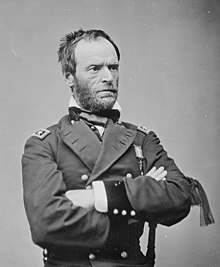
Black-and-white photograph of Sherman in uniform with his arms folded in front of him

General Willilam Tecumseh Sherman

“They cannot be made to love us, but they may be made to fear us.  We cannot change the hearts of those people of the South.

“But we can make war so terrible that they will realize the fact that . . . they are still mortal and should exhaust all peaceful remedies before they fly to war.”

WHAT THE MAJOR HAS TO TELL US

In Entertainment, History, Military, Politics, Social commentary on April 11, 2014 at 12:10 am

Major Dundee is a 1965 Sam Peckinpah Western focusing on a Union cavalry officer (Charlton Heston) who leads a motley troop of soldiers into Mexico to rescue three children kidnapped by Apaches.

Along the way they liberate Mexican villagers and clash with French lancers trying to establish the Austrian Archduke Maximillian 1 as emperor of Mexico.

The Wild Bunch is universally recognized as Peckinpah’s greatest achievement.  It has certainly had a far greater impact on audiences and critics than Major Dundee.  According to Heston, this was really the movie Peckinpah wanted to make while making Dundee, but he couldn’t quite get his hands around it.

As a result, Dundee’s virtues have been tragically overlooked.  It has a larger cast of major characters than Bunch, and these are men you can truly like and identify with:

  • The charm of Benjamin Tyreen (Richard Harrs), a Confederate lieutenant forced into Union service;
  • The steady courage of Sergeant Gomez;
  • The quiet dignity of Aesop (Brock Peters), a black soldier;
  • The quest for maturity in a young, untried bugler Tim Ryan (Michael Anderson, Jr.);
  • The on-the-job training experience of Lt. Graham (Jim Hutton); and
  • The stoic endurance of Indian scout Sam Potts (James Coburn).

These men are charged with a dangerous and dirty mission, and do it as well as they can, but you wouldn’t fear inviting them to meet your family.

Major Dundee | Rotten Tomatoes

Major Dundee (Charlton Heston)

That was definitely not the case with The Wild Bunch, four hardened killers prepared to rip off anyone, anytime, and leave a trail of bodies in their wake.  The only place where you would have felt safe seeing them, in real-life, was behind prison bars.

The Wild Bunch

Dundee is an odyssey movie, in the same vein as Saving Private Ryan.  Both films start with a battle, followed by the disappearance of characters who need to be searched for and brought back to safety.

Just as Dundee assembles a small force to go into Mexico, so, too, does Captain John Miller (Tom Hanks) do the same, with his hunting ground being France.

Dundee’s men retrieve the kidnapped children and survive a near-fatal battle with Indians.  Miller’s men twice clash with the Germans before finding their quarry, James Ryan.

Before Dundee can return to the United States, he must face and defeat a corps of French soldiers.  Before Miller can haul Ryan back to safety, he must repulse a German assault.

Both groups of soldiers–Dundee’s and Miller’s–are transformed by their experiences in ways neither group could possibly articulate.  (Miller, being a highly literate schoolteacher, would surely do a better job of this than the tight-jawed Dundee.)

Dundee’s soldiers return to a United States that’s just ended its Civil War with a Union victory–and the death of slavery.  Miller’s soldiers return to a nation that is now a global superpower.

Of course, Ryan was fortunate in having Steven Spielberg as its director.  With his clout, there was no question that Ryan would emerge as the film he wanted.

Peckinpah lacked such clout.  And he fought with everyone, including the producer, Jerry Bressler, who ultimately held the power to destroy his film.  This guaranteed that his movie would emerge far differently than he had envisioned.

In 2005, an extended version of Dundee was released, featuring 12 minutes of restored footage.  (Much of the original footage was lost after severe cuts to the movie.)

In this, we fully see how unsympathetic a character the martinet Dundee really is.  Owing to Heston’s record of playing heroes, it’s easy to overlook Dundee’s arrogance and lethal fanaticism and automatically view him as a hero.  If he is indeed that, he is a hero with serious flaws.

And his self-imposed mission poses questions for us today:

  • Where is the line between professional duty and personal fanaticism?
  • How do we balance the success of a mission against its potential costs–especially if they prove appalling?
  • At what point–if any–does personal conscience override professional obligations?

Whether intentionally or not, in Major Dundee, Peckinpah laid out a microcosm of the American history that would immediately follow the Civil War.

Former Confederates and Unionists would forego their regional animosities and fight against a recognized mutual enemy—the Indians.  This would prove a dirty and drawn-out war, shorn of the glory and (later) treasured memories of the Civil War.

Just as Dundee’s final battle with French lancers ended with an American victory won at great cost, so, too, would America’s forays into the Spanish-American War and World Wars 1 and 11 prove the same.

Ben Tyreen’s commentary on the barbarism of French troops (“Never underestimate the value of a European education”) would be echoed by twentieth-century Americans uncovering the horrors of Dachau and Buchenwald.

America would learn to project its formidable military power at great cost.  Toward the end of the movie, Teresa Santiago (Senta Berger), the ex-patriot Austrian widow, would ask Dundee: “But who do you answer to?

It is a question that still vividly expresses the view of the international community as this superpower colossus hurtles from one conflict to the next.

PRIDE GOETH BEFORE A FALL

In Bureaucracy, History, Military, Politics on April 10, 2014 at 12:01 am

Pride goeth before destruction, and an haughty spirit before a fall.
–Proverbs 16:18

People often talk about the role sex plays in motivating behavior.  But the power of ego to determine history is often more profound.

Consider the role that ego played in igniting the American Civil War (1861 – 1865).

According to The Destructive War, by Charles Royster, it wasn’t the cause of “states’ rights” that led 13 Southern states to withdraw from the Union in 1960-61.

It was their demand for “respect,” which, in reality, translates into “e-g-o.”

“The respect Southerners demanded did not consist simply of the states’ sovereignty or of the equal rights of Northern and Southern citizens, including slaveholders’ right to take their chattels into Northern territory.

“It entailed, too, respect for their assertion of the moral superiority of slaveholding society over free society,” writes Royster.

It was not enough for Southerners to claim equal standing with Northerners; Northerners must acknowledge it.

But this was something that the North was less and less willing to do.  Finally, its citizens dared to elect Abraham Lincoln in 1860.

Lincoln and his new Republican party damned slavery–and slaveholders–as morally evil, obsolete and ultimately doomed.

And they were determined to prevent slavery from spreading any further throughout the country.

Southerners found all of this intolerable.

The British author, Anthony Trollope, explained to his readers:

“It is no light thing to be told daily, by our fellow citizens…that you are guilty of the one damning sin that cannot be forgiven.

“All this [Southerners] could partly moderate, partly rebuke and partly bear as long as political power remained in their hands.

“But they have gradually felt that this was going, and were prepared to cut the rope and run as soon as it was gone.”

Only 10% of Southerners owned slaves.  The other 90% of the population “had no dog in this fight,” as Southerners liked to say.

Yet they so admired and aspired to be like their “gentleman betters” that they threw in their lot with them.

There were some Southerners who could see what was coming–and vainly warned their fellow citizens.

One of these was Sam Houston, the man who had won Texas independence at the 1836 battle of San Jacinto and later served as that state’s governor.

Sam Houston

On April 19, 1860, addressing a crowd in Galveston, he said:

“Let me tell you what is coming. After the sacrifice of countless millions of treasure and hundreds of thousands of lives, you may win Southern independence if God be not against you.

“But I doubt it.

“I tell you that, while I believe with you in the doctrine of states’ rights, the North is determined to preserve this Union. They are not a fiery, impulsive people as you are, for they live in colder climates.

“But when they begin to move in a given direction, they move with the steady momentum and perseverance of a mighty avalanche; and what I fear is, they will overwhelm the South.”

Four years later, on April 9, 1865, Houston’s warning became history.

Confederate General Robert E. Lee surrendered the Army of Northern Virginia to Union General Ulysses S. Grant at Appomattox Courthouse.

Huge sections of the South had been laid waste by Union troops and more than 258,000 Southerners had been killed.

The South had paid an expensive price for its fixation on ego.

Even more proved at risk a century later, when President John F. Kennedy faced off with Soviet Premier Nikita Khrushchev.

In April, Kennedy had been humiliated at the Bay of Pigs when a CIA-sponsored invasion failed to overthrow the Cuba’s Fidel Castro.

So he was already on the defensive when he and Khrushchev met in Vienna.

Khrushchev pressed his advantage, threatening Kennedy with nuclear war unless the Americans abandoned their protection of West Berlin.

That August, faced with the embarrassment of East Berliners fleeing by the thousands into West Germany, the Soviet leader backed off from his threat.

In its place, he erected the infamous Berlin Wall, sealing off East and West Berlin.

Kennedy’s reaction: “That son of a bitch won’t pay any attention to words. He has to see you move.”

Then, most ominously: “If Khrushchev wants to rub my nose in the dirt, it’s all over.”

In short: Kennedy was prepared to incinerate the planet if he felt his almighty ego was about to get smacked.

Nuclear missile in silo

What has proved true for states and nations proves equally true for those leading every other type of institution.

Although most people like to believe they are guided by rationality and morality, all-too-often, what truly decides the course of events is their ego.

For pre-Civil War Southerners, it meant demanding that “Yankees” show respect for slave-owning society.  Otherwise, they would leave the Union.

For Kennedy, it meant playing a game of “chicken,” backed up with nuclear missiles, to show Khrushchev who Numero Uno really was.

It is well to keep these lessons from history in mind when making our own major decisions.

REWRITING HISTORY FOR TEXANS

In Bureaucracy, History, Politics on November 7, 2013 at 12:16 am

“The problem with writing about history in the Soviet Union,” went the joke, “is that you never know what’s going to happen yesterday.”

The same can now be said about writing history under the new guidelines of the Texas Board of Education.

The changes to the state’s history textbooks were opposed by historians and civil rights leaders. The new curriculum presents history from a right-wing perspective and de-emphasizes the role of blacks, Hispanics and other minority groups.

The board’s decision will affect students living outside Texas because of the state’s major impact on the nation’s textbook publishers.

Because the Texas textbook market is so large, books assigned to the state’s 4.7 million students often become bestsellers, decreasing costs for other school districts and leading them to buy the same materials.

“The books that are altered to fit the standards become the bestselling books, and therefore within the next two years they’ll end up in other classrooms,” said Fritz Fischer, chairman of the National Council for History Education, a group devoted to history teaching at the pre-college level.

“It’s not a partisan issue, it’s a good history issue.”

The new version of history given Texas students will:

  • Celebrate the free market;
  • Minimize the role of labor movements; and
  • Give greater prominence to conservative figures like Phyllis Schlafly.

Additional changes will include:

  • Students will now study Confederate President Jefferson Davis’ inaugural address alongside President Abraham Lincoln’s Gettysburg Address.
  • Upton Sinclair’s book The Jungle, which documented the horrors of working conditions in the meatpacking industry and led to calls for greater regulation, has been removed from the list of suggested readings.
  • The Rev. Martin Luther King Jr.’s “Letter From a Birmingham Jail,” has also been removed.
  • Thomas Jefferson’s name has been removed from a list of the country’s great thinkers because he advocated the separation of church and state.
  • In a sop to the Christian Right, references have been added to “laws of nature and nature’s God” to a section in U.S. history that requires students to explain major political ideas.
  • The word “democratic” has been removed in references to the form of U.S. government, and this will now be described as a “constitutional republic.”
  • A reference to the Second Amendment right to bear arms has been added to a section about citizenship in a U.S. government class.
  • Economics students will be required to “analyze the decline of the U.S. dollar including abandonment of the gold standard.”
  • The names or references to important Hispanics throughout history also were deleted, such as the fact that Tejanos died at the Alamo alongside Davy Crockett and Jim Bowie.
  • All references to “capitalism” have been replaced with “free enterprise.”
  • U.S. “imperialism” no longer exists; there is only “U.S. expansionism.” Only the Europeans are guilty of “imperialism,” just as only the Soviets committed “aggression.”
  • In a rare setback for the radical Right, the slave trade will not be renamed the “Atlantic triangular trade.”

At one time, Americans believed that such wholesale rewriting of history could happen only in the Soviet Union. A classic example of this occurred in 1953, within the Great Soviet Encyclopedia.

Lavrenti Beria had been head of the NKVD, the dreaded secret police, from 1938 to 1953. In 1953, following the death of Joseph Stalin, Beria was arrested and executed on orders of his fellow Communist Party leaders.

Lavrenti Beria

But the Great Soviet Encyclopedia had just gone to press with a long article singing Beria’s praises.

What to do?

The editors of the Encyclopedia wrote an equally long article about “the Berring Straits,” which was to be pasted over the article about Beria, and sent this off to its subscribers.  An unknown number of them decided it was safer to paste accordingly.

In the 1981 film, “Excalibur,” Merlin warns the newly-minted knights of the Round Table: “For it is the doom of men that they forget.”

Forgetting our past is dangerous, but so is “understanding” it incorrectly. Deliberately omitting events and persons from the historical record–such as Thomas Jefferson and Martin Luther King–can be as lethal to the truth as outright lying.

Stalin, for example, ordered the deletion of all references to the major role played by Leon Trotsky, his arch-rival for power, during the Russian Revolution.

Similarly, requiring students to study Confederate President Jefferson Davis’ inaugural address alongside President Lincoln’s Gettysburg Address should be seen for what it is: A thinly-veiled attempt to legitimize the most massive case of treason in United States history.

(The Civil War started on April 12, 1861, when Confederate artillery opened fire on Fort Sumter, a United States fort in Charleston Harbor. Fort Sumter surrendered 34 hours later.

(At least 800,000 Southerners took up arms against the legally elected government of the United States.)

The late broadcast journalist, Edward R. Murrow, would have referred to this as “giving Jesus and Judas equal time.”

All of which simply proves, once again, that the past is never truly dead. It simply waits to be re-interpreted by each new generation–with some interpretations winding up closer to the truth than others.

THE KKK COMES TO CPAC

In History, Politics, Social commentary on March 29, 2013 at 12:02 am

The Ku Klux Klan is rightfully despised by the overwhelming majority of Americans.

So it’s illuminating that its ideology found vigorous support at the Conservative Political Action Conference (CPAC) in Washington, D.C. in mid-March, 2013.

Ku Klux Klan

K. Carl Smith, a black discussion leader, was a member of the Frederick Douglas Republicans.  He was speaking about the role of race in the Republican Party when he was suddenly interrupted.

Scott Terry, a 30-year-old attendee from North Carolina, claimed that “young, white Southern males like myself” were being disenfranchised by Republicans.

Terry blamed the growth of diversity in the party and its outreach to black conservatives.

Smith then told how abolitionist leader Frederick Douglas wrote a letter to his former slaveowner forgiving him for having held him in bondage.

“For giving him shelter and food?” asked Terry, a member of the White Students Union at Towson University in Maryland.

Several members of the audience gasped and others laughed.

Terry later told the liberal blog, Think Progress, that he would “be fine” with an America where blacks were subservient to whites.

African-Americans, he said, should vote in Africa. He claimed the Tea Party agrees with him.

And, no doubt, many of its members privately do.

Terry claimed to be a descendent of Jefferson Davis, the president of the Confederacy during the American Civil War (1861-1865).

As a result, he didn’t totally disagree with slavery: “I can’t make one broad statement that categorically it was evil all the time because that’s not true.”

Another attendee, White Student Union “founder and commander” Matthew Heimbach, called civil rights activist Martin Luther King “a Marxist.”

Later, he said of the Southern Poverty Law Center, which investigates extremist, racist groups: “You look at the SPLC, as fake as they are, they talk about how patriot groups are increasing in the Obama era.  With a black face in charge of the White House, of the federal government, we know it’s foreign. We know something isn’t right.”

According to the Atlantic Wire, 23 members of the White Student Union attended CPAC.

Racism is no stranger to high-ranking memers of the Republican party–and its right-wing allies.

In 2012, Inge Marler, a Tea Party leader in northern Arkansas, kicked off a rally with a joke implying that black Americans were all on welfare:

“A black kid asks his mom, ‘Mama, what’s a democracy?’

“‘Well, son, that be when white folks work every day so us po’ folks can get all our benefits.’

“‘But mama, don’t the white folk get mad about that?’

“‘They sho do, son. They sho do. And that’s called racism.’”

 Inge Marler

The joke was followed by laughter and clapping from the Tea Party audience.

Only after Marler’s remarks came to the attention of the media did the Tea Party oust her from her position.

Since November 6, Republicans have been vigorously debating about why their candidate, Mitt Romney, lost the 2012 Presidential election.

Generally, their “findings” have boiled down to: We didn’t get our message out clearly enough.

On the contrary: There was no mistaking the message that Republicans were sending.  Targeting a wide range of groups, this boiled down to: “America is for us–not you”:

  • Republicans enraged and alienated Latinos by their constant anti-immigrant rhetoric–such as their nominee Mitt Romney’s comment that illegal aliens should “self-deport.”
  • Republicans enraged and alienated blacks by their constant hate-filled and often racist attacks on President Barack Obama.  Clint Eastwood’s empty chair “comedy” act at the Republican convention pleased his right-wing audience.  But it outraged a great many others–especially blacks.
  • Republicans enraged and alienated voters generally and minorities in particular by their blatant efforts to suppress the voting rights of their fellow citizens–especially those of non-whites.  Republicans falsely claimed widespread voter fraud in areas where there was no evidence of it.  When voter fraud was found, the culprit was a get-out-the-vote consulting firm hired by Republicans.
  • Republicans allowed their party to be represented by Donald Trump, the infamous oligarch.  When he  repeatedly claimed that Obama wasn’t an American citizen, Romney refused to dump him as the hate-filled racist he was.
  • Republicans refused to distance themselves from their “de facto” leader, right-wing pundit Rush Limbaugh.  Romney refused to condemn Limbaugh for calling Georgetown University law student Sandra Fluke a “slut” and a “prostitute” after she told Congress that insurance companies should cover contraceptives.
  • Republicans angered and alienated women by constantly talking about: Gutting Planned Parenthood; outlawing abortion; “legitimate rape” and banning birth control.
  • Republicans alienated gays by their blatantly anti-gay sentiments and steadfast opposition to same-sex marriage.

Ultimately, Republicans came to depend for their success on a voting group that’s constantly shrinking–-aging white males. Having alienated blacks, gays, women, Latinos and youths, the Republicans found themselves with no other sources of support.

CPAC’s website claimed the event would showcase “America’s Future: The Next Generation of Conservatives.  New Challenges, Timeless Principles.”

For many of the attending delegates, one of those “timeless principles” turned out to be old-fashioned racism.