Posts Tagged ‘2016 PRESIDENTIAL CAMPAIGN’
2016 PRESIDENTIAL CAMPAIGN, 2020 PRESIDENTIAL CAMPAIGN, ABC NEWS, ALTERNET, AMERICABLOG, ANCIENT ROME, ANTONIN SCALIA, AP, BABY BOOMER RESISTANCE, BERNIE SANDERS, BUZZFEED, CAMPAIGN CONTRIBUTIONS, CBS NEWS, CITIZENS UNITED, CLEOPATRA, CNN, CROOKS AND LIARS, DAILY KOZ, DONALD TRUMP, ELIZABETH WARREN, FACEBOOK, FIVETHIRTYEIGHT, FORECLOSURES, GLADIATORS, JOE BIDEN, JULIUS CAESAR, KIRK DOUGLAS, LAURENCE OLIVER, MARCUS CRASSUS, MICHAEL BLOOMBERG, MITT ROMNEY, MOTHER JONES, MOVEON, MSNBC, NBC NEWS, NEWSWEEK, NEWT GINGRICH, NPR, PBS NEWSHOUR, PETE BUTTIGIEG, POLITICO, POLITICUSUSA, RAW STORY, REUTERS, SALON, SEATTLE TIMES, SHELDON ADELSON, SLATE, SPARTACUS, SUPREME COURT, TALKING POINTS MEMO, THE ATLANTIC, THE CHICAGO SUN-TIMES, THE CHICAGO TRIBUNE, THE DAILY BEAST, THE DAILY BLOG, THE GUARDIAN, THE HILL, THE HUFFINGTON POST, THE LOS ANGELES TIMES, THE NATION, THE NEW YORK TIMES, THE WASHINGTON POST, THINKPROGRESS, TIME, TOM STEYER, TRUTHDIG, TWITTER, U.S. NEWS & WORLD REPORT, UPI, USA TODAY
In Bureaucracy, Business, History, Military, Politics, Social commentary on September 5, 2022 at 12:10 am
The 1960 Kirk Douglas epic, Spartacus, has proven to be more than great entertainment. It has turned out to be a prophecy of the end of the American Republic.
In the movie, Spartacus (Douglas), a Roman slave, entertains Marcus Crassus (Laurence Oliver) the richest man in Rome. He does so by fighting to the death as a gladiator.

Poster for Spartacus
While Spartacus and his fellow gladiator/friend, Draba (Woody Strode), slash and stab at each other in the arena, Crassus idly chats with his crony, Marcus Glabrus (Jon Dall).
Crassus has just secured Glabrus’ appointment as commander of the garrison of Rome. Glabrus is grateful, but curious as to how he did it.
After all, Gaius Gracchus (Charles Laughton), the leader of the Roman Senate, hates Crassus, and vigorously opposes his every move.
“I fought fire with oil,” says Crassus. “I purchased the Senate behind his back.”
Just as Crassus bought the Roman Senate in Spartacus, billionaires similarly bought the 2016 Presidential election.
In 2016, Newt Gingrich, former Speaker of the House of Representatives, ran as the pet candidate of casino billionaire Sheldon G. Adelson.
Since 2007, Adelson had spent millions in support of Gingrich and his causes.
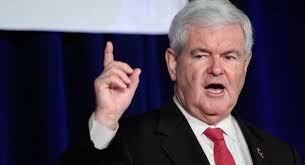
Newt Gingrich
Adelson put up seed money and, ultimately, $7.7 million between 2006 and 2010 for a nonprofit group that served as a precursor to Gingrich’s presidential campaign.
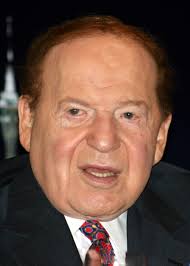
Sheldon Adelson
Such a contribution is beyond the means of the average American. But Adelson is listed by Forbes as the eighth-wealthiest American, with a net worth of $21.5 billion.
Adelson denied any selfish motives for giving millions to a candidate for the most powerful office in the world:
“My motivation for helping Newt is simple and should not be mistaken for anything other than the fact that my wife Miriam and I hold our friendship with him very dear and are doing what we can as private citizens to support his candidacy.”
Former Massachusetts Governor Mitt Romney also relied heavily on a small group of millionaires and billionaires for support.
By February, 2012, a quarter of the money amassed by Romney’s campaign came from just 41 people. Each contributor gave more than $100,000, according to a Washington Post analysis of disclosure data. Nearly a dozen of the donors had contributed $1 million or more.
Some of Romney’s biggest supporters included executives at Bain Capital, his former firm; bankers at Goldman Sachs; and a hedge fund mogul who made billions betting on the housing crash.
Four years later, in May, 2016, Adelson met privately with Republican Presidential nominee-in-waiting Donald Trump.
Adelson promised to contribute more to secure Trump’s election than he had contributed to any previous campaign—up to and exceeding $100 million.
Meanwhile, Trump bragged that he was “not beholden” to any “special interests” because “I’m really rich.” This falsehood proved a main reason for his popularity as a candidate.
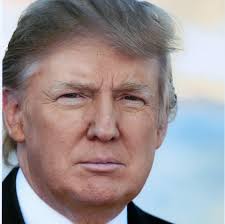
Donald Trump
Fast forward another three years—and a December 4, 2019 story in Fortune: “2020 Presidential Campaign Fundraising (and Spending) Are on Track to Smash Records.”
By then, Trump had raised $165.3 million.
But Democrats altogether had outstripped him with $475.6 million raised.
Among the largest Democratic money-raisers (in millions):
- Bernie Sanders: $74.5
- Elizabeth Warren: $60.3
- Pete Buttigieg: $51.5
- Tom Steyer: $49.6
- Joe Biden: $37.8
Former New York Mayor Michael Bloomberg entered the race on November 24, 2019. Within a week he paid $57 million for TV ads.
His fellow billionaire Tom Steyer spent over $60 million since July, 2019.
The 2020 Presidential election proved the most expensive in American history—so far.
Joe Biden raised $1.06 billion. Donald Trump raised $0.80 billion.
All of this can be directly traced to the 2010 “Citizens United” decision by the U.S. Supreme Court that ended limits in corporate contributions to political campaigns. The decision is so named for the group that successfully sued over federal campaign finance laws.
The 5-4 decision led to the rise of Super PACs—outside groups affiliated with candidates that can take in unlimited contributions as long as they don’t directly coordinate with the candidate. The overwhelming majority of this money goes for negative ads—that slander opponents without saying anything about what a candidate proposes to do.
Former U.S. Supreme Court Justice Antonin Scalia brushed aside criticism of the corrupting role money played in politics: Change the channel or turn off the TV.
“I don’t care who is doing the speech—the more the merrier,” Scalia said. “People are not stupid. If they don’t like it, they’ll shut it off.”
On the contrary: A fundamental principle of propaganda holds that most people are stupid—or can be made to behave stupidly. If they are ceaselessly bombarded with mind-numbing lies, they will eventually substitute these for reality.
During the early 1960s a series of movies about the Roman Empire—like Spartacus and Cleopatra—hit the big screen. In these, rich criminals like Marcus Crassus openly bought the favors of ambitious politicians like Julius Caesar.
No doubt millions of moviegoers thought, “Boy, I’m glad that couldn’t happen here.”
But it has happened here—and it’s happening right now.
2016 PRESIDENTIAL CAMPAIGN, 2016 PRESIDENTIAL ELECTION, 2020 PRESIDENTIAL ELECTION, ABC NEWS, ADOLF HITLER, ALTERNET, AMERICABLOG, AP, ARMED SERVICES, ARTICLES OF IMPEACHMENT, BABY BOOMER RESISTANCE, BARACK OBAMA, BLOOMBERG, BUZZFEED, CBS NEWS, CIA, CLAUS VON STAUFFENBERG, CNN, CROOKS AND LIARS, DAILY KOZ, DONALD TRUMP, FACEBOOK, FBI, FIDEL CASTRO, FIVETHIRTYEIGHT, GESTAPO, HARPER’S MAGAZINE, IMPEACHMENT, JACOBO ARBENZ, JAMES B. COMEY, JAMES MATTIS, JOHN KASICH, JOHN MCCAIN, JOSEPH BIDEN, JUSTICE DEPARTMENT, KIM JONG ON, MARK ESPER, MARTIN NIEMOELLER, MEDIA MATTERS, MOHAMMED MOSADDEGH, MOTHER JONES, MOVEON, MSNBC, MUSLIMS, NATIONAL SECURITY AGENCY, NAZI GERMANY, NBC NEWS, NEWSWEEK, NPR, PBS NEWSHOUR, POLITICO, POLITICUSUSA, RAW STORY, REPUBLICANS, REUTERS, SALON, SEATTLE TIMES, SERGEY KISLYAK, SERGEY LAVROV, SLATE, TALKING POINTS MEMO, THE ATLANTIC, THE CHICAGO SUN-TIMES, THE CHICAGO TRIBUNE, THE DAILY BEAST, THE DAILY BLOG, THE GUARDIAN, THE HILL, THE HOLOCAUST, THE HUFFINGTON POST, THE LOS ANGELES TIMES, THE NATION, THE NEW REPUBLIC, THE NEW YORK TIMES, THE PENTAGON, THE PRESS, THE SS, THE VILLAGE VOICE, THE WASHINGTON POST, THINKPROGRESS, THIRD REICH, TIME, TRUTHDIG, TRUTHOUT, TWENTY-FIFTH AMENDMENT, TWILIGHT ZONE, TWITTER, TWO POLITICAL JUNKIES, U.S. NEWS & WORLD REPORT, UNITED STATES CONSTITUTION, UNITED STATES HOUSE OF REPRESENTATIVES, UNITED STATES SECRET SERVICE, UNITED STATES SENATE, UPI, USA TODAY, VLADIMIR PUTIN, VOTER FRAUD, WHERMACHT, WONKETTE, WORLD WAR 11
In History, Military, Politics, Social commentary on August 25, 2022 at 12:15 am
On July 20, 1944, members of the Wehrmacht high command failed to assassinate Adolf Hitler with a bomb hidden in a briefcase.
Mass arrests quickly followed.
Among the first victims discovered and executed was the conspiracy’s leader, Colonel Claus von Stauffenberg. Standing before a makeshift firing squad at midnight, he cried: “Long live our sacred Germany!”
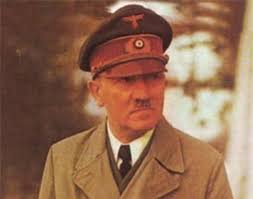
Adolf Hitler
At least 7,000 persons were arrested by the Gestapo. According to records of the Fuehrer Conferences on Naval Affairs, 4,980 were executed.
Had the conspiracy succeeded, history would have turned out differently:
Thus, history can be altered by the appearance—or disappearance—of a single individual.
Which brings us back to Donald Trump.
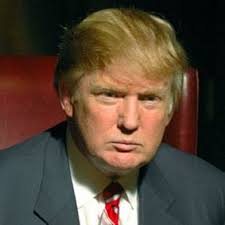
Donald Trump
Just as Germans did nothing to stop Adolf Hitler’s inexorable march toward war—and the destruction of millions of lives and Germany itself—so, too, did Americans seem paralyzed to put an end to the equally self-destructive reign of the man often dubbed “Carrot Caligula.”
- Trump’ could have been non-violently removed via the Twenty-Fifth Amendment to the United States Constitution. This allows the Vice President and a majority of the Cabinet to recommend the removal of the President when he is “unable to discharge the powers and duties of his office.” The Vice President then becomes President.
- No Cabinet members dared to invoke this.
- When Trump praised North Korea’s dictator Kim Jong-On or attacked Vietnam POW John McCain, House and Senate Republicans stayed silent. When he falsely charged massive voter fraud, they stayed silent or loudly parroted his lies.
- On February 5, 2020, the Republican-dominated Senate—ignoring the overwhelming evidence against him—acquitted Trump on both impeachment articles: Obstruction of Congress and abuse of power.
- Pentagon generals stood mute as Trump repeatedly sided with Russian dictator Vladimir Putin against the FBI, CIA and National Security Agency—and even gave classified CIA Intelligence to Russian Foreign Minister Sergey Lavrov and Ambassador Sergey Kislyak.
- High-ranking field marshals in Hitler’s Wehrmacht held their tongues when he insulted them. So did American generals when Trump belittled their intelligence and even patriotism.
- The CIA overthrew Iranian prime minister Mohammad Mosaddegh, in 1953 and Guatemalan president Jacobo Árbenz in 1954. It repeatedly tried—unsuccessfully—to assassinate and/or overthrow Cuban dictator Fidel Castro. But it made no effort to halt the ongoing treachery of Donald Trump.
- When Trump arbitrarily decided to remove American forces from Syria and Afghanistan, Secretary of Defense James Mattis resigned in protest in 2018. But then he was simply replaced by Mark Esper.
- Despite the fact that many of these men regularly came into contact with Trump, not one of them apparently plotted his removal.
- Similarly, Trump repeatedly attacked the integrity of the men and women of the FBI—even firing its director, James Comey, for daring to investigate Russia’s subversion of the 2016 election. If its armed agents—steeped in Federal criminal law—built a case for Trump’s indictment and prosecution, it has never come to light.
- Neither did any of his armed Secret Service agents register the slightest protest, despite his arrogant behavior toward them. He forced them to work without pay during his 35-day government shutdown in 2018. They also had to accompany him to COVID-infected states—both during the Presidential campaign and afterward. Many of them became stricken with this often fatal disease as a result.
On November 3, 2020, 81,255,933 Democratic voters elected former Vice President Joseph Biden the 46th President of the United States. Trump, running for a second term, got 74,196,153 votes.
Yet almost two months after the election, Trump refused to concede, insisting that he won—and repeatedly claiming falsely that he was the victim of massive vote fraud.
This toxic lie has been feverishly embraced by millions of Right-wingers, robbing the Biden administration of its deserved legitimacy.
This refusal to acknowledge the outcome initially denied Biden access to the money, information-sharing and machinery traditionally accorded the President-elect. Trump himself was the beneficiary of such assistance in 2016, after his win over Democratic nominee Hillary Clinton.
Only on November 23 was Biden acknowledged as the winner by the General Services Administration, as the Trump administration finally began the formal transition process.
Trump’s refusal to accept reality posed an unprecedented danger to democracy: No presidential candidate had ever refused to concede defeat once all the votes were counted and legal challenges resolved.
By refusing to commit to a peaceful transfer of power, Trump took on the classic mantle of of a dictator.
Historians have uncovered at least 42 assassination plots against Adolf Hitler. That resistance movement has earned honor for its members, many of whom died heroically for standing firm against a brutal tyrant.
To its eternal shame, the same cannot be said of America during the reign of Donald Trump.
2016 PRESIDENTIAL CAMPAIGN, 2016 PRESIDENTIAL ELECTION, 2020 PRESIDENTIAL ELECTION, ABC NEWS, ADOLF HITLER, ALTERNET, AMERICABLOG, AP, ARMED SERVICES, ARTICLES OF IMPEACHMENT, BABY BOOMER RESISTANCE, BARACK OBAMA, BLOOMBERG, BUZZFEED, CBS NEWS, CIA, CLAUS VON STAUFFENBERG, CNN, CROOKS AND LIARS, DAILY KOZ, DONALD TRUMP, FACEBOOK, FBI, FIDEL CASTRO, FIVETHIRTYEIGHT, GESTAPO, HARPER’S MAGAZINE, IMPEACHMENT, JACOBO ARBENZ, JAMES B. COMEY, JAMES MATTIS, JOHN KASICH, JOHN MCCAIN, JOSEPH BIDEN, JUSTICE DEPARTMENT, KIM JONG ON, MARK ESPER, MARTIN NIEMOELLER, MEDIA MATTERS, MOHAMMED MOSADDEGH, MOTHER JONES, MOVEON, MSNBC, MUSLIMS, NATIONAL SECURITY AGENCY, NAZI GERMANY, NBC NEWS, NEWSWEEK, NPR, PBS NEWSHOUR, POLITICO, POLITICUSUSA, RAW STORY, REPUBLICANS, REUTERS, SALON, SEATTLE TIMES, SERGEY KISLYAK, SERGEY LAVROV, SLATE, TALKING POINTS MEMO, THE ATLANTIC, THE CHICAGO SUN-TIMES, THE CHICAGO TRIBUNE, THE DAILY BEAST, THE DAILY BLOG, THE GUARDIAN, THE HILL, THE HOLOCAUST, THE HUFFINGTON POST, THE LOS ANGELES TIMES, THE NATION, THE NEW REPUBLIC, THE NEW YORK TIMES, THE PENTAGON, THE PRESS, THE SS, THE VILLAGE VOICE, THE WASHINGTON POST, THINKPROGRESS, THIRD REICH, TIME, TRUTHDIG, TRUTHOUT, TWENTY-FIFTH AMENDMENT, TWILIGHT ZONE, TWITTER, TWO POLITICAL JUNKIES, U.S. NEWS & WORLD REPORT, UNITED STATES CONSTITUTION, UNITED STATES HOUSE OF REPRESENTATIVES, UNITED STATES SECRET SERVICE, UNITED STATES SENATE, UPI, USA TODAY, VLADIMIR PUTIN, VOTER FRAUD, WHERMACHT, WONKETTE, WORLD WAR 11
In Bureaucracy, History, Military, Politics, Social commentary on August 24, 2022 at 12:10 am
On July 20, 1944, Colonel Claus Schenk von Stuaffenberg tried to assassinate Adolf Hitler.
He had served with the Wehrmacht in Poland (1939), France (1940) and the Soviet Union (1941).
While serving in Tunisa, he was seriously wounded on April 7, 1943, when Allied fighters strafed his vehicle. He lost his left eye, right hand and two fingers of his left hand after surgery.
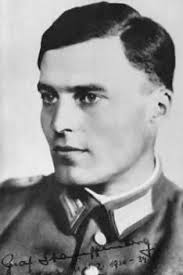
Colonel Claus Schenk von Stuaffenberg
Nevertheless, he now acted as the prime mover for the conspiracy among a growing number of German high command officers to arrest or assassinate Germany’s Fuehrer.
For most of these officers, the motive was craven: The “happy time’ of German victories was over. Germany was losing the war it had launched on the world in 1939–and now they feared the worst.
This was especially true now that the numerically superior forces of the Soviet Union had gone onto the offensive.
For Stauffenberg, there was another reason: His disgust at the horrors he had seen committed by his fellow Wehrmacht soldiers upon defenseless POW’s and civilians in Russia.
Thus, Stauffenberg—more than many Germans—knew firsthand the vengeance his country could expect if the “Thousand-Year Reich” fell.
Something must be done, he believed, to prove to the world that not all Germans—even members of the Wehrmacht—were criminals.
Most of the conspirators wanted to arrest Hitler and surrender to British and American forces—well before the much-feared Russians gained a toehold in Germany.
Stauffenberg didn’t want to arrest Hitler; he wanted to kill him. A live Hitler might eventually be rescued by his Nazi colleagues.
But Hitler was a closely-guarded target. He was surrounded by fanatical bodyguards who were expert marksmen. He often wore a bulletproof vest and a cap lined with three pounds of laminated steel.
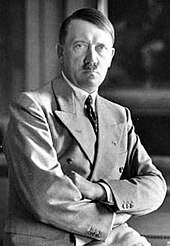
Adolf Hitler
Bundesarchiv, Bild 146-1990-048-29A / CC-BY-SA 3.0 [CC BY-SA 3.0 de (https://creativecommons.org/licenses/by-sa/3.0/de/deed.en)%5D
But his single greatest protection–he claimed—was an instinct for danger. He would suddenly change his schedule—to drop in where he was least expected. Or suddenly depart an event where he was expected to stay a long time.
On November 9, 1939, this instinct saved his life. He was expected to give a long speech at a Munich beer hall before the “old Fighters” of his brown-shirted storm troopers.
Instead, he suddenly cut short his speech and left the beer hall. Forty-five minutes later, a bomb exploded inside a pillar—before which Hitler had been speaking.
Since then, a series of other assassination attempts had been made against Hitler. All of them involved time-bombs. And all of the would-be assassins were members of the German General Staff.
In one case, a bomb secretly stashed aboard Hitler’s plane failed to explode. In another, an officer who had a bomb strapped to himself unexpectedly found his scheduled meeting with Hitler called off. He had to rush into a bathroom to defuse the bomb before it went off.
So now it was the turn of von Stauffenberg. He would carry his bomb—hidden in a briefcase—into a “Hitler conference” packed with military officers.
But Stauffenberg didn’t intend to be a suicide bomber. He meant to direct the government that would replace that of the Nazis.
His bomb—also rigged with a time-fuse—would be left in the conference room while he found an excuse to leave. After the explosion, he would phone one of his fellow conspirators with the news.
Then, the coup—“Operation Valkyrie”—would be on.
Anti-Nazi conspirators would seize control of key posts of the government. The British and Americans would then be informed of Germany’s willingness to surrender. Provided, of course, that the vengeance-seeking Russians did not have a say in its postwar future.
The Wehrmacht and Schutzstaffel (SS) had killed millions of Russians. Many had died in combat. Others had been murdered as captives. Still more had been allowed to die by starvation and exposure to the notorious Russian winter.
So the Germans—both Nazi and anti-Nazi—knew what they could expect if soldiers of the Soviet Union reached German soil.
On July 20, 1944, Stauffenberg appeared at Hitler’s well-guarded military headquarters in East Prussia. Like all his other outposts, Hitler had named it—appropriately enough—“Wolf’s Lair.”

“Wolf’s Lair”
Stauffenberg entered the large, concrete building while the conference was in session. He placed his yellow briefcase next to Hitler—who was standing with his generals at a heavy oaken table. Then he excused himself to take an “urgent” phone call.
After Stauffenberg left the room, Colonel Heinz Brandt, standing next to Hitler, found the briefcase blocking his legs. So he moved it—to the other side of the heavy oaken support, partially shielding Hitler from the blast..
At 12:42 p.m. on July 20, 1944, Stauffenberg’s briefcase bomb erupted.
Brandt died, as did two other officers and a stenographer.
Hitler not only survived, but the plotters failed to seize the key broadcast facilities of the Reich.
This allowed Hitler to make a late-night speech to the nation, revealing the failed plot and assuring Germans that he was alive. And he swore to flush out the “traitorous swine” who had tried to kill him.
He soon proved as bad as his word.
2016 PRESIDENTIAL CAMPAIGN, 2016 PRESIDENTIAL ELECTION, 2020 PRESIDENTIAL ELECTION, ABC NEWS, ADOLF HITLER, ALTERNET, AMERICABLOG, AP, ARMED SERVICES, ARTICLES OF IMPEACHMENT, BABY BOOMER RESISTANCE, BARACK OBAMA, BLOOMBERG, BUZZFEED, CBS NEWS, CIA, CLAUS VON STAUFFENBERG, CNN, CROOKS AND LIARS, DAILY KOZ, DANA ANDREWS, DONALD TRUMP, FACEBOOK, FBI, FIDEL CASTRO, FIVETHIRTYEIGHT, GESTAPO, HARPER’S MAGAZINE, IMPEACHMENT, JACOBO ARBENZ, JAMES B. COMEY, JAMES MATTIS, JOHN KASICH, JOHN MCCAIN, JOSEPH BIDEN, JUSTICE DEPARTMENT, KIM JONG ON, MARK ESPER, MARTIN NIEMOELLER, MEDIA MATTERS, MOHAMMED MOSADDEGH, MOTHER JONES, MOVEON, MSNBC, MUSLIMS, NATIONAL SECURITY AGENCY, NAZI GERMANY, NBC NEWS, NEWSWEEK, NPR, PBS NEWSHOUR, POLITICO, POLITICUSUSA, RAW STORY, REPUBLICANS, REUTERS, SALON, SEATTLE TIMES, SERGEY KISLYAK, SERGEY LAVROV, SLATE, SUPREME COURT, TALKING POINTS MEMO, THE ATLANTIC, THE CHICAGO SUN-TIMES, THE CHICAGO TRIBUNE, THE DAILY BEAST, THE DAILY BLOG, THE GUARDIAN, THE HILL, THE HOLOCAUST, THE HUFFINGTON POST, THE JUDICIARY, THE LOS ANGELES TIMES, THE NATION, THE NEW REPUBLIC, THE NEW YORK TIMES, THE PENTAGON, THE PRESS, THE SS, THE VILLAGE VOICE, THE WASHINGTON POST, THINKPROGRESS, THIRD REICH, TIME, TRUTHDIG, TRUTHOUT, TWENTY-FIFTH AMENDMENT, TWILIGHT ZONE, TWITTER, TWO POLITICAL JUNKIES, U.S. NEWS & WORLD REPORT, UNITED STATES CONSTITUTION, UNITED STATES HOUSE OF REPRESENTATIVES, UNITED STATES SECRET SERVICE, UNITED STATES SENATE, UPI, USA TODAY, VLADIMIR PUTIN, VOTER FRAUD, WHERMACHT, WONKETTE, WORLD WAR 11
In Bureaucracy, History, Military, Politics, Social commentary on August 23, 2022 at 12:10 am
In the Twilight Zone episode, “No Time Like the Past,” Paul Driscoll (Dana Andrews), a scientist in early 1960s America, uses a time machine to visit Nazi Germany on the eve of World War II.
He’s rented a motel room overlooking the balcony from where the Fuehrer, Adolf Hitler will soon make a speech. And he’s eager to watch that speech—through the lens of a telescopic-sighted rifle.
Just as he’s about to pull the trigger, there’s a knock at his door–by the maid. Driscoll hustles her out as soon as possible, then once again picks up his rifle. He—and viewers—can once again see Hitler through the cross-hairs of his weapon.
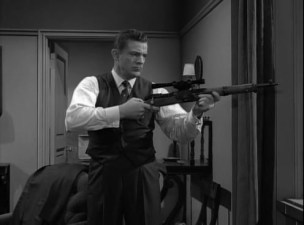
Paul Driscoll prepares to shoot Adolf Hitler
But instead of the anticipated shot, there’s another knock at his door—his time by the black-uniformed secret police, the SS. Driscoll knows the game is up, and disappears into the present just as the thugs break down his door.
And the audience is left to ponder how different the world would have been if Driscoll—or someone in Nazi Germany—had succeeded in assassinating the man whose wars would wipe out the lives of 50 million men, women and children around the globe.
One 2016 Republican candidate for President dared to invoke the menace of Nazi Germany in warning of the dangers of a Donald Trump Presidency. And to argue that Americans could prevent that past from returning.
In November, 2015, John Kasich, the governor of Ohio, was peddling a message of creating jobs, balancing the Federal budget and disdain for Washington, D.C.
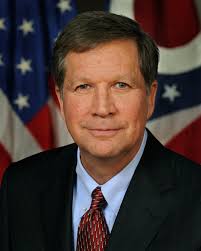
John Kasich
But he remained far behind in the polls, dropping 50% in support in just one month—from September to October. Meanwhile, Trump, the New York billionaire developer, was being backed by 25% of Republican primary voters.
So, with nothing to lose, Kasich decided to take off the gloves. He invoked the “N” word for Republicans: Nazi.
He authorized the creation of a TV ad that opened with ominous music—and the face of a snarling Donald Trump.
“I would like anyone who is listening to consider some thoughts that I’ve paraphrased from the words of German pastor Martin Niemoeller.”
The voice belonged to Tom Moe, a retired colonel in the U.S. Air Force—and a former Vietnam prisoner-of-war.
“You might not care if Donald Trump says Muslims must register with the government, because you’re not one,” continued Moe.
“And you might not care if Donald Trump says he’s going to round up all the Hispanic immigrants, because you’re not one.
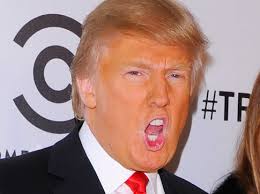
Donald Trump
“And you might not care if Donald Trump says it’s OK to rough up black protesters, because you’re not one.
“And you might not care of Donald Trump wants to suppress journalists, because you’re not one.
“But think about this:
“If he keeps going, and he actually becomes President, he might just get around to you. And you’d better hope that there’s someone left to help you.”
Martin Niemoeller (1892–1984) was a prominent Protestant pastor who had commanded a U-boat during World War 1. He became a bitter public foe of Adolf Hitler.
A staunch anti-Communist, he had initially supported the Nazis as Germany’s only hope of salvation against the Soviet Union.
But when the Nazis made the church subordinate to State authority, Niemoeller created the Pastors’ Emergency League to defend religious freedom.
For his opposition to the Third Reich, Niemoeller spent seven years in concentration camps.
With the collapse of the Reich in 1945, he was freed—and elected President of the Protestant church in Hesse and Nassau in 1947. During the 1960s, he was a president of the World Council of Churches.
He is best remembered for his powerful condemnation of the failure of Germans to protest the increasing oppression of the Nazis:
First they came for the Communists, but I was not a Communist, so I did not speak out.
Then they came for the Socialists, but I was not a Socialist, so I did not speak out.
Then they came for the trade unionists, but I was not a trade unionist, so I did not speak out.
Then they came for the Jews, but I was not a Jew, so I did not speak out.
And when they came for me, there was no one left to speak out for me.
Neither “Adolf Hitler” nor “Nazi Party” was mentioned during the one-minute Kassich video. But a furious Trump threatened to sue Kasich if he could find find anything “not truthful” within the ad.
Apparently he couldn’t find anything “not truthful,” because he never sued.
So threatened the man who had called Mexican immigrants “rapists” and accused President Barack Obama of being a Muslim and an illegal alien.
The Kasich ad was the darkest attack made against Trump by any candidate—Republican or Democrat. And it raised a disturbing question:
If Donald Trump proved to be America’s Adolf Hitler, would there be an American Claus von Stauffenberg?
Colonel Claus Schenk von Stuaffenberg was the German army officer who, on July 20, 1944, tried to assassinate Adolf Hitler.
2016 PRESIDENTIAL CAMPAIGN, ABC NEWS, ALEXANDER SHUSTOROVICH, ALTERNET, ANDREW INTRATER, AP, BUZZFEED, CBS NEWS, CHUCK GRASSLEY, CIA, CITIZENS UNITED, CNN, CROOKS AND LIARS, DAILY KOZ, DEMOCRATIC PARTY, DEPARTMENT OF HOMELAND SECURITY, FACEBOOK, FBI, FEDERAL ELECTIONS COMMISSION, FOX NEWS, JAMES COMEY, JOHN KASICH, JOHN MCCAIN, LEN BLAVATNIK, LINDSEY GRAHAM, MARCO RUBIO, MITCH MCCONNELL, MOTHER JONES, MOVEON, NATIONAL SECURITY AGENCY, NBC NEWS, NEWSWEEK, NPR, OFFICE OF THE DIRECTOR OF NATIONAL INTELLIGENCE, OLIGARCHS, ORRIN HATCH, PAUL RYAN, POLITICAL ACTION COMMITTEES (PACS), POLITICO, RAW STORY, REPUBLICAN PARTY, REUTERS, ROBERT MUELLER, ROD ROSENSTEIN, RUSSIA, SALON, SCOTT WALKER, SEATTLE TIMES, SENATE LEADERSHIP FUND, SIMON KUKES, SLATE, SUPREME COURT, THE ATLANTIC, THE CHICAGO SUN-TIMES, THE CHICAGO TRIBUNE, THE DAILY BEAST, THE GUARDIAN, THE HILL, THE HUFFINGTON POST, THE LOS ANGELES TIMES, THE NATION, THE NEW YORK TIMES, THE WASHINGTON POST, TIME, TRUMP INAUGURAL COMMITTEE, TWITTER, U.S. NEWS & WORLD REPORT, UKRAINE, UPI, USA TODAY, USA TODAY DONALD TRUMP, VLADIMIR PUTIN
In Bureaucracy, History, Law, Politics, Social commentary on May 16, 2022 at 12:11 am
Anyone wondering where Vladimir Putin got the idea he could invade Ukraine with impunity need look no further than the United States Senate.
On April 16, 2018, the New York Times published an editorial taking direct aim at the vast majority of Congressional Republicans.
Specifically, it noted their unwillingness to speak out against threats by President Donald Trump to fire deputy Attorney General Rod Rosenstein and/or Special Counsel Robert Mueller.
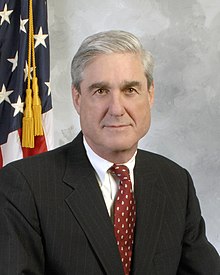
Robert Mueller
Its key paragraph:
“Make no mistake: If Mr. Trump takes such drastic action, he will be striking at the foundation of the American government, attempting to set a precedent that a president, alone among American citizens, is above the law. What can seem now like a political sideshow will instantly become a constitutional crisis, and history will come calling for Mr. [Orrin] Hatch and his colleagues.”
Orrin Hatch was the Republican United States Senator from Utah. He and Republican Senators Lindsey Graham (South Carolina) and Chuck Grassley (Iowa) had warned Trump not to fire Rosenstein or Mueller.
But most Republicans had held silent.
Why?
The Times editorial offers two reasons:
First, Republicans feared enraging an easily infuriated Trump—who might aim his Twitter account at them and cost them votes in the upcoming fall elections.
Second, Republicans feared enraging Trump’s fanatical base—which, in this instance, had two meanings:
- “Something (as a group of people) that reliably provides support (such as for a business or political candidate)”—Merriam Webster; and
- “Without moral principles; ignoble”—Oxford Living Dictionaries
On April 17, Republican Senate Majority Leader Mitch McConnell said he would not allow legislation to protect Mueller’s independent investigation to reach the Senate floor.

Mitch McConnell
“I’m the one who decides what we take to the floor. That’s my responsibility as majority leader. We’ll not be having this on the floor of the Senate,” the Kentucky Republican said in an interview on Fox News.
Earlier in the day, another Republican, Speaker of the House Paul Ryan, claimed that legislation to protect Mueller was “unnecessary.”
“It would not be in the President’s interest to [fire Mueller] and I think he knows that,” said the Wisconsin Congressman.
But there is an additional reason why so few Republicans dared to stand up against Trump.
Trump received help from Russian Intelligence agents during the 2016 Presidential campaign. And House and Senate Republicans have received Russian help of another kind: Bribe monies.
Of course, these are not officially classified as bribes. Officially, they are “campaign contributions.”
In recent years, a network of Russian oligarchs—all of them answerable to Russian dictator Vladimir Putin—has been increasingly contributing to top Republicans.
And, thanks to the Supreme Court’s Citizens United decision in 2010, the donations are entirely legal.
The following data comes from the Federal Election Commission.
One such major contributor is Len Blavatnik, who holds citizenship in both the United States and the United Kingdom. During the 2015-16 election cycle, he proved one of the largest donors to GOP Political Action Committees (PACs).
Blavatnik’s net worth is estimated at $20 billion. Before 2016, he donated to both Democrats and Republicans in meager amounts. But in 2016, he gave $6.35 million to GOP PACs.
Millions of dollars went to top Republican leaders—such as Senators Mitch McConnell, Marco Rubio (Florida) and Lindsey Graham (South Carolina). Specifically, he contributed
- A total of $1.5 million to PACs associated with Rubio.
- $1 million to Trump’s Inaugural Committee.
- $41,000 to both Republicans and Democrats in 2017.
- $1 million to McConnell’s Senate Leadership Fund.
- $3.5 million to a PAC associated with McConnell.
- $1.1 million to Unintimidated PAC, associated with Wisconsin Governor Scott Walker.
- $200,000 to the Arizona Grassroots Action PAC, associated with Arizona Senator John McCain.
- $250,000 to New Day for America PAC, associated with Ohio Governor John Kasich.
- $800,000 went to the Security is Strength PAC, associated with Senator Lindsey Graham.
Another Russian oligarch, Alexander Shustorovich, contributed $1 million to Trump’s Inaugural Committee.
Altogether, four Russian oligarchs—Blavatnik, Shustorovich, Andrew Intrater and Simon Kukes—–contributed $10.4 million from the start of the 2015-16 election cycle through September 2017. Of this, 99% went to Republicans.
As Senate Majority Leader, Mitch McConnell participated in high-level intelligence briefings in 2016. From agencies such as the FBI, CIA and the code-cracking National Security Agency, he learned that the Russians were trying to subvert the electoral process.

In October, 2016, the Department of Homeland Security (DHS) and the Office of the Director of National Intelligence (DNI) issued a joint statement: The Russian government had directed the effort to subvert the 2016 Presidential election.
Two weeks later, McConnell’s PAC accepted a $1 million donation from Blavatnik.
On March 30, 2017, McConnell’s PAC accepted another $1 million from Blavatnik. This was just 10 days after former FBI Director James Comey testified before the House Intelligence Committee about Russia’s efforts to subvert the 2016 election.
Millionaires and billionaires don’t give six- or seven-figure monetary contributions to politicians without expecting to get something in return. And this is especially true—and frightening—when the contributors are linked to a former KGB agent like Vladimir Putin, whose aggressive intentions are increasingly on display.
It’s clear that the Republican party has moved from “Better Dead than Red” to “My Wallet, First and Always.”
2016 PRESIDENTIAL CAMPAIGN, 2020 PRESIDENTIAL CAMPAIGN, ABC NEWS, ADOLF HITLER, ALTERNET, AMERICABLOG, ANCIENT GREECE, ANCIENT ROME, AP, BABY BOOMER RESISTANCE, BERNIE SANDERS, BUZZFEED, CATASTROPHE, CBS NEWS, CHINA, CNN, CONSUMER PROTECTION, CORPORATE TAXES, CORRUPTION, CROOKS AND LIARS, DAILY KOZ, DEMOCRATIC PARTY, DONALD TRUMP, DRUDGE RETORT, EXECUTIVE PAYWATCH, FACEBOOK, FIVETHIRTYEIGHT, FORBES, FUNDRAISING, HARPER’S MAGAZINE, HILLARY CLINTON, INCOME INEQUALITY, IVAN THE TERRIBLE, JOE BIDEN, JOSEPH STALIN, LEON TROTSKY, MEDIA MATTERS, MOTHER JONES, MOVEON, MSNBC, NAZI GERMANY, NBC NEWS, NEWSWEEK, NICCOLO MACHIAVELLI, NPR, PBS NEWSHOUR, POLITICO, POLITICUSUSA, RAW STORY, REUTERS, ROBERT PAYNE, SALON, SEATTLE TIMES, SLATE, SPARTACUS, TALKING POINTS MEMO, THE ATLANTIC, THE CHICAGO SUN-TIMES, THE CHICAGO TRIBUNE, THE CORRUPT SOCIETY (BOOK), THE DAILY BEAST, THE DAILY BLOG, THE DISCOURSES, THE FRENCH REVOLUTION, THE GREAT LEVELER (BOOK), THE GUARDIAN, THE HILL, THE HUFFINGTON POST, THE LOS ANGELES TIMES, THE NATION, THE NEW REPUBLIC, THE NEW YORK TIMES, THE RUSSIAN REVOLUTION, THE VILLAGE VOICE, THE WASHINGTON POST, THINKPROGRESS, TIME, TRUTHDIG, TRUTHOUT, TWITTER, TWO POLITICAL JUNKIES, U.S. NEWS & WORLD REPORT, UPI, USA TODAY, VIOLENCE, Vladimir Lenin, WALL STREET, WALTER SCHEIDEL, WATERGATE, WEALTH GAP, WILLIAM SHAKESPEARE, WINSTON CHURCHILL, WONKETTE
In Bureaucracy, Business, History, Law, Politics, Social commentary on April 29, 2022 at 12:11 am
The gap between rich and poor in the United States has never been greater.
A May 1, 2018 article in Forbes—which bills itself as “The Capitalist Tool”—vividly documents this truth.
“In the 1950s, a typical CEO made 20 times the salary of his or her average worker. Last year, [2017] CEO pay at an S&P 500 Index firm soared to an average of 361 times more than the average rank-and-file worker, or pay of $13,940,000 a year, according to an AFL-CIO’s Executive Paywatch news release today.”
The average CEO pay climbed six percent in 2017—while the average production worker earned just $38,613, according to Executive Paywatch.
The average wage—adjusted for inflation—has stagnated for more than 50 years. Meanwhile, CEOs’ average pay since the 1950s has risen by 1000%.
This would not have been news to Niccolo Machiavelli, the father of modern political science. In his masterwork, The Discourses, he observed the human condition as that of constant struggle:
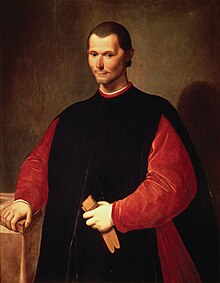
Niccolo Machiavelli
“It was a saying of ancient writers, that men afflict themselves in evil, and become weary of the good, and that both these dispositions produce the same effects.
“For when men are no longer obliged to fight from necessity, they fight from ambition, which passion is so powerful in the hearts of men that it never leaves them, no matter to what height they may rise.
“The reason for this is that nature has created men so that they desire everything, but are unable to attain it. Desire being thus always greater than the faculty of acquiring, discontent with what they have and dissatisfaction with themselves result from it.
“This causes the changes in their fortunes—for as some men desire to have more, while others fear to lose what they have, enmities and war are the consequences. And this brings about the ruin of one province and the elevation of another.”
Author Walter Scheidel, Dickason Professor in the Humanities, Professor of Classics and History at Stanford University, has also given this subject a great deal of thought. And, like Machiavelli, he has reached some highly disturbing conclusions.

Walter Scheidel
World Economic Forum [CC BY-SA 2.0 (https://creativecommons.org/licenses/by-sa/2.0)%5D
Scheidel gave voice to these in his 2017 book, The Great Leveler: Violence and the History of Inequality from the Stone Age to the Twenty-First Century. His thesis: Only violence and catastrophes have consistently reduced inequality throughout history.
According to the book’s jacket blurb: “Are mass violence and catastrophes the only forces that can seriously decrease economic inequality? To judge by thousands of years of history, the answer is yes.
“Tracing the global history of inequality from the Stone Age to today, Walter Scheidel shows that inequality never dies peacefully. Inequality declines when carnage and disaster strike and increases when peace and stability return.
“The Great Leveler is the first book to chart the crucial role of violent shocks in reducing inequality over the full sweep of human history around the world.
“Ever since humans began to farm, herd livestock, and pass on their assets to future generations, economic inequality has been a defining feature of civilization. Over thousands of years, only violent events have significantly lessened inequality.
“The ‘Four Horsemen’ of leveling—mass-mobilization warfare, transformative revolutions, state collapse, and catastrophic plagues—have repeatedly destroyed the fortunes of the rich….
“Today, the violence that reduced inequality in the past seems to have diminished, and that is a good thing. But it casts serious doubt on the prospects for a more equal future.”
Revolutionaries have known the truth of Scheidel’s findings from the gladiators’ revolt of Spartacus (73 – 71 B.C.) to the French Revolution (1789 – 1799) to the overthrow of the Czarist Romanov dynasty (1917).
But American politicians serenely ignore that truth. They depend on the mega-rich for millions of dollars in “campaign contributions”—which pay for self-glorifying ads on TV.
Thus, in 2016, American voters had a “choice” between two “love-the-rich” Presidential candidates: Donald Trump and Hillary Clinton. The result was that millions stayed home or voted in protest for third-party candidates who had no chance of winning.
In his 1975 book, The Corrupt Society: From Ancient Greece to Modern-day America, British historian Robert Payne warned that the predatory rich would not change their behavior: “Nor is there any likelihood that the rich will plow back their money into services to ensure the general good.
“They have rarely demonstrated social responsibility, and they are much more likely to hold on to their wealth at all costs than to renounce any part of it.
“Like the tyrant who lives in a world wholly remote from the world of the people, shielded and protected from all possible influences, the rich are usually the last to observe the social pressures rising from below, and when these social pressures reach flashpoint, it is too late to call in the police or the army.
“The tyrant dies; the police and the army go over to the revolutionaries; and the new government dispossesses the rich by decree. A single authoritative sentence suffices to expunge all private wealth and restore it to the service of the nation.”
For millions of struggling, impoverished Americans, that day cannot come soon enough.
2016 PRESIDENTIAL CAMPAIGN, 2020 PRESIDENTIAL CAMPAIGN, ABC NEWS, ADOLF HITLER, ALTERNET, AMERICABLOG, ANCIENT GREECE, ANCIENT ROME, AP, BABY BOOMER RESISTANCE, BERNIE SANDERS, BUZZFEED, CATASTROPHE, CBS NEWS, CHINA, CNN, CONSUMER PROTECTION, CORPORATE TAXES, CORRUPTION, CROOKS AND LIARS, DAILY KOZ, DEMOCRATIC PARTY, DONALD TRUMP, DRUDGE RETORT, EXECUTIVE PAYWATCH, FACEBOOK, FIVETHIRTYEIGHT, FORBES, FUNDRAISING, HARPER’S MAGAZINE, HILLARY CLINTON, INCOME INEQUALITY, IVAN THE TERRIBLE, JOE BIDEN, JOSEPH STALIN, LEON TROTSKY, MEDIA MATTERS, MOTHER JONES, MOVEON, MSNBC, NAZI GERMANY, NBC NEWS, NEWSWEEK, NICCOLO MACHIAVELLI, NPR, PBS NEWSHOUR, POLITICO, POLITICUSUSA, RAW STORY, REUTERS, ROBERT PAYNE, SALON, SEATTLE TIMES, SLATE, SPARTACUS, TALKING POINTS MEMO, THE ATLANTIC, THE CHICAGO SUN-TIMES, THE CHICAGO TRIBUNE, THE CORRUPT SOCIETY (BOOK), THE DAILY BEAST, THE DAILY BLOG, THE DISCOURSES, THE FRENCH REVOLUTION, THE GREAT LEVELER (BOOK), THE GUARDIAN, THE HILL, THE HUFFINGTON POST, THE LOS ANGELES TIMES, THE NATION, THE NEW REPUBLIC, THE NEW YORK TIMES, THE RUSSIAN REVOLUTION, THE VILLAGE VOICE, THE WASHINGTON POST, THINKPROGRESS, TIME, TRUTHDIG, TRUTHOUT, TWITTER, TWO POLITICAL JUNKIES, U.S. NEWS & WORLD REPORT, UPI, USA TODAY, VIOLENCE, Vladimir Lenin, WALL STREET, WALTER SCHEIDEL, WATERGATE, WEALTH GAP, WILLIAM SHAKESPEARE, WINSTON CHURCHILL, WONKETTE
In Bureaucracy, Business, History, Law, Politics, Social commentary on April 28, 2022 at 12:31 am
Americans are used to Presidential candidates telling lies (euphemistically known as “campaign promises”) to get elected.
But when a candidate actually (and usually accidentally) tells the truth, the results can be electrifying. And sometimes devastating for the candidate.
On June 18, 2019, Democratic Presidential candidate (and momentary front-runner) Joseph Biden addressed a roomful of donors in New York.
The former Vice President believed that his message would comfort his well-heeled audience of billionaires: Don’t worry, if I’m elected, your standard of living won’t change.
Addressing the 100 or so guests at a fundraiser at the Carlyle Hotel in New York City, Biden said that he had taken heat from “some of the people on my team, on the Democratic side” because he had said that rich people were “just as patriotic as poor people.

Joe Biden
“The truth of the matter is, you all, you all know, you all know in your gut what has to be done. We can disagree in the margins but the truth of the matter is it’s all within our wheelhouse and nobody has to be punished. No one’s standard of living will change, nothing would fundamentally change,” he said.
And he added: “I mean, we may not want to demonize anybody who has made money.
“When we have income inequality as large as we have in the United States today, it brews and ferments political discord and basic revolution. Not a joke. Not a joke … It allows demagogues to step in and say the reason where we are is because of the ‘other’….
“You’re not the other. I need you very badly. I hope if I win this nomination, I won’t let you down. I promise you. I have a bad reputation, I always say what I mean. The problem is I sometimes say all that I mean.”
Biden had talked about decreasing income inequality and promoting workers’ rights. But he had also taken a moderate stance when it came to taxation.
United States Senator Bernie Sanders (D-VT), on the other hand, has attacked the ultra-rich as responsible for the ever-widening gap between themselves and the poor.
“I love Bernie, but I’m not Bernie Sanders. I don’t think 500 billionaires are the reason why we’re in trouble,” Biden said in March, 2019.
Instead, he proposed expanding tax credits for the poor and middle class, and making the tax code less friendly to rich investors.
Robert Payne, the distinguished British historian, took a different—and darker—view of the rich.
Payne authored more than 110 books. Among his subjects were Adolf Hitler, Ivan the Terrible, Winston Churchill, Joseph Stalin, Vladimir Lenin, William Shakespeare and Leon Trotsky.
In 1975, he published The Corrupt Society: From Ancient Greece to Present-Day America. It proved a summary of many of his previous works.
Among the epochs it covered: The civilizations of ancient Greece, Rome and China; Nazi Germany; the Soviet Union; and Watergate-era America. And the massive corruption each of those epochs had spawned.
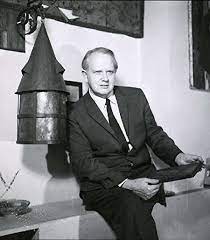
Robert Payne
In his chapter, “A View of the Uncorrupted Society,” Payne warned: Power and wealth are the main sources of corruption.
“The rich, simply by being rich, are infected with corruption. Their overwhelming desire is to grow richer, but they can do this only at the expense of those who are poorer than themselves.
”Their interests conflict with those of the overall society. They live sheltered from the constant anxieties of the poor, and thus cannot understand them. Nor do they try to.”
They see the poor as alien from themselves, and thus come to fear and despise them. And their wealth and influence enables them to buy politicians—who, in turn, write legislation that protects the rich from the poor.
But Payne foresaw an even greater danger from the rich and powerful than their mere isolation from the rest of society: “The mere presence of the rich is corrupting. Their habits, their moral codes, their delight in conspicuous consumption are permanent affronts to the rest of humanity. Vast inequalities of wealth are intolerable in any decent society.”
Writing in 1975, Payne noted that a third of the private wealth was possessed by less than five percent of the population—while about a fifth of the populace lived at the poverty level. By 2000, he predicted, about five percent of the population would possess two-thirds of America’s wealth. And more than half the population would be near or below the starvation level.
The result could only be catastrophe. The only way to halt this this increasing concentration of wealth by fewer people would be through law or violent revolution.
Payne has proven to be an uncanny prophet.
On December 8, 2017, the Seattle Times noted that the wealthiest one percent of Americans owned 40% of the country’s wealth. They owned more wealth than the bottom 90% combined.
From 2013, the share of wealth owned by the one percent increased by nearly three percentage points. Wealth owned by the bottom 90%, meanwhile, fell over the same period.
But this situation need not remain permanent.
2016 PRESIDENTIAL CAMPAIGN, ABC NEWS, ALTERNET, AMERICABLOG, AMERICAN UNIVERSITY, AP, APOLLO MOON LANDING, BABY BOOMER RESISTANCE, BARACK OBAMA, BARBARA TUCHMAN, BBC, BLOOMBERG NEWS, BRIAN KILMEADE, BUZZFEED, CBS NEWS, CNN, COLD WAR, CORONAVIRUS, CROOKS AND LIARS, CUBAN MISSILE CRISIS, DAILY KOZ, DEMOCRATS, DONALD TRUMP, DREAMS FROM MY FATHER (BOOK), FACEBOOK, FIVETHIRTYEIGHT, FOX NEWS, GODFATHER'S PIZZA, HARPER’S MAGAZINE, HERMAN CAIN, HUFFINGTON POST, IGNORANCE, JOHN F. KENNEDY, KELLEYANNE CONWAY, LIBYA, LILTERACY, LITERACY, LYNDON B. JOHNSON, MEDIA MATTERS, MOTHER JONES, MOVEON, MSNBC, NBC NEWS, NEW REPUBLIC, NEWSDAY, NEWSWEEK, NPR, NUCLEAR TEST BAN TREATY, PBS NEWSHOUR, POLITICO, POLITICUSUSA, RATIONALITY, RAW STORY, REPUBLICANS, REUTERS, RICHARD M. NIXON, ROBERT FRANCIS “BETO” O’ROURKE, SALON, SEAN SPICER, SEATTLE TIMES, SLATE, SUPER COMMITTEE OF CONGRESS, TALKING POINTS MEMO, THE ATLANTIC, THE AUDACITY OF HOPE (BOOK), THE CHICAGO SUN-TIMES, THE CHICAGO TRIBUNE, THE DAILY BEAST, THE DAILY BLOG, THE GUARDIAN, THE GUNS OF AUGUST (BOOK), THE HILL, THE HUFFINGTON POST, THE INTERCEPT, THE LOS ANGELES TIMES, THE NATION, THE NEW REPUBLIC, THE NEW YORK TIMES, THE NEW YORKER, THE VILLAGE VOICE, THE WASHINGTON POST, THINKPROGRESS, TIME, TRUTHDIG, TRUTHOUT, TUCKER CARLSON, TWITTER, TWO POLITICAL JUNKIES, U.S. NEWS & WORLD REPORT, UPI, USA TODAY, VIETNAM WAR, WONKETTE, WORLD WAR 1
In Bureaucracy, History, Military, Politics, Social commentary on April 22, 2022 at 12:14 am
Fifty-eight years ago, on November 22, 1963, two bullets slammed into the neck and head of President John Fitzgerald Kennedy.
It has been said that JFK left his country with three great legacies:
- The Nuclear Test Ban Treaty;
- The Apollo moon landing; and
- The Vietnam war.
Of these, the following can be said with certainty:
- The Test Ban Treaty has prevented atmospheric testing—and poisoning—by almost all the world’s nuclear powers.
- After reaching the moon—in 1969—Americans quickly lost interest in space and have today largely abandoned plans for manned exploration. For America, as for JFK, beating the Russians to the moon was the end-goal.
- Under Presidents Lyndon Johnson and Richard Nixon, 58,000 Americans died in Vietnam; 153,303 were wounded; and billions of dollars were squandered in a hopeless effort to intervene in what was essentially a Vietnamese civil war. From 1965 to 1973, the war angrily divided Americas as had no event since the Civil War.
But there was a fourth legacy—and perhaps the most important of all: The belief that mankind could overcome its greatest challenges through rationality and perseverance.
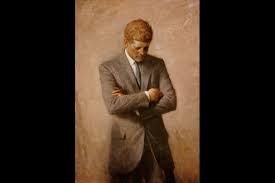
White House painting of JFK
At American University on June 10, 1963, Kennedy called upon his fellow Americans to re-examine the events and attitudes that had led to the Cold War. And he declared that the search for peace was by no means absurd:
“Our problems are man-made; therefore, they can be solved by man. And man can be as big as he wants. No problem of human destiny is beyond human beings.
“Man’s reason and spirit have often solved the seemingly unsolvable, and we believe they can do it again.”
Today, Republicans and Democrats cannot agree on solutions to even the most vital national problems.
On November 21, 2011, the 12 members of the “Super-Committee” of Congress, tasked with finding $1.2 trillion in cuts in government spending, threw up their hands in defeat.
President Kennedy insisted on being well-informed. He speed-read several newspapers every morning and nourished personal relationships with the press-–and not for altruistic reasons. These journalistic contacts gave Kennedy additional sources of information and perspectives on national and international issues.
During the 2012 Presidential campaign, Republican Presidential candidates celebrated their ignorance of both.
Former Godfather’s Pizza CEO Herman Cain famously said, “We need a leader, not a reader.” Thus he excused his ignorance for why President Barack Obama had intervened in Libya.
An August 20, 2019 story in Forbes noted that a Pew Research survey, conducted in July, had found that “the percentage of Republicans attributing a positive effect to higher education has steadily eroded from 58% (2010), 53% (2012), 54% (2015), 43% (2016), and 36% (2017).
“Among Republicans, 59% now say higher education has a negative effect on the U.S., compared to just 18% of Democrats.”
When Robert Francis “Beto” O’Rourke announced his candidacy for President in 2020, Fox News host Brian Kilmeade attacked him for having a “huge library.”
“As if it’s a big plus that he reads books,” scoffed Kilmeade.
In March, 2020, an NBC News poll found that only 30% of Republicans said that they would actually listen to the advice of doctors to stay away from large, crowded areas to avoid Coronavirus.
During the 2016 Presidential campaign, Donald Trump infamously chortled after winning the Nevada Republican primary: “We won with poorly educated. I love the poorly educated.”
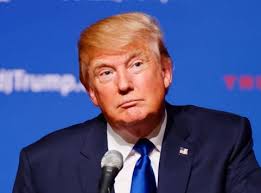
Donald Trump
And, that November, “the poorly educated” elected him President.
As President, he attacked the free press as “the enemy of America” for exposing his lies and criminality. He scorned legitimate mainstream news media while seeking guidance from ego-stroking Right-wing shills at Fox News—who often proved as ignorant as he was.
His senior adviser, Kelleyanne Conway, set the tone of his administration right at the outset. Asked why then-White House press secretary Sean Spicer had lied about the size of the crowd at Trump’s inauguration, Conway replied:
“You’re saying it’s a falsehood. And they’re giving—Sean Spicer, our press secretary—gave alternative facts.”

Kelleyanne Conway
“Alternative facts aren’t facts, they are falsehoods,” Chuck Todd, the moderator on NBC’s “Meet the Press,” properly responded.
During the height of the Cuban Missile Crisis, Kennedy spoke with aides about a book he had just finished: Barbara Tuchman’s The Guns of August, about the events leading to World War 1.
He said that the book’s most important revelation was how European leaders had blindly rushed into war, without thought to the possible consequences. Kennedy told his aides he did not intend to make the same mistake–that, having read his history, he was determined to learn from it.
Republicans attacked President Obama for his Harvard education and articulate use of language. Among their taunts: “Hitler also gave good speeches.”
And they resented his having earned most of his income as a writer of two books: Dreams From My Father and The Audacity of Hope. As if being a writer is somehow subversive.
When knowledge and literacy are attacked as “highfalutin’” arrogance, and ignorance and incoherence are embraced as sincerity, national decline lies just around the corner.
In retrospect, the funeral for President Kennedy marked the death of more than a rational and optimistic human being.
It marked the death of Americans’ pride in choosing reasoning and educated citizens for their leaders.

The Eternal Flame at the grave of President John F. Kennedy
2016 PRESIDENTIAL CAMPAIGN, ABC NEWS, ADAM SCHIFF, ALTERNET, AMERICABLOG, AP, BABY BOOMER RESISTANCE, BBC, BLOOMBERG NEWS, BUZZFEED, CBS NEWS, CNN, CROOKS AND LIARS, DAILY KOZ, DONALD TRUMP, DONALD TRUMP JUNIOR, FACEBOOK, FBI, FIVETHIRTYEIGHT, GRU (RUSSIAN MILITARY INTELLIGENCE), HARPER’S MAGAZINE, HILLARY CLINTON, HOUSE INTELLIGENCE COMMITTEE, HOUSE OF REPRESENTATIVES, HOUSE PERMANENT SELECT COMMITTEE ON INTELLIGENCE, HUFFINGTON POST, JARED KUSHNER, JULIUS CAESAR, JULIUS CAESAR (PLAY), KELLEYANNE CONWAY, KEVIN MCCARTHY, LINDSEY GRAHAM, MARCUS BRUTUS, MARK ANTONY, MEDIA MATTERS, MIKE CONAWAY, MOTHER JONES, MOVEON, MSNBC, MUELLER REPORT, NBC NEWS, NEW REPUBLIC, NEWSDAY, NEWSWEEK, NPR, PAUL MANAFORT, PBS NEWSHOUR, POLITICO, POLITICUSUSA, RAW STORY, REPUBLICANS, REUTERS, ROBERT MUELLER, RONNA MCDANIEL, RUSSIA, SALON, SEATTLE TIMES, SLATE, SUBVERSION, TALKING POINTS MEMO, THE ATLANTIC, THE CHICAGO SUN-TIMES, THE CHICAGO TRIBUNE, THE DAILY BEAST, THE DAILY BLOG, THE GUARDIAN, THE HILL, THE HUFFINGTON POST, THE INTERCEPT, THE LOS ANGELES TIMES, THE NATION, THE NEW REPUBLIC, THE NEW YORK TIMES, THE NEW YORKER, THE VILLAGE VOICE, THE WASHINGTON POST, THINKPROGRESS, TIME, TREASON, TRUTHDIG, TRUTHOUT, TWITTER, TWO POLITICAL JUNKIES, U.S. NEWS & WORLD REPORT, UPI, USA TODAY, WIKILEAKS, WILLIAM BAR, WILLIAM SHAKESPEARE, WONKETTE
In Bureaucracy, Entertainment, History, Law, Politics, Social commentary on April 6, 2022 at 12:10 am
On March 24, 2019, Attorney General William Barr received the long-awaited report by Special Counsel Robert Mueller about Russian efforts to subvert the 2016 Presidential election.
According to Barr, the report—which no one else in the government had seen—showed no evidence that President Donald Trump had colluded with Russian Intelligence agents.
And now House Republicans—acting entirely on that claim—suddenly went on the offensive.
On March 28, all nine Republicans on the House Permanent Select Committee on Intelligence demanded in a letter that Representative Adam Schiff (D-California) resign as its chairman.
On the same day, President Donald Trump tweeted: “Congressman Adam Schiff, who spent two years knowingly and unlawfully lying and leaking, should be forced to resign from Congress!”
Other Republicans quickly joined the chorus:
- House Minority Leader Kevin McCarthy (R-California): Schiff owed “an apology to the American public” and should step down from his post as head of the Intelligence committee.
- Republican National Committee Chairwoman Ronna McDaniel: “They [Schiff and House Judiciary Chairman Jerry Nadler, D-New York] should be removed from their chairmanships. They owe the American people an apology. They owe this President an apology, and they have work to do to heal this democracy because this is our country we are talking about.”
- South Carolina Senator Lindsey Graham: “He’s getting into conspiracy land and he’s acting like an Oliver Stone type figure. That to me is not helpful to him but I’m not going to ask him to resign from Congress.”
- White House Adviser Kelleyanne Conway: “He’s been on every TV show 50 times a day for practically the last two years, promising Americans that this President would either be impeached or indicted. He has no right, as somebody who has been peddling a lie, day after day after day, unchallenged. Unchallenged and not under oath. Somebody should have put him under oath and said, ‘You have evidence, where is it?’”
On March 28, Schiff—speaking in a firm and controlled voice—addressed his critics in the House and beyond.
It was a speech worthy of that given by Mark Antony at the funeral of Julius Caesar.

Adam Schiff
“My colleagues may think it’s okay that the Russians offered dirt on the Democratic candidate for President as part of what was described as ‘the Russian government’s effort to help the Trump campaign.’ You might think that’s okay.
“My colleagues might think it’s okay that when that was offered to the son of the President, who had a pivotal role in the campaign, that the President’s son did not call the FBI, he did not adamantly refuse that foreign help. No, instead that son said that he would ‘love’ the help of the Russians. You might think it’s okay that he took that meeting.
“You might think it’s okay that Paul Manafort, the campaign chair, someone with great experience running campaigns, also took that meeting.
“You might think it’s okay that the President’s son-in-law also took that meeting.
“You might think it’s okay that they concealed it from the public.
“You might think it’s okay that their only disappointment after that meeting was that the dirt they received on Hillary Clinton wasn’t better. You might think that’s okay.![]()
![]()
![]()
“You might think it’s okay that when it was discovered a year later that they’d lied about that meeting and said it was about adoptions, you might think it’s okay that the President is reported to have helped dictate that lie. You might think that’s okay. I don’t.
![]()
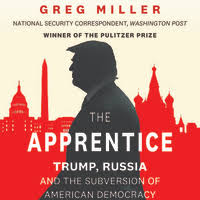
“You might think it’s okay that the Presidential chairman of a campaign would offer information about that campaign to a Russian in exchange for money or debt forgiveness. You might think that’s okay. I don’t.
“You might think it’s okay that campaign chairman offered polling data, campaign polling data to someone linked to Russian intelligence. I don’t think that’s okay.
“You might think it’s okay that the President himself called on Russia to hack his opponent’s emails, ‘if they were listening.’
“You might think it’s okay that later that day, in fact, the Russians attempted to hack a server affiliated with that campaign. I don’t think that’s okay.
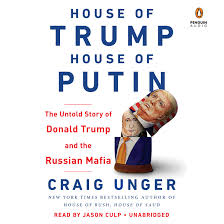
“You might think that it’s okay that the President’s son-in-law sought to establish a secret back channel of communications with the Russians through a Russian diplomatic facility. I don’t think that’s okay.
“You might think it’s okay that an associate of the President made direct contact with the GRU [the Russian military Intelligence agency] through Guccifer 2 and Wikileaks, that is considered a hostile Intelligence agency.
“You might think that it’s okay that a senior campaign official was instructed to reach that associate and find out what that hostile Intelligence agency had to say, in terms of dirt on his opponent.
“You might think it’s okay that the National Security Adviser-Designate [Mike Flynn] secretly conferred with the Russian ambassador about undermining U.S. sanctions, and you might think it’s okay he lied about it to the FBI. You might say that’s all okay.
“You might say that’s just what you need to do to win, but I don’t think it’s okay. I think it’s immoral. I think it’s unethical. I think it’s unpatriotic. And yes, I think it’s corrupt and evidence of collusion.”
Not one Republican dared challenge even one accusation Schiff had made.
2016 PRESIDENTIAL CAMPAIGN, ABC NEWS, ADAM SCHIFF, ALTERNET, AMERICABLOG, AP, BABY BOOMER RESISTANCE, BBC, BLOOMBERG NEWS, BUZZFEED, CBS NEWS, CNN, CROOKS AND LIARS, DAILY KOZ, DONALD TRUMP, FACEBOOK, FIVETHIRTYEIGHT, HARPER’S MAGAZINE, HOUSE INTELLIGENCE COMMITTEE, HOUSE OF REPRESENTATIVES, HOUSE PERMANENT SELECT COMMITTEE ON INTELLIGENCE, HUFFINGTON POST, JULIUS CAESAR, JULIUS CAESAR (PLAY), MARCUS BRUTUS, MARK ANTONY, MEDIA MATTERS, MIKE CONAWAY, MOTHER JONES, MOVEON, MSNBC, MUELLER REPORT, NBC NEWS, NEW REPUBLIC, NEWSDAY, NEWSWEEK, NPR, PBS NEWSHOUR, POLITICO, POLITICUSUSA, RAW STORY, REPUBLICANS, REUTERS, ROBERT MUELLER, RUSSIA, SALON, SEATTLE TIMES, SLATE, SUBVERSION, TALKING POINTS MEMO, THE ATLANTIC, THE CHICAGO SUN-TIMES, THE CHICAGO TRIBUNE, THE DAILY BEAST, THE DAILY BLOG, THE GUARDIAN, THE HILL, THE HUFFINGTON POST, THE INTERCEPT, THE LOS ANGELES TIMES, THE NATION, THE NEW REPUBLIC, THE NEW YORK TIMES, THE NEW YORKER, THE VILLAGE VOICE, THE WASHINGTON POST, THINKPROGRESS, TIME, TRUTHDIG, TRUTHOUT, TWITTER, TWO POLITICAL JUNKIES, U.S. NEWS & WORLD REPORT, UPI, USA TODAY, WILLIAM BAR, WILLIAM SHAKESPEARE, WONKETTE
In Bureaucracy, Entertainment, History, Law, Politics, Social commentary on April 5, 2022 at 12:11 am
“Friends, Romans, countrymen—lend me your ears!”
It’s the opening line of a speech once widely memorized by schoolboys in English literature classes. It’s from William Shakespeare’s “Julius Caesar,” and it’s a far more sophisticated piece of writing than most people realize.
Mark Antony, addressing a crowd of Romans at the funeral of his former patron, Julius Caesar, faces a serious problem.
Caesar has been murdered by a band of conspirators who feared he intended to make himself king. The chief conspirator, Marcus Brutus, is one of the most honored men in ancient Rome. And he has just addressed the same crowd.
As a result, they are now convinced that the assassination was fully justified. They assume that Antony intends to attack the conspirators. And they are ready to attack him—maybe physically—if he does.
But Antony is too smart to do that—at least initially.
Instead, he assures the crowd: “I come to bury Caesar, not to praise him.”
And he praises the chief conspirator: “The noble Brutus hath told you Caesar was ambitious. If so, it was a grievous fault—and grievously hath Caesar answered it.”
Then he introduces a line he will repeat with great effectiveness throughout the rest of his speech: “For Brutus is an honorable man—so are they all, all honorable men.”

The “Death of Julius Caesar,” as depicted by Vincenzo Camuccini.
For Antony, the line is ironic. But it serves his purpose to appease the crowd. Later, he will wield it like a sword against the same conspirators.
“He was my friend, faithful and just to me.” And then: “But Brutus says he was ambitious, and Brutus is an honorable man.”
Antony then goes on to extol Caesar as the foremost Roman of his time:
- As a military victor: “You all do know this mantle. I remember the first time ever Caesar put it on. ‘Twas on…that day he overcame the Nervii.”
- As a humanitarian: “When that the poor hath cried, Caesar hath wept.”
And then, as if against his better judgment, he says: “But here’s a parchment with the seal of Caesar. I found it in his closet—’tis his will. Let but the commons hear this testament—which, pardon me, I do not mean to read—and they would go and kiss dead Caesar’s wounds.”
This inflames the crowd’s curiosity and greed: What has Caesar left them? And Antony’s refusing to read the alleged will only makes them determined to hear it.
Now the crowd is entirely at Antony’s disposal. They hurl abuse at the conspirators: “They were traitors!” “They were villains, murderers!”
So Antony, claiming to read Caesar’s will, pronounces: “To every Roman citizen he gives…seventy-five drachmas.”
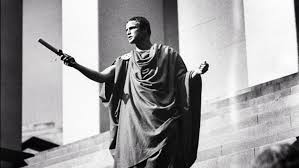
Marlon Brando as Mark Antony in the 1953 film, “Julius Caesar”
Is this truly Caesar’s will? And, if so, does it really make this bequest? No one knows.
In addition, claims Antony, Caesar has left his fellow citizens “his private arbours and new-planted orchards on this side Tiber. He hath left them you, and to your heirs forever, common pleasures, to walk abroad, and recreate yourselves.”
By now the crowd is fired up—against the conspirators.
“Here was a Caesar!” cries Antony. “When comes such another?”
A citizen shouts: “We’ll burn [Caesar’s] body in the holy place. And with the brands fire the traitors’ houses.”
The crowd disperses—to pay fiery homage to Caesar and burn the houses of Brutus and the other conspirators.
Caesar’s assassins flee Rome for their lives. In time, they will face the legions of Antony and Octavian, the young nephew of Caesar—and choose suicide over capture and execution.
Apparently Rep. Adam Schiff (D-California) is familiar with Shakespeare’s play.
Because, on March 28, 2019, he used the same repetitive technique in addressing his “Republican colleagues” on the House Permanent Select Committee on Intelligence.
Days earlier, Attorney General William Barr had claimed to summarize the long-awaited report by Special Counsel Robert Mueller about Russian efforts to subvert the 2016 Presidential election.
According to Barr, the report—which no one else in the government has seen—showed no evidence that President Donald Trump had colluded with Russian Intelligence agents.
And now House Republicans—acting entirely on that claim—were going on the offensive.
On March 28, Rep. Mike Conaway (R-Texas) and all other eight Republicans on the Committee demanded in a letter that Schiff resign as its chairman.
“Mr. Chairman,” the letter read, “since prior to the inauguration of President Trump in January 2017, you’ve been at the center of a well-orchestrated media campaign claiming, among other things, that the Trump campaign colluded with the Russian government.
“On March 24, 2019, the special counsel delivered his findings to the Department of Justice….The special counsel’s investigation did not find that the Trump campaign or anyone associated with it conspired or coordinated with Russia in its efforts to influence the 2016 election….
“Despite these findings, you continue to proclaim to the media that there is ‘significant evidence of collusion.’
“The findings of the Special Counsel conclusively refute your past and present conclusions and have exposed you as having abused your position to knowingly promote false information, having damaged the integrity of this Committee, and undermined faith in U.S. Government institutions.”


 Bureaucracybuster's Blog
2016 PRESIDENTIAL CAMPAIGN, 2020 PRESIDENTIAL CAMPAIGN, ABC NEWS, ALTERNET, AMERICABLOG, ANCIENT ROME, ANTONIN SCALIA, AP, BABY BOOMER RESISTANCE, BERNIE SANDERS, BUZZFEED, CAMPAIGN CONTRIBUTIONS, CBS NEWS, CITIZENS UNITED, CLEOPATRA, CNN, CROOKS AND LIARS, DAILY KOZ, DONALD TRUMP, ELIZABETH WARREN, FACEBOOK, FIVETHIRTYEIGHT, FORECLOSURES, GLADIATORS, JOE BIDEN, JULIUS CAESAR, KIRK DOUGLAS, LAURENCE OLIVER, MARCUS CRASSUS, MICHAEL BLOOMBERG, MITT ROMNEY, MOTHER JONES, MOVEON, MSNBC, NBC NEWS, NEWSWEEK, NEWT GINGRICH, NPR, PBS NEWSHOUR, PETE BUTTIGIEG, POLITICO, POLITICUSUSA, RAW STORY, REUTERS, SALON, SEATTLE TIMES, SHELDON ADELSON, SLATE, SPARTACUS, SUPREME COURT, TALKING POINTS MEMO, THE ATLANTIC, THE CHICAGO SUN-TIMES, THE CHICAGO TRIBUNE, THE DAILY BEAST, THE DAILY BLOG, THE GUARDIAN, THE HILL, THE HUFFINGTON POST, THE LOS ANGELES TIMES, THE NATION, THE NEW YORK TIMES, THE WASHINGTON POST, THINKPROGRESS, TIME, TOM STEYER, TRUTHDIG, TWITTER, U.S. NEWS & WORLD REPORT, UPI, USA TODAY
ANCIENT ROME COMES TO AMERICAN POLITICS
In Bureaucracy, Business, History, Military, Politics, Social commentary on September 5, 2022 at 12:10 amThe 1960 Kirk Douglas epic, Spartacus, has proven to be more than great entertainment. It has turned out to be a prophecy of the end of the American Republic.
In the movie, Spartacus (Douglas), a Roman slave, entertains Marcus Crassus (Laurence Oliver) the richest man in Rome. He does so by fighting to the death as a gladiator.
Poster for Spartacus
While Spartacus and his fellow gladiator/friend, Draba (Woody Strode), slash and stab at each other in the arena, Crassus idly chats with his crony, Marcus Glabrus (Jon Dall).
Crassus has just secured Glabrus’ appointment as commander of the garrison of Rome. Glabrus is grateful, but curious as to how he did it.
After all, Gaius Gracchus (Charles Laughton), the leader of the Roman Senate, hates Crassus, and vigorously opposes his every move.
“I fought fire with oil,” says Crassus. “I purchased the Senate behind his back.”
Just as Crassus bought the Roman Senate in Spartacus, billionaires similarly bought the 2016 Presidential election.
In 2016, Newt Gingrich, former Speaker of the House of Representatives, ran as the pet candidate of casino billionaire Sheldon G. Adelson.
Since 2007, Adelson had spent millions in support of Gingrich and his causes.
Newt Gingrich
Adelson put up seed money and, ultimately, $7.7 million between 2006 and 2010 for a nonprofit group that served as a precursor to Gingrich’s presidential campaign.
Sheldon Adelson
Such a contribution is beyond the means of the average American. But Adelson is listed by Forbes as the eighth-wealthiest American, with a net worth of $21.5 billion.
Adelson denied any selfish motives for giving millions to a candidate for the most powerful office in the world:
“My motivation for helping Newt is simple and should not be mistaken for anything other than the fact that my wife Miriam and I hold our friendship with him very dear and are doing what we can as private citizens to support his candidacy.”
Former Massachusetts Governor Mitt Romney also relied heavily on a small group of millionaires and billionaires for support.
By February, 2012, a quarter of the money amassed by Romney’s campaign came from just 41 people. Each contributor gave more than $100,000, according to a Washington Post analysis of disclosure data. Nearly a dozen of the donors had contributed $1 million or more.
Some of Romney’s biggest supporters included executives at Bain Capital, his former firm; bankers at Goldman Sachs; and a hedge fund mogul who made billions betting on the housing crash.
Four years later, in May, 2016, Adelson met privately with Republican Presidential nominee-in-waiting Donald Trump.
Adelson promised to contribute more to secure Trump’s election than he had contributed to any previous campaign—up to and exceeding $100 million.
Meanwhile, Trump bragged that he was “not beholden” to any “special interests” because “I’m really rich.” This falsehood proved a main reason for his popularity as a candidate.
Donald Trump
Fast forward another three years—and a December 4, 2019 story in Fortune: “2020 Presidential Campaign Fundraising (and Spending) Are on Track to Smash Records.”
By then, Trump had raised $165.3 million.
But Democrats altogether had outstripped him with $475.6 million raised.
Among the largest Democratic money-raisers (in millions):
Former New York Mayor Michael Bloomberg entered the race on November 24, 2019. Within a week he paid $57 million for TV ads.
His fellow billionaire Tom Steyer spent over $60 million since July, 2019.
The 2020 Presidential election proved the most expensive in American history—so far.
Joe Biden raised $1.06 billion. Donald Trump raised $0.80 billion.
All of this can be directly traced to the 2010 “Citizens United” decision by the U.S. Supreme Court that ended limits in corporate contributions to political campaigns. The decision is so named for the group that successfully sued over federal campaign finance laws.
The 5-4 decision led to the rise of Super PACs—outside groups affiliated with candidates that can take in unlimited contributions as long as they don’t directly coordinate with the candidate. The overwhelming majority of this money goes for negative ads—that slander opponents without saying anything about what a candidate proposes to do.
Former U.S. Supreme Court Justice Antonin Scalia brushed aside criticism of the corrupting role money played in politics: Change the channel or turn off the TV.
“I don’t care who is doing the speech—the more the merrier,” Scalia said. “People are not stupid. If they don’t like it, they’ll shut it off.”
On the contrary: A fundamental principle of propaganda holds that most people are stupid—or can be made to behave stupidly. If they are ceaselessly bombarded with mind-numbing lies, they will eventually substitute these for reality.
During the early 1960s a series of movies about the Roman Empire—like Spartacus and Cleopatra—hit the big screen. In these, rich criminals like Marcus Crassus openly bought the favors of ambitious politicians like Julius Caesar.
No doubt millions of moviegoers thought, “Boy, I’m glad that couldn’t happen here.”
But it has happened here—and it’s happening right now.
Share this: