On July 20, 1944, Colonel Claus Schenk von Stuaffenberg tried to assassinate Nazi Germany’s Fuhrer, Adolf Hitler, with a time bomb.
Stauffenberg appeared at Hitler’s well-guarded military headquarters in East Prussia. Like all his other outposts, Hitler had named it—appropriately enough—“Wolf’s Lair.”
While a war conference was in session, he placed his yellow briefcase next to Hitler—who was standing with his generals at a heavy oaken table. Then he excused himself to take an “urgent” phone call.
“Wolf’s Lair”
But after Stauffenberg left the room, Colonel Heinz Brandt, who stood next to Hitler, found the briefcase blocking his legs. So he moved it—to the other side of the heavy oaken support, thus unknowingly shielding Hitler from the full blast.
At 12:42 p.m. on July 20, 1944, Stauffenberg’s briefcase bomb erupted.
Brandt died, as did two other officers and a stenographer. Hitler not only survived, but the plotters failed to seize the key broadcast facilities of the Reich.
This allowed Hitler to make a late-night speech to the nation, revealing the failed plot and assuring Germans that he was still alive. And he swore to flush out the “traitorous swine” who had tried to kill him.
Mass arrests quickly followed. Among the first victims discovered and executed was the conspiracy’s leader, Colonel Claus von Stauffenberg. Standing before a makeshift firing squad at midnight, he cried: “Long live our sacred Germany!”
Claus von Stauffenberg
At least 7,000 persons were arrested by the Gestapo. Of these, 4,980 were executed.
If the conspiracy had succeeded and Germany had surrendered in July or August, 1944, World War II would have ended eight to nine months earlier. This would have meant:
The Russians—who didn’t reach Germany until April, 1945—could not have occupied the Eastern part of the country.
Millions of East Germans would have been spared the misery of living under Communist rule for 44 years.
Many of the future conflicts between the United States and the Soviet Union over access to West Berlin and/or West Germany would have been prevented.
Untold numbers of Holocaust victims would have survived because the concentration camps would have been shut down far earlier.
Yet history notes other tyrants whose evil reigns ended prematurely—such as that of Gaius Caligula.
Caligula became Emperor of Rome in 37 A.D. after succeeding the Emperor Tiberius, his uncle.
For three years, he held—and exercised—life-or-death power over the citizens of Italy and beyond. His attitude toward humanity was best summed up by his remark: “Bear in mind that I can treat anyone exactly as I please.”
Among his litany of crimes, according to his biographer, Gaius Suetonius Tranquillus:
He forced parents to attend the executions of their sons, sending a litter for one man who pleaded ill health. He invited another to dinner immediately after witnessing the execution, and trying to rouse him to gaiety by a great show of affability.
He watched for several successive days as the manager of his gladiatorial shows was beaten with chains, and ordered him killed only when he was disgusted at the stench of his putrefied brain.
He appeared at the temple of Castor and Pollux to be worshiped as Jupiter Latiaris.
He lived in incest with all his three sisters. At a large banquet he placed each of them in turn below him, while his wife reclined above.
He intended to promote his favorite racehorse, Incitatus(“Swift”), to consul.
Like all Roman emperors, Caligula was constantly protected by the Praetorian Guard, an elite unit of the Roman army comprised of tough legionnaires—especially German ones.
There had not been an assassination of a Roman emperor since the death of Julius Caesar almost 100 years earlier.
The assassins in that case had been motivated by a mixture of
Personal animosity toward Caesar’s increasing arrogance and
Genuine fears that he intended to abolish the Roman Republic and set himself up as a dictator.
And Caligula intended to keep a similar fate from overtaking him.
For all his cruelty and egomania, the trait that finally destroyed Caligula was his joy in humiliating others.
Among those he taunted was Cassius Chaerea, a member of his own bodyguard.
Two different historians give two different motives for his decision to assassinate Caligula.
The Jewish historian Josephus claimed that Chaerea was a “noble idealist” deeply committed to “Republican liberties.”
But Suetonius wrote that Caligula considered Chaerea effeminate because of a weak voice and gave him such mocking watchwords as “Priapus” and “Venus.” Whenever Caligula had Chaerea kiss his ring, the emperor would “hold out his hand to kiss, forming and moving it in an obscene fashion.”
On January 22 41 A.D. Chaerea and several other bodyguards hacked Caligula to death with swords before other guards could save him.
The assassination attempts on Adolf Hitler and the successful assassination of Gaius Caligula demonstrate that the greatest danger facing a tyrant is people who:
Are in frequent and highly personal contact with him; and
Keep their animosity toward him a secret—until the moment they wish to strike.
Had Secret Service agent Kerry O’Grady kept her revulsion toward Donald Trump to herself, she might now be hailed as an American traitor—or as democracy’s savior.
Where does loyalty leave off and conscience begin?
Specifically: If you’re a bodyguard for a man you know represents a genuine threat to democracy, what are your obligations to defend him? Should you be as willing to “take a bullet” for him as for someone you truly admire?
Members of Adolf Hitler’s bodyguard faced no such qualms. Right up to the bitter end, with Russian forces only blocks from the Fuhrerbunker, they manned their posts, ready to die for the man who had led them—and Germany—into the ultimate catastrophe.
They made Hitler a closely-guarded target.
He was surrounded by fanatical bodyguards who were expert marksmen. He often wore a bulletproof vest and a cap lined with three pounds of laminated steel.
But his single greatest protection—he claimed—was an instinct for danger. He would suddenly change his schedule—to drop in where he was least expected. Or suddenly depart an event where he was expected to stay a long time.
Adolf Hitler
It wasn’t Hitler’s bodyguards who posed a threat to his life. It was the colonels and generals of the German General Staff.
On August 20, 1934, members of the German army, navy and air force were required to swear the “Law On The Allegiance of Civil Servants and Soldiers of the Armed Forces.”
Whereas members of the armed forces had previously sworn loyalty to Germany, the new law required them to swear an oath of loyalty to Hitler personally.
In coming years, this would prove a deadly trap for many German officers—forcing them to choose between betraying a sacred oath and remaining loyal to a man who was clearly driving Germany to ruin.
For those officers who could not abide Germany’s coming destruction, the choice was simple: Hitler had to go.
A series of assassination attempts were made against Hitler. All of them involved time-bombs. And all of the would-be assassins were members of the German General Staff.
In one case, a bomb secretly stashed aboard Hitler’s plane failed to explode. In another, an officer who had a bomb strapped to himself unexpectedly found his scheduled meeting with Hitler called off. He had to rush into a bathroom to defuse the bomb before it exploded.
Hitler came closest to death on July 20, 1944.
Colonel Claus Schenk von Stuaffenberg was the driving force in a plot to assassinate Hitler with a time bomb.
Claus von Stauffenberg
He had served with the Wehrmacht in Poland (1939), France (1940) and the Soviet Union (1941). While serving in Tunisa, he was seriously wounded on April 7, 1943, when Allied fighters strafed his vehicle. He lost his left eye, right hand and two fingers of his left hand after surgery.
For most of his fellow officers, the motive was craven: The “happy time” of German victories was over. Germany was losing the war it had unleashed on the world in 1939—and now they feared the worst.
This was especially true now that the numerically superior forces of the Soviet Union had gone onto the offensive.
The Wehrmacht in Russia
The Wehrmacht and Schutzstaffel (SS) had killed millions of Russians. Many had died in combat. Others had been murdered as captives. Still more had been allowed to die by starvation and exposure to the notorious Russian winter.
For Stauffenberg, there was another reason: His disgust at the horrors he had seen committed by his fellow Wehrmacht soldiers upon defenseless POW’s and civilians in Russia.
Thus, Stauffenberg—more than many Germans—knew firsthand the vengeance his country could expect if the “Thousand-Year Reich” fell. Something must be done, he believed, to prove to the world that not all Germans—even members of the Wehrmacht—were criminals.
Most of the conspirators wanted to arrest Hitler and surrender to British and American forces—well before the much-feared Russians gained a toehold in Germany. Stauffenberg didn’t want to arrest Hitler; he wanted to kill him. A live Hitler might eventually be rescued by his Nazi colleagues.
Stauffenberg intended to carry his bomb—hidden in a briefcase—into a “Hitler conference” room packed with military officers. Rigged with a time-fuse, it would be left there while he found an excuse to leave. After the explosion, he would phone one of his fellow conspirators with the news.
Stauffenberg intended to direct the new government that would replace that of the Nazis—and open peace talks with the British and Americans. With Hitler dead, the coup—“Operation Valkyrie”—would be on.
Anti-Nazi conspirators would seize control of key posts of the government. They would inform the British and Americans of Germany’s willingness to surrender. Provided, of course, that the vengeance-seeking Russians did not have a say in its postwar future.
On July 20, 1944, Stauffenberg appeared at Hitler’s well-guarded military headquarters in East Prussia. Like all his other outposts, Hitler had named it—appropriately enough—“Wolf’s Lair.”
Stauffenberg entered the large, concrete building while the conference was in session. He placed his yellow briefcase next to Hitler—who was standing with his generals at a heavy oaken table. Then he excused himself to take an “urgent” phone call.
At 12:42 p.m. on July 20, 1944, Stauffenberg’s briefcase bomb erupted.
In the classic 1969 Western, The Wild Bunch, the outlaw gang is pursued by a posse led by Deke Thornton (Robert Ryan), one of its own former members.
This triggers a furious exchange between the gang’s two leaders:
DUTCH ENGSTROM (Ernest Borgnine): Damn that Deke Thornton to hell!
PIKE BISHOP (William Holden): What would you do in his place? He gave his word.
DUTCH ENGSTROM: He gave his word to a railroad!
PIKE BISHOP: It’s his word!
DUTCH ENGSTROM: That’s not what counts! It’s who you give it to!
Where does loyalty leave off and conscience begin?
Specifically: If you’re a bodyguard for a man you know represents a genuine threat to democracy, what are your obligations to defend him? Should you be as willing to “take a bullet” for him as for someone you truly admire?
In October, 2016, Kerry O’Grady, a senior agent in the Denver field office of the United States Secret Service, found herself facing such a quandary.
She had made a series of now-deleted postings on Facebook during the 2016 Presidential campaign saying that she supported Democrat Hillary Clinton and that she would not honor a federal law that prevents agents like her from publicly airing their political beliefs.
Kerry O’Grady
“As a public servant for nearly 23 years, I struggle not to violate the Hatch Act. So I keep quiet and skirt the median,” she wrote in one Facebook post. “To do otherwise can be a criminal offense for those in my position. Despite the fact that I am expected to take a bullet for both sides.”
She had also suggested on Facebook that she would not defend President Donald Trump should someone try to shoot him.
“But this world has changed and I have changed. And I would take jail time over a bullet or an endorsement for what I believe to be disaster to this country and the strong and amazing women and minorities who reside here. Hatch Act be damned. I am with Her [Hillary Clinton],” she wrote.
The Secret Service said in a statement that it could not comment on a specific personnel matter but that it was “aware of the postings and the agency is taking quick and appropriate action.
“All Secret Service agents and employees are held to the highest standards of professional and ethical conduct. Any allegations of misconduct are taken seriously and swiftly investigated.”
Secret Service agents
O’Grady was placed on administrative leave on January 28, 2017 and suspended with pay in February. The disciplinary action took months because of her high rank.
In March, 2019, she retired from the Secret Service.
During the next four years—2017 to 2021—Donald Trump came perilously close to becoming an absolute dictator.
Among his infamies and crimes:
Repeatedly attacking the nation’s free press as “the enemy of the American people” for daring to report his growing list of crimes and disasters.
Publicly siding with Russian dictator Vladimir Putin against American Intelligence agencies—such as the FBI, CIA and National Security Agency—which unanimously agreed that Russia had interfered with the 2016 Presidential election.
Attacking and alienating America’s oldest allies, such as Canada and Great Britain.
Firing FBI Director James Comey for refusing to pledge his personal loyalty to Trump—and continuing to investigate Russian subversion of the 2016 election.
Donald Trump
Shutting down the Federal Government on December 22, 2018, because Democrats refused to fund his useless “border wall” between the United States and Mexico. An estimated 380,000 government employees were furloughed and another 420,000 were ordered to work without pay for 35 days.
Allowing the deadly COVID-19 virus to ravage the country, killing 400,000 Americans by the time he left office.
Repeatedly lying—while still in office and afterward—that the 2020 election had been “stolen” from him by massive voter fraud.
Illegally trying to pressure state legislatures and governors to stop the certification of the vote that had made Joe Biden the president-elect.
Inciting his followers to attack the Capitol Building where Senators and Representatives were meeting to count the Electoral Votes won by himself and Joseph Biden. His objective: Stop the count, which he knew would prove him the loser.
In the classic 1981 crime drama, Prince of the City, Danny Ciello (Treat Williams) turns federal witness against his fellow crime-committing police officers.
His mobbed-up cousin, Nick, warns him that the Mafia wants him dead—but that his greatest danger might come from the bodyguards now surrounding him: “Anyone can be hit. You know that. All a guard has to do is look the wrong way for a second.”
Had that happened while Trump occupied the White House, American democracy would not now be imperiled by a second Trump administration.
Bodyguards for Adolf Hitler faced no such qualms. Right up to the bitter end, with Russian forces only blocks from the Fuhrerbunker, they manned their posts, ready to die for the man who had led them, Germany and the world into the ultimate catastrophe.
Within six years, Hitler had:
Ignited World War II in 1939 through his invasion of Poland.
Directly or indirectly caused the deaths of 50 million people worldwide.
Exterminated six million Jews throughout Eastern Europe and Russia through mass shootings or gassings in a vast system of concentration camps.
On October 18, more than seven million Americans protested the dictatorial policies of President Donald J. Trump.
It was the second nationwide “No Kings” series of protest marches since he took office on January 20.
The first marches, on June 14, had drawn about five million people.
Republicans, knowing the marches were coming, tried to pre-empt their “I Hate Dictators” message with one of their own: That the intended marchers hated America.
Speaker of the House Mike Johnson: “You’re gonna bring together the Marxists, the socialists, the Antifa advocates, the anarchists, and the pro-Hamas wing of the far-left Democrat party.”
Mike Johnson
Other Republicans quickly joined his chorus.
Treasury Secretary Scott Bessent: “This crazy No Kings rally this weekend, which is gonna be the farthest left, the hardest-core, the most unhinged in the Democratic Party, which is a big title.”
Kansas Senator Roger Marshall warned that the protests would turn violent and have to be stopped by the national guard.
Attorney general Pam Bondi claimed, without proof, that the protests were an organized effort with dedicated funding: “You’re seeing people out there with thousands of signs that all match, pre-bought, pre-put together. They are organized, and someone is funding it.”
Pam Bondi
But, according to an October 19 opinion piece in The New Republic, such slanders were proven wrong:
“The atmosphere was extremely energetic and family friendly for both young and old.
“People walked slowly, often with kids in tow. Countless attendees wore large inflatable costumes, inspired by the Portland frog. There was live music, tabling, and speeches by Bill Nye, Mehdi Hasan, and Senators Bernie Sanders and Chris Murphy, among others.”
The greatest threat posed to the Trump administration didn’t come from the “No Kings” rallies. It came from no less a figure than President Donald J. Trump.
To show his utter contempt for those who oppose his policies and dictatorial rule, he posted an AI-generated video on his Truth Social account. It showed him wearing a crown and flying a jet labeled “King Trump” that dumps feces on protesters.
It’s set to the music of the 1986 Top Gun film song, “Danger Zone,” by Kenny Loggiins.
Loggins responded on NPR: “This is an unauthorized use of my performance of ‘Danger Zone.’ Nobody asked me for my permission, which I would have denied, and I request that my recording on this video is removed immediately.
“I can’t imagine why anybody would want their music used or associated with something created with the sole purpose of dividing us. Too many people are trying to tear us apart, and we need to find new ways to come together. We’re all Americans, and we’re all patriotic.
“There is no ‘us and them’ – that’s not who we are, nor is it what we should be. It’s all of us. We’re in this together, and it is my hope that we can embrace music as a way of celebrating and uniting each and every one of us.”
Owing to Logginis’ demand, many YouTube versions of this video don’t contain that music.
NPR contacted to the White House for a response to Loggins’ reaction.
White House spokesman Davis R. Ingle ignored NPR’s questions but contemptuously replied with an image from Top Gun of stars Tom Cruise and the late Val Kilmer, captioned: “I FEEL THE NEED FOR SPEED.”
Loggins could file a copyright infringement suit against Trump.
The Internet erupted with outrage:
“Can’t believe that’s a president of a country.”
“It tells you everything you need to know about what he thinks about the people of America who are, in fact, America.”
“Just to be clear, Americans, this is what Donald Trump thinks of you if you oppose him, protest, or simply ask questions.”
“Trump’s AI fantasy of crowning himself King & dumping shit from a fighter jet is the most honest thing he’s ever posted. He’s literally shitting on Americans because he doesn’t give a fuck about them. And the MAGA stupids will cheer it, calling it “patriotism.”
But these were tame compared to the warning issued by Niccolo Machiavelli, the Florentine statesman, more than 500 years ago.
Niccolo Machiavelli
In his best-known work, The Prince, he advised rulers to “mingle with [citizens] from time to time, and give them an example of his humanity and munificence, always upholding, however, the majesty of his dignity, which must never be allowed to fail in anything whatever.”
“…A prince need trouble little about conspiracies when the people are well disposed. But when they are hostile and hold him in hatred, then he must fear everything and everybody.
“….For whoever conspires always believes that he will satisfy the people by the death of the prince.
“…[The Roman Emperor Commodus], being of a cruel and bestial disposition, in order to…exercise his rapacity on the people, he sought to favor the soldiers and render them licentious. On the other hand, by not maintaining his dignity, by often descending into the theater to fight with gladiators and committing other contemptible actions…he became despicable in the eyes of the soldiers. And being hated on the one hand and despised on the other, he was conspired against and killed.”
On February 6, 2011, Ronald Reagan, if he had been alive, would have been 100 years old.
Publishers rushed to put out worshipful tributes to his eight years as President. Network political programs such as “This Week” and “Meet the Press” assembled surviving members of his administration to re-live the “glory days” of Reagan’s—and their—time in power.
Actually, it was during the Reagan administration that America entered its decline—a Right-wing legacy of huge Federal deficits, tax-cuts for the rich, bloated military budgets and cutbacks in government programs to aid the poor and middle-class.
Ronald Reagan
No two men could have been more different than Vladimir Lenin and Ronald Reagan. Lenin created the Soviet Union in 1917 and became its first in a series of absolute dictators. Reagan spent his life fighting Communism, most notably as President.
So it’s ironic that both men, in death, got essentially the same funeral—and for the same reason: To sanctify and legitimize their respective organizations—and the authority of their potential successors.
Vladimir Lenin
Lenin died on January 21, 1924, and was immediately succeeded by the party’s General Secretary, Joseph Stalin. Stalin, as a youth, had been a seminary student. He knew that, despite Communism’s official atheistic stance, most Russians remained loyal to the Russian Orthodox Church.
So in giving Lenin’s funeral oration, Stalin used the language of religion to confer sainthood upon a militant atheist—and upon his successor, Stalin himself: “We vow to thee, Comrade Lenin, that we will fulfill this, thy commandment….”
Funeral for Vladimir Lenin
Stalin and his fellow Communists immediately launched the “cult of Lenin,” depicting him as a fatherly, all-wise leader whose genius could only be bestowed upon his closest disciples.
Lenin’s extensive political writings were treated as divine writ, and were used to justify everything Stalin and his own successors wanted to do.
A classic example: Although he died 20 years before the Americancreation of the atomic bomb, Lenin was hailed by the Soviets as the “father” of “Soviet nuclear physics.”
Similarly, Republicans quickly turned Reagan into a modern-day saint of mythical proportions.
They did so for the same reason that Stalin deliberately forged a cult around the dead Lenin—to create a “holy” figure of whom other Republicans can claim to be true disciples.
Funeral for Ronald Reagan
These deliberate fictions conveniently ignore a series of ugly truths:
Reagan was onlyoneof a series of Presidents who held the line against the Soviet Union.
His budgets were just as stained with red ink as those of all previous Presidents.
By the end of his term, 138 Reagan administration officials had been investigated, indicted or convicted for official misconduct and/or criminal violations.
His “trickle-down” Reganomics brought prosperity to only the wealthiest 1% of Americans, proving that “a rising tide lifts some yachts.”
By drastically shrinking the tax-base, bloating the defense budget and destroying programs to benefit the poor and middle-class, Reagan produced a $1 trillion deficit-–which only the Clinton Administration eliminated.
Reagan believed that government should not helpthe impoverished. Those who lacked wealth to buy such necessities as housing and medical insurance were written off as unimportant.
John F. Kennedy had praised government service as an honor. Reagan repeatedly said that “the best and the brightest” could be found only in business.
This denigration of government service continues among Republicans to this day—defaming the very institutions they lust to control.
Although he often berated the poor for their “laziness,” Reagan adhered to a “banker’s hours” schedule: During his working hours in the Oval Office, he often had blocks of free time—two to three hours. He would call for his fan mail and answer it.
Reagan saw no need to protect America’s fragile environment against corporate polluters, eager to enrich themselves at its expense. He ignorantly stated: “Approximately 80% of our air pollution stems from hydrocarbons released by vegetation, so let’s not go overboard in setting and enforcing tough emission standards from man-made sources.”
Reagan famously attacked “welfare queens” and sought to deny government benefits for the poor. But he didn’t hesitate to enrich himself at public expense.
Before his Presidency ended, 18 wealthy Californians contributed $156,000 apiece to buy him a 7,200 square-foot mansion overlooking Beverly Hills.
Reagan signed a multi-million dollar deal to write his Presidential memoirs and publish a collection of his speeches.
He signed an exclusive contract with a Washington lecture bureau, which paid him $50,000 per speech given in the United States and $100,000 overseas. This made him the highest-paid speaker in the country.
These monies came in additionto his Presidential pension of $99,500 a year for life and his $30,000 annual pension as a former governor of California.
At a cost to the government of $10 million annually, Reagan—a millionaire who could afford private security—continued to receive lifetime Secret Service protection from 40 fulltime agents.
The “cult of Lenin” died when the Soviet Union collapsed in 1991. The “cult of Reagan” died only when it was superseded by that of Donald Trump.
The difference: Reagan hid his brutal deeds behind a smile; Trump celebrates his openly with a frown.
Donald Trumphas never shown any interest in—let alone knowledge of—history. Yet he might well feel warmly towards an English king who took power 508 years before he did.
Henry VIIIcame to the throne in 1509 and ruled as a tyrant until his death in 1547.
Trumpcame to the Presidency in 2017 and ruled as a tyrant until his electoral ouster in 2021.
In his youth Henry was athletic, highly intelligent, and spoke French, Latin and Spanish. Highly religious, he immensely enjoyed hunting and tennis. His scholarly interests included writing books and music, and he was a lavish patron of the arts.
Henry VIII
Trump graduated from the Wharton School of the University of Pennsylvania in 1968 with a B.S. in Economics. In 2015, his lawyer, Michael Cohen, threatened to sueTrump’shigh school, colleges, and the College Board if they released Trump’s academic records.
At six-feet-two with a slim athletic build, fair complexion and prowess on the jousting and tennis courts, Henry was considered extremely handsome, and even referred to as an “Adonis.” But as he aged, he became obese and his health suffered.
As a young man, standing six-feet-three and with an athletic build, Trumpwas considered handsome and a ladies’ man. But he thought exercise a waste of energy, saying it depletes the body’s energy. By the time he ran for President in 2015-16, he was grotesquely overweight, with orange skin and stood with a pronounced forward tilt.
Henrymarried six times—resulting in two divorces (Catherine of Aragon and Anne of Cleves), two beheadings (Anne Boleyn and Katherine Howard) and one death after childbirth (Jane Seymour). His last wife, Catherine Parr, outlived him.
Trump has been married three times—to Ivana Trump, Marla Maples and Melania Trump. He cheated on Ivana (before divorcing her) with Marla, then cheated on Marla (before divorcing her) with Melania.
Parody of Donald Trump as Henry VIII
Both during and in-between marriages he bedded many other women—and boasted about it. His most infamous boast almost cost him the White House.
During a 2005 exchange with Billy Bush, then the host of Access Hollywood, Trump said: “You know I’m automatically attracted to beautiful—I just start kissing them. It’s like a magnet. Just kiss. I don’t even wait. And when you’re a star they let you do it. You can do anything. Grab them by the pussy. You can do anything.”
Henry VIIIruled England for 36 years, made radical changes to the English Constitution, and ushered in the theory of the divine right of kings in opposition to papal supremacy.
Donald Trumpruled the United States for four years, put radical Right-wing Justices on the Supreme Court, and boasted that it would be great if the country had—like China—a “President-for-Life.”
To make that a reality, he refused to accept electoral defeat in 2020 and incited a violent attack on Congress to stop the count of Electoral College votes proving that former Vice President Joseph Biden had won.
Trump inciting the January 6 attack on Congress
Henrywas an intellectual, the first English king with a modern humanist education. He owned a large library, annotated many books and published one of his own.
Trump published 20 books under his name, but all were written by ghostwriters. This is confirmed by an analysis of his speech patterns—which puts him at a fourth-grade level, the lowest of the previous 15 Presidents.
Henry was ridiculed for his obesity and was subject to raging mood swings and paranoia.
Trump was ridiculed for his obesity, his slow reading of speeches and his obscene egotism: How smart he is, his wealth, his brilliance.
He spouted conspiracy theories:
The “Deep State” was out to destroy him.
News media was “the enemy of the people.”
He lost the 2020 Presidential election because of a conspiracy involving Democrats and rigged voting machines.
It is estimated that Henry executed up to 57,000 people—members of the clergy, ordinary citizens and nobles who had taken part in uprisings and protests.
His victims fell into three categories: Heresy, Treason and Denial of his Royal Supremacy as Head of the English Church.
Among the most prominent: Sir Thomas More, his former chancellor, and Thomas Cromwell, his chief minister.
Trumpnever executed anyone, but he encouraged his legions of Right-wing supporters to attack those he considered enemies: The media, liberals, Hispanics, blacks, “uppity” women, Asians.
After he publicly invited the Proud Boys paramilitary group to “stand back and stand by,” its members conspired to kidnap and execute Michigan Governor Gretchen Whitmer, who had resisted Trump’s demand to “open” the state during the Coronavirus pandemic.
Henry VIIIis largely remembered today for his six wives, massive appetite for food, his bloated appearance and his murderous tyranny.
Donald Trumpwill be remembered as the first President who tried to remain in office despite losing a Presidential election, his two impeachments, and, to date, his being the only former President to be convicted for 34 felonies.
Englishmen believed the country would collapse without a male heir to the throne.Americans believed the country would collapse if an ex-President stands trial for his crimes.
There is more in common between Donald Trump andKing Henry VIIIthan at first might seem possible.
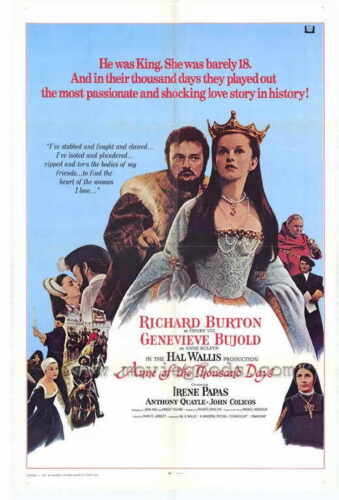
And the 1969 movie, “Anne of the Thousand Days,” brings it vividly to light.
Throughout much of the film, Henry (Richard Burton) lusts to romantically—and sexually—capture the beautiful Anne Boleyn (Geneviève Bujold). The fact that he’s married to Catherine of Aragon matters not at all.
Henry justifies his infidelity on the fact that Catherine has failed to give him a male heir.
He’s been having an affair with Anne’s younger sister, Mary, but is now bored with her. The fact that she’s now pregnant with his child matters not at all, either.
He first notices Anne, 18, at a court ball. She’s engaged to the son of the Earl of Northumberland, and they have received their parents’ permission to marry. But Henry is enraptured with Anne’s beauty and orders his Lord Chancellor, Cardinal Wolsey, to break the engagement.
Anne is furious, and blames bothHenryand Wolsey for ruining her happiness. But as the King’s infatuation continues, she becomes intoxicated with the power it brings her.
Henrypresses Anne to become his mistress. But she says she won’t bear an illegitimate child. Desperate to have a son, Henry decides to divorce Catherine and marry Anne.
For Anne, it’s the ultimate seduction, and she agrees. She’s ordained as Queen, but is popularly reviled by the supporters of Catherine.
Months later, Henryis dismayed when Anne gives birth to a daughter, Elizabeth—who will eventually become Queen afterHenry’sdeath.
Henryturns his always-wandering eye to Jane Seymour, one of Anne’s maids. Anne banishes Jane from the court.
Henry VIII
Anne is furious that Sir Thomas More, the King’s Chancellor, opposesHenry’sdivorce from Catherine. She refuses to sleep with Henryunless he executes More.
Anne gets her wish: More is beheaded. But her next child—a boy—is stillborn.
By now, Henryis convinced Anne will never be able to give him a male heir. He schemes to divorce her and marry Jane. He contrives with his new chief minister, Thomas Cromwell, to have Anne falsely charged with infidelity.
At her trial, Anne vigorously defends herself, proving that the witnesses against her are lying.
In a private meeting with her, Henryoffers to free her if she’ll agree to annul their marriage. Since this will make Elizabeth illegitimate, Anne refuses—and goes courageously to her death
Throughout the movie, Englishmen from Henryon down are convinced that England will collapse if a woman ascends the throne.
And, of course, England not only survives but thrives under the 45-year reign of Queen Elizabeth.
Which brings us to Donald Trump.
Like Henry, Trump is a man of voracious appetites—for wealth, for fame, for sex. Like Henry, he is untroubled by scruples and will commit any crime to attain whatever he wants. Like Henry, he is a man of fierce temper—always eager to crush anyone he thinks has wronged him.
Donald Trump
Countless Englishmen who lived under Henry thought England would collapse if a woman took the throne.
Now countless Americans believed the United States would collapse if a former President was brought to trial.
On March 30, 2023, Trumpwas indicted by a New York grand jury. He thus became the first current or former President to face criminal charges.
On April 1, CNN reported/editorialized: “Former PresidentDonald Trump’sindictment….has thrust the nation into uncharted political, legal and historical waters, and raised a slew of questions about how the criminal case will unfold.
“The Manhattan district attorney’s office has been investigating Trumpin connection with his alleged role in a hush money payment scheme and cover-up involving adult film star Stormy Daniels that dates to the 2016 Presidential election.”
Trumpattacked Manhattan District Attorney Alvin Bragg as pursuing a leftist vendetta to prevent him from running for President in 2024.
“If they can do this to me,” he thundered in countless fund-raising appeals to his Right-wing followers, “they can do this to you.”
Which raised the question: “How many others have tried to illegally overturn a legitimate Presidential election and/or paid hush-money to a porn ‘actress’?”
Trumprepeatedly tried to appear the victim of “a Democratic-led witch hunt.” But if politics tainted the dispensing of justice in Trump’scase, it was on his behalf.
As President, he had immunity from civil and criminal lawsuits. He couldn’t be tried at local, state and federal levels. And he had good reason to avoid facing trial at any level. Among the cases facing him while he held office:
The Manhattan District Attorney’s criminal case against the Trump Organizationfor tax evasion.
The New York Attorney General’s civil investigation into the Trump Organizationfor fraud.
The E. Jean Carroll defamation lawsuit(he called her a liar after she claimed he raped her in the 1990s).
The Mary Trump lawsuit:His niece was suing him for allegedly defrauding her out of millions of dollars.
The Trump Tower lawsuit:Five people claimed that Keith Schiller, the Trump Organization’s then chief of security, hit one of them on the head when they were protesting outside of the company’s Manhattan headquarters in 2015.
But there are other ways a tyrant can be forced to give up power—such as Gaius Caligula, Adolf Hitler and—possibly—Joseph Stalin.
Joseph Stalin ruled as absolute dictator of the Soviet Union from January 21, 1924, to March 5, 1953—29 years.
Joseph Stalin
Throughout his nearly 30-year reign over the Soviet Union, at least 20 million men, women and children died—from executions, deportations, imprisonment in Gulag camps, and a man-made famine through the forced collection of harvests.
Robert Payne, the acclaimed British historian, vividly portrayed the crimes of this murderous tyrant in his brilliant 1965 biography, The Rise and Fall of Stalin.
According to Payne, Stalin was planning yet another purge during the last weeks of his life. This would be “a holocaust greater than any he had planned before.
“This time there would be a chistka [purge] to end all chistkas, a purging of the entire body of the state from top to bottom. No one, not even the highest officials, was to be spared.”
Then, on March 4, 1953, Moscow Radio announced: “During the night of March 1-2, while in his Moscow apartment, Comrade Stalin suffered a cerebral hemorrhage affecting vital areas of the brain.”
Stalin died on March 5, 1953. He was 73 and in poor health from a lifetime of smoking, drinking and little exercise.
But he could have died of unnatural causes.
In the 2004 book, Stalin’s Last Crime, Vladimir P. Naumov, a Russian historian, and Jonathan Brent, a Yale University Soviet scholar, assert that he might have been poisoned.
If this happened, the occasion was during a final dinner with four members of the Politburo. Two of these were Lavrenti P. Beria, chief of the secret police, and Nikita S. Khrushchev, who eventually succeeded Stalin.
The authors believe that, if Stalin was poisoned, the most likely suspect was Beria. The method: Slipping warfarin, a tasteless and colorless blood thinner also used as a rat killer, into his glass of wine.
In Nikita Khrushchev’s 1970 memoirs, he quotes Beria as telling Vyacheslav M. Molotov, another Politburo member, two months after Stalin’s death: “I did him in! I saved all of you.”
It’s entirely possible that Donald Trump’s “Presidency-for-Life” may end by natural causes.
He’s 79, and despite his repeated boastings that he’s the healthiest President in United States history, clearly he isn’t.
He is grotesquely overweight, doesn’t exercise, falls asleep in public appearances and slurs his words. Much of his diet consists of greasy, artery-clogging fast food—such as from McDonald’s and KFC.
He stays up late at night, pouring out his hatred for countless real and imagined enemies on his website, Truth Social.
But that is not the only way his reign could disappear.
Since retaking office on January 20, Trump has ruled as de-facto dictator. Among his outrages.
Turning Immigration and Customs Enforcement (ICE) into his personal Gestapo. Nearly 150,000 people—both illegal aliens and American-born citizens—were arrested between January and late July 2025.
Purging FBI agents who rightly investigated his illegally confiscating classified documents and inciting the January 6, 2021 attack on Congress.
Attacking CBS and ABC for their news departments’ accurately covering his litany of mistakes and crimes.
Ordering the Justice Department to indict former FBI director James Comey and New York Attorney General Letitia James for carrying out their legal responsibilities.
Forcing ABC to (temporarily) cancel Jimmy Kimmel Live! because the comedian made jokes about him.
Shutting down the Federal Government over Democrats’ refusal to back his gutting of Medicare and the Affordable Care Act (ACA) to give tax breaks to billionaires.
On June 14, more than five million Americans protested Trump’s rule with a “No Kings” march. And nearly seven million participated in the October 18 march. More are planned.
* * * * * * * * * *
Niccolo Machiavelli, the father of modern political science, offers a stern warning for Trump—a warning he has steadfastly ignored.
Niccolo Machiavelli
In his masterwork, The Discourses on Livy, Machiavelli notes how important it is for rulers to make themselves loved—or at least respected—by their fellow citizens:
“Note how much more praise those Emperors merited who, after Rome became an empire, conformed to her laws like good princes, than those who took the opposite course.
“Titus, Nerva, Trajan, Hadrian, Antoninus and Marcus Auelius did not require the Praetorians nor the multitudinous legions to defend them, because they were protected by their own good conduct, the good will of the people, and by the love of the Senate.
“On the other hand, neither the Eastern nor the Western armies saved Caligula, Nero, Vitellius and so many other wicked Emperors from the enemies which their bad conduct and evil lives had raised up against them.”
In his better-known work,The Prince, Machiavelli warns rulers who—like Donald Trump–are inclined to rule by fear:
“A prince should make himself feared in such a way that if he does not gain love, he at any rate avoids hatred: for fear and the absence of hatred may well go together.”
By Machiavelli’s standards, Trump has made himself the perfect target for a conspiracy:
“When a prince becomes universally hated, it is likely that he’s harmed some individuals—who thus seek revenge. This desire is increased by seeing that the prince is widely loathed.”
He became Emperor in 37 A.D. after succeeding the Emperor Tiberius, his uncle who had adopted him as a son after his father died.
Caligula’s reign began well—and popularly. He gave Tiberius a magnificent funeral—then recalled to Rome all those whom Tiberius had banished, and ignored all charges that Tiberius had leveled against them.
He gave bonuses to the military and allowed the magistrates unrestricted jurisdiction, without appeal to himself.
But in October 37 A.D. he fell seriously ill or perhaps was poisoned.
Caligula soon recovered but emerged a changed man. He began claiming to be a god, and killing or exiling anyone he saw as a threat. He ordered his victims tortured to death with many slight wounds: “Strike so that he may feel that he is dying.”
Among his litany of crimes, according to his biographer, Gaius Suetonius Tranquillus:
“He forced parents to attend the executions of their sons, sending a litter for one man who pleaded ill health, and inviting another to dinner immediately after witnessing the death, and trying to rouse him to gaiety and jesting by a great show of affability.”
For all his cruelty and egomania, the trait that finally destroyed Caligula was his joy in humiliating others.
His fatal mistake was to taunt Cassius Chaerea, a member of his own bodyguard. Caligula considered Chaerea effeminate because of a weak voice and mocked him with names like “Priapus” and “Venus.”
On January 22 41 A.D. Chaerea and several other bodyguards hacked Caligula to death with swords before other guards could save him.
Next up: Adolf Hitler, dictator of Nazi Germany from January 30, 1933, to April 30, 1945—12 years.
He was born on April 20, 1889, in Braunau am Inn in Austria-Hungary.
Adolf Hitler
He was appointed Chancellor—chief law enforcement officer—of Germany on January 30, 1933, by President Paul von Hindenburg. Upon Hindenburg’s death in 1934, Hitler assumed the Presidency and established himself as absolute dictator.
From 1933 to 1939 he presided over Germany’s rapid economic recovery from the Great Depression, the defiance of restrictions imposed on Germany after World War 1, and the annexation of Austria and Czechoslovakia, where millions of ethnic Germans lived.
These accomplishments won him widespread popular support.
But after absorbing Czechoslovakia in 1938, Hitler felt himself invincible. On September 1, 1939, his armies attacked Poland—and unintentionally ignited World War II.
After conquering Norway, Denmark, Holland, Belgium, France, Greece and Yugoslavia, he made his two greatest mistakes of the war: He invaded the far more powerful Soviet Union on June 22, 1941, and declared war on the equally more powerful United States on December 11.
Parallel to unleashing a war that slaughtered 50 million people, Hitler orchestrated the extermination of at least six million Jews during the Holocaust.
By April, 1945, Germany faced destruction from the advancing Russians on the East, and from the advancing Americans on the West.
On April 30, with Russian forces only blocks from his underground bunker, Hitler lifted a heavy 7.65mm Walther PPK pistol to his right temple, bit on a cyanide capsule, and pulled the trigger.
Just as Caligula’s mangled remains were hastily burned and buried in the Horti Lamiani gardens, Hitler’s body was hastily cremated in the Reich Chancellery garden.
Last up: Joseph Stalin, dictator of the Soviet Union from January 21, 1924, to March 5, 1953—29 years.
Born on December 18, 1878, in Georgia, Russia, he hated Czarist rule and in 1903 joined the Communist Bolsheviks party, led by Vladimir Lenin, to overthrow it.
Joseph Stalin
On November 7, 1917, Lenin overthrew the Provisional Government, which had taken power in February, after Czarist rule collapsed.
Stalin became a member of the new Soviet government, gradually working his way to the position of General Secretary. When Lenin died on January 21, 1924, Stalin outmaneuvered Leon Trotsky, his major rival for the succession, and became absolute dictator.
Starting in 1934, a series of massive purges followed—most notably between August, 1936, and March, 1938.
Throughout his nearly 30-year reign over the Soviet Union, at least 20 million men, women and children died—from executions, deportations, imprisonment in Gulag camps, and a man-made famine through the forced collection of harvests.
Robert Payne, the acclaimed British historian, vividly portrayed the crimes of this murderous tyrant in his brilliant 1965 biography, The Rise and Fall of Stalin.
According to Payne, Stalin was planning yet another purge during the last weeks of his life. This would be “a holocaust greater than any he had planned before.
“This time there would be a chistka [purge] to end all chistkas, a purging of the entire body of the state from top to bottom. No one, not even the highest officials, was to be spared.”
Yet Stalin did nothing to calm their fears. He often summoned his “comrades” to the Kremlin for late-night drinking bouts, where he freely humiliated them.
Long before he took office for the first time on January 20, 2017, Donald Trump never intended to rule as an ordinary President.
Under the Constitution, a President can hold office for—at most—eight years. But a “President-for-Life” can rule until he dies.
That was—and remains—his ambition.
In a closed-door speech to Republican donors on March 3, 2018, Trump revealed his ultimate intention: To overthrow America’s constitutional government.
He praised China’s President, Xi Jinping, for recently assuming full dictatorial powers: “He’s now president for life. President for life. No, he’s great. And look, he was able to do that. I think it’s great. Maybe we’ll have to give that a shot some day.”
The statement was greeted with cheers and laughter by Republican donors.
Xi Jinping
Upon taking office as the Nation’s 45th President, Trump attacked or undermined one public or private institution after another.
Among these:
American Intelligence: Even before taking office, Trump refused to accept the findings of the FBI, CIA and National Security Agency (NSA) that Russian Intelligence agents had intervened in the 2016 election to ensure his victory.
“I think it’s ridiculous,” he told “Fox News Sunday.” “I think it’s just another excuse. I don’t believe it….No, I don’t believe it at all.”
And when FBI Director James Comey dared to pursue a probe into “the Russia thing,” Trump fired him without warning.
American law enforcement agencies: Trump repeatedly attacked his own Attorney General, Jeff Sessions, for not “protecting” him from agents pursuing the Russia investigation.
On November 8, 2018, Trump abruptly fired him, following Democrats’ winning control of the House in the midterm elections.
He threatened to fire Rod J. Rosenstein, the deputy attorney general, who oversaw Special Counsel Robert Mueller’s investigation into Russian subversion of the 2016 election.
American military agencies:In 2018, Trump refused to visit an American cemetery near Paris and referred to U.S. Marines buried there as “losers” and “suckers.”
Trump regularly abused military officials, calling Chairman of the Joint Chief of Staff Mark Milley a “dumbass” and former Secretary of Defense James Mattis “the world’s most overrated general.”
Seal of the Department of Defense
The press: On February 17, 2017, Trump tweeted: “The FAKE NEWS media (failing@nytimes, @NBCNews, @ABC, @CBS, @CNN) is not my enemy, it is the enemy of the American People!”
Appearing before the Conservative Political Action Conference on February 24, 2017, Trump said: “I want you all to know that we are fighting the fake news. It’s fake, phony, fake….I’m against the people that make up stories and make up sources. They shouldn’t be allowed to use sources unless they use somebody’s name. Let their name be put out there.”
The judiciary: Trump repeatedly attacked Seattle US District Judge James Robart, who halted Trump’s first Muslim travel ban.
In one tweet, Trump claimed: “Just cannot believe a judge would put our country in such peril. If something happens blame him and court system. People pouring in. Bad!”
At Trump’s bidding, White House aide Stephen Miller attacked the Ninth Circuit Court of Appeals: “We have a judiciary that has taken far too much power and become, in many cases, a supreme branch of government.”
Donald Trump
Even after leaving the White House in 2021, Trump continued his attacks on one cherished American institution after another:
Facing 91 criminal counts in four cases, he discredited the judicial system, attacking judges, prosecutors, witnesses—and even their family members.
He attacked Independent Counsel Jack Smith as “deranged” and accused him of trying to invalidate his candidacy for President in 2024.
He attacked retired U.S. Army General Mark Milley for calling him “a wannabe dictator,” and said that Milley deserved execution as a traitor.
Milley had successfully averted war with China by calling his Chinese military counterparts in the final weeks of Trump’s administration to assure them that Trump was not planning to attack China.
He claimed voter fraud where none existed, casting doubt on the integrity of the electoral system.
He claimed himself to be the victim of “the deep state” inside the federal bureaucracy.
He attacked the integrity of the FBI—causing previously “law and order” Republicans to demand its defunding.
* * * * * * * * * *
Donald Trump isn’t crazy, as many of his critics charge. He knows exactly what he’s doing—and why.
He intends to strip every potential challenger to his authority—or his version of reality—of legitimacy with the public. If he succeeds, there will be:
No independent press to reveal his failures and crimes.
No independent law enforcement agencies to investigate his abuses of office.
No independent judiciary to hold him accountable.
No independent military to dissent as he recklessly hurtles toward a nuclear disaster.
No candidate—Democrat or Republican—to challenge him for re-election in 2028—or any other year..
No candidate—Democrat or Republican—to challenge his remaining in office as “President-for-Life.”
A dictator can die of illness or old age.
China’s Communist ruler, Mao Zedong died on September 9, 1976, at 82, from a series of heart attacks.
And Spain’s Fascist tyrant, Francisco Franco, died on November 20, 1975, at 82, of congestive heart failure.
But there are other ways a tyrant can be forced to give up power—such as the following three.
Steffen White’s Email: Sparta480@aol.com Former reporter, legal investigator and troubleshooter. Columnist at Bureaucracybuster.com. Fighting political and bureaucratic arrogance, incompetence and/or indifference.
When making complaints in writing, carefully review your email or letter before sending it. Remove any words that are vulgar or profane. Don't make sweeping accusations: "Your agency is a waste."
Don't attribute motives to people you've had problems with, such as: "The postal clerk refused to help me because he's a drunk." If the person actually appeared to be drunk, then be precise in your description: "As he leaned over the counter I could smell beer on his breath. Behind him, in a waste basket, I saw an empty bottle of Coors beer."
Show how the failure of the official to address your problem reflects badly on the company or agency: "This is not the level of service your ads would lead potential customers to expect."
If necessary, note any regulatory agencies that can make life rough for the company or agency if your complaint isn't resolved. For the phone company, for example, cite the FCC or the PUC. But do this only after you have stated you hope your complaint can be settled amicably and privately within the company.




 Bureaucracybuster's Blog
2016 PRESIDENTIAL ELECTION, 2020 PRESIDENTIAL ELECTION, ABC NEWS, ADOLF HITLER, ALTERNET, AMERICABLOG, AP, BABY BOOMER RESISTANCE, BBC, BLOOMBERG, BUZZFEED, CASSIUS CHAEREA, CBS NEWS, CIA, CLAUSS VON STAUFFENBERG, CNN, COVID-19, CROOKS AND LIARS, DAILY KOS, DONALD TRUMP, EAST GERMANY, ERNEST BORGNINE, FBI, FEDERAL GOVERNMENT SHUTDOWN, FIVETHIRTYEIGHT, GAIUS CALIGULA, GAIUS SUETONIUS TRANQUILLUS, GERMAN GENERAL STAFF, HARPER’S MAGAZINE, HITLER LOYALTY OATH, HOLOCAUST, HUFFINGTON POST, JANUARY 6 COUP ATTEMPT, JOSEPH BIDEN, JOSEPHUS, JULIUS CAESAR, KERRY O’GRADY, MEDIA MATTERS, MEXICO, MOTHER JONES, MOVEON, MSNBC, NATIONAL SECURITY AGENCY, NAZI GERMANY, NBC NEWS, NEW REPUBLIC, NEWSDAY, NEWSWEEK, NPR, OPERATION VALKYRIE, PBS NEWSHOUR, POLITICO, POLITICUSUSA, PRINCE OF THE CITY (MOVIE), RAW STORY, REUTERS, Robert Ryan, SALON, SEATTLE TIMES, SLATE, SOVIET UNION, SS, TALKING POINTS MEMO, THE ATLANTIC, THE CHICAGO SUN-TIMES, THE CHICAGO TRIBUNE, THE DAILY BEAST, THE DAILY BLOG, THE GUARDIAN, THE HILL, THE HUFFINGTON POST, THE INTERCEPT, THE LOS ANGELES TIMES, THE NATION, THE NEW REPUBLIC, THE NEW YORK TIMES, THE NEW YORKER, THE VILLAGE VOICE, THE WASHINGTON POST, THE WILD BUNCH (MOVIE), THINKPROGRESS, TIME, TRUTHDIG, TRUTHOUT, TWO POLITICAL JUNKIES, U.S. NEWS & WORLD REPORT, UNITED STATES CONSTITUTION, UNITED STATES SECRET SERVICE, UPI, USA TODAY, VLADIMIR PUTIN, WEST BERLIN, WILLIAM HOLDEN, WORLD WAR 11, X
TYRANTS AND THEIR BODYGUARDS: PART THREE (END)
In Bureaucracy, History, Law Enforcement, Military, Politics, Social commentary on October 31, 2025 at 12:10 amOn July 20, 1944, Colonel Claus Schenk von Stuaffenberg tried to assassinate Nazi Germany’s Fuhrer, Adolf Hitler, with a time bomb.
Stauffenberg appeared at Hitler’s well-guarded military headquarters in East Prussia. Like all his other outposts, Hitler had named it—appropriately enough—“Wolf’s Lair.”
While a war conference was in session, he placed his yellow briefcase next to Hitler—who was standing with his generals at a heavy oaken table. Then he excused himself to take an “urgent” phone call.
“Wolf’s Lair”
But after Stauffenberg left the room, Colonel Heinz Brandt, who stood next to Hitler, found the briefcase blocking his legs. So he moved it—to the other side of the heavy oaken support, thus unknowingly shielding Hitler from the full blast.
At 12:42 p.m. on July 20, 1944, Stauffenberg’s briefcase bomb erupted.
Brandt died, as did two other officers and a stenographer. Hitler not only survived, but the plotters failed to seize the key broadcast facilities of the Reich.
This allowed Hitler to make a late-night speech to the nation, revealing the failed plot and assuring Germans that he was still alive. And he swore to flush out the “traitorous swine” who had tried to kill him.
Mass arrests quickly followed. Among the first victims discovered and executed was the conspiracy’s leader, Colonel Claus von Stauffenberg. Standing before a makeshift firing squad at midnight, he cried: “Long live our sacred Germany!”
Claus von Stauffenberg
At least 7,000 persons were arrested by the Gestapo. Of these, 4,980 were executed.
If the conspiracy had succeeded and Germany had surrendered in July or August, 1944, World War II would have ended eight to nine months earlier. This would have meant:
Yet history notes other tyrants whose evil reigns ended prematurely—such as that of Gaius Caligula.
Caligula became Emperor of Rome in 37 A.D. after succeeding the Emperor Tiberius, his uncle.
For three years, he held—and exercised—life-or-death power over the citizens of Italy and beyond. His attitude toward humanity was best summed up by his remark: “Bear in mind that I can treat anyone exactly as I please.”
Gaius Caligula
Carole Raddato from FRANKFURT, Germany, CC BY-SA 2.0 <https://creativecommons.org/licenses/by-sa/2.0>, via Wikimedia Commons
Among his litany of crimes, according to his biographer, Gaius Suetonius Tranquillus:
Like all Roman emperors, Caligula was constantly protected by the Praetorian Guard, an elite unit of the Roman army comprised of tough legionnaires—especially German ones.
There had not been an assassination of a Roman emperor since the death of Julius Caesar almost 100 years earlier.
The assassins in that case had been motivated by a mixture of
And Caligula intended to keep a similar fate from overtaking him.
For all his cruelty and egomania, the trait that finally destroyed Caligula was his joy in humiliating others.
Among those he taunted was Cassius Chaerea, a member of his own bodyguard.
Two different historians give two different motives for his decision to assassinate Caligula.
The Jewish historian Josephus claimed that Chaerea was a “noble idealist” deeply committed to “Republican liberties.”
But Suetonius wrote that Caligula considered Chaerea effeminate because of a weak voice and gave him such mocking watchwords as “Priapus” and “Venus.” Whenever Caligula had Chaerea kiss his ring, the emperor would “hold out his hand to kiss, forming and moving it in an obscene fashion.”
On January 22 41 A.D. Chaerea and several other bodyguards hacked Caligula to death with swords before other guards could save him.
The assassination attempts on Adolf Hitler and the successful assassination of Gaius Caligula demonstrate that the greatest danger facing a tyrant is people who:
Had Secret Service agent Kerry O’Grady kept her revulsion toward Donald Trump to herself, she might now be hailed as an American traitor—or as democracy’s savior.
Share this: