Posts Tagged ‘SOVIET UNION’
ABC NEWS, ADOLF HITLER, ALBERT SPEER, ALTERNET, AMERICABLOG, AP, BABY BOOMER RESISTANCE, BBC, BLOOMBERG NEWS, BUZZFEED, CBS NEWS, CNN, COREY LEWANDOWSKI, CROOKS AND LIARS, DAILY KOZ, DAVID IRVING, DONALD TRUMP, DRUDGE REPORT, FAITH & FREEDOM COALITION, FIVETHIRTYEIGHT, FRANK BRANDENBURG, HANS BAUR, HARPER’S MAGAZINE, HEINRICH HIMMLER, HITLER’S WAR (BOOK), HOLOCAUST (TV SERIES), HUFFINGTON POST, INSIDE THE THIRD REICH (BOOK), JERRY FALWELL JR., KARL WOLFF, KAY IVEY, LIBERTY UNIVERSITY, LINA HEYDRICH, MEDIA MATTERS, MOTHER JONES, MOVEON, MSNBC, NBC NEWS, NEW REPUBLIC, NEWSDAY, NEWSWEEK, NPR, OTTO REMER, PBS NEWSHOUR, POLITICO, POLITICUSUSA, QUEST: SEARCHING FOR GERMANY'S NAZI PAST (BOOK), RALPH REED, RAW STORY, REINHARD HEYDRICH, REPUBLICAN PARTY, REUTERS, ROY MOORE, RUDOLF HESS, SALON, SEATTLE TIMES, SLATE, SOVIET UNION, TALKING POINTS MEMO, THE ATLANTIC, THE CHICAGO SUN-TIMES, THE CHICAGO TRIBUNE, THE DAILY BEAST, THE DAILY BLOG, THE GUARDIAN, THE HILL, THE HUFFINGTON POST, THE LOS ANGELES TIMES, THE NATION, THE NEW REPUBLIC, THE NEW YORK TIMES, THE NEW YORKER, THE VILLAGE VOICE, THE WASHINGTON POST, THINKPROGRESS, TIME, TRUTHDIG, TRUTHOUT, TWO POLITICAL JUNKIES, U.S. NEWS & WORLD REPORT, UPI, USA TODAY, WEST GERMANY, WONKETTE, X
In Bureaucracy, History, Military, Politics, Social commentary on May 8, 2026 at 12:10 am
Frank Brandenburg had just turned 16 in 1979 when he saw the NBC mini-series Holocaust, depicting the Third Reich’s extermination of six million Jewish men, women and children.
He was stunned. Had such atrocities really taken place?
His parents, friends and teachers refused to talk about Adolf Hitler and his Nazi party that had tyrannically ruled Germany for 12 years.
“No one wants to talk today about that! Let the past sleep,” he was repeatedly told.
Frank Brandenburg had a deeply personal reason for pursuing the truth. He was a citizen of West Germany, growing up in a country that was still divided in two for having lost World War II—a war Hitler had started.
He started reading such books about the Holocaust as:
- Inside the Third Reich, by former Reichminister for Armaments Albert Speer. Speer stated unequivocally that it had happened.
- David Irving’s Hitler’s War, on the other hand, seemed inconclusive on the subject.
- The Auschwitz Lie, by Thies Chrostophersen, flatly asserted that the victorious Allies had concocted this slander to blacken the good name of Germany.
So Brandenburg did something no other teenager had dared attempt: He set out to meet and interview as many former members of the Third Reich as possible.
Among those he interviewed:
- Lina Heydrich, the widow of Reinhard Heydrich, the #2 man in the Schutzstaffel, or SS.
- Otto Remer, who put down the July 20, 1944 generals’ plot against Hitler.
- SS General Karl Wolff, a close confidant of SS Reichsfuhrer Heinrich Himmler.
- The widow and sons of Deputy Fuhrer Rudolf Hess.
- Hans Baur, Hitler’s personal pilot.
These interviews ultimately became a 1990 book: Quest: Searching for Nazi Germany’s Past, co-authored by Brandenburg and Ib Melchior. It is a book that can never be duplicated, because those interviewed by Brandenburg are now dead.

Of his encounters with so many former Nazis, Brandenburg reflected:
“Today I know that in some cases…I was confronted with defensive statements, evasion, self-exoneration and prejudiced portrayals of the facts.
“But when I began my project, at the age of 16, I—naively—had no conception that this might be the case. Not one of the people I talked to expressed any kind of guilt or remorse. Not one of them had regrets or concern for their victims.
“Yet, it is easier for me to understand that. Who, in his old age, wants to admit having committed such misdeeds? To admit that everything one had believed in, worked for and lived for, had been corrupt?”
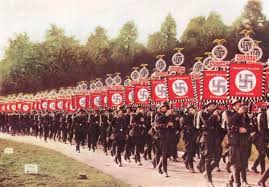
Nazi SS soldiers marching
Which helps explain the reaction historians will receive when, in the future, they interview supporters of Donald Trump.
The Original Nazis were guided by Hitler’s belief that the world was polluted by corruption and ugliness—and their mission was to remove that ugliness and corruption.
This meant removing those peoples they deemed inferior—Jews, Slavs (Poles, Serbs, Russians), Communists, liberals, gypsies, the physically and mentally handicapped.
Today’s Republicans believe themselves to be the only legitimate political party. And so do their supporters.
No sin—or even crime—is intolerable if it’s committed by a Republican.
On October 7, 2016, The Washington Post leaked a video of Republican Presidential nominee Donald Trump making sexually predatory comments about women:
“You know I’m automatically attracted to beautiful—I just start kissing them. It’s like a magnet. Just kiss. I don’t even wait. And when you’re a star they let you do it. You can do anything.

Donald Trump
Right-wingers rushed to excuse Trump’s misogynist comments as mere “frat boy” talk.
- Corey Lewandowski, a former Trump campaign manager and now CNN commentator: “We are electing a leader to the free world. We’re not electing a Sunday school teacher.”
- Jerry Falwell, Jr., president of Liberty University: “When they ask [if Trump’s personal life is relevant] I always talk about the story of the woman at the well who had had five husbands and she was living with somebody she wasn’t married to, and they wanted to stone her. And Jesus said he’s—he who is without sin cast the first stone. I just see how Donald Trump treats other people, and I’m impressed by that.”
- Ralph Reed, founder and chairman of the Faith & Freedom Coalition: “People of faith are voting on issues like who will protect unborn life, defend religious freedom, grow the economy, appoint conservative judges and oppose the Iran nuclear deal.”
In 2017, Roy Moore, the twice-ousted former chief justice of the Alabama Supreme Court, ran for the state’s U.S. Senator.
Four women, in a Washington Post story, accused Moore of seeking romantic relationships with teenage girls while he was in his 30s, and even trolling malls for such dates.
Kay Ivey, the state’s Governor, offered the real reason why Republicans supported Moore:
“I believe in the Republican party, what we stand for, and, most important, we need to have a Republican in the United States Senate to vote on things like the Supreme Court justices, other appointments the Senate has to confirm and make major decisions. So that’s what I plan to do, vote for Republican nominee Roy Moore.”
In short: The Republican party—like the Nazi party—intends to attain absolute power over the lives of American citizens.
Compared to that, electing even accused sexual predators shrinks to insignificance.
60 MIINUTES, ABORTION, ADOLF HITLER, ALBERT SPEER, ALTERNET, AMERICABLOG, AP, BABY BOOMER RESISTANCE, BBC, BERLIN, BIRTH CONTROL, BLOOMBERG, BLUESKY, BUZZFEED, CANADA, CBS NEWS, CENSUS BUREAU, CENTERS FOR DISEASE CONTROL AND PREVENTION (CDC), CNN, CONSUMER FINANCIAL PROTECTION BUREAU, CONTRACEPTION, CONVERSATION WITH AN AMERICAN WRITER (POEM), COVID-19, CROOKS AND LIARS, DAILY KOS, DEMOCRATS, DENMARK, DEPARTMENT OF DEFENSE (DOD), DEPARTMENT OF GOVERNMENT EFFICIENCY (DOGE), DEPARTMENT OF JUSTICE (DOJ), DIVERSITY EQUITY AND INCLUSION (DEI), DONALD TRUMP, ELON MUSK, ENVIRONMENTAL PROTECTION AGENCY, FASCISM, FBI, FEDERAL COMMUNICATIONS COMMISSION (FCC), FEDERAL TRADE COMMISSION (FTC), FIVETHIRTYEIGHT, FOSSIL FUELS, FRANCE, GAS, GEORGE STEPHANOPOULOS, HARPER’S MAGAZINE, HERITAGE FOUNDATION, HUFFINGTON POST, HUNTER BIDEN, INSPECTORS GENERAL, INTELLIGENCE OFFICERS, IRAN, ISRAEL, JANUARY 6 COUP ATTEMPT, JOE BIDEN, JOHN F. KENNEDY CENTER FOR THE PERFORMING ARTS, JOSEPH STALIN, LUXURY JET, MEDAL OF HONOR, MEDIA MATTERS, MOTHER JONES, MOVEON, MSNBC, NATIONAL OCEANIC AND ATMOSPHERIC AGENCY (NOAA), NAZI GERMANY, NBC NEWS, NEWSDAY, NEWSWEEK, NORWAY, NPR, Oil, PARDONS, PBS NEWSHOUR, POLAND, POLITICO, POLITICUSUSA, PROJECT 2025, PUBLIC TRANSIT SYSTEMS, QATAR, RAPE, RAW STORY, REPUBLICAN PARTY, REPUBLICANS, REUTERS, ROBERT PAYNE, SALON, SEATTLE TIMES, SECURITY CLEARANCES, SLATE, SOVIET UNION, STALINGRAD, STRAIT OF HORMUZ, TALKING POINTS MEMO, TAX CUTS, THE ATLANTIC, THE CHICAGO SUN-TIMES, THE CHICAGO TRIBUNE, THE DAILY BEAST, THE DAILY BLOG, THE GUARDIAN, THE HILL, THE HUFFINGTON POST, THE INTERCEPT, THE LIFE AND DEATH OF ADOLF HITLER (BOOK), THE LOS ANGELES TIMES, THE NATION, THE NEW REPUBLIC, THE NEW YORK TIMES, THE NEW YORKER, THE PENTAGON, THE VILLAGE VOICE, THE WASHINGTON POST, THINKPROGRESS, TIME, TRUTHDIG, TRUTHOUT, TWO POLITICAL JUNKIES, U.S. NEWS & WORLD REPORT, UKRAINE, UPI, USA TODAY, VLADIMIR PUTIN, VOLODYMYR ZELENSKY, WAR CRIMES, WEHRMACHT, WORLD WAR 11, X, YEVGENEY YEVTUSHENKO
In Bureaucracy, Business, History, Law, Law Enforcement, Military, Politics, Social commentary on April 30, 2026 at 12:18 am
Eighty-one years ago, on March 19, 1945, facing certain defeat, Adolf Hitler ordered a massive “scorched-earth” campaign throughout Germany.
All German agriculture, industry, ships, communications, roads, food stuffs, mines, bridges, stores and utility plants were to be destroyed.
If implemented, it would deprive the entire German population of even the barest necessities after the war.
Opposing him—at first openly, and later secretly—was Albert Speer, his former architect and now Minister of Armaments.

Albert Speer
Speer argued that there must be a future for the German people: “If our enemies wish to destroy us, why help them? We must leave the people something.”
But Hitler refused to back down: “I don’t want to hear any more.”
He gave Speer 24 hours to reconsider his opposition to the order.
Speer could not directly promise to carry out Hitler’s “scorched earth” order. So he gave Hitler a vague answer that essentially committed him to nothing: “My Fuhrer, I stand unconditionally behind you!”
“Then all is well,” said Hitler, suddenly with tears in his eyes.
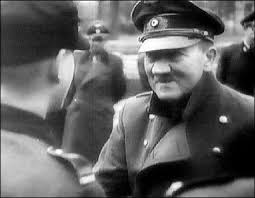
Adolf Hitler addressing boy soldiers as the Third Reich crumbles
“If I stand unreservedly behind you,” said Speer, “then you must entrust me rather than the Gauleiters [district Party leaders serving as provincial governors] with the implementation of your decree.”
Filled with gratitude, Hitler signed the decree Speer had thoughtfully prepared before their fateful meeting.
By doing so, Hitler unintentionally gave Speer the power to thwart his “scorched earth” order.
Trained as an architect, Speer had joined the Nazi Party in 1931. He met Hitler in 1933, when he presented the Fuhrer with architectural designs for the Nuremberg rally scheduled for that year.
From then on, Speer became Hitler’s “genius architect” assigned to create buildings meant to last for a thousand years. “If Hitler had been capable of friendship,” Speer said after the war, “I would have been that friend.”
In 1943, Hitler appointed him Minister of Armaments, charged with revitalizing the German war effort.
Nevertheless, Speer now crisscrossed Germany, persuading military leaders and district governors to not destroy the vital facilities that would be needed after the war.
“No other senior National Socialist could have done the job,” writes Randall Hanson, author of Disobeying Hitler: German Resistance After Valkyrie.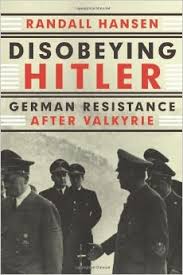
“Speer was one of the very few people in the Reich—-perhaps even the only one—with such power to influence actors’ willingness/unwillingness to destroy.”
Despite his later conviction for war crimes at Nuremberg, Speer never regretted his efforts to save Germany from total destruction at the hands of Adolf Hitler.
* * * * * * * * * *
Why have Republicans almost unanimously stood by Donald Trump despite the wreckage he has made of American foreign and domestic policy?
Fear—that they will lose their privileged positions in Congress if they don’t.
This could happen by:
- Their being voted out of Congress by Trump’s fanatical base; or
- Their being voted out of Congress by anti-Trump voters fed up with Trump’s appalling behavior.
House and Senate Republicans’ support for Trump hinges on one question: “Can I hold onto my power and all the privileges that accompany it by sticking—or breaking—with him?”
The Original Nazis were guided by Hitler’s belief that the world was polluted by corruption and ugliness—and their mission was to remove that ugliness and corruption.
This meant removing those peoples they deemed inferior—Jews, Slavs (Poles, Serbs, Russians), Communists, liberals, gypsies, the physically and mentally handicapped.
Today’s Fascistic Republicans believe themselves to be the only legitimate political party. And so do their supporters.
No sin—or even crime—is intolerable if it’s committed by a Republican.
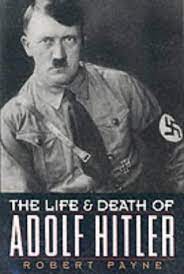
In his bestselling 1973 biography, The Life and Death of Adolf Hitler, British historian Robert Payne harshly condemned the German people for the rise of the Nazi dictator:
“[They] allowed themselves to be seduced by him and came to enjoy the experience….[They] followed him with joy and enthusiasm because he gave them license to pillage and murder to their hearts’ content. They were his servile accomplices, his willing victims.”
Like Hitler, Trump offered his Republican voters and Congressional allies intoxicating dreams: “I will enrich all of you. And I will humiliate and destroy those Americans you most hate.”
For his white, Fascistic, largely elderly audience, those enemies included blacks, atheists, Hispanics, non-Christians, Muslims, liberals, “uppity” women, Asians.
For most of the first three years of his first term, he faced little opposition. What cost Trump the White House wasn’t Democratic or Republican courage but a deadly disease—COVID-19—which Trump refused to take seriously.
Democrats cowered before Trump’s slanders—thereby ensuring more assaults.
Most of the press quailed before Trump. Only a few media outlets—notably The New York Times, CNN and The Washington Post––dared investigate his crimes and blunders.
In 1960, the Russian poet, Yevgeney Yevtushenko, published “Conversation With an American Writer”—a stinging indictment of the cowardly opportunists who had supported the brutal tyranny of Joseph Stalin:
“You have courage,” they tell me.
It’s not true. I was never courageous.
I simply felt it unbecoming
to stoop to the cowardice of my colleagues.
Too many Republicans know all-too-well how it feels to stoop to the cowardice of their colleagues.
60 MIINUTES, ABORTION, ADOLF HITLER, ALBERT SPEER, ALTERNET, AMERICABLOG, AP, BABY BOOMER RESISTANCE, BBC, BERLIN, BIRTH CONTROL, BLOOMBERG, BLUESKY, BUZZFEED, CANADA, CBS NEWS, CENSUS BUREAU, CENTERS FOR DISEASE CONTROL AND PREVENTION (CDC), CNN, CONSUMER FINANCIAL PROTECTION BUREAU, CONTRACEPTION, CONVERSATION WITH AN AMERICAN WRITER (POEM), COVID-19, CROOKS AND LIARS, DAILY KOS, DEMOCRATS, DENMARK, DEPARTMENT OF DEFENSE (DOD), DEPARTMENT OF GOVERNMENT EFFICIENCY (DOGE), DEPARTMENT OF JUSTICE (DOJ), DIVERSITY EQUITY AND INCLUSION (DEI), DONALD TRUMP, ELON MUSK, ENVIRONMENTAL PROTECTION AGENCY, FASCISM, FBI, FEDERAL COMMUNICATIONS COMMISSION (FCC), FEDERAL TRADE COMMISSION (FTC), FIVETHIRTYEIGHT, FOSSIL FUELS, FRANCE, GAS, GEORGE STEPHANOPOULOS, HARPER’S MAGAZINE, HERITAGE FOUNDATION, HUFFINGTON POST, HUNTER BIDEN, INSPECTORS GENERAL, INTELLIGENCE OFFICERS, IRAN, ISRAEL, JANUARY 6 COUP ATTEMPT, JOE BIDEN, JOHN F. KENNEDY CENTER FOR THE PERFORMING ARTS, JOSEPH STALIN, LUXURY JET, MEDAL OF HONOR, MEDIA MATTERS, MOTHER JONES, MOVEON, MSNBC, NATIONAL OCEANIC AND ATMOSPHERIC AGENCY (NOAA), NAZI GERMANY, NBC NEWS, NEWSDAY, NEWSWEEK, NORWAY, NPR, Oil, PARDONS, PBS NEWSHOUR, POLAND, POLITICO, POLITICUSUSA, PROJECT 2025, PUBLIC TRANSIT SYSTEMS, QATAR, RAPE, RAW STORY, REPUBLICAN PARTY, REPUBLICANS, REUTERS, ROBERT PAYNE, SALON, SEATTLE TIMES, SECURITY CLEARANCES, SLATE, SOVIET UNION, STALINGRAD, STRAIT OF HORMUZ, TALKING POINTS MEMO, TAX CUTS, THE ATLANTIC, THE CHICAGO SUN-TIMES, THE CHICAGO TRIBUNE, THE DAILY BEAST, THE DAILY BLOG, THE GUARDIAN, THE HILL, THE HUFFINGTON POST, THE INTERCEPT, THE LIFE AND DEATH OF ADOLF HITLER (BOOK), THE LOS ANGELES TIMES, THE NATION, THE NEW REPUBLIC, THE NEW YORK TIMES, THE NEW YORKER, THE PENTAGON, THE VILLAGE VOICE, THE WASHINGTON POST, THINKPROGRESS, TIME, TRUTHDIG, TRUTHOUT, TWO POLITICAL JUNKIES, U.S. NEWS & WORLD REPORT, UKRAINE, UPI, USA TODAY, VLADIMIR PUTIN, VOLODYMYR ZELENSKY, WAR CRIMES, WEHRMACHT, WORLD WAR 11, X, YEVGENEY YEVTUSHENKO
In Bureaucracy, Business, History, Law, Law Enforcement, Military, Politics, Social commentary on April 29, 2026 at 12:10 am
Since Donald Trump retook the office of President on January 20, 2025, Republicans have lustily supported or remained silent about his litany of criminal, if not treasonous, actions:
- Trump fired the inspectors general—who are charged with protecting the government from waste and corruption—from more than a dozen federal agencies.
- Several career lawyers who worked on the criminal investigations into Trump during the Biden administration were fired by Acting Attorney General James McHenry because he “do[es] not believe that the leadership of the Department can trust you to assist in implementing the President’s agenda faithfully.”
- Trump ordered a purge of about a half-dozen executive assistant directors at the FBI. These were some of the bureau’s top managers overseeing criminal, national security and cyber investigations.
- Their “crime”: Trump blamed them for investigating his inciting the January 6, 2021 coup attempt and his illegal holding of highly sensitive national security documents after leaving office.

- Without explanation, Trump fired Rohit Chopra, the director of the Consumer Financial Protection Bureau, which protects consumers from unfair, deceptive and fraudulent business practices.
- Following Trump’s executive orders, federal agencies deleted multiple federal web pages and data. Among the agencies: The Pentagon, the Centers for Disease Control and Prevention and the Census Bureau. The changes affected content related to diversity, equity and inclusion (DEI), gender identity, public health research, environmental policy and social programs.
- Following Trump’s anti-DEI executive order, the United States Department of Defense (DOD) deleted content that included the achievements of nonwhite groups, such as Navajo code talkers, black Tuskegee Airmen, Medal of Honor winners and women veterans. As in Joseph Stalin’s Soviet Union, those that Trump hates are made to disappear from history.

- Trump fired the board members at the John F. Kennedy Center for the Performing Arts and appointed himself as chairman—just as Joseph Stalin made himself arbiter of what was permissible for artists in the Soviet Union.
- Trump held what amounted to an ambush meeting with Ukrainian President Volodymyr Zelensky at the White House. Siding with Russian dictator Vladimir Putin, Trump blamed Zelensky for Russia’s 2022 invasion of Ukraine.
- Trump demanded that Zelensky sign over mineral rights to the United States without America’s providing a security guarantee for Ukraine. Zelensky left without signing such an agreement.
- The Trump-authorized and illegitimate Department of Government Efficiency (DOGE) led by billionaire Elon Musk, dismantled multiple agencies, invaded the privacy of untold millions by accessing sensitive data systems and fired tens of thousands of federal workers.
- Trump filed frivolous and extortionate lawsuits against major news networks CBS and ABC.
- Against CBS: Trump claimed that its news magazine, “60 Minutes” deceptively edited an interview with Kamala Harris to damage his presidential campaign and influence the election. He initially sought $10 billion in damages, then increased it to $20 billion. Paramount, the owner of CBS, agreed to pay $16 million in legal fees and a contribution to the future Trump Library.

- Against ABC: He claimed that its commentator, George Stephanopoulos, falsely stated he was found liable for “rape” in the case brought by columnist E. Jean Carroll. The jury found Trump liable for sexual abuse and defamation, but not rape. The judge later clarified that what the jury found Trump did was in fact rape, as commonly understood.
- Nevertheless, in December 2024, ABC News agreed to pay $15 million to a foundation for Trump’s presidential library and $1 million in legal fees to settle the lawsuit.
- Trump solicited and received a $400 million luxury jet from Qatar for use as Air Force One, in direct violation of the Emoluments Clause of the United States Constitution, which prohibits federal officials from accepting gifts from foreign countries.
- The jet will cost taxpayers hundreds of millions of dollars to bring it up to presidential standards, including a security sweep of the entire aircraft and costly upgrades to ensure classified communications. After Trump leaves office, it will be transferred to his Presidential library.
Qatar’s donated plane
John Taggart from Claydon Banbury, Oxfordshire, CC BY-SA 2.0 <https://creativecommons.org/licenses/by-sa/2.0>, via Wikimedia Commons
- On February 28, 2026, Trump—in concert with Israel—launched an unprovoked series of devastating airstrikes against Iran.
- On March 11, Trump told a reporter: “You know, you never like to say too early you won. We won. We won the, in the first hour, it was over.”
- But then—to Trump’s surprise and fury—Iran closed the narrow Strait of Hormuz, through which about 20%-25% of the world’s total liquid petroleum consumption (about 20–21 million barrels per day) flows.
- Overnight, gas prices rose. By late April, the national average for a gallon of regular gas reached $4.02 to $4.04, compared to roughly $2.98 before military operations began.
- On April 5—Easter Sunday, no less—Trump posted on his website, Truth Social: “Tuesday will be Power Plant Day, and Bridge Day, all wrapped up in one, in Iran. There will be nothing like it!!! Open up the Fuckin’ Strait, you crazy bastards, or you’ll be living in Hell – JUST WATCH! Praise be to Allah. President DONALD J. TRUMP”
- This was followed on April 7 by another post: “A whole civilization will die tonight, never to be brought back again. I don’t want that to happen, but it probably will.”
- Legal experts and international organizations such as Amnesty International warned that attacking civilian infrastructure would constitute war crimes under international law.
60 MIINUTES, ABORTION, ADOLF HITLER, ALBERT SPEER, ALTERNET, AMERICABLOG, AP, BABY BOOMER RESISTANCE, BBC, BERLIN, BIRTH CONTROL, BLOOMBERG, BLUESKY, BUZZFEED, CANADA, CBS NEWS, CENSUS BUREAU, CENTERS FOR DISEASE CONTROL AND PREVENTION (CDC), CNN, CONSUMER FINANCIAL PROTECTION BUREAU, CONTRACEPTION, CONVERSATION WITH AN AMERICAN WRITER (POEM), COVID-19, CROOKS AND LIARS, DAILY KOS, DEMOCRATS, DENMARK, DEPARTMENT OF DEFENSE (DOD), DEPARTMENT OF GOVERNMENT EFFICIENCY (DOGE), DEPARTMENT OF JUSTICE (DOJ), DIVERSITY EQUITY AND INCLUSION (DEI), DONALD TRUMP, ELON MUSK, ENVIRONMENTAL PROTECTION AGENCY, FASCISM, FBI, FEDERAL COMMUNICATIONS COMMISSION (FCC), FEDERAL TRADE COMMISSION (FTC), FIVETHIRTYEIGHT, FOSSIL FUELS, FRANCE, GAS, GEORGE STEPHANOPOULOS, HARPER’S MAGAZINE, HERITAGE FOUNDATION, HUFFINGTON POST, HUNTER BIDEN, INSPECTORS GENERAL, INTELLIGENCE OFFICERS, IRAN, ISRAEL, JANUARY 6 COUP ATTEMPT, JOE BIDEN, JOHN F. KENNEDY CENTER FOR THE PERFORMING ARTS, JOSEPH STALIN, LUXURY JET, MEDAL OF HONOR, MEDIA MATTERS, MOTHER JONES, MOVEON, MSNBC, NATIONAL OCEANIC AND ATMOSPHERIC AGENCY (NOAA), NAZI GERMANY, NBC NEWS, NEWSDAY, NEWSWEEK, NORWAY, NPR, Oil, PARDONS, PBS NEWSHOUR, POLAND, POLITICO, POLITICUSUSA, PROJECT 2025, PUBLIC TRANSIT SYSTEMS, QATAR, RAPE, RAW STORY, REPUBLICAN PARTY, REPUBLICANS, REUTERS, ROBERT PAYNE, SALON, SEATTLE TIMES, SECURITY CLEARANCES, SLATE, SOVIET UNION, STALINGRAD, STRAIT OF HORMUZ, TALKING POINTS MEMO, TAX CUTS, THE ATLANTIC, THE CHICAGO SUN-TIMES, THE CHICAGO TRIBUNE, THE DAILY BEAST, THE DAILY BLOG, THE GUARDIAN, THE HILL, THE HUFFINGTON POST, THE INTERCEPT, THE LIFE AND DEATH OF ADOLF HITLER (BOOK), THE LOS ANGELES TIMES, THE NATION, THE NEW REPUBLIC, THE NEW YORK TIMES, THE NEW YORKER, THE PENTAGON, THE VILLAGE VOICE, THE WASHINGTON POST, THINKPROGRESS, TIME, TRUTHDIG, TRUTHOUT, TWO POLITICAL JUNKIES, U.S. NEWS & WORLD REPORT, UKRAINE, UPI, USA TODAY, VLADIMIR PUTIN, VOLODYMYR ZELENSKY, WAR CRIMES, WEHRMACHT, WORLD WAR 11, X, YEVGENEY YEVTUSHENKO
In Bureaucracy, Business, History, Law, Law Enforcement, Military, Politics, Social commentary on April 28, 2026 at 12:10 am
Albert Speer, Minister of Armaments for the Third Reich, was appalled.
His Fuhrer, Adolf Hitler—the man he had idolized for 14 years—had just passed a death sentence on Germany, the nation he claimed to love above all others.
On September 1, 1939, Hitler had triggered World War II with the invasion of Poland. This led to a series of quick, spectacular victories—over Poland, Norway, Denmark and France.
Then, on June 22, 1941, Hitler turned on his ally, the Soviet Union, with which he had signed a non-aggression pact in August, 1939.
It had taken the Wehrmacht six weeks to conquer France. Hitler believed that was how long it would take to defeat the Soviet Union.
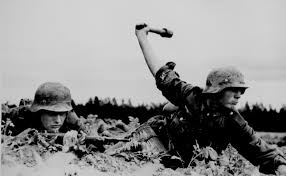
German soldiers invading the Soviet Union
Again, a series of spectacular battlefield victories followed—before the Wehrmacht was halted at the gates of Moscow. A year later, still enmeshed in Russia, the turning point came at Stalingrad, with the loss of the elite Sixth Army and 800,000 soldiers.
Starting in 1943, the Red Army slowly but steadily regained ground it had lost—the western half of Russia—and began pushing back the Germans. By March, 1945, it was fighting inside Germany—and heading straight for its capital: Berlin.
And by March, 1945, so were American and British forces. After landing in Normandy on June 6, 1944, they had steadily pushed their way across Europe and into Germany.
On March 19, 1945, facing certain defeat, Hitler ordered a massive “scorched-earth” campaign throughout Germany.
All German agriculture, industry, ships, communications, roads, food stuffs, mines, bridges, stores and utility plants were to be destroyed.
If implemented, it would deprive the entire German population of even the barest necessities after the war. And he entrusted the campaign to Albert Speer, his favorite architect-turned-Minister-of-Armaments.
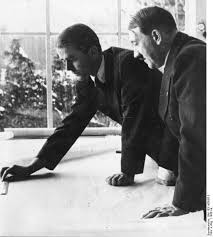
Albert Speer and Adolf Hitler pouring over architectural plans
Now living in a bunker 50 feet below bomb-shattered Berlin, Hitler gave full vent to his most destructive impulses.
“If the war is lost,” Hitler told Speer, “the nation will also perish. This fate is inevitable. There is no necessity to take into consideration the basis which the people will need to continue even a most primitive existence.
“On the contrary, it will be better to destroy these things ourselves, because this nation will have proved to be the weaker one and the future will belong solely to the stronger eastern nation.
“Besides, those who will remain after the battle are only the inferior ones, for the good ones have all been killed.”
* * * * *
During the 2024 Presidential campaign, Americans were repeatedly warned that Donald Trump intended to embrace Project 2025, a collection of policy proposals to fundamentally reshape the U.S. federal government.
Among these:
- The Department of Justice must be thoroughly “reformed” and tightly overseen by the White House.
- The director of the FBI must be personally accountable to the President—just as the head of the KGB is personally accountable to Vladimir Putin.

Seal of the Justice Department
- Federal employees could be instantly fired for not obeying illegal orders, or on mere whim—including the whim of the President.
- The Environmental Protection Agency would be stripped of its authority to protect the air, water and soil.
- The National Oceanic and Atmospheric Administration (NOAA) which the project calls “one of the main drivers of the climate change alarm industry” would be abolished.
- Fossil fuels—the leading cause of global warming—would be favored and environmental regulations to combat climate change abolished.
- Federal funding for all public transit systems across the country would be eliminated.
- Traditionally independent federal agencies such as the Department of Justice, Federal Communications Commission and the Federal Trade Commission would be placed under Presidential control.
- The wealthiest 1% would receive massive tax cuts at the expense of the poor and middle class.
- Conception would be designated as the point where life begins.
- Abortion would be outlawed.
- Access to birth control would be sharply restricted, if not banned.
All of these have since been vigorously implemented by the Trump administration. Yet almost no Republican members of Congress have dared to oppose this wholesale rejection of almost 250 years of American democracy.
Since Trump retook office on January 20, 2025, Republicans have lustily supported or remained silent about his following acts of criminality, if not treason:
- On January 20, 2025—his first day as re-elected President—Trump granted clemency to more than 1,500 people convicted of offenses related to the January 6, 2021 United States Capitol attack. This sends a clear message that his supporters can commit virtually any crime against his opponents with impunity.
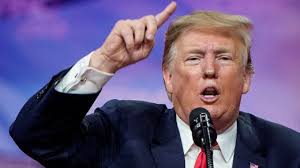
Donald Trump
- Trump revoked the security clearances of 51 former Intelligence officials. Their “crime”: Signing a letter in 2020 stating that reports about a laptop allegedly belonging to Hunter Biden, son of then-presidential candidate Joe Biden, had “classic earmarks of a Russian information operation.”
- During a press conference in North Carolina, Trump reaffirmed his stance that Canada should become the 51st state. Rejecting the longtime friendship between the two countries, Trump took an increasingly aggressive stance toward Canada, imposing steep tariffs and even threatening military intervention.
ABC NEWS, ADOLF HITLER, AFFORDABLE CARE ACT (ACA), ALTERNET, AMERICABLOG, AP, AUSTRIA, BABY BOOMER RESISTANCE, BBC, BELGIUM, BLOOMBERG, BLUESKY, BOB WOODWARD, BUZZFEED, CARL BERNSTEIN, CBS NEWS, CHINA, CIA, CNN, CONSPIRACIES, CROOKS AND LIARS, CUBA, CZECHOSLOVAKIA, DAILY KOS, DONALD TRUMP, FBI, FEDERAL GOVERNMENT SHUTDOWN, FIDEL CASTRO, FIVETHIRTYEIGHT, FRANCE, FRANCISCO FRANCO, GAIUS CALIGULA, GAIUS SUETONIUS TRANQUILLUS, GREECE, HARPER’S MAGAZINE, HOLOCAUST, HUFFINGTON POST, IMMIGRATION AND CUSTOMS ENFORCEMENT (ICE), JANUARY 6 COUP ATTEMPT, JIMMY KIMMEL, JOSEPH STALIN, KFC, LAVRENTI BERIA, LEON TROTSKY, LETITIA JAMES, MACDONALD’S, MAO ZEDONG, MEDIA MATTERS, MOTHER JONES, MOVEON, MSNBC, NAZI GERMANY, NBC NEWS, NEWSDAY, NEWSWEEK, NICCOLO MACHIAVELLI, NIKITA KHRUSHCHEV, NORWAY, NPR, PAUL VON HINDENBURG, PBS NEWSHOUR, POLITBURO, POLITICO, POLITICUSUSA, RAW STORY, REPUBLICANS, REUTERS, ROBERT PAYNE, SALON, SEATTLE TIMES, SLATE, SOVIET UNION, SPAIN, TALKING POINTS MEMO, THE ATLANTIC, THE CHICAGO SUN-TIMES, THE CHICAGO TRIBUNE, THE DAILY BEAST, THE DAILY BLOG, THE DAILY KOS, THE DISCOURSES ON LIVY (BOOK), THE GUARDIAN, THE HILL, THE HUFFINGTON POST, THE INTERCEPT, THE LOS ANGELES TIMES, THE NATION, THE NEW REPUBLIC, THE NEW YORK TIMES, THE NEW YORKER, THE RISE AND FALL OF STALIN (BOOK), THE VILLAGE VOICE, THE WASHINGTON POST, THINKPROGRESS, TIME, TRUTHDIG, TRUTHOUT, TWO POLITICAL JUNKIES, U.S. NEWS & WORLD REPORT, UNITED STATES, UNITED STATES DEPARTMENT OF JUSTICE, UPI, USA TODAY, Vladimir Lenin, VYACHESLAV MOLOTOV, WATERGATE, WORLD WAR 1, WORLD WAR 11, X, YUGOSLAVIA
In Bureaucracy, History, Law, Law Enforcement, Military, Politics, Social commentary on April 13, 2026 at 12:07 am
A dictator can die of illness or old age.
But there are other ways a tyrant can be forced to give up power—such as Gaius Caligula, Adolf Hitler and—possibly—Joseph Stalin.
Death by Fellow Bureaucrat
Joseph Stalin ruled as absolute dictator of the Soviet Union from January 21, 1924, to March 5, 1953—29 years.
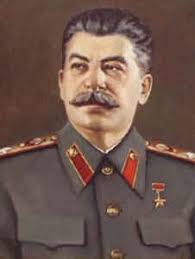
Joseph Stalin
Throughout his nearly 30-year reign over the Soviet Union, at least 20 million men, women and children died—from executions, deportations, imprisonment in Gulag camps, and a man-made famine through the forced collection of harvests.
Robert Payne, the acclaimed British historian, vividly portrayed the crimes of this murderous tyrant in his brilliant 1965 biography, The Rise and Fall of Stalin.
According to Payne, Stalin was planning yet another purge during the last weeks of his life. This would be “a holocaust greater than any he had planned before.
“This time there would be a chistka [purge] to end all chistkas, a purging of the entire body of the state from top to bottom. No one, not even the highest officials, was to be spared.”
Then, on March 5, 1953, Stalin died—officially from a cerebral hemorrhage.
He was 73 and in poor health from a lifetime of smoking, drinking and little exercise. But he could have died of unnatural causes.
In the 2004 book, Stalin’s Last Crime, Vladimir P. Naumov, a Russian historian, and Jonathan Brent, a Yale University Soviet scholar, assert that he might have been poisoned.
If this happened, the occasion was during a final dinner with four members of the Politburo. Two of these were Lavrenti P. Beria, chief of the secret police, and Nikita S. Khrushchev, who eventually succeeded Stalin.
The authors believe that, if Stalin was poisoned, the most likely suspect was Beria. The method: Slipping warfarin, a tasteless and colorless blood thinner also used as a rat killer, into his glass of wine.
In Nikita Khrushchev’s 1970 memoirs, he quotes Beria as telling Vyacheslav M. Molotov, another Politburo member, two months after Stalin’s death: “I did him in! I saved all of you.”
It’s entirely possible that Donald Trump’s “Presidency-for-Life” may end by natural causes.
He’s 79, and despite his repeated boastings that he’s the healthiest President in United States history, clearly he isn’t.
He is grotesquely overweight, doesn’t exercise, falls asleep in public appearances and slurs his words. Much of his diet consists of greasy, artery-clogging fast food—such as from McDonald’s and KFC.
He stays up late at night, pouring out his hatred for countless real and imagined enemies on his website, Truth Social.
But that is not the only way his reign could disappear in other ways:
- The Vice President and a majority of the Cabinet could invoke the Twenty-Fifth Amendment to the United States Constitution. This allows the removal of the President when he is “unable to discharge the powers and duties of his office.” The Vice President then becomes President.
- Within the Senate and House of Representatives, Republicans could stop backing his every infamy and secure his impeachment and conviction.
- Generals could protest publicly Trump’s attacks on their intelligence and even patriotism—or his racist and sexist firings of professional military officers.
- FBI agents could initiate their own unofficial investigations of Trump’s crimes and leak those results to the press. It was through such leaks that Bob Woodward and Carl Bernstein brought down Richard Nixon.
* * * * * * * * * *
More than 500 years ago, Niccolo Machiavelli, the Florentine statesman, authored The Discourses on Livy, a work of political history and philosophy. In it, he outlined how citizens of a republic can maintain their freedoms.
One of the longest chapters—Book Three, Chapter Six—covers “Of Conspiracies.” In it, those who wish to conspire against a ruler will find highly useful advice. And so will those who wish to foil such a conspiracy.

Niccolo Machiavelli
Above all, he notes how important it is for rulers to make themselves loved—or at least respected—by their fellow citizens:
“Note how much more praise those Emperors merited who, after Rome became an empire, conformed to her laws like good princes, than those who took the opposite course.
“Titus, Nerva, Trajan, Hadrian, Antoninus and Marcus Auelius did not require the Praetorians nor the multitudinous legions to defend them, because they were protected by their own good conduct, the good will of the people, and by the love of the Senate.
“On the other hand, neither the Eastern nor the Western armies saved Caligula, Nero, Vitellius and so many other wicked Emperors from the enemies which their bad conduct and evil lives had raised up against them.”
In his better-known work, The Prince, Machiavelli warns rulers who—like Donald Trump–are inclined to rule by fear:
“A prince should make himself feared in such a way that if he does not gain love, he at any rate avoids hatred: for fear and the absence of hatred may well go together.”
By Machiavelli’s standards, Trump has made himself the perfect target for a conspiracy:
“When a prince becomes universally hated, it is likely that he’s harmed some individuals—who thus seek revenge. This desire is increased by seeing that the prince is widely loathed.”
ABC NEWS, ADOLF HITLER, AFFORDABLE CARE ACT (ACA), ALTERNET, AMERICABLOG, AP, AUSTRIA, BABY BOOMER RESISTANCE, BBC, BELGIUM, BLOOMBERG, BLUESKY, BOB WOODWARD, BUZZFEED, CARL BERNSTEIN, CBS NEWS, CHINA, CNN, CONSPIRACIES, CROOKS AND LIARS, CUBA, CZECHOSLOVAKIA, DAILY KOS, DONALD TRUMP, FBI, FEDERAL GOVERNMENT SHUTDOWN, FIDEL CASTRO, FIVETHIRTYEIGHT, FRANCE, FRANCISCO FRANCO, GAIUS CALIGULA, GAIUS SUETONIUS TRANQUILLUS, GREECE, HARPER’S MAGAZINE, HOLLAND, HOLOCAUST, HUFFINGTON POST, IMMIGRATION AND CUSTOMS ENFORCEMENT (ICE), JANUARY 6 COUP ATTEMPT, JIMMY KIMMEL, JOSEPH STALIN, KFC, LAVRENTI BERIA, LEON TROTSKY, LETITIA JAMES, MACDONALD’S, MAO ZEDONG, MEDIA MATTERS, MOTHER JONES, MOVEON, MSNBC, NAZI GERMANY, NBC NEWS, NEWSDAY, NEWSWEEK, NICCOLO MACHIAVELLI, NIKITA KHRUSHCHEV, NORWAY, NPR, NSA, PAUL VON HINDENBURG, PBS NEWSHOUR, POLITBURO, POLITICO, POLITICUSUSA, RAW STORY, REPUBLICANS, REUTERS, ROBERT PAYNE, SALON, SEATTLE TIMES, SLATE, SOVIET UNION, SPAIN, TALKING POINTS MEMO, THE ATLANTIC, THE CHICAGO SUN-TIMES, THE CHICAGO TRIBUNE, THE DAILY BEAST, THE DAILY BLOG, THE DAILY KOS, THE DISCOURSES ON LIVY (BOOK), THE GUARDIAN, THE HILL, THE HUFFINGTON POST, THE INTERCEPT, THE LOS ANGELES TIMES, THE NATION, THE NEW REPUBLIC, THE NEW YORK TIMES, THE NEW YORKER, THE RISE AND FALL OF STALIN (BOOK), THE VILLAGE VOICE, THE WASHINGTON POST, THINKPROGRESS, TIME, TRUTHDIG, TRUTHOUT, TWO POLITICAL JUNKIES, U.S. NEWS & WORLD REPORT, UNITED STATES, UNITED STATES DEPARTMENT OF JUSTICE, UPI, USA TODAY, Vladimir Lenin, VYACHESLAV MOLOTOV, WATERGATE, WORLD WAR 1, WORLD WAR 11, X, YUGOSLAVIA
In Bureaucracy, History, Law, Law Enforcement, Military, Politics, Social commentary on April 10, 2026 at 12:16 am
A dictator can die of illness or old age. That’s what happened to Francisco Franco (Spain), Mao Zedong (China) and Fidel Castro (Cuba).
But there are other ways a tyrant can be forced to give up power—such as the following three.
Death by Bodyguards
First up: Gaius Caligula, the “Mad Emperor” of Imperial Rome.
Caligula’s reign spanned March 18, 37 A.D. to January 24, 41 A.D.—four years.

Gaius Caligula
Carole Raddato from FRANKFURT, Germany, CC BY-SA 2.0 <https://creativecommons.org/licenses/by-sa/2.0>, via Wikimedia Commons
He became Emperor in 37 A.D. after succeeding the Emperor Tiberius, his uncle who had adopted him as a son after his father died.
Caligula’s reign began well—and popularly. He gave Tiberius a magnificent funeral—then recalled to Rome all those whom Tiberius had banished, and ignored all charges that Tiberius had leveled against them.
He gave bonuses to the military and allowed the magistrates unrestricted jurisdiction, without appeal to himself.
But in October 37 A.D. he fell seriously ill or perhaps was poisoned.
Caligula soon recovered but emerged a changed man. He began claiming to be a god, and killing or exiling anyone he saw as a threat. He ordered his victims tortured to death with many slight wounds: “Strike so that he may feel that he is dying.”
Among his litany of crimes, according to his biographer, Gaius Suetonius Tranquillus:
“He forced parents to attend the executions of their sons, sending a litter for one man who pleaded ill health, and inviting another to dinner immediately after witnessing the death, and trying to rouse him to gaiety and jesting by a great show of affability.”
For all his cruelty and egomania, the trait that finally destroyed Caligula was his joy in humiliating others.
His fatal mistake was to taunt Cassius Chaerea, a member of his own bodyguard. Caligula considered Chaerea effeminate because of a weak voice and mocked him with names like “Priapus” and “Venus.”
On January 22 41 A.D. Chaerea and several other bodyguards hacked Caligula to death with swords before other guards could save him.
Death by Suicide
Next up: Adolf Hitler, dictator of Nazi Germany from January 30, 1933, to April 30, 1945—12 years.
He was born on April 20, 1889, in Braunau am Inn in Austria-Hungary.
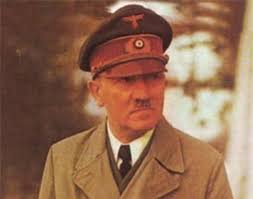
Adolf Hitler
He was appointed Chancellor—chief law enforcement officer—of Germany on January 30, 1933, by President Paul von Hindenburg. Upon Hindenburg’s death in 1934, Hitler assumed the Presidency and established himself as absolute dictator.
From 1933 to 1939 he presided over Germany’s rapid economic recovery from the Great Depression, the defiance of restrictions imposed on Germany after World War 1, and the annexation of Austria and Czechoslovakia, where millions of ethnic Germans lived.
These accomplishments won him widespread popular support.
But after absorbing Czechoslovakia in 1938, Hitler felt himself invincible. On September 1, 1939, his armies attacked Poland—and unintentionally ignited World War II.
After conquering Norway, Denmark, Holland, Belgium, France, Greece and Yugoslavia, he made his two greatest mistakes of the war: He invaded the far more powerful Soviet Union on June 22, 1941, and declared war on the equally more powerful United States on December 11.
Parallel to unleashing a war that slaughtered 50 million people, Hitler orchestrated the extermination of at least six million Jews during the Holocaust.
By April, 1945, Germany faced destruction from the advancing Russians on the East, and from the advancing Americans on the West.
On April 30, with Russian forces only blocks from his underground bunker, Hitler lifted a heavy 7.65mm Walther PPK pistol to his right temple, bit on a cyanide capsule, and pulled the trigger.
Just as Caligula’s mangled remains were hastily burned and buried in the Horti Lamiani gardens, Hitler’s body was hastily cremated in the Reich Chancellery garden.
Last up: Joseph Stalin, dictator of the Soviet Union from January 21, 1924, to March 5, 1953—29 years.
Born on December 18, 1878, in Georgia, Russia, he hated Czarist rule and in 1903 joined the Communist Bolsheviks party, led by Vladimir Lenin, to overthrow it.
Joseph Stalin
On November 7, 1917, Lenin overthrew the Provisional Government, which had taken power in February, after Czarist rule collapsed.
Stalin became a member of the new Soviet government, gradually working his way to the position of General Secretary. When Lenin died on January 21, 1924, Stalin outmaneuvered Leon Trotsky, his major rival for the succession, and became absolute dictator.
Starting in 1934, a series of massive purges followed—most notably between August, 1936, and March, 1938.
Throughout his nearly 30-year reign over the Soviet Union, at least 20 million men, women and children died—from executions, deportations, imprisonment in Gulag camps, and a man-made famine through the forced collection of harvests.
Robert Payne, the acclaimed British historian, vividly portrayed the crimes of this murderous tyrant in his brilliant 1965 biography, The Rise and Fall of Stalin.
According to Payne, Stalin was planning yet another purge during the last weeks of his life. This would be “a holocaust greater than any he had planned before.
“This time there would be a chistka [purge] to end all chistkas, a purging of the entire body of the state from top to bottom. No one, not even the highest officials, was to be spared.”
Yet Stalin did nothing to calm their fears. He often summoned his “comrades” to the Kremlin for late-night drinking bouts, where he freely humiliated them.
ADOLF HITLER, ALI HOSSEINI KHAMENEI, ALTERNET, AMERICABLOG, AP, BABY BOOMER RESISTANCE, BAHRAIN, BATTLE OF BRITAIN, BBC, BLOOMBERG, BLUESKY, BUZZFEED, CBS NEWS, CNN, CROOKS AND LIARS, DAILY KOS, DONALD TRUMP, DRONES, ENGLAND, FIVETHIRTYEIGHT, FRANCE, GREAT BRITAIN, HARPER’S MAGAZINE, HUFFINGTON POST, IRAN, ISRAELI DEFENSE FORCES, JOSEPH STALIN, KIEV, KUWAIT, LUFTWAFFE, MEDIA MATTERS, MOJTABA KHAMENEI, MOSCOW, MOTHER JONES, MOVEON, MSNBC, NAZI GERMANY, NBC NEWS, NEWSDAY, NEWSWEEK, NPR, NUCLEAR WEAPONS, OMAN, OPERATION BARBAROSSA, OPERATION EPIC FURY, PBS NEWSHOUR, PETE HEGSETH, POLAND, POLITICO, POLITICUSUSA, QATER, RAW STORY, REUTERS, RUSSIA, SALON, SAUDI ARABIA, SEATTLE TIMES, SLATE, SOVIET UNION, SS, STRAIT OF HORMUZ, TALKING POINTS MEMO, TERHAN, THE ATLANTIC, THE BLITZ, THE CHICAGO SUN-TIMES, THE CHICAGO TRIBUNE, THE DAILY BEAST, THE DAILY BLOG, THE GUARDIAN, THE HILL, THE HUFFINGTON POST, THE INTERCEPT, THE LOS ANGELES TIMES, THE NATION, THE NEW REPUBLIC, THE NEW YORK TIMES, THE NEW YORKER, THE PENTAGON, THE UNITED ARAB EMIRATES, THE VILLAGE VOICE, THE WASHINGTON POST, THINKPROGRESS, TIME, TRUTHDIG, TRUTHOUT, TWO POLITICAL JUNKIES, U.S. NEWS & WORLD REPORT, UKRAINE, UPI, USA TODAY, WEHRMACHT, WORLD WAR 11, X
In Bureaucracy, History, Military, Politics, Social commentary on April 9, 2026 at 12:14 am
There are major similarities between Adolf Hitler’s 1941 invasion and intended conquest of the Soviet Union and Donald Trump’s 2026 attack and intended conquest of Iran.
Even as late as January 30, 1945, Hitler claimed that God firmly stood on the side of the Third Reich—and thus would guarantee its eventual victory.
PAST – HITLER: God the Almighty has made our nation. By defending its existence we are defending His work…Therefore, it is all the more necessary on this twelfth anniversary of the rise to power to strengthen the heart more than ever before and to steel ourselves in the holy determination to wield the sword, no matter where and under what circumstances, until final victory crowns our efforts.
Similarly, on March 22, 2026, Secretary of Defense Pete Hegseth, hosting his monthly Christian worship service at the Pentagon, prayed:
PRESENT – HEGSETH: Let every round find its mark against the enemies of righteousness and our great nation. Give them wisdom in every decision, endurance for the trial ahead, unbreakable unity, and overwhelming violence of action against those who deserve no mercy.
“I pursued my enemies and overtook them, and did not turn back till they were consumed,” he read from Psalms 18:37. “Those who hated me I destroyed. They cried to the Lord, but He did not answer them.”

On December 31, 1939—more than three months into World War 11—Hitler made clear his ultimate war aims:
PAST – HITLER: We shall only talk of peace when we have won the war. The Jewish capitalist world will not survive the twentieth century.
PRESENT – PETE HEGSETH: Iran cannot outlast us. We are going to ensure through violence of action and our offensive capabilities and our defensive capabilities, as I said, that we set the tone and the tempo of this fight.
Hitler believed that German airpower could force Great Britain to submit to his will. The Battle of Britain and The Blitz proved him wrong.
He also believed that his mechanized Panzers—which had defeated French and British armies in May-June,1940—would succeed where Napoleon’s horse-driven Grand Army had failed in 1812. The final proof of his mistake appeared on April 30, 1945, as Russian forces were almost literally knocking at his Fuhrerbunker door.
PAST – HITLER: We have only to kick in the front door and the whole rotten structure will come crashing down.
Hegseth believes that American airpower can force Iran to submit to his will. But the Strait of Hormuz remains closed to world shipping (except for those nations that Iran regards as friendly or neutral). So long as this continues, Americans’ gas prices will continue to rise with no end in sight—and pose a threat to Republicans’ continued control of the House and Senate.
About 20% of the world’s total oil consumption—roughly 20-21 million barrels per day—passes through this, making it the world’s most crucial oil chokepoint.
PRESENT – HEGSETH: Iran will never possess a nuclear bomb, not on our watch, not ever. And this is why President Trump’s moral clarity on Iran today is so vital. Unlike the past, where vague red lines and endless negotiations let Iran fund terror and inch ever so slightly toward a bomb, this president sees the threat plainly and acts decisively, no more half measures, especially when Iran is at its weakest. No more letting Tehran play for time while our people pay the price.
PAST – HITLER: Russia is already broken and will never rise again.
PRESENT – HEGSETH: Iran’s senior leaders are dead, the so-called governing council that might have selected a successor, dead, missing or cowering in bunkers, too terrified to even occupy the same room. Senior generals, mid-level officers, enlisted ranks, they can’t talk or communicate, let alone mount a coordinated and sustained offensive. That’s not great for morale.
PAST – HITLER: Moscow must disappear from the earth’s surface as soon as its riches have been brought to shelter.
PRESENT – HEGSETH: The enemy can no longer shoot the volume of missiles they once did, not even close, and the chairman will lay out some of those percentages. So, our air defenses and that of our allies have plenty of runway. We can sustain this fight easily for as long as we need to. And as I said yesterday, we set the terms.
PAST – HITLER: Today I am at the head of the strongest Army in the world, the most gigantic Air Force and of a proud Navy. Behind and around me stands the Party with which I became great and which has become great through me. Our enemies must not deceive themselves—in the 2,000 years of German history known to us, our people have never been more united than today.
PRESENT – HEGSETH: And we know their ability to shoot versus our ability to defend. That difference gets wider and wider every day. Our defense gets better. Their offense capabilities diminish as we are going into ammunitions that we, as we said, have tens of thousands of and can drop unlimited supplies on, with even more effects than the stand-off munitions we have now, which is why, when we say the throttle’s going up, the throttle’s going up. And it’s going to stay on high.
ADOLF HITLER, ALI HOSSEINI KHAMENEI, ALTERNET, AMERICABLOG, AP, BABY BOOMER RESISTANCE, BAHRAIN, BATTLE OF BRITAIN, BBC, BLOOMBERG, BLUESKY, BUZZFEED, CBS NEWS, CNN, CROOKS AND LIARS, DAILY KOS, DONALD TRUMP, DRONES, ENGLAND, FIVETHIRTYEIGHT, FRANCE, GREAT BRITAIN, HARPER’S MAGAZINE, HUFFINGTON POST, IRAN, ISRAELI DEFENSE FORCES, JOSEPH STALIN, KIEV, KUWAIT, LUFTWAFFE, MEDIA MATTERS, MOJTABA KHAMENEI, MOSCOW, MOTHER JONES, MOVEON, MSNBC, NAZI GERMANY, NBC NEWS, NEWSDAY, NEWSWEEK, NPR, NUCLEAR WEAPONS, OMAN, OPERATION BARBAROSSA, OPERATION EPIC FURY, PBS NEWSHOUR, PETE HEGSETH, POLAND, POLITICO, POLITICUSUSA, QATER, RAW STORY, REUTERS, RUSSIA, SALON, SAUDI ARABIA, SEATTLE TIMES, SLATE, SOVIET UNION, SS, STRAIT OF HORMUZ, TALKING POINTS MEMO, TERHAN, THE ATLANTIC, THE BLITZ, THE CHICAGO SUN-TIMES, THE CHICAGO TRIBUNE, THE DAILY BEAST, THE DAILY BLOG, THE GUARDIAN, THE HILL, THE HUFFINGTON POST, THE INTERCEPT, THE LOS ANGELES TIMES, THE NATION, THE NEW REPUBLIC, THE NEW YORK TIMES, THE NEW YORKER, THE PENTAGON, THE UNITED ARAB EMIRATES, THE VILLAGE VOICE, THE WASHINGTON POST, THINKPROGRESS, TIME, TRUTHDIG, TRUTHOUT, TWO POLITICAL JUNKIES, U.S. NEWS & WORLD REPORT, UKRAINE, UPI, USA TODAY, WEHRMACHT, WORLD WAR 11, X
In Bureaucracy, History, Military, Politics, Social commentary on April 8, 2026 at 12:10 am
There are major similarities between Adolf Hitler’s 1941 invasion and intended conquest of the Soviet Union and Donald Trump’s 2026 attack and intended conquest of Iran.
But, for lack of courage and/or historical perspective, those similarities have not been featured during political and/or military commentaries on the ongoing conflict.
A good starting point: A comparison of the address given by German Fuhrer Adolf Hitler on the first day of “Operation Barbarossa” (June 22, 1941) and the one given by Secretary of Defense Pete Hegseth (on May 4) four days after the start of “Operation Epic Fury.”
PAST – HITLER: German people! At this moment a march is taking place that, as regards extent, compares with the greatest the world hitherto has seen. United with their Finnish comrades, the fighters of the victory of Narvik are standing in the Northern Arctic. German divisions commanded by the conqueror of Norway, in cooperation with the heroes of Finnish freedom, under their marshal, are protecting Finnish soil.
PRESENT – HEGSETH: I stand before you today with one unmistakable message about Operation Epic Fury: America is winning decisively, devastatingly and without mercy. Under the direct command of President Trump, the War Department unleashed this operation early Saturday morning, just four days ago, which means we need to remember two things.
Second, we are only four days into this, and the results have been incredible, historic really. Only the United States of America could lead this, only us. But when you add the Israeli Defense Forces, a devastatingly capable force, the combination is sheer destruction for our radical Islamist Iranian adversaries. They are toast and they know it, or at least soon enough they will know it. And we have only just begun to hunt, dismantle, demoralize, destroy and defeat their capabilities just four days in.
PAST – HITLER: Formations of the German Eastern Front extend from East Prussia to the Carpathians. German and Rumanian soldiers are united under Chief of State Antonescu from the banks of the Pruth along the lower reaches of the Danube to the shores of the Black Sea. The task of this front, therefore, no longer is the protection of single countries, but the safeguarding of Europe and thereby the salvation of all.
PRESENT – HEGSETH: Starting last night and to be completed in a few days, in under a week, the two most powerful Air Forces in the world will have complete control of Iranian skies, uncontested airspace. I hope all the folks watching understand what uncontested airspace and complete control means.
It means we will fly all day, all night, day and night finding, fixing and finishing the missiles and defense industrial base of the Iranian military, finding and fixing their leaders and their military leaders, flying over Tehran, flying over Iran, flying over their capital, flying over the IRGC [Islamic Revolutionary Guard Corps], Iranian leaders looking up and seeing only US and Israeli air power every minute of every day until we decide it’s over.
PAST – HITLER: I therefore decided today again to lay the fate and future of the German Reich and our people in the hands of our soldiers.
PRESENT – HEGSETH: And Iran will be able to do nothing about it. B-2s, B-52s, B-1s, Predator drones, fighters controlling the skies, picking targets, death and destruction from the sky all day long. We’re playing for keeps. Our warfighters have maximum authorities granted personally by the president and yours truly.
On August 22, 1939—nine days before he launched an unprovoked attack on Poland on September 1—Hitler summoned his top generals to Berchtesgaden. There he lectured:
PAST – HITLER: I shall give a propagandist reason for starting the war. Never mind whether it is plausible or not. The victor will not be asked afterward whether he told the truth or not. In starting and waging a war it is not right that matters but victory.
Close your hearts to pity! Act brutally! Eighty million people must obtain what is their right…The stronger man is right…Be harsh and remorseless! Be steeled against all signs of compassion!
The instructions Hitler issued for the conduct of war on Poland applied just as fervently when the Wehrmacht invaded the Soviet Union on June 22, 1941. And the Russians quickly responded with a campaign of vengeance.
As General Gotthard Heinrici noted: “The Russian soldiers are told by their commanders that they will be executed by us, so they are reluctant to surrender—and sometimes fire on our soldiers from the rear. This, of course, demands countermeasures on our side, which are harsh. So both sides step things up, and as a result there are masses of casualties.”
PRESENT – HEGSETH: Our rules of engagement are bold, precise and designed to unleash American power, not shackle it. This was never meant to be a fair fight, and it is not a fair fight. We are punching them while they’re down, which is exactly how it should be. Thus far, Operation Epic Fury has delivered twice the air power of shock and awe of Iraq in 2003, minus Paul Bremer and the Nation Building.
The campaign has seven times the intensity of Israel’s previous operations against Iran during the 12-day war, seven times. And as President Trump said, more and larger waves are coming; we are just getting started. We are accelerating, not decelerating. Iran’s capabilities are evaporating by the hour. While American strength grows, fiercer smarter and utterly dominant.
ABC NEWS, ADOLF HITLER, ALI HOSSEINI KHAMENEI, ALTERNET, AMERICABLOG, AP, AYATOLLAH ALI KHAMENEI, BABY BOOMER RESISTANCE, BAHRAIN, BBC, BERLIN, BLOOMBERG, BLOOMBERG NEWS, BLUESKY, BUZZFEED, CBS NEWS, CNN, CROOKS AND LIARS, DAILY KOS, DONALD TRUMP, DRONES, FINLAND, FIVETHIRTYEIGHT, FRANCE, GREAT BRITAIN, HARPER’S MAGAZINE, HUFFINGTON POST, IRAN, ISRAEL, ITALY, JAPAN, JOACHIM VON RIBBENTROP, JOSEPH STALIN, KIEV, KUWAIT, LENINGRAD, LUFTWAFFE, MEDIA MATTERS, MOJTABA KHAMENEI, MOSCOW, MOTHER JONES, MOVEON, MSNBC, NAZI GERMANY, NBC NEWS, NEW REPUBLIC, NEWSDAY, NEWSWEEK, NEWT GINGRICH, NPR, NUCLEAR WEAPONS, OIL FIELDS, OMAN, OPERATION BARBAROSSA, PBS NEWSHOUR, PETE HEGSETH, POLAND, POLITICO, POLITICUSUSA, QATAR, QATER, RAW STORY, REUTERS, SALON, SAUDI ARABIA, SEATTLE TIMES, SLATE, SOVIET UNION, SS, TALKING POINTS MEMO, THE ATLANTIC, THE CHICAGO SUN-TIMES, THE CHICAGO TRIBUNE, THE DAILY BEAST, THE DAILY BLOG, THE GUARDIAN, THE HILL, THE HUFFINGTON POST, THE INTERCEPT, THE LONGEST DAY (MOVIE, THE LOS ANGELES TIMES, THE NATION, THE NEW REPUBLIC, THE NEW YORK TIMES, THE NEW YORKER, THE PENTAGON, THE UNITED ARAB EMIRATES, THE VILLAGE VOICE, THE WASHINGTON POST, THINKPROGRESS, THIRD REICH, TIME, TRUTHDIG, TRUTHOUT, TWO POLITICAL JUNKIES, U.S. NEWS & WORLD REPORT, UKRAINE, UNIFORMS, UPI, USA TODAY, VYACHESLAV MOLOTOV, WEHRMACHT, WONKETTE, WORLD WAR 11, X
In Bureaucracy, History, Military, Politics, Social commentary on April 1, 2026 at 12:17 am
Now, fast-forward 85 years—from 1941 to 2026. Substitute President Donald Trump for Fuhrer Adolf Hitler and Mojtaba Khamenei for Joseph Stalin—and Iran for the Soviet Union.

Just as Hitler launched his attack on the Soviet Union without warning, so did Trump launch his on Iran—on February 28.
Hitler—and numerous members of the Wehrmacht—believed that Germany’s mechanized panzers would quickly subdue Soviet armies.
“We were fast,” recalled Panzer Lieutenant Hans-Erdmann Schonbeck. “And our tank forces could cover huge distances. And once we broke through the enemy’s defenses, our orders were not to worry about threats to our right or left but to keep going, deep into Russian territory.”

Panzer tank
But the tanks soon faced unexpected difficulties. Most roads in Russia were unpaved, so the tanks raised huge dust clouds almost everywhere they went. The dust clogged their engines and brought many tanks to a halt. Repair crews worked themselves to exhaustion so that the lightning-fast advance could continue.
Another drawback not evident at the outset of the invasion: Summer uniforms. For a war that began on June 22, 1941, these were entirely appropriate. But as the months quickly passed, the notorious Russian winter season loomed ever closer.

Germans in summer uniforms
The German command underestimated the campaign’s duration, expecting a victory by autumn 1941, and prioritized ammunition and fuel over winter equipment. Although winter gear existed, it was stuck in supply depots in the West, and transport lines were too strained by the Soviets’ “scorched earth” tactics to move it to the front.
Without proper greatcoats or insulated boots, soldiers suffered from extreme cold, with temperatures dropping far below zero. Many resorted to stealing blankets from civilians or using blankets as makeshift clothing.
In its war with Iran, American’s air force completely dominated the skies. But then both American planes and ground forces faced an unexpected enemy: Mass-produced drones.
The same weapons—some of them supplied by Iran to Russia—have been used since 2022 in Ukraine. Unmanned and remotely-controlled, Ukrainian and Russian drones have transformed the battlefield. They’re estimated to inflict around 80% of combat casualties on both sides.
The technology—like that forged in Germany’s Blitzkrieg tactics—is revolutionizing warfare and evolving rapidly. To adapt to the new era, the U.S. military is learning lessons from Ukraine.

Iranian drone
Student News Agency, Attribution, via Wikimedia Commons
Not only are American military forces being targeted, so are those Gulf nations that have allied themselves with the United States: The United Arab Emirates, Saudi Arabia, Kuwait, Bahrain, Qatar and Oman.
Primarily targeted: Energy infrastructure, airports and sites hosting American military personnel.
For Iran, the drones are relatively cheap. For the United States, the costs of countering this threat are steadily mounting. A typical Shahed-136 costs Tehran roughly $20,000 to $50,000, while interceptor missiles, such as the Patriot and Terminal High Altitude Area Defense (THAAD), cost millions.
On August 22, 1939—the eve of his invasion of Poland, which would ignite World War II—Adolf Hitler delivered a secret address to his supreme commanders and generals. Its climax:
“Close your hearts to pity. Act brutally. Eighty million people must obtain what is their right. Their existence must be made secure. The stronger man is right. The greatest harshness.”
Hitler urged his generals to act similarly toward the Russians, whom he regarded as subhumans.
The results of this policy soon became obvious when the Wehrmacht invaded Ukraine. Ukrainians, long suffering under the yoke of Stalin, greeted the invaders with bread and salt, the traditional greeting of comrades.
Within a month, they realized that the tyranny of Stalin had been replaced by an all-out extermination campaign of Hitler. For every Ukrainian the Germans killed, 10 more emerged to seek revenge.
Eighty-five years later, Donald Trump and officials of his administration are celebrating the indiscriminate slaughter of Iranians, whether civilian or military.
“We totally demolished Kharg Island, but we may hit it a few more times just for fun,” Trump said on NBC News.
On March 22, Secretary of Defense Pete Hegseth, hosting his monthly Christian worship service at the Pentagon, prayed: “Let every round find its mark against the enemies of righteousness and our great nation.
“Give them wisdom in every decision, endurance for the trial ahead, unbreakable unity, and overwhelming violence of action against those who deserve no mercy.”

Pete Hegseth
“I pursued my enemies and overtook them, and did not turn back till they were consumed,” he read from Psalms 18:37. “Those who hated me I destroyed. They cried to the Lord, but He did not answer them.”
Former House speaker and Trump advisor Newt Gingrich posted on X: “Instead of fighting over a 21-mile-wide bottleneck [Strait of Hormuz] forever, we [could] cut a new channel through friendly territory. A dozen thermonuclear detonations and you’ve got a waterway wider than the Panama Canal, deeper than the Suez, and safe from Iranian attacks.”
This would produce countless numbers of casualties and cover the Middle East with radioactive fallout.
It remains to be seen if such exhortations will lead American soldiers to act as barbarically as those of the Wehrmacht and SS—and inspire similar barbarism in return.
ABC NEWS, ADOLF HITLER, ALI HOSSEINI KHAMENEI, ALTERNET, AMERICABLOG, AP, AYATOLLAH ALI KHAMENEI, BABY BOOMER RESISTANCE, BAHRAIN, BBC, BERLIN, BLOOMBERG, BLOOMBERG NEWS, BLUESKY, BUZZFEED, CBS NEWS, CNN, CROOKS AND LIARS, DAILY KOS, DONALD TRUMP, DRONES, FINLAND, FIVETHIRTYEIGHT, FRANCE, GREAT BRITAIN, HARPER’S MAGAZINE, HUFFINGTON POST, IRAN, ISRAEL, ITALY, JAPAN, JOACHIM VON RIBBENTROP, JOSEPH STALIN, KIEV, KUWAIT, LENINGRAD, LUFTWAFFE, MEDIA MATTERS, MOJTABA KHAMENEI, MOSCOW, MOTHER JONES, MOVEON, MSNBC, NAZI GERMANY, NBC NEWS, NEW REPUBLIC, NEWSDAY, NEWSWEEK, NEWT GINGRICH, NPR, NUCLEAR WEAPONS, OIL FIELDS, OMAN, OPERATION BARBAROSSA, PBS NEWSHOUR, PETE HEGSETH, POLAND, POLITICO, POLITICUSUSA, QATAR, QATER, RAW STORY, REUTERS, SALON, SAUDI ARABIA, SEATTLE TIMES, SLATE, SOVIET UNION, SS, TALKING POINTS MEMO, THE ATLANTIC, THE CHICAGO SUN-TIMES, THE CHICAGO TRIBUNE, THE DAILY BEAST, THE DAILY BLOG, THE GUARDIAN, THE HILL, THE HUFFINGTON POST, THE INTERCEPT, THE LONGEST DAY (MOVIE, THE LOS ANGELES TIMES, THE NATION, THE NEW REPUBLIC, THE NEW YORK TIMES, THE NEW YORKER, THE PENTAGON, THE UNITED ARAB EMIRATES, THE VILLAGE VOICE, THE WASHINGTON POST, THINKPROGRESS, THIRD REICH, TIME, TRUTHDIG, TRUTHOUT, TWO POLITICAL JUNKIES, U.S. NEWS & WORLD REPORT, UKRAINE, UNIFORMS, UPI, USA TODAY, VYACHESLAV MOLOTOV, WEHRMACHT, WONKETTE, WORLD WAR 11, X
In Bureaucracy, History, Military, Politics, Social commentary on March 31, 2026 at 12:48 am
The city: Berlin.
The date: November 12–13, 1940.
The event: A meeting between German Fuhrer Adolf Hitler and Soviet Foreign Minister Vyacheslav Molotov.
The purposes: To discuss:
- Soviet expansion and control over Finland, Bulgaria, and the Turkish Straits; and
- Germany’s desire for the USSR to attack British interests in India and Iran.
Hitler wanted the USSR to join the Axis (Germany, Italy, and Japan) and expand “southward” toward the Indian Ocean to avoid conflict in Europe.
Adolf Hitler
Molotov ignored the talk of India and instead demanded control over Finland, Bulgaria, and the Turkish Straits.
Hitler adamantly opposed Soviet control over Finland, which he considered a strategic ally. He feared a Soviet expansion into Scandinavia would threaten German iron ore supplies from Sweden and northern interests.
And he deeply feared that the Soviet Union would cut off Germany’s vital Romanian oil supplies. Romania provided roughly 75% of German oil in 1941. A late 1940 Soviet attack on the Ploiești oil fields would render Germany helpless and force an end to the war.
On a personal level, Molotov and Hitler grated on each other’s nerves. Molotov was blunt in his remarks and didn’t spare Hitler at all. He seldom smiled and refused to compromises on Russia’s demands for control of Finland, Bulgaria, and the Turkish Straits.
At one point, Molotov asked: “Is last year’s agreement [between Germany and Russia] still valid?”
Hitler replied that it was.
“I asked this question,” said Molotov, “because of the Finns. You are on very friendly relations with the Finns. You invite people from Finland to Germany and you send missions there. And the Finns are very dangerous people. They undermine our security and we’ll have to do something about that and we are going to do something about that.”

Vyacheslav Molotov
“I understand you very well,” exploded Hitler. “You want to wage war against Finland and that is quite out of the question. Do you hear me? It’s impossible because my supplies of iron, nickel and other important raw materials would be cut.”
During the talks, British Royal Air Force (RAF) bombers appeared overhead, forcing the leaders to move to an air raid shelter.
German Foreign Minister Joachim von Ribbentrop had been trying to convince Molotov that Great Britain was “beaten” and that the British Empire was a “gigantic world-wide estate in bankruptcy” ready for partition.
Molotov sarcastically replied: “If England is beaten, why are we in this shelter and whose are the bombs that are falling?”
Even while Molotov was still in Berlin, Hitler ordered his generals to attack the Soviet Union on May 15, 1941.
Within a month they responded with a detailed plan code-named “Operation Barbarossa.”
Less than one year later—on June 22, 1941—with 134 divisions at full fighting strength and 73 more divisions for deployment behind the front, the German Wehrmacht invaded the Soviet Union.
Now the two most ruthless dictators on earth—Adolf Hitler and Joseph Stalin—were locked in a fight to the death.
At the outset, the odds clearly favored the Germans.
The invasion caught the Soviet Union by surprise. Joseph Stalin had received Intelligence reports from Great Britain that Germany was preparing to attack. But Stalin, who believed the British were trying to drive a wedge between him and Hitler, put his faith in Hitler, whose guarantees had long proved worthless.

German army units
From June to September, the Wehrmacht captured vast territories and encircled hundreds of thousands of Red Army troops. German forces quickly advanced toward Leningrad, Moscow, and Kiev, inflicting massive casualties.
The Luftwaffe destroyed much of the Soviet air force on the ground.
In June and July, German panzers quickly advanced, capturing over 300,000 Soviet prisoners in the Minsk-Bialystok pocket. By late September, Army Group South captured Kiev, resulting in the largest encirclement in history, with roughly 600,000 Soviet soldiers trapped.
By the end of 1941, more than three million Soviet soldiers were captured or killed. Still, the Soviet Union did not collapse and continued to commit new field armies to the conflict.
By December, the Wehrmacht, besieging Moscow, were literally freezing to death in their summer uniforms. Then, on December 5-6, the Soviets launched their decisive counter-offensive before Moscow, forcing German forces into a retreat.
It marked the first major land defeat for the Wehrmacht since its September 1, 1939 invasion of Poland, which ignited World War II.
Now, fast-forward 85 years. Substitute President Donald Trump for Fuhrer Adolf Hitler and Mojtaba Khamenei for Joseph Stalin—and Iran for the Soviet Union.
Donald Trump and Adolf Hitler
Just as Hitler launched his attack on the Soviet Union without warning, so did Trump launch his on Iran—on February 28.
Hitler’s attack didn’t kill Joseph Stalin, the all-powerful dictator of the Soviet Union. But Trump’s airstrikes killed Ali Hosseini Khamenei, who had ruled Iran as its supreme leader from 1989.

Ayatollah Ali Khamenei
Still, the Iranians quickly elevated his son, Mojtaba Khamenei, to the same position—and went on fighting.
Hitler—and numerous members of the Wehrmacht—believed that Germany’s mechanized panzers would succeed where Napoleon Bonaparte had failed in 1812. And that they could conquer the Soviet Union in only three months.
They were wrong.


ABC NEWS, ADOLF HITLER, ALBERT SPEER, ALTERNET, AMERICABLOG, AP, BABY BOOMER RESISTANCE, BBC, BLOOMBERG NEWS, BUZZFEED, CBS NEWS, CNN, COREY LEWANDOWSKI, CROOKS AND LIARS, DAILY KOZ, DAVID IRVING, DONALD TRUMP, DRUDGE REPORT, FAITH & FREEDOM COALITION, FIVETHIRTYEIGHT, FRANK BRANDENBURG, HANS BAUR, HARPER’S MAGAZINE, HEINRICH HIMMLER, HITLER’S WAR (BOOK), HOLOCAUST (TV SERIES), HUFFINGTON POST, INSIDE THE THIRD REICH (BOOK), JERRY FALWELL JR., KARL WOLFF, KAY IVEY, LIBERTY UNIVERSITY, LINA HEYDRICH, MEDIA MATTERS, MOTHER JONES, MOVEON, MSNBC, NBC NEWS, NEW REPUBLIC, NEWSDAY, NEWSWEEK, NPR, OTTO REMER, PBS NEWSHOUR, POLITICO, POLITICUSUSA, QUEST: SEARCHING FOR GERMANY'S NAZI PAST (BOOK), RALPH REED, RAW STORY, REINHARD HEYDRICH, REPUBLICAN PARTY, REUTERS, ROY MOORE, RUDOLF HESS, SALON, SEATTLE TIMES, SLATE, SOVIET UNION, TALKING POINTS MEMO, THE ATLANTIC, THE CHICAGO SUN-TIMES, THE CHICAGO TRIBUNE, THE DAILY BEAST, THE DAILY BLOG, THE GUARDIAN, THE HILL, THE HUFFINGTON POST, THE LOS ANGELES TIMES, THE NATION, THE NEW REPUBLIC, THE NEW YORK TIMES, THE NEW YORKER, THE VILLAGE VOICE, THE WASHINGTON POST, THINKPROGRESS, TIME, TRUTHDIG, TRUTHOUT, TWO POLITICAL JUNKIES, U.S. NEWS & WORLD REPORT, UPI, USA TODAY, WEST GERMANY, WONKETTE, X
LIKE NAZIS, LIKE REPUBLICANS: IT’S POWER, NOT MORALITY, THAT COUNTS
In Bureaucracy, History, Military, Politics, Social commentary on May 8, 2026 at 12:10 amFrank Brandenburg had just turned 16 in 1979 when he saw the NBC mini-series Holocaust, depicting the Third Reich’s extermination of six million Jewish men, women and children.
He was stunned. Had such atrocities really taken place?
His parents, friends and teachers refused to talk about Adolf Hitler and his Nazi party that had tyrannically ruled Germany for 12 years.
“No one wants to talk today about that! Let the past sleep,” he was repeatedly told.
Frank Brandenburg had a deeply personal reason for pursuing the truth. He was a citizen of West Germany, growing up in a country that was still divided in two for having lost World War II—a war Hitler had started.
He started reading such books about the Holocaust as:
So Brandenburg did something no other teenager had dared attempt: He set out to meet and interview as many former members of the Third Reich as possible.
Among those he interviewed:
These interviews ultimately became a 1990 book: Quest: Searching for Nazi Germany’s Past, co-authored by Brandenburg and Ib Melchior. It is a book that can never be duplicated, because those interviewed by Brandenburg are now dead.
Of his encounters with so many former Nazis, Brandenburg reflected:
“Today I know that in some cases…I was confronted with defensive statements, evasion, self-exoneration and prejudiced portrayals of the facts.
“But when I began my project, at the age of 16, I—naively—had no conception that this might be the case. Not one of the people I talked to expressed any kind of guilt or remorse. Not one of them had regrets or concern for their victims.
“Yet, it is easier for me to understand that. Who, in his old age, wants to admit having committed such misdeeds? To admit that everything one had believed in, worked for and lived for, had been corrupt?”
Nazi SS soldiers marching
Which helps explain the reaction historians will receive when, in the future, they interview supporters of Donald Trump.
The Original Nazis were guided by Hitler’s belief that the world was polluted by corruption and ugliness—and their mission was to remove that ugliness and corruption.
This meant removing those peoples they deemed inferior—Jews, Slavs (Poles, Serbs, Russians), Communists, liberals, gypsies, the physically and mentally handicapped.
Today’s Republicans believe themselves to be the only legitimate political party. And so do their supporters.
No sin—or even crime—is intolerable if it’s committed by a Republican.
On October 7, 2016, The Washington Post leaked a video of Republican Presidential nominee Donald Trump making sexually predatory comments about women:
“You know I’m automatically attracted to beautiful—I just start kissing them. It’s like a magnet. Just kiss. I don’t even wait. And when you’re a star they let you do it. You can do anything.
Donald Trump
Right-wingers rushed to excuse Trump’s misogynist comments as mere “frat boy” talk.
In 2017, Roy Moore, the twice-ousted former chief justice of the Alabama Supreme Court, ran for the state’s U.S. Senator.
Four women, in a Washington Post story, accused Moore of seeking romantic relationships with teenage girls while he was in his 30s, and even trolling malls for such dates.
Kay Ivey, the state’s Governor, offered the real reason why Republicans supported Moore:
“I believe in the Republican party, what we stand for, and, most important, we need to have a Republican in the United States Senate to vote on things like the Supreme Court justices, other appointments the Senate has to confirm and make major decisions. So that’s what I plan to do, vote for Republican nominee Roy Moore.”
In short: The Republican party—like the Nazi party—intends to attain absolute power over the lives of American citizens.
Compared to that, electing even accused sexual predators shrinks to insignificance.
Share this: