Posts Tagged ‘REPUBLICAN PARTY’
9/11, ABC NEWS, ADOLF HITLER, AMERICANS FOR TAX REFORM, ANDERSON COOPER, ANTI-COMMUNISM, ARTHUR MILLER, BILL CLINTON, CBS NEWS, CENTER FOR SECURITY POLICY, CHINA, CHRIS MATTHEWS, CNN, DICK CHENEY, DWIGHT D. EISENHOWER, EDWARD R. MURROW, FACEBOOK, GEORGE H.W. BUSH, HARRY S. TRUMAN, HEINRICH HIMMLER, HERMAN CAIN, HERMAN GORING, HILLARY CLINTON, HUMA ABEDIN, JEWS, JIMMY CARTER, JOHN BIRCH SOCIETY, JOHN F. KENNEDY, JOHN STEINBECK, JOSEPH GOEBBELS, JOSEPH MCCARTHY, JOSEPH STALIN, KGB, LIZ CHENEY, LUCILLE BALL, LYNDON B. JOHNSON, MICHELLE BACHMANN, MIKE HUCKABEE, MITT ROMNEY, MSNBC, MUSLIM BROTHERHOOD, MUSLIMS, NAZI GERMANY, NAZI PARTY, NBC NEWS, NEWT GINGRICH, PETE SEEGER, RED SCARE, REINHARD HEYDRICH, REPUBLICAN PARTY, RICHARD NIXON, RICK SANTORUM, Ronald Reagan, SENATOR MIKE ENZI, SOVIET UNION, SS, THE AMERICAN CENTER FOR SECURITY POLICY, THE HUFFINGTON POST, THE LOS ANGELES TIMES, THE NEW YORK TIMES, THE WASHINGTON POST, TWITTER, WYOMING
In Bureaucracy, History, Politics, Social commentary on November 28, 2013 at 12:00 am
With the Soviet Union collapsed in 1991, the Republican Party went into a tailspin of dismay.
For almost 50 years, Republicans had conjured up The Red Bogeyman to scare voters into sending them to Congress and the White House.
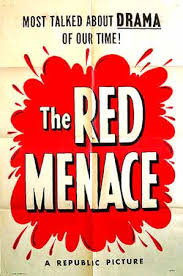
But now that the “workers’ paradise” had disappeared, Americans seemed to lose interest in the Communist Menace.
True, the People’s Republic of China remained, and its increasing economic clout would challenge the United States well into the 21st century. But Americans didn’t seem to fear the Red Chinese as they had the Red Russians.
What was the Republican Party to do to lure voters?
On September 11, 2001, the answer arrived–in two highjacked jetliners that crashed into the World Trade Center in New York and one that struck the Pentagon in Washington, D.C.
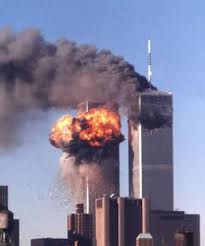
Exit The Red Bogeyman. Enter The Maniacal Muslim.
Consider:
- Mike Huckabee – “If the purpose of a church is to push forward the gospel of Jesus Christ, and then you have a Muslim group that says that Jesus Christ and all the people that follow him are a bunch of infidels who should be essentially obliterated, I have a hard time understanding that.”
- Herman Cain – ”I would not” appoint a Muslim in his administration.
- Newt Gingrich – “I am convinced that if we do not decisively win the struggle over the nature of America, by the time they [his grandchildren] are my age they will be in a secular atheist country, potentially one dominated by radical Islamists. …”
- Rick Santorum – On supporting the racial profiling of Muslims: “Obviously, Muslims would be someone you look at, absolutely.”
- Mitt Romney – “Based on the numbers of American Muslims in our population, I cannot see that a Cabinet position [for a Muslim] would be justified.”
And on July 13, Rep. Michelle Bachmann (R-Minn.) sent letters to the Inspectors General of the Departments of
- Defense;
- State;
- Justice; and
- Homeland Security.
“The purpose of these letters,” wrote Bachmann, was to “request a multi-department investigation into potential Muslim Brotherhood infiltration into the United States Government.”

Michelle Bachmann
Bachmann further asserted in her letter to the State Department that Huma Abedin, deputy chief of staff to Secretary of State Hillary Clinton, had ties to the Muslim Brotherhood.
And the evidence for this?
The Center for Security Policy’s claim that Abedin’s father (who died when she was a teenager), mother and brother are “connected” to the organization.
And what is the Center of Security Policy? A private organization subsidized by donors to neo-conservative causes.
In a separate letter, Bachmann demanded to know how Abedin received her security clearance.
Among the co-signers of Bachmann’s letter to the Inspectors General were:
- Rep. Trent Franks of Arizona, who has said abortion has done more harm to blacks than slavery;
- Rep. Lynn Westmoreland of Georgia, who called presidential candidate Barack Obama and his wife, Michelle, ”uppity”; and
- Rep. Louie Gohmert of Texas, who claims that terrorist organizations send pregnant women into the U.S. so that their children will be American citizens–who can enter and leave the country at will as they are trained to be terrorists abroad.
When pressed for their evidence of “a vast Muslim conspiracy,” right-wing accusers usually refuse to provide any.
An example of this occurred during an August 13, 2010 interview between Gohmert and CNN’s Anderson Cooper:
COOPER: What research? Can you tell us about the research?
GOHMERT: You are attacking the messenger, Anderson, you are better than this. You used to be good. You used to find that there was a problem and you would go after it.
COOPER: Sir, I am asking you for evidence of something that you said on the floor of the House.
GOHMERT: I did, and you listen, this is a problem. If you would spend as much time looking into the problem as you would have been trying to come after me and belittle me this week –
COOPER: Sir, do you want to offer any evidence? I’m giving you an opportunity to say what research and evidence you have. You’ve offered none, other than yelling.
Nor did Gohmert offer any evidence that evening.
Of course, the ultimate Republican Muslim slander is that President Barack Obama–a longtime Christian–is himself a Muslim.
No doubt Republicans feel totally safe in making these attacks, since Muslims comprise only 1% of the American population.
This has long been a hallmark of right-wing attacks–to go after a minority that cannot effectively defend itself.
Thus, Adolf Hitler attacked the Jews of Germany.
And Republicans have successively attacked blacks, Hispanics and gays–until each group became politically influential enough to defeat Republican candidates.
Today, most right-wing politicians at least grudgingly court all of these groups.
When Muslims become a significant political force in their own right, the Right will court them, too. And then move on to yet another helpless scapegoat to blame for America’s troubles.
9/11, ABC NEWS, ADOLF HITLER, AMERICANS FOR TAX REFORM, ANDERSON COOPER, ANTI-COMMUNISM, ARTHUR MILLER, BILL CLINTON, CBS NEWS, CENTER FOR SECURITY POLICY, CHINA, CHRIS MATTHEWS, CNN, DICK CHENEY, DWIGHT D. EISENHOWER, EDWARD R. MURROW, FACEBOOK, GEORGE H.W. BUSH, HARRY S. TRUMAN, HEINRICH HIMMLER, HERMAN CAIN, HERMAN GORING, HILLARY CLINTON, HUMA ABEDIN, JEWS, JIMMY CARTER, JOHN BIRCH SOCIETY, JOHN F. KENNEDY, JOHN STEINBECK, JOSEPH GOEBBELS, JOSEPH MCCARTHY, JOSEPH STALIN, KGB, LIZ CHENEY, LUCILLE BALL, LYNDON B. JOHNSON, MICHELLE BACHMANN, MIKE HUCKABEE, MITT ROMNEY, MSNBC, MUSLIM BROTHERHOOD, MUSLIMS, NAZI GERMANY, NAZI PARTY, NBC NEWS, NEWT GINGRICH, PETE SEEGER, RED SCARE, REINHARD HEYDRICH, REPUBLICAN PARTY, RICHARD NIXON, RICK SANTORUM, Ronald Reagan, SENATOR MIKE ENZI, SOVIET UNION, SS, THE AMERICAN CENTER FOR SECURITY POLICY, THE HUFFINGTON POST, THE LOS ANGELES TIMES, THE NEW YORK TIMES, THE WASHINGTON POST, TWITTER, WYOMING
In Bureaucracy, History, Politics, Social commentary on November 27, 2013 at 12:05 am
“Judge not, that you not be judged. For with what judgment you judged, you shall be judged, and with what measure you mete, it shall be measured to you again.”
So warns the Gospel of St. Matthew, 7:1-2. It’s advice that Right-wingers Joseph McCarthy, Robert Welch and George H.W. Bush would have done well to heed.
Joseph McCarthy, Wisconsin’s gift to the United States Senate, became infamous as the demagogue whose Red-baiting accusations terrified America from 1950 to 1954.
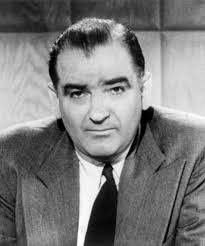
Joseph McCarthy
Elected to the Senate in 1946, he rose to national prominence on February 9, 1950, after giving a fiery speech in Wheeling, West Virginia:
“The State Department is infested with communists. I have here in my hand a list of 205—a list of names that were made known to the Secretary of State as being members of the Communist Party and who nevertheless are still working and shaping policy in the State Department.”
Americans were already growing increasingly fearful of Communism:
- Soviet dictator Joseph Stalin had not withdrawn the Red Army from the countries it had occupied in Eastern Europe during World War II.
- In 1948, the Soviet Union developed–and demonstrated–its own atomic bomb, an achievement U.S. scientists had claimed would not happen for at least a decade.
- In 1949, China fell to the triumphant armies of Mao Tse Tung.
But anti-communism as a lever to political advancement sharply accelerated following McCarthy’s speech. Republicans–resentful at being denied the White House since 1932–seized upon anti-communism as their passport to power.
No American–no matter how prominent–was safe from the accusation of being a Communist or a Communist sympathizer–”a Comsymp” or “fellow traveler” in the style of the era.
Among those accused:
- Secretary of State George C. Marshall, who had overseen America’s strategy for defeating Nazi Germany and Imperial Japan
- President Harry S. Truman
- Playwright Lillian Hellman and Arthur Miller
- Actors Charlie Chaplin, Zero Mostel, Lloyd Bridges, Howard Da Silva, Edward G. Robinson and John Garfield
- Composers Arron Copland and Elmer Bernstein
- Physicist J. Robert Oppenheimer, who presided over the creation of America’s atomic bomb
- Actressses Lee Grant, Delores del Rio, Ruth Gordon and Lucille Ball
- Journalists Edward R. Murrow and William L. Shirer, who had chronicled the rise of Nazi Germany
- Folksinger Pete Seeger
- Writers Irwin Shaw, Howard Fast, John Steinbeck and Dashiell Hammett
Even “untouchable” Republicans became targets for such slander.
The most prominent of these was President Dwight D. Eisenhower–labeled ”a conscious, dedicated agent of the Communist Conspiracy” by Robert Welch, who founded the John Birth Society in 1958.

Robert Welch
Welch, an independently wealthy businessman, used his money to publicize the Society and its views. Welch saw even hardline anti-Communists like Vice President Richard Nixon and actor Ronald Reagan as dangerously liberal.
Meanwhile, McCarthy finally overstepped himself. In 1953, he attacked the leadership of the United States Army as “a hotbed of traitors” and convened an inquiry through the Senate Permanent Subcommittee on Investigations.
But the hearings backfired, exposing McCarthy as the bullying demagogue he was. A Senate committee voted to condemn his behavior, charging that he had “acted contrary to senatorial ethics and tended to bring the Senate into dishonor and disrepute.”
Although McCarthy remained in the Senate another two and a half years, his political influence had ended.
Journalists who had raced to cover his latest slander now avoided him. So did his Republican colleagues–many of whom had once sought his help at election time.
Yet even without McCarthy, Republicans rode the issue of anti-Communism to victory from 1948 to 1960.
After holding the White House for eight years under Eisenhower, they lost it in 1960 to John F. Kennedy and again in 1964 to Lyndon Johnson.
By 1968, with the nation mired in Vietnam and convulsed by antiwar demonstrations, Americans turned once more to those who preyed upon their fears and hates. They elected Richard Nison–and re-elected him in 1972.
After Jimmy Carter won the Presidency in 1976 and lost it in 1980, Republicans held the White House until 1992. Throughout that time, they continued to accuse their opponents of being devious agents–or at least unwitting pawns–of “the Communist conspiracy.”
Even as late as 1992, President George H.W. Bush and the Republican establishment charged that Arkansas Governor Bill Clinton might be a KGB plant.
Their evidence: During his tenure at Oxford University in 1969-70, Clinton had briefly visited Moscow.
Thus, the Republican charged that he might have been “programmed” as a real-life “Manchrian candidate” to become, first, Governor of Arkansas–one of America’s poorest states–and then President.
What made this charge all the more absurd: The Soviet Union had officially dissolved in December, 1991.
Although Republicans continued to hurl “Communist!” and “treason!” at their opponents, these charges no longer carried the weight they had while the Soviet Union existed.
Right-wingers had to settle for attacking their opponents as “liberals” and “soft on crime.”
Then, on September 11, 2001, Republicans–and their right-wing supporters–at last found a suitable replacement for the Red Menace.
9/11, ABC NEWS, ADOLF HITLER, AMERICANS FOR TAX REFORM, ANDERSON COOPER, ANTI-COMMUNISM, ARTHUR MILLER, BILL CLINTON, CBS NEWS, CENTER FOR SECURITY POLICY, CHINA, CHRIS MATTHEWS, CNN, DICK CHENEY, DWIGHT D. EISENHOWER, EDWARD R. MURROW, FACEBOOK, GEORGE H.W. BUSH, HARRY S. TRUMAN, HEINRICH HIMMLER, HERMAN CAIN, HERMAN GORING, HILLARY CLINTON, HUMA ABEDIN, JEWS, JIMMY CARTER, JOHN BIRCH SOCIETY, JOHN F. KENNEDY, JOHN STEINBECK, JOSEPH GOEBBELS, JOSEPH MCCARTHY, JOSEPH STALIN, KGB, LIZ CHENEY, LUCILLE BALL, LYNDON B. JOHNSON, MARY CHENEY, MICHELLE BACHMANN, MIKE HUCKABEE, MITT ROMNEY, MSNBC, MUSLIM BROTHERHOOD, MUSLIMS, NAZI GERMANY, NAZI PARTY, NBC NEWS, NEWT GINGRICH, PETE SEEGER, RED SCARE, REINHARD HEYDRICH, REPUBLICAN PARTY, RICHARD NIXON, RICK SANTORUM, Ronald Reagan, SAME-SEX MARRIAGE, SENATOR MIKE ENZI, SOVIET UNION, SS, THE AMERICAN CENTER FOR SECURITY POLICY, THE HUFFINGTON POST, THE LOS ANGELES TIMES, THE NEW YORK TIMES, THE WASHINGTON POST, TWITTER, WYOMING
In Bureaucracy, History, Politics, Social commentary on November 26, 2013 at 12:09 am
“All revolutions,” said Ernst Rohem, leader of Adolf Hitler’s brown-shirted thugs, the S.A., “devour their own children.”
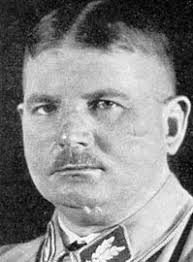
Ernst Rohem
Fittingly, he said this as he sat inside a prison cell awaiting his own execution.
On June 30, 1934, Hitler had ordered a massive purge of his private army, the S.A., or Stormtroopers. The purge was carried out by Hitler’s elite army-within-an-army, the Schutzstaffel, or Protective Squads, better known as the SS.
The S.A. Brownshirts had been instrumental in securing Hitler’s rise to Chancellor of Germany on January 30, 1933. They had intimidated political opponents and organized mass rallies for the Nazi Party.
But after Hitler reached the pinnacle of power, they became a liability.
Ernst Rohem, their commander, urged Hitler to disband the regular German army, the Reichswehr, and replace it with his own legions as the nation’s defense force.
Frightened by Rohem’s ambitions, the generals of the Reichswehr gave Hitler an ultimatum: Get rid of Rohem–or they would get rid of him.
So Rohem died in a hail of SS bullets–as did several hundred of his longtime S.A. cronies.
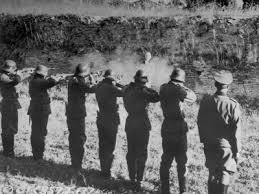
SS firing squad
Among the SS commanders supervising those executions was Reinhard Heydrich–a tall, blond-haired formal naval officer who was both a champion fencer and talented violinist.
Ultimately, he would become the personification of the Nazi ideal–”the man with the iron heart,” as Hitler eulogized at Heydrich’s funeral just eight years later.
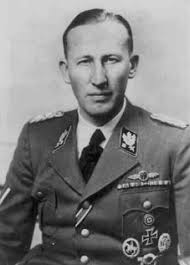
Reinhard Heydrich
Even so, Heydrich had a problem: He could never escape vicious rumors that his family tree contained a Jewish ancestor.
His paternal grandmother had married Reinhold Heydrich, and then Gustav Robert Suss. For unknown reasons, she decided to call herself Suss-Heydrich.
Since “Suss” was widely believed in Germany to indicate Jewish origin, the “stigma” of Jewish heritage attached itself to the Heydrich family.
Heydrich joined the SS in 1931 and quickly became head of its counterintelligence service. But his arrogance and overweening ambition created a great many enemies.
Only a year later, he became the target of an urgent investigation by the SS itself.
The charge: That he was part-Jewish, the ultimate sin in Hitler’s “racially pure” Nazi Germany.
The investigation cleared Heydrich, but the rumor of his “tainted” origins persisted, clearly tormenting the second most powerful man in the SS.
Even his superior, Heinrich Himmler, the Reichsfuhrer-SS, believed it.
When Heydrich was assassinated in 1942 by Czech assassins in Prague, Himmler attended his funeral.
He paid tribute to his former subordinate at the service–”You, Reinhard Heydrich, were a truly good SS-man.” But he could not resist saying in private:
“He was an unhappy man, completely divided against himself, as often happened with those of mixed race.”
Those who dare to harshly judge others usually find themselves assailed just as harshly.
A modern-day example is Liz Cheney, daughter of former Vice President Dick Cheney and now a candidate for U.S. Senator from Wyoming.
Liz is positioning herself as far more right-wing than her opponent, Republican U.S. Senator Michael Bradley “Mike” Enzi.
She has her work cut out for her: In March, 2007, Enzi was ranked by National Journal as the sixth-most conservative U.S. Senator.
Among his legislative priorities:
- Supporting partial privatization of Social Security
- Consistently voting against expanding Medicare.
- Voting against enrolling more children or the poor in public healthcare.

Mike Enzi
And Liz has a problem Enzi does not: Her sister, Mary, is not only a lesbian but legally married to another woman: Heather Poe.
This has led many Wyoming voters to wonder if Liz Cheney is far-Right enough to merit their support.
So Liz is going all-out to assure them that even though her sister leads a degenerate lifestyle, she, Liz, stands foursquare against legalizing gay marriage:
“I do believe it’s an issue that’s got to be left up to states. I do believe in the traditional definition of marriage.”

Liz Cheney
And, in another statement: “I am strongly pro-life and I am not pro-gay marriage.
“I believe the issue of marriage must be decided by the states, and by the people in the states, not by judges and not even by legislators, but by the people themselves.”
This stance has led to a heated rift between her and Mary.
“For the record, I love my sister, but she is dead wrong on the issue of marriage,” Mary Cheney wrote in a Facebook post in September.
“Freedom means freedom for everyone,” she continued. “That means that all families–regardless of how they look or how they are made–all families are entitled to the same rights, privileges and protections as every other.”
Adding to the complications: Their father, Dick Cheney—often ridiculed as “Darth Vader” for his own extreme Right-wing views—endorsed same-sex marriage in 2009.
But, as was true for officials in Nazi Germany, so is it true for Right-wing Republicans: It’s impossible to be too radical a Right-winger.
In the 1930s and 40s, it was politically—and personally—dangerous to be labeled “pro-Jewish” or “pro-Communist” in Hitler’s Germany.
And today it is equally dangerous—at least politically—to be labeled “pro-liberal” or “pro-gay” in the Republican Party.
9/11, ABC NEWS, ABRAHAM LINCOLN, AL QAEDA, ANDREW JACKSON, BARACK OBAMA, BILL CLINTON, CBS NEWS, CNN, CUBAN MISSILE CRISIS, EMANCIPATION PROCLOMATION, EXTORTION, FACEBOOK, FBI, FEDERAL GOVERNMENT SHUTDOWN, FORD'S THEATER, FRANKLIN ROOSEVELT, FURLOUGHS, GEORGE H.W. BUSH, JOHN F. KENNEDY, JOSEPH MCCARTHY, MAFIA, MITT ROMNEY, MSNBC'S "HARDBALL", NBC NEWS, NEGOTIATING, OBAMACARE, PATRIOT ACT, R.I.CO. ACT, REPUBLICAN PARTY, REPUBLICANS, RICHARD NIXON, Secret Service, TED NUGENT, TERRORISM, THE AFFORDABLE CARE ACT, THE LOS ANGELES TIMES, THE NEW YORK TIMES THE WASHINGTON POST, TWITTER, UNITED STATES HOLOCAUST MEMORIAL, VIETNAM WAR MEMORIAL, WHITE HOUSE, WORLD WAR 11
In Bureaucracy, History, Politics on October 4, 2013 at 12:01 am
For a half-century, Republicans have been damning the very government they lust to control.
Consider this choice comment from Mitt Romney supporter Ted Nugent:
“I spoke at the NRA and will stand by my speech. It’s 100 percent positive. It’s about we the people taking back our American dream from the corrupt monsters in the federal government under this administration, the communist czars he [President Barack Obama] has appointed.”
Romney, of course, refused to disavow the slander Nugent cast over every man and woman working on behalf of the American people.
Romney and his fellow Republicans salivate at every vile charge they can hurl at the very government they lust to control.
As in the case of Senator Joseph McCarthy, no slander is too great if it advances their path to power.
But there are others–living or at least working in Washington, D.C.–who simply go about their jobs with quiet dedication. And they leave slanderous, self-glorifying rhetoric to Right-wing politicians.
One of these unsung heroes was Stephen Tyrone Johns, a security guard at the United States Holocaust Memorial Museum.

On June 10, 2009, Johns, 39, was shot and killed by James Wenneker von Brunn, a white supremist and Holocaust denier. Brunn was himself shot and wounded by two other security guards who returned fire.
While in jail awaiting his trial, von Brunn–who was 88–died on January 6, 2010.
To work in Washington, D.C., is to realize that this city ranks–with New York City–at the top of Al Qaeda’s list of targets.
No one knows this better than the agents of the United States Secret Service, who protect the President, Vice President, their families and the White House itself 24 hours a day.

Prior to 9/11, visiting the White House was assumed to be an American right. No longer.
Today, if you want to tour the Executive Mansion, you quickly learn there are only two ways to get in:
- Through a special pass provided by your Congressman; or
- By someone connected with the incumbent administration.
Congressmen, however, have a limited number of passes to give out. And most of these go to people who have put serious money into the Congressman’s re-election campaigns.
And the odds that you’ll know someone who works in the White House–and who’s willing to offer you an invitation–are even smaller than those of knowing a Congressman.
But even that isn’t enough to get you through the White House door.
You’ll have to undergo a Secret Service background check. And that requires you to submit the following information in advance of your visit:
- Name
- Date of birth
- Birthplace
- Social Security Number
And be prepared to leave a great many items at your hotel room. Among these:
- Cameras or video recorders
- Handbags, book bags, backpacks or purses
- Food or beverages, tobacco products, personal grooming items (i.e. makeup, lotion, etc.)
- Strollers
- Cell phones
- Any pointed objects
- Aerosol containers
- Guns, ammunition, fireworks, electric stun guns, mace, martial arts weapons/devices, or knives of any size
Visitors enter the White House–after showing a government-issued ID card such as a driver’s license–from the south side of East Executive Avenue.
After passing through the security screening room, they walk upstairs to the first door and through the East, Green, Blue, Red and State Dining rooms.
Secret Service agents quietly stand post in every room–unless they’re tasked with explaining the illustrious history of each section of the White House.
Like everyone else who lives/works there, the Secret Service fully appreciates the incredible sense of history that radiates throughout the building.
This is where
- Abraham Lincoln signed the Emancipation Proclomation;
- Franklin Roosevelt directed the United States to victory in World War II;
- John F. Kennedy stared down the Soviets during the Cuban Missile Crisis.
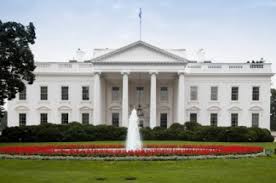
But even the generally unsmiling Secret Service agents have their human side.
While touring the East Wing of the White House, I asked an agent: “Is the East Room where President Nixon gave his farewell speech?” on August 9, 1974.
“I haven’t been programmed for that information,” the agent joked, inviting me to ask a question he could answer.
Another guest asked the same agent if he enjoyed being a Secret Serviceman.
To my surprise, he said that this was simply what he did for a living. His real passion, he said, was counseling youths.
“If you love something,” he advised, “get a job where you can do it. And if you can’t get a job you’re passionate about, get a job so you can pursue your passion.”
Of the more than 2.65 million civilian employees of the executive branch, more than 800,000 have been sent home without pay.
These men and women aren’t faceless “bureaucrats,” as Right-wingers would have people believe. They are hustands and wives, fathers and mothers. They have bills to pay, just like everyone else.
Many of them, such as agents of the FBI and Secret Service, have taken an oath to defend the United States Constitution–with their lives if necessary.
And they now face the dread of going for weeks or even months without a paycheck–as pawns in another Right-wing case of: “My way or no way.”
They deserve a better break–and so do all those who cherish liberty.
9/11, ABC NEWS, ABRAHAM LINCOLN, AL QAEDA, ANDREW JACKSON, BARACK OBAMA, BILL CLINTON, CBS NEWS, CNN, CUBAN MISSILE CRISIS, EMANCIPATION PROCLOMATION, EXTORTION, FACEBOOK, FBI, FEDERAL GOVERNMENT SHUTDOWN, FORD'S THEATER, FRANKLIN ROOSEVELT, FURLOUGHS, GEORGE H.W. BUSH, JOHN F. KENNEDY, JOSEPH MCCARTHY, MAFIA, MITT ROMNEY, MSNBC'S "HARDBALL", NBC NEWS, NEGOTIATING, OBAMACARE, PATRIOT ACT, R.I.CO. ACT, REPUBLICAN PARTY, REPUBLICANS, RICHARD NIXON, Secret Service, TED NUGENT, TERRORISM, THE AFFORDABLE CARE ACT, THE LOS ANGELES TIMES, THE NEW YORK TIMES THE WASHINGTON POST, TWITTER, UNITED STATES HOLOCAUST MEMORIAL, VIETNAM WAR MEMORIAL, WHITE HOUSE, WORLD WAR 11
In Bureaucracy, History, Law, Politics on October 3, 2013 at 12:06 am
Listen to almost any Republican and you’re almost certain to hear how much he hates and despises “Washington.”
To hear Right-wingers tell it, you might believe that “Washington” is:
- The capitol of an enemy nation;
- A cesspool of corrupt, power-hungry men and women slavering to gain dictatorial control over the life of every American;
- A center of lethal contagion which, like ancient Carthage, should be burned to the ground and its inhabitants destroyed or scattered.
All that prevents “Washington” from gaining absolute power–so claim Republicans–is the Republican Party.
But others who live or work in Washington, D.C. take a far different view of their city and the duties they perform.
These men and women will never call a press conference or rake in millions in “political contributions” (i.e., legalized bribes) for promising special privileges to special interests.
Many of them work for the National Park Service. Every national monument–and Washington is speckled with monuments–has several of these employees assigned to it.
Their duties are to protect the monuments and offer historical commentary to the public.
One such employee regularly addresses visitors to Ford’s Theater–known worldwide as the scene of President Abraham Lincoln’s assassination.
George (a pseudonym) opens his lecture by raising the question every member of the audience wants answered: How much of Ford’s Theater remains intact from the night of Lincoln’s murder–April 14, 1865?
And the answer is: Only the exterior of the building.
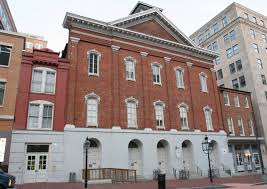
After Lincoln’s assassination, enraged Union soldiers converted the interior of the building into a military command center. That meant ripping out all the seats for spectators and the stage for actors.
The stage and seats–even the “Presidential Box” where Lincoln sat–have all been reproduced for a modern audience.
As George talks, you can tell that, for him, this is no typical day job. He realizes that, renovated or not, Ford’s Theater remains saturated with history. And he clearly feels privileged to share that history with others.
George explains that Presidential assassin John Wilkes Booth did not sneak into the theater. He didn’t have to–as a celebrity actor, he received the sort of favored treatment now accorded Lindsay Lohan.
Another monument where you will find Park Ranger guides is the Vietnam Veterans Memorial.
Completed in 1982, it receives about 3 million visitors a year. Adorning the Wall, in columns that seem to reach endlessly to the sky, are the names of the 58,195 soldiers who gave their lives during the Vietnam War.
That struggle–from 1961 to 1975–proved the most divisive American conflict since the Civil War.
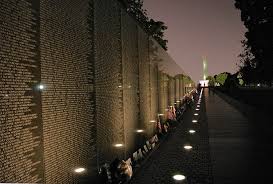
On the day I visited the memorial, groups of elementary schoolchildren passed by. They were jabbering loudly, seemingly oblivious to the terrible sacrifice the Wall was meant to commemorate.
But their adult chaperones realized its significance, and ordered the children to quiet down.
I asked a nearby Park Ranger: “Do you feel people now respond differently to the Wall, as we get further away from the Vietnam war?”
“No,” he answered. He felt that today’s visitors showed the same reverence for the monument and for the losses it had been created to honor as those who had first come in the early 1980s.
And it may well be true: I saw many tiny American flags and wreaths of flowers left at various points along the Wall, which stretches across 250 feet of land on the Mall.
When thinking about “Washington,” it’s essential to remember that this city–along with New York City–remains at the top of Al Qaeda’s target list.
Those who choose to live and/or work here do so in the potential shadow of violent death.
Anytime you enter a Federal building, be prepared to undergo a security check.
In most agencies–such as the Department of Agriculture–you simply place your bags or purses into an X-ray machine similar to those found at airports, and walk through a magnetometer. If no alarms sound, you collect your valuables and pass on through.
Such machines are, of course, nammed by armed security guards. And they stand sentinel at every conceivable Federal building–such as the Supreme Court, the Department of Justice, the Smithsonian Museum, the Pentagon and the U.S. Holocaust Memorial Museum.
These men and women must daily inspect the bodies and handbags of the 15 million people who visit Washington, D.C. annually, generating $5.24 billion dollar in revenues.
This means repeating the same screening gestures countless times–looking through X-ray machines at bags or coats, and running an electronic “wand” up and down those people whose clothing gives off signs of metallic objects.
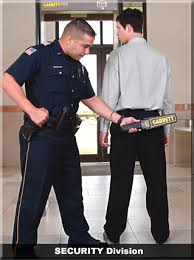
It also means projecting a smiling, friendly demeanor towards those same people–many of whom are in a rush and/or resent being electronically sniffed over.
And every security guard knows this: It’s only a matter of time before the next terrorist shows up.
On June 10, 2009, just that happened at the United States Holocaust Memorial.
9/11, ABC NEWS, ABRAHAM LINCOLN, AL QAEDA, ANDREW JACKSON, BARACK OBAMA, BILL CLINTON, CBS NEWS, CNN, CUBAN MISSILE CRISIS, EMANCIPATION PROCLOMATION, EXTORTION, FACEBOOK, FBI, FEDERAL GOVERNMENT SHUTDOWN, FORD'S THEATER, FRANKLIN ROOSEVELT, FURLOUGHS, GEORGE H.W. BUSH, JOHN F. KENNEDY, JOSEPH MCCARTHY, MAFIA, MITT ROMNEY, MSNBC'S "HARDBALL", NBC NEWS, NEGOTIATING, OBAMACARE, PATRIOT ACT, R.I.CO. ACT, REPUBLICAN PARTY, REPUBLICANS, RICHARD NIXON, Secret Service, TED NUGENT, TERRORISM, THE AFFORDABLE CARE ACT, THE LOS ANGELES TIMES, THE NEW YORK TIMES THE WASHINGTON POST, TWITTER, UNITED STATES HOLOCAUST MEMORIAL, VIETNAM WAR MEMORIAL, WHITE HOUSE, WORLD WAR 11
In Bureaucracy, History, Law, Politics on October 2, 2013 at 2:45 am
To hear many political pundits tell it, the shutdown of the Federal Government is the result of “political dysfunction,” as if everybody in Congress were tripping on LSD.
This is not only untrue but misleading.
The truth is that the shutdown is the result of yet another ruthless attempt by Right-wing Republicans to obtain absolute power.
When they can obtain it at the ballot box, they rule as though by divine right. When they can’t obtain it at election time, they try to obtain it through intimidation.
Thus, in 1992 and 1996, their Presidential candidates–President George H.W. Bush and Senator Bob Dole, respectively–couldn’t defeat Bill Clinton.
So Republicans mounted an inquisition into a failed land deal that occurred before Clinton was first elected President. This investigation spanned the length of the Clinton Presidency and produced no evidence or indictments of criminal activity.
It did, however, turn up the salacious news that Clinton had actually enjoyed several instances of oral sex courtesy of a libidinous White House intern named Monica Lewinsky.
Unable to defeat Clinton at election time, and unable to find any actual criminal wrongdoing on his part, Right-wing Republicans tried to drive him out of office by impeachment.
The effort failed, and Clinton stayed in the White House until his term expired in 2001.
Then, as now, it was members of the House of Representatives who were the driving force.
Now, fast forward to the present: Republicans have made it their mission to deprive millions of Americans of health care. They have voted 42 times to repeal or undermine the Affordable Care Act, better known as Obamacare.
And they have made its elimination the focus of their threats to shut down the government unless they get their way.
Yet, consider this: Whether they like it or not, the Affordable Care Act is now a law that was legally passed by both houses of Congress. It has been certified as Constitutional by no less than a Republican Chief Justice of the United States Supreme Court.
Under our system of government, that’s as legal as it gets.
But Republicans don’t care about legality when they’re pursuing absolute power over the lives of their fellow Americans.
Thus, they have carried out their threat to shut down the Federal Government since they couldn’t coerce Senate Democrats into de-funding “Obamacare.”
As a result:
- More than 800,000 federal workers have been sent home without pay;
- National parks and monuments have been closed;
- Some programs have been temporarily crippled–such as WIC, which provides nutritional food to poor mothers with infants; and
- Some members of “essential services” are still required to be on duty–such as the military and Federal law enforcement agencies–but without receiving paychecks.
Of course, this disgrace didn’t have to happen.
President Obama didn’t have to cave in to the latest Republican extortion demands to prevent such a shutdown.
He could have ordered his Attorney General, Eric Holder, to launch an FBI invesdtigation into terroristic threats made by Right-wingers to shut down the government.
Both the 1970 Racketeer Influenced Corrupt Organizations (RICO) Act and the USA Patriot Act provide remedies for punishing the sort of behavior engaged in by House Republicans.
RICO opens with a series of definitions of “racketeering activity” which can be prosecuted by Justice Department attorneys. Among those crimes: Extortion.

Extortion is defined as “a criminal offense which occurs when a person unlawfully obtains either money, property or services from a person(s), entity, or institution, through coercion.”
And if President Obama believed that RICO was not sufficient to deal with extortionate behavior, he could have relied on the Patriot Act of 2001, passed in the wake of 9/11.
In Section 802, the Act defines domestic terrorism. Among the behavior that is defined as criminal:
“Activities that…appear to be intended…to influence the policy of a government by intimidation or coercion [and]…occur primarily within the territorial jurisdiction of the United States.”
Demanding that the President de-fund Obamacare or face a potentially disastrous government shutdown clearly falls within the legal definition of “activities…intended…to influence the policy of a government by intimidation or coercion.”
If the FBI had determined that Federal laws against extortion and terrorism had been broken, the Justice Department could have convened criminal grand juries to indict those Republicans found as violators.
President Obama should have authorized this investigation as soon as Republicans started making terroristic threats. Thus, he would have served notice on his sworn enemies that he was no one to take lightly.
Knowing that they might well face indictment and prosecution for engaging in domestic terrorism would have frightened many Republicans into backing away from such behavior.
Those who persisted would have found themselves fighting desperately to stay out of prison. They would have had to pay huge fees to top-flight criminal attorneys.
They would have lived with, first, the threat of indictments hanging over their heads, and, once those indictments were returned, with the threat of conviction and imprisonment.
As a result, they would not have had time to make destroying the Presidency of Barack Obama their Number One priority.
But Obama forfeited all those advantages when he accused Republicans of “blackmail” and then refused to legally punish them for it.
ABC NEWS, ADOLF HITLER, ANDREW JACKSON, BARACK OBAMA, CBS NEWS, CHRIS MATTHEWS, CNN, CNN'S "STARTING POINT", CUBAN MISSILE CRISIS, DEBT CEILING, EXTORTION, FACEBOOK, GEORGE W. BUSH, HOUSE SPEAKER JOHN BOEHNER, JOHN F. KENNEDY, MAFIA, MSNBC'S "HARDBALL", MUNICH CONFERENCE, NBC NEWS, NEGOTIATING, NEVILLE CHAMBERLAIN, NICCOLO MACHIAVELLI, OBAMACARE, PAP SMEARS, PATRIOT ACT, PLANNED PARENTHOOD, R.I.CO. ACT, REPUBLICAN PARTY, REPUBLICANS, THE AFFORDABLE CARE ACT, THE LOS ANGELES TIMES, THE NEW YORK TIMES THE WASHINGTON POST, THE PRINCE, TWITTER, WINSTON CHURCHILL, WORLD WAR 11
In Bureaucracy, History, Law Enforcement, Politics, Social commentary on September 24, 2013 at 12:00 am
The 1938 Munich Conference taught an invaluable lesson in foreign affairs: Caving in to the demands of insatiable thugs leads to only more demands.
That was what British Prime Minister Nveille Chamberlain learned when he sought to appease Adolf Hitler, Germany’s war-intent Fuehrer.
Chamberlain believed that by giving in to Hitler’s demands for “the German part” of Czechoslavakia known as the Sudetenland he could avoid war.
On September 29, Chamberlain and French Prime Minister Edouard Daladier met with Hitler and signed the Munich Agreement, resulting in the immediate German occupation of part of Czechoslavakia.
The Czechoslovakian government had not been a party to the talks. Their “allies” had sold them out.
Chamberlain returned to England a hero. Holding aloft a copy of the worthless agreement he had signed with Hitler, he told cheering crowds in London: “I believe it is peace for our time.”
Winston Churchill knew better, predicting: “Britain and France had to choose between war and dishonor. They chose dishonor. They will have war.”
And so they did.
It is not too late for President Barack Obama to apply this lesson from history.
With the United States facing a disastrous government shutdown unless the President surrenders to the latest Republican extortion threats, Obama can:
- Invoke the Racketeer Influenced Corrupt Organizations Act (RICO) and/or the Patriot Act;
- Rally the American people against this criminal threat to the security of the Nation.
Second Option: Calling upon the American people for their support
President John F. Kennedy did just that–successfully–during the most deadly crisis of his administration.
Addressing the Nation on October 22, 1962, Kennedy shocked his fellow citizens by revealing that the Soviet Union had placed offensive nuclear missiles in Cuba.
After outlining a series of steps he had taken to end the crisis, Kennedy sought to reassure and inspire his audience. His words are worth remembering today:
“The path we have chosen for the present is full of hazards, as all paths are, but it is the one most consistent with our character and courage as a nation and our commitments around the world.
“The cost of freedom is always high, but Americans have always paid it. And one path we shall never choose, and that is the path of surrender or submission.”
Just as President Kennedy called on his fellow Americans for support against a foreign enemy, President Obama can rally his countrymen against an equally ruthless domestic enemy.
During such a national address, President Obama can reveal such blunt truths as:

- Republicans have adopted the same my-way-or-else “negotiating” stance as Adolf Hitler.
- Like the Nazis, they are determined to gain absolute power–or destroy the Nation they claim to love.
- They raised the debt ceiling seven times during the eight-year Presidency of George W. Bush.
- But now that a Democrat holds the White House, raising the debt ceiling is unacceptable.
- Despite Republican lies, we cannot revitalize the economy by slashing taxes on the wealthy and cash-hoarding corporations while cutting benefits for millions of average Americans.
- We will need both tax increases and sensible entitlement cuts to regain our economic strength.
- The Affordable Health Care Act frees Americans from the greed-fueled tyranny of the insurance industry.
- Americans who could never hope to obtain medical coverage–for themselves and their families–can now do so.
Finally, President Obama can end his speech by directly calling for the active support of his fellow Americans. Something like this:
“My fellow Americans, I have taken an oath to ‘preserve, protect and defend the Constitution of the United States.’
“But I cannot do this on my own. As citizens of a Republic, each of us carries that burden. We must each do our part to protect the land and the liberties we love.
“Tonight, I’m asking for your help.
“We stand on the edge of economic and social disaster. Therefore, I am asking each of you to stand up for America tonight–by demanding the recall of the entire membership of the Republican Party.
“As President John F. Kennedy said:
‘In your hands, my fellow citizens, more than mine, will rest the final success or failure of our course. Since this country was founded, each generation of Americans has been summoned to give testimony to its national loyalty.’
“This is the moment when each of us must decide–whether we will survive as a Republic, or allow ruthless political fanatics to destroy what has lasted and thrived for more than 200 years.”
President Obama has taken forceful action against America’s most ruthless foreign enemies—most notably, Osama bin Laden.
If the Nation is to survive, he must now act just as forcefully against America’s most ruthless domestic enemies.
Fortunately, there is still time for him to do so. The fact that he has not done so in the past does not rule out his doing so now.
He needs to only remember–and act on–the words of another American President–Andrew Jackson–who counseled: “One man with courage makes a majority.”
ABC NEWS, ADOLF HITLER, ANDREW JACKSON, BARACK OBAMA, CBS NEWS, CHRIS MATTHEWS, CNN, CNN'S "STARTING POINT", CUBAN MISSILE CRISIS, DEBT CEILING, EXTORTION, FACEBOOK, GEORGE W. BUSH, HOUSE SPEAKER JOHN BOEHNER, JOHN F. KENNEDY, MAFIA, MSNBC'S "HARDBALL", MUNICH CONFERENCE, NBC NEWS, NEGOTIATING, NEVILLE CHAMBERLAIN, NICCOLO MACHIAVELLI, OBAMACARE, PAP SMEARS, PATRIOT ACT, PLANNED PARENTHOOD, R.I.CO. ACT, REPUBLICAN PARTY, REPUBLICANS, THE AFFORDABLE CARE ACT, THE LOS ANGELES TIMES, THE NEW YORK TIMES THE WASHINGTON POST, THE PRINCE, TWITTER, WINSTON CHURCHILL, WORLD WAR 11
In Bureaucracy, History, Law Enforcement, Politics, Social commentary on September 23, 2013 at 12:10 am
Republicans are once again playing extortion politics–threatening to shut down the government unless they get their way.
And their way means abolishing The Affordable Care Act, otherwise known as Obamacare.
But this is a nightmare that doesn’t have to be.
There are, in fact, two ways to avoid it.
Assuming that President Obama doesn’t once again surrender to Republican extortion demands, he has two formidable weapons he can deploy:
First Option: RICO to the rescue
The Racketeer Influenced Corrupt Organizations (RICO) Act is a provision of the Organized Crime Control Act of 1970. It authorizes prosecution for acts performed as part of an ongoing criminal organization.
It has been applied to not only the Mafia but to individuals, businesses, political protest groups, and terrorist organizations. In short, a RICO claim can arise in almost any context.
Such as the one President Barack Obama faced in 2011 when Republicans threatened to destroy the credit rating of the United States unless their budgetary demands were met.
And such as the present case when Republicans are again threatening the security of the Nation with extortionate demands.
RICO opens with a series of definitions of “racketeering activity” which can be prosecuted by Justice Department attorneys. Among those crimes: Extortion.
Extortion is defined as “a criminal offense which occurs when a person unlawfully obtains either money, property or services from a person(s), entity, or institution, through coercion.”
The RICO Act defines “a pattern of racketeering activity” as “at least two acts of racketeering activity, one of which occurred after the effective date of this chapter and the last of which occurred within ten years…after the commission of a prior act of racketeering activity.”
And if President Obama believes that RICO is not sufficient to deal with extortionate behavior, he can rely on the USA Patriot Act of 2001, passed in the wake of 9/11.
In Section 802, the Act defines domestic terrorism. Among the behavior that is defined as criminal:
“Activities that…appear to be intended…to influence the policy of a government by intimidation or coercion [and]…occur primarily within the territorial jurisdiction of the United States.”
Demanding that the President de-fund Obamacare or face a potentially disastrous government shutdown clearly falls within the legal definition of “activities…intended…to influence the policy of a government by intimidation or coercion.”
The remedies for punishing such criminal behavior are now legally in place. President Obama need only direct the Justice Department to apply them.
President Obama can direct Attorney General Eric Holder to investigate whether Republican Congressman—and their Tea Party cohorts—have violated Federal anti-racketeering and/or anti-terrorism laws.
- Holder, in turn, can order the FBI to conduct such an investigation.
- If the FBI finds sufficient evidence that these laws had been violated, Holder can empanel criminal grand juries to indict those violators.
The fact that members of Congress would be criminally investigated and possibly indicted would not violate the separation-of-powers principle. Congressmen have in the past been investigated, indicted and convicted for various criminal offenses.
Such indictments and prosecutions–and especially convictions–would serve notice on current and future members of Congress that the lives and fortunes of American citizens may not be held hostage as part of a negotiated settlement.
On August 1, 2011, Chris Matthews, host of MSNBC’s “Hardball,” wrapped up his program with a search for “options” to avoid another round of Republican extortion tactics.
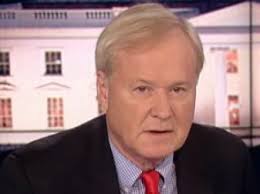
Chris Matthews
“I want to know what steps the president ‘could’ have taken to avoid this hostage-taking.
“…Is there another way than either buckling to the Republicans or letting the government and the country crash?
“How does he use the power of the presidency, the logic, emotion and basic patriotism of the people to thwart those willing to threaten, disrupt, even possibly destroy to get their way?”
The answer to his questions–then and now–is: Replace the law of fear with the rule of law.
Or, as Niccolo Machiavelli, the father of modern politics, instructed future leaders in The Prince:
“I conclude, therefore, with regard to being loved and feared, that men love at their own free will, but fear at the will of the prince, and that a wise prince must rely on what is in his power and not on what is in the power of others….”
Instead, in 2011, Obama surrendered to Republican extortion demands. As a result, the United States suffered a massive loss to its international credit rating.
But there was another way Obama could have stood up to Republican extortionists. And it remains available to him now–if only he has the courage to act.
ABC NEWS, ADOLF HITLER, ANDREW JACKSON, BARACK OBAMA, CBS NEWS, CHRIS MATTHEWS, CNN, CNN'S "STARTING POINT", CUBAN MISSILE CRISIS, DEBT CEILING, EXTORTION, FACEBOOK, GEORGE W. BUSH, HOUSE SPEAKER JOHN BOEHNER, JOHN F. KENNEDY, MAFIA, MSNBC'S "HARDBALL", MUNICH CONFERENCE, NBC NEWS, NEGOTIATING, NEVILLE CHAMBERLAIN, NICCOLO MACHIAVELLI, OBAMACARE, PAP SMEARS, PATRIOT ACT, PLANNED PARENTHOOD, R.I.CO. ACT, REPUBLICAN PARTY, REPUBLICANS, THE AFFORDABLE CARE ACT, THE LOS ANGELES TIMES, THE NEW YORK TIMES THE WASHINGTON POST, THE PRINCE, TWITTER, WINSTON CHURCHILL, WORLD WAR 11
In Bureaucracy, History, Law Enforcement, Politics, Social commentary on September 20, 2013 at 12:15 am
Republicans are once again playing extortion politics–threatening to shut down the government unless they get their way.
And their way means abolishing The Affordable Care Act, otherwise known as Obamacare.
They’re enraged that millions of uninsured Americans might receive medical care on a par with that given members of the House and Senate.
So on September 20, the House will vote on a short-term government funding bill that will include a provision to defund Obamacare.
That provision is a no-go for Senate Democrats and President Obama. If the House and Senate can’t work out a compromise, many functions of the federal government will be shut down indefinitely on Oct. 1.
Republicans have repeatedly threatened to shut down the government unless their constantly escalating demands were met.
In November, 1995, Newt Gingrich, then Speaker of the House of Representatives, carried out his threat. Gingrich unwisely admitted that he did so because President Bill Clinton had put him in the back of Air Force One during a recent trip to Israel.
The shutdown proved a disaster for Republicans. Clinton was handily re-elected in 1996 and Gingrich suddenly resigned from Congress in 1998.
Still, the Republicans continued their policy of my-way-or-else. In April, 2011, the United States government almost shut down over Republican demands about subsidized pap smears.
During a late-night White House meeting with President Barack Obama and key Congressional leaders, Republican House Speaker John Boehner made this threat:
His conference would not approve funding for the government if any money were allowed to flow to Planned Parenthood through Title X legislation.
Facing an April 8 deadline, negotiators worked day and night to strike a compromise–and finally reached one.
Three months later–on July 9–Republican extortionists again threatened the Nation with financial ruin and international disgrace unless their demands were met.

esident Obama had offered to make historic cuts in the federal government and the social safety net–on which millions of Americans depend for their most basic needs.
But House Speaker John Boehner rejected that offer. He could not agree to the tax increases that Democrats wanted to impose on the wealthiest 1% as part of the bargain.

John Boehner
As the calendar moved ever closer to the fateful date of August 2, Republican leaders continued to insist: Any deal that includes taxes “can’t pass the House.”
President Obama had previously insisted on extending the debt ceiling through 2012. But in mid-July, he simply asked congressional leaders to review three options with their members:
- The “Grand Bargain” choice—favored by Obama–would cut deficits by about $4 trillion, including spending cuts and new tax revenues.
- A medium-range plan would aim to reduce the deficit by about $2 trillion.
- The smallest option would cut between $1 trillion and $1.5 trillion, without increased tax revenue or any Medicare and Medicaid cuts.
And the Republican response?
Said Rep. Darrell Issa, chairman of the Oversight and Government Reform Committee: “Quite frankly, [Republican] members of Congress are getting tired of what the president won’t do and what the president wants.”
Noted political analyst Chris Matthews summed up the sheer criminality of what happened within the House of Representatives.
Speaking on MSNBC’s “Hardball,” on July 28–five days before Congress reached its August 2 deadline to raise the debt-ceiling–Matthews noted:
“The first people to bow to the demands of those threatening to blow up the economy were the Republicans in the House, the leaders. The leaders did what the followers told them to do: meet the demands, hold up the country to get their way.
“Those followers didn’t win the Senate, or the Presidency, just the House.
“But by using the House they were able to hold up the entire United States government. They threatened to blow things up economically and it worked.
“They said they were willing to do that–just to get their way–not by persuasion, not by politics, not by democratic government, but by threatening the destruction of the country’s finances.
“Right. So what’s next? The power grid? Will they next time threaten to close down the country’s electricity and communications systems?”
With the United States teetering on the brink of national bankruptcy, President Obama faced three choices:
- Counter Republican extortion attempts via RICO–the Racketeer Influenced Corrupt Oganizations Act.
- Make a “Cuban Missile Crisis”-style address to the American people, seeking to rally them against a criminal threat to the financial security of the Nation.
- Cave in to Republican demands.
Unfortunately for Obama and the Nation, he chose Number Three.
The results were easily predictable: Emboldened by success, the extortionists continue to make even greater demands.
But this is a nightmare that doesn’t have to be.
There are, in fact, two ways to avoid it:
- The President can order the Justice Department to prosecute Republican extortion attempts via RICO–the Racketeer Influenced Corrupt Organizations Act.
- The President can make a “Cuban Missile Crisis” style address to the American people, seeking to rally them against a criminal threat to the security of the Nation.
9/11, ABC NEWS, AL QAEDA, AMERICAN EMPIRE, BILL CLINTON, BUREAUCRACY, CBS NEWS, CHRIS MATHEWS, CNN, DWIGHT EISENHOWER, FACEBOOK, FBI, FRANKLIN D. ROOSEVELT, GEORGE H.W. BUSH, GEORGE W. BUSH, GERALD R. FORD, HARRY S. TRUMAN, JIMMY CARTER, JOHN F. KENNEDY, LYNDON B. JOHNSON, MSNBC, NBC NEWS, NIGEL HAMILTON, OSAMA BIN LADEN, REPUBLICAN PARTY, RIAHCRD M. NIXON, ROMAN EMPIRE, SEPTEMBER 11, SUETONIUS, TERRORISM, THE HUFFINGTON POST, THE LOS ANGELES TIMES, THE NEW YORK TIMES, THE TWELVE CAESARS, TWITTER
In Bureaucracy, History, Military, Politics, Social commentary on September 13, 2013 at 12:00 am
Colonel Brandt: “I wonder what we’ll do after we lose the war.”
Captain Kiesel: “Prepare for the next one.”
–“The Cross of Iron,” film by Sam Peckinpah
On September 12, 2001, President George W. Bush attended a meeting of the National Security Council.
“Why shouldn’t we go against Iraq, not just Al-Qaeda?” demanded Donald Rumsfeld, the Secretary of Defense.
Vice President Dick Cheney enthusiastically agreed.
Secretary of State Colin Powell then pointed out there was absolutely no evidence that Iraq had had anything to do with 9/11 or Al-Qaeda. And he added: “The American people want us to do something about Al-Qaeda”–-not Iraq.
On November 21, 2001, only 10 weeks after 9/11, Bush told Rumsfeld: It’s time to turn to Iraq.

Liars Club: Condoleeza Rice, Dick Cheney, George Bush, Donald Rumsfeld
Bush and his war-hungry Cabinet officials knew that Americans demanded vengeance on Al-Qaeda’s mastermind, Osama bin Laden, and not Iraqi dictator Saddam Hussein,. So they repeatedly fabricated “links” between the two:
- Saddam had worked hand-in-glove with Bin Laden to plan 9/11.
- Saddam was harboring and supporting Al-Qaeda throughout Iraq.
- Saddam, with help from Al-Qaeda, was scheming to build a nuclear bomb.
Yet as early as September 22, 2001, Bush had received a classified President’s Daily Brief intelligence report, which stated that there was no evidence linking Saddam Hussein to 9/11.
The report added that there was scant credible evidence that Iraq had any significant collaborative ties with Al-Qaeda.
Even more important: Saddam had tried to monitor Al Qaeda through his intelligence service-–because he saw Al-Qaeda and other theocratic radical Islamist organizations as a potential threat to his secular regime.
Bush administration officials repeatedly claimed that Iraq possessed huge quantities of chemical and biological weapons, in violation of UN resolutions. And they further claimed that US intelligence agencies had determined:
- the precise locations where these weapons were stored;
- the identities of those involved in their production; and
- the military orders issued by Saddam Hussein for their use in the event of war.
Among other lies stated as fact by members of the Bush administration:
- Iraq had sought uranium from Niger, in west Africa;
- Thousands of aluminum tubes imported by Iraq could be used in centrifuges to create enriched uranium;
- Iraq had up to 20 long-range Scud missiles, prohibited under UN sanctions;
- Iraq had massive stockpiles of chemical and biological agents, including nerve gas, anthrax and botulinum toxin;
- Saddam Hussein had issued chemical weapons to front-line troops who would use them when US forces crossed into Iraq.
Consider the following:
August 26, 2002: Cheney told the Veterans of Foreign Wars, “There is no doubt that Saddam Hussein now has weapons of mass destruction. There is no doubt he is amassing them to use against our friends, against our allies and against us.”
September 8, 2002: National Security Advisor Condoleeza Rice said on CNN: ”There is certainly evidence that Al-Qaeda people have been in Iraq. There is certainly evidence that Saddam Hussein cavorts with terrorists.”
September 18, 2002: Rumsfeld told the House Armed Services Committee, “We do know that the Iraqi regime has chemical and biological weapons. His regime has amassed large, clandestine stockpiles of chemical weapons—including VX, sarin, cyclosarin and mustard gas.”
October 7, 2002: Bush declared in a nationally televised speech in Cincinnati that Iraq “possesses and produces chemical and biological weapons. It is seeking nuclear weapons.”
March 16, 2003: Cheney declared on NBC’s “Meet the Press”: “We believe [Saddam Hussein] has, in fact, reconstituted nuclear weapons.”
March 30, 2003: On ABC’s “This Week” program, 10 days into the war, Rumsfeld said: “We know where they [weapons of mass destruction] are.”
Bush never regretted his decision to invade Iraq, which occurred on March 29, 2003.
Even as American occupying forces repeatedly failed to turn up any evidence of “weapons of mass destruction” (WMDs), Bush and his minions claimed the invasion a good thing.
In fact, Bush-–who hid out the Vietnam war in the Texas Air National Guard-–even joked publicly about the absence of WMDs.
He did so at a White House Correspondents dinner on March 24, 2004-–one year after he had started the war.
To Bush, the non-existent WMDs were nothing more than the butt of a joke that night. While an overhead projector displayed photos of a puzzled-looking Bush searching around the Oval Office, Bush recited a comedy routine.
Click here: Bush laughs at no WMD in Iraq – YouTube
“Those weapons of mass destruction have gotta be somewhere,” Bush laughed, while a photo showed him poking around the corners in the Oval Office.
“Nope-–no weapons over there! Maybe they’re under here,” he said, as a photo showed him looking under a desk.
Meanwhile, an assembly of wealthy, pampered men and women–-the elite of America’s media and political classes–-laughed heartily during Bush’s performance.
Ultimately, the war that Bush had deliberately provoked would
- Take the lives of 4,486 Americans;
- Cost the United States Treasury at least $810 billion; and
- Kill at least 116,000 Iraqi civilians.


9/11, ABC NEWS, ADOLF HITLER, AMERICANS FOR TAX REFORM, ANDERSON COOPER, ANTI-COMMUNISM, ARTHUR MILLER, BILL CLINTON, CBS NEWS, CENTER FOR SECURITY POLICY, CHINA, CHRIS MATTHEWS, CNN, DICK CHENEY, DWIGHT D. EISENHOWER, EDWARD R. MURROW, FACEBOOK, GEORGE H.W. BUSH, HARRY S. TRUMAN, HEINRICH HIMMLER, HERMAN CAIN, HERMAN GORING, HILLARY CLINTON, HUMA ABEDIN, JEWS, JIMMY CARTER, JOHN BIRCH SOCIETY, JOHN F. KENNEDY, JOHN STEINBECK, JOSEPH GOEBBELS, JOSEPH MCCARTHY, JOSEPH STALIN, KGB, LIZ CHENEY, LUCILLE BALL, LYNDON B. JOHNSON, MICHELLE BACHMANN, MIKE HUCKABEE, MITT ROMNEY, MSNBC, MUSLIM BROTHERHOOD, MUSLIMS, NAZI GERMANY, NAZI PARTY, NBC NEWS, NEWT GINGRICH, PETE SEEGER, RED SCARE, REINHARD HEYDRICH, REPUBLICAN PARTY, RICHARD NIXON, RICK SANTORUM, Ronald Reagan, SENATOR MIKE ENZI, SOVIET UNION, SS, THE AMERICAN CENTER FOR SECURITY POLICY, THE HUFFINGTON POST, THE LOS ANGELES TIMES, THE NEW YORK TIMES, THE WASHINGTON POST, TWITTER, WYOMING
THE POLITICS OF SCAPEGOATING: PART THREE (END)
In Bureaucracy, History, Politics, Social commentary on November 28, 2013 at 12:00 amWith the Soviet Union collapsed in 1991, the Republican Party went into a tailspin of dismay.
For almost 50 years, Republicans had conjured up The Red Bogeyman to scare voters into sending them to Congress and the White House.
But now that the “workers’ paradise” had disappeared, Americans seemed to lose interest in the Communist Menace.
True, the People’s Republic of China remained, and its increasing economic clout would challenge the United States well into the 21st century. But Americans didn’t seem to fear the Red Chinese as they had the Red Russians.
What was the Republican Party to do to lure voters?
On September 11, 2001, the answer arrived–in two highjacked jetliners that crashed into the World Trade Center in New York and one that struck the Pentagon in Washington, D.C.
Exit The Red Bogeyman. Enter The Maniacal Muslim.
Consider:
And on July 13, Rep. Michelle Bachmann (R-Minn.) sent letters to the Inspectors General of the Departments of
“The purpose of these letters,” wrote Bachmann, was to “request a multi-department investigation into potential Muslim Brotherhood infiltration into the United States Government.”
Michelle Bachmann
Bachmann further asserted in her letter to the State Department that Huma Abedin, deputy chief of staff to Secretary of State Hillary Clinton, had ties to the Muslim Brotherhood.
And the evidence for this?
The Center for Security Policy’s claim that Abedin’s father (who died when she was a teenager), mother and brother are “connected” to the organization.
And what is the Center of Security Policy? A private organization subsidized by donors to neo-conservative causes.
In a separate letter, Bachmann demanded to know how Abedin received her security clearance.
Among the co-signers of Bachmann’s letter to the Inspectors General were:
When pressed for their evidence of “a vast Muslim conspiracy,” right-wing accusers usually refuse to provide any.
An example of this occurred during an August 13, 2010 interview between Gohmert and CNN’s Anderson Cooper:
COOPER: What research? Can you tell us about the research?
GOHMERT: You are attacking the messenger, Anderson, you are better than this. You used to be good. You used to find that there was a problem and you would go after it.
COOPER: Sir, I am asking you for evidence of something that you said on the floor of the House.
GOHMERT: I did, and you listen, this is a problem. If you would spend as much time looking into the problem as you would have been trying to come after me and belittle me this week –
COOPER: Sir, do you want to offer any evidence? I’m giving you an opportunity to say what research and evidence you have. You’ve offered none, other than yelling.
Nor did Gohmert offer any evidence that evening.
Of course, the ultimate Republican Muslim slander is that President Barack Obama–a longtime Christian–is himself a Muslim.
No doubt Republicans feel totally safe in making these attacks, since Muslims comprise only 1% of the American population.
This has long been a hallmark of right-wing attacks–to go after a minority that cannot effectively defend itself.
Thus, Adolf Hitler attacked the Jews of Germany.
And Republicans have successively attacked blacks, Hispanics and gays–until each group became politically influential enough to defeat Republican candidates.
Today, most right-wing politicians at least grudgingly court all of these groups.
When Muslims become a significant political force in their own right, the Right will court them, too. And then move on to yet another helpless scapegoat to blame for America’s troubles.
Share this: