bureaucracybusters

Posts Tagged ‘JOSEPH STALIN’

THE POLITICS OF SCAPEGOATING: PART ONE (OF THREE)

In Bureaucracy, History, Politics, Social commentary on November 26, 2013 at 12:09 am

“All revolutions,” said Ernst Rohem, leader of Adolf Hitler’s brown-shirted thugs, the S.A., “devour their own children.”

Ernst Rohem

Fittingly, he said this as he sat inside a prison cell awaiting his own execution.

On June 30, 1934, Hitler had ordered a massive purge of his private army, the S.A., or Stormtroopers.  The purge was carried out by Hitler’s elite army-within-an-army, the Schutzstaffel, or Protective Squads, better known as the SS.

The S.A. Brownshirts had been instrumental in securing Hitler’s rise to Chancellor of Germany on January 30, 1933.  They had intimidated political opponents and organized mass rallies for the Nazi Party.

But after Hitler reached the pinnacle of power, they became a liability.

Ernst Rohem, their commander, urged Hitler to disband the regular German army, the Reichswehr, and replace it with his own legions as the nation’s defense force.

Frightened by Rohem’s ambitions, the generals of the Reichswehr gave Hitler an ultimatum: Get rid of Rohem–or they would get rid of him.

So Rohem died in a hail of SS bullets–as did several hundred of his longtime S.A. cronies.

SS firing squad

Among the SS commanders supervising those executions was Reinhard Heydrich–a tall, blond-haired formal naval officer who was both a champion fencer and talented violinist.

Ultimately, he would become the personification of the Nazi ideal–”the man with the iron heart,” as Hitler eulogized at Heydrich’s funeral just eight years later.

Reinhard Heydrich

Even so, Heydrich had a problem: He could never escape vicious rumors that his family tree contained a Jewish ancestor.

His paternal grandmother had married Reinhold Heydrich, and then Gustav Robert Suss.  For unknown reasons, she decided to call herself Suss-Heydrich.

Since “Suss” was widely believed in Germany to indicate Jewish origin, the “stigma” of Jewish heritage attached itself to the Heydrich family.

Heydrich joined the SS in 1931 and quickly became head of its counterintelligence service.  But his arrogance and overweening ambition created a great many enemies.

Only a year later, he became the target of an urgent investigation by the SS itself.

The charge: That he was part-Jewish, the ultimate sin in Hitler’s “racially pure” Nazi Germany.

The investigation cleared Heydrich, but the rumor of his “tainted” origins persisted, clearly tormenting the second most powerful man in the SS.

Even his superior, Heinrich Himmler, the Reichsfuhrer-SS, believed it.

When Heydrich was assassinated in 1942 by Czech assassins in Prague, Himmler attended his funeral.

He paid tribute to his former subordinate at the service–”You, Reinhard Heydrich, were a truly good SS-man.”  But he could not resist saying in private:

“He was an unhappy man, completely divided against himself, as often happened with those of mixed race.”

Those who dare to harshly judge others usually find themselves assailed just as harshly.

A modern-day example is Liz Cheney, daughter of former Vice President Dick Cheney and now a candidate for U.S. Senator from Wyoming.

Liz is positioning herself as far more right-wing than her opponent, Republican U.S. Senator Michael Bradley “Mike” Enzi.

She has her work cut out for her: In March, 2007, Enzi was ranked by National Journal as the sixth-most conservative U.S. Senator.

Among his legislative priorities:

  • Supporting partial privatization of Social Security
  • Consistently voting against expanding Medicare.
  • Voting against enrolling more children or the poor in public healthcare.


                     Mike Enzi

And Liz has a problem Enzi does not: Her sister, Mary, is not only a lesbian but legally married to another woman: Heather Poe.

This has led many Wyoming voters to wonder if Liz Cheney is far-Right enough to merit their support.

So Liz is going all-out to assure them that even though her sister leads a degenerate lifestyle, she, Liz, stands foursquare against legalizing gay marriage:

“I do believe it’s an issue that’s got to be left up to states. I do believe in the traditional definition of marriage.”

Liz Cheney

And, in another statement: “I am strongly pro-life and I am not pro-gay marriage.

“I believe the issue of marriage must be decided by the states, and by the people in the states, not by judges and not even by legislators, but by the people themselves.”

This stance has led to a heated rift between her and Mary.

“For the record, I love my sister, but she is dead wrong on the issue of marriage,” Mary Cheney wrote in a Facebook post in September.

“Freedom means freedom for everyone,” she continued. “That means that all families–regardless of how they look or how they are made–all families are entitled to the same rights, privileges and protections as every other.”

Adding to the complications: Their father, Dick Cheney—often ridiculed as “Darth Vader” for his own extreme Right-wing views—endorsed same-sex marriage in 2009.

But, as was true for officials in Nazi Germany, so is it true for Right-wing Republicans: It’s impossible to be too radical a Right-winger.

In the 1930s and 40s, it was politically—and personally—dangerous to be labeled “pro-Jewish” or “pro-Communist” in Hitler’s Germany.

And today it is equally dangerous—at least politically—to be labeled “pro-liberal” or “pro-gay” in the Republican Party.

REWRITING HISTORY FOR TEXANS

In Bureaucracy, History, Politics on November 7, 2013 at 12:16 am

“The problem with writing about history in the Soviet Union,” went the joke, “is that you never know what’s going to happen yesterday.”

The same can now be said about writing history under the new guidelines of the Texas Board of Education.

The changes to the state’s history textbooks were opposed by historians and civil rights leaders. The new curriculum presents history from a right-wing perspective and de-emphasizes the role of blacks, Hispanics and other minority groups.

The board’s decision will affect students living outside Texas because of the state’s major impact on the nation’s textbook publishers.

Because the Texas textbook market is so large, books assigned to the state’s 4.7 million students often become bestsellers, decreasing costs for other school districts and leading them to buy the same materials.

“The books that are altered to fit the standards become the bestselling books, and therefore within the next two years they’ll end up in other classrooms,” said Fritz Fischer, chairman of the National Council for History Education, a group devoted to history teaching at the pre-college level.

“It’s not a partisan issue, it’s a good history issue.”

The new version of history given Texas students will:

  • Celebrate the free market;
  • Minimize the role of labor movements; and
  • Give greater prominence to conservative figures like Phyllis Schlafly.

Additional changes will include:

  • Students will now study Confederate President Jefferson Davis’ inaugural address alongside President Abraham Lincoln’s Gettysburg Address.
  • Upton Sinclair’s book The Jungle, which documented the horrors of working conditions in the meatpacking industry and led to calls for greater regulation, has been removed from the list of suggested readings.
  • The Rev. Martin Luther King Jr.’s “Letter From a Birmingham Jail,” has also been removed.
  • Thomas Jefferson’s name has been removed from a list of the country’s great thinkers because he advocated the separation of church and state.
  • In a sop to the Christian Right, references have been added to “laws of nature and nature’s God” to a section in U.S. history that requires students to explain major political ideas.
  • The word “democratic” has been removed in references to the form of U.S. government, and this will now be described as a “constitutional republic.”
  • A reference to the Second Amendment right to bear arms has been added to a section about citizenship in a U.S. government class.
  • Economics students will be required to “analyze the decline of the U.S. dollar including abandonment of the gold standard.”
  • The names or references to important Hispanics throughout history also were deleted, such as the fact that Tejanos died at the Alamo alongside Davy Crockett and Jim Bowie.
  • All references to “capitalism” have been replaced with “free enterprise.”
  • U.S. “imperialism” no longer exists; there is only “U.S. expansionism.” Only the Europeans are guilty of “imperialism,” just as only the Soviets committed “aggression.”
  • In a rare setback for the radical Right, the slave trade will not be renamed the “Atlantic triangular trade.”

At one time, Americans believed that such wholesale rewriting of history could happen only in the Soviet Union. A classic example of this occurred in 1953, within the Great Soviet Encyclopedia.

Lavrenti Beria had been head of the NKVD, the dreaded secret police, from 1938 to 1953. In 1953, following the death of Joseph Stalin, Beria was arrested and executed on orders of his fellow Communist Party leaders.

Lavrenti Beria

But the Great Soviet Encyclopedia had just gone to press with a long article singing Beria’s praises.

What to do?

The editors of the Encyclopedia wrote an equally long article about “the Berring Straits,” which was to be pasted over the article about Beria, and sent this off to its subscribers.  An unknown number of them decided it was safer to paste accordingly.

In the 1981 film, “Excalibur,” Merlin warns the newly-minted knights of the Round Table: “For it is the doom of men that they forget.”

Forgetting our past is dangerous, but so is “understanding” it incorrectly. Deliberately omitting events and persons from the historical record–such as Thomas Jefferson and Martin Luther King–can be as lethal to the truth as outright lying.

Stalin, for example, ordered the deletion of all references to the major role played by Leon Trotsky, his arch-rival for power, during the Russian Revolution.

Similarly, requiring students to study Confederate President Jefferson Davis’ inaugural address alongside President Lincoln’s Gettysburg Address should be seen for what it is: A thinly-veiled attempt to legitimize the most massive case of treason in United States history.

(The Civil War started on April 12, 1861, when Confederate artillery opened fire on Fort Sumter, a United States fort in Charleston Harbor. Fort Sumter surrendered 34 hours later.

(At least 800,000 Southerners took up arms against the legally elected government of the United States.)

The late broadcast journalist, Edward R. Murrow, would have referred to this as “giving Jesus and Judas equal time.”

All of which simply proves, once again, that the past is never truly dead. It simply waits to be re-interpreted by each new generation–with some interpretations winding up closer to the truth than others.
IS THERE A HITLER IN YOUR CEO?

In Bureaucracy, History, Military, Social commentary on September 2, 2013 at 12:01 am

Each Labor Day, American politicians offer lip-service tribute to those millions of American workers who make corportate profits a reality.

But no one ever says anything about those over-pampered, over-paid CEOs who all too often take credit for the work done by those millions of American workers.

Too many CEOs have–consciously or not–patterened themselves after the ultimate CEO: Adolf Hitler.

Ever since he shot himself in his underground Berlin bunker on April 30, 1945, historians have fiercely debated:  Was der Fuehrer a military genius or an imbecile?

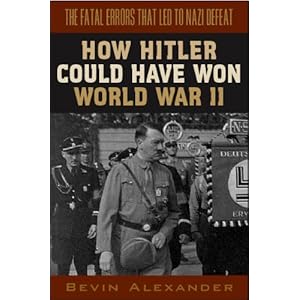
With literally thousands of titles to choose, the average reader may feel overwhelmed.  But if you’re looking for an understandable, overall view of Hitler’s generalship, an excellent choice would be How Hitler Could Have Won World War II by Bevin Alexander.

How Hitler Could Have Won World War II

Among “the fatal errors that led to Nazi defeat” (as proclaimed on the book jacket) were:

  • Wasting hundreds of Luftwaffe pilots, fighters and bombers in a half-hearted attempt to conquer England.
  • Ignoring the pleas of generals like Erwin Rommel to conquer Syria, Iraq and Saudi Arabia–thus giving Germany control of most of the world’s oil.
  • Attacking his ally, the Soviet Union, while still at war with Great Britain.
  • Needlessly turning millions of Russians into enemies rather than allies by his brutal and murderous policies.
  • Declaring war on the United States after the Japanese attacked Pearl Harbor.  (Had he not done so, Americans would have focused all their attention on conquering Japan.)
  • Refusing to negotiate a separate peace with Soviet dictator Joseph Stalin–thus granting Germany a large portion of captured Russian territory in exchange for letting Stalin remain in power.
  • Insisting on a ”not one step back” military “strategy” that led to the unnecessary surrounding, capture and/or deaths of hundreds of thousands of German servicemen.

As the war turned increasingly against him, Hitler became ever more rigid in his thinking.  He demanded absolute control over the smallest details of his forces.  This, in turn, led to astounding and needless losses in German soldiers.

One such incident was immortalized in the 1962 movie, The Longest Day, about the Allied invasion of France known as D-Day.

On June 6, 1944, Rommel ordered the panzer tanks to drive the Allies from the Normandy beaches.  But these could not be released except on direct order of the Fuehrer.

As Hitler’s chief of staff, General Alfred Jodl, informed Rommel: The Fuehrer was asleep–and, no, he, Jodl, would not wake him.

By the time Hitler awoke and issued the order, it was too late.

Nor could he accept responsibility for the policies that were clearly leading Germany to certain defeat.  Hitler blamed his generals, accused them of cowardice, and relieved many of the best ones from command.

Among those sacked was Heinz Guderian, creator of the German panzer corps–and thus responsible for its highly effective “blitzkrieg” campaign against France in 1940.

Heinz Guderian

Another was Erich von Manstein, designer of the strategy that defeated France in six weeks–something Germany couldn’t do during the four years of World War 1.

Erich von Manstein

Finally, on April 29, 1945–with the Russians only blocks from his underground bunker in Berlin–Hitler dictated his “Last Political Testament.”  Once again, he refused to accept responsibility for unleashing a war that would ultimately consume 50 million lives:

“It is untrue that I or anyone else in Germany wanted war in 1939.  It was desired and instigated exclusively by those international statesmen who either were of Jewish origin or worked for Jewish interests.”

Hitler had launched the war with a lie–that Poland had attacked Germany, rather than vice versa.  And he closed the war–and his life–with a final lie.

All of which, once again, brings us back to Niccolo Machiavelli, the father of political science.

In his classic book, The Discourses, he wrote at length on the best ways to maintain liberty within a republic.  In Book Three, Chapter 31, Machiavelli declares: “Great Men and Powerful Republics Preserve an Equal Dignity and Courage in Prosperity and Adversity.”

It is a chapter that Adolf Hitler would have done well to read.

“…A truly great man is ever the same under all circumstances.  And if his fortune varies, exalting him at one moment and oppressing him at another, he himself never varies, but always preserves a firm courage, which is so closely interwoven with his character that everyone can readily see that the fickleness of fortune has no power over him.

“The conduct of weak men is very different.  Made vain and intoxicated by good fortune, they attribute their success to merits which they do not possess, and this makes them odious and insupportable to all around them. 

And when they have afterwards to meet a reverse of fortune, they quickly fall into the other extreme, and become abject and vile.  

“Thence it comes that princes of this character think more of flying in adversity than of defending themselves, like men who, having made a bad use of prosperity, are wholly unprepared for any defense against reverses.”

Stay alert to signs of such character flaws among your own business colleagues–and especially your superiors.  They are the warning signs of a future catastrophe.

IS THERE A HITLER IN YOUR CEO?

In Bureaucracy, Business, Politics, Social commentary on May 3, 2013 at 12:35 am

Would-be CEOs and Fuehrers, listen up: Character is destiny.

Case in point: The ultimate Fuehrer and CEO, Adolf Hitler.

Ever since he shot himself in his underground Berlin bunker on April 30, 1945, historians have fiercely debated: Was der Fuehrer a military genius or an imbecile?

With literally thousands of titles to choose, the average reader may feel overwhelmed. But if you’re looking for an understandable, overall view of Hitler’s generalship, an excellent choice would be How Hitler Could Have Won World War II by Bevin Alexander.

How Hitler Could Have Won World War II

Among “the fatal errors that led to Nazi defeat” (as proclaimed on the book jacket) were:

  • Wasting hundreds of Luftwaffe pilots, fighters and bombers in a half-hearted attempt to conquer England.
  • Ignoring the pleas of generals like Erwin Rommel to conquer Syria, Iraq and Saudi Arabia–thus giving Germany control of most of the world’s oil.
  • Attacking his ally, the Soviet Union, while still at war with Great Britain.
  • Needlessly turning millions of Russians into enemies rather than allies by his brutal and murderous policies.
  • Declaring war on the United States after the Japanese attacked Pearl Harbor. (Had he not done so, Americans would have focused all their attention on conquering Japan.)
  • Refusing to negotiate a separate peace with Soviet dictator Joseph Stalin–thus granting Germany a large portion of captured Russian territory in exchange for letting Stalin remain in power.
  • Insisting on a “not one step back” military “strategy” that led to the unnecessary surrounding, capture and/or deaths of hundreds of thousands of German servicemen.

As the war turned increasingly against him, Hitler became ever more rigid in his thinking. He demanded absolute control over the smallest details of his forces. This, in turn, led to astounding and needless losses in German soldiers.

One such incident was immortalized in the 1962 movie, The Longest Day, about the Allied invasion of France known as D-Day.

On June 6, 1944, Rommel ordered the panzer tanks to drive the Allies from the Normandy beaches. But these could not be released except on direct order of the Fuehrer.

As Hitler’s chief of staff, General Alfred Jodl, informed Rommel: The Fuehrer was asleep–and, no, he, Jodl, would not wake him.

By the time Hitler awoke and issued the order, it was too late.

Nor could he accept responsibility for the policies that were clearly leading Germany to certain defeat. Hitler blamed his generals, accused them of cowardice, and relieved many of the best ones from command.

Among those sacked was Heinz Guderian, creator of the German panzer corps–and thus responsible for its highly effective “blitzkrieg” campaign against France in 1940.

Heinz Guderian

Another was Erich von Manstein, designer of the strategy that defeated France in six weeks–something Germany couldn’t do during the four years of World War 1.

Erich von Manstein

Finally, on April 29, 1945–with the Russians only blocks from his underground bunker in Berlin–Hitler dictated his “Last Political Testament.” Once again, he refused to accept responsibility for unleashing a war that would ultimately consume 50 million lives:

“It is untrue that I or anyone else in Germany wanted war in 1939. It was desired and instigated exclusively by those international statesmen who either were of Jewish origin or worked for Jewish interests.”

Hitler had launched the war with a lie–that Poland had attacked Germany, rather than vice versa. And he closed the war–and his life–with a final lie.

All of which, once again, brings us back to Niccolo Machiavelli, the father of political science.

In his classic book, The Discourses, he wrote at length on the best ways to maintain liberty within a republic. In Book Three, Chapter 31, Machiavelli declares: “Great Men and Powerful Republics Preserve an Equal Dignity and Courage in Prosperity and Adversity.”

It is a chapter that Adolf Hitler would have done well to read.

“…A truly great man is ever the same under all circumstances. And if his fortune varies, exalting him at one moment and oppressing him at another, he himself never varies, but always preserves a firm courage, which is so closely interwoven with his character that everyone can readily see that the fickleness of fortune has no power over him.

“The conduct of weak men is very different. Made vain and intoxicated by good fortune, they attribute their success to merits which they do not possess, and this makes them odious and insupportable to all around them.

“And when they have afterwards to meet a reverse of fortune, they quickly fall into the other extreme, and become abject and vile.

“Thence it comes that princes of this character think more of flying in adversity than of defending themselves, like men who, having made a bad use of prosperity, are wholly unprepared for any defense against reverses.”

Stay alert to signs of such character flaws among your own business colleagues–and especially your superiors. They are the warning signs of a future catastrophe.

WHEN THE KGB COMES CALLING

In Bureaucracy, History, Humor, Law Enforcement, Social commentary on April 24, 2013 at 12:00 am

A day after bombs ravaged the Boston Marathon, Russian President Vladimir Putin offered his country’s assistance in investigating this latest Islamic outrage.

Putin said in a condolences note published on the Kremlin’s website that the international community should unite to fight terrorism.

Vladimir Putin

Putin said Russia “would be ready to provide assistance” to U.S. authorities with the probe into the bombings at the Boston marathon.

Fortunately, the FBI, Bureau of Alcohol, Tobacco and Firearms (ATF) and Boston police were able, within a week, to identify and kill/arrest the two brothers responsible for killing three people and injuring about 180 more.

But suppose President Obama had taken Putin up on his offer?

Officially, the KGB (“Committee for State Security”) no longer exists.  It was abolished by then-Soviet President Mikhail Gorbachev following the agency’s unsuccessful coup against him in August, 1991.

But its legacy lives on in the renamed FSB (Federal Security Service).

The KGB was formed in 1954, the year after the death of Joseph Stalin, Russia’s 20th century version of Ivan the Terrible.  (Previously, the state secret police had been known, first, as the Cheka–“Extraordinary Commission”– and then as the NKVD.)

Regardless of its name, the agency relentlessly pursued its twin goals: Brutally repressing political oppression at home and spying on its enemies abroad.

Through the reins of Nikita Khrushchev, Leonid Brezhniev, Yuri Andropov, Constitin Chernenko and Mikhail Gorbachev, the KGB acted as “the sword and shield of Russia.”  Among its tens of thousands of members was Vladimir Putin.

Even the worst abuses of J. Edgar Hoover’s FBI pale in comparison to those of the KGB, which ran its own prisons, routinely tortured and murdered men and women, and conducted espionage abroad.

The agency remained impervious to control except by its Kremlin masters–who were the ones directing its worst atrocities.

So it’s intriguing to imagine how the KGB would have reacted to the bombings at the Boston Marathon.

Perhaps the best way to do this is to see the KGB–oops, FSB–through the eyes of its former victims: The ussians themselves.

Unable to protest the abuses of the all-powerful police, Russians–in secret, and only among their most-trusted friends and family members–struck back with humor of the blackest sort

  • Q. Why do the KGB operate in groups of three? A. One who can read, one who can write and one to keep an eye on the two intellectuals.
  • A KGB officer tells the next-of-kin that her father committed suicide.  Woman: How did he die?  KGB: Skull fracture.  Woman:  How did it happen?  KGB: He wouldn’t drink the poison.
  • A Russian teacher asks her class, “Who wrote ‘The Communist Manifesto’?”  A boy says, “I don’t know, but it wasn’t me.”  The teacher thinks he’s being flippant, so she sends him home.  The boy tells his father, who complains to a friend who’s a KGB agent.  “Don’t worry,” says the KGB man, “I’ll find out who really wrote it.”  The KGB agent drives to the home of the teacher’s apartment.  The teacher asks, “Why have you woken me up?”  The KGB officer says: “It wasn’t the boy.  His father has confessed.” 
  • A man owns a parrot–until one day it disappears.  The owner rushes to the nearest KGB office.  “Why come to us?  It’s none of our affair,” says the KGB official.  “I just wanted you to know,” says the man, “that if it turns up, I don’t happen to share its opinions.”
  • A KGB agent spots an old man reading a book and asks what it’s about. “I’m learning Hebrew,” says the man, “because it’s the language of Heaven.  When I die, I want to talk to God.”  The KGB man says, “But suppose when you die you go to Hell?”  The old man says: “I already know Russian.”
  • The Egyptian government announces that an unidentified mummy has been found, and asks the world’s best archaeologists to help solve the mystery.  In response, the Soviet Union sends its top archaeologist–accompanied by two KGB guards to ensure he doesn’t defect.  The three men enter the tomb and, three days later, emerge.  “It’s Ramses III,” says the archaeologist.  “How did you figure it out?” asks a reporter.  And one of the KGB guards says, “The bastard finally confessed.”
  • A man knocks at the door of his neighbor’s apartment, yelling: “Quick, get up, get dressed!”  From inside he can hear screams of fear.  “Don’t worry,” he says, “it’s nothing serious.  I’m not from the KGB.  I just wanted to tell you your flat is on fire.”
  • A Russian boy asks his father, “Will there still be a KGB when we achieve Full Communism?”  And his father replies: “No, by then people will have learned how to arrest themselves.”
  • A delegation comes to the Kremlin to visit Leonid Brezhniev.  When they leave, Brezhniev can’t find his  cigarette case.  He telephones the head of the KGB and says, “Find out of one of the delegates took my case.”  Later, Brezhniev finds it under a table.  He calls the KGB director and says, “I found my case.  You can let the delegates go.”  “It’s too late for that,” says the KGB director, adding: “Half the delegates admitted they took your case, and the other half died under questioning.”

LOVE VS. FEAR

In History, Politics on April 11, 2013 at 12:02 am

Dick Cheney left office as co-President of the United States on January 20, 2009.  During the last four years, he has had time to write his memoirs and reflect on the legacies of the George W. Bush Presidency.

His book, In My Time, was published in 2012.  And, in March, Cheney appeared in the Showtime-produced documentary, “The World According to Dick Cheney.”

Dick Cheney

Throughout the program, Cheney showed no interest in introspection.

“I don’t go around thinking, ‘Gee, I wish we’d done this, or I wish I’d done that,'” said Cheney.  “The world is as you find it, and you’ve got to deal with that….You don’t get do-overs.

“I did what I did, and it’s all part of the public record and I feel very good about it.  If I had it to do over again, I’d do it in a minute.”

When the interviewer, R.J. Cutler, raised how the administration altered privacy rights, tortured detainees and pushed for an unnecessary war in Iraq, Cheney replied:

“Tell me what terrorist acts you would let go forward because you didn’t want to be a mean and nasty fella?”

Perhaps the most telling moment came when Cheney outlined his overall views on Realpolitick:

“Are you going to trade the lives of a number of people because you want to preserve your honor?” asked Cheney.  “This was a wartime situation and it was more important to be successful than it was to be loved.”

Perhaps Cheney was thinking of Niccolo Machiavelli’s famous quote about love versus fear in The Prince, his primer on how to attain political power:

From this arises the question whether it is better to be loved than feared, or feared more than loved.  The reply is, that one ought to be both feared and loved, but as it is difficult for the two to go together, it is much safer to be feared than loved. 

For it may be said of men in general that they are ungrateful, voluble, dissemblers, anxious to avoid danger and covetous of gain; as long as you benefit them, they are entirely yours: they offer you their blood, their goods, their life and their children, when the necessity is remote, but when it approaches, they revolt….

Niccolo Machiavelli

And men have less scruple in offending one who makes himself loved than one who makes himself feared; for love is held by a chain of obligations which, men being selfish, is broken whenever it serves their purpose; but fear is maintained by a dread of punishment which never fails.

Cheney appears to belileve that it’s better to be feared than loved.

In that, he has plenty of company among his fellow politicians–in the United States and elsewhere.  But there is more to Machiavelli’s teaching, and this is usually overlooked–as it most certainly was by Cheney:

Still, a prince should make himself feared in such a way that if he does not gain love, he at any rate avoids hatred: for fear and the absence of hatred may well go together, and will always be attained by one who abstains from interfering with the property of his citizens and subjects or with their women. 

If Cheney considers himself a student of Machiavelli, then he utterly ignored this last offering of cautionary advice.

By authorizing the use of torture, the administration made itself–in the eyes of its Western European allies as well as its Islamic enemies–an epicenter of evil.  “Guantanamo”–the Marine base in Cuba that had been largely forgotten over the decades–became a synonym for Auschwitz.

And after photographs emerged of the tortures and humiliataions of detainees at Abu Garib Prison in Iraq, the United States sank even lower in the world’s estimation.

Among the human rights violations committed upon prisoners held by U.S. Army military police and assorted CIA agents:

  • physical abuse
  • psychological abuse
  • torture
  • rape
  • sodomy
  • homicide.

Of the ultimate legacy of George W. Bush and Dick Cheney, historian Nigel Hamilton wrote in his 2010 book, American Caesars: Lives of the Presidents from Franklin D. Roosevelt to George W. Bush:

“…arguably the worst of all the American Caesars, who willfully and recklessly destroyed so much of the moral basis of American leadership in the modern world.”

Joseph Stalin once famously asked: “How many divisions does the Pope have?”  Stalin died in 1953.  Had he lived on into the 1980s, he would have found out.

It was then that Pope John Paul II showed the power of an aroused spirituality.

John Paul II

When the Soviet Union seemed about to invade his native Poland as it had Hungary and Czechoslavakia, the Pope reportedly sent the Kremlin a message: He would fly to Warsaw and place himself directly in the line of fire.

The Soviets never dared launch their planned invasion.

It is a lesson utterly lost on the likes of men like Dick Cheney.