Posts Tagged ‘BILL CLINTON’
ADOLF HITLER, BARACK OBAMA, BILL CLINTON, CHRIS MATTHEWS, CNN'S "STARTING POINT", CZECHOSLAVAKIA, DARRELL ISSA, DEBT CEILING, EXECUTIVE ORDERS, EXTORTION, FACEBOOK, GEORGE W. BUSH, HOUSE SPEAKER JOHN BOEHNER, immigration reform, JIMMY CARTER, MSNBC'S "HARDBALL", NAZI GERMANY, NEGOTIATING, NEVILLE CHAMBERLAIN, NEWT GINGRICH, NICCOLO MACHIAVELLI, PAP SMEARS, PLANNED PARENTHOOD, POLAND, R.I.CO. ACT, REPUBLICAN PARTY, REPUBLICANS, Ronald Reagan, THE PRINCE, TITLE X, TWITTER, WARREN BUFFET, WINSTON CHURCHILL, WORLD WAR 11
In Bureaucracy, History, Law, Law Enforcement, Politics on July 7, 2014 at 9:21 am
In November, 1995, Newt Gingrich, then Speaker of the House of Representatives, carried out his threat to shut down the government.
Then he unwisely admitted that he did so because President Bill Clinton had put him in the back of Air Force One during a recent trip to Israel.

Newt Gingrich
The shutdown proved a disaster for Republicans. Clinton was handily re-elected in 1996 and Gingrich suddenly resigned from Congress in 1998.
Still, the Republicans continued their policy of my-way-or-else.
In April, 2011, the United States government almost shut down over Republican demands about subsidized pap smears.
During a late-night White House meeting with President Barack Obama and key Congressional leaders, Republican House Speaker John Boehner made this threat:
His conference would not approve funding for the government if any money were allowed to flow to Planned Parenthood through Title X legislation.
Facing an April 8 deadline, negotiators worked day and night to strike a compromise–and finally reached one.
Three months later–on July 9–Republican extortionists again threatened the Nation with financial ruin and international disgrace unless their demands were met.

President Obama had offered to make historic cuts in the federal government and the social safety net–on which millions of Americans depend for their most basic needs.
But House Speaker John Boehner rejected that offer. He could not agree to the tax increases that Democrats wanted to impose on the wealthiest 1% as part of the bargain.

John Boehner
As the calendar moved ever closer to the fateful date of August 2, Republican leaders continued to insist: Any deal that includes taxes “can’t pass the House.”
One senior Republican said talks would go right up to–and maybe beyond–the brink of default.
“I think we’ll be here in August,” said Republican Representative Pete Sessions, of Texas. “We are not going to leave town until a proper deal gets done.”
President Obama had previously insisted on extending the debt ceiling through 2012. But in mid-July, he simply asked congressional leaders to review three options with their members:
- The “Grand Bargain” choice—favored by Obama–would cut deficits by about $4 trillion, including spending cuts and new tax revenues.
- A medium-range plan would aim to reduce the deficit by about $2 trillion.
- The smallest option would cut between $1 trillion and $1.5 trillion, without increased tax revenue or any Medicare and Medicaid cuts.
And the Republican response?
Said Rep. Darrell Issa, chairman of the Oversight and Government Reform Committee:“Quite frankly, [Republican] members of Congress are getting tired of what the president won’t do and what the president wants.”
Noted political analyst Chris Matthews summed up the sheer criminality of what happened within the House of Representatives.
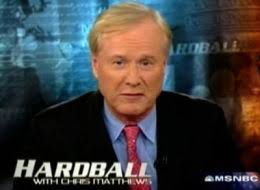
Chris Matthews
Speaking on MSNBC’s “Hardball,” on July 28–five days before Congress reached its August 2 deadline to raise the debt-ceiling–Matthews noted:
“The first people to bow to the demands of those threatening to blow up the economy were the Republicans in the House, the leaders. The leaders did what the followers told them to do: meet the demands, hold up the country to get their way.
“Those followers didn’t win the Senate, or the Presidency, just the House.
“But by using the House they were able to hold up the entire United States government. They threatened to blow things up economically and it worked.
“They said they were willing to do that–just to get their way–not by persuasion, not by politics, not by democratic government, but by threatening the destruction of the country’s finances.
“Right. So what’s next? The power grid? Will they next time threaten to close down the country’s electricity and communications systems?”
With the United States teetering on the brink of national bankruptcy, President Obama faced three choices:
- Prosecute Republican extortionists under the Racketeer Influenced Corrupt Oganizations Act;
- Seek to rally the American people against a criminal threat to the financial security of the Nation;
- Cave in to Republican demands.
Unfortunately for Obama and the Nation, he chose Number Three.
A graduate of Columbia University and Harvard Law School, Obama is easily one of the most academically gifted Presidents in United States history.
But for all this, he failed–from the onset of his Presidency–to grasp and apply this fundamental lesson taught by Niccolo Machiavelli, the father of modern political science.
In his classic work on politics, The Prince, Machiavelli warns:
From this arises the question whether it is better to be loved than feared, or feared more than loved.
The reply is, that one ought to be both feared and loved, but as it is difficult for the two to go together, it is much safer to be feared than loved….
Men have less scruple in offending one who makes himself loved than one who makes himself feared. For love is held by a chain of obligations which, men being selfish, is broken whenever it serves their purpose. But fear is maintained by a dread of punishment which never fails.
Obama has failed to heed this advice. And, predictably, his sworn enemies–which is what Republicans consider themselves to be–have felt free to demonize and obstruct him at every turn.
ABC NEWS, ADOLF HITLER, BILL CLINTON, CBS NEWS, CNN, FACEBOOK, HILLARY CLINTON, INFIDELITY, JOSEPH MCCARTHY, KARL ROVE, LANGUAGE, NBC NEWS, NEWT GINGRICH, REPUBLICANS, SOUTH CROLINA PRIMARY, THE LOS ANGELES TIMES, THE NEW YORK TIMES, THE WASHINGTON POST, TWITTER
In Bureaucracy, History, Politics, Social commentary on May 16, 2014 at 4:12 pm
Even so every good tree bringeth forth good fruit; but a corrupt tree bringeth forth evil fruit. A good tree cannot bring forth evil fruit, neither can a corrupt tree bring forth good fruit. Every tree that bringeth not forth good fruit is hewn down, and cast into the fire. Wherefore by their fruits ye shall know them.
—Matthew 7: 17-20
Meet the Gingrich Twins: Good Newt and Bad Newt.
Here’s how Good Newt responded to GOP strategist Karl Rove’s insinuation that Hillary Clinton might have brain damage.
Clinton was hospitalized in late December 2012, where doctors discovered a blood clot related to a concussion she had suffered earlier in the month. She was released from the hospital several days later.
On May 12, Rove told the New York Post:
“Thirty days in the hospital? And when she reappears, she’s wearing glasses that are only for people who have traumatic brain injury? We need to know what’s up with that.”

Karl Rove
The next day, Good Newt held a Facebook Q and A session, where he wrote:
“i am totally opposed and deeply offended by Karl Rove’s comments about Secretary Clinton. I have many policy disagreements with Hillary but this kind of personal charge is exactly whats wrong with american politics. he should apologize and stop discussing her health. i was angry when people did this to Reagan in 1980 and I am angry when they do it to her today.”
Good Newt is “appalled” that anyone could stoop so low. He’s concerned not only for himself and his party, but the country.

Newt Gingrich
Unfortunately, for Good Newt, he has an identical evil twin: Bad Newt.
And sometimes people–especially Democrats–mistake one for the other.
It was Bad Newt who, as Speaker of the House of Representatives, wrote a 1996 memo that encouraged Republicans to “speak like Newt.”
Entitled “Language: A Key Mechanism of Control,” it urged Republicans to attack Democrats with such words as “corrupt,” “selfish,” “destructive,” “hypocrisy,” “liberal,” “sick,” and “traitors.”
Even worse, Bad Newt encouraged the news media to disseminate such accusations. Among his suggestions:
-
“Fights make news.”
-
Create a “shield issue” to deflect criticism: “A shield issue is just, you know, your opponent is going to attack you as lacking compassion. “You better…show up in the local paper holding a baby in the neonatal center….”
In the memo, Bad Newt advised:
“….In the video “We are a Majority,” Language is listed as a key mechanism of control used by a majority party, along with Agenda, Rules, Attitude and Learning.
“As the tapes have been used in training sessions across the country and mailed to candidates we have heard a plaintive plea: ‘I wish I could speak like Newt.’
“That takes years of practice. But, we believe that you could have a significant impact on your campaign and the way you communicate if we help a little. That is why we have created this list of words and phrases….
“This list is prepared so that you might have a directory of words to use in writing literature and mail, in preparing speeches, and in producing electronic media.
“The words and phrases are powerful. Read them. Memorize as many as possible. And remember that like any tool, these words will not help if they are not used.”
Here is the list of words Bad Newt urged his followers to use in describing “the opponent, their record, proposals and their party”:
- abuse of power
- anti- (issue): flag, family, child, jobs
- betray
- bizarre
- bosses
- bureaucracy
- cheat
- coercion
- “compassion” is not enough
- collapse(ing)
- consequences
- corrupt
- corruption
- criminal rights
- crisis
- cynicism
- decay
- deeper
- destroy
- destructive
- devour
- disgrace
- endanger
- excuses
- failure (fail)
- greed
- hypocrisy
- ideological
- impose
- incompetent
- insecure
- insensitive
|
- intolerant
- liberal
- lie
- limit(s)
- machine
- mandate(s)
- obsolete
- pathetic
- patronage
- permissive attitude
- pessimistic
- punish (poor …)
- radical
- red tape
- self-serving
- selfish
- sensationalists
- shallow
- shame
- sick
- spend(ing)
- stagnation
- status quo
- steal
- taxes
- they/them
- threaten
- traitors
- unionized
- urgent (cy)
- waste
- welfare
|
Yes, speaking like Newt–or Adolf Hitler or Joseph McCarthy–”takes years of practice.”
And Karl Rove has clearly had that.
In 2000, he gleefully smeared Arizona Senator John McCain as brain-damaged from his years as a Vietnam POW–thus removing him from the Presidential race as a competitor for George W. Bush.
So you can understand why Good Newt hates being mistaken for his evil twin, Bad Newt.
Unfortunately, they look–and sound–so alike it’s impossible to tell them apart.
But since they’re both 70, perhaps one day soon we’ll find out which one we’re left with–Good Newt or Bad Newt.
Unless, of course, they both drop off at the same time. Then we will never know which was which.
It’s definitely a mystery worth living with.
ABC NEWS, AFGHANISTAN, AL QAEDA, ARMY RANGERS, BARACK OBAMA, BILL CLINTON, BLACK HAWK DOWN, BOKO HARAM, BRING BACK OUR GIRLS, CBS NEWS, CNN, DELTA FORCE, FACEBOOK, GEORGE H.W. BUSH, IRAQ, JOHN KERRY, MOHAMMED FARRAH AIDID, NBC NEWS, NIGERIA, PBS NEWSHOUR, REPUBLICANS, SOMALIA, SYRIA, TERRORISM, THE LOS ANGELES TIMES, THE NEW YORK TIMES, THE WASHINGTON POST, TWITTER, UKRAINE
In Bureaucracy, History, Military, Politics, Social commentary on May 9, 2014 at 9:38 am
In December, 1992, 25,000 American soldiers entered Somalia to distribute food to its starving people.
At first, all seemed to be going well.
In the beginning, it was U.S. policy to avoid taking sides in the civil war or picking fights with Somali warlords. The Somalis believed the American troops were neutral and welcomed them everywhere.
But then what began as a humanitarian mission turned into a nation-building one.
Mohammed Farrah Aidid, the most powerful of Somalia’s warlords, had ruled Mogadishu, its capital, before the Marines arrived.
Mohammed Farrah Aidid
Aidid waited until the Marines withdrew–in April, 1993–and then declared war on the small remaining force of United Nations (U.N.) peacekeepers.
In June, his militia ambushed and butchered 24 U.N. peacekeepers. Soon afterward, they began targeting American personnel.
On June 12, U.S. troops started attacking targets in Mogadishu in hopes of finding Aidid.
On August 26th, a U.S. Army task force flew into Mogadishu. It consisted of 440 elite troops from Army Rangers and the super-secret anti-terrorist Delta Force.
On October 3rd, 17 helicopters took off from their base at the Mogadishu airport–into the heart of Aidid’s territory. An intelligence tip claimed that Aidid would meet with 20 of his top lieutenants at the nearby Olympic Hotel.
Their mission: Capture Aidid.
The force of 115 men expected the operation to last 90 minutes. They would not return for 17 hours.
After roping down from their helicopters, the Rangers sealed off the streets around the Olympic Hotel.
A 12-truck convoy arrived to drive them and their prisoners back to base. Delta Force soldiers led 20 of Aidid’s lieutenants out of the target building.
But Aidid was not among them.
Suddenly, one of the Black Hawk helicopters circling overheard was hit by a rocket-propelled grenade, spun out of control and crashed.
Not long after, a second Black Hawk was shot down. More men were sent in to secure the crash sites and get the soldiers out. But the rescue team itself got pinned down.
For about 18 hours, outnumbered elite U.S. soldiers were pinned down in a hail of gunfire by thousands of Somali militia and civilians.
Helicopters flew in fresh ammunition and strafed Somali gunmen. Meanwhile, 70 vehicles–including tanks and armored personnel carriers–raced to the trapped men.
The vehicles arrived and the Rangers and Delta Force soldiers climbed aboard.
The Red Cross later estimated that 1,000 Somalis had been killed.
As for American casualties: 18 were dead; more than 80 were wounded; one was temporarily taken prisoner.
In 2001, the film, Black Hawk Down, would vividly depict this nightmarish catastrophe..

For most Americans watching TV from the safety of their homes, the worst loss was this: Seeing the body of an American soldier dragged by cheering Somalis through the streets of Mogadishu.
It was the worst land battle for American troops since the Vietnam War. And it had immediate consequences.
Within days, President Bill Clinton decided to withdraw troops from Somalia and abandon the hunt for Aidid. Most humiliating of all, American representatives were sent to resume negotiations with the warlord.
Today, almost 21 years after the disaster in Somalia, a conflict exists between gung-ho interventionist American policymakers and their war-weary–and wary–populace.
Republicans have been especially hawkish. They have demanded that President Barack Obama send “boots on the ground” to
- Iraq (as if America’s 10-year debacle there wasn’t long enough)
- Afghanistan (where its nominal president, Hamid Karzai, insists on the right to try American soldiers in Islamic courts of law)
- Syria (where a civil war now pits two of America’s greatest enemies–Al Qaeda and Hizbollah–against each other); and
- Ukraine (where a confrontation between American and Russian military forces could easily trigger a third world war between nuclear-armed superpowers)
A May 2 exchange between Judy Woodruff and Mark Shields on the PBS Newshour captures this division in philosophies:
JUDY WOODRUFF: Well, one of the other things the Democrats are worried about… is the administration, the president’s standing on foreign policy….
And the president himself, Mark, held a news conference overseas in the last few days and talked about the criticism and said, what do they want me to do?
You know, we have been in these wars and are they saying, we should do more? And they say no. Well, what should we do?
MARK SHIELDS: The fact is that we’re operating in a reality of the last decade of this country, in the sense that the majority of Americans believing that we were deceived and misled into war in Iraq, that whatever one calls our experiences in Afghanistan and Iraq, they will not be seen as successes.
And they are not viewed that way, and, at the same time, an American people who were essentially spared any involvement in that war, any of those wars, who have just really sort of soured on American involvement in the world.
* * * * *
Right now, many Americans feel good that “we’re doing something” about the abduction of Nigerian teenagers.
But elation will quickly turn to outrage if American soldiers once again become needless casualties in yet another avoidable conflict with yet another ruthless African warlord.
ABC NEWS, AFGHANISTAN, AL QAEDA, ARMY RANGERS, BARACK OBAMA, BILL CLINTON, BLACK HAWK DOWN, BOKO HARAM, BRING BACK OUR GIRLS, CBS NEWS, CNN, DELTA FORCE, FACEBOOK, GEORGE H.W. BUSH, IRAQ, JOHN KERRY, MOHAMMED FARRAH AIDID, NBC NEWS, NIGERIA, PBS NEWSHOUR, REPUBLICANS, SOMALIA, SYRIA, TERRORISM, THE LOS ANGELES TIMES, THE NEW YORK TIMES, THE WASHINGTON POST, TWITTER, UKRAINE
In Bureaucracy, History, Military, Politics, Social commentary on May 8, 2014 at 1:00 am
“Bring back our girls!”
It’s become a rallying cry among Nigerians–and among do-gooder Americans.
On April 15, nearly 300 teenage girls were kidnapped from a Nigerian school by Boko Haram, an Islamist terrorist group that has ties to Al Qaeda.
Its leader, Abubakar Shekau, claimed responsibility for the abudctions and threatened to sell the girls.
He also warned that Boko Haram would attack other schools and kidnap more girls.
Boko Haram means: “Western education is sinful.”
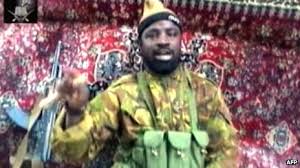
Abubakar Shekau
Fifty-three of the girls managed to escape; 276 remain in captivity.
It didn’t take long for Americans to thrust themselves into yet another role as World Policeman:
- The United States Senate passed a bipartisan resolution demanding the girls’ safe and immediate return.
- Several lawmakers observed a moment of silence on the Capitol steps.
- Dozens of people protested outside the Nigerian Embassy in Washington, D.C.
- All 20 female United States Senators urged President Barack Obama to pursue severe international sanctions against Boko Haram.
- Another group of Senators urged Nigerian President Goodluck Jonathan to tackle the causes of unrest in his country.
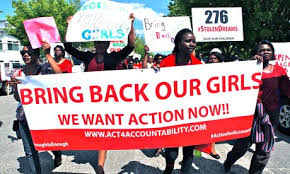
Protest at Nigerian Embassy in Washington, D.C.
- The United States repeatedly offered assistance. But Nigeria refused to respond until Secretary of State John Kerry telephoned Jonathan as international outrage grew over the fate of the missing girls.
- Inerviewed by NBC’s Today, President Obama said: “In the short term our goal is obviously to help the international community, and the Nigerian government, as a team to do everything we can to recover these young ladies.”
- Obama further noted: “But we’re also going to have to deal with the broader problem of organizations like [Boko Haram] that can cause such havoc in people’s day-to-day lives.”
- White House Press Secretary Jay Carney announced that the United States would send military and law enforcement personnel skilled in investigations, hostage negotiation, Intelligence and victim assistance to Nigeria.
- Carney said that the United States would not send fighting units to Nigeria.
Abubakar Shekau, the leader of Boko Haram, didn’t waste time reacting.
On May 5, in a clip released online, he declared war on the West.
Echoing President George W. Bush’s famous statement–“Either you are with us, or you are with the terrorists”–Shekau warned:
“Either you are with us … or you are with Obama! [French President] Francois Hollande! George Bush. Bush! Clinton!”
Pausing briefly, he added: “Abraham Lincoln!”
Most Americans have little interest in foreign affairs–and thus short memories for international events. So few now remember another well-intentioned effort that failed miserably in Africa almost 21 years ago.
Like the “Save our girls!” affair, it, too, started as a humanitarian gesture.
In 1992, civil war and famine gripped Somalia, resulting in over 300,000 civilian deaths.
Mogadishu, the capital of Somalia, was the most dangerous city in the world.
Fourteen armed militas, each led by its own warlord, were fighting to dominate Somalia. Teenage gunmen, high on a narcotic called quat, spread terror in their “technicals”–pick-up trucks equipped with heavy machine guns.
“I was overwhelmed. I’d never seen anything like it,” recalled Khalil Dale, a Red Cross worker. “There were bodies of people who had died of starvation.
“There were people with gunshot wounds. There were young children, women, just lying, waiting to die, really emaciated. and there would be mounds of dead bodies waiting to be buried. We were doing 300 or 400 a day.”
In late 1992, President George H.W. Bush launched a massive humanitarian mission to help feed the starving people of Somalia.
He ordered 25,000 troops into Somalia to carry out Operation Restore Hope.
Bush had been defeated for a second term by former Arkansas Governor Bill Clinton. Sending Americans into Somalia was the last major effort of his Presidency.
Addressing the American people from the Oval Office, Bush declared:
“Every American has seen the shocking images from Somalia. The scope of suffering there is hard to imagine.
“Only the United States has the global reach to place a large security force on the ground in such a distant place quickly and efficiently and thus save thousands of innocents from death.”

President George H.W. Bush addressing the nation
Americans–who like to think of themselves as international saviors instead of aggressors–applauded Bush’s action.
Then they turned their attention to more immediate concerns–such as the failing economy.
At first, all seemed to be going well
But then what began as a humanitarian mission turned into a nation-building one.
On January 20, 1993, Bill Clinton took office as President.
Mohammed Farrah Aidid, the most powerful of Somalia’s warlords, ruled Mogadishu. At Somali ports, his militias seized international food shipments intended to relieve starvation.
Food became his weapon–to be doled out to his supporters, and denied to everyone else.
A force of 20,000 United States Marines backed up the United Nations relief effort. Somalis started receiving food and a sense of order was restored.
Aidid waited until the Marines withdrew–in April, 1993–and then declared war on the small remaining force of U.N. peacekeepers.
ABC NEWS, ADOLF HITLER, AFFORDABLE CARE ACT, BARACK OBAMA, BILL CLINTON, CBS NEWS, CNN, FACEBOOK, GOVERNMENT SHUTDOWN, MARLIN STUTZMAN, NBC NEWS, NEWT GINGRICH, OBAMACARE, THE NEW YORK TIMES, THE WASHINGTON POST, TWITTER
In Bureaucracy, History, Politics, Social commentary on April 7, 2014 at 12:07 am
And the most glorious exploits do not always furnish us with the clearest discoveries of virtue or vice in men; sometimes a matter of less moment, an expression or a jest, informs us better of their characters and inclinations, than the most famous sieges, the greatest armaments, or the bloodiest battles whatsoever.
–Plutarch, Life of Alexander
In 1994, Newt Gingrich, then Speaker of the House of Representatives, shut down the Federal Government.
Officially, the reason was a budget impasse with President Bill Clinton. Unofficially–and in reality–the reason was altogether different.
Clinton had forced him to sit in the back of Air Force One on a trip to Israel for the funeral of former prime minister Yitzhak Rabinl.
“This is petty,” Gingrich confessed to startled reporters. “I’m going to say up front it’s petty, But I think it’s human.
“When you land at Andrews [Air Force Base, in Washington, D.C.] and you’ve been on the plane for 25 hours and nobody has talked to you and they ask you to get off by the back ramp….
“You just wonder, where is their sense of manners, where is their sense of courtesy?”
Gingrich’s childish verbal tirade was a public relations disaster for the Republicans. “Cry Baby,” screamed the New York Daily News, next to a picture of Gingrich in a diaper.

When House Democrats brought a poster-sized image of the cartoon onto the floor, the Republican majority forced them to remove it.
But the damage was done, and Republicans paid a fearful price for the shutdown and Gingrich’s candor about the reason for it.
Fast forward 19 years later, and, once again, the public–and, most especially, federal employees–faced the hardships of another Republican-led government shutdown.
The official reason given by Republicans was: They wanted to save the country from the dangers of providing healthcare insurance to all Americans, not simply the wealthiest 1%.
To hear Republicans tell it, Obamacare–actually, the Affordable Care Act–would “destroy the medical system as we know it.”
The Act aims to:
-
Increase the quality and affordability of health insurance;
-
Lower the uninsured rate by expanding public and private insurance coverage;
-
Reduce the costs of healthcare for individuals and the government;
- Forbid insurance companies the right to deny coverage for “pre-existing conditions”; and
- Require employers with more than 50 employees to offer health insurance to their fulltime workers–or pay a large penalty.
Republicans also claimed that it would bankrupt the country–although the Congressional Budget Office stated that the ACA would lower future deficits and Medicare spending.
After passing the House and Senate, the ACA was signed into law by President Barack Obama on March 23, 2010.
On June 28, 2012, the United States Supreme Court–whose Chief Justice, John Roberts, is a Republican–upheld the constitutionality of the ACA,
Yet House Republicans continued searching for a way to stop the law from taking effect. By September, 2013, they had voted 42 times to repeal “Obamacare.”
But their efforts achieved nothing, since the Democratic-led Senate refused to go along with such legislation.
Finally, unable to legally overturn the Act or to legislatively repeal it, House Republicans fell back on something much simpler.
Threats and fear.
Threats–of voting to shut down salaries paid to most Federal employees.
Most employees, because they themselves would continue to draw hefty salaries while they were denying them to FBI agents, air traffic controllers and members of the military, among others.
And fear–that would be generated throughout the Federal government, the United States and America’s international allies.
It was the my-way-or-else “negotiating” style of Adolf Hitler: Do-as-I-say-or-I-will-destroy-you.
When Obama and Senate Democrats refused to knuckle under to yet another Republican extortion effort, House Republicans made good on their threat.
They shut down the government.
Republicans claimed that Obama and Senate Democrats were the ones who refused to see reason and negotiate.
By “negotiate,” they meant: Agree to Republican demands to de-fund “Obamacare.”
But then the unthinkable happened: A Republican gave away the real reason for the shutdown.
“We’re not going to be disrespected,” Rep. Marlin Stutzman (R-Ind.) told the Washington Examiner. “We have to get something out of this. And I don’t know what that even is.”

Marlin Stutzman
With Newt Gingrich, the real reason for the government shutdown was his petty ego.
A subsidiary reason was to bully President Clinton into gutting Republican-despised Federal programs to help the poor and middle-class.
Nineteen years later, Republicans–as admitted by Martlin Stutzman–were out to get “respect.”
And they were out to get it the same way a thuggish gang leader gets it: By demanding: “Do what I say or I’ll kill you.”
At the end of World War II, Americans tried to cleanse West Germany of its former Nazi leaders and their supporters.
Such thuggishness will continue unless, somehow, Americans cleanse their own government of those who “negotiate” Nazi-Republican style.
9/11, ABC NEWS, ADOLF HITLER, AMERICANS FOR TAX REFORM, ANDERSON COOPER, ANTI-COMMUNISM, ARTHUR MILLER, BILL CLINTON, CBS NEWS, CENTER FOR SECURITY POLICY, CHINA, CHRIS MATTHEWS, CNN, DICK CHENEY, DWIGHT D. EISENHOWER, EDWARD R. MURROW, FACEBOOK, GEORGE H.W. BUSH, HARRY S. TRUMAN, HEINRICH HIMMLER, HERMAN CAIN, HERMAN GORING, HILLARY CLINTON, HUMA ABEDIN, JEWS, JIMMY CARTER, JOHN BIRCH SOCIETY, JOHN F. KENNEDY, JOHN STEINBECK, JOSEPH GOEBBELS, JOSEPH MCCARTHY, JOSEPH STALIN, KGB, LIZ CHENEY, LUCILLE BALL, LYNDON B. JOHNSON, MICHELLE BACHMANN, MIKE HUCKABEE, MITT ROMNEY, MSNBC, MUSLIM BROTHERHOOD, MUSLIMS, NAZI GERMANY, NAZI PARTY, NBC NEWS, NEWT GINGRICH, PETE SEEGER, RED SCARE, REINHARD HEYDRICH, REPUBLICAN PARTY, RICHARD NIXON, RICK SANTORUM, Ronald Reagan, SENATOR MIKE ENZI, SOVIET UNION, SS, THE AMERICAN CENTER FOR SECURITY POLICY, THE HUFFINGTON POST, THE LOS ANGELES TIMES, THE NEW YORK TIMES, THE WASHINGTON POST, TWITTER, WYOMING
In Bureaucracy, History, Politics, Social commentary on November 28, 2013 at 12:00 am
With the Soviet Union collapsed in 1991, the Republican Party went into a tailspin of dismay.
For almost 50 years, Republicans had conjured up The Red Bogeyman to scare voters into sending them to Congress and the White House.
But now that the “workers’ paradise” had disappeared, Americans seemed to lose interest in the Communist Menace.
True, the People’s Republic of China remained, and its increasing economic clout would challenge the United States well into the 21st century. But Americans didn’t seem to fear the Red Chinese as they had the Red Russians.
What was the Republican Party to do to lure voters?
On September 11, 2001, the answer arrived–in two highjacked jetliners that crashed into the World Trade Center in New York and one that struck the Pentagon in Washington, D.C.
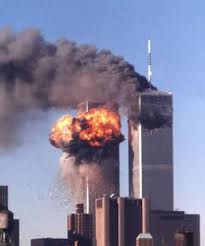
Exit The Red Bogeyman. Enter The Maniacal Muslim.
Consider:
- Mike Huckabee – “If the purpose of a church is to push forward the gospel of Jesus Christ, and then you have a Muslim group that says that Jesus Christ and all the people that follow him are a bunch of infidels who should be essentially obliterated, I have a hard time understanding that.”
- Herman Cain – ”I would not” appoint a Muslim in his administration.
- Newt Gingrich – “I am convinced that if we do not decisively win the struggle over the nature of America, by the time they [his grandchildren] are my age they will be in a secular atheist country, potentially one dominated by radical Islamists. …”
- Rick Santorum – On supporting the racial profiling of Muslims: “Obviously, Muslims would be someone you look at, absolutely.”
- Mitt Romney – “Based on the numbers of American Muslims in our population, I cannot see that a Cabinet position [for a Muslim] would be justified.”
And on July 13, Rep. Michelle Bachmann (R-Minn.) sent letters to the Inspectors General of the Departments of
- Defense;
- State;
- Justice; and
- Homeland Security.
“The purpose of these letters,” wrote Bachmann, was to “request a multi-department investigation into potential Muslim Brotherhood infiltration into the United States Government.”

Michelle Bachmann
Bachmann further asserted in her letter to the State Department that Huma Abedin, deputy chief of staff to Secretary of State Hillary Clinton, had ties to the Muslim Brotherhood.
And the evidence for this?
The Center for Security Policy’s claim that Abedin’s father (who died when she was a teenager), mother and brother are “connected” to the organization.
And what is the Center of Security Policy? A private organization subsidized by donors to neo-conservative causes.
In a separate letter, Bachmann demanded to know how Abedin received her security clearance.
Among the co-signers of Bachmann’s letter to the Inspectors General were:
- Rep. Trent Franks of Arizona, who has said abortion has done more harm to blacks than slavery;
- Rep. Lynn Westmoreland of Georgia, who called presidential candidate Barack Obama and his wife, Michelle, ”uppity”; and
- Rep. Louie Gohmert of Texas, who claims that terrorist organizations send pregnant women into the U.S. so that their children will be American citizens–who can enter and leave the country at will as they are trained to be terrorists abroad.
When pressed for their evidence of “a vast Muslim conspiracy,” right-wing accusers usually refuse to provide any.
An example of this occurred during an August 13, 2010 interview between Gohmert and CNN’s Anderson Cooper:
COOPER: What research? Can you tell us about the research?
GOHMERT: You are attacking the messenger, Anderson, you are better than this. You used to be good. You used to find that there was a problem and you would go after it.
COOPER: Sir, I am asking you for evidence of something that you said on the floor of the House.
GOHMERT: I did, and you listen, this is a problem. If you would spend as much time looking into the problem as you would have been trying to come after me and belittle me this week –
COOPER: Sir, do you want to offer any evidence? I’m giving you an opportunity to say what research and evidence you have. You’ve offered none, other than yelling.
Nor did Gohmert offer any evidence that evening.
Of course, the ultimate Republican Muslim slander is that President Barack Obama–a longtime Christian–is himself a Muslim.
No doubt Republicans feel totally safe in making these attacks, since Muslims comprise only 1% of the American population.
This has long been a hallmark of right-wing attacks–to go after a minority that cannot effectively defend itself.
Thus, Adolf Hitler attacked the Jews of Germany.
And Republicans have successively attacked blacks, Hispanics and gays–until each group became politically influential enough to defeat Republican candidates.
Today, most right-wing politicians at least grudgingly court all of these groups.
When Muslims become a significant political force in their own right, the Right will court them, too. And then move on to yet another helpless scapegoat to blame for America’s troubles.
9/11, ABC NEWS, ADOLF HITLER, AMERICANS FOR TAX REFORM, ANDERSON COOPER, ANTI-COMMUNISM, ARTHUR MILLER, BILL CLINTON, CBS NEWS, CENTER FOR SECURITY POLICY, CHINA, CHRIS MATTHEWS, CNN, DICK CHENEY, DWIGHT D. EISENHOWER, EDWARD R. MURROW, FACEBOOK, GEORGE H.W. BUSH, HARRY S. TRUMAN, HEINRICH HIMMLER, HERMAN CAIN, HERMAN GORING, HILLARY CLINTON, HUMA ABEDIN, JEWS, JIMMY CARTER, JOHN BIRCH SOCIETY, JOHN F. KENNEDY, JOHN STEINBECK, JOSEPH GOEBBELS, JOSEPH MCCARTHY, JOSEPH STALIN, KGB, LIZ CHENEY, LUCILLE BALL, LYNDON B. JOHNSON, MICHELLE BACHMANN, MIKE HUCKABEE, MITT ROMNEY, MSNBC, MUSLIM BROTHERHOOD, MUSLIMS, NAZI GERMANY, NAZI PARTY, NBC NEWS, NEWT GINGRICH, PETE SEEGER, RED SCARE, REINHARD HEYDRICH, REPUBLICAN PARTY, RICHARD NIXON, RICK SANTORUM, Ronald Reagan, SENATOR MIKE ENZI, SOVIET UNION, SS, THE AMERICAN CENTER FOR SECURITY POLICY, THE HUFFINGTON POST, THE LOS ANGELES TIMES, THE NEW YORK TIMES, THE WASHINGTON POST, TWITTER, WYOMING
In Bureaucracy, History, Politics, Social commentary on November 27, 2013 at 12:05 am
“Judge not, that you not be judged. For with what judgment you judged, you shall be judged, and with what measure you mete, it shall be measured to you again.”
So warns the Gospel of St. Matthew, 7:1-2. It’s advice that Right-wingers Joseph McCarthy, Robert Welch and George H.W. Bush would have done well to heed.
Joseph McCarthy, Wisconsin’s gift to the United States Senate, became infamous as the demagogue whose Red-baiting accusations terrified America from 1950 to 1954.
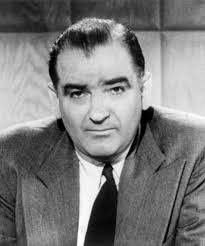
Joseph McCarthy
Elected to the Senate in 1946, he rose to national prominence on February 9, 1950, after giving a fiery speech in Wheeling, West Virginia:
“The State Department is infested with communists. I have here in my hand a list of 205—a list of names that were made known to the Secretary of State as being members of the Communist Party and who nevertheless are still working and shaping policy in the State Department.”
Americans were already growing increasingly fearful of Communism:
- Soviet dictator Joseph Stalin had not withdrawn the Red Army from the countries it had occupied in Eastern Europe during World War II.
- In 1948, the Soviet Union developed–and demonstrated–its own atomic bomb, an achievement U.S. scientists had claimed would not happen for at least a decade.
- In 1949, China fell to the triumphant armies of Mao Tse Tung.
But anti-communism as a lever to political advancement sharply accelerated following McCarthy’s speech. Republicans–resentful at being denied the White House since 1932–seized upon anti-communism as their passport to power.
No American–no matter how prominent–was safe from the accusation of being a Communist or a Communist sympathizer–”a Comsymp” or “fellow traveler” in the style of the era.
Among those accused:
- Secretary of State George C. Marshall, who had overseen America’s strategy for defeating Nazi Germany and Imperial Japan
- President Harry S. Truman
- Playwright Lillian Hellman and Arthur Miller
- Actors Charlie Chaplin, Zero Mostel, Lloyd Bridges, Howard Da Silva, Edward G. Robinson and John Garfield
- Composers Arron Copland and Elmer Bernstein
- Physicist J. Robert Oppenheimer, who presided over the creation of America’s atomic bomb
- Actressses Lee Grant, Delores del Rio, Ruth Gordon and Lucille Ball
- Journalists Edward R. Murrow and William L. Shirer, who had chronicled the rise of Nazi Germany
- Folksinger Pete Seeger
- Writers Irwin Shaw, Howard Fast, John Steinbeck and Dashiell Hammett
Even “untouchable” Republicans became targets for such slander.
The most prominent of these was President Dwight D. Eisenhower–labeled ”a conscious, dedicated agent of the Communist Conspiracy” by Robert Welch, who founded the John Birth Society in 1958.

Robert Welch
Welch, an independently wealthy businessman, used his money to publicize the Society and its views. Welch saw even hardline anti-Communists like Vice President Richard Nixon and actor Ronald Reagan as dangerously liberal.
Meanwhile, McCarthy finally overstepped himself. In 1953, he attacked the leadership of the United States Army as “a hotbed of traitors” and convened an inquiry through the Senate Permanent Subcommittee on Investigations.
But the hearings backfired, exposing McCarthy as the bullying demagogue he was. A Senate committee voted to condemn his behavior, charging that he had “acted contrary to senatorial ethics and tended to bring the Senate into dishonor and disrepute.”
Although McCarthy remained in the Senate another two and a half years, his political influence had ended.
Journalists who had raced to cover his latest slander now avoided him. So did his Republican colleagues–many of whom had once sought his help at election time.
Yet even without McCarthy, Republicans rode the issue of anti-Communism to victory from 1948 to 1960.
After holding the White House for eight years under Eisenhower, they lost it in 1960 to John F. Kennedy and again in 1964 to Lyndon Johnson.
By 1968, with the nation mired in Vietnam and convulsed by antiwar demonstrations, Americans turned once more to those who preyed upon their fears and hates. They elected Richard Nison–and re-elected him in 1972.
After Jimmy Carter won the Presidency in 1976 and lost it in 1980, Republicans held the White House until 1992. Throughout that time, they continued to accuse their opponents of being devious agents–or at least unwitting pawns–of “the Communist conspiracy.”
Even as late as 1992, President George H.W. Bush and the Republican establishment charged that Arkansas Governor Bill Clinton might be a KGB plant.
Their evidence: During his tenure at Oxford University in 1969-70, Clinton had briefly visited Moscow.
Thus, the Republican charged that he might have been “programmed” as a real-life “Manchrian candidate” to become, first, Governor of Arkansas–one of America’s poorest states–and then President.
What made this charge all the more absurd: The Soviet Union had officially dissolved in December, 1991.
Although Republicans continued to hurl “Communist!” and “treason!” at their opponents, these charges no longer carried the weight they had while the Soviet Union existed.
Right-wingers had to settle for attacking their opponents as “liberals” and “soft on crime.”
Then, on September 11, 2001, Republicans–and their right-wing supporters–at last found a suitable replacement for the Red Menace.
9/11, ABC NEWS, ADOLF HITLER, AMERICANS FOR TAX REFORM, ANDERSON COOPER, ANTI-COMMUNISM, ARTHUR MILLER, BILL CLINTON, CBS NEWS, CENTER FOR SECURITY POLICY, CHINA, CHRIS MATTHEWS, CNN, DICK CHENEY, DWIGHT D. EISENHOWER, EDWARD R. MURROW, FACEBOOK, GEORGE H.W. BUSH, HARRY S. TRUMAN, HEINRICH HIMMLER, HERMAN CAIN, HERMAN GORING, HILLARY CLINTON, HUMA ABEDIN, JEWS, JIMMY CARTER, JOHN BIRCH SOCIETY, JOHN F. KENNEDY, JOHN STEINBECK, JOSEPH GOEBBELS, JOSEPH MCCARTHY, JOSEPH STALIN, KGB, LIZ CHENEY, LUCILLE BALL, LYNDON B. JOHNSON, MARY CHENEY, MICHELLE BACHMANN, MIKE HUCKABEE, MITT ROMNEY, MSNBC, MUSLIM BROTHERHOOD, MUSLIMS, NAZI GERMANY, NAZI PARTY, NBC NEWS, NEWT GINGRICH, PETE SEEGER, RED SCARE, REINHARD HEYDRICH, REPUBLICAN PARTY, RICHARD NIXON, RICK SANTORUM, Ronald Reagan, SAME-SEX MARRIAGE, SENATOR MIKE ENZI, SOVIET UNION, SS, THE AMERICAN CENTER FOR SECURITY POLICY, THE HUFFINGTON POST, THE LOS ANGELES TIMES, THE NEW YORK TIMES, THE WASHINGTON POST, TWITTER, WYOMING
In Bureaucracy, History, Politics, Social commentary on November 26, 2013 at 12:09 am
“All revolutions,” said Ernst Rohem, leader of Adolf Hitler’s brown-shirted thugs, the S.A., “devour their own children.”
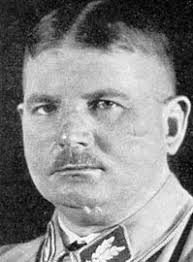
Ernst Rohem
Fittingly, he said this as he sat inside a prison cell awaiting his own execution.
On June 30, 1934, Hitler had ordered a massive purge of his private army, the S.A., or Stormtroopers. The purge was carried out by Hitler’s elite army-within-an-army, the Schutzstaffel, or Protective Squads, better known as the SS.
The S.A. Brownshirts had been instrumental in securing Hitler’s rise to Chancellor of Germany on January 30, 1933. They had intimidated political opponents and organized mass rallies for the Nazi Party.
But after Hitler reached the pinnacle of power, they became a liability.
Ernst Rohem, their commander, urged Hitler to disband the regular German army, the Reichswehr, and replace it with his own legions as the nation’s defense force.
Frightened by Rohem’s ambitions, the generals of the Reichswehr gave Hitler an ultimatum: Get rid of Rohem–or they would get rid of him.
So Rohem died in a hail of SS bullets–as did several hundred of his longtime S.A. cronies.
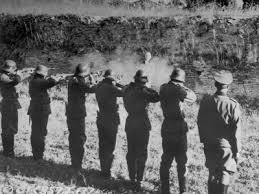
SS firing squad
Among the SS commanders supervising those executions was Reinhard Heydrich–a tall, blond-haired formal naval officer who was both a champion fencer and talented violinist.
Ultimately, he would become the personification of the Nazi ideal–”the man with the iron heart,” as Hitler eulogized at Heydrich’s funeral just eight years later.
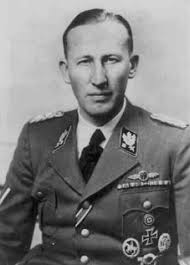
Reinhard Heydrich
Even so, Heydrich had a problem: He could never escape vicious rumors that his family tree contained a Jewish ancestor.
His paternal grandmother had married Reinhold Heydrich, and then Gustav Robert Suss. For unknown reasons, she decided to call herself Suss-Heydrich.
Since “Suss” was widely believed in Germany to indicate Jewish origin, the “stigma” of Jewish heritage attached itself to the Heydrich family.
Heydrich joined the SS in 1931 and quickly became head of its counterintelligence service. But his arrogance and overweening ambition created a great many enemies.
Only a year later, he became the target of an urgent investigation by the SS itself.
The charge: That he was part-Jewish, the ultimate sin in Hitler’s “racially pure” Nazi Germany.
The investigation cleared Heydrich, but the rumor of his “tainted” origins persisted, clearly tormenting the second most powerful man in the SS.
Even his superior, Heinrich Himmler, the Reichsfuhrer-SS, believed it.
When Heydrich was assassinated in 1942 by Czech assassins in Prague, Himmler attended his funeral.
He paid tribute to his former subordinate at the service–”You, Reinhard Heydrich, were a truly good SS-man.” But he could not resist saying in private:
“He was an unhappy man, completely divided against himself, as often happened with those of mixed race.”
Those who dare to harshly judge others usually find themselves assailed just as harshly.
A modern-day example is Liz Cheney, daughter of former Vice President Dick Cheney and now a candidate for U.S. Senator from Wyoming.
Liz is positioning herself as far more right-wing than her opponent, Republican U.S. Senator Michael Bradley “Mike” Enzi.
She has her work cut out for her: In March, 2007, Enzi was ranked by National Journal as the sixth-most conservative U.S. Senator.
Among his legislative priorities:
- Supporting partial privatization of Social Security
- Consistently voting against expanding Medicare.
- Voting against enrolling more children or the poor in public healthcare.

Mike Enzi
And Liz has a problem Enzi does not: Her sister, Mary, is not only a lesbian but legally married to another woman: Heather Poe.
This has led many Wyoming voters to wonder if Liz Cheney is far-Right enough to merit their support.
So Liz is going all-out to assure them that even though her sister leads a degenerate lifestyle, she, Liz, stands foursquare against legalizing gay marriage:
“I do believe it’s an issue that’s got to be left up to states. I do believe in the traditional definition of marriage.”

Liz Cheney
And, in another statement: “I am strongly pro-life and I am not pro-gay marriage.
“I believe the issue of marriage must be decided by the states, and by the people in the states, not by judges and not even by legislators, but by the people themselves.”
This stance has led to a heated rift between her and Mary.
“For the record, I love my sister, but she is dead wrong on the issue of marriage,” Mary Cheney wrote in a Facebook post in September.
“Freedom means freedom for everyone,” she continued. “That means that all families–regardless of how they look or how they are made–all families are entitled to the same rights, privileges and protections as every other.”
Adding to the complications: Their father, Dick Cheney—often ridiculed as “Darth Vader” for his own extreme Right-wing views—endorsed same-sex marriage in 2009.
But, as was true for officials in Nazi Germany, so is it true for Right-wing Republicans: It’s impossible to be too radical a Right-winger.
In the 1930s and 40s, it was politically—and personally—dangerous to be labeled “pro-Jewish” or “pro-Communist” in Hitler’s Germany.
And today it is equally dangerous—at least politically—to be labeled “pro-liberal” or “pro-gay” in the Republican Party.
2012 PRESIDENTIAL RACE, BAY OF PIGS, BERLIN WALL, BILL CLINTON, BRUCE GREENWOOD, CARLOS MARCELLO, CIA, CIVIL RIGHTS, CLIFF ROBERTSON, CUBAN MISSILE CRISIS, DAVID HALBERSTAM, FACEBOOK, FBI, FIDEL CASTRO, FRANK SINATRA, ICH BEN EIN BERLINNER SPEECH, INTERNET MOVIE DATABASE, J. EDGAR HOOVER, JAMES MARSDEN, JOHN F. KENNEDY, JOSEPH MCCARTHY, JOSEPH P. KENNEDY, LYNDON B. JOHNSON, MAFIA, MALCOM X, MARTIN LUTHER KING, MARTIN SHEEN, MOVIES, NEWT GINGRICH, NIKITA KHRUSHCHEV, NUCLEAR TEST BAN TREATY, PT-109, RICK PERRY, ROBERT F. KENNEDY, ROBERT S. MCNAMARA, SAM GIANCANA, SANTOS TRAFFICANTE, Sarah Palin, SATURDAY NIGHT LIVE, SOVIET UNION, THE BEST AND THE BRIGHTEST, THE BUTLER, THE MISSILES OF OCTOBER, THE RAT PACK, THIRTEEN DAYS, TWILIGHT ZONE, TWITTER, VIETNAM WAR, WILLIAM DEVANE, WILLIAM PETERSEN
In Bureaucracy, History, Law, Law Enforcement, Military, Politics, Social commentary on November 22, 2013 at 12:30 am
Fifty years ago this November 22, two bullets slammed into the neck and head of President John Fitzgerald Kennedy. It has been said that he left his country with three great legacies:
- The Nuclear Test Ban Treaty;
- The Apollo moon landing; and
- The Vietnam war.
Of these, the following can be said with certainty:
- The Test Ban Treaty has prevented atmosphereic testing–and poisoning–by almost all the world’s nuclear powers.
- After reaching the moon–in 1969–Americans quickly lost interest in space and have today largely abandoned plans for manned exploration.
- Under Presidents Lyndon Johnson and Richard Nixon, 58,000 Americans died in Vietnam; 153,303 were wounded; and billions of dollars were squandered in a hopeless effort to intervene in what was essentially a Vietnamese civil war. From 1965 to 1972, the war angrily divided Americas as had no event since the Civil War.
But there was a fourth legacy–and perhaps the most important of all: The belief that mankind could overcome its greatest challenges through rationality and perseverance.
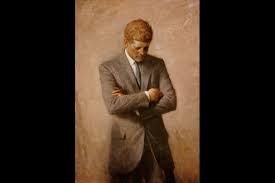
White House painting of JFK
At American University on June 10, 1963, Kennedy called upon his fellow Americans to re-examine the events and attitudes that had led to the Cold War. And he declared that the search for peace was by no means absurd:
“Our problems are man-made; therefore, they can be solved by man. And man can be as big as he wants. No problem of human destiny is beyond human beings.
“Man’s reason and spirit have often solved the seemingly unsolvable, and we believe they can do it again.”
Today, politicians from both parties cannot agree on solutions to even the most vital national problems.
On November 21, 2011, the 12 members of the “Super-Committee” of Congress, tasked with finding $1.2 trillion in cuts in government spending, threw up their hands in defeat.
President Kennedy speed-read several newspapers every morning. He nourished personal relationships with the press-–and not for entirely altruistic reasons. These journalistic relationships gave Kennedy additional sources of information and perspectives on national and international issues.
In 2012, Republican Presidential candidates celebrated their ignorance of both.
Former Godfather’s Pizza CEO Herman Cain famously said, “We need a leader, not a reader.” Thus he excused his ignorance of the reasons for President Barack Obama’s intervention in Libya.
Texas Governor Rick Perry showed similar pride in not knowing there are nine judges on the United States Supreme Court:
“Well, obviously, I know there are nine Supreme Court judges. I don’t know how eight came out my mouth. But the, uh, the fact is, I can tell you–I don’t have memorized all of those Supreme Ccourt judges. And, uh, ah–
“Here’s what I do know. That when I put an individual on the Supreme Court, just like I done in Texas, ah, we got nine Supreme Court justices in Texas, ah, they will be strict constructionists….”
In short, it’s the media’s fault if they ask you a question and your answer reveals your own ignorance, stupidity or criminality.
During the height of the Cuban Missile Crisis, Kennedy spoke with aides about a book he had just finished: Barbara Tuchman’s The Guns of August, on the events leading to World War 1.
He said that the book’s most important revelation was how European leaders had blindly rushed into war, without thought to the possible consequences. Kennedy told his aides he did not intend to make the same mistake-–that, having read his history, he was determined to learn from it.
Contrast that with today’s woeful historical ignorance among Republican Presidential candidates-–and those who aspire to be.
Consider Sarah Palin’s rewriting of history via “The Midnight Ride of Paul Revere”: “He warned the British that they weren’t going to be taking away our arms by ringing those bells and, um, making sure as he’s riding his horse through town to send those warning shots and bells that, uh, we were going to be secure and we were going to be free.”
In fact, Revere wasn’t warning the British about anything. Instead, he was warning his fellow Americans about an impending British attack–as his celebrated catchphrase “The British are coming!” made clear.
Republicans have attacked President Obama for his Harvard education and articulate use of language. Among their taunts: “Hitler also gave good speeches.”
And they resent his having earned most of his income as a writer of two books: Dreams From My Father and The Audacity of Hope. As if being a writer is somehow subversive.
When knowledge and literacy are attacked as “highfalutin’” arrogance, and ignorance and incoherence are embraced as sincerity, national decline lies just around the corner.
In retrospect, the funeral for President Kennedy marked the death of more than a rational and optimistic human being.
It marked the death of Americans’ pride in choosing reasoning and educated citizens for their leaders.

The Eternal Flame at the grave of President John F. Kennedy
BAY OF PIGS, BERLIN WALL, BILL CLINTON, BRUCE GREENWOOD, CARLOS MARCELLO, CIA, CIVIL RIGHTS, CLIFF ROBERTSON, CUBAN MISSILE CRISIS, DAVID HALBERSTAM, FACEBOOK, FBI, FIDEL CASTRO, FRANK SINATRA, HOUSE ASSASSINATIONS COMMITTEE, ICH BEN EIN BERLINNER SPEECH, INTERNET MOVIE DATABASE, J. EDGAR HOOVER, JACK RUBY, JAMES MARSDEN, JOHN F. KENNEDY, JOSEPH MCCARTHY, JOSEPH P. KENNEDY, KGB, LEE HARVEY OSWALD, LYNDON B. JOHNSON, MAFIA, MALCOM X, MARTIN LUTHER KING, MARTIN SHEEN, MOVIES, NIKITA KHRUSHCHEV, NUCLEAR TEST BAN TREATY, PT-109, ROBERT F. KENNEDY, ROBERT S. MCNAMARA, SAM GIANCANA, SANTOS TRAFFICANTE, SATURDAY NIGHT LIVE, SOVIET UNION, THE BEST AND THE BRIGHTEST, THE BUTLER, THE MISSILES OF OCTOBER, THE RAT PACK, THIRTEEN DAYS, TWILIGHT ZONE, TWITTER, VIETNAM WAR, WARREN COMMISSION, WILLIAM DEVANE, WILLIAM PETERSEN
In Bureaucracy, History, Law, Law Enforcement, Military, Politics, Social commentary on November 21, 2013 at 12:16 am
Elected to the House of Representatives in 1946, John F. Kennedy served six undistinguished years before being elected U.S. Senator from Massachussetts in 1952.
In 1956, his eloquence and political skill almost won him the Vice Presidential nomination at the Democratic National Convention. But the nominee, Adlai Stevenson, chose Tennessee Senator Estes Kefauver as his running mate.
Fortunately for Kennedy.
President Dwight D. Eisenhower, running for re-election, easily beat Stevenson.
Had Kennedy been on the ticket, his Catholic religion would have been blamed for the loss–and almost certainly prevented him from getting the Presidential nomination in 1960.
In 1957, his book, Profiles in Courage won the Pulitzer Prize for history.
From 1957 to 1960, Kennedy laid plans for a successful Presidential race. Many voters thought him too young and inexperienced for such high office.
But he used his TV debates with then-Vice President Richard Nixon to calm such fears, transforming himself overnight into a serious contender.
Many Americans identified with Kennedy as they had with film stars. In contrast with normally drab politicians, he seemed exciting and glamorous.
Since 1960, for millions of Americans, mere competence in a President isn’t enough; he should be charming and movie-star handsome as well.

John F. Kennedy after taking a swim at Santa Monica Beach, 1960
But charismatic politicians face the danger of waning enthusiasm.
Many people were growing disillusioned with Kennedy before he died. He had raised hopes that couldn’t be met–especially among blacks.
And many whites bitterly opposed his support of integration, believing that Kennedy was “moving too fast” in changing race relations.
Still, for millions of Americans, Kennedy represented a time of change.
“Let’s get this country moving again” had been his campaign slogan in 1960. He had demanded an end to the non-existent “missile gap” between the United States and Soviet Union.
And he had said that America should create full employment and re-evaluate its policies toward Africa, Latin America and Asia.
His youth, the grace and beauty of his wife and the oft-reported antics of his two young children–Caroline and John–added to the atmosphere that change was on the way.
But Kennedy was not so committed to change as many believed.
- As a Senator he had strongly opposed abolishing the Electoral College.
- He had made no outcry against the Red-baiting tactics of Senator Joseph R. McCarthy, a frequent dinner guest at the home of his father.
- As President, Kennedy never forgot that he had been elected by a margin of 112,881 votes. He often rationalized his refusal to tackle controversial issues by saying: “We’ll do it after I’m re-elected. So we’d better make damn sure I am re-elected.”
- He thought it absurd for the United States to refuse to recognize “Red”China, but didn’t try to change American foreign policy in that area.
Nevertheless, many historians believe that. by vocally supporting civil rights and healthcare for the elderly, Kennedy laid the groundwork for Lyndon Johnson’s legislative victories.
Perhaps no aspect of Kennedy’s Presidency has received closer study than his assassination.
Hundreds of books and thousands of articles have hotly debated whether he was murdered by a lone “nut” or a deadly conspiracy of powerful men.
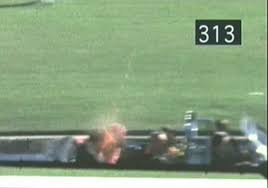
JFK’s assassination: The moment of impact
The murder has been the subject of two government investigations. The first, by the Warren Commission in 1964, concluded that an embittered ex-Marine and Marxist, Lee Harvey Oswald, acted alone in killing Kennedy.
Similarly, the Commission determined that nightclub owner Jack Ruby had killed Oswald on impulse, and not as the result of a conspiracy.
Millions of disbelieving Americans rejected the Warren Report–and named their own villains:
- The KGB;
- The Mob;
- Anti-Castro Cubans;
- Vice President Lyndon B. Johnson;
- Right-wing businessmen and/or military leaders;
- Fidel Castro.
Each of these groups or persons had reason to hate Kennedy:
- The KGB–for Kennedy’s humiliation of the Soviet Union during the Cuban Missile Crisis.
- The Mob–in retaliation for the administration’s crackdown on organized crime.
- Anti-Castro Cubans–for JFK’s refusal to commit American military forces to overthrowing Castro at the Bay of Pigs invasion.
- Lyndon Johnson–lusting for power, he stood to gain the most from Kennedy’s elimination.
- Right-wing businessmen and/or military leaders–for believing that Kennedy had “sold out” the country to the Soviet Union.
- Fidel Castro–knowing the CIA was trying to assassinate or overthrow him, he had reason to respond in kind.
The second investigation, conducted in 1977-79 by the House Assassinstions Committee, determined that Oswald and a second, unknown sniper had fired at Kennedy. (Oswald was deemed the assassin; the other man’s shot had missed.)
The Chief Counsel for the Committee, G. Robert Blakey, believed New Orleans Mafia boss Carlos Marcello organized the assassination, owing to his hatred of Robert Kennedy for his war on the crime syndicates.
Still, 50 years after JFK’s assassination, no court-admissible evidence has come forward to convict anyone other than Oswald for the murder.
The impact of Kennedy’s death on popular culture remains great. Millions saw him as an American sccess story–a brilliant and courageous hero who had worked his way to the top.
But his sudden and violent end proved a shock for those who believed there was always a happy ending.
If so gifted–and protected–a man as John F. Kennedy could be so suddenly and brutally destroyed, no one else could depend on a secure future.
 Bureaucracybuster's Blog
ABC NEWS, ADOLF HITLER, BILL CLINTON, CBS NEWS, CNN, FACEBOOK, HILLARY CLINTON, INFIDELITY, JOSEPH MCCARTHY, KARL ROVE, LANGUAGE, NBC NEWS, NEWT GINGRICH, REPUBLICANS, SOUTH CROLINA PRIMARY, THE LOS ANGELES TIMES, THE NEW YORK TIMES, THE WASHINGTON POST, TWITTER
BY THEIR WORDS YE SHALL KNOW THEM
In Bureaucracy, History, Politics, Social commentary on May 16, 2014 at 4:12 pmEven so every good tree bringeth forth good fruit; but a corrupt tree bringeth forth evil fruit. A good tree cannot bring forth evil fruit, neither can a corrupt tree bring forth good fruit. Every tree that bringeth not forth good fruit is hewn down, and cast into the fire. Wherefore by their fruits ye shall know them.
—Matthew 7: 17-20
Meet the Gingrich Twins: Good Newt and Bad Newt.
Here’s how Good Newt responded to GOP strategist Karl Rove’s insinuation that Hillary Clinton might have brain damage.
Clinton was hospitalized in late December 2012, where doctors discovered a blood clot related to a concussion she had suffered earlier in the month. She was released from the hospital several days later.
On May 12, Rove told the New York Post:
“Thirty days in the hospital? And when she reappears, she’s wearing glasses that are only for people who have traumatic brain injury? We need to know what’s up with that.”
Karl Rove
The next day, Good Newt held a Facebook Q and A session, where he wrote:
“i am totally opposed and deeply offended by Karl Rove’s comments about Secretary Clinton. I have many policy disagreements with Hillary but this kind of personal charge is exactly whats wrong with american politics. he should apologize and stop discussing her health. i was angry when people did this to Reagan in 1980 and I am angry when they do it to her today.”
Good Newt is “appalled” that anyone could stoop so low. He’s concerned not only for himself and his party, but the country.
Newt Gingrich
Unfortunately, for Good Newt, he has an identical evil twin: Bad Newt.
And sometimes people–especially Democrats–mistake one for the other.
It was Bad Newt who, as Speaker of the House of Representatives, wrote a 1996 memo that encouraged Republicans to “speak like Newt.”
Entitled “Language: A Key Mechanism of Control,” it urged Republicans to attack Democrats with such words as “corrupt,” “selfish,” “destructive,” “hypocrisy,” “liberal,” “sick,” and “traitors.”
Even worse, Bad Newt encouraged the news media to disseminate such accusations. Among his suggestions:
In the memo, Bad Newt advised:
“….In the video “We are a Majority,” Language is listed as a key mechanism of control used by a majority party, along with Agenda, Rules, Attitude and Learning.
“As the tapes have been used in training sessions across the country and mailed to candidates we have heard a plaintive plea: ‘I wish I could speak like Newt.’
“That takes years of practice. But, we believe that you could have a significant impact on your campaign and the way you communicate if we help a little. That is why we have created this list of words and phrases….
“This list is prepared so that you might have a directory of words to use in writing literature and mail, in preparing speeches, and in producing electronic media.
“The words and phrases are powerful. Read them. Memorize as many as possible. And remember that like any tool, these words will not help if they are not used.”
Here is the list of words Bad Newt urged his followers to use in describing “the opponent, their record, proposals and their party”:
Yes, speaking like Newt–or Adolf Hitler or Joseph McCarthy–”takes years of practice.”
And Karl Rove has clearly had that.
In 2000, he gleefully smeared Arizona Senator John McCain as brain-damaged from his years as a Vietnam POW–thus removing him from the Presidential race as a competitor for George W. Bush.
So you can understand why Good Newt hates being mistaken for his evil twin, Bad Newt.
Unfortunately, they look–and sound–so alike it’s impossible to tell them apart.
But since they’re both 70, perhaps one day soon we’ll find out which one we’re left with–Good Newt or Bad Newt.
Unless, of course, they both drop off at the same time. Then we will never know which was which.
It’s definitely a mystery worth living with.
Share this: