Posts Tagged ‘BBC’
9/11 TERRORIST ATTACKS, ABC NEWS, AFGHANISTAN, ALTERNET, AMERICABLOG, AP, BABY BOOMER RESISTANCE, BBC, BLOOMBERG NEWS, BUZZFEED, CBS NEWS, CNN, CROOKS AND LIARS, DAILY KOZ, DONALD TRUMP, FACEBOOK, FIVETHIRTYEIGHT, HARPER’S MAGAZINE, HUFFINGTON POST, JOSEPH BIDEN, MEDIA MATTERS, MOTHER JONES, MOVEON, MSNBC, NBC NEWS, NEW REPUBLIC, NEWSDAY, NEWSWEEK, NPR, OSAMA BIN LADEN, PBS NEWSHOUR, PENTAGON, PEOPLE’S ARMY OF VIETNAM, POLITICO, POLITICUSUSA, RAW STORY, REUTERS, RICHARD NIXON, RUSSIA, SAIGON, SALON, SEATTLE TIMES, SLATE, TALIBAN, TALKING POINTS MEMO, THE ATLANTIC, THE CHICAGO SUN-TIMES, THE CHICAGO TRIBUNE, THE DAILY BEAST, THE DAILY BLOG, THE GUARDIAN, THE HILL, THE HUFFINGTON POST, THE INTERCEPT, THE LOS ANGELES TIMES, THE NATION, THE NEW REPUBLIC, THE NEW YORK TIMES, THE NEW YORKER, THE VILLAGE VOICE, THE WASHINGTON POST, THINKPROGRESS, TIME, TRUTHDIG, TRUTHOUT, TWITTER, TWO POLITICAL JUNKIES, U.S. NEWS & WORLD REPORT, UKRAINE, UPI, USA TODAY, VIET CONG, VIETNAM WAR, VLADIMIR PUTIN, VOLODYMYR ZELENSKY, WONKETTE, WORLD TRADE CENTER
In Bureaucracy, History, Military, Politics, Social commentary on May 18, 2022 at 12:12 am
For those born after 1975, America’s departure from Afghanistan marks the first humiliating retreat from a valuable ally.
But this is wrong.
In April, 1975, the South Vietnamese Army suddenly crumbled under an all-out offensive by North Vietnamese regular army units.
The United States—which had been been supplying military assistance to Vietnam since the Presidency of Dwight D. Eisenhower—suddenly saw its worst nightmare come to life.
It had poured more than $120 billion into the conflict in Vietnam from 1965-73. At least 58,000 United States soldiers had died there. Another 304,000 had been wounded.
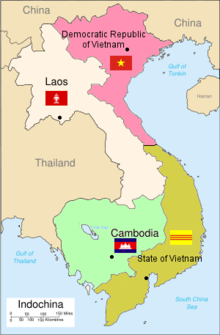
Vietnam during the Vietnam war
User:SnowFire, CC BY-SA 4.0 <https://creativecommons.org/licenses/by-sa/4.0>, via Wikimedia Commons
The last American troops had left Vietnam on March 29, 1973. President Richard Nixon claimed that he had achieved “peace with honor.” The South Vietnamese Army was supposedly now trained by Americans to defend the “country” from attack by North Vietnam.
Then came December 13, 1974—the start of the North’s all-out offensive.
The result: South Vietnamese forces melted away.
This was hardly surprising to American veterans of the war. Among them a favorite joke had been: “There’s a new batch of South Vietnamese rifles for sale. Never fired, and only dropped once.”
By April 30, 1975, Saigon, the capitol of South Vietnam, fell to the People’s Army of Vietnam and the Viet Cong.

Fall of Saigon
At home, watching TV, Americans felt shame as Army helicopters hurriedly lifted off the roof of the United States embassy. Numerous South Vietnamese desperately tried to climb aboard—only to have their hands stomped on by Americans equally desperate to get out before North Vietnamese forces reached them.
Now, 46 years later, Americans were seeing Air Force planes taking off from Kabul Airport, with hordes of Afghans desperate to leave the country, racing after them.
Said President Joseph Biden: “Over our country’s 20 years at war in Afghanistan, America has sent its finest young men and women, invested nearly $1 trillion dollars, trained over 300,000 Afghan soldiers and police, equipped them with state-of-the-art military equipment, and maintained their air force as part of the longest war in U.S. history.”

Joseph Biden
Just as the South Vietnamese Army had chosen flight instead of fight, so, too, did the Afghan Army—in just 10 days.
“One more year, or five more years, of U.S. military presence would not have made a difference if the Afghan military cannot or will not hold its own country,” said Biden. “And an endless American presence in the middle of another country’s civil conflict was not acceptable to me.
“When I came to office, I inherited a deal cut by my predecessor—which he invited the Taliban to discuss at Camp David on the eve of 9/11 of 2019—that left the Taliban in the strongest position militarily since 2001 and imposed a May 1, 2021 deadline on U.S. Forces.

Donald Trump
“Shortly before he left office, he also drew U.S. Forces down to a bare minimum of 2,500. Therefore, when I became President, I faced a choice—follow through on the deal, with a brief extension to get our forces and our allies’ forces out safely, or ramp up our presence and send more American troops to fight once again in another country’s civil conflict.
“I was the fourth President to preside over an American troop presence in Afghanistan—two Republicans, two Democrats. I would not, and will not, pass this war onto a fifth.”
Republicans have since tried hard to blame the resulting chaos on Biden. But in doing so they deliberately ignore the role played by his predecessor, Donald Trump, in facilitating that rout.
As Biden noted, Trump had invited the Taliban to Camp David to discuss the withdrawal of American forces from Afghanistan. Making this offer thoroughly disgraceful were two factors:
First: The date for this conference was on the eve of the 18th anniversary of the September 11, 2001 terrorist attacks on the Pentagon and World Trade Center. Osama bin Laden, the mastermind of those attacks, was then living in Afghanistan under the protection of the Taliban.
It was the refusal of the Taliban to turn him over to American justice that led directly to the American invasion of Afghanistan in October, 2001.
Second: Pointedly uninvited to this conference were any members of the Afghan government, which—officially—the United States regarded as a valuable ally.
There is a brutal lesson here that Americans have long refused to learn: Bad allies make for bad outcomes. Those who refuse to defend themselves cannot be bribed or forced to do so by others.
Contrast the “I have to catch a plane” cowardice of Afghan soldiers with the courage of Ukrainian soldiers—and civilians—fiercely defending their country from Vladimir Putin’s unprovoked Russian invasion.
During the assault by Russian troops on the capital of Kiev, the Biden administration urged President Volodymyr Zelensky to evacuate to a safer location and offered to help him do so. Zelensky refused, saying: “The fight is here [in Kiev]; I need ammunition, not a ride.”
Until Presidents and Congressional leaders learn to distinguish worthwhile allies from worthless ones, Americans will continue to waste lives and treasure on the latter.
ABC NEWS, ABORTION, AFFORDABLE CARE ACT, ALABAMA, ALTERNET, AMERICABLOG, AP, ASSASSINATION, BABY BOOMER RESISTANCE, BBC, BLOOMBERG NEWS, BRIAN KEMP, BUZZFEED, CARL AUSTIN WEISS, CBS NEWS, CNN, CROOKS AND LIARS, DAILY KOZ, DONALD TRUMP, FACEBOOK, FIVETHIRTYEIGHT, GEORGE C. WALLACE, GEORGIA, HARPER’S MAGAZINE, HUEY LONG, HUFFINGTON POST, INCEST, KAY IVEY, MARK JOSEPH STERN, MEDIA MATTERS, MOTHER JONES, MOVEON, MSNBC, NBC NEWS, NEW REPUBLIC, NEWSDAY, NEWSWEEK, NICCOLO MACHIAVELLI, NPR, PBS NEWSHOUR, POLITICO, POLITICUSUSA, RACHELLE GRIMMER, RAPE, RAW STORY, REINHARD HEYDRICH, REPUBLICANS, REUTERS, ROE V. WADE, Ronald Reagan, SALON, SEATTLE TIMES, Secret Service, SLATE, TALKING POINTS MEMO, THE ATLANTIC, THE CHICAGO SUN-TIMES, THE CHICAGO TRIBUNE, THE DAILY BEAST, THE DAILY BLOG, THE GUARDIAN, THE HILL, THE HUFFINGTON POST, THE INTERCEPT, THE LOS ANGELES TIMES, THE NATION, THE NEW REPUBLIC, THE NEW YORK TIMES, THE NEW YORKER, THE PRINCE, THE VILLAGE VOICE, THE WASHINGTON POST, THINKPROGRESS, TIME, TRUTHDIG, TRUTHOUT, TWITTER, TWO POLITICAL JUNKIES, U.S. NEWS & WORLD REPORT, UNITED STATES SUPREME COURT, UPI, USA TODAY, WELFARE
In Bureaucracy, History, Law, Law Enforcement, Politics, Social commentary on May 17, 2022 at 12:10 am
In The Prince, Niccolo Machiavelli, the father of modern political science, raised the question of “whether it is better to be loved than feared, or feared more than loved.”
And he answered it: “The reply is, that one ought to be both feared and loved, but as it is difficult for the two to go together, it is much safer to be feared than loved.”
But Machiavelli warned against relying primarily on fear:
“Still, a prince should make himself feared in such a way that if he does not gain love, he at any rate avoids hatred, for fear and the absence of hatred may well go together, and will always be attained by one who abstains from interfering with the property of his citizens….or with their women.”
If the Republicans governing Georgia and Alabama ever read this warning, they have ignored it with a vengeance.
Niccolo Machiavelli
On May 7, 2019, Georgia Governor Brian Kemp signed an anti-abortion law that—in defiance of the 1973 Supreme Court decision in Roe v. Wade—re-criminalizes abortion.
The law bans abortions as soon as a fetal heartbeat is detectable. This usually occurs about six weeks into a pregnancy—even before many women know they’re pregnant.
The law permits abortions
- Only if the mother’s life is at risk; or
- If the fetus cannot survive.
No exceptions are made for cases of rape or incest.
“HB 481 would also have consequences for women who get abortions from doctors or miscarry,” writes Mark Joseph Stern for Slate.
“A woman who seeks out an illegal abortion from a health care provider would be a party to murder, subject to life in prison. And a woman who miscarries because of her own conduct—say, using drugs while pregnant—would be liable for second-degree murder, punishable by 10 to 30 years’ imprisonment.
“Prosecutors may interrogate women who miscarry to determine whether they can be held responsible; if they find evidence of culpability, they may charge, detain, and try these women for the death of their fetuses.” [Emphasis added.]
In addition, a woman could be sentenced to 10 years’ imprisonment if she leaves Georgia to obtain an abortion in another state.
And on May 14, 2019, Alabama Governor Kay Ivey signed into law the “Alabama Human Life Protection Act.” The law only allows exceptions “to avoid a serious health risk to the unborn child’s mother,” for ectopic pregnancy and if the “unborn child has a lethal anomaly.”
Again, no exceptions are made for rape or incest.
Ivey admitted that the new law may be unenforceable owing to Roe v. Wade, which legalized abortion in all 50 states. But the whole point of the law is to challenge that decision, Ivey said.
Republicans constantly claim to be “the party of small government.” But there can be no more intrusive act than dictating to a woman that she must give birth—even if she’s the victim of rape or incest.
At the same time:
- Republicans have proven uniformly hostile to providing poor mothers with access to food, clothing and medical care.
- Donald Trump made repealing the Affordable Care Act—which provides medical insurance to more than 20 million Americans—the hallmark of his Presidency.
It’s easy to imagine many of these women fatally cracking under the strain.
On December 6, 2011, Rachelle Grimmer, a 38-year-old resident of San Antonio, pulled a gun in a state welfare office and held off police for seven hours. Then she shot and wounded her two children—ages 10 and 12—before fatally shooting herself.
For months, she had been unable to qualify for food stamps.
Thus, women living in abortion-banning states face Right-wing hypocrisy on one hand and draconian laws punishing the most intimate acts—of sexuality and reproductive freedom—on the other.
It’s easy to imagine some pregnant women—especially the victims of incest and/or rape—desperately seeking redress through violence. And the targets of their wrath could easily be the Republican legislators of their states who have made their lives a living hell.
Trump is constantly guarded by the Secret Service. And governors are protected by state police. But state assemblymen and senators aren’t assigned such details—unless there’s a specific threat made against them. Nor are anti-abortion Right-wing commentators like Tucker Carlson.
In fact, Right-wing figures have often been the targets of successful—and unsuccessful—assassination attempts.
- On September 8, 1935, Louisiana U.S. Senator Huey Long was shot and fatally wounded by Carl Austin Weiss, an idealistic young doctor. Long had intended to run for President in 1936 and unseat Franklin D. Roosevelt.
- On May 27, 1942, SS Obergruppenführer (General) Reinhard Heydrich—“The Butcher of Prague”—was killed with a hand grenade by two Czech patriots.
- On May 15, 1972, Presidential candidate George C. Wallace was shot and paralyzed by a crazed gunman while mingling with supporters in a Maryland shopping center.
- On March 30, 1981, President Ronald Reagan was shot and almost killed by a psychotic gunman while walking to his bulletproof limousine in Washington, D.C.
All but one of these men (Heydrich) were protected by bodyguards when they were attacked.
Given the ferocity of laws aimed specifically at them, some women may decide to abort more than fetuses.
ABC NEWS, ADULTERY, ALTERNET, AMERICABLOG, AP, BABY BOOMER RESISTANCE, BARACK OBAMA, BBC, BIBLE, BILLY GRAHAM, BLOOMBERG NEWS, BUZZFEED, CBS NEWS, CNN, CROOKS AND LIARS, DAILY KOZ, FACEBOOK, FIVETHIRTYEIGHT, FRANKLIN GRAHAM, HARPER’S MAGAZINE, HOMOSEXUALITY, HUFFINGTON POST, I USA TODAY, MEDIA MATTERS, MITT ROMNEY, MOTHER JONES, MOVEON, MSNBC, NBC NEWS, NEW REPUBLIC, NEWSDAY, NEWSWEEK, NEWT GINGRICH, NPR, PBS NEWSHOUR, POLITICO, POLITICUSUSA, RAW STORY, REUTERS, RICK SANTORUM, SALON, SCIENCE, SEATTLE TIMES, SLATE, SLAVERY, SPANISH INQUISITION, TALKING POINTS MEMO, TEA PARTY, THE ATLANTIC, THE CHICAGO SUN-TIMES, THE CHICAGO TRIBUNE, THE DAILY BEAST, THE DAILY BLOG, THE GUARDIAN, THE HILL, THE HUFFINGTON POST, THE INTERCEPT, THE LOS ANGELES TIMES, THE NATION, THE NEW REPUBLIC, THE NEW YORK TIMES, THE NEW YORKER, THE VILLAGE VOICE, THE WASHINGTON POST, THEOLOGY, THINKPROGRESS, TIME, TRUTHDIG, TRUTHOUT, TWITTER, TWO POLITICAL JUNKIES, U.S. NEWS & WORLD REPORT, UP, UPI, USA TODAY, WAR, WOMEN
In Bureaucracy, History, Law, Law Enforcement, Military, Politics, Social commentary on May 13, 2022 at 12:10 am
On February 18, 2012, GOP Presidential candidate Rick Santorum warned about the “phony theology” of President Barack Obama.
Rick Santorum
“It’s not about you,” Santorum told supporters of the right-wing Tea Party in Columbus, Ohio. “It’s not about your quality of life.
“It’s not about your jobs. It’s about some phony ideal. Some phony theology. Oh, not a theology based on the Bible. A different theology.”
Which raises an interesting question: What would a Bible-based agenda mean for the country?
The death penalty would be vastly expanded to cover such “crimes” as:
- Sabbath-breaking: Because the Lord considers it a holy day, anyone who works on the Sabbath must be put to death. (Exodus 31:12-15)
- Adultery: If a man commits adultery with another man’s wife, both the man and the woman must be put to death. (Leviticus 20:10)
- Fornication: A priest’s daughter who loses her honor by committing fornication and thereby dishonors her father also, shall be burned to death. (Leviticus 21:9)
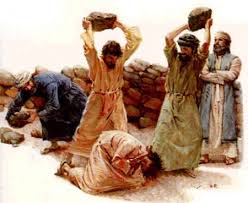
A Biblical-era stoning
- Nonbelievers: They entered into a covenant to seek the Lord, the God of their fathers, with all their heart and soul; and everyone who would not seek the Lord, the God of Israel, was to be put to death, whether small or great, whether man or woman. (2 Chronicles 15:12-13)
- Homosexuality: If a man also lies with mankind, as he lies with a woman, both of them have committed an abomination. They shall surely be put to death. Their blood shall be upon them. (Leviticus 20-13)
- Taking the Lord’s name in vain: Anyone who blasphemes the name of the Lord is to be put to death. The entire assembly must stone them. (Leviticus 24:16)
The Thirteenth Amendment to the Constitution—which forbids slavery—would be repealed. The Bible not only permits slavery but lays out rules for its practice—such as:
Almost all scientific progress would be discarded, since most of its findings conflict with the Bible:
- One generation passes away, and another generation comes: but the earth abides forever. (Ecclesiastes 1:4). This claim is totally contradicted by what astronomers now know about the eventual fate of the Earth: In about 7.6 billion years, the sun will exhaust its nuclear fuels. This will vastly increase its heat and gravitational pull, and at least Mercury, Earth and Venus will be vaporized.
- The Bible speaks of a world where physical laws are often violated by the will of God. Thus, Jesus turns water into wine and raises Lazarus from the dead; Jonah lives inside a fish for three days; Noah dies at 950 years; and demons are exorcised.
- In Biblical times, mental illness was seen as a manifestation of demonic possession. Today we know that mental illness has nothing to do with evil spirits.
Laws guaranteeing equal rights for women would be repealed:
- I do not permit a woman to teach or to have authority over a man; she must be silent. (1 Timothy 12:10)
- Wives, submit to your husbands as to the Lord. (Ephesians 5:22)
- A woman should learn in quietness and full submission. (1 Timothy 2:11)
- But if…evidence of the girl’s virginity is not found, they shall bring the girl to the entrance of her father’s house and there her townsman shall stone her to death. (Deuteronomy 22:20-21)
Military conflicts would be fought without regard to the Geneva Convention–as the Israelites did:
- “You are my battle-ax and sword,” says the Lord. “With you I will shatter nations and destroy many kingdoms….With you I will shatter men and women, old people and children, young men and maidens. With you I will shatter shepherds and flocks, farmers and oxen, captains and rulers.” (Jeremiah 51:20-23)
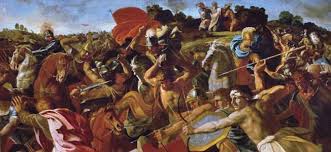
Depiction of the taking of Jericho by the Israelites
- Samuel said to Saul, “This is what the Lord Almighty says: ‘I will punish the Amalekites for what they did to Israel when they waylaid them as they came up from Egypt. Now go, attack the Amalekites and totally destroy everything that belongs to them. Do not spare them; put to death men and women, children and infants, cattle and sheep, camels and donkeys.’” (1 Samuel 15, 1-3)
Yes, a nation governed by “a theology based on the Bible” would be one far different from the United States we know today.
Since a number of Old Testament practices might lend themselves to easy abuse, this is not a matter to be taken lightly.
ABC NEWS, ADULTERY, ALTERNET, AMERICABLOG, AP, BABY BOOMER RESISTANCE, BARACK OBAMA, BBC, BIBLE, BILLY GRAHAM, BLOOMBERG NEWS, BUZZFEED, CBS NEWS, CNN, CROOKS AND LIARS, DAILY KOZ, FACEBOOK, FIVETHIRTYEIGHT, FRANKLIN GRAHAM, HARPER’S MAGAZINE, HOMOSEXUALITY, HUFFINGTON POST, I USA TODAY, MEDIA MATTERS, MITT ROMNEY, MOTHER JONES, MOVEON, MSNBC, NBC NEWS, NEW REPUBLIC, NEWSDAY, NEWSWEEK, NEWT GINGRICH, NPR, PBS NEWSHOUR, POLITICO, POLITICUSUSA, RAW STORY, REUTERS, RICK SANTORUM, SALON, SCIENCE, SEATTLE TIMES, SLATE, SLAVERY, SPANISH INQUISITION, TALKING POINTS MEMO, TEA PARTY, THE ATLANTIC, THE CHICAGO SUN-TIMES, THE CHICAGO TRIBUNE, THE DAILY BEAST, THE DAILY BLOG, THE GUARDIAN, THE HILL, THE HUFFINGTON POST, THE INTERCEPT, THE LOS ANGELES TIMES, THE NATION, THE NEW REPUBLIC, THE NEW YORK TIMES, THE NEW YORKER, THE VILLAGE VOICE, THE WASHINGTON POST, THEOLOGY, THINKPROGRESS, TIME, TRUTHDIG, TRUTHOUT, TWITTER, TWO POLITICAL JUNKIES, U.S. NEWS & WORLD REPORT, UP, UPI, USA TODAY, WAR, WOMEN
In Bureaucracy, History, Law, Law Enforcement, Military, Politics, Social commentary on May 12, 2022 at 12:13 am
Franklin Graham, son of Billy Graham, America’s most famous preacher, spends a lot of time deciding who qualifies as a Christian—and who doesn’t.

Franklin Graham
He said just that on the February 21, 2012 edition of the MSNBC show, “Morning Joe.”
First, however, he offered his views on the relative Christian dedication of the major contenders for the Presidency in 2012:
President Barack Obama: “Islam sees him as a son of Islam….I can’t say categorically that [Obama is not Muslim] because Islam has gotten a free pass under Obama.”
Former Speaker of the House Newt Gingrich: “Newt’s been married several times… but he could make a good candidate. I think Newt is a Christian. At least he told me he is.”
Former Pennsylvania U.S. Senator Rick Santorum: “His values are so clear on moral issues. No question about it. I think he is, no question, a man of faith.”
Former Massachusetts Governor Mitt Romney: “I’m just saying most Christians would not recognize Mormonism. Of course they believe in Jesus Christ, but they have a lot of other things that they believe in, too, that we don’t accept theologically.”
Thus, Graham had no problem in pronouncing as “saved” a notorious multiple-adulterer like Gingrich, or a rights-denying religious zealot like Santorum.
But he clearly refused to pronounce as “saved” a longtime church-goer like Obama or a Mormon like Romney (whose faith, most evangelicals like Graham believe, is actually a non-Christian cult).
Toward the end of the program, Mike Barnicle, one of the panelists interviewing Graham, said: “You must spend a big part of the day checking out what you conceive to be people’s depth of faith, in terms of measuring.”
“This is my business,” replied Graham. “You guys go through newspapers every day. I look at a person’s political interest, but more importantly I look at their spiritual interests….
“You have to go by what a person says, and how they live their lives…Are they faithful church goers? Or do they just go when the cameras are on them?”
Another man who dedicated his life to judging the religious commitment of others was Bernard Gui, the chief inquisitor at Toulouse from 1308 to 1322.
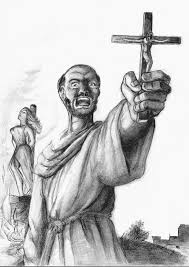
Bernard Gui
His inquisition of those suspected or accused of heresy led to over 900 guilty verdicts. Of those convicted during examination by Gui, 42 were executed—by being burned at the stake.
Gui closely studied the best methods for interrogating “heretics.” He set forth his findings in his most important and famous work, Practica Inquisitionis Heretice Pravitatis. or “Conduct of the Inquisition into Heretical Wickedness.”
In this, he offered a vivid example of how such interrogations might go. The following is taken from that manual:
Interrogator: You call your faith Christian, for you consider ours as false and heretical. But I ask whether you have ever believed as true another faith than that which the Roman Church holds to be true?
Accused Heretic: I believe the true faith which the Roman Church believes, and which you openly preach to us.
Interrogator: Perhaps you have some of your sect at Rome whom you call the Roman Church. I, when I preach, say many things, some of which are common to us both, as that God liveth, and you believe some of what I preach. Nevertheless you may be a heretic in not believing other matters which are to be believed.

“Heretic” being burned at the stake
Accused Heretic: I believe all things that a Christian should believe.
Interrogator: I know your tricks. What the members of your sect believe you hold to be that which a Christian should believe. But we waste time in this fencing. Say simply, Do you believe in one God the Father, and the Son, and the Holy Ghost?
Accused Heretic: I believe.
Interrogator: Do you believe in Christ born of the Virgin, suffered, risen, and ascended to heaven?
Accused Heretic: (Briskly) I believe.
Interrogator: Do you believe the bread and wine in the mass performed by the priests to be changed into the body and blood of Christ by divine virtue?
Accused Heretic: Ought I not to believe this?
Interrogator: I don’t ask if you ought to believe, but if you do believe.
Accused Heretic: I believe whatever you and other good doctors order me to believe.
Inquisitor: Those good doctors are the masters of your sect; if I accord with them you believe with me; if not, not.
Accused Heretic: I willingly believe with you if you teach what is good to me.
Inquisitor: You consider it good to you if I teach what your other masters teach. Say, then, do you believe the body of our Lord, Jesus Christ to be in the altar?
Accused Heretic: (Promptly) I believe that a body is there, and that all bodies are of our Lord.
Interrogator: I ask whether the body there is of the Lord who was born of the Virgin, hung on the cross, arose from the dead, ascended, etc.
Accused Heretic: And you, sir, do you not believe it?
Interrogator: I believe it wholly.
Accused Heretic: I believe likewise.
ABC NEWS, ADOLF HITLER, ALTERNET, AMERICABLOG, AP, BABY BOOMER RESISTANCE, BBC, BLOOMBERG NEWS, BUZZFEED, CBS NEWS, CENTERS FOR DISEASE CONTROL AND PREVENTION (CDC), CNN, COVID-19, CROOKS AND LIARS, DAILY KOZ, DEMOCRATS, DONALD TRUMP, FACEBOOK, FIVETHIRTYEIGHT, FOOD PRICES, FOX NEWS NETWORK, FRANKLIN D. ROOSEVELT, HARPER’S MAGAZINE, HUFFINGTON POST, HUNTER BIDEN, illegal immigration, IMMIGRATION AND CUSTOMS ENFORCEMENT (ICE), INFLATION, JANUARY 6 COUP ATTEMPT, JOSEPH BIDEN, JOSEPH MCCARTHY, LATINOS, MARJORIE TAYLOR GREENE, MARK MEADOWS, MEDIA MATTERS, MICHELLE OBAMA, MITCH MCCONNELL, MO BROOKS, MOTHER JONES, MOVEON, MSNBC, NAZIS, NBC NEWS, NEW REPUBLIC, NEWSDAY, NEWSWEEK, NEWT GINGRICH, NICCOLO MACHIAVELLI, NPR, PBS NEWSHOUR, POLITICO, POLITICUSUSA, PRICE-GOUGING, Racketeer Influenced Corrupt Organizations (RICO) Act, RAW STORY, REPUBLICANS, REUTERS, RICHARD NIXON, RIDICULE, RUDY GIULIANI, SALON, SEATTLE TIMES, SLATE, TALKING POINTS MEMO, THE ATLANTIC, THE CHICAGO SUN-TIMES, THE CHICAGO TRIBUNE, THE DAILY BEAST, THE DAILY BLOG, THE GUARDIAN, THE HILL, THE HUFFINGTON POST, THE LOS ANGELES TIMES, THE NATION, THE NEW REPUBLIC, THE NEW YORK TIMES, THE NEW YORKER, THE VILLAGE VOICE, THE WASHINGTON POST, THINKPROGRESS, TIME, TITLE 42, TOM COTTON, TREASON, TRUTHDIG, TRUTHOUT, TUCKER CARLSON, TWITTER, TWO POLITICAL JUNKIES, U.S. NEWS & WORLD REPORT, UKRAINE, UNITED STATES HOUSE OF REPRESENTATIVES, UNITED STATES SENATE, UPI, USA TODAY, VLADIMIR PUTIN, VOLODYMYR ZELENSKY, WONKETTE
In Bureaucracy, History, Law, Law Enforcement, Military, Politics, Social commentary on May 11, 2022 at 12:17 am
According to numerous polls, Democrats are looking at a political massacre this November—losing both the House and Senate.
Nany of the problems facing Democrats are self-inflicted. But they can be resolved if Democrats—and especially President Joseph Biden—are willing to fight fire with fire.
In Part One of this series, four such remedies were listed. Here are the remaining two.
WEAPON #5: ACCUSE—AND PROSECUTE—REPUBLICANS FOR SUPPORTING DICTATORSHIP
Just hours after the deadly January 6, 2021 coup attempt at the United States Capitol, 147 Republicans lawmakers in the House and Senate voted to overturn then-president Donald Trump’s election loss, following months of his baseless claims that the November election had been stolen.
Mounting evidence proves that many Republicans actively tried to assist Trump in illegally overturning the results of the 2020 election.
For example: On January 17, Georgia Rep. Marjorie Taylor Greene texted Trump’s chief of staff, Mark Meadows, advising Trump to declare martial law.
Yet not one Republican member of Congress has been indicted—let alone convicted—by the Biden Justice Department. Nor has any key member of the Trump administration, such as:
- Rep, Mo Brooks (R-Ala.) who incited the Trump crowd with: “Today is the day American patriots start taking down names and kicking ass!”
- Trump’s attorney, Rudy Giuliani, who cried to the demonstrators, “Let’s have trial by combat!”
- Donald Trump, who incited his followers to attack the Capitol and has spent a year and a half spreading poisonous lies that the 2020 election was “stolen” from him through “massive” voter fraud.
There is no better way to discourage law-abiding citizens and encourage law-breaking ones than to allow notorious criminals to go unpunished.

Donald Trump
President Biden should order Attorney General Merrick Garland to immediately start prosecuting ALL Republicans linked to the January 6 coup attempt.
Democrats should make their slogan for 2022—and 2024: “This time, vote like your whole democracy depends on it.”
WEAPON #6 DROP THE FIXATION ON ADMITTING ILLEGAL ALIENS
The Biden administration is pushing to lift Title 42, a 1944 federal law meant to help prevent the spread of communicable disease.
In March, 2020, at the start of the COVID-19 pandemic, the Centers for Disease Control and Prevention (CDC) authorized agents of Immigration and Customs Enforcement (ICE) to quickly expel migrants and deny entry to asylum seekers at the U.S.-Mexico border.
For President Donald Trump, the order restricted migrants’ entry into the country. But many congressional Democrats claimed that it short-circuited the country’s asylum system.
Republicans are fiercely defending Title 42—and holding continued funding for COVID research and vaccines as hostage for its retention.
When people are frightened and angry by high prices for food, housing and gas, they don’t welcome competition from uninvited illegal aliens. This includes Latinos—55% of whom disapprove of the job that Biden is doing.
Biden should drop plans to lift Title 42. He can use this as leverage in dealing with Republicans. And refusing to support illegal immigration won’t cost him support among Latinos.
* * * * *
Millions of Americans believe that only liberals can be Communist sympathizers and traitors. This is the direct result of decades of Republican propaganda dating back to 1946.
Republicans, having lost the White House from 1932 to 1948, furiously sought a return to power. And they found their remedy in attacking the patriotism of their fellow Americans—ushering in the infamous era of Joseph McCarthy, Richard Nixon and the Hollywood Blacklist.
Democrats need to similarly damn Republicans with the charge of “Traitor.” The difference: There is plenty of evidence—much of it on video—to document its truth.
In 1996, Newt Gingrich, then Republican Speaker of the House of Representatives, wrote a memo that encouraged Republicans to “speak like Newt.”
Entitled “Language: A Key Mechanism of Control,” it urged Republicans to attack Democrats with such words as “corrupt,” “selfish,” “destructive,” “hypocrisy,” “liberal,” “sick,” and “traitors.”
By contrast, Democrats have proven indifferent to or ignorant of the power of effective language. This has been true despite overwhelming evidence of Donald Trump’s treason. Out of this could have come:
- “TrumPutin”
- “Commissar-in-Chief”
- “Fake President”
- “DJTraitor”
- “Red Donald.”
In addition, Democrats have handicapped themselves via the Michelle Obama formula: “When they go low, we go high.” When you’re in a boxing match and your opponent goes for your groin, you’re a fool to adhere to Marquis of Queensbury.
Finally, Democrats have refused to see most of their fellow Americans for what they are.
Historically, the United States has always been a highly conservative nation. Going from “conservative” to “Fascist” is a relatively easy step—as millions of Donald Trump’s supporters have proven.
That’s why, despite his manifest criminalities, a majority of Right-wing Americans would have given Trump another four years.
But COVID-19 changed all that. Suddenly, millions of Americans found themselves stuck at home with their children. Many of them couldn’t go to work—because they were sick or their jobs had disappeared. Their 401Ks suddenly became worthless.
Only a lethal pandemic forced them to vote for Joe Biden.
In short: To win elections, Democrats must use the same weapons as their sworn Republican enemies and brutally attack them head-on.
And they must appeal to what truly moves most voters: Greed. Fear. Hatred.
ABC NEWS, ADOLF HITLER, ALTERNET, AMERICABLOG, AP, BABY BOOMER RESISTANCE, BBC, BLOOMBERG NEWS, BUZZFEED, CBS NEWS, CENTERS FOR DISEASE CONTROL AND PREVENTION (CDC), CNN, COVID-19, CROOKS AND LIARS, DAILY KOZ, DEMOCRATS, DONALD TRUMP, FACEBOOK, FIVETHIRTYEIGHT, FOOD PRICES, FOX NEWS NETWORK, FRANKLIN D. ROOSEVELT, HARPER’S MAGAZINE, HUFFINGTON POST, HUNTER BIDEN, illegal immigration, IMMIGRATION AND CUSTOMS ENFORCEMENT (ICE), INFLATION, JANUARY 6 COUP ATTEMPT, JOSEPH BIDEN, JOSEPH MCCARTHY, LATINOS, MARJORIE TAYLOR GREENE, MARK MEADOWS, MEDIA MATTERS, MICHELLE OBAMA, MITCH MCCONNELL, MO BROOKS, MOTHER JONES, MOVEON, MSNBC, NAZIS, NBC NEWS, NEW REPUBLIC, NEWSDAY, NEWSWEEK, NEWT GINGRICH, NICCOLO MACHIAVELLI, NPR, PBS NEWSHOUR, POLITICO, POLITICUSUSA, PRICE-GOUGING, Racketeer Influenced Corrupt Organizations (RICO) Act, RAW STORY, REPUBLICANS, REUTERS, RICHARD NIXON, RIDICULE, RUDY GIULIANI, SALON, SEATTLE TIMES, SLATE, TALKING POINTS MEMO, THE ATLANTIC, THE CHICAGO SUN-TIMES, THE CHICAGO TRIBUNE, THE DAILY BEAST, THE DAILY BLOG, THE GUARDIAN, THE HILL, THE HUFFINGTON POST, THE LOS ANGELES TIMES, THE NATION, THE NEW REPUBLIC, THE NEW YORK TIMES, THE NEW YORKER, THE VILLAGE VOICE, THE WASHINGTON POST, THINKPROGRESS, TIME, TITLE 42, TOM COTTON, TREASON, TRUTHDIG, TRUTHOUT, TUCKER CARLSON, TWITTER, TWO POLITICAL JUNKIES, U.S. NEWS & WORLD REPORT, UKRAINE, UNITED STATES HOUSE OF REPRESENTATIVES, UNITED STATES SENATE, UPI, USA TODAY, VLADIMIR PUTIN, VOLODYMYR ZELENSKY, WONKETTE
In Bureaucracy, Business, History, Law, Law Enforcement, Medical, Military, Politics, Social commentary on May 10, 2022 at 12:22 am
“Republicans have the advantage with voters in 2022 elections, poll finds.”
So read the headline in an April 29 story on the NPR website. According to the story:
- “All signs are pointing to a difficult midterm election for President Biden and Democrats, and a new NPR/PBS NewsHour/Marist poll has fresh evidence of that.”
- “Of the 1,162 registered voters surveyed, 47% said they are more likely to vote for the Republican in their district, as opposed to 44% who said Democrats.”
- Voters favor Republicans on the issues of inflation, crime and national security. Inflation is Americans’ No. 1 concern.
- On immigration, the country is split.
Political pundits are openly predicting that this will hand Republicans the House, if not the Senate as well.
Yet there are steps that Democrats—particularly President Joseph Biden—can take to try to reverse this outcome.
WEAPON #1: REASSURE VOTERS THAT HE IS ATTACKING INFLATION IN A WAY THEY CAN UNDERSTAND
When people are frightened and angry, they look for simple answers and solutions—and scapegoats. That is how Republicans deal with crises.
Republicans learned long ago that most voters aren’t moved by appeals to their rationality. Instead, what counts with them is emotions.
And Republicans have become experts at appealing to these—especially the baser ones. For Republicans, the Big Three are: Hatred, Greed, Fear.
Voters want to buy groceries at an affordable price—and to walk streets and enter stores without wearing a mask. And they want concrete reasons to believe that these can become reality.
President Biden should do the same in combating rising gas and food prices, which are frightening and angering millions.
Instead of accepting the conventional explanation of “supply chain difficulties,” he should blame rising prices on the entrenched greed of corporations. In many cases, it is no doubt true.

More importantly, Biden should propose a bill to make price gouging a national crime, punishable by a lengthy prison term. It can be modeled on the anti-extortion provisions in the Racketeer Influenced Corrupt Organizations (RICO) Act.
No matter what happens on the bill, the President faces a win/win situation.
If it passes, he can rightly take credit for it and reap the popularity certain to result. And if Republicans block its passage, he can rightly blame them, thus ensuring that he and Democrats are seen as “the people’s champions.”
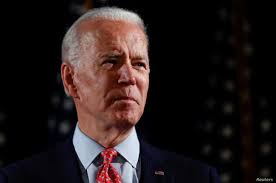
President Joe Biden
WEAPON #2: STOP THINKING OF REPUBLICANS AS “OUR FRIENDS”
The President should stop referring to “our Republican friends.” He has no friends among men and women dedicated to overthrowing Constitutional government and imposing a lifelong criminal and tyrant in his place.
Republicans have enthusiastically embraced Donald Trump’s Big Lie that the 2020 election was stolen from him—despite overwhelming evidence that it wasn’t.
Legislators in Republican-controlled states are now working furiously to corrupt election machinery at state and local levels so they can nullify the votes of millions of Democrats in the 2022 and 2024 elections.
Their ultimate goal: Restore a lifelong criminal and Russia-appeasing traitor to absolute power as “President-for-Life.”
And more than a year after that treasonous attempted coup, many Republicans still refuse to accept the legitimacy of Biden’s win.
Would Franklin D. Roosevelt have referred to his Right-wing enemies as “our Nazi friends”?

January 6, 2021 attempted coup
WEAPON #3: BLAME DONALD TRUMP AND HIS STORMTRUMPERS FOR COVID-19 DEATHS
Trump learned how deadly the virus was in January, 2020. But he
- Publicly denied this and attacked mask-wearing and social distancing;
- Attacked governors who issued stay-at-home orders to contain the virus;
- Incited his followers to defy those orders; and
- Secretly got vaccinated before leaving office and has only reluctantly acknowledged the importance of vaccinations.
His legacy of defying science continues to live on in his millions of Stormtrumper followers—who refuse to mask up, social distance and, most importantly, get vaccinated. The vast majority of those now flooding hospital ICU rooms—and morgues—are unvaccinated.
As a result, countless victims of crime, accidents, heart attacks, strokes and other debilitating conditions find their surgeries/treatments canceled or indefinitely postponed. And doctors and nurses treating these patients are nearing the breaking point of exhaustion.

President Biden and the health officials of his administration should blame the unvaccinated for their egotistical selfishness in causing this crisis. This will put Republicans on the defensive and divert attacks on the President.
He should also propose a national law allowing hospitals to stop admitting unvaccinated anti-vaxxers. These people need to face the consequences of their own irresponsible behavior. Only then will hospitals be free to care for those who deserve medical treatment.
WEAPON #4: BLAME TRUMP AND REPUBLICANS FOR THE CURRENT CRISIS IN UKRAINE
In July, 2019, Trump tried to extort a “favor” from Ukrainian President Volodymyr Zelensky: Investigate on presumed 2020 Democratic Presidential Candidate Joseph Biden and his son, Hunter, who had had business dealings in Ukraine.
Clearly implied in the call: Produce “dirt” on Biden—or you won’t get the Congressionally authorized $400 million in military aid.
Biden should blame Trump for having encouraged Putin to invade Ukraine. Example: Siding with Putin against the FBI and CIA when they agreed that Russia had interfered in the 2016 Presidential election. The words “traitor” and “treason” should be routinely used when he discusses these incidents.
ABC NEWS, ABORTION, ADOLF HITLER, ALBERT SPEER, ALTERNET, AMERICABLOG, AP, ASSASSINATION, BABY BOOMER RESISTANCE, BBC, BLOOMBERG NEWS, BRETT KAVANAUGH, BUZZFEED, CBS NEWS, CENTER FOR REPRODUCTIVE RIGHTS, CLARENCE THOMAS, CNN, CROOKS AND LIARS, CZECHOSLOVAKIA, DAILY KOZ, DONALD TRUMP, DRUDGE REPORT, FACEBOOK, FINAL SOLUTION, FIVETHIRTYEIGHT, FOX NEWS, FRANKLIN GRAHAM, HARPER’S MAGAZINE, HEINRICH HIMMLER, HERMANN GOERING, HUFFINGTON POST, JOACHIM VON RIBBENTROP, LENI RIEFENSTAHL, LINDSEY GRAHAM, MARCO RUBIO, MEDIA MATTERS, MITCH MCCONNEL, MOTHER JONES, MOVEON, MSNBC, NATIONAL RIFLE ASSOCIATION, NAZI GERMANY, NBC NEWS, NEW REPUBLIC, NEWSDAY, NEWSWEEK, NPR, PBS NEWSHOUR, POLITICO, POLITICUSUSA, RAND PAUL, RAW STORY, REINHARD HEYDRICH, REUTERS, ROLAND FREISLER, RON DESANTIS, RUDOLF HESS, SALON, SAMUEL ALITO, SEATTLE TIMES, SLATE, SS, TALKING POINTS MEMO, TED CRUZ, THE ATLANTIC, THE CHICAGO SUN-TIMES, THE CHICAGO TRIBUNE, THE DAILY BEAST, THE DAILY BLOG, THE GUARDIAN, THE HILL, THE HUFFINGTON POST, THE LOS ANGELES TIMES, THE NATION, THE NEW REPUBLIC, THE NEW YORK TIMES, THE NEW YORKER, THE SUPREME COURT, THE VILLAGE VOICE, THE WASHINGTON POST, THINKPROGRESS, TIME, TRUTHDIG, TRUTHOUT, TUCKER CARLSON, TWITTER, TWO POLITICAL JUNKIES, U.S. NEWS & WORLD REPORT, UPI, USA TODAY, WANNSEE CONFERENCE
In Bureaucracy, Entertainment, History, Politics, Social commentary on May 9, 2022 at 12:10 am
In 1942, two British-trained Czech commandos assassinated SS Obergruppenführer (General) Reinhard Heydrich.
A tall, blond-haired former naval officer, he was both a champion fencer and talented violinist. Heydrich joined the Schutzstaffel, or Protective Squads, better known as the SS, in 1931, and quickly became head of its counterintelligence service.
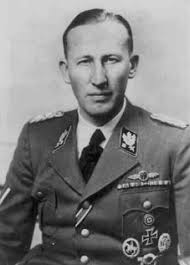
Reinhard Heycrich
In September, 1941, Heydrich was appointed “Reich Protector” of Czechoslovakia, which had fallen prey to Germany in 1938 but whose citizens were growing restless under Nazi rule.
Heydrich immediately ordered a purge, executing 92 people within the first three days of his arrival in Prague. By February, 1942, 4,000-5,000 people had been arrested.
In January, 1942, Heydrich convened a meeting of high-ranking political and military leaders to streamline “the Final Solution to the Jewish Question.”
At the now-infamous Wannsee conference, Heydrich decreed that, henceforth, all Jews in Reich-occupied territories would be shipped to extermination camps. No exceptions would be made for women, children or the infirm.
An estimated six million Jews were thus slaughtered.
Returning to Prague, Heydrich continued his policy of carrot-and-stick with the Czechs—improving the social security system and requisitioning luxury hotels for middle-class workers, alternating with arrests and executions.
The Czech government-in-exile, headquartered in London, feared that Heydrich’s incentives might lead the Czechs to passively accept domination. They decided to assassinate Heydrich.
Two British-trained Czech commandos—Jan Kubis and Joseph Gabcik—parachuted into Prague.
Unexpectedly, they got help from Heydrich himself. Supremely arrogant, he traveled the same route every day from home to his downtown office and refused to be escorted by armed guards, claiming no one would dare attack him.
On May 27, 1942, Kubis and Gabcik waited at a hairpin turn in the road always taken by Heydrich. When Heydrich’s Mercedes slowed down, Gabcik raised his machinegun–which jammed.
Rising in his seat, Heydrich aimed his revolver at Gabcik—as Kubis lobbed a hand grenade at the car. The explosion drove steel and leather fragments of the car’s upholstery into Heydrich’s diaphragm, spleen and lung.
Hitler dispatched doctors from Berlin to save the Reich Protector. But infection set in, and on June 4, Heydrich died at age 38.
The assassination sent shockwaves through the upper echelons of the Third Reich. No one had dared assault—much less assassinate—a high-ranking Nazi official.
Nazis had slaughtered tens of thousands without hesitation—or fear that the same might happen to them.
Suddenly they realized that the fury they had aroused could be turned against themselves.
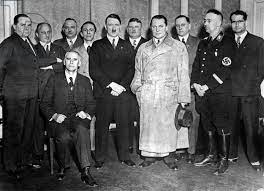
Members of the Nazi government
Which brings us to the leaders of America’s own Right-wing.
The names of infamous Nazis were widely known:
- Reichsmarshall Hermann Goering;
- Propaganda Minister Paul Joseph Goebbels;
- Deputy Fuhrer Rudolf Hess;
- Propaganda Film Director Leni Riefenstahl;
- SS-Reichsfuhrer Heinrich Himmler;
- “Hanging Judge” Roland Freisler;
- Architect Albert Speer;
- Foreign Minister Joachim von Ribbentrop;
- SS Obergruoppenfuhrer Reinhard Heydrich; and
- The most infamous Nazi of all: Adolf Hitler.
And so are the names of the infamous leaders of the American Right:
- Senate Minority Leader Mitch McConnell;
- Supreme Court Justice Amy Coney Barrett;
- Texas Senator Ted Cruz;
- Supreme Court Justice Clarence Thomas;
- Commentator Tucker Carlson;
- Supreme Court Justice Neil Gorsuch;
- Evangelist Franklin Graham;
- Supreme Court Justice Brett Kavanaugh;
- Florida Senator Marco Rubio;
- Supreme Court Justice Samuel Alito;
- Florida Governor Ron DeSantis; and
- The most infamous Right-winger of all: Former President Donald Trump.
The difference between these two infamous groups is this:
In Nazi Germany, ordinary Germans could not learn about the personal lives of their dictators—including their home addresses—and to conspire against them.
In the United States, ordinary citizens have an array of means to do this. They can turn to newspapers, TV and magazines. And if that isn’t enough, “people finder” websites, for a modest price, provide addresses and names of relatives of potential targets.
In Nazi Germany, firearms were tightly controlled. In the United States, the Right’s National Rifle Association has successfully lobbied to put lethal firepower into the hands of virtually anyone who wants it.
Which brings us to the firestorm now erupting over the publication of an initial draft majority opinion of the Supreme Court. Backed by the Court’s five Right-wing Justices, it overturns the 1973 Roe v. Wade decision legalizing abortion.
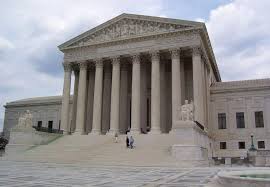
The Supreme Court
In one to two months, millions of women will likely become victims of Right-wing anti-abortion fanaticism.
According to the Center for Reproductive Rights, 23 states will institute bans, with trigger laws on the books in 13 of them. These are bans designed to take effect if Roe is overturned.
Republicans boast that they want to “get the government off the backs of the people.” Yet since 1973 they have furiously tried to re-insert it into the vagina of every American woman.
Interfering with the right to obtain medical care—especially when it applies to sexually-involved matters—is an act guaranteed to arouse fury in even the most pacifistic men and women.
This is especially true when a political party—such as that of the Nazis and Republicans—makes clear its intention to rule by force, rather than by public consent.
Reinhard Heydrich believed himself invulnerable from the hatred of the enemies he had made. That arrogance cost him his life.
The day may soon come when America’s own Right-wingers start learning the same lesson.
2012 PRESIDENTIAL ELECTION, ABC NEWS, ALTERNET, AMERICABLOG, AMERICAN CROSSROADS, ANN COULTER, AP, BABY BOOMER RESISTANCE, BARACK OBAMA, BBC, BENITO MUSSOLINI, BLOOMBERG NEWS, BUZZFEED, CBS NEWS, CNN, CROOKS AND LIARS, DAILY KOS, DAILY KOZ, DONALD TRUMP, FACEBOOK, FASCISM, FIVETHIRTYEIGHT, HARPER’S MAGAZINE, HUFFINGTON POST, IN TRUMP WE TRUST (BOOK), KARL ROVE, MEDIA MATTERS, MITT ROMNEY, MOTHER JONES, MOVEON, MSNBC, NBC NEWS, NEW REPUBLIC, NEWSDAY, NEWSWEEK, NPR, PBS NEWSHOUR, POLITICO, POLITICUSUSA, RAW STORY, REUTERS, SALON, SEATTLE TIMES, SLATE, TALKING POINTS MEMO, THE ATLANTIC, THE CHICAGO SUN-TIMES, THE CHICAGO TRIBUNE, THE DAILY BEAST, THE DAILY BLOG, THE GUARDIAN, THE HILL, THE HUFFINGTON POST, THE INTERCEPT, THE LOS ANGELES TIMES, THE NATION, THE NEW REPUBLIC, THE NEW YORK TIMES, THE NEW YORKER, THE VILLAGE VOICE, THE WALL STREET JOURNAL, THE WASHINGTON POST, THINKPROGRESS, TIME, TRUTHDIG, TRUTHOUT, TWITTER, TWO POLITICAL JUNKIES, U.S. NEWS & WORLD REPORT, UPI, USA TODAY, WONKETTE
In Bureaucracy, History, Politics, Social commentary on May 6, 2022 at 12:10 am
On November 6, 2012, Ann Coulter, the Right-wing activist and propagandist, was devastated by the re-election of President Barack Obama.
“People are suffering. The country is in disarray,” she whined during an interview. “If Mitt Romney [the Republican Presidential nominee] cannot win in this economy, then the tipping point has been reached. We have more takers than makers and it’s over. There is no hope.
“Mitt Romney was the president we needed right now, and I think it is so sad that we are going to be deprived of his brain power, of his skills in turning companies around, turning the Olympics around, his idea and his kindness for being able to push very conservative ideas on a country that no longer is interested in conservative ideas. It is interested in handouts.”
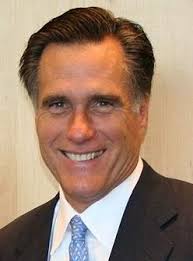
Mitt Romney
Note the chief reason for her regret: Romney would have been “able to push very conservative ideas on a country that no longer is interested in conservative ideas.”
Unfortunately for Coulter, a majority of Americans rejected this mentality—and the repressive measures that would have accompanied it.
So, naturally, Coulter and her fellow Rightists felt dejected.
One of these was Donald Trump, then a real estate mogul and host of the “reality show” The Apprentice.
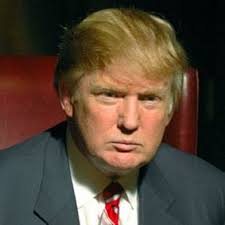
Donald Trump
When it became clear that Romney was not going to be America’s 45th President, Trump went ballistic on Twitter. Among his tweets:
- More votes equals a loss…revolution!
- Lets fight like hell and stop this great and disgusting injustice! The world is laughing at us.
- We can’t let this happen. We should march on Washington and stop this travesty. Our nation is totally divided!
- The phoney electoral college made a laughing stock out of our nation. The loser one!
- He lost the popular vote by a lot and won the election. We should have a revolution in this country!
To put Trump’s rants into real-world perspective:
- According to Trump, the electoral process works when a Republican wins the Presidency. It only doesn’t work when a Democrat wins.
- “We should march on Washington” conjures up images of another Fascist–Benito Mussolini—marching on Rome at the head of his Blackshirts to seize power. Which, in a democracy, is treason.
- “The phoney electoral college made a laughing stock out of our nation. The loser one!”
Ironically, the 2012 Republican Platform had fully embraced preserving the Electoral College: “We oppose the National Popular Vote Interstate Compact or any other scheme to abolish or distort the procedures of the Electoral College.
“We recognize that an unconstitutional effort to impose ‘national popular vote’ would be a mortal threat to our federal system and a guarantee of corruption as every ballot box in every state would become a chance to steal the presidency.”
And the loser didn’t win: He lost.
Obama got 60,652,238 votes. Romney got 57,810,407.
But by 2016, Coulter no longer felt dismayed. She felt rejuvenated—for she had found her perfect Presidential candidate: Donald Trump.
Appearing on the Right-wing radio program, “The Eric Metaxes Show,” she said: “It is like the fall of Rome but, thank God, and I am not using the Lord’s name in vain, I mean that absolutely literally, thank God for raising up Donald Trump and giving us a chance to save the country.
“What is the point of talking about abortion or anything else unless you get Donald Trump in to build the wall, deport illegals, end this ‘anchor baby’ nonsense, stop importing 100,000 Muslims a year, in addition to two million Third Worlders per year. It’s madness what this country has been doing.”
Coulter not only spoke on Trump’s behalf—she sang his praises in a 2016 book: In Trump We Trust: E Pluribus Awesome!

Ann Coulter
According to its dust jacket: “[Ann Coulter] argues that a bull in the china shop is exactly what we need to make America great again.
“In this powerful book, Coulter explains why conservatives, moderates, and even disgruntled Democrats should set aside their doubts and embrace Trump:
“He’s putting America first in our trade deals and alliances, rather than pandering to our allies and enemies.
“He’s abandoned the GOP’s decades-long commitment to a bellicose foreign policy, at a time when the entire country is sick of unnecessary wars.”
To Coulter’s delight, Trump defeated Democratic Presidential nominee Hillary Clinton on November 9, 2016.
Although Clinton got almost 2.9 million more popular votes, he swamped her in the Electoral College—304 votes to Clinton’s 227.
Suddenly, for Trump, the Electoral College wasn’t “phoney.”
But by May, 2017, four months after Trump had taken office as President, Ann Coulter was ready to abandon him. Her chief complaint: He hadn’t built the wall along the United States-Mexican border he had promised to erect.
“We want the ruthless businessman we were promised,” she told the conservative website, The Daily Caller.
“I guess we have to try to push him to keep his promises. But this isn’t North Korea, and if he doesn’t keep his promises I’m out.
“This is why we voted for him. I think everyone who voted for him knew his personality was grotesque, it was the issues.”
In short: She backed a monster to wreak destruction on those she hated.
2016 PRESIDENTIAL RACE, ABC NEWS, ABORTION, ADOLF HITLER, ALTERNET, AMERICABLOG, AMY CONEY BARRETT, AP, BABY BOOMER RESISTANCE, BBC, BIRTH CONTROL, BLOOMBERG NEWS, BRETT KAVANAUGH, BUZZFEED, CAPITAL PUNISHMENT, CBS NEWS, CHARLES SCHULTZ, CNN, CONSERVATIVE VICTORY (BOOK), CONTRACEPTION, CROOKS AND LIARS, DAILY KOZ, DONALD TRUMP, FACEBOOK, FIVETHIRTYEIGHT, HARPER’S MAGAZINE, HUFFINGTON POST, MEDIA MATTERS, MOTHER JONES, MOVEON, MSNBC, NBC NEWS, NEIL GORSUCH, NEW REPUBLIC, NEWSDAY, NEWSWEEK, NPR, NUCLEAR WAR, PBS NEWSHOUR, PEANUTS CARTOON SERIES, POLITICO, POLITICUSUSA, RAW STORY, REPUBLICAN PARTY, REPUBLICANS, REUTERS, ROE V. WADE, Ronald Reagan, RUSH LIMBAUGH, SALON, SANDRA FLUKE, SCOTT DESJARLIS, SEAN HANNITY, SEATTLE TIMES, SLATE, TALIBAN, TALKING POINTS MEMO, THE ATLANTIC, THE CHICAGO SUN-TIMES, THE CHICAGO TRIBUNE, THE DAILY BEAST, THE DAILY BLOG, THE GUARDIAN, THE HILL, THE HUFFINGTON POST, THE LOS ANGELES TIMES, THE NATION, THE NEW REPUBLIC, THE NEW YORK TIMES, THE NEW YORKER, THE VILLAGE VOICE, THE WASHINGTON POST, THINKPROGRESS, TIME, TRUTHDIG, TRUTHOUT, TWITTER, TWO POLITICAL JUNKIES, U.S. NEWS & WORLD REPORT, UPI, USA TODAY, WAR, WONKETTE
In Bureaucracy, History, Law Enforcement, Medical, Politics, Social commentary on May 5, 2022 at 12:15 am
On May 2, POLITICO released a bombshell of a story: The United States Supreme Court intended to strike down Roe v. Wade.
The proof came in an initial draft majority opinion written by Justice Samuel Alito, circulated within the court and obtained by POLITICO.
The draft opinion completely repudiates the 1973 decision which guaranteed federal constitutional protections of abortion rights.
The Supreme Court
“Roe was egregiously wrong from the start,” Alito writes. “Its reasoning was exceptionally weak, and the decision has had damaging consequences.”
Some 36 million women could then lose abortion access, according to research from Planned Parenthood, a healthcare organization which provides abortions.
Making this possible was the appointment of three Right-wing Justices by President Donald Trump: Neil Gorsuch (2017); Brett Kavanaugh (2018); and Amy Coney Barrett (2020).
This has been a dream for Right-wing anti-abortion fanatics since the Court struck down abortion restrictions almost 50 years ago.
So what’s responsible for all this fetus fanaticism?
First, there is an energized constituency for politicians willing to wave this red flag.
Every major Republican Presidential candidate since Ronald Reagan has tapped into this voting bloc. And each has found plenty of votes to be gotten from it.
Second, many fetus fanatics simply dislike women.
They fear and resent the women’s movement, which has given women the right to enter the workforce and compete directly with men.
And what they hate most is the legal right of a woman to avoid becoming pregnant via birth control—or to abort the result of a male’s sperm if they do. They see this as a personal rejection.
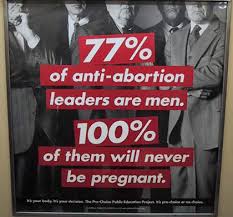
The Right is made up overwhelmingly of white males. And many of these men would feel entirely at home with a Christianized version of the Taliban. They long for a world where women meekly cater to their every demand and believe only what their male masters approve for them to believe.
Third, many fetus fanatics are “pro-life” when it comes to fetuses, but hypocritically refuse to support the needs of children from low-income families.
Fourth, many fetus fanatics are “family values” hypocrites.
For example: Representative Scott DesJarlais (R-TN), an anti-abortion, “family values” doctor, had an affair with a patient and later pressured her to get an abortion. He also agreed that his wife should have two abortions.
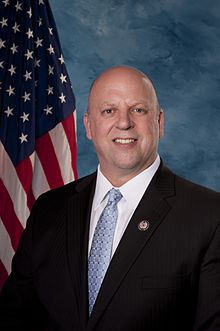
Scott DesJarlais
People like this subscribe to a philosophy of: “Do as I say, not as I do. And if I do it, it’s in the service of a Higher Cause and therefore entirely justified.”
Fifth, many fetus fanatics feel guilty about their own past sexual transgressions—especially if these resulted in pregnancy.
And they want to prevent others from living the same life they did.
Some of these people are well-intentioned. Even so, they usurp unto themselves a God-like right to intrude on the most intimate decisions for others—regardless of what those people may need or want.
Sixth, many fetus fanatics embrace contradictory goals.
On one hand, most of them claim they want to “get government off the backs of the people.” That usually means allowing corporations to pollute, sell dangerous products and treat their employees as slaves.
On the other hand, they want to insert the government into the vagina of every woman. That means empowering State and Federal authorities to prevent women from getting birth control or an abortion—even in cases of rape, incest, or to save the life of the mother.
Seventh, many leaders of the fetus fanatics movement are independently wealthy.
This means that even if abortion could be outlawed for the vast majority, they could always bribe a willing doctor—here or abroad—to perform such an operation on their wife, daughter and/or mistress. For them, there is always an escape clause.
Eighth, many fetus fanatics are not truly “pro-life.”
They totally oppose abortion under most—-if not all—circumstances. But they also fully support:
- making military-style assault weapons available to nutcases;
- capital punishment;
- going to war for almost any reason;
- wholesale massacres of wildlife;
- despoiling of the environment; and/or
- even nuclear war.
Lucy, the famous cartoon character in Charles Schultz’ “Peanuts” series, once said: “I love humanity. It’s people I can’t stand.” With fetus fanatics, the line runs: “I love fetuses. Everything else is expendable.”
Ninth, many fetus fanatics believe that since their religion teaches that abortion is wrong, they have a moral duty to enforce that belief on others.
This is especially true for evangelical Christians. These are the same people who condemn Muslims—such as those in Saudi Arabia—for segregating women, forbidding them to drive and forcing them to wear head scarfs or chadors—loose, usually black robes.
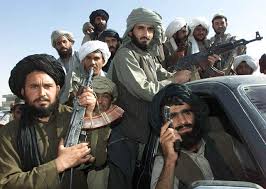
Taliban: Islam’s version of the “Right-to-Life” movement
But while they condemn Islamics for their general intolerance of others’ religious beliefs, they lust to impose their own upon those who belong to other churches. Or who belong to no church at all.
Tenth, many fetus fanatics are just as opposed to birth control as they are to abortion.
Thus, when Georgia University law student Sandra Fluke asked Congress to require insurance companies to cover birth control, Rush Limbaugh branded her a “slut” and a “prostitute.”
2016 PRESIDENTIAL ELECTION, ABC NEWS, AFFORDABLE CARE ACT, ALAN LADD, ALTERNET, AMERICABLOG, AP, BABY BOOMER RESISTANCE, BBC, BLOOMBERG NEWS, BORDER WALL, BUZZFEED, CALVERA (CHARACTER), CANADA, CAPITOL INSURRECTION, CBS NEWS, CHARLES GEORGE GORDON, CHRIS (CHARACTER), CHYE-CHING HUANG, CIA, CNN, COVID-19, CROOKS AND LIARS, DAILY KOZ, DONALD TRUMP, DONALD TRUMP: TRAGIC HERO (ARTICLE), ELECTORAL COLLEGE, ELI WALLACH, FACEBOOK, FBI, FEDERAL FISCAL POLICY, FEDERAL GOVERNMENT SHUTDOWN, FIVETHIRTYEIGHT, HAMLET, HARPER’S MAGAZINE, HOOVER INSTITUTE, HUFFINGTON POST, ISLAMIC STATE, JACK PALANCE, JAMES COMEY, JEFF SESSONS, JOHN FORD, JOHN WAYNE, JOSEPH BIDEN, KHARTOUM, KIM JONG ON, LEE MARVIN, MEDIA MATTERS, MOTHER JONES, MOVEON, MSNBC, NATIONAL SECURITY AGENCY, NBC NEWS, NEW REPUBLIC, NEWSDAY, NEWSWEEK, NORTH KOREA, NPR, PBS NEWSHOUR, POLITICO, POLITICUSUSA, RAW STORY, REUTERS, ROBERT S. MUELLER III, RUFUS RYKER (CHARACTER), RUSSIA, SALON, SEATTLE TIMES, SERGEY KISLYAK, SERGEY LAVROV, SHANE (MOVIE), SLATE, STEVE MCQUEEN, TALKING POINTS MEMO, TAX CUTS AND JOBS ACT OF 2017, THE ATLANTIC, THE CASE FOR TRUMP (BOOK), THE CHICAGO SUN-TIMES, THE CHICAGO TRIBUNE, THE DAILY BEAST, THE DAILY BLOG, THE GUARDIAN, THE HILL, THE HUFFINGTON POST, THE LOS ANGELES TIMES, THE MAGNIFICENT SEVEN (MOVIE), THE MAN WHO SHOT LIBERTY VALANCE (MOVIE), THE NATION, THE NEW REPUBLIC, THE NEW YORK TIMES, THE NEW YORKER, THE PRESS, THE VILLAGE VOICE, THE WASHINGTON POST, THINKPROGRESS, TIME, TRAGEDY, TRUMP FOUNDATION, TRUMP UNIVERSITY, TRUTHDIG, TRUTHOUT, TWITTER, TWO POLITICAL JUNKIES, U.S. NEWS & WORLD REPORT, UKRAINE, UPI, USA TODAY, VICTOR DAVIS HANSON, VLADIMIR PUTIN, VOLODYMYR ZELENSKY, WILLIAM SHAKESPEARE, WILSON (CHARACTER), WONKETTE, YUL BRYNNER
In Bureaucracy, Entertainment, History, Law, Law Enforcement, Medical, Politics, Social commentary on May 4, 2022 at 12:12 am
For historian and classicist Victor Davis Hanson, Donald Trump possesses an unappreciated self-awareness and sense of what it means to be a tragic hero.
Trump was into the first year of his Presidency when Hanson penned his article, “Donald Trump, Tragic Hero,” published on April 12, 2018.
To make his case, Hanson cites a series of popular Western movies featuring lethal men who risk—and sometimes sacrifice—their lives on behalf of others too weak to vanquish evil on their own.

Victor Davis Hanson
Thus in the classic 1960 film, The Magnificent Seven, the Seven slaughter the outlaw Calvera and his banditos—and then ride into the sunset. As they do, Chris (Yul Brynner) tells Vin (Steve McQueen): “The old man was right. Only the farmers won. We lost. We always lose.”
Writes Hanson: “He knows that few appreciate that the tragic heroes in their midst are either tragic or heroic — until they are safely gone and what they have done in time can be attributed to someone else. Worse, he knows that the tragic hero’s existence is solitary and without the nourishing networks and affirmation of the peasant’s agrarian life.”
Chris may know this, but there is absolutely no evidence that Trump does. He has never shown even an awareness of sensitivity and self-knowledge, let alone the possession of either. Trump is at best semi-literate. The concept of tragedy—as expressed in the Greek tragedies to which Hanson refers throughout his article—means nothing to Trump.
Moreover, the Seven have risked their lives—and four of them have died doing so—on behalf of villagers who can pay them almost nothing.
It is inconceivable that Trump would risk anything—especially his life—for people he regarded as poor and thus unworthy of his concern.

Copyright © 1960 – United Artists Corporation.”, Public domain, via Wikimedia Commons
In their first encounter with Calvera (Eli Wallach) the bandit chief offers to make the Seven partners in his ravaging of the village. Of his intended victims, Calvera sneers: “If God had not wanted them sheared, he would not have made them sheep.”
If Trump had heard Calvera’s offer, he would have instantly accepted it.
In June 2016, USA Today published an analysis of litigation involving Trump. Over the previous 30 years, Trump and his businesses had been involved in 3,500 legal cases in U.S. Federal and state courts.
Of the 3,500 suits, Trump or one of his companies were plaintiffs in 1,900; defendants in 1,450; and bankruptcy, third party, or other in 150. Trump was named in at least 169 suits in federal court.
Many of those cases centered around his refusal to pay contractors for their finished work on his properties. Most of the contractors didn’t have the financial resources—as Trump had—to spend years in court trying to obtain the monies they were owed. As a result, they never received payment—or, at best, only a small portion of what they were owed.
When he ran for President in 2015-16, Trump repeatedly promised poor and middle-class Americans a far better plan for medical care than the Affordable Care Act.
He spent the next four years thuggishly trying to dismantle “Obanacare,” the signature achievement of Barack Obama, America’s first black President. But never did he offer even a general outline of his own alleged plan to “replace” it.
Hanson tries to draw a further parallel between Trump and the fictional Tom Doniphon, the unsung hero of John Ford’s 1962 movie, The Man Who Shot Liberty Valance.

Copyright © 1962 Paramount Pictures Corporation and John Ford Productions, Inc.”, Public domain, via Wikimedia Commons
Hanson sums up the movie thus:
“Tom Doniphon (John Wayne)…unheroically kills the thuggish Liberty Valance [Lee Marvin], births the [political] career of Ranse Stoddard [James Stewart] and his marriage to Doniphon’s girlfriend [Vera Miles] and thereby ensures civilization is Shinbone’s frontier future. His service done, he burns down his house and degenerates from feared rancher to alcoholic outcast.”
It is inconceivable that Trump would take the risk of committing a crime on behalf of someone else—or being able to resist bragging about it if he did. It is equally inconceivable that he would give up a woman he wanted for the happiness of another man.
Most unbelievable of all is the suggestion that Trump would imitate Doniphon by quietly riding off into the sunset.
Trump has often “joked” about becoming “President-for-Life.” After losing the November 3 Presidential election to former Vice President Joe Biden, he filed 60 lawsuits to overturn the will of 80 million voters. Those failing, he tried some old-fashioned but unsuccessful arm-twisting of several state lawmakers to “find” non-existent votes for him.
Finally, on January 6, he incited a mob of his fanatical followers to attack the United States Capitol Building. Their mission: Stop the counting of Electoral College ballots certain to give Biden the victory.
Victor Davis Hanson is a brilliant scholar and colorful writer. But his effort on Trump’s behalf is embarrassing and appalling.
In a series of bestselling books, he has eloquently chronicled the heroism of the ancient Greeks in defending their budding democracy.
It is depressing—and frightening—to discover that this same man can blatantly ignore the criminalities and even treason of the greatest and most destructive tyrant to ever attain the Presidency.


 Bureaucracybuster's Blog
9/11 TERRORIST ATTACKS, ABC NEWS, AFGHANISTAN, ALTERNET, AMERICABLOG, AP, BABY BOOMER RESISTANCE, BBC, BLOOMBERG NEWS, BUZZFEED, CBS NEWS, CNN, CROOKS AND LIARS, DAILY KOZ, DONALD TRUMP, FACEBOOK, FIVETHIRTYEIGHT, HARPER’S MAGAZINE, HUFFINGTON POST, JOSEPH BIDEN, MEDIA MATTERS, MOTHER JONES, MOVEON, MSNBC, NBC NEWS, NEW REPUBLIC, NEWSDAY, NEWSWEEK, NPR, OSAMA BIN LADEN, PBS NEWSHOUR, PENTAGON, PEOPLE’S ARMY OF VIETNAM, POLITICO, POLITICUSUSA, RAW STORY, REUTERS, RICHARD NIXON, RUSSIA, SAIGON, SALON, SEATTLE TIMES, SLATE, TALIBAN, TALKING POINTS MEMO, THE ATLANTIC, THE CHICAGO SUN-TIMES, THE CHICAGO TRIBUNE, THE DAILY BEAST, THE DAILY BLOG, THE GUARDIAN, THE HILL, THE HUFFINGTON POST, THE INTERCEPT, THE LOS ANGELES TIMES, THE NATION, THE NEW REPUBLIC, THE NEW YORK TIMES, THE NEW YORKER, THE VILLAGE VOICE, THE WASHINGTON POST, THINKPROGRESS, TIME, TRUTHDIG, TRUTHOUT, TWITTER, TWO POLITICAL JUNKIES, U.S. NEWS & WORLD REPORT, UKRAINE, UPI, USA TODAY, VIET CONG, VIETNAM WAR, VLADIMIR PUTIN, VOLODYMYR ZELENSKY, WONKETTE, WORLD TRADE CENTER
BAD ALLIES = BAD OUTCOMES
In Bureaucracy, History, Military, Politics, Social commentary on May 18, 2022 at 12:12 amFor those born after 1975, America’s departure from Afghanistan marks the first humiliating retreat from a valuable ally.
But this is wrong.
In April, 1975, the South Vietnamese Army suddenly crumbled under an all-out offensive by North Vietnamese regular army units.
The United States—which had been been supplying military assistance to Vietnam since the Presidency of Dwight D. Eisenhower—suddenly saw its worst nightmare come to life.
It had poured more than $120 billion into the conflict in Vietnam from 1965-73. At least 58,000 United States soldiers had died there. Another 304,000 had been wounded.
Vietnam during the Vietnam war
User:SnowFire, CC BY-SA 4.0 <https://creativecommons.org/licenses/by-sa/4.0>, via Wikimedia Commons
The last American troops had left Vietnam on March 29, 1973. President Richard Nixon claimed that he had achieved “peace with honor.” The South Vietnamese Army was supposedly now trained by Americans to defend the “country” from attack by North Vietnam.
Then came December 13, 1974—the start of the North’s all-out offensive.
The result: South Vietnamese forces melted away.
This was hardly surprising to American veterans of the war. Among them a favorite joke had been: “There’s a new batch of South Vietnamese rifles for sale. Never fired, and only dropped once.”
By April 30, 1975, Saigon, the capitol of South Vietnam, fell to the People’s Army of Vietnam and the Viet Cong.
Fall of Saigon
At home, watching TV, Americans felt shame as Army helicopters hurriedly lifted off the roof of the United States embassy. Numerous South Vietnamese desperately tried to climb aboard—only to have their hands stomped on by Americans equally desperate to get out before North Vietnamese forces reached them.
Now, 46 years later, Americans were seeing Air Force planes taking off from Kabul Airport, with hordes of Afghans desperate to leave the country, racing after them.
Said President Joseph Biden: “Over our country’s 20 years at war in Afghanistan, America has sent its finest young men and women, invested nearly $1 trillion dollars, trained over 300,000 Afghan soldiers and police, equipped them with state-of-the-art military equipment, and maintained their air force as part of the longest war in U.S. history.”
Joseph Biden
Just as the South Vietnamese Army had chosen flight instead of fight, so, too, did the Afghan Army—in just 10 days.
“One more year, or five more years, of U.S. military presence would not have made a difference if the Afghan military cannot or will not hold its own country,” said Biden. “And an endless American presence in the middle of another country’s civil conflict was not acceptable to me.
“When I came to office, I inherited a deal cut by my predecessor—which he invited the Taliban to discuss at Camp David on the eve of 9/11 of 2019—that left the Taliban in the strongest position militarily since 2001 and imposed a May 1, 2021 deadline on U.S. Forces.
Donald Trump
“Shortly before he left office, he also drew U.S. Forces down to a bare minimum of 2,500. Therefore, when I became President, I faced a choice—follow through on the deal, with a brief extension to get our forces and our allies’ forces out safely, or ramp up our presence and send more American troops to fight once again in another country’s civil conflict.
“I was the fourth President to preside over an American troop presence in Afghanistan—two Republicans, two Democrats. I would not, and will not, pass this war onto a fifth.”
Republicans have since tried hard to blame the resulting chaos on Biden. But in doing so they deliberately ignore the role played by his predecessor, Donald Trump, in facilitating that rout.
As Biden noted, Trump had invited the Taliban to Camp David to discuss the withdrawal of American forces from Afghanistan. Making this offer thoroughly disgraceful were two factors:
First: The date for this conference was on the eve of the 18th anniversary of the September 11, 2001 terrorist attacks on the Pentagon and World Trade Center. Osama bin Laden, the mastermind of those attacks, was then living in Afghanistan under the protection of the Taliban.
It was the refusal of the Taliban to turn him over to American justice that led directly to the American invasion of Afghanistan in October, 2001.
Second: Pointedly uninvited to this conference were any members of the Afghan government, which—officially—the United States regarded as a valuable ally.
There is a brutal lesson here that Americans have long refused to learn: Bad allies make for bad outcomes. Those who refuse to defend themselves cannot be bribed or forced to do so by others.
Contrast the “I have to catch a plane” cowardice of Afghan soldiers with the courage of Ukrainian soldiers—and civilians—fiercely defending their country from Vladimir Putin’s unprovoked Russian invasion.
During the assault by Russian troops on the capital of Kiev, the Biden administration urged President Volodymyr Zelensky to evacuate to a safer location and offered to help him do so. Zelensky refused, saying: “The fight is here [in Kiev]; I need ammunition, not a ride.”
Until Presidents and Congressional leaders learn to distinguish worthwhile allies from worthless ones, Americans will continue to waste lives and treasure on the latter.
Share this: