The 2016 Boston Marathon was scheduled for April 18.
And local, State and Federal law enforcement authorities had been planning security for the event since October, 2015.
So it was only natural that these agencies wanted the public to know the Marathon would be as safe as more than 5,000 law enforcement officers could make it.
The Boston Marathon
“‘Leave the worrying to us’: Security Ramped Up for Boston Marathon,” read the headline of the April 16 issue of USA Today.
And it gave the reason for this: Three years earlier, on April 15, 2013, two bombers had wreaked havoc at the finish line of the race.
It also named the bombers–brothers Dzhokhar and Tamerlan Tsarnaev–whose terrorist act killed three people and injured about 264 others.
Tamerlan and Dzhokhar Tsarnaev
It further noted that Tamerlan had died in a shootout with police three days after the marathon–and police had captured Dzhohkar several hours later. (He was convicted by a jury and sentenced to death.)
The story saidnothing, however,about their citing Islam as the reason for their murderous rampage.
The April 16 edition ofThe Boston Patchcarried this headline: “Boston Marathon 2016: Security Changes You Can’t See All Around You.”
The article stated that most of these precautions couldn’t be revealed. Then it added that even though law enforcement officials hadn’t identified a credible threat to this year’s Boston Marathon, “recent events make the world feel less safe today than in 2013.”
But the article saidnothingabout those “recent events,” such as:
In 2013, two Muslims butchered and beheaded a British soldier on a busy London street.
In 2014, an axe-wielding Muslim slashed two New York police officers, before being shot by other cops.
In 2015, Muslims slaughtered 12 people at a Paris satirical magazine for publishing cartoons about the Prophet Mohammed.
In 2015, more than 100 people were murdered in ISIS attacks across Paris.
In 2016, a series of Islamic terrorist bombing attacks in Brussels killed 31 and injured more than 300.
Nor did the story say thatall of these “recent events” were carried out by followers of the Islamic religion.
On April 6,The Boston Globeannounced: “Tight security planned for upcoming Boston Marathon.”
The story noted that, in drawing up their security arrangements, “authorities analyzed terrorist attacks in Paris, San Bernardino, Calif., and Brussels in recent months.”
The San Bernardino attack had occurred on December 2, 2015.
The story said that Syed Rizwan Farook and Tashfeen Malik, had slaughtered 14 people and wounded 22 at a Department of Public Health training event and birthday party.
Tashfeen Malik and Syed Rizwan Farook
But the article did not inform readers thatFarook and Malik were Muslims acting in the name of Islam.
The story quoted Harold Shaw, special agent in charge of the FBI’s Boston Field Office, as saying: “San Bernardino taught us something very significant. They [the killers] were not on the radar.”
But the article omitted “something very significant”: Farook and Malik had melded perfectly into American society before their outrage. Thus,the only factor that could have put them “on the radar” as potential terrorists was their being Muslims.
And in an America driven by Political Correctness, notingthatwould have beenverboten.
NBC News carried a story on “How the Boston Marathon is Using Security Technology.”
The story then described how police used a high-tech partner, Esri, to track, in real-time, the progress of the morning’s race.
“When you look [at] security, there’s three legs to the stool: People, process and technology,” said Arnette Heintze, CEO and co-founder of Hillard Heintze, an investigation and security risk management company.
Yet for all the gushing kudos leveled at the new uses of sophisticated technology for keeping people safe, one thing was conspicuously ignored.
The opening paragraph, “Three years after a deadly bombing at the Boston Marathon….” left unnamed those had made the use of this technology necessary–Tamerlan and Dzhokhar Tsarnaev.
Nor did it mention that Dzhokhar had laid out, in a note, his reason for attacking innocent men and women: “We Muslims are one body, you hurt one you hurt us all.
“Well at least that’s how Muhammed wanted it to be forever. The ummah [Islamic community] is beginning to rise.
“Know you are righting men who look into the barrel of your gun and see heaven, how how can you compete with that. We are promised victory and will surely get it.”
But wait! There’s something even more demoralizing awaiting these “heirs of tomorrow.”
The discovery that for all the “we hire only the brightest” rhetoric by employers, having a college degree actually means little to most CEOs.
A new report from the Center for College Affordability and Productivity concludes that nearly half of the nation’s recent college graduates hold jobs that don’t require a degree.
In short, many of the jobs they have aren’t worth the price of their diploma.
From that report:
Increasing numbers of recent college graduates are ending up in relatively low-skilled jobs that, historically, have gone to those with lower levels of educational attainment. This study examines this phenomenon in some detail, concluding:
About 48% of employed U.S. college graduates are in jobs that the Bureau of Labor Statistics (BLS) suggests requires less than a four-year college education. And 11% of employed college graduates are in occupations requiring more than a high-school diploma but less than a bachelor’s. Another 37% are in occupations requiring no more than a high-school diploma;
The proportion of overeducated workers in occupations appears to have grown substantially; in 1970, fewer than one percent of taxi drivers and two percent of firefighters had college degrees, while now more than 15% do in both jobs;
About five million college graduates are in jobs the BLS says require less than a high-school education;
But a glance at their accompanying photos offers the real appeal of this site.
Consider the profile of “Eric, The Actor”:
With his shirt unbuttoned down to his chest in the classic Fabio style, he claims:
I’m an award winning NYC actor who has traveled the World for movies and for pleasure.
I recently founded my own production company. I have a vision of not only entertaining people but also of getting people to think and hopefully help foster social change.
I also love the outdoors and sustainable culture. I am also active in social causes.
And he’s also available–for $200 an hour.
So if you’re a college graduate who can’t find a willing-to-hire employer within your chosen profession–such as pharmacy of engineering– there’s always Rent-A-Gent.
Or some similar agency catering to the whims of the American plutocracy, for whom $200 an hour means what buying a Snicker’s candy bar means for the fast-disappearing middle class.
It should be enough to make you hesitate before signing up for a loan to cover the average $57,000 cost of a public college education.
Or an even larger loan to cover the $132,000 cost of a private college education.
But if you’re still thinking that “employers really respect that degree,” consider this: Job recruiters spend exactly six seconds examining your resume.
According to The Ladders research, recruiters spend an average of “six seconds before they make the initial ‘fit or not fit’ decision” tointerviewyou.
Not hire you–just to meet you. You’ll still have plenty ofchances to get shot down during or after the interview.
According to the study, when scanning a resume, recruiters looked at the following items:
Your name
Current title and company
Current position start and end dates
Previous title and company
Previous position start and end dates
Education
American employers should be legally compelled to hire as responsibly as college students are expected to pursue an education.
Until this happens, those young men and women thinking of committing a big chunk of their time and going into massive debt to pursue a college degree should think twice before doing so.
And as of July 15, 2015, Ashley Madison joined this list.
Ashley Madison is, of course, the notorious website for cheating wives and husbands.
Launched in 2001, its catchy slogan is: “Life is short. Have an affair.”
One of its ads featured a photo of a woman apparently kneeling at the feet of a bare-chested man, her hand passionately clawing at his belt. Next to her was the caption: “Join FREE & change your life today. Guaranteed!”
Now millions of its clients may find their lives changed in ways they never imagined–and for the worse.
Ashley Madison claims to have more than 37 million members. And now, untold numbers of them may find their lives changed forever.
Its hackers were enraged at the company’s refusal to fully delete users’ profiles unless it received a $19 fee.
Referring to themselves as “The Impact Team,” they stated in an online manifesto: “Full Delete netted [Avid Life Media, the parent company of Ashley Madison] $1.7 million in revenue in 2014. It’s also a complete lie.
“Users almost always pay with credit card; their purchase details are not removed as promised, and include real names and address, which is of course the most important information the users want removed.”
On July 20, Avid Life Media defended the service, and said it would make it free.
The hackers demanded: “AM [Ashley Madison] AND EM [Established Men] MUST SHUT DOWN IMMEDIATELY PERMANENTLY.
“We have taken over all systems in your entire office and production domains, all customer information databases, source code repositories, financial records, emails.
“Shutting down AM and EM will cost you, but non-compliance will cost you more.”
The hackers threatened to “release all customer records, including profiles with all the customers’ secret sexual fantasies and matching credit card transactions, real names and addresses, and employee documents and emails.”
Avid Life Media assured its customers that it had hired “one of the world’s top IT security teams” to work on the breach:
“At this time, we have been able to secure our sites, and close the unauthorized access points. We are working with law enforcement agencies, which are investigating this criminal act.”
This statement gives new meaning to the phrase, “Closing the barn door after the cow has gotten out.”
And it raises the question: Why wasn’t this “top IT security team” hired at the outset?
After all, its database is a blackmailer’s dream-come-true. Yet apparently its owners didn’t care enough about the privacy of their customers to provide adequate security.
On August 18, 2015, the hackers began releasing their pirated information.
As usual during a corporation’s data breach, Ashley Madison issued a reassuring statement: “We are working with law enforcement agencies, which are investigating this criminal act.
“Any and all parties responsible for this act of cyber-terrorism will be held responsible.”
Eight of those customers (so far) have decided to hold Ashley Madisonresponsible. They have filed lawsuits against the company in California, Georgia, Minnesota, Missouri, Tennessee and Texas.
They seek class-action status to represent Ashley Madison’s 37 million users.
The lawsuits claim negligence, breach of contract and privacy violations. They charge that Ashley Madison failed to take reasonable steps to protect the security of its users, including those who paid the $19 fee to have their information deleted.
If they win–and force the owners of Ashley Madison to pay up big-time–this could set a precedent for lawsuits by other victims of such data breaches.
An October 22, 2014 “commentary” published in Forbesmagazine raised the highly disturbing question: “Cybersecurity: Does Corporate America Really Care?”
And the answer is clearly: No.
Its author is John Hering, co-founder and executive director of Lookout, which bills itself as “the world leader in mobile security for consumers and enterprises alike.”
“One thing is clear,” writes Hering. “CEOs need to put security on their strategic agendas alongside revenue growth and other issues given priority in boardrooms.”
Hering warns that “CEOs don’t seem to be making security a priority.” And he offers several reasons for this:
The sheer number of data compromises;
Relatively little consumer outcry;
Almost no impact on the companies’ standing on Wall Street;
Executives may consider such breaches part of the cost of doing business.
“Sales figures and new products are top of mind,” writes Hering. “Shoring up IT systems aren’t.”
The key to sharply reducing data breaches lies in holding greed-obsessed CEOs financially accountable for their criminal negligence.
Only then will their mindset of “We don’t care, we don’t have to” be replaced with: “We care, because our heads will roll if we don’t.”
There’s a scene in the classic 1956 Western, The Searchers,that counterterrorism experts should study closely.
John Wayne–in the role of Indian-hating Ethan Edwards–and a party of Texas Rangers discover the corpse of a Comanche killed during a raid on a nearby farmhouse.
One of the Rangers–a teenager enraged by the Indians’ killing of his family–picks up a rock and bashes in the head of the dead Indian.
Wayne, sitting astride his horse, asks: “Why don’t you finish the job?”
He draws his revolver and fires two shots, taking out the eyes of the dead Comanche–although the mutilation is not depicted onscreen.
John Wayne as Ethan Edwards inThe Searchers
The leader of the Rangers, a part-time minister, asks: ”What good did that do?”
“By what you preach, none,” says Wayne/Edwards. “But by what that Comanche believes–ain’t got no eyes, he can’t enter the Spirit land. Has to wander forever between the winds. Youget it, Reverend.”
Now, fast forward to May 1, 2011: U.S. Navy SEALS descend on a compound in Abbottabad, Pakistan, and kill Osama bin Laden, the Al Qaeda chieftain.
Among the details of the raid that most titillates the media and public: The commandos were accompanied by a bomb-sniffing dog, a Belgian Malinois.
The canine was strapped to a member of the SEAL team as he lowered himself and the dog to the ground from a hovering helicopter near the compound.
Heavily armored dogs–equipped with infrared night-sight cameras–have been used in the past by the top-secret unit.
The cameras on their heads beam live TV pictures back to the troops, providing them with critical information and warning of ambushes.
The war dogs wear ballistic body armor that is said to withstand damage from single and double-edged knives, as well as protective gear which shields them from shrapnel and gunfire.
Some dogs are trained to silently locate booby traps and concealed enemies such as snipers. The dogs’ keen senses of smell and hearing makes them far more effective at detecting these dangers than humans.
The animals will attack anyone carrying a weapon and have become a pivotal part of special operations as they crawl unnoticed into tunnels or rooms to hunt for enemy combatants.
Which brings us to the ultimate of ironies: Osama bin Laden may have been killed through the aid of an animal Muslims fear and despise.
Muslims generally cast dogs in a negative light because of their ritual impurity. Muhammad did not like dogs according to Sunni tradition, and most practicing Muslims do not have dogs as pets.
It is said that angels do not enter a house which contains a dog. Though dogs are not allowed for pets, they are allowed to be kept if used for work, such as guarding the house or farm, or when used for hunting.
Because Islam considers dogs in general to be unclean, many Muslim taxi drivers and store owners have refused to accommodate customers who have guide dogs.
In 2003, the Islamic Sharia Council, based in the United Kingdom, ruled that the ban on dogs does not apply to those used for guide work.
But many Muslims continue to refuse access, and see the pressure to allow the dogs as an attack upon their religious beliefs.
Counterterror specialists have learned that Muslims’ dread of dogs can be turned into a potent weapon against Islamic suicide bombers.
In Israel, use of bomb-sniffing dogs has proven highly effective—but not simply because of the dogs’ ability to detect explosives through their highly-developed sense of smell.
Muslim suicide-bombers fear that if they blow themselves up near a dog, they might kill the animal—and its unclean blood might be mingled with their own. This would make them unworthy to ascend to Heaven and claim those 72 willing virgins.
Similarly, news in 2009 that bomb-sniffing dogs might soon be patrolling Metro Vancouver’s buses and SkyTrains as a prelude to the 2010 Olympics touched off Muslims’ alarms.
“If I am going to the mosque and pray, and I have this saliva on my body, I have to go and change or clean,” said Shawket Hassan, vice president of the British Columbia Muslim Association.
Hassan said that he wanted the transit police to develop guidelines that would keep the dogs about one foot away from passengers.
What are the lessons to be learned from all this? They are two-fold:
Only timely tactical intelligence will reveal Islamic terrorists’ latest plans for destruction.
But no matter how adept such killers prove at concealing their momentary aims, they cannot conceal the attributes and long-term objectives of the religion, history and culture which have scarred and molded them.
American police, Intelligence and military operatives must constantly ask themselves: “How can we turn Islamic religion, Islamic history and islamic culture into weapons against the terrorists we face?”
These institutions must become intimately knowledgeable about the mindset of our Islamic enemies, just as the best frontier Army scouts and officers became knowledgeable about the mindset of the Indians they fought.
And then they must ruthlessly apply that knowledge against the weaknesses of those sworn enemies.
“Bridge of Spies” vividly recaptures a now-forgotten time in American history.
It was the time of “the Cold War.” A time when:
America was almost universally seen as “The Good Guy,” in contrast to “The Bad Guy” of the Soviet Union;
The United States and the Soviet Union held each other at bay with arsenals of nuclear weapons;
Wisconsin Senator Joseph R. McCarthy terrorized the nation, accusing anyone who disagreed with him of being a Communist–and leaving ruined lives in his wake;
American TVs blared commercials warning that Soviet Premier Nikita Khrushchev had boasted: “We will bury you”; and
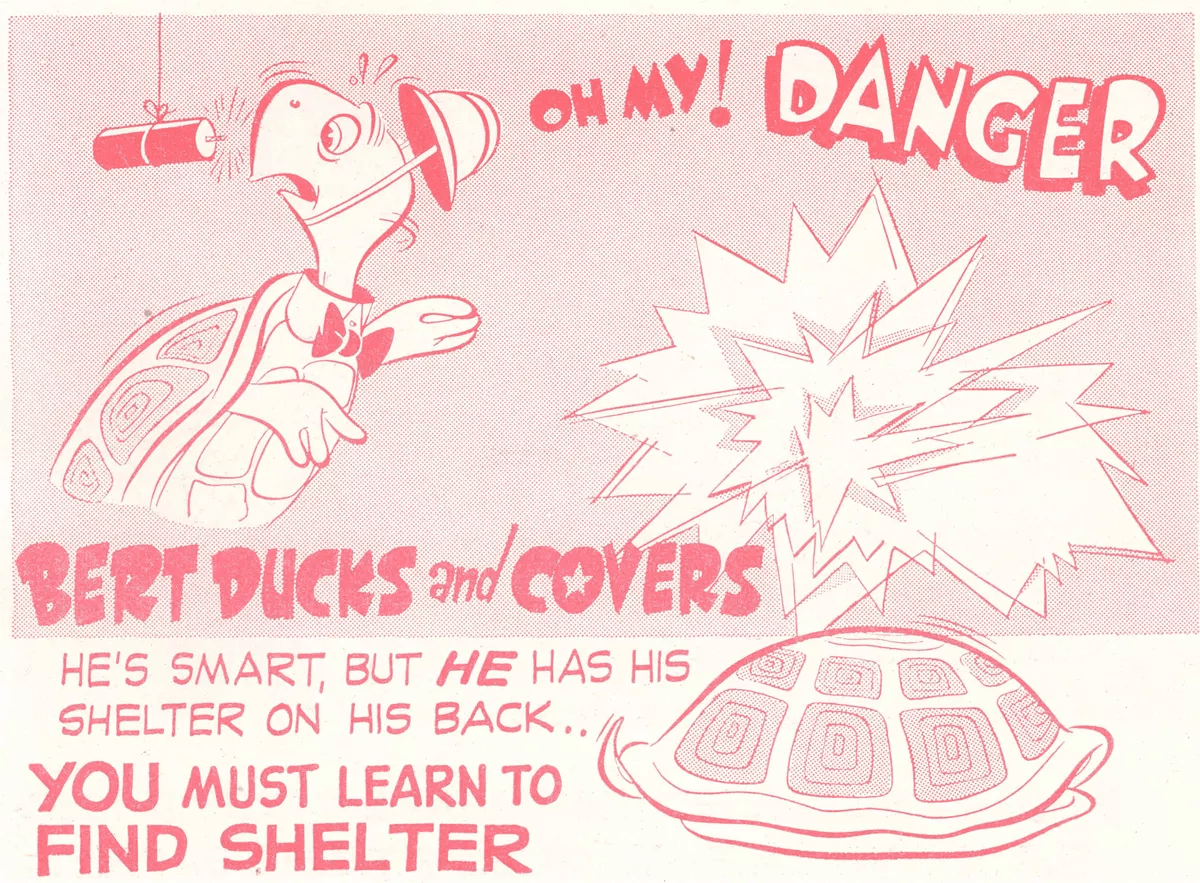
Children and teenagers were taught in school that they could survive a nuclear attack through “duck and cover” drills. They were instructed to keep their bathtubs filled with water for safe drinking, in the event of a Soviet nuclear strike.
Bert the Turtle teaches schoolchildren to “Duck and Cover”
Yet even in this poisonous atmosphere of fear and denunciation, some men stood out as heroes–simply by holding fast to their consciences.
One of these was a New York insurance attorney named James B. Donovan (played by Tom Hanks). Asked by the Justice Department to defend arrested Soviet spy Rudolph Abel (Mark Rylance) Donovan did what no one expected.
He gave Abel a truly vigorous defense, arguing that the evidence used to convict him was the legally-tainted product of an invalid search warrant.
Upon Abel’s conviction and sentencing to 45 years’ imprisonment, Donovan again shocked the political and legal communities by appealing the case to the Supreme Court.
Donovan argued that Constitutional protections should apply toeveryone–including non-Americans–tried in American courts. To do less made a mockery of the very freedoms we claimed to champion.
He lost by a vote of 5-4. But the arguments he made would resurface 50 years later when al-Qaeda suspects were hauled into American courts.
James B. Donovan
In 1961, Donovan was again called upon to render service by a Federal agency–this time the CIA. It wanted his help in negotiating the release of its spy, Francis Gary Powers, shot down over the Soviet Union in 1960 while flying a high-altitude U-2 spy plane.
Throughout “Bridge of Spies,” audiences learn some unsettling truths about how the American government–and governments generally– actually operate.
The first three of these were outlined in Part one of this series:
Truth #1: Appearance counts for more than reality.
Truth #2: Individual conscience can wreck the best-laid plans of government.
Truth #3: High-ranking government officials will ask citizens to take risks they themselves refuse to take.
Now for the remaining truths revealed in this movie.
Truth #4: Appeals to fear often prevail when appeals to humanity are ignored.
After crossing into East Germany, Donovan enters into negotiations with Wolfgang Vogel, a lawyer representing the East German government.
Vogel offers to exchange Frederic Pryor, an American economics graduate student seized by the East German secret police, for Abel. Donovan replies this is a deal-breaker; the United States (which is never mentioned during the negotiations) wants Powers, not Pryor.
Nevertheless, Donovan is equally concerned for Pryor, and adds him to the list of hostages to be released in return for Abel.
Then a new complication arises: The East German government that holds Pryor threatens to pull out. claiming to be insulted because Donovan did not inform them that the USSR was a party to the negotiation.
His reasoned, legal arguments having failed, Donovan resorts to a threat. He conveys a warning to the president of East Germany:
Abel has not yet revealed any Soviet secrets. But if this deal fails, he may well do so to earn favors from the United States government.And, in that case, the Soviets will blame you–Erich Honecker, the president of East Germany–for the resulting damage.
Where arguments based on humanity have failed, this one–based on fear–works. A prisoner-exchange is arranged.
Truth #5: Personal loyalty can supersede bureaucratic inventions.
On February 10, 1962, Donovan, Abel and several CIA agents arrive at the Glienicke Bridge, which connects East and West Germany. The Soviets have Powers, but not Pryor–who is to be released at Checkpoint Charlie, a crossing point between East and West Berlin.
Glienicke Bridge, the “Bridge of Spies”
The CIA agent in charge of the American delegation tells Abel he can cross into East Germany, even though Pryor has not been released.
But Abel has learned that Donovan has negotiated the release of not only Powers but Pryor. Out of loyalty to the man who has vigorously defended him, he waits on his side of the bridge until word arrives that Pryor has been released.
Then Abel crosses into East Germany while Powers crosses into the Western sector.
Donovan returns home. Before flying off to West Germany, he had told his wife he was going on a fishing trip in Scotland.
His wife and children learn the truth about the risks he ran and the success he attained only when a television newscast breaks the news:
Francis Gary Powers has been returned to the United States. And the man responsible is James Donovan, once the most reviled man in America for having defended a notorious Soviet spy.
Steven Spielberg’s new movie, “Bridge of Spies,” is that rarity among films: An intelligent mixture of history and drama, stripped of gratuitous sex and violence.
It’s also a film that accurately reveals unsettling truths about how government intelligence agencies really operate.
Truth #1: Appearance counts for more than reality.
The movie opens with the FBI’s arrest of KGB spy Rudolph Abel (Mark Rylance). The evidence against him is overwhelming. This–plus the “Red Scare” climate of 1957–will guarantee his conviction.
But the Eisenhower administration doesn’t want the upcoming trialto be seenas a hangman’s court. It must have theappearanceof a fair proceeding.
So the Justice Department (through the Brooklyn Bar Association) asks a New York insurance attorney named James B. Donovan (Tom Hanks) to take on Abel’s defense. He’s expected to make a reasonably competent effort but not go all out on behalf of his client.
Truth #2: Individual conscience can wreck the best-laid plans of government.
Donovan has never handled a spy case before. And he has no delusions that Abel isn’t the spy he’s charged with being. But he’s determined to give Abel the same committed defense he would give to any other client.
Rudolph Abel (Mark Rylance) and James Donovan (Tom Hanks) in court
This comes as a shock to the prosecutors, the judge, his law firm and even his family.
A CIA agent approaches Donovan in a nearly deserted restaurant and asks him to reveal any secrets that might help win Abel’s conviction.
“No, of course not,” replies the CIA agent, assuming Donovan is agreeing to keep the overture secret.
“No, I mean this conversationisn’t happening,” angrily says Donovan, who leaves the agent fuming.
Donovan becomes a pariah; his mailbox is stuffed with hate mail and one night a would-be drive-by killer riddles his house with bullets.
Abel is convicted and sentenced to 45 years’ imprisonment. But Donovan–again shocking everyone he knows–pursues an appeal up to the Supreme Court.
He argues that the evidence against Abel is tainted by an invalid search warrant. No American citizen could be convicted under such circumstances. And the Constitutional protections that hold true forAmericansshould hold equally true fornon-Americans charged with crimes in American courts.
Donovan’s arguments will be heard a half-century later, when al-Qaeda suspects are hauled before American courts.
He puts on an impressive case on Abel’s behalf, but loses 5-4 at the Supreme Court.
That seems to be the end of Donovan’s relationship with Abel. But events soon dictate otherwise.
Before the judge could pronounce a death sentence on Abel, Donovan had argued that this might be a mistake. The day might come, he told the judge, when an American spy might fall into Soviet hands.
And then the United States would need to swap Abel to secure the release of its own agent.
The judge, moved by that argument, had given Abel a lengthy prison term instead.
That day comes sooner than anyone in the Pentagon expects.
On May 1, 1960, Francis Gary Powers, a former Air Force pilot, is flying a high-altitude U-2 plane above the Soviet Union for the CIA. The plane is equipped with state-of-the-art cameras, and Powers intends to photograph military sites and other important complexes.
Suddenly, a surface-to-air missile slams into the plane. Powers ejects before it crashes, but fails to commit suicide with a poison pin concealed in a phony silver dollar. He’s captured by the KGB and brutally interrogated, but maintains his silence.
At about the same time, Frederic Pryor, an American economics graduate student living in West Germany, visits his German girlfriend living in Soviet-dominated East Germany.
The Soviets are starting to build their infamous Berlin Wall, which will stop the flow of refugees from East to West. Pryor tries to bring his girlfriend and her father into West Berlin, but he’s stopped and arrested by agents of Stasi, the East German police, who accuse him of being a spy.
Meanwhile, the Soviet Union wants its spy, Abel, returned, before he can spell its secrets. In turn, the new Kennedy administration wants Powers returned, beforehecan be made to spill American secrets.
Truth #3: High-ranking government officials will ask citizens to take risks they themselves refuse to take.
In 1961, Donovan is once again sought out by the American government–this time by no less than CIA Director Allen Dulles.
And he’s asked to go where no official American representative can go–East Germany. His new assignment: Negotiate the exchange of Powers for Abel.
The CIA wants its spy back. And it’s willing to send Donovan into East Germany to negotiate his release. But it’s not willing to back him up if he’s arrested by Stasi, the notorious East German secret police.
The fiction must be maintained that Donovan is acting strictly on his own behalf, not that of the United States.
In such a case, Donovan could spend the rest of his life in a Communist prison cell.
Steven Spielberg’sLincolnis more than a mesmerizing history lesson.
It’s a timely reminder that racism and repression are not confined to any one period or political party.
At the heart of the film: Abraham Lincoln (Daniel Day-Lewis) wants to win ratification of what will be the Thirteenth Amendment to the United States Constitution. An amendment that will forever ban slavery.
True, Lincoln, in 1862, had issued the Emancipation Proclamation. This—in theory—freed slaves held in the Confederate states that had seceded from the Union in 1861.
But Lincoln regards this as a temporary wartime measure. He fears that once the war ends, the Supreme Court may rule the Proclamation unconstitutional. This might allow Southerners to continue practicing slavery, even after losing the war.
To prevent this, Congress must pass an anti-slavery amendment.
But winning Congressional passage of such an amendment won’t be easy.
The Senate had ratified its passage in 1864. But the amendment must secure approval from the House of Representatives to become law.
And the House is filled with men–there are no women menmbers during the 19th century–who seethe with hostility.
Some are hostile to Lincoln personally. One of them dubs him a dictator–Abraham Africanus.” Another accuses him of shifting his positions for the sake of expediency.
Other members–white men all–are hostile to the idea of “equality between the races.” To them, ending slavery means opening the door to interracial marriage–especially marriage between black men and white women.
Perhaps even worse, it means possibly giving blacks–or women–the the right to vote.
In fact, the possibility that blacks might win voting rights arises early in the movie. Lincoln is speaking to a couple of black Union soldiers, and one of them is unafraid to voice his discontent. He’s upset that black soldiers are paid less than white ones–and that they’re led only by white officers.
He says that, in time, maybe this will change. Maybe, in 100 years, he guesses, blacks will get the right to vote.
(To the shame of all Americans, that’s how long it will eventually take. Not until the passage of the Voting Rights Act of 1965 will blacks be guaranteed legal protection against discriminatory voting practices.)
To understand the Congressional debate over the Thirteenth Amendment, it’s necessary to remember this: In Lincoln’s time, theRepublicanswere the party of progressives.
The party was founded on an anti-slavery platform. Its members were thus reviled as “Black Republicans.” And until the 1960s, the South was solidlyDemocratic.
Democrats were the ones defending the status quo–slavery–and opposing freed blacks in the South of Reconstruction and long afterward.
In short, in the 18th century,Democratsin the South acted asRepublicansdo now. The South went Republican only after a Democratic President–Lyndon B. Johnson–rammed the Civil Rights Act of 1964 through Congress.
Watching this re-enactment of the 1865 debate inLincolnis like watching the current Presidential campaign. The same mentalities are at work:
Those (in this case, slave-owners) who already have a great deal want to gain even more at the expense of others.
Those (slaves and freed blacks) who have little strive to gain more or at least hang onto what they have.
Those who defend the privileged wealthy refuse to allow their “social inferiors” to enjoy similar privileges (such as the right to vote).
During the 2012 Presidential race, Republicans tried to bar those likely to vote for President Barack Obama from getting into the voting booth. But their bogus “voter ID” restrictions were struck down in courts across the nation.
Listening to those opposing the amendment, one is reminded of Mitt Romney’s infamous comments about the “47%”:
“Well, there are 47% of the people who will vote for the president no matter what….
“Who are dependent upon government, who believe that–that they are victims, who believe that government has a responsibility to care for them, who believe that they’re entitled to healthcare, to food, to housing, to you name it. But that’s–it’s an entitlement. And the government should give it to them.”
Put another way: “Who says people have a right to obtain medical care, food and housing? If they can’t inherit unearned wealth the way I did, screw them.”
In the end, it’s Abraham Lincoln who has the final word–and leaves his nation the better for it. Through diplomacy and backroom dealings (trading political offices for votes) he wins passage of the anti-slavery amendment.
The ownership of human chattel is finally an ugly memory of the American past.
The movie closes with a historically-correct tribute to Lincoln’s generosity toward those who opposed him–in Congress and on the battlefield. It occurs during Lincoln’s Second Inaugural Address:
“With malice toward none, with charity for all….To bind up the nation’s wounds. To care for him who shall have bourne the battle, and for his widow and his orphan….”
This ending presents a vivid philosophical contrast with the increasingly mean-spirited rhetoric and policies of 2016’s Republican candidates for President–especially those of Donald Trump.
Watching Lincoln, you realize how incredibly lucky America was as a nation to have had such leadership when it was most urgently needed.
In 1964, Thomas Becket, archbishop of Canterbury, once again struggled against King Henry II for power over English citizens.
This time, the conflict was fought across thousands of movie screens, with Richard Burton as Becket and Peter O’Toole as Henry, as portrayed in Jean Anouilh’s 1959 play.
A quick summary:
Becket, a brilliant Saxon noble, is the favorite friend of Henry. They hunt, fight and bed women together. Henry even appoints him as Chancellor, the highest law enforcement officer in the country.
But there is a storm on the horizon: The power of the Catholic Church is steadily rising, and Henry needs a highly-placed ally against its power. When the Archbishop of Canterbury dies, Henry appoints Becket in his place.
But suddenly the entirely secular Becket undergoes a religious conversion–and an unexpected change in allegiance. He insists that priests accused of criminal offenses be tried only in the church’s own courts–thus making them immune from Henry’s secular ones.
As a moviegoer, it’s easy to root for conscience-stricken Becket, as played by the charming Burton. Henry, as played by O’Toole, is a brutish adolescent, alternately fearful and enraged at his own incompetence.
But in rooting for Becket/Burton, the audience can overlook the significance of allowing religious doctrine to trump secular law.
The consequences of this are now becoming clear in Indiana.
On March 26, 2015, its governor, Mike Pence, signed into law the Religious Freedom Restoration Act. This will allow any individual or corporation to cite its religious beliefs as a defense when sued by a private party.
Mike Pence
Officially, its intent is to prevent the government from forcing business owners to act in ways contrary to strongly held religious beliefs. Unofficially, its intent is to appease the hatred of gays and lesbians by the religious Right, a key constituency of the Republican party.
In short, a bakery that doesn’t want to make a cake to be used at a gay wedding or a restaurant that doesn’t want to serve lesbian patrons will have the legal right to refuse to do so.
The same applies for a hospital that doesn’t want to provide care to a gay or lesbian patient.
The bill was passed overwhelmingly by both chambers of the Republican-controlled state legislature. And signed into law by a Republican governor.
“Today I signed the Religious Freedom Restoration Act, because I support the freedom of religion for every Hoosier of every faith,” Mike Pence said in a statement on the day he signed the bill.
“The Constitution of the United States and the Indiana Constitution both provide strong recognition of the freedom of religion but today, many people of faith feel their religious liberty is under attack by government action.”
Bill-signing ceremonies are usually highly public events. Governors–and presidents–normally want their constituents to see them creating new legislation.
Yet for all his praise for the bill, Pence signed it in a ceremony closed to the public and the press. The media were asked to leave even the waiting area of the governor’s office.
It’s almost as if Pence sensed that he was about to push open a door into a danger-filled room. And this may well be the case.
Through that door may soon march the First Church of Cannabis. The day after Pence signed the Act, church founder Bill Levin announced on his Facebook page that he had filed paperwork with the office of the Indiana Secretary of State.
Its registration had been approved–and Levin was ecstatic: “Now we begin to accomplish our goals of Love, Understanding, and Good Health.
“Donate $100 or more and become a GREEN ANGEL. Donate $500 or more and become a GOLD ANGEL. Donate $1000 or more and become a CHURCH POOHBA.”
And Levin had a personal comment for the governor who had made it all possible:
“Dear Mikey Pence…
“DUDE!.. keep crapping all over the state.. and I will plant a seed of LOVE, UNDERSTANDING and COMPASSION in each pile you leave.. and it will grow into a big skunky cannabis tree. Crap away Mikey.. Crap Away…”
No doubt many Indiana legislators are furious that their effort to attack gays may have brought legal marijuana to their highly conservative state. But worse may be to come.
Since 9/11, Right-wingers such as Rush Limbaugh and Sean Hannity have warned that Muslims are trying to impose Sharia (Islamic law) on America. And now Indiana’s legislators, in elevating religion above the law, may have laid the legal foundations for making that possible.
Ironically, this may not be so far removed from the goals of the Republican party as many think. Both the party and adherents of Sharia agree:
Women should have fewer rights than men.
Abortion should be illegal.
There should be no separation between church and state.
Religion should be taught in school.
Religious doctrine trumps science.
Government should be based on religious doctrine.
Homosexuality should be outlawed.
What will happen when some Muslims in Indiana claim their right–guaranteed in Islamic religious law–to have as many as four wives?
And when they claim that the Religious Freedom Restoration Act protects that right?
Fasten your seatbelts, it’s going to be a bumpy nightmare.
Sean Penn is not the first celebrity to “get close to” a gangster.
Singer Frank Sinatra set the standard as far back as the 1940s when he was often seen in the company of notorious Mafiosi such as Charles “Lucky” Luciano and Willie Moretti.
(It was Moretti who is rumored to have freed Sinatra from his financially-limiting contract with bandleader Tommy Dorsey in the early 1940s.
His alleged method of persuasion: Jamming a pistol down Dorsey’s throat and threatening to kill him. Dorsey eventually sold the contract to Sinatra for one dollar.
But the mobster whom Sinatra was most-often linked with–by gossip and FBI reports–was Sam “Mooney” Giancana.
Giancana started out as a “wheelman” and enforcer for the teenage “42 Gang,” then joined the Chicago mob in the late 1930s. By 1957 he had been appointed its boss.
Sam Giancana
Sinatra often partied with Giancana, both in nightclubs and at his own residence in Palm Springs, California.
In December, 1959, financier Joseph P. Kennedy summoned Sinatra to the family compound in Hyannis Port, Massachusetts. His son, Senator John F. Kennedy, was planning to run for President in 1960. And the elder Kennedy wanted Sinatra’s help.
Sinatra and the Senator were by now well-acquainted. They shared a taste for gossip, nightclubs and beautiful women.
According to Sinatra’s daughter, Tina, the Kennedy patriarch said: “I think that you can help [the campaign] in [the] West Virginia [primary] and Illinois [in the general election] with our friends.
“You understand, Frank, I can’t go. They’re my friends, too, but I can’t approach them. But you can.”
Frank Sinatra
By “our friends,” Kennedy meant the Mafia. Joseph P. Kennedy had done business with the mob as a bootlegger during Prohibition.
Now he wanted the Mafia to pressure local union members into voting for JFK–and making contributions to the Kennedy Presidential campaign.
Sinatra went to his friend, Sam Giancana, and asked for the mob’s support. And Giancana promised to deliver it.
In return, Giancana–and other mobsters–expected to win an ally in the White House. He was later overheard on an FBI wiretap saying he had been promised by Sinatra that “if I even got a traffic ticket, none of those fuckers [the FBI] would know me.”
Since 1959, Giancana and other “Top Hoodlum” mobsters had been under increasingly heavy FBI surveillance. Giancana wanted it stopped.
And Sinatra had assured him that, under a Kennedy Presidency, it would stop.
On Election Night, 1960, John F. Kennedy carried Illinois–and won the White House by a mere 120,000 votes nationwide.
Then, to the horror of the Mafia, JFK installed his brother, Robert Francis Kennedy, as Attorney General. From 1957 to 1959, RFK had pursued gangsters as chief counsel for the Senate Rackets Committee.
Now he declared all-out war on organized crime. Convictions against organized crime figures rose 800% during his four years in office.
Robert F. Kennedy
Sinatra tried to deliver for Giancana. He sent Peter Lawford–his Rat Pack pal and brother-in-law to the President–to talk with Robert Kennedy about laying off on the Mafia don.
Kennedy told Lawford to mind his own business.
Giancana came under even greater pressure. FBI agents put a 24-hour “lockstep” surveillance on him, following him even into church and restrooms.
“I was on the road with this broad,” Giancana raged to his murderous associate, Johnny Formosa. “There must have been 20 guys [FBI agents]. They were next door, upstairs, downstairs, surrounded all the way around!
“Get in a car, somebody picks you up I lose that tail–boom!–I get picked up someplace else! Four or five cars, back and forth, back and forth.”
In another exchange with Formosa, Giancana’s anger at Sinatra boiled over:
“The last time I talked to [Sinatra] was at the hotel in Florida. And he said, ‘Don’t worry about it. If I can’t talk to the old man [Joseph P. Kennedy] I’m going to talk to the man [President Kennedy].’
“One minute he says he’s talked to Robert, and the next minute he says he hasn’t talked to him. So he never did talk to him.”
Formosa suggested a remedy: “Let’s show ’em. Let’s show those fuckin’ Hollywood fruitcakes that they can’t get away with it as if nothin’s happened.
“Let’s hit Sinatra. Or I could whack out a couple of those other guys, Lawford and that [Dean] Martin. And I could take the nigger [Sammy Davis, Jr.] and put his other eye out.”
Giancana refused to issue the contract. But he seriously considered doing so, as he confessed to a Chicago associate named Tommy DiBella:
“One night I’m fucking Phyllis [McGuire, a member of the famous McGuire sisters trio], playing Sinatra songs in the background, and the whole time I’m thinking to myself, ‘Christ, how can I silence that voice?’
“It’s the most beautiful voice in the world. Frank’s lucky he’s got it. It saved his life.”
Sinatra’s Rat Pack “pally,” Dean Martin, summed it up: “Only Frank could get away with the shit he’s got away with. Only Frank. Anybody else would’ve been dead.”
Sinatra survived the murderous anger of a mob boss. It remains to be seen if Sean Penn can do the same.
Actor Sean Penn believes the Mexican Government wants to put him at risk by convincing Joaquin “El Chapo” (“Shorty”) Guzman that Penn played a role—deliberately or negligently—in his capture.
“We know the Mexican government, they clearly were humiliated by the notion that someone found him before they did,” Penn told interviewer Charlie Rose.
“Nobody found him before they did. We are not smarter than the DEA, or Mexican Intelligence. We had a contact upon which we were able to facilitate an invitation.”
By “we” Penn meant himself and Mexican actress Kate del Castillo, who had actually arranged the meeting.
Actress Kate del Castillo
“They wanted to encourage the cartel to put you in their crosshairs?” Rose asked.
“Yes,” Penn answered.
This is entirely possible. Guzman’s escape from a “maximum security” prison in July, 2015, had proved internationally embarrassing for the Mexican Government
Even more embarrassing: He escaped through a mile-long tunnel that literally led to his cell. Almost certainly this happened with the collusion of some prison guards.
Penn–and del Castillo–could face dangers from at least three groups.
Danger #1: El Chapo
Already there is evidence that “El Chapo” regrets having given an interview to Penn and del Castillo in the Mexican jungle on October 2, 2015.
Sean Penn
Published in Rolling Stone on January 9, the article contained such Guzman boasts as:
“I supply more heroin, methamphetamine, cocaine and marijuana than anyone else in the world. I have a fleet of submarines, airplanes, trucks and boats.”
Juan Pablo Badillo, one of Guzman’s attorneys, has since claimed that the article contains falsehoods:
“It’s a lie, absurd speculation from Mr. Penn. Mr. Penn should be called to testify to respond about the stupidities he has said.
“He [Guzman] could not have made these claims. Mr. Guzman is a very serious man, very intelligent.”
This could spell danger for Penn and del Castillo. Guzman is responsible for the deaths of thousands of rivals, journalists and police.
Among the witnesses to the drug cartels’ savagery is Michael Levine, a 25-year veteran of the Drug Enforcement Administration and the author of Deep Cover: Mexican Government Drug Corruption From the Inside.
“Depending on what the cartels and/or the many corrupt Mexican cops and Mexican government officials believe El Chapo divulged during the interview, Penn, and whomever else was present, may be in more physical danger than he could ever imagine,” said Levine.
An anonymous law enforcement official said that not only could Penn be in danger, but so could his entire family.
“It won’t happen now. They [the cartels] wait. Him or people close to him are in danger. They don’t single out the one person. They go for the person’s family.
“He poked his head into a nest of vipers with an amazing global reach. He was a fool. As public as Penn is, he will be a sitting duck.”
Danger #2: Guzman’s Competitors in the Drug Trade
“The problem with dealing with someone like Guzman on this personal basis, where one is perceived as a ‘friend’ or an aide or a business partner of sorts to Chapo, is that you have to be prepared to inherit all his enemies, and there are many,” warned Michael Levine.
“These are some very kill-crazy people. The notoriety gained by killing someone like Penn or even del Castillo will actually turn these bastards on.
“It’s a step into the dark world of the kill crazies. Believe me it is there, and unwittingly these two may have stepped into a world where there is an actual competition to kill them,” said Levine, who has dealt face-to-face with Latin American drug lords.
Danger #3: Wannabe Cartel Members
Countless men–in Mexico and the United States–would love to “do El Chapo a favor” by gunning down Penn and/or del Castillo.
This could happen even if Guzman harbors no ill will toward either. It would be enough for someone to simply believe that he did.
An additional motive: The fame–or infamy–that the assassin of a “big celebrity” like Penn would receive. John Lennon died at the hands of such a fame-obsessed, psychotic gunman.
This means that literally anyone could be a potential assassin–making it that much harder to defend against.
When clients enter the Justice Department’s Witness Security Program, they are quickly asked: “Who do you think poses the biggest threat to you?”
Deputy U.S. marshals, who operate the program, assume that a witness is the best judge of who poses the greatest danger to him.
Witness Security Program protection detail
This works well when a witness is unknown and testifying against someone who is equally unknown to the public.
But when a witness is notorious–such as Sammy “The Bull” Gravano–and the defendant is equally infamous–such as John Gotti–all bets are off.
Of course, Federally-protected witnesses have two advantages going for them that Penn and del Castillo do not:
First, they are protected by the U.S. Marshals Service, which has an excellent track record in protecting its charges; and
Second, they are expected to assume a low profile, which serves as their best protection.
Sean Penn and Kate del Castillo aren’t Federally-protected witnesses. And they’re unlikely to assume a low profile by going into hiding.
Steffen White’s Email: Sparta480@aol.com Former reporter, legal investigator and troubleshooter. Columnist at Bureaucracybuster.com. Fighting political and bureaucratic arrogance, incompetence and/or indifference.
When making complaints in writing, carefully review your email or letter before sending it. Remove any words that are vulgar or profane. Don't make sweeping accusations: "Your agency is a waste."
Don't attribute motives to people you've had problems with, such as: "The postal clerk refused to help me because he's a drunk." If the person actually appeared to be drunk, then be precise in your description: "As he leaned over the counter I could smell beer on his breath. Behind him, in a waste basket, I saw an empty bottle of Coors beer."
Show how the failure of the official to address your problem reflects badly on the company or agency: "This is not the level of service your ads would lead potential customers to expect."
If necessary, note any regulatory agencies that can make life rough for the company or agency if your complaint isn't resolved. For the phone company, for example, cite the FCC or the PUC. But do this only after you have stated you hope your complaint can be settled amicably and privately within the company.




 Bureaucracybuster's Blog
9/11 ATTACKS, ABC NEWS, ARTHUR M. CUMMINGS, BOSTON GLOBE, BOSTON MARATHON, BOSTON MARATHON BOMBING, BOSTON PATCH, BRUSSELS BOMBINGS, CBS NEWS, CNN, FACEBOOK, FBI, FIRST AMENDMENT, FRANKLIN D. ROOSEVELT, ISIS, ISLAM, ISLAMIC TERRORISM, JIHADIST, NAZI GERMANY, NBC NEWS, PARIS TERRORIST ATTACKS, POLITICAL CORRECTNESS, RADICAL ISLAM, SAMUEL P. HUNTINGTON, SAN BERNARDINO MASSACRE, SECURITY, STEVEN EMERSON, THE CHICAGO SUN-TIMES, THE CHICAGO TRIBUNE, THE CLASH OF CIVILIZATIONS AND THE REMAKING OF WORLD ORDER, THE LOS ANGELES TIMES, THE NEW YORK TIMES, THE WASHINGTON POST, TWITTER, US NEWS, USA TODAY, WORLD WAR ii
KNOWING THE ENEMY, REFUSING TO NAME IT: PART ONE (OF TWO)
In Bureaucracy, Entertainment, History, Law Enforcement, Military, Politics, Social commentary on April 26, 2016 at 12:05 amThe 2016 Boston Marathon was scheduled for April 18.
And local, State and Federal law enforcement authorities had been planning security for the event since October, 2015.
So it was only natural that these agencies wanted the public to know the Marathon would be as safe as more than 5,000 law enforcement officers could make it.
The Boston Marathon
“‘Leave the worrying to us’: Security Ramped Up for Boston Marathon,” read the headline of the April 16 issue of USA Today.
And it gave the reason for this: Three years earlier, on April 15, 2013, two bombers had wreaked havoc at the finish line of the race.
It also named the bombers–brothers Dzhokhar and Tamerlan Tsarnaev–whose terrorist act killed three people and injured about 264 others.
Tamerlan and Dzhokhar Tsarnaev
It further noted that Tamerlan had died in a shootout with police three days after the marathon–and police had captured Dzhohkar several hours later. (He was convicted by a jury and sentenced to death.)
The story said nothing, however, about their citing Islam as the reason for their murderous rampage.
Click here: ‘Leave the worrying to us’: Security ramped up for Boston Marathon
The April 16 edition of The Boston Patch carried this headline: “Boston Marathon 2016: Security Changes You Can’t See All Around You.”
The article stated that most of these precautions couldn’t be revealed. Then it added that even though law enforcement officials hadn’t identified a credible threat to this year’s Boston Marathon, “recent events make the world feel less safe today than in 2013.”
But the article said nothing about those “recent events,” such as:
Nor did the story say that all of these “recent events” were carried out by followers of the Islamic religion.
Click here: Brussels attacks add urgency to Boston Marathon security | US News
On April 6, The Boston Globe announced: “Tight security planned for upcoming Boston Marathon.”
The story noted that, in drawing up their security arrangements, “authorities analyzed terrorist attacks in Paris, San Bernardino, Calif., and Brussels in recent months.”
The San Bernardino attack had occurred on December 2, 2015.
The story said that Syed Rizwan Farook and Tashfeen Malik, had slaughtered 14 people and wounded 22 at a Department of Public Health training event and birthday party.
Tashfeen Malik and Syed Rizwan Farook
But the article did not inform readers that Farook and Malik were Muslims acting in the name of Islam.
The story quoted Harold Shaw, special agent in charge of the FBI’s Boston Field Office, as saying: “San Bernardino taught us something very significant. They [the killers] were not on the radar.”
But the article omitted “something very significant”: Farook and Malik had melded perfectly into American society before their outrage. Thus, the only factor that could have put them “on the radar” as potential terrorists was their being Muslims.
And in an America driven by Political Correctness, noting that would have been verboten.
Click here: Tight security planned for upcoming Boston Marathon – The Boston Globe
NBC News carried a story on “How the Boston Marathon is Using Security Technology.”
The story then described how police used a high-tech partner, Esri, to track, in real-time, the progress of the morning’s race.
“When you look [at] security, there’s three legs to the stool: People, process and technology,” said Arnette Heintze, CEO and co-founder of Hillard Heintze, an investigation and security risk management company.
Click here: How the Boston Marathon is Using Security Technology – NBC News
Yet for all the gushing kudos leveled at the new uses of sophisticated technology for keeping people safe, one thing was conspicuously ignored.
The opening paragraph, “Three years after a deadly bombing at the Boston Marathon….” left unnamed those had made the use of this technology necessary–Tamerlan and Dzhokhar Tsarnaev.
Nor did it mention that Dzhokhar had laid out, in a note, his reason for attacking innocent men and women: “We Muslims are one body, you hurt one you hurt us all.
“Well at least that’s how Muhammed wanted it to be forever. The ummah [Islamic community] is beginning to rise.
“Know you are righting men who look into the barrel of your gun and see heaven, how how can you compete with that. We are promised victory and will surely get it.”
Click here: Text from Dzhokhar Tsarnaev’s note left in Watertown boat – The Boston Globe
Share this: