Archive for the ‘Business’ Category
9/11 TERROR ATTACKS, ABC NEWS, ALASKA AIRLINES, ALDRICH AMES, ALTERNET, AMERICABLOG, AMERICAN AIRLINES, AP, BABY BOOMER RESISTANCE, BBC, BC NEWS, BLOOMBERG, BLUESKY, BUZZFEED, CBS NEWS, CIA, CNN, CROOKS AND LIARS, DAILY KOS, DELTA AIRLINES, FBI, FIVETHIRTYEIGHT, HARPER’S MAGAZINE, HUFFINGTON POST, IDENTOGO, JETBLUE AIRLINES, JOHN F. KENNEDY, JOHN W. HINCKLEY, LYNETTE "SQUEAKY" FROMME, MEDIA MATTERS, MOTHER JONES, MOVEON, MSNBC, NBC NEWS, NEWSDAY, NEWSWEEK, NPR, PBS NEWSHOUR, POLITICO, POLITICUSUSA, PRESIDENT GERALD FORD, PRESIDENT RONALD REAGAN, RALPH NADER, RAW STORY, REUTERS, RICHARD REID, ROBERT HANSSEN, SALON, SARAH JANE MOORE, SEATTLE TIMES, Secret Service, SECURITY, SHOE-BOMBER, SLATE, SOUTHWEST AIRLINES, TALKING POINTS MEMO, TERRORISM, THE ATLANTIC, THE CHICAGO SUN-TIMES, THE CHICAGO TRIBUNE, THE DAILY BEAST, THE DAILY BLOG, THE GUARDIAN, THE HILL, THE HUFFINGTON POST, THE INTERCEPT, THE LOS ANGELES TIMES, THE NATION, THE NEW REPUBLIC, THE NEW YORK TIMES, THE NEW YORKER, THE PENTAGON, THE VILLAGE VOICE, THE WALL STREET JOURNAL, THE WASHINGTON POST, THINKPROGRESS, TIME, TRANSPORTATION SAFETY ADMINISTRATION (TSA), TRUTHDIG, TRUTHOUT, TSA PRECHECK, TWITTER, TWO POLITICAL JUNKIES, U.S. NEWS & WORLD REPORT, UNITED AIRLINES, UNITED FLIGHT 93, UPI, USA TODAY, USAIRWAYS, VIRGIN AMERICAN AIRLINES, WEALTH GAP, WORLD TRADE CENTER, X
In Bureaucracy, Business, History, Law, Law Enforcement, Politics, Social commentary on November 20, 2025 at 12:10 am
More than 20 years after 9/11, America is now selling its Islamic enemies access to the very weapons—jet-fueled airplanes—they need to wage jihad against its citizens.
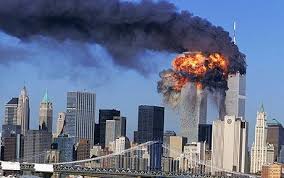
World Trade Center on September 11, 2001
This danger is brought to you by IdentoGO, the private security company chosen by the Transportation Safety Administration (TSA) to screen airline passengers.
Consider this ad it posts:
“How many times have you stood in line at the airport watching others breeze through security with no hassle? By enrolling in TSA Pre✓® , you too can breeze through security.
“Keep your shoes, jacket and belt on; your laptop in its case; 3-1-1 compliant liquids in your bag; and enjoy a better overall travel experience.
“TSA Pre✓® allows low-risk travelers to experience faster, more efficient screening at participating U.S. airport checkpoints for domestic and international travel.”
Yes, for an enrollment payment of $78, you, too, can apply to receive such preferential treatment. Even if it means putting the Nation’s security at risk. Travelers that are eligible for TSA Pre✓® include:
- U.S. citizens of frequent flyer programs who meet TSA-mandated criteria and who have been invited by a participating airline;
- U.S. citizen, U.S. national or Lawful Permanent Residents who are members of the TSA Pre✓® Application Program;
- U.S. citizens who are members of a U.S. Customs and Border Protection Trusted Traveler program, such as Global Entry, SENTRI, and NEXUS and Canadian citizens who are members of NEXUS; and
- Members of the U.S. Armed Forces.
- Find an IdentoGO Center near you, including a growing number of airport locations, offering TSA Pre✓® and pre-enroll online.
- Schedule an appointment to come in for fingerprinting.
- Pay the $85 applications fee and show your proof-of-identity documents from the approved list of valid government IDs.
- A Known Traveler Number (KTN) will be mailed to you or can be obtained online.
- Once enrolled, your KTN is used when booking travel and your TSA Pre✓® approval is printed on your boarding passes.
- Be sure to update your airline member profile to have the number automatically sent to the TSA when making reservations.
Among the credit cards that will buy you such preferential treatment:
If you’re accepted, you don’t need to undergo another background check for the next five years.
In 2024, 96% of TSA PreCheck passengers waited less than five minutes to board.
So what difference does it make that some passengers must submit to close inspection while others do not?
- If you’re trying to carry a metallic firearm aboard a plane, the magnetometer will likely pick it up. But if you’ve filled your computer with plastic explosive, the magnetometer won’t pick it up.

Advanced imaging technology
- Or maybe you want to be a shoe-bomber like Richard Reid, who tried to blow up an American Airlines flight in 2001. Being allowed to skip the requirement to remove your shoes will certainly take you a long way toward reaching your goal.
Why is America being placed at such risk? Three reasons:
- The greed of American airline corporations and the TSA.
- Wealthy, self-entitled Americans hate waiting in long airport security lines—like ordinary citizens.
- The Calvinistic belief—shared by most Americans—that wealth is a sign of God’s favor, and thus proof that its holder is worthy of deference, if not awe.
On September 11, 2001, 2,996 people were killed and more than 6,000 others wounded as three highjacked airliners slammed into:
- The North Tower of the World Trade Center;
- The South Tower of the World Trade Center;
- The Pentagon; and
- A field in Somerset County, Pennsylvania, after passengers and crew on United Flight 93 tried to regain control.
The attacks inflicted the worst shock and grief on America since the 1963 assassination of President John F. Kennedy.
So think about how easy it is to qualify as a TSA Pre-Check passenger the next time you board an airliner.
According to Yelp! reviews of thoroughly satisfied IdentoGO customers:
- “My TSA precheck appointment was done in 10 minutes! Plenty of free parking in their parking lot. The staff was friendly and courteous. I made an appointment thru the TSA precheck website. When I arrived, there was no wait. The office was clean, and the staff member who I met was friendly and courteous. Be sure to bring in your proper documents. $85 fee collected at the end of appointment. TSA precheck works for domestic flights only.”
- “The friendly agent took me in right away and he proceeded to go through my application with me, just to double check that all the information in the application is correct. He took my fingerprints (all fingers) and I was pretty much done in about 10 minutes.”
- “Going here for TSA precheck is a no-brainer. Super easy to get an appointment, free parking, and no waiting. Staff was friendly and efficient, explained what to expect after they submitted my information, and within less than 10 minutes I was on my way. Went in on a Friday afternoon and by Monday evening (ok, late evening really), I had my KTN. So, so easy.”
ABC NEWS, ALTERNET, AMERICABLOG, AP, ATOMIC BOMB, BABY BOOMER RESISTANCE, BARACK OBAMA, BBC, BEIRUT BOMBING, BILL CLINTON, BLOOMBERG NEWS, BUZZFEED, CBS NEWS, CHRIS MATTHEWS, CNN, COMMUNISM, CROOKS AND LIARS, CULTS, DAILY KOS, DONALD TRUMP, ECONOMICS, FIVETHIRTYEIGHT, GEORGE H.W. BUSH, HARDBALL, HARPER’S MAGAZINE, HUFFINGTON POST, IRAN, IRAN-CONTRA AFFAIR, JOHN F. KENNEDY, JOSEPH STALIN, MEDIA MATTERS, MEET THE PRESS, MOTHER JONES, MOVEON, MSNBC, NBC NEWS, NEW REPUBLIC, NEWSDAY, NEWSWEEK, NPR, PBS NEWSHOUR, POLITICO, POLITICUSUSA, POLLUTION, RAW STORY, REPUBLICAN PARTY, REUTERS, Ronald Reagan, SALON, SEATTLE TIMES, Secret Service, SLATE, SOVIET NUCLEAR PHYSICS, SOVIET UNION, TALKING POINTS MEMO, TAX CUTS, TERRORISM, THE ATLANTIC, THE CHICAGO SUN-TIMES, THE CHICAGO TRIBUNE, THE DAILY BEAST, THE DAILY BLOG, THE GUARDIAN, THE HILL, THE HUFFINGTON POST, THE INTERCEPT, THE LOS ANGELES TIMES, THE NATION, THE NEW REPUBLIC, THE NEW YORK TIMES, THE NEW YORKER, THE VILLAGE VOICE, THE WASHINGTON POST, THINKPROGRESS, THIS WEEK, TIME, TRUTHDIG, TRUTHOUT, TWO POLITICAL JUNKIES, U.S. NEWS & WORLD REPORT, UPI, USA TODAY, Vladimir Lenin, X
In Bureaucracy, Business, History, Military, Politics, Social commentary on October 27, 2025 at 12:05 am
On February 6, 2011, Ronald Reagan, if he had been alive, would have been 100 years old.
Publishers rushed to put out worshipful tributes to his eight years as President. Network political programs such as “This Week” and “Meet the Press” assembled surviving members of his administration to re-live the “glory days” of Reagan’s—and their—time in power.
Actually, it was during the Reagan administration that America entered its decline—a Right-wing legacy of huge Federal deficits, tax-cuts for the rich, bloated military budgets and cutbacks in government programs to aid the poor and middle-class.
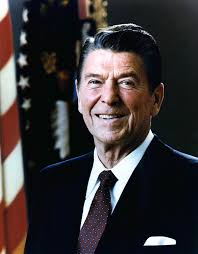
Ronald Reagan
No two men could have been more different than Vladimir Lenin and Ronald Reagan. Lenin created the Soviet Union in 1917 and became its first in a series of absolute dictators. Reagan spent his life fighting Communism, most notably as President.
So it’s ironic that both men, in death, got essentially the same funeral—and for the same reason: To sanctify and legitimize their respective organizations—and the authority of their potential successors.
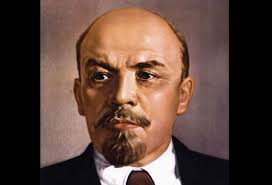
Vladimir Lenin
Lenin died on January 21, 1924, and was immediately succeeded by the party’s General Secretary, Joseph Stalin. Stalin, as a youth, had been a seminary student. He knew that, despite Communism’s official atheistic stance, most Russians remained loyal to the Russian Orthodox Church.
So in giving Lenin’s funeral oration, Stalin used the language of religion to confer sainthood upon a militant atheist—and upon his successor, Stalin himself: “We vow to thee, Comrade Lenin, that we will fulfill this, thy commandment….”
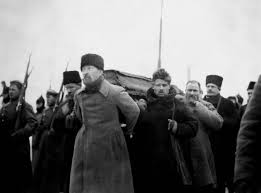
Funeral for Vladimir Lenin
Stalin and his fellow Communists immediately launched the “cult of Lenin,” depicting him as a fatherly, all-wise leader whose genius could only be bestowed upon his closest disciples.
Lenin’s extensive political writings were treated as divine writ, and were used to justify everything Stalin and his own successors wanted to do.
A classic example: Although he died 20 years before the American creation of the atomic bomb, Lenin was hailed by the Soviets as the “father” of “Soviet nuclear physics.”
Similarly, Republicans quickly turned Reagan into a modern-day saint of mythical proportions.
They did so for the same reason that Stalin deliberately forged a cult around the dead Lenin—to create a “holy” figure of whom other Republicans can claim to be true disciples.
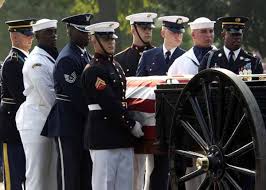
Funeral for Ronald Reagan
These deliberate fictions conveniently ignore a series of ugly truths:
- Reagan was only one of a series of Presidents who held the line against the Soviet Union.
- His budgets were just as stained with red ink as those of all previous Presidents.
- By the end of his term, 138 Reagan administration officials had been investigated, indicted or convicted for official misconduct and/or criminal violations.
- His “trickle-down” Reganomics brought prosperity to only the wealthiest 1% of Americans, proving that “a rising tide lifts some yachts.”
- By drastically shrinking the tax-base, bloating the defense budget and destroying programs to benefit the poor and middle-class, Reagan produced a $1 trillion deficit-–which only the Clinton Administration eliminated.
- Reagan believed that government should not help the impoverished. Those who lacked wealth to buy such necessities as housing and medical insurance were written off as unimportant.
- John F. Kennedy had praised government service as an honor. Reagan repeatedly said that “the best and the brightest” could be found only in business.
- This denigration of government service continues among Republicans to this day—defaming the very institutions they lust to control.
- Although he often berated the poor for their “laziness,” Reagan adhered to a “banker’s hours” schedule: During his working hours in the Oval Office, he often had blocks of free time—two to three hours. He would call for his fan mail and answer it.
- Reagan saw no need to protect America’s fragile environment against corporate polluters, eager to enrich themselves at its expense. He ignorantly stated: “Approximately 80% of our air pollution stems from hydrocarbons released by vegetation, so let’s not go overboard in setting and enforcing tough emission standards from man-made sources.”
Reagan famously attacked “welfare queens” and sought to deny government benefits for the poor. But he didn’t hesitate to enrich himself at public expense.
- Before his Presidency ended, 18 wealthy Californians contributed $156,000 apiece to buy him a 7,200 square-foot mansion overlooking Beverly Hills.
- Reagan signed a multi-million dollar deal to write his Presidential memoirs and publish a collection of his speeches.
- He signed an exclusive contract with a Washington lecture bureau, which paid him $50,000 per speech given in the United States and $100,000 overseas. This made him the highest-paid speaker in the country.
- These monies came in addition to his Presidential pension of $99,500 a year for life and his $30,000 annual pension as a former governor of California.
- At a cost to the government of $10 million annually, Reagan—a millionaire who could afford private security—continued to receive lifetime Secret Service protection from 40 fulltime agents.
The “cult of Lenin” died when the Soviet Union collapsed in 1991. The “cult of Reagan” died only when it was superseded by that of Donald Trump.
The difference: Reagan hid his brutal deeds behind a smile; Trump celebrates his openly with a frown.
60 MINUTES, ABC NEWS, ALTERNET, AMERICABLOG, AMERICANS WITH DISABILITIES ACT, AP, BABY BOOMER RESISTANCE, BBC, BLOOMBERG NEWS, BUZZFEED, CBS NEWS, CNN, CONGRESS, CROOKS AND LIARS, DAILY KOS, DEMOCRATIC PARTY, DO NOT CALL REGISTRY, FBI, FEDERAL COMMUNICATIONS COMMISSION (FCC), FIVETHIRTYEIGHT, HARPER’S MAGAZINE, HUFFINGTON POST, MEDIA MATTERS, MOTHER JONES, MOVEON, MSNBC, NBC NEWS, NEW REPUBLIC, NEWSDAY, NEWSWEEK, NPR, PBS NEWSHOUR, PETE BUTTIGIEG, POLITICO, POLITICUSUSA, RAW STORY, REPUBLICAN PARTY, REUTERS, SALON, SAN FRANCISCO, SAN FRANCISCO MUNICIPAL RAILWAY (MUNI) SYSTEM, SEATTLE TIMES, SLATE, SPAM CALLS, TALKING POINTS MEMO, TELEMARKETING, THE ATLANTIC, THE CHICAGO SUN-TIMES, THE CHICAGO TRIBUNE, THE DAILY BEAST, THE DAILY BLOG, THE GUARDIAN, THE HILL, THE HUFFINGTON POST, THE LOS ANGELES TIMES, THE NATION, THE NEW REPUBLIC, THE NEW YORK TIMES, THE NEW YORKER, THE VILLAGE VOICE, THE WASHINGTON POST, THINKPROGRESS, TIME, TRUTHDIG, TRUTHOUT, TWO POLITICAL JUNKIES, U.S. NEWS & WORLD REPORT, UNITED STATES DEPARTMENT OF TRANSPORTATION, UPI, USA TODAY, WONKETTE, X
In Bureaucracy, Business, History, Law, Law Enforcement, Politics, Social commentary on October 15, 2025 at 12:06 am
It’s wonderful to believe that when you have a problem, you can write your local / state / federal representative and s/he will “give it my fullest attention.”
Unfortunately, that’s usually not what happens.
Two cases on the futility of expectations:
Case #1: On August 12, 2021, Mark (a pseudonym) wrote a letter to Secretary of Transportation Pete Buttigieg. The subject: The disgraceful performance of San Francisco’s Municipal Railway (MUNI) bus lines during the COVID-19 pandemic.
Mark had previously complained to MUNI and his member of the San Francisco Board of Supervisors—without result. So now he decided to literally make it a Federal case:
“MUNI bus drivers are the highest-paid in the nation: The average MUNI driver makes $79,617, 51% above the national average bus driver salary of $52,730. This pay is 27% higher than the combined average salaries of drivers in Dallas, Boston and Atlanta.
“Yet for more than a year, many of these drivers have been ‘earning’ their pay by staying at home—or going on what amounts to an extended vacation at the expense of San Francisco voters and MUNI riders.”

Many bus routes, Mark wrote, had been eliminated. This forced riders to cram themselves aboard the first bus available—making it impossible to “maintain social distancing” as recorded messages aboard MUNI buses advised.
Other routes had been substantially altered, with passengers learning this only after they were deposited far from their expected drop-off point.
These changes were especially difficult for elderly and/or disabled riders.
Mark suggested that Buttigieg threaten MUNI with:
- The loss of the Federal monies it received through the Department of Transportation; and
- An Americans With Disabilities lawsuit on behalf of San Franciscans unable to receive the transit services they needed.
Mark never received even the courtesy of a reply, let alone a positive change in MUNI’s operations.
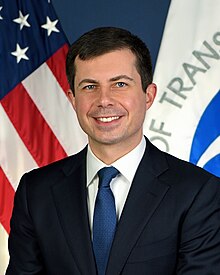
Pete Buttigieg
Case #2: Janet, a chef in Los Angeles, was fed up with getting Spam calls on her cell phone. Each time she got one, she blocked the number. Being on the national Do Not Call Registry, she believed she had an airtight case to take to the Federal Communications Commission (FCC) which regulates the airways.
So she called the FCC and spoke with one of its representatives.
She said that she had saved to her phone the numbers of Spam callers—and she was prepared to turn these over to the FCC.
The FCC’s rep applauded Janet’s willingness to turn over this information.
“Then what happens?” asked Janet.
“We’ll put it into our files.”
In short: the FCC had no intention of acting on the Spam-caller numbers that Janet was prepared to turn over.

Janet didn’t hide her disappointment: “If someone went to the FBI and said, ‘I’m being shaken down by the Mafia,’ and the FBI said, ‘Well, we’ll put this into our files’ but wasn’t willing to do anything more, how many people do you think would be willing to report crimes to the FBI?”
The FCC rep admitted that this would greatly reduce the willingness of the public to report crimes to the FBI. But she made no effort to help Janet stop the harassing Spam calls.
Incidents like the ones above are a potent reason why so many people have lost their trust in government—at all levels.
Untold numbers of average citizens feel their elected officials—and the agencies they administer—don’t care about their problems. Even worse, they believe—accurately—that if they were wealthy contributors to the Democratic or Republican party, their complaints would be addressed promptly.
On April 24, 2016, CBS’ longtime documentary series, “60 Minutes,” aired a segment titled “Dialing for Dollars.”
It opened with the following: “The American public has a low opinion of Congress. Only 14 percent think it’s doing a good job. But Congress has excelled in one way. Raising money. Members of Congress raised more than a billion dollars for their 2014 election. And they never stop.
“Nearly every day, they spend hours on the phone asking supporters and even total strangers for campaign donations—hours spent away from the jobs they were elected to do. The pressure on candidates to raise money has ratcheted up since the Supreme Court’s Citizens United decision in 2010. That allowed unlimited spending by corporations, unions and individuals in elections.”
In short: Members of Congress—the branch that writes the laws governing the lives of 328.2 million Americans—have essentially become telemarketers.
People who write to their members of Congress expect at least the courtesy of a reply addressing their concerns within a reasonable period of time. Many constituents will not receive even that.
Or the “reply” they receive arrives weeks or months later—and opens with: “Thank you for writing me to support my bill….”
Usually they haven’t even heard of the bill cited—and couldn’t care less about it. As they scan the letter—no doubt drafted by a low-level staffer—they search in vain for an offer of help, or at least empathy.
Millions of Americans will have no other contact with government officials than this. And it will convince them that if government isn’t their enemy, it’s certainly not their friend.
2018 FEDERAL GOVERNMENT SHUTDOWN, ABC NEWS, ADOLF, ADOLF HITLER, AFFORDABLE CARE ACT (ACT), ALAMO, ALTERNET, AMERICABLOG, ANTONIO LOPEZ DE SANTA ANNA, AP, “BIG BEAUTIFUL BILL, BABY BOOMER RESISTANCE, BBC, BLOOMBERG, BLUESKY, BOB WOODWARD, BORDER WALL, BUZZFEED, CBS NEWS, CNN, CROOKS AND LIARS, CZECHOSLOVAKIA, DAILY KOS, DAVID CROCKETT, DEMOCRATS, DONALD TRUMP, FBI, FEDERAL AVIATION ADMINISTRATION, FEDERAL GOVERNMENT SHUTDOWN, FIVETHIRTYEIGHT, FURLOUGHS, GOVERNMENT SHUTDOWN, HAKEEM JEFFRIES, HARPER’S MAGAZINE, HUFFINGTON POST, ILLEGAL ALIENS, J.D. VANCE, JACK SMITH, JAMES BOWIE, JIMMY KIMMEL, JOHN F. KENNEDY, JOSE ANDRES, JOSEPH STALIN, KIM JONG UN, MANUEL CASTILLON, MEDIA MATTERS, MEDICAID, MEDICARE, MOTHER JONES, MOVEON, MSNBC, MSNBC'S "HARDBALL", NATIONAL PARK SERVICE, NBC NEWS, NEWSDAY, NEWSWEEK, NPR, OBAMACARE, PBS NEWSHOUR, POLITICO, POLITICUSUSA, RAW STORY, REPUBLICAN PARTY, REPUBLICANS, REUTERS, RICHARD NIXON, ROBERT MUELLER, ROBERT PAYNE, SALON, SEATTLE TIMES, SLATE, SOVIET UNION, TALKING POINTS MEMO, THE ATLANTIC, THE CHICAGO SUN-TIMES, THE CHICAGO TRIBUNE, THE DAILY BEAST, THE DAILY BLOG, THE GUARDIAN, THE HILL, THE HUFFINGTON POST, THE INTERCEPT, THE LIFE AND DEATH OF ADOLF HITLER (BOOK), THE LOS ANGELES TIMES, THE NATION, THE NEW REPUBLIC, THE NEW YORK TIMES, THE NEW YORKER, THE PRINCE, THE VILLAGE VOICE, THE WASHINGTON POST, THINKPROGRESS, TIME, TRANSPORTATION SAFETY ADMINISTRATION (TSA), TRUTHDIG, TRUTHOUT, TWO POLITICAL JUNKIES, U.S. NEWS & WORLD REPORT, UNITED STATES HOLOCAUST MEMORIAL, UNITED STATES HOUSE OF REPRESENTATIVES, UNITED STATES SENATE, UPI, USA TODAY, WASHINGTON WEEK, WINSTON CHURCHILL, WONKETTE, WORLD WAR 11, X
In Bureaucracy, Business, History, Law, Medical, Military, Politics, Social commentary on October 7, 2025 at 12:10 am
On October 1, President Donald Trump shut down the Federal government.
On July 4, Trump had signed the One Big Beautiful Bill Act into law, which impacts Medicaid, Medicare and the Affordable Care Act (ACA), and is projected to cause millions of Americans to lose health insurance coverage.
The bill includes the largest cuts in Medicaid’s history, reducing funding by nearly $1 trillion over the next decade.
Or, as Trump and Republicans might say: “What are the lives of Americans but so many chickens?”
Democratic senators refused to support a temporary spending bill to fund the government unless it included an extension of these subsidies, which keep health care plans affordable for many Americans.
Trump—and Congressional Republicans—refused to do this. In addition, both falsely claimed that Democrats wanted to give health coverage to illegal aliens.
For Trump, winning—not truth—is all that matters. During his first term as President, he told 30,573 lies.

Donald Trump
Congress failed to pass the annual appropriations bills required to fund government agencies before the new fiscal year began on October 1, 2025. As a result, federal agencies must cease all “non-essential” functions until funding is approved.
The Congressional Budget Office estimated that about 750,000 employees will be furloughed on the average day. That’s $400 million in salary each day that the government will ultimately pay, but will not get work for.
Trump had threatened to use a shutdown to permanently reduce the size of the federal workforce.
“We can get rid of a lot of things that we didn’t want and they’d be Democrat things,” Trump told reporters in the Oval Office. “They just don’t learn. So we have no choice. I have to do that for the country.
“When you shut it down, you have to do layoffs, so we’d be laying off a lot of people. They’re going to be Democrats.”
This is the language—and “negotiating” style—of Adolf Hitler.
Robert Payne, author of the bestselling biography, The Life and Death of Adolf Hitler (1973), described Hitler’s “negotiating” style thus:

“Although Hitler prized his own talents as a negotiator, a man always capable of striking a good bargain, he was totally lacking in finesse.
“He was incapable of bargaining. He was like a man who goes up to a fruit peddler and threatens to blow his brains out if he does not sell his applies at the lowest possible price.”
Like Hitler, Trump relies on insults and anger to put his victims on the defense.
On September 29, Trump posted an AI-generated video on social media depicting House Democratic leader Hakeem Jeffries wearing a sombrero and curly mustache as mariachi music plays in the background.
After Jeffries condemned the video as racist and bigoted, on September 30 Trump posted another deepfake video mocking his reaction.
On October 1, Vice President J.D. Vance called the videos “funny,” adding, “The president’s joking, and we’re having a good time.”
Yet Trump has raged when late-night comedians like Jimmy Kimmel have joked about him.
Like Hitler, Trump relies on fear: “Real power is—I don’t even want to use the word—fear,” he told journalist Bob Woodward in March 2016 when still a Presidential candidate.
On the October 3 edition of Washington Week with the Atlantic, Ashley Parker, a staff writer for The Atlantic magazine, said:
“[Trump] likes threatening Democrats, right, saying, we’re going to do what Project 2025 promised. We’re going to fire all these workers. We’re going to figure out what agencies we can just eliminate forever. It’s a fun thing to say. That’s for him. That’s why I say it’s trolling, but it’s not quite clear that that’s actually what he wants to do.”

Federal agencies began explicitly blaming Democrats for the government shutdown—even before it happened.
On September 30, the Department of Housing and Urban Development’s website posted: “The radical left are going to shut down the government.”
For Trump, everyone who opposes him is a “radical leftist”-–even though he boasted that he and Communist North Korean dictator Kim Jong-Un “fell in love.”
Democrats fear they will be blamed for the shutdown. Yet they might triumph if they remember that what worked against Hitler will most likely work against Trump.
Rule #1: Refuse to placate a brutal dictator. Such men see any concessions as weakness—and make only greater demands. Hitler, for example, demanded only a part of Czechoslovakia—and then seized the whole country.
Rule #2: When Hitler found himself facing an opponent who couldn’t be bribed or cowed—such as British Prime Minister Winston Churchill or Soviet Premier Joseph Stalin—he raged and/or sulked.
When Trump has faced an opponent he can’t buy or intimidate—such as Special Counsels Robert Mueller and Jack Smith—he has done the same.
Rule #3: Don’t sell out an ally or make concessions to an insatiable dictator—and believe he can be trusted to keep his word. Trump has repeatedly proven his word can’t be trusted.
Far more than a government shutdown is at stake.
If Democrats fall victim to their usual cowardice and disunity in the face of Right-wing threats and attacks, they will:
- End their relevance as a political party; and
- Condemn to death millions of Americans who cannot obtain life-saving medical care while billionaires gain huge tax cuts.
ABC NEWS, ADOLF HITLER, AFFORDABLE CARE ACT (ACT), ALAMO, ALTERNET, AMERICABLOG, ANTONIO LOPEZ DE SANTA ANNA, AP, “BIG BEAUTIFUL BILL, BABY BOOMER RESISTANCE, BARACK OBAMA, BBC, BLOOMBERG, BLUESKY, BOB WOODWARD, BORDER WALL, BUZZFEED, CBS NEWS, CNN, CROOKS AND LIARS, CZECHOSLOVAKIA, DAILY KOS, DAVID CROCKETT, DEMOCRATS, DONALD TRUMP, FBI, FEDERAL AVIATION ADMINISTRATION, FEDERAL GOVERNMENT SHUTDOWN, FIVETHIRTYEIGHT, HAKEEM JEFFRIES, HARPER’S MAGAZINE, HUFFINGTON POST, ILLEGAL ALIENS, J.D. VANCE, JACK SMITH, JAMES BOWIE, JIMMY KIMMEL, JOSE ANDRES, JOSEPH STALIN, KIM JONG UN, MANUEL CASTILLON, MEDIA MATTERS, MEDICAID, MEDICARE, MOTHER JONES, MOVEON, MSNBC, NANCY PELOSI, NBC NEWS, NEWSDAY, NEWSWEEK, NPR, OBAMACARE, PBS NEWSHOUR, POLITICO, POLITICUSUSA, RAW STORY, REPUBLICANS, REUTERS, ROBERT MUELLER, ROBERT PAYNE, SALON, SEATTLE TIMES, SLATE, TALKING POINTS MEMO, THE ATLANTIC, THE CHICAGO SUN-TIMES, THE CHICAGO TRIBUNE, THE DAILY BEAST, THE DAILY BLOG, THE GUARDIAN, THE HILL, THE HUFFINGTON POST, THE INTERCEPT, THE LIFE AND DEATH OF ADOLF HITLER (BOOK), THE LOS ANGELES TIMES, THE NATION, THE NEW REPUBLIC, THE NEW YORK TIMES, THE NEW YORKER, THE PRINCE, THE VILLAGE VOICE, THE WASHINGTON POST, THINKPROGRESS, TIME, TRANSPORTATION SAFETY ADMINISTRATION (TSA), TRUTHDIG, TRUTHOUT, TWO POLITICAL JUNKIES, U.S. NEWS & WORLD REPORT, UNITED STATES HOUSE OF REPRESENTATIVES, UNITED STATES SENATE, UPI, USA TODAY, UV LIGHT, WASHINGTON WEEK, WINSTON CHURCHILL, WONKETTE, X
In Bureaucracy, Business, History, Medical, Military, Politics, Social commentary on October 6, 2025 at 12:46 am
It was the night of March 5, 1836. For the roughly 200 men inside the surrounded Alamo, death lay only hours away.
Inside a house in San Antonio, Texas, Mexican dictator Antonio Lopez de Santa Anna was holding a council of war with his generals.
For 12 days, his army had bombarded the old mission. Still, the Texians—whose numbers included the legendary bear hunter and Congressman David Crockett and knife fighter James Bowie—held out.
Now Santa Anna was in a hurry to take the makeshift fortress. Once its defenders were dead, he could march on to sweep all American settlers from Texas.
One of his generals, Manuel Castrillón, urged Santa Anna to wait just a few more days. By then, far bigger cannon would be available. When the Alamo’s three-feet-thick walls had been knocked down, the defenders would be forced to surrender.
The lives of countless Mexican soldiers would thus be spared.
Santa Anna was eating a late-night chicken dinner. He held up a chicken leg and said: “What are the lives of soldiers but those of so many chickens?”

Antonio Lopez de Santa Anna
Santa Anna ordered his generals to prepare an all-out attack on the Alamo, to be launched the next morning—March 6, 1836—at 5 a.m.
Hours later, the attack went forward. Within 90 minutes, every Alamo defender was dead—and so were at least 600 Mexican soldiers.
“What are the lives of Americans but those of so many chickens?”
That could well be the slogan of President Donald Trump and his fellow Republicans during the October 1 shutdown of the Federal government.
On July 4, Trump signed the One Big Beautiful Bill Act into law, which enacts significant cuts to federal health programs to help pay for tax reductions.
The law primarily impacts Medicaid, Medicare, and the Affordable Care Act (ACA), and is projected to cause millions of Americans to lose health insurance coverage. The bill includes the largest cuts in Medicaid’s history, reducing funding by nearly $1 trillion over the next decade.
Democrats had demanded a bill that reversed cuts to Medicaid and prevented health insurance premiums from rising at the end of the year. Republicans had refused.
Trump had threatened to use a shutdown to permanently reduce the size of the federal work force:
“We can do things during the shutdown that are irreversible, that are bad for them and irreversible by them, like cutting vast numbers of people out, cutting things that they like, cutting programs that they like.”

Donald Trump
And Trump’s Congressional supporters quickly issued threats of their own:
“We have never had Democrats that are so insane as this,” said Senator Bernie Moreno (R-OH), “because this is going to last a long—if they shut down the government tonight, my prediction is it will go on for a long, long time.”
“Far-left interest groups and far-left Democrat members wanted to show down with the president, and so Senate Democrats have sacrificed the American people to Democrats’ partisan interests,” Senate majority leader John Thune said.
Republicans control the White House, the Senate and the House of Representatives. Yet they are blaming the shutdown on the party that doesn’t control any of these institutions.
And they are using a Trump lie to justify it: “One of the things [Democrats] want to do is, they want to give incredible Medicare, Cadillac, the Cadillac Medicare, to illegal immigrants. And what that does is, it keeps them coming into our country like they do in California. And no country can afford that, no country.”
On the September 30 edition of The PBS News Hour, Liz Landers, the News Hour’s White House correspondent, said: “Undocumented immigrants are not allowed to be enrolled in federally funded health care coverage in this country. That includes Medicare, Medicaid, CHIP, the child health care program, and even some of those Affordable Care Act subsidies.”
This is the first government shutdown since December 22, 2018, during Trump’s first term. Angered that Democrats refused his demands for border wall funding, Trump declared the government closed.
About 380,000 government employees were furloughed and another 420,000 were ordered to work without pay.
The shutdown lasted 35 days—December 22, 2018 to January 25, 2019. It ended only when House Speaker Nancy Pelosi refused to open the House of Representatives for Trump’s annual State of the Union message.
The effects of the shutdown quickly became evident:
- For weeks, hundreds of thousands of government workers missed paychecks.
- Trash piled up in national parks.
- Increasing numbers of employees of the Transportation Safety Administration (TSA)—which provides security against airline terrorism—began refusing to come to work, claiming to be sick.
- At the Federal Aviation Administration (FAA) many air traffic controllers called in “sick.” Those who showed up to work without pay grew increasingly frazzled as they feared being evicted for being unable to make rent or house payments.
- Due to the shortage of air traffic controllers, many planes weren’t able to land safely at places like New York’s LaGuardia Airport.
- Many Federal employees—such as FBI agents—were forced to rely on soup kitchens to feed their families.
- Celebrity chef Jose Andres launched ChefsForFeds, which offered free hot meals for government employees and their families at restaurants across the country.
- Many workers tried to bring in money by babysitting or driving for Uber.
ABC NEWS, ALEXANDER THE GREAT, ALTERNET, AMERICABLOG, AP, BABY BOOMER RESISTANCE, BBC, BLOOMBERG NEWS, BUZZFEED, CBS NEWS, CNN, CROOKS AND LIARS, DAILY KOS, DOUGLAS MACARTHUR, FEDERAL SECURITY SERVICE, FIVETHIRTYEIGHT, GATES OF FIRE (BOOK), HARPER’S MAGAZINE, HUFFINGTON POST, KGB, MEDIA MATTERS, MERCENARIES, MOTHER JONES, MOVEON, MSNBC, NBC NEWS, NEW REPUBLIC, NEWSDAY, NEWSWEEK, NICCOLO MACHIAVELLI, NPR, PBS NEWSHOUR, POLITICO, POLITICUSUSA, RAW STORY, REUTERS, SALON, SEATTLE TIMES, SLATE, SPARTA, STANLEY MCCRYSTAL, STEVEN PRESSFIELD, TALKING POINTS MEMO, THE ATLANTIC, THE CHICAGO SUN-TIMES, THE CHICAGO TRIBUNE, THE DAILY BEAST, THE DAILY BLOG, THE GUARDIAN, THE HILL, THE HUFFINGTON POST, THE INTERCEPT, THE LOS ANGELES TIMES, THE NATION, THE NEW REPUBLIC, THE NEW YORK TIMES, THE NEW YORKER, THE PROFESSION (BOOK), THE VILLAGE VOICE, THE VIRTUES OF WAR (BOOK), THE WASHINGTON POST, THERMOPYLAE, THINKPROGRESS, TIME, TRUTHDIG, TRUTHOUT, U.S. NEWS & WORLD REPORT, UKRAINE, UPI, USA TODAY, VLADIMIR PUTIN, WAGNER GROUP, X, YEGENEY PRIGOZHIN
In Bureaucracy, Business, History, Military, Politics, Social commentary on September 15, 2025 at 12:08 am
In May, 2014, Yevgeny Prigozhin founded the Kremlin-affiliated mercenary army Wagner Group.
Since Russian President Vladimir Putin ordered a “special military operation” against Ukraine on February 24, 2022, Wagner has played a major role in the fighting.
Prigozhin had repeatedly clashed with Russian Defense Minister Sergei Shoigu, blaming him for a lack of ammunition to his embattled fighters—resulting in thousands of casualties.

Yevgeney Prigozhin
Government of the Russian Federation, CC BY 3.0 <https://creativecommons.org/licenses/by/3.0>, via Wikimedia Commons
On June 23, 2023, Prigozhin claimed that regular Russian armed forces had launched missile strikes against Wagner forces, killing a “huge” number.
He announced: “The council of commanders of PMC Wagner has made a decision—the evil that the military leadership of the country brings must be stopped.”
In response, criminal charges were filed against Prigozhin by the Russian Federal Security Service—the renamed KGB—for inciting an armed rebellion.
Wagner withdrew from Ukraine, occupied the Russian city of Rostov-on-Don and headed for Moscow. While doing so, Wagner shot down a Russian fighter plane and several military helicopters.
Putin decried the action as treason, and vowed to quash the uprising.
Talks between Prigozhin and Belarussian president Alexander Lukashenko resulted in charges being dropped. Wagner ceased its march on Moscow. Prigozhin would move to Belarus but remain under investigation for treason. Wagner troops would return to Ukraine.
On August 23, 2023, Prigozhin was killed along with nine other people when a business jet crashed in Tyer Oblast, north of Moscow.
American military sources believe the crash was likely caused by a bomb on board or sabotage.
The danger of relying on mercenaries forms the plot of The Profession, a 2011 novel by bestselling author Steven Pressfield.

Pressfield made his literary reputation with a series of classic novels about ancient Greece.
In Gates of Fire (1998) he explored the rigors and heroism of Spartan society—and the famous last stand of its 300 picked warriors at Thermopylae.
In The Virtues of War (2004) he entered the mind of Alexander the Great, whose armies swept across the known world, destroying all who dared oppose them.
But in The Profession, Pressfield created a plausible world set into the future of 2032. The book’s own dust jacket offers the best summary of its plot-line:
“Everywhere military force is for hire. Oil companies, multi-national corporations and banks employ powerful, cutting-edge mercenary armies to control global chaos and protect their riches.
“Force Insertion is the world’s merc monopoly. Its leader is the disgraced former United States Marine General James Salter, stripped of his command by the president for nuclear saber-rattling with the Chinese and banished to the Far East.”
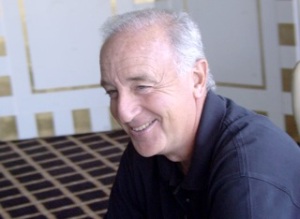
Steven Pressfield
Salter appears as a hybrid of World War II General Douglas MacArthur and Iraqi War General Stanley McCrystal.
Like MacArthur, Salter has butted heads with his President—and paid dearly for it. Now his ambition is no less than to become President himself—by popular acclaim. And like McCrystal, he is a pure warrior who leads from the front and is revered by his men.
Salter seizes Saudi Arabian oil fields, then offers them as a gift to America. By doing so, he makes himself the most popular man in the country—and a guaranteed occupant of the White House.
Douglas MacArthur

Stanley McCrystal
“The United States is an empire…but the American people lack the imperial temperament,” asserts Salter. “We’re not legionaries, we’re mechanics. In the end the American Dream boils down to what? ‘I’m getting mine and the hell with you.’”
Americans, says Salter, have come to like mercenaries: “They’ve had enough of sacrificing their sons and daughters in the name of some illusory world order. They want someone else’s sons and daughters to bear the burden….
“They want their problems to go away. They want me to to make them go away.”
Returning to the United States, he is acclaimed as a hero—and the next President.
He knows that his country is on a downward spiral toward oblivion: “Any time that you have the rise of mercenaries…society has entered a twilight era, a time past the zenith of its arc.”
And he doesn’t believe that his Presidency will arrest that decline: “But maybe in the short run, it’s better that my hand be on the wheel…rather than some other self-aggrandizing sonofabitch whose motives might not be as well intentioned….”
More than 500 years ago, Niccolo Machiavelli warned of the dangers of relying on mercenaries:
“Mercenaries…are useless and dangerous. And if a prince holds on to his state by means of mercenary armies, he will never be stable or secure; for they are disunited, ambitious, without discipline, disloyal; they are brave among friends; among enemies they are cowards.

Niccolo Machiavelli
“They have neither the fear of God nor fidelity to men, and destruction is deferred only so long as the attack is. For in peace one is robbed by them, and in war by the enemy.”
Centuries ago, Niccolo Machiavelli issued a warning against relying on men whose first love is their own enrichment.
Steven Pressfield, in a work of fiction, has given us a nightmarish vision of a not-so-distant America where “Name your price” has become the byward for an age.
Both warnings are well worth heeding.
ABC NEWS, AFFORDABLE CARE ACT (ACA), ALTERNET, AMERICABLOG, AP, BABY BOOMER RESISTANCE, BARACK OBAMA, BBC, BC NEWS, BLOOMBERG, BLUESKY, BUZZFEED, CBS NEWS, CIA, CNN, CROOKS AND LIARS, DAILY KOS, FIVETHIRTYEIGHT, FRANKLIN D. ROOSEVELT, HARPER’S MAGAZINE, HUFFINGTON POST, JOHN SCHNATTER, MEDIA MATTERS, MITT ROMNEY, MOTHER JONES, MOVEON, MSNBC, NBC NEWS, NEW DEAL, NEWSDAY, NEWSWEEK, NPR, OBAMACARE, PAPA JOHN'S PIZZA, PBS NEWSHOUR, POLITICO, POLITICUSUSA, RAW STORY, REPUBLICAN PARTY, REUTERS, Ronald Reagan, SALON, SEATTLE TIMES, SLATE, TALKING POINTS MEMO, THE ATLANTIC, THE CHICAGO SUN-TIMES, THE CHICAGO TRIBUNE, THE DAILY BEAST, THE DAILY BLOG, THE GUARDIAN, THE HILL, THE HUFFINGTON POST, THE INTERCEPT, THE LOS ANGELES TIMES, THE NATION, THE NEW REPUBLIC, THE NEW YORK TIMES, THE NEW YORKER, THE VILLAGE VOICE, THE WALL STREET JOURNAL, THE WASHINGTON POST, THINKPROGRESS, TIME, TRUTHDIG, TRUTHOUT, TWO POLITICAL JUNKIES, U.S. NEWS & WORLD REPORT, UPI, USA TODAY, WILLIAM J. CASEY, X
In Bureaucracy, Business, History, Law, Politics, Social commentary on September 1, 2025 at 12:11 am
When William J. Casey was a young attorney during the Great Depression, he learned an important lesson.
Jobs were hard to find, so Casey was glad to be hired by the Tax Research Institute of America in New York.
His task: Study New Deal legislation and write reports explaining it to corporate CEOs.
At first, he thought they wanted detailed legal commentary on the meaning of the new legislation.
But the he quickly learned a blunt truth: Businessmen neither understood nor welcomed President Franklin D. Roosevelt’s efforts at reforming American capitalism. And they didn’t want legal commentary.
Instead, they wanted to know: “What is the bare minimum we have to do to achieve compliance with the law?”
In short: How do we get by FDR’s new programs?
Fifty years later, Casey would bring the same mindset to his duties as director of the Central Intelligence Agency (CIA) for President Ronald Reagan.

William J. Casey
He was presiding over the CIA when it deliberately violated Congress’ ban on funding the “Contras,” the Right-wing death squads of Nicaragua.
Casey gave lip service to the demands of Congress. But privately, with the help of Marine Lieutenant Colonel Oliver North, he set up an “off-the-shelf” operation to provide arms to overthrow the leftist government of Daniel Ortega.
It was what President Ronald Reagan wanted. So Casey felt he had a duty to get it done, and Congress be damned.
When news of Casey’s—and Reagan’s—illegal behavior leaked, in November, 1986, it almost destroyed the Reagan administration.
Especially damning: Much of the funding directed to the “Contras” had come from Iran, America’s mortal enemy.
To ransom a handful of American hostages who had been kidnapped in Lebanon, Reagan sold them America’s most sophisticated missiles in a weak-kneed exchange for American hostages.
Then he went on television and brazenly denied that any such “arms for hostages” trade had ever happened.
Ronald Reagan
But the “Casey Doctrine” of minimum compliance with the law didn’t die with Casey (who expired of a brain tumor in 1987).
It was very much alive within the American business community as President Barack Obama sought to bring medical coverage to all Americans, and not simply the ultra-wealthy.
The single most important provision of the Affordable Care Act (ACA)—better-known as Obamacare—requires large businesses to provide insurance to fulltime employees who work more than 30 hours a week.
For part-time employees, who work fewer than 30 hours, a company isn’t penalized for failing to provide health insurance coverage.
Obama’s enemies slandered him as a ruthless practitioner of “Chicago politics.” So it’s easy to assume that he took “the Casey Doctrine” into account when he shepherded the ACA through Congress.

Barack Obama
But he didn’t.
The result was predictable. And its consequences quickly became clear.
Employers feel motivated to move fulltime workers into part-time positions, and thus avoid
- Providing their employees with medical insurance; and
- A fine for non-compliance with the law.
Some employers openly showed their contempt for President Obama—and the idea that employers had any obligation to those who make their profits a reality.
John Schnatter, CEO of Papa John’s Pizza, said:
- The price of his pizzas would go up—by 11 to 14 cents per pizza, or 15 to 20 cents per order; and
- He would pass along these costs to his customers.
“If Obamacare is in fact not repealed,” Schnatter told Politico, “we will find tactics to shallow out any Obamacare costs and core strategies to pass that cost onto consumers in order to protect our shareholders’ best interests.”
After all, why should a multibillion dollar company show any concern for those who make its profits a reality?
Consider:
- Papa John’s is the world’s third-largest pizza delivery chain, operating in 49 countries and territories with over 5,500 locations globally
- As of late August 2025, it had a net worth of approximately $1.56 to $1.59 billion.
In May, 2012, Schnatter hosted a fundraising event for Republican Presidential candidate Mitt Romney at his own Louisville, Kentucky, mansion.
“What a home this is,” gushed Romney. “What grounds these are, the pool, the golf course.
“You know, if a Democrat were here he’d look around and say no one should live like this. Republicans come here and say everyone should live like this.”
Of course, Romney conveniently ignored an ugly fact:
For Papa John’s minimum-wage-earning employees—many of them working only part-time—the odds of their owning a comparable estate are non-existent.
Had Obama been the serious student of Realpolitick that his enemies claimed, he would have predicted that most businesses would seek to avoid compliance with his law.
To counter that, he should have required employers to provide insurance coverage for all of their employees—regardless of their fulltime or part-time status.
This, in turn, would have produced two substantial benefits:
- All employees would have been able to obtain medical coverage; and
- Employers would have been encouraged to provide fulltime positions rather than part-time ones, since they would feel, “I’m paying for fulltime insurance coverage, so I should be getting fulltime work in return.”
The “Casey Doctrine” of minimum compliance should always be remembered when reformers try to protect Americans from predatory employers.
ABC NEWS, ALTERNET, AMERICABLOG, AP, BABY BOOMER RESISTANCE, BBC, BLOOMBERG NEWS, BUZZFEED, CBS NEWS, CNN, CRIME, CROOKS AND LIARS, DAILY KOS, FIVETHIRTYEIGHT, GUN CONTROL, HARPER’S MAGAZINE, HUFFINGTON POST, MARTIN LUTHER KING, MEDIA MATTERS, MOTHER JONES, MOVEON, MSNBC, NATIONAL RIFLE ASSOCIATION, NBC NEWS, NEW REPUBLIC, NEWSDAY, NEWSWEEK, NPR, PBS NEWSHOUR, POLITICO, POLITICUSUSA, RAW STORY, REUTERS, ROBERT F. KENNEDY, SALON, SEATTLE TIMES, SECOND AMENDMENT, SELF-DEFENSE, SLATE, STAND-YOUR-GROUND LAWS, TALKING POINTS MEMO, THE ATLANTIC, THE CHICAGO SUN-TIMES, THE CHICAGO TRIBUNE, THE DAILY BEAST, THE DAILY BLOG, THE GUARDIAN, THE HILL, THE HUFFINGTON POST, THE INTERCEPT, THE LOS ANGELES TIMES, THE NATION, THE NEW REPUBLIC, THE NEW YORK TIMES, THE NEW YORKER, THE VILLAGE VOICE, THE WASHINGTON POST, THINKPROGRESS, TIME, TRUTHDIG, TRUTHOUT, U.S. NEWS & WORLD REPORT, UPI, USA TODAY, VIRGINIA TECH SHOOTINGS, WRONGFUL-DEATH, X
In Bureaucracy, Business, History, Law, Law Enforcement, Politics, Social commentary on August 29, 2025 at 12:14 am
The victims of the violence are black and white, rich and poor, young and old, famous and unknown. They are, most important of all, human beings whom other human beings loved and needed. No one—no matter where he lives or what he does—can be certain who will suffer from some senseless act of bloodshed. And yet it goes on and on.
–Robert F. Kennedy, April 4, 1968
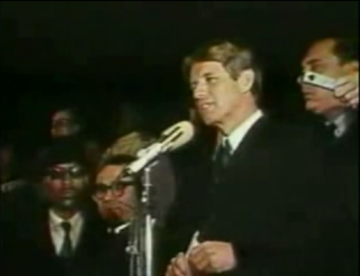
Senator Robert F. Kennedy announcing the murder of Dr. Martin Luther King, Jr.
By https://www.youtube.com/watch?v=jPYNb4ex6Ko, Fair use, https://en.wikipedia.org/w/index.php?curid=14289385
A total of 262 people had been killed and 1,161 people had been wounded in 268 shootings, as of July 31, 2025.
What should the surviving victims of gun massacres do to seek redress?
And how can the relatives and friends of those who didn’t survive seek justice for those they loved?
Two things:
First, don’t count on politicians to support a ban on assault weapons.
Politicians—with rare exceptions—have only two goals:
- Get elected to office, and
- Stay in office.
And too many of them fear the economic and voting clout of the NRA to risk its wrath.
Consider Mitt Romney and President Barack Obama.
Both rushed to offer condolences to the surviving victims of the massacre at the Century 16 Theater in Aurora, Colorado, on July 20, 2012.
And both steadfastly refused to even discuss gun control—let alone support a ban on the type of assault weapons used by James Holmes, leaving 12 dead and 58 wounded.
Second, those who survived these massacres—and the relatives and friends of those who didn’t—should file wrongful death, class-action lawsuits against the NRA.
There is sound, legal precedent for this.
- For decades, the American tobacco industry peddled death and disability to millions and reaped billions of dollars in profits.
- The industry vigorously claimed there was no evidence that smoking caused cancer, heart disease, emphysema or any other ailment.
- Tobacco companies spent billions on slick advertising campaigns to win new smokers and attack medical warnings about the dangers of smoking.
- Tobacco companies spent millions to elect compliant politicians and block anti-smoking legislation.
- From 1954 to 1994, over 800 private lawsuits were filed against tobacco companies in state courts. But only two plaintiffs prevailed, and both of those decisions were reversed on appeal.
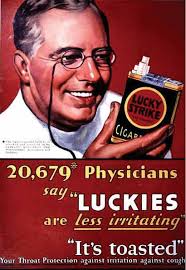
- In 1994, amidst great pessimism, Mississippi Attorney General Mike Moore filed a lawsuit against the tobacco industry. But other states soon followed, ultimately growing to 46.
- Their goal: To seek monetary, equitable and injunctive relief under various consumer-protection and anti-trust laws.
- The theory underlying these lawsuits was: Cigarettes produced by the tobacco industry created health problems among the population, which badly strained the states’ public healthcare systems.
- In 1998, the states settled their Medicaid lawsuits against the tobacco industry for recovery of their tobacco-related, health-care costs. In return, they exempted the companies from private lawsuits for tobacco-related injuries.
- The companies agreed to curtail or cease certain marketing practices. They also agreed to pay, forever, annual payments to the states to compensate some of the medical costs for patients with smoking-related illnesses.
The parallels with the NRA are obvious:
- For decades, the NRA has peddled deadly weapons to millions, reaped billions of dollars in profits and refused to admit the carnage those weapons have produced: “Guns don’t kill people. People kill people.” With guns.

- The NRA has bitterly fought background checks on gun-buyers, in effect granting even criminals and the mentally ill the right to own arsenals of death-dealing weaponry.
- The NRA has spent millions on slick advertising campaigns to win new members and frighten them into buying guns.
- The NRA has spent millions on political contributions to block gun-control legislation.
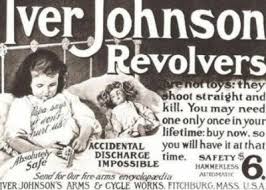
- The NRA has spent millions attacking political candidates and elected officials who warned about the dangers of unrestricted access to assault and/or concealed weapons.
- The NRA has spent millions pushing “Stand Your Ground” laws in more than half the states, which potentially give every citizen a “license to kill.”
- The NRA receives millions of dollars from online sales of ammunition, high-capacity ammunition magazines, and other accessories through its point-of-sale Round-Up Program—thus directly profiting by selling a product that kills about 30,288 people a year.
- Firearms made indiscriminately available through NRA lobbying have filled hospitals with casualties, and have thus badly strained the states’ public healthcare systems.
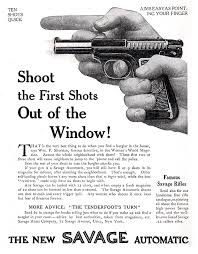
It will take a series of highly expensive and well-publicized lawsuits to significantly weaken the NRA, financially and politically.
The first ones will have to be brought by the surviving victims of gun violence—and by the friends and families of those who did not survive it. Only they will have the courage and motivation to take such a risk.
As with the cases first brought against tobacco companies, there will be losses. And the NRA will rejoice with each one.
But, in time, state Attorneys Generals will see the clear parallels between lawsuits filed against those who peddle death by cigarette and those who peddle death by armor-piercing bullet.
And then the NRA—like the tobacco industry—will face an adversary wealthy enough to stand up for the rights of the gun industry’s own victims.
Only then will those politicians supporting reasonable gun controls dare to stand up for the victims of these needless tragedies.
2024 PRESIDENTIAL CAMPAIGN, 2026 MIDTERM ELECTIONS, ABC NEWS, ADOLF HITLER, ALTERNET, AMERICABLOG, AP, ATTORNEY GENERAL OF THE UNITED STATES, ” SPACE DEVELOPMENT AGENCY (SDA), BABY BOOMER RESISTANCE, BBC, BIG BEUTIFUL BILL, BLOOMBERG, BUZZFEED, CBS NEWS, CHRIS KREBS, CNN, CROOKS AND LIARS, CYBERSECURITY, DAILY KOS, DAN MCADAMS, DEMOCRATS, DEPARTMENT OF GOVERNMENT EFFICIENCY (DOGE), DONALD TRUMP, ELON MUSK, ERNST ROHM, FBI, FEDERAL DEFICIT, FIVETHIRTYEIGHT, FOOD STAMPS, HARPER’S MAGAZINE, HEINRICH HIMMLER, HUFFINGTON POST, INTERNAL REVENUE SERVICE, Kamala Harris, KAROLINE LEAVITT, MATT GAETZ, MEDIA MATTERS, MEDICAID, MICHAEL COHEN, MOTHER JONES, MOVEON, MSNBC, NATIONAL LABOR RELATIONS BOARD (NLRB), NATIONAL RECONNAISSANCE OFFICE (NRO), NBC NEWS, NEW REPUBLIC, NEWSDAY, NEWSWEEK, NORTHWESTERN UNIVERSITY, NPR, PAM BONDI, PBS NEWSHOUR, POLITICO, POLITICUSUSA, RAW STORY, REPUBLICANS, REUTERS, SALON, SEATTLE TIMES, SLATE, SPACE X, STORM TROOPERS, TALKING POINTS MEMO, TESLA, THE ATLANTIC, THE CHICAGO SUN-TIMES, THE CHICAGO TRIBUNE, THE DAILY BEAST, THE DAILY BLOG, THE GUARDIAN, THE HILL, THE HUFFINGTON POST, THE INTERCEPT, THE LOS ANGELES TIMES, THE NATION, THE NEW REPUBLIC, THE NEW YORK TIMES, THE NEW YORKER, THE S.A., THE SS, THE VILLAGE VOICE, THE WASHINGTON POST, THINKPROGRESS, THIRD REICH, TIME, TRUTHDIG, TRUTHOUT, TWITTER, TWO POLITICAL JUNKIES, U.S. NEWS & WORLD REPORT, UNITED STATES ATTORNEY’S OFFICE, UNITED STATES DEPARTMENT OF JUSTICE, UNITED STATES HOUSE OF REPRESENTATIVES, UNITED STATES SENATE, UPI, USA TODAY, X
In Bureaucracy, Business, History, Law, Law Enforcement, Politics, Social commentary on August 28, 2025 at 12:10 am
Donald Trump, upon taking office as President, appointed Elon Musk the head of a newly-created government agency called DOGE (Department of Government Efficiency). Its stated goal: Eliminating inefficiency and waste within the federal bureaucracy.
DOGE’s activities included shuttering government agencies, defunding programs and firing up to 100,000 federal employees.
Musk initially claimed he would save taxpayers $2 trillion. But financial records now indicate a savings of $175 billion.
Musk’s tenure with DOGE officially ended on May 29.

Elon Musk
The Royal Society, CC BY-SA 3.0 <https://creativecommons.org/licenses/by-sa/3.0>, via Wikimedia Commons
Musk donated $288 million to Trump’s 2024 Presidential campaign. He repeatedly praised Trump: “This election, I think, is going to decide the fate of America, and along with the fate of America, the fate of Western civilization.”
And Trump praised Musk: “Only Elon can do this,” Trump said of a SpaceX launch. “That’s why I love you, Elon.”
But that lovefest has brutally ended. On June 3, 2025, Musk blasted the massive tax-and-spending bill backed by Trump.
Dubbed the “One Big, Beautiful Bill” by Trump—and thus by House and Senate Republicans—the legislation will:
- Extend the 2017 Trump tax cuts, keeping taxes low on the richest Americans;
- Hurt millions of Americans by slashing $600 billion from Medicaid;
- Cost millions some or all of their food stamp benefits;
- Leave nine to 14 million people without health insurance by 2034;
- Add $3.1 trillion to the nation’s debt.
Having narrowly passed the House of Representatives by one vote, the bill passed the Senate on July 4, as Trump had demanded.
Elon Musk vigorously dissented. In a post on X, his social media site, he wrote: “I’m sorry, but I just can’t stand it anymore.
“This massive, outrageous, pork-filled Congressional spending bill is a disgusting abomination. Shame on those who voted for it: you know you did wrong. You know it.”
In a follow-up post, he added: “It will massively increase the already gigantic budget deficit to $2.5 trillion (!!!) and burden America citizens with crushingly unsustainable debt.”

Tesla headquarters
Larry D. Moore, CC BY 4.0 <https://creativecommons.org/licenses/by/4.0>, via Wikimedia Commons
Even worse for Republicans, Musk wrote on X: “In November next year, we fire all politicians who betrayed the American people,” suggesting that he would fund campaigns in the upcoming 2026 midterm elections to remove those who voted for the bill.
Many Republicans were expecting Musk to fund their midterm campaigns against Democrats—and their own primary challengers.

Donald Trump
Trump has loudly proclaimed his belief in taking vengeance on those who cross him: “If someone screws you, screw them back 10 times harder,” he told business leaders during a 2005 speech in Colorado.
Trump is an alpha male who enjoys dominating others. So is Musk. As Dan McAdams, a psychology professor at Northwestern University, told Newsweek:
“Two alphas can probably get along well enough as long as they don’t interfere with each other’s respective domain.
“Musk is certainly a narcissist but his self-worth is caught up in what he achieves. He really cares about building electric cars, sending people into space, and so on.
“Trump does not care about anything except himself. His entire self worth depends on others adoring him and fearing him.”
Musk is the world’s richest man, with an estimated net worth of $314 billion as of November 2024, according to the Bloomberg Billionaires Index. He owns Tesla, Inc., X (formerly Twitter), Space X and xAI, an artificial intelligence startup that he founded in 2023.
He commands unlimited resources in money, attorneys and the ability to reach millions through X. He’s received billions of dollars in Federal contracts—among them $733.5 million for the Space Development Agency (SDA) and two for the National Reconnaissance Office (NRO).
But Trump commands the Justice Department and Internal Revenue Service. He’s already turned that machinery on former federal officials he hates—such as Chris Krebs, the former director for cybersecurity.
Pam Bondi, Trump’s appointment for Attorney General, has proven her reliability. As Florida Attorney General, she solicited a political contribution from Trump while her office deliberated investigating alleged fraud at Trump University and its affiliates.
After Bondi dropped the Trump University case, Trump wrote her a $25,000 check for her re-election campaign. The money came from the Donald J. Trump Foundation.
And Trump has already started his attack on Musk: On July 1, when reporters asked him if he would deport South Africa-born Musk, Trump said: “We’ll have to take a look. We might have to put DOGE on Elon.”
And on July 3, The New Republic published that Trump was responsible for rumors about Elon Musk’s rampant White House ketamine use: “‘Actually, we dropped a dime to The New York Times….on Elon’s drug taking,’” said Trump, according to his biographer Michael Wolff,
Musk could easily be indicted for corruption—even if it’s totally unwarranted. At the very least, many—if not all—of Musk’s government contracts could be cancelled. At the worst, Musk could find himself locked in combat with Federal prosecutors for the length of Trump’s term and facing huge fines—if not imprisonment.
Ernst Rohm felt invulnerable at the start of 1934. After leaving government with an effusive send-off from Trump, Elon Musk may have felt the same.
Like Rohm, Musk may live to regret the devotion he’s lavished on his choice for Fuhrer.
2024 PRESIDENTIAL CAMPAIGN, 2026 MIDTERM ELECTIONS, ABC NEWS, ADOLF HITLER, ALTERNET, AMERICABLOG, AP, ATTORNEY GENERAL OF THE UNITED STATES, “BIG BEAUTIFUL BILL, BABY BOOMER RESISTANCE, BBC, BLOOMBERG, BUZZFEED, CBS NEWS, CHRIS KREBS, CNN, CROOKS AND LIARS, CYBERSECURITY, DAILY KOS, DAN MCADAMS, DEMOCRATS, DEPARTMENT OF GOVERNMENT EFFICIENCY (DOGE), DONALD TRUMP, ELON MUSK, ERNST ROHM, FBI, FEDERAL DEFICIT, FIVETHIRTYEIGHT, FOOD STAMPS, HARPER’S MAGAZINE, HEINRICH HIMMLER, HUFFINGTON POST, INTERNAL REVENUE SERVICE, Kamala Harris, KAROLINE LEAVITT, MATT GAETZ, MEDIA MATTERS, MEDICAID, MICHAEL COHEN, MOTHER JONES, MOVEON, MSNBC, NATIONAL LABOR RELATIONS BOARD (NLRB), NATIONAL RECONNAISSANCE OFFICE (NRO), NBC NEWS, NEW REPUBLIC, NEWSDAY, NEWSWEEK, NORTHWESTERN UNIVERSITY, NPR, PAM BONDI, PBS NEWSHOUR, POLITICO, POLITICUSUSA, RAW STORY, REPUBLICANS, REUTERS, SALON, SEATTLE TIMES, SLATE, SPACE DEVELOPOMENT AGENCY (SDA), SPACE X, STORM TROOPERS, TALKING POINTS MEMO, TESLA, THE ATLANTIC, THE CHICAGO SUN-TIMES, THE CHICAGO TRIBUNE, THE DAILY BEAST, THE DAILY BLOG, THE GUARDIAN, THE HILL, THE HUFFINGTON POST, THE INTERCEPT, THE LOS ANGELES TIMES, THE NATION, THE NEW REPUBLIC, THE NEW YORK TIMES, THE NEW YORKER, THE S.A., THE SS, THE VILLAGE VOICE, THE WASHINGTON POST, THINKPROGRESS, THIRD REICH, TIME, TRUTHDIG, TRUTHOUT, TWITTER, TWO POLITICAL JUNKIES, U.S. NEWS & WORLD REPORT, UNITED STATES ATTORNEY’S OFFICE, UNITED STATES DEPARTMENT OF JUSTICE, UNITED STATES HOUSE OF REPRESENTATIVES, UNITED STATES SENATE, UPI, USA TODAY, X
In Bureaucracy, Business, History, Law, Law Enforcement, Politics, Social commentary on August 27, 2025 at 12:18 am
On June 30, 1934, German Chancellor Adolf Hitler ordered a massive purge of his private army, the S.A., (Sturmabteilungor). It was carried out by Hitler’s elite army-within-an-army, the Schutzstaffel, or Protective Squads, better known as the SS.
The Brownshirts (also known as “Storm Troopers”) had been instrumental in securing Hitler’s rise to Chancellor of Germany on January 30, 1933. They had violently intimidated political opponents (especially Communists) and organized mass rallies for the Nazi Party.
But after Hitler reached the pinnacle of power, they became a liability.
Ernst Rohm, their commander, had served as a tough army officer during World War 1. He was one of the few men allowed to use “du,” the personal form of “you” in German, when addressing Hitler.
Rohm urged Hitler to disband the regular German army, the Reichswehr, and replace it with his own undisciplined paramilitary legions as the nation’s defense force.
By 1934, the Storm Troopers numbered approximately three million. By contrast, about 100,000 soldiers served in the Reichswehr, owing to restrictions imposed by the 1919 Versailles Treaty which ended World War 1.
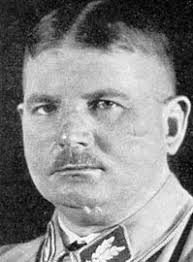
Ernst Rohm
Frightened by Rohm’s ambitions, the generals of the Reichswehr gave Hitler an ultimatum: Get rid of Rohm—or they would get rid of him.
Hitler didn’t hesitate. Backed by armed thugs, he stormed into Rohm’s apartment, catching him in bed with a young S.A. Storm Trooper.
Accusing his onetime friend of treasonously plotting to overthrow him, Hitler screamed: “You’re going to be shot!”
Rohm was not plotting a coup. But the generals had the whip hand—and, for Hitler, that was enough to literally sign Rohm’s death warrant.
Hours later, sitting in a prison cell, Rohm was offered a pistol with a single bullet.
“Adolf himself should do the dirty work,” said Rohm, adding: “All revolutions devour their own children.”
One hour later, Rohm died in a hail of SS bullets.
Earlier throughout that day, so had several hundred of his longtime S.A. cronies. Many of them yelled “Heil Hitler!” as they stood against barracks walls waiting to be shot.

SS soldiers marching
Thirteen days later, addressing the Reichstag, Germany’s parliament, Hitler justified his purge in a nationally broadcast speech:
“If anyone reproaches me and asks why I did not resort to the regular courts of justice, then all I can say is this: In this hour I was responsible for the fate of the German people, and thereby I became the Supreme Judge of the German people!
“I gave the order to shoot the ringleaders in this treason, and I further gave the order to cauterize down to the raw flesh the ulcers of this poisoning of the wells in our domestic life.
“Let the nation know that its existence—which depends on its internal order and security—cannot be threatened with impunity by anyone! And let it be known for all time to come that if anyone raises his hand to strike the State, then certain death is his lot.”
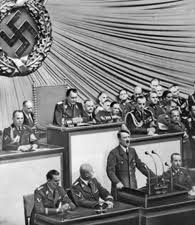

Adolf Hitler addressing parliament
Bundesarchiv, Bild 183-E11354 / CC-BY-SA 3.0, CC BY-SA 3.0 DE <https://creativecommons.org/licenses/by-sa/3.0/de/deed.en>, via Wikimedia Commons
Ninety-one years after Adolf Hitler declared himself “the Supreme Judge of the German people,” the United States faces the same fate under re-elected President Donald J. Trump.
And his Number One victim may turn out to be Elon Musk, the man who played a pivotal role in sending him back to the White House.
Musk, the leader of Space X Tesla and X (formerly Twitter), had donated tens of millions of dollars to pro-Trump super PACs, jumped around the stage behind Trump during campaign rallies, and turned X into a Right-wing cheering squad for Trump.
Trump, upon taking office, appointed Musk the head of a fictional government agency called DOGE (Department of Government Efficiency). Its official goal: Eliminating inefficiency and waste within the federal bureaucracy.
But some—like former Trump lawyer Michael Cohen—had a warning for Musk: “Donald Trump is loyal to one person and one person only…himself.
“The moment Elon steps an inch out of Trump’s line, despite all he might have done for him, Donald will cut him off, disparage and denigrate him. Elon is no different than me or anyone else similarly situated. It’s just a matter of when.”
Cohen speaks from bitter personal experience.
A longtime executive of the Trump Organization, Cohen told ABC news in 2011: “If somebody does something Mr. Trump doesn’t like, I do everything in my power to resolve it to Mr. Trump’s benefit.”
In April 2018, the United States Attorney for the Southern District of New York began investigating Cohen. Charges reportedly included bank fraud, wire fraud and violations of campaign finance law.

Michael Cohen
By IowaPolitics.com (Trump executive Michael Cohen 012) [CC BY-SA 2.0 (https://creativecommons.org/licenses/by-sa/2.0)%5D, via Wikimedia Commons
On April 9, 2018, the FBI, executing a federal search warrant, raided Cohen’s office at the law firm of Squire Patton Boggs, as well as at his home and his room in the Loews Regency Hotel in New York City.
Agents seized emails, tax and business records and recordings of phone conversations that Cohen had made.
Trump’s response: “Michael Cohen only handled a tiny, tiny fraction of my legal work.”
Thus Trump undermined the argument of Cohen’s lawyers that he was the President’s personal attorney—and therefore everything Cohen did was protected by attorney-client privilege.


 Bureaucracybuster's Blog
9/11 TERROR ATTACKS, ABC NEWS, ALASKA AIRLINES, ALDRICH AMES, ALTERNET, AMERICABLOG, AMERICAN AIRLINES, AP, BABY BOOMER RESISTANCE, BBC, BC NEWS, BLOOMBERG, BLUESKY, BUZZFEED, CBS NEWS, CIA, CNN, CROOKS AND LIARS, DAILY KOS, DELTA AIRLINES, FBI, FIVETHIRTYEIGHT, HARPER’S MAGAZINE, HUFFINGTON POST, IDENTOGO, JETBLUE AIRLINES, JOHN F. KENNEDY, JOHN W. HINCKLEY, LYNETTE "SQUEAKY" FROMME, MEDIA MATTERS, MOTHER JONES, MOVEON, MSNBC, NBC NEWS, NEWSDAY, NEWSWEEK, NPR, PBS NEWSHOUR, POLITICO, POLITICUSUSA, PRESIDENT GERALD FORD, PRESIDENT RONALD REAGAN, RALPH NADER, RAW STORY, REUTERS, RICHARD REID, ROBERT HANSSEN, SALON, SARAH JANE MOORE, SEATTLE TIMES, Secret Service, SECURITY, SHOE-BOMBER, SLATE, SOUTHWEST AIRLINES, TALKING POINTS MEMO, TERRORISM, THE ATLANTIC, THE CHICAGO SUN-TIMES, THE CHICAGO TRIBUNE, THE DAILY BEAST, THE DAILY BLOG, THE GUARDIAN, THE HILL, THE HUFFINGTON POST, THE INTERCEPT, THE LOS ANGELES TIMES, THE NATION, THE NEW REPUBLIC, THE NEW YORK TIMES, THE NEW YORKER, THE PENTAGON, THE VILLAGE VOICE, THE WALL STREET JOURNAL, THE WASHINGTON POST, THINKPROGRESS, TIME, TRANSPORTATION SAFETY ADMINISTRATION (TSA), TRUTHDIG, TRUTHOUT, TSA PRECHECK, TWITTER, TWO POLITICAL JUNKIES, U.S. NEWS & WORLD REPORT, UNITED AIRLINES, UNITED FLIGHT 93, UPI, USA TODAY, USAIRWAYS, VIRGIN AMERICAN AIRLINES, WEALTH GAP, WORLD TRADE CENTER, X
COMING: THE NEXT 9/11, COURTESY OF TSA: PART ONE (OF TWO)
In Bureaucracy, Business, History, Law, Law Enforcement, Politics, Social commentary on November 20, 2025 at 12:10 amMore than 20 years after 9/11, America is now selling its Islamic enemies access to the very weapons—jet-fueled airplanes—they need to wage jihad against its citizens.
World Trade Center on September 11, 2001
This danger is brought to you by IdentoGO, the private security company chosen by the Transportation Safety Administration (TSA) to screen airline passengers.
Consider this ad it posts:
“How many times have you stood in line at the airport watching others breeze through security with no hassle? By enrolling in TSA Pre✓® , you too can breeze through security.
“Keep your shoes, jacket and belt on; your laptop in its case; 3-1-1 compliant liquids in your bag; and enjoy a better overall travel experience.
“TSA Pre✓® allows low-risk travelers to experience faster, more efficient screening at participating U.S. airport checkpoints for domestic and international travel.”
Yes, for an enrollment payment of $78, you, too, can apply to receive such preferential treatment. Even if it means putting the Nation’s security at risk. Travelers that are eligible for TSA Pre✓® include:
To apply for TSA Pre✓®:
Among the credit cards that will buy you such preferential treatment:
If you’re accepted, you don’t need to undergo another background check for the next five years.
In 2024, 96% of TSA PreCheck passengers waited less than five minutes to board.
So what difference does it make that some passengers must submit to close inspection while others do not?
Advanced imaging technology
Why is America being placed at such risk? Three reasons:
On September 11, 2001, 2,996 people were killed and more than 6,000 others wounded as three highjacked airliners slammed into:
The attacks inflicted the worst shock and grief on America since the 1963 assassination of President John F. Kennedy.
So think about how easy it is to qualify as a TSA Pre-Check passenger the next time you board an airliner.
According to Yelp! reviews of thoroughly satisfied IdentoGO customers:
Share this: