Archive for May, 2024|Monthly archive page
ABC NEWS, ALBERT EINSTEIN, ALTERNET, AMERICABLOG, AP, ASTRONOMY, BABY BOOMER RESISTANCE, BARACK OBAMA, BBC, BLOOMBERG, BUZZFEED, CBS NEWS, CNN, CROOKS AND LIARS, DAILY KOS, DISNEY CHANNEL, FIVETHIRTYEIGHT, HANNAH MONTANA (TV SHOW), HARPER’S MAGAZINE, HUFFINGTON POST, JESUS CHRIST, LAWRENCE KRAUSS, MEDIA MATTERS, MILEY CYRUS, MOTHER JONES, MOVEON, MSNBC, NBC NEWS, NEW REPUBLIC, NEWSDAY, NEWSWEEK, NPR, PBS NEWSHOUR, POLITICO, POLITICUSUSA, RAW STORY, REUTERS, SALON, SCIENCE, SEATTLE TIMES, SLATE, TALKING POINTS MEMO, THE ATLANTIC, THE CHICAGO SUN-TIMES, THE CHICAGO TRIBUNE, THE DAILY BEAST, THE DAILY BLOG, THE GUARDIAN, THE HILL, THE HUFFINGTON POST, THE INTERCEPT, THE LOS ANGELES TIMES, THE NATION, THE NEW REPUBLIC, THE NEW YORK TIMES, THE NEW YORKER, THE VILLAGE VOICE, THE WASHINGTON POST, THINKPROGRESS, TIME, TRUTHDIG, TRUTHOUT, TWO POLITICAL JUNKIES, U.S. NEWS & WORLD REPORT, UPI, USA TODAY, X
In Entertainment, History, RELIGION, Social commentary on May 31, 2024 at 12:10 am
Miley Cyrus has been called the “Teen Queen” of the 2000s. She is also one of the few child stars with a successful musical career as an adult.
The daughter of country singer Billy Ray Cyrus, she became a teen idol at 13 as Hannah Montana in the Disney Channel television series (2006-2011) of that name. As Hannah Montana, she achieved success on the Billboard charts with two number-one soundtracks.
But on March 1, 2012, she outraged the Christian Right by committing the ultimate sin: She believed in science.
She posted a tweet featuring a photo of the physicist Lawrence Krauss: “Beautiful.”
But it wasn’t what then-19-year-old Cyrus wrote that enraged the “kill-for-Christ” types. It was the words—from Krauss—emblazoned against the photo.
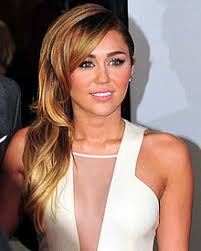
Miley Cyrus
EVERY ATOM IN YOUR BODY CAME FROM A STAR THAT EXPLODED. AND, THE ATOMS IN YOUR LEFT HAND PROBABLY CAME FROM A DIFFERENT STAR THAN THE ATOMS IN YOUR RIGHT HAND.
IT REALLY IS THE MOST POETIC THING I KNOW ABOUT THE UNIVERSE.
YOU ARE ALL STARDUST.
YOU COULDN’T BE HERE IF STARS HADN’T EXPLODED, BECAUSE THE ELEMENTS (THE CARBON, NITROGEN, OXYGEN AND ALL THE THINGS THAT MATTER FOR EVOLUTION) WEREN’T CREATED AT THE BEGINNING OF TIME, THEY WERE CREATED IN STARS.
SO FORGET JESUS. STARS DIED SO YOU COULD LIVE.

And it was those three words—“SO FORGET JESUS”—that roused right-wing Christians to deluge Cyrus’ twitter account with insults and death threats. Among these:
“So are you no longer a Christian? Forget Jesus??? Seriously? What has happened to you out there in the famous world? What????”
“You seriously believe that crap? It’s so ridiculously stupid. Go to hell.”
Cyrus quickly made it clear she didn’t intend to meekly accept such aggression. She tweeted: “U have nothing better 2 do than hate? That saddens me. Im surrounded by love Im sorry 4 whatever happened 2 make u so bitter.
“How can people take the love out of science and bring hate into religion so easily?” she asked and then quoted Albert Einstein:
“It makes me sad to think the world is this way. Like Einstein says ‘Science without religion is lame. Religion without science is blind.’”
She demanded that Twitter (now known as “X”) police itself against the cyber-bullies who often use its service.

Twitter said that its users should just block their harassers.
That ignored the question: If you start getting scores—or hundreds—of insulting and threatening tweets, are you supposed to take the time to block each one?
Twitter said that it would investigate violent threats, but then slopped the problem back onto the victim.
According to the Twitter Help Center:
“Contact local Law Enforcement or Trusted Individuals: We will investigate reports of violent threats but please remember we are not the police and we cannot actively work with the police to report incidents that you report to us.
“If something has gone beyond the point of a personal conflict and has turned into actual violent threats that you feel are credible, call the police.”
In short, you’re on your own.
All of which raised the question: Why do so many people who claim to be filled with Christian love instantly resort to insults, threats or violence simply because someone has dared to express a different religious opinion?
Could it be that then-Senator Barack Obama was more insightful than many fundamentalist Christians wanted to admit?
It was at an April 6, 2008 San Francisco fundraising event that the Presidential candidate said:
“You go into some of these small towns in Pennsylvania, and like a lot of small towns in the Midwest, the jobs have been gone now for 25 years and nothing’s replaced them….
“So it’s not surprising then that they get bitter, they cling to guns or religion or antipathy to people who aren’t like them or anti-immigrant sentiment or anti-trade sentiment as a way to explain their frustrations.”
Of course, if Obama had said this about conditions in the Arab world, millions of these same fundamentalist Christians would have wildly applauded.
Obama took a lot of heat from Christian fundamentalists for his comment. But it remains true that the anger so many of these people aimed at Cyrus is out of all proportion to the “damage” inflicted by her single word: “Beautiful.”
She was not:
- Preventing anyone from worshipping as s/he pleased;
- Urging the Federal Government to ban religious worship;
- Promoting some other faith—such as Islam—over that of Christianity.
She was merely agreeing with an observation—and an opinion—of an internationally-renowned physicist.
You can agree with her. Or disagree with her. Or ignore her completely.
But Cyrus has every right to believe as she wishes.
As do fundamentalists—who believe that a man who died 2,000 years ago is going to magically return from the grave to make everything wonderful.
Clearly, many religious people—of all faiths—desperately need to remember the words of the French philosopher Voltaire: “I do not agree with what you say, but I’ll defend to the death your right to say it.”
And he warned: “Anyone who has the power to make you believe absurdities has the power to make you commit injustices.”
ABC NEWS, ADOLF HITLER, ALTERNET, AMERICABLOG, AP, ASSASSINATION, BABY BOOMER RESISTANCE, BUZZFEED, CBS NEWS, CNN, CONSPIRACIES, CROOKS AND LIARS, DAILY KOS, DAILY KOZ, DAY OF THE JACKAL, DONALD TRUMP, DRUDGE RETORT, FIVETHIRTYEIGHT, FREDERICK FORSYTHE, GAIUS CASSIUS, HARPER’S MAGAZINE, JULIUS CAESAR, LINCOLN MEMORIAL, MAR-A-LAGO, MARCUS BRUTUS, MARK ANTHONY, MEDIA MATTERS, MOTHER JONES, MOVEON, MSNBC, NBC NEWS, NEWSWEEK, NICCOLO MACHIAVELLI, NPR, PBS NEWSHOUR, PLOTS, POLITICO, POLITICUSUSA, RAW STORY, REUTERS, RICHARD M. NIXON, SALON, SEATTLE TIMES, Secret Service, SLATE, TALKING POINTS MEMO, THE ATLANTIC, THE CHICAGO SUN-TIMES, THE CHICAGO TRIBUNE, THE DAILY BEAST, THE DAILY BLOG, THE DISCOURSES, THE GUARDIAN, THE HILL, THE HUFFINGTON POST, THE LOS ANGELES TIMES, THE NATION, THE NEW REPUBLIC, THE NEW YORK TIMES, THE VILLAGE VOICE, THE WALL STREET JOURNAL, THE WASHINGTON POST, THINKPROGRESS, TIME, TRUTHDIG, TRUTHOUT, TWO POLITICAL JUNKIES, U.S. NEWS & WORLD REPORT, UPI, USA TODAY, VIETNAM WAR, WHITE HOUSE STAFFER, WONKETTE, X
In Bureaucracy, History, Law Enforcement, Military, Politics, Social commentary on May 30, 2024 at 12:12 am
More than 500 years ago, Niccolo Machiavelli, the Florentine statesman, authored The Discourses on Livy, a work of political history and philosophy. In it, he outlined how citizens of a republic can maintain their freedoms.
One of the longest chapters—Book Three, Chapter Six—covers “Of Conspiracies.” In it, those who wish to conspire against a ruler will find highly useful advice.
And so will those who wish to foil such a conspiracy.
For conspirators, there are three ways their efforts can be foiled.
- Discovery through denunciation;
- Discovery through incautiousness;
- Discovery through writings.
The first has already been covered. Now for the second and third.

Discovery through Writings: You may talk freely with anyone man about everything, for unless you have committed yourself in writing, the “Yes” of one man is worth as much as the “No” of another.
Thus, you should guard most carefully against writing, as against a dangerous rock, for nothing will convict you quicker than your own handwriting.
You may escape, then, from the accusation of a single individual, unless you are convicted by some writing or other pledge, which you should be careful never to give.
If you are denounced, there are means of escaping punishment:
- By denying the accusation and claiming that the person making it hates you; or
- Claiming that your accuser was tortured or coerced into giving false testimony against you.
But the most prudent course is to not tell your intentions to anyone, and to carry out the attempt yourself.
Even if you’re not discovered before you carry out your attack, there are still two dangers facing a conspirator:
Dangers in Execution: These result from:
- An unexpected change in the routine of the intended target;
- The lack of courage among the conspirators; or
- An error on their part, such as leaving some of those alive whom the conspirators intended to kill.
Adolf Hitler, who claimed to have a sixth-sense for danger, was famous for changing his routine at the last minute.
On November 9, 1939, this instinct saved his life. He had been scheduled to give a long speech at a Munich beer hall before the “Old Fighters” of his storm troopers.
But that evening he cut short his speech and left the beer hall. Forty-five minutes later, a bomb exploded inside a pillar—before which Hitler had been speaking.
Conspirators can also be doomed by their good intentions.
In 44 B.C., Gaius Cassius, Marcus Brutus and other Roman senators decided to assassinate Julius Caesar, whose dictatorial ambitions they feared.
Cassius also intended to murder Mark Anthony, Caesar’s strongest ally. But Brutus objected, fearing the plotters would look like butchers, not saviors. Even worse, he allowed Anthony to deliver a eulogy at Caesar’s funeral.
This proved so inflammatory that the mourners rioted, driving the conspirators out of Rome. Soon afterward, they were defeated in a battle with the legions of Anthony and Octavian Caesar—and forced to commit suicide to avoid capture and execution.
Machiavelli closes his chapter “Of Conspiracies” with advice to rulers on how they should act when they find a conspiracy has been formed against them.
If they discover that a conspiracy exists against them, they must, before punishing its authors, strive to learn its nature and extent. And they must measure the danger posed by the conspirators against their own strength.
And if they find it powerful and alarming, they must not expose it until they have amassed sufficient force to crush it. Otherwise, they will only speed their own destruction. They should try to pretend ignorance of it. If the conspirators find themselves discovered, they will be forced by necessity to act without consideration.
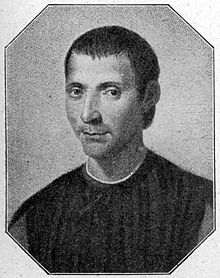
Niccolo Machiavelli
The foregoing was taken from Book Three, Chapter Six, of Machiavelli’s masterwork, The Discourses on Livy, which was published posthumously in 1531. But elsewhere in this volume, he notes how important it is for rulers to make themselves loved—or at least respected—by their fellow citizens:
Note how much more praise those Emperors merited who, after Rome became an empire, conformed to her laws like good princes, than those who took the opposite course.
Titus, Nerva, Trajan, Hadrian, Antoninus and Marcus Auelius did not require the Praetorians nor the multitudinous legions to defend them, because they were protected by their own good conduct, the good will of the people, and by the love of the Senate.
On the other hand, neither the Eastern nor the Western armies saved Caligula, Nero, Vitellius and so many other wicked Emperors from the enemies which their bad conduct and evil lives had raised up against them.
In his better-known work, The Prince, he warns rulers who—like Donald Trump–are inclined to rule by fear:
A prince should make himself feared in such a way that if he does not gain love, he at any rate avoids hatred: for fear and the absence of hatred may well go together.

Donald Trump
By Machiavelli’s standards, Trump has made himself the perfect target for a conspiracy.
“When a prince becomes universally hated, it is likely that he’s harmed some individuals—who thus seek revenge. This desire is increased by seeing that the prince is widely loathed.”
ABC NEWS, ADOLF HITLER, ALTERNET, AMERICABLOG, AP, ASSASSINATION, BABY BOOMER RESISTANCE, BUZZFEED, CBS NEWS, CNN, CONSPIRACIES, CROOKS AND LIARS, DAILY KOS, DAILY KOZ, DAY OF THE JACKAL, DONALD TRUMP, FIVETHIRTYEIGHT, FREDERICK FORSYTHE, GAIUS CASSIUS, HARPER’S MAGAZINE, JULIUS CAESAR, LINCOLN MEMORIAL, MAR-A-LAGO, MARCUS BRUTUS, MARK ANTHONY, MEDIA MATTERS, MOTHER JONES, MOVEON, MSNBC, NBC NEWS, NEWSWEEK, NICCOLO MACHIAVELLI, NPR, PBS NEWSHOUR, PLOTS, POLITICO, POLITICUSUSA, RAW STORY, REUTERS, RICHARD M. NIXON, SALON, SEATTLE TIMES, Secret Service, SLATE, TALKING POINTS MEMO, THE ATLANTIC, THE CHICAGO SUN-TIMES, THE CHICAGO TRIBUNE, THE DAILY BEAST, THE DAILY BLOG, THE DISCOURSES, THE GUARDIAN, THE HILL, THE HUFFINGTON POST, THE LOS ANGELES TIMES, THE NATION, THE NEW REPUBLIC, THE NEW YORK TIMES, THE VILLAGE VOICE, THE WALL STREET JOURNAL, THE WASHINGTON POST, THINKPROGRESS, TIME, TRUTHDIG, TRUTHOUT, TWO POLITICAL JUNKIES, U.S. NEWS & WORLD REPORT, UPI, USA TODAY, VIETNAM WAR, WONKETTE, X
In Bureaucracy, History, Law Enforcement, Military, Politics, Social commentary on May 29, 2024 at 12:10 am
More than 500 years ago, Niccolo Machiavelli, the father of modern political science, offered sound advice for would-be conspirators—and for rulers seeking to thwart conspiracies.
He did so in The Discourses on Livy, a work of political history and philosophy. In it, he outlined how citizens of a republic can maintain their freedoms.
One of the longest chapters—Book Three, Chapter Six—covers “Of Conspiracies.” In it, those who wish to conspire against a ruler will find highly useful advice. And so will those who might well become the targets of conspiracies—such as President Donald J. Trump.
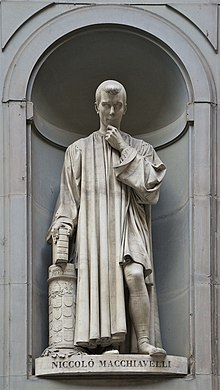
Niccolo Machiavellil
The most dangerous time for a ruler comes when he is universally hated.
Niccolo Machiavelli: When a prince becomes universally hated, it is likely that he’s harmed some individuals—who thus seek revenge. This desire is increased by seeing the prince is widely loathed.
A prince, then, should avoid incurring such universal hatred….
By doing this, he protects himself from such vengeance-seekers. There are two reasons for this:
(1) Men rarely risk danger to avenge a wrong; and
(2) Even if they want to avenge a wrong, they know they will face almost universal condemnation because the prince is held in such high esteem.
Machiavelli draws a distinction between plots and conspiracies.
A plot may be formed by a single individual or by many. The first isn’t a conspiracy, since that would involve at least two participants.
A single plotter avoids the danger faced by two or more conspirators:
Since no one knows his intention, he can’t be betrayed by an accomplice.
Anyone may form a plot, whether he is prominent or insignificant, because everyone is at some time allowed to speak to the prince. And he can use this opportunity to satisfy his desire for revenge.
On the other hand, says Machiavelli, the dangers of assassination by a trusted intimate are slight.
Few people dare to assault a prince. Of those who do, few or none escapes being killed in the attempt, or immediately afterward. As a result, only a small number of people are willing to incur such certain death.
Those who take part in a conspiracy against a ruler are “the great men of the state, or those on terms of familiar intercourse with the prince.”
These are men who have access to him. Julius Caesar, for example, was stabbed to death by members of the Roman Senate, who feared his assuming dictatorial powers.
And Adolf Hitler was conspired against by colonels and generals of the German Army. He was in fact holding a war conference when a briefcase bomb exploded, killing three officers and a stenographer, but leaving Hitler only slightly injured.
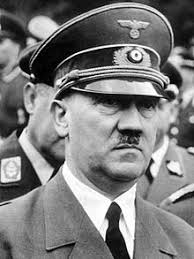

Adolf Hitler
There are three ways a conspiracy can be foiled:
- Discovery through denunciation;
- Discovery through incautiousness;
- Discovery through writings.
Discovery through Denunciation: This occurs through treachery or lack of prudence among one or more conspirators.
Treachery is so common that you can safely tell your plans to only your most trusted friends who are willing to risk their lives for your sake. You may find that you have only one or two of these.
But as you are bring more people into the conspiracy, the chances of discovery greatly increase. It’s impossible to find many who can be completely trusted: For their devotion to you must be greater than their sense of danger and fear of punishment.
Discovery through Carelessness: This happens when one of the conspirators speaks incautiously, so that a third person overhears it Or it may occur from thoughtlessness, when a conspirator tells the secret to his wife or child, or to some other indiscreet person.
When a conspiracy has more than three or four members, its discovery is almost certain, either through treason, imprudence or carelessness.
If more than one conspirator is arrested, the whole plot is discovered, for it will be impossible for any two to agree perfectly as to all their statements.
If only one is arrested, he may—through courage and stubbornness—be able to conceal the names of his accomplices. But then the others, to remain safe, must not panic and flee, since this is certain to be discovered.
If one of them becomes fearful—whether it’s the one who was arrested or is still at liberty—discovery of the conspiracy is certain.
The best way to avoid such detection is to confide your project to your intended fellow conspirators at the moment of execution—and not sooner.
A classic example of this occurred in ancient Persia. According to the Greek historian Herodotus: A group of nobles assembled to discuss overthrowing a usurper to the throne. The last one to arrive was Darius.
When one of the conspirators asked, “When should we strike?” Darius replied: “We must either go now at this very moment and carry it into execution, or I shall go and denounce you all. For I will not give any of you time to denounce me.”
At that, they went directly to the palace, assassinated the usurper and proclaimed Darius their new king.
ABC NEWS, ADOLF HITLER, ALBERT SPEER, ALTERNET, AMERICABLOG, AP, ASSASSINATION, BABY BOOMER RESISTANCE, BBC, BLOOMBERG NEWS, BRETT KAVANAUGH, BUZZFEED, CBS NEWS, CLARENCE THOMAS, CNN, CROOKS AND LIARS, CZECHOSLOVAKIA, DAILY KOS, DONALD TRUMP, DRUDGE REPORT, FINAL SOLUTION, FIVETHIRTYEIGHT, HARPER’S MAGAZINE, HEINRICH HIMMLER, HERMANN GOERING, HUFFINGTON POST, MARCO RUBIO, MEDIA MATTERS, MEDICAID, MITCH MCCONNEL, MOTHER JONES, MOVEON, MSNBC, NATIONAL RIFLE ASSOCIATION, NAZI GERMANY, NBC NEWS, NEW REPUBLIC, NEWSDAY, NEWSWEEK, NPR, PBS NEWSHOUR, POLITICO, POLITICUSUSA, RAND PAUL, RAW STORY, REINHARD HEYDRICH, REUTERS, ROLAND FREISLER, RON DESANTIS, RUDOLF HESS, SALON, SAMUEL ALITO, SEATTLE TIMES, SLATE, SS, STEVE BANNON, SUPPLEMENTAL NUTRITION ASSISTANCE PROGRAM (SNAP), TALKING POINTS MEMO, TED CRUZ, THE ATLANTIC, THE CHICAGO SUN-TIMES, THE CHICAGO TRIBUNE, THE DAILY BEAST, THE DAILY BLOG, THE GUARDIAN, THE HILL, THE HUFFINGTON POST, THE LOS ANGELES TIMES, THE NATION, THE NEW REPUBLIC, THE NEW YORK TIMES, THE NEW YORKER, THE SUPREME COURT, THE VILLAGE VOICE, THE WASHINGTON POST, THINKPROGRESS, TIME, TRUTHDIG, TRUTHOUT, TWO POLITICAL JUNKIES, U.S. NEWS & WORLD REPORT, UPI, USA TODAY, WANNSEE CONFERENCE, X
In Bureaucracy, Entertainment, History, Politics, Social commentary on May 28, 2024 at 12:10 am
“We mock you. We mock your fear. We want your fear. It’s going to be accountability. We are taking apart the administrative state. We’re going to destroy the deep state, and we’re going to hold everybody responsible that put this republic in the situation its in today.
“Accountability, responsibility. And that will come with authority. The authority of Donald J. Trump as the 47th president of the United States.”
The speaker was Steve Bannon, former Trump campaign manager and White House advisor. And he was issuing a warning to everyone who didn’t enthusiastically accept Donald Trump as his Once and Future Fuhrer.
Threats of violence have become common among Republicans since 2015, when Trump first ran for President. And they continue to cast a shadow over the 2024 Presidential campaign.
On March 16, 2016, Trump warned Republicans that if he didn’t win the GOP nomination in July, his supporters would literally riot: “I think you’d have riots. I think you would see problems like you’ve never seen before. I think bad things would happen. I really do. I wouldn’t lead it, but I think bad things would happen.”
An NBC reporter summed it up as: “The message to Republicans was clear: ‘Nice convention you got there, shame if something happened to it.’”
Eight years later, on March 16, Trump made a similar threat: “Now if I don’t get elected, it’s going to be a bloodbath for the whole—that’s gonna be the least of it….If this election isn’t won, I’m not sure that you’ll ever have another election in this country.”
The Third Reich similarly relied on violence—or the threat of it—to preserve its dictatorial control over Germany.
A key representative of that violence was Reinhard Tristan Eugen Heydrich.
A tall, blond-haired former naval officer, Heydrich was both a champion fencer and talented violinist. Heydrich joined the Schutzstaffel, or Protective Squads, better known as the SS, in 1931, and quickly became head of its counterintelligence service.
In 1934, he oversaw the “Night of the Long Knives” purge of Hitler’s brown-shirted S.A., or Stormtroopers.
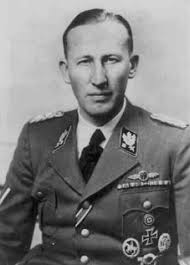
Reinhard Heycrich
In September, 1941, Heydrich was appointed “Reich Protector” of Czechoslovakia, which had fallen prey to Germany in 1938 but whose citizens were growing restless under Nazi rule.
Heydrich immediately ordered a purge, executing 92 people within the first three days of his arrival in Prague. By February, 1942, 4,000-5,000 people had been arrested.
In January, 1942, Heydrich convened a meeting of high-ranking political and military leaders in Wannsee, Germany, to streamline “the Final Solution to the Jewish Question.”
An estimated six million Jews were thus slaughtered.
Returning to Prague, Heydrich continued his policy of carrot-and-stick with the Czechs—improving the social security system and requisitioning luxury hotels for middle-class workers, alternating with arrests and executions.
Two British-trained Czech commandos—Jan Kubis and Joseph Gabcik—parachuted into Prague.
On May 27, 1942, they waited at a hairpin turn in the road always taken by Heydrich. When Heydrich’s Mercedes slowed down, Gabcik raised his machinegun—which jammed.
Rising in his seat, Heydrich aimed his revolver at Gabcik—as Kubis lobbed a hand grenade at the car. The explosion drove steel and leather fragments of the car’s upholstery into Heydrich’s diaphragm, spleen and lung.

Scene of Reinhard Heydrich’s assassination
Hitler dispatched doctors from Berlin to save the Reich Protector. But infection set in, and on June 4, Heydrich died at age 38.
The assassination sent shockwaves through the upper echelons of the Third Reich. No one had dared assault—much less assassinate—a high-ranking Nazi official.
Nazis had slaughtered tens of thousands without hesitation—or fear that the same might happen to them.
Suddenly they realized that the fury they had aroused could be turned against themselves.
Which brings us to the leaders of America’s own Right-wing.
The names of infamous Nazis were widely known:
- Reichsmarshall Hermann Goering;
- Propaganda Minister Paul Joseph Goebbels;
- Deputy Fuhrer Rudolf Hess;
- SS-Reichsfuhrer Heinrich Himmler;
- “Hanging Judge” Roland Freisler;
- Architect Albert Speer;
- SS Obergruoppenfuhrer Reinhard Heydrich; and
- Fuhrer Adolf Hitler.
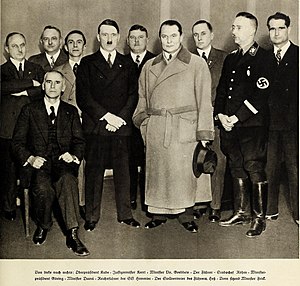
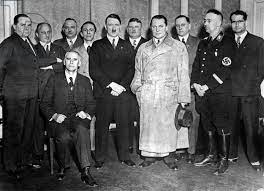
Members of the Nazi government
And so are the names of the infamous leaders of the American Right:
- Senate Minority Leader Mitch McConnell;
- Texas Senator Ted Cruz;
- Supreme Court Justice Clarence Thomas;
- Evangelist Franklin Graham;
- Florida Senator Marco Rubio;
- Supreme Court Justice Samuel Alito;
- Florida Governor Ron DeSantis;
- Former President Donald Trump.
The difference between these two infamous groups is this:
In Nazi Germany, ordinary Germans could not learn about the personal lives of their dictators—including their home addresses—and to conspire against them.
In the United States, ordinary citizens have an array of means to do this. They can turn to newspapers, TV and magazines. And if that isn’t enough, “people finder” websites, for a modest price, provide addresses and names of relatives of potential targets.
In Nazi Germany, firearms were tightly controlled.
In the United States, the Right’s National Rifle Association has successfully lobbied to put lethal firepower into the hands of virtually anyone who wants it.
Eighty-two years ago, Reinhard Heydrich believed himself invulnerable from the hatred of the enemies he had made. That arrogance cost him his life.
The day may soon come when America’s own Right-wingers start learning that same lesson.
ABC NEWS, ALTERNET, AMERICABLOG, AP, BABY BOOMER RESISTANCE, BBC, BILL MAULDIN, BLOOMBERG, BUZZFEED, CBS NEWS, CNN, CROOKS AND LIARS, DAILY KOS, DONALD TRUMP, FIVETHIRTYEIGHT, GENERAL LUCIAN K. TRUSCOTT, GEORGE W. BUSH, HARPER’S MAGAZINE, HUFFINGTON POST, IRAQ WAR, JEB BUSH, MEDIA MATTERS, MEMORIAL DAY, MOTHER JONES, MOVEON, MSNBC, NATIONAL CONSERVATIVE POLITICAL ACTION CONFERENCE (CPAC), NBC NEWS, NEW REPUBLIC, NEWSDAY, NEWSWEEK, NPR, OLD GLORY, PBS NEWSHOUR, POLITICO, POLITICUSUSA, RAW STORY, REUTERS, SADDAM HUSSEIN, SALON, SAVING PRIVATE RYAN, SCOTT WALKER, SEATTLE TIMES, SLATE, STEVEN SPIELBERG, TALKING POINTS MEMO, THE ATLANTIC, THE CHICAGO SUN-TIMES, THE CHICAGO TRIBUNE, THE DAILY BEAST, THE DAILY BLOG, THE GUARDIAN, THE HILL, THE HUFFINGTON POST, THE INTERCEPT, THE LOS ANGELES TIMES, THE NATION, THE NEW REPUBLIC, THE NEW YORK TIMES, THE NEW YORKER, THE VILLAGE VOICE, THE WALL STREET JOURNAL, THE WASHINGTON POST, THINKPROGRESS, TIME, TRUTHDIG, TRUTHOUT, TWO POLITICAL JUNKIES, U.S. NEWS & WORLD REPORT, UPI, USA TODAY, WEAPONS OF MASS DESTRUCTION, WHITE HOUSE CORRESPONDENTS DINNER, WORLD WAR 11, X
In Bureaucracy, History, Military, Politics, Social commentary on May 27, 2024 at 12:10 am
Saving Private Ryan, Steven Spielberg’s 1998 World War II epic, is a tribute to the virtues of courage and self-sacrifice in defense of loyalty and freedom.
Virtues that are increasingly lost on millions of Right-wing Americans who have turned their backs on democracy and fervently embraced rule by strongman.
The movie opens with a scene of an American flag snapping in the wind. Except that the brilliant colors of Old Glory have been washed out, leaving only black-and-white stripes and black stars.
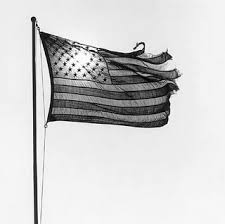
And then the movie opens—not during World war II but the present day.
Did Spielberg know something that his audience could only sense? Such as that the United States, for all its military power, has become a pale shadow of its former glory?
May 30, 1945, marked the first Memorial Day after World War II ended in Europe. On that day, the Sicily-Rome American Cemetery, near the town of Nettuno, held about 20,000 graves.
Most were soldiers who had died in Sicily, at Salerno, or at Anzio. One of the speakers at the ceremony was Lieutenant General Lucian K. Truscott, Jr., the U.S. Fifth Army Commander.
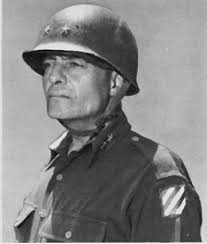
Lieutenant General Lucian K. Truscott, Jr.
Unlike many other generals, Truscott had shared in the dangers of combat, pouring over maps on the hood of his jeep with company commanders as bullets or shells whizzed about him.
When it came his turn to speak, Truscott moved to the podium. Then he turned his back on the assembled visitors—which included several Congressmen.
The audience he now faced were the graves of his fellow soldiers.
Among those who heard Truscott’s speech was Bill Mauldin, the famous cartoonist for the Army newspaper, Stars and Stripes. Mauldin had created Willie and Joe, the unshaven, slovenly-looking “dogfaces” who came to symbolize the GI.
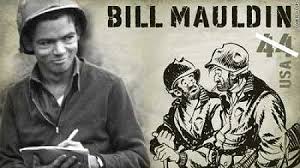
Bill Mauldin and “Willie and Joe,” the characters he made famous
It’s from Mauldin that we have the fullest account of Truscott’s speech that day.
“He apologized to the dead men for their presence there. He said that everybody tells leaders that it is not their fault that men get killed in war, but that every leader knows in his heart that this is not altogether true.
“He said he hoped anybody here through any mistake of his would forgive him, but he realized that he was asking a hell of a lot under the circumstances….
“Truscott said he would not speak of the ‘glorious’ dead because he didn’t see much glory in getting killed in your teens or early twenties.
“He promised that if in the future he ran into anybody, especially old men, who thought death in battle was glorious, he would straighten them out. He said he thought it was the least he could do.
“It was the most moving gesture I ever saw,” wrote Mauldin.
Then Truscott walked away, without acknowledging his audience of celebrities.
Fast forward 61 years later—to March 24, 2004.
At a White House Correspondents dinner in Washington, D.C., President George W. Bush joked publicly about the absence of Weapons of Mass Destruction (WMDs) in Iraq.
One year earlier, he had ordered the invasion of Iraq, claiming that its dictator, Saddam Hussein, possessed WMDs he intended to use against the United States.
To Bush, the non-existent WMDs were simply the butt of a joke that night. While an overhead projector displayed photos of a puzzled-looking Bush searching around the Oval Office, Bush recited a comedy routine.
“Those Weapons of Mass Destruction have gotta be here somewhere,” Bush laughed, while a photo showed him poking around the corners of the Oval Office.
“Nope—no weapons over there! Maybe they’re under here,” he said, as a photo showed him looking under a desk.
George W. Bush jokes about “missing” WMDs
It was a scene that could have occurred under the Roman emperor Nero: An assembly of wealthy, pampered men and women–the elite of America’s media and political classes–laughed heartily during Bush’s performance.
Only later did outrage come—from Democrats and Iraqi war veterans. Especially those veterans who had lost comrades or suffered horrific wounds to protect America from a threat that had never existed.
Then fast forward another 11 years—to February 27, 2015.
The Republican party’s leading Presidential contenders for 2016 gathered at the Conservative Political Action Conference (CPAC) in National Harbor, Maryland.
Among them:
- Florida Governor Jeb Bush;
- Wisconsin Governor Scott Walker; and
- Businessman Donald Trump.
Although each candidate tried to stake his own claim to the Oval Office, all of them agreed on two points:
First, President Barack Obama had been dangerously timid in his conduct of foreign policy; and
Second, they would pursue aggressive military action in the Middle East.
Neither Bush nor Walker had seen fit to enter the ranks of the military he wished to plunge into further combat. And Trump was a five-time draft dodger while the Vietnam war raged.
Bush, Walker and Trump are typical of those who make up the United States Congress:
Of those members elected to the House and Senate in November, 2016, only 102—less than 19%—served in the U.S. military.
Small wonder then, that, for many people, Old Glory has taken on a darker, washed-out appearance, in real-life as in film.
ABC NEWS, ADOLF HITLER, ADVICE, ALTERNET, AMERICABLOG, AP, BABY BOOMER RESISTANCE, BAY OF PIGS, BBC, BENITO MUSSOLINI, BLOOMBERG NEWS, BUZZFEED, CAESARE BORGIA, CBS NEWS, CNN, CORPORATIONS, CROOKS AND LIARS, CUBA, DAILY KOS, DAILY KOZ, FIDEL CASTRO, FIVETHIRTYEIGHT, FLORENCE, HARPER’S MAGAZINE, HUFFINGTON POST, JOHN F. KENNEDY, JOSEPH STALIN, KING PERSEUS OF MACEDON, MEDIA MATTERS, MOTHER JONES, MOVEON, MSNBC, NAZI-SOVIET "NON-AGGRESSION PACT", NBC NEWS, NEW REPUBLIC, NEWSDAY, NEWSWEEK, NICCOLO MACHIAVELLI, NPR, PBS NEWSHOUR, POLITICO, POLITICS, POLITICUSUSA, POPE JULIUS 11, RAW STORY, REUTERS, SALON, SEATTLE TIMES, SLATE, TALKING POINTS MEMO, THE ATLANTIC, THE CHICAGO SUN-TIMES, THE CHICAGO TRIBUNE, THE DAILY BEAST, THE DAILY BLOG, THE DISCOURSES, THE GUARDIAN, THE HILL, THE HUFFINGTON POST, THE INTERCEPT, THE LOS ANGELES TIMES, THE NATION, THE NEW REPUBLIC, THE NEW YORK TIMES, THE NEW YORKER, THE PRINCE, THE SS, THE VILLAGE VOICE, THE WASHINGTON POST, THINKPROGRESS, THIRD REICH, TIME, TRUTHDIG, TRUTHOUT, TWITTER, U.S. NEWS & WORLD REPORT, UKRAINE, UPI, USA TODAY, VLADIMIR PUTIN, VOLODYMYR ZELENSKY, WEHRMACHT, WORLD WAR 11
In Bureaucracy, Business, History, Military, Politics, Social commentary on May 24, 2024 at 12:10 am
Ask the average person, “What do you think of Niccolo Machiavelli?” and he’s likely to say: “The devil.”
In fact, “The Old Nick” became an English term used to describe Satan and slander Machiavelli at the same time.

Niccolo Machiavelli
The truth, however, is more complex. Machiavelli was a passionate Republican, who spent most of his adult life in the service of his beloved city-state, Florence.
The years he spent as a diplomat were tumultuous ones for Italy—with men like Pope Julius II and Caesare Borgia vying for power and plunging Italy into one bloodbath after another.
Florence, for all its wealth, lacked a strong army, and thus lay at the mercy of powerful enemies, such as Borgia. Machiavelli often had to use his wits to keep them at bay.
Machiavelli is best-known for his writing of The Prince, a pamphlet on the arts of gaining and holding power. Its admirers have included Benito Mussolini and Joseph Stalin.
But his longer and more thoughtful work is The Discourses, in which he offers advice on how to maintain liberty within a republic. Among its admirers were many of the men who framed the Constitution of the United States.
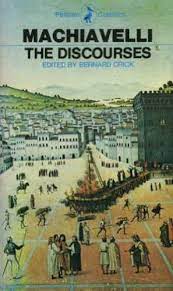

Most people believe that Machiavelli advocated evil for its own sake.
Not so. Rather, he recognized that sometimes there is no perfect—or perfectly good—solution to a problem.
Sometimes it’s necessary to take stern—even brutal—action to stop an evil (such as a riot) before it becomes widespread:
“A man who wishes to make a profession of goodness in everything must inevitably come to grief among so many who are not good. And therefore it is necessary for a prince, who wishes to maintain himself, to learn how not to be good, and to use this knowledge and not use it, according to the necessity of the case.”
His counsel remains as relevant today as it did during his lifetime (1469 – 1527). This is especially true for politicians—and students of political science.
But plenty of ordinary citizens can also benefit from the advice he has to offer—such as those in business who are asked to give advice to more powerful superiors.
Machiavelli warns there is danger in urging rulers to take a particular course of action: “For men only judge of matters by the result, all the blame of failure is charged upon him who first advised it, while in case of success he receives commendations. But the reward never equals the punishment.”
This puts would-be counselors in a difficult position: “If they do not advise what seems to them for the good of the republic or the prince, regardless of the consequences to themselves, then they fail to do their duty.
“And if they do advise it, then it is at the risk of their position and their lives, for all men are blind in thus, that they judge of good or evil counsels only by the results.”
Thus, Machiavelli warns that an adviser should “take things moderately, and not to undertake to advocate any enterprise with too much zeal, but to give one’s advice calmly and modestly.”
The person who asked for the advice may follow it, or not, as of his own choice, and not because he was led or forced into it by the adviser.
Above all, the adviser must avoid the danger of urging a course of action that runs “contrary to the wishes of the many.
“For the danger arises when your advice has caused the many to be contravened. In that case, when the result is unfortunate, they all concur in your destruction.”
Or, as President John F. Kennedy famously said after the disastrous invasion of Cuba at the Bay of Pigs in April, 1961: “Victory has a hundred fathers and defeat is an orphan.”
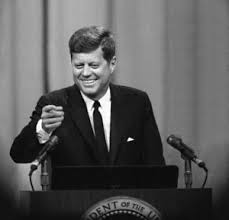
John F. Kennedy
By “not advocating any enterprise with too much zeal,” the adviser gains two advantages:
“The first is, you avoid all danger.
“And the second consists in the great credit which you will have if, after having modestly advised a certain course, your counsel is rejected, and the adoption of a different course results unfortunately.”
Finally, the time to give advice is before a catastrophe occurs, not after. Machiavelli gives a vivid example of what can happen if this rule is ignored.
King Perseus of Macedon had gone to war with Paulus Aemilius—and suffered a humiliating defeat. Fleeing the battlefield with a handful of his men, he later bewailed the disaster that had overtaken him.
Suddenly, one of his lieutenants began to lecture Perseus on the many errors he had committed, which had led to his ruin.
“Traitor,” raged the king, turning upon him, “you have waited until now to tell me all this, when there is no longer any time to remedy it—” And Perseus slew him with his own hands.
Niccolo Machiavelli sums up the lesson as this:
“Thus was this man punished for having been silent when he should have spoken, and for having spoken when he should have been silent.”
Be careful that you don’t make the same mistake.
2016 PRESIDENTIAL ELECTION, ABC NEWS, AIR FORCE, ALTERNET, AMERICABLOG, AP, ARMY, “MR. PRESIDENT” TITLE, BABY BOOMER RESISTANCE, BBC, BLOOMBERG, BUZZFEED, CBS NEWS, CNN, CROOKS AND LIARS, DAILY KOS, DAVID PECKER, DONALD TRUMP, DWIGHT D. EISENHOWER, FBI, FEDERAL AVIATION ADMINISTRATION, FIVETHIRTYEIGHT, HARPER’S MAGAZINE, HUFFINGTON POST, JIMMY CARTER, JOHN F. KENNEDY, JOSEPH BIDEN, KAREN MCDOUGAL, KONSTANTIN CHERNENKO, LEONID BREZHNEV, MARINE CORPS, MEDIA MATTERS, MIKHAIL GORBACHEV, MOTHER JONES, MOVEON, MSNBC, NATIONAL ENQUIRER, NAVY, NBC NEWS, NEW REPUBLIC, NEWSDAY, NEWSWEEK, NPR, PBS NEWSHOUR, POLITICO, POLITICUSUSA, RAW STORY, REUTERS, Ronald Reagan, SALON, SEATTLE TIMES, Secret Service, SLATE, SOVIET UNION, STOLEN VALOR ACT, STORMY DANIELS, TALKING POINTS MEMO, THE ATLANTIC, THE CHICAGO SUN-TIMES, THE CHICAGO TRIBUNE, THE DAILY BEAST, THE DAILY BLOG, THE GUARDIAN, THE HILL, THE HUFFINGTON POST, THE INTERCEPT, THE LOS ANGELES TIMES, THE NATION, THE NEW REPUBLIC, THE NEW YORK TIMES, THE NEW YORKER, THE PRESIDENCY, THE VILLAGE VOICE, THE WASHINGTON POST, THINKPROGRESS, TIME, TOMMY TURBERVILLE, TRUTHDIG, TRUTHOUT, TWO POLITICAL JUNKIES, U.S. NEWS & WORLD REPORT, UNITED STATES SECRET SERVICE, UPI, USA TODAY, X, YURI ANDROPOV
In Bureaucracy, History, Law, Law Enforcement, Medical, Politics, Social commentary on May 23, 2024 at 12:36 am
The upcoming 2024 Presidential election has raised serious issues which demand addressing.
Unfortunately, it’s too late to apply such remedies to this election. But they could be in place by the time the 2028 election occurs.
Reform #1: Institute mandatory FBI background investigations on all declared Presidential candidates.
Donald Trump’s trial for hush money payments to porn “star” Stormy Daniels has highlighted an issue that should have been addressed long ago: Americans don’t know as much about their candidates for President as they think they do.
- As the trial testimony of former National Enquirer publisher David Pecker has revealed: In August, 2015, he met with Trump at Trump Tower and offered to use the Enquirer to catch and kill any allegations of extramarital affairs against Trump.
- Later he personally facilitated a $150,000 payment to former Playboy Playmate Karen McDougal to keep her affair with Trump hushed up.
- This came in addition to Trump’s paying $130,000 in hush money to Daniels to ensure his 2006 tryst with her didn’t emerge during the campaign.

Donald Trump and Stormy Daniels
- Similarly, in 1960, Senator John F. Kennedy successfully ran for President while concealing his affliction with Addison’s Disease—an insufficiency of the Adrenal glands that can prove fatal.
Thus, all future candidates for President should be required to submit to full FBI background investigations at least one year before election time—with the results released before the election. Any candidate refusing to participate should be barred from competing.
You’re not allowed to become an FBI agent or Cabinet Secretary without passing a background investigation. You shouldn’t be allowed to become President without one, either.
Reform #2: No Presidential candidate can be over 70 at the time s/he leaves office.
The Federal Aviation Administration mandates that commercial airlines cannot employ pilots after they reach the age of 65.
FBI agents have a mandatory retirement age of 57.
Commissioned officers of the Army, Navy, Air Force and Marine Corps must retire by 64.
Yet Donald Trump is 77 and will turn 78 on June 14. Joseph Biden is 81 and will turn 82 on November 20.
If Trump wins, he will be 82 in 2028, his last year in office (assuming he doesn’t stage another—and successful—coup attempt). If Biden wins re-election, in 2028 he will be 86 (assuming he’s still alive by then).
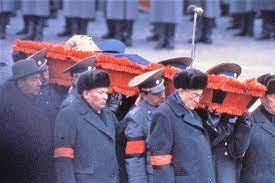
Funeral for Soviet dictator Leonid Brezhnev – 1982
The Presidency is notorious for prematurely ageing its occupants: “The typical president ages two years for every year they are in office,” said Dr. Michael Roizen. He used presidential medical records from the 1920s through today to reach this conclusion.
The United States Presidency is becoming a mirror-image of the former Soviet Union:
- In 1982, General Secretary Leonid Brezhnev died at age 75.
- He was succeeded by Yuri Andropov—who died, in 1984, at age 69.
- He, in turn, was followed by Konstantin Chernenko—who died in 1985 at age 73.
Finally, the Politburo—tired of replacing the General Secretary every two years—elected 54-year-old Mikhail Gorbachev, who lived to leave office six years later at age 60.
In the United States, having two geriatric Presidential candidates has become comic fodder for late-night TV hosts. Yet voters fear that neither candidate can handle the strains of another four years as President—or even survive a full term.
Reform #3: Abolish the honorific title of “Mr. President” for ex-Presidents.
This used to be offered as a tribute to a former President for having won the support of the majority of Americans.
But Donald Trump has corrupted this phrase, as he has so much else in American life. Since losing the 2020 Presidential election, he has continued to insist that he is the legitimate President of the United States, and Joseph Biden is a usurper.
When his fanatical followers refer to him as “President Trump,” that is what they mean—thus trying to de-legitimize Biden’s Presidency and elevate Trump as the rightful victor.
The 2005 Stolen Valor Act makes it a federal misdemeanor for anyone to falsely claim to have received any U.S. military decoration or medal—such as the Medal of Honor or Purple Heart. Violating the law can lead to fines, up to a year in prison, or both.
Thus, Congress should mandate that only the current holder of the Presidency has the legal right to call himself “Mr. President”—and that right ends when he no longer occupies the White House.
Reform #4: Require millionaire ex-Presidents to pay for Secret Service protection.
Every ex-President since Dwight D. Eisenhower—even Jimmy Carter—has been a millionaire.
Assigning a platoon of elite Secret Service agents to watch over every ex-President 24/7 is a huge expense.
The case of Ronald Reagan is instructive: At a cost to the government of $10 million annually, Reagan—while living in a 7,200 square-foot mansion overlooking Beverly Hills—received lifetime Secret Service protection from 40 fulltime agents.
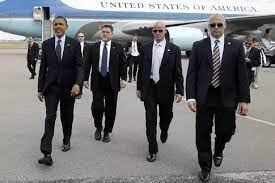
United States Secret Service
It’s also an unnecessary expense. There has never been an attack on an ex-President in all of American history.
Still, if the powers-that-be consider this essential, then millionaire ex-Presidents should be required to pay for their protection—just as moguls and Hollywood celebrities do.
As the situation now exists, the government is simply providing welfare for the rich. Whereas the poor face strict limits on how high their income can be and still receive welfare.
AARON KESSELHEIM, ABC NEWS, ADVERTISING, ALTERNET, AMERICABLOG, AP, BABY BOOMER RESISTANCE, BARRY MANILOW, BBC, BLOOMBERG, BUZZFEED, CBS NEWS, CNN, CROOKS AND LIARS, DAILY KOS, DIABETES, EBOLA, FIVETHIRTYEIGHT, HARPER’S MAGAZINE, HARVARD MEDICAL SCHOOL, HUFFINGTON POST, JAMA NETWORK OPEN, JARDIANCE, MEDIA MATTERS, MOTHER JONES, MOVEON, MSNBC, NBC NEWS, NEW REPUBLIC, NEWSDAY, NEWSWEEK, NPR, PBS NEWSHOUR, PHARMACEUTICAL INDUSTRY, POLITICO, POLITICUSUSA, RAW STORY, REUTERS, SALON, SEATTLE TIMES, SLATE, TALKING POINTS MEMO, THE ATLANTIC, THE CHICAGO SUN-TIMES, THE CHICAGO TRIBUNE, THE DAILY BEAST, THE DAILY BLOG, THE GUARDIAN, THE HARVARD GAZETTE, THE HILL, THE HUFFINGTON POST, THE INTERCEPT, THE LOS ANGELES TIMES, THE NATION, THE NEW REPUBLIC, THE NEW YORK TIMES, THE NEW YORKER, THE VILLAGE VOICE, THE WASHINGTON POST, THINKPROGRESS, TIME, TRUTHDIG, TRUTHOUT, TWO POLITICAL JUNKIES, U.S. NEWS & WORLD REPORT, UPI, USA TODAY, X
In Bureaucracy, History, Law, Law Enforcement, Medical, Social commentary on May 22, 2024 at 12:13 am
I have type 2 diabetes but I manage it well
It’s a little pill with a big story to tell
I take once daily Jardiance at each day’s start
As time went on, it was easy to see
I’m lowering my A1c
Jardiance is really swell
The little pill with a big story to tell.
Millions of Americans have heard this jingle for Jardiance—an anti-diabetes medication—whose ads flood the airways. And millions of Americans are furious about those ads.
The pharmaceutical industry is flooding the airways with ads for its products—especially at dinnertime.

Jardiance ad
Catch any of the “Big Three” national newscasts—on ABC, CBS and NBC—and you’ll see that the vast majority of their ads are funded by Big Pharma.
The United States and New Zealand are the only two countries that allow pharmaceutical companies to directly advertise prescription drugs to consumers.
In 1996, pharmaceutical companies spent $550 million on drug ads. That number increased more than 10-fold by 2020, reaching $6.58 billion annually.
In 2022, the three most-advertised drugs in the United States were:
Rinvoq (for adults with moderate to severe rheumatoid arthritis)
Dupixent (curbs the immune system over-reaction that results in atopic dermatitis)
and Skyriz (used to treat adults with: moderate to severe plaque psoriasis).
And that advertising didn’t come cheaply. Rinvoq spent more than $315.8 million on TV ads in 2022. Dupixent spent $305.9 million and Skyrizi spent $174.4 million.
In 2022, the industry spent just under $8.1 billion on ad campaigns, which includes all advertising areas, such as TV, print, social media and streaming channels.
Drug companies view the ads as an increasingly effective way to target viewers—especially older ones—who need more extensive medical care and treatment for potentially life-threatening conditions.
No doubt the companies would love to be able to hand out their medications on street corners—the way pushers of heroin and meth now do. But that would put them directly in the crosshairs of federal and local law enforcement.

So the best these companies can do is try to convince patients to nag their doctors: “Oh, I want that drug.”
Meanwhile, there are widespread concerns that:
- Drugs will be prescribed inappropriately by patients asking for drugs they have seen on TV;
- Patients will ask for or receive expensive brand-name medications, which are often featured in commercials, instead of less expensive generic ones; and
- Patients will show less interest in shedding unhealthy lifestyles and rely simply on drugs.
The last one is especially important, given the cheerful atmosphere of so many of these ads. Take the one for Jardiance, for example.
The clearly obese woman in the ad is shown at her office. She isn’t working—because she’s too busy singing about having a life-threatening disease. Her co-workers are equally joyful as they join her in singing the praises of Jardiance.
It’s easy to imagine a parody of such commercials. If a cure is eventually found for Ebola, a similar ad could be based on Barry Manilow’s classic song, “Only in Chicago”:
I got sick
And I sat on the bed
And puked out my guts.
And oh I swear
I remember how much I bled
And I thought I’d die.
With Ebola I knew I’d lose it all
It was real, it was Death.
This would be followed by a cheery ad for a pill that eliminates the symptoms of this usually fatal disease.

Ebola virus
The Harvard Gazette, in a March 1, 2023 article, warned that most advertised medicines don’t prove much better than other treatment options:
“We’ve all seen the commercials. People relaxed, smiling, and having fun with friends and family despite having a horrible or uncomfortable — or at least chronic — condition. Their new lease on life comes courtesy of a drug. Then the fine print. Roll the list of potential side effects, some of which seem worse than the malady itself.
“So why are the spots so popular with sponsors? Because they’re so effective — at least in terms of sales. In a recent issue of JAMA Network Open, Aaron Kesselheim and colleagues published the results of a study showing that some of the most heavily advertised drugs are largely no better at treating disease than other options.”
Kesselheim, a professor of medicine at Harvard Medical School, bluntly gave the reason why pharmaceutical companies spend billions on drug advertising:
“Direct-to-consumer advertising is really intended for consumers. As a primary care physician, people certainly come into my office with advertisements that they’ve printed off the internet or that they remember seeing during the football game the previous Sunday and say, ‘What about this drug?’
“Studies show that when patients come in and ask their physicians about particular drugs, they’re more likely to get prescriptions for those drugs. Doctors of course also watch TV, but the pharmaceutical industry spends much more money advertising its drugs directly to physicians, through visits to their offices, sponsorship of continuing medical education, support of professional society meetings, consultancies, and the like.
“Actually, the amount of money that pharmaceutical companies spend on advertising to physicians is far higher than the amount spent on direct-to-consumer advertising because physicians are the ones writing the prescriptions.”
ABC NEWS, ALAMO, ALTERNET, AMERICABLOG, ANDREW JACKSON, ANTONIO LOPEZ DE SANTA ANNA, AP, BABY BOOMER RESISTANCE, BBC, BLOOMBERG NEWS, BUZZFEED, CBS NEWS, CHARLES VII, CNN, CROOKS AND LIARS, DAILY KOZ, DAVID CROCKETT, FIVETHIRTYEIGHT, FRANCE, HARPER’S MAGAZINE, HUFFINGTON POST, JAMES BOWIE, JOAN OF ARC, LONE STAR: A HISTORY OF TEXAS AND THE TEXANS (BOOK), MEDIA MATTERS, MOTHER JONES, MOVEON, MSNBC, NBC NEWS, NEW REPUBLIC, NEWSDAY, NEWSWEEK, NPR, PBS NEWSHOUR, POLITICO, POLITICUSUSA, RAW STORY, REUTERS, RUSSIA, SALON, SAM HOUSTON, SEATTLE TIMES, SLATE, T.R. FEHRENBACH, TALKING POINTS MEMO, TEXAS, THE ATLANTIC, THE CHICAGO SUN-TIMES, THE CHICAGO TRIBUNE, THE DAILY BEAST, THE DAILY BLOG, THE GUARDIAN, THE HILL, THE HUFFINGTON POST, THE INTERCEPT, THE LOS ANGELES TIMES, THE NATION, THE NEW REPUBLIC, THE NEW YORK TIMES, THE NEW YORKER, THE VILLAGE VOICE, THE WASHINGTON POST, THINKPROGRESS, TIME, TRUTHDIG, TRUTHOUT, TWO POLITICAL JUNKIES, U.S. NEWS & WORLD REPORT, UKRAINE, UPI, USA TODAY, VLADIMIR PUTIN, VOLODYMYR ZELENSKY, WILLIAM BARRET TRAVIS, WONKETTE, X
In History, Military, Politics, Social commentary on May 21, 2024 at 12:10 am
They seem to come out of nowhere—people who have never had military training nor even any experience with violence. Yet they display an utter fearlessness and eloquence that inspires others to great deeds in the face of overwhelming danger.
For 13 days—from February 23 to March 6, 1836—about 200 frontiersmen defended a ruined mission in San Antonio, Texas, against an army of 2,000 Mexican soldiers.
Few of them had known each other before finding themselves besieged. None of them had had professional military training. Some had served in local militias or as irregulars fighting Indians under the command of frontier officers such as Andrew Jackson.
One of these was David Crockett, recently a Congressman from Tennessee.
Since the vast majority of the garrison were volunteers, they could have deserted the fortress at any time.
Holding them in place was a former lawyer named William Barret Travis. Gifted with an eloquence beyond his 26 years, he gave purpose to their stand.
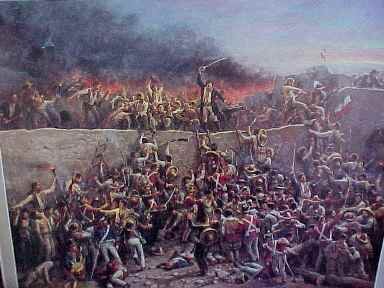
William Barret Travis (with sword) at the Alamo
As historian T.R. Fehrenbach writes in his monumental book, Lone Star: A History of Texas and the Texans:
“From the Alamo, from his first message before the arrival of the Mexicans to his last, his words had the ring of prophecy. The Texas historian who stated publicly that few people would want to have a son serve under William Barret Travis had forgotten, in the comforts of long security, the reasons why men make war.”
When the final assault came before dawn on March 6, 1836, the roughly 200 defenders killed and wounded about 600 of their enemies—inflicting a casualty rate of 33% on the Mexican army.
Travis’ body was found near his cannon on the north wall.
The garrison’s sacrifice inspired Sam Houston’s ragtag army to fall on the Mexican army at San Jacinto on April 21. Slaughtering about 800 soldiers, the Texans captured Mexican dictator Antonio Lopez de Santa Anna—and forced him to surrender control of Texas in return for his life.
- Volodymyr Zelensky (January 25, 1978 – ) is a former attorney, actor and comedian who, as the sixth president of Ukraine, now leads his country in a life-or-death struggle against the aggressive Russia of Vladimir Putin.
After earning a law degree from the Kiev National Economic University, he pursued a career in comedy. He created his own production company, Kvartal 95, which produced films, cartoons, and TV shows. His comedy, Servant of the People, starred Zelensky as the president of Ukraine.

Volodymyr Zelensky
In 2019, he announced his candidacy for president of Ukraine. He opposed the corruption that had been rife under the country’s luxury-loving president, Victor Yanukovych.
(In 2014, Ukrainians had rioted in Kiev and evicted Yanukovych. And that didn’t sit well with his “sponsor”—Russian President Vladimir Putin.)
A second feature of Zelensky’s presidential campaign: He promised to resolve the Russia-sponsored separatist movement in Donbas and end Ukraine’s protracted conflict there with Russia.
Zelensky won election by a landslide, with 72% of the vote.
In 2021, his administration came under mounting pressure from Russia. On February 24, 2022, Putin ordered a full-scale invasion of Ukraine.
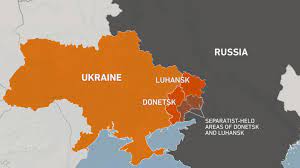
Ukraine vs. Russia
In the early hours of February 24, shortly before the start of the Russian invasion, Zelensky recorded an address to both Ukraine and Russia. As a Jew, he refuted Putin’s claims that there were Neo-Nazis in the Ukrainian government.
And he appealed to Russians—in Russian—to pressure their leadership to prevent war.
During the assault by Russian troops on the capital of Kiev, the Biden administration urged Zelensky to evacuate to a safer location and offered to help him do so. Zelensky refused, saying: “The fight is here [in Kiev]; I need ammunition, not a ride.”
As CBS correspondent Scott Pelley put it: “The moment Zelensky told his people he refused to flee, they refused to fall.”
Russia expected Kiev to fall in three days. But 61 days after the invasion, Kiev still remains defiant—and in the hands of Ukrainians.
When he wasn’t broadcasting defiance at Russia and rousing Ukrainians to heroism, he was often visiting the battlefront.
Interviewed on CBS’ 60 Minutes, Zelensky said: “I don’t want to make myself out to be a hero. I love my family. I want to live many more years, but choosing between running or being with my people, of course I’m ready to give my life for my country.”
Since the start of the invasion, he has reportedly been the target of more than a dozen assassination attempts.
Other world leaders have applauded his courage and leadership. Historian Andrew Roberts compared him to Winston Churchill.
The Harvard Political Review said that Zelensky “has harnessed the power of social media to become history’s first truly online wartime leader, bypassing traditional gatekeepers as he uses the internet to reach out to the people.”
Zelensky sees Ukraine’s struggle as the opening round of Russia’s war against the West.
“Some are….saying, ‘We can’t defend Ukraine because there could be a nuclear war.’ I think that today, no one in this world can predict what Russia will do. If they invade further into our territory, then they will definitely move closer and closer to Europe. They will only become stronger and less predictable.”
ABC NEWS, ALAMO, ALTERNET, AMERICABLOG, ANDREW JACKSON, ANTONIO LOPEZ DE SANTA ANNA, AP, BABY BOOMER RESISTANCE, BBC, BLOOMBERG NEWS, BUZZFEED, CBS NEWS, CHARLES VII, CNN, CROOKS AND LIARS, DAILY KOZ, DAVID CROCKETT, FIVETHIRTYEIGHT, FRANCE, HARPER’S MAGAZINE, HUFFINGTON POST, JAMES BOWIE, JOAN OF ARC, LONE STAR: A HISTORY OF TEXAS AND THE TEXANS (BOOK), MEDIA MATTERS, MOTHER JONES, MOVEON, MSNBC, NBC NEWS, NEW REPUBLIC, NEWSDAY, NEWSWEEK, NPR, PBS NEWSHOUR, POLITICO, POLITICUSUSA, RAW STORY, REUTERS, RUSSIA, SALON, SAM HOUSTON, SEATTLE TIMES, SLATE, T.R. FEHRENBACH, TALKING POINTS MEMO, TEXAS, THE ATLANTIC, THE CHICAGO SUN-TIMES, THE CHICAGO TRIBUNE, THE DAILY BEAST, THE DAILY BLOG, THE GUARDIAN, THE HILL, THE HUFFINGTON POST, THE INTERCEPT, THE LOS ANGELES TIMES, THE NATION, THE NEW REPUBLIC, THE NEW YORK TIMES, THE NEW YORKER, THE VILLAGE VOICE, THE WASHINGTON POST, THINKPROGRESS, TIME, TRUTHDIG, TRUTHOUT, TWO POLITICAL JUNKIES, U.S. NEWS & WORLD REPORT, UKRAINE, UPI, USA TODAY, VLADIMIR PUTIN, VOLODYMYR ZELENSKY, WILLIAM BARRET TRAVIS, WONKETTE, X
In History, Military, Politics, Social commentary on May 20, 2024 at 12:10 am
Joan of Arc. William Barret Travis. Volodymyr Zelensky.
The first two names long ago burned themselves into the pages of history. The third one is now doing the same.
They seem to come out of nowhere—people who have never had military training nor even any experience with violence. Yet they display an utter fearlessness and eloquence that inspires others to great deeds in the face of overwhelming danger.
- Joan of Arc (c. 1412 – 30 May 1431) was an illiterate peasant girl who, in France’s darkest hour, became its greatest hero.
In 1428, when she was about 17, Joan traveled to Vaucouleurs and asked for an armed escort to King Charles V11. She said that she had received visions from the archangel Michael, Saint Margaret and Saint Catherine of Alexandra, instructing her to deliver France from English domination.
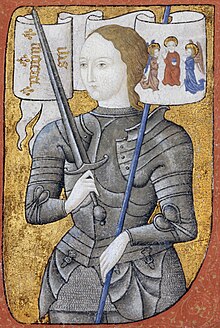
Joan of Arc
Her request was rejected twice, but eventually Robert de Baudricourt, the garrison commander, relented and gave her an escort to meet Charles at Chinon. She had never seen Charles, but even though he disguised himself among his courtiers, she instantly recognized him.
After their interview, Charles sent Joan at the head of a relief army to lift the siege of Orléans.
She had never wielded a lance or sword, or even ridden a war horse. She had never studied military strategy nor even seen a battlefield. Yet nine days after arriving at Orléans, she lifted the siege on May 8, 1429.
On May 4, her army attacked the outlying fortress of Saint Loup. She arrived just as the French soldiers were retreating after a failed attempt. Her sudden appearance roused the soldiers to cheer and launch another assault—which overwhelmed the fortress.
In June, Joan decisively defeated the English at the Battle of Patay. She then advanced on Reims, entering the city on July 16. The next day, Charles was consecrated as the King of France in Reims Cathedral with Joan at his side.
These victories paved the way for the final French victory in the Hundred Years’ War at Castillon in 1453.
Joan never attributed her success to anyone but God. She referred to herself as “Joan the Maid” and demanded that her soldiers refrain from sexual activity. At her orders, prostitutes—the camp followers of both French and British armies—were driven out of her encampments.
She did not expect to live a long life—and warned that the French had only about a year to claim their victories before she died.
On May 23, 1430, while relieving the siege of Compiegne, she was captured by Burgundians troops and exchanged to the English. Tried for heresy, she was declared guilty and burned at the stake on May 30,1431.
Only 19 when she died, she had, through her inspired leadership, restored the kingdom of France.
- William Barret Travis (August 1, 1809 – March 6, 1836) was a South Carolina lawyer whose courage and eloquence inspired 200 Texans to hold back a Mexican army at the Alamo.
An early advocate of Texas’ independence from Mexico, Travis entered the newly-formed Texas army as a regular officer. Although he had no experience in battle, he burned for glory as a cavalryman. But he accepted the order of Governor Henry Smith to go to San Antonio and defend the Alamo from the approaching Mexicans.
William Barret Travis
Arriving there, he found himself overshadowed by the popularity of co-commander James Bowie, the legendary knife fighter. But when Bowie collapsed with pneumonia on February 23, 1836—the first day of the siege—Travis took command.
According to historian T.R. Fehrenbach:
“The true measure of this man, with his soldier’s cap, his sword, his exalted ideas of honor, and his florid rhetoric, was that he captured these violent frontiersmen and bent them to his purpose.
“No competent Texas historian really believes Travis drew his line on the ground with his sword and invited his men to leave or stay. That was not Buck Travis’ style. He intended to keep his command on the walls regardless of what the men wanted. He was consciously guarding the ramparts of Texas.”

The siege of the Alamo
On February 23, 1836, Travis penned one of the most famous letters in early American history. Addressing it “To the People of Texas and All Americans in the World,” he wrote:
“I am besieged with a thousand or more of the Mexicans under Santa Anna [the president and dictator of Mexico]…..
“The enemy has demanded our surrender at discretion, otherwise the garrison is to be put to the sword. I shall never surrender or retreat. Thus, I call on you in the name of Liberty, of patriotism, and everything dear to the American character, to come to my aid with all dispatch…
“If this call is neglected I am determined to sustain myself as long as possible and die like a soldier who never forgets what is due his honor and that of his country. VICTORY OR DEATH.”
On March 3, Travis wrote his last letter, addressing it to the newly-declared Republic of Texas. “I shall have to fight the enemy on his own terms….The victory will cost the enemy so dear it will be worse for him than a defeat.”
On March 6, 1836, his prophecy came true.


 Bureaucracybuster's Blog
ABC NEWS, ALBERT EINSTEIN, ALTERNET, AMERICABLOG, AP, ASTRONOMY, BABY BOOMER RESISTANCE, BARACK OBAMA, BBC, BLOOMBERG, BUZZFEED, CBS NEWS, CNN, CROOKS AND LIARS, DAILY KOS, DISNEY CHANNEL, FIVETHIRTYEIGHT, HANNAH MONTANA (TV SHOW), HARPER’S MAGAZINE, HUFFINGTON POST, JESUS CHRIST, LAWRENCE KRAUSS, MEDIA MATTERS, MILEY CYRUS, MOTHER JONES, MOVEON, MSNBC, NBC NEWS, NEW REPUBLIC, NEWSDAY, NEWSWEEK, NPR, PBS NEWSHOUR, POLITICO, POLITICUSUSA, RAW STORY, REUTERS, SALON, SCIENCE, SEATTLE TIMES, SLATE, TALKING POINTS MEMO, THE ATLANTIC, THE CHICAGO SUN-TIMES, THE CHICAGO TRIBUNE, THE DAILY BEAST, THE DAILY BLOG, THE GUARDIAN, THE HILL, THE HUFFINGTON POST, THE INTERCEPT, THE LOS ANGELES TIMES, THE NATION, THE NEW REPUBLIC, THE NEW YORK TIMES, THE NEW YORKER, THE VILLAGE VOICE, THE WASHINGTON POST, THINKPROGRESS, TIME, TRUTHDIG, TRUTHOUT, TWO POLITICAL JUNKIES, U.S. NEWS & WORLD REPORT, UPI, USA TODAY, X
MILEY’S SIN
In Entertainment, History, RELIGION, Social commentary on May 31, 2024 at 12:10 amMiley Cyrus has been called the “Teen Queen” of the 2000s. She is also one of the few child stars with a successful musical career as an adult.
The daughter of country singer Billy Ray Cyrus, she became a teen idol at 13 as Hannah Montana in the Disney Channel television series (2006-2011) of that name. As Hannah Montana, she achieved success on the Billboard charts with two number-one soundtracks.
But on March 1, 2012, she outraged the Christian Right by committing the ultimate sin: She believed in science.
She posted a tweet featuring a photo of the physicist Lawrence Krauss: “Beautiful.”
But it wasn’t what then-19-year-old Cyrus wrote that enraged the “kill-for-Christ” types. It was the words—from Krauss—emblazoned against the photo.
Miley Cyrus
EVERY ATOM IN YOUR BODY CAME FROM A STAR THAT EXPLODED. AND, THE ATOMS IN YOUR LEFT HAND PROBABLY CAME FROM A DIFFERENT STAR THAN THE ATOMS IN YOUR RIGHT HAND.
IT REALLY IS THE MOST POETIC THING I KNOW ABOUT THE UNIVERSE.
YOU ARE ALL STARDUST.
YOU COULDN’T BE HERE IF STARS HADN’T EXPLODED, BECAUSE THE ELEMENTS (THE CARBON, NITROGEN, OXYGEN AND ALL THE THINGS THAT MATTER FOR EVOLUTION) WEREN’T CREATED AT THE BEGINNING OF TIME, THEY WERE CREATED IN STARS.
SO FORGET JESUS. STARS DIED SO YOU COULD LIVE.
And it was those three words—“SO FORGET JESUS”—that roused right-wing Christians to deluge Cyrus’ twitter account with insults and death threats. Among these:
“So are you no longer a Christian? Forget Jesus??? Seriously? What has happened to you out there in the famous world? What????”
“You seriously believe that crap? It’s so ridiculously stupid. Go to hell.”
Cyrus quickly made it clear she didn’t intend to meekly accept such aggression. She tweeted: “U have nothing better 2 do than hate? That saddens me. Im surrounded by love Im sorry 4 whatever happened 2 make u so bitter.
“How can people take the love out of science and bring hate into religion so easily?” she asked and then quoted Albert Einstein:
“It makes me sad to think the world is this way. Like Einstein says ‘Science without religion is lame. Religion without science is blind.’”
She demanded that Twitter (now known as “X”) police itself against the cyber-bullies who often use its service.
Twitter said that its users should just block their harassers.
That ignored the question: If you start getting scores—or hundreds—of insulting and threatening tweets, are you supposed to take the time to block each one?
Twitter said that it would investigate violent threats, but then slopped the problem back onto the victim.
According to the Twitter Help Center:
“Contact local Law Enforcement or Trusted Individuals: We will investigate reports of violent threats but please remember we are not the police and we cannot actively work with the police to report incidents that you report to us.
“If something has gone beyond the point of a personal conflict and has turned into actual violent threats that you feel are credible, call the police.”
In short, you’re on your own.
All of which raised the question: Why do so many people who claim to be filled with Christian love instantly resort to insults, threats or violence simply because someone has dared to express a different religious opinion?
Could it be that then-Senator Barack Obama was more insightful than many fundamentalist Christians wanted to admit?
It was at an April 6, 2008 San Francisco fundraising event that the Presidential candidate said:
“You go into some of these small towns in Pennsylvania, and like a lot of small towns in the Midwest, the jobs have been gone now for 25 years and nothing’s replaced them….
“So it’s not surprising then that they get bitter, they cling to guns or religion or antipathy to people who aren’t like them or anti-immigrant sentiment or anti-trade sentiment as a way to explain their frustrations.”
Of course, if Obama had said this about conditions in the Arab world, millions of these same fundamentalist Christians would have wildly applauded.
Obama took a lot of heat from Christian fundamentalists for his comment. But it remains true that the anger so many of these people aimed at Cyrus is out of all proportion to the “damage” inflicted by her single word: “Beautiful.”
She was not:
She was merely agreeing with an observation—and an opinion—of an internationally-renowned physicist.
You can agree with her. Or disagree with her. Or ignore her completely.
But Cyrus has every right to believe as she wishes.
As do fundamentalists—who believe that a man who died 2,000 years ago is going to magically return from the grave to make everything wonderful.
Clearly, many religious people—of all faiths—desperately need to remember the words of the French philosopher Voltaire: “I do not agree with what you say, but I’ll defend to the death your right to say it.”
And he warned: “Anyone who has the power to make you believe absurdities has the power to make you commit injustices.”
Share this: