Posts Tagged ‘VIETNAM WAR’
2012 PRESIDENTIAL RACE, ALTERNET, AP, BARACK OBAMA, BAY OF PIGS, BBC, BERLIN WALL, BILL CLINTON, BRUCE GREENWOOD, BUZZFEED, CARLOS MARCELLO, CBS NEWS, CIA, CIVIL RIGHTS, CLIFF ROBERTSON, CNN, CUBAN MISSILE CRISIS, DAILY KOS, DAVID HALBERSTAM, DONALD J. TRUMP, FACEBOOK, FBI, FIDEL CASTRO, FRANK SINATRA, HERMAN CAIN, ICH BEN EIN BERLINNER SPEECH, INTERNET MOVIE DATABASE, J. EDGAR HOOVER, JAMES MARSDEN, JOHN F. KENNEDY, JOSEPH MCCARTHY, JOSEPH P. KENNEDY, LYNDON B. JOHNSON, MAFIA, MALCOM X, MARTIN LUTHER KING, MARTIN SHEEN, MOTHER JONES, MOVEON, MOVIES, NBC NEWS, NEWSWEEK, NEWT GINGRICH, NIKITA KHRUSHCHEV, NPR, NUCLEAR TEST BAN TREATY, POLITICO, PT-109, RAW STORY, REUTERS, RICK PERRY, ROBERT F. KENNEDY, ROBERT S. MCNAMARA, SALON, SAM GIANCANA, SANTOS TRAFFICANTE, Sarah Palin, SATURDAY NIGHT LIVE, SEATTLE TIMES, SLATE, SOVIET UNION, THE ATLANTIC, THE BEST AND THE BRIGHTEST, THE BUTLER, THE CHICAGO SUN-TIMES, THE CHICAGO TRIBUNE, THE DAILY BEAST, THE GUARDIAN, THE HILL, THE HUFFINGTON POST, THE LOS ANGELES TIMES, THE MISSILES OF OCTOBER, THE NEW YORK TIMES, THE RAT PACK, THE WALL STREET JOURNAL, THE WASHINGTON POST, THIRTEEN DAYS, TIME, TWILIGHT ZONE, TWITTER, U.S. NEWS & WORLD REPORT, UPI, USA TODAY, VIETNAM WAR, WILLIAM DEVANE, WILLIAM PETERSON
In Bureaucracy, Business, History, Law, Law Enforcement, Military, Politics, Social commentary on July 7, 2022 at 9:24 am
John F. Kennedy became President when civil rights suddenly became a burning issue throughout the Nation.
At Kennedy’s request, dozen of law firms sent lawyers South, so civil rights demonstrators would not lack counsel.
Prominent blacks such as Thurgood Marshall, Robert C. Weaver and George L.L. Weaver were appointed, respectively, to the Supreme Court, the Housing and House Finance Agency and the office of Assistant Secretary of Labor.
But Kennedy was highly reluctant to push for a civil rights bill addressing the overall issues of racial discrimination.
The reason: Most of the chairman of House and Senate committees were deeply conservative Southern racists–whether Republican or Democrat. They decided whether Kennedy’s foreign policy initiatives would be approved or opposed–especially his bills for increased foreign aid.
Kennedy believed he could not offend such men without jeopardizing the legacy he wanted to achieve in foreign policy.
This timidity, in turn, led many prominent blacks—such as Martin Luther King and Malcom X—to believe they would see no innovative moves on Kennedy’s part.
But events forced Kennedy’s hand.
On September 30, 1962, the President sent deputy U.S. marshals and National Guardsmen into Mississippi to restore order. Rioting had erupted when, by federal court order, James Meredith, a black, was enrolled at the state university.
Kennedy’s problems in winning support for his civil rights program arose in the folkways of the Nation. When laws run counter to a nation’s folkways, the laws lose.
In backing the admission of Meredith, the President chose an incident which would set off shockwaves for black rights.
Kennedy held mixed emotions about the demand for civil rights by blacks. On one hand, as an Irish Catholic, he grew up with stories about longtime discrimination against his ancestors (such as the “No Irish Need Apply” signs posted by numerous employers).
On the other hand, he had been born into a world of power and wealth, and he had to grope his way toward understanding the problems of the oppressed.
Another major confrontation broke out between Kennedy and the forces of segregation on June 11, 1963. Alabama Governor George C. Wallace personally blocked the entrance of two black pupils to the University of Tuscaloosa.
The President, watching on TV, federalized the Alabama National Guard, which Wallace had used to ring the school. Wallace withdrew and the students were admitted and enrolled.
That same day, Kennedy addressed the nation on the need for genuine equality for all Americans: “The question is whether we are going to treat our fellow Americans as we want to be treated.”
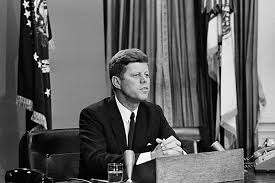
JFK addresses the nation on civil rights
And he called on Congress to pass his civil rights bill, which had been stalled by the legislators.
On August 28, 1963, 200,000 civil rights demonstrators flooded Washington, D.C., for a massive rally.
Fearing that violence would erupt—embarrassing his administration and setting back the cause of civil rights—Kennedy had sought to persuade Dr. Martin Luther King, the march’s chief figure, to cancel the proposed march.
But King and his fellow organizers were determined to go through with it. They had, they said, waited too long for justice to be satisfied with anything less.
The dignity and peacefulness of the rally–and, most especially, King’s soaring “I Have a Dream” speech–won tremendous sympathy throughout the country. Kennedy met with civil rights leaders afterward to offer his support.
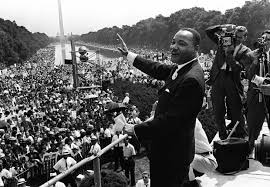
Martin Luther King during the March on Washington
But Kennedy’s civil rights bill remained stalled in Congress until 1964. President Lyndon B. Johnson used the assassinated Kennedy’s new status as a martyr to gain enough support for its passage.
Meanwhile, on yet another front, the Kennedy administration was waging an unprecedented war against organized crime.
This was primarily the work of Attorney General Robert F. Kennedy. As chief counsel for the Senate Permanent Subcommittee on Investigations (1957–59), he had interrogated about 800 mobsters who had been summoned by subpoena.
And he had learned, firsthand, how ineffective the FBI and Justice Department were at bringing such powerful criminals to justice. The FBI had long steered clear of organized crime investigations, largely because its director, J. Edgar Hoover, feared corruption of his agents.
Upon taking office as Attorney General, he greatly expanded the number of attorneys assigned to the Justice Department’s Organized Crime Section. And, more important, he used his status as brother to the President to jawbone FBI Director J. Edgar Hoover into attacking the Mob.
The FBI installed illegal microphones in Mob hangouts throughout the country and started building cases against such mobsters as Sam Giancana, Santos Trafficante and Carlos Marcello.
The administration’s attack on the Mob has led some historians to believe the assassination of President Kennedy was Mob-orchestrated.
The reasons:
- Joseph P. Kennedy, the family patriarch, solicited Mob money and influence for his son’s 1960 Presidential campaign.
- Through singer Frank Sinatra, the elder Kennedy assured Chicago Mafia boss Sam Giancana that the mob would get a free ride if his son were elected President.
- The CIA, seeking any way to topple Fidel Castro, enlisted the Mafia to assassinate him.
- But Robert Kennedy, as Attorney General, ignored the Mob’s “contributions” and pressed his war against the syndicates
- As a result, mobsters felt betrayed and lusted for vengeance.
2012 PRESIDENTIAL RACE, ALTERNET, AP, BARACK OBAMA, BAY OF PIGS, BBC, BERLIN WALL, BILL CLINTON, BRUCE GREENWOOD, BUZZFEED, CARLOS MARCELLO, CBS NEWS, CIA, CIVIL RIGHTS, CLIFF ROBERTSON, CNN, CUBAN MISSILE CRISIS, DAILY KOS, DAVID HALBERSTAM, DONALD J. TRUMP, FACEBOOK, FBI, FIDEL CASTRO, FRANK SINATRA, HERMAN CAIN, ICH BEN EIN BERLINNER SPEECH, INTERNET MOVIE DATABASE, J. EDGAR HOOVER, JAMES MARSDEN, JOHN F. KENNEDY, JOSEPH MCCARTHY, JOSEPH P. KENNEDY, LYNDON B. JOHNSON, MAFIA, MALCOM X, MARTIN LUTHER KING, MARTIN SHEEN, MOTHER JONES, MOVEON, MOVIES, NBC NEWS, NEWSWEEK, NEWT GINGRICH, NIKITA KHRUSHCHEV, NPR, NUCLEAR TEST BAN TREATY, POLITICO, PT-109, RAW STORY, REUTERS, RICK PERRY, ROBERT F. KENNEDY, ROBERT S. MCNAMARA, SALON, SAM GIANCANA, SANTOS TRAFFICANTE, Sarah Palin, SATURDAY NIGHT LIVE, SEATTLE TIMES, SLATE, SOVIET UNION, THE ATLANTIC, THE BEST AND THE BRIGHTEST, THE BUTLER, THE CHICAGO SUN-TIMES, THE CHICAGO TRIBUNE, THE DAILY BEAST, THE GUARDIAN, THE HILL, THE HUFFINGTON POST, THE LOS ANGELES TIMES, THE MISSILES OF OCTOBER, THE NEW YORK TIMES, THE RAT PACK, THE WALL STREET JOURNAL, THE WASHINGTON POST, THIRTEEN DAYS, TIME, TWILIGHT ZONE, TWITTER, U.S. NEWS & WORLD REPORT, UPI, USA TODAY, VIETNAM WAR, WILLIAM DEVANE, WILLIAM PETERSON
In Bureaucracy, Business, History, Law, Law Enforcement, Military, Politics, Social commentary on July 6, 2022 at 10:46 am
By October, 1962, Nikita Khrushchev, premier of the Soviet Union, had supplied Cuba with more than 40,000 soldiers, 1,300 field pieces, 700 anti-aircraft guns, 350 tanks and 150 jets.
The motive: To deter another invasion.
Khrushchev also began supplying Castro with nuclear-tipped ballistic missiles.
Their discovery, in October, 1962, ignited the single most dangerous confrontation of the Cold War.
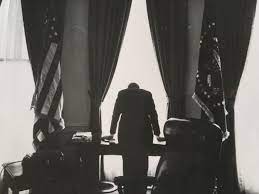

John F. Kennedy during the Cuban Missile Crisis
On October 16, Kennedy was shown photographs of nuclear missile sites under construction on the island. The pictures had been taken on the previous day by a high-altitude U-2 spy plane.
Suddenly, the two most powerful nuclear countries—the United States and the Soviet Union—appeared on the brink of nuclear war.
Kennedy officials claimed they couldn’t understand why Khrushchev had placed nuclear missiles in Cuba. “Maybe Khrushchev’s gone mad” was a typical musing.
The Kennedy administration never admitted that JFK had been waging a no-holds-barred campaign to overthrow the Cuban government and assassinate its leader.
Kennedy convened a group of his 12 most important advisers, which became known as Ex-Comm, for Executive Committee.
For seven days, Kennedy and his advisers intensely and privately debated their options. Some of the participants—such as Air Force General Curtis LeMay—urged an all-out air strike against the missile sites.
Robert Kennedy, the Attorney General (and the President’s brother) opposed initial calls for an air strike.
It would be, he said, “a Pearl Harbor in reverse.” And, he added: “I don’t want my brother to go down in history as the Tojo of the 1960s.”
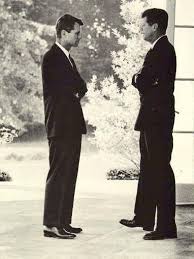
Robert F. and John F. Kennedy
Others—such as Adlai Stevenson, the United States delegate to the United Nations—urged a reliance on quiet diplomacy.
It was Secretary of Defense Robert S. McNamara who suggested a middle course: A naval blockade—a “quarantine” in Kennedy’s softened term—around Cuba. This would hopefully prevent the arrival of more Soviet offensive weapons on the island.
The President insisted that the missiles had to go—by peaceful means, if possible, but by the use of military force if necessary.
Kennedy finally settled on a naval blockade of Cuba. This would prevent additional missiles from coming in and give Khrushchev time to negotiate and save face.
On October 22, President Kennedy appeared on nationwide TV to denounce the presence of Russian nuclear missiles in Cuba.
He demanded their withdrawal, and warned that any missile launched against any nation in the Western hemisphere would be answered with “a full retaliatory response upon the Soviet Union.”
Kennedy ordered American military readiness raised to a level of Defcom-2—the step just short of total war.
The United States had about 27,000 nuclear weapons; the Soviets had about 3,000. In a first nuclear exchange, the United States could have launched about 3,000 nuclear weapons and the Soviets about 250.
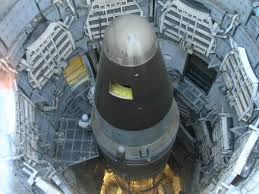
Nuclear missile in silo
On October 28, Khrushchev announced that the missile sites would be destroyed and the missiles crated and shipped back to the Soviet Union.
In return, Kennedy gave his promise—publicly—to lift the blockade and not invade Cuba
Privately, he also promised to remove obsolete Jupiter II nuclear missiles from Turkey, which bordered the Soviet Union. Those missiles were, in effect, the American version of the Russian missiles that had been shipped to Cuba.
The world escaped nuclear disaster by a hair’s-breath.
Khrushchev didn’t know that Kennedy had intended to order a full-scale invasion of Cuba in just another 24 hours if an agreement couldn’t be reached.
And Kennedy and his military advisors didn’t know that Russian soldiers defending Cuba had been armed with tactical nuclear weapons.
If warfare of any type had broken out, the temptation to go nuclear would have been overwhelming.
The Cuban Missile Crisis marked the only time the world came to the brink of nuclear war.
The Right attacked Kennedy for refusing to destroy Castro, thus allowing Cuba to remain a Communist bastion only 90 miles from Florida.
The Left believed it was a needless confrontation that risked the destruction of humanity.
For Kennedy, forcing the Soviets to remove their missiles from Cuba re-won the confidence he had lost among so many Americans following the Bay of Pigs fiasco.
It also made him face the brutal truth that a miscalculation during a nuclear crisis could destroy all life on Earth.
He felt he could now move—cautiously—toward better relations between the United States and the Soviet Union.
Ironically, the crisis had the same effects on Khrushchev—who had witnessed the horrors of Germany’s 1941 invasion of the Soviet Union and the subsequent loss of at least 22 million Soviet citizens.
Slowly and carefully, Kennedy and Khrushchev negotiated the details of what would become the Nuclear Test Ban Treaty, which banned nuclear testing in the atmosphere.
Underground tests would continue, but the amounts of deadly strontium-90 radiation polluting the atmosphere would be vastly reduced.
The treaty was signed between the United States and the Soviet Union on July 25, 1963.
Kennedy considered it his greatest achievement as President, saying in a speech: “According to a Chinese proverb, a journey of a thousand miles begins with a single step. My fellow Americans, let us take that first step.”
2012 PRESIDENTIAL RACE, ALTERNET, AP, BARACK OBAMA, BAY OF PIGS, BBC, BERLIN WALL, BILL CLINTON, BRUCE GREENWOOD, BUZZFEED, CARLOS MARCELLO, CBS NEWS, CIA, CIVIL RIGHTS, CLIFF ROBERTSON, CNN, CUBAN MISSILE CRISIS, DAILY KOS, DAVID HALBERSTAM, DONALD J. TRUMP, FACEBOOK, FBI, FIDEL CASTRO, FRANK SINATRA, HERMAN CAIN, ICH BEN EIN BERLINNER SPEECH, INTERNET MOVIE DATABASE, J. EDGAR HOOVER, JAMES MARSDEN, JOHN F. KENNEDY, JOSEPH MCCARTHY, JOSEPH P. KENNEDY, LYNDON B. JOHNSON, MAFIA, MALCOM X, MARTIN LUTHER KING, MARTIN SHEEN, MOTHER JONES, MOVEON, MOVIES, NBC NEWS, NEWSWEEK, NEWT GINGRICH, NIKITA KHRUSHCHEV, NPR, NUCLEAR TEST BAN TREATY, POLITICO, PT-109, RAW STORY, REUTERS, RICK PERRY, ROBERT F. KENNEDY, ROBERT S. MCNAMARA, SALON, SAM GIANCANA, SANTOS TRAFFICANTE, Sarah Palin, SATURDAY NIGHT LIVE, SEATTLE TIMES, SLATE, SOVIET UNION, THE ATLANTIC, THE BEST AND THE BRIGHTEST, THE BUTLER, THE CHICAGO SUN-TIMES, THE CHICAGO TRIBUNE, THE DAILY BEAST, THE GUARDIAN, THE HILL, THE HUFFINGTON POST, THE LOS ANGELES TIMES, THE MISSILES OF OCTOBER, THE NEW YORK TIMES, THE RAT PACK, THE WALL STREET JOURNAL, THE WASHINGTON POST, THIRTEEN DAYS, TIME, TWILIGHT ZONE, TWITTER, U.S. NEWS & WORLD REPORT, UPI, USA TODAY, VIETNAM WAR, WILLIAM DEVANE, WILLIAM PETERSON
In Bureaucracy, Business, History, Law, Law Enforcement, Military, Politics, Social commentary on July 5, 2022 at 9:31 am
During the 1960 Presidential campaign, then-Senator John F. Kennedy promised to build a Peace Corps to train people in underdeveloped nations to help themselves.
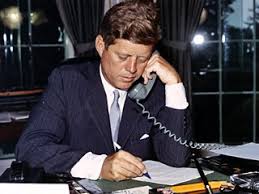
John F. Kennedy
In March, 1961, the program went into effect, with the President’s brother-in-law, Sergent Shriver, as director.
Starvation, illiteracy and disease were the enemies of the Corps. Any nation wanting aid could request it. The first group of volunteers went to the Philippines, the second to Ecuador and the third to Tanganyika.
The problems of the underdeveloped world were too great for any single organization to solve. But the Corps lifted the spirits of many living in those countries. And it captured the imagination of millions of Americans—especially those of thousands of idealistic youths who entered its ranks.
To combat the growing Communist threat to Latin America, Kennedy established the Alliance for Progress. He defined the Alliance’s goal as providing “revolutionary progress through powerful, democratic means.”
Within two years he could report:
“Some 140,000 housing units have been constructed. Slum clearance projects have begun, and 3,000 classrooms have been built. More than 4,000,000 school books have been distributed.
“The Alliance has fired the imagination and kindled the hopes of millions of our good neighbors. Their drive toward modernization is gaining momentum as it unleashes the energies of these millions.
“The United States is becoming increasingly identified in the minds of the people with the goal they move toward: a better life with freedom,” said Kennedy.
Critics of the program, however, charged that the President was trying to “dress up the old policies” of Franklin D. Roosevelt in new rhetoric. Since FDR’s time, the United States has believed in giving economic aid to Latin America.
Much—if not most—of these billions of dollars has wound up in the pockets of various right-wing dictators, such as Anastasio Somoza and Rafael Trujillo.
Meanwhile, Kennedy was urging action on another front—that of outer space.
“This generation does not intend to founder in the backwash of the coming age of space,” declared the President. He committed the United States to putting a man on the moon by the end of the decade.
As indeed it happened less than six years after his death—on July 20, 1969.
Kennedy’s idealistic rhetoric masked his real reason for going to the moon: To score a propaganda victory over the Soviet Union.
Another of his anti-Communist goals: To remove Fidel Castro from power in Cuba at almost any cost.
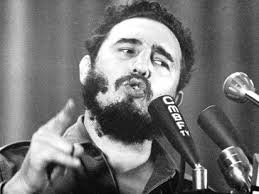
Fidel Castro
Immediately after the failed Bay of Pigs invasion, Kennedy appointed his brother, Robert–who was then the Attorney General—to oversee a CIA program to overthrow Castro.
The CIA and the Mafia entered into an unholy alliance to assassinate Castro—each for its own benefit:
- The CIA wanted to please Kennedy by overthrowing the Communist leader who had nationalized American corporate holdings.
- The Mafia wanted to regain its lucrative casino and brothel holdings that had made Cuba the playground of the rich in pre-Castro times.
The mobsters were authorized to offer $150,000 to anyone who would kill Castro and were promised any support the Agency could yield.
“We were hysterical about Castro at about the time of the Bay of Pigs and thereafter,” then-former Secretary of Defense Robert S. McNamara testified before Congress about these efforts. “And there was pressure from JFK and RFK to do something about Castro.”
Nor was everyone in the CIA enthusiastic about the “get Castro” effort.
“Everyone at CIA was surprised at Kennedy’s obsession with Fidel,” recalled Sam Halpern, who was assigned to the Cuba Project. “They thought it was a waste of time. We all knew [Fidel] couldn’t hurt us. Most of us at CIA initially liked Kennedy, but why go after this little guy?
“One thing is for sure: Kennedy wasn’t doing it out of national security concerns. It was a personal thing. The Kennedy family felt personally burnt by the Bay of Pigs and sought revenge.”
It was all-out war. Among the tactics used:
- Hiring Cuban gangsters to murder Cuban police officials and Soviet technicians.
- Sabotaging mines.
- Paying up to $100,000 per “hit” for the murder or kidnapping of Cuban officials.
- Using biological and chemical warfare against the Cuban sugar industry.
- Planting colorful seashells rigged to explode at a site where Castro liked to go skindiving.
- Trying to arrange for his being presented with a wetsuit impregnated with noxious bacteria and mold spores, or with lethal chemical agents.
- Attempting to infect Castro’s scuba regulator with tuberculous bacilli.
- Trying to douse his handkerchiefs, cigars, tea and coffee with other lethal bacteria.
But all of these efforts failed to assassinate Castro–or overthrow the Cuban Revolution he was heading.
“Bobby (Kennedy) wanted boom and bang all over the island,” recalled Halpern. “It was stupid. The pressure from the White House was very great.”
Americans would rightly label such methods as ”terrorist” if another power used them against the United States today. And the Cuban government saw the situation exactly the same way.
So Castro appealed to Nikita Khrushchev, leader of the Soviet Union, for assistance.
Khrushchev was quick to comply: “We must not allow the Communist infant to be strangled in its crib,” he told members of his inner circle.
2012 PRESIDENTIAL RACE, ALTERNET, AP, BARACK OBAMA, BAY OF PIGS, BBC, BERLIN WALL, BILL CLINTON, BRUCE GREENWOOD, BUZZFEED, CARLOS MARCELLO, CBS NEWS, CIA, CIVIL RIGHTS, CLIFF ROBERTSON, CNN, CUBAN MISSILE CRISIS, DAILY KOS, DAVID HALBERSTAM, DONALD J. TRUMP, FACEBOOK, FBI, FIDEL CASTRO, FRANK SINATRA, ICH BEN EIN BERLINNER SPEECH, INTERNET MOVIE DATABASE, J. EDGAR HOOVER, JAMES MARSDEN, JOHN F. KENNEDY, JOSEPH MCCARTHY, JOSEPH P. KENNEDY, LYNDON B. JOHNSON, MAFIA, MALCOM X, MARTIN LUTHER KING, MARTIN SHEEN, MOTHER JONES, MOVEON, MOVIES, NBC NEWS, NEWSWEEK, NEWT GINGRICH, NIKITA KHRUSHCHEV, NPR, NUCLEAR TEST BAN TREATY, POLITICO, PT-109, RAW STORY, REUTERS, RICK PERRY, ROBERT F. KENNEDY, ROBERT S. MCNAMARA, SALON, SAM GIANCANA, SANTOS TRAFFICANTE, Sarah Palin, SATURDAY NIGHT LIVE, SEATTLE TIMES, SLATE, SOVIET UNION, THE ATLANTIC, THE BEST AND THE BRIGHTEST, THE BUTLER, THE CHICAGO SUN-TIMES, THE CHICAGO TRIBUNE, THE DAILY BEAST, THE GUARDIAN, THE HILL, THE HUFFINGTON POST, THE LOS ANGELES TIMES, THE MISSILES OF OCTOBER, THE NEW YORK TIMES, THE RAT PACK, THE WALL STREET JOURNAL, THE WASHINGTON POST, THIRTEEN DAYS, TIME, TWILIGHT ZONE, TWITTER, U.S. NEWS & WORLD REPORT, UPI, USA TODAY, VIETNAM WAR, WILLIAM DEVANE, WILLIAM PETERSON
In Bureaucracy, Business, History, Law, Law Enforcement, Military, Politics, Social commentary on July 4, 2022 at 11:55 am
This October 16 – 28 will mark 60 years since the world hovered on the brink of nuclear oblivion.
It was the most dangerous moment of the Cold War. And it was the supreme test of John F. Kennedy’s leadership as the 35th President of the United States.
He served as President for only two years, ten months and two days.
Yet today—-61 years since he took office, and 59 years since his assassination—millions of Americans still remember Kennedy with reverence, even awe. This despite decades of highly embarrassing revelations about his scandalous private life.
Some have called the Kennedy administration a golden era in American history. A time when touch football, lively White House parties, stimulus to the arts and the antics of the President’s children became national obsessions.
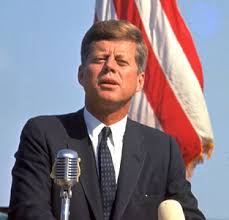
John F. Kennedy
Others have called the Kennedy Presidency a monument to the unchecked power of wealth and ambition. An administration staffed by young novices playing at statesmen, riddled with nepotism, and whose legacy includes the Bay of Pigs, the Vietnam war and the world’s first nuclear confrontation.
The opening days of the Kennedy Presidency raised hopes for a dramatic change in relations between the United States and the Soviet Union.
But detente was not possible then. The Russians had not yet experienced their coming agricultural problems and the setback in Cuba during the Missile Crisis. And the United States had not suffered defeat in Vietnam.
Kennedy’s first brush with international Communism came on April 17, 1961, with the invasion of Cuba at the Bay of Pigs. This operation had been planned and directed by the Central Intelligence Agency during the final months of Dwight D. Eisenhower’s term as President.
The U.S. Navy was to land about 1,400 Cuban exiles on the island to overthrow the Communist government of Fidel Castro. They were supposed to head into the mountains—as Castro himself had done against the dictatorship of Fulgencio Batista in 1956—and raise the cry of revolution.
The invasion would occur after an American air strike had knocked out the Cuban air force. But the airstrike failed and Kennedy, under the pressure of world opinion, called off a second try.
Even so, the invasion went ahead. When the invaders surged onto the beaches, they found Castro’s army waiting for them. Many of the invaders were killed on the spot. Others were captured—to be ransomed by the United States in December, 1962, in return for medical supplies.
It was a major public relations setback for the newly-installed Kennedy administration, which had raised hopes for a change in American-Soviet relations.
Kennedy, trying to abort widespread criticism, publicly took the blame for the setback: “There’s an old saying that victory has a hundred fathers and defeat is an orphan….I’m the responsible officer of the Government.”
The Bay of Pigs convinced Kennedy that he had been misled by the CIA and the Joint Chiefs of Staff. Out of this came his decision to rely heavily on the counsel of his brother, Robert, whom he had installed as Attorney General.
The failed Cuban invasion—unfortunately for Kennedy—convinced Soviet Premier Nikita S. Khrushchev that the President was weak.
Khrushchev told an associate that he could understand if Kennedy had not decided to invade Cuba. But once he did, Kennedy should have pressed on and wiped out Castro.
Khrushchev attributed this to Kennedy’s youth, inexperience and timidity—and believed he could bully the President.
On June 4, 1961, Kennedy met with Khrushchev in Vienna to discuss world tensions. Khrushchev threatened to go to nuclear war over the American presence in West Berlin—the dividing line between Western Europe, protected by the United States, and Eastern Europe, controlled by the Soviet Union.
Kennedy, who prized rationality, was shaken by Khrushchev’s unexpected rage. After the conference, he told an associate: “It’s going to be a cold winter.”
Meanwhile, East Berliners felt they were about to be denied access to West Berlin. A flood of 3,000 refugees daily poured into West Germany.
Khrushchev was embarrassed at this clear showing of the unpopularity of the Communist regime. In August, he ordered that a concrete wall—backed up by barbed wire, searchlights and armed guards—be erected to seal off East Berlin.
As tensions mounted and a Soviet invasion of West Berlin seemed likely, Kennedy sent additional troops to the city in a massive demonstration of American will.
Two years later, on June 26, 1963, during a 10-day tour of Europe, Kennedy visited Berlin to deliver his “I am a Berliner” speech to a frenzied crowd of thousands.
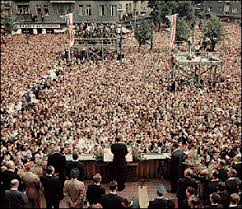
JFK addresses crowds at the Berlin Wall
“There are many people in the world who really don’t understand, or say they don’t, what is the great issue between the free world and the Communist world,” orated Kennedy. “Let them come to Berlin.”
Standing within gunshot of the Berlin wall, he lashed out at the Soviet Union and praised the citizens of West Berlin for being “on the front lines of freedom” for more than 20 years.
“All free men, wherever they may live,” said Kennedy, “are citizens of Berlin. And therefore, as a free man, I take pride in the words, ‘Ich ben ein Berliner.’”
9/11 TERRORIST ATTACKS, ABC NEWS, AFGHANISTAN, ALTERNET, AMERICABLOG, AP, BABY BOOMER RESISTANCE, BBC, BLOOMBERG NEWS, BUZZFEED, CBS NEWS, CNN, CROOKS AND LIARS, DAILY KOZ, DONALD TRUMP, FACEBOOK, FIVETHIRTYEIGHT, HARPER’S MAGAZINE, HUFFINGTON POST, JOSEPH BIDEN, MEDIA MATTERS, MOTHER JONES, MOVEON, MSNBC, NBC NEWS, NEW REPUBLIC, NEWSDAY, NEWSWEEK, NPR, OSAMA BIN LADEN, PBS NEWSHOUR, PENTAGON, PEOPLE’S ARMY OF VIETNAM, POLITICO, POLITICUSUSA, RAW STORY, REUTERS, RICHARD NIXON, RUSSIA, SAIGON, SALON, SEATTLE TIMES, SLATE, TALIBAN, TALKING POINTS MEMO, THE ATLANTIC, THE CHICAGO SUN-TIMES, THE CHICAGO TRIBUNE, THE DAILY BEAST, THE DAILY BLOG, THE GUARDIAN, THE HILL, THE HUFFINGTON POST, THE INTERCEPT, THE LOS ANGELES TIMES, THE NATION, THE NEW REPUBLIC, THE NEW YORK TIMES, THE NEW YORKER, THE VILLAGE VOICE, THE WASHINGTON POST, THINKPROGRESS, TIME, TRUTHDIG, TRUTHOUT, TWITTER, TWO POLITICAL JUNKIES, U.S. NEWS & WORLD REPORT, UKRAINE, UPI, USA TODAY, VIET CONG, VIETNAM WAR, VLADIMIR PUTIN, VOLODYMYR ZELENSKY, WONKETTE, WORLD TRADE CENTER
In Bureaucracy, History, Military, Politics, Social commentary on May 18, 2022 at 12:12 am
For those born after 1975, America’s departure from Afghanistan marks the first humiliating retreat from a valuable ally.
But this is wrong.
In April, 1975, the South Vietnamese Army suddenly crumbled under an all-out offensive by North Vietnamese regular army units.
The United States—which had been been supplying military assistance to Vietnam since the Presidency of Dwight D. Eisenhower—suddenly saw its worst nightmare come to life.
It had poured more than $120 billion into the conflict in Vietnam from 1965-73. At least 58,000 United States soldiers had died there. Another 304,000 had been wounded.
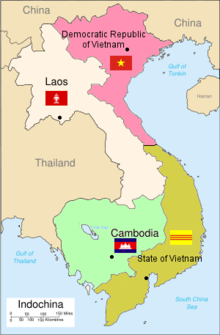
Vietnam during the Vietnam war
User:SnowFire, CC BY-SA 4.0 <https://creativecommons.org/licenses/by-sa/4.0>, via Wikimedia Commons
The last American troops had left Vietnam on March 29, 1973. President Richard Nixon claimed that he had achieved “peace with honor.” The South Vietnamese Army was supposedly now trained by Americans to defend the “country” from attack by North Vietnam.
Then came December 13, 1974—the start of the North’s all-out offensive.
The result: South Vietnamese forces melted away.
This was hardly surprising to American veterans of the war. Among them a favorite joke had been: “There’s a new batch of South Vietnamese rifles for sale. Never fired, and only dropped once.”
By April 30, 1975, Saigon, the capitol of South Vietnam, fell to the People’s Army of Vietnam and the Viet Cong.

Fall of Saigon
At home, watching TV, Americans felt shame as Army helicopters hurriedly lifted off the roof of the United States embassy. Numerous South Vietnamese desperately tried to climb aboard—only to have their hands stomped on by Americans equally desperate to get out before North Vietnamese forces reached them.
Now, 46 years later, Americans were seeing Air Force planes taking off from Kabul Airport, with hordes of Afghans desperate to leave the country, racing after them.
Said President Joseph Biden: “Over our country’s 20 years at war in Afghanistan, America has sent its finest young men and women, invested nearly $1 trillion dollars, trained over 300,000 Afghan soldiers and police, equipped them with state-of-the-art military equipment, and maintained their air force as part of the longest war in U.S. history.”

Joseph Biden
Just as the South Vietnamese Army had chosen flight instead of fight, so, too, did the Afghan Army—in just 10 days.
“One more year, or five more years, of U.S. military presence would not have made a difference if the Afghan military cannot or will not hold its own country,” said Biden. “And an endless American presence in the middle of another country’s civil conflict was not acceptable to me.
“When I came to office, I inherited a deal cut by my predecessor—which he invited the Taliban to discuss at Camp David on the eve of 9/11 of 2019—that left the Taliban in the strongest position militarily since 2001 and imposed a May 1, 2021 deadline on U.S. Forces.
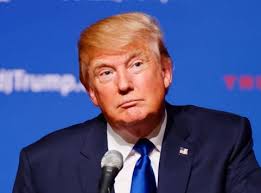
Donald Trump
“Shortly before he left office, he also drew U.S. Forces down to a bare minimum of 2,500. Therefore, when I became President, I faced a choice—follow through on the deal, with a brief extension to get our forces and our allies’ forces out safely, or ramp up our presence and send more American troops to fight once again in another country’s civil conflict.
“I was the fourth President to preside over an American troop presence in Afghanistan—two Republicans, two Democrats. I would not, and will not, pass this war onto a fifth.”
Republicans have since tried hard to blame the resulting chaos on Biden. But in doing so they deliberately ignore the role played by his predecessor, Donald Trump, in facilitating that rout.
As Biden noted, Trump had invited the Taliban to Camp David to discuss the withdrawal of American forces from Afghanistan. Making this offer thoroughly disgraceful were two factors:
First: The date for this conference was on the eve of the 18th anniversary of the September 11, 2001 terrorist attacks on the Pentagon and World Trade Center. Osama bin Laden, the mastermind of those attacks, was then living in Afghanistan under the protection of the Taliban.
It was the refusal of the Taliban to turn him over to American justice that led directly to the American invasion of Afghanistan in October, 2001.
Second: Pointedly uninvited to this conference were any members of the Afghan government, which—officially—the United States regarded as a valuable ally.
There is a brutal lesson here that Americans have long refused to learn: Bad allies make for bad outcomes. Those who refuse to defend themselves cannot be bribed or forced to do so by others.
Contrast the “I have to catch a plane” cowardice of Afghan soldiers with the courage of Ukrainian soldiers—and civilians—fiercely defending their country from Vladimir Putin’s unprovoked Russian invasion.
During the assault by Russian troops on the capital of Kiev, the Biden administration urged President Volodymyr Zelensky to evacuate to a safer location and offered to help him do so. Zelensky refused, saying: “The fight is here [in Kiev]; I need ammunition, not a ride.”
Until Presidents and Congressional leaders learn to distinguish worthwhile allies from worthless ones, Americans will continue to waste lives and treasure on the latter.
2016 PRESIDENTIAL CAMPAIGN, ABC NEWS, ALTERNET, AMERICABLOG, AMERICAN UNIVERSITY, AP, APOLLO MOON LANDING, BABY BOOMER RESISTANCE, BARACK OBAMA, BARBARA TUCHMAN, BBC, BLOOMBERG NEWS, BRIAN KILMEADE, BUZZFEED, CBS NEWS, CNN, COLD WAR, CORONAVIRUS, CROOKS AND LIARS, CUBAN MISSILE CRISIS, DAILY KOZ, DEMOCRATS, DONALD TRUMP, DREAMS FROM MY FATHER (BOOK), FACEBOOK, FIVETHIRTYEIGHT, FOX NEWS, GODFATHER'S PIZZA, HARPER’S MAGAZINE, HERMAN CAIN, HUFFINGTON POST, IGNORANCE, JOHN F. KENNEDY, KELLEYANNE CONWAY, LIBYA, LILTERACY, LITERACY, LYNDON B. JOHNSON, MEDIA MATTERS, MOTHER JONES, MOVEON, MSNBC, NBC NEWS, NEW REPUBLIC, NEWSDAY, NEWSWEEK, NPR, NUCLEAR TEST BAN TREATY, PBS NEWSHOUR, POLITICO, POLITICUSUSA, RATIONALITY, RAW STORY, REPUBLICANS, REUTERS, RICHARD M. NIXON, ROBERT FRANCIS “BETO” O’ROURKE, SALON, SEAN SPICER, SEATTLE TIMES, SLATE, SUPER COMMITTEE OF CONGRESS, TALKING POINTS MEMO, THE ATLANTIC, THE AUDACITY OF HOPE (BOOK), THE CHICAGO SUN-TIMES, THE CHICAGO TRIBUNE, THE DAILY BEAST, THE DAILY BLOG, THE GUARDIAN, THE GUNS OF AUGUST (BOOK), THE HILL, THE HUFFINGTON POST, THE INTERCEPT, THE LOS ANGELES TIMES, THE NATION, THE NEW REPUBLIC, THE NEW YORK TIMES, THE NEW YORKER, THE VILLAGE VOICE, THE WASHINGTON POST, THINKPROGRESS, TIME, TRUTHDIG, TRUTHOUT, TUCKER CARLSON, TWITTER, TWO POLITICAL JUNKIES, U.S. NEWS & WORLD REPORT, UPI, USA TODAY, VIETNAM WAR, WONKETTE, WORLD WAR 1
In Bureaucracy, History, Military, Politics, Social commentary on April 22, 2022 at 12:14 am
Fifty-eight years ago, on November 22, 1963, two bullets slammed into the neck and head of President John Fitzgerald Kennedy.
It has been said that JFK left his country with three great legacies:
- The Nuclear Test Ban Treaty;
- The Apollo moon landing; and
- The Vietnam war.
Of these, the following can be said with certainty:
- The Test Ban Treaty has prevented atmospheric testing—and poisoning—by almost all the world’s nuclear powers.
- After reaching the moon—in 1969—Americans quickly lost interest in space and have today largely abandoned plans for manned exploration. For America, as for JFK, beating the Russians to the moon was the end-goal.
- Under Presidents Lyndon Johnson and Richard Nixon, 58,000 Americans died in Vietnam; 153,303 were wounded; and billions of dollars were squandered in a hopeless effort to intervene in what was essentially a Vietnamese civil war. From 1965 to 1973, the war angrily divided Americas as had no event since the Civil War.
But there was a fourth legacy—and perhaps the most important of all: The belief that mankind could overcome its greatest challenges through rationality and perseverance.
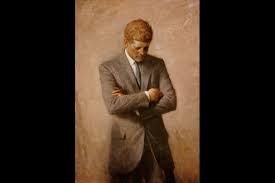
White House painting of JFK
At American University on June 10, 1963, Kennedy called upon his fellow Americans to re-examine the events and attitudes that had led to the Cold War. And he declared that the search for peace was by no means absurd:
“Our problems are man-made; therefore, they can be solved by man. And man can be as big as he wants. No problem of human destiny is beyond human beings.
“Man’s reason and spirit have often solved the seemingly unsolvable, and we believe they can do it again.”
Today, Republicans and Democrats cannot agree on solutions to even the most vital national problems.
On November 21, 2011, the 12 members of the “Super-Committee” of Congress, tasked with finding $1.2 trillion in cuts in government spending, threw up their hands in defeat.
President Kennedy insisted on being well-informed. He speed-read several newspapers every morning and nourished personal relationships with the press-–and not for altruistic reasons. These journalistic contacts gave Kennedy additional sources of information and perspectives on national and international issues.
During the 2012 Presidential campaign, Republican Presidential candidates celebrated their ignorance of both.
Former Godfather’s Pizza CEO Herman Cain famously said, “We need a leader, not a reader.” Thus he excused his ignorance for why President Barack Obama had intervened in Libya.
An August 20, 2019 story in Forbes noted that a Pew Research survey, conducted in July, had found that “the percentage of Republicans attributing a positive effect to higher education has steadily eroded from 58% (2010), 53% (2012), 54% (2015), 43% (2016), and 36% (2017).
“Among Republicans, 59% now say higher education has a negative effect on the U.S., compared to just 18% of Democrats.”
When Robert Francis “Beto” O’Rourke announced his candidacy for President in 2020, Fox News host Brian Kilmeade attacked him for having a “huge library.”
“As if it’s a big plus that he reads books,” scoffed Kilmeade.
In March, 2020, an NBC News poll found that only 30% of Republicans said that they would actually listen to the advice of doctors to stay away from large, crowded areas to avoid Coronavirus.
During the 2016 Presidential campaign, Donald Trump infamously chortled after winning the Nevada Republican primary: “We won with poorly educated. I love the poorly educated.”
Donald Trump
And, that November, “the poorly educated” elected him President.
As President, he attacked the free press as “the enemy of America” for exposing his lies and criminality. He scorned legitimate mainstream news media while seeking guidance from ego-stroking Right-wing shills at Fox News—who often proved as ignorant as he was.
His senior adviser, Kelleyanne Conway, set the tone of his administration right at the outset. Asked why then-White House press secretary Sean Spicer had lied about the size of the crowd at Trump’s inauguration, Conway replied:
“You’re saying it’s a falsehood. And they’re giving—Sean Spicer, our press secretary—gave alternative facts.”

Kelleyanne Conway
“Alternative facts aren’t facts, they are falsehoods,” Chuck Todd, the moderator on NBC’s “Meet the Press,” properly responded.
During the height of the Cuban Missile Crisis, Kennedy spoke with aides about a book he had just finished: Barbara Tuchman’s The Guns of August, about the events leading to World War 1.
He said that the book’s most important revelation was how European leaders had blindly rushed into war, without thought to the possible consequences. Kennedy told his aides he did not intend to make the same mistake–that, having read his history, he was determined to learn from it.
Republicans attacked President Obama for his Harvard education and articulate use of language. Among their taunts: “Hitler also gave good speeches.”
And they resented his having earned most of his income as a writer of two books: Dreams From My Father and The Audacity of Hope. As if being a writer is somehow subversive.
When knowledge and literacy are attacked as “highfalutin’” arrogance, and ignorance and incoherence are embraced as sincerity, national decline lies just around the corner.
In retrospect, the funeral for President Kennedy marked the death of more than a rational and optimistic human being.
It marked the death of Americans’ pride in choosing reasoning and educated citizens for their leaders.
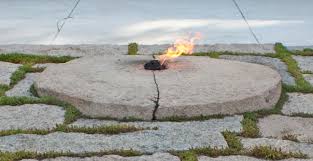
The Eternal Flame at the grave of President John F. Kennedy
2003 IRAQ WAR, ABC NEWS, ALTERNET, AMERICABLOG, AP, BABY BOOMER RESISTANCE, BBC, BECKET (MOVIE), BLOOMBERG NEWS, BOMBING, BUZZFEED, CBS NEWS, CNN, CROOKS AND LIARS, D-DAY, DAILY KOZ, FACEBOOK, FIVETHIRTYEIGHT, FLAMETHROWERS, GEORGE W. BUSH, HARPER’S MAGAZINE, HUFFINGTON POST, IRAQ, MEDIA MATTERS, MOTHER JONES, MOVEON, MSNBC, NAVY SEALS, NAZI GERMANY, NBC NEWS, NEW REPUBLIC, NEWSDAY, NEWSWEEK, NPR, PBS NEWSHOUR, PETER O'TOOLE, POLITICO, POLITICUSUSA, RAW STORY, REUTERS, RICHARD BURTON, RUSSIA, SALON, SEATTLE TIMES, SLATE, TALKING POINTS MEMO, THE ATLANTIC, THE CHICAGO SUN-TIMES, THE CHICAGO TRIBUNE, THE DAILY BEAST, THE DAILY BLOG, THE GUARDIAN, THE HILL, THE HUFFINGTON POST, THE INTERCEPT, THE LOS ANGELES TIMES, THE NATION, THE NEW REPUBLIC, THE NEW YORK TIMES, THE NEW YORKER, THE VILLAGE VOICE, THE WASHINGTON POST, THINKPROGRESS, TIME, TRUTHDIG, TRUTHOUT, TWITTER, TWO POLITICAL JUNKIES, U.S. AIR FORCE, U.S. NEWS & WORLD REPORT, UKRAINE, UPI, USA TODAY, VICTORY THROUGH AIR POWER (MOVIE), VIETNAM WAR, VLADIMIR PUTIN, WALT DISNEY, WONKETTE, WORLD WAR 11
In History, Military, Politics, Social commentary on April 4, 2022 at 12:10 am
Victory Through Air Power is a 1943 Walt Disney animated Technocolor feature film released during World War II. It’s based on the book—of the same title—by Alexander P. de Seversky.
Its thesis is summed up in its title: That by using bombers and fighter aircraft, the United States can attain swift, stunning victory over its Axis enemies: Germany, Italy and Japan.
Although it’s not explicitly stated, the overall impression given is that, through the use of air power, America can defeat its enemies without deploying millions of ground troops.

The movie has long since been forgotten except by film buffs, but its message has not. Especially by the highest officials within the U.S. Air Force.
Although the Air Force regularly boasted of the tonnage of bombs its planes dropped over Nazi Germany, it failed to attain its primary goal: Break the will of the Germans to resist.
On the contrary: Just as the German bombings of England had solidified the will of the British people to resist, so Allied bombing increased the determination of the Germans to fight on.
Nor did the failure of air power end there.
On June 6, 1944—D-Day—the Allies launched their invasion of Nazi-occupied France.
The operation was the largest amphibious invasion in history. More than 160,000 troops landed—73,000 Americans, 61,715 British and 21,400 Canadians.
Allied air power bombed and strafed German troops out in the open. But it couldn’t dislodge soldiers barricaded in steel-and-concrete-reinforced bunkers or pillboxes. Those had to be dislodged, one group at a time, by Allied soldiers armed with rifles, dynamite and flamethrowers.
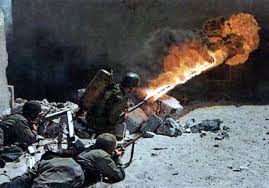
Soldier using flamethrower
This situation proved true throughout the rest of the war.
Then, starting in 1964, the theory of “Victory Through Air Power” once again proved a dud—in Vietnam.
From 1964 to 1975, seven million tons of bombs were dropped on Vietnam, Laos, and Cambodia—more than twice the amount of bombs dropped on Europe and Asia in World War II.
Yet the result proved exactly the same as it had in World War II: The bombing enraged the North Vietnamese and steeled their resolve to fight on to the end.
Hanoi ordered the distribution of rifles to its citizens—to be used for shooting at American planes. Although this probably didn’t bring any planes down, it greatly increased morale among the populace.
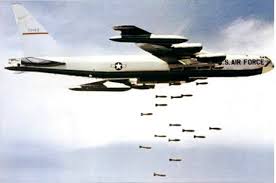
American bomber
The belief that victory could be achieved primarily—if not entirely—through air power had another unforeseen result during the Vietnam war. It gradually sucked the United States ever deeper into the conflict.
To bomb North Vietnam, the United States needed air force bases in South Vietnam. This required that those bombers and fighters be protected.
So a force to provide round-the-clock security had to be maintained. But there weren’t enough guards to defend themselves against a major attack by North Vietnamese forces.
So more American troops were needed—to guard the guards.
North Vietnam continued to press greater numbers of its soldiers into attacks on American bases. This forced America to provide greater numbers of its own soldiers to defend against such attacks.
Eventually, the United States had more than 500,000 ground troops fighting in Vietnam—with no end in sight to the conflict.
But it isn’t enough to subdue a conquered nation—it must be occupied. And air power alone will not suffice.
Americans learned this to their dismay in Iraq after quickly taking Baghdad and subduing the forces of Saddam Hussein. On May 1, 2003, President George W. bush declared the war over.
Except that it wasn’t.
A nationwide insurgency quickly mushroomed—and there simply weren’t enough American troops to prevent or stop these attacks. These continued until the United States finally withdrew from Iraq in 2011.
Since February 24, Russian President Vladimir Putin has directed carpet-bombing attacks on Ukraine, Russia’s neighboring republic. They have leveled cities such as Mariupol with cluster bombs and phosphorus bombs.

Vladimir Putin
Kremlin.ru, CC BY 4.0 <https://creativecommons.org/licenses/by/4.0>, via Wikimedia Commons
Cluster bombs contain small explosive bombs called “sub-munitions.” Dropped from an aircraft or fired from the ground, they open in the air and release the sub-munitions. This scatters a carpet of bombs over a large area without any degree of accuracy.
They don’t explode on impact but remain hazardous as anti-personnel landmines. Up to 87% of recorded victims are civilians.
And yet Ukrainians continue to fiercely resist. At least seven Russian generals have been killed, and NATO estimates that Russia has lost between 21,000 and 45,000 in dead and wounded.
Finally, pulverizing cities from the air comes with a cost—to those doing the pulverizing.
In the 1964 classic, Becket, England’s Chancellor, Thomas Becket (Richard Burton) has captured a French city for his king, Henry II (Peter O’Toole) and is about to lead a peaceful parade of soldiers into it.
“In my day,” complains an English baron, “we marched into a city and slaughtered the lot.”
“Yes—into a dead city,” retorts Becket. “I want to give the King living cities to increase his wealth.”
It’s more than a safe bet that Victory Through Air Power will prove as hollow a slogan in the future as it has in the past.
2016 PRESIDENTIAL CAMPAIGN, AARON ZEBLEY, ABC NEWS, ALTERNET, AP, BATMAN, BUZZFEED, CBS NEWS, CNN, CROOKS AND LIARS, DAILY KOZ, DONALD TRUMP, FACEBOOK, FBI, FOUNDING FATHERS, FOX NEWS NETWORK, HOUSE INTELLIGENCE COMMITTEE, HOUSE JUDICIARY COMMITTEE, JAMES COMEY, MOTHER JONES, MOVEON, MOVIES, MSNBC, NBC NEWS, NEWSWEEK, NICCOLO MACHIAVELLI, NPR, PBS NEWSHOUR, POLITICO, RAW STORY, REUTERS, ROBERT MUELLER III, RUSSIA, SALON, SEATTLE TIMES, SLATE, SPIDER-MAN, SUPERHEROES, THE ATLANTIC, THE CHICAGO SUN-TIMES, THE CHICAGO TRIBUNE, THE DAILY BEAST, THE GUARDIAN, THE HILL, THE HUFFINGTON POST, THE LOS ANGELES TIMES, THE NATION, THE NEW YORK TIMES, THE PRINCE, THE WASHINGTON POST, TIME, TWITTER, U.S. NEWS & WORLD REPORT, UNITED STATES DEPARTMENT OF JUSTICE, UNITED STATES MARINES, UPI, USA TODAY, VIETNAM WAR, VLADIMIR PUTIN, WONDER WOMAN
In Bureaucracy, History, Law, Law Enforcement, Military, Politics, Social commentary on January 14, 2022 at 12:10 am
“For men in general judge more by the eyes than by the hands, for every one can see, but very few have to feel. Everyone sees what you appear to be, few feel what you are….”
So wrote Niccolo Machiavelli in his famous book, The Prince, on how to attain political power.
And his advice applies directly to the reception given the July 24, 2019 appearance of former Special Counsel Robert S. Mueller before the House Judiciary Committee.
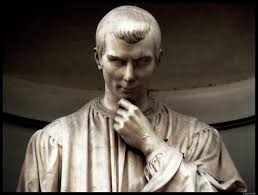
Niccolo Machiavelli
There he testified that Donald Trump, the 45th President of the United States:
- Sought Russian interference during the 2016 Presidential campaign.
- Benefited from that intervention.
- Concealed his close personal economic ties to Vladimir Putin by lying to the public about his hidden attempts to secure a construction project in Moscow.
- Lied to the special prosecutor.
- Directed subordinates to falsify records.
- Tried to exert “undue influence” on law enforcement in order to protect himself and his allies.
A July 26, 2019 article in The Atlantic—entitled “The Press Has Adopted Trump’s Reality-Show Standards”—sums up the general reaction of the nation’s press to these bombshell revelations:
“In any other administration, in any other time, a special prosecutor, former FBI director, and decorated Marine testifying that the president of the United States was an unprosecuted felon who encouraged and then benefited from an attack on American democracy in pursuit of personal and political gain would bring the country to a grinding halt.
“But the American political press found Mueller insufficiently dazzling.”
Among those media:
- The New York Times: “Mueller’s Performance Was a Departure From His Much-Fabled Stamina.”
- The Washington Post: “On Mueller’s Final Day on the National Stage, a Halting, Faltering Performance.” And another reporter dubbed him a “weary old man.”
- The Hill: “Muller’s ‘Blockbuster’ Appearance Turned into ‘Bomb’ of Performance.”
- Politico: “Bob Mueller Is Struggling.”
- Right-wing media openly questioned Mueller’s health. These same media never mention that Trump is grotesquely overweight, never walks when he can ride, and eats a diet high in fats and calories.
In short: The nation’s most influential news media—on which citizens depend for their understanding of national and international personalities and events—has adopted the standards of teenagers.
Summer is when American teenagers lose themselves in movies featuring superheroes such as Batman, Wonder Woman and Spider-Man.
Americans like their heroes young and powerful—preferably invincible. They want their heroes to be handsome and their villains to be ugly. They want to see lots of explosions and collapsing buildings.
And if a superhero can deliver a zinger of a line while throwing a KO punch, so much the better.
Lacking a sense of history—or concern for it—most Americans remain ignorant of the men, women and events that have shaped the era in which they live.
Most of those who watched Robert Mueller testify before Congress knew nothing of the sacrifices he had made for his country:
- As a Marine Vietnam veteran decorated for heroism (1968-1971);
- As a United States Attorney (1986-1987 and 1998-2001);
- As a United States Assistant Attorney General (1990-1993 and 2001); and
- As director of the FBI (2001-2013).
Retiring from the FBI in 2013 at age 69, Mueller’s 27-year career as a dedicated law enforcer seemed at last to be over.
Then President Trump fired FBI Director James Comey for daring to investigate links between Russian Intelligence agents and the Trump 2016 Presidential campaign.
And, once again, on May 17, 2017, Mueller accepted his country’s call to serve as Special Counsel to investigate those links.
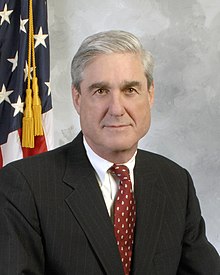
Robert Mueller
Since then, Trump, his shills in Congress and Right-wing Fox News had relentlessly attacked Mueller’s integrity and investigative methods.
Never knowing when he might be fired by Trump, Mueller quietly and methodically pursued his investigation.
As a result, Mueller:
- Indicted three companies and 34 individuals.
- Obtained eight guilty pleas to felonies or convictions—including five Trump associates and campaign officials.
- Unveiled the Russians’ determination to elect Trump over Hillary Clinton.
- Discovered that Trump associates knew about Russian outreach efforts during the campaign.
Since the onset of Mueller’s investigation, Trump and his Republican lackeys in the House and Senate ruthlessly tried to smear his name and undermine his findings.
So on July 24, 2019,, a Democratic Congress summoned Mueller to testify publicly about the conclusions he had reached. He was forced to:
- Testify for seven hours before the House Judiciary Committee and the House Intelligence Committee.
- Endure powerful, hot klieg lights needed by television cameras.
- Patiently take questions that were often self-serving
- Respectfully answer questions meant to attack his personal and professional integrity.
- Simplify complex legal scenarios for men and women who have the attention span of a gnat.
Although Mueller was joined by former deputy special counsel Aaron Zebley, Zebley was forbidden to give testimony. He could only serve as Mueller’s counsel, giving quiet advice.
So the entire seven hours of public testimony fell on the shoulders of a 74-year-old man. No wonder he appeared tired by the end of the day.
A news media that prizes glitz over substance has abdicated the role intended for it by the Founding Fathers: To act as a watchdog over the nation’s leaders.
2016 PRESIDENTIAL CAMPAIGN, 9/11, ABC NEWS, ADAM KINZINGER, ALEXANDRIA OCASIO-CORTEZ, ALLEN WEST, ALTERNET, AMERICABLOG, ANN COULTER, AP, BABY BOOMER RESISTANCE, BBC, BILL CLINTON, BLOOMBERG NEWS, BUZZFEED, CAPITOL ATTACK, CBS NEWS, CHRISTOPHER S. MURPHY, CNN, COMMUNISM, CROOKS AND LIARS, DAILY KOZ, DEMOCRATS, DONALD TRUMP, DWIGHT D. EISENHOWER, EGYPT, FACEBOOK, FERGUS CULLEN, FIVETHIRTYEIGHT, GAMAL ABDEL NASSER, GEORGE H.W. BUSH, HARPER’S MAGAZINE, HILLARY CLINTON, HOUSE OVERSIGHT AND REFORM COMMITTEE, HUFFINGTON POST, IMPEACHMENT, ISRAEL, JEB LUND, JIMMY CARTER, JOHN F. KENNEDY, JOHN KASICH, JORDAN, JOSEPH MCCARTHY, LIZ CHENEY, LYNDON B. JOHNSON, MARJORIE TAYLOR GREENE, MEDIA MATTERS, MICHAEL HAYDEN, MICHELLE BACHMANN, MIKE PENCE, MITCH MCCONNELL, MOSHE DAYAN, MOTHER JONES, MOVEON, MSNBC, NANCY PELOSI, NATIONAL SECURITY AGENCY, NATURAL RESOURCES COMMITTEE, NBC NEWS, NEW REPUBLIC, NEWSDAY, NEWSWEEK, NPR, OSAMA BIN LADEN, PAUL GOSAR, PAUL RYAN, PBS NEWSHOUR, PHIL GRAMM, PHILIP KLINE, POLITICO, POLITICUSUSA, RAW STORY, REPUBLICAN NATIONAL CONVENTION, REPUBLICANS, REUTERS, RICHARD NIXON, ROGER STONE, ROLLING STONE, RON KLEIN, SALON, Sarah Palin, SEATTLE TIMES, SLATE, SOVIET UNION, TALKING POINTS MEMO, THE ATLANTIC, THE CHICAGO SUN-TIMES, THE CHICAGO TRIBUNE, THE DAILY BEAST, THE DAILY BLOG, THE GUARDIAN, THE HILL, THE HUFFINGTON POST, THE LOS ANGELES TIMES, THE NATION, THE NEW REPUBLIC, THE NEW YORK TIMES, THE NEW YORKER, THE PENTAGON, THE VILLAGE VOICE, THE WASHINGTON POST, THINKPROGRESS, TIME, TIMOTHY MCVEIGH, TRUTHDIG, TRUTHOUT, TWITTER, TWO POLITICAL JUNKIES, U.S. NEWS & WORLD REPORT, UNITED STATES HOUSE OF REPRESENTATIVES, UNITED STATES SECRET SERVICE, UPI, USA TODAY, VIETNAM WAR, WONKETTE, WORLD TRADE CENTER
In Bureaucracy, History, Law, Law Enforcement, Military, Politics, Social commentary on November 26, 2021 at 12:14 am
Having made threats of violence an integral part of his successful 2016 campaign for President, Donald Trump continued to make violence a hallmark of his Presidency.
Throughout his run for President, Trump’s followers chanted, “Lock her up!” at Democratic candidate Hillary Clinton. Yet Clinton has never been tried for a crime, let alone convicted of one.
As President, Trump still encouraged his followers to shout this chant.
On July 2, 2017, Trump tweeted a video showing him punching a man with the CNN logo superimposed on his head during a WWE wrestling match.
And on August 15, 2017, Trump retweeted a cartoon photo of a “Trump Train” running over a CNN reporter.

Summing up Trump’s legacy of hatred, longtime Republican Presidential adviser David Gergen said:
“Trump unleashed the dogs of hatred in this country from the day he declared he was running for president, and they’ve been snarling and barking at each other ever since. It’s just inevitable there are going to be acts of violence that grow out of that.”
Gergen said this on October 24, 2018—the day that pipe bombs were mailed to:
- Former President Barack Obama
- Former President Bill Clinton
- Former First Lady and United States Senator Hillary Clinton
- Former Attorney General Eric Holder
- Congresswoman Maxine Waters
- Former Vice President Joe Biden
- Actor Robert De Niro
- Former CIA Director John Brennan
Trump had brutally and repeatedly attacked all of these intended victims. And the man who sent the bombs—Cesar Sayoc Jr. of Aventura, Florida—had plastered his van with stickers supporting Trump.
Donald Trump
On October 8, 2020, 13 Right-wingers were arrested and charged in a terrorism plot to kidnap Democratic Michigan Governor Gretchen Whitmer. The terrorists intended to overthrow several state governments that they “believe are violating the US Constitution,” including the government of Michigan, according to a federal criminal complaint.
Trump had repeatedly attacked Whitmer for issuing a March 23 stay-at-home order to stem the COVID-19 pandemic in that state.
After losing the 2020 Presidential election, Trump ordered his campaign to file at least 63 lawsuits contesting Joseph Biden’s victory. Upon losing all of these, Trump turned to violence as his last-ditch remedy to stay in office.
On January 6, he incited thousands of his supporters to storm the United States Capitol Building where members of the Senate were counting the electoral votes cast in the election.
The Stormtrumpers’ goal: Stop the ballot counting—and thus maintain Trump in office.
The Stormtrumpers marched to the United States Capitol—and quickly brushed aside Capitol Police.
- Members of the mob attacked police with chemical agents, metal poles and lead pipes.
- At least 140 police officers suffered injuries, including concussions, broken ribs, smashed spinal discs, a lost eye.
- Many lawmakers’ offices were occupied and vandalized—including that of House Speaker Nancy Pelosi, a favorite Right-wing target.
- Lawmakers huddled under desks and behind locked doors, expecting to die any minute.
- More than three hours passed before police—using riot gear, shields and batons—retook control of the Capitol.

Stormtrumpers scaling Capitol Building walls
And Republicans?
Even after being forced to flee for their lives or barricade themselves in House or Senate rooms, Republicans refused to condemn Trump. On January 11, the House voted 232-197 to impeach Trump for incitement of insurrection against the United States government.
Senate Democrats wanted to try Trump while he was still in office. But then-Senate Majority Leader Mitch McConnell (R-KY) refused. On February 13, after a five-day trial, Republicans acquitted Trump by a vote of 57-43, failing 10 votes short of the two-thirds majority needed to convict.
Since then, Republicans such as Paul Gosar (R-AZ) and Marjorie Taylor Greene (R-GA) have recast the attempted coup as a non-violent—even patriotic—event.
“Outright propaganda and lies are being used to unleash the national security state against law-abiding U.S. citizens, especially Trump voters,” Gosar said, condemning the Justice Department’s Investigation of Capitol attackers.
And Greene claims: “January 6 was just a riot at the Capitol and if you think about what our Declaration of Independence says, it says to overthrow tyrants.”
A party—Republican—that has made such a heavy, long-running—and successful—investment in violence is not going to voluntarily turn pacifist.
And a party—Democratic—that has generally behaved like cowards and appeasers toward its sworn enemies isn’t going to survive, let alone preserve democracy.
In May, 1967, Israel faced a similar deadly threat.
On May 22, Egyptian President Gamal Abdel Nasser announced that the Straits of Tiran would be closed to all Israeli shipping. And Nasser mobilized the Egyptian military along the border with Israel.
On May 30, Jordan and Egypt signed a defence pact. The next day, the Iraqi army began deploying troops and armored units in Jordan. They were reinforced by an Egyptian contingent.
Israel was being surrounded—and its sworn enemies were about to attack.
“We are being bullied,” said longtime Israeli soldier Moshe Dayan. “And the only way to handle a bully is to punch him in the face.”
On June 5, Israel struck first, defeating its enemies and securing huge tracts of territory as a defensive barrier.
Democrats have yet to learn Dayan’s lesson. They—and the country—may not turn out to be as fortunate as Israel.
2016 PRESIDENTIAL CAMPAIGN, 9/11, ABC NEWS, ADAM KINZINGER, ALEXANDRIA OCASIO-CORTEZ, ALLEN WEST, ALTERNET, AMERICABLOG, ANN COULTER, AP, BABY BOOMER RESISTANCE, BBC, BILL CLINTON, BLOOMBERG NEWS, BUZZFEED, CAPITOL ATTACK, CBS NEWS, CHRISTOPHER S. MURPHY, CNN, COMMUNISM, CROOKS AND LIARS, DAILY KOZ, DEMOCRATS, DONALD TRUMP, DWIGHT D. EISENHOWER, EGYPT, FACEBOOK, FERGUS CULLEN, FIVETHIRTYEIGHT, GAMAL ABDEL NASSER, GEORGE H.W. BUSH, HARPER’S MAGAZINE, HILLARY CLINTON, HOUSE OVERSIGHT AND REFORM COMMITTEE, HUFFINGTON POST, IMPEACHMENT, ISRAEL, JEB LUND, JIMMY CARTER, JOHN F. KENNEDY, JOHN KASICH, JORDAN, JOSEPH MCCARTHY, LIZ CHENEY, LYNDON B. JOHNSON, MARJORIE TAYLOR GREENE, MEDIA MATTERS, MICHAEL HAYDEN, MICHELLE BACHMANN, MIKE PENCE, MITCH MCCONNELL, MOSHE DAYAN, MOTHER JONES, MOVEON, MSNBC, NANCY PELOSI, NATIONAL SECURITY AGENCY, NATURAL RESOURCES COMMITTEE, NBC NEWS, NEW REPUBLIC, NEWSDAY, NEWSWEEK, NPR, OSAMA BIN LADEN, PAUL GOSAR, PAUL RYAN, PBS NEWSHOUR, PHIL GRAMM, PHILIP KLINE, POLITICO, POLITICUSUSA, RAW STORY, REPUBLICAN NATIONAL CONVENTION, REPUBLICANS, REUTERS, RICHARD NIXON, ROGER STONE, ROLLING STONE, RON KLEIN, SALON, Sarah Palin, SEATTLE TIMES, SLATE, SOVIET UNION, TALKING POINTS MEMO, THE ATLANTIC, THE CHICAGO SUN-TIMES, THE CHICAGO TRIBUNE, THE DAILY BEAST, THE DAILY BLOG, THE GUARDIAN, THE HILL, THE HUFFINGTON POST, THE LOS ANGELES TIMES, THE NATION, THE NEW REPUBLIC, THE NEW YORK TIMES, THE NEW YORKER, THE PENTAGON, THE VILLAGE VOICE, THE WASHINGTON POST, THINKPROGRESS, TIME, TIMOTHY MCVEIGH, TRUTHDIG, TRUTHOUT, TWITTER, TWO POLITICAL JUNKIES, U.S. NEWS & WORLD REPORT, UNITED STATES HOUSE OF REPRESENTATIVES, UNITED STATES SECRET SERVICE, UPI, USA TODAY, VIETNAM WAR, WONKETTE, WORLD TRADE CENTER
In Bureaucracy, History, Law, Law Enforcement, Military, Politics, Social commentary on November 25, 2021 at 12:05 am
With the rise of Donald Trump to Republican standard-bearer in 2015, threats of violence entered the rhetoric—and tactics—of the Republican party.
On March 16, 2016, he warned Republicans that if he didn’t win the GOP nomination in July, his supporters would literally riot:
“I think you’d have riots. I think you would see problems like you’ve never seen before. I think bad things would happen. I really do. I wouldn’t lead it, but I think bad things would happen.”
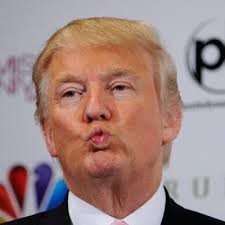
Donald Trump
Republicans clearly saw this as a threat is undeniable.
Paul Ryan, their Speaker of the House, said on March 17: “Nobody should say such things in my opinion because to even address or hint to violence is unacceptable.”
And Ohio governor and Republican presidential candidate John Kasich chinned in. “Leaders don’t imply violence,” Kasich told “Face the Nation” on March 20. “When he says that there could be riots, that’s inappropriate. I think you understand that, okay? Secondly, while we have our differences and disagreements, we’re Americans. Americans don’t say, ‘Let’s take to the streets and have violence.'”
But threatening his Republican and Democratic opponents with violence played a major role in Donald Trump’s campaign for President.
No other candidate—Republican or Democrat—had ever made such repeated and brutal use of threats of physical assault in pursuing the Presidency.
- Philip Klein, the managing editor of the Washington Examiner, wrote on the eve of the Republican National Convention in July: “Political commentators now routinely talk about the riots that would break out in Cleveland if Trump were denied the nomination, about how his supporters have guns and all hell could break loose, that they would burn everything to the ground. It works to Trump’s advantage to not try too hard to dispel these notions.”
- On August 9, Trump told a rally in Wilmington, North Carolina: “Hillary [Clinton] wants to abolish, essentially abolish, the Second Amendment. If she gets to pick her [Supreme Court] judges, nothing you can do folks. Although the Second Amendment people, maybe there is, I don’t know.”
- “Don’t treat this as a political misstep,” Senator Christopher S. Murphy of Connecticut, who has called for stiffer gun laws, wrote on Twitter. “It’s an assassination threat, seriously upping the possibility of a national tragedy & crisis.”
- “Well, let me say if someone else said that outside of the hall, he’d be in the back of a police wagon now, with the Secret Service questioning him,” said Michael Hayden, former head of the CIA and National Security Agency (NSA).
Threats of this type continued to be made by Trump supporters right up to the day of the election.
- On July 29, Roger Stone, a notorious Right-wing political consultant acting as a Trump strategist, told Breitbart News: “The first thing Trump needs to do is begin talking about [voter fraud] constantly. If there’s voter fraud, this election will be illegitimate, the election of the winner will be illegitimate, we will have a constitutional crisis, widespread civil disobedience, and the government will no longer be the government.”
- At a town hall meeting where Trump’s Vice Presidential nominee Mike Pence appeared, a woman named Rhonda said: “For me personally, if Hillary Clinton gets in, I myself am ready for a revolution.”
- In Cincinnati, a Trump supporter threatened to forcibly remove Clinton from the White House if she won the race: “If she’s in office, I hope we can start a coup. She should be in prison or shot. That’s how I feel about it,”
- Dan Bowman, a 50-year-old contractor, said of Hillary Clinton, the Democratic nominee: “We’re going to have a revolution and take them out of office if that’s what it takes. There’s going to be a lot of bloodshed. But that’s what it’s going to take….I would do whatever I can for my country.”
Even Fergus Cullen, former chairman of the New Hampshire GOP, expressed fear of what might happen if Trump lost the election:

Fergus Cullen
“That’s really scary,” Cullen said, recounting the violence at Trump rallies around the country leading up to the Republican National Convention. “In this country, we’ve always had recriminations after one side loses. But we haven’t had riots. We haven’t had mobs that act out with violence against supporters of the other side.
“There’s no telling what his supporters would be willing to do at the slightest encouragement from their candidate,” he said.
Trump even began encouraging his mostly white supporters to sign up online to be “election observers” to stop “Crooked Hillary from rigging this election.” He urged them to act as poll watchers in “other” [non-white] communities to ensure that things are “on the up and up.”
Many of his supporters promised to do so.
“Trump said to watch your precincts. I’m going to go, for sure,” said Steve Webb, a 61-year-old carpenter from Fairfield, Ohio.
“I’ll look for…well, it’s called racial profiling. Mexicans. Syrians. People who can’t speak American,” he said. “I’m going to go right up behind them. I’ll do everything legally. I want to see if they are accountable. I’m not going to do anything illegal. I’m going to make them a little bit nervous.”

 Bureaucracybuster's Blog
2012 PRESIDENTIAL RACE, ALTERNET, AP, BARACK OBAMA, BAY OF PIGS, BBC, BERLIN WALL, BILL CLINTON, BRUCE GREENWOOD, BUZZFEED, CARLOS MARCELLO, CBS NEWS, CIA, CIVIL RIGHTS, CLIFF ROBERTSON, CNN, CUBAN MISSILE CRISIS, DAILY KOS, DAVID HALBERSTAM, DONALD J. TRUMP, FACEBOOK, FBI, FIDEL CASTRO, FRANK SINATRA, HERMAN CAIN, ICH BEN EIN BERLINNER SPEECH, INTERNET MOVIE DATABASE, J. EDGAR HOOVER, JAMES MARSDEN, JOHN F. KENNEDY, JOSEPH MCCARTHY, JOSEPH P. KENNEDY, LYNDON B. JOHNSON, MAFIA, MALCOM X, MARTIN LUTHER KING, MARTIN SHEEN, MOTHER JONES, MOVEON, MOVIES, NBC NEWS, NEWSWEEK, NEWT GINGRICH, NIKITA KHRUSHCHEV, NPR, NUCLEAR TEST BAN TREATY, POLITICO, PT-109, RAW STORY, REUTERS, RICK PERRY, ROBERT F. KENNEDY, ROBERT S. MCNAMARA, SALON, SAM GIANCANA, SANTOS TRAFFICANTE, Sarah Palin, SATURDAY NIGHT LIVE, SEATTLE TIMES, SLATE, SOVIET UNION, THE ATLANTIC, THE BEST AND THE BRIGHTEST, THE BUTLER, THE CHICAGO SUN-TIMES, THE CHICAGO TRIBUNE, THE DAILY BEAST, THE GUARDIAN, THE HILL, THE HUFFINGTON POST, THE LOS ANGELES TIMES, THE MISSILES OF OCTOBER, THE NEW YORK TIMES, THE RAT PACK, THE WALL STREET JOURNAL, THE WASHINGTON POST, THIRTEEN DAYS, TIME, TWILIGHT ZONE, TWITTER, U.S. NEWS & WORLD REPORT, UPI, USA TODAY, VIETNAM WAR, WILLIAM DEVANE, WILLIAM PETERSON
JFK: ONE HUNDRED YEARS LATER: PART FOUR (OF TEN)
In Bureaucracy, Business, History, Law, Law Enforcement, Military, Politics, Social commentary on July 7, 2022 at 9:24 amJohn F. Kennedy became President when civil rights suddenly became a burning issue throughout the Nation.
At Kennedy’s request, dozen of law firms sent lawyers South, so civil rights demonstrators would not lack counsel.
Prominent blacks such as Thurgood Marshall, Robert C. Weaver and George L.L. Weaver were appointed, respectively, to the Supreme Court, the Housing and House Finance Agency and the office of Assistant Secretary of Labor.
But Kennedy was highly reluctant to push for a civil rights bill addressing the overall issues of racial discrimination.
The reason: Most of the chairman of House and Senate committees were deeply conservative Southern racists–whether Republican or Democrat. They decided whether Kennedy’s foreign policy initiatives would be approved or opposed–especially his bills for increased foreign aid.
Kennedy believed he could not offend such men without jeopardizing the legacy he wanted to achieve in foreign policy.
This timidity, in turn, led many prominent blacks—such as Martin Luther King and Malcom X—to believe they would see no innovative moves on Kennedy’s part.
But events forced Kennedy’s hand.
On September 30, 1962, the President sent deputy U.S. marshals and National Guardsmen into Mississippi to restore order. Rioting had erupted when, by federal court order, James Meredith, a black, was enrolled at the state university.
Kennedy’s problems in winning support for his civil rights program arose in the folkways of the Nation. When laws run counter to a nation’s folkways, the laws lose.
In backing the admission of Meredith, the President chose an incident which would set off shockwaves for black rights.
Kennedy held mixed emotions about the demand for civil rights by blacks. On one hand, as an Irish Catholic, he grew up with stories about longtime discrimination against his ancestors (such as the “No Irish Need Apply” signs posted by numerous employers).
On the other hand, he had been born into a world of power and wealth, and he had to grope his way toward understanding the problems of the oppressed.
Another major confrontation broke out between Kennedy and the forces of segregation on June 11, 1963. Alabama Governor George C. Wallace personally blocked the entrance of two black pupils to the University of Tuscaloosa.
The President, watching on TV, federalized the Alabama National Guard, which Wallace had used to ring the school. Wallace withdrew and the students were admitted and enrolled.
That same day, Kennedy addressed the nation on the need for genuine equality for all Americans: “The question is whether we are going to treat our fellow Americans as we want to be treated.”
JFK addresses the nation on civil rights
And he called on Congress to pass his civil rights bill, which had been stalled by the legislators.
On August 28, 1963, 200,000 civil rights demonstrators flooded Washington, D.C., for a massive rally.
Fearing that violence would erupt—embarrassing his administration and setting back the cause of civil rights—Kennedy had sought to persuade Dr. Martin Luther King, the march’s chief figure, to cancel the proposed march.
But King and his fellow organizers were determined to go through with it. They had, they said, waited too long for justice to be satisfied with anything less.
The dignity and peacefulness of the rally–and, most especially, King’s soaring “I Have a Dream” speech–won tremendous sympathy throughout the country. Kennedy met with civil rights leaders afterward to offer his support.
Martin Luther King during the March on Washington
But Kennedy’s civil rights bill remained stalled in Congress until 1964. President Lyndon B. Johnson used the assassinated Kennedy’s new status as a martyr to gain enough support for its passage.
Meanwhile, on yet another front, the Kennedy administration was waging an unprecedented war against organized crime.
This was primarily the work of Attorney General Robert F. Kennedy. As chief counsel for the Senate Permanent Subcommittee on Investigations (1957–59), he had interrogated about 800 mobsters who had been summoned by subpoena.
And he had learned, firsthand, how ineffective the FBI and Justice Department were at bringing such powerful criminals to justice. The FBI had long steered clear of organized crime investigations, largely because its director, J. Edgar Hoover, feared corruption of his agents.
Upon taking office as Attorney General, he greatly expanded the number of attorneys assigned to the Justice Department’s Organized Crime Section. And, more important, he used his status as brother to the President to jawbone FBI Director J. Edgar Hoover into attacking the Mob.
The FBI installed illegal microphones in Mob hangouts throughout the country and started building cases against such mobsters as Sam Giancana, Santos Trafficante and Carlos Marcello.
The administration’s attack on the Mob has led some historians to believe the assassination of President Kennedy was Mob-orchestrated.
The reasons:
Share this: