Posts Tagged ‘THE NEW YORK TIMES’
ABC NEWS, ADVICE, BAY OF PIGS, CBS NEWS, CNN, CORPORATIONS, CUBA, FACEBOOK, FIDEL CASTRO, JOHN F. KENNEDY, NBC NEWS, NICCOLO MACHIAVELLI, POLITICS, THE CHICAGO SUN-TIMES, THE CHICAGO TRIBUNE, THE DISCOURSES, THE LOS ANGELES TIMES, THE NEW YORK TIMES, THE PRINCE, THE WASHINGTON POST, TWITTER
In Bureaucracy, Business, History, Military, Politics on June 23, 2016 at 1:14 am
On the rare occasion when most people think of Niccolo Machiavelli, the image of the devil comes to mind.

Niccolo Machiavelli
In fact, “The Old Nick” became an English term used to describe Satan and slander Machiavelli at the same time.
The truth, however, is more complex. Machiavelli was a passionate Republican, who spent most of his adult life in the service of his beloved city-state, Florence.
The years he spent as a diplomat were tumultuous ones for Italy–with men like Pope Julius II and Caesare Borgia vying for power and plunging Italy into one bloodbath after another.
Machiavelli is best-known for his writing of The Prince, a pamphlet on the arts of gaining and holding power. Its admirers have included Benito Mussolini and Joseph Stalin.

But his longer and more thoughtful work is The Discourses, in which he offers advice on how to maintain liberty within a republic. Among its admirers were many of the men who framed the Constitution of the United States.

Also contrary to what most people believe about Machiavelli, he did not advocate evil for its own sake. Rather, he recognized that sometimes there is no perfect–or perfectly good–solution to a problem.
Sometimes it’s necessary to take stern–even brutal–action to stop an evil (such as a riot) before it becomes widespread.
His counsel remains as relevant today as it did during his lifetime (1469 – 1527)–especially for politicians.
But plenty of ordinary citizens can also benefit from the advice he has to offer–such as those who are asked to give advice to more powerful superiors.
Machiavelli warns there is danger in urging rulers to take a particular course of action:
“For men only judge of matters by the result, all the blame of failure is charged upon him who first advised it, while in case of success he receives commendations. But the reward never equals the punishment.”
This puts would-be counselors in a difficult position: “If they do not advise what seems to them for the good of the republic or the prince, regardless of the consequences to themselves, then they fail to do their duty.
“And if they do advise it, then it is at the risk of their position and their lives, for all men are blind in thus, that they judge of good or evil counsels only by the results.”
Thus, Machiavelli warns that an adviser should “take things moderately, and not to undertake to advocate any enterprise with too much zeal, but to give one’s advice calmly and modestly.”
The person who asked for the advice may follow it, or not, as of his own choice, and not because he was led or forced into it by the adviser.
Above all, the adviser must avoid the danger of urging a course of action that runs “contrary to the wishes of the many.
“For the danger arises when your advice has caused the many to be contravened. In that case, when the result is unfortunate, they all concur in your destruction.”
Or, as President John F. Kennedy famously said after the disastrous invasion of Cuba at the Bay of Pigs in April, 1961: “Victory has a hundred fathers and defeat is an orphan.”

John F. Kennedy
By “not advocating any enterprise with too much zeal,” the adviser gains two advantages:
“The first is, you avoid all danger.
“And the second consists in the great credit which you will have if, after having modestly advised a certain course, your counsel is rejected, and the adoption of a different course results unfortunately.”
Finally, the time to give advice is before a catastrophe occurs, not after. Machiavelli gives a vivid example of what can happen if this rule is ignored.
King Perseus of Macedon had gone to war with Paulus Aemilius–and suffered a humiliating defeat. Fleeing the battlefield with a handful of his men, he later bewailed the disaster that had overtaken him.
Suddenly, one of his lieutenants began to lecture Perseus on the many errors he had committed, which had led to his ruin.
“Traitor,” raged the king, turning upon him, “you have waited until now to tell me all this, when there is no longer any time to remedy it–” And Perseus slew him with his own hands.
Niccolo Machiavelli sums up the lesson as this:
“Thus was this man punished for having been silent when he should have spoken, and for having spoken when he should have been silent.”
Be careful that you don’t make the same mistake.
ABC NEWS, AFGHANISTAN, BARACK OBAMA, CBS NEWS, CNN, FACEBOOK, GENERAL STANLEY MCCRYSTAL, HAMID KARZAI, JOHN F. KENNEDY, MICHAEL HASTINGS, NBC NEWS, NGO DINH DIEM, NORTH VIETNAMESE ARMY, ROLLING STONE MAGAZINE, THE CHICAGO SUN-TIMES, THE CHICAGO TRIBUNE, THE LOS ANGELES TIMES, THE NEW YORK TIMES, THE OPERATORS, THE PENTAGON, THE WASHINGTON POST, TWITTER, VIETCONG, VIETNAM
In Bureaucracy, History, Military, Politics, Social commentary on June 22, 2016 at 12:39 am
Michael Hastings was the Rolling Stone reporter whose 2010 article on “The Runaway General” ended the illustrious military career of General Stanley McCrystal.
In 2012, Hastings greatly expanded on his article with a 2012 book: The Operators: The Wild and Terrifying Inside Story of America’s War in Afghanistan.
According to its hardcover dust jacket: “General Stanley McCrystal, the innovative, forward-thinking, commanding general of international and U.S. forces in Afghanistan, was living large. He was better known to some as Big Stan, M4, Stan, and his loyal staff liked to call him a ‘rock star.’
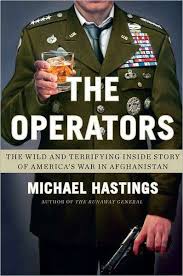
“During a spring 2010 trip across Europe to garner additional allied help for the war effort, McCrystal was accompanied by journalist Michael Hastings of Rolling Stone.
“For days, Hastings looked on as McCrystal and his staff let off steam, partying and openly bashing the Obama administration for what they saw as a lack of leadership.
“When Hastings’ piece appeared a few months later, it set off a poiltical firestorm: McCrystal was ordered to Washington where he was fired unceremoniously.”
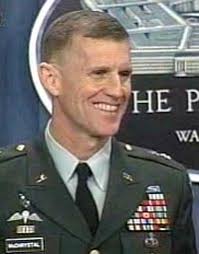
General Stanley A. McCrystal
But there is an even deeper element to be found within Hastings’ book–that is, for anyone with even a general knowledge of the war in Vietnam.
Hastings (who died in a high-speed car accident in 2013) does not make any direct parallels between the almost 11-year conflict in Afghanistan and the 14-year conflict in Vietnam.
But those parallels are definitely there for anyone to see:
- Ngo Dinh Diem, the “president” of South Vietnam (1955 -1963) was a Catholic mandarin who was alienated from an overwhelmingly poor, 95% Buddhist country.
- Hamid Karzai, the “president” of Afghanistan (2004 – 2014) was from a wealthy Pashtun family and is alienated from members of other Afghan tribes.
- Diem’s authority didn’t extend far beyond Saigon.
- Karzai’s authority didn’t extend beyond Kabul.
- Diem didn’t believe in democracy–despite American claims to support his efforts to bring it to Vietnam.
- Ditto for Karzai–despite American claims that he sought to bring democracy to Afghanistan.
- Diem was widely regarded in Vietnam as an illegitimate leader, imposed by the Americans.
- Ditto for Karzai.
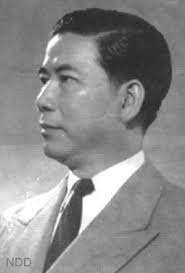
Ngo Dinh Diem

Hamid Karzai
- American soldiers were sent to Vietnam because America feared Communism.
- American soldiers were sent to Afghanistan because America feared terrorism.
- Americans were ordered to train the South Vietnamese to defend themselves against Communism.
- American troops were ordered to train the Afghan army to defend themselves against terrorism.
- Americans quickly determined that the South Vietnamese army was worthless–and decided to fight the Vietcong in its place.
- Americans quickly determined that the Afghan army was worthless–and decided to fight the Taliban in its place.

American soldiers in Vietnam
- There was massive distrust between American and South Vietnamese soldiers.
- Ditto for relations between American and Afghan soldiers.
- American soldiers in Vietnam felt surrounded by enemies and hamstrung by unrealistic orders to win “hearts and minds” at the risk of their own lives.
- Ditto for American soldiers stationed in Afghanistan.
- President John F. Kennedy doubted that Americans could win a war in Vietnam and tried to contain the conflict.
- President Barack Obama came into office determined to contain the Afghan conflict and withdraw American troops as soon as possible.
- The Pentagon saw Vietnam as “the only war we’ve got” and pressed to insert greater numbers of men.
- The Pentagon sees Afghanistan as one of several wars “we’ve got” and has pressed to insert greater numbers of men.
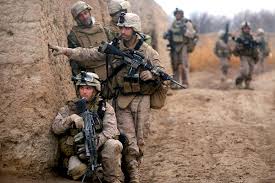
American soldiers in Afghanistan
- The Vietcong and North Vietnamese Army (NVA) posed no threat to the security of the United States.
- The Taliban poses no threat to the security of the United States.
- The far Right embraced the Vietnam war as a way to assert American power in Asia.
- The far Right embraces the Afghan war as a way to assert American power in the Middle East.
- Counterinsurgency was preached as the key to defeating the Vietcong in Vietnam–where it didn’t work.
- Counterinsurgency is now being preached as the key to defeating the Taliban in Afghanistan–where it hasn’t worked.
- Americans entered Vietnam without an exit strategy.
- Americans entered Afghanistan without an exit strategy.
From this, the United States should draw several conclusions:
- Commit forces only when American security is truly threatened.
- Go in with overwhelming force, destroy as much of the enemy as quickly as possible, then get out.
- Occupations are costly in lives and treasure–as Napoleon Bonaparte and Adolf Hitler discovered–and should be avoided.
- Don’t try to remake the cultures of other nations–especially those of a primitive, alien nature such as Afghanistan.
Hastings’ book does not cover the Afghan war to its end. It can’t, since there is no telling when that war will end.
But by the end of its 379 pages, it’s clear what that outcome will be: Another futile exercise in “nation-building” at an exorbitant cost in American lives and treasure.
ABC NEWS, ABORTION, ADOLF HITLER, ALTERNET, AMERICABLOG, ANN COULTER, AP, ASSASSINATION, BABY BOOMER RESISTANCE, BARACK OBAMA, BBC, BILL CLINTON, BLOOMBERG NEWS, BUZZFEED, CARLY FIORINA, CBS NEWS, CENTER FOR MEDICAL PROGRESS, CNN, CROOKS AND LIARS, DAILY KOZ, DRUDGE REPORT, EDUARDO "TED" CRUZ, FACEBOOK, FBI, FETAL TISSUE, FIVETHIRTYEIGHT, GABRIELLE GIFFORDS, GEORGE H.W. BUSH, HARPER’S MAGAZINE, HATE CRIMES, HEALTHCARE, HUFFINGTON POST, JARROD NADLER, MARCO RUBIO, MARSHA BLACKBURN, MEDIA MATTERS, MEIN KAMPF, MIKE HUCKABEE, MOTHER JONES, MOVEON, MSNBC, NBC NEWS, NEW REPUBLIC, NEWSDAY, NEWSWEEK, NEWT GINGRICH, NPR, PBS NEWSHOUR, PLANNED PARENTHOOD, POLITICO, POLITICUSUSA, RAW STORY, REPUBLICAN PARTY, REPUBLICANS, REUTERS, ROBERT L. DEAR, RODNEY KING RIOTS, RUSH LIMBAUGH, SALON, Sarah Palin, SEAN HANNITY, SEATTLE TIMES, SLATE, TALKING POINTS MEMO, TEA PARTY, TERRORISM, THE ATLANTIC, THE CHICAGO SUN-TIMES, THE CHICAGO TRIBUNE, THE DAILY BEAST, THE DAILY BLOG, THE GUARDIAN, THE HILL, THE HUFFINGTON POST, THE LOS ANGELES TIMES, THE NATION, THE NEW REPUBLIC, THE NEW YORK TIMES, THE NEW YORKER, THE VILLAGE VOICE, THE WASHINGTON POST, THINKPROGRESS, TIME, TRUTHDIG, TRUTHOUT, TWITTER, TWO POLITICAL JUNKIES, U.S. NEWS & WORLD REPORT, UPI, USA TODAY, WONKETTE
In Bureaucracy, History, Law, Politics, Social commentary on June 21, 2016 at 12:01 am
Since the Supreme Court legalized abortion on January 22, 1973, the Republican Party has been committed to saving fetuses.
Even if this puts the lives of adult men and women in jeopardy.
In 2015, the Center for Medical Progress (CMP) released several videos that had been secretly recorded. These purported to show that Planned Parenthood (PP) was engaging in the illegal sale of fetal tissue.
The videos attracted massive media coverage. Congressional Republicans immediately started pushing bills to strip PP of Federal family planning funding.
Officials in Indiana, South Dakota, Kansas, Missouri, Georgia and Massachusetts investigated the charges and found no evidence that Planned Parenthood had broken any state laws concerning the collection of fetal tissues.
On October 8, 2015, Representative Jason Chaffetz (R-Utah), stated that the GOP investigation found no evidence of any wrongdoing.
In fact, all of the videos were found to be altered, according to an analysis by Fusion GPS, a Washington-based research company. Members of CMP have since been indicted by a Texas grand jury on felony charges for tampering with governmental records.
None of this, however, prevented Republican candidates for President from claiming that the videos were, in fact, legitimate.
Carly Fiorina, the former CEO of Hewlett-Packard, falsely claimed in the second GOP Presidential debate that the videos showed “a fully formed fetus on the table…while someone says we have to keep it alive to harvest its brain.”
Although Fiorina claimed to have seen that footage, she never produced any copy of it. Nor has anyone else found evidence to sustain her claim.

Carly Fiorina
Nor was Fiorina the only Republican candidate making this false claim. Others included Texas U.S. Senator Eduardo “Ted” Cruz, former Arkansas governor Mike Huckabee and Florida U.S. Senator Marco Rubio.
On November 27, 2015, Robert L. Dear, armed with a rifle, attacked a Planned Parenthood clinic in Colorado Springs, Colorado. He killed one police officer and two civilians, and wounded five more officers and four civilians.
After a five-hour standoff, SWAT teams crashed an armored vehicle into the lobby and rescued several people trapped inside. At that point, Dear surrendered.
After his arrest, he gave a rambling interview to police. At one point, he said, “No more baby parts”–a direct reference to the false and inflammatory charges made by GOP members.
The latest case of Republican irresponsibility on the abortion issue came in March.
That was when the House Select Investigative Panel on Infant Lives subpoenaed a list of names of doctors and researchers involved in fetal tissue research.
Rep. Marsha Blackburn (R-TN), who chairs the panel, claimed that her investigation had uncovered evidence that StemExpress, a bio-medical company, and three abortion clinics, violated the Health Insurance Portability and Accountability Act (HIPAA).
In early June, Blackburn sent two public letters to the Obama administration.

Rep. Marsha Blackburn
These contained the names and contact information of researchers at StemExpress, university and hospital researchers, and Planned Parenthood staffers.
The unredacted letters were also posted on the select panel’s website. In an interview with Rewire, a representative for Blackburn said that the “staff just made a mistake.”
At the panel’s first hearing on March 2, Rep. Jerrod Nadler (D-NY) had warned Blackburn:
“The committee has no rules in place to protect the names of those subpoenaed–raising the possibility of Congress effectively painting targets on the backs of scientists and researchers for no particular reason other than the Republicans’ desire for a culture war.”
In another letter sent to Blackburn, House Democrats charged that Republicans on the panel may be feeding sensitive information to anti-abortion groups who wish to harm members of the reproductive rights community.
They noted that the panel had publicly released the name of a doctor who had previously been threatened by anti-abortion groups, along with the specific information about when he would appear before the panel.
“Assurances that you take seriously individual privacy and security concerns are insufficient,” the letter read.
“You reneged on promises to protect the individual privacy and security of a deposition witness. Just last week, Panel Republicans leaked letters to FOX News and posted documents on your website that contained names, contact information, and other personally identifiable information of doctors and researchers.”
Initially, some schools and organizations blacked out the names of researchers in documents provided to the committee to protect their researchers’ safety. But recent subpoenas issued by the committee didn’t allow for that security measure.
Scientists have warned that targeting fetal tissue research–and the researchers who work in that field–poses national security risks.
Fetal tissue research is invaluable for developing cures to diseases like Alzheimer’s and multiple sclerosis. It could lead to a vaccine for the Zika virus, which poses a serious risk to pregnant women.
Yet it is “desire for a culture war” that takes top priority for Republicans.
And Republicans know exactly what constituency they are arousing: Those masses of alienated, uneducated Americans who can be easily manipulated by inflammatory rhetoric.
Those men and women who stockpile weapons–and believe that God has empowered them to use violence to enforce their religious beliefs on others.
Essentially, Republicans are calling upon this constituency to achieve with bullets what the party hasn’t been able to achieve in court or at the ballot box.
ABC NEWS, ABORTION, ADOLF HITLER, ALTERNET, AMERICABLOG, ANN COULTER, AP, ASSASSINATION, BABY BOOMER RESISTANCE, BARACK OBAMA, BBC, BILL CLINTON, BLOOMBERG NEWS, BUZZFEED, CARLY FIORINA, CBS NEWS, CENTER FOR MEDICAL PROGRESS, CNN, CROOKS AND LIARS, DAILY KOZ, DRUDGE REPORT, EDUARDO "TED" CRUZ, FACEBOOK, FBI, FETAL TISSUE, FIVETHIRTYEIGHT, GABRIELLE GIFFORDS, GEORGE H.W. BUSH, HARPER’S MAGAZINE, HATE CRIMES, HEALTHCARE, HUFFINGTON POST, JARROD NADLER, MARCO RUBIO, MARSHA BLACKBURN, MEDIA MATTERS, MEIN KAMPF, MIKE HUCKABEE, MOTHER JONES, MOVEON, MSNBC, NBC NEWS, NEW REPUBLIC, NEWSDAY, NEWSWEEK, NEWT GINGRICH, NPR, PBS NEWSHOUR, PLANNED PARENTHOOD, POLITICO, POLITICUSUSA, RAW STORY, REPUBLICAN PARTY, REPUBLICANS, REUTERS, ROBERT L. DEAR, RODNEY KING RIOTS, RUSH LIMBAUGH, SALON, Sarah Palin, SEAN HANNITY, SEATTLE TIMES, SLATE, TALKING POINTS MEMO, TEA PARTY, TERRORISM, THE ATLANTIC, THE CHICAGO SUN-TIMES, THE CHICAGO TRIBUNE, THE DAILY BEAST, THE DAILY BLOG, THE GUARDIAN, THE HILL, THE HUFFINGTON POST, THE LOS ANGELES TIMES, THE NATION, THE NEW REPUBLIC, THE NEW YORK TIMES, THE NEW YORKER, THE VILLAGE VOICE, THE WASHINGTON POST, THINKPROGRESS, TIME, TRUTHDIG, TRUTHOUT, TWITTER, TWO POLITICAL JUNKIES, U.S. NEWS & WORLD REPORT, UPI, USA TODAY
In Bureaucracy, History, Law Enforcement, Politics, Social commentary on June 20, 2016 at 1:00 am
Intimidation–physical as well as political–has increasingly become the weapon of choice for influential Republicans in the pursuit of absolute power.
This consists of aiming violent–and violence-arousing–rhetoric at their Democratic opponents. This is not a case of careless language that is simply misinterpreted, with tragic results.
Hate-mongers like Sarah Palin and Ann Coulter fully understand the constituency they are trying to reach: Those masses of alienated, uneducated Americans who live only for their guns and hardline religious beliefs–and who can be easily manipulated by perceived threats to either.

If a “nutcase” assaults a Democratic politician and misses, then the Republican establishment claims to be shocked–shocked!–that such a thing could have happened.
And if the attempt proves successful–as in the January 8, 2011 Tucson shooting of Rep. Gabrille Giffords–then Republicans weep crocodile tears for public consumption.
The difference is that, in this case, they rejoice in knowing that Democratic ranks have been thinned and their opponents are even more on the defensive, for fear of the same happening to them.
Consider the following:
- Rep. Randy Neugebauer (R-Texas) yelled “baby killer” at Bart Stupak (D-Mich.) on the House Floor.
- Florida GOP Congressional candidate Allen West, referring to his Democratic opponent, Rep. Ron Klein, told Tea Party activists: “You’ve got to make the fellow scared to come out of his house. That’s the only way you’re going to win. That’s the only way you’re going to get these people’s attention.”
- Rep. Devin Nuines (R-CA) said Tea Partiers had “every right” to use racist and homophobic slurs against Democrats, justifying it via Democrats’ “totalitarian tactics.”
- Rep. Michelle Bachmann (R-Minn.) said she wanted her constituents “armed and dangerous” against the Obama administration.
- Right-wing pundit Ann Coulter: “My only regret with Timothy McVeigh is that he did not go to the New York Times building.”
- Senator Phil Gramm (R-Tex.): “We’re going to keep building the party until we’re hunting Democrats with dogs.”
- Rep. Louisa M. Slauter (D-NY) received a phone message threatening sniper attacks against lawmakers and their families.
- In 2010 former Alaska Governor Sarah Palin posted a “crosshairs map” targeting Democratic members of Congress who had voted for President Barack Obama’s healthcare bill. Sarah Palin told her supporters: “Get in their face and argue with them. No matter how tough it gets, never retreat, instead RELOAD!”

Sarah Palin’s “Crosshairs Map”
For more than 50 years, Republicans have vilified government–except when they controlled it. They have sought to convince Americans that Democrats are at least potential traitors, if not actual ones.
Among the slanders Republicans have routinely hurled at Democrats:
- Democrats are plotting to “take away your guns.”
- Democrats are “anti-work” and want to turn America into a welfare-dependent society.
- Democrats are “Godless” and want to force atheism on believing Christians.
- Democrats will allow United Nations “black helicopters” to stage a military takeover of the United States.
During the 1992 Presidential campaign, Republicans slandered Bill Clinton as a brainwashed “Manchurian candidate” because he had briefly visited the Soviet Union during his college years.
After the Soviet Union collapsed in 1991, Republicans lost their “soft on Communism” slander-line. So they tried to persuade voters that Democrats were “soft on crime.”
When riots flared in 1992 after the acquittal of LAPD officers who had savagely beaten Rodney King, President George H.W. Bush blamed the carnage on the “Great Society” programs of the 1960s.
When President Barack Obama set out to provide healthcare for all Americans–and not simply the wealthy–Republicans tried to frighten voters with lies. The most infamous of these was that healthcare reform would lead to wholesale murder by government “death panels,” as Sarah Palin put it.
That insurance companies had functioned for decades as “death panels” in denying healthcare to patients was totally ignored.
Republicans have since encouraged right-wing groups to claim that Obama was not born in Hawaii, but in Kenya. The reason for this is to strip Obama of legitimacy as a leader.
Republicans–brandishing photos of President Obama bearing a Hitler forelock and toothbrush mustache–have claimed he intends to set up concentration camps for those who disagree with him.
Newt Gingrich, the former Republican Speaker of the House, charged that Obama was pursuing a socialist agenda to reform healthcare.

Newt Gingrich
In his book, To Save America: Stopping Obama’s Secular-Socialist Machine, Gingrich claimed that Obama’s policy agenda was as “great a threat to America as Nazi Germany and the Soviet Union.”
Almost immediately after Obama took office, he came under attack by an industry of right-wing book authors such as Sean Hannity, Ann Coulter and Rush Limbaugh.
Among the terms they have used to demonize Obama:
- radical
- Socialist
- anti-American
- extremist
- subversive
- imperial
As Adolf Hitler, the master of 20th century propaganda advised in Mein Kampf: “All effective propaganda must be confined to a few bare essentials.
“Those must be expressed as far as possible in stereotypical formulas. These slogans should be persistently repeated until the very last individual has come to grasp the idea that has been put forward.”
Nowhere has Republican fanaticism proven greater than on the issue of abortion.
Since the Supreme Court legalized abortion on January 22, 1973, the Republican Party has been committed to saving fetuses.
Even if this puts the lives of adult men and women in jeopardy.
ABC NEWS, ACADEMY AWARDS, BARACK OBAMA, BEN-HUR, CBS NEWS, CHARLTON HESTON, CNN, EL CID, FACEBOOK, FOX NEWS, GUN CONTROL, JIM CARREY, JOHN F. KENNEDY, KHARTOUM, MAJOR DUNDEE, MOSES, MOVIES, NATIONAL RIFLE ASSOCIATION, NBC NEWS, PLANET OF THE APES, RICHARD M. NIXON, ROBERT F. KENNEDY, SCREEN ACTORS GUILD, THE CHICAGO SUN-TIMES, THE CHICAGO TRIBUNE, THE LOS ANGELES TIMES, THE NEW YORK TIMES, THE TEN COMMANDMENTS, THE WAR LORD, THE WASHINGTONPOST, TWITTER
In Bureaucracy, Entertainment, History, Politics on June 17, 2016 at 12:05 am
In March, 2013, the National Rifle Association (NRA) and its Right-wing allies declared war on comedian Jim Carrey.
The reason: His music parody video: “Cold Dead Hand,” which mocked gun fanatics and the late Charlton Heston, former president of the NRA.
Click here: Jim Carrey’s Pro-Gun Control Stance Angers Conservatives
Among its lyrics:
Charlton Heston movies are no longer in demand
And his immortal soul may lay forever in the sand.
The angels wouldn’t take him up to heaven like he’d planned.
’Cause they couldn’t pry that gun from his cold, dead hand.
The phrase, “cold dead hand,” originated with Heston himself.
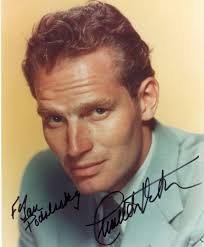
Charlton Heston in his prime
On May 20, 2000, the actor and then-president of the NRA addressed the organization at its 129th convention in Charlotte, North Carolina.
He warned that then-Vice President and Democratic Presidential candidade Al Gore “is going to smear you as the enemy,” and concluded:
“So, as we set out this year to defeat the divisive forces that would take freedom away, I want to say those fighting words for everyone within the sound of my voice to hear and to heed, and especially for you, Mr. Gore: ‘From my cold, dead hands!’”
Carrey’s stance on gun control couldn’t have been more opposite.
In in February, 2013, he outraged Right-wingers by tweeting: “Any1 who would run out to buy an assault rifle after the Newton massacre has very little left in their body or soul worth protecting.”
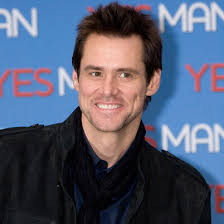
Jim Carrey
Fox Nation referred to the tweet as “nasty.”
Red Alert Politics writer Erin Brown dismissed it as “a careless remark …rooted in the shallow, parroted talking points so commonly espoused by liberal elites.”
But that was nothing compared to the rage that has greeted “Cold Dead Hand.” Reason TV’s Remy offered a parody rebuttal to Carrey’s song. Its lyrics included:
It takes a talking ass
to oppose a vaccination
when your PhD is in
making funny faces.
None of which bothered Carrey. In fact, he exulted in Right-wing outrage, tweeting: “Cold Dead Hand’ is abt u heartless motherf%ckers unwilling 2 bend 4 the safety of our kids. Sorry if you’re offended…”
Among its lyrics:
It takes a cold, dead hand to decide to pull the trigger.
Takes a cold, dead heart and as near as I can figger.
With your cold, dead aim you’re tryin’ to prove your dick is bigger …..
Many psychologists have long theorized that a fascination with firearms can compensate for inadequate sexual performance.
But it’s one thing for an unknown psychologist to write this in an obscure medical journal and another for a famous comedian to splash it across the Internet.
Carrey is especially ruthless in attacking those who–like the NRA–make a lucrative living off gun sales:
Imagine if the Lord were here…
And on the ones
Who sell the guns
He’d sic the vultures and coyotes
Only the devil’s true devotees
Could profiteer
From pain and fear.
Many Rightists attacked Carrey for parodying a man–Heston–who died in 2008 and could not defend himself. But Heston had appeared several times on “Saturday Night Live” to spoof his granite-hard image.
In his video, Carrey dares to attack not simply the masculinity of the Rightist NRA crowd, but even its courage:
You don’t want to get caught
With your trousers down
When the psycho killer
Comes around
So you make your home
Like a Thunderdome
And you’re always packin’
Everywhere you roam.
Perhaps that’s what most outraged the Right–the accusation that its members live in fear and do their best to generate needless fear in others.
Fear that can supposedly be abated by turning America into a society where everyone packs a weapon and every moment holds a potential High Noon.
Carrey was not shy in responding to his Rightist critics. On March 29, 2013, he issued this statement:
“Since I released my “Cold Dead Hand” video on Funny or Die this week, I have watched Fux News rant, rave, bare its fangs and viciously slander me because of my stand against large magazines and assault rifles.
“I would take them to task legally if I felt they were worth my time or that anyone with a brain in their head could actually fall for such irresponsible buffoonery. That would gain them far too much attention which is all they really care about.
“I’ll just say this: in my opinion Fux News is a last resort for kinda-sorta-almost-journalists whose options have been severely limited by their extreme and intolerant views; a media colostomy bag that has begun to burst at the seams and should be emptied before it becomes a public health issue.”
The NRA has spent decades bribing and intimidating its way through Congress. Those members who subscribe to its “guns for everyone” agenda get legalized bribes (i.e., “campaign contributions”).
Those who refuse to do so face the threat–if not the reality–of being ousted.
Bullies are conspicuously vulnerable to ridicule. Their only “defense” is to smash anyone who dares to mock their folly, brutality or pretense to omnipotence.
Or, as Ernest Hemingway once put it: “Fascism is a lie told by bullies.”
ABC NEWS, ACADEMY AWARDS, BARACK OBAMA, BEN-HUR, CBS NEWS, CHARLTON HESTON, CNN, EL CID, FACEBOOK, FOX NEWS, GUN CONTROL, JIM CARREY, JOHN F. KENNEDY, KHARTOUM, MAJOR DUNDEE, MOSES, MOVIES, NATIONAL RIFLE ASSOCIATION, NBC NEWS, PLANET OF THE APES, RICHARD M. NIXON, ROBERT F. KENNEDY, SCREEN ACTORS GUILD, THE CHICAGO SUN-TIMES, THE CHICAGO TRIBUNE, THE LOS ANGELES TIMES, THE NEW YORK TIMES, THE TEN COMMANDMENTS, THE WAR LORD, THE WASHINGTONPOST, TWITTER
In Entertainment, History, Politics, Social commentary on June 16, 2016 at 12:06 am
Bullies do not like to be mocked.
Anyone who doubts this need only examine the Right’s reaction to actor Jim Carrey’s March, 2013 “Cold Dead Hand” music video.
In this, Carrey–a strong advocate of gun control–mocked the National Rifle Association (NRA) and its right-wing allies.
These included rural America and (for the video’s purposes) the late actor Charlton Heston, who served as the NRA’s five-term president (1998-2003).

Jim Carrey as Charlton Heston
The video featured Carrey and alt-rock band Eels as “Lonesome Earl And The Clutterbusters,” a country band on a TV set modeled after the 1960s variety show, “Hee Haw.” Carrey also portrayed Heston as a dim-witted, teeth-clenching champion of the NRA.
“I find the gun problem frustrating,” Carrey said in a press release, “and ‘Cold Dead Hand’ is my fun little way of expressing that frustration.”
Carrey’s frustration triggered NRA outrage.
Click here: Jim Carrey’s Pro-Gun Control Stance Angers Conservatives
Fox News personality Greg Gutfeld ranted: “He is probably the most pathetic tool on the face of the earth and I hope his career is dead and I hope he ends up sleeping in a car.
“This video made me want to go out and buy a gun. He thinks this is biting satire going after rural America and a dead man… He’s a dirty, stinking coward… He’s such a pathetic, sad, little freak. He’s a gibbering mess. He’s a modern bigot.”
Columnist Larry Elder spared no venom in attacking Carrey: “Let’s be charitable–call Carrey ignorant, not stupid.”
Click here: Jim Carrey: Not ‘Dumb & Dumber,’ Just Ignorant
Much of his March 29 column centered on defending Heston, who died at 84 in 2008.
A lyric in Carrey’s song says “Charlton Heston’s movies are no longer in demand.” This prompted Elder to defend the continuing popularity of Heston’s 1956 movie, “The Ten Commandments,” where he played Moses.
Elder felt compelled to defend Heston’s off-screen persona as well, citing his 64-year marriage to his college sweetheart, Lydia.
On the other hand, writes Elder, Carrey, “followed the well-worn Hollywood path: Get famous; get rich; dump the first wife/mother of your kid(s), who stood by you during the tough times; and act out your social life in the tabs to the embarrassment of your kid(s).”
Clearly, Carrey’s video struck a nerve with Right-wing gun fanatics. But why?
Start with Gutfield’s accusation that Carry was “going after rural America.”
Rural America–home of the most superstitious, ignorant and knee-jerk Fascist elements in American society–boastfully refers to itself as “The Heartland.”
In short: a prime NRA and Rightist constituency.
It was rural America to which Senator Barack Obama referred–accurately–during his 2008 Presidential campaign:
“They get bitter, they cling to guns or religion or antipathy to people who aren’t like them or anti-immigrant sentiment or anti-trade sentiment as a way to explain their frustrations.”
Second, there’s Elder’s outrage that Carrey should dare to say that Heston’s movies “are no longer in demand.”
Among these movies: “Major Dundee,” “El Cid,” “Khartoum,” “The War Lord.” And even the hammiest film for which he is best-known: “The Ten Commandments.”
In a film career spanning 62 years, Heston vividly portrayed such historical characters as:
- Rodrigo Diaz de Bivar in “El Cid’:
- Mark Anthony in “Julius Caesar”;
- John the Baptist in “The Greatest Story Ever Told”;
- Andrew Jackson in “The President’s Lady” and “The Buccaneer”;
- Michaelangelo in “The Agony and the Ecstasy”;
- General Charles Gordon in “Khartoun.”
And he played fictitious characters, too:
- Civil War officers (“Major Dundee”);
- Norman knights (“The War Lord”);
- ranchers (“Three Violent People”;
- explorers (“The Naked Jungle”).
- Judah Ben-Hur (“Ben-Hur”);
- astronauts (“Planet of the Apes”)’
Heston was a widely respected actor who won the Academy Award for Best Actor in 1959 for “Ben Hur” and servecd as the president of the Screen Actors Guild from 1965 to 1971.
But it was not Heston’s film career that Carrey focused on–but his role as president of the NRA.
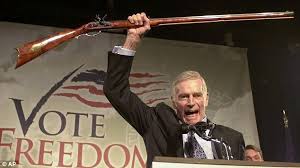
Charlton Heston at the NRA convention
Ironically, Heston had identified himself with liberal causes long before he became the face and voice of the gun lobby.
In 1961, he campaigned for Senator John F. Kennedy for President. In 1963, he took part in Martin Luther King’s March on Washington.
In 1968, after the assassination of Senator Robert F. Kennedy, he joined actors Kirk Douglas, James Stewart and Gregory Peck in issuing a statement supporting President Lyndon Johnson’s Gun Control Act of 1968.
But over the coming decades, Heston became increasingly conservative:
- Reportedly voting for Richard Nixon in 1972;
- Supporting gun rights; and
- Campaigning for Republican Presidential candidates Ronald Reagan, George H.W. Bush and George W. Bush.
When asked why he changed political alliances, Heston replied: “I didn’t change. The Democratic party changed.”
2001 ATTACKS, ABC NEWS, AFGHANISTAN, ALAN KURDI, CBS NEWS, CNN, DRIVER'S LICENSES, FACEBOOK, FBI, IRAQ, ISALM, ISLAMICS, JAMES COMEY, KUWAIT, LIBYA, MUSLIMS, NBC NEWS, PENTAGON, PEW RESEARCH CENTER, QTAR, REAL ID ACT, RELIGION, SAUDI ARABIA, SEPTEMBER 11, SYRIA, TERRORISM, THE CHICAGO SUN-TIMES, THE CHICAGO TRIBUNE, THE LOS ANGELES TIMES, THE NEW YORK TIMES, THE WASHINGTON POST, TRANSPORTATION SAFETY ADMINISTRATION, TWITTER, UNITED ARAB EMIRATES, UPI, USA TODAY, WORLD TRADE CENTER
In Bureaucracy, History, Law, Politics, Social commentary on June 15, 2016 at 12:02 am
Starting in 2016, traveling by air in the United States became more complicated.
In 2005, Congress passed the Real ID Act as a counter-terrorism measure. Its goal was to set security standards for government-issued IDs.
The Act started to be introduced in late 2013. Now in the last phase of its implementation, its enforcers have decided that some states haven’t complied with its requirements.
As a result, driver’s licenses from those states will no longer suffice to pass through airport security. And that includes domestic flights as well as international ones.
Those states: New York, New Hampshire, Minnesota, Louisiana and American Samoa.
The reason: Licenses issued by those states don’t contain enough identifying information to pass muster with the Transportation Safety Administration (TSA).

So how are residents of these states supposed to cope? The Federal Government is advising them to get a passport.
Your old New York driver’s license may make it harder for you to fly in 2016 | syracuse.com
And this, in turn, carries an illogic all its own. As one soon-to-be affected New York traveler outlined:
“To get a passport I’ll first need to get a certified copy of my birth certifcate.
“And to get a copy of my birth certificate I need only to submit a copy of my driver’s license. A copy, no face-to-face, is-that-really you?
“So a New York driver’s license isn’t good enough for flying but it is good enough to get a birth certificate, whch gets me a passport, which allows me to fly.”
Got all that?

Sample state ID card that’s acceptable under the Real ID Act
And while TSA is beefing up security at the back door, the Obama administration is casting aside the front door.
On September 10, 2015, the administration announced that it would accept at least 10,000 displaced Syrians over the next year.
That is in addition to the 2,000 Islamic refugees the United States has already accepted.
According to U.S. Census data, America welcomes about 100,000 Muslim immigrants legally each year. This represents the fastest growing segment of immigrants coming to the United States.
The Pew Research Center estimates there are 2.5 million Islamics in the United States. The Council on American-Islamic Relations (CAIR) puts the figure at seven million.
The Troubling Math of Muslim Migration | National Review Online
And while all this is happening, the FBI is being overwhelmed by the demands of countering Islamic terrorism against the United States.
On July 8, 2015, FBI director James Comey testified before Congress about the increasing burdens his agency faces in combating terrorism.
“We are stopping these things [Islamic terror plots] so far through tremendous hard work, the use of sources, the use of online undercovers.
“But it is incredibly difficult. I cannot see my stopping these indefinitely.”
Consider the math: The FBI has only 35,000 agents and analysts–against seven million potential suspects.
And only a portion of those agents and analysts are charged with investigating terrorism.
How did all of this come to be?
To start at the beginning: On March 15, 2011, protests broke out in Syria, with demonstrators demanding political reforms and the ouster of dictator Bashar al-Assad.
These protests, met with government repression, continued to grow into a wholesale civil war. Since then, more than 470,000 Syrians people have been killed.
Put another way: More than 470,000 potential or actual Islamic terrorists will never again pose a threat to the United States or Western Europe.
But European nations and the United States have chosen to see this truth as a negative, not a positive.
More than a million Islamic migrants and refugees crossed into Europe in 2015.
And all it took to make this happen was a photo that’s been seen the world over: A photo of a three-year old Syrian boy named Alan Kurdi, lying dead on a Turkish beach.

A cartoon parody of this picture showed a group of wealthy Arab rulers looking on indifferently at Kurdi’s body.
It also highlighted a Politically Incorrect truth:
While European nations are being swamped by hundreds of thousands of these uninvited “guests,” the Arab world’s wealthiest nations are doing almost nothing for Syria’s refugees.
According to Amnesty International, the “six Gulf countries–Qatar, United Arab Emirates, Saudi Arabia, Kuwait, Oman and Bahrain–have offered zero resettlement places to Syrian refugees.”
These nations are far closer to Syria than are Europe and the United States. And they contain some of the Arab world’s largest military budgets and its highest standards of living.
Note the contradiction: Democratic, non-Islamic countries are exposing themselves to increasing numbers of potential–if not actual–Islamic terrorists. Meanwhile, the Arab world has closed its own doors to Syrian refugees
The Arab world’s wealthiest nations are doing next to nothing for Syria’s refugees – The Washington Post
* * * * *
During the 1980s, the United States government considered Islamic acts of anti-American terrorism as simply crimes, and not acts of war.
The September 11, 2001 terror attacks on the Pentagon and World Trade Center changed that. For almost 15 years, the United States military has actively fought Islamics in Afghanistan, Iraq, Syria and Libya.
To be admitting huge numbers of a population with which the United States is now waging all-out war is worse than stupid. It is a guarantee of national suicide.
ABC NEWS, ANWAR SADAT, ARTHUR BREMER, ASSASSINATION, CBS NEWS, CHARLES L. COTTON, CIA, CNN, DYLANN ROOF, EMANUEL AFRICAN METHODIST CHURCH, FACEBOOK, GEORGE C. WALLACE, GUN CONTROL, HATE CRIMES, NATIONAL RIFLE ASSOCIATION, NBC NEWS, RAFAEL CRUZ, REPUBLICAN PARTY, REPUBLICANS, ROBERT F. KENNEDY, Secret Service, THE CHICAGO SUN-TIMES, THE CHICAGO TRIBUNE, THE LOS ANGELES TIMES, THE NEW YORK TIMES, THE SECOND AMENDMENT, THE WASHINGTON POST, TWITTER
In History, Law Enforcement, Politics, Social commentary on June 14, 2016 at 12:06 am
“You know the great thing about the state of Iowa is, I’m pretty sure you all define gun control the same way we do in Texas–hitting what you aim at.
“My wife, Heidi, who is a petite, 5’2 California blonde, she was standing at the tripod unloading the full machine gun with a pink baseball cap that said ‘armed and fabulous.’”
Yes, it was United States Senator Rafael Cruz (R-Texas) on the prowl for laughs–and votes–at a town hall meeting in Iowa. Normally, Cruz would do his vote-hunting in Texas.
But now Cruz had a bigger prize on his mind than simply being re-elected a United States Senator. Cruz wanted to be President in 2016.
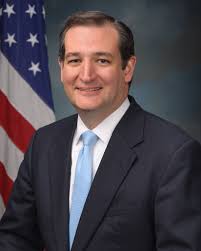
U.S. Senator Rafael Cruz
Cruz’ jokes about gun control came on June 19, 2015, only two days after Dylann Roof, a white high school dropout, gunned down three black men and six black women at Emanuel African Methodist Episcopal Church in Charleston, South Carolina.
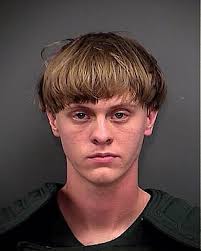
Dylann Roof
Following his remarks, Cruz headed to a shooting range, where he fired off rounds on a semiautomatic .223-caliber Smith and Wesson M&P 15.
Cruz’ remarks no doubt appeared insensitive to the latest victims of gun violence and those who now mourned for them. But the comments of Charles L. Cotton took insulting the dead to a whole new level.
Cotton is a National Rifle Association (NRA) board member who also runs TexasCHLForum.com, an online discussion forum about guns and gun owners’ rights in Texas and beyond.
In a discussion thread on June 18, 2015–one day after the church slaughter–a board member noted that Clementa C. Pinckney, one of the nine people slain, was a pastor and a state legislator in South Carolina.
Cotton responded: “And he voted against concealed-carry. Eight of his church members who might be alive if he had expressly allowed members to carry handguns in church are dead. Innocent people died because of his position on a political issue.”

That discussion thread was quickly deleted.
During a subsequent phone interview, Cotton emphasized that he had been speaking as a private citizen–and not as an NRA board member:
“It was a discussion we were having about so called gun-free zones. It’s my opinion that there should not be any gun-free zones in schools or churches or anywhere else. If we look at mass shootings that occur, most happen in gun-free zones.”
If private citizens were allowed to carry guns everywhere, Cotton said, there will be fewer mass shootings because “if armed citizens are in there, they have a chance to defend themselves and other citizens.”
Cotton’s position–“there should not be any gun-free zones”–is exactly that of the NRA itself.
Under such circumstances, America will become a nation where anyplace, anytime, can be turned into the O.K. Corral.
Another point that Cotton didn’t mention: Dylann Roof did believe in concealed-carry–and it cost not his life but the lives of nine innocent men and women.
Finally, there is this: Even highly-trained shooters–such as those assigned to the United States Secret Service–don’t always respond as expected.
On May 15, 1972, Alabama Governor George Wallace was campaigning for President in Laurel, Maryland. He gave a speech behind a bulletproof podium at the Laurel Shopping Center. Then he moved from it to mingle with the crowd.
Since the 1968 assassination of Senator Robert F. Kennedy, all those campaigning for President have been assigned Secret Service bodyguards. And Wallace was surrounded by them as he shook hands with his eager supporters.
Suddenly, Arthur Bremer, a fame-seeking failure in life and romance, pushed his way forward, aimed a .38 revolver at Wallace’s abdomen and opened fire. Before the Secret Service could subdue him, he hit Wallace four times, leaving him paralyzed for the rest of his life.

Arthur Bremer shoots George Wallace
Nor was he Bremer’s only victim. Three other people present were wounded unintentionally:
- Alabama State Trooper Captain E C Dothard, Wallace’s personal bodyguard, who was shot in the stomach;
- Dora Thompson, a campaign volunteer, who was shot in the leg; and
- Nick Zarvos, a Secret Service agent, who was shot in the neck, severely impairing his speech.
None of Wallace’s bodyguards got off a shot at Bremer–before or after he pulled the trigger.
On October 6, 1981, Egyptian President Anwar Sadat was reviewing a military parade in Cairo when a truck apparently broke down directly across from where he was seated.
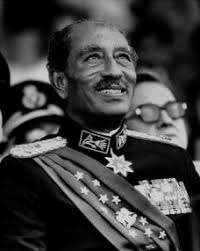
Anwar Sadat, moments before his assassination
Suddenly, soldiers bolted from the rear of the vehicle, throwing hand grenades and firing assault rifles. They rushed straight at Sadat–who died instantly under a hail of bullets.
Meanwhile, Sadat’s bodyguards–who had been trained by the CIA–panicked and fled.
Sadat had been assassinated by army officers who believed he had betrayed Islam by making peace with Israel in 1977.
The ultimate test of the NRA’s mantra that “there should not be any gun-free zones…anywhere” will come only when one or more heavily-armed gunmen target an NRA convention.
It will then be interesting to see if the surviving NRA members are as quick to blame themselves for being victims as they are the victims of other mass slaughters.
ABC NEWS, CBS NEWS, CNN, CRIME, ELLIOT ROGER, FACEBOOK, GAYS, GUN CONTROL, MARTIN LUTHER KING, MENTAL ILLNESS, NATIONAL RIFLE ASSOCIATION, NBC NEWS, PULSE NIGHTCLUB, ROBERT F. KENNEDY, SECOND AMENDMENT, SELF-DEFENSE, STAND-YOUR-GROUND LAWS, THE CHICAGO SUN-TIMES, THE CHICAGO TRIBUNE, THE LOS ANGELES TIMES, THE NEW YORK TIMES, THE WASHINGTON POST, TOBACCO INDUSTRY, TWITTER, U.S. CONSTITUTION, WRONGFUL-DEATH LAWSUITS
In History, Law, Law Enforcement, Politics, Social commentary on June 13, 2016 at 12:02 am
The victims of the violence are black and white, rich and poor, young and old, famous and unknown. They are, most important of all, human beings whom other human beings loved and needed. No one – no matter where he lives or what he does – can be certain who will suffer from some senseless act of bloodshed. And yet it goes on and on.
–Robert F. Kennedy, April 4, 1968

Senator Robert F. Kennedy announcing the murder of Dr. Martin Luther King, Jr.
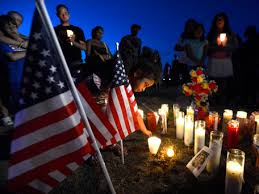
What should the surviving victims of the Pulse nightclub massacre in Orlando, Florida, do to seek redress?
And how can the relatives and friends of those who didn’t survive seek justice for those they loved?
First, don’t count on politicians to support a ban on assault weapons.
Politicians–with rare exceptions–have only two goals:
- Get elected to office, and
- Stay in office.
And most of them fear the economic and voting clout of the National Rifle Association (NRA) to risk its wrath. Those that don’t greedily accept its bribes–i.e., “campaign contributions.”
Second, don’t expect the mental health profession to prevent such future tragedies.
There is simply no definitive way to predict who is likely to commit mass murder.
And even if such a method were developed, it would likely be ruled unconstitutional. A person can’t be jailed or hospitalized for fear of what he might do.
Third, those who survived the Pulse nightclub rampage–and the relatives and friends of those who didn’t–should file wrongful death, class-action lawsuits against the NRA.
There is sound, legal precedent for this.
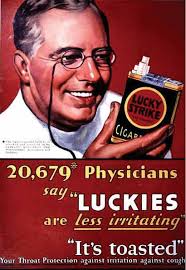
For decades, the American tobacco industry peddled death and disability to millions and reaped billions of dollars in profits.
- The industry vigorously claimed there was no evidence that smoking caused cancer, heart disease, emphysema or any other ailment.
- Tobacco companies spent billions on slick advertising campaigns to win new smokers and attack medical warnings about the dangers of smoking.
- Tobacco companies spent millions to elect compliant politicians and block anti-smoking legislation.
- From 1954 to 1994, over 800 private lawsuits were filed against tobacco companies in state courts. But only two plaintiffs prevailed, and both of those decisions were reversed on appeal.
- In 1994, amidst great pessimism, Mississippi Attorney General Mike Moore filed a lawsuit against the tobacco industry. But other states soon followed, ultimately growing to 46.
- Their goal: To seek monetary, equitable and injunctive relief under various consumer-protection and anti-trust laws.
- The theory underlying these lawsuits was: Cigarettes produced by the tobacco industry created health problems among the population, which badly strained the states’ public healthcare systems.
- In 1998, the states settled their Medicaid lawsuits against the tobacco industry for recovery of their tobacco-related, health-care costs. In return, they exempted the companies from private lawsuits for tobacco-related injuries.
- The companies agreed to curtail or cease certain marketing practices. They also agreed to pay, forever, annual payments to the states to compensate some of the medical costs for patients with smoking-related illnesses.
The parallels with the NRA are obvious:
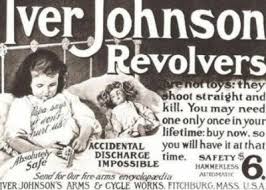
- For decades, the NRA has peddled deadly weapons to millions, reaped billions of dollars in profits and refused to admit the carnage those weapons have produced: “Guns don’t kill people. People kill people.” With guns.
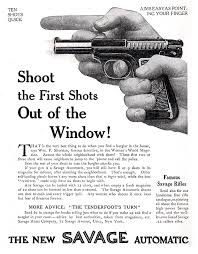
- The NRA has steadfastly defended the right to own Teflon-coated “cop killer” bullets,” whose only purpose is to penetrate bullet-resistant vests worn by law enforcement officers.
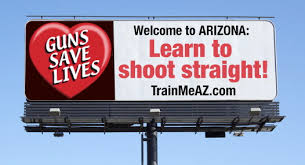
- The NRA has bitterly fought background checks on gun-buyers, in effect granting even criminals and the mentally ill the right to own arsenals of death-dealing weaponry.
- The NRA has spent millions on slick advertising campaigns to win new members and frighten them into buying guns.
- The NRA has spent millions on political contributions to block gun-control legislation.
- The NRA has spent millions attacking political candidates and elected officials who warned about the dangers of unrestricted access to assault and/or concealed weapons.

- The NRA has spent millions pushing “Stand Your Ground” laws in more than half the states, which potentially give every citizen a “license to kill.”
- The NRA receives millions of dollars from online sales of ammunition, high-capacity ammunition magazines, and other accessories through its point-of-sale Round-Up Program–thus directly profiting by selling a product that kills about 30,288 people a year.
- Firearms made indiscriminately available through NRA lobbying have filled hospitals–such as those in Orlando–with casualties, and have thus badly strained the states’ public healthcare systems.
It will take a series of highly expensive and well-publicized lawsuits to significantly weaken the NRA, financially and politically.
The first ones will have to be brought by the surviving victims of gun violence–and by the friends and families of those who did not survive it. Only they will have the courage and motivation to take such a risk.
As with the cases first brought against tobacco companies, there will be losses. And the NRA will rejoice with each one.
But, in time, state Attorneys General will see the clear parallels between lawsuits filed against those who peddle death by cigarette and those who peddle death by armor-piercing bullet.
And then the NRA–like the tobacco industry–will face an adversary wealthy enough to stand up for the rights of the gun industry’s own victims.
Only then will those politicians supporting reasonable gun controls dare to stand up for the victims of such needless tragedies as the one in Orlando, Florida.
ABC NEWS, AIRLINE PASSENGER RIGHTS, AIRLINES, AIRTRAN, AMERICAN AIRLINES, AMERICAN CUSTOMER SATISFACTION INDEX, BUSINESS INSIDER, CBS NEWS, CNN, COMPLAINT LETTERS, CONSUMER RIGHTS, DAVE CARROLL, DELTA AIRLINES, FACEBOOK, ITUNES, JETBLUE AIRWAYS, KGB, LEISHA HAILEY, NBC NEWS, NICCOLO MACHIAVELLI, SOUTHWEST AIRLINES, THE CHICAGO SUN-TIMES, THE CHICAGO TRIBUNE, THE LOS ANGELES TIMES, THE NEW YORK TIMES, THE PRINCE, THE WASHINGTON POST, TWITTER, U.S. AIRWAYS, UNITED BREAKS GUITARS, US AIRWAYS, YOUTUBE
In Bureaucracy, Business, History, Law, Self-Help, Social commentary on June 10, 2016 at 12:21 am
The concept of “consumer rights” has not yet reached the airline industry.
Under Federal law, as enforced by the Federal Aviation Administration, airline passengers have only the following guaranteed rights:
If your flight is delayed (such as by bad weather) and you’re stuck on the tarnac:
- Tarnac delays cannot exceed three hours. You can leave the plane if you choose after that.
- Food and water must be available after the plane has been stuck on the tarnac for two hours.
- The airline must service toilets, keep air conditioning on, and keep trash cans clean.
In addition, the U.S. government mandates these “rights” for air travelers:
- Compensation when you’re bumped due to overbooking –and for no other reason.
- An airline must accept lost/damaged baggage liability up to $3,000 in depreciated value per passenger for a domestic flight (limits on international flights are either about $1,700 or $635, depending on which rule applies).
Beyond those, all you can claim is what’s in each airline’s “contract of carriage.” Those contracts are–naturally–heavily biased toward airlines, not customers.
Unfortunately, the law–and the Congressmen who create it–is still largely owned by the airlines. Thus you, as a customer, are forced to make do with the weapons at hand.
These essentially boil down to two:
- Threatening the airlines with bad publicity; and
- Threatening the airlines with a private or class-action lawsuit.
In both cases, it’s best to first contact the highest-ranking officials in the airline company.
There are two reasons for this:
- They have the most to lose, and
- They have the power to redress your complaint.
You can try to reach the CEO or one of his assistants during the time of the incident. But, most likely, this will happen afterwards.
If a mini-Hitler of an airline steward decides to eject you because s/he doesn’t like your clothes or request for help, there’s nothing you can do about it.
If you physically resist, you will almost certainly be arrested and charged with some version of domestic terrorism. You’ll be shipped off to jail and forced to defend yourself against the bogus charge.

Even if the authorities decide to not prosecute, you’ll have to spend at least several hundred dollars on legal representation.
And, of course, the airlines won’t care. They won’t be spending a dime on your prosecution–that will be paid for by the local U.S. Attorney’s (federal prosecutor’s) office.
Niccolo Machiavelli, the father of political science, wisely advised in The Prince:
“A prince…must imitate the fox and the lion, for the lion cannot protect himself from traps, and the fox cannot defend himself from wolves. One must therefore be a fox to avoid traps, and a lion to frighten wolves.”
This is definitely the time to take on the trappings of a fox. However painful it is to swallow the insult at the time it’s given, don’t give the airlines an excuse to have you arrested.
Take your revenge afterward. That’s what musician Dave Carroll did.
Carroll alleged that, in 2008, he and fellow passengers saw United Airlines’ baggage-handling crew throwing guitars on the tarmac in Chicago O’Hare. He arrived at Omaha, Nebraska, his destination to discover that the neck of his $3,500 Taylor guitar had been broken.
Carroll complained to three United employees, but they proved indifferent. He filed a claim with the airline–but was told he was ineligible for compensation.
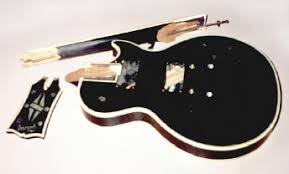
The reason? He had not filed the claim within the company’s stipulated “standard 24-hour timeframe.”
Carroll turned to his musical roots for a remedy. He wrote a song, “United Breaks Guitars,” and turned it into a music video which he posted on YouTube and iTunes in July, 2009.
Click here: United Breaks Guitars – YouTube
The song went viral, and became a public relations nightmare for the airline.
The Sunday Times reported that, four days after the video’s posting, United Airlines’ stock price fell 10% costing stockholders about $180 million in value.
Most customers, admittedly, aren’t musicians. For them–short of suing–the weapons of choice will be:
- The phone
- Letters
- The Internet
- Consumer protection organizations that can be enlisted
Let’s start with the first: The phone.
Most customers assume the place to take their anger is the airline Customer Service desk. And the airlines encourage people to do just that.
Don’t do it.
Customer Service is staffed by people who may ooze compassion but who aren’t authorized to do anything on your behalf. And of course they’ll be well-versed in the standard airline excuses for why your request is denied.
(Think of Dave Carroll and the excuse United’s reps offered him: You didn’t file your claim within 24 hours.)
Even if they truly want to help you, they’ll find themselves outranked at every level.
So take your complaint to someone who has the authority to resolve it. This means, preferably, the CEO of the airline, or at least one of his executive colleagues.
The other above-mentioned remedies will be discussed in my coming series, “KGB Airways: Fighting Airline Arrogance.”
_(cropped).jpg)


ABC NEWS, AFGHANISTAN, BARACK OBAMA, CBS NEWS, CNN, FACEBOOK, GENERAL STANLEY MCCRYSTAL, HAMID KARZAI, JOHN F. KENNEDY, MICHAEL HASTINGS, NBC NEWS, NGO DINH DIEM, NORTH VIETNAMESE ARMY, ROLLING STONE MAGAZINE, THE CHICAGO SUN-TIMES, THE CHICAGO TRIBUNE, THE LOS ANGELES TIMES, THE NEW YORK TIMES, THE OPERATORS, THE PENTAGON, THE WASHINGTON POST, TWITTER, VIETCONG, VIETNAM
VIETNAM–MIDDLE-EAST STYLE
In Bureaucracy, History, Military, Politics, Social commentary on June 22, 2016 at 12:39 amMichael Hastings was the Rolling Stone reporter whose 2010 article on “The Runaway General” ended the illustrious military career of General Stanley McCrystal.
In 2012, Hastings greatly expanded on his article with a 2012 book: The Operators: The Wild and Terrifying Inside Story of America’s War in Afghanistan.
According to its hardcover dust jacket: “General Stanley McCrystal, the innovative, forward-thinking, commanding general of international and U.S. forces in Afghanistan, was living large. He was better known to some as Big Stan, M4, Stan, and his loyal staff liked to call him a ‘rock star.’
“During a spring 2010 trip across Europe to garner additional allied help for the war effort, McCrystal was accompanied by journalist Michael Hastings of Rolling Stone.
“For days, Hastings looked on as McCrystal and his staff let off steam, partying and openly bashing the Obama administration for what they saw as a lack of leadership.
“When Hastings’ piece appeared a few months later, it set off a poiltical firestorm: McCrystal was ordered to Washington where he was fired unceremoniously.”
General Stanley A. McCrystal
But there is an even deeper element to be found within Hastings’ book–that is, for anyone with even a general knowledge of the war in Vietnam.
Hastings (who died in a high-speed car accident in 2013) does not make any direct parallels between the almost 11-year conflict in Afghanistan and the 14-year conflict in Vietnam.
But those parallels are definitely there for anyone to see:
Ngo Dinh Diem
Hamid Karzai
American soldiers in Vietnam
American soldiers in Afghanistan
From this, the United States should draw several conclusions:
Hastings’ book does not cover the Afghan war to its end. It can’t, since there is no telling when that war will end.
But by the end of its 379 pages, it’s clear what that outcome will be: Another futile exercise in “nation-building” at an exorbitant cost in American lives and treasure.
Share this: