Posts Tagged ‘SYRIA’
9/11 ATTACKS, ABC NEWS, ADOLF EICHMANN, ADOLF HITLER, ALTERNET, AMERICABLOG, AMERICAN CIVIL LIBERTIES UNION, AP, BABY BOOMER RESISTANCE, BBC, BLOOMBERG, BUZZFEED, CBS NEWS, CNN, CROOKS AND LIARS, DAILY KOS, DEPARTMENT OF HOMELAND SECURITY, DONALD TRUMP, EGYPT, EXECUTIVE ORDER, FACEBOOK, FIVETHIRTYEIGHT, HARPER’S MAGAZINE, HEINRICH HIMMLER, HERMAN GORING, HITLER 1889-1936: HUBRIS, HITLER 1936-1945: NEMESIS, HITLER: ASCENT: 1889-1939, HUFFINGTON POST, IAN KERSHAW, IRAN, IRQA, JOSEPH GOEBBELS, LYBIA, MEDIA MATTERS, MOTHER JONES, MOVEON, MSNBC, MUSLIM REFUGEES, NAZI GERMANY, NBC NEWS, NEW REPUBLIC, NEWSDAY, NEWSWEEK, NPR, OSAMA BIN LADEN, PBS NEWSHOUR, PENTAGON, POLITICO, POLITICUSUSA, RAW STORY, REUTERS, ROBERT PAYNE, SALON, SAUDI ARABIA, SEATTLE TIMES, SLATE, SOMALIA, STALINGRAD (MOVIE), SUDAN, SYRIA, TALKING POINTS MEMO, THE ATLANTIC, THE CHICAGO SUN-TIMES, THE CHICAGO TRIBUNE, THE DAILY BEAST, THE DAILY BLOG, THE GUARDIAN, THE HILL, THE HUFFINGTON POST, THE INTERCEPT, THE LIFE AND DEATH OF ADOLF HITLER, THE LOS ANGELES TIMES, THE NATION, THE NEW REPUBLIC, THE NEW YORK TIMES, THE NEW YORKER, THE VILLAGE VOICE, THE WASHINGTON POST, THINKPROGRESS, THIRD REICH, TIME, TRUTHDIG, TRUTHOUT, TURKEY, TWO POLITICAL JUNKIES, U.S. NEWS & WORLD REPORT, UNITED ARAB EMIRATES, UPI, USA TODAY, VOLKER ULRICH, WALTER SHAUB, WORLD TRADE CENTER, X, YEMEN
In Bureaucracy, Business, History, Law, Law Enforcement, Politics, Social commentary on April 25, 2025 at 12:19 am
In Stalingrad, a 1993 German-made war movie, a platoon of German Army soldiers leaves behind the beaches and beauties of Italy and find themselves fighting desperately to stay alive in Russia.
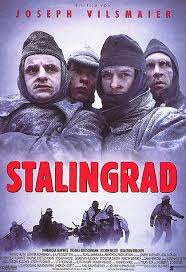
Early in the film, there is an exchange that has its real-life counterpart almost 75 years later.
A young, idealistic German lieutenant, newly transferred to the Russian front, is horrified when he sees a fellow soldier from another unit sadistically beat a Russian prisoner to death.
He seeks out the man’s superior, a captain, and says: “Captain, I must protest about the behavior of your men.”
“You want to protest?” asks the captain, grinning sardonically. “Tell the Fuhrer.”
Fast forward to January 28, 2017, the day after President Donald J. Trump signed into law an executive order which:
- Suspended entry of all refugees to the United States for 120 days;
- Barred Syrian refugees indefinitely;, and
- Blocked entry into the United States for 90 days for citizens from Iran, Iraq, Libya, Somalia, Sudan, Syria and Yemen.
The new rules—and the efforts of security personnel at major international airports to enforce them—triggered a tsunami of chaos and fear among travelers.
“We’ve gotten reports of people being detained all over the country,” said Becca Heller, the director of the International Refugee Assistance Project. “They’re literally pouring in by the minute.”
Refugees on flights when the order was signed on January 27 were detained upon arrival.
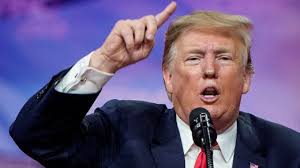
Donald Trump
Many students attending American universities were blocked from returning to the United States from visits abroad.
According to Homeland Security officials, 109 people who were already in transit to the United States when the order was signed were denied access; 173 were stopped before boarding planes heading to America. Eighty-one people who were stopped were eventually given waivers to enter the United States.
Internationally, travelers were seized by panic when they were not allowed to board flights to the United States. In Dubai and Istanbul, airport and immigration officials turned passengers away at boarding gates. At least one family was removed from a flight it had boarded.
Earlier on January 28, Trump, isolated in the White House from all the chaos he had unleashed in airports across the nation and throughout the world, said:
“It’s not a Muslim ban, but we were totally prepared. It’s working out very nicely. You see it at the airports, you see it all over.”
Then the American Civil Liberties Union intervened.

Two Iraqi immigrants, defended by the ACLU, accused Trump of legal and constitutional overreach.
The Iraqis had been detained at John F. Kennedy International Airport in New York City. One had served as an interpreter for American forces in Iraq for a decade. The other was en route to reunite with his wife and son in Texas.
The interpreter, Hameed Khalid Darweesh, was released after nearly 19 hours of detention. So was the other traveler, Haider Sameer Abdulkhaleq Alshawi.
Before the two men were released, one of their lawyers, Mark Doss, a supervising attorney at the International Refugee Assistance Project, asked an official, “Who is the person we need to talk to?”
“Call Mr. Trump,” said the official, who refused to identify himself.
He might just as well have said: “You want to protest? Tell the Fuhrer.”
The ACLU action secured at least a temporary blocking of part of Trump’s order. A Brooklyn judge barred the government from deporting some arrivals who found themselves ensnared by the Presidential order.
Judge Ann M. Donnelly of the Federal District Court in Brooklyn, ruled that sending the travelers home could cause them “irreparable harm.” She said the government was “enjoined and restrained from, in any manner and by any means, removing individuals” who had arrived in the United States with valid visas or refugee status.
But she did not force the administration to let in people otherwise blocked by the executive order who have not yet traveled to the United States. Nor did she issue a broader ruling on the constitutionality of the order.
* * * * *
On November 5, 75 million ignorant, hate-filled, Right-wing Americans re-elected Donald Trump—a man reflecting their own hate and ignorance—to the Presidency.
Summing up Trump’s character in a March 25, 2016 broadcast of The PBS Newshour, conservative political columnist David Brooks warned: “The odd thing about [Trump’s] whole career and his whole language, his whole world view is there is no room for love in it. You get a sense of a man who received no love, can give no love….
“And so you really are seeing someone who just has an odd psychology unleavened by kindness and charity, but where it’s all winners and losers, beating and being beat. And that’s part of the authoritarian personality.”
There were countless warning signs available for Trump’s supporters to see—if they had wanted to see them:
- His facing 91 criminal counts in four cases;
- His threats against his political opponents and Justice Department prosecutors;
- His conviction for raping columnist E. Jean Carroll;
- His continued lying about winning the 2020 Presidential election;
- His conviction on 34 counts of falsifying business records;
- His unjustified attacks the integrity of the FBI—causing previously “law and order” Republicans to demand its defunding.
Those who voted for Trump will now learn the meaning of the Nazi slogan: “The Fuhrer proposes and disposes for all.” Those who voted against him knew this already.
2020 PRESIDENTIL ELECTION, 9/11 ATTACKS, ABC NEWS, ADOLF EICHMANN, ADOLF HITLER, ALTERNET, AMERICABLOG, AMERICAN CIVIL LIBERTIES UNION, AMERICAN CIVIL LIBERTIES UNION (ACLU), AP, AUGUST FLENTJE, BABY BOOMER RESISTANCE, BBC, BLOOMBERG, BUZZFEED, CBS NEWS, CNN, CROOKS AND LIARS, DAILY KOS, DEPARTMENT OF HOMELAND SECURITY, DEPARTMENT OF JUSTICE, DONALD TRUMP, DUBAI, E. JEAN CARROLL, EGYPT, EL SALVADOR, EREZ REUVENI, EXECUTIVE ORDER, FACEBOOK, FALSIFYING BUSINESS RECORDS, FBI, FIVETHIRTYEIGHT, HARPER’S MAGAZINE, HEINRICH HIMMLER, HERMAN GORING, HITLER 1889 – 1936: HUBRIS (BOOK), HITLER 1889-1936: HUBRIS, HITLER 1936 – 1945 NEMESIS (BOOK), HITLER 1936-1945: NEMESIS, HITLER: ASCENT: 1889 – 1939 (BOOK), HITLER: ASCENT: 1889-1939, HUFFINGTON POST, IAN KERSHAW, ILLEGAL ALIENS, IMMIGRATION AND CUSTOMS ENFORCEMENT (ICE), INTERNATIONAL REFUGEE ASSISTANCE PROJECT, IRAN, IRAQ, ISTANBUL, JOSEPH GOEBBELS, KILMAR ABREGO GARCIA, LIBYA, LYBIA, MEDIA MATTERS, MOTHER JONES, MOVEON, MS-13 GANG, MSNBC, MUSLIM REFUGEES, MUSLIMS, NAZI GERMANY, NBC NEWS, NEW REPUBLIC, NEWSDAY, NEWSWEEK, NPR, OSAMA BIN LADEN, PAM BONDI, PAULA XINIS, PBS NEWSHOUR, PENTAGON, POLITICO, POLITICUSUSA, RAW STORY, REUTERS, ROBERT PAYNE, SALON, SAUDI ARABIA, SEATTLE TIMES, SLATE, SOMALIA, STALINGRAD (MOVIE), SUDAN, SYRIA, TALKING POINTS MEMO, THE ATLANTIC, THE CHICAGO SUN-TIMES, THE CHICAGO TRIBUNE, THE DAILY BEAST, THE DAILY BLOG, THE GUARDIAN, THE HILL, THE HUFFINGTON POST, THE INTERCEPT, THE LIFE AND DEATH OF ADOLF HITLER, THE LOS ANGELES TIMES, THE NATION, THE NEW REPUBLIC, THE NEW YORK TIMES, THE NEW YORKER, THE VILLAGE VOICE, THE WASHINGTON POST, THINKPROGRESS, THIRD REICH, TIME, TODD BLANCHE, TRUTHDIG, TRUTHOUT, TURKEY, TWO POLITICAL JUNKIES, U.S. NEWS & WORLD REPORT, UNITED ARAB EMIRATES, UPI, USA TODAY, VOLKER ULRICH, WALTER SHAUB, WERNER WILLIKENS, WORLD TRADE CENTER, X, YEMEN
In Bureaucracy, Business, History, Law, Law Enforcement, Politics, Social commentary on April 24, 2025 at 12:06 am
When historians—-and ordinary citizens—think about the Third Reich, the name of Werner Willikens doesn’t immediately spring to mind.
Adolf Hitler, Herman Goring, Joseph Goebbels, Heinrich Himmler, Adolf Eichmann—yes.
But why Werner Willikens?
British historian and author Ian Kershaw has unearthed the reason.
He has written extensively about the Third Reich. He is best-known for his monumental, two-volume biography, Hitler 1889–1936: Hubris (1998) and Hitler 1936–1945: Nemesis (2000).

Ian Kershaw
Willikens, State Secretary in the Ministry of Food, gave a speech on February 21, 1934 that casts new light on how Hitler came to exercise vast authority over Nazi Germany:
“Everyone who has the opportunity to observe it knows that the Fuhrer can hardly dictate from above everything he intends to realize sooner or later.
“On the contrary, up till now everyone with a post in the new Germany has worked best when he has, so to speak, worked towards the Fuhrer….
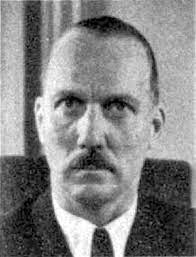
Werner Willikens
“In fact, it is the duty of everybody to try to work towards the Fuhrer along the lines he would wish. Anyone who makes mistakes will notice it soon enough.
“But anyone who really works towards the Fuhrer along his lines and towards his goal will certainly both now and in the future one day have the finest reward in the form of the sudden legal confirmation of his work.”
Volker Ullrich, bestselling author of Hitler: Ascent 1889 – 1939, summed up the results of this interplay between Hitler and his subjects:
“Kershaw tried to show that in many instances Hitler didn’t need to do very much at all since German society–everyone from the underlings surrounding him to ordinary people on the street—-were increasingly inclined to anticipate and fulfill the Fuhrer’s every wish, ‘working towards him.’
“…Kershaw…. illustrate[d] that without the readiness of many people to work for the man in charge, there would have been no way he could have achieved his murderous aims.
“Kershaw’s main thesis was that the dynamics of the Nazi regime arose from the interplay of Hitler’s intentions with activism emanating from subordinate individuals and institutions. The results were ever more radical ‘solutions.'”
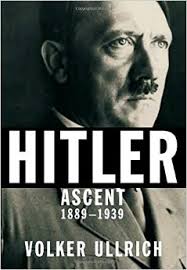
On April 30, 1945, Adolf Hitler simultaneously bit on a cyanide capsule and fired a pistol shot into his right temple.
The concept of “working towards the Fuhrer” seemed to have come to a literally fiery end.
Fast forward almost 80 years later–to January 20, 2025.
Donald J. Trump, upon resuming the office of President, has declared all-out war on illegal aliens within the United States. He has given Immigration and Customs Enforcement (ICE) full powers to seize and deport anyone fitting that description.
Even if that person is a legal resident who has lived in the United States legally with a work permit since 2011 and is protected from deportation by a 2019 court order.
Such was the case with Kilmar Abrego Garcia, a Salvadoran citizen living in Maryland. He illegally entered the United States at age 18 to escape being drafted into the 18th Street Gang.
In 2019 he was arrested in Maryland and detained by federal immigration authorities. An immigration judge granted Garcia protection from deportation because he might risk violence from local gangs in El Salvador.
On March 12, 2025, Garcia was stopped and detained by immigration agents and questioned about his alleged affiliation with the MS-13 gang. MS-13 was originally formed by Salvadoran immigrants fleeing civil war in their homeland and is now involved in myriad illegal enterprises,
ICE deported him to El Salvador, alongside hundreds of other men accused of being gang members.
There was just one problem: Garcia was deported due to a clerical error.
U.S. District Judge Paula Xinis ordered that Garcia be returned to Maryland: “His detention appears wholly lawless.”
In turn, the Justice Department claimed that it could not return him from a sovereign nation.
On April 5, Erez Reuveni, the acting deputy director of the department’s immigration litigation division, struggled to answer questions from the judge about the circumstances of Garcia’s deportation.
Asked why the U.S. couldn’t ask for his return, Reuveni said: “The first thing I did when I got this case on my desk is ask my clients the same question. Our only arguments are jurisdictional. He should not have been sent to El Salvador.
“My answer to a lot of these questions is going to be frustrating, and I am frustrated. The government made a choice here to produce no evidence.”
Attorney General Pam Bondi took issue with how Reuveni handled the case in court. The next day, she ordered him put on administrative leave by Deputy U.S. Attorney Todd Blanche. He is no longer working on the Abrego Garcia case or in the Justice Department in general.
August Flentje, Reuveni’s supervisor, was also placed on administrative leave. Flentje was told he had failed to supervise a subordinate.
In a statement to CNN, Bondi said: “At my direction, every Department of Justice attorney is required to zealously advocate on behalf of the United States. Any attorney who fails to abide by this direction will face consequences.”
Reuveni had been praised as a “top-notched” prosecutor by his superiors in an email announcing his promotion two weeks ago. His crime lay in his failure to “work toward the Fuhrer.“
ABC NEWS, AL QAEDA, ALTERNET, AMERICABLOG, AP, BABY BOOMER RESISTANCE, BASHIR AL-ASSAD, BBC, BLOOMBERG, BLUESKY, BUZZFEED, CBS NEWS, CHARLES GEORGE GORDON, CHARLTON HESTON, CNN, CROOKS AND LIARS, DAILY KOS, DRUDGE RETORT, FIVETHIRTYEIGHT, GEORGE W. BUSH, GREAT BRITAIN, HARPER’S MAGAZINE, HIZBOLLAH, HUFFINGTON POST, IRAQ, ISLAM, KHARTOUM, KHARTOUM (MOVIE), LAURENCE OLIVER, MEDIA MATTERS, MOTHER JONES, MOVEON, MSNBC, NBC NEWS, NEOCONS, NEW REPUBLIC, NEWSDAY, NEWSWEEK, NPR, PBS NEWSHOUR, POLITICO, POLITICUSUSA, PRESIDENT BARACK OBAMA, RAW STORY, REPUBLICAN PARTY, REUTERS, SALON, SEATTLE TIMES, SHIITE MUSLIMS, SLATE, SUDAN, SUNNI MUSLIMS, SYRIA, TALKING POINTS MEMO, THE ATLANTIC, THE CHICAGO SUN-TIMES, THE CHICAGO TRIBUNE, THE DAILY BEAST, THE DAILY BLOG, THE GUARDIAN, THE HILL, THE HUFFINGTON POST, THE INTERCEPT, THE LOS ANGELES TIMES, THE MADHI, THE NATION, THE NEW REPUBLIC, THE NEW YORK TIMES, THE NEW YORKER, THE VILLAGE VOICE, THE WALL STREET JOURNAL, THE WASHINGTON POST, THINKPROGRESS, TIME, TRUTHDIG, TRUTHOUT, TWO POLITICAL JUNKIES, U.S. NEWS & WORLD REPORT, UPI, USA TODAY, WILLIAM GLADSTONE, WONKETTE, X
In Bureaucracy, History, Military, Politics, Social commentary on January 28, 2025 at 12:06 am
January 26, 2025, marked the 140th anniversary of the fall of Khartoum, the Sudanese city that sits on the banks of the White and Blue Nile Rivers.
The siege and fall of Khartoum is one of the truly epic stories of military history.
From March 18, 1884, to January 26, 1885, the charisma and military genius of one man—British General Charles George Gordon—held at bay an army of thousands of fanatical Islamics intent on slaughtering everyone in the city. 

Khartoum in 1888—four years after the siege
At stake were the lives of Khartoum’s 30,000 residents.
By comparison: The defenders of the Alamo—a far better-known battle—numbered no more than 250. And the siege of the San Antonio mission lasted only 13 days (February 23 to March 6, 1836) against an army of about 2,000 Mexicans.
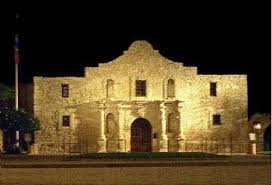
The Alamo
Gordon’s story may seem antiquated. But it resembles the efforts Republicans made to pressure the Obama administration to commit ground forces to “freeing” Syria of its longtime dictator, “President” Bashir al-Assad.
The neocons of the George W. Bush Administration plunged the United States into an unprovoked war against Iraq in 2003. After Baghdad quickly fell, Americans cheered, thinking the war was over and the troops would soon return home.
Suddenly, American soldiers found themselves waging a two-front war in the same country: Fighting an Iraqi insurgency to throw them out, while trying to suppress growing sectarian warfare between Sunni and Shia Muslims.
And then, with Syria, Americans were being urged to plunge headfirst into a conflict they knew nothing about—and in which they had absolutely no stake.
On one side was the Ba’ath regime of Bashir al-Assad, supported by Russia, Iran, Hizbollah and elements in the Iraqi government. Hizbollah is comprised of Shiite Muslims, who form a minority of Islamics.
A sworn enemy of Israel, it has kidnapped scores of Americans suicidal enough to visit Lebanon and truck-bombed the Marine barracks in Beirut in 1983, killing 299 Americans.
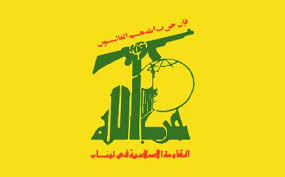
Flag of Hizbollah
Al-Qaeda, on the other hand, is made up of Sunni Muslims, who form the majority of that religion.
It is intolerant of non-Sunni Muslims and has instigated violence against them. It denounces them as “takfirs”–heretics—and thus worthy of extermination.

Flag of Al-Qaeda
In short, it’s a Muslim-vs.-Muslim “holy war.
It’s all very reminiscent of events in the 1966 epic film, Khartoum, starring Charlton Heston as British General Charles George Gordon.
In 1884, the British government sends Gordon, a real-life hero of the Victorian era, to evacuate the Sudanese city of Khartoum.
Mohammed Achmed, a previously anonymous Sudanese, has proclaimed himself “The Madhi” (“The Expected One”) and raised the cry of jihad.
The Madhi (played by Lawrence Olivier) intends to drive all foreigners (of which the English are the largest group) out of Sudan and exterminate all those Muslims who do not practice his “pure” version of Islam.


Charlton Heston as Gordon (left); Laurence Oliver as the Madhi (right)
Gordon arrives in Khartoum to find he’s not fighting a rag-tag army of peasants. Instead, the Madhi is a highly intelligent military strategist.
And Gordon, an evangelical Christian, also finds he has underestimated the Madhi’s religious fanaticism: “I seem to have suffered from the delusion that I had a monopoly on God.”
A surprised Gordon finds himself and 30,000 Sudanese trapped in Khartoum when the Madhi’s forces suddenly appear. He sends off messengers and telegrams to the British Government, begging for a military relief force.
But the British Government wants nothing to do with the Sudan. It has sent Gordon there as a sop to British public opinion that “something” had to be done to quell the Madhist uprising.
The siege continues and tightens.
In Britain, the public hails Gordon as a Christian hero and demands that the Government send a relief expedition to save him.
Prime Minister William Gladstone finally sends a token force—which arrives in Khartoum two days after the city has fallen to the Madhi’s forces.
Gordon, standing at the top of a staircase and coolly facing down his dervish enemies, is speared to death.
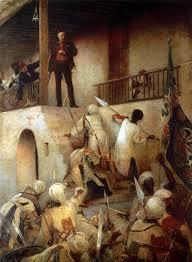
George W. Joy’s famous—and romanticized—painting of “The Death of Gordon”
(Actually, the best historical evidence indicates that Gordon fought to the last with pistol and sword before being overwhelmed by his Islamic enemies.)
When the news reaches England, Britons mourn—and then demand vengeance for the death of their hero.
The Government, which had sought to wash its hands of the poor, military unimportant Sudan, suddenly has to send an army to avenge Gordon.
As the narrator of Khartoum intones at the close of the film: “For 15 years the British paid the price with shame and war.”
There is a blunt lesson for Americans to learn from this episode—and from the 1966 movie Khartoum itself.
Americans have been fighting in the Middle East since 2001—first in Afghanistan to destroy Al-Qaeda, and then in Iraq, to pursue George W. Bush’s vendetta against Saddam Hussein. They continue to fight in Syria against ISIS.
The United States faces a crumbling infrastructure, millions living in poverty and trillions of dollars in debt.
It’s time for Americans to clean up their own house before worrying about the messes in other nations—especially those wholly alien to American values.
9/11 ATTACKS, ABC NEWS, ADOLF EICHMANN, ADOLF HITLER, ALTERNET, AMERICABLOG, AMERICAN CIVIL LIBERTIES UNION, AP, BABY BOOMER RESISTANCE, BBC, BLOOMBERG, BUZZFEED, CBS NEWS, CNN, CROOKS AND LIARS, DAILY KOS, DEPARTMENT OF HOMELAND SECURITY, DONALD TRUMP, EGYPT, EXECUTIVE ORDER, FACEBOOK, FIVETHIRTYEIGHT, HARPER’S MAGAZINE, HEINRICH HIMMLER, HERMAN GORING, HITLER 1889-1936: HUBRIS, HITLER 1936-1945: NEMESIS, HITLER: ASCENT: 1889-1939, HUFFINGTON POST, IAN KERSHAW, IRAN, IRQA, JOSEPH GOEBBELS, LYBIA, MEDIA MATTERS, MOTHER JONES, MOVEON, MSNBC, MUSLIM REFUGEES, NAZI GERMANY, NBC NEWS, NEW REPUBLIC, NEWSDAY, NEWSWEEK, NPR, OSAMA BIN LADEN, PBS NEWSHOUR, PENTAGON, POLITICO, POLITICUSUSA, RAW STORY, REUTERS, ROBERT PAYNE, SALON, SAUDI ARABIA, SEATTLE TIMES, SLATE, SOMALIA, STALINGRAD (MOVIE), SUDAN, SYRIA, TALKING POINTS MEMO, THE ATLANTIC, THE CHICAGO SUN-TIMES, THE CHICAGO TRIBUNE, THE DAILY BEAST, THE DAILY BLOG, THE GUARDIAN, THE HILL, THE HUFFINGTON POST, THE INTERCEPT, THE LIFE AND DEATH OF ADOLF HITLER, THE LOS ANGELES TIMES, THE NATION, THE NEW REPUBLIC, THE NEW YORK TIMES, THE NEW YORKER, THE VILLAGE VOICE, THE WASHINGTON POST, THINKPROGRESS, THIRD REICH, TIME, TRUTHDIG, TRUTHOUT, TURKEY, TWO POLITICAL JUNKIES, U.S. NEWS & WORLD REPORT, UNITED ARAB EMIRATES, UPI, USA TODAY, VOLKER ULRICH, WALTER SHAUB, WORLD TRADE CENTER, X, YEMEN
In Bureaucracy, Business, History, Law, Law Enforcement, Politics, Social commentary on December 6, 2024 at 12:10 am
In Stalingrad, a 1993 German-made war movie, a platoon of German Army soldiers leaves behind the beaches and beauties of Italy and find themselves fighting desperately to stay alive in Russia.
Early in the film, there is an exchange that has its real-life counterpart almost 75 years later.
A young, idealistic German lieutenant, newly transferred to the Russian front, is horrified when he sees a fellow soldier from another unit sadistically beat a Russian prisoner to death.
He seeks out the man’s superior, a captain, and says: “Captain, I must protest about the behavior of your men.”
“You want to protest?” asks the captain, grinning sardonically. “Tell the Fuhrer.”
Fast forward to January 28, 2017, the day after President Donald J. Trump signed into law an executive order which:
- Suspended entry of all refugees to the United States for 120 days;
- Barred Syrian refugees indefinitely;, and
- Blocked entry into the United States for 90 days for citizens from Iran, Iraq, Libya, Somalia, Sudan, Syria and Yemen.
The new rules—and the efforts of security personnel at major international airports to enforce them—triggered a tsunami of chaos and fear among travelers.
“We’ve gotten reports of people being detained all over the country,” said Becca Heller, the director of the International Refugee Assistance Project. “They’re literally pouring in by the minute.”
Refugees on flights when the order was signed on January 27 were detained upon arrival.
Donald Trump
Many students attending American universities were blocked from returning to the United States from visits abroad.
According to Homeland Security officials, 109 people who were already in transit to the United States when the order was signed were denied access; 173 were stopped before boarding planes heading to America. Eighty-one people who were stopped were eventually given waivers to enter the United States.
Internationally, travelers were seized by panic when they were not allowed to board flights to the United States. In Dubai and Istanbul, airport and immigration officials turned passengers away at boarding gates. At least one family was removed from a flight it had boarded.
Earlier on January 28, Trump, isolated in the White House from all the chaos he had unleashed in airports across the nation and throughout the world, said:
“It’s not a Muslim ban, but we were totally prepared. It’s working out very nicely. You see it at the airports, you see it all over.”
Then the American Civil Liberties Union intervened.
Two Iraqi immigrants, defended by the ACLU, accused Trump of legal and constitutional overreach.
The Iraqis had been detained at John F. Kennedy International Airport in New York City. One had served as an interpreter for American forces in Iraq for a decade. The other was en route to reunite with his wife and son in Texas.
The interpreter, Hameed Khalid Darweesh, was released after nearly 19 hours of detention. So was the other traveler, Haider Sameer Abdulkhaleq Alshawi.
Before the two men were released, one of their lawyers, Mark Doss, a supervising attorney at the International Refugee Assistance Project, asked an official, “Who is the person we need to talk to?”
“Call Mr. Trump,” said the official, who refused to identify himself.
He might just as well have said: “You want to protest? Tell the Fuhrer.”
The ACLU action secured at least a temporary blocking of part of Trump’s order. A Brooklyn judge barred the government from deporting some arrivals who found themselves ensnared by the Presidential order.
Judge Ann M. Donnelly of the Federal District Court in Brooklyn, ruled that sending the travelers home could cause them “irreparable harm.” She said the government was “enjoined and restrained from, in any manner and by any means, removing individuals” who had arrived in the United States with valid visas or refugee status.
But she did not force the administration to let in people otherwise blocked by the executive order who have not yet traveled to the United States. Nor did she issue a broader ruling on the constitutionality of the order.
* * * * *
On November 5, 75 million ignorant, hate-filled, Right-wing Americans re-elected Donald Trump—a man reflecting their own hate and ignorance—to the Presidency.
Summing up Trump’s character in a March 25, 2016 broadcast of The PBS Newshour, conservative political columnist David Brooks warned: “The odd thing about [Trump’s] whole career and his whole language, his whole world view is there is no room for love in it. You get a sense of a man who received no love, can give no love….
“And so you really are seeing someone who just has an odd psychology unleavened by kindness and charity, but where it’s all winners and losers, beating and being beat. And that’s part of the authoritarian personality.”
There were countless warning signs available for Trump’s supporters to see—if they had wanted to see them:
- His facing 91 criminal counts in four cases;
- His threats against his political opponents and Justice Department prosecutors;
- His conviction for raping columnist E. Jean Carroll;
- His continued lying about winning the 2020 Presidential election;
- His conviction on 34 counts of falsifying business records;
- His unjustified attacks the integrity of the FBI—causing previously “law and order” Republicans to demand its defunding.
Those who voted for Trump will now learn the meaning of the Nazi slogan: “The Fuhrer proposes and disposes for all.” Those who voted against him knew this already.
9/11 ATTACKS, ABC NEWS, ADOLF EICHMANN, ADOLF HITLER, ALTERNET, AMERICABLOG, AMERICAN CIVIL LIBERTIES UNION, AP, BABY BOOMER RESISTANCE, BBC, BLOOMBERG, BUZZFEED, CBS NEWS, CNN, CROOKS AND LIARS, DAILY KOS, DEPARTMENT OF HOMELAND SECURITY, DONALD TRUMP, EGYPT, EXECUTIVE ORDER, FACEBOOK, FIVETHIRTYEIGHT, HARPER’S MAGAZINE, HEINRICH HIMMLER, HERMAN GORING, HITLER 1889-1936: HUBRIS, HITLER 1936-1945: NEMESIS, HITLER: ASCENT: 1889-1939, HUFFINGTON POST, IAN KERSHAW, IRAN, IRQA, JOSEPH GOEBBELS, LYBIA, MEDIA MATTERS, MOTHER JONES, MOVEON, MSNBC, MUSLIM REFUGEES, NAZI GERMANY, NBC NEWS, NEW REPUBLIC, NEWSDAY, NEWSWEEK, NPR, OSAMA BIN LADEN, PBS NEWSHOUR, PENTAGON, POLITICO, POLITICUSUSA, RAW STORY, REUTERS, ROBERT PAYNE, SALON, SAUDI ARABIA, SEATTLE TIMES, SLATE, SOMALIA, STALINGRAD (MOVIE), SUDAN, SYRIA, TALKING POINTS MEMO, THE ATLANTIC, THE CHICAGO SUN-TIMES, THE CHICAGO TRIBUNE, THE DAILY BEAST, THE DAILY BLOG, THE GUARDIAN, THE HILL, THE HUFFINGTON POST, THE INTERCEPT, THE LIFE AND DEATH OF ADOLF HITLER, THE LOS ANGELES TIMES, THE NATION, THE NEW REPUBLIC, THE NEW YORK TIMES, THE NEW YORKER, THE VILLAGE VOICE, THE WASHINGTON POST, THINKPROGRESS, THIRD REICH, TIME, TRUTHDIG, TRUTHOUT, TURKEY, TWO POLITICAL JUNKIES, U.S. NEWS & WORLD REPORT, UNITED ARAB EMIRATES, UPI, USA TODAY, VOLKER ULRICH, WALTER SHAUB, WORLD TRADE CENTER, X, YEMEN
In Bureaucracy, Business, History, Law, Law Enforcement, Politics, Social commentary on December 5, 2024 at 12:32 am
When historians—-and ordinary citizens—think about the Third Reich, the name of Werner Willikens doesn’t immediately spring to mind.
Adolf Hitler, Herman Goring, Joseph Goebbels, Heinrich Himmler, Adolf Eichmann—yes.
But Werner Willikens? Why him?
Ian Kershaw has unearthed the reason.
Ian Kershaw is a British historian and author who has written extensively about the Third Reich. He is best-known for his monumental, two-volume biography, Hitler 1889–1936: Hubris (1998) and Hitler 1936–1945: Nemesis (2000).
Ian Kershaw
Willikens, State Secretary in the Ministry of Food, gave a speech on February 21, 1934 that casts new light on how Hitler came to exercise vast authority over Nazi Germany:
“Everyone who has the opportunity to observe it knows that the Fuhrer can hardly dictate from above everything he intends to realize sooner or later.
“On the contrary, up till now everyone with a post in the new Germany has worked best when he has, so to speak, worked towards the Fuhrer….
“In fact, it is the duty of everybody to try to work towards the Fuhrer along the lines he would wish. Anyone who makes mistakes will notice it soon enough.
“But anyone who really works towards the Fuhrer along his lines and towards his goal will certainly both now and in the future one day have the finest reward in the form of the sudden legal confirmation of his work.”
Volker Ullrich, bestselling author of Hitler: Ascent 1889 – 1939, summed up the results of this interplay between Hitler and his subjects:
“Kershaw tried to show that in many instances Hitler didn’t need to do very much at all since German society–everyone from the underlings surrounding him to ordinary people on the street—-were increasingly inclined to anticipate and fulfill the Fuhrer’s every wish, ‘working towards him.’
“…Kershaw did not minimize the historical role played by Hitler and his insane, ideological fixations, but he did illustrate that without the readiness of many people to work for the man in charge, there would have been no way he could have achieved his murderous aims.
“Kershaw’s main thesis was that the dynamics of the Nazi regime arose from the interplay of Hitler’s intentions with activism emanating from subordinate individuals and institutions. The results were ever more radical ‘solutions.'”
With the Third Reich dying in the flames of Berlin, at about 3:30 p.m. on April 30, 1945, Adolf Hitler simultaneously bit on a cyanide capsule and fired a pistol shot into his right temple.
The concept of “working towards the Fuhrer” seemed to have come to a literally fiery end.
Fast forward almost 72 years later–to 4:42 p.m. on January 27, 2017.
Newly inaugurated President Donald J. Trump signed into law an executive order that:
- Suspended entry of all refugees to the United States for 120 days;
- Barred Syrian refugees indefinitely; and
- Blocked entry into the United States for 90 days for citizens of Iran, Iraq, Libya, Somalia, Sudan, Syria and Yemen.
Trump’s executive order read as follows: “In order to protect Americans, the United States must ensure that those admitted to this country do not bear hostile attitudes toward it and its founding principles.
“The United States cannot, and should not, admit those who do not support the Constitution, or those who would place violent ideologies over American law.”
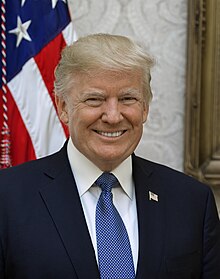
President Donald Trump
But that statement excluded three extremely troubling facts.
First: Over the previous four decades, there had been no fatal attacks within the United States by immigrants from any of those seven banned countries.
Second, approximately 3,000 Americans had been killed by immigrants from Saudi Arabia, the United Arab Emirates, Egypt, and Turkey. Most of those victims died during the attacks on the Pentagon and World Trade Center on September 11, 2001.
In fact, 15 of the 19 highjackers who took part in those attacks came from Saudi Arabia. Osama bin Laden, the mastermind of the attacks, was himself a Saudi from a wealthy family with strong ties to the Saudi Royal Family.
Third, Saudi Arabia, the United Arab Emirates, Egypt, and Turkey were all countries where Trump had close business ties. His properties included two luxury towers in Turkey and golf courses in the United Arab Emirates.
Trump listed companies on his FEC filing possibly related to a development project in Jeddah, Saudi Arabia’s second-biggest city, located outside Mecca: DT Jeddah Technical Services Manager LLC, DT Jeddah Technical Services Manager Member Corp., THC Jeddah Hotel Manager LLC and THC Jeddah Hotel Manager Member Corp.
Trump listed two companies on his FEC filing possibly related to business in Egypt: Trump Marks Egypt and Trump Marks Egypt LLC.
The full dimensions of Trump’s holdings throughout the Middle East aren’t known because he has refused to release his tax returns.
On January 11, 2017, Trump said that:
- He would resign from his positions at the Trump Organization but that he would not divest his ownership.
- The organization would be managed by his sons Eric and Don Jr. and chief financial officer Allen Weisselberg.
- The organization would terminate pending deals and not seek new international business.
Walter Shaub, director of the Office of Government Ethics, said that these measures did not resolve the President’s conflict-of-interest problems and called them “meaningless.”
It was after Trump signed his executive order that the true consequences of “working towards the Fuhrer”—or President—were fully revealed.
ABC NEWS, ALTERNET, AMERICABLOG, AP, BABY BOOMER RESISTANCE, BBC, BERLIN AIRLIFT, BLOOMBERG, BLOOMBERG NEWS, BUZZFEED, CBS NEWS, CNN, CROOKS AND LIARS, DAILY KOS, EGYPT, FIVETHIRTYEIGHT, HARPER’S MAGAZINE, HUFFINGTON POST, ILLEGAL ALIENS, illegal immigration, ISRAEL, MEDIA MATTERS, MEXICO, MOTHER JONES, MOVEON, MSNBC, NBC NEWS, NEW REPUBLIC, NEWSDAY, NEWSWEEK, NPR, OUTER LIMITS "ZANTI MISFITS" EPISODE, PBS NEWSHOUR, POLITICO, POLITICUSUSA, RAW STORY, REPUBLICAN PARTY, REUTERS, SALON, SEATTLE TIMES, SLATE, SOVIET UNION, SYRIA, TALKING POINTS MEMO, THE ATLANTIC, THE CHICAGO SUN-TIMES, THE CHICAGO TRIBUNE, THE DAILY BEAST, THE DAILY BLOG, THE GUARDIAN, THE HILL, THE HUFFINGTON POST, THE INTERCEPT, THE LOS ANGELES TIMES, THE NATION, THE NEW REPUBLIC, THE NEW YORK TIMES, THE NEW YORKER, THE OUTER LIMITS, THE VILLAGE VOICE, THE WASHINGTON POST, THINKPROGRESS, TIME, TRUTHDIG, TRUTHOUT, TWO POLITICAL JUNKIES, U.S. NEWS & WORLD REPORT, UPI, USA TODAY, X, YOM KIPPUR WAR
In Bureaucracy, History, Law, Law Enforcement, Military, Politics, Social commentary on October 14, 2024 at 12:16 am
Suppose the Federal Government could identify and arrest all or most of the estimated 11 to 20 million illegal aliens now living in the United States. Would deporting them to their native countries solve America’s illegal immigration crisis?
Hardly.
Most of America’s illegals come from neighboring Hispanic countries. As soon as they are deported, most of them cross the Mexican border again.
More importantly: The governments of Central and South American countries use the United States as a dumping ground—of those citizens who might demand reforms in their political and economic institutions.
There is only one approach that could strike a meaningful blow against illegal immigration. And it might well be called “The Zanti Option.”
Viewers of the 1960s sci-fi series, The Outer Limits, will vividly recall its 1963 episode, “The Zanti Misfits.”
In this, soldiers at an American Army base in a California ghost town nervously await first-contact with an alien race that has landed a space ship nearby.
The soldiers are warned to steer clear of the ship, and they do. But then an escaped convict (Bruce Dern, in an early role) happens upon the scene—and the ship.
The Zantis, enraged, emerge—and soon the soldiers at the military base find themselves under attack.

A “Zanti”
The soldiers desperately fight back—with flamethrowers, machineguns or just rifle butts. Finally the soldiers wipe out the Zantis.
But now the base—and probably America—faces a wholesale invasion from the planet Zanti to avenge the deaths of their comrades.
So the soldiers wait anxiously for their next transmission from Zanti—which soon arrives.
To their surprise—and relief—it’s a message of thanks: “We will not retaliate. We never intended to. We knew that you could not live with such aliens in your midst.
“It was always our intention that you destroy them…We are incapable of executing our own species, but you are not. You are practiced executioners. We thank you.”
Meanwhile, on May 11, 2023, the Biden administration scrapped Title 42, a Trump-era public health order issued in 2020 during the early weeks of the COVID-19 pandemic. Under this, 2.4 illegal aliens had been expelled from the southern border.

Illegal aliens invading the United States
The rapid nature of the expulsions—usually taking place within hours—sharply curtailed access to asylum regulations.
Immigration—especially illegal immigration—has become an increasingly volatile issue within the United States. This is especially true as the country continues to recover from the COVID-19 pandemic and supply housing, food and jobs to its own citizens.
But even without Title 42, there is a way for the United States to effectively deal with unwanted illegal aliens:
Instead of deporting them to Central American countries—from which they will easily sneak back into the United States—the Federal Government can ship them off to more distant lands.
Like Afghanistan.
Or Iraq.
Or Syria.
Such a policy change would:
- Close the Mexican revolving door, which keeps illegal immigration flowing; and
- Send an unmistakably blunt message to other would-be illegals: “The same fate awaits you.”
Although this might seem a far-fetched proposal, it could be easily carried out by the United States Air Force. According to its website: “The C-5 Galaxy is one of the largest aircraft in the world and the largest airlifter in the Air Force inventory.
“The C-5 has a greater capacity than any other airlifter. It [can] carry 36 standard pallets and 81 troops simultaneously.
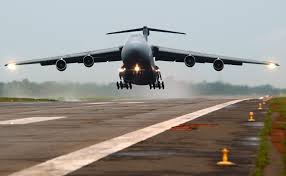
C-5 transport plane
“[It can also carry] any of the Army’s air-transportable combat equipment, including such bulky items as the 74-ton mobile scissors bridge.
“It can also carry outsize and oversize cargo over intercontinental ranges and can take off or land in relatively short distances.”
The C-5 Galaxy’s maximum cargo weight: 281,001 pounds
Instead of being stuffed with cargo, these planes could be stuffed wall-to-wall with illegal aliens.
The United States Air Force has a proud history of successfully providing America’s soldiers—and allies—with the supplies they need.
From June 24, 1948 to May 12, 1949, only the Berlin Airlift stood between German citizens and starvation.
The Soviet Union had blocked the railway, road, and canal access to the Berlin sectors under allied control. Their goal: Force the western powers to allow the Soviet zone to supply Berlin with food, fuel, and aid.
This would have given the Soviets control over the entire city.
Air forces from the United States, England, Canada, Australia, New Zealand and South Africa flew over 200,000 flights in one year, dropping more than 4,700 tons of necessities daily to the besieged Berliners.
The success of the Berlin Airlift raised American prestige and embarrassed the Soviets, who lifted the blockade.

The Berlin Airlift
A similar triumph came during the Yom Kippur War after Egypt and Syria attacked Israel without warning on October 6, 1973.
For 32 days, the Air Force shipped 22,325 tons of ammunition, artillery, tanks and other supplies. These proved invaluable in saving Israel from destruction.
So the mass deportation of millions of illegal aliens lies within America’s technological capability.
The only uncertainty: Is an American President willing to give that order?
ABC NEWS, AL QAEDA, ALTERNET, AMERICABLOG, AMERICAN CAESARS: THE LIVES OF THE PRESIDENTS FROM FRANKLIN D. ROOSEVELT TO GEORGE W. BUSH, AMERICAN EMPIRE, AP, ” 9/11, BABY BOOMER RESISTANCE, BASHAR AL-ASSAD, BILL CLINTON, BLOOMBERG, BUREAUCRACY, BUZZFEED, CBS NEWS, CHRIS MATHEWS, CNN, CONDOLEEZA RICE, CROOKS AND LIARS, DAILY KOZ, DONALD TRUMP, DRUDGE REPORT, DWIGHT EISENHOWER, FACEBOOK, FBI, FIVETHIRTYEIGHT, FRANKLIN D. ROOSEVELT, GEORGE H.W. BUSH, GEORGE W. BUSH, GERALD R. FORD, HARPER’S MAGAZINE, HARRY S. TRUMAN, HUFFINGTON POST, JD VANCE, JIMMY CARTER, JOHN F. KENNEDY, JOSEPH BIDEN, Kamala Harris, LYNDON B. JOHNSON, MEDIA MATTERS, MOTHER JONES, MOVEON, MSNBC, NBC NEWS, NEWSWEEK, NIGEL HAMILTON, NPR, OSAMA BIN LADEN, PBS NEWSHOUR, POLITICO, POLITICUSUSA, RAW STORY, REPUBLICAN PARTY, REUTERS, RICHARD CLARKE, RICHARD NIXON, ROMAN EMPIRE, SALON, SEATTLE TIMES, SEPTEMBER 11, SLATE, SUETONIUS, SYRIA, TALKING POINTS MEMO, TERRORISM, THE ATLANTIC, THE CHICAGO SUN-TIMES, THE CHICAGO TRIBUNE, THE DAILY BEAST, THE DAILY BLOG, THE GUARDIAN, THE HILL, THE HUFFINGTON POST, THE LOS ANGELES TIMES, THE NATION, THE NEW REPUBLIC, THE NEW YORK TIMES, THE TWELVE CAESARS, THE VILLAGE VOICE, THE WASHINGTON POST, THINKPROGRESS, TIME, TRUTHDIG, TRUTHOUT, TWITTER, TWO POLITICAL JUNKIES, U.S. NEWS & WORLD REPORT, UPI, USA TODAY
In Bureaucracy, History, Military, Politics, Social commentary on September 16, 2024 at 12:11 am
Colonel Brandt: “I wonder what we’ll do after we lose the war.”
Captain Kiesel: “Prepare for the next one.”
–-“The Cross of Iron,” film by Sam Peckinpah
On September 12, 2001, President George W. Bush attended a meeting of the National Security Council.
“Why shouldn’t we go against Iraq, not just Al-Qaeda?” demanded Donald Rumsfeld, the Secretary of Defense.
Vice President Dick Cheney enthusiastically agreed.
Secretary of State Colin Powell then pointed out there was absolutely no evidence that Iraq had had anything to do with 9/11 or Al-Qaeda. And he added: “The American people want us to do something about Al-Qaeda”—not Iraq.
On November 21, 2001, only 10 weeks after 9/11, Bush told Rumsfeld: It’s time to turn to Iraq.
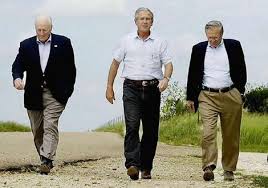
Liars Club: Dick Cheney, George Bush, Donald Rumsfeld
Bush and his war-hungry Cabinet officials knew that Americans demanded vengeance on Al-Qaeda’s mastermind, Osama bin Laden, and not Iraqi dictator Saddam Hussein. So they repeatedly fabricated “links” between the two:
- Saddam had worked hand-in-glove with Bin Laden to plan 9/11.
- Saddam was harboring and supporting Al-Qaeda throughout Iraq.
- Saddam, with help from Al-Qaeda, was scheming to build a nuclear bomb.
Yet as early as September 22, 2001, Bush had received a classified President’s Daily Brief intelligence report, which stated that there was no evidence linking Saddam Hussein to 9/11.
The report added that there was scant credible evidence that Iraq had any significant collaborative ties with Al-Qaeda.
Even more important: Saddam had tried to monitor Al Qaeda through his intelligence service—because he saw Al-Qaeda and other theocratic radical Islamist organizations as a potential threat to his secular regime.
Bush administration officials repeatedly claimed that Iraq possessed huge quantities of chemical and biological weapons, in violation of UN resolutions. And they further claimed that US intelligence agencies had determined:
- the precise locations where these weapons were stored;
- the identities of those involved in their production; and
- the military orders issued by Saddam Hussein for their use in the event of war.
Among other lies stated as fact by members of the Bush administration:
- Iraq had sought uranium from Niger, in west Africa.
- Thousands of aluminum tubes imported by Iraq could be used in centrifuges to create enriched uranium.
- Iraq had up to 20 long-range Scud missiles, prohibited under UN sanctions.
- Iraq had massive stockpiles of chemical and biological agents, including nerve gas, anthrax and botulinum toxin.
- Saddam Hussein had issued chemical weapons to front-line troops who would use them when US forces crossed into Iraq.
Consider the following:
August 26, 2002: Cheney told the Veterans of Foreign Wars, “There is no doubt that Saddam Hussein now has weapons of mass destruction. There is no doubt he is amassing them to use against our friends, against our allies and against us.”
September 8, 2002: National Security Advisor Condoleeza Rice said on CNN: ”There is certainly evidence that Al-Qaeda people have been in Iraq. There is certainly evidence that Saddam Hussein cavorts with terrorists.”
September 18, 2002: Rumsfeld told the House Armed Services Committee, “We do know that the Iraqi regime has chemical and biological weapons. His regime has amassed large, clandestine stockpiles of chemical weapons—including VX, sarin, cyclosarin and mustard gas.”
October 7, 2002: Bush declared in a nationally televised speech in Cincinnati that Iraq “possesses and produces chemical and biological weapons. It is seeking nuclear weapons.”
March 16, 2003: Cheney declared on NBC’s “Meet the Press”: “We believe [Saddam Hussein] has, in fact, reconstituted nuclear weapons.”
March 30, 2003: On ABC’s “This Week” program, 10 days into the war, Rumsfeld said: “We know where they [weapons of mass destruction] are.”
Bush never regretted his decision to invade Iraq, which occurred on March 20, 2003.
Even as American occupying forces repeatedly failed to turn up any evidence of “weapons of mass destruction” (WMDs), Bush and his minions claimed the invasion a good thing.
In fact, Bush—who hid out the Vietnam war in the Texas Air National Guard—even joked publicly about the absence of WMDs.
He did so at a White House Correspondents dinner on March 24, 2004—one year after he had started the war.
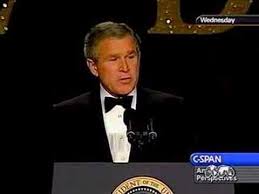
George W. Bush at the 2004 White House Correspondents’ dinner
To Bush, the non-existent WMDs were nothing more than the butt of a joke that night. While an overhead projector displayed photos of a puzzled-looking Bush searching around the Oval Office, Bush recited a comedy routine.
Click here: Bush laughs at no WMD in Iraq – YouTube
“Those weapons of mass destruction have gotta be somewhere,” Bush laughed, while a photo showed him poking around the corners in the Oval Office.
“Nope–no weapons over there! Maybe they’re under here,” he said, as a photo showed him looking under a desk.
Meanwhile, an assembly of wealthy, pampered men and women—the elite of America’s media and political classes—laughed heartily during Bush’s performance. It was a scene worthy of the court of the ancient Caesars, complete with royal flunkies.
Ultimately, the war that Bush had deliberately provoked
- Took the lives of 4,484 Americans.
- Cost the United States Treasury at least $2 trillion.
- Created a Middle East power vacumn.
- Allowed Iran–Iraq’s arch enemy–to eagerly fill it.
- Killed at least 655,000 Iraqis.
- Bush retired from office with a lavish pension and full Secret Service protection.
- He wrote his memoirs and was paid $7 for the first 1.5 million copies.
- Cheney, Rumsfeld, Rice retired to private business, wrote their own memoirs, and lived in comfort as respected elder statesmen.
ABC NEWS, AL QAEDA, ALTERNET, AMERICABLOG, AMERICAN CAESARS: THE LIVES OF THE PRESIDENTS FROM FRANKLIN D. ROOSEVELT TO GEORGE W. BUSH, AMERICAN EMPIRE, AP, ” 9/11, BABY BOOMER RESISTANCE, BASHAR AL-ASSAD, BILL CLINTON, BLOOMBERG, BUREAUCRACY, BUZZFEED, CBS NEWS, CHRIS MATHEWS, CNN, CONDOLEEZA RICE, CROOKS AND LIARS, DAILY KOZ, DONALD TRUMP, DRUDGE REPORT, DWIGHT EISENHOWER, FBI, FIVETHIRTYEIGHT, FRANKLIN D. ROOSEVELT, GEORGE H.W. BUSH, GEORGE W. BUSH, GERALD R. FORD, HARPER’S MAGAZINE, HARRY S. TRUMAN, HUFFINGTON POST, JD VANCE, JIMMY CARTER, JOHN F. KENNEDY, JOSEPH BIDEN, Kamala Harris, LYNDON B. JOHNSON, MEDIA MATTERS, MOTHER JONES, MOVEON, MSNBC, NBC NEWS, NEWSWEEK, NIGEL HAMILTON, NPR, OSAMA BIN LADEN, PBS NEWSHOUR, POLITICO, POLITICUSUSA, RAW STORY, REPUBLICAN PARTY, REUTERS, RICHARD CLARKE, RICHARD NIXON, ROMAN EMPIRE, SALON, SEATTLE TIMES, SEPTEMBER 11, SLATE, SUETONIUS, SYRIA, TALKING POINTS MEMO, TERRORISM, THE ATLANTIC, THE CHICAGO SUN-TIMES, THE CHICAGO TRIBUNE, THE DAILY BEAST, THE DAILY BLOG, THE GUARDIAN, THE HILL, THE HUFFINGTON POST, THE LOS ANGELES TIMES, THE NATION, THE NEW REPUBLIC, THE NEW YORK TIMES, THE TWELVE CAESARS, THE VILLAGE VOICE, THE WASHINGTON POST, THINKPROGRESS, TIME, TRUTHDIG, TRUTHOUT, TWITTER, TWO POLITICAL JUNKIES, U.S. NEWS & WORLD REPORT, UPI, USA TODAY, X
In Bureaucracy, History, Military, Politics, Social commentary on September 13, 2024 at 12:17 am
September 11, 2024, marked the 23rd anniversary of the worst terrorist attack on United States soil. Inevitably, this is a time to remember all those whose lives were so cruelly snuffed out.
But it should also be a time to remember those who made this atrocity inevitable—by refusing to acknowledge and address the impending threat from Al-Qaeda.
British historian Nigel Hamilton has chronicled their arrogance and indifference in his 2010 biography: American Caesars: Lives of the Presidents from Franklin D. Roosevelt to George W. Bush.
Hamilton noted that Richard Clarke, the national security advisor on terrorism, was certain that Osama bin Laden had arranged the [USS.] Cole bombing in Aden on October 12, 2000.
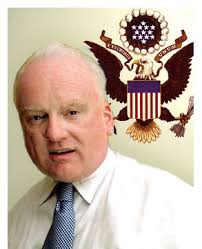
Richard Clarke
For months, Clarke tried to convince others in the Bush Administration that Bin Laden was plotting another attack against the United States—either abroad or at home.
But Clarke could not prevail against the know-it-all arrogance of such higher-ranking Bush officials as Vice President Dick Cheney; Secretary of Defense Donald Rumsfeld; Rumsfeld’s deputy, Paul Wolfowitz; and National Security Advisor Condoleeza Rice.
Rice initially refused to hold a cabinet-level meeting on the subject. Then she “insisted the matter be handled only by a more junior Deputy Principals meeting” in April, 2001, writes Hamilton.
Wolfowitz, the number-two man at the Department of Defense, said: “I don’t understand why we are beginning by talking about this one man, bin Laden.”
Even after Clarke outlined the threat posed by Al-Qaeda, Wolfowitz—whose real target was Saddam Hussein—said: “You give bin Laden too much credit.”
Wolfowitz insisted that bin Laden couldn’t carry out his terrorist acts without the aid of a state sponsor—namely, Iraq.
Wolfowitz, in fact, blamed Iraq for the 1993 bombing of the World Trade Center. Clarke was stunned, since there was absolutely no evidence of Iraqi involvement in this.
“Al-Qaeda plans major acts of terrorism against the United States,” Clarke warned his colleagues. He pointed out that, like Adolf Hitler, bin Laden had actually published his plans for future destruction.
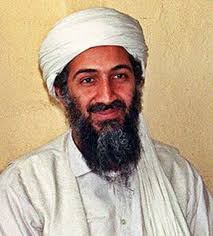
Osama bin Laden
And he added: “Sometimes, as with Hitler in Mein Kampf, you have to believe that these people will actually do what they say they will do.”
Wolfowitz heatedly traded on his Jewish heritage to bring Clarke’s unwelcome arguments to a halt: “I resent any comparison between the Holocaust and this little terrorist in Afghanistan.”
Writing in outraged fury, Hamilton sums up Clarke’s agonizing frustrations:
- Bush’s senior advisors treated their colleagues who had served in the Clinton administration with contempt.
- President Bush, Vice President Dick Cheney, National Security Advisor Condoleeza Rice, Secretary of Defense Donald Rumsfeld and Deputy Defense Secretary Paul Wolfowitz seemed content to ignore the danger signals of an impending Al-Qaeda attack.
- This left only Secretary of State Colin Powell, his deputy Richard Armitage, Richard Clarke and a skeptical Treasury Secretary, Paul O’Neill, to wage “a lonely battle to waken a seemingly deranged new administration.”
Clarke alerted Federal Intelligence agencies that “Al-Qaeda is planning a major attack on us.” He asked the FBI and CIA to report to his office all they could learn about suspicious persons or activities at home and abroad.
Finally, at a meeting with Rice on September 4, 2001, Clarke challenged her to “picture yourself at a moment when in the very near future Al-Qaeda has killed hundreds of Americans, and imagine asking yourself what you wish then that you had already done.”
Seven days later, Al-Qaeda struck, and 3,000 Americans died horrifically—and needlessly.
Neither Bush, Cheney, Rice, Rumsfeld nor Wolfowitz ever admitted their negligence. Nor would any of them be brought to account.
Disgustingly, these were the same officials who, afterward, posed as the Nation’s saviors–and branded anyone who disagreed with them as a traitor, practices the Right continues to exploit to this day.
Only Richard Clarke—who had vainly argued for stepped-up security precautions and taking the fight to Al-Qaeda—gave that apology.
On March 24, 2004, Clarke testified at the public 9/11 Commission hearings. Addressing relatives of victims in the audience, he said: “Your government failed you, those entrusted with protecting you failed you, and I failed you.”
Yet even worse was to come.
On the evening after the September 11 attacks, Bush took Clarke aside during a meeting in the White House Situation Room:
“I want you, as soon as you can, to go back over everything, everything. See if Saddam [Hussein, the dictator of Iraq] did this. See if he’s linked in any way.”
Clarke was stunned: “But, Mr. President, Al-Qaeda did this.”
“I know, I know,” said Bush. “But see if Saddam was involved. I want to know.”
Hussein had not plotted the attack—and there was no evidence proving that he did. But the attack gave “W” the excuse he wanted to remove the man he blamed for the 1992 defeat of his father, President George H.W. Bush.
Bush believed that his father would have been re-elected if he had “gone all the way” into Baghdad during the 1991 Gulf War.
He would finish the job that his father had started but failed to compete.
On September 12, 2001, Bush attended a meeting of the National Security Council.
“Why shouldn’t we go against Iraq, not just Al-Qaeda?” demanded Donald Rumsfeld, the Secretary of Defense.
Vice President Dick Cheney enthusiastically agreed.
ABC NEWS, AL QAEDA, ALTERNET, AMERICABLOG, AMERICAN CAESARS: THE LIVES OF THE PRESIDENTS FROM FRANKLIN D. ROOSEVELT TO GEORGE W. BUSH, AMERICAN EMPIRE, AP, ” 9/11, BABY BOOMER RESISTANCE, BASHAR AL-ASSAD, BILL CLINTON, BLOOMBERG, BUREAUCRACY, BUZZFEED, CBS NEWS, CHRIS MATHEWS, CNN, CONDOLEEZA RICE, CROOKS AND LIARS, DAILY KOZ, DONALD TRUMP, DRUDGE REPORT, DWIGHT EISENHOWER, FBI, FIVETHIRTYEIGHT, FRANKLIN D. ROOSEVELT, GEORGE H.W. BUSH, GEORGE W. BUSH, GERALD R. FORD, HARPER’S MAGAZINE, HARRY S. TRUMAN, HUFFINGTON POST, JD VANCE, JIMMY CARTER, JOHN F. KENNEDY, JOSEPH BIDEN, Kamala Harris, LYNDON B. JOHNSON, MEDIA MATTERS, MOTHER JONES, MOVEON, MSNBC, NBC NEWS, NEWSWEEK, NIGEL HAMILTON, NPR, OSAMA BIN LADEN, PBS NEWSHOUR, POLITICO, POLITICUSUSA, RAW STORY, REPUBLICAN PARTY, REUTERS, RICHARD CLARKE, RICHARD NIXON, ROMAN EMPIRE, SALON, SEATTLE TIMES, SEPTEMBER 11, SLATE, SUETONIUS, SYRIA, TALKING POINTS MEMO, TERRORISM, THE ATLANTIC, THE CHICAGO SUN-TIMES, THE CHICAGO TRIBUNE, THE DAILY BEAST, THE DAILY BLOG, THE GUARDIAN, THE HILL, THE HUFFINGTON POST, THE LOS ANGELES TIMES, THE NATION, THE NEW REPUBLIC, THE NEW YORK TIMES, THE TWELVE CAESARS, THE VILLAGE VOICE, THE WASHINGTON POST, THINKPROGRESS, TIME, TRUTHDIG, TRUTHOUT, TWO POLITICAL JUNKIES, U.S. NEWS & WORLD REPORT, UPI, USA TODAY, X
In Bureaucracy, History, Military, Politics, Social commentary on September 12, 2024 at 12:09 am
It’s that time of year again–-yet another anniversary celebration of September 11, 2001.
The day when Islamic terrorists slammed two jetliners into the World Trade Center and a third into the Pentagon.
They would have crashed a fourth jetliner into the White House or Capitol Building except for the heroic resistance of passengers aboard United Airlines Flight 93.
In the years immediately following 9/11, politicians of both parties used this anniversary to wave flags and make self-serving patriotic speeches.
This was especially true for officials of the administration of President George W. Bush—which, even as the rubble was being cleared at the Pentagon and World Trade Center, was preparing to use the attack as an excuse to topple Iraqi dictator Saddam Hussein.
Hussein had not plotted 9/11, and there was no evidence that he did. But that didn’t matter to Bush and those planning the invasion and conquest of Iraq.
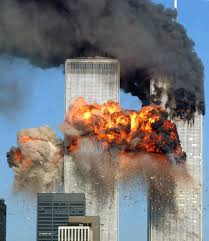
World Trade Center on September 11, 2001
So here it is, 23 years later, and, once again, politicians are using 9/11 as a prop to advance their careers.
Donald Trump, fresh from his disastrous debate with Democratic Presidential nominee Kamala Harris the previous night in Philadelphia, Pennsylvania, attended the commemoration event at Ground Zero in Manhattan.
Joining him was President Joe Biden, Vice President Harris and Trump’s running mate, JD Vance.
As on past commemorations of 9/11, those who died were remembered by friends and relatives of those who knew and loved them.
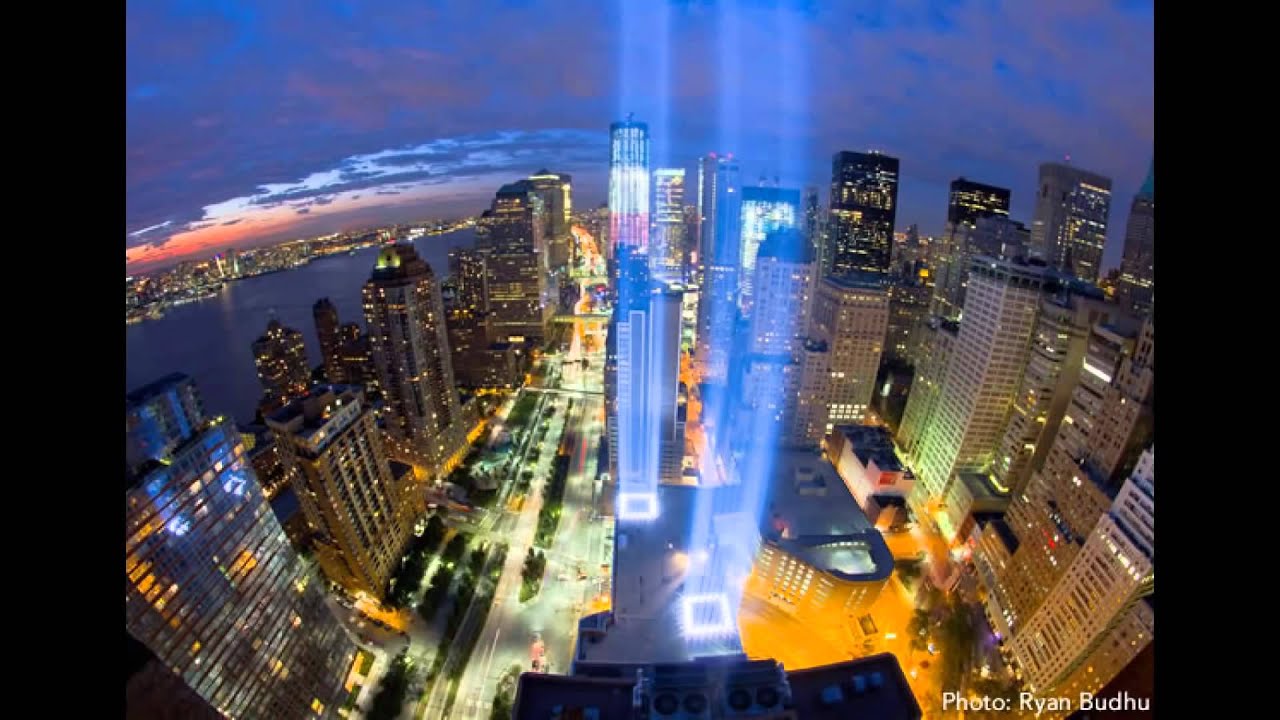
Tribute to 9/11 World Trade Center Victims
It is in fact appropriate to remember the innocents who died on that day—and the heroism of the police and firefighters who died trying to save them.
But it’s equally important to remember those who made 9/11 not simply possible but inevitable.
And that does not mean only the 19 highjackers who turned those planes into fuel-bombs. It means the officials at the highest levels of the administration of President George W. Bush.
Officials who, to this day, have never been held accountable in any way for the resulting death and destruction.
And who have been allowed to blatantly lie that they “kept us safe” from terrorism.
Obviously, such an indictment is not going to be presented by TV commentators today—not even on such liberal networks as CNN and MSNBC. And most definitely not on the right-wing Fox network.
Fortunately, British historian Nigel Hamilton has dared to lay bare the facts of this disgrace. Hamilton is the author of several acclaimed political biographies, including JFK: Reckless Youth and Bill Clinton: Mastering the Presidency.
In 2007, he began research on his latest book: American Caesars: The Lives of the Presidents From Franklin D. Roosevelt to George W. Bush.


Nigel Hamilton
By Nigel Hamilton (Nigel Hamilton picture)
The inspiration for this came from a classic work of ancient biography: The Twelve Caesars, by Gaius Suetonius Tranquillus–-known as Suetonius.
Suetonius, a Roman citizen and historian, had chronicled the lives of the first twelve Caesars of imperial Rome: Julius Caesar, Augustus, Tiberius, Caligula, Claudius, Nero, Galba, Otho, Vitellius, Vespasian, Titus and Domitian.
Hamilton wanted to examine post-World War II United States history as Suetonius had examined that of ancient Rome: Through the lives of the 12 “emperors” who had held the power of life and death over their fellow citizens—and those of other nations.
For Hamilton, the “greatest of American emperors, the Caesar Augustus of his time,” was Franklin D. Roosevelt, who led his country through the Great Depression and World War II.
His “”great successors” were Harry S. Truman, Dwight D. Eisenhower and John F. Kennedy—who, in turn, contained the Soviet Union abroad and presided over sustained economic prosperity at home.
By contrast, “arguably the worst of all the American Caesars” was “George W. Bush, and his deputy, Dick Cheney, who willfully and recklessly destroyed so much of the moral basis of American leadership in the modern world.”
Among the most lethal of Bush’s offenses: The appointing of officials who refused to take seriously the threat posed by Al-Qaeda.
And this arrogance and indifference continued–right up to September 11, 2001, when the World Trade Center and Pentagon became targets for destruction.
Among the few administration officials who did take Al-Qaeda seriously was Richard Clarke, the chief counter-terrorism adviser on the National Security Council.
Clarke had been thus appointed in 1998 by President Bill Clinton. He continued in the same role under President Bush—but the position was no longer given cabinet-level access.
This put him at a severe disadvantage when dealing with other, higher-ranking Bush officials—such as Vice President Dick Cheney, Secretary of Defense Donald Rumsfeld, Rumsfeld’s deputy, Paul Wolfowitz and National Security Advisor Condoleeza Rice.
These turned out to be the very officials who refused to believe that Al-Qaeda posed a lethal threat to the United States.
“Indeed,” writes Hamilton, “in the entire first eight months of the Bush Presidency, Clarke was not permitted to brief President Bush a single time, despite mounting evidence of plans for a new al-Qaeda outrage.” [Italics added]
Nor did it help that, during his first eight months in office before September 11, Bush was on vacation, according to the Washington Post, 42% of the time.
ABC NEWS, AL QAEDA, ALTERNET, AMERICABLOG, AMERICAN EXCEPTIONALISM, AMERICAN RECKONING: THE VIETNAM WAR AND OUR NATIONAL IDENTITY (BOOK), AP, BABY BOOMER RESISTANCE, BARACK OBAMA, BASHIR AL-ASSAD, BBC, BLOOMBERG NEWS, BUZZFEED, CANADA, CBS NEWS, CHINA, CHRISTIAN G. APPY, CNN, CROOKS AND LIARS, DAILY KOZ, DEMOCRATS, FIVETHIRTYEIGHT, HARPER’S MAGAZINE, HOUSE UN-AMERICAN ACTIVITIES COMMITTEE, HUFFINGTON POST, HUMAN RIGHTS, MEDIA MATTERS, MOTHER JONES, MOVEON, MSNBC, NBC NEWS, NEW REPUBLIC, NEWSDAY, NEWSWEEK, NPR, PBS NEWSHOUR, POLITICO, POLITICUSUSA, RAW STORY, REPUBLICANS, REUTERS, RUSSIA, SALLY YATES, SALON, SEATTLE TIMES, SLATE, SYRIA, TALKING POINTS MEMO, THE ATLANTIC, THE CHICAGO SUN-TIMES, THE CHICAGO TRIBUNE, THE DAILY BEAST, THE DAILY BLOG, THE GUARDIAN, THE HILL, THE HUFFINGTON POST, THE LOS ANGELES TIMES, THE NATION, THE NEW REPUBLIC, THE NEW YORK TIMES, THE NEW YORKER, THE VILLAGE VOICE, THE WASHINGTON POST, THINKPROGRESS, TIME, TRUTHDIG, TRUTHOUT, TWO POLITICAL JUNKIES, TYRANNY, U.S. NEWS & WORLD REPORT, UNITED STATES CONSTITUTION, UPI, USA TODAY, VIETNAM WAR, VLADIMIR PUTIN, WONKETTE, X
In Bureaucracy, History, Military, Politics, Social commentary on July 12, 2024 at 12:15 am
“Who are we?” asks Christian G. Appy in the opening of his 2015 book, American Reckoning: The Vietnam War and Our National Identity.
For Appy, it’s impossible to understand the enormous impact of the Vietnam war on the United States without first understanding the image that Americans had of themselves before that conflict. And he describes that image as:
“The broad faith that the United States [was] a unique force for good in the world, superior not only in its military and economic power but in the quality of its government and institutions, the character and morality of its people, and its way of life…..
“It was still unimaginable to most Americans that their own nation would wage aggressive war and justify it with unfounded claims, that it would support undemocratic governments reviled by their own people, and that American troops would be sent to fight in countries where they were widely regarded not as liberators but as imperialist invaders.”
Appy contends that, for millions of Americans, the Vietnam war dealt a mortal blow to that tremendously appealing self-image.
Yet for millions more, the United States remains an exemplary nation with a divine mission to lead other nations—willingly or unwillingly—to follow its example. And those Americans become furious when anyone—especially a foreigner—dares question that belief.
On September 11, 2013, the New York Times published an Op-Ed (guest editorial) from Russian President Vladimir Putin, entitled: “A Plea for Caution from Russia: What Putin Has to Say to Americans About Syria.”
To no one’s surprise, Putin strongly opposed an American air strike on Syria. Its “President” (i.e., dictator) Bashir al-Assad, is a close ally of Russia. Just as his late father and dictator, Hafez al-Assad, was a close ally of the Soviet Union.
And Putin is a former member of the KGB, the infamous secret police which ruled the Soviet Union from its birth in 1917 to its collapse in 1991.In his September 11 guest editorial in the New York Times, Putin offered the expected Russian take on Syria:
- Poison gas was used in Syria.
- It wasn’t used by the Syrian Army.
- “Opposition forces [used it] to provoke intervention by their powerful foreign patrons.”
- “There are few champions of democracy in Syria. But there are more than enough [al] Qaeda fighters and extremists of all stripes battling the government.”
But it’s the concluding paragraph that enraged American politicians the most—especially Right-wing ones. In it, Putin took exception with American “exceptionalism.”
Referring to then-President Barack Obama, Putin wrote:
“And I would rather disagree with a case he made on American exceptionalism, stating that the United States’ policy is ‘what makes America different. It’s what makes us exceptional.’
“It is extremely dangerous to encourage people to see themselves as exceptional, whatever the motivation. There are big countries and small countries, rich and poor, those with long democratic traditions and those still finding their way to democracy. Their policies differ, too.
“We are all different, but when we ask for the Lord’s blessings, we must not forget that God created us equal.”
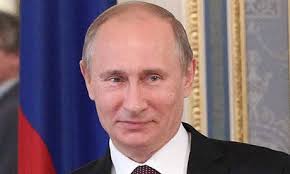
Vladimir Putin
Putin has never publicly shown any interest in religion. But by invoking “the Lord,” he was able to turn the Christian beliefs of his Western audience into a useful weapon.
Americans’ outrage quickly erupted.
“I was insulted,” then-House Speaker John Boehner (R-Ohio) told reporters when asked for his blunt reaction to the editorial.
“I have to be honest with you, I was at dinner, and I almost wanted to vomit,” said U.S. Senator Bob Menendez (D-New Jersey).
Putin had dared to question the self-righteousness of American foreign policy—and those who make it.
Making his case for war with Syria, Obama had said: “America is not the world’s policeman….But when, with modest effort and risk, we can stop children from being gassed to death, and thereby make our own children safer over the long run, I believe we should act.
“That’s what makes America different. That’s what makes us exceptional. With humility, but with resolve, let us never lose sight of that essential truth.”

Barack Obama
In short: Because we consider ourselves “exceptional,” we have the divine right to do whatever we want.
It’s not necessary to see Putin as a champion of democracy (he isn’t) to see the truth in this part of his editorial:
“It is extremely dangerous to encourage people to see themselves as exceptional, whatever the motivation.”
From 1938 to 1969, the House Un-American Activities Committee sought to define what was “American” and what was “Un-American.”
As if “American” stood for all things virtuous.
Whoever heard of an “Un-French Activities Committee”? Or an “Un-German” or “Un-British” one?
The late S.I. Hayakawa was a professor of semantics (the study of the relationship between words and what they stand for).In his bestselling book, Language in Thought and Action, he observed that a person has four ways of responding to a message:
- Accept the speaker and his message.
- Accept the speaker but reject the message.
- Accept the message but reject the speaker.
- Reject the message and the speaker.
In this case, Americans might want to consider #3 where “American exceptionalism” is concerned.


_b_617.jpg)


&docid=yt8OxrbTDh591M&tbnid=ik44Wblm3ZvX6M%3A&vet=1&w=325&h=475&bih=469&biw=819&ved=0ahUKEwjC-_Ka0enRAhVJKGMKHV61ApUQMwghKAAwAA&iact=c&ictx=1)


9/11 ATTACKS, ABC NEWS, ADOLF EICHMANN, ADOLF HITLER, ALTERNET, AMERICABLOG, AMERICAN CIVIL LIBERTIES UNION, AP, BABY BOOMER RESISTANCE, BBC, BLOOMBERG, BUZZFEED, CBS NEWS, CNN, CROOKS AND LIARS, DAILY KOS, DEPARTMENT OF HOMELAND SECURITY, DONALD TRUMP, EGYPT, EXECUTIVE ORDER, FACEBOOK, FIVETHIRTYEIGHT, HARPER’S MAGAZINE, HEINRICH HIMMLER, HERMAN GORING, HITLER 1889-1936: HUBRIS, HITLER 1936-1945: NEMESIS, HITLER: ASCENT: 1889-1939, HUFFINGTON POST, IAN KERSHAW, IRAN, IRQA, JOSEPH GOEBBELS, LYBIA, MEDIA MATTERS, MOTHER JONES, MOVEON, MSNBC, MUSLIM REFUGEES, NAZI GERMANY, NBC NEWS, NEW REPUBLIC, NEWSDAY, NEWSWEEK, NPR, OSAMA BIN LADEN, PBS NEWSHOUR, PENTAGON, POLITICO, POLITICUSUSA, RAW STORY, REUTERS, ROBERT PAYNE, SALON, SAUDI ARABIA, SEATTLE TIMES, SLATE, SOMALIA, STALINGRAD (MOVIE), SUDAN, SYRIA, TALKING POINTS MEMO, THE ATLANTIC, THE CHICAGO SUN-TIMES, THE CHICAGO TRIBUNE, THE DAILY BEAST, THE DAILY BLOG, THE GUARDIAN, THE HILL, THE HUFFINGTON POST, THE INTERCEPT, THE LIFE AND DEATH OF ADOLF HITLER, THE LOS ANGELES TIMES, THE NATION, THE NEW REPUBLIC, THE NEW YORK TIMES, THE NEW YORKER, THE VILLAGE VOICE, THE WASHINGTON POST, THINKPROGRESS, THIRD REICH, TIME, TRUTHDIG, TRUTHOUT, TURKEY, TWO POLITICAL JUNKIES, U.S. NEWS & WORLD REPORT, UNITED ARAB EMIRATES, UPI, USA TODAY, VOLKER ULRICH, WALTER SHAUB, WORLD TRADE CENTER, X, YEMEN
“WORKING TOWARDS THE PRESIDENT”: PART TWO (END)
In Bureaucracy, Business, History, Law, Law Enforcement, Politics, Social commentary on April 25, 2025 at 12:19 amIn Stalingrad, a 1993 German-made war movie, a platoon of German Army soldiers leaves behind the beaches and beauties of Italy and find themselves fighting desperately to stay alive in Russia.
Early in the film, there is an exchange that has its real-life counterpart almost 75 years later.
A young, idealistic German lieutenant, newly transferred to the Russian front, is horrified when he sees a fellow soldier from another unit sadistically beat a Russian prisoner to death.
He seeks out the man’s superior, a captain, and says: “Captain, I must protest about the behavior of your men.”
“You want to protest?” asks the captain, grinning sardonically. “Tell the Fuhrer.”
Fast forward to January 28, 2017, the day after President Donald J. Trump signed into law an executive order which:
The new rules—and the efforts of security personnel at major international airports to enforce them—triggered a tsunami of chaos and fear among travelers.
“We’ve gotten reports of people being detained all over the country,” said Becca Heller, the director of the International Refugee Assistance Project. “They’re literally pouring in by the minute.”
Refugees on flights when the order was signed on January 27 were detained upon arrival.
Donald Trump
Many students attending American universities were blocked from returning to the United States from visits abroad.
According to Homeland Security officials, 109 people who were already in transit to the United States when the order was signed were denied access; 173 were stopped before boarding planes heading to America. Eighty-one people who were stopped were eventually given waivers to enter the United States.
Internationally, travelers were seized by panic when they were not allowed to board flights to the United States. In Dubai and Istanbul, airport and immigration officials turned passengers away at boarding gates. At least one family was removed from a flight it had boarded.
Earlier on January 28, Trump, isolated in the White House from all the chaos he had unleashed in airports across the nation and throughout the world, said:
“It’s not a Muslim ban, but we were totally prepared. It’s working out very nicely. You see it at the airports, you see it all over.”
Then the American Civil Liberties Union intervened.
Two Iraqi immigrants, defended by the ACLU, accused Trump of legal and constitutional overreach.
The Iraqis had been detained at John F. Kennedy International Airport in New York City. One had served as an interpreter for American forces in Iraq for a decade. The other was en route to reunite with his wife and son in Texas.
The interpreter, Hameed Khalid Darweesh, was released after nearly 19 hours of detention. So was the other traveler, Haider Sameer Abdulkhaleq Alshawi.
Before the two men were released, one of their lawyers, Mark Doss, a supervising attorney at the International Refugee Assistance Project, asked an official, “Who is the person we need to talk to?”
“Call Mr. Trump,” said the official, who refused to identify himself.
He might just as well have said: “You want to protest? Tell the Fuhrer.”
The ACLU action secured at least a temporary blocking of part of Trump’s order. A Brooklyn judge barred the government from deporting some arrivals who found themselves ensnared by the Presidential order.
Judge Ann M. Donnelly of the Federal District Court in Brooklyn, ruled that sending the travelers home could cause them “irreparable harm.” She said the government was “enjoined and restrained from, in any manner and by any means, removing individuals” who had arrived in the United States with valid visas or refugee status.
But she did not force the administration to let in people otherwise blocked by the executive order who have not yet traveled to the United States. Nor did she issue a broader ruling on the constitutionality of the order.
* * * * *
On November 5, 75 million ignorant, hate-filled, Right-wing Americans re-elected Donald Trump—a man reflecting their own hate and ignorance—to the Presidency.
Summing up Trump’s character in a March 25, 2016 broadcast of The PBS Newshour, conservative political columnist David Brooks warned: “The odd thing about [Trump’s] whole career and his whole language, his whole world view is there is no room for love in it. You get a sense of a man who received no love, can give no love….
“And so you really are seeing someone who just has an odd psychology unleavened by kindness and charity, but where it’s all winners and losers, beating and being beat. And that’s part of the authoritarian personality.”
There were countless warning signs available for Trump’s supporters to see—if they had wanted to see them:
Those who voted for Trump will now learn the meaning of the Nazi slogan: “The Fuhrer proposes and disposes for all.” Those who voted against him knew this already.
Share this: