Posts Tagged ‘SADDAM HUSSEIN’
9/11 ATTACKS, ABC NEWS, AL QAEDA, ALTERNET, AMERICABLOG, AMERICAN CAESARS: THE LIVES OF THE PRESIDENTS FROM FRANKLIN D. ROOSEVELT TO GEORGE W. BUSH (BOOK), AMERICAN EMPIRE, AP, BABY BOOMER RESISTANCE, BARACK OBAMA, BASHAR AL-ASSAD, BBC, BILL CLINTON, BLOOMBERG NEWS, BUREAUCRACY, BUZZFEED, CBS NEWS, CHRIS MATHEWS, CNN, COLIN POWELL, CONDOLEEZA RICE, CROOKS AND LIARS, DAILY KOS, DICK CHENEY, DONALD RUMSFELD, DONALD TRUMP, DWIGHT EISENHOWER, FBI, FIVETHIRTYEIGHT, FRANKLIN D. ROOSEVELT, GAIUS SUETONIUS TRANQUILLIUS, GEORGE H.W. BUSH, GEORGE W. BUSH, GERALD R. FORD, HARPER’S MAGAZINE, HARRY S. TRUMAN, HOLOCAUST, HUFFINGTON POST, IRAN, IRAQ, ISRAEL, JEFFREY EPSTEIN, JFK: RECKLESS YOUTH (BOOK), JIMMY CARTER, JOHN F. KENNEDY, LYNDON B. JOHNSON, MEDIA MATTERS, MEIN KAMPF, MOTHER JONES, MOVEON, MSNBC, NATIONAL SECURITY COUNCIL, NBC NEWS, NEW REPUBLIC, NEWSDAY, NEWSWEEK, NIGEL HAMILTON, NPR, OSAMA BIN LADEN, PAUL O’NEIL, PAUL WOLFOWITZ, PBS NEWSHOUR, POLITICO, POLITICUSUSA, RAW STORY, REPUBLICAN PARTY, REUTERS, RICHARD CLARKE, RICHARD NIXON, ROMAN EMPIRE, SADDAM HUSSEIN, SALON, SEATTLE TIMES, SEPTEMBER 11, SLATE, SOVIET UNION, SUETONIUS, SYRIA, TALKING POINTS MEMO, TERRORISM, THE ATLANTIC, THE CHICAGO SUN-TIMES, THE CHICAGO TRIBUNE, THE DAILY BEAST, THE DAILY BLOG, THE GUARDIAN, THE HILL, THE HUFFINGTON POST, THE INTERCEPT, THE LOS ANGELES TIMES, THE NATION, THE NEW REPUBLIC, THE NEW YORK TIMES, THE NEW YORKER, THE PENTAGON, THE TWELVE CAESARS (BOOK), THE VILLAGE VOICE, THE WASHINGTON POST, THINKPROGRESS, TIME, TRUTHDIG, TRUTHOUT, U.S. NEWS & WORLD REPORT, UPI, USA TODAY, WEAPONS OF MASS DESTRUCTION, WHITE HOUSE CORRESPONDENTS DINNER, WORLD TRADE CENTER, WORLD WAR 11, X
In Bureaucracy, History, Military, Politics, Social commentary on March 18, 2026 at 12:40 am
On September 12, 2001, President George W. Bush attended a meeting of the National Security Council.
“Why shouldn’t we go against Iraq, not just Al-Qaeda?” demanded Donald Rumsfeld, the Secretary of Defense.
Vice President Dick Cheney enthusiastically agreed.
Secretary of State Colin Powell then pointed out there was absolutely no evidence that Iraq had had anything to do with 9/11 or Al-Qaeda. And he added: “The American people want us to do something about Al-Qaeda”—not Iraq.
On November 21, 2001, only 10 weeks after 9/11, Bush told Rumsfeld: It’s time to turn to Iraq.


Condoleeza Rice
Bush and his war-hungry Cabinet officials knew that Americans demanded vengeance on Al Qaeda’s mastermind, Osama bin Laden, and not Iraqi dictator Saddam Hussein. So they repeatedly fabricated “links” between the two:
- Saddam had worked hand-in-glove with Bin Laden to plan 9/11.
- Saddam was harboring and supporting Al-Qaeda throughout Iraq.
- Saddam, with help from Al-Qaeda, was scheming to build a nuclear bomb.
Yet as early as September 22, 2001, Bush had received a classified President’s Daily Brief intelligence report, which stated that there was no evidence linking Saddam Hussein to 9/11.
The report added that there was scant credible evidence that Iraq had any significant collaborative ties with Al-Qaeda.
Even more important: Saddam had tried to monitor Al Qaeda through his intelligence service—because he saw Al-Qaeda and other theocratic radical Islamist organizations as a potential threat to his secular regime.

Dick Cheney
Bush administration officials repeatedly claimed that Iraq possessed huge quantities of chemical and biological weapons, in violation of UN resolutions. And they further lied that US intelligence agencies had determined:
- The precise locations where these weapons were stored;
- The identities of those involved in their production; and
- The military orders issued by Saddam Hussein for their use in the event of war.
Among other lies stated as fact by members of the Bush administration:
- Iraq had sought uranium from Niger, in west Africa.
- Thousands of aluminum tubes imported by Iraq could be used in centrifuges to create enriched uranium.
- Iraq had up to 20 long-range Scud missiles, prohibited under UN sanctions.
- Iraq had massive stockpiles of chemical and biological agents, including nerve gas, anthrax and botulinum toxin.
- Saddam Hussein had issued chemical weapons to front-line troops who would use them when U.S. forces crossed into Iraq.
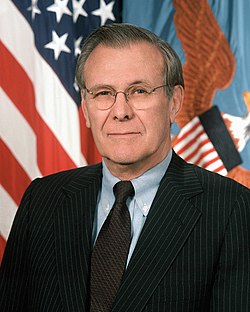
Donald Rumsfeld
Consider the following:
August 26, 2002: Cheney told the Veterans of Foreign Wars, “There is no doubt that Saddam Hussein now has weapons of mass destruction. There is no doubt he is amassing them to use against our friends, against our allies and against us.”
September 8, 2002: National Security Advisor Condoleeza Rice said on CNN: ”There is certainly evidence that Al-Qaeda people have been in Iraq. There is certainly evidence that Saddam Hussein cavorts with terrorists.”
September 18, 2002: Rumsfeld told the House Armed Services Committee, “We do know that the Iraqi regime has chemical and biological weapons. His regime has amassed large, clandestine stockpiles of chemical weapons—including VX, sarin, cyclosarin and mustard gas.”
October 7, 2002: Bush declared in a nationally televised speech in Cincinnati that Iraq “possesses and produces chemical and biological weapons. It is seeking nuclear weapons.”
March 16, 2003: Cheney declared on NBC’s “Meet the Press”: “We believe [Saddam Hussein] has, in fact, reconstituted nuclear weapons.”
Bush never regretted his decision to attack Iraq—on March 19, 2003.
Even as American occupying forces repeatedly failed to turn up any evidence of “weapons of mass destruction” (WMDs), Bush and his minions claimed the invasion a good thing.
In fact, Bush—who hid out the Vietnam war in the Texas Air National Guard—even joked publicly about the absence of WMDs.
He did so at a White House Correspondents dinner on March 24, 2004—one year after he had started the war.

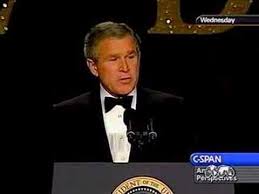
George W. Bush at the 2004 White House Correspondents’ dinner
To Bush, the non-existent WMDs were nothing more than the butt of a joke that night. While an overhead projector displayed photos of a puzzled-looking Bush searching around the Oval Office, Bush recited a comedy routine.
“Those weapons of mass destruction have gotta be somewhere,” Bush laughed, while a photo showed him poking around the corners in the Oval Office.
“Nope—no weapons over there! Maybe they’re under here,” he said, as a photo showed him looking under a desk.
Meanwhile, an assembly of wealthy, pampered men and women—-the elite of America’s media and political classes—laughed heartily during Bush’s performance.
It was a scene worthy of the court of the ancient Caesars, complete with royal flunkies: “Hey! That country we just destroyed wasn’t a threat to us after all! Isn’t that a gas?”
The results of the war that Bush had deliberately provoked:
- Cost the lives of 4,484 Americans.
- Depleted the United States Treasury of at least $2 trillion.
- Created a Middle East power vacuum.
- Allowed Iran—Iraq’s arch enemy—to eagerly fill it.
- Frightened and repelled even America’s closest allies.
- Killed at least 655,000 Iraqis.
- Bush retired from office with a lavish pension and full Secret Service protection.
- He wrote his memoirs and was paid $7 million for the first 1.5 million copies.
- Cheney, Rumsfeld and Rice retired to private business, wrote their memoirs, and lived in comfort as respected elder statesmen.
9/11 ATTACKS, ABC NEWS, AL QAEDA, ALTERNET, AMERICABLOG, AMERICAN CAESARS: THE LIVES OF THE PRESIDENTS FROM FRANKLIN D. ROOSEVELT TO GEORGE W. BUSH (BOOK), AMERICAN EMPIRE, AP, BABY BOOMER RESISTANCE, BASHAR AL-ASSAD, BBC, BILL CLINTON, BLOOMBERG NEWS, BUREAUCRACY, BUZZFEED, CBS NEWS, CHRIS MATHEWS, CNN, COLIN POWELL, CONDOLEEZA RICE, CROOKS AND LIARS, DAILY KOS, DICK CHENEY, DONALD RUMSFELD, DONALD TRUMP, DWIGHT EISENHOWER, FBI, FIVETHIRTYEIGHT, FRANKLIN D. ROOSEVELT, GAIUS SUETONIUS TRANQUILLIUS, GEORGE H.W. BUSH, GEORGE W. BUSH, GERALD R. FORD, HARPER’S MAGAZINE, HARRY S. TRUMAN, HOLOCAUST, HUFFINGTON POST, IRAN, IRAQ, ISRAEL, JEFFREY EPSTEIJN, JFK: RECKLESS YOUTH (BOOK), JIMMY CARTER, JOHN F. KENNEDY, LYNDON B. JOHNSON, MEDIA MATTERS, MEIN KAMPF, MOTHER JONES, MOVEON, MSNBC, NATIONAL SECURITY COUNCIL, NBC NEWS, NEW REPUBLIC, NEWSDAY, NEWSWEEK, NIGEL HAMILTON, NPR, OSAMA BIN LADEN, PAUL O’NEIL, PAUL WOLFOWITZ, PBS NEWSHOUR, POLITICO, POLITICUSUSA, RAW STORY, REPUBLICAN PARTY, REUTERS, RICHARD CLARKE, RICHARD NIXON, ROMAN EMPIRE, SADDAM HUSSEIN, SALON, SEATTLE TIMES, SEPTEMBER 11, SLATE, SOVIET UNION, SUETONIUS, SYRIA, TALKING POINTS MEMO, TERRORISM, THE ATLANTIC, THE CHICAGO SUN-TIMES, THE CHICAGO TRIBUNE, THE DAILY BEAST, THE DAILY BLOG, THE GUARDIAN, THE HILL, THE HUFFINGTON POST, THE INTERCEPT, THE LOS ANGELES TIMES, THE NATION, THE NEW REPUBLIC, THE NEW YORK TIMES, THE NEW YORKER, THE PENTAGON, THE TWELVE CAESARS (BOOK), THE VILLAGE VOICE, THE WASHINGTON POST, THINKPROGRESS, TIME, TRUTHDIG, TRUTHOUT, U.S. NEWS & WORLD REPORT, UPI, USA TODAY, WEAPONS OF MASS DESTRUCTION, WHITE HOUSE CORRESPONDENTS DINNER, WORLD TRADE CENTER, WORLD WAR 11, X
In Bureaucracy, History, Military, Politics, Social commentary on March 17, 2026 at 12:10 am
As President Donald Trump rains bombs and missiles on Iran, it’s vital to remember how American hubris led to a nine-year war in Iraq—from the “shock and awe” bombardment of March 20, 2003, until combat forces were finally withdrawn on December 18, 2011.
But this should also be a time to remember those Americans who made the 9/11 atrocity—and the disastrous Iraq war that followed—inevitable.
British historian Nigel Hamilton has chronicled their arrogance and indifference in his 2010 biography: American Caesars: Lives of the Presidents from Franklin D. Roosevelt to George W. Bush.
Hamilton noted that Richard Clarke, the national security advisor on terrorism, was certain that Osama bin Laden had arranged the USS Cole bombing in Aden on October 12, 2000.
For months, Clarke tried to convince others in the Bush Administration that Bin Laden was plotting another attack against the United States—either abroad or at home.
But Clarke could not prevail against the know-it-all arrogance of such higher-ranking Bush officials as Vice President Dick Cheney; Secretary of Defense Donald Rumsfeld; Rumsfeld’s deputy, Paul Wolfowitz; and National Security Advisor Condoleeza Rice.
Rice initially refused to hold a cabinet-level meeting on the subject. Then she “insisted the matter be handled only by a more junior Deputy Principals meeting” in April, 2001, writes Hamilton.
Even after Clarke outlined the threat posed by Al-Qaeda, Wolfowitz—the number-two man at the Department of Defense—said: “You give bin Laden too much credit.”
Wolfowitz—whose real target was Saddam Hussein—insisted that bin Laden couldn’t carry out his terrorist acts without the aid of a state sponsor—namely, Iraq.
In fact, Wolfowitz blamed Iraq for the 1993 bombing of the World Trade Center. Clarke was stunned, since there was absolutely no evidence of Iraqi involvement in this.
“Al-Qaeda plans major acts of terrorism against the United States,” Clarke warned his colleagues. He pointed out that, like Adolf Hitler, bin Laden had actually published his plans for future destruction.
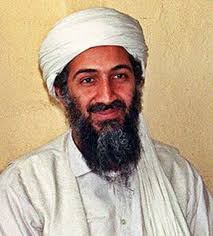
Osama bin Laden
And he added: “Sometimes, as with Hitler in Mein Kampf, you have to believe that these people will actually do what they say they will do.”
Wolfowitz heatedly traded on his Jewish heritage to bring Clarke’s unwelcome arguments to a halt: “I resent any comparison between the Holocaust and this little terrorist in Afghanistan.”
Writing in outraged fury, Hamilton sums up Clarke’s agonizing frustrations:
- Bush’s senior advisors treated their colleagues who had served in the Clinton administration with contempt.
- Bush, Dick Cheney, Rice, Rumsfeld and Wolfowitz seemed content to ignore the danger signals of an impending al-Qaeda attack.
- This left only Secretary of State Colin Powell, his deputy Richard Armitage, Richard Clarke and a skeptical Treasury Secretary, Paul O’Neill, to wage “a lonely battle to waken a seemingly deranged new administration.”
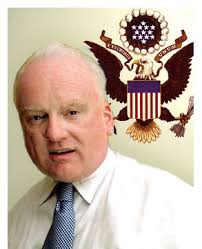
Richard Clarke
Clarke alerted Federal Intelligence agencies that “Al-Qaeda is planning a major attack on us.” He asked the FBI and CIA to report to his office all they could learn about suspicious persons or activities at home and abroad.
Finally, at a meeting with Rice on September 4, 2001, Clarke challenged her to “picture yourself at a moment when in the very near future Al-Qaeda has killed hundreds of Americans, and imagine asking yourself what you wish then that you had already done.”
Seven days later, Al-Qaeda struck, and 3,000 Americans died horrifically—and needlessly.
Neither Bush, Cheney, Rice, Rumsfeld nor Wolfowitz ever admitted their negligence. Nor would any of them be brought to account.

Condoleeza Rice, Dick Cheney, George W. Bush and Donald Rumsfeld
Disgustingly, these were the same officials who, afterward, posed as the Nation’s saviors—and branded anyone who disagreed with them as a traitor, practices the Right continues to exploit to this day.
Only Richard Clarke—who had vainly argued for stepped-up security precautions and taking the fight to Al-Qaeda—gave that apology.
On March 24, 2004, Clarke testified at the public 9/11 Commission hearings. Addressing relatives of victims in the audience, he said: “Your government failed you, those entrusted with protecting you failed you, and I failed you.”
Yet even worse was to come.
On the evening after the September 11 attacks, Bush took Clarke aside during a meeting in the White House Situation Room:
“I want you, as soon as you can, to go back over everything, everything. See if Saddam [Hussein, the dictator of Iraq] did this. See if he’s linked in any way.”
Clarke was stunned: “But, Mr. President, Al-Qaeda did this.”
“I know, I know,” said Bush. “But see if Saddam was involved. I want to know.”
Hussein had not plotted the attack—and there was no evidence proving that he did.
But the attack gave “W” the excuse he wanted to remove the man he blamed for the 1992 defeat of his father, President George H.W. Bush.
Bush believed that his father would have been re-elected if he had “gone all the way” into Baghdad during the 1991 Gulf War.
He would finish the job that his father had started but failed to compete.
It was Hamlet Revisited—with missiles.
On September 12, 2001, Bush attended a meeting of the National Security Council.
“Why shouldn’t we go against Iraq, not just Al-Qaeda?” demanded Donald Rumsfeld, the Secretary of Defense.
Vice President Dick Cheney enthusiastically agreed.
9/11 ATTACKS, ABC NEWS, AL QAEDA, ALTERNET, AMERICABLOG, AMERICAN CAESARS: THE LIVES OF THE PRESIDENTS FROM FRANKLIN D. ROOSEVELT TO GEORGE W. BUSH (BOOK), AMERICAN EMPIRE, AP, BABY BOOMER RESISTANCE, BASHAR AL-ASSAD, BBC, BILL CLINTON, BLOOMBERG NEWS, BUREAUCRACY, BUZZFEED, CBS NEWS, CHRIS MATHEWS, CNN, COLIN POWELL, CONDOLEEZA RICE, CROOKS AND LIARS, DAILY KOS, DICK CHENEY, DONALD RUMSFELD, DONALD TRUMP, DWIGHT EISENHOWER, FBI, FIVETHIRTYEIGHT, FRANKLIN D. ROOSEVELT, GAIUS SUETONIUS TRANQUILLIUS, GEORGE H.W. BUSH, GEORGE W. BUSH, GERALD R. FORD, HARPER’S MAGAZINE, HARRY S. TRUMAN, HOLOCAUST, HUFFINGTON POST, IRAN, IRAQ, ISRAEL, JEFFREY EPSTEIN, JFK: RECKLESS YOUTH (BOOK), JIMMY CARTER, JOHN F. KENNEDY, LYNDON B. JOHNSON, MEDIA MATTERS, MEIN KAMPF, MOTHER JONES, MOVEON, MSNBC, NATIONAL SECURITY COUNCIL, NBC NEWS, NEW REPUBLIC, NEWSDAY, NEWSWEEK, NIGEL HAMILTON, NPR, OSAMA BIN LADEN, PAUL O’NEIL, PAUL WOLFOWITZ, PBS NEWSHOUR, POLITICO, POLITICUSUSA, RAW STORY, REPUBLICAN PARTY, REUTERS, RICHARD CLARKE, RICHARD NIXON, ROMAN EMPIRE, SADDAM HUSSEIN, SALON, SEATTLE TIMES, SLATE, SOVIET UNION, SYRIA, TALKING POINTS MEMO, TERRORISM, THE ATLANTIC, THE CHICAGO SUN-TIMES, THE CHICAGO TRIBUNE, THE DAILY BEAST, THE DAILY BLOG, THE GUARDIAN, THE HILL, THE HUFFINGTON POST, THE INTERCEPT, THE LOS ANGELES TIMES, THE NATION, THE NEW REPUBLIC, THE NEW YORK TIMES, THE NEW YORKER, THE PENTAGON, THE TWELVE CAESARS (BOOK), THE VILLAGE VOICE, THE WASHINGTON POST, THINKPROGRESS, TIME, TRUTHDIG, TRUTHOUT, U.S. NEWS & WORLD REPORT, UPI, USA TODAY, WEAPONS OF MASS DESTRUCTION, WHITE HOUSE CORRESPONDENTS DINNER, WORLD TRADE CENTER, WORLD WAR 11, X
In Bureaucracy, History, Military, Politics, Social commentary on March 16, 2026 at 12:55 am
On February 28, 2026, President Donald J. Trump—in collusion with Israel—launched massive airstrikes against Iran.
Since then, he—and other members of his administration—have issued a series of shifting and contradictory reasons for starting the war. Among them:
- Preventing Iran from developing nuclear weapons.
- Destroying Iran’s missile capabilities.
- Annihilating the Iranian navy.
- Ensuring that Iran quit arming, funding and/or directing “terrorist armies” outside its borders.
- Pre-empting an Iranian attack on American military bases in the Middle East.
One reason not given: Driving the Epstein files—which document Trump’s salacious relationship with pedophile Jeffrey Epstein—off the airways and Internet.
Equally worrisome has been Trump’s shifting estimates about how long the conflict will rage:
- March 9: “It’s going to be ended soon.”
- March 11: “Any time I want it to end, it will end.”
- March 13: “It’ll be as long as it’s necessary.”
- March 13: “When I feel it in my bones” when asked “When are you going to know when it’s over?”
Trump’s comments are eerily similar to those made by President George W. Bush on May 1, 2003.
Standing under a “Mission Accomplished” banner on the deck of the aircraft carrier USS Abraham Lincoln, Bush announced: “Major combat operations in Iraq have ended. In the battle of Iraq, the United States and our allies have prevailed.”
Only on December 18, 2011, were American forces withdrawn from Iraq.
But Americans, refusing to learn from history or even read it, are now being forced to repeat it.
To begin at the beginning:
Even as the rubble was being cleared at the Pentagon and World Trade Center from 9/11, President George W. Bush was preparing to use the attack as an excuse to topple Iraqi dictator Saddam Hussein.
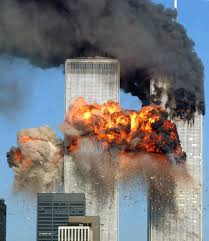
World Trade Center on September 11, 2001
Hussein had not plotted 9/11, and there was no evidence that he did. But that didn’t matter to Bush and those planning the invasion and conquest of Iraq.
British historian Nigel Hamilton has dared to lay bare the facts of this disgrace. Hamilton is the author of several acclaimed political biographies, including JFK: Reckless Youth and Bill Clinton: Mastering the Presidency.
In 2007, he began research on his latest book: American Caesars: The Lives of the Presidents From Franklin D. Roosevelt to George W. Bush.

Nigel Hamilton
Nigel Hamilton, CC BY-SA 3.0 <http://creativecommons.org/licenses/by-sa/3.0/>, via Wikimedia Commons
The inspiration for this came from a classic work of ancient biography: The Twelve Caesars, by Gaius Suetonius Tranquillus—known as Suetonius.
Suetonius, a Roman citizen and historian, had chronicled the lives of the first twelve Caesars of imperial Rome: Julius Caesar, Augustus, Tiberius, Caligula, Claudius, Nero, Galba, Otho, Vitellius, Vespasian, Titus and Domitian.
Hamilton wanted to examine post-World War II United States history as Suetonius had examined that of ancient Rome: Through the lives of the 12 “emperors” who had held the power of life and death over their fellow citizens—and those of other nations.
For Hamilton, the “greatest of American emperors, the Caesar Augustus of his time,” was Franklin D. Roosevelt, who led his country through the Great Depression and World War II.

Franklin D. Roosevelt
His “”great successors” were Harry S. Truman, Dwight D. Eisenhower and John F. Kennedy—who, in turn, contained the Soviet Union abroad and presided over sustained economic prosperity at home.
By contrast, “arguably the worst of all the American Caesars” was “George W. Bush, and his deputy, Dick Cheney, who willfully and recklessly destroyed so much of the moral basis of American leadership in the modern world.”
Among the most lethal of Bush’s offenses: The appointing of officials who refused to take seriously the threat posed by Al-Qaeda.
And this arrogance and indifference continued—right up to September 11, 2001, when the World Trade Center and Pentagon became targets for destruction.
Among the few administration officials who did take Al-Qaeda seriously was Richard Clarke, the chief counter-terrorism adviser on the National Security Council.
Clarke had been thus appointed in 1998 by President Bill Clinton. He continued in the same role under President Bush—but the position was no longer given cabinet-level access.
This put him at a severe disadvantage when dealing with other, higher-ranking Bush officials—such as Vice President Dick Cheney, Secretary of Defense Donald Rumsfeld, Rumsfeld’s deputy, Paul Wolfowitz and National Security Advisor Condoleeza Rice.
These turned out to be the very officials who refused to believe that Al-Qaeda posed a lethal threat to the United States.
“Indeed,” writes Hamilton, “in the entire first eight months of the Bush Presidency, Clarke was not permitted to brief President Bush a single time, despite mounting evidence of plans for a new al-Qaeda outrage.” [Italics added]
Nor did it help that, during his first eight months in office before September 11, Bush was on vacation, according to the Washington Post, 42% of the time.
For months, Clarke tried to convince others in the Bush Administration that Bin Laden was plotting another attack against the United States–either abroad or at home.
But Clarke could not prevail against the know-it-all arrogance of such higher-ranking Bush officials as Cheney, Rumsfeld, Wolfowitz and Rice.
2003 IRAQ WAR, ABC NEWS, ADOLF HITLER, ALTERNET, AMERICABLOG, AP, BABY BOOMER RESISTANCE, BBC, BLOOMBERG NEWS, BUZZFEED, CBS NEWS, CHINA, CNN, CRIMEAN PENINSULA, CROOKS AND LIARS, DAILY KOS, DONALD TRUMP, ECONOMIC SANCTIONS, EDOUARD DELADIER, ENGLAND, FIVETHIRTYEIGHT, FRANCE, GEORGE W. BUSH, HARPER’S MAGAZINE, HUFFINGTON POST, IRAN, JOACHIM VON RIBBENTROP, KIEV, MEDIA MATTERS, MOSKOVA (SHIP), MOTHER JONES, MOVEON, MSNBC, MUNICH CONFERENCE, NATO, NBC NEWS, NEVILLE CHAMBERLAIN, NEW REPUBLIC, NEWSDAY, NEWSWEEK, NPR, PBS NEWSHOUR, POLAND, POLITICO, POLITICUSUSA, RAW STORY, REPUBLIC OF GEORGIA, REUTERS, RUBLES, RUSSIA, SADDAM HUSSEIN, SALON, SEATTLE TIMES, SECOND CHECHEN WAR, SLATE, SOVIET UNION, TALKING POINTS MEMO, THE ATLANTIC, THE CHICAGO SUN-TIMES, THE CHICAGO TRIBUNE, THE DAILY BEAST, THE DAILY BLOG, THE GUARDIAN, THE HILL, THE HUFFINGTON POST, THE INTERCEPT, THE LOS ANGELES TIMES, THE NATION, THE NEW REPUBLIC, THE NEW YORK TIMES, THE NEW YORKER, THE VILLAGE VOICE, THE WASHINGTON POST, THINKPROGRESS, TIME, TRUTHDIG, TRUTHOUT, TWO POLITICAL JUNKIES, U.S. NEWS & WORLD REPORT, UKRAINE, UNITED STATES, UPI, USA TODAY, VLADIMIR PUTIN, WONKETTE, X
In Bureaucracy, Business, History, Military, Politics, Social commentary on March 12, 2026 at 12:39 am
On February 28, 2022, CNN’s website published the following headline: RUSSIA FACES FINANCIAL MELTDOWN AS SANCTIONS SLAM ITS ECONOMY.
The story opened:
“Russia was scrambling to prevent financial meltdown Monday as its economy was slammed by a broadside of crushing Western sanctions imposed over the weekend in response to the invasion of Ukraine.”
That unprovoked attack had opened on February 24, with missile and artillery attacks, striking major Ukrainian cities, including Kiev.
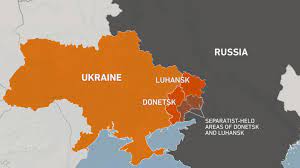
Ukraine vs. Russia
Russian President Vladimir Putin believed that the conquest of Ukraine would be a cakewalk. Intent on restoring the borders of the former Soviet Union, he had swept from one successful war to the next:
- In 1999-2000, he waged the Second Chechen War, restoring federal control of Chechnya.
- In 2008, he invaded the Republic of Georgia, which had declared its independence as the Soviet Union began to crumble. By war’s end, Russia occupied 20% of Georgia’s territory.
- In 2014, Putin invaded and annexed the Crimean Peninsula from Ukraine.
Meanwhile, the North Atlantic Treaty Organization (NATO) launched only verbal condemnations.
The reasons:
- Fear of igniting a nuclear war;
- Belief that Russia was simply acting within its own sphere of influence; and/or
- Then-President Donald Trump’s repeated attacks on NATO and displays of subservience to Putin.
NATO emblem
Russia had began massing troops on the Ukrainian border in 2021.
When the invasion came, the United States and its Western European allies retaliated with unprecedented economic sanctions.
Among the resulting casualties:
- The ruble crashed.
- Russia’s central bank more than doubled interest rates to 20%.
- Economists predicted the Russian economy could decline by five percent.
- The West—especially the United States—froze at least half of the $630 billion in international reserves that Putin had amassed to stave off tough sanctions.
Then the war bogged down for Russia. By 2026:
- Russia occupied approximately 20% of Ukraine.
- Russia made slow expansions in the east, but Ukraine regained about 400 square kilometers of territory.
- The war has become a conflict fought with drones, Vehicle movement near the front has become impossible.
- Russian drones and missiles target civilian infrastructure and residential areas.
- Ukraine has launched deep-strike operations against Russian military production and energy facilities.
- Russian casualties are estimated between 1.1 million and 1.3 million.
- Ukrainian casualties are estimated between 500,000 and 600,000.
- In short: The war is not going the way Putin assumed it would.

Vladimir Putin
Пресс-служба Президента РФ, CC BY 4.0 <https://creativecommons.org/licenses/by/4.0>, via Wikimedia Commons
Putin attacked Ukraine to prevent it from joining NATO. But:
- It has frightened Sweden and Finland into joining NATO.
- Russia has suffered a series of humiliating battlefield defeats and its draft has enraged millions of Russians.
- Putin has refused to withdraw from Ukraine and become bogged down in a seemingly endless war.
- As a result, Putin has locked himself into a no-win position.
- And NATO is now fully revitalized to meet future Russian threats.
This is not the first time a dictator has guessed wrong about the results of his actions.
On September 1, 1939, German Fuhrer Adolf Hitler ordered his armies to invade Poland.
Almost a year earlier—on September 29, 1938—he had bullied British Prime Minister Neville Chamberlain and French Prime Minister Edouard Daladier into surrendering the northern, southwest and western regions of Czechoslovakia, inhabited mostly by ethnic Germans.
The Munich Agreement whetted Hitler’s appetite for greater conquests—and fueled his contempt for England and France: “Our enemies are little worms,” he said in a conference with his generals. “I saw them at Munich.”
He believed he could conquer Poland, and Chamberlain and Daladier would meekly ratify his latest acquisition.
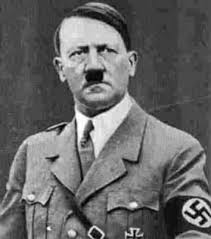
Adolf Hitler
So he was stunned when, on September 3, 1939, Britain and France—however reluctantly—honored their pledged word to Poland and declared war on Germany.
“What now?” Hitler furiously asked his Foreign Minister, Joachim von Ribbentrop.
Ribbentrop had no answer.
Knowing that Germany lacked the resources for a long war, Hitler had intended to fight a series of quick, small wars, gobbling up one country at a time. Now he found himself locked in an endless war with heavyweights France and England—and eventually the Soviet Union and the United States.
He stayed locked into that war until he committed suicide on April 30, 1945, and the Third Reich officially collapsed on May 7.
Fifty-eight years later, on March 21, 2003, President George W. Bush’s attacked Saddam Hussein’s Iraq.

George W. Bush
The war started impressively, with 1,700 air sorties and 504 Cruise missiles.
Within two weeks, American ground forces entered Baghdad. After four days of intense fighting, the Iraqi regime fell. By April 14, the Pentagon reported that major military operations had ended.
On May 1, 2003, Bush declared that the war was won.
But then American forces became embroiled in an endless, nationwide guerrilla war. Eighteen years later, the United States was still fighting in Iraq.
The war that Bush had deliberately provoked:
- Took the lives of 4,484 Americans.
- Cost the United States Treasury at least $2 trillion.
- Allowed Iran—Iraq’s arch enemy—to eagerly fill it the vacuum.
- Killed at least 655,000 Iraqis.
- Frightened China and Russia into expanding the size of their militaries.
On February 28, 2026, President Donald J. Trump—in collusion with Israel—launched massive airstrikes against Iran, predicting, on March 9: “It’s going to be ended soon….”
Thus do the worst intentions of hubristic dictators often come undone.
ABC NEWS, ALTERNET, AMERICABLOG, AP, BABY BOOMER RESISTANCE, BBC, BILL MAULDIN, BLOOMBERG, BUZZFEED, CBS NEWS, CNN, CROOKS AND LIARS, DAILY KOS, DONALD TRUMP, FIVETHIRTYEIGHT, GENERAL LUCIAN K. TRUSCOTT, GEORGE W. BUSH, HARPER’S MAGAZINE, HUFFINGTON POST, IRAQ WAR, JEB BUSH, MEDIA MATTERS, MEMORIAL DAY, MOTHER JONES, MOVEON, MSNBC, NATIONAL CONSERVATIVE POLITICAL ACTION CONFERENCE (CPAC), NBC NEWS, NEW REPUBLIC, NEWSDAY, NEWSWEEK, NPR, OLD GLORY, PBS NEWSHOUR, POLITICO, POLITICUSUSA, RAW STORY, REUTERS, SADDAM HUSSEIN, SALON, SAVING PRIVATE RYAN, SCOTT WALKER, SEATTLE TIMES, SLATE, STEVEN SPIELBERG, TALKING POINTS MEMO, THE ATLANTIC, THE CHICAGO SUN-TIMES, THE CHICAGO TRIBUNE, THE DAILY BEAST, THE DAILY BLOG, THE GUARDIAN, THE HILL, THE HUFFINGTON POST, THE INTERCEPT, THE LOS ANGELES TIMES, THE NATION, THE NEW REPUBLIC, THE NEW YORK TIMES, THE NEW YORKER, THE VILLAGE VOICE, THE WALL STREET JOURNAL, THE WASHINGTON POST, THINKPROGRESS, TIME, TRUTHDIG, TRUTHOUT, TWO POLITICAL JUNKIES, U.S. NEWS & WORLD REPORT, UPI, USA TODAY, WEAPONS OF MASS DESTRUCTION, WHITE HOUSE CORRESPONDENTS DINNER, WORLD WAR 11, X
In Bureaucracy, History, Military, Politics, Social commentary on May 27, 2024 at 12:10 am
Saving Private Ryan, Steven Spielberg’s 1998 World War II epic, is a tribute to the virtues of courage and self-sacrifice in defense of loyalty and freedom.
Virtues that are increasingly lost on millions of Right-wing Americans who have turned their backs on democracy and fervently embraced rule by strongman.
The movie opens with a scene of an American flag snapping in the wind. Except that the brilliant colors of Old Glory have been washed out, leaving only black-and-white stripes and black stars.
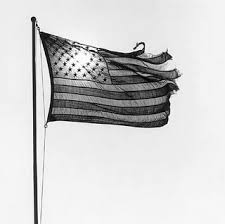
And then the movie opens—not during World war II but the present day.
Did Spielberg know something that his audience could only sense? Such as that the United States, for all its military power, has become a pale shadow of its former glory?
May 30, 1945, marked the first Memorial Day after World War II ended in Europe. On that day, the Sicily-Rome American Cemetery, near the town of Nettuno, held about 20,000 graves.
Most were soldiers who had died in Sicily, at Salerno, or at Anzio. One of the speakers at the ceremony was Lieutenant General Lucian K. Truscott, Jr., the U.S. Fifth Army Commander.
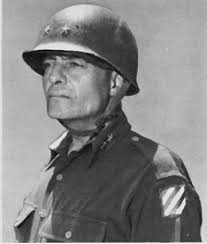
Lieutenant General Lucian K. Truscott, Jr.
Unlike many other generals, Truscott had shared in the dangers of combat, pouring over maps on the hood of his jeep with company commanders as bullets or shells whizzed about him.
When it came his turn to speak, Truscott moved to the podium. Then he turned his back on the assembled visitors—which included several Congressmen.
The audience he now faced were the graves of his fellow soldiers.
Among those who heard Truscott’s speech was Bill Mauldin, the famous cartoonist for the Army newspaper, Stars and Stripes. Mauldin had created Willie and Joe, the unshaven, slovenly-looking “dogfaces” who came to symbolize the GI.
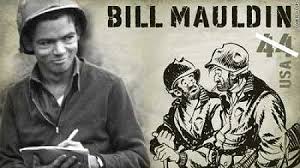
Bill Mauldin and “Willie and Joe,” the characters he made famous
It’s from Mauldin that we have the fullest account of Truscott’s speech that day.
“He apologized to the dead men for their presence there. He said that everybody tells leaders that it is not their fault that men get killed in war, but that every leader knows in his heart that this is not altogether true.
“He said he hoped anybody here through any mistake of his would forgive him, but he realized that he was asking a hell of a lot under the circumstances….
“Truscott said he would not speak of the ‘glorious’ dead because he didn’t see much glory in getting killed in your teens or early twenties.
“He promised that if in the future he ran into anybody, especially old men, who thought death in battle was glorious, he would straighten them out. He said he thought it was the least he could do.
“It was the most moving gesture I ever saw,” wrote Mauldin.
Then Truscott walked away, without acknowledging his audience of celebrities.
Fast forward 61 years later—to March 24, 2004.
At a White House Correspondents dinner in Washington, D.C., President George W. Bush joked publicly about the absence of Weapons of Mass Destruction (WMDs) in Iraq.
One year earlier, he had ordered the invasion of Iraq, claiming that its dictator, Saddam Hussein, possessed WMDs he intended to use against the United States.
To Bush, the non-existent WMDs were simply the butt of a joke that night. While an overhead projector displayed photos of a puzzled-looking Bush searching around the Oval Office, Bush recited a comedy routine.
“Those Weapons of Mass Destruction have gotta be here somewhere,” Bush laughed, while a photo showed him poking around the corners of the Oval Office.
“Nope—no weapons over there! Maybe they’re under here,” he said, as a photo showed him looking under a desk.
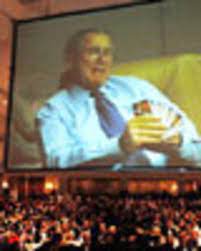
George W. Bush jokes about “missing” WMDs
It was a scene that could have occurred under the Roman emperor Nero: An assembly of wealthy, pampered men and women–the elite of America’s media and political classes–laughed heartily during Bush’s performance.
Only later did outrage come—from Democrats and Iraqi war veterans. Especially those veterans who had lost comrades or suffered horrific wounds to protect America from a threat that had never existed.
Then fast forward another 11 years—to February 27, 2015.
The Republican party’s leading Presidential contenders for 2016 gathered at the Conservative Political Action Conference (CPAC) in National Harbor, Maryland.
Among them:
- Florida Governor Jeb Bush;
- Wisconsin Governor Scott Walker; and
- Businessman Donald Trump.
Although each candidate tried to stake his own claim to the Oval Office, all of them agreed on two points:
First, President Barack Obama had been dangerously timid in his conduct of foreign policy; and
Second, they would pursue aggressive military action in the Middle East.
Neither Bush nor Walker had seen fit to enter the ranks of the military he wished to plunge into further combat. And Trump was a five-time draft dodger while the Vietnam war raged.
Bush, Walker and Trump are typical of those who make up the United States Congress:
Of those members elected to the House and Senate in November, 2016, only 102—less than 19%—served in the U.S. military.
Small wonder then, that, for many people, Old Glory has taken on a darker, washed-out appearance, in real-life as in film.
"MISSION: IMPOSSIBLE", 2016 PRESIDENTIAL ELECTION, ABC NEWS, ALTERNET, AMERICABLOG, AP, AUGUSTO PINOCHET, AUGUSTO SANDINO, AYATOLLAH RUHOLLAH KHOMEINI, ” 9/11, BABY BOOMER RESISTANCE, BAY OF PIGS, BBC, BLOOMBERG NEWS, BUZZFEED, CBS NEWS, CHIANG KAI-SHEK, CHILE, CIA, CNN, CROOKS AND LIARS, CUBA, DAILY KOS, DAILY KOZ, DONALD TRUMP, DWIGHT D. EISENHOWER, FIDEL CASTRO, FIVETHIRTYEIGHT, FULGENCIO BATISTA, GEORGE W. BUSH, GUATEMALA, HAITI, HARPER’S MAGAZINE, HONODURAS, HUFFINGTON POST, IRAQ, JACOBO ARBENZ, JOHN F. KENNEDY, MAFIA, MAO TSE-TUNG, MEDIA MATTERS, MOHAMMAD MOSADDEGH, MOHAMMAD-REZA SHAH PHLAVI, MOTHER JONES, MOVEON, MSNBC, NATIONAL SECURITY AGENCY, NBC NEWS, NEW REPUBLIC, NEWSDAY, NEWSWEEK, NICARAGUA, NPR, OSAMA BIN LADEN, PBS NEWSHOUR, POLITICO, POLITICUSUSA, RAW STORY, REUTERS, RICHARD M. NIXON, ROBERT MUELLER, RUSSIA, SADDAM HUSSEIN, SALON, SALVADOR ALLENDE, SEATTLE TIMES, SLATE, SOVIET UNION, TALKING POINTS MEMO, THE ATLANTIC, THE CHICAGO SUN-TIMES, THE CHICAGO TRIBUNE, THE DAILY BEAST, THE DAILY BLOG, THE GUARDIAN, THE HILL, THE HUFFINGTON POST, THE INTERCEPT, THE LOS ANGELES TIMES, THE NATION, THE NEW REPUBLIC, THE NEW YORK TIMES, THE NEW YORKER, THE VILLAGE VOICE, THE WASHINGTON POST, THINKPROGRESS, TIME, TRUTHDIG, TRUTHOUT, TWITTER, U.S. NEWS & WORLD REPORT, UNITED FRUIT COMPANY, UPI, USA TODAY
In Bureaucracy, History, Military, Politics, Social commentary on November 3, 2023 at 12:13 am
The CIA, FBI and National Security Agency (which cracks codes and listens to the telephone conversation of foreign leaders) unanimously agree: Russian trolls and Intelligence agents played a major role in subverting the 2016 Presidential election.
Special Counsel Robert Mueller III, assigned in May, 2017, to investigate charges of Russian interference, believed there was collusion. He indicted or obtained guilty pleas from 34 people and three companies.
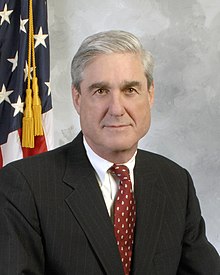
Robert Mueller
And about 58% of Americans believe that President Donald Trump tried to obstruct the investigation.
Apparently, most Americans don’t like having their elections subverted by enemy nations.
Subverting the governments of other countries is a right that Americans have long reserved for themselves. Among those regimes that have been toppled:
- Between 1898 and 1934, the United States repeatedly intervened with military force in Central America and the Caribbean.
- Americans staged invasions of Honduras in 1903, 1907, 1911, 1912, 1919, 1924 and 1925 to defend U.S. interests. These were defined as Standard Oil and the United Fruit Company.
- The United States occupied Nicaragua almost continuously from 1912 to 1933. Its legacy was the imposition of the tyrannical Somoza family, which ruled from 1936 to 1979.
- The United States occupied Haiti from 1915 to 1934. American banks had lent money to Haiti and requested American government intervention.
- In 1918, 13,000 American soldiers joined armies from Europe and Japan to overthrow the new Soviet government and restore the previous Czarist regime. By 1920, the invading forces proved unsuccessful and withdrew.
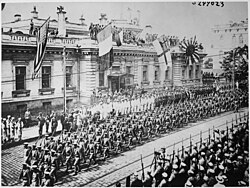
Allied troops parading in Vladivostok, 1918
- From 1946 to 1949, the United States provided military, logistical and other aid to the Right-wing Chinese Nationalist Party of Chiang Kai-shek. Its opponent: Communist forces led by Mao Tse-Tung, who ultimately proved victorious.
- In 1953, the Eisenhower administration ordered the CIA to overthrew the democratically-elected government of of Iranian Prime Minister Mohammad Mosaddegh. His crime: Nationalizing the Iranian oil industry, which had been under British control since 1913. He was succeeded by Mohammad-Reza Shah Phlavi.
- Whereas Mossadeddgh had ruled as a constitutional monarch, Phlavi was a dictator who depended on United States government support to retain power until he was overthrown in 1979 by the Ayatollah Ruhollah Khomeini.
- In 1954, the CIA overthrew the democratically-elected government of Guatemalan President Jacobo Arbenz. His crime: Installing a series of reforms that expanded the right to vote, allowed workers to organize, legitimized political parties and allowed public debate. Most infuriating to American Right-wingers: His agrarian reform law, which expropriated parts of large land-holdings and redistributed them to agricultural laborers.
- The United Fruit Company lobbied the United States government to overthrow him—and the CIA went into action. Arbenz was replaced by the first of a series of brutal Right-wing dictators.
- From 1959 until 1963, the United States government was obsessed with overthrowing the revolutionary Cuban government of Fidel Castro. Although not democratically elected, Castro was wildly popular in Cuba for overthrowing the dictatorial Fulgencio Batista.
- On April 17, 1961, over 1,400 CIA-trained Cuban exiles invaded Cuba at the Bay of Pigs. Cuban military forces crushed the invasion in three days.
- Infuriated with the failure of the Bay of Pigs invasion, President John F. Kennedy authorized “Operation Mongoose” to remove Castro through sabotage and assassination. The CIA, wanting to please Kennedy, teamed up with the Mafia, which wanted to resurrect its casinos on the island.
- Among the tactics used: Hiring Cuban gangsters to murder police officials and Soviet technicians; sabotaging mines; using biological and chemical warfare against the Cuban sugar industry. None of these proved successful in assassinating Castro nor overturning his regime.
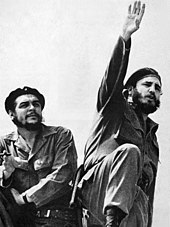
Ernesto “Che” Guevera and Fidel Castro
- In 1970, President Richard M. Nixon ordered the CIA to prevent Marxist Salvador Allende from being democratically elected as president of Chile. When that failed, he ordered the CIA to overthrow Allende. Allende’s crime: A series of liberal reforms, including nationalizing large-scale industries (notably copper mining and banking).
- In 1973, he was overthrown by Chilean army units and national police. He was followed by Right-wing dictator Augusto Pinochet, who slaughtered 3,200 political dissidents, imprisoned 30,000 and forced another 200,000 Chileans into exile.
And how did Americans react to all these attempts—successful and unsuccessful—at regime change?
Through indifference or outright support.
The popular 1960s TV series, “Mission: Impossible,” regularly depicted a CIA-type agency supporting regimes “we” liked or toppling those “we” didn’t.
Americans generally assume their Presidents and Congress know best who is a “friend” and who is an “enemy.” America’s friends usually turn out to be Right-wing dictators like Chiang Kai-Shek, Fulgencio Batista, Augusto Pinochet and Mohammad-Reza Shah Phlavi.
And its enemies often turn out to be liberal reformers like Augusto Sandino, Mohammad Mosaddegh and Salvador Allende.
Americans tend to favor intervention for the flimsiest of reasons. In 2003, President George W. Bush claimed Iraq’s dictator, Saddam Hussein, had plotted 9/11 with Osama bin Laden. There was absolutely no proof to substantiate this, yet Americans overwhelmingly supported Bush’s unprovoked invasion of Iraq.
But now the shoe is on the other foot.
Except for President Donald Trump and his fanatical supporters, Americans are furious that a foreign power has dared to install “regime change” on them.
Americans are now tasting the medicine they have dished out to so many other countries. And they find it as repugnant as those countries have found the American brand.
ABC NEWS, AESOP'S FABLES, ALTERNET, AMERICABLOG, AP, ARABS, BABY BOOMER RESISTANCE, BBC, BLOOMBERG NEWS, BOMBING ISRAELI DEFENSE FORCES, BUZZFEED, CBS NEWS, CIVIL WAR, CNN, CONFEDERATE STATES OF AMERICA, CROOKS AND LIARS, DAILY KOS, FIVETHIRTYEIGHT, GAZA STRIP, GULF WAR, HAMAS, HAMBURG RAID, HARPER’S MAGAZINE, HUFFINGTON POST, ISLAMICS, ISRAEL, ISRAELI AIR FORCE, MEDIA MATTERS, MOTHER JONES, MOVEON, MSNBC, NAZI GERMANY, NBC NEWS, NEW REPUBLIC, NEWSDAY, NEWSWEEK, NICCOLO MACHIAVELLI, NPR, PBS NEWSHOUR, POLITICO, POLITICUSUSA, RAW STORY, REUTERS, ROYAL AIR FORCE, SADDAM HUSSEIN, SALON, SEATTLE TIMES, SLATE, TALKING POINTS MEMO, THE ATLANTIC, THE CHICAGO SUN-TIMES, THE CHICAGO TRIBUNE, THE DAILY BEAST, THE DAILY BLOG, THE DISCOURSES, THE GUARDIAN, THE HILL, THE HUFFINGTON POST, THE INTERCEPT, THE LOS ANGELES TIMES, THE NATION, THE NEW REPUBLIC, THE NEW YORK TIMES, THE NEW YORKER, THE VILLAGE VOICE, THE WASHINGTON POST, THINKPROGRESS, THOMAS "STONEWALL" JACKSON, TIME, TRUTHDIG, TRUTHOUT, TWITTER, U.S. NEWS & WORLD REPORT, UNITED STATES AIR FORCE, UPI, USA TODAY, WILLIAM TECUMSEH SHERMAN, WORLD WAR 11
In Bureaucracy, History, Military, Politics, Social commentary on October 23, 2023 at 1:13 am
Thomas Jonathan “Stonewall” Jackson, the great Southern general of the American Civil War (1861-1865) had a simple philosophy of war.
To end Union efforts to crush the newly-minted Confederate States of America, he urged Southerners to take no prisoners. Instead, they should kill every Union soldier they could lay hands on.
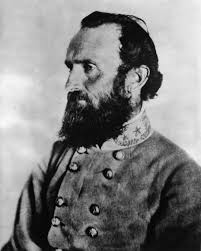
Thomas “Stonewall” Jackson
Jackson’s views on war were shared by not only his fellow Southerners but, ironically, by one of the fiercest enemies of the Confederacy: William Tecumseh Sherman.
Sherman was the Union general who in 1864 cut a swath of destruction through the South while “marching through Georgia.”
He is credited—or reviled—as the father of “total war,” thus making the suffering of civilians an integral part of any conflict. Sherman realized that civilian support played a vital role in a nation’s war-making capacity.
Destroy that support, he believed, and the conflict would end.
In March, 1985, just as the Civil War was close to its end, a staff officer told Sherman about Jackson’s opinion on not taking prisoners.
Asked for his reaction, Sherman said: “Perhaps he was right. It seems cruel, but if there were no quarter given, most men would keep out of war. Rebellions would be few and short.”
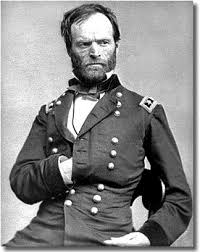
William Tecumseh Sherman
Contrast that with the way Israel has long responded to hundreds of unprovoked rocket attacks by the Hamas terrorist group.
Beginning in July 8, 2014, the Israeli Air Force bombarded more than 900 Hamas targets in the Gaza Strip.
Israel claimed it was trying to avoid civilian casualties in the crowded urban landscape. Members of the Israeli military began telephoning Palestinian residents whose homes had been targeted, warning them to leave.
One resident, Sawsan Kawarea, claimed she received a call from “David,” who said he was with the Israeli military.
“He asked for me by name. He said: ‘You have women and children in the house. Get out. You have five minutes before the rockets come,’” Kawarea said in an interview.
She ran outside with her children. A small rocket hit the house soon afterward. Five minutes later, a larger missile hit, destroying the house.
For years, the Israeli military has delivered such warnings via cellphone calls and small “warning rockets”—usually sent from drones.
The strategy has a nickname: “Roof knocking.”
It’s Israel’s response to longtime criticism for “collateral damage.” That is: Civilians killed while its military takes action in the crowded Palestinian territories.
The policy allows Israel to say: We did our best to avoid killing civilians.
But in waging Politically Correct warfare to head off criticism, Israel has made a dangerous mistake.
Niccolo Machiavelli, the 15th century Florentine statesmen, carefully studied both war and politics.

Niccolo Machiavelli
In his major work, The Discourses, he wrote candidly about how to preserve liberties within a republic. In waging war, he advised:
…Often individual men, and sometimes a whole city, will act so culpably against the state that as an example to others and for his own security the prince has no other remedy but to destroy it entirely. Honor consists in being able, and knowing when and how, to chastise evil-doers.
And a prince who fails to punish them, so that they shall not be able to do any more harm, will be regarded as either ignorant or cowardly.
Meanwhile, on the Gaza Strip: After a week of Israeli bombing more than 900 Hamas targets, Palestinian medical officials claimed that 186 people had been killed and at least 1,390 wounded.
That worked out to about 26 people killed every day.
Contrast those figures with the casualties suffered by a single German city during World War 11 air raids during eight days and seven nights.
Beginning on July 24, 1943, the U.S. Air Force and the British Royal Air Force over several days killed 42,600 civilians and wounded 37,000 in Hamburg and practically destroyed the entire city.
The bombing ignited a firestorm that incinerated more than eight square miles, baking alive many of those who sought safety in cellars and bomb shelters.
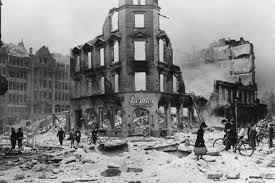
Hamburg, Germany, after Allied bombing raids
For the vaunted Israeli Air Force to have killed so few of its enemies after dropping so many bombs testified to a massive waste of ordinance.
Clearly, the only people making good on these raids were the arms makers supplying the bombs.
If the United States and Great Britain had managed to kill only 26 Germans a day in World War II, America, Britain and Nazi Germany would still be at war today.
No wonder Hamas continues to fire rockets into Israel.
Machiavelli knew—and often warned—that while it was useful to avoid hatred, it was fatal to be despised. And he also warned that humility toward insolent enemies will only encourage their hatred and contempt for you.
An Aesop’s fable well sums up the lesson Israel should have learned long ago: A snake was stepped on by so many people he prayed to Zeus for help. And Zeus said: “If you’d bitten the first person who stepped on you, the second would have thought twice about it.”
"MISSION: IMPOSSIBLE", 2016 PRESIDENTIAL ELECTION, ABC NEWS, ADAM SCHIFF, ALTERNET, AMERICABLOG, AP, AUGUSTO PINOCHET, AUGUSTO SANDINO, AYATOLLAH RUHOLLAH KHOMEINI, ” 9/11, BABY BOOMER RESISTANCE, BAY OF PIGS, BERNARD LAW MONTGOMERY, BUZZFEED, CBS NEWS, CHIANG KAI-SHEK, CHILE, CIA, CNN, CROOKS AND LIARS, CUBA, DAILY KOZ, DONALD TRUMP, DRUDGE RETORT, DWIGHT D. EISENHOWER, FBI, FIDEL CASTRO, FIVETHIRTYEIGHT, FULGENCIO BATISTA, GEORGE W. BUSH, GUATEMALA, HAITI, HARPER’S MAGAZINE, HONODURAS, HUNTER BIDEN, IRAQ, JACOBO ARBENZ, JOE BIDEN, JOHN F. KENNEDY, MAFIA, MAO TSE-TUNG, MEDIA MATTERS, MICK MULVANEY, MOHAMMAD MOSADDEGH, MOHAMMAD-REZA SHAH PHLAVI, MOTHER JONES, MOVEON, MSNBC, NANCY PELOSI, NATIONAL SECURITY AGENCY, NBC NEWS, NEWSWEEK, NICARAGUA, NPR, OSAMA BIN LADEN, PBS NEWSHOUR, POLITICO, POLITICUSUSA, RAW STORY, REUTERS, RICHARD M. NIXON, RUSSIA, SADDAM HUSSEIN, SALON, SALVADOR ALLENDE, SEATTLE TIMES, SLATE, SOVIET UNION, TALKING POINTS MEMO, THE ATLANTIC, THE CHICAGO SUN-TIMES, THE CHICAGO TRIBUNE, THE DAILY BEAST, THE DAILY BLOG, THE GUARDIAN, THE HILL, THE HUFFINGTON POST, THE LOS ANGELES TIMES, THE NATION, THE NEW REPUBLIC, THE NEW YORK TIMES, THE VILLAGE VOICE, THE WASHINGTON POST, THINKPROGRESS, TIME, TRUTHDIG, TRUTHOUT, TWITTER, TWO POLITICAL JUNKIES, U.S. NEWS & WORLD REPORT, UKRAINE, UNITED FRUIT COMPANY, UPI, USA TODAY, VOLODYMYR ZELENSKY, WINSTON CHURCHILL, WONKETTE, WORLD WAR 11
In Bureaucracy, History, Politics, Social commentary on September 22, 2023 at 12:18 am
“I have news for everybody: Get over it. There’s going to be political influence in foreign policy.”
The speaker was White House chief of staff Mick Mulvaney. And in an October 17, 2019 press conference, he was trying to put the best possible spin on President Donald Trump’s latest outrage: An attempt to extort a “favor” from the president of Ukraine.
In July, 2019, Trump told Mulvaney to withhold almost $400 million in promised military aid for Ukraine, which faces increasing aggression from Russia.
On July 25, Trump telephoned Ukrainian President Volodymyr Zelensky to “request” a “favor”: Investigate Democratic Presidential Candidate Joe Biden and his son, Hunter, who had had business dealings in Ukraine.The reason for such an investigation: To find embarrassing “dirt” on Biden.
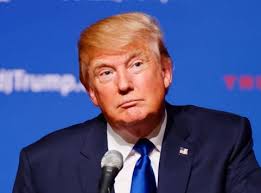
Donald Trump
But then a CIA whistleblower filed a complaint about the extortion attempt—and the media and Congress soon learned of it.
Rep. Adam Schiff, D-Calif., tweeted: “The transcript of the call reads like a classic mob shakedown: — We do a lot for Ukraine — There’s not much reciprocity — I have a favor to ask — Investigate my opponent — My people will be in touch — Nice country you got there. It would be a shame if something happened to her.”
On September 24, 2019, Nancy Pelosi, speaker to the House of Representatives, announced a formal impeachment inquiry into Trump.
During World War II, President Franklin D. Roosevelt didn’t hesitate to leverage the great economic and military power of the United States to gain concessions from Winston Churchill, the prime minister of Great Britain.
At Roosevelt’s insistence, for example, it was an American—General Dwight D. Eisenhower—who was appointed Supreme Allied Commander in Europe. Had the British gotten their way, the post would have almost certainly gone to British Field Marshal Bernard Law Montgomery.
Roosevelt’s insistence, however, had nothing to do with personally benefiting himself.
But the unpleasant truth remains that subverting the governments of other countries is a right that Americans have long reserved for themselves. For example:
- Between 1898 and 1934, the United States repeatedly intervened with military force in Central America and the Caribbean.
- Americans staged invasions of Honduras in 1903, 1907, 1911, 1912, 1919, 1924 and 1925 to defend U.S. interests. These were defined as Standard Oil and the United Fruit Company.
- The United States occupied Nicaragua almost continuously from 1912 to 1933. Its legacy was the imposition of the tyrannical Somoza family, which ruled from 1936 to 1979.
- The United States occupied Haiti from 1915 to 1934. American banks had lent money to Haiti and requested American government intervention.
- In 1918, 13,000 American soldiers joined armies from Europe and Japan to overthrow the new Soviet government and restore the previous Tsarist regime. By 1920, the invading forces proved unsuccessful and withdrew.
Allied troops parading in Vladivostok, 1918
- In 1953, President Dwight D. Eisenhower ordered the CIA to overthrew the democratically-elected government of of Iranian Prime Minister Mohammad Mosaddegh. His crime: Nationalizing the Iranian oil industry, which had been under British control since 1913.
- He was succeeded by Mohammad-Reza Shah Phlavi. Whereas Mossadeddgh had ruled as a constitutional monarch, Phlavi was a dictator who depended on United States government support to retain power until he was overthrown in 1979 by the Ayatollah Ruhollah Khomeini.
- In 1954, the CIA overthrew the democratically-elected government of Guatemalan President Jacobo Arbenz. His crime: Installing a series of reforms that expanded the right to vote, allowed workers to organize, legitimized political parties and allowed public debate.
- Most infuriating to American Right-wingers: His agrarian reform law, which expropriated parts of large land-holdings and redistributed them to agricultural laborers.
- From 1959 until 1963, the United States government was obsessed with overthrowing the revolutionary Cuban government of Fidel Castro. Although not democratically elected, Castro was wildly popular in Cuba for overthrowing the dictatorial Fulgencio Batista.
- On April 17, 1961, over 1,400 CIA-trained Cuban exiles invaded Cuba at the Bay of Pigs. Cuban military forces crushed the invasion in three days.
- Infuriated with the failure of the Bay of Pigs invasion, President John F. Kennedy authorized “Operation Mongoose” to remove Castro through sabotage and assassination. The CIA, wanting to please Kennedy, teamed up with the Mafia, which wanted to resurrect its casinos on the island.
Ernesto “Che” Guevera and Fidel Castro
- In 1970, President Richard M. Nixon ordered the CIA to prevent Marxist Salvador Allende from being democratically elected as president of Chile. When that failed, he ordered the CIA to overthrow Allende.
- Allende’s crime: A series of liberal reforms, including nationalizing large-scale industries (notably copper mining and banking). In 1973, he was overthrown by Chilean army units and national police.
- He was followed by Right-wing dictator Augusto Pinochet, who slaughtered 3,200 political dissidents, imprisoned 30,000 and forced another 200,000 Chileans into exile.
Americans reacted to all these attempts—successful and unsuccessful—with indifference or outright support.
The popular 1960s TV series, “Mission: Impossible,” regularly depicted a CIA-type agency supporting regimes “we” liked or toppling those “we” didn’t.
Americans generally assume their Presidents and Congress know best who is a “friend” and who is an “enemy.” America’s friends often turn out, for the most part, to be Right-wing dictators like Fulgencio Batista, Augusto Pinochet and Mohammad-Reza Shah Phlavi.
And its enemies often turn out to be liberal reformers like Augusto Sandino, Jacobo Arbenz, Mohammad Mosaddegh and Salvador Allende.
2003 IRAQ WAR, ABC NEWS, ADOLF HITLER, ALTERNET, AMERICABLOG, AP, BABY BOOMER RESISTANCE, BBC, BLOOMBERG NEWS, BUZZFEED, CBS NEWS, CNN, CRIMEAN PENINSULA, CROOKS AND LIARS, DAILY KOS, DONALD TRUMP, ECONOMIC SANCTIONS, EDOUARD DELADIER, FACEBOOK, FIVETHIRTYEIGHT, FRANCE, GEORGE W. BUSH, HARPER’S MAGAZINE, HUFFINGTON POST, IRAN, JOACHIM VON RIBBENTROP, KIEV, MEDIA MATTERS, MOSKOVA (SHIP), MOTHER JONES, MOVEON, MSNBC, MUNICH CONFERENCE, NATO, NBC NEWS, NEVILLE CHAMBERLAIN, NEW REPUBLIC, NEWSDAY, NEWSWEEK, NPR, PBS NEWSHOUR, POLAND, POLITICO, POLITICUSUSA, RAW STORY, REPUBLIC OF GEORGIA, REUTERS, RUBLES, RUSSIA, SADDAM HUSSEIN, SALON, SEATTLE TIMES, SECOND CHECHEN WAR, SLATE, SOVIET UNION, TALKING POINTS MEMO, THE ATLANTIC, THE CHICAGO SUN-TIMES, THE CHICAGO TRIBUNE, THE DAILY BEAST, THE DAILY BLOG, THE GUARDIAN, THE HILL, THE HUFFINGTON POST, THE INTERCEPT, THE LOS ANGELES TIMES, THE NATION, THE NEW REPUBLIC, THE NEW YORK TIMES, THE NEW YORKER, THE VILLAGE VOICE, THE WASHINGTON POST, THINKPROGRESS, TIME, TRUTHDIG, TRUTHOUT, TWITTER, TWO POLITICAL JUNKIES, U.S. NEWS & WORLD REPORT, UKRAINE, UNITED STATES, UPI, USA TODAY, VLADIMIR PUTIN, WONKETTE
In Bureaucracy, Business, History, Military, Politics, Social commentary on December 2, 2022 at 12:14 am
On February 24, Russia launched an unprovoked attack on Ukraine with missiles and artillery, striking major Ukrainian cities, including its capitol, Kiev.
Ukraine vs. Russia
Russian President Vladimir Putin had every reason to believe that the conquest of Ukraine would be a cakewalk. Intent on restoring the borders of the former Soviet Union, he had swept from one successful war to the next:
- In 1999-2000, he waged the Second Chechen War, restoring federal control of Chechnya.
- In 2008, he invaded the Republic of Georgia, which had declared its independence as the Soviet Union began to crumble. By war’s end, Russia occupied 20% of Georgia’s territory.
- In 2014, Putin invaded and annexed the Crimean Peninsula from Ukraine.
Meanwhile, the North Atlantic Treaty Organization (NATO) launched only verbal condemnations.
The reasons:
- Fear of igniting a nuclear war;
- Belief that Russia was simply acting within its own sphere of influence; and/or
- Then-President Donald Trump’s repeated attacks on NATO and displays of subservience to Putin.
NATO emblem
When Russia invaded, the United States—now led by anti-Putin President Joe Biden—and its Western European allies retaliated with unprecedented economic sanctions.
Among the resulting casualties:
- The ruble crashed.
- Russia’s central bank more than doubled interest rates to 20%.
- The European subsidiary of Russia’s biggest bank almost collapsed in a massive Depression-era run by savers.
- Economists predicted the Russian economy could decline by five percent.
- The West—especially the United States—froze at least half of the $630 billion in international reserves that Putin had amassed to stave off tough sanctions.
On the battlefield, the war bogged down for Russia:
- Kiev remains unconquered.
- The Moskva, the flagship of Russia’s Black Sea Fleet, was sunk on April 14 after being struck by two Ukrainian Neptune anti-ship missiles.
- On September 21, with Russian forces bogged down or retreating, Putin announced the partial mobilization of 300,000 military reservists. All male citizens below 60 are now eligible to be drafted.
- More than 194,000 Russian men (and their wives or girlfriends) fled to such neighboring countries as Turkey, Georgia, Kazakhstan and Mongolia.
- Ukrainian forces retook the key city of Kherson in November; Russian forces, which had occupied the city since March, withdrew.
In short: The war is not going the way Putin assumed it would.

Vladimir Putin
Kremlin.ru, CC BY 4.0 <https://creativecommons.org/licenses/by/4.0>, via Wikimedia Commons
This is not the first time a dictator has guessed wrong about the results of his actions.
On September 1, 1939, German Fuhrer Adolf Hitler ordered his armies to invade Poland.
Almost a year earlier—on September 29, 1938—he had bullied British Prime Minister Neville Chamberlain and French Prime Minister Edouard Daladier into surrendering the northern, southwest and western regions of Czechoslovakia, inhabited mostly by ethnic Germans.
The Munich Agreement—which Chamberlain boasted meant “peace in our time—only whetted Hitler’s appetite for greater conquests.
It also led him to hold France and England in contempt: “Our enemies are little worms,” he said in a conference with his generals. “I saw them at Munich.”
He believed he could conquer Poland, and Chamberlain and Daladier would meekly ratify his latest acquisition.
Adolf Hitler
So he was stunned when, on September 3, 1939, Britain and France—however reluctantly—honored their pledged word to Poland and declared war on Germany.
“What now?” Hitler furiously asked his Foreign Minister, Joachim von Ribbentrop.
Ribbentrop had no answer.
Hitler knew that Germany didn’t have the resources for a long war. He had intended to fight a series of quick, small wars, gobbling up one country at a time. Now he found himself locked in an endless war with heavyweights France and England.
In time, he would fatally add the Soviet Union and the United States to his list of enemies.
And he stayed locked into that war until he committed suicide on April 30, 1945, and the Third Reich officially collapsed on May 7.
Fast forward to March 21, 2003 and President George W. Bush’s launching of an attack on Saddam Hussein’s Iraq.
George W. Bush
The war got off to an impressive start with 1,700 air sorties and 504 Cruise missiles.
Within roughly two weeks, American ground forces entered Baghdad, and after four days of intense fighting, the Iraqi regime fell. By April 14, the Pentagon reported that major military operations had ended.
On May 1, 2003, Bush declared that the war was won.
But then American forces became embroiled in an endless, nationwide guerrilla war. Eighteen years later, the United States was still fighting in Iraq.
The war that Bush had deliberately provoked:
- Took the lives of 4,484 Americans.
- Cost the United States Treasury at least $2 trillion.
- Created a Middle East power vacuum.
- Allowed Iran—Iraq’s arch enemy—to eagerly fill it.
- Frightened and repelled even America’s closest allies.
- Killed at least 655,000 Iraqis.
- Frightened China and Russia into expanding the size of their militaries.
Bush came to a better end than Adolf Hitler: He retired from office with a lavish pension and full Secret Service protection.
And Putin?
His attack on Ukraine was reportedly motivated, in part, to ensure that Ukrainians did not join NATO.
But his invasion has frightened Sweden and Finland into joining NATO.
And NATO is now fully revitalized to meet future Russian threats.
Thus can the worst intentions of hubristic dictators come undone.
2003 IRAQ WAR, ABC NEWS, ADOLF HITLER, ALTERNET, AMERICABLOG, AP, BABY BOOMER RESISTANCE, BBC, BLOOMBERG NEWS, BUZZFEED, CBS NEWS, CHINA, CNN, CRIMEAN PENINSULA, CROOKS AND LIARS, DAILY KOZ, DONALD TRUMP, ECONOMIC SANCTIONS, EDOUARD DELADIER, ENGLAND, FACEBOOK, FIVETHIRTYEIGHT, FRANCE, GEORGE W. BUSH, HARPER’S MAGAZINE, HUFFINGTON POST, IRAN, JOACHIM VON RIBBENTROP, KIEV, MEDIA MATTERS, MOSKOVA (SHIP), MOTHER JONES, MOVEON, MSNBC, MUNICH CONFERENCE, NATO, NBC NEWS, NEVILLE CHAMBERLAIN, NEW REPUBLIC, NEWSDAY, NEWSWEEK, NPR, PBS NEWSHOUR, POLAND, POLITICO, POLITICUSUSA, RAW STORY, REPUBLIC OF GEORGIA, REUTERS, RUBLES, RUSSIA, SADDAM HUSSEIN, SALON, SEATTLE TIMES, SECOND CHECHEN WAR, SLATE, SOVIET UNION, TALKING POINTS MEMO, THE ATLANTIC, THE CHICAGO SUN-TIMES, THE CHICAGO TRIBUNE, THE DAILY BEAST, THE DAILY BLOG, THE GUARDIAN, THE HILL, THE HUFFINGTON POST, THE INTERCEPT, THE LOS ANGELES TIMES, THE NATION, THE NEW REPUBLIC, THE NEW YORK TIMES, THE NEW YORKER, THE VILLAGE VOICE, THE WASHINGTON POST, THINKPROGRESS, TIME, TRUTHDIG, TRUTHOUT, TWITTER, TWO POLITICAL JUNKIES, U.S. NEWS & WORLD REPORT, UKRAINE, UNITED STATES, UPI, USA TODAY, VLADIMIR PUTIN, WONKETTE
In Bureaucracy, Business, History, Military, Politics, Social commentary on October 12, 2022 at 12:10 am
On February 28, CNN’s website published the following headline: Russia faces financial meltdown as sanctions slam its economy.
The story opened:
“Russia was scrambling to prevent financial meltdown Monday as its economy was slammed by a broadside of crushing Western sanctions imposed over the weekend in response to the invasion of Ukraine.”
That unprovoked attack opened on February 24, with missile and artillery attacks, striking major Ukrainian cities, including Kiev.
Ukraine vs. Russia
Russian President Vladimir Putin believed that the conquest of Ukraine would be a cakewalk. Intent on restoring the borders of the former Soviet Union, he had swept from one successful war to the next:
- In 1999-2000, he waged the Second Chechen War, restoring federal control of Chechnya.
- In 2008, he invaded the Republic of Georgia, which had declared its independence as the Soviet Union began to crumble. By war’s end, Russia occupied 20% of Georgia’s territory.
- In 2014, Putin invaded and annexed the Crimean Peninsula from Ukraine.
Meanwhile, the North Atlantic Treaty Organization (NATO) launched only verbal condemnations.
The reasons:
- Fear of igniting a nuclear war;
- Belief that Russia was simply acting within its own sphere of influence; and/or
- Then-President Donald Trump’s repeated attacks on NATO and displays of subservience to Putin.
NATO emblem
Russia had began massing troops on the Ukrainian border in 2021.
When the invasion came, the United States and its Western European allies retaliated with unprecedented economic sanctions.
Among the resulting casualties:
- The ruble crashed.
- Russia’s central bank more than doubled interest rates to 20%.
- Economists predicted the Russian economy could decline by five percent.
- The West—especially the United States—froze at least half of the $630 billion in international reserves that Putin had amassed to stave off tough sanctions.
Then the war bogged down for Russia:
- In late August, Ukraine, using missile systems supplied by the United States, destroyed Russian ammunition dumps and a Russian air base in Crimea.
- By September, Ukrainian forces recaptured much of the northeastern Kharkiv region, including the city of Izium, which the Russians had been using as a logistics hub.
- On September 21, Putin announced the partial mobilization of 300,000 military reservists. All male citizens below 60 are now eligible to be drafted.
- This, in turn, led at least 194,000 Russian men to such neighboring countries as Turkey, Georgia, Kazakhstan and Mongolia.
In short: The war is not going the way Putin assumed it would.
Vladimir Putin
Kremlin.ru, CC BY 4.0 <https://creativecommons.org/licenses/by/4.0>, via Wikimedia Commons
This is not the first time a dictator has guessed wrong about the results of his actions.
On September 1, 1939, German Fuhrer Adolf Hitler ordered his armies to invade Poland.
Almost a year earlier—on September 29, 1938—he had bullied British Prime Minister Neville Chamberlain and French Prime Minister Edouard Daladier into surrendering the northern, southwest and western regions of Czechoslovakia, inhabited mostly by ethnic Germans.
The Munich Agreement whetted Hitler’s appetite for greater conquests—and fueled his contempt for England and France: “Our enemies are little worms,” he said in a conference with his generals. “I saw them at Munich.”
He believed he could conquer Poland, and Chamberlain and Daladier would meekly ratify his latest acquisition.
Adolf Hitler
So he was stunned when, on September 3, 1939, Britain and France—however reluctantly—honored their pledged word to Poland and declared war on Germany.
“What now?” Hitler furiously asked his Foreign Minister, Joachim von Ribbentrop.
Ribbentrop had no answer.
Knowing that Germany lacked the resources for a long war, Hitler had intended to fight a series of quick, small wars, gobbling up one country at a time. Now he found himself locked in an endless war with heavyweights France and England—and eventually the Soviet Union and the United States.
He stayed locked into that war until he committed suicide on April 30, 1945, and the Third Reich officially collapsed on May 7.
Fifty-eight years later, on March 21, 2003, President George W. Bush’s attacked Saddam Hussein’s Iraq.
George W. Bush
The war started impressively, with 1,700 air sorties and 504 Cruise missiles.
Within two weeks, American ground forces entered Baghdad. After four days of intense fighting, the Iraqi regime fell. By April 14, the Pentagon reported that major military operations had ended.
On May 1, 2003, Bush declared that the war was won.
But then American forces became embroiled in an endless, nationwide guerrilla war. Eighteen years later, the United States was still fighting in Iraq.
The war that Bush had deliberately provoked:
- Took the lives of 4,484 Americans.
- Cost the United States Treasury at least $2 trillion.
- Allowed Iran—Iraq’s arch enemy—to eagerly fill it.
- Frightened and repelled even America’s closest allies.
- Killed at least 655,000 Iraqis.
- Frightened China and Russia into expanding the size of their militaries.
And Putin?
- A major reason for his attack: To prevent Ukraine from joining NATO.
- But it has frightened Sweden and Finland into joining NATO.
- After four years of the Putin-appeasing Trump administration, the United States, under President Joe Biden, has aggressively supplied sophisticated weapons to Ukraine.
- Through a series of humiliating battlefield defeats and by enraging millions of Russians with a draft, Putin has locked himself into a no-win position.
- And NATO is now fully revitalized to meet future Russian threats.
Thus do the worst intentions of hubristic dictators often come undone.


 Bureaucracybuster's Blog
9/11 ATTACKS, ABC NEWS, AL QAEDA, ALTERNET, AMERICABLOG, AMERICAN CAESARS: THE LIVES OF THE PRESIDENTS FROM FRANKLIN D. ROOSEVELT TO GEORGE W. BUSH (BOOK), AMERICAN EMPIRE, AP, BABY BOOMER RESISTANCE, BARACK OBAMA, BASHAR AL-ASSAD, BBC, BILL CLINTON, BLOOMBERG NEWS, BUREAUCRACY, BUZZFEED, CBS NEWS, CHRIS MATHEWS, CNN, COLIN POWELL, CONDOLEEZA RICE, CROOKS AND LIARS, DAILY KOS, DICK CHENEY, DONALD RUMSFELD, DONALD TRUMP, DWIGHT EISENHOWER, FBI, FIVETHIRTYEIGHT, FRANKLIN D. ROOSEVELT, GAIUS SUETONIUS TRANQUILLIUS, GEORGE H.W. BUSH, GEORGE W. BUSH, GERALD R. FORD, HARPER’S MAGAZINE, HARRY S. TRUMAN, HOLOCAUST, HUFFINGTON POST, IRAN, IRAQ, ISRAEL, JEFFREY EPSTEIN, JFK: RECKLESS YOUTH (BOOK), JIMMY CARTER, JOHN F. KENNEDY, LYNDON B. JOHNSON, MEDIA MATTERS, MEIN KAMPF, MOTHER JONES, MOVEON, MSNBC, NATIONAL SECURITY COUNCIL, NBC NEWS, NEW REPUBLIC, NEWSDAY, NEWSWEEK, NIGEL HAMILTON, NPR, OSAMA BIN LADEN, PAUL O’NEIL, PAUL WOLFOWITZ, PBS NEWSHOUR, POLITICO, POLITICUSUSA, RAW STORY, REPUBLICAN PARTY, REUTERS, RICHARD CLARKE, RICHARD NIXON, ROMAN EMPIRE, SADDAM HUSSEIN, SALON, SEATTLE TIMES, SEPTEMBER 11, SLATE, SOVIET UNION, SUETONIUS, SYRIA, TALKING POINTS MEMO, TERRORISM, THE ATLANTIC, THE CHICAGO SUN-TIMES, THE CHICAGO TRIBUNE, THE DAILY BEAST, THE DAILY BLOG, THE GUARDIAN, THE HILL, THE HUFFINGTON POST, THE INTERCEPT, THE LOS ANGELES TIMES, THE NATION, THE NEW REPUBLIC, THE NEW YORK TIMES, THE NEW YORKER, THE PENTAGON, THE TWELVE CAESARS (BOOK), THE VILLAGE VOICE, THE WASHINGTON POST, THINKPROGRESS, TIME, TRUTHDIG, TRUTHOUT, U.S. NEWS & WORLD REPORT, UPI, USA TODAY, WEAPONS OF MASS DESTRUCTION, WHITE HOUSE CORRESPONDENTS DINNER, WORLD TRADE CENTER, WORLD WAR 11, X
DISASTER IN IRAQ: PROLOGUE TO DISASTER IN IRAN: PART THREE (END)
In Bureaucracy, History, Military, Politics, Social commentary on March 18, 2026 at 12:40 amOn September 12, 2001, President George W. Bush attended a meeting of the National Security Council.
“Why shouldn’t we go against Iraq, not just Al-Qaeda?” demanded Donald Rumsfeld, the Secretary of Defense.
Vice President Dick Cheney enthusiastically agreed.
Secretary of State Colin Powell then pointed out there was absolutely no evidence that Iraq had had anything to do with 9/11 or Al-Qaeda. And he added: “The American people want us to do something about Al-Qaeda”—not Iraq.
On November 21, 2001, only 10 weeks after 9/11, Bush told Rumsfeld: It’s time to turn to Iraq.
Condoleeza Rice
Bush and his war-hungry Cabinet officials knew that Americans demanded vengeance on Al Qaeda’s mastermind, Osama bin Laden, and not Iraqi dictator Saddam Hussein. So they repeatedly fabricated “links” between the two:
Yet as early as September 22, 2001, Bush had received a classified President’s Daily Brief intelligence report, which stated that there was no evidence linking Saddam Hussein to 9/11.
The report added that there was scant credible evidence that Iraq had any significant collaborative ties with Al-Qaeda.
Even more important: Saddam had tried to monitor Al Qaeda through his intelligence service—because he saw Al-Qaeda and other theocratic radical Islamist organizations as a potential threat to his secular regime.
Dick Cheney
Bush administration officials repeatedly claimed that Iraq possessed huge quantities of chemical and biological weapons, in violation of UN resolutions. And they further lied that US intelligence agencies had determined:
Among other lies stated as fact by members of the Bush administration:
Donald Rumsfeld
Consider the following:
August 26, 2002: Cheney told the Veterans of Foreign Wars, “There is no doubt that Saddam Hussein now has weapons of mass destruction. There is no doubt he is amassing them to use against our friends, against our allies and against us.”
September 8, 2002: National Security Advisor Condoleeza Rice said on CNN: ”There is certainly evidence that Al-Qaeda people have been in Iraq. There is certainly evidence that Saddam Hussein cavorts with terrorists.”
September 18, 2002: Rumsfeld told the House Armed Services Committee, “We do know that the Iraqi regime has chemical and biological weapons. His regime has amassed large, clandestine stockpiles of chemical weapons—including VX, sarin, cyclosarin and mustard gas.”
October 7, 2002: Bush declared in a nationally televised speech in Cincinnati that Iraq “possesses and produces chemical and biological weapons. It is seeking nuclear weapons.”
March 16, 2003: Cheney declared on NBC’s “Meet the Press”: “We believe [Saddam Hussein] has, in fact, reconstituted nuclear weapons.”
Bush never regretted his decision to attack Iraq—on March 19, 2003.
Even as American occupying forces repeatedly failed to turn up any evidence of “weapons of mass destruction” (WMDs), Bush and his minions claimed the invasion a good thing.
In fact, Bush—who hid out the Vietnam war in the Texas Air National Guard—even joked publicly about the absence of WMDs.
He did so at a White House Correspondents dinner on March 24, 2004—one year after he had started the war.
George W. Bush at the 2004 White House Correspondents’ dinner
To Bush, the non-existent WMDs were nothing more than the butt of a joke that night. While an overhead projector displayed photos of a puzzled-looking Bush searching around the Oval Office, Bush recited a comedy routine.
“Those weapons of mass destruction have gotta be somewhere,” Bush laughed, while a photo showed him poking around the corners in the Oval Office.
“Nope—no weapons over there! Maybe they’re under here,” he said, as a photo showed him looking under a desk.
Meanwhile, an assembly of wealthy, pampered men and women—-the elite of America’s media and political classes—laughed heartily during Bush’s performance.
It was a scene worthy of the court of the ancient Caesars, complete with royal flunkies: “Hey! That country we just destroyed wasn’t a threat to us after all! Isn’t that a gas?”
The results of the war that Bush had deliberately provoked:
Share this: