Posts Tagged ‘NICCOLO MACHIAVELLI’
ABC NEWS, CHRIS WALLACE, CNN, DEBATE, EVASION, FACEBOOK, FOX NEWS NETWORK, GOP DEBATE, JOHN KASICH, LYING, MEGYN KELLY, NBC NEWS, NICCOLO MACHIAVELLI, REPUBLICAN PARTY, SCOTT WALKER, THE CHICAGO SUN-TIMES, THE CHICAGO TRIBUNE, THE LOS ANGELES TIMES, THE NEW YORK TIMES, THE PRINCE, THE WALL STREET JOURNAL, THE WASHINGTON POST, TWITTER, USA TODAY
In Bureaucracy, History, Politics, Social commentary on August 17, 2015 at 12:05 am
As the August 6 Republican debate wore on, so did the evasive answers.
Chris Wallace, Fox News Commentator to Businessman Donald Trump: “In 2011, you told Forbes magazine that ‘I’ve used the laws of the country to advantage.’ But at the same time, financial experts involved in those bankruptcies say that lenders to your companies lost billions of dollars.
“…With that record, why should we trust you to run the nation’s business?”
TRUMP: “Because I have used the laws of this country just like the greatest people that you read about every day in business have used the laws of this country, the chapter laws, to do a great job for my company, for myself, for my employees, for my family, et cetra. I have never gone bankrupt, by the way.”
[Trump totally ignored the charge that “lenders to your companies lost billions of dollars.” He bragged that he had “used the laws” to “do a great job for my company….” He seemed to be saying that as long as he made a killing, it didn’t matter if his lenders got nothing.]

Donald Trump
Chris Wallace persisted in his questioning: “Well, sir, let’s just talk about the latest example, which is Trump Entertainment Resorts, which went bankrupt in 2009.
“In that case alone, lenders to your company lost over $1 billion and more than $1,100 people were laid off. Is that the way that you’d run the country?”
TRUMP: “…First of al, these lenders aren’t babies. These are total killers….And I had the good sense to leave Atlantic City….Every company virtually in Atlantic City went bankrupt.
“…Seven years ago I left Atlantic City before it totally cratered, and I made a lot of money in Atlantic City, and I’m very proud of it….”
WALLACE: “So….”
TRUMP: “And by the way, this country right now owes $19 trillion. And they need somebody like me to straighten out that mess.”
[Trump bragged about making “a lot of money” in Atlantic City while ignoring the jobs lost by his employees and the monies lost by his lenders. He said that America needed “somebody like me” to straighten out its financial mess.
[But there is a difference between making a profit for yourself as a businessman and ensuring a just society for all Americans as President.]
Fox News Moderator Megyn Kelly to former Florida Governor Jeb Bush: “…A story appeared today quoting an anonymous GOP donor who said you called Mr. Trump a clown, a buffoon….”
BUSH: “None of which is true.”
Then, after saying “I want to win,” he attacked President Barack Obama:
“We’re not going to win by doing what Barack Obama and Hillary Clinton do each and every day. Dividing the country. Saying, creating a grievance kind of environment.”
[From literally the first day Obama’s Presidency, Republicans tried to block every piece of legislation he proposed. This was especially true of his efforts to provide healthcare for all Americans.
[Thus, Bush slandered the President and distorted history while denying that he had slandered Trump.]
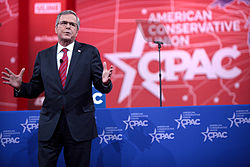
Jeb Bush
Sometimes it is the moderator who raises non-issues, as Megyn Kelly did with Senator Rand Paul:
“In the wake of the Supreme Court’s ruling on same sex marriage…what will you do to ensure Christians are not prosecuted for speaking out against gay marriage….?”
[Christians are not being “prosecuted for speaking out against gay marriage.” The First Amendment guarantees freedom of speech, especially on controversial issues.]
Fox News Moderator Brett Baier asked Dr. Benjamin Carson: “As President, would you have used military force [in Syria, when its dictator, Bashir al-Assad, was found to have used chemical weapons against his own citizens]?”
CARSON: “…I would shore up our military first, because if you don’t get the military right, nothing else is going to work.”
[In short, Carson didn’t say whether he would have used military force in Syria.]
* * * * *
So how do you tell when a politician is evading?
First, educate yourself on the issues. If you know that President George W. Bush intended to go to war with Iraq when he took office in 2001, you won’t buy the line that he was the victim of poor intelligence two years later.
Second, pay attention to the question being asked. If it seeks a specific answer, the failure of a candidate to give one will alert you that s/he’s evading. Be especially alert to the unwillingness of candidates to directly answer “Yes” or “No” questions.
Third, look for contradictions in the candidates’ statements. If he describes himself as “pro-life” but calls for huge increases in the nuclear arsenal, it means: He’s anti-abortion but pro-slaughter–so long as the victims aren’t fetuses.
Fourth, beware of meaningless babble. A favorite trick of highly-polished debators–such as President John F. Kennedy–is to throw out impressive-sounding statistics which seem to answer the question but don’t.
Fifth, beware the emotion-charged story. To inflame Americans against Saddam Hussein in 1991, President George H.W. Bush clamed that Iraqi soldiers had ripped Kuwaiti babies from incubators. Only after the Gulf (oil) war did the story prove to be false.
ABC NEWS, CHRIS WALLACE, CNN, DEBATE, EVASION, FACEBOOK, FOX NEWS NETWORK, GOP DEBATE, JOHN KASICH, LYING, MEGYN KELLY, NBC NEWS, NICCOLO MACHIAVELLI, REPUBLICAN PARTY, SCOTT WALKER, THE CHICAGO SUN-TIMES, THE CHICAGO TRIBUNE, THE LOS ANGELES TIMES, THE NEW YORK TIMES, THE PRINCE, THE WALL STREET JOURNAL, THE WASHINGTON POST, TWITTER, USA TODAY
In Bureaucracy, History, Politics, Social commentary on August 14, 2015 at 12:30 am
Most politicians are masters at evading questions they don’t want to answer. And they are equally adept at giving answers that seem to be candid but in fact say nothing.
These skills were on full display during the August 6 GOP debate hosted by the Fox News Network.
For example:
Business Executive Donald Trump had just slammed the Federal Government’s failure to control illegal immigration.
And Fox News Moderator Chris Wallace wanted to know if Ohio Governor John Kasich agreed with him:
“When you say that the American government is stupid, that the Mexican government is sending criminals, that we’re being bamboozled, is that an adequate response to the question of illegal immigration?”
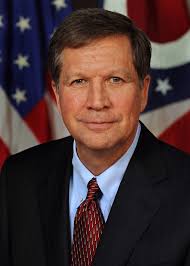
John Kasich
KASICH: “Now, he’s got his solutions. Some of us have other solutions. You know, look, I balanced the federal budget as one of the chief architects when I was in Washington. Hasn’t been done since.
“I was a military reformer. I took the state of Ohio from an $8 billion hole and a 350,000 job loss to a $2 billion surplus and a gain of 350,000 jobs.”
[Kasich, more liberal-minded than his fellow Republicans, didn’t want to condemn Trump’s hawkish views. If he did, he would lose support from the anti-immigrant Republican base. So he changed the subject to his economic policies as governor of Ohio.]
WALLACE: “Respectfully, can we talk about illegal immigration?”
KASICH: “But the point is that we all have solutions. Mr. Trump is touching a nerve because people want the wall to be built. They want to see an end to illegal immigration.
“They want to see it, and we all do. But we all have different ways of getting there. And you’re going to hear from all of us tonight about what our ideas are.”
[Kasich totally evaded the question. He said that “we all have solutions” to illegal immigration. But he never offered his.]
Fox News Moderator Megyn Kelly to Florida Governor Jeb Bush: “…For days on end in this campaign, you struggled to answer a question about whether knowing what we know now…we would’ve invaded Iraq….
“You finally said ‘No.'”
“To the families of those who died in that war who say they liberated and deposed a ruthless dictator, how do you look at them now and say that your brothers war was a mistake?”
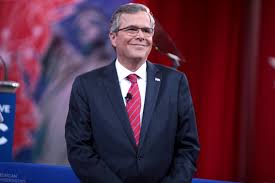
Jeb Bush
BUSH: “Knowing what we know now, with faulty intelligence, and not having security be the first priority when — when we invaded, it was a mistake. I wouldn’t have gone in.”
[Bush’s reply totally ignored that his brother, President George W. Bush, deliberately ignored all evidence that Saddam Hussein did not pose a threat to the United States.
[He also ignored the fact that his brother provoked a needless, bloody and financially ruinous war in Iraq.]
BUSH: “…As governor of the state of Florida, I called every one of [the families who had lost members in Iraq and expressed his condolences].
“…And, every one of them said that their child did not die in vain, or their wife, of their husband did not die in vain. So, why it was difficult for me to do it was based on that.”
[This sounded plausible. But then Bush moved to shift the blame from his brother to President Barack Obama.]
BUSH: “Here’s the lesson that we should take from this, which relates to this whole subject, Barack Obama became president, and he abandoned Iraq.
“He left, and when he left Al Qaida was done for. ISIS was created because of the void that we left, and that void now exists as a caliphate the size of Indiana.”
[In fact, “ISIS was created because of the void” that emerged when Bush toppled Saddam Hussein. Hussein’s dictatorial rule had suppressed religious-based terror organizations like Al Qaeda and ISIS.]
For News Moderator Megyn Kelly asked Dr. Benjamin Carson: “Your critics say that your [foreign policy] inexperience shows.
“You’ve suggested that the Baltic States are not a part of NATO, just months ago you were unfamiliar with the major political parties and government in Israel, and domestically, you thought Alan Greenspan had been treasury secretary instead of federal reserve chair.
“Aren’t these basic mistakes, and don’t they raise legitimate questions about whether you are ready to be president?”
CARSON: “So, you know, experience comes from a large number of different arenas, and America became a great nation early on not because it was flooded with politicians, but because it was flooded with people who understood the value of personal responsibility, hard work, creativity, innovation, and that’s what will get us on the right track now, as well.”
[Carson totally evaded the question. He implied that other qualities–such as “hard work, creativity, innovation”–would make up for his lack of foreign policy experience and knowledge.]
ABC NEWS, CHRIS WALLACE, CNN, DEBATE, EVASION, FACEBOOK, FOX NEWS NETWORK, GOP DEBATE, JOHN KASICH, LYING, MEGYN KELLY, NBC NEWS, NICCOLO MACHIAVELLI, REPUBLICAN PARTY, SCOTT WALKER, THE CHICAGO SUN-TIMES, THE CHICAGO TRIBUNE, THE LOS ANGELES TIMES, THE NEW YORK TIMES, THE PRINCE, THE WALL STREET JOURNAL, THE WASHINGTON POST, TWITTER, USA TODAY
In Bureaucracy, History, Politics, Social commentary on August 13, 2015 at 12:58 am
“For men in general judge more by the eyes than by the hands, for every one can see, but very few have to feel. Everyone sees what you appear to be, few feel what you are.”
So wrote Niccolo Machiavelli, the father of modern politics, in his infamous book, The Prince.
It’s a sentment that voters should constantly keep in mind–especially when watching televised debates between opposing candidates.
The August 6 GOP debate offered many examples of men appearing to address questions put to them. In fact, they generally refused to directly address the issues raised by the three Fox News Network commentators.

The candidates of the Fox News GOP debate
The evasions began early.
Fox News Moderator Megyn Kelly to Media Mogul Donald Trump: “Mr. Trump…you’ve called women you don’t like “fat pigs, dogs, slobs, and disgusting animals.”
“Your Twitter account has several disparaging comments about women’s looks. You once told a contestant on Celebrity Apprentice it would be a pretty picture to see her on her knees.
“Does that sound to you like the temperament of a man we should elect as president, and how will you answer the charge from Hillary Clinton, who was likely to be the Democratic nominee, that you are part of the war on women?
TRUMP: “I think the big problem this country has is being politically correct.”

Donald Trump
[Trump did not refute that he had made insulting remarks about women. He simply claimed that he was the victim of Political Correctness. And Kelly did not call him on his evasiveness.]
Then Kelly moved on to the subject of abortion–and Wisconsin Governor Scott Walker.
KELLY: “Governor Walker, you’ve consistently said that you want to make abortion illegal even in cases of rape, incest, or to save the life of the mother.
“You recently signed an abortion law in Wisconsin that does have an exception for the mother’s life, but you’re on the record as having objected to it.
“Would you really let a mother die rather than have an abortion, and with 83% of the American public in favor of a life exception, are you too out of the mainstream on this issue to win the general election?
WALKER: “Well, I’m pro-life, I’ve always been pro-life, and I’ve got a position that I think is consistent with many Americans out there in that…
“…in that I believe that that is an unborn child that’s in need of protection out there, and I’ve said many a time that that unborn child can be protected, and there are many other alternatives that can also protect the life of that mother. That’s been consistently proven.”

Scott Walker
[Clearly, Walker did not want to admit that he would allow a woman to die rather than have an abortion. Nor did he want to admit that he would force a victim of rape or incest to carry to full term the fetus of that victimizer.
[So he simply claimed that “there are many other alternatives that can also protect the life of that mother” without offering any evidence to prove it.]
Fox News Moderator Chris Wallace to Donald Trump:
“…You have repeatedly said that you have evidence that the Mexican government is doing this, but you have evidence you have refused or declined to share.
“Why not use this first Republican presidential debate to share your proof with the American people?”
TRUMP: “Border Patrol, I was at the border last week. Border Patrol, people that I deal with, that I talk to, they say this is what’s happening….”
[Trump’s “evidence” was strictly anecdotal. He cited unmamed “Border Patrol” sources for his general statement and offered nothing more.]
Fox News Moderator Chris Wallace to Ohio Governor John Kasich on illegal immigration:
WALLACE: “Governor Kasich, I know you don’t like to talk about Donald Trump. But I do want to ask you about the merit of what he just said.
“When you say that the American government is stupid, that the Mexican government is sending criminals, that we’re being bamboozled, is that an adequate response to the question of illegal immigration?
KASICH: “Chris, first of all, I was just saying to Chris Christie, they say we’re outspoken, we need to take lessons from Donald Trump if we’re really going to learn it. Here is the thing about Donald Trump.
“Donald Trump is hitting a nerve in this country. He is. He’s hitting a nerve. People are frustrated. They’re fed up. They don’t think the government is working for them. And for people who want to just tune him out, they’re making a mistake.
[Kasich was avoiding giving a direct answer. More liberal-minded than most Republicans, he didn’t want to alienate their Right-wing base by opposing his party’s “deport them all” position.
[He needed time to think of a response that wouldn’t cost him votes–and bought it by throwing cheap flattery at Trump.]
ABC NEWS, ABORTION, ADOLF HITLER, ALTERNET, AMERICABLOG, ANDREW JACKSON, AP, BABY BOOMER RESISTANCE, BARACK OBAMA, BBC, BLOOMBERG NEWS, BUZZFEED, CBS NEWS, CHRIS MATTHEWS, CNN, CNN'S "STARTING POINT", CROOKS AND LIARS, CUBAN MISSILE CRISIS, DAILY KOS, DEBT CEILING, EXTORTION, FACEBOOK, FIVETHIRTYEIGHT, GEORGE W. BUSH, HARPER’S MAGAZINE, HOUSE SPEAKER JOHN BOEHNER, HUFFINGTON POST, JOHN F. KENNEDY, MAFIA, MEDIA MATTERS, MOTHER JONES, MOVEON, MSNBC, MSNBC'S "HARDBALL", MUNICH CONFERENCE, NBC NEWS, NEGOTIATING, NEVILLE CHAMBERLAIN, NEW REPUBLIC, NEWSDAY, NEWSWEEK, NICCOLO MACHIAVELLI, NPR, OBAMACARE, PAP SMEARS, PATRIOT ACT, PBS NEWSHOUR, PLANNED PARENTHOOD, POLITICO, POLITICUSUSA, R.I.CO. ACT, RAW STORY, REPUBLICAN PARTY, REPUBLICANS, REUTERS, SALON, SEATTLE TIMES, SLATE, TALKING POINTS MEMO, TED CRUZ, THE AFFORDABLE CARE ACT, THE ATLANTIC, THE CHICAGO SUN-TIMES, THE CHICAGO TRIBUNE, THE DAILY BEAST, THE DAILY BLOG, THE GUARDIAN, THE HILL, THE HUFFINGTON POST, THE INTERCEPT, THE LOS ANGELES TIMES, THE NATION, THE NEW REPUBLIC, THE NEW YORK TIMES, THE NEW YORK TIMES THE WASHINGTON POST, THE NEW YORKER, THE PRINCE, THE VILLAGE VOICE, THE WASHINGTON POST, THINKPROGRESS, TIME, TRUTHDIG, TRUTHOUT, TWITTER, TWO POLITICAL JUNKIES, U.S. NEWS & WORLD REPORT, UPI, USA TODAY, WINSTON CHURCHILL, WORLD WAR 11, X
In Bureaucracy, History, Law, Politics, Social commentary on August 10, 2015 at 12:41 am
On August 1, 2011, Chris Matthews, host of MSNBC’s “Hardball,” wrapped up his program with a search for “options” to avoid another round of Republican extortion tactics:
“I want to know what steps the president [Barack Obama] ‘could’ have taken to avoid this hostage-taking [over raising the debt-ceiling].
“…Is there another way than either buckling to the Republicans or letting the government and the country crash?
“How does he use the power of the presidency, the logic, emotion and basic patriotism of the people to thwart those willing to threaten, disrupt, even possibly destroy to get their way?”
And the answer to his questions–then and now–is: Replace the law of fear with the rule of law.
As Niccolo Machiavelli, the father of modern politics, instructed future leaders in The Prince:

Niccolo Machiavelli
“And men have less scruple in offending one who makes himself loved than one who makes himself feared; for love is held by a chain of obligations which, men being selfish, is broken whenever it serves their purpose; but fear is maintained by a dread of punishment which never fails….
“I conclude, therefore, with regard to being loved and feared, that men love at their own free will, but fear at the will of the prince, and that a wise prince must rely on what is in his power and not on what is in the power of others….”
Instead, in 2011, President Barack Obama surrendered to Republican extortion demands. As a result, the United States suffered a massive loss to its international credit rating.
But there were two other ways Obama could have stood up to Republican extortionists:
- Invoke the Racketeer Influenced Corrupt Organizations Act (RICO) and/or the USA Patriot Act;
- Rally the American people against this criminal threat to the security of the Nation.
And these remain available to him now–if only he has the courage to act.
Second Option: Calling upon the American people for their support
President John F. Kennedy did just that–successfully–during the most deadly crisis of his administration.
Addressing the Nation on October 22, 1962, Kennedy shocked his fellow citizens by revealing that the Soviet Union had placed offensive nuclear missiles in Cuba.
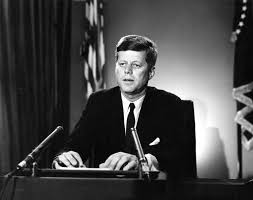
President John F. Kennedy
After outlining a series of steps he had taken to end the crisis, Kennedy sought to reassure and inspire his audience. His words are worth remembering today:
“The cost of freedom is always high, but Americans have always paid it. And one path we shall never choose, and that is the path of surrender or submission.”
Just as President Kennedy called on his fellow Americans for support against a foreign enemy, President Obama could rally his countrymen against an equally ruthless domestic enemy.
During such a national address, President Obama could reveal such blunt truths as:
- Republicans have adopted the same my-way-or-else “negotiating” stance as Adolf Hitler.
- Like the Nazis, they are determined to gain absolute power–or destroy the Nation they claim to love.
- And, once again, they are threatening to shut down the government–and deny essential services to millions of Americans–unless they get their way.
Finally, President Obama could end his speech by directly calling for the active support of his fellow Americans. Something like this:
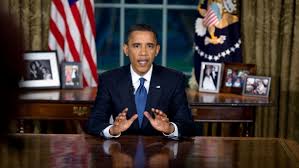
President Barack Obama
“My fellow Americans, I have taken an oath to ‘preserve, protect and defend the Constitution of the United States.’
“But I cannot do this on my own. As citizens of a Republic, each of us carries that burden. We must each do our part to protect the land and the liberties we love.
“Tonight, I’m asking for your help.
“We stand on the edge of economic and social disaster. Therefore, I am asking each of you to stand up for America tonight–by demanding the recall of the entire membership of the Republican Party.”
* * * * *
The 1938 Munich Conference taught an invaluable lesson in foreign affairs: Caving in to the demands of insatiable thugs leads to only more demands.
That was what British Prime Minister Neville Chamberlain learned when he sought to appease Adolf Hitler, Germany’s war-intent Fuehrer.
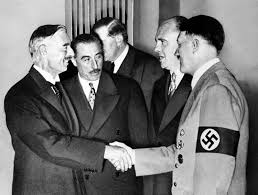
Neville Chamberlain greets Adolf Hitler
Chamberlain believed that by giving in to Hitler’s demands for the “German part” of Czechoslovakia known as the Sudetenland he could avoid war.
On September 29, Chamberlain and French Prime Minister Edouard Daladier met with Hitler and signed the Munich Agreement, resulting in the immediate German occupation of part of Czechoslovakia.
The Czechoslovakian government had not been a party to the talks. Their “allies” had sold them out.
In a matter of weeks, Hitler turned his attention–and demands–to Poland.
When his generals balked, warning that invading Poland would trigger a war with France and Britain, Hitler brushed aside their fears: “Our enemies are little worms. I saw them at Munich.”
Chamberlain returned to England a hero. Holding aloft a copy of the worthless agreement he had signed with Hitler, he told cheering crowds in London: “I believe it is peace for our time.”
Winston Churchill knew better, predicting: “Britain and France had to choose between war and dishonor. They chose dishonor. They will have war.”
And so they did.
It is not too late for President Barack Obama to apply this lesson from history.
ABC NEWS, ABORTION, ADOLF HITLER, ALTERNET, AMERICABLOG, ANDREW JACKSON, AP, BABY BOOMER RESISTANCE, BARACK OBAMA, BBC, BLOOMBERG NEWS, BUZZFEED, CBS NEWS, CHRIS MATTHEWS, CNN, CNN'S "STARTING POINT", CROOKS AND LIARS, CUBAN MISSILE CRISIS, DAILY KOS, DEBT CEILING, EXTORTION, FIVETHIRTYEIGHT, GEORGE W. BUSH, HARPER’S MAGAZINE, HOUSE SPEAKER JOHN BOEHNER, HUFFINGTON POST, JOHN F. KENNEDY, MAFIA, MEDIA MATTERS, MOTHER JONES, MOVEON, MSNBC, MSNBC'S "HARDBALL", MUNICH CONFERENCE, NBC NEWS, NEGOTIATING, NEVILLE CHAMBERLAIN, NEW REPUBLIC, NEWSDAY, NEWSWEEK, NICCOLO MACHIAVELLI, NPR, OBAMACARE, PAP SMEARS, PATRIOT ACT, PBS NEWSHOUR, PLANNED PARENTHOOD, POLITICO, POLITICUSUSA, R.I.CO. ACT, RAW STORY, REPUBLICAN PARTY, REPUBLICANS, REUTERS, SALON, SEATTLE TIMES, SLATE, TALKING POINTS MEMO, TED CRUZ, THE AFFORDABLE CARE ACT, THE ATLANTIC, THE CHICAGO SUN-TIMES, THE CHICAGO TRIBUNE, THE DAILY BEAST, THE DAILY BLOG, THE GUARDIAN, THE HILL, THE HUFFINGTON POST, THE INTERCEPT, THE LOS ANGELES TIMES, THE NATION, THE NEW REPUBLIC, THE NEW YORK TIMES, THE NEW YORK TIMES THE WASHINGTON POST, THE NEW YORKER, THE PRINCE, THE VILLAGE VOICE, THE WASHINGTON POST, THINKPROGRESS, TIME, TRUTHDIG, TRUTHOUT, TWITTER, TWO POLITICAL JUNKIES, U.S. NEWS & WORLD REPORT, UPI, USA TODAY, WINSTON CHURCHILL, WORLD WAR 11, X
In Bureaucracy, History, Law, Politics, Social commentary on August 7, 2015 at 8:58 am
On July 9, 2011-–Republican extortionists again threatened the Nation with financial ruin and international disgrace unless their demands were met.
President Obama had offered to make historic cuts in the Federal Government and the social safety net–on which millions of Americans depend for their most basic needs.
And the Republican response?
Said Rep. Darrell Issa, chairman of the Oversight and Government Reform Committee:“Quite frankly, [Republican] members of Congress are getting tired of what the president won’t do and what the president wants.”
Noted political analyst Chris Matthews summed up the sheer criminality of what happened within the House of Representatives.
Speaking on MSNBC’s “Hardball,” on July 28–five days before Congress reached its August 2 deadline to raise the debt-ceiling–Matthews noted:
“The first people to bow to the demands of those threatening to blow up the economy were the Republicans in the House, the leaders. The leaders did what the followers told them to do: meet the demands, hold up the country to get their way.
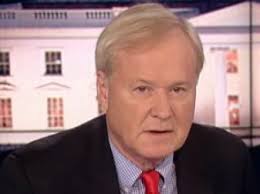
Chris Matthews
“Those followers didn’t win the Senate, or the Presidency, just the House.
“But by using the House they were able to hold up the entire United States government. They threatened to blow things up economically and it worked.
“They said they were willing to do that–just to get their way–not by persuasion, not by politics, not by democratic government, but by threatening the destruction of the country’s finances.
“Right. So what’s next? The power grid? Will they next time threaten to close down the country’s electricity and communications systems?”
With the United States teetering on the brink of national bankruptcy, President Obama faced three choices:
- Counter Republican extortion attempts via RICO–the Racketeer Influenced Corrupt Organizations Act.
- Make a “Cuban Missile Crisis”-style address to the American people, seeking to rally them against a criminal threat to the financial security of the Nation.
- Cave in to Republican demands.
Unfortunately for Obama and the Nation, he chose Number Three.
The results were easily predictable: Emboldened by success, the extortionists continue to make even greater demands.
Such as those now being made: De-fund Planned Parenthood or we’ll destroy the country.
But this is a nightmare that doesn’t have to be.
There are, in fact, two ways to avoid it.
Assuming that President Obama doesn’t once again surrender to Republican extortion demands, he has two formidable weapons he can deploy:
First Option: RICO to the rescue
The Racketeer Influenced Corrupt Organizations (RICO) Act is a provision of the Organized Crime Control Act of 1970. It authorizes prosecution for acts performed as part of an ongoing criminal organization.
It has been applied to not only the Mafia but to individuals, businesses, political protest groups, and terrorist organizations. In short, a RICO claim can arise in almost any context.
Such as the one President Barack Obama faced in 2011 when Republicans threatened to destroy the credit rating of the United States unless their budgetary demands were met.
And such as the present case when Republicans are again threatening the security of the Nation with extortionate demands.
RICO opens with a series of definitions of “racketeering activity” which can be prosecuted by Justice Department attorneys. Among those crimes: Extortion.

Extortion is defined as “a criminal offense which occurs when a person unlawfully obtains either money, property or services from a person(s), entity, or institution, through coercion.”
The RICO Act defines “a pattern of racketeering activity” as “at least two acts of racketeering activity, one of which occurred after the effective date of this chapter and the last of which occurred within ten years…after the commission of a prior act of racketeering activity.”
And if President Obama believes that RICO is not sufficient to deal with extortionate behavior, he can rely on the USA Patriot Act of 2001, passed in the wake of 9/11.
In Section 802, the Act defines domestic terrorism. Among the behavior that is defined as criminal:
“Activities that…appear to be intended…to influence the policy of a government by intimidation or coercion [and]…occur primarily within the territorial jurisdiction of the United States.”
Republicans are now demanding that Democrats de-fund Planned Parenthood or be forced to shut down essential services needed by millions of Americans.
That clearly falls within the legal definition of “activities…intended…to influence the policy of a government by intimidation or coercion.”
The remedies for punishing such criminal behavior are now legally in place. President Obama need only direct the Justice Department to apply them.
President Obama can direct Attorney General Loretta E. Lynch to investigate whether Republican Congressman—and their Tea Party cohorts—have violated Federal anti-racketeering and/or anti-terrorism laws.
- Lynch can order the FBI to conduct such an investigation.
- If the FBI finds sufficient evidence that these laws had been violated, Holder can empanel criminal grand juries to indict those violators.
Criminally investigating and indicting members of Congress would not violate the separation-of-powers principle. Congressmen have in the past been investigated, indicted and convicted for various criminal offenses.
Such indictments and prosecutions–and especially convictions–would serve a truly cleansing function.
They would serve notice on current and future members of Congress that the safety and fortunes of American citizens may not be held hostage as part of a negotiated settlement.
ABC NEWS, ABORTION, ADOLF HITLER, ALTERNET, AMERICABLOG, ANDREW JACKSON, AP, BABY BOOMER RESISTANCE, BARACK OBAMA, BBC, BLOOMBERG NEWS, BUZZFEED, CBS NEWS, CHRIS MATTHEWS, CNN, CNN'S "STARTING POINT", CROOKS AND LIARS, CUBAN MISSILE CRISIS, DAILY KOS, DEBT CEILING, EXTORTION, FACEBOOK, FIVETHIRTYEIGHT, GEORGE W. BUSH, HARPER’S MAGAZINE, HOUSE SPEAKER JOHN BOEHNER, HUFFINGTON POST, JOHN F. KENNEDY, MAFIA, MEDIA MATTERS, MOTHER JONES, MOVEON, MSNBC, MSNBC'S "HARDBALL", MUNICH CONFERENCE, NBC NEWS, NEGOTIATING, NEVILLE CHAMBERLAIN, NEW REPUBLIC, NEWSDAY, NEWSWEEK, NICCOLO MACHIAVELLI, NPR, OBAMACARE, PAP SMEARS, PATRIOT ACT, PBS NEWSHOUR, PLANNED PARENTHOOD, POLITICO, POLITICUSUSA, R.I.CO. ACT, RAW STORY, REPUBLICAN PARTY, REPUBLICANS, REUTERS, SALON, SEATTLE TIMES, SLATE, TALKING POINTS MEMO, TED CRUZ, THE AFFORDABLE CARE ACT, THE ATLANTIC, THE CHICAGO SUN-TIMES, THE CHICAGO TRIBUNE, THE DAILY BEAST, THE DAILY BLOG, THE GUARDIAN, THE HILL, THE HUFFINGTON POST, THE INTERCEPT, THE LOS ANGELES TIMES, THE NATION, THE NEW REPUBLIC, THE NEW YORK TIMES, THE NEW YORK TIMES THE WASHINGTON POST, THE NEW YORKER, THE PRINCE, THE VILLAGE VOICE, THE WASHINGTON POST, THINKPROGRESS, TIME, TRUTHDIG, TRUTHOUT, TWITTER, TWO POLITICAL JUNKIES, U.S. NEWS & WORLD REPORT, UPI, USA TODAY, WINSTON CHURCHILL, WORLD WAR 11
In History, Law, Law Enforcement, Politics, Social commentary on August 6, 2015 at 2:04 pm
Republicans love fetuses.
In fact, they love them so much they’re willing to shut down the Federal Government and deny vital public services to millions of their fellow Americans.
That shutdown could be coming as early as September, when Congress returns from its summer break.
The reasons are two-fold:
First, the fast-approaching 2016 Presidential election; and
Second, Republicans’ long-standing desire to de-fund Planned Parenthood (PP).

This upcoming effort will be fueled by a highly emotional charge: That PP sells fetal tissue and organs.
Anti-abortion organizations Operation Rescue and the Center for Medical Progress recently released videos purporting to show PP officials discussing such sales.
In response, PP said that they may donate fetal tissue at the request of a patient, but that fetal organs and tissues are never sold.
Three Congressional committees are now making inquiries into PP practices.
On August 3, 2015, a Republican bill to defund PP failed to pass in the Senate. Currently, the organization receives $528 million in Federal funding each year.
Since the 1980s, Congressional Republicans have tried to de-fund PP. Their efforts almost led to a government shutdown in 2011.
PP has consistently claimed that it does not use its Federal funding to pay for abortion services. But anti-abortionists argue that Federal monies free up other resources that are used to provide abortions.
Abortions represent three percent of total services provided by PP, and are provided to about 10% of its clients.

The other 97% of services are for contraception, treatment and tests for sexually transmitted diseases, cancer screenings, and other women’s health services.
Click here: Planned Parenthood
PP estimates that its contraceptive services prevent approximately 612,000 unintended pregnancies–and 291,000 abortions–annually.
According to Politico, Republican Senators plan to attach a provision to the current omnibus spending bill–which funds all Federal agencies for 2015-2016.
The provision will ban funding for all Federal agencies–unless PP’s funding is cut.
Leading the call for a government shutdown is Texas Senator Ted Cruz, who tried to de-fund PP in 2013. That attempt led to a two-week government shutdown.
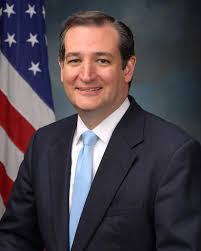
Senator Ted Cruz
Joining Cruz are Republicans in the House and Senate—not enough to defund PP, but enough to deny vitally-needed services to millions of Americans.
The reason for the 2013 government shutdown? Republicans were enraged that millions of uninsured Americans might receive medical care on a par with that given members of the House and Senate.
It was, in short, yet another Right-wing effort to eliminate the Affordable Care Act, better-known as “Obamacare.”
So on September 20, 2013, the House of Representatives voted on a short-term government funding bill that included a provision to de-fund Obamacare.
That provision was a no-go for Senate Democrats and President Barack Obama. When the House and Senate couldn’t reach a compromise, many functions of the Federal government shut down on Oct. 1.
The shutdown lasted for 16 days and cost the United States economy $2 to $6 billion in economic output, according to the Office of Management and Budget.
It ended when President Obama and Senate Democrats refused to submit to Republican blackmail. Medical care still remained available to millions of poor and middle-class Americans.
Republicans have repeatedly threatened to shut down the government unless their constantly escalating demands were met.
In November, 1995, Newt Gingrich, then Speaker of the House of Representatives, carried out this threat.
The official reason: Republicans objected to Democratic President Bill Clinton’s budgetary requests for funding Medicare, education, the environment and public health in the 1996 Federal budget.
The real reason: Gingrich unwisely admitted that he was angry because Clinton had put him in the back of Air Force One during a recent trip to Israel.
The shutdown proved a disaster for Republicans. Clinton was handily re-elected in 1996 and Gingrich suddenly resigned from Congress in 1998.
In April, 2011, the United States government almost shut down again over Republican demands about subsidized pap smears.
During a late-night White House meeting with President Obama and key Congressional leaders, Republican House Speaker John Boehner made this threat:
His conference would not approve funding for the government if any money were allowed to flow to Planned Parenthood through Title X legislation.
Facing an April 8 deadline, negotiators worked day and night to strike a compromise–and finally reached one.
Three months later–-on July 9, 2011-–Republican extortionists again threatened the Nation with financial ruin and international disgrace unless their demands were met.

Sign of The Black Hand extortion group
President Obama had offered to make historic cuts in the Federal Government and the social safety net–on which millions of Americans depend for their most basic needs.
But House Speaker John Boehner rejected that offer. He could not agree to the tax increases that Democrats wanted to impose on the wealthiest 1% as part of the bargain.
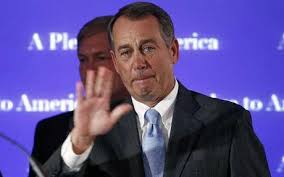
John Boehner
As the calendar moved ever closer to the fateful date of August 2, Republican leaders continued to insist: Any deal that includes taxes “can’t pass the House.”
President Obama had previously insisted on extending the debt ceiling through 2012. But in mid-July, he simply asked congressional leaders to review three options with their members:
- The “Grand Bargain” choice—favored by Obama–would cut deficits by about $4 trillion, including spending cuts and new tax revenues.
- A medium-range plan would aim to reduce the deficit by about $2 trillion.
- The smallest option would cut between $1 trillion and $1.5 trillion, without increased tax revenue or any Medicare and Medicaid cuts.
And the Republican response?
ABC NEWS, CBS NEWS, CNN, FACEBOOK, FBI, MEXICAN WAR, NBC NEWS, NICCOLO MACHIAVELLI, POLICE, POLICE BRUTALITY, SANDRA BLAND, TEXAS RANGERS, THE CHICAGO SUN-TIMES, THE CHICAGO TRIBUNE, THE DISCOURSES, THE LOS ANGELES TIMES, THE NEW YORK TIMES, THE PRINCE, THE WASHINGTON POST, TWITTER, USA TODAY
In Bureaucracy, History, Law Enforcement, Social commentary on July 31, 2015 at 12:10 am
By now, a second–and female–officer has arrived on the scene of the arrest of motorist Sandra Bland.
Bland: Make you feel real good for a female. Y’all strong, y’all real strong.
Encinia: I want you to wait right here.
Bland: I can’t go anywhere with your fucking knee in my back, duh!
Encinia: (to bystander): You need to leave! You need to leave!
(Bland continues screaming, but much of it is inaudible)
Encinia: For a warning you’re going to jail.
Bland: Whatever, whatever.
Encinia: You’re going to jail for resisting arrest. Stand up.
Bland: If I could, I can’t.
Encinia: OK, roll over.
Bland: I can’t even fucking feel my arms.
Encinia: Tuck your knee in, tuck your knee in.
Bland: (Crying): Goddamn. I can’t [muffled].
Encinia: Listen, listen. You’re going to sit up on your butt.
Bland: You just slammed my head into the ground and you do not even care …
[Bland has already told both officers that (1) she is an epileptic, and (2) Encinia slammed her head into the ground. Now she is again putting them on notice that she could have sustained a traumatic brain injury. But neither officer shows any concern.]
Sandra Bland’s jail booking photo
Encinia: Sit up on your butt.
Female officer: Listen to how he is telling you to get up.
Bland: I can’t even hear.
Female officer: Yes you can.
[After having her head slammed into the ground, Bland says she cannot hear. Both officers should consider that the injury to her head may be serious–and take her to an emergency room for evaluation.]
Encinia: Sit up on your butt.
Bland: He slammed my fucking head into the ground.
Encinia: Sit up on your butt.
Bland: What the hell.
Encinia: Now stand up.
Bland: All of this for a traffic signal. I swear to God. All of this for a traffic signal. (To bystander.) Thank you for recording! Thank you! For a traffic signal — slam me into the ground and everything! Everything! I hope y’all feel good.
Encinia: This officer saw everything.
Female officer: I saw everything.
[Since the female officer was not present when Encinia initially encountered Bland–as the video proves–she could not have “seen everything.” Her claiming to have done so could be seen as evidence that she intends to lie on Encinia’s behalf.]
Bland: And (mufled) no you didn’t. You didn’t see everything leading up to it.
Female Officer: I’m not talking to you.
Bland: You don’t have to.
[This is the last exchange between Bland and the officers as recorded on the dashcam video of Brian Encinia’s police cruiser.]
* * * * *
Born in 1987, Sandra Bland grew up in Illinois, and lived with her family in suburban Chicago.
She graduated Willowbrook High School in Villa Park, Illinois, where she ran track and played volleyball. She was also a varsity cheerleader and part of the marching band.
She then attended Prairie View A&M University outside Hempstead, Waller County, Texas. She graduated in 2009 with a degree in agriculture.
Bland returned to Illinois in 2009.
In January 2015, she began posting videos on Facebook about police brutality against blacks.
In early July she traveled to Waller County, Texas, to begin a job at her alma mater, Prairie View A&M.
In one of her last conversations with her mother, Geneva Reed-Veal, Bland said:
“Momma, now I know what my purpose is. My purpose is to go back to Texas. My purpose is to stop all social injustice in the South.”
On July 13–three days after her arrest on July 10–Bland was found dead in her cell in Waller County Jail in Hempstead, Texas.

Sandra Bland memorial
Police claimed that she had hanged herself, citing a video she posted in Facebook in March, where Bland stated she was depressed.
Cannon Lambert, an attorney for the Bland family, said that at the time of Bland’s death, her relatives were raising money for Bland’s $5,000 bail. And Bland knew it.
“We don’t understand this,” said Lambert. “It doesn’t make sense.”
The Texas Rangers and the FBI are still investigating Bland’s death.
The Harris County medical examiner conducted an autopsy and ruled her death a suicide, claiming that it found no evidence of a violent struggle.
One possibility: Bland came to Texas to “stop all social injustice in the South.” She may have grown fatally depressed at her inability to “save herself” from jail over a simple traffic violation.
Another possibility: Texas authorities may have indulged in a long-cherished Texas tradition, best explained by a 19th-century Texas Ranger named Samuel Reid.
Reid served as a Ranger scout during the Mexican War (1846-1848). Recalling his experiences south of the border, he wrote:
“Our orders were most strict not to molest any unarmed Mexican.
“And if some of the most notorious of these villians were found shot, or hung up in the chaparral…the [United States] government was charitably bound to suppose that, during a fit of remorse and desperation, tortured by conscience for the many evil deeds they had committed, they had recklessly laid violent hands upon their own lives! Quien sabe?”
Meanwhile, Brian Encinia has been placed on administrative duties after the state Department of Public Safety found “violations of procedures regarding traffic stops and the department’s courtesy policy.”
ABC NEWS, CBS NEWS, CNN, FACEBOOK, FBI, MEXICAN WAR, NBC NEWS, NICCOLO MACHIAVELLI, POLICE, POLICE BRUTALITY, SANDRA BLAND, TEXAS RANGERS, THE CHICAGO SUN-TIMES, THE CHICAGO TRIBUNE, THE DISCOURSES, THE LOS ANGELES TIMES, THE NEW YORK TIMES, THE PRINCE, THE WASHINGTON POST, TWITTER, USA TODAY
In Bureaucracy, History, Law Enforcement, Social commentary on July 30, 2015 at 1:02 am
The confrontation between black motorist Sandra Bland and Texas State Trooper Brian Encinia continued to worsen.
Encinia: If you would’ve just listened.
Bland: I was trying to sign the fucking ticket — whatever.
Encinia: Stop moving!
Bland: Are you fucking serious?
Encinia: Stop moving!
Bland: Oh I can’t wait ’til we go to court. Ooh I can’t wait. I cannot wait ’til we go to court. I can’t wait. Oh I can’t wait! You want me to sit down now?
Encinia: No.
Bland: Or are you going to throw me to the floor? That would make you feel better about yourself?
[Bland continues to attack Encinia’s masculinity–almost as if she’s daring him to rough her up. If he wasn’t thinking of throwing her to the floor, she just gave him the idea.]

Sandra Bland voicemail from jail
Encinia: Knock it off!
Bland: Nah that would make you feel better about yourself. That would make you feel real good wouldn’t it? Pussy ass. Fucking pussy. For a failure to signal you’re doing all of this. In little ass Praire View, Texas. My God they must have …
[Niccolo Machiavelli, in his masterwork, The Discourses, offers this cautionary advice: “I hold it to be a proof of great prudence for men to abstain from threats and insulting words toward any one, for neither the one or the other in any way diminishes the strength of the enemy.
[“(Contempt) make(s) him more cautious, and (insults) increase his hatred of you, and make him more persevering in his efforts to injure you.”
[That’s clearly what happened here.]
Encinia: You were getting a warning, until now you’re going to jail.
Bland: I’m getting a — for what? For what?
Encinia: You can come read.
Bland: I’m getting a warning for what? For what!?
Encinia: Stay right here.
Bland: Well you just pointed me over there! Get your mind right.
Encinia: I said stay over here. Stay over here.
Bland: Ooh I swear on my life, y’all are some pussies. A pussy-ass cop, for a fucking signal you’re gonna take me to jail.
[Again, Bland is essentially daring Encinia–who has total control of her–to physically abuse her. For her own sake, the smart thing to do would be to shut up.]
Encinia (to dispatch, or an officer arriving on scene): I got her in control she’s in some handcuffs.
Bland: For a fucking ticket. What a pussy. What a pussy. You’re about to break my fucking wrist!
Encinia: Stop moving.
Bland: I’m standing still! You keep moving me, goddammit.
Encinia: Stay right here. Stand right there.
Bland: Don’t touch me. Fucking pussy — for a traffic ticket (inaudible).
(door slams)
[Again: More profanity–and yet another challenge to Encinia’s masculinity.]
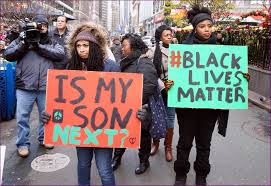
Sandra Bland was an activist in the Black Lives Matter movement
Encinia: Come read right over here. This right here says ‘a warning.’ You started creating the problems.
Bland: You asked me what was wrong!
Encinia: Do you have anything on your person that’s illegal?
Bland: Do I feel like I have anything on me? This a fucking maxi dress.
Encinia: I’m going to remove your glasses.
Bland: This a maxi dress. (Inaudible) Fucking assholes.
Encinia: Come over here.
Bland: You about to break my wrist. Can you stop? You’re about to fucking break my wrist! Stop!!!
Encinia: Stop now! Stop it! If you would stop resisting.
Female officer: Stop resisting ma’am.
[Even if Bland is not resisting, the testimony of a second officer who says she is could have been used against her in court.]
Bland: (cries) For a fucking traffic ticket, you are such a pussy. You are such a pussy.
[Is Bland referring to Encinia or the female officer? In either case, such language will do her no good–on the street or in court.]
Female officer: No, you are. You should not be fighting.
Encinia: Get on the ground!
Bland: For a traffic signal!
Encinia: You are yanking around, when you pull away from me, you’re resisting arrest.
Bland: Don’t it make you feel real good don’t it? A female for a traffic ticket. Don’t it make you feel good Officer Encinia? You’re a real man now. You just slammed me, knocked my head into the ground. I got epilepsy, you motherfucker.
[By stating she is epileptic, Bland has notified both officers that she could be in danger of a potentially lethal seizure at any moment. The smart move for the police would have been to rush her to a hospital for an emergency checkup. But they don’t even talk about doing this.]
Encinia: Good. Good.
Bland: Good? Good?
Female officer: You should have thought about it before you started resisting.
[The female officer has just confimed–perhaps unintentionally–that her partner slammed Bland’s head into the ground. She has also demonstrated her own indifference to Bland’s having received a potentially life-threatening injury.]
Bland: Make you feel real good for a female. Y’all strong, y’all real strong.
Encinia: I want you to wait right here.
Bland: I can’t go anywhere with your fucking knee in my back, duh!
Encinia: (to bystander): You need to leave! You need to leave!
[Although the bystander is not interfering in any way with the arrest, Encinia clearly does not want a non-cop witness to his treatment of Bland.]
ABC NEWS, CBS NEWS, CNN, FACEBOOK, FBI, MEXICAN WAR, NBC NEWS, NICCOLO MACHIAVELLI, POLICE, POLICE BRUTALITY, SANDRA BLAND, TEXAS RANGERS, THE CHICAGO SUN-TIMES, THE CHICAGO TRIBUNE, THE DISCOURSES, THE LOS ANGELES TIMES, THE NEW YORK TIMES, THE PRINCE, THE WASHINGTON POST, TWITTER, USA TODAY
In Bureaucracy, History, Law Enforcement, Social commentary on July 29, 2015 at 12:17 am
There are some useful lessons to be learned from the arrest of Sandra Bland.
Lessons about how a police officer should behave toward the public. And lessons about how the public can protect themselves from police abuse.
On July 10, Texas State Trooper Brian Encinia stopped black motorist Sandra Bland for failing to signal a lane change.
The confrontation quickly escalated to unwarranted aggression and threats by Encinia and foul-mouthed, combative behavior by Bland.
Brian Encinia: I’m going to yank you out of here.
Sandra Bland: OK, you’re going to yank me out of my car? OK, alright.
Encinia (calling in backup): 2547.
Bland: Let’s do this.
Encinia: Yeah, we’re going to. (Grabs for Bland.)
Bland: Don’t touch me!
[Although Encinia is clearly angry, Bland’s refusal to exit her car was technically “resisting arrest.” This was a charge to be fought–in court–by her attorney, not–on the street–by Bland.]
Encinia: Get out of the car!
Bland: Don’t touch me. Don’t touch me! I’m not under arrest–you don’t have the right to take me out of the car.
Encinia: You are under arrest!
[Once the officer says, “You are under arrest,” legally, that’s it. The arrest can be challenged later–in court. And it may be found unwarranted–in court. But it’s useless and even dangerous to dispute a cop’s right to make an arrest on the street.]
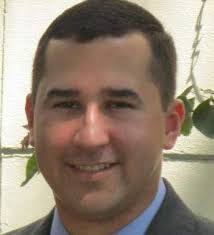
Brian Encinia
Bland: I’m under arrest? For what? For what? For what?
Encinia (to dispatch): 2547 county fm 1098 (inaudible) send me another unit. (To Bland) Get out of the car! Get out of the car now!
Bland: Why am I being apprehended? You’re trying to give me a ticket for failure….
Encinia: I said get out of the car!
Bland: Why am I being apprehended? You just opened my–
Encinia: I‘m giving you a lawful order. I’m going to drag you out of here.
Bland: So you’re threatening to drag me out of my own car?
Encinia: Get out of the car!
Bland: And then you’re going to [crosstalk] me?
Encinia: I will light you up! Get out! Now! (Draws stun gun and points it at Bland.)
Bland: Wow. Wow. (Bland exits car.)
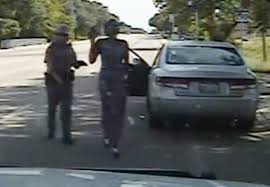
Brian Encinia aiming a Taser at Sandra Bland
Encinia: Get out. Now. Get out of the car!
Bland: For a failure to signal? You’re doing all of this for a failure to signal?
Encinia: Get over there.
Bland: Right, yeah, let’s take this to court, let’s do this.
Encinia: Go ahead.
Bland: For a failure to signal? Yup, for a failure to signal!
Encinia: Get off the phone!
Bland: (crosstalk)
Encinia: Get off the phone! Put your phone down!
Bland: I’m not on the phone. I have a right to record. This is my property. Sir?
Encinia: Put your phone down right now. Put your phone down!
(Bland slams phone down on her trunk.)
Bland: For a fucking failure to signal. My goodness. Y’all are interesting. Very interesting.
[Profanity is never helpful in a situation like this–and usually leads to further escalation. And when the case comes to trial, it’s likely to convince a jury: “She got what she deserved.”]
Encinia: Come over here. Come over here now.
Bland: You feelin’ good about yourself?
Encinia: Stand right here. Stand right there.
Bland: You feelin’ good about yourself? For a failure to signal? You feel real good about yourself don’t you? You feel good about yourself don’t you?
[Bland would have been well-advised to remain silent–and refrain from personal attacks on a man who’s clearly shown himself over the edge.]
Encinia: Turn around. Turn around. Turn around now. Put your hands behind your back.
Bland: Why am I being arrested?
Encinia: Turn around.
Bland: Why can’t you–
Encinia: I’m giving you a lawful order. I will tell you–
Bland: Why am I being arrested?
Encinia: Turn around!
[Obviously, if Bland were complying with the order to “turn around,” Encinia would not be repeating it.]
Bland: Why won’t you tell me that part?
Encinia: I’m giving you a lawful order. Turn around.
Bland: Why will you not tell me what’s going on?
Encinia: You are not complying.
Bland: I’m not complying ’cause you just pulled me out of my car.
[Bland admits that she’s “not complying.” Had she lived, this could have been used against her in court.]
Encinia: Turn around.
Bland: Are you fucking kidding me? This is some bull…
Encinia: Put your hands behind your back.
Bland: ‘Cause you know this straight bullshit. And you’re full of shit. Full of straight shit. That’s all y’all are is some straight scared cops. South Carolina got y’all bitch asses scared. That’s all it is. Fucking scared of a female.
[Bland is directly challenging the masculinity of a man who clearly feels he has something to prove. Big mistake.]
ABC NEWS, CBS NEWS, CNN, FACEBOOK, FBI, MEXICAN WAR, NBC NEWS, NICCOLO MACHIAVELLI, POLICE, POLICE BRUTALITY, SANDRA BLAND, TEXAS RANGERS, THE CHICAGO SUN-TIMES, THE CHICAGO TRIBUNE, THE DISCOURSES, THE LOS ANGELES TIMES, THE NEW YORK TIMES, THE PRINCE, THE WASHINGTON POST, TWITTER, USA TODAY
In Bureaucracy, History, Law Enforcement, Social commentary, Uncategorized on July 28, 2015 at 12:51 am
Niccolo Machiavelli offered some advice that might have saved the life of Sandra Bland.
In 1513, Niccolo Machiavelli, the Florentine statesman who has been called the father of modern political science, published his best-known work: The Prince.

Niccolo Machiavelli
Among the lessons he offered to those seeking to gain power was this:
A prince…must imitate the fox and the lion, for the lion cannot protect himself from traps, and the fox cannot defend himself from wolves.
One must therefore be a fox to avoid traps, and a lion to frighten wolves. Those who wish to be only lions do not realize this.
When confronted by an armed and–in this case, egocentric–law enforcement officer, it’s always best to imitate the fox.
Black motorist Sandra Bland didn’t understand this truth. Or, if she did, she flagrantly ignored it–to her own destruction.

Sandra Bland
Bland, born in the Chicago suburb of Naperville, Illinois, had just arrived in Texas to take a job at Prairie View A&M University, outside Hempstead, Waller County.
In January, 2015, she began posting videos on Facebook, denouncing racism and police brutality. In one she wrote: “In the news that we’ve seen as of late, you could stand there, surrender to the cops, and still be killed.”
On July 10, Bland was pulled over for a minor traffic violation by Texas State Trooper Brian Encinia.
FULL VIDEO OF SANDRA BLAND TRAFFIC STOP – YouTube
Their exchange was recorded on the dashcam video of Encinia’s police car, and has been transcribed by the Huffington Post’s Matt Ramos and Dhyana Taylor.
My own commentary on what happened is given in blue italics.
Brian Encinia: Hello ma’am. We’re the Texas Highway Patrol and the reason for your stop is because you failed to signal the lane change. Do you have your driver’s license and registration with you? What’s wrong? How long have you been in Texas?
Sandra Bland: Got here just today.
Encinia: OK. Do you have a driver’s license? (Pause) OK, where you headed to now? Give me a few minutes.
(Bland inaudible)
(Encinia returns to his car for several minutes, then approaches Bland again.)
Encinia: OK, ma’am. You OK?
Bland: I’m waiting on you. This is your job. I’m waiting on you. When’re you going to let me go?
[A better–that is, safer–answer would have been: “I’m fine.” And then to say nothing until the officer responds.]
Encinia: I don’t know, you seem very really irritated.
Bland: I am. I really am. I feel like it’s crap what I’m getting a ticket for. I was getting out of your way. You were speeding up, tailing me, so I move over and you stop me. So yeah, I am a little irritated, but that doesn’t stop you from giving me a ticket, so [inaudible] ticket.
[Bland may have been correct. But accusing the officer of improperly stopping her was a mistake from the get-go. No cop is going to admit he made a mistake in stopping someone–especially a cop as clearly aggressive as Encinia quickly proved to be.]
Encinia: Are you done?
Bland: You asked me what was wrong, now I told you.
Encinia: OK.
Bland: So now I’m done, yeah.
Encinia: You mind putting out your cigarette, please? If you don’t mind?
Bland: I’m in my car, why do I have to put out my cigarette?
[The smart thing would have been to put out the cigarette. Even though the trooper said “please,” this was clearly an order.]
Encinia: Well you can step on out now.
[This was clearly the point where Encinia decided to take action–to give her a warning, a ticket, or make an arrest For most of the encounter, he doesn’t say which.]
Bland: I don’t have to step out of my car.
Encinia: Step out of the car.
Bland: Why am I–?
Encinia: Step out of the car!
[It’s standard procedure for officers to order drivers to exit their cars before they write tickets or citations. The reason: The danger that the motorist might drive off–or even use the car as a weapon.]
Bland: No, you don’t have the right. No, you don’t have the right.
[Telling a policeman he doesn’t have the right to make an arrest is like telling a judge he doesn’t have the right to make a ruling. Both are certain to land you in trouble.]
Encinia: Step out of the car.
Bland: You do not have the right. You do not have the right to do this.
Encinia: I do have the right, now step out or I will remove you.
[Even if the officer’s forthcoming actions are later ruled improper by a judge, he has the legal right at that time to enforce compliance with his orders.]
Bland: I refuse to talk to you other than to identify myself. [crosstalk] I am getting removed for a failure to signal?
Encinia: Step out or I will remove you. I’m giving you a lawful order. Get out of the car now or I’m going to remove you.
Bland: And I’m calling my lawyer.
[Bland would have done better to simply get out of the car, submit to arrest, and then call her lawyer when she reached the police station.]


ABC NEWS, CHRIS WALLACE, CNN, DEBATE, EVASION, FACEBOOK, FOX NEWS NETWORK, GOP DEBATE, JOHN KASICH, LYING, MEGYN KELLY, NBC NEWS, NICCOLO MACHIAVELLI, REPUBLICAN PARTY, SCOTT WALKER, THE CHICAGO SUN-TIMES, THE CHICAGO TRIBUNE, THE LOS ANGELES TIMES, THE NEW YORK TIMES, THE PRINCE, THE WALL STREET JOURNAL, THE WASHINGTON POST, TWITTER, USA TODAY
SPOTTING EVASIONS: PART THREE (END)
In Bureaucracy, History, Politics, Social commentary on August 17, 2015 at 12:05 amAs the August 6 Republican debate wore on, so did the evasive answers.
Chris Wallace, Fox News Commentator to Businessman Donald Trump: “In 2011, you told Forbes magazine that ‘I’ve used the laws of the country to advantage.’ But at the same time, financial experts involved in those bankruptcies say that lenders to your companies lost billions of dollars.
“…With that record, why should we trust you to run the nation’s business?”
TRUMP: “Because I have used the laws of this country just like the greatest people that you read about every day in business have used the laws of this country, the chapter laws, to do a great job for my company, for myself, for my employees, for my family, et cetra. I have never gone bankrupt, by the way.”
[Trump totally ignored the charge that “lenders to your companies lost billions of dollars.” He bragged that he had “used the laws” to “do a great job for my company….” He seemed to be saying that as long as he made a killing, it didn’t matter if his lenders got nothing.]
Donald Trump
Chris Wallace persisted in his questioning: “Well, sir, let’s just talk about the latest example, which is Trump Entertainment Resorts, which went bankrupt in 2009.
“In that case alone, lenders to your company lost over $1 billion and more than $1,100 people were laid off. Is that the way that you’d run the country?”
TRUMP: “…First of al, these lenders aren’t babies. These are total killers….And I had the good sense to leave Atlantic City….Every company virtually in Atlantic City went bankrupt.
“…Seven years ago I left Atlantic City before it totally cratered, and I made a lot of money in Atlantic City, and I’m very proud of it….”
WALLACE: “So….”
TRUMP: “And by the way, this country right now owes $19 trillion. And they need somebody like me to straighten out that mess.”
[Trump bragged about making “a lot of money” in Atlantic City while ignoring the jobs lost by his employees and the monies lost by his lenders. He said that America needed “somebody like me” to straighten out its financial mess.
[But there is a difference between making a profit for yourself as a businessman and ensuring a just society for all Americans as President.]
Fox News Moderator Megyn Kelly to former Florida Governor Jeb Bush: “…A story appeared today quoting an anonymous GOP donor who said you called Mr. Trump a clown, a buffoon….”
BUSH: “None of which is true.”
Then, after saying “I want to win,” he attacked President Barack Obama:
“We’re not going to win by doing what Barack Obama and Hillary Clinton do each and every day. Dividing the country. Saying, creating a grievance kind of environment.”
[From literally the first day Obama’s Presidency, Republicans tried to block every piece of legislation he proposed. This was especially true of his efforts to provide healthcare for all Americans.
[Thus, Bush slandered the President and distorted history while denying that he had slandered Trump.]
Jeb Bush
Sometimes it is the moderator who raises non-issues, as Megyn Kelly did with Senator Rand Paul:
“In the wake of the Supreme Court’s ruling on same sex marriage…what will you do to ensure Christians are not prosecuted for speaking out against gay marriage….?”
[Christians are not being “prosecuted for speaking out against gay marriage.” The First Amendment guarantees freedom of speech, especially on controversial issues.]
Fox News Moderator Brett Baier asked Dr. Benjamin Carson: “As President, would you have used military force [in Syria, when its dictator, Bashir al-Assad, was found to have used chemical weapons against his own citizens]?”
CARSON: “…I would shore up our military first, because if you don’t get the military right, nothing else is going to work.”
[In short, Carson didn’t say whether he would have used military force in Syria.]
* * * * *
So how do you tell when a politician is evading?
First, educate yourself on the issues. If you know that President George W. Bush intended to go to war with Iraq when he took office in 2001, you won’t buy the line that he was the victim of poor intelligence two years later.
Second, pay attention to the question being asked. If it seeks a specific answer, the failure of a candidate to give one will alert you that s/he’s evading. Be especially alert to the unwillingness of candidates to directly answer “Yes” or “No” questions.
Third, look for contradictions in the candidates’ statements. If he describes himself as “pro-life” but calls for huge increases in the nuclear arsenal, it means: He’s anti-abortion but pro-slaughter–so long as the victims aren’t fetuses.
Fourth, beware of meaningless babble. A favorite trick of highly-polished debators–such as President John F. Kennedy–is to throw out impressive-sounding statistics which seem to answer the question but don’t.
Fifth, beware the emotion-charged story. To inflame Americans against Saddam Hussein in 1991, President George H.W. Bush clamed that Iraqi soldiers had ripped Kuwaiti babies from incubators. Only after the Gulf (oil) war did the story prove to be false.
Share this: