Posts Tagged ‘JOSEPH MCCARTHY’
2012 PRESIDENTIAL RACE, ALTERNET, AP, BARACK OBAMA, BAY OF PIGS, BBC, BERLIN WALL, BILL CLINTON, BRUCE GREENWOOD, BUZZFEED, CARLOS MARCELLO, CBS NEWS, CIA, CIVIL RIGHTS, CLIFF ROBERTSON, CNN, CUBAN MISSILE CRISIS, DAILY KOS, DAVID HALBERSTAM, DONALD J. TRUMP, FACEBOOK, FBI, FIDEL CASTRO, FRANK SINATRA, HERMAN CAIN, ICH BEN EIN BERLINNER SPEECH, INTERNET MOVIE DATABASE, J. EDGAR HOOVER, JAMES MARSDEN, JOHN F. KENNEDY, JOSEPH MCCARTHY, JOSEPH P. KENNEDY, LYNDON B. JOHNSON, MAFIA, MALCOM X, MARTIN LUTHER KING, MARTIN SHEEN, MOTHER JONES, MOVEON, MOVIES, NBC NEWS, NEWSWEEK, NEWT GINGRICH, NIKITA KHRUSHCHEV, NPR, NUCLEAR TEST BAN TREATY, POLITICO, PT-109, RAW STORY, REUTERS, RICK PERRY, ROBERT F. KENNEDY, ROBERT S. MCNAMARA, SALON, SAM GIANCANA, SANTOS TRAFFICANTE, Sarah Palin, SATURDAY NIGHT LIVE, SEATTLE TIMES, SLATE, SOVIET UNION, THE ATLANTIC, THE BEST AND THE BRIGHTEST, THE BUTLER, THE CHICAGO SUN-TIMES, THE CHICAGO TRIBUNE, THE DAILY BEAST, THE GUARDIAN, THE HILL, THE HUFFINGTON POST, THE LOS ANGELES TIMES, THE MISSILES OF OCTOBER, THE NEW YORK TIMES, THE RAT PACK, THE WALL STREET JOURNAL, THE WASHINGTON POST, THIRTEEN DAYS, TIME, TWILIGHT ZONE, TWITTER, U.S. NEWS & WORLD REPORT, UPI, USA TODAY, VIETNAM WAR, WILLIAM DEVANE, WILLIAM PETERSON
In Bureaucracy, Business, History, Law, Law Enforcement, Military, Politics, Social commentary on May 5, 2017 at 12:10 am
During the 1960 Presidential campaign, then-Senator John F. Kennedy promised to build a Peace Corps to train people in underdeveloped nations to help themselves.
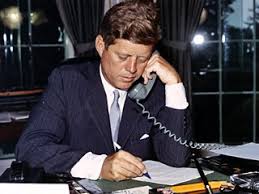
John F. Kennedy
In March, 1961, the program went into effect, with the President’s brother-in-law, Sergent Shriver, as director.
Starvation, illiteracy and disease were the enemies of the Corps. Any nation wanting aid could request it. The first group of volunteers went to the Philippines, the second to Ecuador and the third to Tanganyika.
The problems of the underdeveloped world were too great for any single organization to solve. But the Corps lifted the spirits of many living in those countries. And it captured the imagination of millions of Americans—especially those of thousands of idealistic youths who entered its ranks.
To combat the growing Communist threat to Latin America, Kennedy established the Alliance for Progress. He defined the Alliance’s goal as providing “revolutionary progress through powerful, democratic means.”
Within two years he could report:
“Some 140,000 housing units have been constructed. Slum clearance projects have begun, and 3,000 classrooms have been built. More than 4,000,000 school books have been distributed.
“The Alliance has fired the imagination and kindled the hopes of millions of our good neighbors. Their drive toward modernization is gaining momentum as it unleashes the energies of these millions.
“The United States is becoming increasingly identified in the minds of the people with the goal they move toward: a better life with freedom,” said Kennedy.
Critics of the program, however, charged that the President was trying to “dress up the old policies” of Franklin D. Roosevelt in new rhetoric. Since FDR’s time, the United States has believed in giving economic aid to Latin America.
Much—if not most—of these billions of dollars has wound up in the pockets of various right-wing dictators, such as Anastasio Somoza and Rafael Trujillo.
Meanwhile, Kennedy was urging action on another front—that of outer space.
“This generation does not intend to founder in the backwash of the coming age of space,” declared the President. He committed the United States to putting a man on the moon by the end of the decade.
As indeed it happened less than six years after his death—on July 20, 1969.
Kennedy’s idealistic rhetoric masked his real reason for going to the moon: To score a propaganda victory over the Soviet Union.
Another of his anti-Communist goals: To remove Fidel Castro from power in Cuba at almost any cost.
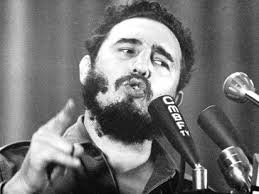
Fidel Castro
Immediately after the failed Bay of Pigs invasion, Kennedy appointed his brother, Robert–who was then the Attorney General—to oversee a CIA program to overthrow Castro.
The CIA and the Mafia entered into an unholy alliance to assassinate Castro—each for its own benefit:
- The CIA wanted to please Kennedy by overthrowing the Communist leader who had nationalized American corporate holdings.
- The Mafia wanted to regain its lucrative casino and brothel holdings that had made Cuba the playground of the rich in pre-Castro times.
The mobsters were authorized to offer $150,000 to anyone who would kill Castro and were promised any support the Agency could yield.
“We were hysterical about Castro at about the time of the Bay of Pigs and thereafter,” then-former Secretary of Defense Robert S. McNamara testified before Congress about these efforts. “And there was pressure from JFK and RFK to do something about Castro.”
Nor was everyone in the CIA enthusiastic about the “get Castro” effort.
“Everyone at CIA was surprised at Kennedy’s obsession with Fidel,” recalled Sam Halpern, who was assigned to the Cuba Project. “They thought it was a waste of time. We all knew [Fidel] couldn’t hurt us. Most of us at CIA initially liked Kennedy, but why go after this little guy?
“One thing is for sure: Kennedy wasn’t doing it out of national security concerns. It was a personal thing. The Kennedy family felt personally burnt by the Bay of Pigs and sought revenge.”
It was all-out war. Among the tactics used:
- Hiring Cuban gangsters to murder Cuban police officials and Soviet technicians.
- Sabotaging mines.
- Paying up to $100,000 per “hit” for the murder or kidnapping of Cuban officials.
- Using biological and chemical warfare against the Cuban sugar industry.
- Planting colorful seashells rigged to explode at a site where Castro liked to go skindiving.
- Trying to arrange for his being presented with a wetsuit impregnated with noxious bacteria and mold spores, or with lethal chemical agents.
- Attempting to infect Castro’s scuba regulator with tuberculous bacilli.
- Trying to douse his handkerchiefs, cigars, tea and coffee with other lethal bacteria.
But all of these efforts failed to assassinate Castro–or overthrow the Cuban Revolution he was heading.
“Bobby (Kennedy) wanted boom and bang all over the island,” recalled Halpern. “It was stupid. The pressure from the White House was very great.”
Americans would rightly label such methods as ”terrorist” if another power used them against the United States today. And the Cuban government saw the situation exactly the same way.
So Castro appealed to Nikita Khrushchev, leader of the Soviet Union, for assistance.
Khrushchev was quick to comply: “We must not allow the Communist infant to be strangled in its crib,” he told members of his inner circle.
2012 PRESIDENTIAL RACE, ALTERNET, AP, BARACK OBAMA, BAY OF PIGS, BBC, BERLIN WALL, BILL CLINTON, BRUCE GREENWOOD, BUZZFEED, CARLOS MARCELLO, CBS NEWS, CIA, CIVIL RIGHTS, CLIFF ROBERTSON, CNN, CUBAN MISSILE CRISIS, DAILY KOS, DAVID HALBERSTAM, DONALD J. TRUMP, FACEBOOK, FBI, FIDEL CASTRO, FRANK SINATRA, ICH BEN EIN BERLINNER SPEECH, INTERNET MOVIE DATABASE, J. EDGAR HOOVER, JAMES MARSDEN, JOHN F. KENNEDY, JOSEPH MCCARTHY, JOSEPH P. KENNEDY, LYNDON B. JOHNSON, MAFIA, MALCOM X, MARTIN LUTHER KING, MARTIN SHEEN, MOTHER JONES, MOVEON, MOVIES, NBC NEWS, NEWSWEEK, NEWT GINGRICH, NIKITA KHRUSHCHEV, NPR, NUCLEAR TEST BAN TREATY, POLITICO, PT-109, RAW STORY, REUTERS, RICK PERRY, ROBERT F. KENNEDY, ROBERT S. MCNAMARA, SALON, SAM GIANCANA, SANTOS TRAFFICANTE, Sarah Palin, SATURDAY NIGHT LIVE, SEATTLE TIMES, SLATE, SOVIET UNION, THE ATLANTIC, THE BEST AND THE BRIGHTEST, THE BUTLER, THE CHICAGO SUN-TIMES, THE CHICAGO TRIBUNE, THE DAILY BEAST, THE GUARDIAN, THE HILL, THE HUFFINGTON POST, THE LOS ANGELES TIMES, THE MISSILES OF OCTOBER, THE NEW YORK TIMES, THE RAT PACK, THE WALL STREET JOURNAL, THE WASHINGTON POST, THIRTEEN DAYS, TIME, TWILIGHT ZONE, TWITTER, U.S. NEWS & WORLD REPORT, UPI, USA TODAY, VIETNAM WAR, WILLIAM DEVANE, WILLIAM PETERSON
In Bureaucracy, Business, History, Law, Law Enforcement, Military, Politics, Social commentary on May 4, 2017 at 12:03 am
May 29, 2017, will mark the 100th anniversary of the birth of President John Fitzgerald Kennedy in Brookline, Massachusetts.
Today—-56 years after he took office—those who voted for him bitterly contrast his memory with the current President, Donald John Trump:
JFK – A decorated war hero
DJT – A five-times draft-dodger
JFK – Youthful (43 upon taking office) and handsome
DJT – Old (70) and overweight
JFK – A fervent anti-Communist
DJT – Elected with support from Russian Communist Intelligence
JFK – Witty, self-mocking
DJT – Humorless, self-bragging
JFK – Optimistic, well-informed, appealing to the best in Americans
DJT – Doom-saying, uninformed, appealing to the “darker side” of his Right-wing base
Some have called the Kennedy administration a golden era in American history. A time when touch football, lively White House parties, stimulus to the arts and the antics of the President’s children became national obsessions.
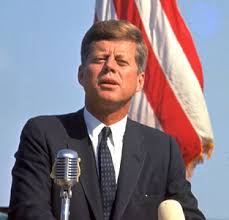
John F. Kennedy
Others have called the Kennedy Presidency a monument to the unchecked power of wealth and ambition. An administration staffed by young novices playing at statesmen, riddled with nepotism, and whose legacy includes the Bay of Pigs, the Vietnam war and the world’s first nuclear confrontation.
The opening days of the Kennedy Presidency raised hopes for a dramatic change in relations between the United States and the Soviet Union.
But detente was not possible then. The Russians had not yet experienced their coming agricultural problems and the setback in Cuba during the Missile Crisis. And the United States had not suffered defeat in Vietnam.
Kennedy’s first brush with international Communism came on April 17, 1961, with the invasion of Cuba at the Bay of Pigs. This operation had been planned and directed by the Central Intelligence Agency during the final months of Dwight D. Eisenhower’s term as President.
The U.S. Navy was to land about 1,400 Cuban exiles on the island to overthrow the Communist government of Fidel Castro. They were supposed to head into the mountains—as Castro himself had done against the dictatorship of Fulgencio Batista in 1956—and raise the cry of revolution.
The invasion would occur after an American air strike had knocked out the Cuban air force. But the airstrike failed and Kennedy, under the pressure of world opinion, called off a second try.
Even so, the invasion went ahead. When the invaders surged onto the beaches, they found Castro’s army waiting for them. Many of the invaders were killed on the spot. Others were captured—to be ransomed by the United States in December, 1962, in return for medical supplies.
It was a major public relations setback for the newly-installed Kennedy administration, which had raised hopes for a change in American-Soviet relations.
Kennedy, trying to abort widespread criticism, publicly took the blame for the setback: “There’s an old saying that victory has a hundred fathers and defeat is an orphan….I’m the responsible officer of the Government.”
The Bay of Pigs convinced Kennedy that he had been misled by the CIA and the Joint Chiefs of Staff. Out of this came his decision to rely heavily on the counsel of his brother, Robert, whom he had installed as Attorney General.
The failed Cuban invasion—unfortunately for Kennedy—convinced Soviet Premier Nikita S. Khrushchev that the President was weak.
Khrushchev told an associate that he could understand if Kennedy had not decided to invade Cuba. But once he did, Kennedy should have pressed on and wiped out Castro.
Khrushchev attributed this to Kennedy’s youth, inexperience and timidity—and believed he could bully the President.
On June 4, 1961, Kennedy met with Khrushchev in Vienna to discuss world tensions. Khrushchev threatened to go to nuclear war over the American presence in West Berlin—the dividing line between Western Europe, protected by the United States, and Eastern Europe, controlled by the Soviet Union.
Kennedy, who prized rationality, was shaken by Khrushchev’s unexpected rage. After the conference, he told an associate: “It’s going to be a cold winter.”
Meanwhile, East Berliners felt they were about to be denied access to West Berlin. A flood of 3,000 refugees daily poured into West Germany.
Khrushchev was embarrassed at this clear showing of the unpopularity of the Communist regime. In August, he ordered that a concrete wall—backed up by barbed wire, searchlights and armed guards—be erected to seal off East Berlin.
As tensions mounted and a Soviet invasion of West Berlin seemed likely, Kennedy sent additional troops to the city in a massive demonstration of American will.
Two years later, on June 26, 1963, during a 10-day tour of Europe, Kennedy visited Berlin to deliver his “I am a Berliner” speech to a frenzied crowd of thousands.
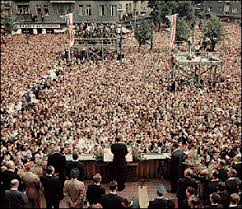
JFK addresses crowds at the Berlin Wall
“There are many people in the world who really don’t understand, or say they don’t, what is the great issue between the free world and the Communist world,” orated Kennedy. “Let them come to Berlin.”
Standing within gunshot of the Berlin wall, he lashed out at the Soviet Union and praised the citizens of West Berlin for being “on the front lines of freedom” for more than 20 years.
“All free men, wherever they may live,” said Kennedy, “are citizens of Berlin. And therefore, as a free man, I take pride in the words, ‘Ich ben ein Berliner.’”
ABC NEWS, AFGHANISTAN WAR, ALEXANDER THE GREAT, ALTERNET, AP, ATHENS, BARACK OBAMA, BBC, BUZZFEED, CBS NEWS, CENTRAL INTELLIGENCE AGENCY, CNN, DAILY KOS, DAVID PETRAEUS, DONALD TRUMP, DWIGHT D. EISENHOWER, ESPIONAGE, FACEBOOK, GATES OF FIRE, IRAQ WAR, JAMES BOND, JOSEPH MCCARTHY, MOTHER JONES, MOVEON, NBC NEWS, NEWSWEEK, NPR, PAULA BROADWELL, POLITICO, RAW STORY, REUTERS, SALON, SEATTLE TIMES, SKYFALL, SLATE, SPARTA, SPYING, STEVEN PRESSFIELD, THE AFGHAN CAMPAIGN, THE ATLANTIC, THE CHICAGO SUN-TIMES, THE CHICAGO TRIBUNE, THE DAILY BEAST, THE GUARDIAN, THE HILL, THE HUFFINGTON POST, THE LOS ANGELES TIMES, THE NEW YORK TIMES, THE VIRTUES OF WAR, THE WALL STREET JOURNAL, THE WASHINGTON POST, TIDES OF WAR, TIME, TWITTER, U.S. MARINE CORPS, U.S. NEWS & WORLD REPORT, UPI, USA TODAY
In Bureaucracy, History, Military, Politics, Social commentary on April 21, 2017 at 12:20 am
Steven Pressfield is the bestselling author of several novels on ancient Greece.
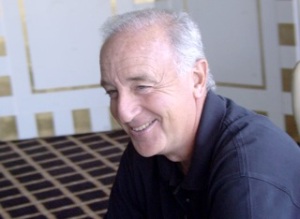
Steven Pressfield
In Gates of Fire (1998) he celebrated the immortal battle of Thermopylae, where 300 Spartans held at bay a vastly superior Persian army for three days.
In Tides of War (2000) he re-fought the ancient world’s 25-year version of the Cold War between the Greek city-states of Athens and Sparta.
n The Virtues of War (2004) he chronicled the military career of Alexander the Great–through the eyes of the conqueror himself.

And in The Afghan Campaign (2006) he accompanied Alexander’s army as it waged a vicious, three-year counterinsurgency war against native Afghans.
Besides being an amateur historian of armed conflict, Pressfield is a former Marine. His novel, Gates of Fire, has been adopted by the Marine Corps as required reading.
So Pressfield knows something about the art–and horrors–of war. And about the decline of heroism in the modern age.
Consider the events of November 9, 2012.
On that date, General David Petraeus suddenly resigned his position as director of the Central Intelligence Agency. He had held this just slightly more than a year.
The reason: The revelation of–and his admission to–an extramarital affair with Paula Broadwell, the woman who had written an admiring biography of him called All In.
Ironically, this happened to be the same day that “Skyfall”–the latest James Bond film–opened nationwide.
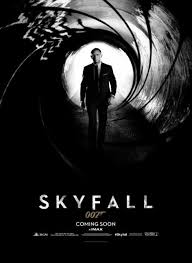
Since Bond made his first onscreen appearance in 1962’s “Dr. No,” England’s most famous spy has bedded countless women. And has become internationally famous as the ultimate ladykiller.
But real-life doesn’t quite work the same way.
What is permitted–and even celebrated–in a fictional spy is not treated the same way in the real world of espionage.
Prior to this, Petraeus had been the golden boy of the American Army–the best-known and most revered general since Dwight D. Eisenhower.
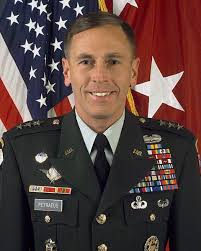
David Petraeus
The man who
- had given 37 years of his life to protecting the nation;
- had rewritten the book on how to fight counterinsurgency wars;
- had turned around the stagnated war in Iraq;
- had presided over the winding down of the war in Afghanistan.
As President Barack Obama put it:
“General Petraeus had an extraordinary career. He served this country with great distinction in Iraq, in Afghanistan and as head of the CIA.
“I want to emphasize that from my perspective, at least, he has provided this country an extraordinary service. We are safer because of the work that Dave Petraeus has done.
“And my main hope right now is that he and his family are able to move on and that this ends up being a single side note on what has otherwise been an extraordinary career.”
It’s why Pressfield candidly admits he prefers the ancient world to the present:
“If I’m pressed to really think about the question, I would answer that what appeals to me about the ancient world as opposed to the modern is that the ancient world was pre-Christian, pre-Freudian, pre-Marxist, pre-consumerist, pre-reductivist.
“It was grander, it was nobler, it was simpler. You didn’t have the notion of turn-the-other-cheek. You had Oedipus but you didn’t have the Oedipus complex. It was political but it was not politically correct.”
To illustrate what he meant, Pressfield cited this passage from Thucydides’ The Peloponnesian War, on how ancient-world politics took on its own tone of McCarthyism:
To fit in with the change of events, words, too, had to change their usual meanings. What used to be described as a thoughtless act of aggression was now regarded as the courage one would expect to find in a party member.
To think of the future and wait was merely another way of saying one was a coward. Any idea of moderation was just an attempt to disguise one’s unmanly character. Ability to understand a question from all sides meant that one was totally unfitted for action.
As if speaking on the scandal involving David Petraeus, Pressfield states:
“Our age has been denatured. The heroic has been bled out of it.
“The callings of the past––he profession of arms, the priesthood, the medical and legal professions, politics, the arts, journalism, education, even motherhood and fatherhood–every one has been sullied and degraded by scandal after scandal.
“We’re hard up for heroes these days, and even harder up for conceiving ourselves in that light. That’s why I’m drawn to the ancient world. It’s truer, in my view, to how we really are.
“The ancient world has not been reductified and deconstructed as ours has; it has not been robbed of all dignity. They had heroes then. There was such a thing, truly, as the Heroic Age. Men like Achilles and Leonidas really did exist.
“There was such a thing, truly, as heroic leadership. Alexander the Great did not command via satellite or remote control. He rode into battle at the head of his Companion cavalry; he was the first to strike the foe.”
Today, generals command armies while stationed thousands of miles from the front. And they face more danger from heart attacks than enemy bullets.
And commanding American generals is Donald Trump, a five-times draft-dodger who equates avoiding sexually-transmitted diseases with surviving the Vietnam war: “It is my personal Vietnam. I feel like a great and very brave soldier.”
2012 ELECTION, 2016 ELECTION, 2016 PRESIDENTIAL RACE, ABC NEWS, ADOLF HITLER, ADULTERY, CBS NEWS, CNN, DONALD TRUMP, FACEBOOK, HOUSE OF REPRESENTATIVES, HUMOR, JOHN KING, JOSEPH MCCARTHY, LANGUAGE, MARIANNE GINTHER, NBC NEWS, NEWT GINGRICH, OPEN MARRIAGE, REPUBLICANS, RICK SANTORUM, RON PAUL, SECRETARY OF STATE, SOUTH CROLINA PRIMARY, SPEAKER OF THE HOUSE, THE CHICAGO SUN-TIMES, THE CHICAGO TRIBUNE, THE LOS ANGELES TIMES, THE NEW YORK TIMES, THE WASHINGTON POST, TWITTER, USA TODAY
In Bureaucracy, History, Politics, Social commentary on November 15, 2016 at 12:09 am
Even so every good tree bringeth forth good fruit; but a corrupt tree bringeth forth evil fruit. A good tree cannot bring forth evil fruit, neither can a corrupt tree bring forth good fruit.
Every tree that bringeth not forth good fruit is hewn down, and cast into the fire. Wherefore by their fruits ye shall know them.
—Matthew 7: 17-20
Meet the Gingrich Twins: Good Newt and Bad Newt.
Both served as Speaker of the House of Representatives from 1995 to 1999.
Both ran–unsuccessfully–for President in 2012.
Both are again seeking power in 2016–as President-elect Donald Trump’s pick for Secretary of State.
And both also have much to teach America about the effective–and unscrupulous–use of language as used by ambitious, ruthless politicians.
Here’s how Good Newt responded to a question by CNN Moderator John King during the GOP Presidential debate at Charleston, South Carolina, on January 19, 2012:
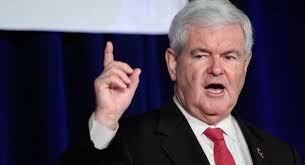
Newt Gingrich, once again giving “the finger” to America
King: “As you know, your ex-wife [Marianne Ginther] gave an interview to ABC News and another interview with The Washington Post.
“And this story has now gone viral on the internet. In it, she says that you came to her in 1999, at a time when you were having an affair. She says you asked her, sir, to enter into an open marriage. Would you like to take some time to respond to that?”

Marianne Ginther
Good Newt: “No, but I will. I think the destructive, vicious, negative nature of much of much of the news media makes it harder to govern this country, harder to attract decent people to run for public office. And I am appalled that you would begin a presidential debate on a topic like that….
“To take an ex-wife and make it two days before the primary a significant question for a presidential campaign is as close to despicable as anything I can imagine….
“Every personal friend I have who knew us in that period said the story was false. We offered several of them to ABC to prove it was false.
“They weren’t interested because they would like to attack any Republican. They’re attacking the governor. They’re attacking me. I’m sure they’ll presently get around to Senator [Rick] Santorum and Congressman [Ron] Paul.”
Good Newt is “appalled” that anyone could stoop so low. He’s concerned not only for himself and his party, but the country.
Unfortunately, for Good Newt, he has an identical evil twin: Bad Newt. And sometimes people–especially Democrats–mistake one for the other.
It was Bad Newt who, as Speaker of the House of Representatives, wrote a 1996 memo that encouraged Republicans to “speak like Newt.”
Entitled “Language: A Key Mechanism of Control,” it urged Republicans to attack Democrats with such words as “corrupt,” “selfish,” “destructive,” “hypocrisy,” “liberal,” “sick,” and “traitors.”
Even worse, Bad Newt encouraged the news media to disseminate such accusations. Among his suggestions:
- “Fights make news.”
- Create a “shield issue” to deflect criticism: “A shield issue is, just, you know, your opponent is going to attack you as lacking compassion. You better…show up in the local paper holding a baby in the neonatal center.”
In the memo, Bad Newt advised:
“….In the video ‘We are a Majority,’ Language is listed as a key mechanism of control used by a majority party, along with Agenda, Rules, Attitude and Learning.
“As the tapes have been used in training sessions across the country and mailed to candidates we have heard a plaintive plea: ‘I wish I could speak like Newt.’
“That takes years of practice. But, we believe that you could have a significant impact on your campaign and the way you communicate if we help a little. That is why we have created this list of words and phrases….
“This list is prepared so that you might have a directory of words to use in writing literature and mail, in preparing speeches, and in producing electronic media.
“The words and phrases are powerful. Read them. Memorize as many as possible. And remember that like any tool, these words will not help if they are not used.”
Here is the list of words Bad Newt urged his followers to use in describing “the opponent, their record, proposals and their party”:
- abuse of power
- anti- (issue): flag, family, child, jobs
- betray
- bizarre
- bosses
- bureaucracy
- cheat
- coercion
- “compassion” is not enough
- collapse(ing)
- consequences
- corrupt
- corruption
- criminal rights
- crisis
- cynicism
- decay
- deeper
- destroy
- destructive
- devour
- disgrace
- endanger
- excuses
- failure (fail)
- greed
- hypocrisy
- ideological
- impose
- incompetent
- insecure
- insensitive
|
- intolerant
- liberal
- lie
- limit(s)
- machine
- mandate(s)
- obsolete
- pathetic
- patronage
- permissive attitude
- pessimistic
- punish (poor …)
- radical
- red tape
- self-serving
- selfish
- sensationalists
- shallow
- shame
- sick
- spend(ing)
- stagnation
- status quo
- steal
- taxes
- they/them
- threaten
- traitors
- unionized
- urgent (cy)
- waste
- welfare
|
Yes, speaking like Newt–or Adolf Hitler or Joseph McCarthy–“takes years of practice.”
So you can understand why Good Newt hates being mistaken for his evil twin, Bad Newt.
Unfortunately, they look–and sound–so alike it’s impossible to tell them apart.
But since they’re both 73, perhaps one day soon we’ll find out which one we’re left with–Good Newt or Bad Newt.
Unless, of course, they both drop off at the same time. Then we will never know which was which.
It’s definitely a mystery worth living with.
ABC NEWS, AL QAEDA, BARACK OBAMA, CBS NEWS, CENTRAL AMERICA, CHAING KAI-SHEK, CHINA, CNN, COLUMBIA, COMMUNISM, CRIMEA, CUBA, CZECHOSLAVAKIA, DEMOCRATS, FACEBOOK, GUATEMALA, GUNBOAT DIPLOMACY, HARRY S. TRUMAN, HEZBOLLAH, HUNGARY, JOHN F. KENNEDY, JOSEPH MCCARTHY, LATIN AMERICA, LYNDON B. JOHNSON, MAO TSE-TUNG, MITT ROMNEY, MONROE DOCTRINE, NBC NEWS, NICARAGUA, PANAMA, POLAND, REPUBLICANS, RICHARD M. NIXON, SOCHI OLYMPICS, SOVIET UNION, SPHERES OF INFLUENCE, SYRIA, THE CHICAGO SUN-TIMES, THE CHICAGO TRIBUNE, THE LOS ANGELES TIMES, THE NEW YORK TIMES, THE WASHINGTON POST, TWITTER, UKRAINE, VIETNAM, VLADIMIR PUTIN
In Bureaucracy, History, Politics, Social commentary on September 27, 2016 at 12:05 am
It didn’t take much for American Right-wingers to start salivating–and celebrating.
All it took was for Russia to move troops into its neighboring territories of Ukraine and Crimea.
Ever since the collapse of the Soviet Union in 1991, the American Right felt dejected. Accusing Democrats of being “terrorist-lovers” just hadn’t been as profitable as accusing them of being “Communists.”
The torch had barely gone out at the much-ballyhooed 2014 Sochi Olympics when Russian President Vladimir Putin began menacing the Ukraine.
Even while the Olympics played out on television, Ukrainians had rioted in Kiev and evicted their corrupt, luxury-loving president, Victor Yanukovych.
And this, of course, didn’t sit well with his “sponsor”–Putin.
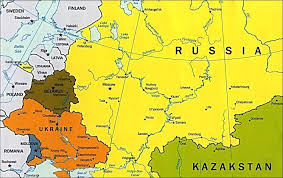
Yanukovych had rejected a pending European Union association agreement. He had chosen instead to pursue a Russian loan bailout and closer ties with Russia.
And that had sat well with Putin.
Since the breakup of the Soviet Union in 1991, Putin had yearned for a reestablishment of the same. He had called that breakup “the greatest geopolitical tragedy of the 20th century.”
So it was almost a certainty that, when his chosen puppet, Yanukovych, was sent packing, Putin would find some way to retaliate.
And since late February, 2014, he has done so, gradually moving Russian troops into Ukraine and its autonomous republic, Crimea.
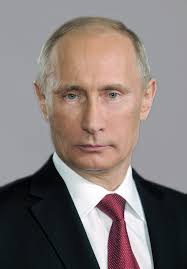
Vladimir Putin
By late March, it was clear that Russia had sufficient forces in both Ukraine and Crimea to wreak any amount of destruction Putin may wish to inflict.
And where there is activity by Russians, there are American Rightists eager–in Shakespeare’s word–to “cry havoc and let slip the dogs of war.”
Or at least to use such events to their own political advantage.
Right-wingers such as Mitt Romney, the former governor of Massachussetts who lost the 2012 Presidential election by a wide margin to Barack Obama.
“There’s no question but that the president’s naiveté with regards to Russia,” said Romney on March 23, 2014.
“And unfortunately, not having anticipated Russia’s intentions, the president wasn’t able to shape the kinds of events that may have been able to prevent the kinds of circumstances that you’re seeing in the Ukraine, as well as the things that you’re seeing in Syria.”
All of which overlooks a number of brutal political truths.
First, all great powers have spheres of interest–and jealously guard them.
For the United States, it’s Latin and Central America, as established by the Monroe Doctrine.
And just what is the Monroe Doctrine?
It’s a statement made by President James Monroe in his 1823 annual message to Congress, which warned European powers not to interfere in the affairs of the Western Hemisphere.
It has no other legitimacy than the willingness of the United States to use armed force to back it up. When the United States no longer has the will or resources to enforce the Doctrine, it will cease to have meaning.

For the Soviet Union, its spheres of influence include the Ukraine. Long known as “the breadbasket of Russia,” in 2011, it was the world’s third-largest grain exporter.
Russia will no more give up access to that breadbasket than the United States would part with the rich farming states of the Midwest.
Second, spheres of influence often prove disastrous to those smaller countries affected.
Throughout Latin and Central America, the United States remains highly unpopular for its brutal use of “gunboat diplomacy” during the 20th century.
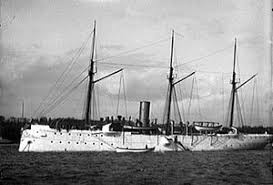
American gunboat
Among those countries invaded or controlled by America: Mexico, Cuba, Guatemala, Nicaragua, Columbia, Panama and the Dominican Republic.
The resulting anger has led many Latin and Central Americans to support Communist Cuba, even though its political oppression and economic failure are universally apparent.
Similarly, the Union of Soviet Socialist Republics (U.S.S.R.) forced many nations–such as Poland, Hungary and Czechoslavakia–to submit to the will of Moscow.
The alternative? The threat of Soviet invasion–as occurred in Hungary in 1956 and Czechoslovakia in 1968.
Third, even “great powers” are not all-powerful.
In 1949, after a long civil war, the forces of Mao Tse-tung defeated the Nationalist armies of Chaing Kai-Shek, who withdrew to Taiwan.
China had never been a territory of the United States. Nor could the United States have prevented Mao from defeating the corrupt, ineptly-led Nationalist forces.
Even so, Republican Senators and Representatives such as Richard Nixon and Joseph McCarthy eagerly blamed President Harry S. Truman and the Democrats for “losing China.”
The fear of being accused of “losing” another country led Presidents John F. Kennedy, Lyndon B. Johnson and Richard M. Nixon to tragically commit the United States to “roll back” Communism in Cuba and Vietnam.
Now Republicans–who claim the United States can’t afford to provide healthcare for its poorest citizens–want to turn the national budget over to the Pentagon.
They want the United States to “intervene” in Syria–even though this civil war pits Al Qaeda and Hezbollah, two of America’s greatest enemies, against each other.
They want the United States to “intervene” in Ukraine–even though this would mean going to war with the only nuclear power capable of turning America into an atomic graveyard.
Before plunging into conflicts that don’t concern us and where there is absolutely nothing to “win,” Americans would do well to remember the above-stated lessons of history. And to learn from them.
2016 ELECTION, ABC NEWS, BARACK OBAMA, BILL CLINTON, CBS NEWS, CHIANG KAI-SHEK, CHINA, CNN, CUBAN MISSILE CRISIS, DEMOCRATIC PARTY, DONALD TRUMP, DWIGHT D. EISENHOWER, FOX NEWS, GEORGE H.W. BUSH, GEORGE W. BUSH, HARRY S. TRUMAN, HILLARY CLINTON, JOHN F. KENNEDY, JOSEPH MCCARTHY, MAO TSE-TUNG, MITT ROMNEY, NAVY SEALS, NBC NEWS, NO EASY DAY, OSAMA BIN LADEN, PENTAGON, REPUBLICAN PARTY, RICHARD NIXON, Ronald Reagan, THE CHICAGO SUN-TIMES, THE CHICAGO TRIBUNE, THE LOS ANGELES TIMES, THE NEW YORK TIMES, THE NEW YORKER, THE WASHINGTONPOST, TREASON, U.S. NAVY SEALS, VLADIMIR PUTIN, WIKILEAKS
In Bureaucracy, History, Military, Politics, Social commentary on July 28, 2016 at 12:08 am
“Russia, if you’re listening, I hope you’re able to find the 30,000 emails that are missing. I think you will probably be rewarded mightily by our press.”
The speaker was Donald Trump, holding a July 27 press conference in Doral, Fla.
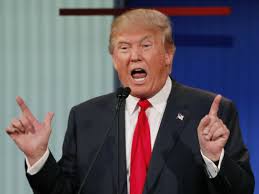
Donald Trump
And he was urging a foreign leader to hack into the private email server of his Presidential rival, Hillary Clinton.
Five days earlier, Wikileaks had released 19,252 emails and 8,034 attachments hacked from computers of the highest-ranking officials of the Democratic National Committee (DNC).
Cyber-security experts believe the hacking originated from Russia–and that Russian President Vladimir Putin may have authorized it.
Politicians on the Left and Right expressed outrage at Trump’s remarks.
But this is not the first time the Right has jeopardized American security.
During the 2012 Presidential campaign, supporters of Mitt Romney accused President Barack Obama of leaking top-secret details of the U.S. Navy SEALs raid on Osama bin Laden’s compound in Abbottabad, Pakistan.
The raid, launched on May 1, 2011, resulted in the death of the 9/11 mastermind and the capture of a treasury of highly sensitive Al Qaeda documents.
According to Right-wingers, Obama wanted to provide Hollywood screenwriters with material for a movie to glorify his role in authorizing the raid.
In August, 2012, the Right found its own secrets-leakers. And they operated under the name of the Fox News Network.
Their motive: To promote a book–No Easy Day: The Firsthand Account of the Mission That Killed Osama Bin Laden. It was slated to hit bookstores on September 11–the 11th anniversary of Al Qaeda’s attacks on the Pentagon and World Trade Center.
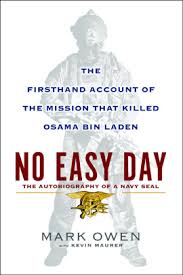
It had been penned under the pseudonym “Mark Owen.” But the real name of the author–a 36-year-old former Navy SEAL Team Six member who took part in the raid–was Matt Bissonnette, of Wrangell, Alaska.
Bissonnette’s real name became public after multiple sources leaked it to Fox News–who revealed it on August 23.
The Navy SEALs who killed bin Laden had previously been left unidentified.
Fox News had repeatedly accused President Obama and members of his administration of treasonously leaking military secrets to the media to glorify the President.
Many former and current SEAL members feared that the book would release information that could compromise future missions.
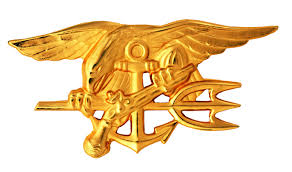
U.S. Navy SEALs insignia
One Navy SEAL told Fox News, “How do we tell our guys to stay quiet when this guy won’t?” Some SEALs called Bissonnette a “traitor.”
And Colonel Tim Nye, a Special Operations Command spokesman, said the author “put himself in danger” by writing the book.
“This individual came forward. He started the process. He had to have known where this would lead. He’s the one who started this, so he bears the ultimate responsibility for this.”
But Bissonnette placed more than his own life in jeopardy. He endangered the lives of every one of the men who participated in the bin Laden raid.
If Bissonnette fell into the hands of Al Qaeda terrorists or sympathizers, he could conceivably be tortured into revealing at least some of the names and locations of his former team members.
And Fox News not only revealed his true name but the town where he lived.

Even the liberal Nation magazine was appalled at the recklessness of this Right-wing propaganda outlet. Jeremy Scahill, a writer for Nation, tweeted:
“Why on earth would FOX News publish the alleged identity of one of the ST6 members who was in the OBL raid? Seriously.”
Millions of Right-wing Americans have been conditioned by decades of Fascistic propaganda to believe that:
- Democrats are all traitors–or at least potential traitors.
- Even those Democrats who aren’t traitors are too weak-kneed to protect the nation from its sworn enemies.
- Democrats (have betrayed) (are betraying) (intend to betray) national security secrets to the Soviet/Chinese Communists.
- Democrats have (betrayed/) (are betraying) (intend to betray) national security secrets to Islamic Jihadists.
- Only Republicans can be trusted to protect the nation.
Republicans blamed President Harry S. Truman for “losing China” to the forces of Mao Tse Tung in 1949. America could not have prevented a corrupt and incompetent Chiang Kai-Shek from being driven off the Chinese mainland by Mao’s overwhelmingly powerful armies.
Then, in 1950, Senator “Tail Gunner Joe” McCarthy charged that the State Department was infested by Communists–and that the Truman administration knew it but refused to take action. The charges were false.

Joseph R. McCarthy
During the 2008 Presidential campaign, Republicans charged that Barack Obama was really a Muslim non-citizen who intended to sell out America’s security to his Muslim “masters.”
Attacking the patriotism of their opponents has repeatedly elected Republicans:
- It elected Dwight Eisenhower President and turned Congress Republican in 1952 and 1956.
- It elected Richard Nixon President in 1968 and 1972.
- It elected Ronald Reagan President in 1980 and 1984.
- It elected George H.W. Bush President in 1988.
- It gave Republicans control of the Congress in 1994 (although Bill Clinton had been elected President in 1992).
- It elected George W. Bush President in 2000 and 2004.
- It gave control of the House to Republicans in 2010 and the Senate in 2014.
And now Republicans hope this appeal will elect a man who has openly called on Vladimir Putin to hack into American computers.
ABC NEWS, ADOLF HITLER, ALTERNET, ANDREW JACKSON, AP, BUZZFEED, CBS NEWS, CNN, COLLEGE FOOTBALL, CROOKS AND LIARS, DAILY KOZ, DREW PEARSON, DWIGHT EISENHOWER, EDWARD R. MURROW, FACEBOOK, GEORGE C. MARSHALL, HARRY S. TRUMAN, JERRY SANDUSKY, JOE PATERNO, JOSEPH MCCARTHY, JOSEPH STALIN, LOUIS FREEH, MOTHER JONES, MOVEON, NBC NEWS, NEWSWEEK, NIKE, NIKITA KHRUSHCHEV, NPR, PENN STATE UNIVERSITY, POLITICO, RAW STORY, REUTERS, SALON, SEATTLE TIMES, SLATE, SOVIET UNION, THE ATLANTIC, THE CHICAGO SUN-TIMES, THE CHICAGO TRIBUNE, THE DAILY BEAST, THE GUARDIAN, THE HILL, THE HUFFINGTON POST, THE LOS ANGELES TIMES, THE NATION, THE NEW YORK TIMES, THE WASHINGTON POST, THIRD REICH, TIME, TWITTER, U.S. NEWS & WORLD REPORT, UP, UPI, USA TODAY, YEVGENEY YEVTUSHENKO
In Bureaucracy, History, Law, Politics, Social commentary on July 1, 2016 at 12:16 am
“One man with courage,” said frontier general Andrew Jackson, “makes a majority.”
Yet it’s amazing how many “heroes” come out of the woodwork only after the danger is safely past.
Joseph Stalin dominated the Soviet Union from 1928 to 1953. He held absolute power twice as long as Adolf Hitler–whose Third Reich lasted only 12 years.
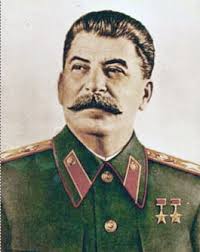
Joseph Stalin
Above all, he was responsible for the deaths of at least 20,000,000 men, women and children:
- At the hands of the executioners of the NKVD (later named the KGB).
- In exile–usually in Siberia–in Soviet penal camps.
- Of man-made starvation brought on by Stalin’s forced “collective-farm” policies.
Then, the unthinkable happened: Stalin finally died on March 5, 1953.
Almost three years later–on February 25, 1956–Stalin’s successor, Nikita Khrushchev, shocked the 20th Party Congress of the Soviet Union with a bombshell announcement:
Stalin–the “Wise Leader and Teacher”–had been a murderous despot.
Among his crimes:
- He had created a regime based on “suspicion, fear and terror.”
- His massive purges of the officer corps had almost destroyed the Red Army–thus inviting Hitler’s 1941 invasion, which killed at least 20 million Soviet citizens.
- He had allied himself with Hitler in 1939 and ignored repeated warnings of the coming Nazi invasion.
Naturally, Khrushchev didn’t advertise the role he had played as one of Stalin’s most trusted and brutal henchmen.
Over the ensuing years, many of the statues and portraits of Stalin that had dotted the Soviet Union like smallpox scars were quietly taken down. The city of Stalingrad–which Stalin had renamed from its original name of Tsaritsyn–became Volgograd.
Then, in 1961, Stalin’s corpse was removed from its prominent spot in the Lenin mausoleum and reburied in a place for lesser heroes of the Russian Revolution.
The young poet, Yevgeney Yevtushenko, noted the occasion in his famous poem, “The Heirs of Stalin.” Its gist: Stalin the tyrant was dead, but his followers still walked the earth–and lusted for a return to power.
Something similar happened in the United States around the same time.
From 1950 to 1954, Wisconsin Republican Senator Joseph R. McCarthy terrorized the nation, accusing anyone who disagreed with him of being a Communist–and leaving ruined lives in his wake.

Joseph R. McCarthy
Among those civilians and government officials he slandered as Communists were:
- President Harry S. Truman
- President Dwight D. Eisenhower
- Broadcast journalist Edward R. Murrow
- Secretary of State George C. Marshall
- Columnist Drew Pearson
Finally, in 1954, McCarthy overreached himself and accused the U.S. Army of being a hotbed of Communist traitors. Joseph Welch, counsel for the Army, destroyed McCarthy’s credibility in a now-famous retort:
“Senator, may we not drop this?….You’ve done enough. Have you no sense of decency, sir? At long last, have you left no sense of decency?”
Later that year, the Senate censured McCarthy, and he rapidly declined in power and health.
Senatorial colleagues who had once courted his support now avoided him.
They left the Senate when he rose to speak. Reporters who had once fawned on him for his latest sensational slander now ignored him.
Eisenhower–who had sought McCarthy’s support during his 1952 race for President–joked that “McCarthyism” was now “McCarthywasm.”
Fast-forward to July 12, 2012–and the release of former FBI Director Louie Freeh’s report on serial pedophile Jerry Sandusky. As the assistant football coach at Penn State University (PSU), he had used the football facilities to sexually attack numerous young boys.

Jerry Sandusky
But Sandusky was regarded as more than a second-banana. He received Assistant Coach of the Year awards in 1986 and 1999, and authored several books about his coaching experiences.
In 1977, Sandusky founded The Second Mile, a non-profit charity serving underprivileged, at-risk youth.
“Our most saddening and sobering finding is the total disregard for the safety and welfare of Sandusky’s child victims by the most senior leaders at Penn State,” Freeh stated.
College football is a $2.6 billion-a-year business. And Penn State is one of its premiere brands, with revenue of $70 million in 2010.
PSU’s seven-month internal investigation, headed by Freeh, revealed:
- Joe Paterno, head coach of the Penn State Nittany Lions, was aware of a 1998 criminal investigation of Sandusky.
- So was president Graham Spanier, athletic director Tim Curley and vice president Gary Schultz.
- In 2001, then-graduate assistant Mike McQueary reported to Paterno that he’d seen Sandusky attacking a boy in the shower.
- Paterno, Spanier, Curley and Schultz then conspired to cover up for Sandusky.
- The rapes of these boys occurred in the Lasch Building–where Paterno had his office.
- A janitor who had witnessed a rape in 2000 said he had feared losing his job if he told anyone about it. “It would be like going against the President of the United States,” Freeh said at a press conference.
In 2011, Sandusky was arrested and charged with sexually abusing young boys over a 15-year period. On June 22, 2012, he was convicted on 45 of the 48 charges. He will likely spend the rest of his life in prison.
On the day the Freeh report was released, Nike–a longtime sponsor for Penn State–announced that it would remove Paterno’s name from the child care center at its world headquarters in Beaverton, Oregon.
2016 PRESIDENTIAL CAMPAIGN, ABC NEWS, ADOLF HITLER, ALTERNET, AMERICABLOG, AP, BABY BOOMER RESISTANCE, BARACK OBAMA, BBC, BERNIE SANDERS, BLOOMBERG NEWS, BUZZFEED, CBS NEWS, CNN, CROOKS AND LIARS, D-DAY, DAILY KOZ, DAVID BROOKS, DEMOCRATIC PARTY, DONALD TRUMP, ELIZABETH WARREN, FACEBOOK, FIVETHIRTYEIGHT, GEORGE S. PATTON, HARPER’S MAGAZINE, HEINZ GUERIAN, HILLARY CLINTON, HUFFINGTON POST, JOSEPH MCCARTHY, LIBERALS, MARCO RUBIO, MARK SHIELDS, MEDIA MATTERS, MOTHER JONES, MOVEON, MSNBC, NAZI GERMANY, NBC NEWS, NEW REPUBLIC, NEWSDAY, NEWSWEEK, NEWT GINGRICH, NOCCOLO MACHIAVELLI, NPR, PBS NEWSHOUR, POLITICO, POLITICUSUSA, RAW STORY, REPUBLICAN PARTY, REPUBLICANS, REUTERS, SALON, SEATTLE TIMES, SLANDER, SLATE, STALINGRAD, TALKING POINTS MEMO, TED CRUZ, THE ATLANTIC, THE CHICAGO SUN-TIMES, THE CHICAGO TRIBUNE, THE DAILY BEAST, THE DAILY BLOG, THE GUARDIAN, THE HILL, THE HUFFINGTON POST, THE LOS ANGELES TIMES, THE NATION, THE NEW REPUBLIC, THE NEW YORK TIMES, THE NEW YORKER, THE PRINCE, THE VILLAGE VOICE, THE WASHINGTON POST, THINKPROGRESS, TIME, TRUTHDIG, TRUTHOUT, TWITTER, TWO POLITICAL JUNKIES, U.S. NEWS & WORLD REPORT, UPI, USA TODAY, WAFFEN-SS
In Bureaucracy, History, Politics, Social commentary on June 2, 2016 at 12:13 am
Massachusetts U.S. Senator Elizabeth Warren seems to know something that most of her fellow Democrats don’t–or choose to ignore.
Nazi Germany wasn’t defeated because “we were the Good Guys and they were the Bad Guys.”
On the contrary: It was defeated because the Allies waged war as brutally as the Germans.
For example:
- From D-Day to the fall of Berlin, captured Waffen-SS soldiers were often shot out of hand.
- When American troops came under fire in the German city of Aachen, Lt. Col. Derrill Daniel brought in a self-propelled 155mm artillery piece and opened up on a theater housing German soldiers. After the city surrendered, a German colonel labeled the use of the 155 “barbarous” and demanded that it be outlawed.
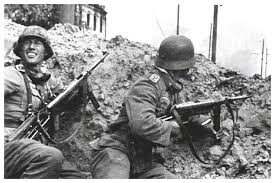
German soldiers at Stalingrad
- The United States and Great Britain carpet-bombed about 150 German cities by day and night, killing 305,000 to 600,000 civilians.
- During the battle of Stalingrad in 1942, Wilhelm Hoffman, a young German soldier and diarist, was appalled that the Russians refused to surrender. He wrote: “You don’t see them at all, they have established themselves in houses and cellars and are firing on all sides, including from our rear! Barbarians! They use gangster methods….”
In short: The Allies won because they dared to meet the brutality of a Heinz Guderian with that of a George S. Patton.
This is a lesson that has been totally lost on the liberals of the Democratic Party. Which explains why they lost most of the Presidential elections of the 20th century.
To Republicans, “lawfully elected” applies only to Republican Presidents. A Democrat who runs against a Republican is automatically considered a traitor.
And a Democrat who defeats a Republican is automatically considered a usurper, and thus deserves to be slandered and obstructed, if not impeached.
Unable to defeat Bill Clinton in 1992 and 1996, Republicans tried in 1998 to impeach him for getting oral sex in the White House.
Similarly, 2012 Presidential candidate Herman Cain, asked in a conference call with bloggers why Republicans couldn’t just impeach President Barack Obama, replied:
“That’s a great question and it is a great–it would be a great thing to do but because the Senate is controlled by Democrats we would never be able to get the Senate first to take up that action.”
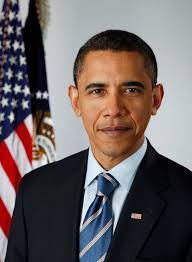
Barack Obama
In Renegade: The Making of a President, Richard Wolffe chronicled Obama’s successful 2008 bid for the White House. Among his revelations:
Obama, a believer in rationality and decency, felt more comfortable in responding to attacks on his character than in making them on the character of his enemies.
A graduate of Columbia University and Harvard Law School, Obama is easily one of the most academically gifted Presidents in United States history.
But for all this, he failed–from the onset of his Presidency–to grasp and apply this fundamental lesson taught by Niccolo Machiavelli, the father of modern political science.
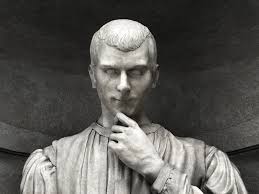
Niccolo Machiavelli
In The Prince, Machiavelli warns:
From this arises the question whether it is better to be more loved than feared, or feared more than loved.
The reply is, that one ought to be both feared and loved, but as it is difficult for the two to go together, it is much safer to be feared than loved….
And men have less scruple in offending one who makes himself loved than one who makes himself feared; for love is held by a chain of obligations which, men being selfish, is broken whenever it serves their purpose; but fear is maintained by a dread of punishment which never fails.
Just as they have blithely disregarded the lessons of history, liberals have ignored the Realpolitik of Machiavelli–with catastrophic results.
On Facebook and Twitter, liberals are already celebrating the “certain” Presidency of Vermont U.S. Senator Bernie Sanders or former First Lady Hillary Clinton in 2017.
They forget–or ignore–that liberals couldn’t believe America would elect, respectively, Richard Nixon (1968 and 1972), Ronald Reagan (1980 and 1984), George H.W. Bush (1988) and George W. Bush (2000 and 2004).
But Elizabeth Warren clearly hasn’t forgotten those Republican victories. Nor does she take for granted that Republican Presidential nominee Donald Trump is certain to lose in November.
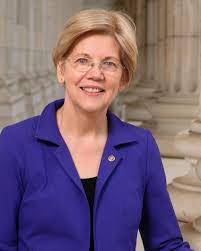
Elizabeth Warren
Instead, Warren has dared to do what no other Democrat–or Republican–has: Attack Trump head-on, with the kind of blunt, insulting language he has lavished on his opponents.
On March 31, she appeared on The Late Show, with Stephen Colbert. Her take on the egotistical billionaire:
“Donald Trump is looking out for exactly one guy, and that guy’s name is Donald Trump. He smells that there’s change in the air and what he wants to do is make sure that that change works really, really well for Donald Trump.
“The truth is, he inherited a fortune from his father, he kept it going by cheating and defrauding people, and then he takes his creditors through Chapter 11.”
When Colbert said that Trump had never broken the law, Warren replied that he had never broken the law “and been caught.”
For Democrats to win elective victories and enact their agenda, they must find their own George Patton to take on the Waffen-SS generals among Republican ranks.
Only Elizabeth Warren has so far grasped this truth. And only she seems determined to act on it.
2016 PRESIDENTIAL CAMPAIGN, ABC NEWS, ADOLF HITLER, ALTERNET, AMERICABLOG, AP, BABY BOOMER RESISTANCE, BARACK OBAMA, BBC, BERNIE SANDERS, BLOOMBERG NEWS, BUZZFEED, CBS NEWS, CNN, CROOKS AND LIARS, D-DAY, DAILY KOZ, DAVID BROOKS, DEMOCRATIC PARTY, DONALD TRUMP, ELIZABETH WARREN, FACEBOOK, FIVETHIRTYEIGHT, GEORGE S. PATTON, HARPER’S MAGAZINE, HEINZ GUERIAN, HILLARY CLINTON, HUFFINGTON POST, JOSEPH MCCARTHY, LIBERALS, MARCO RUBIO, MARK SHIELDS, MEDIA MATTERS, MOTHER JONES, MOVEON, MSNBC, NAZI GERMANY, NBC NEWS, NEW REPUBLIC, NEWSDAY, NEWSWEEK, NEWT GINGRICH, NOCCOLO MACHIAVELLI, NPR, PBS NEWSHOUR, POLITICO, POLITICUSUSA, RAND PAUL, RAW STORY, REPUBLICAN PARTY, REPUBLICANS, REUTERS, SALON, SEATTLE TIMES, SLANDER, SLATE, STALINGRAD, TALKING POINTS MEMO, TED CRUZ, THE ATLANTIC, THE CHICAGO SUN-TIMES, THE CHICAGO TRIBUNE, THE DAILY BEAST, THE DAILY BLOG, THE GUARDIAN, THE HILL, THE HUFFINGTON POST, THE LOS ANGELES TIMES, THE NATION, THE NEW REPUBLIC, THE NEW YORK TIMES, THE NEW YORKER, THE PRINCE, THE VILLAGE VOICE, THE WASHINGTON POST, THINKPROGRESS, TIME, TRUTHDIG, TRUTHOUT, TWITTER, TWO POLITICAL JUNKIES, U.S. NEWS & WORLD REPORT, UPI, USA TODAY, WAFFEN-SS
In Bureaucracy, History, Politics, Social commentary on June 1, 2016 at 12:04 am
Donald Trump, “for all his moral flaws, is a marketing genius.”
So stated New York Times columnist David Brooks on the May 27 edition of the PBS Newshour.
“And you look at what he does. He just picks a word and he attaches it to a person. Little Marco {Rubio], Lyin’ Ted [Cruz], Crooked Hillary [Clinton].

Donald Trump
“And that’s a word. And that’s how marketing works. It’s a simple, blunt message, but it gets under. It sticks, and it diminishes. And so it has been super effective for him, because he knows how to do that. And [Hillary] just comes with ‘Oh, he’s divisive.’
“These are words that are not exciting people. And her campaign style has gotten, if anything…a little more stagnant and more flat.”
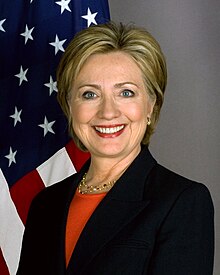
Hillary Clinton
Hillary Clinton isn’t the only Presidential candidate who has proven unable to cope with Trump’s gifts for insult. His targets–and insults–have included:
-
Former Texas Governor Rick Perry: “Wears glasses to seem smart.”
-
Former Florida Governor Jeb Bush: “Low Energy Jeb.”
-
Vermont U.S. Senator Bernie Sanders: “Crazy Bernie.”
-
Ohio Governor John Kasich: “Mathematically dead and totally desperate.”
So far, only one opponent has managed to stand up to Trump: Massachusetts U.S. Senator Elizabeth Warren, whom Trump has called “goofy.”
Florida U.S. Senator Marco Rubio tried to out-insult Trump at the Republican Presidential candidates’ debate on March 3.
“I call him Little Marco. Little Marco. Hello, Marco,” said Trump.
And so Rubio retaliated with “Big Donald.” Since Americans generally believe that “bigger is better,” this was a poor choice of insult.
On the May 27 edition of the PBS Newshour, syndicated columnist Mark Shields noted the ability of Elizabeth Warren to rattle Trump:
“Elizabeth Warren gets under Donald Trunp’s skin. And I think she’s been the most effective adversary. I think she’s done more to unite the Democratic party than either Hillary Clinton or Bernie Sanders.
“I mean, she obviously–he can’t stay away from her. He is tweeting about her.”
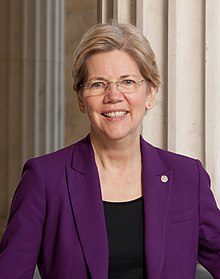
Elizabeth Warren
JUDY WOODRUFF (moderator): “But whether it’s Elizabeth Warren or not, doesn’t Hillary Clinton need to come up with some approach that works, that is as effective comeback?”
DAVID BROOKS: “Yes. Well, I think she does, not that anybody else has managed to do this….
“And so the tactics…is either you do what Elizabeth Warren has done, like full-bore negativity, that kind of [get] under the skin, or try to ridicule him and use humor. Humor is not Hillary Clinton’s strongest point.”
But sharp-edged humor clearly works for Warren.
A May 12 story on CNN–“Elizabeth Warren Gives Trump a Dose of His Own Medicine on Twitter”–notes:
“In the past week the Massachusetts Democrat has refined an aggressive anti-Trump message through a series of so-called tweetstorms.
“Whenever Trump criticizes her, Warren fires right back at him, sometimes twice as hard.”
Warren’s tweets, according to the article, appear to have two goals:
- Challenge Trump on social media, which he has so far dominated; and
- Use attention-catching words like “bully” and “loser.”
Among her tweets:
- “But here’s the thing. You can beat a bully–not by tucking tail and running, but by holding your ground.”
- When Trump boasted “I’m driving her nuts” Warren tweeted: “No, @realDonaldTrump – your racism, sexism & xenophobia doesn’t drive me nuts. It makes me sick. And I’m not alone.”
- “You care so much about struggling American workers, @realDonaldTrump, that you want to abolish the federal minimum wage?”
- “@realDonaldTrump: Your policies are dangerous. Your words are reckless. Your record is embarrassing. And your free ride is over.”
Nor has Warren restricted herself to battling Trump on Twitter.
On May 24, Warren unleashed perhaps her most devastating attack on Trump at an event hosted by the Center for Popular Democracy:
“Just yesterday, it came out that Donald Trump had said back in 2007 that he was ‘excited’ for the real estate market to crash because, quote, ‘I’ve always made more money in bad markets than in good markets.’
“That’s right. The rest of us were horrified by the 2008 financial crisis, by what happened to the millions of families…that were forced out of their homes.
“But Donald Trump was drooling over the idea of a housing meltdown–because it meant he could buy up a bunch more property on the cheap.
“What kind of a man does that? Root for people to get thrown out on the street? Root for people to lose their jobs? Root for people to lose their pensions?
“What kind of a man does that? I’ll tell you exactly what kind—a man who cares about no one but himself. A small, insecure moneygrubber who doesn’t care who gets hurt, so long as he makes some money off it….
“Sometimes Trump claims he is tough on Wall Street–tough on the guys who cheated people….. But now he’s singing a very different song.
“Last week, he said that the new Dodd-Frank financial regulations have…’made it impossible for bankers to function’ and he will put out a new plan soon that ‘will be close to dismantling Dodd-Frank.’
“Donald Trump is worried about helping poor little Wall Street? Let me find the world’s smallest violin to play a sad, sad song.”
2016 PRESIDENTIAL CAMPAIGN, ABC NEWS, ADOLF HITLER, ALTERNET, AMERICABLOG, AP, BABY BOOMER RESISTANCE, BARACK OBAMA, BBC, BERNIE SANDERS, BLOOMBERG NEWS, BUZZFEED, CBS NEWS, CNN, CROOKS AND LIARS, D-DAY, DAILY KOZ, DAVID BROOKS, DEMOCRATIC PARTY, DONALD TRUMP, ELIZABETH WARREN, FACEBOOK, FIVETHIRTYEIGHT, GEORGE S. PATTON, HARPER’S MAGAZINE, HEINZ GUERIAN, HILLARY CLINTON, HUFFINGTON POST, JOSEPH MCCARTHY, LIBERALS, MARCO RUBIO, MARK SHIELDS, MEDIA MATTERS, MOTHER JONES, MOVEON, MSNBC, NAZI GERMANY, NBC NEWS, NEW REPUBLIC, NEWSDAY, NEWSWEEK, NEWT GINGRICH, NOCCOLO MACHIAVELLI, NPR, PBS NEWSHOUR, POLITICO, POLITICUSUSA, RAND PAUL, RAW STORY, REPUBLICAN PARTY, REPUBLICANS, REUTERS, SALON, SEATTLE TIMES, SLANDER, SLATE, STALINGRAD, TALKING POINTS MEMO, TED CRUZ, THE ATLANTIC, THE CHICAGO SUN-TIMES, THE CHICAGO TRIBUNE, THE DAILY BEAST, THE DAILY BLOG, THE GUARDIAN, THE HILL, THE HUFFINGTON POST, THE LOS ANGELES TIMES, THE NATION, THE NEW REPUBLIC, THE NEW YORK TIMES, THE NEW YORKER, THE PRINCE, THE VILLAGE VOICE, THE WASHINGTON POST, THINKPROGRESS, TIME, TRUTHDIG, TRUTHOUT, TWITTER, TWO POLITICAL JUNKIES, U.S. NEWS & WORLD REPORT, UPI, USA TODAY, WAFFEN-SS
In Bureaucracy, History, Politics, Social commentary on May 31, 2016 at 12:05 am
Syndicated columnist Mark Shields and New York Times columnist David Brooks appear every Friday on the PBS Newshour to review the week’s major political events.
On May 27, Shields–a liberal, and Brooks, a conservative–came to some disturbingly similar conclusions about the character of Republican Presidential front-runner Donald Trump.
With the business magnate having won the 2016 Republican Presidential nomination, both columnists appeared increasingly dismayed.
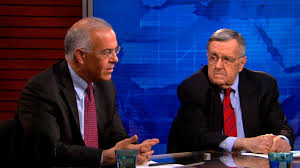
David Brooks and Mark Shields
MARK SHIELDS: “Donald Trump gratuitously slandered Ted Cruz’s wife. He libeled Ted Cruz’s father for being potentially part of Lee Harvey Oswald’s assassination of the president of the United States, suggesting that he was somehow a fellow traveler in that.
“This is a libel. You don’t get over it….
“I cannot figure out any possible advantage to Donald Trump when he’s got a problem with Latinos and with women to go into New Mexico, where the nation’s only Latina woman Republican governor sits, who has not said anything negative about him, who endorsed one of his opponents, but has not been an attack dog on Donald Trump, and absolutely goes after her and is abusive to her.
“And I’m just saying to myself, what is the advantage to this?
“…I think this man may be addicted to the roar of the grease paint and the sound of the crowd, or however it goes, smell of the crowd.
“And those rallies bring out something in him, and he just feels that he has to–and it’s all personal….I mean, it’s not a philosophical difference. It’s not a political difference. It’s all personal.”
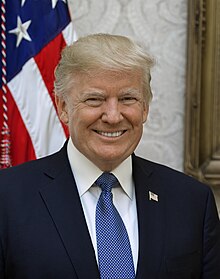
Donald Trump
Ironically, Rand Paul, Republican U.S. Senator from Kentucky, has reached a similar conclusion about Trump:
“I think there is a sophomore quality that is entertaining with Mr. Trump, but I am worried. I’m very concerned of having him in charge of his nuclear weapons because his visceral response to attack people on their appearance–short, tall, fat, ugly–my goodness that happened in junior high.”
DAVID BROOKS: “Trump, for all his moral flaws, is a marketing genius. And you look at what he does. He just picks a word and he attaches it to a person. Little Marco [Rubio], Lyin’ Ted [Cruz], Crooked Hillary [Clinton].
“And that’s a word. And that’s how marketing works. It’s a simple, blunt message, but it gets under.
“It sticks, and it diminishes. And so it has been super effective for him, because he knows how to do that. And she [Hillary Clinton] just comes with, ‘Oh, he’s divisive.’
“These are words that are not exciting people. And her campaign style has gotten, if anything…a little more stagnant and more flat.”
How did American politics reach this state of affairs?
In 1996, Newt Gingrich, then Republican Speaker of the House of Representatives, wrote a memo that encouraged Republicans to “speak like Newt.”
Entitled “Language: A Key Mechanism of Control,” it urged Republicans to attack Democrats with such words as “corrupt,” “selfish,” “destructive,” “hypocrisy,” “liberal,” “sick,” and “traitors.”
Newt Gingrich
Even worse, Gingrich encouraged the news media to disseminate such accusations. Among his suggestions:
- “Fights make news.”
- Create a “shield issue” to deflect criticism: “A shield issue is, just, you know, your opponent is going to attack you as lacking compassion. You better…show up in the local paper holding a baby in the neonatal center.”
In the memo, Gingrich advised:
“….In the video “We are a Majority,” Language is listed as a key mechanism of control used by a majority party, along with Agenda, Rules, Attitude and Learning.
As the tapes have been used in training sessions across the country and mailed to candidates we have heard a plaintive plea: ‘I wish I could speak like Newt.’
“That takes years of practice. But, we believe that you could have a significant impact on your campaign and the way you communicate if we help a little. That is why we have created this list of words and phrases….
“This list is prepared so that you might have a directory of words to use in writing literature and mail, in preparing speeches, and in producing electronic media.
“The words and phrases are powerful. Read them. Memorize as many as possible. And remember that like any tool, these words will not help if they are not used.”
Here is the list of words Gingrich urged his followers to use in describing “the opponent, their record, proposals and their party”:
- abuse of power
- anti- (issue): flag, family, child, jobs
- betray
- bizarre
- bosses
- bureaucracy
- cheat
- coercion
- “compassion” is not enough
- collapse(ing)
- consequences
- corrupt
- corruption
- criminal rights
- crisis
- cynicism
- decay
- deeper
- destroy
- destructive
- devour
- disgrace
- endanger
- excuses
- failure (fail)
- greed
- hypocrisy
- ideological
- impose
- incompetent
- insecure
- insensitive
|
- intolerant
- liberal
- lie
- limit(s)
- machine
- mandate(s)
- obsolete
- pathetic
- patronage
- permissive attitude
- pessimistic
- punish (poor …)
- radical
- red tape
- self-serving
- selfish
- sensationalists
- shallow
- shame
- sick
- spend(ing)
- stagnation
- status quo
- steal
- taxes
- they/them
- threaten
- traitors
- unionized
- urgent (cy)
- waste
- welfare
|
Yes, speaking like Newt–or Adolf Hitler or Joseph McCarthy–“takes years of practice.”
And to the dismay of both Republicans and Democrats, Donald Trump has learned his lessons well.


%2C_side_view_1.jpg%2F300px-USS_Yorktown_(PG-1)%2C_side_view_1.jpg&imgrefurl=https%3A%2F%2Fen.wikipedia.org%2Fwiki%2FYorktown-class_gunboat&docid=IJnJQf9Gjk6Z0M&tbnid=MjZ187QW-8UJFM%3A&w=300&h=203&bih=469&biw=819&ved=0ahUKEwjK2LSlkKzPAhVLw2MKHcmIApsQxiAIAg&iact=c&ictx=1)


2012 PRESIDENTIAL RACE, ALTERNET, AP, BARACK OBAMA, BAY OF PIGS, BBC, BERLIN WALL, BILL CLINTON, BRUCE GREENWOOD, BUZZFEED, CARLOS MARCELLO, CBS NEWS, CIA, CIVIL RIGHTS, CLIFF ROBERTSON, CNN, CUBAN MISSILE CRISIS, DAILY KOS, DAVID HALBERSTAM, DONALD J. TRUMP, FACEBOOK, FBI, FIDEL CASTRO, FRANK SINATRA, HERMAN CAIN, ICH BEN EIN BERLINNER SPEECH, INTERNET MOVIE DATABASE, J. EDGAR HOOVER, JAMES MARSDEN, JOHN F. KENNEDY, JOSEPH MCCARTHY, JOSEPH P. KENNEDY, LYNDON B. JOHNSON, MAFIA, MALCOM X, MARTIN LUTHER KING, MARTIN SHEEN, MOTHER JONES, MOVEON, MOVIES, NBC NEWS, NEWSWEEK, NEWT GINGRICH, NIKITA KHRUSHCHEV, NPR, NUCLEAR TEST BAN TREATY, POLITICO, PT-109, RAW STORY, REUTERS, RICK PERRY, ROBERT F. KENNEDY, ROBERT S. MCNAMARA, SALON, SAM GIANCANA, SANTOS TRAFFICANTE, Sarah Palin, SATURDAY NIGHT LIVE, SEATTLE TIMES, SLATE, SOVIET UNION, THE ATLANTIC, THE BEST AND THE BRIGHTEST, THE BUTLER, THE CHICAGO SUN-TIMES, THE CHICAGO TRIBUNE, THE DAILY BEAST, THE GUARDIAN, THE HILL, THE HUFFINGTON POST, THE LOS ANGELES TIMES, THE MISSILES OF OCTOBER, THE NEW YORK TIMES, THE RAT PACK, THE WALL STREET JOURNAL, THE WASHINGTON POST, THIRTEEN DAYS, TIME, TWILIGHT ZONE, TWITTER, U.S. NEWS & WORLD REPORT, UPI, USA TODAY, VIETNAM WAR, WILLIAM DEVANE, WILLIAM PETERSON
JFK: ONE HUNDRED YEARS LATER: PART TWO (OF TEN)
In Bureaucracy, Business, History, Law, Law Enforcement, Military, Politics, Social commentary on May 5, 2017 at 12:10 amDuring the 1960 Presidential campaign, then-Senator John F. Kennedy promised to build a Peace Corps to train people in underdeveloped nations to help themselves.
John F. Kennedy
In March, 1961, the program went into effect, with the President’s brother-in-law, Sergent Shriver, as director.
Starvation, illiteracy and disease were the enemies of the Corps. Any nation wanting aid could request it. The first group of volunteers went to the Philippines, the second to Ecuador and the third to Tanganyika.
The problems of the underdeveloped world were too great for any single organization to solve. But the Corps lifted the spirits of many living in those countries. And it captured the imagination of millions of Americans—especially those of thousands of idealistic youths who entered its ranks.
To combat the growing Communist threat to Latin America, Kennedy established the Alliance for Progress. He defined the Alliance’s goal as providing “revolutionary progress through powerful, democratic means.”
Within two years he could report:
“Some 140,000 housing units have been constructed. Slum clearance projects have begun, and 3,000 classrooms have been built. More than 4,000,000 school books have been distributed.
“The Alliance has fired the imagination and kindled the hopes of millions of our good neighbors. Their drive toward modernization is gaining momentum as it unleashes the energies of these millions.
“The United States is becoming increasingly identified in the minds of the people with the goal they move toward: a better life with freedom,” said Kennedy.
Critics of the program, however, charged that the President was trying to “dress up the old policies” of Franklin D. Roosevelt in new rhetoric. Since FDR’s time, the United States has believed in giving economic aid to Latin America.
Much—if not most—of these billions of dollars has wound up in the pockets of various right-wing dictators, such as Anastasio Somoza and Rafael Trujillo.
Meanwhile, Kennedy was urging action on another front—that of outer space.
“This generation does not intend to founder in the backwash of the coming age of space,” declared the President. He committed the United States to putting a man on the moon by the end of the decade.
As indeed it happened less than six years after his death—on July 20, 1969.
Kennedy’s idealistic rhetoric masked his real reason for going to the moon: To score a propaganda victory over the Soviet Union.
Another of his anti-Communist goals: To remove Fidel Castro from power in Cuba at almost any cost.
Fidel Castro
Immediately after the failed Bay of Pigs invasion, Kennedy appointed his brother, Robert–who was then the Attorney General—to oversee a CIA program to overthrow Castro.
The CIA and the Mafia entered into an unholy alliance to assassinate Castro—each for its own benefit:
The mobsters were authorized to offer $150,000 to anyone who would kill Castro and were promised any support the Agency could yield.
“We were hysterical about Castro at about the time of the Bay of Pigs and thereafter,” then-former Secretary of Defense Robert S. McNamara testified before Congress about these efforts. “And there was pressure from JFK and RFK to do something about Castro.”
Nor was everyone in the CIA enthusiastic about the “get Castro” effort.
“Everyone at CIA was surprised at Kennedy’s obsession with Fidel,” recalled Sam Halpern, who was assigned to the Cuba Project. “They thought it was a waste of time. We all knew [Fidel] couldn’t hurt us. Most of us at CIA initially liked Kennedy, but why go after this little guy?
“One thing is for sure: Kennedy wasn’t doing it out of national security concerns. It was a personal thing. The Kennedy family felt personally burnt by the Bay of Pigs and sought revenge.”
It was all-out war. Among the tactics used:
But all of these efforts failed to assassinate Castro–or overthrow the Cuban Revolution he was heading.
“Bobby (Kennedy) wanted boom and bang all over the island,” recalled Halpern. “It was stupid. The pressure from the White House was very great.”
Americans would rightly label such methods as ”terrorist” if another power used them against the United States today. And the Cuban government saw the situation exactly the same way.
So Castro appealed to Nikita Khrushchev, leader of the Soviet Union, for assistance.
Khrushchev was quick to comply: “We must not allow the Communist infant to be strangled in its crib,” he told members of his inner circle.
Share this: