Posts Tagged ‘HOUSE INTELLIGENCE COMMITTEE’
2016 PRESIDENTIAL CAMPAIGN, ABC NEWS, AFGHANISTAN, ALTERNET, AMERICABLOG, AP, BABY BOOMER RESISTANCE, BARACK OBAMA, BLOOMBERG, BOB WOODWARD, BUZZFEED, CBS NEWS, CENTER FOR AMERICAN PROGRESS ACTION FUND, CIA, CLINTON WATTS, CNN, COVID-19, CRAIG UNGER, CROOKS AND LIARS, DAILY KOS, DAVID ROTHKOPF, DEPARTMENT OF HOMELAND SECURITY, DIRECTOR OF NATIONAL INTELLIGENCE, DONALD TRUMP, DONALD TRUMP JR., DRUDGE RETORT, ERIC TRUMP, FBI, FBI’S COUNTERTERRORISM DIVISION, FEAR: TRUMP IN THE WHITE HOUSE (BOOK), FIVETHIRTYEIGHT, FOX NEWS, G7, GEORGE PAPADOPOULOS, GREG MILLER, HARPER’S MAGAZINE, HILLARY CLINTON, HOUSE INTELLIGENCE COMMITTEE, HOUSE OF TRUMP HOUSE OF PUTIN (BOOK), HOWARD STERN, ISLAMIC STATE OF IRAQ AND SYRIA (ISIS), ISRAELI INTELLIGENCE, JAMES CARLOS BLAKE, JAMES COMEY, JARED KUSHNER, JEFF SESSIONS, JOE SCARBOROUGH, JOINT TERRORISM TASK FORCE, JOSEPH BIDEN, Kamala Harris, KAYLEIGH MCENANY, KIM JONG-UN, MAIN INTELLIGENCE DIRECTORATE, MALCOM W. NANCE, MEDIA MATTERS, MICHAEL FLYNN, MICHAEL ISIKOFF, MOSCOW PROJECT, MOTHER JONES, MOVEON, MSNBC, NATALIA VESELNITSKAYA, NATIONAL SECURITY AGENCY, NBC NEWS, NEWSWEEK, NPR, OFFICE OF THE DIRECTOR OF NATIONAL INTELLIGENCE, PAUL MANAFORT, PBS NEWSHOUR, PERIL (BOOK), POLITICO, POLITICUSUSA, PRESIDENT’S DAILY BRIEFING, PRINCETON UNIVERSITY, RAGE (BOOK), RAW STORY, REPUBLICAN PARTY, REPUBLICANS, REUTERS, REX TILLERSON, RICHARD M. NIXON, RINAT AKHMETSHIN, ROBERT S. MUELLER 111, ROD ROSENSTEIN, RUSSIA, RUSSIAN ROULETTE (BOOK), SALLY YATES, SALON, SEAL TEAM SIX, SEATTLE TIMES, SENATE INTELLIGENCE COMMITTEE, SERGEY KISLYAK, SERGEY LAVROV, SLATE, TALIBAN, TALKING POINTS MEMO, THE APPRENTICE (BOOK), THE ATLANTIC, THE CHICAGO SUN-TIMES, THE CHICAGO TRIBUNE, THE DAILY BEAST, THE DAILY BLOG, THE FRIENDS OFPANCHO VILLA (BOOK(), THE GUARDIAN, THE HILL, THE HUFFINGTON POST, THE LOS ANGELES TIMES, THE NATION, THE NEW REPUBLIC, THE NEW YORK TIMES, THE PLOT TO DESTROY DEMOCRACY (BOOK), THE VILLAGE VOICE, THE WASHINGTON POST, THINKPROGRESS, TIME, TREASON, TRUMP TOWER MEETING, TRUTHDIG, TRUTHOUT, TWO POLITICAL JUNKIES, U.S. NAVY SEALS, U.S. NEWS & WORLD REPORT, UNITED STATES DEPARTMENT OF JUSTICE, UNITED STATES DEPARTMENT OF STATE, UPI, USA TODAY, VANIT FAIR, VICTOR YANUKOVYCH, VLADIMIR PUTIN, WIKILEAKS, WILLIAM BARR, WONKETTE, X
In Bureaucracy, History, Law, Law Enforcement, Military, Politics, Social commentary on January 21, 2025 at 12:10 am
Donald Trump won the 2016 Presidential race by promising to “Make America Great Again.”
Yet if any country emerged as the chief beneficiary of Trump’s tenure in the White House, it was Russia.
Among Trump’s many acts that placed the United States at a disadvantage in dealing with its mortal adversary:
TREASON EXAMPLE #3: Many of those Trump appointed to office had strong ties to the government of Russian President Vladimir Putin.
One of these was Secretary of State Rex Tillerson. In 2013, as the chief executive of ExxonMobil, he was presented with Russia’s Order of Friendship award. He had just signed deals with the state-owned Russian oil company Rosneft. Its chief, Igor Sechin, is a loyal Putin lieutenant.

Rex Tillerson
Another was Attorney General Jeff Sessions. During the 2016 campaign, Sessions—then serving as a surrogate for Trump’s campaign—twice spoke with Russian Ambassador Sergey Kislyak. But during his Senate nomination hearings, Sessions denied that he had had “communications with the Russians” during the campaign.
It was the discovery of those contacts by the news media that forced Sessions to recuse himself from any Justice Department cases involving Trump and Russia. All of these—including the appointment of Special Counsel Robert Mueller III—would be handled by Deputy Attorney General Rod Rosenstein.
This led Trump to rage at Sessions—in person, in press conferences and on Twitter: “If I had known he would do this, I would have never appointed him.”
It wasn’t Sessions’ perjury that troubled Trump—it was its discovery.
On November 7, 2018, the day after the Democrats won a majority in the House of Representatives, Trump fired him.
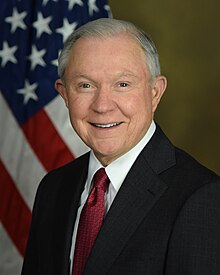
Jeff Sessions
The Moscow Project is an initiative of the Center for the American Progress Action Fund. Its objective: “Analyzing the facts behind Trump’s collusion with Russia and communicating the findings to the public.”
According to its March 21, 2018 report (updated on July 10): “In total, we have learned of 80 contacts between Trump’s team and Russia linked operatives, including at least 23 meetings.
“And we know that at least 24 high-ranking campaign officials and Trump advisors were aware of contacts with Russia-linked operatives during the campaign and transition. None of these contacts were ever reported to the proper authorities. Instead, the Trump team tried to cover up every single one of them….
“The Trump campaign issued at least 15 blanket denials of contacts with Russia, all of which have been proven false.”
Members of the Trump team who had contacts with Russians during the campaign or transition included:
- Michael Cohen
- Roger Stone
- Donald Trump Jr.
- Jeff Sessions
- Paul Manafort
- Jared Kushner
- Carter Page
- Michael Flynn
- Erik Prince
- George Papadopoulos
- Anthony Scaramucci
- Rick Gates
George Papadopoulos, a member of the foreign policy advisory panel to Trump’s 2016 Presidential campaign, pleaded guilty to making false statements about his contacts with Russians to the FBI. So did Flynn.
Paul Manafort was convicted for money-laundering relating to his work for the government of the Putin-supported president of Ukraine, Victor Yanukovych.
The discovery of numerous contacts between Trump campaign officials and Russian Intelligence agents led the FBI to investigate Russia’s efforts to subvert the 2016 Presidential election.
In July, 2018, Special Counsel Robert S. Mueller charged 12 officers of the GRU, Russia’s military intelligence agency, with crimes committed to the high-profile hacking and leaking emails from the Democratic National Committee during the 2016 campaign.
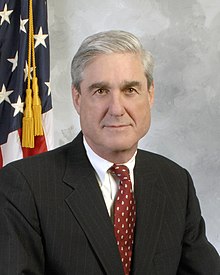
Robert S. Mueller III
On numerous occasions, Donald Trump has fiercely denied any Russian connections. For example:
July 27, 2016: “I mean I have nothing to do with Russia. I don’t have any jobs in Russia. I’m all over the world but we’re not involved in Russia.”
October 24, 2016: “I have nothing to do with Russia, folks, I’ll give you a written statement.”
January 11, 2017: “Russia has never tried to use leverage over me. I HAVE NOTHING TO DO WITH RUSSIA – NO DEALS, NO LOANS, NO NOTHING!”
February 7, 2017: “I don’t know [Russian President Vladimir] Putin, have no deals in Russia, and the haters are going crazy.”
In fact, Trump had a highly profitable relationship with Russia—as his two sons, Donald, Jr., and Eric, unintentionally revealed.
In 2008, Donald Trump, Jr. said at a New York real estate conference: “In terms of high-end product influx into the US, Russians make up a pretty disproportionate cross-section of a lot of our assets. Say, in Dubai, and certainly with our project in SoHo, and anywhere in New York. We see a lot of money pouring in from Russia.”

Donald Trump, Jr.
Gage Skidmore from Surprise, AZ, United States of America, CC BY-SA 2.0 <https://creativecommons.org/licenses/by-sa/2.0>, via Wikimedia Commons
And Trump’s son, Eric, has been quoted as saying in 2014: “Well, we don’t rely on American banks. We have all the funding we need out of Russia. We’ve got some guys that really, really love golf, and they’re really invested in our programs. We just go there all the time.”
In 2005, the Trump Organization signed a one-year contract for a construction project in Moscow to erect a Trump skyscraper. It was stipulated any spas or fitness areas be branded “The Spa by Ivanka Trump.”
The project fell through—because news reports emerged then about the Russian hacking of the Democratic National Committee, making a Russian business connection a political liability.
2016 PRESIDENTIAL CAMPAIGN, ABC NEWS, AFGHANISTAN, ALTERNET, AMERICABLOG, AP, BABY BOOMER RESISTANCE, BARACK OBAMA, BLOOMBERG, BOB WOODWARD, BUZZFEED, CBS NEWS, CENTER FOR AMERICAN PROGRESS ACTION FUND, CIA, CLINTON WATTS, CNN, COVID-19, CRAIG UNGER, CROOKS AND LIARS, DAILY KOS, DAVID ROTHKOPF, DEPARTMENT OF HOMELAND SECURITY, DIRECTOR OF NATIONAL INTELLIGENCE, DONALD TRUMP, DONALD TRUMP JR., DRUDGE RETORT, ERIC TRUMP, FBI, FBI’S COUNTERTERRORISM DIVISION, FEAR: TRUMP IN THE WHITE HOUSE (BOOK), FIVETHIRTYEIGHT, FOX NEWS, G7, GEORGE PAPADOPOULOS, GREG MILLER, HARPER’S MAGAZINE, HILLARY CLINTON, HOUSE INTELLIGENCE COMMITTEE, HOUSE OF TRUMP HOUSE OF PUTIN (BOOK), HOWARD STERN, ISLAMIC STATE OF IRAQ AND SYRIA (ISIS), ISRAELI INTELLIGENCE, JAMES CARLOS BLAKE, JAMES COMEY, JARED KUSHNER, JEFF SESSIONS, JOE SCARBOROUGH, JOINT TERRORISM TASK FORCE, JOSEPH BIDEN, Kamala Harris, MAIN INTELLIGENCE DIRECTORATE, MALCOM W. NANCE, MEDIA MATTERS, MICHAEL FLYNN, MICHAEL ISIKOFF, MOSCOW PROJECT, MOTHER JONES, MOVEON, MSNBC, NATALIA VESELNITSKAYA, NATIONAL SECURITY AGENCY, NBC NEWS, NEWSWEEK, NPR, OFFICE OF THE DIRECTOR OF NATIONAL INTELLIGENCE, PAUL MANAFORT, PBS NEWSHOUR, PERIL (BOOK), POLITICO, POLITICUSUSA, PRESIDENT’S DAILY BRIEFING, PRINCETON UNIVERSITY, RAGE (BOOK), RAW STORY, REPUBLICAN PARTY, REPUBLICANS, REUTERS, REX TILLERSON, RICHARD M. NIXON, RINAT AKHMETSHIN, ROBERT S. MUELLER 111, ROD ROSENSTEIN, RUSSIA, RUSSIAN ROULETTE (BOOK), SALLY YATES, SALON, SEAL TEAM SIX, SEATTLE TIMES, SENATE INTELLIGENCE COMMITTEE, SERGEY KISLYAK, SERGEY LAVROV, SLATE, TALIBAN, TALKING POINTS MEMO, THE APPRENTICE (BOOK), THE ATLANTIC, THE CHICAGO SUN-TIMES, THE CHICAGO TRIBUNE, THE DAILY BEAST, THE DAILY BLOG, THE FRIENDS OFPANCHO VILLA (BOOK(), THE GUARDIAN, THE HILL, THE HUFFINGTON POST, THE LOS ANGELES TIMES, THE NATION, THE NEW REPUBLIC, THE NEW YORK TIMES, THE PLOT TO DESTROY DEMOCRACY (BOOK), THE VILLAGE VOICE, THE WASHINGTON POST, THINKPROGRESS, TIME, TREASON, TRUMP TOWER MEETING, TRUTHDIG, TRUTHOUT, TWO POLITICAL JUNKIES, U.S. NAVY SEALS, U.S. NEWS & WORLD REPORT, UNITED STATES DEPARTMENT OF JUSTICE, UNITED STATES DEPARTMENT OF STATE, UPI, USA TODAY, VANIT FAIR, VICTOR YANUKOVYCH, VLADIMIR PUTIN, WIKILEAKS, WILLIAM BARR, WONKETTE, X
In Bureaucracy, History, Law, Law Enforcement, Military, Politics, Social commentary on January 20, 2025 at 12:11 am
“Who has not known men who discovered the truth about themselves only to be tortured by it for the rest of their lives? Is a man worse off when he doesn’t know who he is or when he learns he is truly a coward? When he is ignorant of his true nature or when he knows he is a traitor at heart? Not that I pity either cowards or traitors. To the contrary: In a just world, they would all be made to face the hard truth about themselves before they died.”
—James Carlos Blake, The Friends of Pancho Villa
On June 28, 2019, President Donald Trump demonstrated how seriously he took American election security.
It came during a meeting with Russian President Vladimir Putin in Osaka, Japan—their first since the March 22 release of the Mueller Report, which documented Russia’s subversion of the 2016 Presidential election.
An NBC News reporter asked: Would you tell Putin not to meddle in the 2020 Presidential election?
“Yes, of course I will,” replied Trump, grinning. “Don’t meddle in the election, please.”
And he jokingly wagged his finger at Putin: “Don’t meddle in the election.”
Putin grinned back.
Trump has repeatedly claimed that there was “no collusion” between him and members of Russia’s Intelligence community. But from the outset, he has acted like a guilty man desperate to stop an investigation before it uncovers the full extent of his criminality and treason.
TREASON EXAMPLE #1: On July 9, 2016, high-ranking members of his Presidential campaign met at Trump Tower with at least two lobbyists who had ties to Russian dictator Vladimir Putin. The participants included:
- Trump’s son, Donald Trump Jr.;
- His son-in-law, Jared Kushner;
- His then-campaign manager, Paul Manafort;
- Natalia Veselnitskaya, a Russian lawyer with ties to Putin; and
- Rinat Akhmetshin, a former Soviet counterintelligence officer suspected of having ongoing ties to Russian Intelligence.
The purpose of that meeting: To gain access to any “dirt” Russian Intelligence could supply on Democratic Presidential nominee Hillary Clinton.
Trump originally claimed that the meeting was “about the adoption of Russian children.” Eventually he admitted that it had been “a meeting to get information on an opponent.”
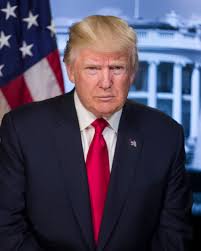
Donald Trump
TREASON EXAMPLE #2: On July 22, 2016, Wikileaks released 19,252 emails and 8,034 attachments hacked from computers of the highest-ranking officials of the Democratic National Committee (DNC). Early reports traced the leak to Russian hackers.
On July 27, 2016, during his campaign for President, Trump said at a press conference in Doral, Florida: “Russia, if you are listening, I hope you are able to find the 33,000 emails that are missing [from Democratic Presidential candidate Hillary Clinton’s computer]. I think you will probably be rewarded mightily by our press.”
This was nothing less than treason—calling upon a foreign power, hostile to the United States, to interfere in its Presidential election.
Hours later, the Main Intelligence Directorate in Moscow targeted Clinton’s personal office and hit more than 70 other Clinton campaign accounts.
Clinton Watts is a consultant and researcher on cyberwarfare. He has served as:
- An FBI Special Agent on a Joint Terrorism Task Force (JTTF);
- The Executive Officer of the Combating Terrorism Center at West Point (CTC); and
- A consultant to the FBI’s Counter Terrorism Division (CTD) and National Security Branch (NSB).
In a statement he prepared for the U.S. Senate Select Committee on Intelligence, Watts outlined cyberwarfare measures that Russia used to subvert the 2016 Presidential campaign.
He delivered this on March 30. 2017. Part of this reads as follows:
Through the end of 2015 and start of 2016, the Russian influence system….began pushing themes and messages seeking to influence the outcome of the U.S. Presidential election.
Russia’s overt media outlets and covert trolls sought to sideline opponents on both sides of the political spectrum with adversarial views toward the Kremlin. The final months leading up to the election have been the predominate focus of Russian influence discussions to date.
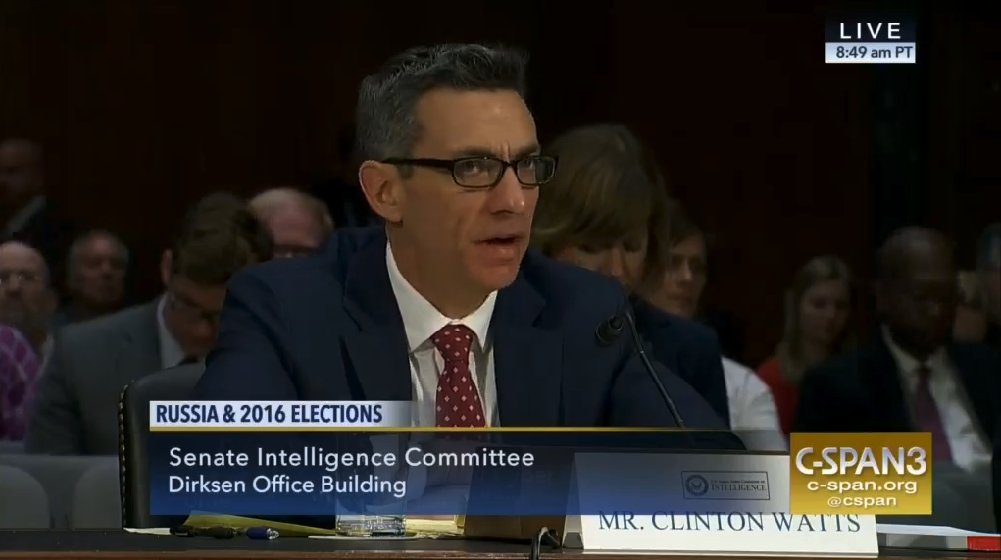
Clinton Watts
However, Russian Active Measures were in full swing during both the Republican and Democratic primary season and may have helped sink the hopes of candidates more hostile to Russian interests long before the field narrowed.
The final piece of Russia’s modern Active Measures surfaced in the summer of 2016 as hacked materials from previous months were strategically leaked.
On 22 July 2016, Wikileaks released troves of stolen communications from the Democratic National Committee and later batches of campaign emails. Guccifer 2.0 and DC Leaks revealed hacked information from a host of former U.S. government officials throughout July and August 2016.
For the remainder of the campaign season, this compromising material powered the influence system Russia successfully constructed in the previous two years.
TREASON EXAMPLE #3: Many of those Trump appointed to office had strong ties to the government of Russian President Vladimir Putin.
One of these was Secretary of State Rex Tillerson. In 2013, as the chief executive of ExxonMobil, he was presented with Russia’s Order of Friendship award. He had just signed deals with the state-owned Russian oil company Rosneft. Its chief, Igor Sechin, is a loyal Putin lieutenant.
Rex Tillerson
2016 PRESIDENTIAL ELECTION, 2020 PRESIDENTIAL ELECTION, ABC NEWS, ABRAHAM LINCOLN, ADAM SCHIFF, ADOLF HITLER, ALEXANDER VINDMAN, ALTERNET, AMERICABLOG, AP, BABY BOOMER RESISTANCE, BLOOMBERG, BUZZFEED, CBS NEWS, CNN, CROOKS AND LIARS, DAILY KOZ, DEMOCRATS, DONALD TRUMP, DRUDGE RETORT, FACEBOOK, FIVETHIRTYEIGHT, FOX NEWS NETWORK, GERRYMANDERING, HARPER’S MAGAZINE, HOUSE INTELLIGENCE COMMITTEE, HOWARD BAKER, HUNTER BIDEN, JOE BIDEN, JOEL MATHIS, KEN PAXTON, LYNDON JOHNSON, MARIA YOVANOVICH, MEDIA MATTERS, MEDICAID, MICK MULVANEY, MOTHER JONES, MOVEON, MSNBC, NATIONAL SECURITY COUNCIL, NBC NEWS, NEWSWEEK, NPR, POLITICO, POLITICUSUSA, RAW STORY, REPUBLICANS, REUTERS, RICHARD NIXON, ROBERT PAYNE, RUDI GIULIANI, RUSSIA, SALON, SEATTLE TIMES, SLATE, TALKING POINTS MEMO, THE ATLANTIC, THE CHICAGO SUN-TIMES, THE CHICAGO TRIBUNE, THE DAILY BEAST, THE DAILY BLOG, THE GUARDIAN, THE HILL, THE HUFFINGTON POST, THE LIFE AND DEATH OF ADOLF HITLER (BOOK), THE LOS ANGELES TIMES, THE NATION, THE NEW REPUBLIC, THE NEW YORK TIMES, THE VILLAGE VOICE, THE WASHINGTON POST, THINKPROGRESS, THIRD REICH, TIME, TRUTHDIG, TRUTHOUT, TWITTER, TWO POLITICAL JUNKIES, U.S. NEWS & WORLD REPORT, UKRAINE, UPI, USA TODAY, VOLODYMYR ZELENSKY, VOTER ID LAWS, WATERGATE, WONKETTE
In Bureaucracy, History, Law, Law Enforcement, Politics, Social commentary on October 30, 2024 at 12:09 am
In a November 14, 2019 column, “Republicans Can’t Abandon Trump Now Because They’re All Guilty,” freelance journalist Joel Mathis warned: “Trump’s abuses of power mirror those of the GOP as a whole. Republicans can’t turn on him, because doing so would be to indict their party’s entire approach to politics.”
For example:
- At the state level, GOP legislatures have passed numerous voter ID laws over the last decade. Officially, the reason has been to prevent non-citizens from voting. In reality, the motive is to depress turnout among Democratic constituencies.
- When Democrats have won elections, Republicans have tried to block them from carrying out their policies. In Utah, voters approved Medicaid expansion at the ballot box—but Republicans nullified this.
- In North Carolina, Republican legislators prevented voters from choosing their representatives. Instead, Republican representatives chose voters through partisan sorting. In September, 2019, the state’s Supreme Court ruled the legislative gerrymandered district map unconstitutional.
The upshot of all this, wrote Mathis: “The president and his party are united in the belief that their entitlement to power allows them to manipulate and undermine the country’s democratic processes….The president and today’s GOP share the same sins. It will be difficult for them to abandon each other.”


On November 3, 2020, 81,255,933 Democratic voters outvoted 74,196,153 Republican voters to elect former Vice President Joseph Biden as the 46th President of the United States.
In the Electoral College—where Presidential elections are actually decided—Biden won by a margin of 306 to 232 votes for Trump.
Trump refused to accept that verdict. For the first time in American history, a President demanded a halt to the counting of votes while the outcome of an election hung in doubt.
States ignored his demand and kept counting.
Next, Trump ordered his attorneys to file lawsuits to overturn the election results, charging electoral fraud. Specifically:
- Illegal aliens had been allowed to vote.
- Trump ballots had been systematically destroyed.
- Tampered voting machines had turned Trump votes into Biden ones.
Throughout November and December, 61 cases were filed by Trump and his allies in state and federal courts—in Wisconsin, Arizona, Nevada, Michigan, Minnesota and Georgia, challenging the election results.
All were withdrawn by Trump’s attorneys or dismissed by Federal judges—some of them appointed by Trump himself.
Losing in the courts, Trump invited two Republican legislative leaders from Michigan to the White House to persuade them to stop the state from certifying the vote.
The Michigan legislators said they would follow the law.
On December 5, Trump called Georgia Governor Brian Kemp and asked him to call a special legislative session and convince state legislators to select their own electors that would support him, thus overturning Biden’s win.
Kemp refused, saying he lacked the authority to do so.
On December 8, the Supreme Court refused to hear Trump’s bid to reverse Pennsylvania’s certification of Biden’s victory. Representative Mike Kelly (R-PA), a Trump ally, argued that the state’s 2.5 million mail-in were unconstitutional.
The Court’s order read, “The application for injunctive relief presented to Justice [Samuel] Alito and by him referred to the Court is denied.” Although Trump had appointed three of the Court’s Justices, not one of them dissented.
Legal scholars almost unanimously agreed the Court’s action quashed Trump’s efforts to overturn the 2020 election results through the courts.

The Supreme Court
On December 8, Republican Senate Majority Leader Mitch McConnell and Missouri United States Senator Roy Blunt joined House Republican Leader Kevin McCarthy in blocking a resolution asserting that Biden is the President-elect of the United States.
Still, Trump pressed on. On December 9, he asked the Supreme Court to block millions of Biden votes from Georgia, Michigan, Pennsylvania and Wisconsin.
The request came in a filing with the court in a lawsuit brought by Texas Attorney General Ken Paxton.
The Court refused.
* * * * *
The United States has indeed become a polarized country. But it’s not the polarization between Republicans and Democrats, or between conservatives and liberals.
It’s the polarization between Right-wing fanatics intent on enslaving everyone who doesn’t subscribe to their Fascistic beliefs and agenda—and those who resist being enslaved.
Those who hoped that Republicans would choose patriotism over partisanship got their answer on February 5. That was when the Republican-dominated Senate—ignoring the overwhelming evidence against him—acquitted Donald Trump on both impeachment articles.
It’s natural to regret that the United States has become a sharply divided nation. CNN has taken the lead in hand-wringing with a weepy-voiced PSA:
“Our trust has been broken—in our leaders, in our institutions and even some of our friends. And we are hurting, Now more than ever we need each other to listen, to learn from one another, and to rebuild those bonds. Because trust shows we believe in the good in each other. It’s what makes us human. And when we can trust one another, that is when we can truly achieve great things.”
But those who insist on the truth should realize there is only one choice:
Either non-Fascist Americans will destroy the Republican party and its voters that threaten to enslave them—or they will be enslaved by Republicans and their voters who believe they are entitled to manipulate and destroy the country’s democratic processes.
There is no middle ground.
2016 PRESIDENTIAL ELECTION, 2020 PRESIDENTIAL ELECTION, ABC NEWS, ABRAHAM LINCOLN, ADAM SCHIFF, ADOLF HITLER, ALEXANDER VINDMAN, ALTERNET, AMERICABLOG, AP, BABY BOOMER RESISTANCE, BLOOMBERG, BUZZFEED, CBS NEWS, CNN, CROOKS AND LIARS, DAILY KOZ, DEMOCRATS, DONALD TRUMP, DRUDGE RETORT, FACEBOOK, FIVETHIRTYEIGHT, FOX NEWS NETWORK, GERRYMANDERING, HARPER’S MAGAZINE, HOUSE INTELLIGENCE COMMITTEE, HOWARD BAKER, HUNTER BIDEN, JOE BIDEN, JOEL MATHIS, KEN PAXTON, LYNDON JOHNSON, MARIA YOVANOVICH, MEDIA MATTERS, MEDICAID, MICK MULVANEY, MOTHER JONES, MOVEON, MSNBC, NATIONAL SECURITY COUNCIL, NBC NEWS, NEWSWEEK, NPR, POLITICO, POLITICUSUSA, RAW STORY, REPUBLICANS, REUTERS, RICHARD NIXON, ROBERT PAYNE, RUDI GIULIANI, RUSSIA, SALON, SEATTLE TIMES, SLATE, TALKING POINTS MEMO, THE ATLANTIC, THE CHICAGO SUN-TIMES, THE CHICAGO TRIBUNE, THE DAILY BEAST, THE DAILY BLOG, THE GUARDIAN, THE HILL, THE HUFFINGTON POST, THE LIFE AND DEATH OF ADOLF HITLER (BOOK), THE LOS ANGELES TIMES, THE NATION, THE NEW REPUBLIC, THE NEW YORK TIMES, THE VILLAGE VOICE, THE WASHINGTON POST, THINKPROGRESS, THIRD REICH, TIME, TRUTHDIG, TRUTHOUT, TWITTER, TWO POLITICAL JUNKIES, U.S. NEWS & WORLD REPORT, UKRAINE, UPI, USA TODAY, VOLODYMYR ZELENSKY, VOTER ID LAWS, WATERGATE, WONKETTE
In Bureaucracy, History, Law, Law Enforcement, Politics, Social commentary on October 29, 2024 at 12:13 am
On November 14, 2019, the CNN website showcased an opinion piece by Jane Carr and Laura Juncadella entitled: “Fractured States of America.”
And it opened:
“Some worry that it’s already too late, that we’ve crossed a threshold of polarization from which there is no return. Others look toward a future where more moderate voices are heeded and heard, and Americans can find better ways to relate to each other.
“Still others look back to history for a guide—perhaps for what not to do, or at the very least for proof that while it’s been bad before, progress is still possible.”
Then followed a series of anecdotes. The sub-headlines summed up many of the comments reported.
- “I was starting to hate people that I have loved for years.”
- “Voting for Trump cost me my friends.”
- “I feel like I’m living in hostile territory.”
- “Our children are watching this bloodsport.”
- “A student’s Nazi-style salute reflects the mate.”
- “Our leaders reflect the worst of us.”
- “I truly believe I will be assaulted over a bumper sticker.”
- “It already feels like a cold war.”
Abraham Lincoln warned: “A house divided against itself cannot stand. I believe this government cannot endure, permanently, half-slave and half-free. It will become all one thing or all the other.”
America now faces such a choice:
- To submit to the tyrannical aggression of a ruthless political party convinced that they are entitled to manipulate and undermine the country’s democratic processes; or
- To fiercely resist that aggression and the destruction of those democratic processes.
Consider the face-off between President Donald J. Trump and Army Lt. Colonel Alexander Vindman.
Vindman is a United States Army officer who served as the Director for European Affairs for the United States National Security Council. He was also a witness to Trump’s efforts to extort “a favor” from the president of Ukraine.
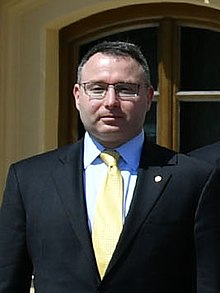
Lt. Colonel Alexander Vindman
Адміністрація Президента України [CC BY 4.0 (https://creativecommons.org/licenses/by/4.0)%5D
In July, 2019, Trump told his acting chief of staff, Mick Mulvaney, to withhold almost $400 million in promised military aid for Ukraine, which faces increasing aggression from Russia.
On July 25, Trump telephoned Ukrainian President Volodymyr Zelensky to “request” a “favor”: Investigate 2020 Democratic Presidential Candidate Joe Biden and his son, Hunter, who has had business dealings in Ukraine.
The reason for such an investigation: To find embarrassing “dirt” on Biden.
“I was concerned by the call,” Vindman, who had heard Trump’s phone call, testified before the House Intelligence Committee. “I did not think it was proper to demand that a foreign government investigate a U.S. citizen, and I was worried about the implications for the U.S. Government’s support of Ukraine.
“I realized that if Ukraine pursued an investigation into the Bidens and Burisma, it would likely be interpreted as a partisan play which would undoubtedly result in Ukraine losing the bipartisan support it has thus far maintained. This would all undermine U.S. national security.”
Trump denounced Vindman as a “Never Trumper”—as if opposing his extortion attempt constituted a blasphemy. Republicans and their shills on the Fox News Network attacked him as well.
As a result, he sought physical protection by the Army for himself and his family.
(On February 7, 2020, he was reassigned from the National Security Council at Trump’s order.)
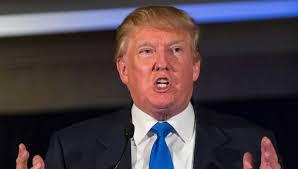
Donald Trump
* * * * *
On November 25, 2019, CNN political correspondent Jake Tapper interviewed Representative Adam Schiff on the coming impeachment trial.
What would it mean if Republicans uniformly oppose any articles of impeachment against Trump? asked Tapper.
“It will have very long-term consequences, if that’s where we end up,” replied Schiff.
“And if not today, I think Republican members in the future, to their children and their grandchildren, will have to explain why they did nothing in the face of this deeply unethical man who did such damage to the country.”
In his bestselling 1973 biography, The Life and Death of Adolf Hitler, British historian Robert Payne harshly condemned the German people for the rise of the Nazi dictator:
“[They] allowed themselves to be seduced by him and came to enjoy the experience….[They] followed him with joy and enthusiasm because he gave them license to pillage and murder to their hearts’ content. They were his servile accomplices, his willing victims.”

Like Hitler, Trump offered his Republican voters and Congressional allies intoxicating dreams: “I will enrich all of you. And I will humiliate and destroy those Americans you most hate.”
For his white, Fascistic, largely elderly audience, those enemies included blacks, atheists, Hispanics, non-Christians, Muslims, liberals, “uppity” women, Asians.
And, again like Hitler, his audience had always possessed these dreams. Trump offered them nothing new. As a lifelong hater, he undoubtedly shared their dreams. But as a lifelong opportunist, he realized that he could use them to catapult himself into a position of supreme power.
He despised his followers—both as voters and Congressional allies—for they were merely the instruments of his will.
For Trump’s supporters in the House and Senate, fear remains their overwhelming motivation. They fear that if they cross him—or simply don’t praise him enough—he will sic his fanatical base on them. And then they will lose their cozy positions—and the power and perks that go with them.
2016 PRESIDENTIAL CAMPAIGN, ABC NEWS, AFGHANISTAN, ALEXANDER SHUSTOROVICH, ALTERNET, AMERICABLOG, ANDREW INTRATER, AP, ARCHIBALD COX, BABY BOOMER RESISTANCE, BARACK OBAMA, BENNY JOHNSON, BLOOMBERG, BUZZFEED, CBS NEWS, CIA, CLINTON WATTS, CNN, CRAIG UNGER, CROOKS AND LIARS, DAILY KOZ, DAVE RUBIN, DEPARTMENT OF HOMELAND SECURITY, DEVIN NUNES, DIANNE FEINSTEIN, DONALD TRUMP, DONALD TRUMP JR., DOUG COLLINS, DRUDGE RETORT, FACEBOOK, FBI, FBI’S COUNTERTERRORISM DIVISION, FIVETHIRTYEIGHT, FOREIGN AGENTS REGISTRATION ACT (FARA), FOX NEWS, GREG MILLER, HARPER’S MAGAZINE, HILLARY CLINTON, HOUSE INTELLIGENCE COMMITTEE, HOUSE OF TRUMP HOUSE OF PUTIN (BOOK), ISLAMIC STATE OF IRAQ AND SYRIA (ISIS), ISRAELI INTELLIGENCE, JAMES COMEY, JARED KUSHNER, JEFF SESSIONS, JERROLD NADLER, JOE SCARBOROUGH, JOINT TERRORISM TASK FORCE, KAYLEIGH MCENANY, KEVIN MCCARTHY, LAUREN SUTHERN, LEN BLAVATNIK, LESTER HOLT, LINDSEY GRAHAM, MAIN INTELLIGENCE DIRECTORATE, MALCOM NANCE, MALCOM W. NANCE, MARCO RUBIO, MATT CHRISTIANSEN, MEDIA MATTERS, MICHAEL FLYNN, MICHAEL ISIKOFF, MIKE PENCE, MITCH MCCONNELL, MONEY-LAUNDERING, MOTHER JONES, MOVEON, MSNBC, NATALIA VESELNITSKAYA, NATIONAL SECURITY AGENCY, NBC NEWS, NEWSWEEK, NPR, OFFICE OF THE DIRECTOR OF NATIONAL INTELLIGENCE, PAUL MANAFORT, PAUL RYAN, PBS NEWSHOUR, POLITICO, POLITICUSUSA, PRESIDENT’S DAILY BRIEFING, PRINCETON UNIVERSITY, PROPAGANDA, RAW STORY, REPUBLICAN PARTY, REPUBLICANS, REUTERS, REX TILLERSON, RICHARD M. NIXON, RINAT AKHMETSHIN, ROBERT S. MUELLER 111, ROD ROSENSTEIN, RT, RUSSIA, RUSSIAN ROULETTE (BOOK), SALON, SEAL TEAM SIX, SEATTLE TIMES, SENATE INTELLIGENCE COMMITTEE, SERGEY KISLYAK, SERGEY LAVROV, SLATE, SUPREME COURT, TALIBAN, TALKING POINTS MEMO, TAYLOR HANSEN, TENET MEDIA, THE APPRENTICE (BOOK), THE ATLANTIC, THE CHICAGO SUN-TIMES, THE CHICAGO TRIBUNE, THE DAILY BEAST, THE DAILY BLOG, THE GUARDIAN, THE HILL, THE HUFFINGTON POST, THE LOS ANGELES TIMES, THE NATION, THE NEW REPUBLIC, THE NEW YORK TIMES, THE PLOT TO DESDTROY DEMOCRACY (BOOK), THE PLOT TO DESTROY DEMOCRACY (BOOK), THE VILLAGE VOICE, THE WASHINGTON POST, THINKPROGRESS, TIM POOL, TIME, TREASON, TRUMP INAUGURAL COMMITTEE, TRUMP TOWER MEETING, TRUTHDIG, TRUTHOUT, TWITTER, TWO POLITICAL JUNKIES, U.S. NAVY SEALS, U.S. NEWS & WORLD REPORT, UNITED STATES DEPARTMENT OF JUSTICE, UNITED STATES DEPARTMENT OF STATE, UPI, USA TODAY, VLADIMIR PUTIN, WIKILEAKS, WILLIAM BARR, WONKETTE
In Bureaucracy, History, Law, Law Enforcement, Military, Politics, Social commentary on September 20, 2024 at 12:10 am
Would you believe in a love at first sight?
(Yes, it happens with a mirror all the time.)
What do you see when you turn out the light?
(It stays on so that my face can shine.)
Oh, I get by with a little help from my Vlad.
Mm, I can lie with a little help from my Vlad.
Mm, you’re gonna die with a little help from my Vlad.
The appointment of Robert S. Mueller as Special Counsel aroused unprecedented hopes and fears.
Yet even before the release of the long-awaited Mueller report, several deeply-researched and well-written books outlined Russia’s efforts to subvert the 2016 Presidential race. And they cast devastating light on Trump’s loyalty to the United States.
Among these:
- The Apprentice: Trump, Russia and the Subversion of Democracy, by Greg Miller
- House of Trump, House of Putin: The Untold Story of Donald Trump and the Russian Mafia, by Craig Unger
- Russian Roulette: The Inside Story of Putin’s War on America and the Election of Donald Trump, by Michael Isikoff
- The Plot to Destroy Democracy: How Putin and His Spies Are Undermining America and Dismantling the West, by Malcom W. Nance
According to its blurb on Amazon.com, The Apprentice is “based on interviews with hundreds of people in Trump’s inner circle, current and former government officials, individuals with close ties to the White House, members of the law enforcement and intelligence communities, foreign officials, and confidential documents.”
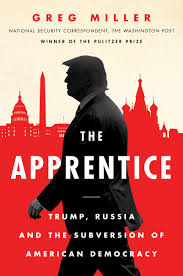
Among the subjects it covers:
- The Trump Tower meeting, where the Trump campaign sought “dirt” on Hillary Clinton from Russian Intelligence agents;
- The penetration by Russian Intelligence of computer systems used by Democrats;
- How Jared Kushner, Trump’s son-in-law, tried to set up a secret back channel to Moscow via Russian diplomatic facilities;
- Trump’s giving Russian officials highly classified secrets supplied by Israeli Intelligence;
- Trump’s clashes with the FBI and CIA.
Miller is a veteran investigative journalist and twice winner of the Pulitzer Prize. Among his stories: National security adviser Michael Flynn’s discussing U.S. sanctions with Russian officials prior to Trump’s inauguration. The story contributed to Flynn’s ouster.
Then there’s House of Trump, House of Putin, whose jacket blurb describes Trump’s inauguration as “the culmination of Vladimir Putin’s long mission to undermine Western democracy, a mission that he and his hand-selected group of oligarchs and Mafia kingpins had ensnared Trump in, starting more than twenty years ago with the massive bailout of a string of sensational Trump hotel and casino failures in Atlantic City.

“…Craig Unger methodically traces the deep-rooted alliance between the highest echelons of American political operatives and the biggest players in the frightening underworld of the Russian Mafia. He traces Donald Trump’s sordid ascent from foundering real estate tycoon to leader of the free world….
“Without Trump, Russia would have lacked a key component in its attempts to return to imperial greatness. Without Russia, Trump would not be president.”
As an appendix to the book, Unger writes: “Donald Trump has repeatedly said he has nothing to do with Russia. Below are fifty-nine Trump connections to Russia.”
Russian Roulette, according to its dust jacket, “is a story of political skullduggery unprecedented in American history. It weaves together tales of international intrigue, cyber espionage, and superpower rivalry.
“After U.S.-Russia relations soured, as Vladimir Putin moved to reassert Russian strength on the global stage, Moscow trained its best hackers and trolls on U.S. political targets and exploited WikiLeaks to disseminate information that could affect the 2016 election.
“The Russians were wildly successful and the great break-in of 2016 was no ‘third-rate burglary.’ It was far more sophisticated and sinister—a brazen act of political espionage designed to interfere with American democracy. At the end of the day, Trump, the candidate who pursued business deals in Russia, won….
“This story of high-tech spying and multiple political feuds is told against the backdrop of Trump’s strange relationship with Putin and the curious ties between members of his inner circle—including Paul Manafort and Michael Flynn—and Russia.”
Malcom Nance, the author of The Plot to Destroy Democracy, is an Intelligence and foreign policy analyst and media commentator on terrorism, intelligence, insurgency and torture.
In his book, he outlines how “Donald Trump was made President of the United States with the assistance of a foreign power.
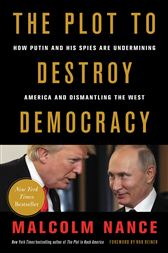
“[It is] the dramatic story of how blackmail, espionage, assassination, and psychological warfare were used by Vladimir Putin and his spy agencies to steal the 2016 U.S. election—and attempted to bring about the fall of NATO, the European Union, and western democracy….
“Nance has utilized top secret Russian-sourced political and hybrid warfare strategy documents to demonstrate the master plan to undermine American institutions that has been in effect from the Cold War to the present day.
“Based on original research and countless interviews with espionage experts, Nance examines how Putin’s recent hacking accomplished a crucial first step for destabilizing the West for Russia, and why Putin is just the man to do it.”
These books—combined with the findings of the Mueller report—clearly establish the damning conclusion: The man now sitting in the Oval Office is an illegitimate usurper, installed by an unholy alliance of American Fascists and Russian Communists.
2016 PRESIDENTIAL CAMPAIGN, ABC NEWS, AFGHANISTAN, ALEXANDER SHUSTOROVICH, ALTERNET, AMERICABLOG, ANDREW INTRATER, AP, ARCHIBALD COX, BABY BOOMER RESISTANCE, BARACK OBAMA, BENNY JOHNSON, BLOOMBERG, BUZZFEED, CBS NEWS, CIA, CLINTON WATTS, CNN, CRAIG UNGER, CROOKS AND LIARS, DAILY KOZ, DAVE RUBIN, DEPARTMENT OF HOMELAND SECURITY, DEVIN NUNES, DIANNE FEINSTEIN, DONALD TRUMP, DONALD TRUMP JR., DOUG COLLINS, DRUDGE RETORT, FACEBOOK, FBI, FBI’S COUNTERTERRORISM DIVISION, FIVETHIRTYEIGHT, FOREIGN AGENTS REGISTRATION ACT (FARA), FOX NEWS, GREG MILLER, HARPER’S MAGAZINE, HILLARY CLINTON, HOUSE INTELLIGENCE COMMITTEE, HOUSE OF TRUMP HOUSE OF PUTIN (BOOK), ISLAMIC STATE OF IRAQ AND SYRIA (ISIS), ISRAELI INTELLIGENCE, JAMES COMEY, JARED KUSHNER, JEFF SESSIONS, JERROLD NADLER, JOE SCARBOROUGH, JOINT TERRORISM TASK FORCE, KAYLEIGH MCENANY, KEVIN MCCARTHY, LAUREN SUTHERN, LEN BLAVATNIK, LINDSEY GRAHAM, MAIN INTELLIGENCE DIRECTORATE, MALCOM NANCE, MALCOM W. NANCE, MARCO RUBIO, MATT CHRISTIANSEN, MEDIA MATTERS, MICHAEL FLYNN, MICHAEL ISIKOFF, MIKE PENCE, MITCH MCCONNELL, MONEY-LAUNDERING, MOTHER JONES, MOVEON, MSNBC, NATALIA VESELNITSKAYA, NATIONAL SECURITY AGENCY, NBC NEWS, NEWSWEEK, NPR, OFFICE OF THE DIRECTOR OF NATIONAL INTELLIGENCE, PAUL MANAFORT, PAUL RYAN, PBS NEWSHOUR, POLITICO, POLITICUSUSA, PRESIDENT’S DAILY BRIEFING, PRINCETON UNIVERSITY, PROPAGANDA, RAW STORY, REPUBLICAN PARTY, REPUBLICANS, REUTERS, REX TILLERSON, RICHARD M. NIXON, RINAT AKHMETSHIN, ROBERT S. MUELLER 111, ROD ROSENSTEIN, RT, RUSSIA, RUSSIAN ROULETTE (BOOK), SALON, SEAL TEAM SIX, SEATTLE TIMES, SENATE INTELLIGENCE COMMITTEE, SERGEY KISLYAK, SERGEY LAVROV, SLATE, SUPREME COURT, TALIBAN, TALKING POINTS MEMO, TAYLOR HANSEN, TENET MEDIA, THE APPRENTICE (BOOK), THE ATLANTIC, THE CHICAGO SUN-TIMES, THE CHICAGO TRIBUNE, THE DAILY BEAST, THE DAILY BLOG, THE GUARDIAN, THE HILL, THE HUFFINGTON POST, THE LOS ANGELES TIMES, THE NATION, THE NEW REPUBLIC, THE NEW YORK TIMES, THE PLOT TO DESTROY DEMOCRACY (BOOK), THE VILLAGE VOICE, THE WASHINGTON POST, THINKPROGRESS, TIM POOL, TIME, TREASON, TRUMP INAUGURAL COMMITTEE, TRUMP TOWER MEETING, TRUTHDIG, TRUTHOUT, TWITTER, TWO POLITICAL JUNKIES, U.S. NAVY SEALS, U.S. NEWS & WORLD REPORT, UNITED STATES DEPARTMENT OF JUSTICE, UNITED STATES DEPARTMENT OF STATE, UPI, USA TODAY, VLADIMIR PUTIN, WIKILEAKS, WILLIAM BARR, WONKETTE
In Bureaucracy, History, Law, Law Enforcement, Military, Politics, Social commentary on September 19, 2024 at 12:16 am
Do you need anybody?
(I need a Gestapo that kills.)
Could it be anybody?
(As long as it kills I get thrills.)
Yes, I get by with a little help from my Vlad.
Mm, I can lie with a little help from my Vlad.
Mm, you’re gonna fry with a little help from my Vlad.
On January 20, 2017—the day Donald Trump became the 45th President of the United States—Michael Flynn became the nation’s 25th National Security Adviser.
Flynn was a former United States Army lieutenant general and director of the Defense Intelligence Agency.
TREASON EXAMPLE #5 On February 8, Flynn denied having spoken to Russian ambassador Sergey Kislyak in December, 2016, about removing the sanctions placed on Russia by the outgoing Obama administration.
The sanctions had been placed in retaliation for Russia’s efforts to manipulate the 2016 Presidential election.
On February 13, The Washington Post reported that Acting Attorney General Sally Yates had warned Trump in late January that Flynn had lied about his contacts with Kislyak—and that he could be blackmailed by Russian Intelligence.
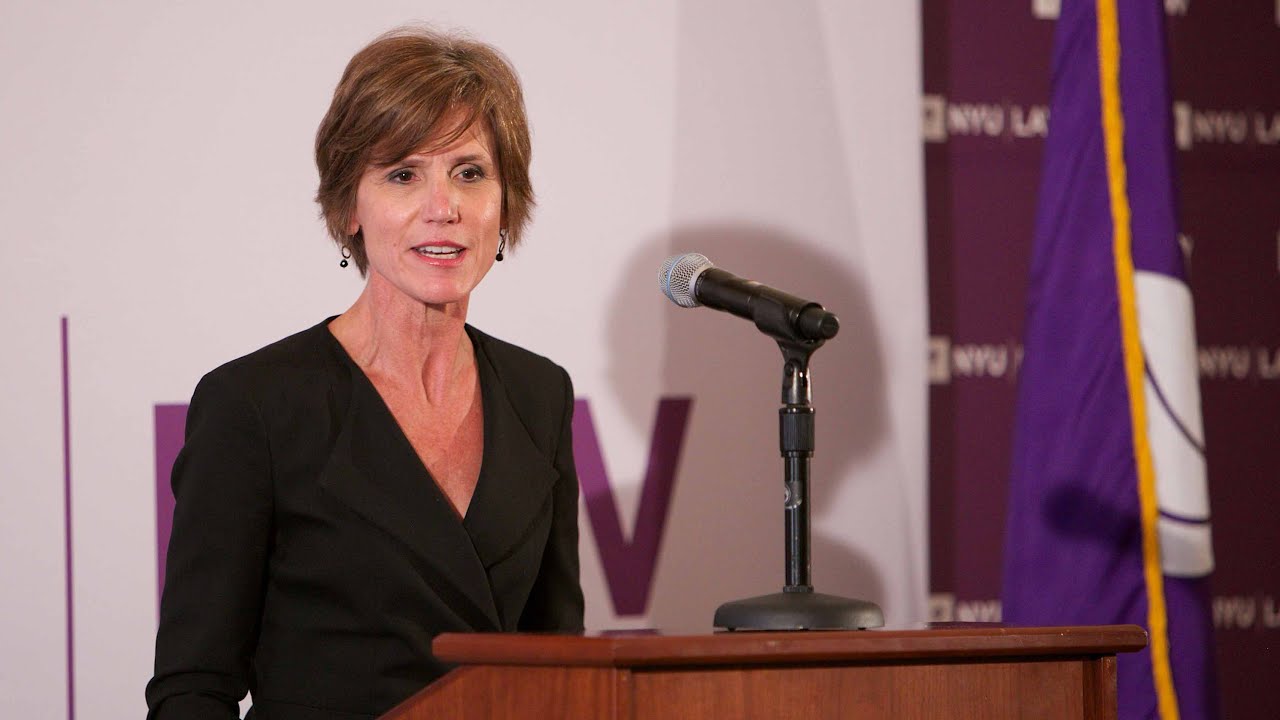
Sally Yates
Flynn was forced to resign that same day—after only 24 days as National Security Adviser.
Officially, the reason given was that he had misled Vice President Mike Pence. But Flynn’s deception had already been known—via the warning to Trump by Yates.
Only after Yates’ warning became known to the media was Flynn forced to resign.
The same Washington Post story reported that, in December, 2015, he had appeared on Russia Today, the news network that American Intelligence agencies consider “the Kremlin’s principal international propaganda outlet.”
He had also received more than $45,000 as a “speaking fee” from the network for a talk on world affairs. At the gala where Flynn received the fee, he sat next to Russian President Vladimir Putin for dinner.
Flynn did not file the required paperwork for the trip. Nor did he report the “fee” to the Pentagon.
On December 1, 2017, Flynn appeared in federal court to formalize a deal with Special Counsel Robert S. Mueller III. He plead guilty to a felony count of “willfully and knowingly” making “false, fictitious and fraudulent statements” to the FBI.
TREASON EXAMPLE #6 On May 9, 2017, President Trump fired FBI Director James Comey for investigating Russia’s subversion of the 2016 Presidential race.
There were four reasons for this:
- Comey had refused to pledge his personal loyalty to Trump. Trump had made the “request” during a private dinner at the White House in January.
- Comey told Trump that he would always be honest with him. But that didn’t satisfy Trump’s demand that the head of the FBI act as his personal secret police chief—as was the case in the former Soviet Union.
- Comey had rejected Trump’s attempt to coerce him into dropping the FBI’s investigation into former National Security Adviser Michael Flynn.
- Comey had recently asked the Justice Department to fund an expanded FBI investigation into well-documented contacts between Trump’s 2016 Presidential campaign and Russian Intelligence agents.

James Comey
TREASON EXAMPLE #7 On May 10, Trump met with Russian Foreign Minister Sergey Lavrov and Russian Ambassador Sergey Kislyak in the Oval Office—and gave them highly classified Israeli Intelligence about an Islamic State plot to turn laptops into concealable bombs.
Kislyak is reportedly a top recruiter for Russia’s SVR foreign intelligence agency. He has been closely linked with Jeff Sessions, then Attorney General, and fired National Security Adviser Mike Flynn.
“I just fired the head of the FBI,” Trump told the two dignitaries. “He was crazy, a real nut job. I faced great pressure because of Russia. That’s taken off.”
TREASON EXAMPLE #8 On July 16, 2018, Trump attended a press conference in Helsinki, Finland, with Russian President Vladimir Putin.
There he blamed American Intelligence agencies—such as the FBI, CIA and National Security Agency—as partners in a conspiracy: “You have groups that are wondering why the FBI never took the server, why haven’t they taken the server? Why was the FBI told to leave the office of the Democratic National Committee?
“I have President Putin. He just said it’s not Russia. I will say this: I don’t see any reason why it would be.”
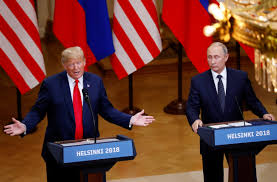
Donald Trump, Vladimir Putin in Helsinki
TREASON EXAMPLE #9 On June 9, 2018, Trump called for Russia to be readmitted to the G7.
“I think it would be an asset to have Russia back in,” he said during an impromptu press conference at the summit.
“I think it would be good for the world. I think it would be good for Russia. I think it would be good for the United States. I think it would be good for all of the countries of the current G7. I think the G8 would be better.”
Russia was ousted from the group in 2014 after Putin annexed Crimea—the first violation of a European country’s borders since World War II.
“Today crystallizes precisely why Putin was so eager to see Trump elected,” said former Obama National Security Council spokesman Ned Price.
“For Putin, this is return on his investment, and it’s safe to say that his investment has paid off beyond even his wildest dreams,” he said in a statement to CNN.
2016 PRESIDENTIAL CAMPAIGN, ABC NEWS, AFGHANISTAN, ALEXANDER SHUSTOROVICH, ALTERNET, AMERICABLOG, ANDREW INTRATER, AP, ARCHIBALD COX, BABY BOOMER RESISTANCE, BARACK OBAMA, BENNY JOHNSON, BLOOMBERG, BUZZFEED, CBS NEWS, CIA, CLINTON WATTS, CNN, CRAIG UNGER, CROOKS AND LIARS, DAILY KOZ, DAVE RUBIN, DEPARTMENT OF HOMELAND SECURITY, DEVIN NUNES, DIANNE FEINSTEIN, DONALD TRUMP, DONALD TRUMP JR., DOUG COLLINS, DRUDGE RETORT, FACEBOOK, FBI, FBI’S COUNTERTERRORISM DIVISION, FIVETHIRTYEIGHT, FOREIGN AGENTS REGISTRATION ACT (FARA), FOX NEWS, GREG MILLER, HARPER’S MAGAZINE, HILLARY CLINTON, HOUSE INTELLIGENCE COMMITTEE, HOUSE OF TRUMP HOUSE OF PUTIN (BOOK), ISLAMIC STATE OF IRAQ AND SYRIA (ISIS), ISRAELI INTELLIGENCE, JAMES COMEY, JARED KUSHNER, JEFF SESSIONS, JERROLD NADLER, JOE SCARBOROUGH, JOINT TERRORISM TASK FORCE, KAYLEIGH MCENANY, KEVIN MCCARTHY, LAUREN SUTHERN, LEN BLAVATNIK, LINDSEY GRAHAM, MAIN INTELLIGENCE DIRECTORATE, MALCOM NANCE, MALCOM W. NANCE, MARCO RUBIO, MATT CHRISTIANSEN, MEDIA MATTERS, MICHAEL FLYNN, MICHAEL ISIKOFF, MIKE PENCE, MITCH MCCONNELL, MONEY-LAUNDERING, MOTHER JONES, MOVEON, MSNBC, NATALIA VESELNITSKAYA, NATIONAL SECURITY AGENCY, NBC NEWS, NEWSWEEK, NPR, OFFICE OF THE DIRECTOR OF NATIONAL INTELLIGENCE, PAUL MANAFORT, PAUL RYAN, PBS NEWSHOUR, POLITICO, POLITICUSUSA, PRESIDENT’S DAILY BRIEFING, PRINCETON UNIVERSITY, PROPAGANDA, RAW STORY, REPUBLICAN PARTY, REPUBLICANS, REUTERS, REX TILLERSON, RICHARD M. NIXON, RINAT AKHMETSHIN, ROBERT S. MUELLER 111, ROD ROSENSTEIN, RT, RUSSIA, RUSSIAN ROULETTE (BOOK), SALON, SEAL TEAM SIX, SEATTLE TIMES, SENATE INTELLIGENCE COMMITTEE, SERGEY KISLYAK, SERGEY LAVROV, SLATE, SUPREME COURT, TALIBAN, TALKING POINTS MEMO, TAYLOR HANSEN, TENET MEDIA, THE APPRENTICE (BOOK), THE ATLANTIC, THE CHICAGO SUN-TIMES, THE CHICAGO TRIBUNE, THE DAILY BEAST, THE DAILY BLOG, THE GUARDIAN, THE HILL, THE HUFFINGTON POST, THE LOS ANGELES TIMES, THE NATION, THE NEW REPUBLIC, THE NEW YORK TIMES, THE PLOT TO DESTROY DEMOCRACY (BOOK), THE VILLAGE VOICE, THE WASHINGTON POST, THINKPROGRESS, TIM POOL, TIME, TREASON, TRUMP INAUGURAL COMMITTEE, TRUMP TOWER MEETING, TRUTHDIG, TRUTHOUT, TWITTER, TWO POLITICAL JUNKIES, U.S. NAVY SEALS, U.S. NEWS & WORLD REPORT, UNITED STATES DEPARTMENT OF JUSTICE, UNITED STATES DEPARTMENT OF STATE, UPI, USA TODAY, VLADIMIR PUTIN, WIKILEAKS, WILLIAM BARR, WONKETTE
In Bureaucracy, History, Law, Law Enforcement, Military, Politics, Social commentary on September 18, 2024 at 12:14 am
What do I do when the bank calls me in?
(Does it worry you to be in debt?)
How do I feel when I need rubles fast?
(Do you worry Vlad might say “Nyet”?)
No, I get by with a little help from my Vlad.
Mm, I can lie with a little help from my Vlad.
Mm, you’re gonna fry with a little help from my Vlad.
Donald Trump—as the Republican nominee for President—steadfastly refused to acknowledge his decades-long relationship with Russia. On October 24, 2016, he stated: “I have nothing to do with Russia, folks, I’ll give you a written statement.”
In fact, Trump had a highly profitable relationship with Russia—as his two sons, Donald, Jr., and Eric, unintentionally revealed:
In 2008, Donald Trump, Jr. said at a New York real estate conference: “In terms of high-end product influx into the US, Russians make up a pretty disproportionate cross-section of a lot of our assets….We see a lot of money pouring in from Russia.”
And Trump’s son, Eric, said in 2014: “Well, we don’t rely on American banks. We have all the funding we need out of Russia.”
Trump quickly appointed men with ties to Russian officials to high positions.
Among these: Attorney General Jeff Sessions. During the 2016 campaign, Sessions—then serving as a surrogate for Trump’s campaign—twice spoke with Russian Ambassador Sergey Kislyak.
But during his Senate confirmation hearings, Sessions denied that he had had “communications with the Russians” during the campaign.
The discovery of numerous contacts between Trump campaign officials and Russian Intelligence agents led the FBI to investigate Russia’s efforts to influence the outcome of the 2016 Presidential election.
TREASON EXAMPLE #4: Trump has repeatedly praised and defended Russian dictator Vladimir Putin.

Vladimir Putin
On December 18, 2015, Trump appeared on MSNBC’s “Morning Joe.” Its host, Joe Scarborough, was upset by Trump’s praise for Putin:
SCARBOROUGH: Well, I mean, [he’s] also a person who kills journalists, political opponents, and invades countries. Obviously that would be a concern, would it not?
TRUMP: He’s running his country, and at least he’s a leader. Unlike what we have in this country.
SCARBOROUGH: But again: He kills journalists that don’t agree with him.
TRUMP: I think our country does plenty of killing, also, Joe, so, you know. There’s a lot of stupidity going on in the world right now, Joe. A lot of killing going on. A lot of stupidity. And that’s the way it is.
On October 7, 2016, the Department of Homeland Security and the Office of the Director of National Intelligence issued a joint statement blaming the Russian government for the hacking of Democratic National Committee emails. Its motive: “To interfere with the US election process.”
Two days later, Trump publicly stated: “But I notice, anytime anything wrong happens, they like to say the Russians are—Maybe there is no hacking. But they always blame Russia.”
On December 16, 2016, FBI Director James B. Comey and Director of National Intelligence James R. Clapper Jr. agreed with a CIA assessment that Russia intervened in the 2016 election in part to help Donald Trump win the White House.

Trump, however, steadfastly denied any such role by Russia: “I think it’s ridiculous,” he told “Fox News Sunday.” “I think it’s just another excuse. I don’t believe it….No, I don’t believe it at all.”
Clinton Watts, a consultant to the FBI’s Counter Terrorism Division, is an expert on cyberwarfare.
Testifying before the U.S. Senate Select Committee on Intelligence on March 30, 2017, Watts outlined cyberwarfare measures that Russia used to subvert the 2016 Presidential campaign.
This pattern of Russian falsehoods and social media manipulation of the American electorate continued through Election Day and persists today.
Many of the accounts we watched push the false Incirlik story in July now focus their efforts on shaping the upcoming European elections, promoting fears of immigration or false claims of refugee criminality.
They’ve not forgotten about the United States either. This past week, we observed social media campaigns targeting Speaker of the House Paul Ryan hoping to foment further unrest amongst U.S. democratic institutions, their leaders and their constituents.
As we noted two days before the Presidential election in our article describing Russian influence operations, Russia certainly seeks to promote Western candidates sympathetic to their worldview and foreign policy objectives.
But winning a single election is not their end goal. Russian Active Measures hope to topple democracies through the pursuit of five complementary objectives:
- Undermine citizen confidence in democratic governance;
- Foment and exacerbate divisive political fractures;
- Erode trust between citizens and elected officials and democratic institutions;
- Popularize Russian policy agendas within foreign populations;
- Create general distrust or confusion over information sources by blurring the lines between fact and fiction.
From these objectives, the Kremlin can crumble democracies from the inside out creating political divisions resulting in two key milestones:
- The dissolution of the European Union and
- The break up of the North American Treaty Organization (NATO).
TREASON EXAMPLE #5 On January 20, 2017—the day Donald J. Trump became the 45th President of the United States—Michael Flynn took office as the nation’s 25th National Security Adviser.
Two days later, The Wall Street Journal reported that Flynn was under investigation by U.S. counterintelligence agents for his secret communications with Russian officials.
2016 PRESIDENTIAL CAMPAIGN, ABC NEWS, AFGHANISTAN, ALEXANDER SHUSTOROVICH, ALTERNET, AMERICABLOG, ANDREW INTRATER, AP, ARCHIBALD COX, BABY BOOMER RESISTANCE, BARACK OBAMA, BENNY JOHNSON, BLOOMBERG, BUZZFEED, CBS NEWS, CIA, CLINTON WATTS, CNN, CRAIG UNGER, CROOKS AND LIARS, DAILY KOZ, DAVE RUBIN, DEPARTMENT OF HOMELAND SECURITY, DEVIN NUNES, DIANNE FEINSTEIN, DONALD TRUMP, DONALD TRUMP JR., DOUG COLLINS, DRUDGE RETORT, FACEBOOK, FBI, FBI’S COUNTERTERRORISM DIVISION, FIVETHIRTYEIGHT, FOREIGN AGENTS REGISTRATION ACT (FARA), FOX NEWS, GREG MILLER, HARPER’S MAGAZINE, HILLARY CLINTON, HOUSE INTELLIGENCE COMMITTEE, HOUSE OF TRUMP HOUSE OF PUTIN (BOOK), ISLAMIC STATE OF IRAQ AND SYRIA (ISIS), ISRAELI INTELLIGENCE, JAMES COMEY, JARED KUSHNER, JEFF SESSIONS, JERROLD NADLER, JOE SCARBOROUGH, JOINT TERRORISM TASK FORCE, KAYLEIGH MCENANY, KEVIN MCCARTHY, LAUREN SUTHERN, LEN BLAVATNIK, LINDSEY GRAHAM, MAIN INTELLIGENCE DIRECTORATE, MALCOM NANCE, MALCOM W. NANCE, MARCO RUBIO, MATT CHRISTIANSEN, MEDIA MATTERS, MICHAEL FLYNN, MICHAEL ISIKOFF, MIKE PENCE, MITCH MCCONNELL, MONEY-LAUNDERING, MOTHER JONES, MOVEON, MSNBC, NATALIA VESELNITSKAYA, NATIONAL SECURITY AGENCY, NBC NEWS, NEWSWEEK, NPR, OFFICE OF THE DIRECTOR OF NATIONAL INTELLIGENCE, PAUL MANAFORT, PAUL RYAN, PBS NEWSHOUR, POLITICO, POLITICUSUSA, PRESIDENT’S DAILY BRIEFING, PRINCETON UNIVERSITY, PROPAGANDA, RAW STORY, REPUBLICAN PARTY, REPUBLICANS, REUTERS, REX TILLERSON, RICHARD M. NIXON, RINAT AKHMETSHIN, ROBERT S. MUELLER 111, ROD ROSENSTEIN, RT, RUSSIA, RUSSIAN ROULETTE (BOOK), SALON, SEAL TEAM SIX, SEATTLE TIMES, SENATE INTELLIGENCE COMMITTEE, SERGEY KISLYAK, SERGEY LAVROV, SLATE, SUPREME COURT, TALIBAN, TALKING POINTS MEMO, TAYLOR HANSEN, TENET MEDIA, THE APPRENTICE (BOOK), THE ATLANTIC, THE CHICAGO SUN-TIMES, THE CHICAGO TRIBUNE, THE DAILY BEAST, THE DAILY BLOG, THE GUARDIAN, THE HILL, THE HUFFINGTON POST, THE LOS ANGELES TIMES, THE NATION, THE NEW REPUBLIC, THE NEW YORK TIMES, THE PLOT TO DESTROY DEMOCRACY (BOOK), THE VILLAGE VOICE, THE WASHINGTON POST, THINKPROGRESS, TIM POOL, TIME, TREASON, TRUMP INAUGURAL COMMITTEE, TRUMP TOWER MEETING, TRUTHDIG, TRUTHOUT, TWITTER, TWO POLITICAL JUNKIES, U.S. NAVY SEALS, U.S. NEWS & WORLD REPORT, UNITED STATES DEPARTMENT OF JUSTICE, UNITED STATES DEPARTMENT OF STATE, UPI, USA TODAY, VLADIMIR PUTIN, WIKILEAKS, WILLIAM BARR, WONKETTE
In Bureaucracy, History, Law, Law Enforcement, Military, Politics, Social commentary on September 17, 2024 at 12:10 am
What would you think if I ripped off some kids?
Would you walk out and not vote for me?
Lend me your ears and I’ll feed you a line
And I’ll try not to laugh cynically.
Oh, I get by with a little help from my Vlad.
Mm, I can lie with a little help from my Vlad.
Mm, you’re gonna fry with a little help from my Vlad.
On September 4, the Department of Justice indicted two Russian nationals—Kostiantyn Kalashnikov, 31, and Elena Afanasyeva, 27—for conspiracy to violate the Foreign Agents Registration Act (FARA) and conspiracy to commit money laundering.
Both were employees of RT, a Russian state-controlled media outlet, in a $10 million scheme to create and distribute hidden Russian propaganda to U.S. audiences.
RT did so through its ownership of Tenet Media, an American Right-wing company. Among its employees were six right-wing influencers: Matt Christiansen, Tayler Hansen, Benny Johnson, Tim Pool, Dave Rubin and Lauren Southern.

Numerous Republicans have profited through Russian bribes (officially described as “campaign contributions”). Among these:
- Former Senate Majority Leader Mitch McConnell (Kentucky);
- Former House Speaker Paul Ryan;
- Senator Marco Rubio (Florida);
- Former House Minority Leader Kevin McCarthy (California);
- Senator Lindsey Graham (South Carolina).
But no Republican has benefited more from Russian monies and assistance than former President Donald Trump, who received:
- $1 million to the Trump Inaugural Committee from Russian oligarch Len Blavatnik;
- $1 million to the Trump Inaugural Committee from Russian oligarch Alexander Shustorovich;
- $250,000 to Trump’s Inaugural Committee from Russian oligarch, Andrew Intrater
Trump has repeatedly claimed “no collusion” between himself and Russia. But the evidence overwhelmingly speaks otherwise.
TREASON EXAMPLE #1 On July 9, 2016, high-ranking members of his Presidential campaign met at Trump Tower with at least two lobbyists who had ties to Russian dictator Vladimir Putin. The participants included:
- Trump’s son, Donald Trump Jr.;
- His son-in-law, Jared Kushner;
- His then-campaign manager, Paul Manafort;
- Natalia Veselnitskaya, a Russian lawyer with ties to Putin; and
- Rinat Akhmetshin, a former Soviet counterintelligence officer suspected of having ongoing ties to Russian Intelligence.
The purpose of that meeting: To gain access to any “dirt” Russian Intelligence could supply on Democratic Presidential nominee Hillary Clinton.
Trump originally claimed that the meeting was “about the adoption of Russian children.” Eventually he admitted that it had been “a meeting to get information on an opponent.”
Donald Trump
TREASON EXAMPLE #2 On July 22, 2016, Wikileaks released 19,252 emails and 8,034 attachments hacked from computers of the highest-ranking officials of the Democratic National Committee (DNC). Early reports traced the leak to Russian hackers.
On July 27, 2016, during his campaign for President, Trump said at a press conference in Doral, Florida: “Russia, if you are listening, I hope you are able to find the 33,000 emails that are missing [from Democratic Presidential candidate Hillary Clinton’s computer]. I think you will probably be rewarded mightily by our press.”
Hours later, the Main Intelligence Directorate in Moscow targeted Clinton’s personal office and hit more than 70 other Clinton campaign accounts.
Clinton Watts is a consultant and researcher on cyberwarfare. He has served as
- An FBI Special Agent on a Joint Terrorism Task Force (JTTF);
- The Executive Officer of the Combating Terrorism Center at West Point (CTC); and
- A consultant to the FBI’s Counter Terrorism Division (CTD) and National Security Branch (NSB).
In a statement he prepared for the U.S. Senate Select Committee on Intelligence, Watts outlined cyberwarfare measures that Russia used to subvert the 2016 Presidential campaign.
He delivered this on March 30. 2017. Part of this reads as follows:
Through the end of 2015 and start of 2016, the Russian influence system….began pushing themes and messages seeking to influence the outcome of the U.S. Presidential election.
Russia’s overt media outlets and covert trolls sought to sideline opponents on both sides of the political spectrum with adversarial views toward the Kremlin. The final months leading up to the election have been the predominate focus of Russian influence discussions to date.
Clinton Watts
However, Russian Active Measures were in full swing during both the Republican and Democratic primary season and may have helped sink the hopes of candidates more hostile to Russian interests long before the field narrowed.
The final piece of Russia’s modern Active Measures surfaced in the summer of 2016 as hacked materials from previous months were strategically leaked.
On 22 July 2016, Wikileaks released troves of stolen communications from the Democratic National Committee and later batches of campaign emails. Guccifer 2.0 and DC Leaks revealed hacked information from a host of former U.S. government officials throughout July and August 2016.
For the remainder of the campaign season, this compromising material powered the influence system Russia successfully constructed in the previous two years.
TREASON EXAMPLE #3 Throughout 2016, the CIA, FBI and National Security Agency (NSA) found numerous ties between officials of the Trump Presidential campaign and Russian Intelligence agents.
And many of those Trump appointed to office had strong ties to the government of Russian President Vladimir Putin.
Rex Tillerson
One of these was Secretary of State Rex Tillerson. In 2013, as the chief executive of ExxonMobil, he was presented with Russia’s Order of Friendship award. He had just signed deals with the state-owned Russian oil company Rosneft. Its chief, Igor Sechin, is a loyal Putin lieutenant.
2016 PRESIDENTIAL CAMPAIGN, ABC NEWS, ALTERNET, AMERICABLOG, AP, BABY BOOMER RESISTANCE, BBC, BLOOMBERG, BUZZFEED, CBS NEWS, CIA, CNN, CROOKS AND LIARS, DAILY KOS, DONALD TRUMP, FBI, FIVETHIRTYEIGHT, FOX NEWS, HARPER’S MAGAZINE, HOUSE INTELLIGENCE COMMITTEE, HOUSE JUDICIARY COMMITTEE, HUFFINGTON POST, MEDIA MATTERS, MICHAEL FLYNN, MOTHER JONES, MOVEON, MSNBC, NBC NEWS, NEW REPUBLIC, NEWSDAY, NEWSWEEK, NPR, PBS NEWSHOUR, POLITICO, POLITICUSUSA, PRINCETON UNIVERSITY, RAW STORY, REPUBLICAN PARTY, REPUBLICANS, REUTERS, ROBERT MUELLER III, ROD ROSENSTEIN, RUSSIA, SALON, SEATTLE TIMES, SENATE INTELLIGENCE COMMITTEE, SERGEY KISLYAK, SERGEY LAVROV, SLATE, TALKING POINTS MEMO, THE ATLANTIC, THE CHICAGO SUN-TIMES, THE CHICAGO TRIBUNE, THE DAILY BEAST, THE DAILY BLOG, THE GUARDIAN, THE HILL, THE HUFFINGTON POST, THE INTERCEPT, THE LOS ANGELES TIMES, THE NATION, THE NEW REPUBLIC, THE NEW YORK TIMES, THE NEW YORKER, THE VILLAGE VOICE, THE WASHINGTON POST, THINKPROGRESS, TIME, TRUTHDIG, TRUTHOUT, TWO POLITICAL JUNKIES, U.S. NEWS & WORLD REPORT, UNITED STATES DEPARTMENT OF JUSTICE, UNITED STATES HOUSE OF REPRESENTATIVES, UNITED STATES MARINE CORPS, UNITED STATES SENATE, UNIVERSITY OF VIRGINIA LAW SCHOOL, UPI, USA TODAY, VIETNAM WAR, VLADIMIR PUTIN, WILLIAM BARR, WONKETTE, X
In Bureaucracy, History, Law, Law Enforcement, Military, Politics, Social commentary on August 8, 2024 at 12:10 am
In May 17, 2017, Former FBI director Robert Mueller III, was appointed Special Counsel of the Department of Justice.
As such, he was charged with investigating Russia’s subversion of the 2016 Presidential election. On March 22, 2019, he submitted his findings to Attorney General William Barr.
By that date, Mueller had:
- Indicted 34 people—including four former Trump campaign advisers.
- Indicted three Russian companies.
- Obtained eight guilty pleas to felonies or convictions—including five Trump associates and campaign officials.
- Unveiled Russians’ determination to elect Trump over Hillary Clinton.
- Revealed that former National Security Adviser Michael Flynn discussed removing sanctions against Russia with then-Russian ambassador, Sergey Kislyak, during the transition period.
- Discovered that Trump associates knew about Russian outreach efforts during the campaign.
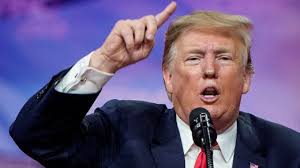
Donald Trump
On July 24, 2019, Mueller testified before the House Judiciary Committee. There he revealed that Donald Trump, the President of the United States, had:
- Sought Russian interference during the 2016 Presidential campaign.
- Benefited from that intervention.
- Concealed his close personal economic ties to Vladimir Putin by lying to the public about his hidden attempts to secure a construction project in Moscow.
- Lied to the special prosecutor.
- Directed subordinates to falsify records.
- Tried to exert “undue influence” on law enforcement in order to protect himself and his allies.
While appearing before Congress, Mueller was forced to:
- Testify for seven hours before the House Judiciary Committee and the House Intelligence Committee.
- Endure powerful, hot klieg lights needed by television cameras.
- Patiently take questions that were at times self-serving
- Respectfully answer questions meant to attack his personal and professional integrity.
- Simplify complex legal scenarios for men and women who have the attention span of a gnat.
Although Mueller was joined by former deputy special counsel Aaron Zebley, Zebley was forbidden to give testimony. He could only serve as Mueller’s counsel, giving quiet advice.
So the entire seven hours of public testimony fell on the shoulders of a 74-year-old man. No wonder he appeared tired by the end of the day.
And what was his reward?
A July 26, 2019 article in The Atlantic—entitled “The Press Has Adopted Trump’s Reality-Show Standards”—sums up the general reaction of the nation’s press to these bombshell revelations:
“In any other administration, in any other time, a special prosecutor, former FBI director, and decorated Marine testifying that the president of the United States was an unprosecuted felon who encouraged and then benefited from an attack on American democracy in pursuit of personal and political gain would bring the country to a grinding halt.
“But the American political press found Mueller insufficiently dazzling.”
Among those media:
- The New York Times: “Mueller’s Performance Was a Departure From His Much-Fabled Stamina.”
- The Washington Post: “On Mueller’s Final Day on the National Stage, a Halting, Faltering Performance.” And another reporter dubbed him a “weary old man.”
- The Hill: “Muller’s ‘Blockbuster’ Appearance Turned into ‘Bomb’ of Performance.”
- Politico: “Bob Mueller Is Struggling.”
- Right-wing media openly questioned Mueller’s health. These same media never mentioned that Trump is grotesquely overweight, never walks when he can ride, and eats a diet high in fats and calories.
In short: The nation’s most influential news media—on which citizens depend for their understanding of national and international personalities and events—has adopted the standards of teenagers.
* * * * *
Americans like their heroes young and powerful—preferably invincible. They want their heroes to be handsome and their villains to be ugly. They want to see lots of explosions and collapsing buildings.
And if a superhero can deliver a zinger of a line while throwing a KO punch, so much the better.
Lacking a sense of history—or concern for it—most Americans remain ignorant of the men, women and events that have shaped the era in which they live.
Most of those who watched Robert Mueller testify before Congress knew nothing of the sacrifices he had made for his country:
- As a Marine Vietnam veteran decorated for heroism (1968-1971);
- As a United States Attorney (1986-1987 and 1998-2001);
- As a United States Assistant Attorney General (1990-1993 and 2001); and
- As director of the FBI (2001-2013).
Robert Mueller
A news media that prizes glitz over substance has abdicated the role intended for it by the Founding Fathers: To act as a watchdog over the nation’s leaders.
That does not, however, diminish the legacy of Robert Mueller’s achievements—as Special Counsel and every other position he has held.
Revered within the law enforcement community, he will forever rank among the giants who personify courage and integrity
As a soldier, prosecutor, FBI director and Special Counsel, Robert Mueller took an oath to “support and defend the Constitution of the United States against all enemies, foreign and domestic.”
So did Donald Trump when he was inaugurated the nation’s 45th President. And so did every Republican member of the House of Representatives and the Senate.
The difference between Robert Mueller and Trump—and the overwhelming majority of Republican Congressional members—is this: Mueller, like a compass pointing True North, has always stayed faithful to that oath.
In doing so, he carried on his shoulders the burdens created when millions of racist, hate-filled Americans deliberately sent a corrupt, Russian-backed egomaniac and would-be dictator to the White House.
2016 PRESIDENTIAL ELECTION, 2020 PRESIDENTIAL ELECTION, ABC NEWS, ACAM SCHIFF, ADOLF HITLER, ALTERNET, AMERICABLOG, AP, BABY BOOMER RESISTANCE, BBC, BLOOMBERG NEWS, BRETT CROZIER, BUZZFEED, CBS NEWS, CHARLES PIERCE, CHRIS KREBS, CNN, CONVERSATION WITH AN AMERICAN WRITER (POEM), CORONAVIRUS, CROOKS AND LIARS, CYBERSECURITY AND INFRASTRUCTURE SECURITY AGENCY, DAILY KOS, DEPARTMENT OF HOMELAND SECURITY, DEPARTMENT OF STATE, DIMITRI SHOSTAKOVICH, DONALD TRUMP, DRUDGE REPORT, ESQUIRE MAGAZINE, FBI, FIVETHIRTYEIGHT, FOX NEWS NETWORK, GREAT TERROR, HARPER’S MAGAZINE, HOUSE INTELLIGENCE COMMITTEE, HOUSE OF REPRESENTATIVES, HUFFINGTON POST, JOSEPH BIDEN, JOSEPH STALIN, MARIA YOVANOVICH, MEDIA MATTERS, MICROSOFT, MIKHAIL TUKHACHEVESKY, MOTHER JONES, MOVEON, MSNBC, NAZI GERMANY, NBC NEWS, NEW REPUBLIC, NEWSDAY, NEWSWEEK, NICCOLO MACHIAVELLI, NIKITA KHRUSHCHEV, NIKOLAI ZHILAYEV, NPR, PBS NEWSHOUR, POLITICO, POLITICUSUSA, RAW STORY, REUTERS, RUDY GIULIANI, SALON, SEATTLE TIMES, SLATE, SOVIET UNION, TALKING POINTS MEMO, THE ATLANTIC, THE CHICAGO SUN-TIMES, THE CHICAGO TRIBUNE, THE DAILY BEAST, THE DAILY BLOG, THE DISCOURSES, THE GUARDIAN, THE HILL, THE HUFFINGTON POST, THE LOS ANGELES TIMES, THE NATION, THE NEW REPUBLIC, THE NEW YORK TIMES, THE NEW YORKER, THE VILLAGE VOICE, THE WALL STREET JOURNAL, THE WASHINGTON POST, THINKPROGRESS, THOMAS MODLY, TIME, TRUTHDIG, TRUTHOUT, TWITTER, TWO POLITICAL JUNKIES, U.S. NEWS & WORLD REPORT, UKRAINE, UPI, USA TODAY, WEHRMACHT, WONKETTE, WORLD WAR ii, YEVGENEY YEVTUSHENKO
In Bureaucracy, History, Law, Law Enforcement, Military, Politics, Social commentary on March 21, 2024 at 12:10 am
Next hero: Marie Yovanovitch, the former United States ambassador to Ukraine (2016 – 2019). She had joined the Foreign Service in 1986, and served as ambassador to Kyrgyzstan (2005 – 2008) and Armenia (2008 – 2011).
In May 2019, on President Donald Trump’s orders, the State Department recalled Yovanovitch as ambassador to Ukraine. She had earned respect from the national security community for her efforts to encourage Ukraine to tackle corruption.
But she had been criticized by Right-wing media outlets—notably Fox News Network-–and by Trump’s personal attorney, Rudy Giuliani.

Marie Yovanovitch
CNN reported that Yovanovitch stopped Giuliani from interviewing witnesses in his search for politically damaging information against former Vice President Joe Biden, whose son, Hunter, had had business dealings in Ukraine.
On October 11, 2019, she appeared before the House Intelligence Committee, chaired by Representative Adam Schiff (D-CA). She did so in defiance of orders by the White House and State Department to not attend.
“She was a hero even before she hit the hearing room,” wrote Charles Pierce for Esquire magazine.
“She told them to stuff their directives, she would answer a congressional subpoena like a citizen is supposed to do. And she didn’t sneak in through the basement. She walked into the Capitol through the front doors, and she didn’t do so to fck around.”
Testifying for nearly 10 hours, Yovanovitch said that Trump had removed her from her post owing to “unfounded and false claims” and “a concerted campaign against me.”
She believed that associates of Trump’s personal lawyer, Giuliani, might have thought “that their personal financial ambitions were stymied by our anti-corruption policy in Ukraine.”
And she warned that the State Department was being “attacked and hollowed out from within. State Department leadership, with Congress, needs to take action now to defend this great institution, and its thousands of loyal and effective employees.”
Another victim on Trump’s hate-list was Chis Krebs.
During the 2016 Presidential race, Russian propaganda had played a major role in convincing millions of Americans to vote for Donald Trump. Social media platforms—especially Facebook and Twitter—were flooded with genuinely fake news to sow discord among Americans and create a pathway for Trump’s election.
And where Internet trolls left off, Russian computer hackers took over.
Trump didn’t win a majority of the popular vote. But he got enough help from Russian President Vladimir Putin to triumph in the Electoral College.
So notorious was the role played by Russian trolls and hackers in winning Trump the 2016 election that the Department of Homeland Security (DHS) was determined to prevent a repetition in 2020.
And point man for this was Chris Krebs.
Born in Atlanta, Georgia, in 1977, Krebs had received a B.A. in environmental sciences from the University of Virginia in 1999, and a J.D. from the George Mason University School of Law in 2007.
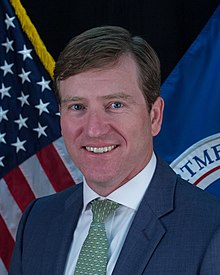
Chris Krebs
Krebs had served as Senior Advisor to the Assistant Secretary of Homeland Security for Infrastructure Protection, and later worked in the private sector as Director for Cybersecurity Policy for Microsoft.
Now he was director of the Cybersecurity and Infrastructure Security Agency at DHS.
In preparation for the 2020 Presidential election, Krebs launched a massive effort to counter lies spread by Russians—and Americans—on social media platforms. Among his duties:
- Sharing Intelligence from agencies such as the CIA and National Security Agency with local officials about foreign efforts at election interference.
- Ensuring that domestic voting equipment was secure.
- Attacking domestic misinformation head-on.
As a result, Krebs was widely praised for revamping the department’s cybersecurity efforts and increasing coordination with state and local governments.
By all accounts—except Trump’s—the November 3, 2020 election went very smoothly.
As a result of the vast increase in election security, Trump not only failed to win the popular vote again but couldn’t get the help he expected from Putin.
On November 17, Trump fired Chris Krebs.
The reason: Krebs had not only countered Russian propaganda lies—he had dared to counter Trump’s as well. For example: He rejected Trump’s claims of widespread voter fraud: There “is no evidence that any voting system deleted or lost votes, changed votes, or was in any way compromised.”
In a November 17 story on the CNN website, CNN reporters Kaitlan Collins and Paul LeBlanc bluntly concluded:
“[Krebs’] dismissal underscores the lengths Trump is willing to go to punish those who don’t adopt his conspiratorial view of the election.
“Since CNN and other outlets called the race for President-elect Joe Biden, Trump has refused to accept the results, instead pushing baseless conspiracies that his second term is being stolen.”
Yet, by depriving Trump of Russian help, Krebs ensured a victory for democracy.
On January 6, the House and Senate counted the Electoral Votes—and pronounced Joseph Biden the winner—bringing an end to Trump’s reign of criminality and treason.
In his 1960 poem, “Conversation With an American Writer,” the Russian poet, Yevgeney Yevtushenko spoke for those Russians who had maintained their integrity in the face of Stalinist terror:
“You have courage,” they tell me.
It’s not true. I was never courageous.
I simply felt it unbecoming
to stoop to the cowardice of my colleagues.
Unfortunately, the same cannot be said of Republicans in the United States Senate and House of Representatives in the face of Trump terror.


 Bureaucracybuster's Blog
2016 PRESIDENTIAL CAMPAIGN, ABC NEWS, AFGHANISTAN, ALTERNET, AMERICABLOG, AP, BABY BOOMER RESISTANCE, BARACK OBAMA, BLOOMBERG, BOB WOODWARD, BUZZFEED, CBS NEWS, CENTER FOR AMERICAN PROGRESS ACTION FUND, CIA, CLINTON WATTS, CNN, COVID-19, CRAIG UNGER, CROOKS AND LIARS, DAILY KOS, DAVID ROTHKOPF, DEPARTMENT OF HOMELAND SECURITY, DIRECTOR OF NATIONAL INTELLIGENCE, DONALD TRUMP, DONALD TRUMP JR., DRUDGE RETORT, ERIC TRUMP, FBI, FBI’S COUNTERTERRORISM DIVISION, FEAR: TRUMP IN THE WHITE HOUSE (BOOK), FIVETHIRTYEIGHT, FOX NEWS, G7, GEORGE PAPADOPOULOS, GREG MILLER, HARPER’S MAGAZINE, HILLARY CLINTON, HOUSE INTELLIGENCE COMMITTEE, HOUSE OF TRUMP HOUSE OF PUTIN (BOOK), HOWARD STERN, ISLAMIC STATE OF IRAQ AND SYRIA (ISIS), ISRAELI INTELLIGENCE, JAMES CARLOS BLAKE, JAMES COMEY, JARED KUSHNER, JEFF SESSIONS, JOE SCARBOROUGH, JOINT TERRORISM TASK FORCE, JOSEPH BIDEN, Kamala Harris, KAYLEIGH MCENANY, KIM JONG-UN, MAIN INTELLIGENCE DIRECTORATE, MALCOM W. NANCE, MEDIA MATTERS, MICHAEL FLYNN, MICHAEL ISIKOFF, MOSCOW PROJECT, MOTHER JONES, MOVEON, MSNBC, NATALIA VESELNITSKAYA, NATIONAL SECURITY AGENCY, NBC NEWS, NEWSWEEK, NPR, OFFICE OF THE DIRECTOR OF NATIONAL INTELLIGENCE, PAUL MANAFORT, PBS NEWSHOUR, PERIL (BOOK), POLITICO, POLITICUSUSA, PRESIDENT’S DAILY BRIEFING, PRINCETON UNIVERSITY, RAGE (BOOK), RAW STORY, REPUBLICAN PARTY, REPUBLICANS, REUTERS, REX TILLERSON, RICHARD M. NIXON, RINAT AKHMETSHIN, ROBERT S. MUELLER 111, ROD ROSENSTEIN, RUSSIA, RUSSIAN ROULETTE (BOOK), SALLY YATES, SALON, SEAL TEAM SIX, SEATTLE TIMES, SENATE INTELLIGENCE COMMITTEE, SERGEY KISLYAK, SERGEY LAVROV, SLATE, TALIBAN, TALKING POINTS MEMO, THE APPRENTICE (BOOK), THE ATLANTIC, THE CHICAGO SUN-TIMES, THE CHICAGO TRIBUNE, THE DAILY BEAST, THE DAILY BLOG, THE FRIENDS OFPANCHO VILLA (BOOK(), THE GUARDIAN, THE HILL, THE HUFFINGTON POST, THE LOS ANGELES TIMES, THE NATION, THE NEW REPUBLIC, THE NEW YORK TIMES, THE PLOT TO DESTROY DEMOCRACY (BOOK), THE VILLAGE VOICE, THE WASHINGTON POST, THINKPROGRESS, TIME, TREASON, TRUMP TOWER MEETING, TRUTHDIG, TRUTHOUT, TWO POLITICAL JUNKIES, U.S. NAVY SEALS, U.S. NEWS & WORLD REPORT, UNITED STATES DEPARTMENT OF JUSTICE, UNITED STATES DEPARTMENT OF STATE, UPI, USA TODAY, VANIT FAIR, VICTOR YANUKOVYCH, VLADIMIR PUTIN, WIKILEAKS, WILLIAM BARR, WONKETTE, X
TREASON IS A TRUMP’S BEST FRIEND: PART TWO (OF SIX)
In Bureaucracy, History, Law, Law Enforcement, Military, Politics, Social commentary on January 21, 2025 at 12:10 amDonald Trump won the 2016 Presidential race by promising to “Make America Great Again.”
Yet if any country emerged as the chief beneficiary of Trump’s tenure in the White House, it was Russia.
Among Trump’s many acts that placed the United States at a disadvantage in dealing with its mortal adversary:
TREASON EXAMPLE #3: Many of those Trump appointed to office had strong ties to the government of Russian President Vladimir Putin.
One of these was Secretary of State Rex Tillerson. In 2013, as the chief executive of ExxonMobil, he was presented with Russia’s Order of Friendship award. He had just signed deals with the state-owned Russian oil company Rosneft. Its chief, Igor Sechin, is a loyal Putin lieutenant.
Rex Tillerson
Another was Attorney General Jeff Sessions. During the 2016 campaign, Sessions—then serving as a surrogate for Trump’s campaign—twice spoke with Russian Ambassador Sergey Kislyak. But during his Senate nomination hearings, Sessions denied that he had had “communications with the Russians” during the campaign.
It was the discovery of those contacts by the news media that forced Sessions to recuse himself from any Justice Department cases involving Trump and Russia. All of these—including the appointment of Special Counsel Robert Mueller III—would be handled by Deputy Attorney General Rod Rosenstein.
This led Trump to rage at Sessions—in person, in press conferences and on Twitter: “If I had known he would do this, I would have never appointed him.”
It wasn’t Sessions’ perjury that troubled Trump—it was its discovery.
On November 7, 2018, the day after the Democrats won a majority in the House of Representatives, Trump fired him.
Jeff Sessions
The Moscow Project is an initiative of the Center for the American Progress Action Fund. Its objective: “Analyzing the facts behind Trump’s collusion with Russia and communicating the findings to the public.”
According to its March 21, 2018 report (updated on July 10): “In total, we have learned of 80 contacts between Trump’s team and Russia linked operatives, including at least 23 meetings.
“And we know that at least 24 high-ranking campaign officials and Trump advisors were aware of contacts with Russia-linked operatives during the campaign and transition. None of these contacts were ever reported to the proper authorities. Instead, the Trump team tried to cover up every single one of them….
“The Trump campaign issued at least 15 blanket denials of contacts with Russia, all of which have been proven false.”
Members of the Trump team who had contacts with Russians during the campaign or transition included:
George Papadopoulos, a member of the foreign policy advisory panel to Trump’s 2016 Presidential campaign, pleaded guilty to making false statements about his contacts with Russians to the FBI. So did Flynn.
Paul Manafort was convicted for money-laundering relating to his work for the government of the Putin-supported president of Ukraine, Victor Yanukovych.
The discovery of numerous contacts between Trump campaign officials and Russian Intelligence agents led the FBI to investigate Russia’s efforts to subvert the 2016 Presidential election.
In July, 2018, Special Counsel Robert S. Mueller charged 12 officers of the GRU, Russia’s military intelligence agency, with crimes committed to the high-profile hacking and leaking emails from the Democratic National Committee during the 2016 campaign.
Robert S. Mueller III
On numerous occasions, Donald Trump has fiercely denied any Russian connections. For example:
July 27, 2016: “I mean I have nothing to do with Russia. I don’t have any jobs in Russia. I’m all over the world but we’re not involved in Russia.”
October 24, 2016: “I have nothing to do with Russia, folks, I’ll give you a written statement.”
January 11, 2017: “Russia has never tried to use leverage over me. I HAVE NOTHING TO DO WITH RUSSIA – NO DEALS, NO LOANS, NO NOTHING!”
February 7, 2017: “I don’t know [Russian President Vladimir] Putin, have no deals in Russia, and the haters are going crazy.”
In fact, Trump had a highly profitable relationship with Russia—as his two sons, Donald, Jr., and Eric, unintentionally revealed.
In 2008, Donald Trump, Jr. said at a New York real estate conference: “In terms of high-end product influx into the US, Russians make up a pretty disproportionate cross-section of a lot of our assets. Say, in Dubai, and certainly with our project in SoHo, and anywhere in New York. We see a lot of money pouring in from Russia.”
Donald Trump, Jr.
Gage Skidmore from Surprise, AZ, United States of America, CC BY-SA 2.0 <https://creativecommons.org/licenses/by-sa/2.0>, via Wikimedia Commons
And Trump’s son, Eric, has been quoted as saying in 2014: “Well, we don’t rely on American banks. We have all the funding we need out of Russia. We’ve got some guys that really, really love golf, and they’re really invested in our programs. We just go there all the time.”
In 2005, the Trump Organization signed a one-year contract for a construction project in Moscow to erect a Trump skyscraper. It was stipulated any spas or fitness areas be branded “The Spa by Ivanka Trump.”
The project fell through—because news reports emerged then about the Russian hacking of the Democratic National Committee, making a Russian business connection a political liability.
Share this: