Posts Tagged ‘COVID-19’
ABC NEWS, ADOLF HITLER, ALTERNET, AMERICABLOG, AP, BABY BOOMER RESISTANCE, BETSY DEVOS, BLACKWATER, BLOOMBERG, BUZZFEED, CBS NEWS, CENTERS FOR DISDEASE CONTROL AND PREVENTION (CDC), CNN, CORONAVIRUS, COVID-19, CROOKS AND LIARS, DAILY KOZ, DONALD TRUMP, DRUDGE RETORT, ERIK PRINCE, FACEBOOK, FIVETHIRTYEIGHT, GRETCHEN WHITMER, HARPER’S MAGAZINE, HUNTINGTON BEACH, LUNG CANCER, MEDIA MATTERS, MICHIGAN CONSERVATIVE COALITION, MOTHER JONES, MOVEON, MSNBC, NBC NEWS, NEWSWEEK, NPR, NUREMBERG RALLIES, PBS NEWSHOUR, POLITICO, POLITICUSUSA, RAW STORY, REUTERS, RUSH LIMBAUGH, SALON, SEATTLE TIMES, SLATE, STAY-AT-HOME ORDERS, TALKING POINTS MEMO, THE ATLANTIC, THE CHICAGO SUN-TIMES, THE CHICAGO TRIBUNE, THE DAILY BEAST, THE DAILY BLOG, THE GUARDIAN, THE HILL, THE HUFFINGTON POST, THE LOS ANGELES TIMES, THE NATION, THE NEW REPUBLIC, THE NEW YORK TIMES, THE VILLAGE VOICE, THE WASHINGTON POST, THINKPROGRESS, TIME, TRUTHDIG, TRUTHOUT, TWITTER, TWO POLITICAL JUNKIES, U.S. NEWS & WORLD REPORT, UPI, USA TODAY, WONKETTE
In Bureaucracy, History, Law, Law Enforcement, Medical, Politics, Social commentary on December 24, 2021 at 12:14 am
On April 17, 2020, more than 100 protesters converged on Huntington Beach, California, in a demonstration against the state’s Coronavirus stay-at-home order.
It was part of a series of national demonstrations organized by Right-wing groups.
Many of the protesters carried Donald Trump banners and American flags. Most were not wearing masks or practicing social distancing—keeping themselves at least six feet apart from others. And they defied scientific findings and medical experts’ warnings, as if daring the virus to “come and get me.”
“I don’t think there’s any reason for us to be on lockdown now,” said 62-year-old Paula Doyle. “We didn’t have any dangers; we have no danger in our hospitals now of overflowing.”
That’s because California’s quick closure of businesses and its order that residents stay home had temporarily prevented Coronavirus from reaching epic proportions in the state. Many hospitals had been left largely empty, waiting for a surge that had yet to come.
On April 18, when more than 31,000 Americans lay dead of the Coronavirus, and more than 90% of the country was under stay-at-home orders. demonstrations erupted across the United States.

Anti-lockdown demonstration at the Ohio Statehouse
Becker1999 from Grove City, OH, CC BY 2.0 <https://creativecommons.org/licenses/by/2.0>, via Wikimedia Commons
More than 250 people showed up at Austin, Texas. Other protests occurred at the capitols of Minnesota, Michigan and Virginia. An estimated 400 people gathered in Concord, New Hampshire. A rally outside Maryland’s statehouse in Annapolis drew about 200 protesters.
President Donald Trump had been the primary instigator of such protests. He said he favored a quick return to normal practices and the reopening of businesses across the country.
But what he favored most of all was a return to his Nuremberg-like political rallies, where he could bask in the worship of his fanatical base and hurl slanders at virtually everyone he hated. And he couldn’t do that so long as mass demonstrations were banned—and people must stand at least six feet apart.
There are two factors to these protests that are truly astounding.
First, many of the protesters attacked the governors who had issued stay-at-home orders as fascists. This is a hallmark of Right-wing politics—accusing their opponents of being what they are themselves.
One protester at the Huntington Beach demonstration carried a sign that read: “Defy Fascist Lockdown.”
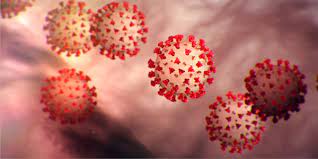
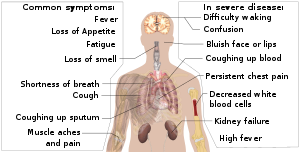
COVID-19 virus
And Michigan Democratic Governor Gretchen Whitmer, who had defied the Republican legislature by extending her stay-at-home order, was denounced as a Nazi, with protesters displaying signs like “Heil Whitmer.”
Second, the protesters utterly rejected the rising death-toll caused by the virus. At that time, this stood at 80,574.
Medical experts universally warned that stopping the chain of transmission to avoid overwhelming medical systems was the only way to buy time while treatments and vaccines could be developed.
Yet for these protesters, it’s as if the rising body count wasn’t happening.
Some of the rallies were being pushed by Republican-allied groups in battleground states with Democratic governors.
The April 30 protest at the Michigan Capitol Building featured treasonous Confederate flags and hangman’s nooses. Some signs displayed swastikas. Many of the demonstrators were armed with AK-47s.
That protest was organized by the Michigan Conservative Coalition, a group co-founded by a GOP state representative and his wife, who was on the advisory board for an official Trump campaign group called Women for Trump and was the co-founder of Michigan Trump Republicans.
Another of the event’s promoters, Greg McNeilly, was a longtime political adviser to the wealthy DeVos family, which included then-Secretary of Education Betsy DeVos and her brother, Erik Prince, founder of the notorious Blackwater mercenary group.
On May 1, 2020, Trump tweeted in support of the Michigan demonstrators. “These are very good people, but they are angry. They want their lives back again, safely! See them, talk to them, make a deal.”
Republicans’ disdain for education in general—and science in particular—has led to the following: In March, 2020, an NBC News poll found that only 30% of Republicans said that they would actually listen to the advice of doctors to stay away from large, crowded areas to avoid Coronavirus.
These are the same people who get their version of reality from Right-wing sources like Fox News Network and Rush Limbaugh.
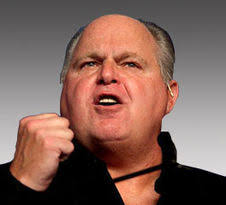
Rush Limbaugh
On his March 27 show, Limbaugh dismissed Coronavirus as “the common cold,” then added: “We didn’t elect a president to defer to a bunch of health experts that we don’t know.
“And how do we know they’re even health experts? Well, they wear white lab coats, and they’ve been in the job for a while, and they’re at the CDC [Centers for Disease Control and Prevention] and they’re at the NIH [National Institutes of Health] and they’re up, well—yeah, they’ve been there, and they are there.”
In 2015, Limbaugh said: “Firsthand smoke takes 50 years to kill people, if it does. Not everybody that smokes gets cancer. Now, it’s true that everybody who smokes dies, but so does everyone who eats carrots.”
Five years later, on February 17, 2021, Limbaugh—a longtime and heavy cigar smoker—died of Stage Four lung cancer.
And today, thanks to the legacy of Trump and his Republican allies, more than 800,000 Americans are dead of COVID.
ABC NEWS, ADOLF HITLER, ALTERNET, AMERICABLOG, AP, BABY BOOMER RESISTANCE, BBC, BLOOMBERG, BLOOMBERG NEWS, BUZZFEED, CBS NEWS, CNN, COVID-19, CROOKS AND LIARS, DAILY KOZ, DONALD J. TRUMP, DRUDGE RETORT, ECONOMY, EMPLOYMENT, FACEBOOK, FBI, FIVETHIRTYEIGHT, GESTAPO, HARPER’S MAGAZINE, HUFFINGTON POST, INDEPENDENT COUNSEL, JEWS, JOE BIDEN, JOE SCARBOROUGH, MEDIA, MEDIA MATTERS, MEXICO, MIKA BRZEZINSKI, MORNING JOE, MOTHER JONES, MOVEON, MSNBC, NAZI ATROCITIES, NBC NEWS, NEW REPUBLIC, NEWSDAY, NEWSWEEK, NPR, PAM BONDI, PBS NEWSHOUR, POLITICO, POLITICUSUSA, RAW STORY, REPUBLICANS, REUTERS, SALON, SARAH HUCKABEE SANDERS, SEATTLE TIMES, SLATE, SOVIET UNION, TALKING POINTS MEMO, THE ATLANTIC, THE CHICAGO SUN-TIMES, THE CHICAGO TRIBUNE, THE DAILY BEAST, THE DAILY BLOG, THE GUARDIAN, THE HILL, THE HUFFINGTON POST, THE LOS ANGELES TIMES, THE NATION, THE NEW REPUBLIC, THE NEW YORK TIMES, THE NEW YORKER, THE VILLAGE VOICE, THE WASHINGTON POST, THINKPROGRESS, TIME, TRUMP UNIVERSITY SCANDAL, TRUTHDIG, TRUTHOUT, TWITTER, TWO POLITICAL JUNKIES, U.S. NEWS & WORLD REPORT, UNEMPLOYMENT, UPI, USA TODAY, WEHRMACHT, WONKETTE
In Bureaucracy, History, Politics, Social commentary on December 22, 2021 at 12:10 am
On April 27, 2020, Joe Scarborough offered an important insight about why most Americans ignored President Donald Trump’s crimes and outrages for so long:
“Back in January Joe Biden wrote an Op-Ed that the President was not prepared for this coming pandemic, and things were going to get worse. And he said ‘Let your doctors talk. Let your scientists talk. Follow their lead.’
“…And it’s been one scam idea after another, that people then promoted on other networks, scam doctors promoting these scam solutions, claiming that everybody who had taken this malaria drug had been cured in certain hospitals. This is just the sort of thing that catches up to Donald Trump.
“I’ve said from the very beginning: You can lie about independent counsels, people won’t listen. You can lie about former FBI directors—“
MIKA BRZEZINSKI: “It doesn’t impact their lives.”
JOE SCARBOROUGH: “They’re still going to work, the kids are doing fine, they’ve got enough money to pay their rent, to pay their mortgage, You can even lie about the Ukraine call—they don’t really care.
“But all of these lies, all of these [COVID-19] scams that he’s been pushing…have been revealed as lies—not by the people on cable news, but by their doctors. By nurses they know. If you’ve got a doctor who’s been treating your family for 20-25 years, you’re going to believe that person more than a scam artist that’s pushing propaganda for Donald Trump on talk radio.”
On August 23, 2018, Trump appearing on “Fox and Friends,” said: “I tell you what, if I ever got impeached, I think the market would crash, I think everybody would be very poor.”
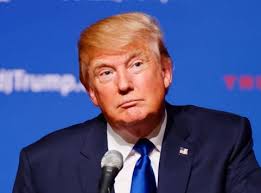
Donald Trump
Thus, he appealed to the greed and fear of his voting base—and no doubt hoped to reach beyond it: “Keep me in power or you’ll all suffer for it.”
Then-White House Press Secretary Sarah Huckabee Sanders bragged, on June 4, 2018:
“Since taking office, the President has strengthened American leadership, security, prosperity, and accountability. And as we saw from Friday’s jobs report, our economy is stronger, Americans are optimistic, and business is booming.”
Many Congressional Republicans echoed this: The American people care only about the economy—and how well-off they are.
For eight years, Nazi Germany underwent such an epoch. Germans called it “The Happy Time.”
It began on January 30, 1933, when Adolf Hitler became Chancellor—and lasted until June 22, 1941, when Hitler invaded the Soviet Union.
Germans knew about the Nazis’ cruelty to the Jews, the conquests of Austria and Czechoslovakia, the mass arrests and concentration camps.
They didn’t care.
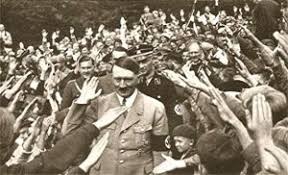
Frenzied Germans greet Adolf Hitler
The Gestapo didn’t have to watch everyone: German “patriots” gladly reported their fellow citizens—especially Jews—to the secret police.
As far as everyday Germans were concerned:
- The streets were clean and peaceful.
- Employment was high.
- The trouble-making unions were gone.
- Germany was once again “taking its rightful place” among ruling nations, after its catastrophic defeat in World War 1.
The height of “The Happy Time” came in June, 1940. In just six weeks, the Wehrmacht accomplished what the German army hadn’t in four years during World War 1: The total defeat of its longtime enemy, France.
Suddenly, French clothes, perfumes, delicacies, paintings and other “fortunes of war” came pouring into the Fatherland.
Most Germans believed der Krieg—“the war”—was over, and only good times lay ahead.
Then, on June 22, 1941, three million Wehrmacht soldiers slashed their way into the Soviet Union. The Third Reich was now locked in a death-struggle with a nation even more powerful than itself.

German soldiers in the Soviet Union
And then, on December 11, 1941—four days after Germany’s ally, Japan, attacked Pearl Harbor—Hitler declared war on the United States.
“The Happy Time” for Germans was over. Only prolonged disaster lay ahead.
Donald Trump has spent his life appealing to the greed or fear of those around him. For example:
- Florida Attorney General Pam Bondi personally solicited a political contribution from Trump around the same time her office deliberated joining an investigation of alleged fraud at Trump University and its affiliates.
- After Bondi dropped the Trump University case against Trump, he wrote her a $25,000 check for her re-election campaign.
- According to an April 14, 2019 story by ABC News, a nationwide review uncovered at least 36 criminal cases where Trump was invoked in direct connection with violent acts, threats of violence or allegations of assault.
- In nine cases, attackers hailed Trump in the midst or immediate aftermath of physically assaulting victims. In 10 more cases, perpetrators cheered or defended Trump while taunting or threatening others. And in another 10 cases, Trump and his rhetoric were cited in court to explain a defendant’s violent or threatening behavior.
But starting on February 28, 2026, Trump faced an enemy that he couldn’t bribe or intimidate.
A fanatical regime like COVID-19 doesn’t accept bribe-monies or grovel before a raging tyrant.
The Germans made a devil’s-bargain with Adolf Hitler—and paid dearly for it.
Millions of greedy Americans have embraced Donald Trump—another would-be tyrant—as America’s economic savior.
By supporting Trump—or at least not opposing him—they also made a devil’s-bargain. And such bargains always end with the devil winning.
1984 NOVEL, ABC NEWS, ALTERNET, AMERICABLOG, AP, BABY BOOMER RESISTANCE, BBC, BLOOMBERG NEWS, BUZZFEED, CBS NEWS, CHRISTMAS, CNN, COMMERCIALISM, COVID-19, CROOKS AND LIARS, DAILY KOZ, DONALD TRUMP, DRUDGE RETORT, EASTASIA, EURASIA, FACEBOOK, FIVETHIRTYEIGHT, FOX NEWS, GEORGE ORWELL, HARPER’S MAGAZINE, HUFFINGTON POST, JESUS, MEDIA MATTERS, MEGYN KELLY, MOTHER JONES, MOVEON, MSNBC, NBC NEWS, NEW REPUBLIC, NEWSDAY, NEWSWEEK, NPR, OCEANIA, PBS NEWSHOUR, POLITICO, POLITICUSUSA, RAW STORY, REUTERS, ROMAN EMPIRE, RUPERT MURDOCH, SALON, SANTA CLAUS, SATURNALIA, SEATTLE TIMES, SLATE, STARBUCK'S, TALKING POINTS MEMO, THE ATLANTIC, THE CHICAGO SUN-TIMES, THE CHICAGO TRIBUNE, THE DAILY BEAST, THE DAILY BLOG, THE GUARDIAN, THE HILL, THE HUFFINGTON POST, THE LOS ANGELES TIMES, THE NATION, THE NEW REPUBLIC, THE NEW YORK TIMES, THE NEW YORKER, THE VILLAGE VOICE, THE WASHINGTON POST, THINKPROGRESS, TIME, TRUTHDIG, TRUTHOUT, TWITTER, TWO POLITICAL JUNKIES, U.S. NEWS & WORLD REPORT, UPI, USA TODAY, WAR ON CHRISTMAS, WONKETTE
In Bureaucracy, Business, History, Politics, Social commentary on December 6, 2021 at 12:10 am
Christmas is special.
So, each year, the executives at Fox News find new ways to stir up emotions by resurrecting the “war on Christmas” slander.
Fox launched this in 2004 with a recurring segment called “Christmas Under Siege.” Thus, aggressive Right-wingers cloak themselves in the garb of righteous victims.
Stirring up false controversies is a daily assignment for the alleged reporters of this company owned by Right-wing oligarch Rupert Murdoch.
And at Christmastime this effort goes into overdrive.
Consider:
On December 11, 2013. then-Fox hostess Megyn Kelly offered this on “The Kelly File,” her then-popular Fox News program.

Megyn Kelly
Referring to an article by Slate writer Aisha Harris on “Santa Claus Should Not Be a White Man Anymore,” she said:
“When I saw this headline, I kinda laughed and I said, ‘Oh, this is ridiculous. Yet another person claiming it’s racist to have a white Santa.’
“And by the way, for all you kids watching at home, Santa just is white. But this person is maybe just arguing that we should also have a black Santa. But, you know, Santa is what he is, and just so you know, we’re just debating this because someone wrote about it, kids.”
Of course, Santa Claus is a completely fictional character. Arguing about his skin color is as pointless as arguing about his weight.
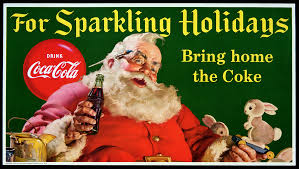
But Kelly wasn’t content to talk only about Santa. So she turned next to Jesus, a historical figure about whom we have not a single reference to his appearance, let alone a picture.
“Just because it makes you feel uncomfortable doesn’t mean it has to change. You know, I mean, Jesus was a white man, too.
“He was a historical figure; that’s a verifiable fact—as is Santa, I want you kids watching to know that—but my point is: How do you revise it, in the middle of the legacy of the story, and change Santa from white to black?”
Santa Claus a verifiable historical figure? Not even Charlie Brown, in the annually telecast “Peanuts” Christmas special, would make that claim.
In 2015, Donald Trump claimed center-stage in “defending” Christmas. And the target of his ire? Starbucks.
In years past, its disposable coffee cups featured snowflakes, winter scenes, reindeer and Christmas ornaments.
But in 2015, Starbucks decided to go with a minimalist, all-red design, its only feature being the company’s green and white logo.
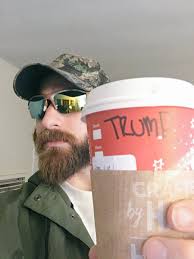
Baked Alaska with his Trump cup
This angered some religious Right-wingers, who generally care more about symbols than substance. And Trump was eager to enlist evangelicals as voters.
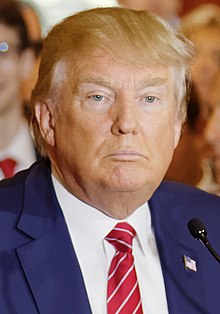
During a campaign rally in October, 2015, Trump promised: “I guarantee if I become president, we’re going to be saying ‘Merry Christmas’ at every store.”
Donald Trump
On November 9, 2015, addressing a crowd of several thousands in Springfield, Illinois, Trump said: “Did you read about Starbucks? No more Merry Christmas on Starbucks.
“I have one of the most successful Starbucks, in Trump Tower. Maybe we should boycott Starbucks? I don’t know. Seriously, I don’t care. That’s the end of that lease, but who cares?
“If I become president, we’re all going to be saying Merry Christmas again, that I can tell you.”
Trump did not explain how he would coerce non-Christian Americans—-such as atheists, Jews and Muslims—into observing a Christian holiday.
Those who claim that Christmas is threatened don’t know—or deliberately ignore—-the following:
- The Christmas shopping season can start as early as September. Some consumers begin shopping even earlier.
- For many stores, holiday shopping accounts for nearly a third of annual sales.
- For 2021, the National Retail Federation (NRF) expects Americans to spend between $843.4 and $859 billion during the holiday season.
- The NFA expects Americans to individually spend roughly $998 on gifts, food, and decorations in 2021.
- In spite of the COVID-19 pandemic, holiday sales in 2020 totaled $188.2 billion,
In short, no one is “making war” on Christmas—-except Right-wing broadcasters at Fox News to jack up ratings.
As to the historical realities of this season:
- There is no reference anywhere in the Bible to the month—let alone the day—of Jesus’ birth.
- Jesus never commanded his followers to celebrate his birth—but he did call on them to remember his death. It’s called Easter.
- Many of the “religious” traditions associated with Christmas stem from the pagan Roman festival, Saturnalia, which celebrated the “birthday” of the sun.
- This was celebrated December 17-25.
- Saturnalia traditions included feasting, gift-giving, lighting candles (to ward off evil spirits) and displaying wreaths (as a sign of coming spring).
- Early Christians tried mightily to convince their members to stop celebrating the Saturnalia.
- When these efforts failed, the Roman Catholic Church, in the fourth century, “Christianised” the festival by naming Saturnalia’s concluding day, December 25, as Jesus’ birthday.
In George Orwell’s classic novel, 1984, Oceania is always at war with Eurasia or Eastasia. Its citizens are kept in a constant state of frenzy as they’re directed to search for endless “enemies of the state.”
This, in turn, allows the unseen rulers of Oceania to run their dictatorship without interference.
It’s a lesson well-known to hucksters like Donald Trump and the men who run Fox News.
2020 PRESIDENTIAL ELECTION, ABC NEWS, ALTERNET, AMERICABLOG, ANTHONY FAUCI, AP, BABY BOOMER RESISTANCE, BBC, BLACK FRIDAY SALES, BLOOMBERG NEWS, BOB WOODWARD, BUZZFEED, CAPITOL ATTACK, CBS NEWS, CHRISTMAS, CNN, COVID-19, CROOKS AND LIARS, DAILY KOZ, DAVID BROOKS, DONALD TRUMP, ELECTORAL COLLEGE, FACEBOOK, FIVETHIRTYEIGHT, FOX NEWS NETWORK, GRETCHEN WHITMER, HARPER’S MAGAZINE, HUFFINGTON POST, IVERMECTIN, JOHNSON & JOHNSON, JONATHAN CAPEEHART, JOSEPH BIDEN, MASKS, MEDIA MATTERS, MODERNA, MOTHER JONES, MOVEON, MSNBC, NBC NEWS, NEW REPUBLIC, NEW YEAR'S, NEWSDAY, NEWSWEEK, NPR, OMICROM, PBS NEWSHOUR, PFIZER, POLITICO, POLITICUSUSA, RAW STORY, REPUBLICANS, REUTERS, SALON, SEATTLE TIMES, SLATE, SOCIAL DISTANCING, SPANISH FLU, STAY-AT-HOME ORDERS, TALKING POINTS MEMO, THANKSGIVING, THE ATLANTIC, THE CHICAGO SUN-TIMES, THE CHICAGO TRIBUNE, THE DAILY BEAST, THE DAILY BLOG, THE GUARDIAN, THE HILL, THE HUFFINGTON POST, THE LOS ANGELES TIMES, THE NATION, THE NEW REPUBLIC, THE NEW YORK TIMES, THE NEW YORKER, THE VILLAGE VOICE, THE WASHINGTON POST, THINKPROGRESS, TIME, TRUTHDIG, TRUTHOUT, TWITTER, TWO POLITICAL JUNKIES, U.S. NEWS & WORLD REPORT, UPI, USA TODAY, VACCINES, WONKETTE
In Bureaucracy, History, Law, Law Enforcement, Medical, Politics, Social commentary on November 30, 2021 at 12:10 am
As millions of Right-wingers refused to get vaccinated, the newer—and deadlier—Delta variant of COVID-19 moved in for the kill.
The result: A massive overcrowding of hospitals—where those who refused to get vaccinated are now taking up beds needed for legitimate victims of strokes, heart attacks, accidents and crime.

COVID-19 vaccination map – July 21, 2021
George Karabassis, CC BY 4.0 <https://creativecommons.org/licenses/by/4.0>, via Wikimedia Commons
Even after three COVID-19 vaccines have been developed, millions of Right-wingers refuse to get vaccinated. Although they refuse women the right to abortion, they insist “It’s my body!” when it came to mandatory vaccinations.
As a result, in states won by Trump in the 2020 Presidential election, hospitals surge with unvaccinated COVID-19 patients—and graveyards fill with them.
Every hospital bed taken by an unvaccinated Stormtrumper is a bed denied to a legitimate medical patient—such as a victim of stroke, heart attack, accident or crime.
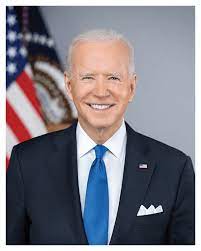
Yet President Joseph Biden has refused to blame those men and women who are directly responsible for this outrage.
Joseph Biden
Doing so would not only be accurate—it would enable Biden to place blame on his sworn political enemies and thus enhance his own popularity: “We would have achieved freedom from COVID-19—but these people have sabotaged their country’s safety out of sheer selfishness and arrogance!”
Trump viciously attacked the nation’s free press as “the enemy of the American people.” But Biden and his fellow Democrats refuse to blame those most responsible for the nation’s continuing COVID-19 epidemic.
As a result, millions of Americans believe it’s Biden’s fault for not delivering a miracle after he stated, on March 12:
“If we do this together [get vaccinated] by July 4, there is a good chance you, your family and friends can get together in your backyard or in your neighborhood and have a cookout or a barbecue and celebrate Independence Day.
“After a long, hard year, that will make this Independence Day truly special—where we not only mark our independence as a nation but we begin to mark our independence from this virus.”
Anti-vaxxers or their loved ones have filed at least two dozen lawsuits across the country to force hospitals to give them Ivermectin, a drug for de-worming cows and horses. But it remains an unproven cure for the virus.
Many unvaccinated patients beg—or demand—to be vaccinated. But to their surprise, they’re told it’s now too late.
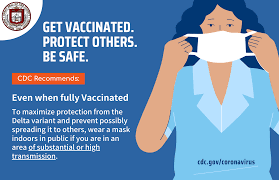
And as of November 9, comes Omicrom—better-named as Trump 3.0.
This marks the third wave of Coronavirus to strike the United States since Donald Trump became President. Early reports indicate that even twice-vaccinated people might not be safe from it.
This is directly attributable to those millions of anti-vaxxers and Trump-supporting Right-wingers who have refused to wear masks and get vaccinated—even when vaccines are free and readily available.
And Trump 3.0 is arriving just in time for the coming of winter—and the advent of Thanksgiving, Christmas and New Year’s. The holidays when Americans crisscross the nation in huge numbers to visit friends and relatives—and stay indoors at close quarters with them.
According to AAA Travel, for Thanksgiving alone, 48.3 million were expected to drive,4.2 million were expected to fly, and one million were expected to use other means of transit, such as busses, trains or cruises.
That will undoubtedly lead to spreading the new across the country—and in intimate settings where
And with the holidays comes the crowd-magnet known as “Black Friday”—when giant shopping malls offer vastly reduced sales to lure tens of thousands of shoppers indoors—where the virus spreads most quickly.
**********
It’s long past time to punish the egotistical selfishness of those who refuse to protect themselves and others.
And the most effective way to do this is to turn them away from hospitals when they show up.
They should be forcibly told: “You say it’s your right to refuse to get vaccinated? Fine. Well, it’s our right to reserve beds for patients who deserve to be treated. And you don’t.”
So long as hospitals cater to these self-indulgent Right-wingers—most of them Trump supporters—they will feel empowered to consume vital medical resources needed for legitimate victims of strokes, heart attacks, accidents and crime.
These people need to be forcibly taught that there are consequences for irresponsibly selfish and arrogant behavior. So long as they are catered to, they will never learn this vital lesson.
And there is an even more important reason for taking what many will see as a radical step.
Those unvaccinated men and women who survive to 2024 will eagerly cast their votes for Donald Trump. Trump makes no secret of his desire to be “President-for-Life”—and incited a treasonous attack on the United States Capitol to overturn the free and fair election of 2020.
If he re-enters the White House in 2024, he will never voluntarily leave—and will establish a dictatorship backed up by military, police and judicial power to remain “President-for-Life.”
So the more of these unvaccinated Right-wingers who aren’t around to cast their votes in 2024, the safer democracy will be.
President Biden may not feel free to say this. But it remains brutally true nevertheless.
2020 PRESIDENTIAL ELECTION, ABC NEWS, ALTERNET, AMERICABLOG, ANTHONY FAUCI, AP, BABY BOOMER RESISTANCE, BBC, BLACK FRIDAY SALES, BLOOMBERG NEWS, BOB WOODWARD, BUZZFEED, CAPITOL ATTACK, CBS NEWS, CHRISTMAS, CNN, COVID-19, CROOKS AND LIARS, DAILY KOZ, DAVID BROOKS, DONALD TRUMP, ELECTORAL COLLEGE, FACEBOOK, FIVETHIRTYEIGHT, FOX NEWS NETWORK, GRETCHEN WHITMER, HARPER’S MAGAZINE, HUFFINGTON POST, IVERMECTIN, JOHNSON & JOHNSON, JONATHAN CAPEEHART, JOSEPH BIDEN, MASKS, MEDIA MATTERS, MODERNA, MOTHER JONES, MOVEON, MSNBC, NBC NEWS, NEW REPUBLIC, NEW YEAR'S, NEWSDAY, NEWSWEEK, NPR, OMICROM, PBS NEWSHOUR, PFIZER, POLITICO, POLITICUSUSA, RAW STORY, REPUBLICANS, REUTERS, SALON, SEATTLE TIMES, SLATE, SOCIAL DISTANCING, SPANISH FLU, STAY-AT-HOME ORDERS, TALKING POINTS MEMO, THANKSGIVING, THE ATLANTIC, THE CHICAGO SUN-TIMES, THE CHICAGO TRIBUNE, THE DAILY BEAST, THE DAILY BLOG, THE GUARDIAN, THE HILL, THE HUFFINGTON POST, THE LOS ANGELES TIMES, THE NATION, THE NEW REPUBLIC, THE NEW YORK TIMES, THE NEW YORKER, THE VILLAGE VOICE, THE WASHINGTON POST, THINKPROGRESS, TIME, TRUTHDIG, TRUTHOUT, TWITTER, TWO POLITICAL JUNKIES, U.S. NEWS & WORLD REPORT, UPI, USA TODAY, VACCINES, WONKETTE
In Bureaucracy, History, Law, Law Enforcement, Medical, Politics, Social commentary on November 29, 2021 at 12:20 am
First, there was COVID-19, which slammed into the United States in early January, 2000.
Then, in June, 2021, as COVID-19 seemed on the wane, the Delta variant struck.
Now, as of November 9, the world is facing Omicron—a new variant of COVID-19.
Discovered in South Africa, Omicron would be better-described as Trump 3.0.
As President of the United States, Donald Trump bequeathed to his country two deadly legacies:
- A treasonous lust to overthrow democratic government; and
- The deadliest virus seen in America since the 1919 Spanish flu epidemic.
Throughout his Presidency, Trump “joked” about how wonderful it would be for the United States to have a “President-for-Life”—such as Xi Jinping in China.
Trump proved that he was not joking on January 6, when he incited his followers to stop the counting of Electoral College votes in the United States Capitol Building.
Donald Trump
This amounted to an attempted coup. Had the violent mob achieved its aims, the vote count would have ended before Joseph Biden could be officially pronounced the next President of the United States. And Trump would have remained President.
For it is the Electoral College vote—not the popular one—that determines the outcome of Presidential elections.
Biden had received 81,268,924 votes to 74,2164 for Trump. But it was Biden’s winning of 306 votes to Trump’s 232 in the Electoral College that made him President.
A year later, Trump continues to spew lies that millions of Right-wing Americans eagerly believe: “Trump won the election; Biden is an illegitimate President.”
Even worse: Trump’s followers in Republican-controlled states are working to rig the upcoming 2024 Presidential election to guarantee a Republican win—even if voters decide otherwise.
So much for Trump’s legacy of treason and criminality.
Now for his legacy as Coronavirus-in-Chief.
From the outset of the pandemic, Trump lied about the dangers Americans were facing.
On February 7, 2020, he told Washington Post editor and reporter Bob Woodward: “It goes through the air, Bob. That’s always tougher than the touch. The touch, you don’t have to touch things, right? But the air, you just breathe the air and that’s how it’s passed….It’s also more deadly than your strenuous flues.”
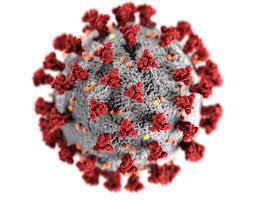
COVID-19
But from January to early March, 2020, Trump and his allies within the Republican party and Fox News Network repeatedly assured Americans they had nothing to fear.
And early on, Trump made the virus a referendum on himself. If you supported him, you didn’t wear a mask when you ventured out in public. This despite the fact that, throughout 2020, there was no vaccine available and hospitals were rapidly overwhelmed by debilitated and dying casualties of the virus.
Even worse: Trump declared open warfare on those Democratic governors—such as Michigan’s Gretchen Whitmer—who imposed quarantine “stay-at-home’ orders to halt the spread of the virus. And he repeatedly ridiculed the warnings of medical experts—such as Dr. Anthony Fauci, the nation’s top expert on infectious disease.
For Trump, assuring his own re-election in 2020 took precedence over everything. He knew that as long as Americans stayed home the economy would be depressed. And citizens in depressed economies don’t re-elect Presidents they blame for their suffering.
So for Trump, getting millions of parents back to work meant getting millions of children back to school—no matter the risk. Toward that end, Trump even threatened to cut off federal aid to schools that did not forcibly return children to classes.
Washington Post Columnist Jonathan Capehart echoed him: “I think, if we had had a president of the United States who took this seriously when this first came on the scene, if we had a Republican party that took this seriously enough to warn everyone, their constituents saying, wash your hands, then put on a mask, then go get the vaccine, we wouldn’t be where we are right now.”
Jonathan Capehart
But neither Trump nor the Republican party urged Americans to “wash your hands, put on a mask, then go get the vaccine.”
By March, 2021, three vaccines—by Pfizer, Moderna and Johnson & Johnson—became available. A total of 90.4 million doses of these vaccines had been given. And 30.7 million Americans had been fully vaccinated against the virus.
But after a triumphant beginning, the pace of vaccinations slowed, then halted. By late July, 2021, only 49.6% of Americans had been fully vaccinated.
Many of those who had gotten one shot of the Pfizer and Moderna vaccines refused to get the necessary second one. These must be given almost a month apart.
(The Johnson & Johnson vaccine requires only one shot.)
What had happened?
“The people I know personally who are not getting the vaccine, for them, it was like, ‘They rushed this thing,'” theorized New York Times columnist David Brooks. “‘Who knows what’s going to happen to all these people who get the shots in 10 years or 20 years?’ So, why should I take the risk?'”
And leading the way to this catastrophe of self-destruction were the states of the South and Midwest: Mississippi (47.1%,), Alabama (50.5%), Arkansas (53.2%), and Tennessee (52.9%) with the lowest rates of residents who have gotten at least one shot.
By late July, three states—Florida, Texas and Missouri—with lower vaccination rates accounted for 40% of all cases nationwide.
2020 PRESIDENTIAL ELECTION, ABC NEWS, ALTERNET, AMERICABLOG, AP, BABY BOOMER RESISTANCE, BBC, BLOOMBERG NEWS, BUZZFEED, CBS NEWS, CNN, COVID-19, CROOKS AND LIARS, DAILY KOZ, DONALD TRUMP, FACEBOOK, FIVETHIRTYEIGHT, HARPER’S MAGAZINE, HUFFINGTON POST, JOSEPH BIDEN, MASKS, MEDIA MATTERS, MODERNA VACCINE, MOTHER JONES, MOVEON, MSNBC, NBC NEWS, NEW REPUBLIC, NEWSDAY, NEWSWEEK, NPR, OSAMA BIN LADEN, PBS NEWSHOUR, PFIZER VACCINE, POLITICO, POLITICUSUSA, RAW STORY, REUTERS, SALON, SEATTLE TIMES, SLATE, SOCIAL DISTANCING, TALKING POINTS MEMO, THE ATLANTIC, THE CHICAGO SUN-TIMES, THE CHICAGO TRIBUNE, THE DAILY BEAST, THE DAILY BLOG, THE GUARDIAN, THE HILL, THE HUFFINGTON POST, THE LOS ANGELES TIMES, THE NATION, THE NEW REPUBLIC, THE NEW YORK TIMES, THE NEW YORKER, THE VILLAGE VOICE, THE WASHINGTON POST, THINKPROGRESS, TIME, TRUTHDIG, TRUTHOUT, TWITTER, TWO POLITICAL JUNKIES, U.S. NEWS & WORLD REPORT, UPI, USA TODAY, VACCINATIONS, WONKETTE
In Bureaucracy, History, Law, Law Enforcement, Medical, Politics, Social commentary on November 16, 2021 at 12:12 am
On March 12, in his first primetime address as President, Joseph Biden said he would order states to make all adults eligible for vaccinations by May 1:
“If we do this together, by July 4, there is a good chance you, your family and friends can get together in your backyard or in your neighborhood and have a cookout or a barbecue and celebrate Independence Day.
“After a long, hard year, that will make this Independence Day truly special—where we not only mark our independence as a nation but we begin to mark our independence from this virus.”
For all of his sincerity, Biden has made three major—and possibly fatal—mistakes in his effort to protect his fellow Americans from COVID-19.
COVID-19 virus
Mistake #1: Setting a July 4 date
Admittedly, Biden hedged his prediction: “”If we do this together, by July 4, there is a good chance….”
Still, there are simply too many variables to any disease or pestilence to guarantee its extinction by a specific date.
(A friend of mine, whose apartment was infested with bedbugs, was stunned when an exterminator promised: “I’ll have them gone in three visits or I’ll change my name.” The exterminator was gone before the bedbugs were.)
But to millions of simplistic, miracle-demanding Americans, Biden’s “July 4, 2021” statement became the date by which they fully expected to see COVID-19 totally eliminated—and the country returned to its state before the plague arrived.
Joseph Biden
So fast-forward to November, 2021, with medical experts predicting a rise in COVID-19 cases.
There are two reasons for this:
First, due to the cold and holidays, more people will be spending more time indoors with friends and relatives in their homes, and with strangers in large shopping centers.
Second, many Americans have never gotten vaccinated. Or they got only the first shot (of the Moderna or Pfizer vaccine) and didn’t bother to get a second. Or they got vaccinated—but neglected to get a booster shot.
So now all those millions of simplistic, science-denying Americans will feel: “Biden lied to me!”
Mistake #2: Refusing to blame the Stormtrumpers
Throughout 2020, President Donald Trump brutally attacked social distancing, wearing face masks and the medical professionals who advocated both.
To demonstrate their loyalty, his millions of Right-wing followers threw caution—and often their own lives—to the COVID-infected winds.
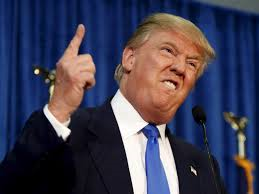
Donald Trump
Even after three COVID-19 vaccines have been developed, millions of Right-wingers refuse to get vaccinated. Although they refuse women the right to abortion, they insist “It’s my body!” when it came to mandatory vaccinations.
As a result, in states won by Trump in the 2020 Presidential election, hospitals surge with unvaccinated COVID-19 patients—and graveyards fill with them.
Every hospital bed taken by an unvaccinated Stormtrumper is a bed denied to a legitimate medical patient—such as a victim of stroke, heart attack, accident or crime.
Yet President Biden has refused to blame those men and women who are directly responsible for this outrage.
Doing so would not only be accurate—it would allow Biden to place blame on his sworn political enemies and thus enhance his own popularity: “We would have achieved freedom from COVID-19—but these people have sabotaged their country’s safety out of sheer selfishness and arrogance!”
Trump viciously attacked the nation’s free press as “the enemy of the American people.” But Biden and his fellow Democrats refuse to blame those most responsible for the nation’s continuing COVID-19 epidemic.
Mistake #3: Failing to put Stormtrumpers’ deaths in perspective
Since the overwhelming numbers of COVID-19 victims are now unvaccinated Stormtrumpers, it’s necessary to view these in a new perspective.
And Biden could—and should—offer that perspective. For example:
“My fellow Americans, tonight I can report to you that the United States is safer today than it has been since 2015. Tens of thousands of men and women, determined to overturn our most basic freedoms, are no longer able to do so.
“They refused to get vaccinated or even wear masks. By denying science and showing utter disregard for their own health and that of their fellow citizens, they chose a path that led directly to their own demise.
“They brought on their own deaths. There is no way to protect people who, through sheer arrogance and/or ignorance, court suicide.
“Moreover, these were people who swore allegiance to a lifelong criminal and would-be dictator who illegally conspired to overturn the verdict of a legitimate election.
“His efforts culminated in an attempted coup against Congressional members counting the electoral votes of the 2020 election.
“Despite this, millions of Fascistic Americans still lust to support their would-be Fuhrer in 2024. Should he once again enter the White House, it’s a certainty he will remain there—as he has so often ‘joked’—as ‘President-for-Life.’
“Just as we don’t grieve for those who supported the foreign terrorism of Osama bin Laden, there is no reason to grieve for those who supported the domestic terrorism of Donald Trump.”
Thus, the self-inflicted removal of Trump supporters can be accurately presented as a victory for democracy.
2003 IRAQ WAR, 9/11 ATTACKS, ABC NEWS, ABORTION, ADOLF HITLER, AL-QAEDA, ALTERNET, AMERICABLOG, ANDREW CUOMO, ANTHONY FAUCI, AP, BABY BOOMER RESISTANCE, BARACK OBAMA, BLOOMBERG, BOB WOODWARD, BRENDA FITZGERALD, BUZZFEED, CARL BERNSTEIN, CBS NEWS, CENTERS FOR DISEASE CONTROL AND PREVENTION (CDC), CHICAGO, CHINA, CLOROX BLEACH, CNN, CORONAVIRUS, COVID-19, COVID-19 TEST KITS, CROOKS AND LIARS, DAILY KOZ, DAVID BROOKS, DEBORAH BIRX, DEPARTMENT OF HOMELAND SECURITY (DHS), DONALD RUMSFELD, DONALD TRUMP, DRUDGE REPORT, EBOLA, FACEBOOK, FEDERAL EMERGENCY MANAGEMENT AGENCY (FEMA), FIVETHIRTYEIGHT, FLORIDA, FORBES, FOX BUSINESS NETWORK, FOX NEWS, FOX NEWS NETWORK, FRANKLIN D. ROOSEVELT, GEORGE W. BUSH, GRETCHEN WHITMER, GROVER NORQUIST, HARPER’S MAGAZINE, HUFFINGTON POST, IMPEACHMENT, JARED KUSHNER, JAY INSLEE, JOE BIDEN, JOHN BOLTON, JOHNSON & JOHNSON VACCINE, KOREAN WAR, KRISTI NOEM, KRISTIN URQUIZA, LARRY HOGAN, LOS ANGELES, LOUIS X1V, LYNDON B. JOHNSON, MALARIA, MARK ANTHONY URQUIZA, MARK SHIELDS, MARYLAND, MASKS, MASSACHUSSETS, MEDIA MATTERS, MICHIGAN, MICK MULVANEY, MIKE PENCE, MODERNA VACCINE, MOLOCH, MOTHER JONES, MOVEON, MSNBC, N95 MASKS, N95 RESPIRATORS, NATIONAL SECURITY COUNSIL (NSC), NAVY SEALS, NBC NEWS, NEW YORK, NEW YORK CITY, NEWSWEEK, NPR, NURSES, OSAMA BIN LADEN, PAULA REID, PBS NEWSHOUR, PERSONAL PROTECTIVE EQUIPMENT (PPE), PFIZER VACCINE, PHOENIX RALLY, POLITICO, POLITICUSUSA, RAW STORY, REPUBLICANS, REUTERS, RICHARD M. NIXON, ROBERT RAY REDFIELD, ROLLING STONE MAGAZINE, RUDOLPH GIULIANI, RUDY GIULIANI, SALON, SCHOOLS, SEAN HANNITY, SEAN HANNITY SHOW, SEATTLE TIMES, SLATE, SOUTH DAKOTA, STEVEN PRESSFIELD, STOCK MARKET, TALKING POINTS MEMO, THE ATLANTIC, THE CHICAGO SUN-TIMES, THE CHICAGO TRIBUNE, THE DAILY BEAST, THE DAILY BLOG, THE GUARDIAN, THE HILL, THE HUFFINGTON POST, THE LOS ANGELES TIMES, THE NATION, THE NATIONAL SECURITY COUNCIL, THE NEW REPUBLIC, THE NEW YORK TIMES, THE VILLAGE VOICE, THE WASHINGTON POST, THE WHITE HOUSE PANDEMIC OFFICE, THINKPROGRESS, THIRD REICH, TIM ZIEMER, TIME, TOLUSE OLORUNNIPA, TOM BOSSERT, TOM FRIEDMAN, TRISH REGAN, TRISH REGAN PRIMETIME, TRUTHDIG, TRUTHOUT, TULSA OKLAHOMA RALLY, TWITTER, TWO POLITICAL JUNKIES, U.S. NEWS & WORLD REPORT, UNITED STATES, UPI, USA TODAY, UV LIGHT, VENDORS, VENTILATORS, VIETNAM WAR, WALTER SHAUB, WASHINGTON, WASHINGTON D.C., WASHINGTON MONTHLY, WASHINGTON WEEK IN REVIEW, WATERGATE, WHITE HOUSE PANDEMIC OFFICE, WONKETTE, WORLD TRADE CENTER
In Bureaucracy, Business, History, Law, Law Enforcement, Politics, Social commentary on November 10, 2021 at 12:13 am
SACRIFICE YOUR CHILDREN FOR ME
On July 10, 2020, Paula Reid, White House correspondent for CBS News, warned on the PBS program, Washington Week.
“But one of the most significant things out of the administration this week is the fact that Dr. [Deborah] Birx [Coronavirus Response Coordinator for the White House Coronavirus Task Force] said that we really don’t have that much data on COVID in children because the under-10 set is really the least tested.”
Just as the ancient Canaanites sacrificed their children to the god Moloch, so President Donald J. Trump expected his followers—and opponents—to risk their children’s lives for him.
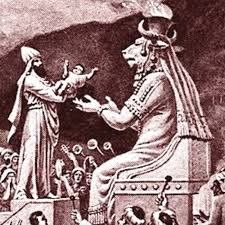
A child sacrifice to Moloch
On August 10, CBS News reported:
“Nearly 100,000 children tested positive for the Coronavirus in the last two weeks of July, a new report from the American Academy of Pediatrics finds. Just over 97,000 children tested positive for the Coronavirus from July 16 to July 30, according to the association.”
By October, 2020, no vaccine had been invented. Nor had a national system of testing or contact tracing.
Hospitals began overflowing with COVID cases. Doctors and nurses were overwhelmed with fatigue. Many of them had become COVID victims.
On October 20, more than 70,450 new coronavirus cases were reported in the United States in a day for the first time.
On October 25, White House chief of staff Mark Meadows told CNN’s Jake Tapper on “State of the Union”: “We are not going to control the pandemic. We are going to control the fact that we get vaccines, therapeutics and other mitigation areas,”
By October 28, more than 8.8 million Americans had been diagnosed with COVID, and at least 227,673 had died from it.
Meanwhile, Trump kept barnstorming the country in a relentless re-election effort. Although infected with COVID-19 in September, he refused to wear a mask in public. His rallies reflected this same contempt for public health, with most attendees refusing to wear masks and/or socially distance.
Critics dubbed these rallies: “Super-spreader events.”
DECLARING VICTORY OVER CORONAVIRUS
In an October 27 press release from the White House Office of Science and Technology Policy., “Advisor to the President” and First Daughter Ivanka Trump noted her father’s signature achievement:
“ENDING THE COVID-19 PANDEMIC. From the outset of the COVID-19 pandemic, the Administration has taken decisive action to engage scientists and health professionals in academia, industry, and government to understand, treat and defeat the disease.”
Ivanka Trump has absolutely no scientific or technology background.
* * * * * * * * * *
Donald Trump has spent his life trading on the greed or fear of others. For example:
- Florida Attorney General Pam Bondi personally solicited a political contribution from Trump around the same time her office deliberated joining an investigation of alleged fraud at Trump University and its affiliates.
- After Bondi dropped the Trump University case against Trump, he wrote her a $25,000 check for her re-election campaign.
- According to an April 14, 2019 story by ABC News, a nationwide review uncovered at least 36 criminal cases where Trump was invoked in direct connection with violent acts, threats of violence or allegations of assault.
- In nine cases, attackers hailed Trump in the midst or immediate aftermath of physically assaulting victims. In 10 more cases, perpetrators cheered or defended Trump while taunting or threatening others. And in another 10 cases, Trump and his rhetoric were cited in court to explain a defendant’s violent or threatening behavior.
But in January, 2020, Trump confronted an enemy—to his re-election—that he couldn’t bribe or intimidate.
Unable to apply his trademark solutions, he was forced to improvise one attempted remedy after another. Chief among these:
- Denial
- Lies
- Extortion
- Propaganda as news
- Attacking science
- Reopening the country
- Resignation.
Ultimately, the virus—far more than Democratic nominee Joseph Biden—proved his fatal enemy.
Millions of Americans didn’t care that Trump had criminally fired an FBI director and tried to coerce the president of Ukraine to smear Biden. Nor that he had antagonized America’s closest allies while paying homage to Russian dictator Vladimir Putin.
But when COVID-19 wiped out their jobs, their children had to stay home because schools were closed, and they couldn’t pay their mortgage, Trump’s “President-for-Life” ambitions were doomed.
One of the harshest—and most poignant—attacks on Donald Trump came on August 17, 2020. It was delivered at the Democratic National Convention by Kristin Urquiza—the daughter of one of Trump’s 2016 supporters.
That supporter, Mark Anthony Urquiza, had died—from COVID-19.

Kristin Urquiza
In early June, he contracted the disease, shortly after Arizona lifted its stay-at-home order. He visited a karaoke bar with friends—and died, alone, after five days on a ventilator.
“My dad, Mark Anthony Urquiza, should be here today, but he isn’t,” Kristin said during a televised segment. “He had faith in Donald Trump.
“He voted for him, listened to him, believed him and his mouthpieces when they said that Coronavirus was under control and going to disappear; that it was OK to end social distancing rules before it was safe; and that if you had no underlying health conditions, you’d probably be fine.
“My dad was a healthy 65-year-old. His only preexisting condition was trusting Donald Trump, and for that he paid with his life.”
That, ultimately, will be the real Trump legacy to America.
2003 IRAQ WAR, 9/11 ATTACKS, ABC NEWS, ABORTION, ADOLF HITLER, AL-QAEDA, ALTERNET, AMERICABLOG, ANDREW CUOMO, ANTHONY FAUCI, AP, BABY BOOMER RESISTANCE, BARACK OBAMA, BLOOMBERG, BOB WOODWARD, BRENDA FITZGERALD, BUZZFEED, CARL BERNSTEIN, CBS NEWS, CENTERS FOR DISEASE CONTROL AND PREVENTION (CDC), CHICAGO, CHINA, CLOROX BLEACH, CNN, CORONAVIRUS, COVID-19, COVID-19 TEST KITS, CROOKS AND LIARS, DAILY KOZ, DAVID BROOKS, DEBORAH BIRX, DEPARTMENT OF HOMELAND SECURITY (DHS), DONALD RUMSFELD, DONALD TRUMP, DRUDGE REPORT, EBOLA, FACEBOOK, FEDERAL EMERGENCY MANAGEMENT AGENCY (FEMA), FIVETHIRTYEIGHT, FLORIDA, FORBES, FOX BUSINESS NETWORK, FOX NEWS, FOX NEWS NETWORK, FRANKLIN D. ROOSEVELT, GEORGE W. BUSH, GRETCHEN WHITMER, GROVER NORQUIST, HARPER’S MAGAZINE, HUFFINGTON POST, IMPEACHMENT, JARED KUSHNER, JAY INSLEE, JOE BIDEN, JOHN BOLTON, JOHNSON & JOHNSON VACCINE, KOREAN WAR, KRISTI NOEM, KRISTIN URQUIZA, LARRY HOGAN, LOS ANGELES, LOUIS X1V, LYNDON B. JOHNSON, MALARIA, MARK ANTHONY URQUIZA, MARK SHIELDS, MARYLAND, MASKS, MASSACHUSSETS, MEDIA MATTERS, MICHIGAN, MICK MULVANEY, MIKE PENCE, MODERNA VACCINE, MOLOCH, MOTHER JONES, MOVEON, MSNBC, N95 MASKS, N95 RESPIRATORS, NATIONAL SECURITY COUNSIL (NSC), NAVY SEALS, NBC NEWS, NEW YORK, NEW YORK CITY, NEWSWEEK, NPR, NURSES, OSAMA BIN LADEN, PAULA REID, PBS NEWSHOUR, PERSONAL PROTECTIVE EQUIPMENT (PPE), PFIZER VACCINE, PHOENIX RALLY, POLITICO, POLITICUSUSA, RAW STORY, REPUBLICANS, REUTERS, RICHARD M. NIXON, ROBERT RAY REDFIELD, ROLLING STONE MAGAZINE, RUDOLPH GIULIANI, RUDY GIULIANI, SALON, SCHOOLS, SEAN HANNITY, SEAN HANNITY SHOW, SEATTLE TIMES, SLATE, SOUTH DAKOTA, STEVEN PRESSFIELD, STOCK MARKET, TALKING POINTS MEMO, THE ATLANTIC, THE CHICAGO SUN-TIMES, THE CHICAGO TRIBUNE, THE DAILY BEAST, THE DAILY BLOG, THE GUARDIAN, THE HILL, THE HUFFINGTON POST, THE LOS ANGELES TIMES, THE NATION, THE NATIONAL SECURITY COUNCIL, THE NEW REPUBLIC, THE NEW YORK TIMES, THE VILLAGE VOICE, THE WASHINGTON POST, THE WHITE HOUSE PANDEMIC OFFICE, THINKPROGRESS, THIRD REICH, TIM ZIEMER, TIME, TOLUSE OLORUNNIPA, TOM BOSSERT, TOM FRIEDMAN, TRISH REGAN, TRISH REGAN PRIMETIME, TRUTHDIG, TRUTHOUT, TULSA OKLAHOMA RALLY, TWITTER, TWO POLITICAL JUNKIES, U.S. NEWS & WORLD REPORT, UNITED STATES, UPI, USA TODAY, UV LIGHT, VENDORS, VENTILATORS, VIETNAM WAR, WALTER SHAUB, WASHINGTON, WASHINGTON D.C., WASHINGTON MONTHLY, WASHINGTON WEEK IN REVIEW, WATERGATE, WHITE HOUSE PANDEMIC OFFICE, WONKETTE, WORLD TRADE CENTER
In Bureaucracy, Business, History, Law, Law Enforcement, Politics, Social commentary on November 9, 2021 at 12:41 am
Once states across the country began “reopening,” President Donald J. Trump scheduled his first 2020 re-election rally in Tulsa, Oklahoma.
DEFYING SCIENCE
Then, to celebrate Independence Day, Trump scheduled yet another rally at Mount Rushmore, in Keystone, South Dakota, on July 3, 2020.
Although health experts expressed fears about large gatherings during the Coronavirus pandemic, South Dakota Governor Kristi Noem said people would “not be social distancing” during the celebration:
“In South Dakota, we’ve told people to focus on personal responsibility….Those who want to come and join us, we’ll be giving out free face masks, if they choose to wear one. But we won’t be social distancing.”
“JUST LIVE WITH IT”
According to a July 3 story by NBC News: “Eager to move forward and reopen the economy amid a recession and a looming presidential election, the White House is now pushing acceptance. ‘The virus is with us, but we need to live with it,’ is how one official said the administration plans to message on the pandemic.”
Administration officials would promote a new study they said showed promising results on therapeutics. They would also emphasize high survival rates, particularly for Americans who were within certain age groups and didn’t have underlying conditions.
On June 30, Dr. Anthony Fauci, director of the U.S. National Institute of Allergy and Infectious Diseases, testified before the U.S. Senate: “We are now having 40-plus thousand new cases a day. I would not be surprised if we go up to 100,000 a day if this does not turn around.”
Fauci warned that the infection surge across the South and West “puts the entire country at risk.” Much of that increase was being fueled by young adults testing positive for COVID-19.
The United States had become the country worst-affected by Coronavirus—with more than 6.88 million Americans diagnosed cases and at least 200,000 deaths.
CHILD SACRIFICES
But Trump wanted children to return to school—and not through virtual classes at home.
And he wasn’t asking parents to send their children back to school after summer. He was ordering them to.
On July 8, 2020, he tweeted that he might withhold federal funding from schools that did not resume in-person classes this fall:
“In Germany, Denmark, Norway, Sweden and many other countries, SCHOOLS ARE OPEN WITH NO PROBLEMS. The Dems think it would be bad for them politically if U.S. schools open before the November Election, but is important for the children & families. May cut off funding if not open!”
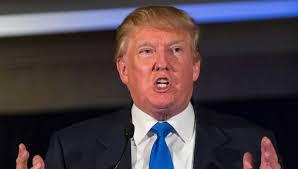
Donald Trump
Most school funding in America comes from states and municipalities, not the federal government. Nonetheless, the White House was exploring ways to use the next Coronavirus relief bill to tie the slice of school funding that did come from Washington to the pace of different schools’ reopenings.
And moments after making that threat, Trump said the guidelines of his own Centers for Disease Prevention and Control (CDC) for safely reopening schools were too expensive and impractical:
“I disagree with @CDCgov on their very tough & expensive guidelines for opening schools. While they want them open, they are asking schools to do very impractical things. I will be meeting with them!!!”
Among those guidelines:
- Schools should have markings on sidewalks and walls, that mark off six feet, and signs reminding students of protective measures.
- Masks should be worn by students and faculty, “as feasible,” and especially when keeping a distance isn’t possible.
- Sharing equipment, games and supplies should be avoided. If that’s not possible, they should be cleaned after each use.
- Playgrounds, cafeterias and dining halls should be shut. Students eat in their classrooms.
- Rooms should be well-ventilated.
- Schools should allow sick staff members to “stay home when they are sick, have been exposed, or caring for someone who is sick,” without being punished for staying home.
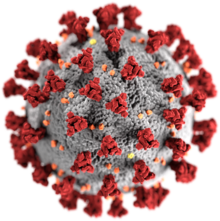
Coronavirus
Many Americans asked: “How can President Trump demand that children return to school in the midst of a deadly plague? Especially when we don’t have adequate testing facilities—and, most importantly, a reliable vaccine?”
There was an answer—and it was brutally ugly.
On July 10, 2020, Paula Reid, White House correspondent for CBS News, provided the answer on the PBS program, Washington Week:
“Well, up until now the administration has really deferred to local leaders to determine when they want to reopen their communities based on the situation on the ground. But then you saw this week, when it comes to schools, the president issuing this broad mandate that all schools must open in the fall or else potentially he will cut funding, when in fact we know most schools are locally funded, and he’s also made other threats.
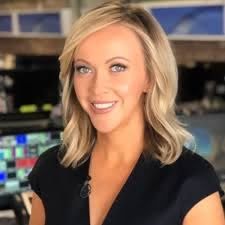
Paula Reid
“He’s made it clear that he is putting pressure on governors, and the question is: Why is he taking this approach to schools specifically when he’s deferred to states on so many other aspects of this pandemic?
“And just speaking with White House advisers, I’m told the president knows that in order to get parents back to work you need to get kids back to class, and for the president a lot of this is about hoping that that would give an economic boost to the U.S. ahead of his reelection in November.”
For which he could then claim credit.
2003 IRAQ WAR, 9/11 ATTACKS, ABC NEWS, ABORTION, ADOLF HITLER, AL-QAEDA, ALTERNET, AMERICABLOG, ANDREW CUOMO, ANTHONY FAUCI, AP, BABY BOOMER RESISTANCE, BARACK OBAMA, BLOOMBERG, BOB WOODWARD, BRENDA FITZGERALD, BUZZFEED, CARL BERNSTEIN, CBS NEWS, CENTERS FOR DISEASE CONTROL AND PREVENTION (CDC), CHICAGO, CHINA, CLOROX BLEACH, CNN, CORONAVIRUS, COVID-19, COVID-19 TEST KITS, CROOKS AND LIARS, DAILY KOZ, DAVID BROOKS, DEBORAH BIRX, DEPARTMENT OF HOMELAND SECURITY (DHS), DONALD RUMSFELD, DONALD TRUMP, DRUDGE REPORT, EBOLA, FACEBOOK, FEDERAL EMERGENCY MANAGEMENT AGENCY (FEMA), FIVETHIRTYEIGHT, FLORIDA, FORBES, FOX BUSINESS NETWORK, FOX NEWS, FOX NEWS NETWORK, FRANKLIN D. ROOSEVELT, GEORGE W. BUSH, GRETCHEN WHITMER, GROVER NORQUIST, HARPER’S MAGAZINE, HUFFINGTON POST, IMPEACHMENT, JARED KUSHNER, JAY INSLEE, JOE BIDEN, JOHN BOLTON, JOHNSON & JOHNSON VACCINE, KRISTI NOEM, KRISTIN URQUIZA, LARRY HOGAN, LOS ANGELES, LOUIS X1V, LYNDON B. JOHNSON, MALARIA, MARK ANTHONY URQUIZA, MARK SHIELDS, MARYLAND, MASKS, MASSACHUSSETS, MEDIA MATTERS, MICHIGAN, MICK MULVANEY, MIKE PENCE, MODERNA VACCINE, MOLOCH, MOTHER JONES, MOVEON, MSNBC, N95 MASKS, N95 RESPIRATORS, NATIONAL SECURITY COUNSIL (NSC), NAVY SEALS, NBC NEWS, NEW YORK, NEW YORK CITY, NEWSWEEK, NPR, NURSES, OSAMA BIN LADEN, PAULA REID, PBS NEWSHOUR, PERSONAL PROTECTIVE EQUIPMENT (PPE), PFIZER VACCINE, PHOENIX RALLY, POLITICO, POLITICUSUSA, RAW STORY, REPUBLICANS, REUTERS, RICHARD M. NIXON, ROBERT RAY REDFIELD, ROLLING STONE MAGAZINE, RUDOLPH GIULIANI, RUDY GIULIANI, SALON, SCHOOLS, SEAN HANNITY, SEAN HANNITY SHOW, SEATTLE TIMES, SLATE, SOUTH DAKOTA, STOCK MARKET, TALKING POINTS MEMO, THE ATLANTIC, THE CHICAGO SUN-TIMES, THE CHICAGO TRIBUNE, THE DAILY BEAST, THE DAILY BLOG, THE GUARDIAN, THE HILL, THE HUFFINGTON POST, THE LOS ANGELES TIMES, THE NATION, THE NATIONAL SECURITY COUNCIL, THE NEW REPUBLIC, THE NEW YORK TIMES, THE VILLAGE VOICE, THE WASHINGTON POST, THE WHITE HOUSE PANDEMIC OFFICE, THINKPROGRESS, THIRD REICH, TIM ZIEMER, TIME, TOLUSE OLORUNNIPA, TOM BOSSERT, TOM FRIEDMAN, TRISH REGAN, TRISH REGAN PRIMETIME, TRUTHDIG, TRUTHOUT, TULSA OKLAHOMA RALLY, TWITTER, TWO POLITICAL JUNKIES, U.S. NEWS & WORLD REPORT, UNITED STATES, UPI, USA TODAY, UV LIGHT, VENDORS, VENTILATORS, VIETNAM WAR, WALTER SHAUB, WASHINGTON, WASHINGTON D.C., WASHINGTON MONTHLY, WASHINGTON WEEK IN REVIEW, WATERGATE, WHITE HOUSE PANDEMIC OFFICE, WONKETTE, WORLD TRADE CENTER
In Bureaucracy, Business, History, Law, Law Enforcement, Politics, Social commentary on November 8, 2021 at 12:12 am
THE DANGERS OF TRUMP’S QUACKERY
On April 23, 2020, President Donald Trump offered his own suggestions for how COVID-19 might be prevented or cured. His proposed remedies: Ultraviolet light and disinfectant.
Medical experts found Trump’s off-the-cuff remarks no laughing matter. Several doctors warned the public against injecting disinfectant or using UV light.
“It is incomprehensible to me that a moron like this holds the highest office in the land and that there exist people stupid enough to think this is OK,” said Walter Shaub, the former director of the Office of Government Ethics. “I can’t believe that in 2020 I have to caution anyone listening to the president that injecting disinfectant could kill you.”
Faced with public ridicule, Trump canceled a White House press briefing for the first time since Easter weekend.
In a self-pitying tweet, on April 25, he wrote: “What is the purpose of having White House News Conferences when the Lamestream Media asks nothing but hostile questions, & then refuses to report the truth or facts accurately.”
The Centers for Disease Control and Prevention (CDC) had urged Americans to wear masks and keep at least six feet from their fellows. And most of the nation’s governors had issued stay-at-home orders that banned large gatherings—including visits to parks and beaches.
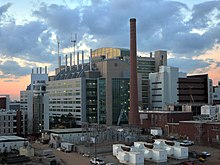
CDC headquarters in Atlanta, Georgia
TRUMP’S DEFIANCE OF SCIENCE–AND LAW
Yet President Trump openly encouraged defiance of those orders.
On April 17, he issued a series of tweets to his supporters, encouraging them to defy the law:
“LIBERATE MINNESOTA!”
“LIBERATE MICHIGAN!”
“LIBERATE VIRGINIA, and save your great 2nd Amendment. It is under siege!”
All these states had Democratic governors. Their residents were being urged to stay indoors, wear masks when they ventured outside and keep a six-feet distance between themselves and others.
These states had been targeted for Right-wing protests—featuring large numbers of men and women standing close together, with most of them not wearing masks. They claim their “freedoms” are being infringed upon.
On April 17, Trump launched his latest effort to deal with Coronavirus:
He issued a series of tweets to his supporters, encouraging them to defy the stay-at-home laws of Minnesota, Michigan and Virginia.
Trump saw the stay-at-home orders as a two-fold threat to himself:
- He couldn’t return to his hate-filled rallies until these were lifted; and
- The stock market wouldn’t start soaring again so long as the country was “locked down.”
Without his Nuremberg-style rallies and a roaring stock market, Trump faced the danger of being a one-term President.
Michigan, Minnesota and Virginia all had Democratic governors. They had urged their residents to stay indoors, wear masks when they ventured outside, and keep a six-feet distance between themselves and others.
As a result, those governors—especially Michigan’s Gretchen Whitmer—were being targeted for abuse and even death threats. And their states were facing disruptive protests by large numbers of Right-wingers standing close together, with few of them wearing masks. The protesters claimed their rights were being infringed upon.
Since the Supreme Court legalized abortion in 1973, the Right has demanded that even women who are pregnant due to rape or incest carry the fetus to term. Yet now that Right-wingers were being asked to wear masks in public—to protect themselves and others from a deadly plague—they had suddenly discovered the mantra: “It’s my body!”
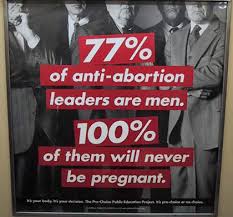
Writer Steven Pressfield summed up the immorality of these protests: “Why are we asked to wear surgical or face masks in public, to practice social distancing and to observe self-quarantining? Because these practices are not for the individual alone but for the protection of the whole [community].”
Washington Governor Jay Inslee tweeted: “The president’s statements this morning encourage illegal and dangerous acts. He is putting millions of people in danger of contracting COVID-19.
“His unhinged rantings and calls for people to ‘liberate’ states could also lead to violence. We’ve seen it before.”
Once states across the country began “reopening,” Trump scheduled his first 2020 re-election rally in Tulsa, Oklahoma.
It was held on June 20 at the BOK Center.
Scientists had learned that Coronavirus is more likely to be transmitted indoors than outdoors, when masses of people are packed together, and when people are loudly talking—or, worse, shouting. This is especially true when they’re not wearing masks.
Masks were available for those who wanted them, but Trump made it clear that his supporters shouldn’t wear masks, as a sign of support for him. Thus, his egomania literally put the lives of his most devoted followers at risk.
Photos of the rally showed men and women densely packed together, with none of them wearing masks.
The Trump campaign boasted that 100,000 people would turn up. To its embarrassment, fewer than 6,200 did. Even worse: At least eight event staff members, including two who were at the rally, later tested positive for COVID-19.
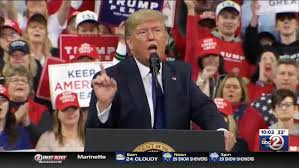
A Trump rally
The Tulsa event was followed by another indoor rally in Phoenix on June 23. “Students for Trump” featured a packed crowd, with almost no one wearing masks.
Then, to celebrate Independence Day, Trump scheduled yet another rally at Mount Rushmore, in Keystone, South Dakota, on July 3.
2003 IRAQ WAR, 9/11 ATTACKS, ABC NEWS, ABORTION, ADOLF HITLER, AL-QAEDA, ALTERNET, AMERICABLOG, ANDREW CUOMO, ANTHONY FAUCI, AP, BABY BOOMER RESISTANCE, BARACK OBAMA, BLOOMBERG, BOB WOODWARD, BRENDA FITZGERALD, BUZZFEED, CARL BERNSTEIN, CBS NEWS, CENTERS FOR DISEASE CONTROL AND PREVENTION (CDC), CHICAGO, CHINA, CLOROX BLEACH, CNN, CORONAVIRUS, COVID-19, COVID-19 TEST KITS, CROOKS AND LIARS, DAILY KOZ, DAVID BROOKS, DEBORAH BIRX, DEPARTMENT OF HOMELAND SECURITY (DHS), DONALD TRUMP, DRUDGE REPORT, EBOLA, FACEBOOK, FEDERAL EMERGENCY MANAGEMENT AGENCY (FEMA), FIVETHIRTYEIGHT, FLORIDA, FORBES, FOX BUSINESS NETWORK, FOX NEWS, FOX NEWS NETWORK, FRANKLIN D. ROOSEVELT, GEORGE W. BUSH, GRETCHEN WHITMER, GROVER NORQUIST, HARPER’S MAGAZINE, HUFFINGTON POST, IMPEACHMENT, JARED KUSHNER, JAY INSLEE, JOE BIDEN, JOHN BOLTON, JOHNSON & JOHNSON VACCINE, KRISTI NOEM, KRISTIN URQUIZA, LARRY HOGAN, LOS ANGELES, LOUIS X1V, LYNDON B. JOHNSON, MALARIA, MARK ANTHONY URQUIZA, MARK SHIELDS, MARYLAND, MASKS, MASSACHUSSETS, MEDIA MATTERS, MICHIGAN, MICK MULVANEY, MIKE PENCE, MODERNA VACCINE, MOLOCH, MOTHER JONES, MOVEON, MSNBC, N95 MASKS, N95 RESPIRATORS, NATIONAL SECURITY COUNSIL (NSC), NAVY SEALS, NBC NEWS, NEW YORK, NEW YORK CITY, NEWSWEEK, NPR, NURSES, OSAMA BIN LADEN, PAULA REID, PBS NEWSHOUR, PERSONAL PROTECTIVE EQUIPMENT (PPE), PFIZER VACCINE, PHOENIX RALLY, POLITICO, POLITICUSUSA, RAW STORY, REPUBLICANS, REUTERS, RICHARD M. NIXON, ROBERT RAY REDFIELD, ROLLING STONE MAGAZINE, RUDOLPH GIULIANI, RUDY GIULIANI, SALON, SCHOOLS, SEAN HANNITY, SEAN HANNITY SHOW, SEATTLE TIMES, SLATE, SOUTH DAKOTA, STOCK MARKET, TALKING POINTS MEMO, THE ATLANTIC, THE CHICAGO SUN-TIMES, THE CHICAGO TRIBUNE, THE DAILY BEAST, THE DAILY BLOG, THE GUARDIAN, THE HILL, THE HUFFINGTON POST, THE LOS ANGELES TIMES, THE NATION, THE NATIONAL SECURITY COUNCIL, THE NEW REPUBLIC, THE NEW YORK TIMES, THE VILLAGE VOICE, THE WASHINGTON POST, THE WHITE HOUSE PANDEMIC OFFICE, THINKPROGRESS, THIRD REICH, TIM ZIEMER, TIME, TOLUSE OLORUNNIPA, TOM BOSSERT, TOM FRIEDMAN, TRISH REGAN, TRISH REGAN PRIMETIME, TRUTHDIG, TRUTHOUT, TULSA OKLAHOMA RALLY, TWITTER, TWO POLITICAL JUNKIES, U.S. NEWS & WORLD REPORT, UNITED STATES, UPI, USA TODAY, UV LIGHT, VENDORS, VENTILATORS, VIETNAM WAR, WALTER SHAUB, WASHINGTON, WASHINGTON D.C., WASHINGTON MONTHLY, WASHINGTON WEEK IN REVIEW, WATERGATE, WHITE HOUSE PANDEMIC OFFICE, WONKETTE, WORLD TRADE CENTER
In Bureaucracy, Business, History, Law, Law Enforcement, Politics, Social commentary on November 5, 2021 at 12:35 am
The Trump administration seized vitally-needed medical supplies in at least seven states. FEMA did not publicly report the thefts, despite the outlay of millions of dollars of taxpayer money. Nor did the administration explain how it decided which supplies to seize and where to reroute them.

SEIZING STATES’ MEDICAL SUPPLIES
The Federal Government did not inform states whose supplies it seized if they would receive the materials they ordered and paid for. That fueled concerns about whether the Trump administration was fairly distributing scarce medical supplies.
“We can’t get any answers,” said a California hospital official who asked not to be identified for fear of retaliation from the White House.
President Donald Trump said it was the states’ responsibility to obtain critically-needed medical supplies. But when they weren’t outbid by the Federal Government, hospital systems and states found their shipments of medical supplies seized with no explanation.
Where did those supplies go?
To China?
To Trump’s private warehouses?
To Jared Kushner, Trump’s son-in-law, for sale on the black market?
No one as yet knows.
A March 2 Washington Monthly story concluded ominously: “What if the White House simply gives all the masks and ventilators to red states and counties, leaving blue ones to struggle? What mechanisms of accountability are left?
“U.S. democracy wasn’t set up to deal with a president openly behaving like a James Bond villain while being protected by a political party behaving more like a mafia than a civic institution.”
PROPAGANDA AS “NEWS”
After Easter weekend, Trump began holding daily press briefings at the White House.
Their official purpose: To update the country on the administration’s ongoing response to the Coronavirus pandemic.
Their real purpose: To serve as a substitute for Trump’s hate-filled political rallies, which resembled those staged by Germany’s Fuhrer, Adolf Hitler, at Nuremberg.
These had been temporarily cancelled due to demands for social distancing to stem the rising tide of the COVID-19 pandemic. That had been Trump’s primary reason for seeking to end social distancing.
The White House tried hard to stage-manage these appearances. For example, on April 14, 2020, Trump interrupted the question-and-answer session by cutting to a White House-produced video to try to shame the media for critical coverage of his response to the crisis.
On April 26, The New York Times ran a story entitled: “Self-praise, hubris and self-pity: Examining 260,000 words about the Coronavirus from President Trump.” Summing up the image that Trump has tried to present of himself to the world, the Times concluded:
“The self-regard, the credit-taking, the audacious rewriting of recent history to cast himself as the hero of the pandemic rather than the president who was slow to respond: Such have been the defining features of Trump’s use of the bully pulpit during the coronavirus outbreak….
“By far the most recurring utterances from Trump in the [White House] briefings are self-congratulations, roughly 600 of them, which are often predicated on exaggerations and falsehoods….
“Trump’s attempts to display empathy or appeal to national unity (about 160 instances) amount to only a quarter of the number of times he complimented himself or a top member of his team.”
QUACKERY AS “MEDICINE”
On April 23, Trump ventured into the equivalent of a PR minefield—and stepped on a mine of his own making.
After musing on new government research into how the virus reacts to different temperatures, climates and surfaces, Trump said: “So I asked Bill [William N. Bryan, acting Under Secretary for Science and Technology at the Department of Homeland Security] a question….
“So, supposing we hit the body with a tremendous—whether it’s ultraviolet or just very powerful light—and I think you said that that hasn’t been checked, but you’re going to test it. And then I said, supposing you brought the light inside the body, which you can do either through the skin or in some other way, and I think you said you’re going to test that too. It sounds interesting.
“And then I see the disinfectant, where it knocks it out in a minute. One minute! And is there a way we can do something like that, by injection inside or almost a cleaning. Because you see it gets in the lungs and it does a tremendous number on the lungs. So it would be interesting to check that. So, that, you’re going to have to use medical doctors with. But it sounds interesting to me.”
Trump was clearly seeking agreement with his latest medical theory. But Dr. Deborah Birx, the Coronavirus Task Force response coordinator, remained silent.
The Internet—and medical experts—did not.
On Twitter—the social media platform Trump routinely uses to attack everyone he hates—his suggestion that injecting disinfectants could treat Coronavirus drew scorn and ridicule.
One tweet showed Trump as a doctor hovering over a patient and saying: “Once I’ve pumped you full of disinfectant, I’ll zap you with this UV torch until you’re cured.”
Another meme featured Trump as Marie Antoinette saying: “Let them eat Clorox.”
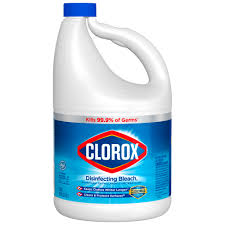
Medical experts found Trump’s off-the-cuff remarks no laughing matter. Several doctors warned the public against injecting disinfectant or using UV light.


ABC NEWS, ADOLF HITLER, ALTERNET, AMERICABLOG, AP, BABY BOOMER RESISTANCE, BETSY DEVOS, BLACKWATER, BLOOMBERG, BUZZFEED, CBS NEWS, CENTERS FOR DISDEASE CONTROL AND PREVENTION (CDC), CNN, CORONAVIRUS, COVID-19, CROOKS AND LIARS, DAILY KOZ, DONALD TRUMP, DRUDGE RETORT, ERIK PRINCE, FACEBOOK, FIVETHIRTYEIGHT, GRETCHEN WHITMER, HARPER’S MAGAZINE, HUNTINGTON BEACH, LUNG CANCER, MEDIA MATTERS, MICHIGAN CONSERVATIVE COALITION, MOTHER JONES, MOVEON, MSNBC, NBC NEWS, NEWSWEEK, NPR, NUREMBERG RALLIES, PBS NEWSHOUR, POLITICO, POLITICUSUSA, RAW STORY, REUTERS, RUSH LIMBAUGH, SALON, SEATTLE TIMES, SLATE, STAY-AT-HOME ORDERS, TALKING POINTS MEMO, THE ATLANTIC, THE CHICAGO SUN-TIMES, THE CHICAGO TRIBUNE, THE DAILY BEAST, THE DAILY BLOG, THE GUARDIAN, THE HILL, THE HUFFINGTON POST, THE LOS ANGELES TIMES, THE NATION, THE NEW REPUBLIC, THE NEW YORK TIMES, THE VILLAGE VOICE, THE WASHINGTON POST, THINKPROGRESS, TIME, TRUTHDIG, TRUTHOUT, TWITTER, TWO POLITICAL JUNKIES, U.S. NEWS & WORLD REPORT, UPI, USA TODAY, WONKETTE
DOWN WITH SCIENCE! GIVE ME DEATH!
In Bureaucracy, History, Law, Law Enforcement, Medical, Politics, Social commentary on December 24, 2021 at 12:14 amOn April 17, 2020, more than 100 protesters converged on Huntington Beach, California, in a demonstration against the state’s Coronavirus stay-at-home order.
It was part of a series of national demonstrations organized by Right-wing groups.
Many of the protesters carried Donald Trump banners and American flags. Most were not wearing masks or practicing social distancing—keeping themselves at least six feet apart from others. And they defied scientific findings and medical experts’ warnings, as if daring the virus to “come and get me.”
“I don’t think there’s any reason for us to be on lockdown now,” said 62-year-old Paula Doyle. “We didn’t have any dangers; we have no danger in our hospitals now of overflowing.”
That’s because California’s quick closure of businesses and its order that residents stay home had temporarily prevented Coronavirus from reaching epic proportions in the state. Many hospitals had been left largely empty, waiting for a surge that had yet to come.
On April 18, when more than 31,000 Americans lay dead of the Coronavirus, and more than 90% of the country was under stay-at-home orders. demonstrations erupted across the United States.
Anti-lockdown demonstration at the Ohio Statehouse
Becker1999 from Grove City, OH, CC BY 2.0 <https://creativecommons.org/licenses/by/2.0>, via Wikimedia Commons
More than 250 people showed up at Austin, Texas. Other protests occurred at the capitols of Minnesota, Michigan and Virginia. An estimated 400 people gathered in Concord, New Hampshire. A rally outside Maryland’s statehouse in Annapolis drew about 200 protesters.
President Donald Trump had been the primary instigator of such protests. He said he favored a quick return to normal practices and the reopening of businesses across the country.
But what he favored most of all was a return to his Nuremberg-like political rallies, where he could bask in the worship of his fanatical base and hurl slanders at virtually everyone he hated. And he couldn’t do that so long as mass demonstrations were banned—and people must stand at least six feet apart.
There are two factors to these protests that are truly astounding.
First, many of the protesters attacked the governors who had issued stay-at-home orders as fascists. This is a hallmark of Right-wing politics—accusing their opponents of being what they are themselves.
One protester at the Huntington Beach demonstration carried a sign that read: “Defy Fascist Lockdown.”
COVID-19 virus
And Michigan Democratic Governor Gretchen Whitmer, who had defied the Republican legislature by extending her stay-at-home order, was denounced as a Nazi, with protesters displaying signs like “Heil Whitmer.”
Second, the protesters utterly rejected the rising death-toll caused by the virus. At that time, this stood at 80,574.
Medical experts universally warned that stopping the chain of transmission to avoid overwhelming medical systems was the only way to buy time while treatments and vaccines could be developed.
Yet for these protesters, it’s as if the rising body count wasn’t happening.
Some of the rallies were being pushed by Republican-allied groups in battleground states with Democratic governors.
The April 30 protest at the Michigan Capitol Building featured treasonous Confederate flags and hangman’s nooses. Some signs displayed swastikas. Many of the demonstrators were armed with AK-47s.
That protest was organized by the Michigan Conservative Coalition, a group co-founded by a GOP state representative and his wife, who was on the advisory board for an official Trump campaign group called Women for Trump and was the co-founder of Michigan Trump Republicans.
Another of the event’s promoters, Greg McNeilly, was a longtime political adviser to the wealthy DeVos family, which included then-Secretary of Education Betsy DeVos and her brother, Erik Prince, founder of the notorious Blackwater mercenary group.
On May 1, 2020, Trump tweeted in support of the Michigan demonstrators. “These are very good people, but they are angry. They want their lives back again, safely! See them, talk to them, make a deal.”
Republicans’ disdain for education in general—and science in particular—has led to the following: In March, 2020, an NBC News poll found that only 30% of Republicans said that they would actually listen to the advice of doctors to stay away from large, crowded areas to avoid Coronavirus.
These are the same people who get their version of reality from Right-wing sources like Fox News Network and Rush Limbaugh.
Rush Limbaugh
On his March 27 show, Limbaugh dismissed Coronavirus as “the common cold,” then added: “We didn’t elect a president to defer to a bunch of health experts that we don’t know.
“And how do we know they’re even health experts? Well, they wear white lab coats, and they’ve been in the job for a while, and they’re at the CDC [Centers for Disease Control and Prevention] and they’re at the NIH [National Institutes of Health] and they’re up, well—yeah, they’ve been there, and they are there.”
In 2015, Limbaugh said: “Firsthand smoke takes 50 years to kill people, if it does. Not everybody that smokes gets cancer. Now, it’s true that everybody who smokes dies, but so does everyone who eats carrots.”
Five years later, on February 17, 2021, Limbaugh—a longtime and heavy cigar smoker—died of Stage Four lung cancer.
And today, thanks to the legacy of Trump and his Republican allies, more than 800,000 Americans are dead of COVID.
Share this: