A truly great man is ever the same under all circumstances. And if his fortune varies, exalting him at one moment and oppressing him at another, he himself never varies, but always preserves a firm courage, which is so closely interwoven with his character that everyone can readily see that the fickleness of fortune has no power over him.
–Niccolo Machiavelli, The Discourses
For President Barack Obama, the last two months of his eight-year Presidency will be an agony.
Perhaps only his wife, Michelle, truly knows the torments he will so stoically endure.
For stoicism–enduring pain or hardship without complaint or showing emotions–has long been central to Obama’s character.
In 2011, two years into his Presidency, he faced an accusation never before leveled against an American President: That he was not an American citizen–and thus not entitled to hold the office he held.
His accuser-in-chief: Donald Trump, an egomaniacal, thrice-married “reality-TV” host and real estate mogul who had filed for corporate bankruptcy four times.
At first Obama ignored the accusation, assuming it was so ridiculous no one could believe it. But, promoted by Right-wing Fox News and Republican leaders, millions of Fascistic Americans thought it actually might be true.
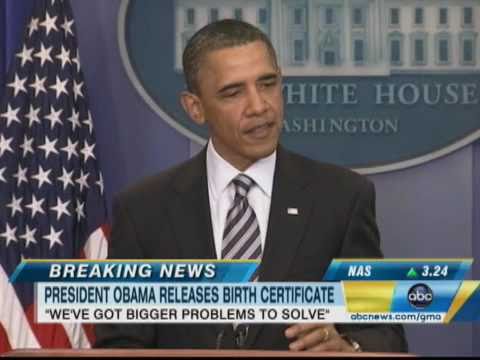
So, on April 27, 2011, the President called a press conference–where he released the long-form version of his Hawaii birth certificate.
President Obama’s birth certificate
“We do not have time for this kind of silliness,” said Obama, speaking as a father might to a roomful of spiteful children. “We have better stuff to do. I have got better stuff to do. We have got big problems to solve.
“We are not going to be able to do it if we are distracted, if we spend time vilifying each other, if we just make stuff up and pretend that facts are not facts.”
And on May 1, the President announced the solving of one of those “big problems”: Osama bin Laden, mastermind of the September 11, 2001 terrorist attacks, had been tracked down and shot dead by elite U.S. Navy SEALS in Pakistan.
To understand Obama’s agony as he ends his term, imagine the following alternate history:
On April 14, 1865, the slavery-sympathizing actor John Wilkes Booth enters Ford’s Theater in Washington, D.C.
His mission: Assassinate President Abraham Lincoln.
Armed with a knife and Derringer, he reaches the unguarded Presidential box. But just as he’s about to push open the door to his–and Lincoln’s–destiny, he halts.
He’s just thought of a more monstrous fate for the President.
Silently, he leaves the theater–and the world never learns how close Lincoln came to death at the hands of an assassin.
Instead, Booth waits out the next four years–until the election of 1868, when Lincoln’s second term is up.
Lincoln has chosen Andrew Johnson, his Vice President, to succeed him.
For the outgoing President, it’s more than a matter of politics. A Johnson victory will secure the legacies Lincoln has created during the last eight years:
- The Thirteenth Amendment, which bans slavery.
- The stationing of Union troops in the South, to ensure that blacks are not re-enslaved.
- The granting of the vote to blacks.
But Johnson is a lackluster candidate, and, after eight years of war and Reconstruction, Americans are eager for “change.”
Suddenly, an unexpected challenger steps forward: The celebrated Shakespearean actor John Wilkes Booth!
Booth promises that, if elected, he will overturn everything Lincoln has done–most especially the Thirteenth Amendment.
He’ll tear up the surrender treaty that officially ended the Civil War and let the Southern states restore the Confederacy.
His campaign slogan: “Let America Enslave Again.”
He calls the President an ape, a buffoon, a dictator with the blood of countless Americans on his hands.
Newspaper reporters covering Johnson often fall asleep during his speeches. Booth whips up his audiences without even trying.
John Wilkes Booth
On November 4, 1868, John Wilkes Booth becomes the seventeenth President of the United States.
It won’t be until 1933 that Presidents begin taking the Oath of Office on January 20. So Abraham Lincoln will remain President until March 4, 1869.
Meanwhile, John Wilkes Booth has never held public office. He needs to pick a cabinet and learn the basics of what it means to be President.
And only one man is qualified to teach him–the man who now holds that office.
Lincoln knows that, in only a matter of months, everything he has worked for will be ruthlessly overturned. Like a beautiful garment pulled apart, thread by thread, until nothing is left but a pile of rubbish on the floor.
But he is a patriot, and a believer in destiny. Fate–or God–has thrust him into the Presidency. And he will carry out the duties that go with that role, however tormenting they now are, right to the end.
He hopes that Divine Providence will bestow a bright future on his beloved country, however bleak its present now looks.
* * * * *
When Barack Obama entered the White House in 2009, he couldn’t imagine spending his last two months in office tutoring the man who had reviled him throughout his Presidency.
It will be his last gift as President to a nation that has often proved ungrateful for his dedicated service.


_(cropped).jpg)


 Bureaucracybuster's Blog
ABC NEWS, AMERICAN TABLOID, ANTI-CASTRO CUBANS, ASSASSINATION, CBS NEWS, CIA, CNN, COMMUNISM, CUBA, CUBAN MISSILE CRISIS, DONALD TRUMP, DWIGHT D. EISENHOWER, FACEBOOK, FBI, FIDEL CASTRO, FLORIDA, FULGENCIO BATISTA, GUS RUSSO, JACK RUBY, JAMES ELLROY, JOHN F. KENNEDY, JOHNNY ROSELLI, LEE HARVEY OSWALD, LIVE BY THE SWORD, LYNDON B. JOHNSON, MAFIA, MARCO RUBIO, NBC NEWS, NIKITA KHRUSHCHEV, ROBERT F. KENNEDY, SAM GIANCANA, THE CHICAGO SUN-TIMES, THE CHICAGO TRIBUNE, THE LOS ANGELES TIMES, THE NEW YORK TIMES, THE WASHINGTON POST, TWITTER, WARREN COMMISSION
AMERICA’S POISONED CUBAN LEGACY: PART ONE (OF FOUR)
In Bureaucracy, History, Military, Politics, Social commentary on November 29, 2016 at 12:08 amOn November 25, Fidel Castro, Cuba’s longtime “Maximum Leader,” died at the age of 90.
Old age and disease finally achieved what years of plotting by CIA and Mafia assassins could not.
To his supporters he was a tireless champion of the poor and a foe of American imperialism. To his enemies he was a ruthless dictator who drove his country to economic ruin in the name of a failed ideology–communism.
His reign began on January 1, 1959, when he swept triumphantly into Havana after a two-year guerrilla campaign against Cuban dictator Fulgencio Batista.
Fidel Castro
Almost immediately, hundreds of thousands of Cubans began fleeing to America. The first émigrés were more than 215,000 Batista followers. The exodus increased, peaking at approximately 78,000 in 1962.
In October, 1962, Castro stopped regularly scheduled travel between the two countries, and asylum seekers began sailing from Cuba to Florida.
Between 1962 and 1979, hundreds of thousands of Cubans entered the United States under the Attorney General’s parole authority.
By 2008, more than 1.24 million Cubans were living in the United States, mostly in South Florida, where the population of Miami was about one-third Cuban. Their sheer numbers transformed the state’s political, economic and cultural life. And not entirely for the better.
Many of these Cubans viewed themselves as political exiles, rather than immigrants, hoping to eventually return to Cuba after its Communist regime fell from power.
The large number of Cubans in South Florida, particularly in Miami’s “Little Havana,” allowed them to preserve their culture and customs to a degree rare for immigrant groups.
With so many discontented immigrants concentrated in Florida, they became a potential force for politicians to court.
And the issue guaranteed to sway their votes was unrelenting hostility to Castro. Unsurprisingly, most of their votes went to Right-wing Republicans.
John F. Kennedy was the first President to face this dilemma.
During the closing months of the administration of President Dwight D. Eisenhower, the CIA had begun training Cuban exiles for an invasion of their former homeland.
The exiles’ goal: To do what Castro had done–seek refuge in the mountains and launch a successful anti-Castro revolution.
But word of the coming invasion quickly leaked: The exiles were terrible secret-keepers. (A joke at the CIA went: “A Cuban thinks a secret is something you tell to only 300 people.”)
Kennedy insisted the invasion must appear to be an entirely Cuban enterprise. He refused to commit U.S. Marines and Air Force bombers.
More than 1,400 invaders landed on April 17, 1961 at the Bay of Pigs–and were quickly overwhelmed, with hundreds of the men taken prisoner.
Kennedy publicly took the blame for its failure: “Victory has a hundred fathers but defeat is an orphan.” But privately he seethed, and ordered the CIA to redouble its efforts to remove Castro at all costs.
To make certain his order was carried out, he appointed his brother, Robert–then Attorney General–to oversee the CIA’s “Castro removal” program.
Robert F. Kennedy and John F. Kennedy
It’s here that America’s obsession with Cuba entered its darkest and most disgraceful period.
The CIA and the Mafia entered into an unholy alliance to assassinate Castro–each for its own benefit:
The CIA supplied poisons and explosives to various members of the Mafia. It was then up to the mobsters to assassinate Castro.
The CIA asked Johnny Roselli, a mobster linked to the Chicago syndicate, to go to Florida in 1961 and 1962 to organize assassination teams of Cuban exiles. They were to infiltrate their homeland and assassinate Castro.
Johnny Roselli
Rosselli called upon two other crime figures: Chicago Mafia boss Sam Giancana and Santos Trafficante, the Costra Nostra chieftain for Tampa, for assistance.
Sam Giancana
Giancana, using the name “Sam Gold” in his dealings with the CIA, was meanwhile being hounded by the FBI on direct orders of Attorney General Robert Kennedy.
The mobsters were authorized to offer $150,000 to anyone who would kill Castro and were promised any support the Agency could yield.
Giancana was to locate someone who was close enough to Castro to be able to drop pills into his food. Trafficante would serve as courier to Cuba, helping to make arrangements for the murder on the island.
Rosselli was to be the main link between all of the participants in the plot.
The available sources disagree on what actually happened. Some believe that the Mob made a genuine effort to “whack” Fidel.
Others are convinced the mobsters simply ran a scam on the government. They pretended to carry out their “patriotic duty” while in fact making no effort at all to penetrate Castro’s security.
The CIA’s war against Castro was known as Operation Mongoose–the mongoose being a traditional enemy of the cobra. And those entrusted with this assignment were known as the Special Group.
“We were hysterical about Castro at about the time of the Bay of Pigs and thereafter,” Secretary of Defense Robert S. McNamara later testified before Congress about these efforts. “And there was pressure from JFK and RFK to do something about Castro.”
Share this: