Archive for the ‘Military’ Category
ABC NEWS, ADOLF HITLER, ALBERT SPEER, ALTERNET, AMERICABLOG, AP, BABY BOOMER RESISTANCE, BBC, BETRAYAL, BIBLES, BLOOMBERG, BUZZFEED, CBS NEWS, CHINA, CNN, CROOKS AND LIARS, DAILY KOS, DONALD TRUMP, ERICH VON MANSTEIN, FBI, FIVETHIRTYEIGHT, FRANCE, HARPER’S MAGAZINE, HUFFINGTON POST, JAMES COMEY, JOSEPH R. MCCARTHY, MAGINOT LINE, MEDIA MATTERS, MICHAEL COHEN, MOTHER JONES, MOVEON, MSNBC, MUGS, NAZI GERMANY, NBC NEWS, NEW REPUBLIC, NEWSDAY, NEWSWEEK, NPR, PBS NEWSHOUR, PEW RESEARCH CENTER, POLITICO, POLITICUSUSA, RAW STORY, REUTERS, ROY COHN, SALON, SEATTLE TIMES, SLATE, SNEAKERS, SOVIET UNION, T-SHIRTS, TALKING POINTS MEMO, THE ATLANTIC, THE CHICAGO SUN-TIMES, THE CHICAGO TRIBUNE, THE DAILY BEAST, THE DAILY BLOG, THE GUARDIAN, THE HILL, THE HUFFINGTON POST, THE INTERCEPT, THE IRAN NUCLEAR DEAL, THE LOS ANGELES TIMES, THE NATION, THE NEW REPUBLIC, THE NEW YORK TIMES, THE NEW YORKER, THE PARIS AGREEMENT, THE VILLAGE VOICE, THE WASHINGTON POST, THE WEEK, THINKPROGRESS, TIME, TRANS-PACIFIC PARTNERSHIP, TRUTHDIG, TRUTHOUT, TWO POLITICAL JUNKIES, U.S. NEWS & WORLD REPORT, UPI, USA TODAY, WORLD WAR 11, X
In Bureaucracy, History, Law, Law Enforcement, Military, Politics, Social commentary on November 18, 2024 at 12:10 am
On January 27, 1944, Adolf Hitler convened a meeting of 100 of his military chiefs, including all the army group commanders of the Eastern front.
The war against the Soviet Union was going badly while the Americans and British were preparing to invade France. And Hitler believed he had the recipe for assuring victory: The Wehrmacht needed to be inoculated with the spirit of National Socialism.
At the end of his long-winded speech, he addressed this challenge to his generals:
“If the worse ever comes to the worst, and I am ever abandoned as Supreme Commander by my own people, I must still expect my entire officer corps to muster around me with daggers drawn—just as every field marshal or the commander of an army corps, division or regiment expects his subordinates to stand by him in the hour of crisis.”
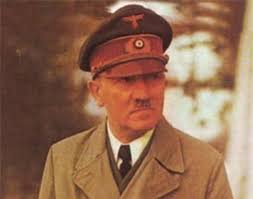
Adolf Hitler
Sitting in the front row was Field Marshal Erich von Manstein, perhaps the most brilliant member of the German General Staff. It was Manstein who had designed the “Sickle Cut” attack on France in May, 1940.
Bypassing the much-vaunted Maginot Line, the Wehrmacht struck through Belgium, taking the French completely by surprise. As a result, it defeated France in six weeks—something Germany had been unable to do during the four years of World War 1.
Now, in a loud voice, Manstein proclaimed: “And so it will be, Mein Fuhrer!”
Hitler froze; it had been more than a decade since anyone had dared interrupt him. Then, trying to make the best of a bad moment, he continued: “Very well. If this is the case, it will be impossible for us to lose this war.”
Hitler hoped that Manstein had intended to reassure him of his loyalty. But Martin Bormann, his all-powerful secretary, told him that the generals had interpreted the outburst differently: That the worse would indeed come to the worst.
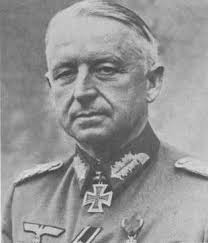
Erich von Manstein
And, which, in fact, happened.
As the Russian army closed in on his underground bunker in April, 1945, Hitler revealed his utter contempt for the Germans who had so blindly served him for 12 years.
“If the war is lost,” Hitler told his former architect and now Minister of Armaments, Albert Speer, “the nation will also perish. This fate is inevitable.
“There is no necessity to take into consideration the basis which the people will need to continue even a most primitive existence.
“On the contrary, it will be better to destroy these things ourselves, because this nation will have proved to be the weaker one and the future will belong solely to the stronger eastern nation.”
Just as Hitler demanded loyalty from his accomplices to infamy, so does Donald Trump.
Former FBI Director James Comey has had firsthand experience in attacking organized crime—and in spotting its leaders.
In his bestselling memoir, A Higher Loyalty, he writes:
“As I found myself thrust into the Trump orbit, I once again was having flashbacks to my earlier career as a prosecutor against the mob. The silent circle of assent. The boss in complete control. The loyalty oaths. The us-versus-them worldview. The lying about all things, large and small, in service to some code of loyalty that put the organization above morality and the truth.”

James Comey
When Comey refused to overlook Trump’s treasonous contacts with Russian dictator Vladimir Putin, Trump fired him.
On October 9, 2019, The Week published an article: “Note to Republicans: Trump will betray you just like he betrayed the Kurds. The one constant in the president’s life is betrayal.” Specifically:
“Trump’s forte is con artistry. He sells books he doesn’t write to people who don’t read. He failed as a businessman but succeeded as a fake businessman on TV. The supreme irony of his life is that he poses as a dealmaker when he is the opposite. Trump doesn’t make deals. He breaks them….
“If there’s a constant in Trump’s life, it’s betrayal. He has betrayed his business partners, his customers, his employees, his friends, his wives, and his voters. A man who is willing to betray those closest to him will not hesitate to turn his back on foreigners thousands of miles away.”
To enrich himself at the expense of his followers, Trump has peddled a variety of expensive products. Among these:
- “Never Surrender” sneakers;
- Mugshot T-shirts, mugs and posters;
- Bibles made in China (as he rails against a trade deficit between China and the United States.
On the international level, Trump has withdrawn the United States from a host of international agreements. Among these:
- The Trans-Pacific Partnership;
- The Paris Agreement to combat global warming;
- The Iran nuclear deal.
As a result, the world no longer trusts the United States to honor its commitments.
A 2018 Pew Research Center survey found that 82 percent of Europeans didn’t trust Trump’s handling of international issues. Seventy-five percent of Canadians and 91 percent of Mexicans didn’t trust him to do the right thing regarding world affairs.
For Trump, as for Hitler, loyalty goes only one way—from others to him. No one who served either man—no matter how loyally or how long—could be certain when he would be deemed disposable.
9/11 ATTACKS, ABC NEWS, ALTERNATIVE ENERGY SOURCES, ALTERNET, AP, ARAB OIL EMBARGO, BBC, BUZZFEED, CBS NEWS, CHRISTIAN RIGHT, CNN, COLD WAR, CROOKS AND LIARS, DAILY KOS, DAILY KOZ, DONALD TRUMP, EGYPT, FACEBOOK, FOSSIL FUELS, GLOBAL WARMING, IRAN, IRAQ, ISLAM, ISRAEL, JAMAL KHASHOGGI, MECCA, MEDINA, MIDDLE EAST, MOHAMMED BIN SALMAN, MOTHER JONES, MOVEON, MSNBC, NAZI GERMANY, NBC NEWS, NEWSWEEK, NPR, Oil, OSAMA BIN LADEN, PBS NEWSHOUR, POLITICO, RAW STORY, REPUBLICANS, REUTERS, SALON, SAND CURTAIN, SAUDI ARABIA, SEATTLE TIMES, SECOND COMING, SHAH OF IRAN, SHIITE MUSLIMS, SLATE, SOVIET UNION, SUNNI MUSLIMS, TERRORISM, THE ATLANTIC, THE CHICAGO SUN-TIMES, THE CHICAGO TRIBUNE, THE DAILY BEAST, THE GUARDIAN, THE HILL, THE HUFFINGTON POST, THE LOS ANGELES TIMES, THE NATION, THE NEW YORK TIMES, THE WALL STREET JOURNAL, THE WASHINGTON POST, TIME, TRUMP WORLD TOWER, TURKEY, U.S. NEWS & WORLD REPORT, UNITED STATES, UPI, USA TODAY, VENEZUELA, WAHHABISM, WORLD WAR ii, X
In Bureaucracy, History, Military, Politics, Social commentary on November 15, 2024 at 12:11 am
The time is long overdue for the United States to scrap its devil’s bargain relationship with Saudi Arabia.
Reason #1: The political assassination of Saudi dissident journalist Jamal Khashoggi, a key critic of Saudi King Mohammed bin Salman.
On October 2, 2018, Khashoggi walked into the Saudi Consulate in Istanbul to pick up a document allowing him to marry a Turkish woman. Video footage showed Khashoggi walking into the consulate; there is none of him leaving it.
He was never seen again.
According to Turkish government officials:
- Fifteen Saudi agents flew into Istanbul.
- They waited for Khashoggi inside the consulate and murdered him within two hours of his arrival.
- The assassins used a bone saw to dismember Khashoggi’s corpse.

Jamal Khashoggi A
April Brady / POMED, CC BY 2.0 <https://creativecommons.org/licenses/by/2.0>, via Wikimedia Commons
Reason #2: Saudi Arabia is a weak ally.
President Donald Trump claimed that Saudi Arabia served as a counter-weight to the growing regional influence of Iran. But Saudi Arabia was unable to defend itself against Saddam Hussein’s Iraq in 1990, after the invasion and takeover of Kuwait.
This was, in fact, why Saudi-born Osama bin Laden decided to declare war on the United States.
He petitioned Saudi King Fahd bin Abdulazis al-Saud to let Saudis oppose any invasion by Iraq. He argued that “infidel” American soldiers stationed in the Kingdom would “pollute” Islam’s two great holy sites: Mecca and Medina.
Having fought against the Soviet Union in Afghanistan during the 1980s, bin Laden offered to help defend Saudi Arabia with his Arab legion.
The king refused—because he knew that, despite all the sophisticated military hardware he had bought from the United States, the Saudis were too militarily weak to resist an invasion.
Bin Laden left the country to wage fulltime war against the United States.
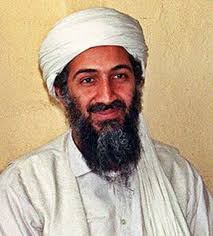
Osama bin Laden
Reason #3: Saudi Arabia is filled with Islamics who hate the United States as “the Great Satan.”
Fifteen of the 19 September 11, 2001 highjackers came from Saudi Arabia.
And Saudi Arabia is the birthplace of Wahhabism, a radical brand of Islam dedicated to “purifying” the world of “unbelievers.”
Reason #4: The only reason the United States cares about Saudi Arabia is that it’s the second-largest oil-producing country (after Venezuela) n the world.
Yet oil consumption threatens the future of the world through global warming. And it keeps America tethered to a regime that is fundamentally unstable and hostile to the West.
Reason #5: The United States can end its dependence on Saudi oil by embarking on a crash program to develop alternatives to oil.
Had this happened during the 1973 Arab oil embargo, the United States would now be energy-independent. America has the technology to do so; it lacks only the will.
Reason #6: Once the United States no longer needs fossil fuels, it can quit financing Middle East dictatorships.
This will end spending billions of dollars every year to prop up dictatorial regimes like those in Saudi Arabia, Iraq and Egypt. America will no longer supply big-ticket military hardware (like fighter planes and missiles) to potentially hostile Islamic regimes.
Reason #7: By withdrawing from the Middle East, the United States can free itself of the burden of acting as Israel’s permanent bodyguard.
Millions of Americans believe they are morally obligated to defend Israel owing to the barbarism of the Holocaust. But America was never a party to this—and has nothing to atone for.
Yet, for decades, the United States has been repeatedly dragged into the never-ending religious conflicts between Israelis and Islamics. Since both sides believe they are doing “God’s will,” there can be no substantial compromise by either.
Reason #8: The United States and its European allies can defend themselves against Islamic terrorism by erecting a “Sand Curtain” around the Middle East.
For 44 years—1947 to 1991—the United States and the Soviet Union were locked in a Cold War stalemate. Essentially, the United States drew a ring around the Soviet Union—including those nations its armies had seized following the defeat of Nazi Germany in 1945.
The United States said, in effect: “We can’t liberate the countries you’re now occupying”—because that would have triggered a nuclear World War III. “But we won’t allow you to occupy and enslave any other countries. And if you try to do so, it will mean total war.”
America could withdraw all of its forces from the Middle East—but keep a good portion stationed in Europe.

It could then publicly announce: “From now on, you are the masters of your own destinies—so long as what you do affects only the Middle East.
“We recognize that barbarism and violence have always been a part of life in the Middle East. And we don’t expect this to change.
“We realize you will destroy as many of your own citizens as you can—because they’re Jewish or Christians, or because Sunni Muslims and Shiite Muslims hate each other.
“Just don’t threaten citizens living outside your territories. In short: Europe and the United States are strictly off-limits to you.
“And if you aim your aggression at either, we will consider this an act of war and use all the weapons at our disposal—including nuclear ones—to wipe you from the face of the Earth.“
2016 PRESIDENTIAL ELECTION, 2020 PRESIDENTIAL ELECTION, ABC NEWS, ADOLF HITLER, ALTERNET, AP, BUZZFEED, CBS NEWS, CIA, CNN, COVID-19, CROOKS AND LIARS, DAILY KOS, DONALD TRUMP, FBI, FRANCE, GUNTER MEISNER, HERMAN WOUK, JAMES COMEY, JANUARY 6 COUP ATTEMPT, JOE BIDEN, KIM JONG-UN, MOTHER JONES, MOVEON, NAZI GERMANY, NBC NEWS, NEWSWEEK, NPR, POLITICO, RAW STORY, REUTERS, SALLY YATES, SALON, SEATTLE TIMES, SERGEY KISLYAK, SERGY LAVROV, SLATE, THE ATLANTIC, THE CHICAGO SUN-TIMES, THE CHICAGO TRIBUNE, THE DAILY BEAST, THE GUARDIAN, THE HILL, THE HUFFINGTON POST, THE LOS ANGELES TIMES, THE NATION, THE NEW YORK TIMES, THE PRESS, THE WASHINGTON POST, THE WINDS OF WAR, TIME, U.S. NEWS & WORLD REPORT, UPI, USA TODAY, VLADIMIR PUTIN, VOLODYMYR ZELENSKY, WALTER VON BRAUCHITSCH, WOLFGANG PREISS, WORLD WAR 11, X
In Bureaucracy, History, Military, Politics, Social commentary on November 14, 2024 at 12:14 am
After Donald Trump won the 2016 election, many people feared he would embark on a radical Right-wing agenda. But others hoped that the Washington bureaucracy would “box him in.”
The same sentiments echoed throughout Germany after Adolf Hitler was appointed Chancellor of Germany on January 30, 1933.
The 1983 TV mini-series, The Winds of War, offered a dramatic example of how honorable men can be overwhelmed by a ruthless dictator.
Based on the bestselling 1971 historical novel by Herman Wouk, the mini-series factually re-created the major historical events of World War II.
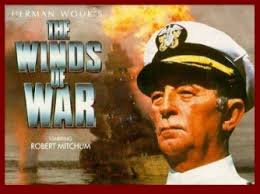
One of those events took place on November 5, 1939.
General Walther von Brauchitsch is summoned to the Chancellery in Berlin to meet with Adolf Hitler. He carries a memorandum signed by all the leaders of the German Wehrmacht asserting that Case Yellow—Hitler’s planned attack against France—is impossible.
Meanwhile, at the German army headquarters at Zossen, in Berlin, the Wehrmacht’s top command wait for word from von Brauchitsch.
CHANCELLERY:
Von Brauchitsch hands the memorandum to Hitler, who reads it.
Adolf Hitler (slamming down the memorandum): So—what is new in all this?
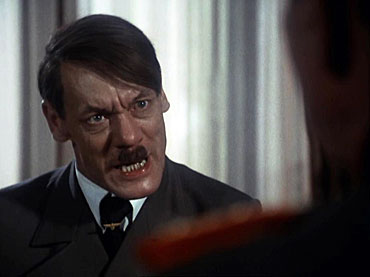
Gunter Meisner as Adolf Hitler in “The Winds of War”
Walther Von Brauchitsch: Fuhrer, it is the army’s final position that Case Yellow cannot proceed.
Hitler: Why not?
Von Brauchitsch: Because of the military fundamentals as stated. The meteorologists predict continuous soaking rains for weeks.
Hitler: It rains on the enemy, too.
ZOSSEN:
Brigadier General Armin Von Roon: The conspiracy has been going on that long—since Czechoslovakia [1938)?
Chief of the General Staff Franz Halder: If the British had not caved in at Munich [where France and Britain sold out their ally, Czechoslovakia]—perhaps. But they did. And ever then, ever since his big triumph, it has been hopeless. Hopeless.
Von Roon: Empty talk, talk, talk. I am staggered.
Halder: A hundred times I myself could have shot the man. I can still at any time. But what would be the result? Chaos. The people are for him. He has unified the country. We must stick to our posts and save him from making military mistakes.
CHANCELLERY:
Von Brauchitsch: Fuhrer, even the supply of artillery shells is totally inadequate.
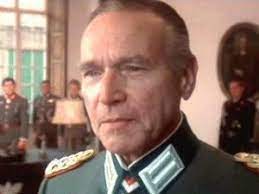
Wolfgang Preiss as Walter von Brauchitsch in “The Winds of War”
Hitler: Do you know how many artillery shells of all calibers we have in the staging areas—right this minute?
Von Brauchitsch: No.
Hitler: How many we have in the reserve dumps in the West? What the monthly annual production of shells is? What the projected rise in production of the next six months is, month by month?
Von Brauchitsch: Who keeps such figures in his head?
Hitler: I do! The supply is adequate. I tell you so. And I’m a field soldier who depended on artillery for four years to protect his life. [He hands von Brauchitsch a sheaf of armaments figures.] Check with your staff. if one of those figures is wrong, you can postpone Case Yellow. Otherwise—you march! And next time you come to see me, know what you’re talking about!
Von Brauchitsch: The morale of the army was low, even in the Polish campaign.
Hitler: Back up this monstrous assertion! In what units was morale low? What action was taken? How many death sentences were handed out for cowardice? Speak up! I’ll fly to the front and pass the death sentences myself. Name one specific instance.
Von Brauchitsch: It was common knowledge—
Hitler: Common knowledge? What is common knowledge is that army headquarters at Zossen crawls with cowards. You opposed me in rearming the Rhineland. You opposed me on the [union] with Austria. You opposed me on Czechoslovakia, until the British came crawling to me. You dirtied in your trousers, you heroes at Zossen, at the idea of marching into Poland. Well, have I once been wrong? Have you once been right? Answer me!
Von Brauchitsch: Mein Fuhrer—
Hitler: Tell everyone who signed this insubordinate Zossen rubbish to beware! I will ruthlessly crush everybody up to the rank of a Field Marshal who dares to oppose me. You don’t have to understand. You only have to obey. The German people understand me. I am Germany.
President Donald Trump:
- Fired FBI Director James Comey for investigating Russia’s subversion of the 2016 Presidential election.
- Attacked the integrity of the American Intelligence community.
- Attacked the free press as “the enemy of the American people.”
- Tried to coerce Ukrainian President Volodymyr Zelensky to smear former Vice President Joe Biden, his presumed Democratic opponent in the 2020 Presidential election.
- Repeatedly lied about the dangers posed by the COVID-19 virus, thus enabling it to ravage the country and kill 400,000 by the time Trump left office.
- Incited his followers to violently attack the United States Capitol Building to overturn the results of the 2020 Presidential election and prevent Joe Biden, the winner, from taking office.
Fast forward 79 years from Adolf Hitler’s stormy confrontation with Walter von Brauchitsch to January 6, 2021.
Like Adolf Hitler, Donald Trump could truthfully say: I am America.
And that was before the United States Supreme Court declared that a President has absolute immunity for his official acts—including criminal ones.
ABC NEWS, ADAM SCHIFF, ADOLF HITLER, ALEX PHILLIPS, ALTERNET, AMERICA’S VOICE, AMERICABLOG, AMERICAN PRIORITY CONFERENCE, AP, AUSTRIA, BABY BOOMER RESISTANCE, BARACK OBAMA, BBC, BERNIE SANDERS, BILL CLINTON, BLACK LIVES MATTER, BLOOMBERG, BUZZFEED, CBS NEWS, CHINA, CINDY MCCAIN, CIVIL WAR, CNN, COLIN FIRTH, COREY LEWANDOWSKI, CROOKS AND LIARS, CZECHOSLOVAKIA, DAILY KOS, DANA LOESCH, DEMOCRATS, DONALD TRUMP, DONALD TRUMP JUNIOR, EUGENE SCOTT, FBI, FINAL SOLUTION, FIVETHIRTYEIGHT, FRANCISCO FRANCO, GEORGE SOROS, HARPER’S MAGAZINE, HILLARY CLINTON, HUFFINGTON POST, HUNTER BIDEN, JOE BIDEN, JOHN MCCAIN, MATT GAETZ, MEDIA MATTERS, MEIN KAMPF, MITT ROMNEY, MOTHER JONES, MOVEON, MSNBC, NANCY PELOSI, NATIONAL RIFLE ASSOCIATION, NAZI GERMANY, NBC NEWS, NEVILLE CHAMBERLAIN, NEW REPUBLIC, NEWSDAY, NEWSWEEK, NINA BURLEIGH, NPR, PBS, PBS NEWSHOUR, PLUTARCH, POLAND, POLITICO, POLITICUSUSA, RACHEL MADDOW, RAW STORY, REPUBLICANS, REUTERS, ROGER STONE, ROSIE O’DONNELL, SALON, SARAH HUCKABEE SANDERS, SEATTLE TIMES, SLATE, SOVIET UNION, SPAIN, TALKING POINTS MEMO, THE ATLANTIC, THE CHICAGO SUN-TIMES, THE CHICAGO TRIBUNE, THE DAILY BEAST, THE DAILY BLOG, THE GEEKZTEAM, THE GUARDIAN, THE HILL, THE HUFFINGTON POST, THE INTERCEPT, THE KINGSMAN (MOVIE), THE LOS ANGELES TIMES, THE NATION, THE NEW REPUBLIC, THE NEW YORK TIMES, THE NEW YORKER, THE TRUMPSMAN (VIDEO), THE VILLAGE VOICE, THE WASHINGTON POST, THINKPROGRESS, TIME, TREASON, TRUTHDIG, TRUTHOUT, TWO POLITICAL JUNKIES, U.S. NEWS & WORLD REPORT, UKRAINE, UNITED STATES, UPI, USA TODAY, VERSALLIES TREATY, VOLODYMR ZELENSKI, WEIMAR REPUBLIC, WHITE HOUSE CORRESPONDENTS ASSOCIATION, WORLD WAR 11, X
In Bureaucracy, History, Military, Politics, Social commentary on November 1, 2024 at 12:09 am
After taking office as President on January 20, 2017, Donald Trump continued to hurl threats of violence against those he hates.
“Trump’s language of violence started with immigrants when he launched his presidential campaign in 2015,” wrote Washington Post Reporter Eugene Scott. “There is a direct line from his language to real violence against immigrants and other innocent Americans caught in the maniacal mass shootings of the past year.
“And this cancer is spreading: to Congress, to the media, to the intelligence community, to foreign allies. There is no end in sight as Trump becomes increasingly unhinged and the GOP remains frozen in abject silence.”
On October 2, 2019, Journalist Nina Burleigh wrote: “Since 2015, TV-watching Americans have been subject to the deimatic spectacle of more than 400 rallies (at least 80 since his election) in which Trump sometimes openly and more often coyly urged supporters to violence. These spectacles have conditioned many Americans to fear him and his more enthusiastic supporters.”
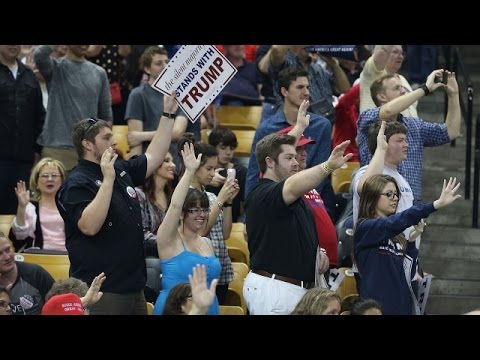
Supporters giving the “Seig Heil” salute to Donald Trump
“Over the last few days, the President’s rhetoric of violence and hate has spread,” stated an October 3, 2019 press release by America’s Voice, a liberal immigration group.
“As Jamelle Bouie noted yesterday, ‘Over the weekend, in a rage over impeachment, President Trump accused Representative Adam Schiff of ‘treason,’ promised ‘Big Consequences’ for the whistle-blower who sounded the alarm about his phone call with President Volodymyr Zelensky of Ukraine and shared a warning — from a Baptist pastor in Dallas — that impeachment ‘will cause a Civil War like fracture in this Nation from which our Country will never heal.’”
Trump’s opponents have good reason to fear. And not simply the public demonstrations by the President’s fanatical base. They should fear the secret fantasies of the Right.
Those secret fantasies have been revealed in a series of Right-wing videos featuring graphic acts of violence against those whom the Right—and Trump—hate.
From October 10 to 12, 2019, attendees of the American Priority Conference at the Trump National Doral Miami resort enjoyed many of those videos.
One of these, “The Trumpsman,” featured a digitized Trump shooting, stabbing and setting fire to such liberals—and even conservatives—as:
- Former President Bill Clinton
- Former Vice President Joe Biden
- Former Democratic Presidential candidate Hillary Clinton
- Democratic Speaker of the House Nancy Pelosi
- Former President Barack Obama
- Vermont United States Senator Bernie Sanders
- Utah Senator Mitt Romney
- The late Arizona Senator John McCain
And legitimate news media—such as CBS, BBC, ABC, CNN, The New York Times and The Washington Post—were also depicted as among Trump’s victims.
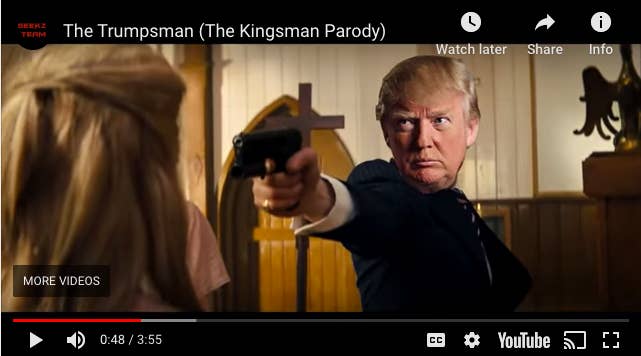
The video was produced by Rightists who believed it reflected what Donald Trump would do to his enemies if only he could get away with it. And given his near-constant calls for violence against his critics, they were absolutely correct.
But the video’s critics were wrong to call for its suppression.
On the contrary—it should have bene widely seen for what it was: The Mein Kampf of Donald Trump and his fanatical followers, in and outside the Republican party.
Like Adolf Hitler’s autobiography, it depicted the future America can expect if the Right gains the power to live out its murderous fantasies. And the fantasy Right-wingers prize most: The brutal extermination of everyone who refuses to submit to their Fascistic tyranny.
“The Trumpsman” is part of a growing genre of pro-Trump memes that routinely earn thousands of views on sites like YouTube and Twitter. Many superimpose the faces of Trump and his chief supporters slaughtering Democrats, liberal celebrities and/or members of the media.
The event’s organizer, Alex Phillips, hurriedly claimed that the “unauthorized video” was shown “in a side room” at the American Priority Conference.
But there was an upside to this exercise in Right-wing porn. Democrats could have run TV ads showing limited clips from “The Trumpsman” video.
Unfortunately, the majority of Democrats lack the courage to attack their Right-wing enemies with the same ruthlessness used against them. That’s why they lost most Presidential elections of the 20th century.
Americans should be constantly warned: These videos were not made by liberals to parody the values and goals of the Republican party and its Right-wing supporters.
These videos were made by Right-wingers—and reflect the true values and intentions of the Republican party and its Right-wing supporters.
The boiler-plate rhetoric that gushes out of Republican conventions—about love of family, God and flag—is the public mask of the Right.
The videos that depict Right-wingers ruthlessly slaughtering anyone who dares to disagree with them reflect the real face of the Right.
Of course, most Americans never imagined that a President would:
- Refuse to accept the results of a legitimate Presidential election;
- Spend four years lying that he had lost through massive voter fraud;
- Incite a mob to attack Congress while it counted Electoral College votes—which he knew proved he had lost in 2020.
Trump’s opponents should stop deluding themselves that: “Surely he’ll never do that.”
Whatever they fear he will do, he will do.
Like all predators, he will stop only when he meets a stronger opponent.
Germans—and the rest of the world—learned that about Adolf Hitler. But only when it was too late.
ABC NEWS, ADAM SCHIFF, ADOLF HITLER, ALEX PHILLIPS, ALTERNET, AMERICA’S VOICE, AMERICABLOG, AMERICAN PRIORITY CONFERENCE, AP, AUSTRIA, BABY BOOMER RESISTANCE, BARACK OBAMA, BBC, BERNIE SANDERS, BILL CLINTON, BLACK LIVES MATTER, BLOOMBERG, BUZZFEED, CBS NEWS, CHINA, CINDY MCCAIN, CIVIL WAR, CNN, COLIN FIRTH, COREY LEWANDOWSKI, CROOKS AND LIARS, CZECHOSLOVAKIA, DAILY KOS, DANA LOESCH, DEMOCRATS, DONALD TRUMP, DONALD TRUMP JUNIOR, EUGENE SCOTT, FBI, FINAL SOLUTION, FIVETHIRTYEIGHT, FRANCISCO FRANCO, GEORGE SOROS, HARPER’S MAGAZINE, HILLARY CLINTON, HUFFINGTON POST, HUNTER BIDEN, JOE BIDEN, JOHN MCCAIN, MATT GAETZ, MEDIA MATTERS, MEIN KAMPF, MITT ROMNEY, MOTHER JONES, MOVEON, MSNBC, NANCY PELOSI, NATIONAL RIFLE ASSOCIATION, NAZI GERMANY, NBC NEWS, NEVILLE CHAMBERLAIN, NEW REPUBLIC, NEWSDAY, NEWSWEEK, NINA BURLEIGH, NPR, PBS, PBS NEWSHOUR, PLUTARCH, POLAND, POLITICO, POLITICUSUSA, RACHEL MADDOW, RAW STORY, REPUBLICANS, REUTERS, ROGER STONE, ROSIE O’DONNELL, SALON, SARAH HUCKABEE SANDERS, SEATTLE TIMES, SLATE, SOVIET UNION, SPAIN, TALKING POINTS MEMO, THE ATLANTIC, THE CHICAGO SUN-TIMES, THE CHICAGO TRIBUNE, THE DAILY BEAST, THE DAILY BLOG, THE GEEKZTEAM, THE GUARDIAN, THE HILL, THE HUFFINGTON POST, THE INTERCEPT, THE KINGSMAN (MOVIE), THE LOS ANGELES TIMES, THE NATION, THE NEW REPUBLIC, THE NEW YORK TIMES, THE NEW YORKER, THE TRUMPSMAN (VIDEO), THE VILLAGE VOICE, THE WASHINGTON POST, THINKPROGRESS, TIME, TREASON, TRUTHDIG, TRUTHOUT, TWO POLITICAL JUNKIES, U.S. NEWS & WORLD REPORT, UKRAINE, UNITED STATES, UPI, USA TODAY, VERSALLIES TREATY, VOLODYMR ZELENSKI, WEIMAR REPUBLIC, WHITE HOUSE CORRESPONDENTS ASSOCIATION, WORLD WAR 11, X
In Bureaucracy, History, Military, Politics, Social commentary on October 31, 2024 at 12:14 am
On November 9, 1923, Nazi Party Fuhrer Adolf Hitler tried to overthrow the government in Munich, Bavaria.
About 2,000 Nazis marched to the center of Munich, where they confronted heavily-armed police. A shootout erupted, killing 16 Nazis and four policemen.
Hitler was injured during the clash, but managed to escape. Two days later, he was arrested and charged with treason.
Put on trial, he found himself treated as a celebrity by a judge sympathetic to Right-wing groups. He was allowed to brutally cross-examine witnesses and even make inflammatory speeches.
At the end of the trial, he was convicted of treason and sentenced to five years’ imprisonment. Of this he served only nine months before being released.
Hitler used his time in Landsberg Prison, in Bavaria, to write his infamous book, Mein Kampf–—“My Struggle.” Part autobiography, part political treatise, it laid out his future plans—for a revitalized Germany and the conquest of other nations.

Adolf Hitler leaving Landsberg Prison, December, 20, 1924
Published in 1925, it was long ignored by all but the most fanatical Nazis. But as Hitler gained increasing numbers of votes in a series of elections, many people—inside and outside Germany—began paying attention to its contents.
By 1939 it had sold 5,200,000 copies and had been translated into 11 languages.
Most of those who bought the book never read it. Its style was bombastic, repetitious and illogical. The first edition contained grammatical errors, reflecting a self-educated man.
Few who read it took Hitler’s intentions seriously. Comedians portrayed him as a wildly gesturing crank who screamed constantly.
Hitler made no effort to hide his program for Germany under his rule. His candor led many people to believe he was a lunatic who could be safely ignored.
He was especially insistent on the need for eliminating world Jewry and conquering the Soviet Union.
On the former topic he wrote: “The nationalization of our masses will succeed only when, aside from all the positive struggle for the soul of our people, their international poisoners are exterminated.
“If at the beginning of the war and during the war twelve or fifteen thousand of these Hebrew corrupters of the nation had been subjected to poison gas, such as had to be endured in the field by hundreds of thousands of our very best German workers of all classes and professions, then the sacrifice of millions at the front would not have been in vain.”
A mere 17 years later, Hitler’s “Thousand-Year Reich” would translate those words into horrific action in a series of extermination camps equipped with gas chambers.

Hitler was equally insistent that Germany needed to find Lebensraum—“Living space”-–in the east. And by “east” he meant “Russia.”
Specifically: “And so we National Socialists consciously draw a line beneath the foreign policy tendency of our pre-War period. We take up where we broke off six hundred years ago.
“We stop the endless German movement to the south and west, and turn our gaze toward the land in the east. At long last we break off the colonial and commercial policy of the pre-War period and shift to the soil policy of the future.
“If we speak of soil in Europe today, we can primarily have in mind only Russia and her vassal border states.”
Hitler finally attained power on January 30, 1933. He realized that Germany was not yet strong enough to impose its will on other nations. So he set out on a secret crash program to make Germany the strongest military power in Europe.
In 1936, he set out on his “mission of Providence”:
- March, 1936: Ordering German troops to reoccupy the demilitarised zone between France and Germany (the Rhineland), in violation of the Versailles Treaty, which ended World War 1.
- July, 1936: Sending troops to Spain to support the Fascist army of General Francisco Franco.
- March 12, 1938: Occupying Austria and “unifying” it with Germany (the “Anschluss“).
- September 29, 1938: Bullying British Prime Minister Neville Chamberlain into surrendering Czechoslovakia’s Sudetenland districts to Germany.
- September 1, 1939: Ordering the invasion of Poland, which unintentionally launched World War II.
- June 22, 1941: Ordering the invasion of the Soviet Union.
- 1941: Secretly ordering “the Final Solution of the Jewish Question,” resulting in the extermination of at least six million Jews.
Only after Hitler set out to conquer, first Europe, then the Soviet Union, did his victims and intended victims realize that Mein Kampf had given them a deadly warning. A warning too many of them had refused to heed.
By the time World War II ended:
- Fifty million men, women and children were died—most of them dying in agony.
- The Soviet Union, having crushed Nazi Germany, become a world power.
- Poland and eastern Europe—once captives of Nazi Germany—now found themselves captives of the Soviet Union.
- The United States, untouched by the war, emerged as the world’s superpower—and the only country strong enough to contain the Soviet Union.
But Adolf Hitler isn’t the only would-be dictator to give ample warning of his murderous intentions.
And, like most Germans in the Weimar Republic, which preceded Nazi Germany, most Americans refuse to take that warning seriously.
1984 (BOOK), 2016 PRESIDENTIAL ELECTION, 2020 PRESIDENTIAL ELECTION, ABC NEWS, ALTERNET, AMERICABLOG, AP, ” 9/11, BABY BOOMER RESISTANCE, BBC, BILL CLINTON, BLOOMBERG NEWS, BUZZFEED, CBS NEWS, CHRIS STIREWALT, CNN, CONDOLEEZA RICE, COVID-19, CROOKS AND LIARS, DAILY KOS, DICK CHENEY, DOMINION VOTING SYSTEMS, DONALD RUMSFELD, DONALD TRUMP, FIVETHIRTYEIGHT, FOX NEWS NETWORK, GEORGE ORWELL, GEORGE W. BUSH, HARPER’S MAGAZINE, HISTORY, HUFFINGTON POST, JANUARY 6 COUP ATTEMPT, JEB BUSH, JOE BIDEN, JOSEPH STALIN, LAURA INGRAHAM, LAVRENTI BERIA, LIBEL, MARCO RUBIO, MEDIA MATTERS, MIKE LINDELL, MOTHER JONES, MOVEON, MSNBC, NAZI-SOVIET NONAGGRESSION PACT, NBC NEWS, NEW REPUBLIC, NEW YORK TIMES V. SULLIVAN, NEWSDAY, NEWSMAX, NEWSWEEK, NKVD, NPR, PAUL WOLFOWITZ, POLITICO, POLITICUSUSA, RAW STORY, REPUBLICAN PARTY, REPUBLICANS, REUTERS, RICHARD CLARKE, RUDOLPH GIULIANI, SALON, SEAN HANNITY, SEATTLE TIMES, SIDNEY POWELL, SLANDER, SLATE, SOVIET UNION, STEVE BANNON, TALKING POINTS MEMO, THE ATLANTIC, THE CHICAGO SUN-TIMES, THE CHICAGO TRIBUNE, THE DAILY BEAST, THE DAILY BLOG, THE GUARDIAN, THE HILL, THE HUFFINGTON POST, THE INTERCEPT, THE LOS ANGELES TIMES, THE NATION, THE NEW REPUBLIC, THE NEW YORK TIMES, THE NEW YORKER, THE VILLAGE VOICE, THE WASHINGTON POST, THE WASHINGTONPOST, THINKPROGRESS, TIME, TRUTHDIG, TRUTHOUT, TUCKER CARLSON, TWO POLITICAL JUNKIES, U.S. NEWS & WORLD REPORT, UPI, USA TODAY, X
In Bureaucracy, Business, History, Military, Politics on October 24, 2024 at 12:05 am
At one time, Americans believed that the wholesale rewriting of history happened only in the Soviet Union.
“The problem with writing about history in the Soviet Union,” went a popular joke inside the Soviet Union, “is that you never know what’s going to happen yesterday.”
A classic example of this occurred in the Great Soviet Encyclopedia.
Lavrentiy Beria had been head of the NKVD, the dreaded predecessor to the KGB, from 1938 to 1953. On June 26, 1953, three months after the death of Soviet dictator Joseph Stalin, Beria was arrested on orders of his fellow Communist Party leaders, who feared he intended to purge them.
Beria was executed on December 23.
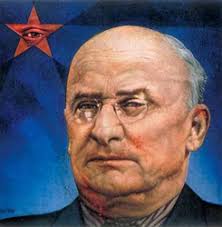
Lavrentiy Beria
But the Great Soviet Encyclopedia had just gone to press with a long article singing Beria’s praises.
What to do?
The editors of the Encyclopedia wrote an equally long article about “the Bering Straits,” which was to be pasted over the article about Beria, and sent this off to its subscribers. An unknown number of them decided it was safer to paste accordingly.
Similarly, Joseph Stalin was depicted in Soviet “history” texts as the architect of Russia’s victory over Nazi Germany during World War II.
No “historian” dared mention that Stalin’s wholesale purges of the Red Army in the 1930s had made the country vulnerable to the German attack in 1941. As had Stalin’s “nonaggression” pact with Germany in 1939, where he and Adolf Hitler secretly divided Poland between them.
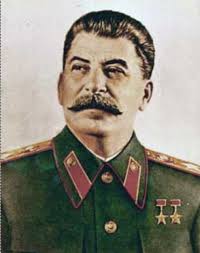
Joseph Stalin
But Russians no longer have a monopoly on rewriting history.
During the 2016 Presidential election, the Republican party furiously rewrote history in a desperate attempt to win the White House.
Specifically, its members tried to convince Americans that:
- President George W. Bush “kept us safe” (excluding, of course, the terror attacks of September 11, 2001, which slaughtered 3,000 Americans); and/or
- President Bush wasn’t to blame for 9/11—it was his predecessor, Bill Clinton (who left office more than a year and a half before 9/11).

World Trade Center – September 11, 2001
In 2015, Jeb Bush entered the “Rewriting History for Americans” sweepstakes.
On October 16, 2015, during an interview on Bloomberg TV, Donald Trump, the leading Republican candidate for President in 2016, dared speak (for Republicans) the unspeakable:
“When you talk about George Bush, I mean, say what you want, the World Trade Center came down during his time. He was President, OK? Blame him, or don’t blame him, but he was President. The World Trade Center came down during his reign.”
Bush was quick to respond on Twitter: “How pathetic for @realdonaldtrump to criticize the president for 9/11. We were attacked & my brother kept us safe.”

Jeb Bush
Trump replied:
“At the debate you said your brother kept us safe–I wanted to be nice & did not mention the WTC came down during his watch, 9/11.”
And: “No @JebBush, you’re pathetic for saying nothing happened during your brother’s term when the World Trade Center was attacked and came down.”
Suddenly, on February 13, another Republican Presidential candidate rushed to rewrite 9/11: Florida United States Senator Marco Rubio.
According to Rubio: “The World Trade Center came down because Bill Clinton didn’t kill Osama bin Laden when he had the chance to kill him.”
And on the following day, on NBC’s “Meet the Press,” he again made the charge: “If you’re going to ascribe blame, don’t blame George W. Bush, blame a decision that was made years earlier, not to take out bin Laden when the opportunity presented itself.”
All of which ignored such embarrassing truths as:
- During the first eight months of the Bush Presidency, Richard Clarke, the counter-terrorism adviser on the National Security Council, was not permitted to brief President Bush, despite mounting evidence of plans for a new Al-Qaeda outrage.
- From January 20 to September 11, 2001, Bush was on vacation, according to the Washington Post, 42% of the time.
- National Security Adviser Condoleeza Rice initially refused to hold a cabinet-level meeting on the subject of terrorism. Then she insisted that the matter be handled only by a more junior Deputy Principals meeting.
- Paul Wolfowitz, the number-two man at the Department of Defense, said: “I don’t understand why we are beginning by talking about this one man, bin Laden.”
- Even after Clarke outlined the threat posed by Al-Qaeda, Wolfowitz—whose real target was Saddam Hussein—said: “You give bin Laden too much credit.”
- Finally, at a meeting with Rice on September 4, 2001, Clarke challenged her to “picture yourself at a moment when in the very near future Al-Qaeda has killed hundreds of Americans, and imagine asking yourself what you wish then that you had already done.”
- Seven days later, Al-Qaeda struck, and 3,000 Americans died horrifically—and needlessly.
- Neither Bush, Vice President Dick Cheney, Rice, Secretary of Defense Donald Rumsfeld nor Wolowitz ever admitted their negligence. Nor has any of them been brought to account.
People who say the Republicans are “batshit crazy” for denying responsibility for 9/11 clearly haven’t read—or understood—George Orwell’s novel, 1984.
The unnamed Party’s slogan is: “He who controls the past controls the future. He who controls the present controls the past.”
The same holds true for Republicans: They hope to rewrite the past, as Joseph Stalin did, to wash away their crimes and errors–and pin these on their self-declared enemies.
And thus gain—and retain—absolute power over 300 million Americans.
2016 PRESIDENTIAL CAMPAIGN, 9/11 ATTACKS, ABC NEWS, ACADEMY AWARDS, ALTERNET, AMERICABLOG, AP, ASSOCIATED PRESS, BABY BOOMER RESISTANCE, BARACK OBAMA, BBC, BEST ACTRESS, BEST SUPPORTING ACTRESS, BIRTHERS, BLOOMBERG, BULLYING, BUZZFEED, CBS NEWS, CENSORSHIP, CHRIS CUOMO, CNN, CREDIBILITY GAP, CROOKS AND LIARS, DAILY KOS, DAVID BROOKS, DAVID HALBERSTAM, DISABILITY, DONALD TRUMP, FIVETHIRTYEIGHT, FOX AND FRIENDS, FRANK STANTON, FULL METAL JACKET, GEORGE MCGOVERN, GOLDEN GLOBES, HARPER’S MAGAZINE, HILLARY CLINTON, HUFFINGTON POST, JOHN F. KENNEDY, KELLEYANNE CONWAY, KRAMER VS. KRAMER, LYNDON B. JOHNSON, MARK SHIELDS, MEDIA MATTERS, MERYL STREEP, MORLEY SAFER, MOTHER JONES, MOVEON, MSNBC, NAVY SEALS, NBC NEWS, NEEWSWEEK, NEW DAY, NEW REPUBLIC, NEWSDAY, NEWSWEEK, NPR, OSAMA BIN LADEN, PBS NEWSHOUR, PETER ARNETT, POLITICO, POLITICUSUSA, RAW STORY, REUTERS, RICHARD NIXON, RONALD ZIEGLER, SALON, SEATTLE TIMES, SERGE KOVALESKI, SLATE, SOPHIE'S CHOICE, STANLEY KUBRICK, TALKING POINTS MEMO, THE ATLANTIC, THE CHICAGO SUN-TIMES, THE CHICAGO TRIBUNE, THE DAILY BEAST, THE DAILY BLOG, THE GUARDIAN, THE HILL, THE HUFFINGTON POST, THE INTERCEPT, THE IRON LADY, THE LOS ANGELES TIMES, THE NATION, THE NEW REPUBLIC, THE NEW YORK TIMES, THE NEW YORKER, THE VILLAGE VOICE, THE WALL STREET JOURNAL, THE WASHINGTON POST, THINKPROGRESS, TIME, TRUTHDIG, TRUTHOUT, TWO POLITICAL JUNKIES, U.S. NEWS & WORLD REPORT, UPI, USA TODAY, VIETNAM WAR, WATERGATE, X
In Bureaucracy, History, Law, Law Enforcement, Military, Politics, Social commentary on October 21, 2024 at 12:10 am
After being presented with the Cecil B. DeMille Lifetime Achievement Award, Meryl Streep criticized Presidential candidate Donald Trump’s mocking of disabled New York Times reporter Serge Kovaleski.
Kovaleski suffers from arthrogryposis, a congenital condition that restricts the movement of the muscles in his arms.
At a South Carolina rally on November 24, 2015, Trump claimed that Kovaleski was backing away from an article he had written four years earlier.
Trump had earlier said the article proved that New Jersey Muslims had celebrated the September 11, 2001 terror attacks. Kovaleski had insisted there was no credible proof of such celebrations.
Angered at being contradicted, Trump mocked Kovaleski: He flopped his right arm around with his hand held at an odd angle while imitating the reporter: “Now, the poor guy, you’ve got to see this guy: ‘Uhh, I don’t know what I said. Uhh, I don’t remember,’ he’s going like ‘I don’t remember. Maybe that’s what I said.'”
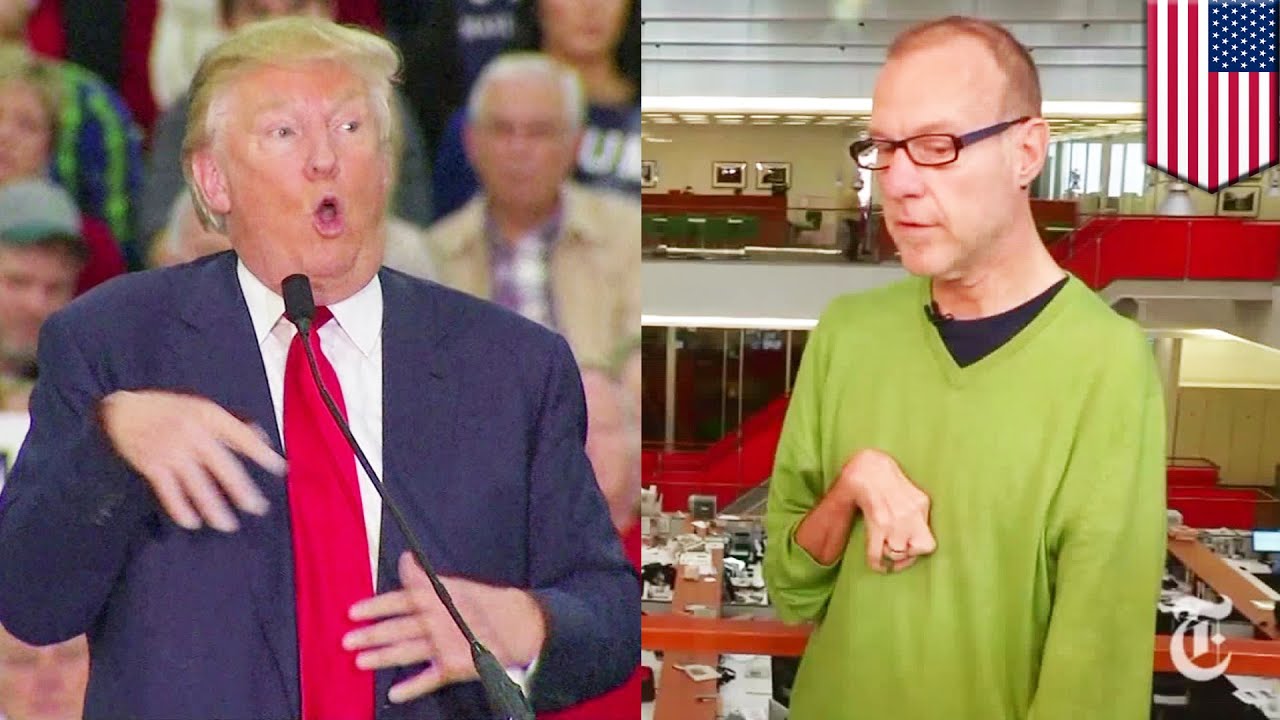
Trump mocking Kovaleski, left; Kovaleski, right
At the Golden Globe Awards on January 8, Streep denounced this behavior that “broke my heart.”
“And this instinct to humiliate, when it’s modeled by someone in the public platform, by someone powerful, it filters down into everybody’s life, because it kind of gives permission for other people to do the same thing.
“Disrespect invites disrespect. Violence incites violence. When the powerful use their position to bully others, we all lose.”
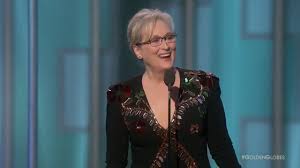
Meryl Streep at the Golden Globes
Streep’s words outraged Trump’s supporters—especially his mouthpiece, Kelleyanne Conway.
Appearing on Right-wing Fox and Friends the next morning, she said: “We have to now form a government, and I’m concerned that somebody with a platform like Meryl Streep is also, I think, inciting people’s worst instincts.
“When she won’t get up there and say, ‘I don’t like it, but let’s try to support him and see where we can find some common ground with him, which [Trump] has actually done from moment one.”
Conway didn’t say what common ground Streep should find with Trump. Perhaps agreeing on mocking the disabled?

Kelleyanne Conway
Then Conway visited CNN’s “New Day,” where she offered a “black-is-white” defense for Trump’s videotaped ridiculing of Kovaleski: It didn’t happen.
The host, Chris Cuomo, having seen the video, wasn’t buying it.
CUOMO: But is [Streep] wrong? Is she wrong that it was wrong for Trump to make gestures like that about a man with disabilities?
CONWAY: He didn’t—but that is not what he did and he has said that a thousand times. As he tweeted out today—
CUOMO: He can say it a million. Look at the video.
CONWAY: Why can’t you—wait, excuse me. Why can’t you give him the benefit of the doubt the way the benefit of the doubt was given to CNN’s polling, all of its analysts?
CUOMO: Because he’s making a disgusting gesture on video talking about Serge.
CONWAY: Not about that reporter and that’s just a fact. That is what he’s said. You should give him—
CUOMO: But how is it not about the reporter?
CONWAY: —the deference and respect if he says that it was—he was not mocking, he was mocking the groveling. He said it again this morning. He has three tweets out about it.
CUOMO: But he’s doing a gesture that goes right to the guy’s vulnerability.
CONWAY: You’re saying you don’t believe him. You’re calling him a liar and you shouldn’t.
CUOMO: Look, Kellyanne, to me that’s like you’re trying to scare me off the point and we both know it’s a waste of time.
CONWAY: I’m not going to scare you off anything.
CUOMO: He’s making a gesture that is so keenly tuned to what Serge’s vulnerability is.
CONWAY: And now you’re giving oxygen to what Meryl Streep said.
CUOMO: Forget about Meryl Streep. This happened before her. If our kids did that, could you imagine what we would say to them?
Conway said she would not bring her children into the discussion.
CUOMO: I will. If my kid did something like that, it’d be a really tough day.
CONWAY: You have to listen to what the president has said about that. Why don’t you believe him?
Conway tried to change the subject to Hillary Clinton: “She was given the benefit of the doubt here constantly.”
When Cuomo asked for specifics, she refused to give them. Then she returned to claiming that Trump had never mocked Kovaleski:
CONWAY: You can’t give him the benefit of the doubt on this, when he’s telling you what was in his heart? You always want to go by what’s come out of his mouth, rather than look at what’s in his heart.
* * * * *
Previously, politicians had defended themselves with arguments like: “You can see right here on the tape, I did (or, I didn’t)….”
Trump has cast aside that logic—and the taped evidence—by demanding: “Believe what I’m telling you, not what you’ve just seen.”
By that rationale, if a security camera shows Trump robbing a bank at gunpoint, we’re supposed to believe him if he says: “No, I didn’t rob that bank. I was simply checking my bank balance.”
Such “logic” holds appeal for paid shills like Kelleyanne Conway. But most people will continue to judge by the evidence.
2016 PRESIDENTIAL CAMPAIGN, 9/11 ATTACKS, ABC NEWS, ACADEMY AWARDS, ALTERNET, AMERICABLOG, AP, ASSOCIATED PRESS, BABY BOOMER RESISTANCE, BARACK OBAMA, BBC, BEST ACTRESS, BEST SUPPORTING ACTRESS, BIRTHERS, BLOOMBERG, BULLYING, BUZZFEED, CBS NEWS, CENSORSHIP, CHRIS CUOMO, CNN, CREDIBILITY GAP, CROOKS AND LIARS, DAILY KOS, DAVID BROOKS, DAVID HALBERSTAM, DISABILITY, DONALD TRUMP, FIVETHIRTYEIGHT, FOX AND FRIENDS, FRANK STANTON, FULL METAL JACKET, GEORGE MCGOVERN, GOLDEN GLOBES, HARPER’S MAGAZINE, HILLARY CLINTON, HUFFINGTON POST, JOHN F. KENNEDY, KELLEYANNE CONWAY, KRAMER VS. KRAMER, LYNDON B. JOHNSON, MARK SHIELDS, MEDIA MATTERS, MERYL STREEP, MORLEY SAFER, MOTHER JONES, MOVEON, MSNBC, NAVY SEALS, NBC NEWS, NEEWSWEEK, NEW DAY, NEW REPUBLIC, NEWSDAY, NEWSWEEK, NPR, OSAMA BIN LADEN, PBS NEWSHOUR, PETER ARNETT, POLITICO, POLITICUSUSA, RAW STORY, REUTERS, RICHARD NIXON, RONALD ZIEGLER, SALON, SEATTLE TIMES, SERGE KOVALESKI, SLATE, SOPHIE'S CHOICE, STANLEY KUBRICK, TALKING POINTS MEMO, THE ATLANTIC, THE CHICAGO SUN-TIMES, THE CHICAGO TRIBUNE, THE DAILY BEAST, THE DAILY BLOG, THE GUARDIAN, THE HILL, THE HUFFINGTON POST, THE INTERCEPT, THE IRON LADY, THE LOS ANGELES TIMES, THE NATION, THE NEW REPUBLIC, THE NEW YORK TIMES, THE NEW YORKER, THE VILLAGE VOICE, THE WALL STREET JOURNAL, THE WASHINGTON POST, THINKPROGRESS, TIME, TRUTHDIG, TRUTHOUT, TWO POLITICAL JUNKIES, U.S. NEWS & WORLD REPORT, UPI, USA TODAY, VIETNAM WAR, WATERGATE, X
In Bureaucracy, History, Law, Law Enforcement, Military, Politics, Social commentary on October 18, 2024 at 12:22 am
For five years, Donald Trump, more than anyone else, popularized the slander that Barack Obama was born in Kenya—and was therefore an illegitimate President.
For more than a year during his 2016 Presidential campaign, Trump continued doing so.
As his popularity fell to less than 1% among blacks, the managers of his campaign urged: Put the “birther” issue behind you.
So, on September 16, 2016—10 days before his scheduled first debate with Democratic Presidential nominee Hillary Clinton—Trump made his version of a reversal.
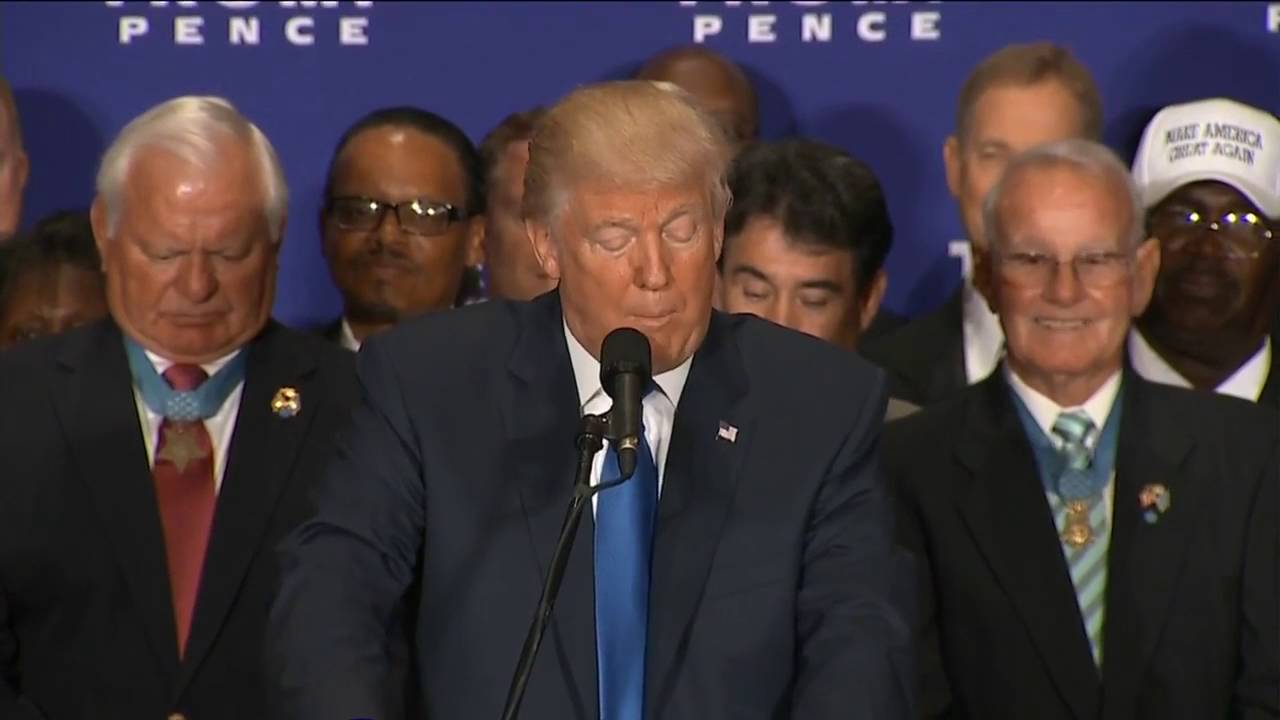
Donald Trump: “President Barack Obama was born in the United States.”
He did so in about seven seconds and 40 words—after spending a half hour paying tribute to the military and promoting his new upscale hotel in Washington, D.C.:
“Now, not to mention her in the same breath, but Hillary Clinton and her campaign of 2008 started the birther controversy.
“I finished it. I finished it. You know what I mean.
“President Barack Obama was born in the United States, period. Now we all want to get back to making America strong and great again.”
His tone made it clear that he felt uneasy making that statement–and wanted to get it over with as fast as possible.
He refused to take questions from reporters covering the event. Nor did he apologize for his five-year campaign of slander.
On the evening of September 16, Hillary Clinton strongly responded to Trump’s comments:
“For five years, he has led the birther movement to de-legitimize our first black president. His campaign was founded on this outrageous lie. There is no erasing it in history.”
And First Lady Michelle Obama slammed Trump for his “birther” claims:
“Then, of course, there were those who questioned, and who continue to question for the past eight years, and up to this very day, whether my husband was even born in this country.
“Well, during his time in office, I think Barack has answered those questions with the examples he set, by going high when they go low. And he’s answered these questions with the progress we’ve achieved together.”
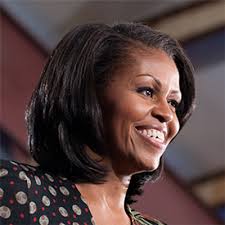
Michelle Obama
But perhaps the best perspective on this event was provided by syndicated columnist Mark Shields and New York Times columnist David Brooks. Each Friday they appear on the PBS Newshour to review the week’s major political events.
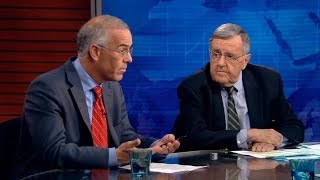
David Brooks and Mark Shields
On September 16, 2016, Shields (a liberal) and Brooks (a conservative) addressed Trump’s about-face on birtherism.
MARK SHIELDS: “I think it’s important to establish right at the outset that [Trump] wasn’t only the loudest and the highest-profile and the most persistent and the most well-publicized birther, he, Donald Trump. He lied. He lied consistently and persistently.
“And, today, without explanation or excuse, he just changed his position and tried to absolutely falsely shift the blame onto Hillary Clinton.
“And this was an appeal to—he debased democracy. He debased the national debate. He appealed to that which is most ignoble or least noble in all of us.”
DAVID BROOKS: “Usually, there’s some tangential relationship to the truth, but a corroding relationship to the truth, frankly, as politics has gone on over the years.
“But now we’re in a reverse, Orwellian inversion of the truth with this. And so we have a team of staffers and then the candidate himself who have taken the normal spin and smashed all the rules.
“And so we are really in Orwell land. We are in 1984. And it’s interesting that an authoritarian personality type comes in at the same time with a complete disrespect for even tangential relationship to the truth that words are unmoored.
“And so I do think this statement sort of shocked me with the purification of a lot of terrible trends that have been happening. And so what’s white is black, and what is up is down, what is down is up. And that really is something new in politics.
“And the fact that there is no penalty for it, apparently—he’s doing fantastic in the last two weeks in the polls–is just somehow where we have gotten.”
Less than two months later, Trump won the Presidency.
Since then, Trump has continued to inhabit what David Brooks called “Orwell land.”
The most recent example of this occurred on January 9, 2017.
The night before, Meryl Streep had enraged Trump and his mouthpiece, Kelleyanne Conway, at the Golden Globes Awards ceremony.
While being presented with the Cecil B. DeMille Lifetime Achievement Award, she had criticized Trump’s mocking, on November 25, 2015, of disabled New York Times reporter Serve Kovaleski:
“There was one performance this year that stunned me. It sank its hooks in my heart. Not because it was good. There was nothing good about it. But it was effective, and it did its job. It made its intended audience laugh and show their teeth.
“It was that moment when the person asking to sit in the most respected seat in our country imitated a disabled reporter. Someone he outranked in privilege, power and the capacity to fight back. It kind of broke my heart when I saw it. I still can’t get it out of my head because it wasn’t in a movie. It was real life.”
2016 PRESIDENTIAL CAMPAIGN, 9/11 ATTACKS, ABC NEWS, ACADEMY AWARDS, ALTERNET, AMERICABLOG, AP, ASSOCIATED PRESS, BABY BOOMER RESISTANCE, BARACK OBAMA, BBC, BEST ACTRESS, BEST SUPPORTING ACTRESS, BIRTHERS, BLOOMBERG, BULLYING, BUZZFEED, CBS NEWS, CENSORSHIP, CHRIS CUOMO, CNN, CREDIBILITY GAP, CROOKS AND LIARS, DAILY KOS, DAVID BROOKS, DAVID HALBERSTAM, DISABILITY, DONALD TRUMP, FIVETHIRTYEIGHT, FOX AND FRIENDS, FRANK STANTON, FULL METAL JACKET, GEORGE MCGOVERN, GOLDEN GLOBES, HARPER’S MAGAZINE, HILLARY CLINTON, HUFFINGTON POST, JOHN F. KENNEDY, KELLEYANNE CONWAY, KRAMER VS. KRAMER, LYNDON B. JOHNSON, MARK SHIELDS, MEDIA MATTERS, MERYL STREEP, MORLEY SAFER, MOTHER JONES, MOVEON, MSNBC, NAVY SEALS, NBC NEWS, NEEWSWEEK, NEW DAY, NEW REPUBLIC, NEWSDAY, NEWSWEEK, NPR, OSAMA BIN LADEN, PBS NEWSHOUR, PETER ARNETT, POLITICO, POLITICUSUSA, RAW STORY, REUTERS, RICHARD NIXON, RONALD ZIEGLER, SALON, SEATTLE TIMES, SERGE KOVALESKI, SLATE, SOPHIE'S CHOICE, STANLEY KUBRICK, TALKING POINTS MEMO, THE ATLANTIC, THE CHICAGO SUN-TIMES, THE CHICAGO TRIBUNE, THE DAILY BEAST, THE DAILY BLOG, THE GUARDIAN, THE HILL, THE HUFFINGTON POST, THE INTERCEPT, THE IRON LADY, THE LOS ANGELES TIMES, THE NATION, THE NEW REPUBLIC, THE NEW YORK TIMES, THE NEW YORKER, THE VILLAGE VOICE, THE WALL STREET JOURNAL, THE WASHINGTON POST, THINKPROGRESS, TIME, TRUTHDIG, TRUTHOUT, TWO POLITICAL JUNKIES, U.S. NEWS & WORLD REPORT, UPI, USA TODAY, VIETNAM WAR, WATERGATE, X
In Bureaucracy, History, Law, Law Enforcement, Military, Politics, Social commentary on October 16, 2024 at 12:26 am
“Credibility gap” is a term that came into use during the mid-1960s to describe public and journalistic distrust of President Lyndon B. Johnson. In particular, the term was applied to his administration’s conduct of the Vietnam war.
It was, in short, a euphemism for accusing government officials of outright lying.
An example of the credibility gap in full swing appeared in Stanley Kubrick’s classic 1987 Vietnam war movie, Full Metal Jacket.
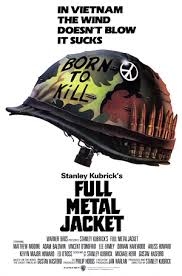
Vietnam was a war where military and political officials spewed a gung-ho version of constant American progress against a tough enemy.
And where civilian reporters like David Halberstam and Walter Cronkite saw—and labeled—the war as a brutal, wasteful and ultimately doomed effort.
Midway through the film, there’s an editorial meeting of The Sea Tiger, the official Marine newspaper.
Lieutenant Lockhart is presiding–and he is determined to give his superiors an endless stream of “all-systems-go” propaganda reports. He reads a series of stories that have been published:
Story #1: DIPLOMATS IN DUNGAREES—MARINE ENGINEERS LEND A HELPING HAND REBUILDING DONG PHUC VILLAGES.
LOCKHART: “Chili, “if we move Vietnamese, they are evacuees. If they come to us to be evacuated, they are refugees.”
Story #2: N.V.A. SOLDIER DESERTS AFTER READING PAMPHLETS.
LOCKHART: “A young North Vietnamese Army regular, who realized his side could not win the war, deserted from his unit after reading Open Arms program pamphlets.”
Story #3: NOT WHILE WE’RE EATING: N.V.A. LEARN MARINES ON A SEARCH AND DESTROY MISSION DON’T LIKE TO BE INTERRUPTED WHILE EATING CHOW.
LOCKHART: “‘Search and destroy.’ Uh, we have a new directive on this. In the future, in place of ‘search and destroy,’ substitute the phrase ‘sweep and clear.’ Got it?”
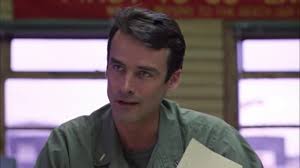
Lt. Lockhart, editor of The Sea Tiger
LOCKHART: “And, Joker—where’s the weenie?”
JOKER: “Sir?”
LOCKHART “The Kill, Joker. I mean, all that fire, the grunts must’ve hit something.”
JOKER: “Didn’t see ’em.”
LOCKHART: “Joker, I’ve told you, we run two basic stories here: Grunts who give half their pay to buy gooks toothbrushes and deodorants—winning of hearts and Minds—okay? And combat action that results in a kill—Winning the War. Now you must have seen blood trails … drag marks?”
JOKER: “It was raining, sir.”
LOCKHART: “Well, that’s why God passed the law of probability. Now rewrite it and give it a happy ending–say, uh, one kill. Make it a sapper or an officer. Grunts like reading about dead officers.”
JOKER: “Okay, an officer. How about a general?”
LOCKHART: “Joker, maybe you’d like our guys to read the paper and feel bad. I mean, in case you didn’t know it, this is not a particularly popular war. Now, it is our job to report the news that these why-are-we-here civilian newsmen ignore.”
So great became the divide between truth and lies during military “press briefings” that reporters started calling them “The Five O’clock Follies.” And even some soldiers took to wearing buttons that said: “Ambushed at Credibility Gap.”
Reporters who dared to write truthfully about the military’s crimes and failures—like David Halberstam of the New York Times and Peter Arnett of the Associated Press—were regarded as traitors by military and political officials.
In 1963, President John F. Kennedy became enraged by Halberstam’s reporting on the corruption of the South Vietnamese government. He pressured New York Times publisher Arthur Ochs Sulzberger to transfer Halberstam to another locale. Sulzberger politely refused—and then, to send a message to Kennedy, extended Halberstam’s stay in Vietnam another six months.
David Halberstam
In 1965, when CBS Correspondent Morley Safer filmed Marines setting fire to the village of Cam Ne with Zippo lighters, President Lyndon B. Johnson was similarly outraged.
He placed an early-morning call to CBS News President Frank Stanton and shouted: “Your boys shat on the American flag!”
The trail of deceit and attempted censorship continued right up to the end of the war—in April, 1975. That was when North Vietnamese forces invaded the South and quickly overwhelmed the incompetent defenses arrayed against them.
And while America was still bogged down in Vietnam, the Watergate scandal erupted on June 17, 1972.
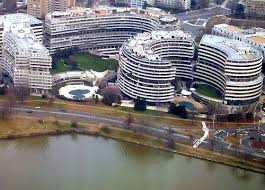
Watergate Hotel
Members of the Nixon administration’s secret “Plumbers Unit” burglarized the offices of the Democratic National Committee at the Watergate Hotel.
Obsessed with re-electing Richard Nixon, they sought incriminating information to discredit U.S. Senator George McGovern, the Democrats’ nominee for President.
When the burglars were caught, President Richard M. Nixon and his topmost officials lied and stonewalled both reporters and investigators seeking the truth.
Nixon’s press secretary, Ronald Ziegler, repeatedly slandered the integrity of The Washington Post for its coverage of the mushrooming Watergate scandal. He called the Watergate break-in “a third-rate burglary” and attacked the Post for “shabby journalism.”
Finally, on April 17, 1973, Ziegler, announced at a press conference: “This is the operative statement. The others are inoperative.”
In short: We’ve been lying to you for the last 10 months. But now we’re telling the truth.
Like Vietnam, the Watergate scandal destroyed the reputations of many of its chief architects. Forty government officials were indicted or jailed.
Vietnam and Watergate were seminal events for Americans coming of age in the late 1960s and early 1970s. They taught an entire generation: Don’t trust the government. Its officials routinely lie, and their lies can be deadly.
ABC NEWS, ALTERNET, AMERICABLOG, AP, BABY BOOMER RESISTANCE, BBC, BERLIN AIRLIFT, BLOOMBERG, BLOOMBERG NEWS, BUZZFEED, CBS NEWS, CNN, CROOKS AND LIARS, DAILY KOS, EGYPT, FIVETHIRTYEIGHT, HARPER’S MAGAZINE, HUFFINGTON POST, ILLEGAL ALIENS, illegal immigration, ISRAEL, MEDIA MATTERS, MEXICO, MOTHER JONES, MOVEON, MSNBC, NBC NEWS, NEW REPUBLIC, NEWSDAY, NEWSWEEK, NPR, OUTER LIMITS "ZANTI MISFITS" EPISODE, PBS NEWSHOUR, POLITICO, POLITICUSUSA, RAW STORY, REPUBLICAN PARTY, REUTERS, SALON, SEATTLE TIMES, SLATE, SOVIET UNION, SYRIA, TALKING POINTS MEMO, THE ATLANTIC, THE CHICAGO SUN-TIMES, THE CHICAGO TRIBUNE, THE DAILY BEAST, THE DAILY BLOG, THE GUARDIAN, THE HILL, THE HUFFINGTON POST, THE INTERCEPT, THE LOS ANGELES TIMES, THE NATION, THE NEW REPUBLIC, THE NEW YORK TIMES, THE NEW YORKER, THE OUTER LIMITS, THE VILLAGE VOICE, THE WASHINGTON POST, THINKPROGRESS, TIME, TRUTHDIG, TRUTHOUT, TWO POLITICAL JUNKIES, U.S. NEWS & WORLD REPORT, UPI, USA TODAY, X, YOM KIPPUR WAR
In Bureaucracy, History, Law, Law Enforcement, Military, Politics, Social commentary on October 14, 2024 at 12:16 am
Suppose the Federal Government could identify and arrest all or most of the estimated 11 to 20 million illegal aliens now living in the United States. Would deporting them to their native countries solve America’s illegal immigration crisis?
Hardly.
Most of America’s illegals come from neighboring Hispanic countries. As soon as they are deported, most of them cross the Mexican border again.
More importantly: The governments of Central and South American countries use the United States as a dumping ground—of those citizens who might demand reforms in their political and economic institutions.
There is only one approach that could strike a meaningful blow against illegal immigration. And it might well be called “The Zanti Option.”
Viewers of the 1960s sci-fi series, The Outer Limits, will vividly recall its 1963 episode, “The Zanti Misfits.”
In this, soldiers at an American Army base in a California ghost town nervously await first-contact with an alien race that has landed a space ship nearby.
The soldiers are warned to steer clear of the ship, and they do. But then an escaped convict (Bruce Dern, in an early role) happens upon the scene—and the ship.
The Zantis, enraged, emerge—and soon the soldiers at the military base find themselves under attack.

A “Zanti”
The soldiers desperately fight back—with flamethrowers, machineguns or just rifle butts. Finally the soldiers wipe out the Zantis.
But now the base—and probably America—faces a wholesale invasion from the planet Zanti to avenge the deaths of their comrades.
So the soldiers wait anxiously for their next transmission from Zanti—which soon arrives.
To their surprise—and relief—it’s a message of thanks: “We will not retaliate. We never intended to. We knew that you could not live with such aliens in your midst.
“It was always our intention that you destroy them…We are incapable of executing our own species, but you are not. You are practiced executioners. We thank you.”
Meanwhile, on May 11, 2023, the Biden administration scrapped Title 42, a Trump-era public health order issued in 2020 during the early weeks of the COVID-19 pandemic. Under this, 2.4 illegal aliens had been expelled from the southern border.

Illegal aliens invading the United States
The rapid nature of the expulsions—usually taking place within hours—sharply curtailed access to asylum regulations.
Immigration—especially illegal immigration—has become an increasingly volatile issue within the United States. This is especially true as the country continues to recover from the COVID-19 pandemic and supply housing, food and jobs to its own citizens.
But even without Title 42, there is a way for the United States to effectively deal with unwanted illegal aliens:
Instead of deporting them to Central American countries—from which they will easily sneak back into the United States—the Federal Government can ship them off to more distant lands.
Like Afghanistan.
Or Iraq.
Or Syria.
Such a policy change would:
- Close the Mexican revolving door, which keeps illegal immigration flowing; and
- Send an unmistakably blunt message to other would-be illegals: “The same fate awaits you.”
Although this might seem a far-fetched proposal, it could be easily carried out by the United States Air Force. According to its website: “The C-5 Galaxy is one of the largest aircraft in the world and the largest airlifter in the Air Force inventory.
“The C-5 has a greater capacity than any other airlifter. It [can] carry 36 standard pallets and 81 troops simultaneously.
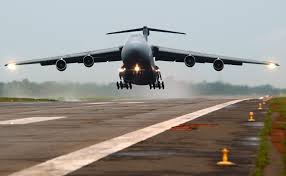
C-5 transport plane
“[It can also carry] any of the Army’s air-transportable combat equipment, including such bulky items as the 74-ton mobile scissors bridge.
“It can also carry outsize and oversize cargo over intercontinental ranges and can take off or land in relatively short distances.”
The C-5 Galaxy’s maximum cargo weight: 281,001 pounds
Instead of being stuffed with cargo, these planes could be stuffed wall-to-wall with illegal aliens.
The United States Air Force has a proud history of successfully providing America’s soldiers—and allies—with the supplies they need.
From June 24, 1948 to May 12, 1949, only the Berlin Airlift stood between German citizens and starvation.
The Soviet Union had blocked the railway, road, and canal access to the Berlin sectors under allied control. Their goal: Force the western powers to allow the Soviet zone to supply Berlin with food, fuel, and aid.
This would have given the Soviets control over the entire city.
Air forces from the United States, England, Canada, Australia, New Zealand and South Africa flew over 200,000 flights in one year, dropping more than 4,700 tons of necessities daily to the besieged Berliners.
The success of the Berlin Airlift raised American prestige and embarrassed the Soviets, who lifted the blockade.

The Berlin Airlift
A similar triumph came during the Yom Kippur War after Egypt and Syria attacked Israel without warning on October 6, 1973.
For 32 days, the Air Force shipped 22,325 tons of ammunition, artillery, tanks and other supplies. These proved invaluable in saving Israel from destruction.
So the mass deportation of millions of illegal aliens lies within America’s technological capability.
The only uncertainty: Is an American President willing to give that order?


ABC NEWS, ADOLF HITLER, ALBERT SPEER, ALTERNET, AMERICABLOG, AP, BABY BOOMER RESISTANCE, BBC, BETRAYAL, BIBLES, BLOOMBERG, BUZZFEED, CBS NEWS, CHINA, CNN, CROOKS AND LIARS, DAILY KOS, DONALD TRUMP, ERICH VON MANSTEIN, FBI, FIVETHIRTYEIGHT, FRANCE, HARPER’S MAGAZINE, HUFFINGTON POST, JAMES COMEY, JOSEPH R. MCCARTHY, MAGINOT LINE, MEDIA MATTERS, MICHAEL COHEN, MOTHER JONES, MOVEON, MSNBC, MUGS, NAZI GERMANY, NBC NEWS, NEW REPUBLIC, NEWSDAY, NEWSWEEK, NPR, PBS NEWSHOUR, PEW RESEARCH CENTER, POLITICO, POLITICUSUSA, RAW STORY, REUTERS, ROY COHN, SALON, SEATTLE TIMES, SLATE, SNEAKERS, SOVIET UNION, T-SHIRTS, TALKING POINTS MEMO, THE ATLANTIC, THE CHICAGO SUN-TIMES, THE CHICAGO TRIBUNE, THE DAILY BEAST, THE DAILY BLOG, THE GUARDIAN, THE HILL, THE HUFFINGTON POST, THE INTERCEPT, THE IRAN NUCLEAR DEAL, THE LOS ANGELES TIMES, THE NATION, THE NEW REPUBLIC, THE NEW YORK TIMES, THE NEW YORKER, THE PARIS AGREEMENT, THE VILLAGE VOICE, THE WASHINGTON POST, THE WEEK, THINKPROGRESS, TIME, TRANS-PACIFIC PARTNERSHIP, TRUTHDIG, TRUTHOUT, TWO POLITICAL JUNKIES, U.S. NEWS & WORLD REPORT, UPI, USA TODAY, WORLD WAR 11, X
HITLER AND TRUMP: YOU OWE ME LOYALTY; I OWE YOU NOTHING
In Bureaucracy, History, Law, Law Enforcement, Military, Politics, Social commentary on November 18, 2024 at 12:10 amOn January 27, 1944, Adolf Hitler convened a meeting of 100 of his military chiefs, including all the army group commanders of the Eastern front.
The war against the Soviet Union was going badly while the Americans and British were preparing to invade France. And Hitler believed he had the recipe for assuring victory: The Wehrmacht needed to be inoculated with the spirit of National Socialism.
At the end of his long-winded speech, he addressed this challenge to his generals:
“If the worse ever comes to the worst, and I am ever abandoned as Supreme Commander by my own people, I must still expect my entire officer corps to muster around me with daggers drawn—just as every field marshal or the commander of an army corps, division or regiment expects his subordinates to stand by him in the hour of crisis.”
Adolf Hitler
Sitting in the front row was Field Marshal Erich von Manstein, perhaps the most brilliant member of the German General Staff. It was Manstein who had designed the “Sickle Cut” attack on France in May, 1940.
Bypassing the much-vaunted Maginot Line, the Wehrmacht struck through Belgium, taking the French completely by surprise. As a result, it defeated France in six weeks—something Germany had been unable to do during the four years of World War 1.
Now, in a loud voice, Manstein proclaimed: “And so it will be, Mein Fuhrer!”
Hitler froze; it had been more than a decade since anyone had dared interrupt him. Then, trying to make the best of a bad moment, he continued: “Very well. If this is the case, it will be impossible for us to lose this war.”
Hitler hoped that Manstein had intended to reassure him of his loyalty. But Martin Bormann, his all-powerful secretary, told him that the generals had interpreted the outburst differently: That the worse would indeed come to the worst.
Erich von Manstein
And, which, in fact, happened.
As the Russian army closed in on his underground bunker in April, 1945, Hitler revealed his utter contempt for the Germans who had so blindly served him for 12 years.
“If the war is lost,” Hitler told his former architect and now Minister of Armaments, Albert Speer, “the nation will also perish. This fate is inevitable.
“There is no necessity to take into consideration the basis which the people will need to continue even a most primitive existence.
“On the contrary, it will be better to destroy these things ourselves, because this nation will have proved to be the weaker one and the future will belong solely to the stronger eastern nation.”
Just as Hitler demanded loyalty from his accomplices to infamy, so does Donald Trump.
Former FBI Director James Comey has had firsthand experience in attacking organized crime—and in spotting its leaders.
In his bestselling memoir, A Higher Loyalty, he writes:
“As I found myself thrust into the Trump orbit, I once again was having flashbacks to my earlier career as a prosecutor against the mob. The silent circle of assent. The boss in complete control. The loyalty oaths. The us-versus-them worldview. The lying about all things, large and small, in service to some code of loyalty that put the organization above morality and the truth.”
James Comey
When Comey refused to overlook Trump’s treasonous contacts with Russian dictator Vladimir Putin, Trump fired him.
On October 9, 2019, The Week published an article: “Note to Republicans: Trump will betray you just like he betrayed the Kurds. The one constant in the president’s life is betrayal.” Specifically:
“Trump’s forte is con artistry. He sells books he doesn’t write to people who don’t read. He failed as a businessman but succeeded as a fake businessman on TV. The supreme irony of his life is that he poses as a dealmaker when he is the opposite. Trump doesn’t make deals. He breaks them….
“If there’s a constant in Trump’s life, it’s betrayal. He has betrayed his business partners, his customers, his employees, his friends, his wives, and his voters. A man who is willing to betray those closest to him will not hesitate to turn his back on foreigners thousands of miles away.”
To enrich himself at the expense of his followers, Trump has peddled a variety of expensive products. Among these:
On the international level, Trump has withdrawn the United States from a host of international agreements. Among these:
As a result, the world no longer trusts the United States to honor its commitments.
A 2018 Pew Research Center survey found that 82 percent of Europeans didn’t trust Trump’s handling of international issues. Seventy-five percent of Canadians and 91 percent of Mexicans didn’t trust him to do the right thing regarding world affairs.
For Trump, as for Hitler, loyalty goes only one way—from others to him. No one who served either man—no matter how loyally or how long—could be certain when he would be deemed disposable.
Share this: