Archive for the ‘Entertainment’ Category
ABC NEWS, ADOLF HITLER, ALTERNET, AMERICABLOG, AP, ASSASSINATION, BABY BOOMER RESISTANCE, BBC, BLOOMBERG NEWS, BRETT KAVANAUGH, BUZZFEED, CBS NEWS, CLARENCE THOMAS, CNN, CROOKS AND LIARS, CZECHOSLOVAKIA, DAILY KOS, DONALD TRUMP, DRUDGE REPORT, FINAL SOLUTION, FIVETHIRTYEIGHT, GREGORY BOVINO, HARPER’S MAGAZINE, HEINRICH HIMMLER, HERMANN GOERING, HUFFINGTON POST, IMMIGRATION AND CUSTOMS ENFORCEMENT (ICE), JANUARY 6 INSURRECTION, JOE BIDEN, KRISTI NOEM, MARCO RUBIO, MEDIA MATTERS, MEDICAID, MOTHER JONES, MOVEON, MSNBC, NATIONAL RIFLE ASSOCIATION, NAZI GERMANY, NBC NEWS, NEW REPUBLIC, NEWSDAY, NEWSWEEK, NPR, PAM BONDI, PBS NEWSHOUR, POLITICO, POLITICUSUSA, RAW STORY, REINHARD HEYDRICH, RENEE GOOD, REUTERS, ROLAND FREISLER, RUDOLF HESS, SALON, SEATTLE TIMES, SLATE, SS, STEPHEN MILLER, TALKING POINTS MEMO, TED CRUZ, THE ATLANTIC, THE CHICAGO SUN-TIMES, THE CHICAGO TRIBUNE, THE DAILY BEAST, THE DAILY BLOG, THE GUARDIAN, THE HILL, THE HUFFINGTON POST, THE LOS ANGELES TIMES, THE NATION, THE NEW REPUBLIC, THE NEW YORK TIMES, THE NEW YORKER, THE SUPREME COURT, THE VILLAGE VOICE, THE WASHINGTON POST, THINKPROGRESS, TIME, TRUTHDIG, TRUTHOUT, TWO POLITICAL JUNKIES, U.S. NEWS & WORLD REPORT, UPI, USA TODAY, WANNSEE CONFERENCE, X
In Bureaucracy, Entertainment, History, Politics, Social commentary on January 21, 2026 at 12:13 am
Threats of violence have become common among Republicans since 2015, when Donald Trump first ran for President.
On March 16, 2016, Trump warned Republicans that if he didn’t win the GOP nomination in July, his supporters would literally riot: “I think you’d have riots. I think you would see problems like you’ve never seen before. I think bad things would happen. I really do. I wouldn’t lead it, but I think bad things would happen.”
Almost five years later, on January 6, 2021, then-President Trump incited a deadly riot against the United States Capitol to stop Congress from certifying the electoral victory of Joe Biden in the 2020 presidential election.
Upon taking office again as President on January 20, 2025, Trump issued a blanket pardon to about 1,500 of his supporters who carried out the attack. This sent a clear message to his future opponents: “I will similarly pardon anyone who assaults you.”
In 2025, a re-elected Trump launched a sweeping deportation effort. Agents of Immigration and Customs Enforcement [ICE] have brutalized migrants and American citizens.
In Minneapolis and Saint Paul, Minnesota, for example, protesters blow whistles, yell or honk horns. Immigration officers break vehicle windows, use pepper spray on protesters and warn observers not to follow them through public spaces. Immigrants and citizens alike are forcibly pulled from cars, stores or homes and detained for hours, days or longer.
On January 7, 2026, an ICE agent shot 37-year-old Renee Nicole Good, a writer and poet, as she legally observed federal agents arresting suspected illegal aliens.
The Third Reich similarly relied on violence—or the threat of it—to preserve its dictatorial control over Germany.
A key representative of that violence was Reinhard Tristan Eugen Heydrich.
A tall, blond-haired former naval officer, Heydrich was both a champion fencer and talented violinist. Heydrich joined the Schutzstaffel, or Protective Squads, better known as the SS, in 1931, and quickly became head of its counterintelligence service.
In 1934, he oversaw the “Night of the Long Knives” purge of Adolf Hitler’s brown-shirted S.A., or Stormtroopers.
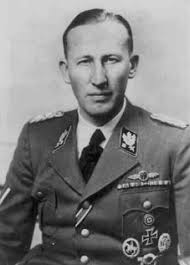
Reinhard Heycrich
In September, 1941, Heydrich was appointed “Reich Protector” of Czechoslovakia, which had fallen prey to Germany in 1938 but whose citizens were growing restless under Nazi rule.
Heydrich immediately ordered a purge, executing 92 people within the first three days of his arrival in Prague. By February, 1942, 4,000-5,000 people had been arrested.
In January, 1942, Heydrich convened a meeting of high-ranking political and military leaders in Wannsee, Germany, to streamline “the Final Solution to the Jewish Question.”
An estimated six million Jews were thus slaughtered.
Returning to Prague, Heydrich continued his policy of carrot-and-stick with the Czechs—improving the social security system and requisitioning luxury hotels for middle-class workers, alternating with arrests and executions.
Two British-trained Czech commandos—Jan Kubis and Joseph Gabcik—parachuted into Prague.
On May 27, 1942, they waited at a hairpin turn in the road always taken by Heydrich. When Heydrich’s Mercedes slowed down, Gabcik raised his machinegun—which jammed.
Rising in his seat, Heydrich aimed his revolver at Gabcik—as Kubis lobbed a hand grenade at the car. The explosion drove steel and leather fragments of the car’s upholstery into Heydrich’s diaphragm, spleen and lung.

Scene of Reinhard Heydrich’s assassination
Hitler dispatched doctors from Berlin to save the Reich Protector. But infection set in, and on June 4, Heydrich died at age 38.
The assassination sent shockwaves through the upper echelons of the Third Reich. No one had dared assault—much less assassinate—a high-ranking Nazi official.
Nazis had slaughtered tens of thousands without hesitation. Suddenly they realized that the fury they had aroused could be turned against themselves.
Which brings us to the leaders of America’s own Right-wing.
The names of infamous Nazis were widely known:
- Fuhrer Adolf Hitler
- Reichsmarshall Hermann Goering
- Propaganda Minister Paul Joseph Goebbels
- Deputy Fuhrer Rudolf Hess
- Propaganda Film Director Leni Riefenstahl
- SS-Reichsfuhrer Heinrich Himmler
- “Hanging Judge” Roland Freisler
- Foreign Minister Joachim von Ribbentrop
- SS Obergruppenfuhrer Reinhard Heydrich
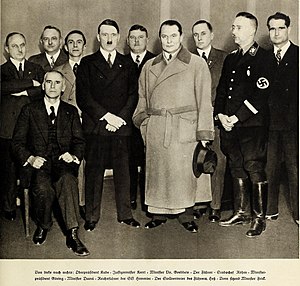
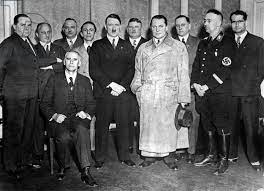
Members of the Nazi government
And so are the names of the infamous leaders of the American Right:
- President Donald Trump
- House Majority Leader Mike Johnson
- White House Deputy Chief of Staff for Policy Stephen Miller
- Texas Senator Ted Cruz
- Supreme Court Justice Clarence Thomas
- Attorney General Pam Bondi
- Secretary of State Marco Rubio
- Department of Homeland Security Secretary Kristi Noem
- U.S. Border Patrol commander Gregory Bovino
The difference between these two infamous groups is this:
In Nazi Germany, ordinary Germans could not learn about the personal lives of their dictators—including their home addresses—and to conspire against them.
In the United States, ordinary citizens have an array of means to do this. They can turn to newspapers, TV and magazines. And if that isn’t enough, “people finder” websites, for a modest price, provide addresses and names of relatives of potential targets.
In Nazi Germany, firearms were tightly controlled.
In the United States, the Right’s National Rifle Association has successfully lobbied to put lethal firepower into the hands of virtually anyone who wants it.
Almost 84 years ago, Reinhard Heydrich believed himself invulnerable from the hatred of the enemies he had made. That arrogance cost him his life.
The day may soon come when America’s own Right-wingers start learning that same lesson.
ACADEMY OF FINE ARTS FIENNA, ADOLF HITLER, ALBERT SPEER, ALTERNET, AMERICABLOG, AP, BABY BOOMER RESISTANCE, BBC, BLOOMBERG, BLUESKY, BORIS PASTERNAK, BUZZFEED, CBS NEWS, CNN, CROOKS AND LIARS, DAILY KOS, DIMITRI SHOSTAKOVICH, DONALD TRUMP, DWIGHT D. EISENHOWER, FEAR AND THE MUSE KEPT WATCH (BOOK), FIVETHIRTYEIGHT, HARPER’S MAGAZINE, HITLER AND THE POWER OF AESTHETICS (BOOK), HUFFINGTON POST, JOHN F. KENNEDY, JOHN F. KENNEDY MEMORIAL CENTER FOR THE PERFORMING ARTS, JOSEPH STALIN, KAROLINE LEAVITT, KIM JONG-UN, MEDIA MATTERS, MOTHER JONES, MOVEON, MSNBC, NBC NEWS, NEWSDAY, NEWSWEEK, NPR, PBS NEWSHOUR, POLITICO, POLITICUSUSA, RAW STORY, REUTERS, SALON, SEATTLE TIMES, SLATE, TALKING POINTS MEMO, THE ATLANTIC, THE CHICAGO SUN-TIMES, THE CHICAGO TRIBUNE, THE DAILY BEAST, THE DAILY BLOG, THE GUARDIAN, THE HILL, THE HUFFINGTON POST, THE INTERCEPT, THE LOS ANGELES TIMES, THE NATION, THE NEW REPUBLIC, THE NEW YORK TIMES, THE NEW YORKER, THE VILLAGE VOICE, THE WASHINGTON POST, THINKPROGRESS, THIRD REICH, TIME, TRUTHDIG, TRUTHOUT, TWO POLITICAL JUNKIES, U.S. NEWS & WORLD REPORT, UPI, USA TODAY, VLADIMIR MAYAKOVSKY, VLADIMIR PUTIN, WHITE HOUSE, WHITE HOUSE BALLROOM, X, XI JING PING
In Bureaucracy, Entertainment, History, Politics, Social commentary on January 15, 2026 at 12:06 am
On December 18, 2025, The John F. Kennedy Memorial Center for the Performing Arts became The Donald Trump and John F. Kennedy Memorial Center for the Performing Arts.
And all that it took for this to happen was for Trump’s handpicked board overseeing the John F. Kennedy Center to declare: “We’re adding Trump’s name to this building.”
Specifically, White House Press Secretary Karoline Leavitt announced on X: “I have just been informed that the highly respected Board of the Kennedy Center, some of the most successful people from all parts of the world, have just voted unanimously to rename the Kennedy Center to the Trump-Kennedy Center, because of the unbelievable work President Trump has done over the last year in saving the building.”
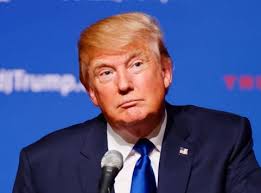
Donald Trump
This totally ignored three vital truths:
First, in 1955, President Dwight D. Eisenhower established a commission for a new public auditorium to showcase the performing arts in the nation’s capital. It was to be called The National Cultural Center.
Second, in January, 1964, two months after the assassination of President John F. Kennedy, Congress passed and President Lyndon B. Johnson signed into law legislation renaming the Center as a “living memorial” in his honor: The John F. Kennedy Memorial Center for the Performing Arts.
Third, adding Trump’s name to the Center legally would require a similar act of Congress—which has not occurred.
Thus, putting Trump’s name on the building without a Congressional act carries all the legitimacy of a graffiti vandal spray-painting his name on the Center.

Trump spent most of 2025 putting his stamp on the Center. First he purged most of the board that governs the institution. Then he replaced its members with pliable ideologues and sycophants, capped by installing itself as the new chairman.
On December 18, his underlings blatantly renamed the center itself.
Given Trump’s well-known admiration for dictators such as Vladimir Putin, Xi Jinping and Kim Jong-Un, it was inevitable that he would seek to remake the arts in his own image.
In doing so, he’s following in the footsteps of propaganda-obsessed tyrants like Joseph Stalin and Adolf Hitler
Consider this blurb from the 2015 nonfiction book, Fear and the Muse Kept Watch: The Russian Masters from Akhmatova and Pasternak to Shostakovich and Eisenstein Under Stalin, by Andy McSmith:
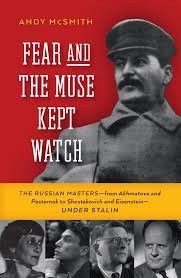
“For those artists visible enough for Stalin to take an interest in them, it was Stalin himself who decided whether they lived in luxury or were sent to the Lubyanka, the headquarters of the secret police, to be tortured and sometimes even executed.
“McSmith brings together the stories of these artists―including [writer] Isaac Babel, [poet and novelist] Boris Pasternak, [composer] Dmitri Shostakovich, and many others―revealing how they pursued their art under Stalin’s regime and often at great personal risk.
“It was a world in which the poet Vladimir Mayakovsky, whose bright yellow tunic was considered a threat to public order under the tsars, struggled to make the communist authorities see the value of avant garde art; Babel publicly thanked the regime for allowing him the privilege of not writing; and Shostakovich’s career veered wildly between public disgrace and wealth and acclaim.”
Adolf Hitler similarly installed himself as the arbiter of culture in Nazi Germany.
In Hitler and the Power of Aesthetics, Frederic Spotts argues that Hitler saw the world corrupted by “evils” he must first destroy so he could re-create it to conform to his artistic ideals.

Hitler considered himself an unappreciated artist. At 18, he had applied for admission to the Academy of Fine Arts Vienna, but was rejected twice. If he had a friend, it was the architect Albert Speer, with whom he felt an artistic kinship.
Even as the Third Reich collapsed, he found time to pore over architectural models he intended to turn into gigantic buildings.
In Hitler’s Germany, culture was not only the end to power but the means of achieving it. His artistry—expressed in spectacles, festivities, parades, rallies and political dramas, as well as in architecture, painting and music—destroyed any sense of individuality and linked the German people with his own drives.
Like Hitler, Trump sees himself as an unrecognized artist. Of the 515 entities he owns, 268 of them—52%—bear his last name. He often refers to his properties as “the swankiest,” “the most beautiful.”
Upon his return to the Presidency in 2025, he turned his “artistic” gifts on the White House. On June 9, contractors began paving over the grass of the White House Rose Garden with stone tiles to create a patio.
Again like Hitler, Trump believes that “bigger is better” in architecture.
On July 31, 2025, the Trump administration announced that a 90,000 square feet addition would be made to the White House to incorporate a 650-person capacity ballroom. In October, Trump ordered the demolition of the White House’s historic East Wing to clear space for it.
The estimated cost has ballooned from $200 million to $400 million.
Trump has repeatedly pushed to enlarge the ballroom—from a 90,000-square-feet addition capable of seating 650 guests to one that can seat, first, 999 guests and then to 1,000 guests at formal dinners.
Tyrants always hail such projects as “gifts for the nation.” In reality, they are self-glorifying monuments to the dictator’s own ego.
ABC NEWS, ABRAHAM LINCOLN, ADOLF HITLER, ALTERNET, AMERICABLOG, AP, BABY BOOMER RESISTANCE, BBC, BLOOMBERG, BLUESKY, BUZZFEED, CBS NEWS, CIVIL WAR, CLARK GABLE, CNN, CONFEDERATE FLAG, CROOKS AND LIARS, DAILY KOS, DANIEL DAY-LEWIS, DRUDGE REPORT, FACEBOOK, FIVETHIRTYEIGHT, GONE WITH THE WIND, HARPER’S MAGAZINE, HATTIE MCDANIEL, HUFFINGTON POST, MARGARET MITCHELL, MEDIA MATTERS, MOTHER JONES, MOVEON, MSNBC, NAZI GERMANY, NBC NEWS, NEWSDAY, NEWSWEEK, NPR, PBS NEWSHOUR, POLITICO, POLITICUSUSA, RACISM, RAW STORY, REUTERS, SALON, SEATTLE TIMES, SLATE, SLAVERY, STEVEN SPIELBERG, TALKING POINTS MEMO, THE ATLANTIC, THE CHICAGO SUN-TIMES, THE CHICAGO TRIBUNE, THE DAILY BEAST, THE DAILY BLOG, THE GUARDIAN, THE HILL, THE HUFFINGTON POST, THE INTERCEPT, THE LOS ANGELES TIMES, THE NATION, THE NEW REPUBLIC, THE NEW YORK TIMES, THE NEW YORKER, THE VILLAGE VOICE, THE WASHINGTON POST, THINKPROGRESS, THIRTEENTH AMENDMENT, TIME, TRUTHDIG, TRUTHOUT, TWO POLITICAL JUNKIES, U.S. NEWS & WORLD REPORT, UPI, USA TODAY, WONKETTE, X
In Entertainment, History, Military, Politics, Social commentary, Uncategorized on December 5, 2025 at 12:11 am
Southerners have long claimed—falsely—that the Civil War was not about slavery.
Steven Spielberg’s Lincoln proves that, from first to last, the cause of the Civil War was slavery.
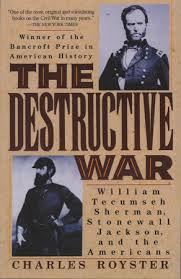
According to The Destructive War, by Charles Royster, arguments over “states’ rights” or economic conflict between North and South didn’t lead 13 Southern states to withdraw from the Union in 1860-61. It was their demand for “respect” of their “peculiar institution”—i.e., slavery.
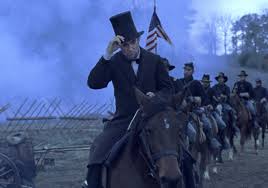
Daniel Day-Lewis as “Lincoln”
“The respect Southerners demanded did not consist simply of the states’ sovereignty or of the equal rights of Northern and Southern citizens, including slaveholders’ right to take their chattels into Northern territory.
“It entailed, too, respect for their assertion of the moral superiority of slaveholding society over free society,” writes Royster.
“It was not enough for Southerners to claim equal standing with Northerners; Northerners must acknowledge it. But this was something that the North was increasingly unwilling to do.”
Finally, its citizens dared to elect Abraham Lincoln as President in 1860. Lincoln and his new Republican party damned slavery—and slaveholders—as morally evil, obsolete and ultimately doomed. And they were determined to prevent slavery from spreading any further throughout the country.
Southerners found all of this intolerable.
The British author, Anthony Trollope, explained to his readers:
“It is no light thing to be told daily, by our fellow citizens…that you are guilty of the one damning sin that cannot be forgiven. All this [Southerners] could partly moderate, partly rebuke and partly bear as long as political power remained in their hands.”
It is to Spielberg’s credit that he forces his audience to look directly at the real cause of the bloodiest conflict on the North American continent.
At the heart of Spielberg’s film: Abraham Lincoln (Daniel Day-Lewis) wants to win ratification of what will be the Thirteenth Amendment to the United States Constitution. An amendment that will forever ban slavery.
But, almost four years into the war, slavery still has powerful friends—in both the North and South.
Many of those friends belong to the House of Representatives, which must ratify the amendment for it to become law. Some are hostile to Lincoln personally. One of them dubs him a dictator: “Abraham Africanus.” Another accuses him of shifting his positions for the sake of expediency.
Other members—white men all—are hostile to the idea of equality between the races.
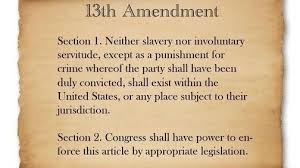
To them, ending slavery means opening the door to interracial marriage—especially marriage between black men and white women. Perhaps even worse, it means possibly giving blacks—or women—the right to vote.
Members of Lincoln’s own Cabinet—such as Secretary of State William Seward—warn him: You can negotiate the end of the war immediately—if you’ll just let Southerners keep their slaves.
After the amendment wins ratification, Lincoln agrees to meet with a “peace delegation” from the Confederate States of America.
At the top of their list of concerns: If they persuade the seceded states to return to the Union, will those states be allowed to nullify the amendment?
No, says Lincoln. He’s willing to make peace with the South, and on highly generous terms. But not at the cost of allowing slavery to live on.
Too many men—North and South—have died in a conflict whose root cause is slavery. Those lives must count for more than simply reuniting the Union.
The South has lost thousands of men (260,000 is the generally accepted figure for its total casualties) and the war is clearly lost. But for its die-hard leaders, parting with slavery is simply unthinkable.
Like Nazi Germany 80 years into the future, the high command of the South won’t surrender until their armies are too beaten down to fight any more.
The major difference between the defeated South of 1865 and the defeated Germany of 1945, is this: The South was allowed to build a beautiful myth of a glorious “Lost Cause,” epitomized by the Margaret Mitchell novel, Gone With the Wind.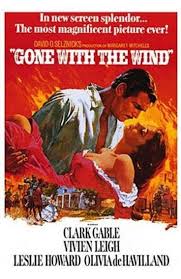
In that telling, dutiful slaves were well-treated by kindly masters. Southern aristocrats wore white suits and their slender-waisted ladies wore long dresses, carried parasols and said “fiddle-dee-dee” to young, handsome suitors.
One million people attended the premier of the movie version in Atlanta on December 15, 1939. The celebration featured stars from the film, receptions, thousands of Confederate flags, false antebellum fronts on stores and homes, and a costume ball.
In keeping with Southern racial tradition, Hattie McDaniel and the other black actors from the film were barred from attending the premiere. Upon learning this, Clark Gable threatened to boycott the event. McDaniel convinced him to attend.
When today’s Southerners fly Confederate flags and speak of “preserving our traditions,” they are actually celebrating their long-banned “peculiar institution.”
By contrast, post-World War II Germany outlawed symbols from the Nazi-era, such as the swastika and the “Heil Hitler” salute, and made Holocaust denial punishable by imprisonment.
America has refused to confront its own shameful past so directly. But Americans can be grateful that Steven Spielberg has had the courage to serve up a long-overdue and much needed lesson in past–and still current—history.
2016 PRESIDENTIAL ELECTION, 2020 PRESIDENTIAL ELECTION, ABC NEWS, ACCESS HOLLYWOOD, ALTERNET, ALVIN BRAGG, AMERICABLOG, ANNE BOLEYN, ANNE OF THE THOUSAND DAYS (MOVIE), AP, BABY BOOMER RESISTANCE, BBC, BILLY BUSH, BLOOMBERG NEWS, BUZZFEED, CATHERINE OF ARAGON, CATHERINE PARR, CBS NEWS, CNN, CROOKS AND LIARS, DAILY KOS, DONALD TRUMP, ELIZABETH 1, FIVETHIRTYEIGHT, GENEVIEVE BUJOLD, GRETCHEN WHITMER, HARPER’S MAGAZINE, HENRY VIII, HUFFINGTON POST, HUSH MONEY, IVANA TRUMP, JANE SEYMOUR, JANUARY 6 COUP ATTEMPT, JOSEPH BIDEN, KATHERINE HOWARD, MARLA MAPLES, MEDIA MATTERS, MELANIA TRUMP, MICHAEL COHEN, MOTHER JONES, MOVEON, MSNBC, NBC NEWS, NEW REPUBLIC, NEW YORK TIMES V. SULLIVAN, NEWSDAY, NEWSWEEK, NPR, PBS NEWSHOUR, POLITICO, POLITICUSUSA, PROUD BOYS, RAW STORY, REUTERS, RICHARD BURTON, SALON, SEATTLE TIMES, SIDNEY POWELL, SLATE, STORMY DANIELS, SUPREME COURT, TALKING POINTS MEMO, THE ATLANTIC, THE CHICAGO SUN-TIMES, THE CHICAGO TRIBUNE, THE DAILY BEAST, THE DAILY BLOG, THE GUARDIAN, THE HILL, THE HUFFINGTON POST, THE INTERCEPT, THE LOS ANGELES TIMES, THE NATION, THE NEW REPUBLIC, THE NEW YORK TIMES, THE NEW YORKER, THE VILLAGE VOICE, THE WASHINGTON POST, THINKPROGRESS, THOMAS CROMWELL, THOMAS MORE, TIME, TRUTHDIG, TRUTHOUT, U.S. NEWS & WORLD REPORT, UPI, USA TODAY, WHARTON SCHOOL OF THE UNIVERSITY OF PENNSYLVANIA, X
In Bureaucracy, Entertainment, History, Law, Law Enforcement, Politics, Social commentary on October 23, 2025 at 12:11 am
There is more in common between Donald Trump and King Henry VIII than at first might seem possible.
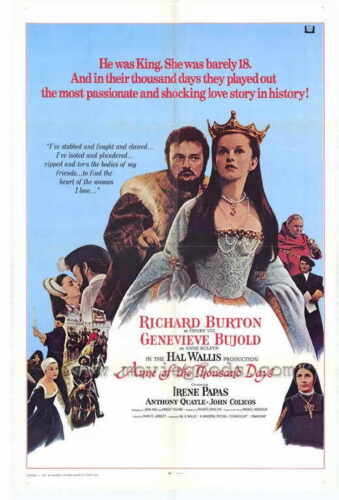
And the 1969 movie, “Anne of the Thousand Days,” brings it vividly to light.
Throughout much of the film, Henry (Richard Burton) lusts to romantically—and sexually—capture the beautiful Anne Boleyn (Geneviève Bujold). The fact that he’s married to Catherine of Aragon matters not at all.
Henry justifies his infidelity on the fact that Catherine has failed to give him a male heir.
He’s been having an affair with Anne’s younger sister, Mary, but is now bored with her. The fact that she’s now pregnant with his child matters not at all, either.
He first notices Anne, 18, at a court ball. She’s engaged to the son of the Earl of Northumberland, and they have received their parents’ permission to marry. But Henry is enraptured with Anne’s beauty and orders his Lord Chancellor, Cardinal Wolsey, to break the engagement.
Anne is furious, and blames both Henry and Wolsey for ruining her happiness. But as the King’s infatuation continues, she becomes intoxicated with the power it brings her.
Henry presses Anne to become his mistress. But she says she won’t bear an illegitimate child. Desperate to have a son, Henry decides to divorce Catherine and marry Anne.
For Anne, it’s the ultimate seduction, and she agrees. She’s ordained as Queen, but is popularly reviled by the supporters of Catherine.
Months later, Henry is dismayed when Anne gives birth to a daughter, Elizabeth—who will eventually become Queen after Henry’s death.
Henry turns his always-wandering eye to Jane Seymour, one of Anne’s maids. Anne banishes Jane from the court.

Henry VIII
Anne is furious that Sir Thomas More, the King’s Chancellor, opposes Henry’s divorce from Catherine. She refuses to sleep with Henry unless he executes More.
Anne gets her wish: More is beheaded. But her next child—a boy—is stillborn.
By now, Henry is convinced Anne will never be able to give him a male heir. He schemes to divorce her and marry Jane. He contrives with his new chief minister, Thomas Cromwell, to have Anne falsely charged with infidelity.
At her trial, Anne vigorously defends herself, proving that the witnesses against her are lying.
In a private meeting with her, Henry offers to free her if she’ll agree to annul their marriage. Since this will make Elizabeth illegitimate, Anne refuses—and goes courageously to her death
Throughout the movie, Englishmen from Henry on down are convinced that England will collapse if a woman ascends the throne.
And, of course, England not only survives but thrives under the 45-year reign of Queen Elizabeth.
Which brings us to Donald Trump.
Like Henry, Trump is a man of voracious appetites—for wealth, for fame, for sex. Like Henry, he is untroubled by scruples and will commit any crime to attain whatever he wants. Like Henry, he is a man of fierce temper—always eager to crush anyone he thinks has wronged him.
Donald Trump
Countless Englishmen who lived under Henry thought England would collapse if a woman took the throne.
Now countless Americans believed the United States would collapse if a former President was brought to trial.
On March 30, 2023, Trump was indicted by a New York grand jury. He thus became the first current or former President to face criminal charges.
On April 1, CNN reported/editorialized: “Former President Donald Trump’s indictment….has thrust the nation into uncharted political, legal and historical waters, and raised a slew of questions about how the criminal case will unfold.
“The Manhattan district attorney’s office has been investigating Trump in connection with his alleged role in a hush money payment scheme and cover-up involving adult film star Stormy Daniels that dates to the 2016 Presidential election.”
Trump attacked Manhattan District Attorney Alvin Bragg as pursuing a leftist vendetta to prevent him from running for President in 2024.
“If they can do this to me,” he thundered in countless fund-raising appeals to his Right-wing followers, “they can do this to you.”
Which raised the question: “How many others have tried to illegally overturn a legitimate Presidential election and/or paid hush-money to a porn ‘actress’?”
Trump repeatedly tried to appear the victim of “a Democratic-led witch hunt.” But if politics tainted the dispensing of justice in Trump’s case, it was on his behalf.
As President, he had immunity from civil and criminal lawsuits. He couldn’t be tried at local, state and federal levels. And he had good reason to avoid facing trial at any level. Among the cases facing him while he held office:
- The Manhattan District Attorney’s criminal case against the Trump Organization for tax evasion.
- The New York Attorney General’s civil investigation into the Trump Organization for fraud.
- The E. Jean Carroll defamation lawsuit (he called her a liar after she claimed he raped her in the 1990s).
- The Mary Trump lawsuit: His niece was suing him for allegedly defrauding her out of millions of dollars.
- The Trump Tower lawsuit: Five people claimed that Keith Schiller, the Trump Organization’s then chief of security, hit one of them on the head when they were protesting outside of the company’s Manhattan headquarters in 2015.
"TOMBSTONE", ABC NEWS, AFFORDABLE CARE ACT, ALTERNET, AMERICABLOG, AP, ARNOLD SCHWARTZNEGGER, ASIANS, BABY BOOMER RESISTANCE, BARACK OBAMA, BBC, BIRTHRIGHT CITIZENSHIP, BLACKS, BLOOMBERG, BLOOMBERG NEWS, BLUESKY, BUZZFEED, CBS NEWS, CNN, CONSTITUTION OF THE UNITED STATES, CROOKS AND LIARS, DAILY KOS, DEATH PENALTY, DISABLED, DISCRIMINATION, DONALD TRUMP, FBI, FIVETHIRTYEIGHT, FOREIGN AID, GRANTS, HARPER’S MAGAZINE, HILLARY CLINTON, HISPANICS, HUFFINGTON POST, IKE CLANTON, illegal immigration, JANUARY 6 COUP ATTEMPT, JOHN H. "DOC" HOLLIDAY, JOHN OLIVER, JOHNNY RINGO, JUSTICE DEPARTMENT, LOANS, MEDIA MATTERS, MERYL STREEP, MIGRANTS, MORGAN EARP, MOTHER JONES, MOVEON, MSNBC, MUSLIMS, NBC NEWS, NEIL YOUNG, NEW REPUBLIC, NEWSDAY, NEWSWEEK, NPR, OBAMACARE, PARIS CLIMATE AGREEMENT, PBS NEWSHOUR, POLITICO, POLITICUSUSA, PRISONERS OF WAR, RAW STORY, REFUGEES, REUTERS, SALON, SEAN SPICER, SEATTLE TIMES, SLATE, TALKING POINTS MEMO, THE ATLANTIC, THE CHICAGO SUN-TIMES, THE CHICAGO TRIBUNE, THE DAILY BEAST, THE DAILY BLOG, THE GUARDIAN, THE HILL, THE HUFFINGTON POST, THE INTERCEPT, THE LOS ANGELES TIMES, THE NATION, THE NEW REPUBLIC, THE NEW YORK TIMES, THE NEW YORKER, THE VILLAGE VOICE, THE WASHINGTON POST, THINKPROGRESS, TIME, TRUTHDIG, TRUTHOUT, TWO POLITICAL JUNKIES, U.S. NEWS & WORLD REPORT, UP, UPI, USA TODAY, VIRGIL EARP, WOMEN, WORLD HEALTH ORGANIZATION (WHO), WYATT EARP, X
In Bureaucracy, Entertainment, History, Politics, Social commentary on September 22, 2025 at 12:05 am
During his 1992 Presidential campaign, Bill Clinton had “It’s the Economy, Stupid,” as his mantra for staying focused on the issue that recession-suffering Americans most cared about.
Donald Trump’s mantra—as Presidential candidate and President—could be summed up as: “It’s the Hatred, Stupid.”
From June 15, 2015, when he launched his first Presidential campaign, until October 24, 2016, Trump fired almost 4,000 angry, insulting tweets at 281 people and institutions that had somehow offended him— in politics, journalism, TV and films.
Donald Trump
The New York Times needed two full pages of its print edition to showcase them. Among his targets:
- Women
- Blacks
- Hispanics
- Asians
- Muslims
- News organizations
- The disabled
- POWs
And his base is equally motivated by hatred—of the same persons and organizations whom Trump regularly attacks. During the 2016 campaign, countless such voters told interviewers: “He says what I’ve long been thinking!”
Trump didn’t implant hatred in them—he simply gave it legitimacy. And they love him for it.
And since coming to power once again as President on January 20, Trump has given his lust for hatred free reign.
- Issued pardons to about 1,500 of his followers who violently tried to overturn the outcome of the 2020 Presidential election in the January 6, 2021 attack on Congress. Move than 250 of those pardoned had been convicted of assaulting police.
- Withdrew the United States from the World Health Organization (WHO).
- Suspended all foreign aid for at least three months.
- Withdrew from the Paris climate agreement.
- Through his appointment of Robert F. Kennedy, Jr. as Secretary of Health and Human Services, has declared all-out war on established medical institutions.
- Ordered the dismissal of 5,000 FBI agents who investigated his incitement of the January 6 riot and his own hoarding of classified documents at Mar-a-Lago.
- Declared “a national emergency” targeting migrants—legal and illegal.
- Sought to cancel automatic citizenship for U.S.-born children, known as birthright, and enshrined within the United States Constitution.
- Withdrew the security detail assigned to former Chairman of the Joint Chiefs of Staff Mark Milley for rightly criticizing him as a wannabe dictator.
- Cancelled travel to the United States for refugees, including those who had been approved to resettle within the country.
- Withdrew the security detail assigned to Anthony Fauci, the former director of the National Institute of Allergy and Infectious Disease. Fauci’s crime: Contradicting Trump’s lies about the dangers of COVID-19.
- Ordered all Federal Diversity, Equity, Inclusion and Accessibility offices, positions, plans, actions, initiatives or programs to be scrapped within 60 days.
- Through his Federal Communications Commission Chairman, Brenden Carr, forced CBS to cancel “The Late Show With Stephen Colbert”—a fierce Trump critic.
Upon being named Chancellor of Germany on January 30, 1933, Adolf Hitler ruthlessly moved to make himself absolute dictator.
During his first eight months since again taking office on January 20, Donald Trump has ruthlessly moved to make himself absolute dictator
* * * * * * * * * *
As non- and anti-Fascist Americans have watched Trump’s behavior with fear and morbid fascination, many of them have asked: “What makes him do the things he does?”
It’s a question asked—and answered—in the 1993 Western, Tombstone. And the answer given in that movie may just hold the answer to the question so many Americans are now asking about Trump.
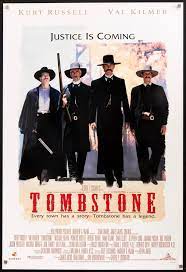
Tombstone recounts the legendary blood feud between the Ike Clanton outlaw gang and the Earp brothers—Wyatt, Morgan and Virgil—in the famous gold-mining town in 1880s Arizona.
Wyatt Earp has been challenged to a gunfight by quick-trigger gunman Johnny Ringo. Although he impulsively accepted the challenge, Wyatt now realizes he’s certain to be killed. Thus follows this exchange with his longtime friend, the pistol-packing dentist, John H. “Doc” Holliday:
WYATT EARP: What makes a man like Ringo, Doc? What makes him do the things he does?
JOHN H. “DOC” HOLLIDAY: A man like Ringo’s got a great empty hole right through the middle of him. He can never kill enough or steal enough or inflict enough pain to ever fill it.
EARP: What does he need?
HOLLIDAY: Revenge.
EARP: For what?
HOLLIDAY: Bein’ born.
Donald Trump was born into a world of wealth and privilege. His father gave him $200 million, which he channeled into a real estate empire. He has claimed to be worth a billion dollars.
He has been linked—often by his own boasts—to some of the most beautiful women in the world. He has been a major force on TV through his “reality show,” The Apprentice. He has literally stamped his name on hundreds of buildings.
And now he holds the Presidency of the United States, the most powerful office in the Western world.
Yet he remains filled with a poisonous hatred that encompasses almost everyone.
Since taking office, he has offered nothing positive in his agenda. Instead, he has focused his efforts on what he can take from others. At the top of his list: Declaring war on millions of illegal immigrants—many of whom hold menial jobs most other Americans refuse to take.
As first-mate Starbuck says of Captain Ahab in Herman Melville’s classic novel, Moby Dick: “He is a champion of darkness.”
ABC NEWS, ALCOHOL, ALTERNET, AMERICABLOG, AP, BABY BOOMER RESISTANCE, BBC, BC NEWS, BLAKE EDWARDS, BLOOMBERG, BLUESKY, BOBBY BROWN, BUZZFEED, CAMELOT, CBS NEWS, CELEBRITIES, CIAGREETES, CNN, COCAINE, CONRAD MURRAY, CRACK, CROOKS AND LIARS, DAILY KOS, DIANE SAWYER, DRUGS, ELVIS PRESLEY, FIVETHIRTYEIGHT, HARPER’S MAGAZINE, HUFFINGTON POST, JULIE ANDREWS, MARILYN MONROE, MARY POPPINS, MEDIA MATTERS, MICHAEL JACKSON, MOTHER JONES, MOUNT SIANI MEDICAL CENTER, MOVEON, MSNBC, MY FAIR LADY, NATIONAL ENQUIRER, NBC NEWS, NEWSDAY, NEWSWEEK, NODULES, NPR, OPHRAH WINFREY, PBS NEWSHOUR, PILLS, POLITICO, POLITICUSUSA, RAW STORY, REUTERS, SALON, SEATTLE TIMES, SLATE, STAR SPANGLED BANNER, TALKING POINTS MEMO, THE ATLANTIC, THE CHICAGO SUN-TIMES, THE CHICAGO TRIBUNE, THE DAILY BEAST, THE DAILY BLOG, THE GUARDIAN, THE HILL, THE HUFFINGTON POST, THE INTERCEPT, THE LOS ANGELES TIMES, THE NATION, THE NEW REPUBLIC, THE NEW YORK TIMES, THE NEW YORKER, THE SOUND OF MUSIC, THE VILLAGE VOICE, THE WASHINGTON POST, THINKPROGRESS, TIME, TRUTHDIG, TRUTHOUT, TWO POLITICAL JUNKIES, U.S. NEWS & WORLD REPORT, UPI, USA TODAY, WHITNEY HOUSTON, X
In Entertainment, History, Medical, Social commentary on September 12, 2025 at 12:10 am
Whitney Houston drowned in her bathtub at the Beverly Hilton Hotel on February 11, 2012.
The cause of death: Coronary artery disease—and cocaine use. She was 48.
Ever since, reporters and commentators have repeatedly used the word “tragedy” to describe her fate.
But there are tragedies that are brought on by events beyond human control—and tragedies that are self-inflicted.
Consider:
Julie Andrews: Whose four-octave soprano voice has delighted audiences for decades on Broadway (Camelot, My Fair Lady) and movies (Mary Poppins, The Sound of Music).
In 1964, she won the Academy Award for Best Actress and Golden Globe Award for Best Actress (for Mary Poppins).
Her performance in The Sound of Music made it the highest-grossing film of 1965—and won her a second Golden Globe Award for Best Actress.
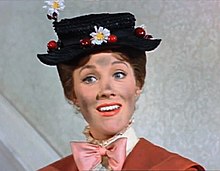
Julie Andrews, in her best-loved role as “Mary Poppins”
In 1997, she underwent surgery at Mount Sinai Medical Center to remove non-cancerous nodules in her throat. The nodules were removed—but so was her ability to sing.
Her husband, Blake Edwards, was widely quoted as saying that Andrews’ voice had been all but ruined: ”If you heard it, you’d weep.”
Whitney Houston: Blessed with beauty, charm and a golden, intense singing voice that could turn even the almost-unsingable “Star Spangled Banner” into a rousing anthem.
As a beloved, internationally-recognized vocalist, she enjoyed even greater fame and wealth as a movie star (The Bodyguard, Waiting to Exhale).

Whitney Houston
Meanwhile, she took on increasingly deadly habits. She chain-smoked cigarettes. And marijuana—“a lot.” She dove into alcohol, pills, cocaine.
During a 2002 interview with Diane Sawyer, she denied using crack. Not because it’s lethal, or because it would destroy The Voice that she believed was God’s gift to her.
No, it was because “I make too much money to ever smoke crack. Let’s get that straight. OK? We don’t do crack. We don’t do that. Crack is whack.”
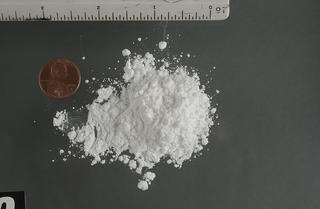
Crack cocaine
In 2006, the National Enquirer ran an interview with her sister-in-law, Tina, who charged that Houston spent her days locked in her bedroom “smoking crack, using sex toys to satisfy herself and ignoring personal hygiene.”
Then, in 2009, appearing on Oprah Winfrey’s season premiere, Houston finally admitted that she used drugs with her ex-husband, Bobby Brown, who “laced marijuana with rock cocaine.”
In other words, crack.
So, apparently, crack wasn’t whack.
Over time, the once-magnificent instrument that was your voice started to change noticeably. She could no longer hit high notes, or hold one the way she did in her immortal hit, “I Will Always Love You.”
Her voice now sounded hoarse, raspy.
In 2010, she embarked on a “Nothing But Love World Tour.” It was a disaster. In Brisbane, she paused during singing to take a drink of water.
A critic said her performance in London was marked by a strained voice filled with coughs and wheezes.
Fans felt cheated—especially after paying $165 for a ticket—and reacted with jeers and boos. Some walked out in mid-concert.
On the night before her death, Houston become belligerent and almost duked it out with singer Stacy Francis at the Tru Hollywood nightclub. Her boyfriend, Ray J, had to step in to prevent a fistfight.
Houston was seen leaving the club drunk, with scratches and bloodstains on her legs.
* * * * *
Whose tragedy was genuine—and whose was self-inflicted?
The ugly truth is that Whitney Houston’s singing career ended long before her life did.
When people remember her monumental hits like “I Will Always Love You,” they’re recalling a time more than 30 years ago.
Another ugly truth is that each of us is responsible for our own actions.
Attorney and talk-show host Nancy Grace blamed Houston’s doctors for Houston’s death. She argued that they had kept writing prescriptions for “America’s songbird” when they knew she was an addict.
But Houston was the one who requested that they write those prescriptions. And she was the one who administered them.
The same chain of events occurred in the Michael Jackson case.
Jackson wanted his drug-of-choice: propofol, a hypnotic sedative used for general anesthesia. And he got it.
He paid his private doctor, Conrad Murray, $150,000—a-month. For a salary that large, Jackson clearly expected to get more than the standard: “Take two aspirins and call me in the morning.”
So he got what he wanted—and it killed him.
Houston, for all her charm, was also used to getting her own way. Once. on an airplane, she tried to light up in the bathroom. When the pilot warned that she could be fined $2,000, she offered to write out a check that moment if she could have her smoke. The pilot refused.
No matter how famous, talented, beautiful and/or wealthy you might be, in the end, you remain a mere mortal. Even if you are allowed to disobey the laws of man, you will be held accountable by your own body for bouts of deadly excess.
That, in the end, is the real legacy of Whitney Houston. And Michael Jackson. And Elvis Presley. And Marilyn Monroe. And a great many other now-dead celebrities.
Sadly, it is a truth that both celebrities and their worshipers must re-learn—over and over.
ABC NEWS, AL PACINO, ALTERNET, AMERICABLOG, AP, BABY BOOMER RESISTANCE, BLOOD FEUD, BUZZFEED, CARLOS MARCELLO, CBS NEWS, CHARLES BRANDT, CIA, CNN, COTTER SMITH, CROOKS AND LIARS, CUBA, DAILY KOZ, ERNEST BORGNINE, F.I.S.T. (MOVIE), FACEBOOK, FBI, FIDEL CASTRO, FIVETHIRTYEIGHT, FRANK FITZSIMMONS, FRANK SHEERAN, GUS RUSSO, HOFFA (MOVIE), INTERNATIONAL BROTHERHOOD OF TEAMSTERS, J. EDGAR HOOVER, JACK NICHOLSON, JAMES R. HOFFA, JOE PESCI, JOHN F. KENNEDY, JUSTICE DEPARTMENT, LIVE BY THE SWORD: THE SECRET WAR AGAINST CASTRO AND THE DEATH OF JFK, MAFIA, MARTIN SCORSESE, MOTHER JONES, MOVEON, MSNBC, NBC NEWS, NETFLIX, NEWSWEEK, NPR, PBS NEWSHOUR, POLITICO, POLITICUSUSA, RAFAEL EDWARD CRUZ, RAW STORY, REUTERS, ROBERT BLAKE, ROBERT DE NIRO, ROBERT F. KENNEDY, RUSSELL BUFFALINO, SALON, SAM GROOM, SEATTLE TIMES, Secret Service, SENATE LABOR RACKETS COMMITTEE, SLATE, SYLVESTER STALLONE, TALKING POINTS MEMO, THE ATLANTIC, THE CHICAGO SUN-TIMES, THE CHICAGO TRIBUNE, THE DAILY BEAST, THE DAILY BLOG, THE GUARDIAN, THE HILL, THE HUFFINGTON POST, THE IRISHMAN (MOVIE), THE LOS ANGELES TIMES, THE NATION, THE NEW YORK TIMES, THE WALL STREET JOURNAL, THE WASHINGTON POST, THINKPROGRESS, TIME, TRUTHDIG, TWITTER, U.S. NEWS & WORLD REPORT, UPI, USA TODAY
In Entertainment, History, Law, Law Enforcement, Politics, Social commentary on August 4, 2025 at 12:16 am
The 1983 TV mini-series, Blood Feud, chronicles the decade-long struggle between Robert F. Kennedy (Cotter Smith) and James R. Hoffa (Robert Blake), president of the International Brotherhood of Teamsters Union.
With Kennedy as Attorney General and facing relentless pressure from the Justice Department, the Mafia despairs of a solution. At a swanky restaurant, several high-ranking Mafiosi agree that “something” must be done.
On November 22, 1963, President John F. Kennedy is assassinated in Dallas, Texas.
Blood Feud clearly implies that the Mafia was responsible.
[The House Assassinations Committee investigated this possibility in 1978, and determined that Carlos Marcello, the Mafia boss of New Orleans, had the means, motive and opportunity to kill JFK. But it could not find any conclusive evidence of his involvement.]
Even with the President dead, RFK’s Justice Department continues to pursue Hoffa. In 1964, he is finally convicted of jury tampering and sentenced to 13 years’ imprisonment.
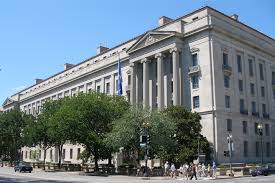
U.S. Department of Justice
Hoping to avoid prison, Hoffa phones Robert Kennedy, offering future Teamsters support if RFK runs for President. To prove he can deliver, he tells Kennedy that the Teamsters have even penetrated the FBI.
[In March, 1964, Kennedy met with Hoffa on an airfield at Dulles International Airport in Washington, D.C. He was accompanied by two Secret Service agents from the detail assigned to ex-First Lady Jacqueline Kennedy.
[FBI Director J. Edgar Hoover, no longer afraid to cross RFK, had withdrawn the agents previously assigned to guard him.
[Accompanying Hoffa were two muscular bodyguards—at least one of whom was packing two pistols in shoulder holsters.
[While the Secret Service agents watched from a respectful distance, Kennedy spoke quietly with Hoffa. The Attorney General showed a document to Hoffa, and the Teamsters leader at times nodded or shook his head.
[The agents drove Kennedy back to Washington. During the ride, he said nothing about the reason for the meeting.
[Gus Russo—author of Live By the Sword: The Secret War Against Castro and the Death of JFK—writes that the reason might have been Dallas.
[Perhaps, he speculates, RFK had wanted to look into Hoffa’s eyes while asking him: Did you have anything to do with the assassination? RFK had, in fact, done this with CIA Director John McCone almost immediately after his brother’s death.]
In Blood Feud, Kennedy confronts J. Edgar Hoover (Ernest Borgnine) and accuses him of illegally planting wiretaps in Mob hangouts all over the country.
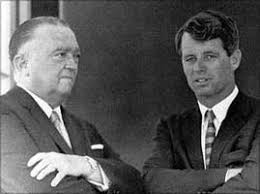
J. Edgar Hoover and Robert F. Kennedy
Hoover retorts that this had been the only way to obtain the prosecution-worthy intelligence Kennedy had demanded: “You loved that flow of information. You didn’t want it to stop.”
Kennedy: Why did you keep the FBI out of the fight against the Mob for decades?
Hoover: “Every agency that came to grips with them got corrupted by their money.”
[So far as is known, Hoover never made any such confession. Historians continue to guess his reason for leaving the Mob alone for decades.]
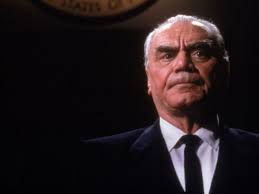

Ernest Borgnine as J. Edgar Hoover
RFK then mentions the CIA’s plots to employ the Mob to assassinate Cuban dictator Fidel Castro.
[The agency had wanted to please President Kennedy, and the Mafia had wanted to regain its casinos lost to the Cuban Revolution. The role the Kennedy brothers played in the CIA’s assassination plots remains murky, and has been the subject of endless speculation.]
“The CIA, doing business with the Mob,” says Kennedy. “The FBI, leaking information to its enemies [the Teamsters].” Then, sadly: “I guess it’s true—everyone does business with everyone.”
[So far as is known, the FBI did not pass on secrets to the Teamsters. But during the 1970s, the Mafia penetrated the Cleveland FBI office through bribes to a secretary. Several FBI Mob informants were “clipped” as a result.]
In 1967, Hoffa goes to prison. He stays there until, in 1971, President Richard Nixon commutes his sentence in hopes of gaining Teamsters’ support for his 1972 re-election.
Kennedy leaves the Justice Department in 1964 and is elected U.S. Senator from New York. In 1968 he runs for President. On June 5, after winning the California primary, he’s assassinated.
In Blood Feud, just before his assassination, RFK asks: “How will I ever really know if the Mob killed Jack because of my anti-Mob crusade?”
Hoffa schemes to return to the presidency of the Teamsters—a post now held by his successor, Frank Fitzsimmons. He runs the union in a more relaxed style than Hoffa, thus giving the Mob greater control over its pension fund.
And the Mafia likes it that way.
On July 30, 1975, Hoffa disappears from the parking lot of the Machus Red Fox Restaurant near Detroit. He had gone there to meet with two Mafia leaders.
Fifty years after the death of James R. Hoffa, and 57 years after that of Robert F. Kennedy:
- Labor unions are a shadow of their former power.
- The threat they once represented to national prosperity has been replaced by that of predatory corporations like Enron and AIG.
- The war RFK began on the Mafia has continued, sending countless mobsters to prison.
- Millions of Americans who once expected the Federal Government to protect them from crime now believe the Government is their biggest threat.
- The idealism that fueled RFK’s life has virtually disappeared from politics.
ABC NEWS, AL PACINO, ALTERNET, AMERICABLOG, AP, BABY BOOMER RESISTANCE, BLOOD FEUD, BUZZFEED, CARLOS MARCELLO, CBS NEWS, CHARLES BRANDT, CIA, CNN, COTTER SMITH, CROOKS AND LIARS, CUBA, DAILY KOZ, ERNEST BORGNINE, F.I.S.T. (MOVIE), FACEBOOK, FBI, FIDEL CASTRO, FIVETHIRTYEIGHT, FRANK FITZSIMMONS, FRANK SHEERAN, GUS RUSSO, HOFFA (MOVIE), INTERNATIONAL BROTHERHOOD OF TEAMSTERS, J. EDGAR HOOVER, JACK NICHOLSON, JAMES R. HOFFA, JOE PESCI, JOHN F. KENNEDY, JUSTICE DEPARTMENT, LIVE BY THE SWORD: THE SECRET WAR AGAINST CASTRO AND THE DEATH OF JFK, MAFIA, MARTIN SCORSESE, MOTHER JONES, MOVEON, MSNBC, NBC NEWS, NETFLIX, NEWSWEEK, NPR, PBS NEWSHOUR, POLITICO, POLITICUSUSA, RAFAEL EDWARD CRUZ, RAW STORY, REUTERS, ROBERT BLAKE, ROBERT DE NIRO, ROBERT F. KENNEDY, RUSSELL BUFFALINO, SALON, SAM GROOM, SEATTLE TIMES, Secret Service, SENATE LABOR RACKETS COMMITTEE, SLATE, SYLVESTER STALLONE, TALKING POINTS MEMO, THE ATLANTIC, THE CHICAGO SUN-TIMES, THE CHICAGO TRIBUNE, THE DAILY BEAST, THE DAILY BLOG, THE GUARDIAN, THE HILL, THE HUFFINGTON POST, THE IRISHMAN (MOVIE), THE LOS ANGELES TIMES, THE NATION, THE NEW YORK TIMES, THE WALL STREET JOURNAL, THE WASHINGTON POST, THINKPROGRESS, TIME, TRUTHDIG, TWITTER, U.S. NEWS & WORLD REPORT, UPI, USA TODAY
In Entertainment, History, Law, Law Enforcement, Politics, Social commentary on August 1, 2025 at 12:23 am
The 1983 TV mini-series, Blood Feud, chronicles the decade-long struggle between Robert F. Kennedy and James R. Hoffa.
Having “helped” Kennedy (Cotter Smith) to oust corrupt Teamsters President Dave Beck, Hoffa (Robert Blake) believes that Kennedy should now be satisfied: “He’s got his scalp. Now he can move on to other things while I run the union.”
But Hoffa has guessed wrong—with fatal results. Realizing that he’s been “played” by Hoffa, a furious Kennedy strikes back.
Robert Blake as James R Hoffa
He orders increased surveillance of Hoffa and his topmost associates. He subpoenas union records and members of both the Teamsters and the Mafia to appear before his committee in public hearings.
And he tries to enlist the aid of legendary FBI Director J. Edgar Hoover (Ernest Borgnine). But Hoover wants no part of a war against organized crime, whose existence he refuses to admit.
Meanwhile, Kennedy’s confrontations with Hoffa grow increasingly fierce. In open hearings, Kennedy accuses Hoffa of receiving kickbacks in the name of his wife. Hoffa damns him for “dirtying my wife’s name.”
Kennedy secures an indictment against Hoffa for hiring a spy to infiltrate the Senate Labor Rackets Committee. He’s so certain of a conviction that he tells the press he’ll “jump off the Capitol building” if Hoffa beats the rap.
But Hoffa’s lawyer, Edward Bennett Williams (Jose Ferrer) puts Kennedy himself on the witness stand. There he portrays Kennedy as a spoiled rich man who’s waging a vendetta against Hoffa.
Hoffa beats the rap, and offers to send Kennedy a parachute. But he jokingly warns reporters: “Hey, Bobby, you better have it checked. I don’t trust myself!”
By 1959, Robert Kennedy’s work as chief counsel for the Senate Labor Rackets Committee is over. But not his determination to send Teamsters President James Hoffa to prison.
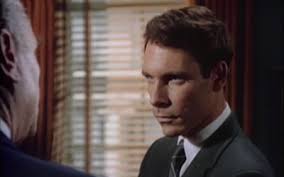
Cotter Smith as Robert Kennedy
Throughout 1960, he manages the Presidential campaign for his brother, John F. Kennedy (Sam Groom). By a margin of only 112,000 votes, JFK wins the election.
Hoffa thinks that his troubles are over, that “Bobby” will move on to other pursuits and forget about the Teamsters.
Hoffa is partly right: Kennedy moves on to another job. But it’s the office of United States Attorney General.
JFK, needing someone in the Cabinet he can trust completely, browbeats Robert into becoming the nation’s top cop.
For Hoffa, it’s a nightmare come true.
As Attorney General, Kennedy no longer has to beg J. Edgar Hoover to attack organized crime. He can—and does—order him to do so.
Throughout the country, the Mafia feels a new heat as FBI agents plant illegal electronic microphones (“bugs”) in their innermost sanctums. Agents openly tail mobsters—and send them to prison in large numbers.
And Kennedy sets up a special unit, composed of topflight prosecutors and investigators, to go after just one man: James Riddle Hoffa. The press comes to call it the “Get Hoffa” squad.
Hoffa continues to beat federal prosecutors in court. But he believes he’s under constant surveillance by the FBI, and his nerves are starting to crack.
Convinced that the FBI has bugged his office, he literally tears apart the room, hoping to find the bug. But he fails to do so.
What he doesn’t know is he’s facing a more personal danger—from one of his closest associates: Edward Grady Partin (Brian Dennehy).
He tells Partin how easy it would be to assassinate Kennedy with a rifle or bomb.
Later, Partin gets into a legal jam—and is abandoned by the Teamsters. Hoping to cut a deal, he relays word to the Justice Department of Hoffa’s threats against the Attorney General.
Now working for the Justice Department, Partin sends in reports on Hoffa’s juror-bribing efforts in yet another trial. Hoffa again beats the rap—but now Kennedy has the insider’s proof he needs to put him away for years.
Meanwhile, the Mafia despairs of the increasing pressure of the Justice Department. At a swanky restaurant, several high-ranking members agree that “something” must be done.
[Although this scene is fictional, it’s clearly based on an infamous outburst of Carlos Marcello, the longtime Mafia boss of New Orleans.
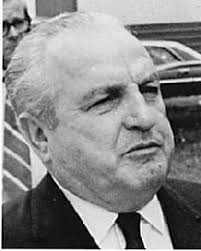
Carlos Marcello
[In 1961, Marcello was deported to his native Guatemala on orders by RFK. After illegally re-entering the country, he swore vengeance against the Attorney General.
[In September, 1962, during a meeting with several mob colleagues, he flew into a rage when someone mentioned Kennedy.
“Take the stone out of my shoe!” he shouted, echoing a Sicilian curse. “Don’t you worry about that little Bobby sonofabitch. He’s going to be taken care of!”
[When one of his colleagues warned that murdering RFK would trigger the wrath of his brother, the President, Marcello replied: “In Sicily they say if you want to kill a dog you don’t cut off the tail. You go for the head.”
[Marcello believed that the death of President Kennedy would render the Attorney General powerless. And he added that he planned to use a “nut” to do the job.]
On November 22, 1963, President John F. Kennedy is assassinated in Dallas, Texas.
Blood Feud clearly implies that the Mafia was responsible.
ABC NEWS, AL PACINO, ALTERNET, AMERICABLOG, AP, BABY BOOMER RESISTANCE, BLOOD FEUD, BUZZFEED, CARLOS MARCELLO, CBS NEWS, CHARLES BRANDT, CIA, CNN, COTTER SMITH, CROOKS AND LIARS, CUBA, DAILY KOZ, ERNEST BORGNINE, F.I.S.T. (MOVIE), FACEBOOK, FBI, FIDEL CASTRO, FIVETHIRTYEIGHT, FRANK FITZSIMMONS, FRANK SHEERAN, GUS RUSSO, HOFFA (MOVIE), INTERNATIONAL BROTHERHOOD OF TEAMSTERS, J. EDGAR HOOVER, JACK NICHOLSON, JAMES R. HOFFA, JOE PESCI, JOHN F. KENNEDY, JUSTICE DEPARTMENT, LIVE BY THE SWORD: THE SECRET WAR AGAINST CASTRO AND THE DEATH OF JFK, MAFIA, MARTIN SCORSESE, MOTHER JONES, MOVEON, MSNBC, NBC NEWS, NETFLIX, NEWSWEEK, NPR, PBS NEWSHOUR, POLITICO, POLITICUSUSA, RAFAEL EDWARD CRUZ, RAW STORY, REUTERS, ROBERT BLAKE, ROBERT DE NIRO, ROBERT F. KENNEDY, RUSSELL BUFFALINO, SALON, SAM GROOM, SEATTLE TIMES, Secret Service, SENATE LABOR RACKETS COMMITTEE, SLATE, SYLVESTER STALLONE, TALKING POINTS MEMO, THE ATLANTIC, THE CHICAGO SUN-TIMES, THE CHICAGO TRIBUNE, THE DAILY BEAST, THE DAILY BLOG, THE GUARDIAN, THE HILL, THE HUFFINGTON POST, THE IRISHMAN (MOVIE), THE LOS ANGELES TIMES, THE NATION, THE NEW YORK TIMES, THE WALL STREET JOURNAL, THE WASHINGTON POST, THINKPROGRESS, TIME, TRUTHDIG, TWITTER, U.S. NEWS & WORLD REPORT, UPI, USA TODAY
In Entertainment, History, Law, Law Enforcement, Politics, Social commentary on July 31, 2025 at 12:39 am
James Riddle Hoffa, the onetime president of the International Brotherhood of Teamsters (IBT) Union, vanished 50 years ago—on July 30, 1975.
Once a powerful union boss courted by mobsters and politicians more than 60 years ago, today he’s best-known for his sudden disappearance and presumed murder.
Elected President of the Teamsters in 1957, Hoffa was convicted of jury tampering in 1964 and began serving an eight-year prison sentence in 1967. Before doing so, he named Frank Fitzsimmons, whom he thought a totally loyal ally, to serve as a caretaker president.
Pardoned by President Richard M. Nixon in December, 1971, Hoffa immediately began campaigning to regain the presidency of the union in 1976. But Fitzsimmons had come to enjoy the IBT presidency—and wanted to keep it.
More importantly, the Mafia wanted him to keep it. Under Hoffa, the Teamsters had bankrolled various Mafia real estate schemes—such as building casinos in Las Vegas.
But Hoffa had kept a tight hold on Teamster monies. Fitzsimmons, by contrast, had allowed the Mafia a free hand—at the expense of the Teamsters pension fund meant for retiring members.
Warned by his onetime Mafia allies to drop his campaign for re-election, Hoffa charged ahead anyway.
On July 30, 1975, he expected to meet with three major Mafia bosses at a restaurant in Detroit: Anthony Giacalone, Russell Buffalino and Anthony Provenzano. With their backing, he expected a guaranteed victory.
Instead, he disappeared.
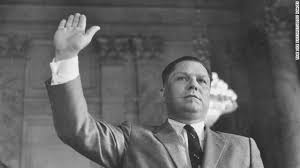
James Riddle Hoffa testifying before the Senate Labor Rackets Committee
The FBI assigned 200 agents to investigate his disappearance. But Hoffa’s body was never found, and even the way he died remained a mystery.
Then, in 2004, former prosecutor-turned-author Charles Brandt published a non-fiction book: I Heard You Paint Houses. Based on tape recorded interviews with former Mafia hitman Frank “The Irishman” Sheeran, it revealed the events that alleged led up to Hoffa’s execution.
And it was none other than Sheeran—to whom Hoffa had presented a gold, diamond-encrusted watch in October, 1974—who carried out the execution. 
In November, 2019, Sheeran’s life was depicted in the movie: The Irishman, directed by Martin Scorsese. Sheeran was portrayed by Robert De Niro, Joe Pesci portrayed Mafia boss Russell Buffalino and Al Pacino played Hoffa.
The Irishman received a limited theatrical release on November 1, 2019, followed by digital streaming on November 27 by Netflix.
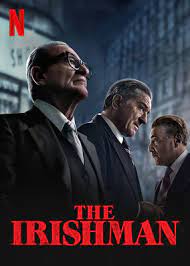
Joe Pesci (Russell Buffalino), Robert DeNiro (Frank Sheeran) and Al Pacino (Jimmy Hoffa)
This was not the first movie made about the life and death of Jimmy Hoffa. Sylvester Stallone played Johnny Kovak, a Hoffa-like labor leader, in 1978’s F.I.S.T. And Jack Nicholson played Hoffa in a 1992 movie.
But the most lengthy and detailed portrayal of Hoffa’s stormy life came 42 years ago on TV.
In 1983, Blood Feud, a two-part TV mini-series, depicted the 11-year animosity between Robert F. Kennedy and Hoffa. Although it took some dramatic liberties, its portrayal of the major events of that period remains essentially accurate.
In 1957, as a young, idealistic attorney, Kennedy declared war on Hoffa, the president of the Mafia-dominated International Brotherhood of Teamsters Union.
As chief counsel for the Senate Labor Rackets Committee, Kennedy was appalled at the corruption he discovered among high-ranking Teamsters officials. As he saw it, under Hoffa’s leadership, the union was nothing less than “a conspiracy of evil.”
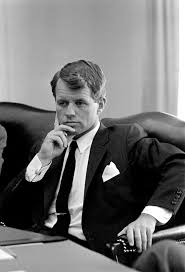
Robert Francis Kennedy as Chief Counsel, Senate Labor Rackets Committee
Hoffa, in turn, held an equally unflattering view of Kennedy. “A rich punk,” said Hoffa, who didn’t know or care about “the average workingman.”
Today, labor unions are a rapidly-vanishing species, commanding far less political influence than they did 60 years ago. As a result, young viewers of this series may find it hard to believe that labor ever held such sway, or that the Teamsters posed such a threat.
And in an age when millions see “Big Government” as the enemy, they may feel strong reservations about the all-out war that Robert F. Kennedy waged against Hoffa.
Blood Feud opens in 1957, when Hoffa (Robert Blake) is a rising figure within the Teamsters. Kennedy (Cotter Smith) is chief counsel for the Senate Labor Rackets Committee.
At first, Hoffa tries to ingratiate himself with Kennedy, telling him: “I know everybody who can help me and anybody who can hurt me.”
A wily Hoffa decides to parley Kennedy’s anti-corruption zeal into a path to power for himself. Via his attorney, Eddie Cheyfitz, he feeds Kennedy incriminating evidence against Dave Beck, president of the Teamsters.
Confronted with a Senate subpoena, Beck flees the country—paving the way for Hoffa to assume the top position in the union. Hoffa believes he has solved two problems at once.
Having “helped” Kennedy to oust Beck, Hoffa believes that Kennedy should now be satisfied: “He’s got his scalp. Now he can move on to other things while I run the union.”
But Hoffa has guessed wrong—with fatal results. Realizing that he’s been “played.” a furious Kennedy strikes back.
He orders increased surveillance of Hoffa and his topmost associates. He subpoenas union records and members of both the Teamsters and the Mafia to appear before his committee in public hearings.
And he tries to enlist the aid of legendary FBI Director J. Edgar Hoover (Ernest Borgnine). But Hoover wants no part of a war against organized crime, whose existence he refuses to admit.
"SPRINGTIME FOR HITLER" (SONG), "THE PRODUCERS" (MOVIEI), "WITH A LITTLE HELP FROM MY FRIENDS" (SONG), 2016 PRESIDENTIAL CAMPAIGN, ABC NEWS, ALEC BALDWIN, ALTERNET, AMERICABLOG, AP, ASTROLOGY, “JESUS LOVES ME” (SONG), “LITTLE BOXES” SONG, “YAKETY YAK” (SONG), BABY BOOMER RESISTANCE, BARACK OBAMA, BBC, BERNIE SANDERS, BLOOMBERG, BUZZFEED, CBS NEWS, CNN, CROOKS AND LIARS, CRUELTY, DAILY KOS, DAVID BROOKS, DEMOCRATIC PARTY, DEMOCRATS, DONALD TRUMP, EGOTISM, ELIZABETH WARREN, EVANGELICALS, FIVETHIRTYEIGHT, HARPER’S MAGAZINE, HILLARY CLINTON, HUFFINGTON POST, HUMOR, IGNORANCE, IT'S A WONDERFUL LIFE (MOVIE), IVANKA TRUMP, JEB BUSH, JEFFREY EPSTEIN, JESUS, JOHN KASICH, LAUGHTER, LIBERALS, MARCO RUBIO, MARJORIE TAYLOR GREENE, MARK HARRISON, MARK SHIELDS, MAYO CLINIC, MEDIA MATTERS, MELANIA TRUMP, MICHELLE OBAMA, MOTHER JONES, MOVEON, MSNBC, NBC NEWS, NEW REPUBLIC, NEWSDAY, NEWSWEEK, NPR, ONE DAY WE WILL LIVE WITHOUT FEAR: EVERYDAY LIVES UNDER THE SOVIET POLICE STATE (BOOK), PARODY, PBS NEWSHOUR, POLITICO, POLITICUSUSA, POPE FRANCIS, RAND PAUL, RAW STORY, READERS DIGEST, REPUBLICAN PARTY, REPUBLICANS, REUTERS, RICK PERRY, RIDICULE, SALON, SATIRE, SATURDAY NIGHT LIVE, SEATTLE TIMES, SLANDER, SLATE, TALKING POINTS MEMO, TED CRUZ, THE ATLANTIC, THE BEATLES, THE CHICAGO SUN-TIMES, THE CHICAGO TRIBUNE, THE COASTERS, THE DAILY BEAST, THE DAILY BLOG, THE GUARDIAN, THE HILL, THE HUFFINGTON POST, THE INTERCEPT, THE LOS ANGELES TIMES, THE NATION, THE NEW REPUBLIC, THE NEW YORK TIMES, THE NEW YORKER, THE VILLAGE VOICE, THE WASHINGTON POST, THINKPROGRESS, TIME, TRUTHDIG, TRUTHOUT, TWO POLITICAL JUNKIES, U.S. NEWS & WORLD REPORT, UPI, USA TODAY, VLADIMIR PUTIN, X
In Entertainment, History, Humor, Politics, RELIGION, Social commentary on July 16, 2025 at 12:06 am
Ridicule is a highly effective weapon. That’s why dictators always try to stamp it out. They know that if you’re laughing at them, you’re not afraid of them. And men like Donald Trump prize being feared above all else.
Yet Democrats and liberals (the two are not always the same) have failed to make use of this formidable weapon.
They could, for example, ridicule those evangelicals who have lustily embraced Trump as the new Jesus:
- Why are Donald Trump’s supporters like Adam and Eve? They are naked, they have only one apple to eat, they live in a forest, and they think they’re in Paradise.
- It’s the twelfth year of the Donald Trump Presidency. Two old friends meet on the street. “What’s the difference between life in the time of Jesus, and life as it is under Trump?” asks one. “Well, in the days of Jesus, one man suffered for all,” says the second man. “And, today, we all suffer for one man.”
- When President Trump and First Lady Melania met Pope Francis: MELANIA thought: “Damn! I thought he’d go up in smoke when the Pope touched him.” TRUMP thought: “Being so close to so much holiness is terrible! I need a bath.” THE POPE thought: “Now I know what Jesus felt like when he met Satan.”

Amazingly in this YouTube-obsessed age, Democrats have never assailed Trump with barrages of satirical musical videos. Yet the opportunities for incredible mirth lie all around us.
Trump’s notorious “bromance” with Vladimir Putin could be satirized by converting the Beatles’ hit, “With a Little Help From My Friends” into “With a Little Help From My Vlad”:
What do I do when the bank calls me in?
(Does it worry you to be in debt?)
How do I feel when I need rubles fast?
(Do you worry Vlad might say “Nyet”?)
No, I get by with a little help from my Vlad.
Mm, I can lie with a little help from my Vlad.
Mm, you’re gonna fry with a little help from my Vlad.

The religious hymn, “Jesus Loves Me,” could take on new meaning when applied to the man whom millions of evangelicals have embraced as their new Savior:
Trumpy loves me, this I know.
For he often tells me so.
Screwing others is his right
‘Cause he’s rich and mean and white.
Yes, Trumpy loves me,
Yes, Trumpy loves me.
Trumpy loves me.
He often tells me so.
Trumpy tells me who to hate.
And it makes me feel so great.
He will build that great big wall
Then good times will be for all.
“Springtime for Hitler,” the signature tune of the hit play and movie, The Producers, could become “Springtime for Trumpland”—and help mightily in clearing up the mystery of his popularity among the Right:
Republicans were having trouble
What a sad, sad story.
Needed a new leader
To restore their former glory.
Where oh where was he?
Who could that man be?
They looked around and then they found
The man for you and me.
And now it’s…
Springtime for Trump goons and bigotry—
Winter for Reason and Light.
Springtime for Trumpland and infamy—
Come on, Trumpsters, let’s go pick a fight. 
Many Americans have wondered how so many millions of their fellow citizens could support Trump. A parody of “Little Boxes” could help explain why:
And the voters in the “heartland”
All went off to the polling booth
Where they pulled hard on the levers
And the Nazis got a win.
And there’s bigots and oppressors
And screaming misogynists–
And they’re all made out of Fascist hatred
And they all sound just the same.
Nor should Republicans generally be ignored, since it’s their support for a proven adulterer, convicted rapist and friend of pedophile Jeffrey Epstein that remains the single greatest infamy of this party. Consider this parody of the classic Coasters’ song, “Yakety Yak”:
Support Marge Greene she is our trash
Or you don’t get no Fascist cash.
If you don’t praise and print her lies
You are a skunk in Republican eyes.
Republicans lie (Just say hi!)
You must “Sieg Heil!” to Donald Trump
‘Cause he’s your Fuhrer, he’s no chump.
You will not catch him with a book
He loves to steal but he’s our crook.
Republicans lie. (Just say hi!)
* * * * * * * * * *
Throughout 2016, liberals celebrated on Facebook and Twitter the “certain” Presidency of former First Lady Hillary Clinton. She was going to “break the glass ceiling.” Democrats were going to retake the Senate—and maybe the House.
They were cheered on by First Lady Michelle Obama’s Pollyannaish advice on political tactics: “When they go low, we go high!”
Meanwhile, Donald Trump planned to subvert the 2016 election with the aid of Russian Intelligence agents and millions of Russian trolls flooding the Internet with legitimately fake news.
History has proven which tactics proved superior.
It’s long past time for Democrats to accept that they—and the country’s democratic traditions—are engaged in a death-match with their Republican opponents.
Only certain defeat is guaranteed by adhering to Marquis of Queensbury when your enemy is using brass knuckles.


-33510-W&docid=hCd9k6PuglvZAM&tbnid=CAo7BRzGtBWa3M%3A&w=500&h=375&bih=469&biw=819&ved=0ahUKEwiissafvJ_MAhUGKWMKHTZZA_MQxiAIAg&iact=c&ictx=1)
&docid=SiluTuHYHtjaZM&tbnid=uLB-PLYDVdkkVM%3A&w=455&h=341&ei=zeN_VI_hKYHjoATGs4Bo&ved=0CAIQxiAwAA&iact=c)


 Bureaucracybuster's Blog
ABC NEWS, ADOLF HITLER, ALTERNET, AMERICABLOG, AP, ASSASSINATION, BABY BOOMER RESISTANCE, BBC, BLOOMBERG NEWS, BRETT KAVANAUGH, BUZZFEED, CBS NEWS, CLARENCE THOMAS, CNN, CROOKS AND LIARS, CZECHOSLOVAKIA, DAILY KOS, DONALD TRUMP, DRUDGE REPORT, FINAL SOLUTION, FIVETHIRTYEIGHT, GREGORY BOVINO, HARPER’S MAGAZINE, HEINRICH HIMMLER, HERMANN GOERING, HUFFINGTON POST, IMMIGRATION AND CUSTOMS ENFORCEMENT (ICE), JANUARY 6 INSURRECTION, JOE BIDEN, KRISTI NOEM, MARCO RUBIO, MEDIA MATTERS, MEDICAID, MOTHER JONES, MOVEON, MSNBC, NATIONAL RIFLE ASSOCIATION, NAZI GERMANY, NBC NEWS, NEW REPUBLIC, NEWSDAY, NEWSWEEK, NPR, PAM BONDI, PBS NEWSHOUR, POLITICO, POLITICUSUSA, RAW STORY, REINHARD HEYDRICH, RENEE GOOD, REUTERS, ROLAND FREISLER, RUDOLF HESS, SALON, SEATTLE TIMES, SLATE, SS, STEPHEN MILLER, TALKING POINTS MEMO, TED CRUZ, THE ATLANTIC, THE CHICAGO SUN-TIMES, THE CHICAGO TRIBUNE, THE DAILY BEAST, THE DAILY BLOG, THE GUARDIAN, THE HILL, THE HUFFINGTON POST, THE LOS ANGELES TIMES, THE NATION, THE NEW REPUBLIC, THE NEW YORK TIMES, THE NEW YORKER, THE SUPREME COURT, THE VILLAGE VOICE, THE WASHINGTON POST, THINKPROGRESS, TIME, TRUTHDIG, TRUTHOUT, TWO POLITICAL JUNKIES, U.S. NEWS & WORLD REPORT, UPI, USA TODAY, WANNSEE CONFERENCE, X
REINHARD HEYDRICH HAS A WARNINIG FOR REPUBLICANS
In Bureaucracy, Entertainment, History, Politics, Social commentary on January 21, 2026 at 12:13 amThreats of violence have become common among Republicans since 2015, when Donald Trump first ran for President.
On March 16, 2016, Trump warned Republicans that if he didn’t win the GOP nomination in July, his supporters would literally riot: “I think you’d have riots. I think you would see problems like you’ve never seen before. I think bad things would happen. I really do. I wouldn’t lead it, but I think bad things would happen.”
Almost five years later, on January 6, 2021, then-President Trump incited a deadly riot against the United States Capitol to stop Congress from certifying the electoral victory of Joe Biden in the 2020 presidential election.
Upon taking office again as President on January 20, 2025, Trump issued a blanket pardon to about 1,500 of his supporters who carried out the attack. This sent a clear message to his future opponents: “I will similarly pardon anyone who assaults you.”
In 2025, a re-elected Trump launched a sweeping deportation effort. Agents of Immigration and Customs Enforcement [ICE] have brutalized migrants and American citizens.
In Minneapolis and Saint Paul, Minnesota, for example, protesters blow whistles, yell or honk horns. Immigration officers break vehicle windows, use pepper spray on protesters and warn observers not to follow them through public spaces. Immigrants and citizens alike are forcibly pulled from cars, stores or homes and detained for hours, days or longer.
On January 7, 2026, an ICE agent shot 37-year-old Renee Nicole Good, a writer and poet, as she legally observed federal agents arresting suspected illegal aliens.
The Third Reich similarly relied on violence—or the threat of it—to preserve its dictatorial control over Germany.
A key representative of that violence was Reinhard Tristan Eugen Heydrich.
A tall, blond-haired former naval officer, Heydrich was both a champion fencer and talented violinist. Heydrich joined the Schutzstaffel, or Protective Squads, better known as the SS, in 1931, and quickly became head of its counterintelligence service.
In 1934, he oversaw the “Night of the Long Knives” purge of Adolf Hitler’s brown-shirted S.A., or Stormtroopers.
Reinhard Heycrich
In September, 1941, Heydrich was appointed “Reich Protector” of Czechoslovakia, which had fallen prey to Germany in 1938 but whose citizens were growing restless under Nazi rule.
Heydrich immediately ordered a purge, executing 92 people within the first three days of his arrival in Prague. By February, 1942, 4,000-5,000 people had been arrested.
In January, 1942, Heydrich convened a meeting of high-ranking political and military leaders in Wannsee, Germany, to streamline “the Final Solution to the Jewish Question.”
An estimated six million Jews were thus slaughtered.
Returning to Prague, Heydrich continued his policy of carrot-and-stick with the Czechs—improving the social security system and requisitioning luxury hotels for middle-class workers, alternating with arrests and executions.
Two British-trained Czech commandos—Jan Kubis and Joseph Gabcik—parachuted into Prague.
On May 27, 1942, they waited at a hairpin turn in the road always taken by Heydrich. When Heydrich’s Mercedes slowed down, Gabcik raised his machinegun—which jammed.
Rising in his seat, Heydrich aimed his revolver at Gabcik—as Kubis lobbed a hand grenade at the car. The explosion drove steel and leather fragments of the car’s upholstery into Heydrich’s diaphragm, spleen and lung.
Scene of Reinhard Heydrich’s assassination
Hitler dispatched doctors from Berlin to save the Reich Protector. But infection set in, and on June 4, Heydrich died at age 38.
The assassination sent shockwaves through the upper echelons of the Third Reich. No one had dared assault—much less assassinate—a high-ranking Nazi official.
Nazis had slaughtered tens of thousands without hesitation. Suddenly they realized that the fury they had aroused could be turned against themselves.
Which brings us to the leaders of America’s own Right-wing.
The names of infamous Nazis were widely known:
Members of the Nazi government
And so are the names of the infamous leaders of the American Right:
The difference between these two infamous groups is this:
In Nazi Germany, ordinary Germans could not learn about the personal lives of their dictators—including their home addresses—and to conspire against them.
In the United States, ordinary citizens have an array of means to do this. They can turn to newspapers, TV and magazines. And if that isn’t enough, “people finder” websites, for a modest price, provide addresses and names of relatives of potential targets.
In Nazi Germany, firearms were tightly controlled.
In the United States, the Right’s National Rifle Association has successfully lobbied to put lethal firepower into the hands of virtually anyone who wants it.
Almost 84 years ago, Reinhard Heydrich believed himself invulnerable from the hatred of the enemies he had made. That arrogance cost him his life.
The day may soon come when America’s own Right-wingers start learning that same lesson.
Share this: