Archive for the ‘Business’ Category
ABC NEWS, AIG, ALAN GREENSPAN, ALTERNET, AP, AYN RAND, BAILOUT PROGRAM, BUSINESS REGULATION, BUZZFEED, CALVIN COOLIDGE, CBS NEWS, CBSNEWS, CEOS, CNN, COLLEGE GRADUATES, CORPORATE BAILOUTS, CROOKS AND LIARS, DAILY KOZ, DRUG-TESTING, FACEBOOK, FBI, FINANCE, GREED, MOTHER JONES, MOVEON, NBC NEWS, NEWSWEEK, NPR, POLITICO, RAW STORY, REPUBLICANS, REUTERS, SALON, SEATTLE TIMES, SLATE, T.A.R.P. PROGRAM, TEA PARTY, THE ATLANTIC, THE CHICAGO SUN-TIMES, THE CHICAGO TRIBUNE, THE DAILY BEAST, THE GUARDIAN, THE HILL, THE HUFFINGTON POST, THE LOS ANGELES TIMES, THE NATION, THE NEW YORK TIMES, THE WASHINGTON POST, TIME, TIMOTHY GEITHNER, TREASURY DEPARTMENT, TWITTER, U.S. NEWS & WORLD REPORT, UNEMPLOYMENT, UPI, USA TODAY, WALL STREET, WELFARE
In Bureaucracy, Business, History, Law, Politics, Social commentary on April 3, 2018 at 12:13 am
The late Robert Benmosche, then CEO of American International Group (AIG), had some blunt advice to college graduates searching for work in a tight job market.
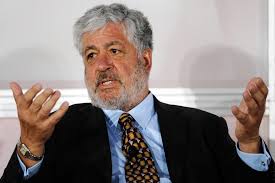
Robert Benmosche
“You have to accept the hand that’s been dealt you in life,” Benmosche said in a 2013 interview on Bloomberg Television. “Don’t cry about it. Deal with it.”
Typical advice from a one-percenter whose company, AIG, suffered a liquidity crisis when its credit ratings were downgraded below “AA” levels in September, 2008.
So how did AIG “deal with” its own crisis? It went crying to its Uncle Sugar, the United States Government, for a bailout.
Which it promptly got.
The United States Federal Reserve Bank, on September 16, 2008, made an $85 billion loan to AIG to meet increased collateral obligations resulting from its credit rating downgrade–and thus saving it from certain bankruptcy.
In return, the Government took an 80% stake in the firm.
(The bailout eventually ballooned to $182 billion in exchange for a 92% stake.)
College graduates, said Benmosche, needed to seize the opportunities that become available to them, even if their options are limited.
“They want me to talk to the students and give them a sense of encouragement, especially with the high unemployment,” said Benmosche.
“My advice will be, ‘Whatever opportunity comes your way, take it. Take it and treat it as if it’s the only one that’s coming your way, because that actually may be the truth.’”
Yes, if you have the opportunity to cry yourself into a multi-billion dollar loan from the Federal Government, by all means, do so.
Of course, willing-to-work college graduates who can’t find willing-to-hire employers won’t be able to count on a generous bailout from the Federal Government.
To which most of them will owe hundreds of thousands of dollars in student loans.
It’s long past time to apply to “untouchable” CEOs like Robert Benmosche the same criteria that Right-wing Republicans demand be applied to welfare recipients.
Republican lawmakers have vigorously pursued welfare drug-testing in Congress and more than 30 states.

Some bills have even targeted people who claim unemployment insurance and food stamps, despite scanty evidence the poor and jobless are disproportionately on drugs.
The concept of background screening is actually sound. But Republicans are aiming it at the wrong end of the economic spectrum.
Since 2008, the government has handed out billions of dollars in bailouts to the wealthiest corporations in the country.
The reason: To rescue the economy from the calamity produced by the criminal greed and recklessness of those same corporations.
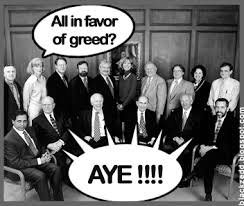
For example:
According to the Special Inspector General for the TARP bailout, the total commitment of government is $16.8 trillion dollars with the $4.6 trillion already paid out.
And it’s equally important to remember that welfare recipients did not:
- Hold CEO positions at any of the banks so far bailed out;
- Run such insurance companies as American International Group (AIG);
- Administer the Federal Home Loan Mortgage Corporation, known as Freddie Mac;
- Command the Federal National Mortgage Association, known as Fannie Mae.
The 2010 documentary Inside Job chronicles the events leading to the 2008 global financial crisis. One of its most insightful moments occurs at a party held by then-Treasury Secretary Henry Paulson.
“We can’t control our greed,” the CEO of a large bank admits to his fellow guests. “You should regulate us more.”
Greed is defined as an excessive desire for wealth or goods. At its worst, greed trumps rationality, judgment and concern about the damage it may cause.
Greed begins in the neurochemistry of the brain. A neurotransmitter called dopamine fuels our greed. The higher the dopamine levels in the brain, the greater the pleasure we experience.
Cocaine, for example, directly increases dopamine levels. So does money.
Harvard researcher Hans Breiter has found, via magnetic resonance imaging studies, that the craving for money activates the same regions of the brain as the lust for sex, cocaine or any other pleasure-inducer.
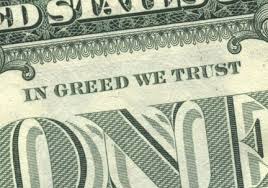
Dopamine is most reliably activated by an experience we haven’t had before. We crave recreating that experience.
But snorting the same amount of cocaine, or earning the same sum of money, does not cause dopamine levels to increase. So the pleasure-seeker must increase the amount of stimuli to keep enjoying the euphoria.
In time, this incessant craving for pleasure becomes an addiction. And feeding that addiction–-with ever more money–becomes the overriding goal.
Thus, the infamous line—”Greed is good”—in the 1987 film, Wall Street, turns out to be both false and deadly for all concerned.
But the situation need not remain this way.
ABC NEWS, ALTERNET, AMERICABLOG, AP, AR-15 ASSAULT RIFLE, ASSAULT WEAPONS, BABY BOOMER RESISTANCE, BARACK OBAMA, BBC, BLOOMBERG NEWS, BUZZFEED, CBS NEWS, CNN, CONCEALED CARRY PERMITS, CROOKS AND LIARS, DAILY KOS, DAILY KOZ, FACEBOOK, FBI, FIVETHIRTYEIGHT, FLORIDA, FLORIDA LEGISLATURE, GUN CONTROL, HANDGUNS, HARPER’S MAGAZINE, HILLARY CLINTON, HUFFINGTON POST, MARCO RUBIO, MARJORY STONEMAN DOUGLAS HIGH SCHOOL, MEDIA MATTERS, MENTAL ILLNESS, MOTHER JONES, MOVEON, MSNBC, NATIONAL RIFLE ASSOCIATION, NBC NEWS, NEW REPUBLIC, NEWSDAY, NEWSWEEK, NIKOLAS CRUZ, NPR, PBS NEWSHOUR, POLITICO, POLITICUSUSA, PORNOGRAPHY, RAW STORY, REPUBLICAN PARTY, REUTERS, RICK SCOTT, SALON, SANFORD BISHOP, SCOT PETERSON, SEATTLE TIMES, SLATE, STAND-YOUR-GROUND LAWS, TALKING POINTS MEMO, THE ATLANTIC, THE CHICAGO SUN-TIMES, THE CHICAGO TRIBUNE, THE DAILY BEAST, THE DAILY BLOG, THE GUARDIAN, THE HILL, THE HUFFINGTON POST, THE INTERCEPT, THE LOS ANGELES TIMES, THE NATION, THE NEW REPUBLIC, THE NEW YORK TIMES, THE NEW YORKER, THE VILLAGE VOICE, THE WASHINGTON POST, THINKPROGRESS, TIME, TRUTHDIG, TRUTHOUT, TWITTER, U.S. NEWS & WORLD REPORT, UPI, USA TODAY, USA TODAY DONALD TRUMP, WAYNE LAPIERRE
In Bureaucracy, Business, History, Law, Law Enforcement, Military, Politics, Social commentary on February 28, 2018 at 12:08 am
On February 14, 19-year-old Nikolas Cruz slaughtered two faculty members and 15 students at Marjory Stoneman Douglas High School in Parkland, Florida.
His weapon of choice: An AR-15 assault rifle, often favored by gun massacre killers.
Since then, the National Rifle Association (NRA), President Donald Trump and their shills (paid and unpaid) have sought to distract attention from the reason for the massacre: Easy access to military assault weaponry by virtually anyone.
Among those they have blamed:
- “The elites” (who, says Wayne LaPierre, the NRA’s executive vice president, “don’t care about America’s schoolchildren”);
- Unarmed school teachers (who should have been armed);
- Cruz’ neighbors and classmates (who didn’t report his obsession with violence to police);
- The media (who “love mass shootings,” according to Dana Loesch, the NRA’s spokeswoman);
- The FBI (which fumbled tips that Cruz was a live grenade waiting to go off).
- Scot Peterson (the armed school resource officer who stayed outside the school as the shooting unfolded).
According to a series of police reports, Cruz suffered from mental illness and was on behavioral medication. The records described fights at home—and his mother’s fear that Cruz was out of control even as an adolescent.

Nikolas Cruz
Even so, it was not mental illness that made it possible for Cruz to slaughter 17 innocent students and faculty.
It was his access to military-style firepower.
Without that, all he could have done was fantasize about inflicting torment on others. Having access to that firepower allowed him to make his fantasies come true.
And who made it possible for Cruz to obtain that firepower? Those Republicans who are literally on the payroll of the NRA.
To start at the top: President Donald Trump. In 2016, the NRA spent more than $30 million to support him and defeat his opponent, Hillary Clinton.
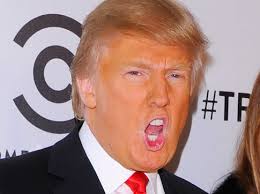
Donald Trump
And that investment has already paid off: In February, 2017, Trump signed a bill making it easier for the mentally ill to buy guns. This repealed an Obama-era regulation that restricted the rights of seriously incapacitated people to own death-dealing firepower.
In fact, during the 2016 election, the NRA and its affiliate, the NRA Institute for Legislative Action, spent a total of $54 million. The vast majority of these monies went to support Republicans or oppose Democrats.
Even so, the NRA has been willing to open its pocketbook to Democrats willing to toe the organization’s line. Rep. Sanford Bishop, of Georgia, has received about $47,000 during his tenure in Congress.
From January 1 to mid-February, 2018, the NRA has spent absolutely nothing to support Democrats, and $337,000 to oppose them.
Then there are Florida’s Republican legislators. All of the following received contributions from the NRA during the 2016 election cycle:
- Rep. Gus M. Bilirakis: $2,000
- Rep. Carlos Curbelo: $2,500
- Rep. Ted Yoho: $1,000
- Rep. Daniel Webster: $1,000
- Rep. John Rutherford: $1,000
- Sen. Marco Rubio: $9,900
- Rep. Dennis Ross: $2,000
- Rep. Tom Rooney: $2,000
- Rep. Bill Posey: $2,000
- Rep. Brian Mast: $4,950
- Rep. Matt Gaetz: $1,000
- Rep. Neal Dunn: $1,000
- Rep. Mario Diaz-Balart: $2,000 Rep.
- Ron DeSantis: $1,000
Then there is Florida Governor Rick Scott.
In 2014, Scott won the praise of the NRA’s Political Victory Fund: “Rick has signed more pro-gun bills into law in one term than any other governor in Florida history.” All of this resulted in his getting an “A+” rating from the organization.

Rick Scott
And what has all this highly-paid political influence bought?
- An AR-15 rifle—designed to kill the maximum number of people—is legally easier to obtain than a handgun.
- Federal law requires gun buyers to be 21 before buying a handgun. But in Florida, an AR-15 can be purchased at age 18.
- Residents aren’t required to register their gun.
- But Floridians must be 21 to buy an alcoholic beverage.
- No permit or license is needed to buy a gun.
- No permit is needed to conceal carry a rifle or shotgun; one is required to conceal carry a handgun.
- The Florida Department of Agriculture and Consumer Services is required to issue a concealed carry permit to anyone who desires one, as long as: S/he is an American citizen; 21 or older; without a felony conviction; and can prove that s/he is competent with a firearm.
- Floridians can buy as many guns as they want at one time.
- Florida does not regulate assault weapons, .50-caliber rifles and large capacity ammunition magazines.
- Florida’s “Stand Your Ground” law allows for the use of deadly force without any obligation to try to avoid violence.
And when criminals and/or the criminally insane turn the weaponry they have legally purchased onto scores of defenseless men, women and children, the NRA again benefits.
For example: One week after the mass slaughter at Marjory Stoneman Douglas High School, Florida legislators voted 71-36 against a measure to consider a ban on semi-automatic weapons.
Yet they declared pornography a public health risk. The bill “recognizes public health risk created by pornography & acknowledges need for education, prevention, research, & policy change to protect citizens of this state.”
Almost all the lawmakers who voted against an assault rifle ban have an “A” rating from the NRA.
Watching in stunned disbelief and outrage were 100 Marjory Stoneman High School students. They had traveled 400 miles from Parkland to the state capital in Tallahassee, hoping to speak with legislators and Governor Scott.
ABC NEWS, ALTERNET, AP, AR-15, ATOMIC BOMB, BENEATH THE PLANET OF THE APES, BUZZFEED, C-PAC, CBS NEWS, CIA, CNN, CROOKS AND LIARS, DAILY KOZ, DEMOCRATIC PARTY, DONALD TRUMP, FACEBOOK, FBI, GUNS, MARJORY STONEMAN DOUGLAS HIGH SCHOOL, MOTHER JONES, MOVEON, NATIONAL RIFLE ASSOCIATION, NBC NEWS, NEWSWEEK, NPR, NSA, POLITICO, RAW STORY, REUTERS, RUSSIA, SALON, SANDY HOOK ELEMENTARY SCHOOL, SEATTLE TIMES, SECOND AMENDMENT, SECURITY GUARDS, SLATE, SOCIALISM, THE ATLANTIC, THE CHICAGO SUN-TIMES, THE CHICAGO TRIBUNE, THE DAILY BEAST, THE GUARDIAN, THE HILL, THE HUFFINGTON POST, THE LOS ANGELES TIMES, THE NATION, THE NEW YORK TIMES, THE WASHINGTON POST, TIME, TWITTER, U.S. NEWS & WORLD REPORT, UPI, USA TODAY, USA TODAY NIKOLAS CRUZ, VLADIMIR PUTIN, WAYNE LAPIERRE
In Bureaucracy, Business, History, Law, Politics, Social commentary on February 27, 2018 at 12:12 am
On February 14, 19-year-old Nikolas Cruz slaughtered two faculty members and 15 students at Marjory Stoneman Douglas High School in Parkland, Florida.
His weapon of choice: An AR-15 assault rifle, often favored by gun massacre killers.
Eight days later, on February 22, Wayne LaPierre, executive vice president of the National Rifle Association, attacked those he held responsible for the series of massacres plaguing American schools.

Wayne LaPierre
And it wasn’t crazed gunmen armed with automatic weapons designed for military use.
With funerals still being planned for some of the victims, LaPierre blamed “the elites,” “saboteurs” and “new European-style socialists” for this and other gun massacres.
He did so at the Conservative Political Action Conference (C-PAC) in National Harbor, Maryland.
“They hate the NRA, they hate the Second Amendment,” said LaPierre, like an Old Testament prophet addressing his fanatical congregation.
“They hate individual freedom. In the rush of calls for more government, they have also revealed…their true selves.
“The elites do not care about America’s schoolchildren. If they truly cared, they would protect them. For them, it is not a safety issue. It is a political issue.
“Their goal is to eliminate the Second Amendment and our firearms freedoms, so they can eradicate all individual freedoms.”
His C-PAC congregation gave him a wild ovation.
He then outlined his solution for protecting America’s schoolchildren: Turning schools into virtual concentration camps patrolled by heavily-armed security guards.
And he accused the Democratic party of being “infested with saboteurs who do not believe in capitalism, do not believe in the Constitution, do not believe in our freedom, and do not believe in America as we know it.”
These “saboteurs” were “new European-style socialists.”
Which was ironic: In 2016, the NRA spent $30 million to elect Donald Trump—who fiercely defends Russian Communist dictator Vladimir Putin against the FBI, NSA and CIA.
But perhaps the highlight of LaPierre’s speech came at its close: “And there is no greater personal, individual freedom than the right to keep and bear arms, the right to protect yourself, and the right to survive.
“It is not bestowed by man, but granted by God to all Americans as our American birthright.”
Anyone who’s seen the 1970 sci-fi movie, Beneath the Planet of the Apes, remembers the final scene: Where seemingly normal underground dwellers strip off their human face masks and reveal themselves to be radiation-scarred mutants.
They wear white robes, and stand silently during a sermon or shout “Amen!” in what is clearly a dark parody of a religious service. It’s immediately clear what they are worshiping: An atomic bomb standing upright.

And they pay tribute to the engine of obliteration that has destroyed human civilization and brought about a world ruled by apes.
Their leader, Mendez, chants:
“Glory be to the Bomb, and to the Holy Fallout. As it was in the beginning, is now, and ever shall be. World without end. Amen.
“His sound has gone out to all lands, and his light unto the end of the world.
“Almighty and everlasting Bomb, who came down among us to make Heaven under Earth. Lighten our darkness. O instrument of God—grant us thy peace!”
Reading Wayne LaPierre’s eulogy to the Gun and his passionate invoking of God, it’s easy to re-imagine his giving a slightly altered version of the sermon offered in Beneath the Planet of the Apes. It’s also easy to imagine this taking place during an NRA convention.
WAYNE LAPIERRE: The heavens declare the glory of the Gun. And the body-count showeth His handiwork.
NRA CONGREGATION: His sound is gone out to all lands; and his Light unto the end of the world.
WAYNE LAPIEREE: He descendeth from the outermost part of Heaven; and there is nothing hid from the lead thereof. There is neither speech nor language after His voice is heard among them.
NRA CONGREGATION: Praise Him! Praise Him! My Strength and my Reddemer!
WAYNE LAPIERRE: Glory be to the Gun, and to the Holy Bodycount! As it was in the Beginning, is now and ever shall be, massacres without end. Amen!
NRA CHORUS: Amen! Amen! Amen! Amen!
WAYNE LAPIERRE: Almighty and everlasting Gun, who came down among us to make Heaven unto Earth. Lighten our darkness with your muzzle flashes. O instrument of God, grant us They peace.
NRA CHOIR: Almighty Gun, who destroyed all men—to create corpses! Behold His glory!
WAYNE LAPIERRE: Behold that Truth that abides in us. To reveal that Truth unto that Maker.
WAYNE LAPIERRE AND NRA CONGREGATION: I reveal my inmost self unto my God.
NRA CHORUS (singing): Unto my God!
NRA CONGREGATION (singing):
All guns bright and beautiful. All creatures dead with lead.
The good Gun makes us what we are!
He takes out eyes to see with, and lips that might yet speak. How great the Gun Almighty, who has made all things dead. Amen!
WAYNE LAPIERRE: May the Blessing of the Gun Almighty and the fellowship of the Holy Bodycount descend on us all, this night and forevermore!
* * * * * *
In 2012, a psychotic gunman slaughtered 20 first-graders and six adults at Sandy Hook Elementary School. Since then, at least 239 school shootings have erupted nationwide, killing 138 people and wounding 438.
9/11, ABC NEWS, AL QAEDA, ALTERNET, AP, BARACK OBAMA, BUZZFEED, CBS NEWS, CNN, CONCEALED WEAPONS BESTS, COP KILLER BULLETS, CRIME, CROOKS AND LIARS, DAILY KOZ, DELTA FORCE, DRUG ENFORCEMENT ADMINISTRATION, ERIC HOLDER, FACEBOOK, FBI, FEDERAL ASSAULT WEAPONS BAN, GABRIELLE GIFFORDS, GEORGE ZIMMERMAN, GREEN BERETS, GUN CONTROL, GUNFIGHT AT THE O.K. CORRAL, MOTHER JONES, MOVEON, NATIONAL RIFLE ASSOCIATION, NBC NEWS, NEWSWEEK, NPR, NUCLEAR WEAPONS, OSAMA BIN LADEN, POLITICO, RAW STORY, REUTERS, SALON, SEATTLE TIMES, SECOND AMENDMENT, SELF-DEFENSE, SEPTEMBER 11 ATTACKS, SLATE, STAND-YOUR-GROUND LAWS, TALIBAN, TERRORISM, THE ATLANTIC, THE CHICAGO SUN-TIMES, THE CHICAGO TRIBUNE, THE DAILY BEAST, THE GUARDIAN, THE HILL, THE HUFFINGTON POST, THE LOS ANGELES TIMES, THE NATION, THE NEW YORK TIMES, THE WASHINGTON POST, TIME, TRAVON MARTIN, TUSCON SHOOTINGS, TWITTER, U.S. CONSTITUTION, U.S. NAVY SEALS, U.S. NEWS & WORLD REPORT, UPI, USA TODAY, WAYNE LAPIERRE
In Bureaucracy, Business, History, Law, Law Enforcement, Military, Politics, Social commentary on February 21, 2018 at 12:03 am
Among the major accomplishments of the National Rifle Association:
- The NRA has steadfastly defended the right to own Teflon-coated “cop killer” bullets,” whose only purpose is to penetrate bullet-resistant vests worn by law enforcement officers.
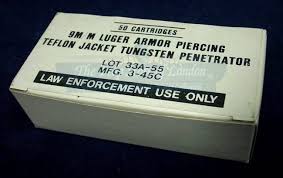
- The NRA and its lobbying arm, the Institute for Legislative Action, is responsible for the “stand-your-ground” ordinances now in effect in more than half the states. These allow for the use of deadly force in self-defense, without any obligation to attempt to retreat first.
- In 2012, the NRA rushed to the defense of accused murderer George Zimmerman, the self-appointed “community watchman” who ignored police orders to stop following 17-year-old Trayvon Martin and ended up shooting him.
- Police did not initially charge Zimmerman because of Florida’s “Stand-Your-Ground” law, which the NRA had rammed through the legislature.
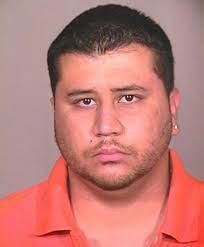
George Zimmerman
- On February 26, 2012, Zimmerman shot unarmed Trayvon Martin, who was wearing a “hoodie.” In March, the NRA issued its own version of a “hoodie”–the Concealed Carry Hooded Sweatshirt, designed to hide firearms. Selling on the NRA’s website for $60 to $65, it is advertised thusly:
- “Inside the sweatshirt you’ll find left and right concealment pockets. The included Velcro®-backed holster and double mag pouch can be repositioned inside the pockets for optimum draw. Ideal for carrying your favorite compact to mid-size pistol, the NRA Concealed Carry Hooded Sweatshirt gives you an extra tactical edge, because its unstructured, casual design appears incapable of concealing a heavy firearm—but it does so with ease!”
- Anyone—including convicted criminals—can buy these “hide-a-gun” sweatshirts, putting both the public and law enforcers at deadly risk.
- The NRA often claims that law-abiding citizens defend themselves with guns millions of times every year. But the FBI has determined that, of the approximately 11,000 gun homicides every year, fewer than 300 are justifiable self-defense killings.
- The NRA supports loopholes that allow criminals to buy guns without background checks, or allow terrorists to buy all the AK-47s they desire.
- The NRA’s executive vice president, Wayne LaPierre, tried to defeat Barack Obama in 2008 and 2012. Yet the President meekly signed legislation allowing guns to be brought into national parks and onto Amtrak trains. Since becoming Chief Executive, he made no effort to curb gun violence.
- High-capacity magazines were prohibited under the 1994 Federal Assault Weapons Ban. It expired in 2004. The NRA—aided by the Bush administration and Republicans generally—easily overcame efforts to renew the ban.
- Political scientist Robert Spitzer, author of the book The Politics of Gun Control, notes that since the passage of the 1993 Brady Handgun Violence Prevention Act and the assault weapons ban in 1994, state and national laws have been drifting toward more open gun access:
- “In 1988, there were about 18 states that had state laws that made it pretty easy for civilians to carry concealed hand guns around in society. By 2011, that number is up to 39 or 40 states having liberalized laws, depending on how you count it, and the NRA has worked very diligently at the state level to win political victories there, and they’ve really been quite successful.”
- On January 8, 2011, Democratic Rep. Gabrielle Giffords was shot in the head while meeting with constituents outside a Tucson, Arizona, grocery store. Also killed was Arizona’s chief U.S. District judge, John Roll, who had just stopped by to see his friend Giffords after celebrating Mass. The total number of victims: six dead, 13 wounded. Severely brain-damaged, Giffords was forced to resign her Congressional seat.

Rep. Gabrielle Giffords after being shot
- “The NRA’s response to the Tucson shootings has been to say as little as possible and to keep its head down,” said Spitzer. “And their approach even more has been to say as little as possible and to simply issue a statement of condolence to the families of those who were injured or killed and to wait for the political storm to pass over and then to pick up politics as usual.”
- This has been the NRA’s reaction after every mass shooting.
- In the spring of 2012, the House Oversight Committee prepared to vote on whether to hold U.S. Attorney General Eric Holder in contempt for allegedly refusing to provide documents related to “Fast and Furious.” This was an undercover operation launched by the Bush administration to track firearms being sold to Mexican drug cartels.
- The NRA notified Congressional members that how they voted would reflect how the NRA rated them in “candidate evaluations” for the November elections. This amounted to blatant extortion, since the NRA had long accused Holder of having an “anti-gun” agenda.
Summing up the current state of gun politics in America, the April 21, 2012 edition of The Economist noted:
“The debate about guns is no longer over whether assault rifles ought to be banned, but over whether guns should be allowed in bars, churches and colleges.”
That is precisely the aim of the NRA—an America where anyplace, anytime, can be turned into the gunfight at the O.K. Corral.
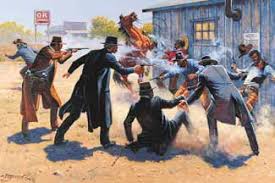
Gunfight at the O.K. Corral – October 26, 1881
And that is precisely what the United States is fast becoming.
Except, so far, the vast majority of victims have not been armed gunfighters but unarmed innocents. And it’s been the “gun rights” types whom the NRA supports who have done the killing.
9/11, ABC NEWS, AL QAEDA, ALTERNET, AP, BARACK OBAMA, BUZZFEED, CBS NEWS, CNN, CONCEALED WEAPONS BESTS, COP KILLER BULLETS, CRIME, CROOKS AND LIARS, DAILY KOZ, DELTA FORCE, DRUG ENFORCEMENT ADMINISTRATION, ERIC HOLDER, FACEBOOK, FBI, FEDERAL ASSAULT WEAPONS BAN, GABRIELLE GIFFORDS, GEORGE ZIMMERMAN, GREEN BERETS, GUN CONTROL, GUNFIGHT AT THE O.K. CORRAL, MOTHER JONES, MOVEON, NATIONAL RIFLE ASSOCIATION, NBC NEWS, NEWSWEEK, NPR, NUCLEAR WEAPONS, OSAMA BIN LADEN, POLITICO, RAW STORY, REUTERS, SALON, SEATTLE TIMES, SECOND AMENDMENT, SELF-DEFENSE, SEPTEMBER 11 ATTACKS, SLATE, STAND-YOUR-GROUND LAWS, TALIBAN, TERRORISM, THE ATLANTIC, THE CHICAGO SUN-TIMES, THE CHICAGO TRIBUNE, THE DAILY BEAST, THE GUARDIAN, THE HILL, THE HUFFINGTON POST, THE LOS ANGELES TIMES, THE NATION, THE NEW YORK TIMES, THE WASHINGTON POST, TIME, TRAVON MARTIN, TUSCON SHOOTINGS, TWITTER, U.S. CONSTITUTION, U.S. NAVY SEALS, U.S. NEWS & WORLD REPORT, UPI, USA TODAY, WAYNE LAPIERRE
In Bureaucracy, Business, History, Law, Law Enforcement, Military, Politics, Social commentary on February 20, 2018 at 12:05 am
On September 11, 2001, Islamic terrorists snuffed out the lives of 3,000 Americans in New York, Washington, D.C. and Pennsylvania.
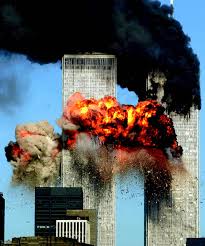
World Trade Center – September 11, 2001
But within less than a month, American warplanes began carpet-bombing Afghanistan, whose rogue Islamic “government” refused to surrender Osama bin Laden, the mastermind of the attacks.
By December, the power of the Taliban was broken—and bin Laden was driven into hiding in Pakistan.
For more than 16 years, the United States—through its global military and espionage networks—has relentlessly hunted down most of those responsible for that September carnage.
On May 1, 2011, U.S. Navy SEALS invaded bin Laden’s fortified mansion in Abbottabad, Pakistan—and shot him dead.
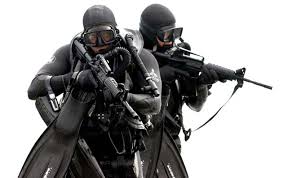
U.S. Navy SEALs
Now, consider these statistics of death, supplied by the Brady Campaign to Prevent Gun Violence:
- One in three people in the U.S. knows someone who has been shot.
- On average, 31 Americans are murdered with guns every day and 151 are treated for a gun assault in an emergency room.
- Every day on average, 55 people kill themselves with a firearm.
- Another 46 people are shot or killed in an accident with a gun.
- U.S. firearm homicide rates are 20 times higher than the combined rates of 22 countries that are our peers in wealth and population.
- A gun in the home is 22 times more likely to be used to kill or injure in a domestic homicide, suicide, or unintentional shooting than to be used in self-defense.
- More than one in five U.S. teenagers (ages 14 to 17) report having witnessed a shooting.
- An average of seven children and teens under the age of 20 are killed by guns every day.
- American children die by guns 11 times as often as children in other high-income countries.
- Youth (ages 0 to 19) in the most rural U.S. counties are as likely to die from a gunshot as those living in the most urban counties.
- Rural children die of more gun suicides and unintentional shooting deaths.
- Urban children die more often of gun homicides.
- Firearm homicide is the second-leading cause of death (after motor vehicle crashes) for young people ages 1-19 in the U.S.
- Medical treatment, criminal justice proceedings, new security precautions, and reductions in quality of life are estimated to cost U.S. citizens $100 billion annually.
- The lifetime medical cost for all gun violence victims in the United States is estimated at $2.3 billion, with almost half the costs borne by taxpayers.
In short, in one year on average:
- More than 114,994 Americans are shot in murders, assault, suicides, suicide attempts, accidents or by police intervention.31,537 people die from gun violence.
- 11,564 are murdered.
- 21,037 people kill themselves.
- 544 people are killed accidentally.
- 468 are killed by police intervention.
- 267 die but intent is not known.
- 81,114 people survive gun injuries.
(These statistics are based on death certificates and estimates from emergency room admissions.)
And who, more than anyone (including the actual killers themselves) has made all this carnage possible?
Your friends at the National Rifle Association (NRA).
But unlike the leadership of Al Qaeda, that of the NRA is not simply known, but celebrated.
Its director, Wayne LaPierre, is courted as a rock star by both Democrats and Republicans seeking NRA political endorsements—and campaign contributions.

Wayne LaPierre
He frequently appears as an honored guest at testimonial dinners and political conventions.
The largest of the 13 national pro-gun groups, the NRA has nearly 4 million members, who focus most of their time lobbying Congress for unlimited “gun rights.”
The NRA claims that its mission is to “protect” the Second Amendment to the United States Constitution, which states:
“A well regulated Militia, being necessary to the security of a free State, the right of the people to keep and bear Arms, shall not be infringed.”
NRA members conveniently ignore the first half of that sentence about “a well regulated Militia….” They simply want everyone to own a gun—and contribute to the NRA.
For the NRA, the Second Amendment is the Constitution, and the rest of the document is a mere appendage.
When Congress ratified the Constitution in 1788, the United States was not a world power.
A mere 26 years later, the British seized and burned Washington, D.C., after repeatedly defeating American armies. On the frontier, settlers had to defend themselves against hostile Indians and marauding bandits.
Only after World War II did the country maintain a powerful standing army during peacetime.
But World War II ended 72 years ago, and today the United States is a far different country than it was in 1788:
-
Its nuclear arsenal can turn any country into thermonuclear ash—anytime an American President decides to do so.
-
Its Army, Navy, Air Force and Marine Corps can target any enemy, anywhere in the world.
-
Its Special Forces—Green Berets, Delta Force and Navy SEALS—are rightly feared by international terrorists.
-
American Intelligence has greatly improved since 9/11. The FBI’s top priority is to prevent terrorist attacks, not simply investigate them afterward.
-
And waging war on criminals generally are about 836,787 full-time sworn local/state/Federal law enforcement officers.
- If a criminal flees or conducts business across state lines, powerful Federal law enforcement agencies—such as the FBI and Drug Enforcement Administration—can put him out of business.
But apparently the NRA hasn’t gotten the word.
ABC NEWS, ALTERNET, AP, BUZZFEED, CBS NEWS, CNN, CRIME, CROOKS AND LIARS, DAILY KOZ, FACEBOOK, GUN CONTROL, MARTIN LUTHER KING, MISSISSIPPI ATTORNEY GENERAL MIKE MOORE, MOTHER JONES, MOVEON, NATIONAL RIFLE ASSOCIATION, NBC NEWS, NEWSWEEK, NPR, POLITICO, RAW STORY, REUTERS, ROBERT F. KENNEDY, SALON, SEATTLE TIMES, SECOND AMENDMENT, SELF-DEFENSE, SLATE, STAND-YOUR-GROUND LAWS, THE ATLANTIC, THE CHICAGO SUN-TIMES, THE CHICAGO TRIBUNE, THE DAILY BEAST, THE GUARDIAN, THE HILL, THE HUFFINGTON POST, THE LOS ANGELES TIMES, THE NATION, THE NEW YORK TIMES, THE WASHINGTON POST, TIME, TWITTER, U.S. CONSTITUTION, U.S. NAVY SEALS, U.S. NEWS & WORLD REPORT, UPI, USA TODAY, WRONGFUL-DEATH LAWSUITS
In Bureaucracy, Business, History, Law, Law Enforcement, Politics, Social commentary on February 19, 2018 at 12:19 am
The victims of the violence are black and white, rich and poor, young and old, famous and unknown. They are, most important of all, human beings whom other human beings loved and needed. No one—no matter where he lives or what he does— can be certain who will suffer from some senseless act of bloodshed. And yet it goes on and on.
–Robert F. Kennedy, April 4, 1968

Senator Robert F. Kennedy announcing the murder of Dr. Martin Luther King, Jr.
What should the surviving victims of gun massacres do to seek redress?
And how can the relatives and friends of those who didn’t survive seek justice for those they loved?
Two things:
First, don’t count on politicians to support a ban on assault weapons.
Politicians—with rare exceptions—have only two goals:
- Get elected to office, and
- Stay in office.
And too many of them fear the economic and voting clout of the NRA to risk its wrath.
Consider Republican Presidential candidate Mitt Romney and President Barack Obama.
Both rushed to offer condolences to the surviving victims of the massacre at the Century 16 Theater in Aurora, Colorado, on July 20, 2012.
And both steadfastly refused to even discuss gun control—let alone support a ban on the type of assault weapons used by James Holmes, leaving 12 dead and 58 wounded.
Second, those who survived the massacre—and the relatives and friends of those who didn’t—should file wrongful death, class-action lawsuits against the NRA.
There is sound, legal precedent for this.
- For decades, the American tobacco industry peddled death and disability to millions and reaped billions of dollars in profits.
- The industry vigorously claimed there was no evidence that smoking caused cancer, heart disease, emphysema or any other ailment.
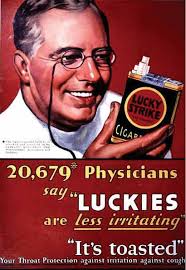
- Tobacco companies spent billions on slick advertising campaigns to win new smokers and attack medical warnings about the dangers of smoking.
- Tobacco companies spent millions to elect compliant politicians and block anti-smoking legislation.
- From 1954 to 1994, over 800 private lawsuits were filed against tobacco companies in state courts. But only two plaintiffs prevailed, and both of those decisions were reversed on appeal.
- In 1994, amidst great pessimism, Mississippi Attorney General Mike Moore filed a lawsuit against the tobacco industry. But other states soon followed, ultimately growing to 46.
- Their goal: To seek monetary, equitable and injunctive relief under various consumer-protection and anti-trust laws.
- The theory underlying these lawsuits was: Cigarettes produced by the tobacco industry created health problems among the population, which badly strained the states’ public healthcare systems.
- In 1998, the states settled their Medicaid lawsuits against the tobacco industry for recovery of their tobacco-related, health-care costs. In return, they exempted the companies from private lawsuits for tobacco-related injuries.
- The companies agreed to curtail or cease certain marketing practices. They also agreed to pay, forever, annual payments to the states to compensate some of the medical costs for patients with smoking-related illnesses.
The parallels with the NRA are obvious:
- For decades, the NRA has peddled deadly weapons to millions, reaped billions of dollars in profits and refused to admit the carnage those weapons have produced: “Guns don’t kill people. People kill people.” With guns.
- The NRA has spent millions on political contributions to block gun-control legislation.
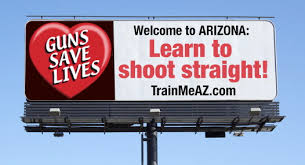
- The NRA has bitterly fought background checks on gun-buyers, in effect granting even criminals and the mentally ill the right to own arsenals of death-dealing weaponry.
- The NRA has spent millions on slick advertising campaigns to win new members and frighten them into buying guns.
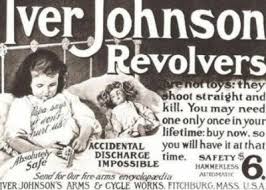
- The NRA has spent millions attacking political candidates and elected officials who warned about the dangers of unrestricted access to assault and/or concealed weapons.
- The NRA has spent millions pushing “Stand Your Ground” laws in more than half the states, which potentially give every citizen a “license to kill.”
- The NRA receives millions of dollars from online sales of ammunition, high-capacity ammunition magazines, and other accessories through its point-of-sale Round-Up Program—thus directly profiting by selling a product that kills about 30,288 people a year.
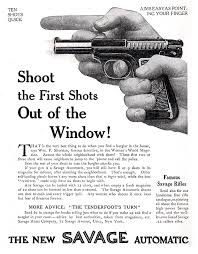
- Firearms made indiscriminately available through NRA lobbying have filled hospitals with casualties, and have thus badly strained the states’ public healthcare systems.
It will take a series of highly expensive and well-publicized lawsuits to significantly weaken the NRA, financially and politically.
The first ones will have to be brought by the surviving victims of gun violence—and by the friends and families of those who did not survive it. Only they will have the courage and motivation to take such a risk.
As with the cases first brought against tobacco companies, there will be losses. And the NRA will rejoice with each one.
But, in time, state Attorneys General will see the clear parallels between lawsuits filed against those who peddle death by cigarette and those who peddle death by armor-piercing bullet.
And then the NRA—like the tobacco industry—will face an adversary wealthy enough to stand up for the rights of the gun industry’s own victims.
Only then will those politicians supporting reasonable gun controls dare to stand up for the victims of these needless tragedies.
2016 PRESIDENTIAL ELECTION, ABC NEWS, ALTERNET, AP, BUZZFEED, CBS NEWS, CENSORSHIP, CHEATSHEET, CNN, COMMUNICATIONS, CROOKS AND LIARS, DAILY KOZ, FACEBOOK, FACEBOOK JAIL, FAMILY VALUES, FORTUNE, JOE BARTON, MARK ZUCKERBERG, MICHAEL MARTIN, MOTHER JONES, MOVEON, NBC NEWS, NEWSWEEK, NPR, POLITICO, RAW STORY, REUTERS, RUSSIAN TROLLS, SALON, SEATTLE TIMES, SLATE, SOCIAL MEDIA WEBSITES, SPAM, THE ATLANTIC, THE CHICAGO SUN-TIMES, THE CHICAGO TRIBUNE, THE DAILY BEAST, THE GUARDIAN, THE HILL, THE HUFFINGTON POST, THE LOS ANGELES TIMES, THE NATION, THE NEW YORK TIMES, THE WASHINGTON POST, TIME, TWITTER, U.S. NEWS & WORLD REPORT, UPI, USA TODAY
In Bureaucracy, Business, History, Politics, Social commentary on January 25, 2018 at 10:39 am
Years ago, Michael Martin, a Los Angeles-based computer repair expert, offered me some advice I have found absolutely essential.
“When you call Technical Support,” he said, “they’re accessing the same information you can get via the computer.
“Most of the time they’re going to have you put the Restore Disk back into the computer and restore it back to default. It wipes out everything on your computer. Technical support costs a lot of money for a company—to hell with your data.
“Be very cautious when you get on the phone with any computer company and they advise you to run the Restore Disk.”

Michael Martin
What Martin said about the unwillingness of computer companies to provide technical support applies just as much to social media websites.
Consider the case of Facebook, the largest social media and networking service. According to its “Newsroom,” it had more than 1.37 billion daily active users on average for September 2017.
Such a huge audience attracts advertisers. And this, in turn, has armed Facebook with total assets of $64.961 billion (2016). These revenues have given its founder, Mark Zuckerberg, an estimated net worth of $75.2 billion.
Yet, for all the billions pouring into Facebook’s coffers, the company refuses to provide a way for its users to directly contact Facebook headquarters.
This may not seem important. But the following case will demonstrate why it is.
A short while ago, a friend of mine (whom I’ll call Janet) sent Zuckerberg a letter, which opened:
“Today while chatting with someone on Facebook I found myself bounced from the page. I was instructed to log in again. When I did so, I got the following message:
| |
Secure Your Account
Hi Janet, we think your computer is infected with malware, and it’s spreading spam through your Facebook account. We’ll walk you through a few steps to explain more and scan your computer for malware.
|
“Naturally, my first reaction was to contact Facebook to find out what, exactly, was meant by Spam. I quickly found, however, that although Facebook’s customers like me have made you a billionaire, they aren’t considered important enough to be provided with direct support for resolving problems like this.
“All that I could do was put a message on file with your ‘Report a Login Issue’ page. I received no response, so I sent another. This, too, has gone unanswered.
“At the bottom of the ‘Report a Login Issue’ page is this: “Thanks for taking the time to submit a report. While we don’t reply to every report, we’ll let you know if we need more details.”
“In short, even after a customer puts a help-request on file with Facebook, s/he has no guarantee that s/he will even receive the courtesy of a reply, let alone the help needed to resolve the problem.
“Is this really what you are proud to call customer service?
“I think it’s entirely appropriate to ask people I don’t know—and who want to roam freely through my computer—exactly what it is they believe is Spam. Because if it isn’t Spam, there’s no reason for them to be roaming freely through my computer.”

Mark Zuckerberg
Janet never received a reply from Zuckerberg—nor from anyone subordinate to him.
Facebook is still the most popular social platform on the Internet. At one time, AOL was the big dog on the block, too. And an April 13, 2015 article on CheatSheet warned that history could repeat itself: “Three Reasons Young People Think Facebook is Lame.”
So did a second article, published in Fortune on April 7, 2016: “Facebook Users Are Sharing Fewer Personal Updates and It’s a Big Problem.”
No doubt a major reason for this is the arrogance of Facebook’s censors.
Another friend of mine—Jim—recently got kicked off Facebook after getting this notice:
The offending post was a news story about Texas Congressman Joe Barton. It described how he had sent a series of smarmy emails to numerous women—while, of course, posing as a paragon of “family values.”
Jim sent a letter to Facebook’s headquarters at 1 Hacker Way, Menlo Park, California 94025.
“If Facebook is going to hold its users to a set of standards, those standards should be clearly and specifically posted. Certainly a legitimate news story—no matter on what the subject—should fall within allowable posting guidelines. But apparently Facebook’s anonymous censors do not agree.
“Facebook functions the way the gods of the ancient Greeks were believed to act: In a totally arbitrary manner, whose decisions, however unwarranted, are beyond appeal.”
Many Facebook users have described—on Facebook—how they have been put in “Facebook jail.” One user offended censors by his too-frequent use of the “Like” option. How this violated Facebook’s terms of service was never explained.
During the 2016 Presidential election, Russian trolls used Facebook, Twitter and Google to post misleading articles and comments. These may well have influenced the outcome of that election.
As a result, these companies are now under widening Congressional investigation.
This is no time for social media companies to needlessly offend those who make their profits a reality.
"HAMILTON", ABC NEWS, ALTERNET, AMERICABLOG, AP, ARNOLD SCHWARZENEGGER, BABY BOOMER RESISTANCE, BARACK OBAMA, BBC, BLOOMBERG, BLOOMBERG NEWS, BLUESKY, BUZZFEED, CBS NEWS, CNN, CROOKS AND LIARS, DAILY KOS, DAILY KOZ, DONALD TRUMP, FACEBOOK, FBI, FIVETHIRTYEIGHT, HARPER’S MAGAZINE, HILLARY CLINTON, HUFFINGTON POST, JAMES COMEY, JOHN OLIVER, MEDIA MATTERS, MERYL STREEP, MIKE PENCE, MOTHER JONES, MOVEON, MSNBC, NBC NEWS, NEIL YOUNG, NEW REPUBLIC, NEWSDAY, NEWSWEEK, NPR, PBS NEWSHOUR, POLITICO, POLITICUSUSA, RAW STORY, REUTERS, SALON, SEATTLE TIMES, SLATE, TALKING POINTS MEMO, THE ATLANTIC, THE CHICAGO SUN-TIMES, THE CHICAGO TRIBUNE, THE DAILY BEAST, THE DAILY BLOG, THE GUARDIAN, THE HILL, THE HUFFINGTON POST, THE INTERCEPT, THE LOS ANGELES TIMES, THE NATION, THE NEW REPUBLIC, THE NEW YORK TIMES, THE NEW YORKER, THE VILLAGE VOICE, THE WASHINGTON POST, THINKPROGRESS, TIME, TRUTHDIG, TRUTHOUT, TWITTER RULES, TWO POLITICAL JUNKIES, U.S. NEWS & WORLD REPORT, UPI, USA TODAY, X
In Bureaucracy, Business, History, Politics, Social commentary on January 24, 2018 at 12:07 am
On May 9, 2017, President Donald Trump abruptly fired FBI Director James Comey.
Reports soon surfaced that his reason for doing so was that Comey had refused to pledge his personal loyalty to Trump.
Just 72 hours after firing Comey, Trump issued a threat to him via Twitter: “James Comey better hope that there are no ‘tapes’ of our conversations before he starts leaking to the press!”
And Twitter’s reaction to such a blatant threat?
Silence.
James B. Comey
From the start of his Presidency, Trump has put his ambitions, excuses and rants on social media. And this has unnerved foreign leaders as well as Trump’s fellow Americans.
As CNN Political Analyst Julian Zelizer outlined in a July 3 article:
“Putting aside the specific content of the recent blasts from the Oval smart phone, the President’s ongoing Twitter storms make all leaders uneasy. The heads of government in most nations prefer a certain amount of predictability and decorum from other heads of state.
“To have one of the most powerful people in the room being someone who is willing to send out explosive and controversial statements through social media, including nasty personal attacks or an edited video of him physically assaulting the media, does not make others….feel very confident about how he will handle deliberations with them.”
On December 12, 2017, Trump used Twitter to attack New York United States Senator Kirsten Gillibrand.
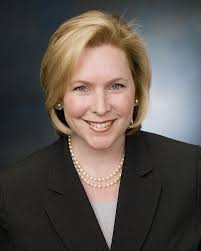
Kirsten Gillibrand
Gillibrand was among six Democratic senators who called for Trump’s resignation after sexual harassment allegations forced three Republican and Democratic members of Congress to resign.
Trump tweeted: “Lightweight Senator Kirsten Gillibrand, a total flunky for Chuck Schumer and someone who would come to my office ‘begging’ for campaign contributions not so long ago (and would do anything for them), is now in the ring fighting against Trump. Very disloyal to Bill & Crooked-USED!”
“I see it as a sexist smear. I mean that’s what it is,” Gillibrand replied in a press conference. “It’s part of the President’s efforts of name calling and it’s not going to silence me, it’s not going to silence me. It’s intended to silence me.”
So how does this behavior apply to “The Twitter Rules”?
Abuse: You may not engage in the targeted harassment of someone, or incite other people to do so. We consider abusive behavior an attempt to harass, intimidate, or silence someone else’s voice. [Italics added.]
On February 17, 2017, Trump tweeted: “The FAKE NEWS media (failing @nytimes, @NBCNews, @ABC, @CBS, @CNN) is not my enemy, it is the enemy of the American People!”
On July 2, 2017, Trump tweeted a video showing him punching a man with the CNN logo superimposed on his head during a WWE wrestling match.
And on August 15, the President retweeted a cartoon photo of a “Trump Train” running over a CNN reporter.
Yet Twitter’s Terms of Service state:
Hateful imagery and display names: You may not use hateful images or symbols in your profile image or profile header. You also may not use your username, display name, or profile bio to engage in abusive behavior, such as targeted harassment or expressing hate towards a person, group, or protected category. We will begin enforcing this rule on December 18, 2017. [Italics added.]
So how do Twitter’s top executives justify allowing these repeated violations of “Twitter Rules”? On September 25, the company tweeted:
“We hold all accounts to the same Rules, and consider a number of factors when assessing whether Tweets violate our Rules.
“Among the considerations is ‘newsworthiness’ and whether a Tweet is of public interest. This has long been internal policy and we’ll soon update our public-facing rules to reflect it. We need to do better on this, and will.”
Twitter has never acknowledged publicly that Trump has violated any of its guidelines. It rarely even acknowledges Trump’s tweets.
So what gives?
Money.
Trump’s apologists have fiercely defended his tweetstorms, claiming they allow him to bypass the media and “communicate directly with the American people.”
One of those apologists is former Twitter CEO Jack Dorsey, who said: “I believe it’s really important to have these conversations out in the open, rather than have them behind closed doors.”

Jack Dorsey
In April, 2017, Twitter announced that it had added 9,000,000 new users, its largest quarter-over-quarter jump in two years.
“We believe Twitter is the best at showing you what’s happening in the world and what’s being talked about,” said Anthony Noto, Twitter’s chief financial officer.
“Having political leaders of the world as well as news agencies participating and driving that is an important element to reinforcing what we’re the best at.”
In short: Trump is good at attracting more Twitter users. and if the company needs to overlook his blatant and repeated violations of its “Twitter Rules,” so be it.
Twitter has been so plagued by trolling that potential investors like the Walt Disney Company refused to taint their own reputations by partnering with it.
But that hasn’t led high-ranking Twitter executives to end their Faustian pact with the biggest Twitter troll of all.
And, as all devotees of the Faust legend know, there comes a time when the Devil wins the bargain.
"HAMILTON", ABC NEWS, ALTERNET, AMERICABLOG, AP, ARNOLD SCHWARZENEGGER, BABY BOOMER RESISTANCE, BARACK OBAMA, BBC, BLOOMBERG, BLOOMBERG NEWS, BLUESKY, BUZZFEED, CBS NEWS, CNN, CROOKS AND LIARS, DAILY KOS, DAILY KOZ, DONALD TRUMP, FACEBOOK, FBI, FIVETHIRTYEIGHT, HARPER’S MAGAZINE, HILLARY CLINTON, HUFFINGTON POST, JAMES COMEY, JOHN OLIVER, MEDIA MATTERS, MERYL STREEP, MIKE PENCE, MOTHER JONES, MOVEON, MSNBC, NBC NEWS, NEIL YOUNG, NEW REPUBLIC, NEWSDAY, NEWSWEEK, NPR, PBS NEWSHOUR, POLITICO, POLITICUSUSA, RAW STORY, REUTERS, SALON, SEATTLE TIMES, SLATE, TALKING POINTS MEMO, THE ATLANTIC, THE CHICAGO SUN-TIMES, THE CHICAGO TRIBUNE, THE DAILY BEAST, THE DAILY BLOG, THE GUARDIAN, THE HILL, THE HUFFINGTON POST, THE INTERCEPT, THE LOS ANGELES TIMES, THE NATION, THE NEW REPUBLIC, THE NEW YORK TIMES, THE NEW YORKER, THE VILLAGE VOICE, THE WASHINGTON POST, THINKPROGRESS, TIME, TRUTHDIG, TRUTHOUT, TWITTER RULES, TWO POLITICAL JUNKIES, U.S. NEWS & WORLD REPORT, UPI, USA TODAY, X
In Bureaucracy, Business, History, Politics, Social commentary on January 23, 2018 at 12:04 am
According to “The Twitter Rules,” posted on the Twitter website:
We believe in freedom of expression and open dialogue, but that means little as an underlying philosophy if voices are silenced because people are afraid to speak up.
In order to ensure that people feel safe expressing diverse opinions and beliefs, we prohibit behavior that crosses the line into abuse, including behavior that harasses, intimidates, or uses fear to silence another user’s voice.
Context matters when evaluating for abusive behavior and determining appropriate enforcement actions. Factors we may take into consideration include, but are not limited to whether:
- the behavior is targeted at an individual or group of people;
- the report has been filed by the target of the abuse or a bystander;
- the behavior is newsworthy and in the legitimate public interest.
Abuse: You may not engage in the targeted harassment of someone, or incite other people to do so. We consider abusive behavior an attempt to harass, intimidate, or silence someone else’s voice.
Unwanted sexual advances: You may not direct abuse at someone by sending unwanted sexual content, objectifying them in a sexually explicit manner, or otherwise engaging in sexual misconduct.
Hateful conduct: You may not promote violence against, threaten, or harass other people on the basis of race, ethnicity, national origin, sexual orientation, gender, gender identity, religious affiliation, age, disability, or serious disease. Read more about our hateful conduct policy.
Hateful imagery and display names: You may not use hateful images or symbols in your profile image or profile header. You also may not use your username, display name, or profile bio to engage in abusive behavior, such as targeted harassment or expressing hate towards a person, group, or protected category. We will begin enforcing this rule on December 18, 2017.
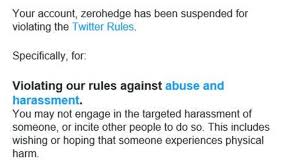
So much for the official version of what Twitter users—and non-Twitter users—can expect from those charged with policing Twitter.
Which leads to the question: Why hasn’t Twitter policed—and purged—the single greatest abuser of its “Twitter Rules”: Donald Trump?
Consider:
Donald Trump’s tweet-first-and-never-mind-the-consequences approach to life has been thoroughly documented.
From June 15, 2015, when he launched his Presidential campaign, until October 24, 2016, he fired nearly 4,000 angry, insulting tweets at 281 people and institutions. The New York Times needed two full pages of its print edition to showcase them.
Donald Trump
Among these targets were:
- His Democratic rival, Hillary Clinton
- His fellow Republican Presidential candidates
- Actress Meryl Streep
- News organizations
- President Barack Obama
- Comedian John Oliver
- Obamacare
- Singer Neil Young
- The state of New Jersey
- Actor Arnold Schwarzenegger.
His Twitter assaults have often dominated entire news cycles for days on end.
As President-elect, he continued these assaults—such as the one on November 18, 2016.
On that evening, Vice President-elect Mike Pence attended a Broadway performance of the hit musical “Hamilton.”
After the curtain call, the actor Brandon Victor Dixon—who plays Aaron Burr—respectfully addressed Pence:
“We are the diverse America who are alarmed and anxious that your new administration will not protect us, our friends, our children, our parents, or defend us and uphold our inalienable rights. But we truly hope that this show has inspired you to uphold our American values and to work on behalf of all of us.”

Brandon Victor Dixon
The Official Tony Awards Youtube Channel, CC BY 4.0 <https://creativecommons.org/licenses/by/4.0>, via Wikimedia Commons
Dixon—who is black—was rightly alarmed.
Trump had received the open and enthusiastic support of the Ku Klux Klan, American Nazi Party and other white supremacist groups. Since his election, white thugs had assaulted blacks and other non-whites across the country.
Trump’s reaction to Dixon’s plea came in two Twitter rants:
“Our wonderful future V.P. Mike Pence was harassed last night at the theater by the cast of Hamilton, cameras blazing. This should not happen!”
And: “The Theater must always be a safe and special place. The cast of Hamilton was very rude last night to a very good man, Mike Pence. Apologize!”
And during his first two weeks as President, Trump attacked 22 people, places and things on his @realDonaldTrump account.
Then, on March 4, 2017, in a series of unhinged tweets, Trump accused former President Barack Obama of tapping his Trump Tower phones prior to the election:
“Terrible! Just found out that Obama had my ‘wires tapped’ in Trump Tower just before the victory. Nothing found. This is McCarthyism!”
“Is it legal for a sitting President to be ‘wire tapping’ a race for president prior to an election? Turned down by court earlier. A NEW LOW!”
“I’d bet a good lawyer could make a great case out of the fact that President Obama was tapping my phones in October, just prior to Election!”
“How low has President Obama gone to tapp my phones during the very sacred election process. This is Nixon/Watergate. Bad (or sick) guy!”
Thus, without offering a shred of evidence to back it up, Trump accused his predecessor—on Twitter—of committing an impeachable offense.
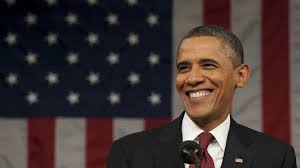
President Barack Obama
On May 9, 2017, Trump abruptly fired FBI Director James Comey.
Reports soon surfaced that his reason for doing so was that Comey had refused to pledge his personal loyalty to Trump.
Trump had made this “request” during a private dinner at the White House in January.
Another unpunished violation of Twitter’s Terms-of-Service was about to occur.
ABC NEWS, ALTERNET, ANCHOR BABIES, AP, BARACK OBAMA, BUZZFEED, CBS NEWS, CNN, CROOKS AND LIARS, DAILY KOZ, DONALD TRUMP, FACEBOOK, FBI, ILLEGAL ALIENS, illegal immigration, IMMIGRATION AND CUSTOMS ENFORCEMENT (ICE), JUSTICE DEPARTMENT, Kamala Harris, MEXICO, MICHELLE OBAMA, MOTHER JONES, MOVEON, NBC NEWS, NEWSWEEK, NPR, POLITICO, RACKETEER INFLUENCED CORRUPT ORGANIZATIONS ACT, RAW STORY, REUTERS, SALON, SAN FRANCISCO, sanctuary cities, SEATTLE TIMES, SLATE, THE ATLANTIC, THE CHICAGO SUN-TIMES, THE CHICAGO TRIBUNE, THE DAILY BEAST, THE GUARDIAN, THE HILL, THE HUFFINGTON POST, THE LOS ANGELES TIMES, THE NATION, THE NEW YORK TIMES, THE WALL STREET JOURNAL, THE WASHINGTON POST, TIME, TWITTER, U.S. NEWS & WORLD REPORT, U.S.-MEXICO WALL, UPI, USA TODAY, WAL-MART
In Bureaucracy, Business, History, Law, Law Enforcement, Politics, Social commentary on January 17, 2018 at 12:56 am
The Federal Government is heading for a shutdown by January 19.
A major reason for this is Presidential Donald Trump’s demand that Congress fund a massive, impenetrable wall along the U.S.-Mexican border.
Its purpose: To end illegal immigration from Mexico.
And Democrats—seeing this as an election-year issue—are totally opposed to the wall.
During his 2016 Presidential campaign, Trump repeatedly boasted: “I will build a great, great wall on our southern border, and I will make Mexico pay for that wall.”
But there are serious obstacles to erecting such a barrier:
- The United States/Mexican border stretches for 1,954 miles—and encompasses rivers, deserts and mountains.
- Environmental and engineering problems.
- Squabbles with ranchers who don’t want to give up any of their land.
- Building such a wall would cost untold billions of dollars.
- Drug traffickers and alien smugglers could easily tunnel under it into the United States—as they are now doing.
There are, in fact, cheaper and more effective remedies for combating illegal immigration.
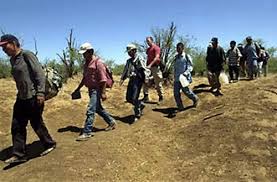
Illegal aliens crossing into the United States
(1) The Justice Department should vigorously attack the “sanctuary movement” that officially thwarts the immigration laws of the United States.
Among the 31 “sanctuary cities” of this country: Washington, D.C.; New York City; Los Angeles; Chicago; San Francisco; Santa Ana; San Diego; Salt Lake City; Phoenix; Dallas; Houston; Austin; Detroit; Jersey City; Minneapolis; Miami; Denver; Baltimore; Seattle; Portland, Oregon; New Haven, Connecticut; and Portland, Maine.
These cities have passed ordinances that ban municipal funds or resources from being used to enforce federal immigration laws. As a result, police or municipal employees are not allowed to inquire about citizens’ immigration status.
(2) Indict the highest-ranking officials of those cities who have actively violated Federal immigration laws.
In San Francisco, for example, former San Francisco District Attorney Kamala Harris—who is now California’s United States Senator—created a secret and illegal program called Back on Track, which provided training for jobs that illegal aliens could not legally hold.
(3) Even if some indicted officials escaped conviction, the results would prove worthwhile.
City officials would be forced to spend huge sums of their own money for attorneys and face months or even years of prosecution.
And this would send a devastating warning to officials in other “sanctuary cities” that the same fate lies in store for them.
(4) CEOs whose companies—like Wal-Mart—systematically employ illegal aliens should be held directly accountable for the actions of their subordinates.
They should be indicted by the Justice Department under the Racketeer Influenced Corrupt Organizations (RICO) Act, the way Mafia bosses are prosecuted for ordering their own subordinates to commit crimes.
Upon conviction, the CEO should be sentenced to a mandatory prison term of at least 20 years.
Convicting a score of CEOs would prove a more effective remedy for combating illegal immigration than stationing tens of thousands of soldiers on the U.S./Mexican border.
Word would quickly get around—and CEOs across the nation would take drastic steps to ensure that their companies strictly complied with Federal immigration laws.

(5) The Government should stop granting automatic citizenship to “anchor babies” born to illegal aliens in the United States.
A comparable practice would be allowing bank robbers who had eluded the FBI to keep their illegally-obtained loot.
A person who violates the bank robbery laws of the United States can be prosecuted for bank robbery, whether he’s immediately arrested or remains uncaught for years. The same should be true for those born illegally within this country.
If they’re not here legally at the time of birth, they should not be considered citizens and should—like their parents—be subject to deportation.
(6) The United States Government—from the President on down—should scrap its apologetic tone on the right to control its national borders.
In 2010, Michelle Obama visited New Hampshire Estates Elementary School in Silver Spring, Maryland.
A second-grader said: “My mom, she says that Barack Obama is taking everybody away that doesn’t have papers.”
“Yeah, well, that’s something that we have to work on right?” replied Mrs. Obama. “To make sure that people can be here with the right kind of papers, right?”
The girl then said: “But my mom doesn’t have any….”
Obama: “Well, we’ll have to work on that. We have to fix that, and everybody’s got to work together in Congress to make sure that happens.”
Mexico doesn’t consider itself racist for strictly enforcing its immigration laws. Neither should the United States.
(7) Voting materials and ballots should be published in one language: English.
In Mexico, voting materials are published in one language—Spanish.
Throughout the United States, millions of Mexican illegals refuse to learn English and yet demand that voting materials and ballots be made available to them in Spanish.
(8) The United States should impose economic and even military sanctions against countries—such as China and Mexico—whose citizens make up the bulk of illegal aliens.
Mexico, for example, uses its American border to rid itself of those who might demand major reforms in the country’s political and economic institutions.
Such nations must learn that dumping their unwanted’s on the United States now comes at an unfavorably high price. Otherwise those dumpings will continue.


 Bureaucracybuster's Blog
ABC NEWS, AIG, ALAN GREENSPAN, ALTERNET, AP, AYN RAND, BAILOUT PROGRAM, BUSINESS REGULATION, BUZZFEED, CALVIN COOLIDGE, CBS NEWS, CBSNEWS, CEOS, CNN, COLLEGE GRADUATES, CORPORATE BAILOUTS, CROOKS AND LIARS, DAILY KOZ, DRUG-TESTING, FACEBOOK, FBI, FINANCE, GREED, MOTHER JONES, MOVEON, NBC NEWS, NEWSWEEK, NPR, POLITICO, RAW STORY, REPUBLICANS, REUTERS, SALON, SEATTLE TIMES, SLATE, T.A.R.P. PROGRAM, TEA PARTY, THE ATLANTIC, THE CHICAGO SUN-TIMES, THE CHICAGO TRIBUNE, THE DAILY BEAST, THE GUARDIAN, THE HILL, THE HUFFINGTON POST, THE LOS ANGELES TIMES, THE NATION, THE NEW YORK TIMES, THE WASHINGTON POST, TIME, TIMOTHY GEITHNER, TREASURY DEPARTMENT, TWITTER, U.S. NEWS & WORLD REPORT, UNEMPLOYMENT, UPI, USA TODAY, WALL STREET, WELFARE
LOAN-TEST CEOS LIKE WELFARE APPLICANTS: PART ONE (OF TWO)
In Bureaucracy, Business, History, Law, Politics, Social commentary on April 3, 2018 at 12:13 amThe late Robert Benmosche, then CEO of American International Group (AIG), had some blunt advice to college graduates searching for work in a tight job market.
Robert Benmosche
“You have to accept the hand that’s been dealt you in life,” Benmosche said in a 2013 interview on Bloomberg Television. “Don’t cry about it. Deal with it.”
Typical advice from a one-percenter whose company, AIG, suffered a liquidity crisis when its credit ratings were downgraded below “AA” levels in September, 2008.
So how did AIG “deal with” its own crisis? It went crying to its Uncle Sugar, the United States Government, for a bailout.
Which it promptly got.
The United States Federal Reserve Bank, on September 16, 2008, made an $85 billion loan to AIG to meet increased collateral obligations resulting from its credit rating downgrade–and thus saving it from certain bankruptcy.
In return, the Government took an 80% stake in the firm.
(The bailout eventually ballooned to $182 billion in exchange for a 92% stake.)
College graduates, said Benmosche, needed to seize the opportunities that become available to them, even if their options are limited.
“They want me to talk to the students and give them a sense of encouragement, especially with the high unemployment,” said Benmosche.
“My advice will be, ‘Whatever opportunity comes your way, take it. Take it and treat it as if it’s the only one that’s coming your way, because that actually may be the truth.’”
Yes, if you have the opportunity to cry yourself into a multi-billion dollar loan from the Federal Government, by all means, do so.
Of course, willing-to-work college graduates who can’t find willing-to-hire employers won’t be able to count on a generous bailout from the Federal Government.
To which most of them will owe hundreds of thousands of dollars in student loans.
It’s long past time to apply to “untouchable” CEOs like Robert Benmosche the same criteria that Right-wing Republicans demand be applied to welfare recipients.
Republican lawmakers have vigorously pursued welfare drug-testing in Congress and more than 30 states.
Some bills have even targeted people who claim unemployment insurance and food stamps, despite scanty evidence the poor and jobless are disproportionately on drugs.
The concept of background screening is actually sound. But Republicans are aiming it at the wrong end of the economic spectrum.
Since 2008, the government has handed out billions of dollars in bailouts to the wealthiest corporations in the country.
The reason: To rescue the economy from the calamity produced by the criminal greed and recklessness of those same corporations.
For example:
According to the Special Inspector General for the TARP bailout, the total commitment of government is $16.8 trillion dollars with the $4.6 trillion already paid out.
And it’s equally important to remember that welfare recipients did not:
The 2010 documentary Inside Job chronicles the events leading to the 2008 global financial crisis. One of its most insightful moments occurs at a party held by then-Treasury Secretary Henry Paulson.
“We can’t control our greed,” the CEO of a large bank admits to his fellow guests. “You should regulate us more.”
Greed is defined as an excessive desire for wealth or goods. At its worst, greed trumps rationality, judgment and concern about the damage it may cause.
Greed begins in the neurochemistry of the brain. A neurotransmitter called dopamine fuels our greed. The higher the dopamine levels in the brain, the greater the pleasure we experience.
Cocaine, for example, directly increases dopamine levels. So does money.
Harvard researcher Hans Breiter has found, via magnetic resonance imaging studies, that the craving for money activates the same regions of the brain as the lust for sex, cocaine or any other pleasure-inducer.
Dopamine is most reliably activated by an experience we haven’t had before. We crave recreating that experience.
But snorting the same amount of cocaine, or earning the same sum of money, does not cause dopamine levels to increase. So the pleasure-seeker must increase the amount of stimuli to keep enjoying the euphoria.
In time, this incessant craving for pleasure becomes an addiction. And feeding that addiction–-with ever more money–becomes the overriding goal.
Thus, the infamous line—”Greed is good”—in the 1987 film, Wall Street, turns out to be both false and deadly for all concerned.
But the situation need not remain this way.
Share this: