Archive for the ‘Business’ Category
ABC NEWS, ADOLF HITLER, ALTERNET, AP, BUZZFEED, CBS NEWS, CNN, CROOKS AND LIARS, DAILY KOZ, DAVID BROOKS, DEMOCRATS, DONALD TRUMP, FACEBOOK, HOUSE OF REPRESENTATIVES, HOUSE OVERSIGHT COMMITTEE, JACKIE SPEIER, JIM JORDAN, JIMMY CARTER, MARK SHIELDS, MICHAEL COHEN, MOTHER JONES, MOVEON, MSNBC, NBC NEWS, NEWSWEEK, NPR, PBS NEWSHOUR, POLITICO, RAW STORY, REPUBLICANS, REUTERS, RICHARD NIXON, ROBERT MUELLER, SALON, SEATTLE TIMES, SLATE, STORMY DANIELS, THE ATLANTIC, THE CHICAGO SUN-TIMES, THE CHICAGO TRIBUNE, THE DAILY BEAST, THE GUARDIAN, THE HILL, THE HUFFINGTON POST, THE LOS ANGELES TIMES, THE NATION, THE NEW YORK TIMES, THE PBS NEWSHOUR, THE WASHINGTON POST, TIME, TWITTER, U.S. NEWS & WORLD REPORT, UNITED STATES SENATE, UPI, USA TODAY
In Bureaucracy, Business, History, Politics, Social commentary on March 5, 2019 at 12:16 am
“Just another week in Caligula’s Rome.”
That was how conservative New York Times columnist David Brooks summed up President Donald Trump’s Washington, D.C. for the week of February 24 to March 1, 2019.
Every Friday Books faces off with liberal syndicated columnist Mark Shields on The PBS Newshour. And on the program for March 1, the two men found common cause in sizing up the appearance of Michael Cohen before the House Oversight Committee two days earlier.
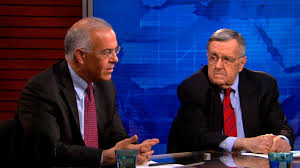
David Brooks and Mark Shields on “The PBS Newshour”
During that hearing, Cohen, Trump’s longtime attorney and fixer:
- Condemned his former boss as “a racist, a conman [and] a cheat.”
- Confirmed that Trump had instructed him to pay $130,000 in hush money to porn “star” Stormy Daniels, to buy her silence during the 2016 Presidential campaign.
- Provided the committee with a copy of a check Trump wrote from his personal bank account—after he became President—“to reimburse me for the hush money payments I made.”
- Produced “copies of letters I wrote at Mr. Trump’s direction that threatened his high school, colleges, and the College Board not to release his grades or SAT scores.”
But for Brooks, far more was at stake than the individual accusations:
“To me, it was more of a moral occasion, more than anything else. What it illustrates is a President and, frankly, Michael Cohen who long ago decided that celebrity and wealth is more important than being a good person. And they have dragged us all down there with us.
“And the people they have dragged most effectively are the House Republicans, a lot of them on that committee, who decided that they were completely incurious about whether Donald Trump was a good guy or a bad guy or a really awful guy, that—their own leader, they didn’t seem to care about that, but they were going to rip the skin off Michael Cohen.
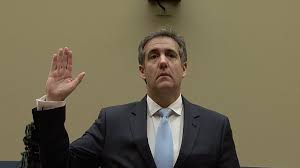
Michael Cohen testifying before Congress
“And so they attacked him. And what struck me is how moral corrosion happens, that you decide you’re going to defend or ignore Trump. And then to do that, you have to morally distance yourself from him. And then you have to morally distance yourself from him every day.
“And, eventually, you just get numb to everything. And so [Ohio Republican Representative] Jim Jordan and other people on the committee were saying, oh, we all knew this, like, it’s all unremarkable. And so that’s—that’s how moral corrosion happens.”
During the hearing, California Representative Jackie Speier asked Cohen: How many times did Trump ask you to intimidate creditors?
Cohen estimated the number at 500.
For Shields, this counted as especially despicable behavior: “And—but the thing about it is, when he stiffed those small business—the plumbers and the electricians who did the work in the Trump projects, and he came back, and Donald Trump loved to hear about it, I mean, reveled in it.
“Now, I mean, at what point do you say that there’s no honor here? I mean, there’s nothing to admire.”
Shields was equally appalled by the refusal of Trump’s Republican committee defenders to condemn his moral depravity—as a businessman or President.
“If you can’t deal with the message, you shoot the messenger. And that’s what their whole strategy was.
“The very fact that not a single member of the Republican committee defended Donald Trump or what he was charged or alleged to have done, to me, was revealing. They just decided to go after Michael Cohen.”
So why have Republicans aligned themselves with such a man?
Republicans don’t fear that Trump will trash the institutions that Americans have cherished for more than 200 years. Institutions like an independent judiciary, a free press, and an incorruptible Justice Department.
He has already attacked all of these—and Republicans have either said nothing or rushed to his defense.
What Republicans truly fear about Donald Trump is that he will finally cross one line too many—like firing Special Counsel Robert Mueller. And that the national outrage following this will force them to launch impeachment proceedings against him.
But it isn’t even Trump they fear will be destroyed.
What they most fear losing is their own hold on nearly absolute power in Congress and the White House. And the riches that go with it.
If Trump is impeached and possibly indicted, he will become a man no one any longer fears. He will be a figure held up to ridicule and condemnation.
Like Adolf Hitler.
Like Richard Nixon.
And his supporters will be branded as losers along with him.
Republicans vividly remember what happened after Nixon was forced to resign on August 9, 1974: Democrats, riding a wave of reform fever, swept Republicans out of the House and Senate—and Jimmy Carter into the White House.
House and Senate Republicans can imagine a future without Trump—but not one where they disappear.
If they are conflicted—whether to continue supporting Trump or desert him—the reason is the same: How can I hold onto my power and all the privileges that go with it?
ABC NEWS, ALTERNET, AP, BARACK OBAMA, BLACKS, BUZZFEED, C-SPAN, CBS NEWS, CNN, CROOKS AND LIARS, DAILY KOZ, DONALD TRUMP, FACEBOOK, FOX NETWORK, FOX NEWS, HILLARY CLINTON, MEDIA, MEGYN KELLY, MEXICANS, MICHELLE WOLF, MIKE TYSON, MOTHER JONES, MOVEON, MSNBC, NBC NEWS, NEWSPAPERS, NEWSWEEK, NPR, PLANNED PARENTHOOD, POLITICO, RAW STORY, REPUBLICAN PARTY, REUTERS, RICK WILSON, RUSSIA, SALON, SARAH HUCKABEE SANDERS, SEAN HANNITY, SEATTLE TIMES, SLATE, THE ATLANTIC, THE CHICAGO SUN-TIMES, THE CHICAGO TRIBUNE, THE DAILY BEAST, THE GUARDIAN, THE HILL, THE HUFFINGTON POST, THE LOS ANGELES TIMES, THE NATION, THE NEW YORK TIMES, THE WASHINGTON POST, TIME, TWITTER, U.S. NEWS & WORLD REPORT, UPI, USA TODAY, USA TODAY DONALD TRUMP, USA TODAY SARAH HUCKABEE SANDERS, WHITE HOUSE CORRESPONDENTS DINNER
In Bureaucracy, Business, History, Politics, Social commentary on February 8, 2019 at 12:16 am
On April 28, 2018, comedian Michelle Wolf skewered high-ranking Trump administration officials and members of the nation’s elite media.
She did so as the host of the annual White House Correspondents Dinner in Washington, D.C.
As a result, she found herself furiously attacked by Right-wing defenders of the Trump administration and some of the nation’s most prominent media.
Most all of their attention was focused on the Trump officials she ridiculed—especially Press Secretary Sarah Huckabee Sanders.

Michelle Wolf
But Wolf threw a series of sharp-edged zingers at some of the Nation’s most prominent media. And these comments have gone largely ignored.
They are, however, well worth examining—for the uncomfortable truths they reveal about much of the news being served up under the guise of fearless objectivity.
On little-watched C-SPAN: This is on C-SPAN; no one watches that. Trump is president; it’s not ideal.
On liberal media’s obsession with “Russiagate”: I know there’s a lot of people that want me to talk about Russia and Putin and collusion, but I’m not going to do that because there’s also a lot of liberal media here. And I’ve never really wanted to know what any of you look like when you orgasm.
On CNN—where “news” now consists of a series of “talking heads” pontificating about stories that other journalists have dug up: We’ve got our friends at CNN here. You guys love breaking news, and you did it. You broke it. Good work. The most useful information on CNN is when Anthony Bourdain tells me where to eat noodles.
On Fox News’ sexual harassment scandals involving such prominent (and former) members as CEO Roger Ailes and commentator Bill O’Reilly: Fox News is here. So, you know what that means, ladies: Cover your drinks. Seriously.
On Fox News’ actual role as the propaganda organ of the Republican party: People want me to make fun of [Fox News commentator] Sean Hannity tonight, but I cannot do that; this dinner is for journalists.
On weak-rated MSNBC, which is the liberal version of Fox News: We’ve got MSNBC here. MSNBC’s news slogan is, “This is who we are.” Guys, it’s not a good slogan. “This is who we are” is what your mom thinks the sad show on NBC is called. “Did you watch ‘This Is Who We Are’ this week? Someone left on a Crockpot, and everyone died.”
On Megyn Kelly, who rose to fame and fortune as a Right-wing propaganda shill on Fox News: And, of course, Megyn Kelly. What would I do without Megyn Kelly? You know, probably be more proud of women.
And, by the way, Megyn, Santa’s black. The weird old guy going through your chimney was Bill O’Reilly. You might want to put a flue on it or something.
[This last jibe centered on Kelly’s infamous December 11, 2013 Fox broadcast where she claimed: “I kind of laughed and said this is so ridiculous. Yet another person claiming it’s racist to have a white Santa. For all you kids watching at home, Santa just is white….Just because it makes you uncomfortable doesn’t mean it has to change. Jesus was a white man too.”]
On the continuing demise of newspapers—on which TV “news reporters” depend for their information: There’s a lot of print media here. There’s a ton of you guys, but I’m not going to go after print media tonight because it’s illegal to attack an endangered species. Buy newspapers.
On the media’s—especially the television media’s—morbid obsession with Donald Trump: There’s a ton of news right now; a lot is going on, and we have all these 24-hour news networks, and we could be covering everything. But, instead, we’re covering like three topics. Every hour, it’s Trump, Russia, Hillary and a panel of four people who remind you why you don’t go home for Thanksgiving.
On the media’s responsibility for the rise of a President they now detest: You guys are obsessed with Trump. Did you used to date him? Because you pretend like you hate him, but I think you love him. I think what no one in this room wants to admit is that Trump has helped all of you. He couldn’t sell steaks or vodka or water or college or ties or Eric, but he has helped you.
He’s helped you sell your papers and your books and your TV. You helped create this monster, and now you’re profiting off of him. And if you’re gonna profit off of Trump, you should at least give him some money because he doesn’t have any.
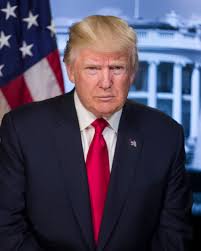
Donald Trump
[This last joke was probably the most painful the assembled media bigwigs had to endure. Because it’s undeniably true.
Trump’s campaign was saved from spending millions on TV advertising because the major TV news networks covered his every word. This was especially true when he was attacking women, blacks, Mexicans, Hillary Clinton, Barack Obama—and even beauty pageant contestants.
For the media, Trump was “good for ratings”—in the same way that Mike Tyson was “good for boxing.” Both were seen as freaks—and thus guaranteed to lure viewers eager to find out: “What outrageous thing has he done now?”]
1984 NOVEL, ABC NEWS, ALTERNET, AP, BUZZFEED, CBS NEWS, CHRISTMAS, CNN, COMMERCIALISM, CROOKS AND LIARS, DAILY KOZ, DONALD TRUMP, EASTASIA, EURASIA, FACEBOOK, FOX NEWS, GEORGE ORWELL, JESUS, MEGYN KELLY, MOTHER JONES, MOVEON, MSNBC, NBC NEWS, NEWSWEEK, NPR, OCEANIA, PBS NEWSHOUR, POLITICO, RAW STORY, REUTERS, ROMAN EMPIRE, RUPERT MURDOCH, SALON, SANTA CLAUS, SATURNALIA, SEATTLE TIMES, SLATE, STARBUCK'S, THE ATLANTIC, THE CHICAGO SUN-TIMES, THE CHICAGO TRIBUNE, THE DAILY BEAST, THE GUARDIAN, THE HILL, THE HUFFINGTON POST, THE LOS ANGELES TIMES, THE NATION, THE NEW YORK TIMES, THE WASHINGTON POST, TIME, TWITTER, U.S. NEWS & WORLD REPORT, UPI, USA TODAY, WAR ON CHRISTMAS
In Bureaucracy, Business, History, Politics, Social commentary on November 20, 2018 at 12:17 am
It’s that time of year again—a time of
- Christmas trees
- Nativity scenes
- Singing carols
- Exchanging gifts with family and friends.
Christmas is special, so, each year, the executives at Fox News find a new way to stir up emotions by resurrecting the “war on Christmas” slander.
Stirring up false controversies is a daily assignment for the alleged reporters of this company owned by Right-wing oligarch Rupert Murdoch.
On December 11, 2013, it fell to Fox hostess Megyn Kelly to carry the ball—on “The Kelly File,” her then-popular Fox News program.

Megyn Kelly
Referring to an article by Slate writer Aisha Harris on “Santa Claus Should Not Be a White Man Anymore,” she said:
“When I saw this headline, I kinda laughed and I said, ‘Oh, this is ridiculous. Yet another person claiming it’s racist to have a white Santa.’
“And by the way, for all you kids watching at home, Santa just is white. But this person is maybe just arguing that we should also have a black Santa. But, you know, Santa is what he is, and just so you know, we’re just debating this because someone wrote about it, kids.”
Of course, Santa Claus is a completely fictional character. Arguing about his skin color is as pointless as arguing about his weight.
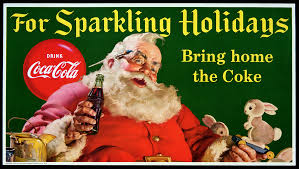
But Kelly wasn’t content to talk only about Santa. So she turned next to Jesus, a historical figure about whom we have not a single reference to his appearance, let alone a picture.
“Just because it makes you feel uncomfortable doesn’t mean it has to change. You know, I mean, Jesus was a white man, too.
“He was a historical figure; that’s a verifiable fact—as is Santa, I want you kids watching to know that—but my point is: How do you revise it, in the middle of the legacy of the story, and change Santa from white to black?”
Santa Claus a verifiable historical figure? Not even Charlie Brown, in the annually telecast “Peanuts” Christmas special, would make that claim.
In 2015, Donald Trump claimed center-stage in “defending” Christmas. And the target of his ire? Starbucks.
In years past, its disposable coffee cups featured snowflakes, winter scenes, reindeer and Christmas ornaments.
But in 2015, Starbucks decided to go with a minimalist, all-red design, its only feature being the company’s green and white logo.
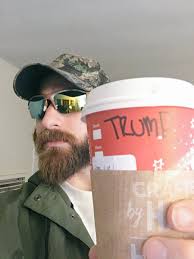
Baked Alaska with his Trump cup
This angered some religious conservatives, who generally care more about symbols than substance. And Trump was eager to enlist evangelicals as voters.
During a campaign rally in October, Trump promised: “I guarantee if I become president, we’re going to be saying ‘Merry Christmas’ at every store.”
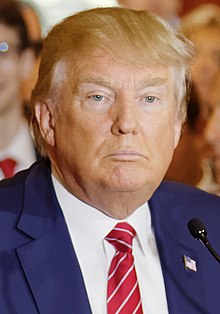
Donald Trump
On November 9, 2015, addressing a crowd of several thousands in Springfield, Illinois, Trump said: “Did you read about Starbucks? No more Merry Christmas on Starbucks.
“I have one of the most successful Starbucks, in Trump Tower. Maybe we should boycott Starbucks? I don’t know. Seriously, I don’t care. That’s the end of that lease, but who cares?
“If I become president, we’re all going to be saying Merry Christmas again, that I can tell you.”
Trump did not explain how he would coerce non-Christian Americans—-such as atheists, Jews and Muslims—into observing a Christian holiday.
Those who claim that Christmas is threatened don’t know—or are ignoring—-the following:
- The Christmas shopping season can start as early as September. Some consumers begin even earlier.
- For 2018, the National Retail Federation expects consumers to spend $717.45 billion to $720.89 billion for the holiday season.
- Holiday sales in 2017 totaled $687.87 billion.
- For many stores, holiday shopping accounts for nearly a third of annual sales.
- In 2016, the average American spent $935.58 on holiday gifts. In 2017, s/he was expected to spend $708.81.
In short, no one is “making war” on Christmas—-except Right-wing broadcasters at Fox News to jack up ratings.
As to the historical realities of this season:
- There is no reference anywhere in the Bible to the month—-let alone the day—of Jesus’ birth.
- Jesus never commanded his followers to celebrate his birth—-but he did call on them to remember his death. It’s called Easter.
- Many of the “religious” traditions associated with Christmas stem from the pagan Roman festival, Saturnalia, which celebrated the “birthday” of the sun.
- This was celebrated December 17-25.
- Saturnalia traditions included feasting, gift-giving, lighting candles (to ward off evil spirits) and displaying wreaths (as a sign of coming spring).
- Early Christians tried mightily to convince their members to stop celebrating the Saturnalia.
- When these efforts failed, the Roman Catholic Church, in the fourth century, “Christianised” the festival by naming Saturnalia’s concluding day, December 25, as Jesus’ birthday.
In George Orwell’s classic novel, 1984, Oceania is always at war with Eurasia or Eastasia. Its citizens are kept in a constant state of frenzy as they’re directed to search for endless “enemies of the state.”
This, in turn, allows the unseen rulers of Oceania to run their dictatorship without interference.
It’s a lesson well-known to hucksters like Donald Trump and the men who run Fox News.
2016 PRESIDENTIAL ELECTION, ABC NEWS, ALTERNET, AP, BERNIE SANDERS, BRETT KAVANAUGH, BUZZFEED, CBS NEWS, CHRISTINE BLASEY FORD, CNN, CROOKS AND LIARS, DAILY KOZ, DEMOCRATIC NATIONAL COMMITTEE, DONALD TRUMP, FACEBOOK, HILLARY CLINTON, IVANKA TRUMP, JAMAL KHASHOGGI, MARCO RUBIO, MOHAMMED BIN SALMAN, MOTHER JONES, MOVEON, MSNBC, NBC NEWS, NEWSWEEK, NPR, PBS NEWSHOUR, POLITICO, RAW STORY, REPUBLICANS, REUTERS, SALON, SAUDI ARABIA, SEATTLE TIMES, SLATE, THE ATLANTIC, THE CHICAGO SUN-TIMES, THE CHICAGO TRIBUNE, THE DAILY BEAST, THE GUARDIAN, THE HILL, THE HUFFINGTON POST, THE LOS ANGELES TIMES, THE NATION, THE NEW YORK TIMES, THE WASHINGTON POST, TIME, TRUMP WORLD TOWER, TURKEY, TWITTER, U.S. NEWS & WORLD REPORT, UNITED STATES SUPREME COURT, UPI, USA TODAY
In Bureaucracy, Business, History, Law Enforcement, Military, Politics, Social commentary on October 18, 2018 at 12:03 am
Once again, the self-righteous cry of “American exceptionalism” is being taken up by members of the United States Congress.
That is: Americans prize morality over money in international relationships.
It’s a myth the historical record won’t support.
The reason for the self-righteous outrage: The disappearance of Saudi dissident Jamal Khashoggi.
He had worked in the Saudi embassies in Washington and London, establishing himself as an unofficial spokesman for the Saudi royal family.
His independent streak and empathy for the Western perspective made him a uniquely important, well-liked contact for foreign journalists and diplomats seeking to understand the royal perspective.
Then, in 2017, Mohammed bin Salman became crown prince, and quickly consolidated power over the kingdom.
Khashoggi’s independent streak made him unwelcome there, so he moved to Virginia and became a columnist for The Washington Post. He also became the crown prince’s chief critic in the West.
On October 2, Khashoggi walked into the Saudi Consulate in Istanbul to pick up a document.
Khashoggi’s marriage had ended under the strain of his voluntary exile from Saudi Arabia. He had since become engaged to a Turkish woman. He thus needed to obtain a document attesting to his divorce from the Saudi authorities so he could remarry in Turkey. The wedding was scheduled for the following day.

Jamal Khashoggi
[GFDL (http://www.gnu.org/copyleft/fdl.html)%5D, via Wikimedia Commons
Turkish authorities have released video footage of Khashoggi walking into the consulate; they say there is none of him leaving it. The Saudis insist that he left the consulate safely, but have not offered any evidence to support this claim.
Turkish officials speaking anonymously say their government has detailed evidence to prove the following:
- That 15 Saudi agents flew into Istanbul on two private jets.
- The airline company has close ties to the crown prince and Saudi Interior Ministry.
- The agents waited for Khashoggi inside the consulate and murdered him within two hours of his arrival.
- The assassins used a bone saw to dismember Khashoggi’s corpse.
These reports have ignited an explosion of “American exceptionalism” among members of Congress—including Republicans.
“I believe the Trump administration will do something,” Florida United States Senator Marco Rubio said. “The president has said that. But, if he doesn’t, Congress will. That, I can tell you with 100 percent certainty.”
And Vermont Senator Bernie Sanders said: “I think one of the strong things that we can do is not only stop military sales, not only put sanctions on Saudi Arabia, but most importantly, get out of this terrible, terrible war in Yemen led by the Saudis.”
Fueling Republicans’ declared outrage: President Donald Trump’s heated defense of the Saudis—with whom he’s long had a financially profitable relationship.
“They buy all sorts of my stuff,”‘ Trump said in July 2015. “All kinds of toys from Trump. They pay me millions and hundreds of millions.”
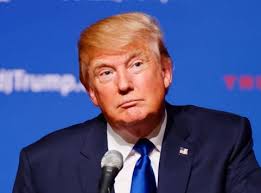
Donald Trump
Among those “toys”:
- In June 2001, he sold the 45th floor of Trump World Tower to the Kingdom of Saudi Arabia for $4.5 million, according to a publicly filed deed for the transaction.
- In August 2015, two months after he launched his presidential campaign, Trump registered eight limited-liability companies that appeared tied to possible deals in the country, according to public records. All of the companies contained “Jeddah,” the name of a Saudi Arabian port city, in their title.
- In 2015, Trump’s daughter Ivanka told Hotelier Middle East, “Dubai is a top priority city for us. We are looking at multiple opportunities in Abu Dhabi, in Qatar, in Saudi Arabia, so those are the four areas where we are seeing the most interest. We haven’t made a final decision in any of the markets but we have many very compelling deals in each of them.”
Of course, Trump is now claiming a higher motive for siding with the Saudis. He doesn’t want to scuttle a major defense deal he made with Saudi Arabia in May, 2017:
“I don’t like the concept of stopping an investment of $110 billion into the United States because you know what they’re going to do, they’re going to take that money and spend it in Russia or China,”
And the next day, Trump said he had spoken with Saudi King Salman: “The king firmly denied any knowledge of it. … It sounded to me like these could have been rogue killers, who knows?”
This is comparable to Trump’s refusal, during his first debate with Hillary Clinton in September, 2016, to admit Russian hacking of the 2016 Democratic National Committee: “It could be Russia, but it could also be China. It could also be lots of other people. It also could be somebody sitting on their bed that weighs 400 pounds.”
“Here we go again with you know you’re guilty until proven innocent. I don’t like that,” said Trump on October 16.
“We just went through that with [Supreme Court nominee] [Brett] Kavanaugh and he was innocent all the way as far as I’m concerned.”
Factual note: Although confirmed as a Supreme Court Justice, Kavanaugh was not proven innocent. The FBI was not allowed to interview Kavanaugh and Christine Blasey Ford, the woman who accused him of attempted rape 36 years ago.
2001 TERROR ATTACKS, 9/11 ATTACKS, 9/11 TERRORIST ATTACKS, ABC NEWS, AIRPORT SECURITY, ALTERNET, AP, BIRTH CERTIFICATES, BUZZFEED, CBS NEWS, CNN, CROOKS AND LIARS, DAILY KOZ, DEPARTMENT OF HOMELAND SECURITY, DEPARTMENT OF MOTOR VEHICLES, DRIVER'S LICENSES, FACEBOOK, FBI, IDENTIFICATION, JOHN DILLINGER, MOHAMMED ATTA, MOTHER JONES, MOVEON, MSNBC, NATIONAL GUARD, NBC NEWS, NEWSWEEK, NPR, OSAMA BIN LADEN, PASSPORTS, PBS NEWSHOUR, POLITICO, RAW STORY, REAL ID ACT, REUTERS, SALON, SAN FRANCISCO FEDERAL BUILDING, SEATTLE TIMES, SECURITY THEATER, SLATE, SOCIAL SECURITY CARD, TERRORISM, THE ATLANTIC, THE CHICAGO SUN-TIMES, THE CHICAGO TRIBUNE, THE DAILY BEAST, THE GUARDIAN, THE HILL, THE HUFFINGTON POST, THE LOS ANGELES TIMES, THE NATION, THE NEW YORK TIMES, THE WASHINGTON POST, THEODORE BUNDY, TIME, TRANSPORTATION SECURITY ADMINISTRATION, TWITTER, U.S. NEWS & WORLD REPORT, UPI, USA TODAY, WORLD TRADE CENTER
In Bureaucracy, Business, History, Law, Law Enforcement, Military, Politics, Social commentary on October 5, 2018 at 12:11 am
Starting in 2016, traveling by air in the United States got more complicated. But not necessarily safer.
In 2005, Congress passed the Real ID Act as a counter-terrorism measure. Its goal was to set security standards for government-issued IDs.
The Act started to be introduced in late 2013. Now in the last phase of its implementation, its enforcers have decided that some states haven’t complied with its requirements.
As a result, driver’s licenses from those states will no longer suffice to pass through airport security. And that includes domestic flights as well as international ones.
Those states: New York, New Hampshire, Minnesota, Louisiana and American Samoa.
The reason: Licenses issued by those states don’t contain enough identifying information to pass muster with the Transportation Security Administration (TSA).

So how are residents of these states supposed to cope? The Federal Government is advising them to get a passport.
But, as one New York traveler outlined:
“To get a passport I’ll first need to get a certified copy of my birth certificate.
“And to get a copy of my birth certificate I need only to submit a copy of my driver’s license. A copy, no face-to-face, is-that-really you?
“So a New York driver’s license isn’t good enough for flying but it is good enough to get a birth certificate, which gets me a passport, which allows me to fly.”
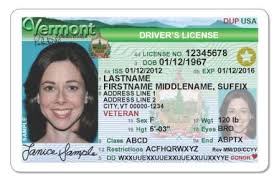
Sample state ID card that’s acceptable under the Real ID Act
So much of what passes for security is actually security theater. It doesn’t actually make us safer, but it makes us feel safer.
And it makes us feel the government is keeping us safe, even when it isn’t.
For example: In the months after 9/11, National Guard troops were stationed in American airports. They certainly looked impressive.
What passengers didn’t know was that the Guardsmen carried unloaded assault rifles.
Consider this advice posted on the State of California Department of Motor Vehicles website:
“A valid California driver license or ID card can be used for federal purposes, including boarding a domestic flight and entering military bases or secure federal facilities, until October 1, 2020. After that date, only a REAL ID card or other federally approved documents will be accepted, such as a valid U.S. passport, passport card or military ID.”
To apply for a REAL ID card:
- Make an appointment (recommended) to visit a DMV field office.
- Provide proof of identity, such as a certified copy of a U.S. birth certificate, U.S. passport, employment authorization document, permanent resident card or foreign passport with an approved form I-94.
- Present proof of your Social Security number, such as an SSN card, W-2 or paystub with full SSN.
- Show a California residency document, such as a rental or lease agreement, mortgage bill, utility bill or employment, medical or school document.
- An original or certified copy of a name change document, such as a marriage certificate or divorce decree, may be required.
How does showing a “utility bill” document prove your integrity?
No doubt Mohammed Atta—the ringleader of the September 11, 2001 attacks—faithfully paid his utility bills—right up to the day when he highjacked American Airlines Flight 11 and crashed the plane into the North Tower of the World Trade Center.
And what does a “school document” reveal about the character of the person?
That s/he attended school? So what?
Theodore Bundy attended the University of Puget Sound and the University of Washington—before embarking on his career as a burglar, kidnapper, rapist and serial killer.
Or take the checking of photo IDs that has become routine to enter State and Federal office buildings.
What exactly does this tell the security guard?
If you’re John Dillinger or Osama bin Laden, it tells him: “This is a very wanted man.”
But if you’re John Q. Public, who’s not notorious as a bank robber or terrorist, showing him your ID tells him nothing.
But people watching the guard performing this security theater ritual assume: “The guard must know what he’s looking for. So we have to be safer for his checking those IDs.”
In fact, most security guards have little training and even less experience. Many of them don’t carry firearms and lack self-defense skills.
According to Salary.com: The median annual Security Guard salary is $29,204, as of July 29, 2016, with a range usually between $25,857 and $33,522.
Not exactly a salary geared to attract “the best and the brightest,” is it?
Or suppose you want to report a crime to a field office of the FBI.
A secretary asks why you’ve come.
If she considers your reason legitimate, she requires you to show your driver’s license or State ID card. Then she makes a xerox of this and hands the card back.
Then you must fill out a single-page form, which requires you to provide your:
- Name
- Address
- Phone number
- Social Security Number
- Reason to speak with an FBI agent
The FBI has always encouraged Americans to report anything they consider a threat to national security or a violation of Federal law.
But demanding so much private information just to report a crime will almost certainly decrease the number of people willing to do so.
2016 PRESIDENTIAL CAMPAIGN, ABC NEWS, ALTERNET, AMERICAN REVOLUTION, AP, BARACK OBAMA, BUREAU OF LABOR STATISTICS, BUZZFEED, CALVIN COOLIDGE, CBS NEWS, CELINDA LAKE, CHINA, CHRIS MATTHEWS, CNN, CROOKS AND LIARS, DAILY KOZ, DIVINE RIGHT OF KINGS THEORY, DONALD TRUMP, EMANCIPATION PROCLAMATION, EMPLOYERS RESPONSIBILITY ACT, EMPLOYMENT ACT OF 1946, FACEBOOK, HARDBALL, HILLARY CLINTON, JOB CREATORS, JOHN F. KENNEDY, LOS ANGELES TIMES, LYNDON B. JOHNSON, MOTHER JONES, MOVEON, MSNBC, NBC NEWS, NEW YORK TIMES, NEWSWEEK, NPR, PBS NEWSHOUR, PETER CAPPELLI, POLITICO, RAW STORY, READERS DIGEST, REPUBLICANS, REUTERS, ROBERT REICH, SALON, SEATTLE TIMES, SENATOR BERNIE SANDERS, SLATE, SLAVERY, STEVE POIZNER, THE ATLANTIC, THE CHICAGO SUN-TIMES, THE CHICAGO TRIBUNE, THE DAILY BEAST, THE GUARDIAN, THE HILL, THE HUFFINGTON POST, THE LOS ANGELES TIMES, THE NATION, THE NEW YORK TIMES, THE RACHEL MADDOW SHOW, THE WASHINGTON POST, TIME, TOMMY G. THOMPSON, TWITTER, U.S. NEWS & WORLD REPORT, UNEMPLOYMENT, UPI, USA TODAY, WALLACE C. PETERSON, WASHINGTON POST, WHY GOOD PEOPLE CAN'T FIND JOBS
In Bureaucracy, Business, History, Law, Law Enforcement, Politics, Social commentary on September 13, 2018 at 12:07 am
Have you noticed how every American employer has suddenly become a “job creator”?
At least, that’s the official Republican line.
But if that’s true:
- Why are so many employers not hiring at all?
- Or, if they are hiring, why aren’t they hiring American workers?
- Why are they hiring mostly part-time employees on a no-benefits basis?
- Why are so many employers shutting down American plants but starting new ones in China, Mexico or the Philippines?
According to an August, 2018 news release by the Bureau of Labor Statistics, U.S. Department of Labor:
- The unemployment rate stood at 3.9 percent in August, 2018, and the number of unemployed persons stood at 6.2 million.
- The unemployment rates stood at the following for:
- Adult men: (3.5 percent)
- Adult women (3.6 percent)
- Teenagers (12.8 percent
- Whites (3.4 percent
- Blacks (6.3 percent)
- Asians (3.0 percent)
- Hispanics (4.7 percent)
- The number of long-term unemployed (those jobless for 27 weeks or more) was little changed in August at 1.3 million and accounted for 21.5 percent of the unemployed. Over the year, the number of long-term unemployed has declined by 403,000.
- The number of persons employed part time for economic reasons (sometimes referred to as involuntary part-time workers), at 4.4 million.
-
Among the marginally attached, there were 1.4 million discouraged workers. These individuals were not in the labor force, wanted and were available for work, and had looked for a job sometime in the prior 12 months.
-
Among the marginally attached, there were 434,000 discouraged workers in August, essentially unchanged from a year earlier. Discouraged workers are persons not currently looking for work because they believe no jobs are available for them.
At the same time, U.S. corporations sit on at least $2 trillion in cash.
Besides lying beyond the reach of the IRS, those monies could be used to hire those millions of qualified, willing-to-work Americans who can’t find fulltime, permanent employment.
An article in the March, 2011 issue of Reader’s Digest gives the lie to the excuses so many employers use for refusing to hire.
Entitled “22 Secrets HR Won’t Tell You About Getting a Job,” it lays bare many of the reasons why America needs to legally force employers to demonstrate as much responsibility for hiring as job-seekers are expected to show toward searching for work.
Among the truths it reveals:
TRUTH NO: 1: After you’re unemployed more than six months, employers consider you unemployable.
TRUTH NO. 2: It’s not what but who you know that counts.
TRUTH NO. 3: Try to avoid HR. Find someone in the company you know. If you don’t know anyone, contact the hiring manager.
TRUTH NO. 4: Cover letters are often ignored, going directly into “the round file.”
TRUTH NO. 5: Employers judge you on the basis of your email address. Avoid the type that reads: “Igetdrunkand party.”
TRUTH NO. 6: You’re not protected against age discrimination. Many employers regularly ignore the law. Are you in your 50s or 60s? Leave your year of graduation off your resume.
TRUTH NO: 7: Just because it’s illegal to discriminate against applicants who have children does not mean you’re safe. Many employers try to screen out parents–such as by checking cars for child safety seats.
TRUTH NO. 8: It’s harder to get a job if you’re fat, since fat people are usually assumed to be lazy.
TRUTH NO. 9: Make sure you give the interviewer a firm handshake. Or he might assume you’re a loser for giving him a weak one.
TRUTH NO. 10: The more you can get the interviewer to talk–especially about himself–the more likely you are to be hired. Ego-driven interviewers love hearing the sound of their own voices and will assume you’re better-qualified than someone who doesn’t want to listen to them prattle.
Millions of Americans blamed President Barack Obama for the nation’s high unemployment rate during his administration. And millions more believe that President Donald Trump has created an economic miracle—despite those millions of Americans still desperately searching for work.
The brutal truth is that no President can hope to turn unemployment around until employers are forced to start living up to their responsibilities.
And those responsibilities should encompass more than simply fattening their own pocketbooks and/or egos at the expense of their fellow Americans. Such behavior used to be called treason.
Americans need to recognize that a country can be betrayed for other than political reasons. It can be sold out for economic ones, too.
Trea$on
Employers who enrich themselves by weakening their country—by throwing millions of qualified workers into the street and moving their plants to other countries—are traitors.
Employers who set up offshore accounts to claim their American companies are foreign-owned—and thus exempt from taxes—are traitors.
Employers who systematically violate Federal immigration laws—to hire illegal aliens instead of willing-to-work Americans—are traitors.
And with a new definition of treason should go new penalties—heavy fines and/or prison terms–for those who sell out their country to enrich themselves.
ABC NEWS, ADOLF HITLER, ALTERNET, AP, BUZZFEED, CANADA, CBS NEWS, CNN, CROOKS AND LIARS, DAILY KOZ, DONALD J. TRUMP, ECONOMY, EMPLOYMENT, FACEBOOK, FBI, FRED TRUMP, GESTAPO, JEWS, MEDIA, MOTHER JONES, MOVEON, MSNBC, NAZI ATROCITIES, NBC NEWS, NEWSWEEK, NPR, PAM BONDI, POLITICO, RAW STORY, REPUBLICANS, REUTERS, SALON, SARAH HUCKABEE SANDERS, SEATTLE TIMES, SLATE, SOVIET UNION, THE ATLANTIC, THE CHICAGO SUN-TIMES, THE CHICAGO TRIBUNE, THE DAILY BEAST, THE GUARDIAN, THE HILL, THE HUFFINGTON POST, THE LOS ANGELES TIMES, THE NATION, THE NEW YORK TIMES, THE WASHINGTON POST, TIME, TRUMP UNIVERSITY SCANDAL, TWITTER, U.S. NEWS & WORLD REPORT, UNEMPLOYMENT, UPI, USA TODAY, WEHRMACHT
In Bureaucracy, Business, History, Law, Law Enforcement, Military, Politics, Social commentary on August 29, 2018 at 12:04 am
On February 26, 2016, Republican Presidential Candidate Donald J. Trump made an astonishing admission: “I’m not like other people.”
He did so while revealing that, as President, he would “open up those libel laws” so that when the New York Times or the Washington Post “write a hit piece, we can sue them and win money instead of having no chance of winning because they’re totally protected.
“With me, they’re not protected, because I’m not like other people, but I’m not taking money, I’m not taking their money.”
On August 23, 2018, Trump, as President, offered additional evidence that he’s “not like other people.” He did so by giving an unprecedented reason why he shouldn’t be impeached.
Appearing on “Fox and Friends,” he said:
- “I don’t know how you can impeach somebody who’s done a great job.”
- “I tell you what, if I ever got impeached, I think the market would crash, I think everybody would be very poor.”
- Pointing to his head, he said: “Because without this thinking, you would see numbers that you wouldn’t believe in reverse.”
He didn’t say: “I shouldn’t be impeached because I’m innocent. I didn’t collude with Russian Intelligence to subvert the 2016 Presidential election.”

Instead, he appealed to the greed and fear of his voting base—and no doubt hoped to reach beyond it: “Keep me in power or you’ll all suffer for it.”
An official White House statement entitled “American Greatness,” issued on June 4 stated:
“Nearly 3 million jobs have been created since President Trump took office. The unemployment rate has dropped to 3.8, the lowest rate since April 2000, and job openings have reached 6.6 million, the highest level recorded. President Trump has restored confidence in the American economy, with confidence among both consumers and businesses reaching historic highs.”
Much of this jobs growth, however, was already underway during the closing years of the Obama administration. But that hasn’t stopped Trump from taking credit for it.
White House Press Secretary Sarah Huckabee Sanders doubtless spoke for millions of Trump supporters when she said, on June 4:
“Since taking office, the President has strengthened American leadership, security, prosperity, and accountability. And as we saw from Friday’s jobs report, our economy is stronger, Americans are optimistic, and business is booming.
“The American people do not believe this strong economy is fantasy or unrealistic.”
Many Congressional Republicans have echoed this: The American people care only about the economy—and how well-off they are.
For eight years, Nazi Germany underwent such an epoch. Germans called it “The Happy Time.”
It began on January 30, 1933, when Adolf Hitler became Chancellor—and lasted until June 22, 1941. Germans knew about the Nazis’ cruelty to the Jews, the mass arrests and concentration camps. They didn’t care.
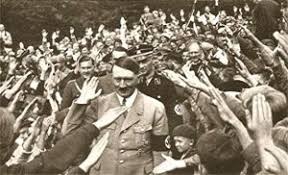
Frenzied Germans greet Adolf Hitler
The Gestapo didn’t have to watch everyone: German “patriots” gladly reported their fellow citizens—especially Jews—to the secret police.
As far as everyday Germans were concerned:
- The streets were clean and peaceful.
- Employment was high.
- The trouble-making unions were gone.
- Germany was once again “taking its rightful place” among ruling nations, after its catastrophic defeat in World War 1.
The height of “The Happy Time” came in June, 1940. In just six weeks, the Wehrmacht accomplished what the German army hadn’t in four years during World War 1: The total defeat of its longtime enemy, France.
Suddenly, French clothes, perfumes, delicacies, paintings and other “fortunes of war” came pouring into the Fatherland. (Reichsmarshall Herman Goring, head of the Luftwaffe—air force—amassed his own private air collection from French museums.)
Most Germans believed der Krieg—“the war”—was over, and only good times lay ahead.
Then, on June 22, 1941, three million Wehrmacht soldiers slashed their way into the Soviet Union. The Third Reich was now locked in a death-struggle with a nation even more powerful than itself.

German soldiers in the Soviet Union
And then, on December 11, 1941—four days after Germany’s ally, Japan, attacked Pearl Harbor—Hitler declared war on the United States.
“The Happy Time” for Germans was over. Only prolonged disaster lay ahead.
Donald Trump has spent his life appealing to the greed or fear of those around him. For example:
- Florida Attorney General Pam Bondi personally solicited a political contribution from Donald Trump around the same time her office deliberated joining an investigation of alleged fraud at Trump University and its affiliates.
- After Bondi dropped the Trump University case against Trump, he wrote her a $25,000 check for her re-election campaign.
- In 1999, Fred Trump, Donald’s father died. His deceased brother’s family sued Donald, arguing they were originally in the will, but Donald took advantage of his father’s dementia to cut them out of it. He withdrew medical benefits critical to his nephew’s infant son: “I was angry because they sued,” Trump later said in an interview.
The Germans made a devil’s-bargain with Adolf Hitler—and paid dearly for it.
Millions of greedy Americans have embraced Donald Trump, another would-be tyrant, as America’s economic savior.
By supporting Trump—or at least not opposing him—they have made a devil’s-bargain.
And such bargains always end with the devil winning.
9/11, ABC NEWS, ACADEMI, AFGHANISTAN, ALTERNET, ANDROID, AP, APPLE IOS, BARACK OBAMA, BLACKWATER, BOOZ ALLEN HAMILTON, BUZZFEED, CBS NEWS, CENTRAL INTELLIGENCE AGENCY, CNN, COFER BLACK, COLD WAR, CONTRACT EMPLOYEES, CROOKS AND LIARS, DAILY KOZ, DONALD TRUMP, EDWARD SNOWDEN, ENRIQUE PRADO, ERIK PRINCE, FACEBOOK, GEORGE W. BUSH, GREEN BERETS, IRAQ, LEGACY OF ASHES (BOOK), LOCKHEED MARTIN, MERCENARIES, MICROSOFT WINDOWS, MOTHER JONES, MOVEON, NATIONAL SECURITY AGENCY, NAVY SEALS, NBC NEWS, NEWSWEEK, NICCOLO MACHIAVELLI, NPR, PAUL BREMER, POLITICO, RAW STORY, REUTERS, ROBERT RICHER, SALON, SEATTLE TIMES, SLATE, SMARTPHONES, THE ATLANTIC, THE CHICAGO SUN-TIMES, THE CHICAGO TRIBUNE, THE DAILY BEAST, THE GUARDIAN, THE HILL, THE HUFFINGTON POST, THE LOS ANGELES TIMES, THE NATION, THE NEW YORK TIMES, THE PENTAGON, THE WASHINGTON POST, TIM WEINER, TIME, TORTURE, TOTAL INTELLIGENCE SOLUTIONS, TWITTER, U.S. NEWS & WORLD REPORT, UNITED STATES AIR FORCE, UNITED STATES ARMY, UPI, USA TODAY, WIKILEAKS, XE SERVICES
In Bureaucracy, Business, History, Military, Politics, Social commentary on August 27, 2018 at 12:07 am
The United States has been fighting in Afghanistan for almost 17 years—with no end in sight.
Between 2001 and 2017, America spent an estimated $714 billion on this conflict.
Now Blackwater founder Erik Prince claims he can attain a victory that has eluded the United States Air Force, Army (including Green Berets) and Navy SEALs.
His proposed solution: His private army of mercenaries—and $3.5 billion in taxpayer monies.

Erik Prince
By Miller Center [CC BY 2.0 (https://creativecommons.org/licenses/by/2.0)%5D, via Wikimedia Commons
In 1997, Prince created Blackwater, a private security company providing support to military and police agencies.
In August, 2003, Blackwater got the first of a series of Federal contracts to deploy its forces in Iraq. For $21 million, it would safeguard Paul Bremer, the proconsul running the American occupation in Iraq.
Ultimately, Blackwater got $1 billion to provide security for American officials and soldiers in Iraq and Afghanistan.
According to human rights organizations, Blackwater abused Iraqis and engaged in torture to obtain information.
In September, 2007, Blackwater guards killed 17 Iraqi civilians and injured 20 more in a Baghdad traffic circle.
Five guards were charged with murder. Three were convicted in October, 2014, of 14 manslaughter charges and in April 2015 sentenced to 30 years in prison. These sentences were deemed unfair upon appeal and await re-sentencing.
As a result of its highly controversial activities in Iraq, Prince renamed the company Xe Services in 2009 and then Academi in 2011.
Now, against opposition by the Pentagon, Prince is pressing Trump to let Academi privatize the war in Afghanistan.
Since the end of the Cold War, the American military and Intelligence communities have grown increasingly dependent on private contractors.
In his 2007 bestseller, Legacy of Ashes: The History of the CIA, Tim Weiner writes:
“Patriotism for profit became a $50-billion-a-year business….The [CIA] began contracting out thousands of jobs to fill the perceived void by the budget cuts that began in 1992.
“A CIA officer could file his retirement papers, turn in his blue identification badge, go to work for a much better salary at a military contractor such as Lockheed Martin or Booz Allen Hamilton, then return to the CIA the next day, wearing a green badge….”
Much of the CIA became totally dependent on mercenaries. They appeared to work for the agency, but their loyalty was actually to their private–and higher-paying—companies.
Writes Weiner: “Legions of CIA veterans quit their posts to sell their services to the agency by writing analyses, creating cover for overseas officers, setting up communications networks, and running clandestine operations.”
One such company was Total Intelligence Solutions, founded in 2007 by Cofer Black, who had been the chief of the CIA’s counter-terrorism center on 9/11. His partners were Robert Richer, formerly the associate deputy director of operations at the CIA, and Enrique Prado, who had been Black’s chief of counter-terror operations at the agency.
Future CIA hires followed suit: Serve for five years, win that prized CIA “credential” and sign up with a private security company to enrich themselves.
This situation met with full support from Right-wing “pro-business” members of Congress and President George W. Bush.
They had long championed the private sector as inherently superior to the public one. And they saw no danger that a man dedicated to enriching himself might put greed ahead of safeguarding his country.
But there are dangers to hiring men whose first love is profit. Recent examples include:
- Edward Snowden deliberately joined Booz Allen Hamilton to secure a job as a computer systems administrator at the National Security Agency (NSA). This gave him access to thousands of highly classified documents—which, in 2013, he began publicly leaking to a wide range of news organizations.
- His motive, he has claimed, was to warn Americans of the privacy-invading dangers posed by their own Intelligence agencies.
- On March 7, 2017, WikiLeaks published a “data dump” of 8,761 documents codenamed “Vault 7.”
- The documents exposed that the CIA had found security flaws in software operating systems such as Microsoft Windows, Android and Apple iOS. These allowed an intruder—such as the CIA—to seize control of a computer or smartphone. The owner could then be photographed through his iPhone camera and have his text messages intercepted.
- According to anonymous U.S. Intelligence and law enforcement sources, the culprits were CIA contract employees.
But there are those who have offered a timely warning against the use of mercenaries. One of these is Niccolo Machiavelli, the Florentine statesman of the Renaissance.
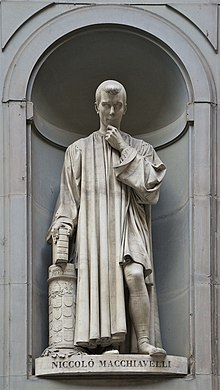
Niccolo Machiavelli
In The Prince, Machiavelli writes:
“Mercenaries…are useless and dangerous. And if a prince holds on to his state by means of mercenary armies, he will never be stable or secure. For they are disunited, ambitious, without discipline, disloyal. They are brave among friends; among enemies they are cowards.
“They have neither the fear of God nor fidelity to man, and destruction is deferred only as the attack is. For in peace one is robbed by them, and in war by the enemy.
“The cause of this is that they have no love or other motive to keep them in the field beyond a trifling wage, which is not enough to make them ready to die for you.”
Centuries after Machiavelli’s warning, Americans are realizing the bitter truth of it firsthand.
ABC NEWS, ADOLF HITLER, ADVICE, ALTERNET, AMERICABLOG, AP, BABY BOOMER RESISTANCE, BAY OF PIGS, BBC, BENITO MUSSOLINI, BLOOMBERG NEWS, BUZZFEED, CAESARE BORGIA, CBS NEWS, CNN, CORPORATIONS, CROOKS AND LIARS, CUBA, DAILY KOS, DAILY KOZ, FACEBOOK, FIDEL CASTRO, FIVETHIRTYEIGHT, FLORENCE, HARPER’S MAGAZINE, HUFFINGTON POST, JOHN F. KENNEDY, JOSEPH STALIN, KING PERSEUS OF MACEDON, MEDIA MATTERS, MOTHER JONES, MOVEON, MSNBC, NAZI-SOVIET NON-AGGRESSION PACT, NBC NEWS, NEW REPUBLIC, NEWSDAY, NEWSWEEK, NICCOLO MACHIAVELLI, NPR, PBS NEWSHOUR, POLITICO, POLITICS, POLITICUSUSA, POPE JULIUS 11, RAW STORY, REUTERS, SALON, SEATTLE TIMES, SLATE, TALKING POINTS MEMO, THE ATLANTIC, THE CHICAGO SUN-TIMES, THE CHICAGO TRIBUNE, THE DAILY BEAST, THE DAILY BLOG, THE DISCOURSES, THE GUARDIAN, THE HILL, THE HUFFINGTON POST, THE INTERCEPT, THE LOS ANGELES TIMES, THE NATION, THE NEW REPUBLIC, THE NEW YORK TIMES, THE NEW YORKER, THE PRINCE, THE SS, THE VILLAGE VOICE, THE WASHINGTON POST, THINKPROGRESS, THIRD REICH, TIME, TRUTHDIG, TRUTHOUT, TWITTER, U.S. NEWS & WORLD REPORT, UKRAINE, UPI, USA TODAY, VLADIMIR PUTIN, VOLODYMYR ZELENSKY, WEHRMACHT, WORLD WAR 11
In Bureaucracy, Business, History, Military, Politics, Social commentary on August 17, 2018 at 12:15 am
Ask the average person, “What do you think of Niccolo Machiavelli?” and he’s likely to say: “The devil.”
In fact, “The Old Nick” became an English term used to describe Satan and slander Machiavelli at the same time.

Niccolo Machiavelli
The truth, however, is more complex. Machiavelli was a passionate Republican, who spent most of his adult life in the service of his beloved city-state, Florence.
The years he spent as a diplomat were tumultuous ones for Italy—with men like Pope Julius II and Caesare Borgia vying for power and plunging Italy into one bloodbath after another.
Florence, for all its wealth, lacked a strong army, and thus lay at the mercy of powerful enemies, such as Borgia. Machiavelli often had to use his wits to keep them at bay.
Machiavelli is best-known for his writing of The Prince, a pamphlet on the arts of gaining and holding power. Its admirers have included Benito Mussolini and Joseph Stalin.
But his longer and more thoughtful work is The Discourses, in which he offers advice on how to maintain liberty within a republic. Among its admirers were many of the men who framed the Constitution of the United States.
Most people believe that Machiavelli advocated evil for its own sake.
Not so. Rather, he recognized that sometimes there is no perfect—or perfectly good—solution to a problem.
Sometimes it’s necessary to take stern—even brutal—action to stop an evil (such as a riot) before it becomes widespread:
“A man who wishes to make a profession of goodness in everything must inevitably come to grief among so many who are not good. And therefore it is necessary for a prince, who wishes to maintain himself, to learn how not to be good, and to use this knowledge and not use it, according to the necessity of the case.”
His counsel remains as relevant today as it did during his lifetime (1469 – 1527). This is especially true for politicians—and students of political science.
But plenty of ordinary citizens can also benefit from the advice he has to offer—such as those in business who are asked to give advice to more powerful superiors.
Machiavelli warns there is danger in urging rulers to take a particular course of action: “For men only judge of matters by the result, all the blame of failure is charged upon him who first advised it, while in case of success he receives commendations. But the reward never equals the punishment.”
This puts would-be counselors in a difficult position: “If they do not advise what seems to them for the good of the republic or the prince, regardless of the consequences to themselves, then they fail to do their duty.
“And if they do advise it, then it is at the risk of their position and their lives, for all men are blind in thus, that they judge of good or evil counsels only by the results.”
Thus, Machiavelli warns that an adviser should “take things moderately, and not to undertake to advocate any enterprise with too much zeal, but to give one’s advice calmly and modestly.”
The person who asked for the advice may follow it, or not, as of his own choice, and not because he was led or forced into it by the adviser.
Above all, the adviser must avoid the danger of urging a course of action that runs “contrary to the wishes of the many.
“For the danger arises when your advice has caused the many to be contravened. In that case, when the result is unfortunate, they all concur in your destruction.”
Or, as President John F. Kennedy famously said after the disastrous invasion of Cuba at the Bay of Pigs in April, 1961: “Victory has a hundred fathers and defeat is an orphan.”
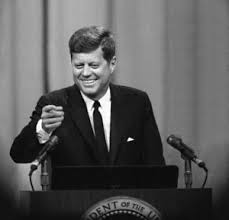
John F. Kennedy
By “not advocating any enterprise with too much zeal,” the adviser gains two advantages:
“The first is, you avoid all danger.
“And the second consists in the great credit which you will have if, after having modestly advised a certain course, your counsel is rejected, and the adoption of a different course results unfortunately.”
Finally, the time to give advice is before a catastrophe occurs, not after. Machiavelli gives a vivid example of what can happen if this rule is ignored.
King Perseus of Macedon had gone to war with Paulus Aemilius—and suffered a humiliating defeat. Fleeing the battlefield with a handful of his men, he later bewailed the disaster that had overtaken him.
Suddenly, one of his lieutenants began to lecture Perseus on the many errors he had committed, which had led to his ruin.
“Traitor,” raged the king, turning upon him, “you have waited until now to tell me all this, when there is no longer any time to remedy it—” And Perseus slew him with his own hands.
Niccolo Machiavelli sums up the lesson as this:
“Thus was this man punished for having been silent when he should have spoken, and for having spoken when he should have been silent.”
Be careful that you don’t make the same mistake.
ABC NEWS, ALTERNET, AMERICAN CAESAR, AP, ARNOLD SCHWARZENEGGER, ASIANS, BARACK OBAMA, BLACKS, BUZZFEED, CANADA, CBS NEWS, CNN, CRIMEA, CROOKS AND LIARS, DAILY KOZ, DISABLED, DOUGLAS MACARTHUR, EUROPEAN UNION, FACEBOOK, FRANCE, G7 CONFERENCE, GERMANY, HILLARY CLINTON, HISPANICS, ITALY, JAPAN, JOHN OLIVER, JUSTIN TRUDEAU, KIM JONG ON, LARRY KUDLOW, MERYL STREEP, MEXICO, MOTHER JONES, MOVEON, MSNBC, NBC NEWS, NEIL YOUNG, NEWSWEEK, NORTH KOREA, NPR, PETER NAVARRO, POLITICO, PRISONERS OF WAR, RAW STORY, REUTERS, RUSSIA, SALON, SEATTLE TIMES, SINGAPORE, SLATE, TARIFFS, THE ATLANTIC, THE CHICAGO SUN-TIMES, THE CHICAGO TRIBUNE, THE DAILY BEAST, THE GUARDIAN, THE HILL, THE HUFFINGTON POST, THE LOS ANGELES TIMES, THE NATION, THE NEW YORK TIMES, THE WASHINGTON POST, TIME, TWITTER, U.S. NEWS & WORLD REPORT, UNITED KINGDOM, UNITED STATES, UPI, USA TODAY, USA TODAY DONALD TRUMP, VLADIMIR PUTIN, WILLIAM MANCHESTER, WOMEN
In Business, History, Military, Politics, Social commentary, Uncategorized on June 13, 2018 at 1:24 am
“He appeared to need enemies the way other men need friends, and his conduct assured that he would always have plenty of them.”
So wrote William Manchester about General Douglas MacArthur in his monumental 1978 biography, American Caesar. But he could have written this just as accurately about Donald Trump, both as Republican Presidential candidate and President.
As a Presidential candidate, Trump repeatedly used Twitter to attack hundreds of real and imagined enemies in politics, journalism, TV and films.
From June 15, 2015, when he launched his Presidential campaign, until October 24, 2016, Trump fired almost 4,000 angry, insulting tweets at 281 people and institutions that had somehow offended him.
Donald Trump
The New York Times needed two full pages of its print edition to showcase them. Among his targets:
- Hillary Clinton
- President Barack Obama
- Actress Meryl Streep
- Comedian John Oliver
- Singer Neil Young
- Actor Arnold Schwarzenegger
- News organizations
- Beauty pageant contestants
Others he clearly delighted in insulting during the campaign included:
- Women
- Blacks
- Hispanics
- Asians
- The disabled
- Prisoners-of-war
As President, he has continued to insult virtually everyone, verbally and on Twitter. His targets have included Democrats, Republicans, the media, foreign leaders (most notably North Korea’s “Little Rocket Man” Kim Jong On) and even members of his Cabinet.
The one major figure that Trump has never attacked is Russian President Vladimir Putin.
But Trump has no such hesitation about insulting leaders of nations which have been America’s traditional allies—such as Canada.
On June 10, Larry Kudlow, Trump’s chief economic adviser, accused Canadian Prime Minister Justin Trudeau of undermining the US and its allies with comments he made at the G7 economic summit in Quebec.
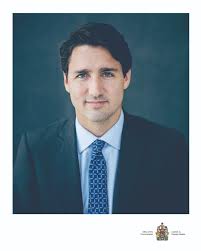
Justin Trudeau
The G7 is comprised of France, Canada, the United Kingdom, Germany, Japan, the United States and Italy.
“It was a betrayal,” Kudlow accused Trudeau on CNN’s “State of the Union.” “He really kind of stabbed us in the back.”
Kudlow said the allies should have been more supportive of Trump because of his scheduled June 12 meeting in Singapore with North Korean dictator Kim Jong On.
“They should have said to him, ‘God speed, you are negotiating with the crazy nuclear tyrant in North Korea, and we are behind you.'”
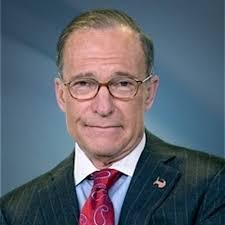
Larry Kudlow
On June 9, the prime minister had said in a press conference that Canada would “move forward with retaliatory measures” on July 1.
The reason for this: Trump’s decision to impose tariffs on steel and aluminum imports from Canada, the European Union and Mexico.
“I have made it very clear to the President that it is not something we relish doing, but it something that we absolutely will do,” Trudeau said. “Canadians, we’re polite, we’re reasonable, but we also will not be pushed around.”
And Peter Navarro, Trump’s trade adviser, went further: “There’s a special place in hell for any foreign leader that engages in bad faith diplomacy with President Donald J. Trump and then tries to stab him in the back on the way out the door.
“And that’s what bad faith Justin Trudeau did with that stunt press conference. That’s what weak, dishonest Justin Trudeau did, and that comes right from Air Force One.”
Given the sheer brutality of the language, there’s no reason to doubt that Navarro was absolutely reflecting Trump’s own venomous anger.
“He [Trump[ did him [Trudeau] a favor,” Navarro said. “He was even willing to sign that socialist communique.”
On June 10, Trump tweeted: “Based on Justin’s false statements at his news conference, and the fact that Canada is charging massive Tariffs to our U.S. farmers, workers and companies, I have instructed our U.S. Reps not to endorse the Communique as we look at Tariffs on automobiles flooding the U.S. Market!,”
But while Trump has made clear his detestation of socialism, he has no qualms about rewarding the aggression of a hardcore Communist like Vladimir Putin. On June 9, he called for Russia to be readmitted to the G7.
“I think it would be an asset to have Russia back in,” he said during an impromptu press conference at the summit.
“I think it would be good for the world. I think it would be good for Russia. I think it would be good for the United States. I think it would be good for all of the countries of the current G7. I think the G8 would be better.”
Russia was ousted from the group in 2014 after Putin annexed Crimea—the first violation of a European country’s borders since World War II.
“Today crystallizes precisely why Putin was so eager to see Trump elected,” said former Obama National Security Council spokesman Ned Price.
“For Putin, this is return on his investment, and it’s safe to say that his investment has paid off beyond even his wildest dreams,” he said in a statement to CNN.
And, in a turn of events that some might call poetic justice, moments after he arrived in Singapore for his meeting with Kim Jong On, Trump tweeted: “Our Great Larry Kudlow, who has been working so hard on trade and the economy, has just suffered a heart attack. He is now in Walter Reed Medical Center.”


ABC NEWS, ADOLF HITLER, ALTERNET, AP, BUZZFEED, CBS NEWS, CNN, CROOKS AND LIARS, DAILY KOZ, DAVID BROOKS, DEMOCRATS, DONALD TRUMP, FACEBOOK, HOUSE OF REPRESENTATIVES, HOUSE OVERSIGHT COMMITTEE, JACKIE SPEIER, JIM JORDAN, JIMMY CARTER, MARK SHIELDS, MICHAEL COHEN, MOTHER JONES, MOVEON, MSNBC, NBC NEWS, NEWSWEEK, NPR, PBS NEWSHOUR, POLITICO, RAW STORY, REPUBLICANS, REUTERS, RICHARD NIXON, ROBERT MUELLER, SALON, SEATTLE TIMES, SLATE, STORMY DANIELS, THE ATLANTIC, THE CHICAGO SUN-TIMES, THE CHICAGO TRIBUNE, THE DAILY BEAST, THE GUARDIAN, THE HILL, THE HUFFINGTON POST, THE LOS ANGELES TIMES, THE NATION, THE NEW YORK TIMES, THE PBS NEWSHOUR, THE WASHINGTON POST, TIME, TWITTER, U.S. NEWS & WORLD REPORT, UNITED STATES SENATE, UPI, USA TODAY
“JUST ANOTHER WEEK IN CALIGULA’S ROME”—AND TRUMP’S WASHINGTON
In Bureaucracy, Business, History, Politics, Social commentary on March 5, 2019 at 12:16 am“Just another week in Caligula’s Rome.”
That was how conservative New York Times columnist David Brooks summed up President Donald Trump’s Washington, D.C. for the week of February 24 to March 1, 2019.
Every Friday Books faces off with liberal syndicated columnist Mark Shields on The PBS Newshour. And on the program for March 1, the two men found common cause in sizing up the appearance of Michael Cohen before the House Oversight Committee two days earlier.
David Brooks and Mark Shields on “The PBS Newshour”
During that hearing, Cohen, Trump’s longtime attorney and fixer:
But for Brooks, far more was at stake than the individual accusations:
“To me, it was more of a moral occasion, more than anything else. What it illustrates is a President and, frankly, Michael Cohen who long ago decided that celebrity and wealth is more important than being a good person. And they have dragged us all down there with us.
“And the people they have dragged most effectively are the House Republicans, a lot of them on that committee, who decided that they were completely incurious about whether Donald Trump was a good guy or a bad guy or a really awful guy, that—their own leader, they didn’t seem to care about that, but they were going to rip the skin off Michael Cohen.
Michael Cohen testifying before Congress
“And so they attacked him. And what struck me is how moral corrosion happens, that you decide you’re going to defend or ignore Trump. And then to do that, you have to morally distance yourself from him. And then you have to morally distance yourself from him every day.
“And, eventually, you just get numb to everything. And so [Ohio Republican Representative] Jim Jordan and other people on the committee were saying, oh, we all knew this, like, it’s all unremarkable. And so that’s—that’s how moral corrosion happens.”
During the hearing, California Representative Jackie Speier asked Cohen: How many times did Trump ask you to intimidate creditors?
Cohen estimated the number at 500.
For Shields, this counted as especially despicable behavior: “And—but the thing about it is, when he stiffed those small business—the plumbers and the electricians who did the work in the Trump projects, and he came back, and Donald Trump loved to hear about it, I mean, reveled in it.
“Now, I mean, at what point do you say that there’s no honor here? I mean, there’s nothing to admire.”
Shields was equally appalled by the refusal of Trump’s Republican committee defenders to condemn his moral depravity—as a businessman or President.
“If you can’t deal with the message, you shoot the messenger. And that’s what their whole strategy was.
“The very fact that not a single member of the Republican committee defended Donald Trump or what he was charged or alleged to have done, to me, was revealing. They just decided to go after Michael Cohen.”
So why have Republicans aligned themselves with such a man?
Republicans don’t fear that Trump will trash the institutions that Americans have cherished for more than 200 years. Institutions like an independent judiciary, a free press, and an incorruptible Justice Department.
He has already attacked all of these—and Republicans have either said nothing or rushed to his defense.
What Republicans truly fear about Donald Trump is that he will finally cross one line too many—like firing Special Counsel Robert Mueller. And that the national outrage following this will force them to launch impeachment proceedings against him.
But it isn’t even Trump they fear will be destroyed.
What they most fear losing is their own hold on nearly absolute power in Congress and the White House. And the riches that go with it.
If Trump is impeached and possibly indicted, he will become a man no one any longer fears. He will be a figure held up to ridicule and condemnation.
Like Adolf Hitler.
Like Richard Nixon.
And his supporters will be branded as losers along with him.
Republicans vividly remember what happened after Nixon was forced to resign on August 9, 1974: Democrats, riding a wave of reform fever, swept Republicans out of the House and Senate—and Jimmy Carter into the White House.
House and Senate Republicans can imagine a future without Trump—but not one where they disappear.
If they are conflicted—whether to continue supporting Trump or desert him—the reason is the same: How can I hold onto my power and all the privileges that go with it?
Share this: