Archive for the ‘Bureaucracy’ Category
ABC NEWS, ADOLF HITLER, ALTERNET, AMERICABLOG, AP, ARIZONA SHOOTINGS, ASSASSINATION, BABY BOOMER RESISTANCE, BARACK OBAMA, BILL CLINTON, BLOOMBERG, BUZZFEED, CBS NEWS, CHRISTINA-TAYLOR GREEN, CNN, CONFEDERATE FLAG, CROOKS AND LIARS, DAILY KOZ, DRUDGE REPORT, DYLANN ROOF, FACEBOOK, FBI, FIVETHIRTYEIGHT, GABRIELLE GIFFORDS, GEORGE H.W. BUSH, HARPER’S MAGAZINE, HATE CRIMES, HEALTHCARE, HUFFINGTON POST, MEDIA MATTERS, MEIN KAMPF, MOTHER JONES, MOVEON, MSNBC, NBC NEWS, NEWSWEEK, NEWT GINGRICH, NPR, PBS NEWSHOUR, POLITICO, POLITICUSUSA, RAW STORY, REP. GABRIELLE GIFFORDS, REPUBLICAN PARTY, REPUBLICANS, REUTERS, RICK PERRY, RICK SANTORUM, RODNEY KING RIOTS, ROLLING STONE MAGAZINE, SALON, Sarah Palin, SEATTLE TIMES, Secret Service, SLATE, TALKING POINTS MEMO, TEA PARTY, TERRORISM, THE ATLANTIC, THE CHICAGO SUN-TIMES, THE CHICAGO TRIBUNE, THE DAILY BEAST, THE DAILY BLOG, THE GUARDIAN, THE HILL, THE HUFFINGTON POST, THE LOS ANGELES TIMES, THE NATION, THE NEW REPUBLIC, THE NEW YORK TIMES, THE VILLAGE VOICE, THE WASHINGTON POST, THINKPROGRESS, TIME, TRUTHDIG, TRUTHOUT, TWITTER, TWO POLITICAL JUNKIES, U.S. DISTRICT JUDGE JOHN ROLL, U.S. MARSHALS SERVICE, U.S. NEWS & WORLD REPORT, UPI, USA TODAY
In Bureaucracy, History, Law, Law Enforcement, Politics, Social commentary on June 23, 2015 at 3:39 pm
On June 17, 2015, Dylann Roof, a white high school dropout, gunned down three black men and six black women at Emanuel African Methodist Episcopal Church in Charleston, South Carolina.
At 21, Roof was unemployed, dividing his time between playing video games and taking drugs.
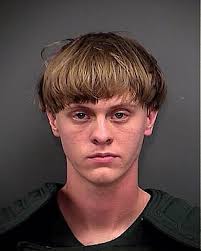
Dylann Roof
The signs of Roof’s malignant racism were evident long before he turned mass murderer:
- He had posed for a photo sitting on the hood of his parents’ car–whose license plate bore a Confederate flag.
- He had posed for pictures wearing a jacket sporting the white supremacist flags of Rhodesia and apartheid South Africa.
- He told a friend that he hoped “to start a civil war” between the black and white races.
- Roof reportedly told friends and neighbors of his plans to kill people.
- In the midst of his massacre of unarmed worshippers, he told one of his victims: “You’ve raped our women, and you are taking over the country.” Then Roof shot him.
The evidence makes clear that Roof’s slaughter was racially motivated. Yet one Republican Presidential candidate after another has refused to acknowledge it.
Jeb Bush, former governor of Florida: “I don’t know what was on the mind or the heart of the man who committed these atrocious crimes.”
Rick Santorum, former United States Senator from Pennsylvania: “You talk about the importance of prayer in this time and we’re now seeing assaults on our religious liberty we’ve never seen before. It’s a time for deeper reflection beyond this horrible situation.”
Bobby Jindal, former governor of Louisiana: “I don’t think we’ll ever know what was going on in his mind.”
But Rolling Stone magazine writer Jeb Lund left no doubt as to what–and who–was ultimately responsible for this crime: Racism and Republicans.
In a June 19 editorial–published two days after the massacre–Lund noted: “This [crime] is political because American movement conservatism has already made these kinds of killings political.
“The Republican Party has weaponized its supporters, made violence a virtue and, with almost every pronouncement for 50 years, given them an enemy politicized, racialized and indivisible.
“Movement conservatives have fetishized a tendentious and ahistorical reading of the Second Amendment to the point that the Constitution itself somehow paradoxically ‘legitimizes’ an armed insurrection against the government created by it.
“Those leading said insurrection are swaddled by the blanket exculpation of patriotism. At the same time, they have synonymized the Democratic Party with illegitimacy and abuse of the American order.
“This is no longer an argument about whether one party’s beliefs are beneficial or harmful, but an attitude that labels leftism so antithetical to the American idea that empowering it on any level is an act of usurpation.”
Click here: The Charleston Shooter: Racist, Violent, and Yes – Political | Rolling Stone
Lund is absolutely right. And the evidence for this was on display long before Dylann Roof opened fire on “uppity blacks” praying in their own church.
Consider:
On January 8, 2011, Democratic Rep. Gabrielle Giffords was shot in the head while meeting with constituents outside a grocery store in Tucson, Arizona. After a miraculous recovery, she continues to struggle with language and has lost 50% of her vision in both eyes.
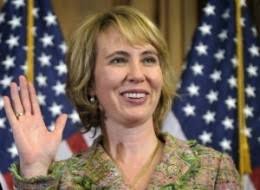
Rep. Gabrielle Giffords
She vowed to return to her former Congressional duties, but was forced to resign for health reasons in 2012.
Giffords was only one victim of a shooting spree that claimed the lives of six people and left 13 others wounded.
Also killed was Arizona’s chief U.S. District judge, John Roll, who had just stopped by to see his friend Giffords after celebrating Mass.
Although the actual shooter, Jared Lee Loughner, was immediately arrested, those who fanned the flames of political violence that consumed 19 people that day have remained unpunished.
Consider the circumstances behind the shootings:
John Roll is Arizona’s chief federal judge. Appointed in 2006, he wins acclaim as a respected jurist and leader who pushes to beef up the court’s strained bench to handle a growing number of border crime-related cases.
In 2009, he becomes a target for threats after allowing a $32 million civil-rights lawsuit by illegal aliens to proceed against a local rancher. The case arouses the fury of local talk radio hosts, who encourage their audiences to threaten Roll’s life.
In one afternoon, Roll logs more than 200 threatening phone calls. Callers threaten the judge and his family. They post personal information about Roll online.
Roll and his wife are placed under fulltime protection by deputy U.S. marshals. Roll finds living under security “unnerving and invasive.”
Authorities identify four men believed responsible for the threats. But Roll declines to press charges on the advice of the Marshals Service.
ABC NEWS, CBS NEWS, CHRISTOPHER DORNER, CNN, DEATH THREATS, FACEBOOK, GEORGE ZIMMERMAN, HAWAII FIVE-O, JACK LORD, LORI TANKEL, LOS ANGELES POLICE DEPARTMENT, NBC NEWS, POLICE, ROBERT DALEY, TARGET BLUE, THE CHICAGO SUN-TIMES, THE CHICAGO TRIBUNE, THE LOS ANGELES TIMES, THE NEW YORK TIMES, THE WASHINGTON POST, TRAYVON MARTIN, TWITTER, USA TODAY
In Bureaucracy, History, Law Enforcement, Politics, Social commentary on June 19, 2015 at 12:01 am
Lori Tankel had a problem: A lot of angry people thought she was George Zimmerman.
She began getting death threats on her
Unfortunately for Tankel, her number was one digit away from the number Zimmerman used to make his call to police just before he fatally shot Martin.
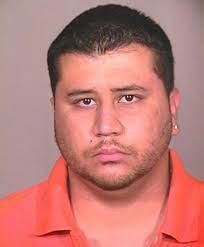
George Zimmerman
The phone number had been shown throughout the trial. And, believing the number was Zimmerman’s, someone posted Tankel’s number online.
Just minutes after the verdict, Tankel began getting death threats.
“We’re going to kill you. We’re going to get you. Watch your back,” threatened a typical call.
Tankel worked as a sales representative for several horse companies. She had grown used to relying on her phone to keep her business going.
But, almost as soon as the Zimmerman verdict came in, “My phone just started to blow up. Phone call after phone call, multiple phone
So she did what any ordinary citizen, faced with multiple death threats, would do: She called the police.
According to her, the Seminole County Sheriff’s Office told her the department itself receives around 400 death threats a minute on social media sites.
In short: Unless you’re wealthy, a politician or–best of all–a cop, don’t expect the police to protect you if your life is threatened.
If you doubt it, consider the lessons to be learned when, in February, 2013, Christopher Dorner declared war on his former fellow officers of the Los Angeles Police Department.
First, above everyone else, police look out for each other.
Robert Daley bluntly revealed this truth in his 1971 bestseller, Target Blue: An Insider’s View of the N.Y.P.D. A police reporter for the New York Times, he served for one year as a deputy police commissioner.

A great many solvable crimes in the city were never solved, because not enough men were assinged to the case. Or because those assigned were lazy or hardly cared or got sidetracked.
“But when a cop got killed, no other cop got sidetracked. Detectives worked on the case night and day….
“In effect, the citizen who murdered his wife’s lover was sought by a team of detectives, two men. But he who killed a cop was sought by 32,000.”
Second, don’t expect the police to do for you what they’ll do for one another.
The LAPD assigned security and surveillance details to at least 50 threatened officers and their families. A typical detail consists of two to five or more guards. And those guards must be changed every eight to 12 hours.
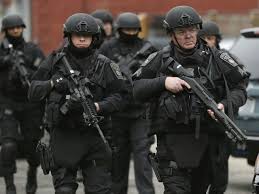
Those details stayed in place long after Dorner was killed in a firefight on February 12.
But if your bullying neighbor threatens to kill you, don’t expect the police to send a guard detail over. They’ll claim: ”We can’t do anything until the guy does something. If he does, give us a call.”
Third, the more status and wealth you command, the more likely the police are to address your complaint or solve your case.
If you’re rich, your complaint will likely get top priority and the best service the agency can provide.
But if you’re poor or even middle-class without high-level political or police connections, you’ll be told: “We just don’t have the resources to protect everybody.”
Fourth, don’t expect your police department to operate with the vigor or efficiency of TV police agencies.
“I want this rock [Hawaii] sealed off,” Steve McGarrett (Jack Lord) routinely ordered when pursuing criminals on “Hawaii Five-O.”
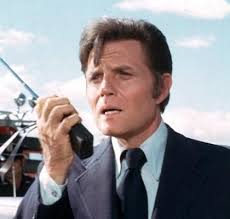
Jack Lord as Steve McGarrett
Real-life police departments, on the other hand:
- Often lack state-of-the-art crime labs to analyze evidence.
- Often lose or accidentally destroy important files.
- Are–like all bureaucracies–staffed by those who are lazy, indifferent or incompetent.
- Are notoriously competitive, generally refusing to share information with other police departments-–thus making it easier for criminals to run amok.
Even when police ”solve” a crime, that simply means making an arrest.
After that, there are at least three possible outcomes:
- The District Attorney may decide not to file charges.
- Or the perpetrator may plead to a lesser offense and serve only a token sentence-–or none at all.
- Or he might be found not guilty by a judge or jury.
Fifth, the result of all this can only be increased disrespect for law enforcement from a deservedly–and increasingly–cynical public.
It is the witnessing of blatant inequities and hypocrisies such as those displayed in the Christopher Dorner case that most damages public support for police at all levels.
When citizens believe police care only about themselves, and lack the ability-–or even the will-–to protect citizens or avenge their victimization by arresting the perpetrators, that is a deadly blow to law enforcement.
Police depend on citizens for more than crime tips. They depend upon them to support hiring more cops and buying state-of-the-art police equipment. When public support vanishes, so does much of that public funding.
The result can only be a return to the days of the lawless West, where citizens–as individuals or members of vigilantee committees–looked only to themselves for protection.
2012 PRESIDENTIAL RACE, 2016 PRESIDENTIAL CAMPAIGN, ABC NEWS, CBS NEWS, CNN, COMMUNISM, DONALD TRUMP, FACEBOOK, HERMAN CAIN, HONOR, JAPAN, JOSEPH MCCARTHY, MATTHEW 7: 17-20, MITT ROMNEY, NBC NEWS, NEWT GINGRICH, SAMURAI, THE CHICAGO SUN-TIMES, THE CHICAGO TRIBUNE, THE LOS ANGELES TIMES, THE NEW YORK TIMES, THE WALL STREET JOURNAL, THE WASHINGTON POST, TWITTER, USA TODAY
In Bureaucracy, History, Politics, Social commentary on June 18, 2015 at 12:05 am
“Senator, may we not drop this?….You’ve done enough. Have you no sense of decency, sir? At long last, have you left no sense of decency?”
The speaker was Joseph N. Welch, chief counsel for the United States Army–then under investigation by Joseph McCarthy’s Senate Permanent Submittee on Investigations for alleged Communist activities.
It was June 9, 1954, the 30th day of the Army-McCarthy hearings.
And it was the pivotal moment that finally destroyed the career of the Wisconsin Senator whose repeated slanders of Communist subversion had bullied and frightened Americans for four years.

Joseph McCarthy
When the Senate gallery erupted in applause, McCarthy–totally surprised at his sudden reverse of fortune–was finished.
Today, however, other Americans could stand to remember the question asked by Welch: “At long last, have you left no sense of decency?”
Americans like Rick Santorum, Republican Presidential candidate in 2016.
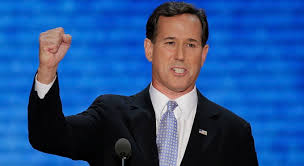
Rick Santorum
As a United States Senator from Pennsylvania (1997 – 2005) and 2012 Presidential candidate, Santorum fervently sought to ban legalized abortion–even in rape cases– and even birth control. They were, he said, an affront to “the way things ought to be.”
But this did not stop him from marrying, in 1990, a woman–Karen Garver–who had spent six years as the unmarried bedmate of an OBGYN-abortionist named Tom Allen, who was 40 years her senior.
Then there’s 2016 Presidential candidate Ted Cruz.
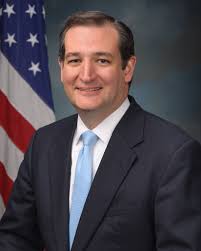
U.S. Senator Ted Cruz (R-Texas)
As a Republican United States Senator from Texas, Cruz voted–three times–against federal aid for victims of Hurricane Sandy.
The October, 2012, hurricane killed about 150 people and caused an estimated $75 billion in damage across the Northeast.
But when a fertilizer plant exploded in West, McLennan County Texas, on April 17, 2013, Cruz vowed that he would seek “all available resources” to assist its victims.
The blast killed 13 people, wounded about 200 others, and caused extensive damages to surrounding homes.
It didn’t matter to Cruz that:
- The facility hadn’t been inspected by the Labor Department’s Occupational Safety and Health Administration (OSHA) since 1985, when the company was fined $30; and
- The plant had been storing 1,350 times the amount of ammonium nitrate that would normally trigger safety oversight by the U.S. Department of Homeland Security (DHS).
Then there’s Donald Trump, the egocentric businessman and “reality star” of NBC’s “The Apprentice.”

Donald Trump
On April 17, 2011, toying with the idea of entering the Presidential race himself, he said this about Mitt Romney, the former Massachusetts governor and GOP candidate:
“He’d buy companies. He’d close companies. He’d get rid of jobs. I’ve built a great company. I’m a much bigger businessman and have a much, much bigger net worth. I mean my net worth is many, many, many times Mitt Romney.
“Mitt Romney is a basically small-business guy, if you really think about it. He was a hedge fund. He was a funds guy. He walked away with some money from a very good company that he didn’t create. He worked there. He didn’t create it.”
Trump added that Bain Capital, the hedge fund where Romney made millions of dollars before running for governor, didn’t create any jobs. Whereas Trump claimed that he–Trump–had created “hundreds of thousands of jobs.”
So at least some observers must have been puzzled when Trump announced, on February 2, 2012: “It’s my honor, real honor, and privilege to endorse Mitt Romney” for President.
“Mitt is tough, he’s smart, he’s sharp, he’s not going to allow bad things to continue to happen to this country that we all love. So, Governor Romney, go out and get ‘em. You can do it,” said Trump.
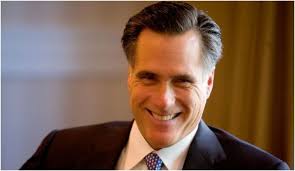
Mitt Romney
And Romney, in turn, had his own swooning-girl moment: “I’m so honored to have his endorsement. There are some things that you just can’t imagine in your life. This is one of them.”
Clearly, the word “hypocrisy” means nothing to Santorum, Cruz, Romney and Trump. But it should mean something to the rest of us.
In samurai Japan, officials who publicly disgraced themselves knew what to do. The samurai code of seppeku told them when they had crossed the line into eternal damnation.
And it gave them a way to redeem their lost honor: With a small “belly-cutting” knife and the help of a trusted assistant who sliced off their head to spare them the agonizing pain of disembowelment.
In the armies of America and Europe, the method was slightly different: A pistol in a private room.
Considering the ready availability of firearms among Right-wing Republicans, redeeming lost honor shouldn’t be a problem for any of these men.

But of course it will be. It takes more than a trigger-pull to “do the right thing.” It takes insight to recognize that you’ve “done the wrong thing.” And it takes courage to act on that insight.
In men who live only for their own egos and wallets, such insight and courage will be forever missing. They are beyond redemption.
Their lives give proof to the warning offered in Matthew 7: 17-20:
“Even so every good tree bringeth forth good fruit; but a corrupt tree bringeth forth evil fruit. A good tree cannot bring forth evil fruit, neither can a corrupt tree bring forth good fruit.
“Every tree that bringeth not forth good fruit is hewn down, and cast into the fire. Wherefore by their fruits ye shall know them.”
2012 PRESIDENTIAL CAMPAIGN, 2016 PRESIDENTIAL CAMPAIGN, ABC NEWS, ABORTION, ADOLF HITLER, BIRTH CONTROL, BROWNSHIRTS, CBS NEWS, CNN, FACEBOOK, HEINRICH HIMMLER, HERMAN GORING, JEWS, KAREN SANTORUM, MSNBC, NAZI GERMANY, NAZI PARTY, NBC NEWS, REINHARD HEYDRICH, REPUBLICAN PARTY, RICK SANTORUM, S.A., SAME-SEX MARRIAGE, SS, THE CHICAGO SUN-TIMES, THE CHICAGO TRIBUNE, THE HUFFINGTON POST, THE LOS ANGELES TIMES, THE NEW YORK TIMES, THE WALL STREET JOURNAL, THE WASHINGTON POST, TWITTER, USA TODAY
In Bureaucracy, History, Politics, Social commentary on June 17, 2015 at 12:01 am
SS Obergruppenfuhrer (General) Reinhard Heydrich laid the foundations for the “Final Solution of the Jewish question.” This resulted in the extermination of six million Jewish men, women and children.
Nevertheless, he was dogged throughout his 11-year career in the Third Reich by rumors that he had a Jewish ancestor.
Similarly, former Pennsylvania United States Senator Rick Santorum has made banning abortion a center-piece of his political life.
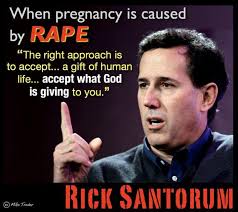
Even so, he found himself accused, during his 2012 campaign for President, of being “soft” on abortion.
In January, 2012, in advance of the South Carolina primary, pink fliers attacking Santorum’s credentials as an anti-abortionist began turning up on windshields at many political events in that state.
Their author was Elizabeth Leichert, an anti-abortion activist.
Dated January 18, 2012, the flier read:
“Like many Christians I know, I was originally very attracted to Rick Santorum’s positions – especially on the Right to Life issue.
“But that was before I began digging into his record….
“Did you know Rick Santorum’s wife, Karen, had a six-year affair with an abortionist named Tom Allen?
“…This abortion doctor was 30 years her senior! In fact, he delivered her as a baby!
“The only reason they broke up was that Karen wanted kids – while Tom was busy killing them.

Karen Garver and Dr. Thomas Allen
“In fact, he [Tom Allen] said, ‘Karen had no problems with what I did for a living,’ and said that Rick Santorum was ‘pro-choice and a humanist.’
“And this was only two years before Rick Santorum ran for Congress!
“After learning these facts, when it comes to Rick Santorum, I can’t help but think of him as a wolf in sheep’s clothing.
“We’ve certainly seen candidates over the years use their “faith” as a campaign issue. We’ve certainly seen candidates who tell us they’re pro-life and then act quite differently once elected.
“I’m afraid that’s describes Rick Santorum to a tee!
“You see, the attacks on him for funding Planned Parenthood are 100% true.
“He’s even stated in a TV interview that he supports Title X funding, which sends our tax dollars to Planned Parenthood! You can see for yourself on youtube.
“He’s also time and again endorsed pro-abortion Republicans who work to defeat any efforts by Congress to save the lives of the unborn.
“I’m writing you because I believe this race for President is critical. I’m worried the facts about Rick Santorum won’t get out in time for this South Carolina Primary, and pro-lifers will be fooled into voting someone like Rick Santorum who DOES NOT share our values.
“He just wants to be President so badly, he’ll say anything to be elected. Period.”
The flier was signed, “In Christ, Elizabeth Leichert.”
Click here: Rick Santorum Is Getting The Worst Of South Carolina’s Dirty Politics – Business Insider
Asked for his reaction, Santorum replied: “It’s ugly, it’s cheap, it’s tawdry. It has no relationship to the issues at hand in this race, and we’re gonna treat it just like the ridiculous stuff that you see where you treat it for the value it is, which is zero.”
The report may be “ugly, cheap and tawdry.” But it’s also apparently true.
As Karen Garver, the future Mrs. Santorum lived with obstetrician and abortionist Dr. Thomas E. Allen in Pittsburgh, Pennsylvania, for most of her 20s during the 1980s.
As a young nursing student, she shared his bed and liberal views on abortion, despite an age difference of 40 years.
Even more striking: Allen had delivered Karen as a baby in 1960. Her father, a pediatrician, got many client referrals through Allen.
‘When she moved out to go be with Rick,” Dr. Allen said in an interview in 2005, “she told me I’d like him, that he was pro-choice and a humanist. But I don’t think there’s a humanist bone in that man’s body.”
Click here: Rick Santorum’s wife Karen had love affair with abortion doctor | Daily Mail Online
Today, as Karen Santorum, she is the Catholic mother of seven and fiercely opposes abortion and birth control.

Karen Santorum
Since Rick Santorum declared himself a candidate for President in 2016, no mention has so far been made of his wife’s unorthodox past.
But abortion is the issue within the Republican party that ignites the greatest passion and fanaticism. There will always be those who consider themselves the most “pure” on this. And who are willing to act even more brutally on their fanaticism.
“Fanatics can justify practically any atrocity to themselves,” wrote the author Mercedes Lackey. “The more untenable their position becomes, the harder they hold to it, and the worse the things they are willing to do to support it.”
2012 PRESIDENTIAL CAMPAIGN, 2016 PRESIDENTIAL CAMPAIGN, ABC NEWS, ABORTION, ADOLF HITLER, BIRTH CONTROL, BROWNSHIRTS, CBS NEWS, CNN, FACEBOOK, HEINRICH HIMMLER, HERMAN GORING, JEWS, KAREN SANTORUM, MSNBC, NAZI GERMANY, NAZI PARTY, NBC NEWS, REINHARD HEYDRICH, REPUBLICAN PARTY, RICK SANTORUM, S.A., SAME-SEX MARRIAGE, SS, THE CHICAGO SUN-TIMES, THE CHICAGO TRIBUNE, THE HUFFINGTON POST, THE LOS ANGELES TIMES, THE NEW YORK TIMES, THE WALL STREET JOURNAL, THE WASHINGTON POST, TWITTER, USA TODAY
In Bureaucracy, History, Law, Politics, Social commentary on June 16, 2015 at 12:04 am
“All revolutions,” said Ernst Rohem, leader of Adolf Hitler’s brown-shirted thugs, the S.A., “devour their own children.”
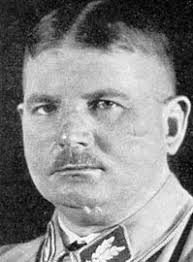
Ernst Rohem
Fittingly, he said this as he sat inside a prison cell awaiting his own execution.
On June 30, 1934, Hitler had ordered a massive purge of his private army, the S.A., or Stormtroopers. The purge was carried out by Hitler’s elite army-within-an-army, the Schutzstaffel, or Protective Squads, better known as the SS.
The S.A. Brownshirts had been instrumental in securing Hitler’s rise to Chancellor of Germany on January 30, 1933. They had intimidated political opponents and organized mass rallies for the Nazi Party.
But after Hitler reached the pinnacle of power, they became a liability.
Ernst Rohem, their commander, urged Hitler to disband the regular German army, the Reichswehr, and replace it with his own legions as the nation’s defense force.
Frightened by Rohem’s ambitions, the generals of the Reichswehr gave Hitler an ultimatum: Get rid of Rohem–or they would get rid of him.
So Rohem died in a hail of SS bullets–as did several hundred of his longtime S.A. cronies.
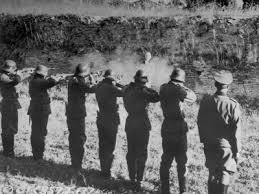
SS firing squad
Among the SS commanders supervising those executions was Reinhard Heydrich–a tall, blond-haired formal naval officer who was both a champion fencer and talented violinist.
Ultimately, he would become the personification of the Nazi ideal–”the man with the iron heart,” as Hitler eulogized at Heydrich’s funeral just eight years later.
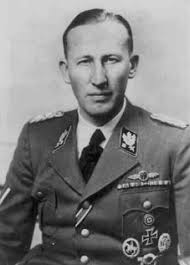
Reinhard Heydrich
Even so, Heydrich had a problem: He could never escape vicious rumors that his family tree contained a Jewish ancestor.
His paternal grandmother had married Reinhold Heydrich, and then Gustav Robert Suss. For unknown reasons, she decided to call herself Suss-Heydrich.
Since “Suss” was widely believed in Germany to indicate Jewish origin, the “stigma” of Jewish heritage attached itself to the Heydrich family.
Heydrich joined the SS in 1931 and quickly became head of its counterintelligence service. But his arrogance and overweening ambition created a great many enemies.
Only a year later, he became the target of an urgent investigation by the SS itself. The charge: That he was part-Jewish, the ultimate sin in Hitler’s “racially pure” Nazi Germany.
The investigation cleared Heydrich, but the rumor of his “tainted” origins persisted, clearly tormenting the second most powerful man in the SS. Even his superior, Heinrich Himmler, the Reichsfuhrer-SS, believed it.
When Heydrich was assassinated in 1942 by Czech commandos in Prague, Himmler attended his funeral. He paid tribute to his former subordinate at the service: ”You, Reinhard Heydrich, were a truly good SS-man.”
But he could not resist saying in private: “He was an unhappy man, completely divided against himself, as often happened with those of mixed race.”
Those who dare to harshly judge others usually find themselves assailed just as harshly.
A modern-day example is Rick Santorum, the former United States Senator from Pennsylvania (1995 – 2007) and a Republican candidate for President in 2012 and 2016.
Rick Santorum
From his entry into politics, Santorum has been a fierce opponent of legalized abortion and even birth control. Among his comments on these issues:
- On why abortion should be illegal even in rape cases: “I believe and I think the right approach is to accept this horribly created–in the sense of rape–but nevertheless a gift in a very broken way, the gift of human life, and accept what God has given to you.”
- On criminal penalties for doctors who perform abortion: “I believe that, that any doctor who performs an abortion–that–I would advocate that any doctor that performs an abortion should be criminally charged for doing so.”
- On de-funding Planned Parenthood: “I can’t imagine any other organization with its roots as poisonous as the roots of Planned Parenthood getting federal funding of any kind. This is an organization that was founded on the eugenics movement, founded on racism.”
- On opposing birth control: “One of the things I will talk about [if elected President in 2012] that no President has talked about before is I think the dangers of contraception in this country, the whole sexual libertine idea. Many in the Christian faith have said, ‘Well, that’s okay. Contraception’s okay.’ It’s not okay, because it’s a license to do things in the sexual realm that is counter to how things are supposed to be.”
So it no doubt came as a shock to Santorum–and his anti-abortion supporters–when he found himself accused of being “soft” on abortion.
The attack came in the form of pink fliers appearing on car windshields at many South Carolina political events in January, 2012.
They were the work of Elizabeth Leichert, an anti-abortion activist.
Dated January 18, 2012, the flier read:
“Like many Christians I know, I was originally very attracted to Rick Santorum’s positions – especially on the Right to Life issue.
“But that was before I began digging into his record….
“Did you know Rick Santorum’s wife, Karen, had a six-year affair with an abortionist named Tom Allen?”
9/11 ATTACKS, ABC NEWS, ADOLF HITLER, AFGHANISTAN, AL QAEDA, BARCK OBAMA, BASHAR AL-ASSAD, CARL VON CLAUSEWITZ, CARLOS THE JACKAL, CBS NEWS, CHEMICAL WEAPONS, CHINA, CNN, FACEBOOK, HARRY TRUMAN, IRAN, ISLAM, ISRAEL, MUSLIMS, NAZI GERMANY, NBC NEWS, OSAMA BIN LADEN, RUSSIA, SOVIET UNION, SYRIA, TERRORISM, THE LOS ANGELES TIMES, THE NEW YORK TIMES, THE WASHINGTON POST, TWITTER, VLADIMIR PUTIN, WORLD WAR 1
In Bureaucracy, History, Military, Politics, Social commentary on June 15, 2015 at 12:10 am
On April 16, the Syrian Observatory for Human Rights released some encouraging news for potential victims of Islamic terrorism–and those fighting it.

More than 310,000 people have been killed in Syria’s uprising-turned-civil war.
Put another way: More than 310,000 potential or actual Islamic terrorists will never again pose a threat to the United States or Western Europe.
The Syrian conflict began on March 15, 2011, triggered by protests demanding political reforms and the ouster of dictator Bashar al-Assad.
According to the Observatory, which is based in Britain:
- The total number of dead is now at 310,000.
- More than 37,000 rebels have been killed and over 46,000 from pro-Assad forces.
- At least 682 Hizbollah fighters.
- The true toll on both sides was likely much higher–by perhaps more than 60,000.
And who does the Syrian Observatory for Human Rights blame for this Islamic self-slaughter? Why, the West, of course.
According to its website:
“The silence of the International community for the war crimes and crimes against humanity committed in Syria encourages the criminals to kill more and more Syrian people because they have not found anyone that deter them from continuing their crimes that cause to wound more than 1500000 people; some of them with permanent disabilities, make hundreds of thousands children without parents, displace more than half of Syrian people and destroy infrastructure, private and public properties.”
310,000 people killed since the beginning of the Syrian Revolution | Syrian Observatory For Human Rights
Got that? “They have not found anyone that deter them from continuing their crimes”–as if it’s the duty of non-Muslims to bring civilized behavior to Islamics.
And why are all these murderers “continuing their crimes”? Because of an inner-religious dispute within Islam that traces back to the fourth century.
Yes, it’s Sunni Muslims, who make up a majority of Islamics, versus Shiite Muslims, who comprise a minority.
Each group considers the other takfirs–that is, “apostates.” And, in Islam, being labeled an apostate can easily get you murdered.
But, according to the Syrian Observatory, it’s the duty of the West to convince these murderers to stop slaughtering one another.
Think of it:
- In three years, 310,000 actual or potential enemies of Western Civilization have chosen to kill each other off.
- Additional thousands are certain to follow their example.
- And the United States cannot be held in any way responsible for it.
Meanwhile, Right-wing Republicans demand that the United States thrust itself into a conflict that doesn’t threaten Americans in any way.
Here are six excellent reasons why America should stay clear of the Syrian bloodbath:
1. Since 1979, Syria has been listed by the U.S. State Department as a sponsor of terrorism.
Among the terrorist groups it supports are Hizbollah and Hamas. For years, Syria provided a safehouse in Damascus to Ilich Ramírez Sánchez–-the notorious terrorist better known as Carlos the Jackal.
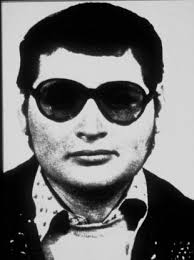
Ilich Ramírez Sánchez–“Carlos the Jackal”
2. There are no “good Syrians” for the United States to support–-only murderers who have long served a tyrant and other murderers who now wish to become the next tyrant.
3. The United States doesn’t know what it wants to do in Syria, other than “send a message.”
Carl von Clausewitz, the Prussian military theorist, wrote: “War is the continuation of state policy by other means.” But President Barack Obama hasn’t stated what he intends gain by attacking Syria.
Obama has said he’s “not after regime-change.” If true, that would leave Assad in power–-and free to go on killing those who resist his rule.
4. The Assad regime is backed by–-among others–-the Iranian-supported terrorist group, Hizbollah (Party of God). Its enemies include another terrorist group–Al Qaeda.
Hizbollah is comprised of Shiite Muslims. A sworn enemy of Israel, it has kidnapped scores of Americans suicidal enough to visit Lebanon and truck-bombed the Marine Barracks in Beirut in 1983, killing 299 Americans.

Flag of Hezbollah
Al-Qaeda, on the other hand, is made up of Sunni Muslims. Besides plotting 9/11, It has attacked the mosques and gatherings of liberal Muslims, Shias, Sufis and other non-Sunnis.
Examples of these sectarian attacks include the Sadr City bombings, the 2004 Ashoura massacre and the April, 2007 Baghdad bombings.

Flag of Al Qaeda
When your enemies are intent on killing each other, it’s best to stand aside and let them do it.
5. China and Russia are fully supporting the Assad dictatorship–-and the brutalities it commits against its own citizens.
This reflects badly on them–-not the United States.
And any move by the United States to directly attack the Assad regime could ignite an all-out war with Russia and/or China.
What happens if American and Russian forces start trading salvos? Or if Russian President Vladimir Putin orders an attack on Israel, in return for America’s attack on Russia’s ally, Syria?
It was exactly that scenario–Great Powers going to war over conflicts between their small-state allies–-that triggered World War l.
6. While Islamic nations like Syria and Iraq wage war within their own borders, they will lack the resources to launch attacks against the United States.
When Adolf Hitler invaded the Soviet Union in 1941, then-Senator Harry Truman said: “I hope the Russians kill lots of Nazis and vice versa.”
That should be America’s view whenever its sworn enemies start killing themselves off. Americans should welcome such self-slaughters, not become entrapped in them.
ABC NEWS, CBS NEWS, CHARLES BOWDEN, CIUDAD JUAREZ, CNN, CORRUPTION, DRUG LORDS, FACEBOOK, MEXICAN ARMY, MEXICO, MURDER CITY, NARCOTICS, NBC NEWS, THE CHICAGO SUN-TIMES, THE CHICAGO TRIBUNE, THE LOS ANGELES TIMES, THE NEW YORK TIMES, THE WASHINGTON POST, TWITTER, YANIRA MALDONADO
In Bureaucracy, History, Law Enforcement, Military, Politics, Social commentary on June 12, 2015 at 12:24 am
On May 22, 2013, Mexican soldiers arrested Yanira Maldonado–-mother of seven-–as she and her husband, Gary, were returning to Arizona after attending a family funeral in Mexico.
During a search of their bus at a military checkpoint in the northwestern state of Sonora, soldiers asked everyone to get off.

Yanira Maldonado
At first, Gary Maldonado was told that marijuana had been found under his seat and found himself arrested. After his father contacted the U.S. Consulate in Hermosillo, authorities said they were mistaken and released Gary.
Then they charged his wife, claiming they had found 12 pounds of marijuana under her bus seat.
After being detained in Mexico for more than a week on drug charges, Yanira Maldonado was released and returned to the United States.
Maldonado met with reporters briefly and said, “Many thanks to everyone, especially my God who let me go free, my family, my children, who with their help, I was able to survive this test.”
Gary Maldonado said he believed Mexican soldiers at the checkpoint wanted a bribe.
It’s entirely likely that this was the case.
Anyone who reads Murder City: Ciudad Juarez and the Global Economy’s New Killing Fields, will certainly think so.
Written by Investigative Reporter Charles Bowden and published in 2010, Murder City provides a terrifying–-and almost lethally depressing–-view of what happens when a city–-and a country–-disintegrates.
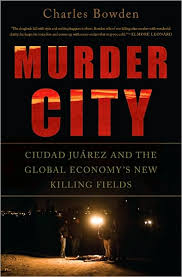
Ciudad Juárez lies just across the Rio Grande from El Paso, Texas. A once-thriving border town, it now resembles a failed state. Notorious as the place where women disappear, its murder rate exceeds that of Baghdad or Mogadishu.
It’s so overwhelmed with the violence of drug trafficking that its leading citizens—police, politicians, even the drug lords—find it safer to live in El Paso.
Hundreds of millions of narco-dollars flow into Juárez each week, and the violence and corruption that follow yield 200 to 300 murders each year.
Among the casualties of that violence:
- A reporter–who has dared to expose cartel-corrupted members of the Mexican Army–is forced to flee to the United States with his young son.
- A beautiful woman who became the mistress of one drug cartel leader is gang-raped by members of a rival cartel.
- A teenage killer for the cartels is now being hunted for having run afoul of his murderous bosses.
This is a city–-and a country–-where virtually no one is safe.
- Mexican police pay big bribes to be assigned to narcotics enforcement squads. The reason: Not to suppress the rampant drug trafficking but to enrich themselves by seizing and selling those narcotics.
- Residents awaken at dawn to find bodies of the drug cartels’ latest victims dumped on streets–their hands, feet and mouths bound with silver and gray duct tape.
- Mexican policewomen are often snatched off the streets and raped–by members of the Mexican Army.
- Honest policemen–and even police chiefs–are routinely gunned down by cartel members.
If there is any one story in Murder City that symbolizes the total corruption of a society awash with drugs and the profits they produce, it is this:
A Mexican priest serves as confessor to drug lords. They, in turn, believe their confessions to be safe, as they are supposed to be heard only by the priest and God.
But one of the drug lords wears a large gold crucifix, which the priest secretly covets.
So he turns from drug lord confessor to police informer–-and the Mexican police raid the next drug lord gathering and confiscate a large quantity of narcotics.
The police don’t intend to turn in the seized narcotics. Instead, they will sell these for their own profit.
And as a reward for his cooperation, the priest is given the large gold crucifix–-which he blesses and consecrates to his God.
Who, exactly, is behind all these killings?
And why?
And who, if anyone, is in charge of Juárez–-or Mexico?
Bowden states it is difficult to answer such questions because the Mexican press has been thoroughly corrupted by drug cartel monies or terrorized by drug cartel hit squads.
Reporters have been murdered–-by the cartels and the army–-for writing anything about killings, the army or the cartels.
The world of Murder City is a nightmarish one:
- Members of drug cartels live like kings.
- Their bribes and violence have corrupted all branches of the Mexican government, military and police forces.
- Ordinary Mexicans live in grinding poverty, thanks to American factories paying starvation wages
When you leave its pages, you are grateful that you can safely put its evil behind you–-unlike the residents of Juarez who remain trapped in its web.
Meanwhile, there is a lesson in this book–-and in the case of Yanira Maldonado–-for anyone with common sense to learn: Stay out of Mexico.
During the 1980s, when Americans were being routinely kidnapped in Beirut, still others–-as if bent on suicide–-were getting passports to travel to Lebanon.
For residents of this failed nation-state called Mexico, it’s too late. Such endemic corruption can never be fought successfully.
But for Americans who do not live there, the message should be clear: “Keep out. Enter at your own risk.”
9/11, ABC NEWS, AFGHANISTAN, BARACK OBAMA, CBS NEWS, CNN, COMMUNIST CHINA, CONFRONT AND CONCEAL, FACEBOOK, GEORGE H.W. BUSH, GEORGE W. BUSH, IRAQ, JOSEPH STALIN, NBC NEWS, NIKITA KHRUSHCHEV, THE LOS ANGELES TIMES, THE NEW YORK TIMES, THE PENTAGON, THE WASHINGTON POST, TWITTER, WALL STREET, WORLD TRADE CENTER
In Bureaucracy, History, Military, Politics, Social commentary on June 11, 2015 at 12:02 am
Psssst! The Republicans and Chinese Communists (“Chi-Coms”) have something in common.
They both much preferred the foreign policy of George W. Bush to that of Barack Obama.
It’s one of the many fascinating revelations offered in Confront and Conceal: Obama’s Secret Wars and Surprising Uses of American Power.

The author is David E. Sanger, the chief Washington correspondent for The New York Times.
Early in 2011, Sanger had lunch at the Central Party School outside Beijing. This is where the party’s leadership debates questions that are thought too controversial to air in public.
A retired general in the People’s Liberation Army sat down next to Sanger and, in a relaxed moment of candor, said:
“I sat through many meetings of the People’s Liberation Army in the 80s and 90s where we tried to imagine what your military forces would look like in 10 to 20 years.
“But frankly, we never thought that you would spend trillions of dollars and so much time tied down in Afghanistan and the Middle East. We never imagined that as a choice you would make.”

Chinese military parade
And, writes Sanger: “Not so secretly, the Chinese were delighted by the Bush-era wars. The longer the United States was bogged down trying to build democracies in foreign lands, the less capable it was of competing in China’s backyard.
“But now that America was emerging from a lost decade in the Middle East, the Chinese began to ask: How should China respond? With cooperation, confrontation, or something in-between?”
And the Chinese were equally thrilled that the United States had squandered so much of its treasury during the eight-year Bush Presidency.
In the decade following 9/11, the Pentagon went on an unprecedented spending binge. The defense budget grew by 67%, to levels 50% higher than it had been per average year during the Cold War.
According to Sanger: “An estimate [the New York Times] put together for the tenth anniversary of the [9/11] attacks suggested that the United States had spent at least $3.3 trillion.”
These monies had gone on
- securing the country;
- invading and trying to rebuild Afghanistan and Iraq; and
- caring for wounded American soldiers.
“Put another way,” writes Sanger, “for every dollar al-Qaeda spent destroying the World Trade Center and attacking the Pentagon, America had spent $6.6 million in response.
“The annual Pentagon budget of $700 billion was equivalent to the combined spending of the next twenty largest military powers….
“The world had come to expect that America would underwrite global security, regardless of the cost. Obama was determined to change that mind-set.”
In short, America became financially and militarily vulnerable during the Presidency of George W. Bush.
And this flatly contradicts the standard Republican line: Obama is a weak President–and is betraying us to the (pick one or both) Muslims/Communists.
It also speaks volumes that the two most important members of the George W. Bush administration declined to attend the 2012 Republican National Convention.
That, of course, meant former President Bush and Vice President Dick Cheney.
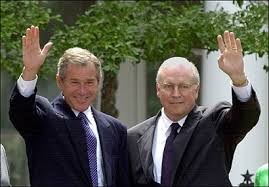
George W. Bush and Dick Cheney
And why was that? Perhaps it’s because polls show that a majority of Americans continue
- To blame Bush for lying the country into a needless, bloody and expensive war with Iraq.
- To blame him for presiding over the 2008 Wall Street meltdown.
- To see Dick Cheney as the Dr. Strangelovian manipulator of George W. Bush.
Even former President George H.W. Bush said he wouldn’t attend the convention.
It’s possible that Bush, Sr., didn’t want to serve as a reminder that his son left the White House with the lowest popularity rating of any modern President.
And that was just fine with those planning to attend the convention–especially its nominee-to-be, Mitt Romney.
They wanted to do with George W. Bush what Nikita Khrushchev and his fellow Communists did with the embarrassing Joseph Stalin: Bury him far from public view.
He didn’t want the viewing audience to be reminded that the United States sharply declined in wealth and prestige during the eight-year reign of George W. Bush and a Republican Congress.
Romney and his fellow conventioneers also didn’t want to remind the country of something else: That Obama has spent most of his own Presidency trying to undo the harm his predecessor did, in both foreign and domestic policy.
Thus, now approaching the 2016 election, the Republican party finds itself torn.
On one hand, its leaders want to claim that Barack Obama is the worst President in the history of the Republic.
On the other hand, they know that most Americans continue to view the last Republican President in just that way.
2016 PRESIDENTIAL RACE, ABC NEWS, ALTERNET, AP, ARTHUR WELLESLEY, BENJAMIN C. BRADLEE, BLACKMAIL, BUZZFEED, CBS NEWS, CNN, CROOKS AND LIARS, DAILY KOZ, DENNIS HASTERT, DUKE OF WELLINGTON, EXTORTION, FACEBOOK, FBI, FEDERAL BANKING LAWS, HARRIETTE WILSON, J. EDGAR HOOVER, JOHN F. KENNEDY, JOSEPH STOCKDALE, JUDITH CAMPBELL, MAFIA, MOTHER JONES, MOVEON, MSNBC, NBC NEWS, NEWSWEEK, NPR, PBS NEWSHOUR, POLITICO, RAW STORY, REPUBLICAN PARTY, REUTERS, ROBERT F. KENNEDY, SALON, SAM GIANCANA, SEATTLE TIMES, SLATE, THE ATLANTIC, THE CHICAGO SUN-TIMES, THE CHICAGO TRIBUNE, THE DAILY BEAST, THE GUARDIAN, THE HILL, THE HUFFINGTON POST, THE LOS ANGELES TIMES, THE NATION, THE NEW YORK TIMES, THE WASHINGTON POST, TIME, TWITTER, U.S. NEWS & WORLD REPORT, UPI, USA TODAY, WILLIAM C. SULLIVAN
In Bureaucracy, History, Law Enforcement, Politics, Social commentary on June 10, 2015 at 12:03 am
On May 28, Dennis Hastert, the former Republican Speaker of the House of Representatives (1999-2007) was indicted for violating federal banking laws and lying to the FBI.
He had tried to conceal $3.5 million in hush-money payments over several years to a man who was blackmailing him.

Dennis Hastert
The source of the blackmail: A homosexual–and possibly coerced–relationship with an underage student while Hastert was a teacher and wrestling coach at Yorkville High School, in Yorkville, Illinois–long before Hastert entered Congress in 1981.
Hastert wasn’t indicted for having had a sexual relationship with an underage student. The statute of limitations had long ago run out on that offense.
He was indicted for trying to evade federal banking laws and lying to the FBI.
According to the indictment, the FBI began investigating the cash withdrawals in 2013.
The Bureau wanted to know if Hastert was using the cash for criminal purposes or if he was the victim of a criminal extortion.
When questioned by the FBI, Hastert said he was storing cash because he didn’t feel safe with the banking system: “Yeah, I kept the cash. That’s what I’m doing.”
Thus, irony: By giving in to blackmail, Hastert:
- Lost $3.5 million;
- Unintentionally engineered his arrest and indictment; and
- Ensured that his darkest secret would be revealed.
There is a lesson to be learned here–one that longtime FBI Director J. Edgar Hoover well understood: Giving in to blackmail only empowers the blackmailer even more.
As William C. Sullivan, the onetime director of the FBI’s Domestic Intelligence Divison, revealed after Hoover’s death in 1972:
“The moment [Hoover] would get something on a senator, he’d send one of the errand boys up and advise the senator that ‘we’re in the course of an investigation, and we by chance happened to come up with this data on your daughter.
“‘But we wanted you to know this. We realize you’d want to know it.’ Well, Jesus, what does that tell the senator? From that time on, the senator’s right in his pocket.”
“Boy, the dirt he [Hoover] has on those Senators!” John F. Kennedy–a former Senator now President–gushed to his journalist-friend, Benjamin C. Bradlee.
Kennedy soon came to know that even Presidents could be targeted for blackmail.
In May, 1962, Hoover privately informed Kennedy that the FBI had learned that Judith Campbell, the mistress of Chicago Mafia boss Sam Giancana, had another bedmate: JFK himself.

John F. Kennedy, J. Edgar Hoover and Robert F. Kennedy
Hoover had feared being retired by the President’s brother, Attorney General Robert F. Kennedy. It had been RFK who had ordered Hoover to attack the Mafia as he had long attacked the Communist Party USA.
Now, as a result of that anti-Mob effort, the FBI had picked up evidence linking the President with the mistress of a top Mafia boss.
Hoover’s tenure as FBI director was thus assured–until his death on May 2, 1972, of a heart attack.
Narcotics agents have their own methods of blackmail in dealing with informants.
When a drug-abuser and/or dealer is coerced into becoming a “snitch,” the narcotics agent orders him to call another user/dealer he knows.
The agent then tapes the call–and makes sure his new informant knows it. From that moment, the “snitch” knows there’s no way out except cooperating with his new master.
The only effective way of handling blackmail was demonstrated by Arthur Wellesley, known to history as the Duke of Wellington.
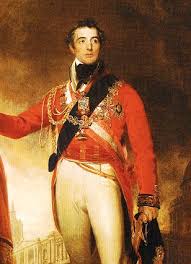
The Duke of Wellington
In 1815, he had defeated Napoleon at the battle of Waterloo, ending France’s longstanding threat to England. With that victory came the honors of a grateful nation.
Then, in December, 1824, Wellington found himself the target of blackmail by Joseph Stockdale, a pornographer and scandal-monger.
“My Lord Duke,” Stockdale write in a letter, “In Harriette Wilson’s memoirs, which I am about to publish, are various anecdotes of Your Grace which it would be most desirable to withhold….
“I have stopped the Press for the moment, but as the publication will take place next week, little delay can necessarily take place.”
Wilson was a famous London courtesan past her prime, then living in exile in Paris. She was asking Wellington to pay money to be left out of her memoirs.
From Wellington came the now-famous reply: “Publish and be damned!”
Wilson’s memoirs appeared in installments, naming half the British aristocracy and scandalizing London society.
And, true to her threat, she named Wellington as one of her lovers–and a not very satisfying one at that.
Wellington was a national hero, husband and father. Even so, his reputation did not suffer, and he went on to become prime minister.
Click here: Rear Window: When Wellington said publish and be damned: The Field Marshal and the Scarlet Woman – Voices
Dennis Hastert, former Speaker of the House, might now wish he had followed the example of the Duke of Wellington.
His reputation might have been trashed, but he wouldn’t now be facing prosecution.
As matter now stand, his reputation has been trashed, and he is facing prosecution.
ABC NEWS, AIG, BLOOD FEUD, CARLOS MARCELLO, CBS NEWS, CNN, COTTER SMITH, CUBA, ENRON, ERNEST BORGNINE, FACEBOOK, FBI, FIDEL CASTRO, INTERNATIONAL BROTHERHOOD OF TEAMSTERS, J. EDGAR HOOVER, JAMES R. HOFFA, JOHN F. KENNEDY, JUSTICE DEPARTMENT, LABOR UNIONS, MAFIA, NBC NEWS, ROBERT BLAKE, ROBERT F. KENNEDY, SAM GROOM, SENATE LABOR RACKETS COMMITEE, THE CHICAGO SUN-TIMES, THE CHICAGO TRIBUNE, THE LOS ANGELES TIMES, THE NEW YORK TIMES, THE WALL STREET JOURNAL, THE WASHINGTON POST, TWITTER, USA TODAY
In Bureaucracy, History, Law Enforcement, Politics, Social commentary on June 9, 2015 at 12:02 am
The 1983 TV mini-series, “Blood Feud,” chronicles the decade-long struggle between Robert F. Kennedy and James R. Hoffa.

As Attorney General, Kennedy declares war–for the first time in American history–on the Mafia. He forces longtime FBI Director J. Edgar Hoover–who has long refused to tackle the Mob–to investigate and arrest mobsters throughout the nation.
He also brings new charges against Hoffa–and, once again, is outraged to see Hoffa acquitted.
But under the unrelenting pressures of being in the crosshairs of the FBI, Hoffa begins to crack. He tells a trusted colleague, Edward Grady Partin (Brian Dennehy) how easy it would be to assassinate Kennedy with a rifle or a bomb.
Later, Partin gets into a legal jam–and is abandoned by the Teamsters. Hoping to cut a deal, he relays word to the Justice Department of Hoffa’s threats against the Attorney General.
Now working for the Justice Department, Partin sends in reports on Hoffa’s juror-bribing efforts in yet another trial. Hoffa again beats the rap–but now Kennedy has the insider’s proof he needs to put him away for years.
Meanwhile, the Mafia despairs of the increasing pressure of the Justice Department. At a swanky restaurant, several high-ranking members agree that “something” must be done.
[Although this scene is fictional, it’s clearly based on an infamous outburst of Carlos Marcello, the longtime Mafia boss of New Orleans.
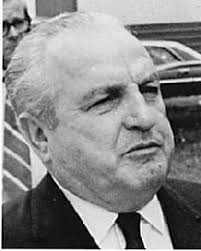 Carlos Marcello
In 1962, Marcello–who had been deported to Guatemala by RFK, then illegally re-entered the country–flew into a rage when a business colleague mentioned Kennedy.
“Take the stone out of my shoe!” he shouted, echoing a Sicilian curse. “Don’t you worry about that little Bobby sonofabitch. He’s going to be taken care of!”
When his colleague warned that murdering RFK would trigger the wrath of his brother, President John F.Kennedy, Marcello replied: “In Sicily they say if you want to kill a dog you don’t cut off the tail. You go for the head.”
Marcello considered President Kennedy to be the head. And he added that he planned to use a “nut” to do the job.]
On November 22, 1963, President John F. Kennedy is assassinated in Dallas. “Blood Feud” clearly implies that the Mafia was responsible.
[The House Assassinations Committee investigated this possibility in 1978, and determined that Marcello had the means, motiva and opportunity to kill JFK. But it could not find any conclusive evidence of his involvement.]
Even with the President dead, RFK’s Justice Department continues to pursue Hoffa. In 1964, he is finally convicted of jury tampering and sentenced to 13 years’ imprisonment.
Hoping to avoid prison, Hoffa phones Robert Kennedy, offering future Teamsters support if RFK runs for President. To prove he can deliver, he tells Kennedy that the Teamsters have even penetrated the FBI.
Kennedy confronts J. Edgar Hoover, accusing him of illegally planting wiretaps in Mob hangouts all over the country.
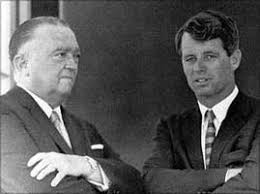
J. Edgar Hoover and Robert F. Kennedy
Hoover retorts that this had been the only way to obtain the prosecution-worthy intelligence Kennedy had demanded: “You loved that flow of information. You didn’t want it to stop.”
Kennedy: Why did you keep the FBI out of the fight against the Mob for decades?
Hoover: “Every agency that came to grips with them got corrupted by their money.”
[So far as is known, Hoover never made any such confession. Historians continue to guess his reason for leaving the Mob alone for decades.]
RFK then mentions the CIA’s plots to employ the Mob to assassinate Cuban dictator Fidel Castro
[The agency had wanted to please President Kennedy, and the Mafia had wanted to regain its casinos lost to the Cuban Revolution.]
“The CIA, doing business with the Mob,” says Kennedy. “The FBI, leaking information to its enemies [the Teamsters].” Then, sadly: “I guess it’s true–everyone does business with everyone.”
[So far as is known, the FBI did not pass on secrets to the Teamsters. But during the 1970s, the Mafia penetrated the Cleveland FBI office through bribes to a secretary. Several FBI Mob informants were “clipped” as a result.]
In 1967, Hoffa goes to prison. He stays there until, in 1971, President Richard Nixon commutes his sentence in hopes of gaining Teamsters support for his 1972 re-election.
Kennedy leaves the Justice Department in 1964 and is elected U.S. Senator from New York. In 1968 he runs for President. On June 5, after winning the California primary, he’s assassinated.
Hoffa schemes to return to the presidency of the Teamsters–a post now held by his successor, Frank Fitzsimmons. He runs the union in a more relaxed style than Hoffa, thus giving the Mob greater control over its pension fund.
And the Mafia likes it that way.
On July 30, 1975, Hoffa disappears from the parking lot of the Machus Red Fox Restaurant near Detroit. He had gone there to meet with two Mafia leaders.
Forty years later:
- Labor unions are a shadow of their former power.
- The threat they once represented to national prosperity has been replaced by that of predatory corporations like Enron and AIG.
- The war RFK began on the Mafia has continued, sending countless mobsters to prison.
- Millions of Americans who once expected the Federal Government to protect them from crime now believe the Government is their biggest threat.
- The idealism that fueled RFK’s life has virtually disappeared from politics.


ABC NEWS, ADOLF HITLER, ALTERNET, AMERICABLOG, AP, ARIZONA SHOOTINGS, ASSASSINATION, BABY BOOMER RESISTANCE, BARACK OBAMA, BILL CLINTON, BLOOMBERG, BUZZFEED, CBS NEWS, CHRISTINA-TAYLOR GREEN, CNN, CONFEDERATE FLAG, CROOKS AND LIARS, DAILY KOZ, DRUDGE REPORT, DYLANN ROOF, FACEBOOK, FBI, FIVETHIRTYEIGHT, GABRIELLE GIFFORDS, GEORGE H.W. BUSH, HARPER’S MAGAZINE, HATE CRIMES, HEALTHCARE, HUFFINGTON POST, MEDIA MATTERS, MEIN KAMPF, MOTHER JONES, MOVEON, MSNBC, NBC NEWS, NEWSWEEK, NEWT GINGRICH, NPR, PBS NEWSHOUR, POLITICO, POLITICUSUSA, RAW STORY, REP. GABRIELLE GIFFORDS, REPUBLICAN PARTY, REPUBLICANS, REUTERS, RICK PERRY, RICK SANTORUM, RODNEY KING RIOTS, ROLLING STONE MAGAZINE, SALON, Sarah Palin, SEATTLE TIMES, Secret Service, SLATE, TALKING POINTS MEMO, TEA PARTY, TERRORISM, THE ATLANTIC, THE CHICAGO SUN-TIMES, THE CHICAGO TRIBUNE, THE DAILY BEAST, THE DAILY BLOG, THE GUARDIAN, THE HILL, THE HUFFINGTON POST, THE LOS ANGELES TIMES, THE NATION, THE NEW REPUBLIC, THE NEW YORK TIMES, THE VILLAGE VOICE, THE WASHINGTON POST, THINKPROGRESS, TIME, TRUTHDIG, TRUTHOUT, TWITTER, TWO POLITICAL JUNKIES, U.S. DISTRICT JUDGE JOHN ROLL, U.S. MARSHALS SERVICE, U.S. NEWS & WORLD REPORT, UPI, USA TODAY
REPUBLICANS AND WEAPONIZED HATRED: PART ONE (OF FOUR)
In Bureaucracy, History, Law, Law Enforcement, Politics, Social commentary on June 23, 2015 at 3:39 pmOn June 17, 2015, Dylann Roof, a white high school dropout, gunned down three black men and six black women at Emanuel African Methodist Episcopal Church in Charleston, South Carolina.
At 21, Roof was unemployed, dividing his time between playing video games and taking drugs.
Dylann Roof
The signs of Roof’s malignant racism were evident long before he turned mass murderer:
The evidence makes clear that Roof’s slaughter was racially motivated. Yet one Republican Presidential candidate after another has refused to acknowledge it.
Jeb Bush, former governor of Florida: “I don’t know what was on the mind or the heart of the man who committed these atrocious crimes.”
Rick Santorum, former United States Senator from Pennsylvania: “You talk about the importance of prayer in this time and we’re now seeing assaults on our religious liberty we’ve never seen before. It’s a time for deeper reflection beyond this horrible situation.”
Bobby Jindal, former governor of Louisiana: “I don’t think we’ll ever know what was going on in his mind.”
But Rolling Stone magazine writer Jeb Lund left no doubt as to what–and who–was ultimately responsible for this crime: Racism and Republicans.
In a June 19 editorial–published two days after the massacre–Lund noted: “This [crime] is political because American movement conservatism has already made these kinds of killings political.
“The Republican Party has weaponized its supporters, made violence a virtue and, with almost every pronouncement for 50 years, given them an enemy politicized, racialized and indivisible.
“Movement conservatives have fetishized a tendentious and ahistorical reading of the Second Amendment to the point that the Constitution itself somehow paradoxically ‘legitimizes’ an armed insurrection against the government created by it.
“Those leading said insurrection are swaddled by the blanket exculpation of patriotism. At the same time, they have synonymized the Democratic Party with illegitimacy and abuse of the American order.
“This is no longer an argument about whether one party’s beliefs are beneficial or harmful, but an attitude that labels leftism so antithetical to the American idea that empowering it on any level is an act of usurpation.”
Click here: The Charleston Shooter: Racist, Violent, and Yes – Political | Rolling Stone
Lund is absolutely right. And the evidence for this was on display long before Dylann Roof opened fire on “uppity blacks” praying in their own church.
Consider:
On January 8, 2011, Democratic Rep. Gabrielle Giffords was shot in the head while meeting with constituents outside a grocery store in Tucson, Arizona. After a miraculous recovery, she continues to struggle with language and has lost 50% of her vision in both eyes.
Rep. Gabrielle Giffords
She vowed to return to her former Congressional duties, but was forced to resign for health reasons in 2012.
Giffords was only one victim of a shooting spree that claimed the lives of six people and left 13 others wounded.
Also killed was Arizona’s chief U.S. District judge, John Roll, who had just stopped by to see his friend Giffords after celebrating Mass.
Although the actual shooter, Jared Lee Loughner, was immediately arrested, those who fanned the flames of political violence that consumed 19 people that day have remained unpunished.
Consider the circumstances behind the shootings:
John Roll is Arizona’s chief federal judge. Appointed in 2006, he wins acclaim as a respected jurist and leader who pushes to beef up the court’s strained bench to handle a growing number of border crime-related cases.
In 2009, he becomes a target for threats after allowing a $32 million civil-rights lawsuit by illegal aliens to proceed against a local rancher. The case arouses the fury of local talk radio hosts, who encourage their audiences to threaten Roll’s life.
In one afternoon, Roll logs more than 200 threatening phone calls. Callers threaten the judge and his family. They post personal information about Roll online.
Roll and his wife are placed under fulltime protection by deputy U.S. marshals. Roll finds living under security “unnerving and invasive.”
Authorities identify four men believed responsible for the threats. But Roll declines to press charges on the advice of the Marshals Service.
Share this: