Posts Tagged ‘WORLD WAR ii’
2016 PRESIDENTIAL ELECTION, 2020 PRESIDENTIAL ELECTION, 9/11 ATTACKS, AARON COPELAND, ABC NEWS, AFGHANISTAN, ALEXANDER SHUSTOROVICH, ALTERNET, ANDREW INTRATER, ANTI-COMMUNISM, ANTIWAR DEMONSTRATIONS, AP, ARMY-MCCARTHY HEARINGS, ARTHUR MILLER, ATOMIC BOMB, BILL CLINTON, BUZZFEED, CBS NEWS, CENTRAL AMERICA, CHAING KAI-SHEK, CHARLIE CHAPLIN, CIA, CINDY HYDE-SMITH, CNN, CROOKS AND LIARS, CUBAN MISSILE CRISIS, DAILY KOZ, DASHIELL HAMMETT, DELORES DEL RIO, DEPARTMENT OF HOMELAND SECURITY, DONALD TRUMP, DONALD TRUMP’S INAUGURAL COMMITTEE, DWIGHT D. EISENHOWER, EDWARD G. ROBINSON, EDWARD R. MURROW, ELMER BERNSTEIN, FACEBOOK, FBI, FEDERAL ELECTION COMMISSION, GEORGE C. MARSHALL, GEORGE H.W. BUSH, H.L. HUNT, HARRY S. TRUMAN, HILLARY CLINTON, HOUSE JUDICIARY COMMITTEE, HOWARD DA SILVA, HOWARD FAST, HOWARD HUGHES, INTERNET RESEARCH AGENCY, IRWIN SHAW, J. ROBERT OPPENHEIMER, JAMES COMEY, JIMMY CARTER, JOHN BIRCH SOCIETY, JOHN F. KENNEDY, JOHN GARFIELD, JOHN KASICH, JOHN MCCAIN, JOHN STEINBECK, JOSEPH R. MCCARTHY, JOSEPH STALIN, LEE GRANT, LEN BLAVATNIK, LILLIAN HELLMAN, LINDSEY GRAHAM, LLOYD BRIDGES, LUCILLE BALL, LYNDON B. JOHNSON, MAIN INTELLIGENCE DIRECTORATE, MAO TSE-TUNG, MARCO RUBIO, MITCH MCCONNELL, MITCH MCCONNELL’S SENATE LEADERSHIP FUN, MOTHER JONES, MOVEON, MSNBC, MUSLIMS, NATIONAL SECURITY AGENCY, NAZI GERMANY, NBC NEWS, NEWSWEEK, NORTH ATLANTIC TREATY ORGANIZATION (NATO), NPR, OFFICE OF THE DIRECTOR OF NATIONAL INTELLIGENCE, PBS NEWSHOUR, PETE SEEGER, POLITICO, RAW STORY, REPUBLICAN PARTY, REUTERS, RICHARD M. NIXON, ROBERT MUELLER, Ronald Reagan, RUTH GORDON, SALON, SCOTT WALKER, SEATTLE TIMES, SIMON KUKES, SLATE, SOVIET UNION, THE ATLANTIC, THE CHICAGO SUN-TIMES, THE CHICAGO TRIBUNE, THE DAILY BEAST, THE GUARDIAN, THE HILL, THE HUFFINGTON POST, THE LOS ANGELES TIMES, THE NATION, THE NEW YORK TIMES, THE WASHINGTON POST, TIME, TWITTER, U.S. NEWS & WORLD REPORT, UNITED STATES HOUSE OF REPRESNTATIVES, UNITED STATES SENATE, UPI, USA TODAY, VIETNAM WAR, VLADIMIR PUTIN, WIKILEAKS, WILLIAM L. SHIRER, WORLD WAR 11, WORLD WAR ii, ZERO MOSTEL
In Bureaucracy, History, Military, Politics, Social commentary on November 5, 2019 at 12:10 am
From 1945 to 2015, it was unthinkable for a Republican Presidential candidate to pay tribute to a Soviet dictator.
But that utterly changed when Donald J. Trump, a “reality TV” host with longstanding financial ties to Russian oligarchs, ran for President of the United States.
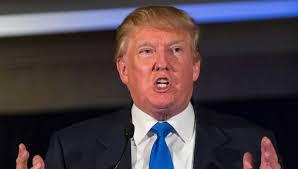
Donald Trump
The reason for the Trump-Putin bromance: Each had something to offer the other.
Putin wanted the United States to ditch the North Atlantic Treaty Organization (NATO) alliance, which had preserved Western Europe from Russian aggression since World War II. And Trump had often attacked America’s funding of NATO as a drain on the American economy.
And Trump wanted to be President. For this, Putin could supply Internet trolls to confuse voters with falsified news—and even the hacking of key voting centers.
And monies. These Russian monies were officially classified as “campaign contributions,” not bribes.
Special Counsel Robert S. Mueller III Mueller spent almost two years uncovering links between Russian Intelligence agents and members of Donald Trump’s Presidential campaign.
On July 24, he addressed Congress on Russia’s subversion of the 2016 Presidential election.
“Over the course of my career, I’ve seen a number of challenges to our democracy,” Mueller declared to members of the House Judiciary Committee.
“The Russian government’s effort to interfere in our election is among the most serious. As I said on May 29, this deserves the attention of every American.
“It wasn’t a single attempt. They’re doing it as we sit here. And they expect to do it during the next campaign.”
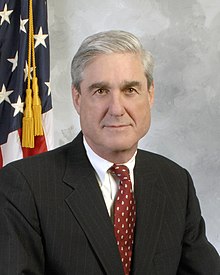
Robert Mueller
In his report, Mueller documented years of meddling in American politics by the Internet Research Agency, which runs the Kremlin’s online disinformation efforts from its headquarters in St. Petersburg.
The Agency reached 126 million Americans through fake accounts on Facebook. Its messages communicated with unaware members of the Trump campaign, and even prompted real-life rallies that mobilized crowds of unwitting voters.
Hours later that same day, Senator Cindy Hyde-Smith (R-Mississippi) blocked the passage of three bills designed to tighten election security at the federal level. She claimed that Congress had already responded to election security needs for the 2020 Presidential election.
Senate Majority Leader Mitch McConnell (R-Kentucky) came to the Senate floor the next day to personally object to House-passed legislation backed by Democrats.
Nor is Trump the only Republican receiving “help” from Putin. A network of Russian oligarchs—all of them answerable to Putin—has been increasingly contributing to top Republicans.
These Russian monies are officially classified as “campaign contributions,” not bribes—which, in fact, they are.
According to the Federal Election Commission:
One such major contributor is Len Blavatnik, who holds citizenship in both the United States and the United Kingdom. During the 2015-16 election cycle, he proved one of the largest donors to GOP Political Action Committees (PACs).
Blavatnik’s net worth is estimated at $20 billion. Before 2016, he donated to both Democrats and Republicans in meager amounts. But in 2016, he gave $6.35 million to GOP PACs.
Millions of dollars went to top Republican leaders—such as Senators Mitch McConnell (Kentucky), Marco Rubio (Florida) and Lindsey Graham (South Carolina).
Specifically, he contributed:
- A total of $1.5 million to PACs associated with Rubio.
- $1 million to Trump’s Inaugural Committee.
- $41,000 to both Republicans and Democrats in 2017.
- $1 million to McConnell’s Senate Leadership Fund.
- $3.5 million to a PAC associated with McConnell.
- $1.1 million to Unintimidated PAC, associated with Wisconsin Governor Scott Walker.
- $200,000 to the Arizona Grassroots Action PAC, associated with the late Arizona Senator John McCain.
- $250,000 to New Day for America PAC, associated with Ohio Governor John Kasich.
- $800,000 to the Security is Strength PAC, associated with Senator Lindsey Graham.
![]()
![]() Another Russian oligarch, Alexander Shustorovich, contributed $1 million to Trump’s Inaugural Committee.
Another Russian oligarch, Alexander Shustorovich, contributed $1 million to Trump’s Inaugural Committee.
Altogether, four Russian oligarchs—Blavatnik, Shustorovich, Andrew Intrater and Simon Kukes—contributed $10.4 million from the start of the 2015-16 election cycle through September 2017. Of this, 99% went to Republicans.
As Senate Majority Leader, Mitch McConnell participated in high-level intelligence briefings in 2016. From agencies such as the FBI, CIA and the code-cracking National Security Agency, he learned that the Russians were trying to subvert the electoral process.

In October, 2016, the Department of Homeland Security (DHS) and the Office of the Director of National Intelligence (DNI) issued a joint statement: The Russian government had directed the effort to subvert the 2016 Presidential election.
Two weeks later, McConnell’s PAC accepted a $1 million donation from Blavatnik.
On March 30, 2017, McConnell’s PAC accepted another $1 million from Blavatnik.
This is just 10 days after former FBI Director James Comey testified before the House Intelligence Committee about Russia’s efforts to subvert the 2016 election.
So, what has changed in the Republican Party? Essentially nothing.
Its enemies changed—from Russian Communists to American liberals. But its goal remains the same: The quest for absolute power.
When Americans feared Communism, Republicans depicted themselves as the only ones who could be trusted to protect the United States. Big contributions poured in from Right-wing billionaires like H.L. Hunt and Howard Hughes.
But then Republicans found they could enrich themselves and stay in power via Russian “campaign contributions.” So long as they did Putin’s bidding, the rubles would roll in.
So for a party of power-drunk would-be dictators, the decision was simple: Better Red than un-elected.
2016 PRESIDENTIAL ELECTION, 2020 PRESIDENTIAL ELECTION, 9/11 ATTACKS, AARON COPELAND, ABC NEWS, AFGHANISTAN, ALEXANDER SHUSTOROVICH, ALTERNET, ANDREW INTRATER, ANTI-COMMUNISM, ANTIWAR DEMONSTRATIONS, AP, ARMY-MCCARTHY HEARINGS, ARTHUR MILLER, ATOMIC BOMB, BILL CLINTON, BUZZFEED, CBS NEWS, CENTRAL AMERICA, CHAING KAI-SHEK, CHARLIE CHAPLIN, CIA, CINDY HYDE-SMITH, CNN, CROOKS AND LIARS, CUBAN MISSILE CRISIS, DAILY KOZ, DASHIELL HAMMETT, DELORES DEL RIO, DEPARTMENT OF HOMELAND SECURITY, DONALD TRUMP, DONALD TRUMP’S INAUGURAL COMMITTEE, DWIGHT D. EISENHOWER, EDWARD G. ROBINSON, EDWARD R. MURROW, ELMER BERNSTEIN, FACEBOOK, FBI, FEDERAL ELECTION COMMISSION, GEORGE C. MARSHALL, GEORGE H.W. BUSH, H.L. HUNT, HARRY S. TRUMAN, HILLARY CLINTON, HOUSE JUDICIARY COMMITTEE, HOWARD DA SILVA, HOWARD FAST, HOWARD HUGHES, INTERNET RESEARCH AGENCY, IRWIN SHAW, J. ROBERT OPPENHEIMER, JAMES COMEY, JIMMY CARTER, JOHN BIRCH SOCIETY, JOHN F. KENNEDY, JOHN GARFIELD, JOHN KASICH, JOHN MCCAIN, JOHN STEINBECK, JOSEPH R. MCCARTHY, JOSEPH STALIN, LEE GRANT, LEN BLAVATNIK, LILLIAN HELLMAN, LINDSEY GRAHAM, LLOYD BRIDGES, LUCILLE BALL, LYNDON B. JOHNSON, MAIN INTELLIGENCE DIRECTORATE, MAO TSE-TUNG, MARCO RUBIO, MITCH MCCONNELL, MITCH MCCONNELL’S SENATE LEADERSHIP FUN, MOTHER JONES, MOVEON, MSNBC, MUSLIMS, NATIONAL SECURITY AGENCY, NAZI GERMANY, NBC NEWS, NEWSWEEK, NORTH ATLANTIC TREATY ORGANIZATION (NATO), NPR, OFFICE OF THE DIRECTOR OF NATIONAL INTELLIGENCE, PBS NEWSHOUR, PETE SEEGER, POLITICO, RAW STORY, REPUBLICAN PARTY, REUTERS, RICHARD M. NIXON, ROBERT MUELLER, Ronald Reagan, RUTH GORDON, SALON, SCOTT WALKER, SEATTLE TIMES, SIMON KUKES, SLATE, SOVIET UNION, THE ATLANTIC, THE CHICAGO SUN-TIMES, THE CHICAGO TRIBUNE, THE DAILY BEAST, THE GUARDIAN, THE HILL, THE HUFFINGTON POST, THE LOS ANGELES TIMES, THE NATION, THE NEW YORK TIMES, THE WASHINGTON POST, TIME, TWITTER, U.S. NEWS & WORLD REPORT, UNITED STATES HOUSE OF REPRESNTATIVES, UNITED STATES SENATE, UPI, USA TODAY, VIETNAM WAR, VLADIMIR PUTIN, WIKILEAKS, WILLIAM L. SHIRER, WORLD WAR ii, ZERO MOSTEL
In Bureaucracy, History, Military, Politics, Social commentary on November 4, 2019 at 12:15 am
There was a time when Republicans saw—and portrayed—themselves as America’s foremost defenders against Communism.
This was particularly true during the early 1950s. Case in point: Wisconsin United States Senator Joseph R. McCarthy.
Elected to the Senate in 1946, he rose to national prominence on February 9, 1950, after giving a fiery speech in Wheeling, West Virginia:
“The State Department is infested with communists. I have here in my hand a list of 205—a list of names that were made known to the Secretary of State as being members of the Communist Party and who nevertheless are still working and shaping policy in the State Department.”
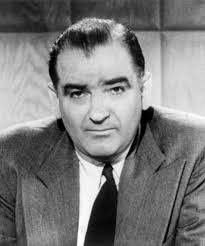
Joseph McCarthy
Americans were already growing increasingly fearful of Communism:
- Soviet dictator Joseph Stalin had not withdrawn the Red Army from the countries it had occupied in Eastern Europe during World War II.
- In 1948, the Soviet Union developed—and demonstrated—its own atomic bomb, an achievement U.S. scientists had claimed would not happen for at least a decade.
- In 1949, China fell to the triumphant armies of Mao Tse Tung. Generalissimo Chaing Kai Shek was driven from mainland China to the tiny island of Taiwan.
Anti-communism as a lever to political advancement sharply accelerated following McCarthy’s speech.
No American—no matter how prominent—was safe from the accusation of being a Communist or a Communist sympathizer—”a Comsymp” or “fellow traveler” in the language of the era.
Among those accused:
- Secretary of State George C. Marshall, who had overseen America’s strategy for defeating Nazi Germany and Imperial Japan.
- President Harry S. Truman.
- Playwrights Lillian Hellman and Arthur Miller.
- Folksinger Pete Seeger.
- Actors Charlie Chaplin, Zero Mostel, Lloyd Bridges, Howard Da Silva, Edward G. Robinson and John Garfield.
- Composers Arron Copland and Elmer Bernstein.
- Physicist J. Robert Oppenheimer, who presided over the creation of America’s atomic bomb, thus forcing Japan to surrender.
- Actresses Lee Grant, Delores del Rio, Ruth Gordon and Lucille Ball.
- Journalists Edward R. Murrow and William L. Shirer, who had chronicled the rise of Nazi Germany.
- Writers Irwin Shaw, Howard Fast, John Steinbeck and Dashiell Hammett
Even prominent Republicans became targets for slanderous attacks on their patriotism. The most prominent of these: President Dwight D. Eisenhower—was labeled ”a conscious, dedicated agent of the Communist Conspiracy” by Robert Welch, founder of the John Birch Society in 1958.
In 1953, McCarthy attacked the leadership of the United States Army as “a hotbed of traitors” and convened an inquiry through the Senate Permanent Subcommittee on Investigations.
But the hearings exposed McCarthy as a bullying demagogue. A Senate committee condemned his behavior for “bring[ing] the Senate into dishonor and disrepute.” Shunned in disgrace by his onetime colleagues, McCarthy drowned his sorrows in alcohol, dying in 1957.
But even without McCarthy, Republicans rode the issue of anti-Communism to victory from 1948 to 1992. “Respectable” anti-Communists—like Richard M. Nixon—depicted themselves as the only ones who could be trusted to safeguard America.
Republicans held the White House for eight years under Dwight D. Eisenhower, then lost it in 1960 to John F. Kennedy and again in 1964 to Lyndon B. Johnson.
By 1968, with the nation mired in Vietnam and convulsed by antiwar demonstrations and race riots, Americans elected Richard Nixon, who preyed upon their fears and hates of blacks and “the Communist menace.”
The same strategy re-elected him in 1972.
Jimmy Carter won the Presidency in 1976 and lost it in 1980 to Ronald Reagan. And Republicans held the White House until 1992.
Upon taking office as President in 1981, Ronald Reagan decided to end the “stalemate” of “containing” Communism. He intended to “roll it back.”
American proxies fought Soviet proxies in Afghanistan and Central America, but the world escaped nuclear holocaust.
During the 1980s and 1990s, Republicans continued to accuse Democrats of being devious agents—or at least unwitting pawns—of “the Communist conspiracy.”
In 1992, President George H.W. Bush and the Republican establishment charged that Arkansas Governor Bill Clinton might be a KGB plant.
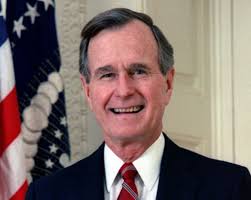
George H.W. Bush
Their “evidence”: During his tenure at Oxford University in 1969-70, Clinton had briefly visited Moscow.
After the Soviet Union’s collapse in 1991, Republicans found that accusing Democrats of being “Commies” didn’t carry the same weight.
So they turned to “domestic enemies” to rail—and run—against: Liberals, blacks, Hispanics, “uppity” women, war protesters, lesbians, gays, and—after 9/11—Muslims.
From 1945 to 2015, it was unthinkable for a Republican Presidential candidate to pay tribute to a Soviet dictator.
But that utterly changed when Donald J. Trump, a “reality TV” host with longstanding financial ties to Russian oligarchs, ran for President of the United States.
Donald Trump
Trump lavishly praised Russian President Vladimir Putin—and even invited him to directly interfere in the 2016 Presidential race.
The reason for the Trump-Putin bromance: Each had something to offer the other.
Putin wanted the United States to ditch the North Atlantic Treaty Organization (NATO) alliance, which had preserved Western Europe from Russian aggression since World War II. And Trump had often attacked America’s funding of NATO as a drain on the American economy.
And Trump wanted to be President. For this, Putin could supply monies, Internet trolls to confuse voters with falsified news—and even the hacking of key voting centers.
ABC NEWS, AFFORDABLE CARE ACT, ALTERNET, AMERICABLOG, AMERICAN NAZI PARTY, AP, BABY BOOMER RESISTANCE, BARACK OBAMA, BUZZFEED, CBS NEWS, CNN, CROOKS AND LIARS, DAILY KOZ, FACEBOOK, FIVETHIRTYEIGHT, FOX NEWS, FRANCE, GEORGE W. BUSH, GREAT BRITAIN, IRAQ, JEAN SCHMIDT, KU KLUX KLAN, MEDICARE, MOTHER JONES, MOVEON, MSNBC, NBC NEWS, NEWSWEEK, NPR, OBAMACARE, OSAMA BIN LADEN, PBS NEWSHOUR, POLITICO, POLITICUSUSA, RAW STORY, REPUBLICANS, REUTERS, Ronald Reagan, SADDAM HUSSEIN, SALON, SEATTLE TIMES, SLATE, SOCIAL SECURITY, SOVIET UNION, SUPREME COURT, TALKING POINTS MEMO, THE ATLANTIC, THE CHICAGO SUN-TIMES, THE CHICAGO TRIBUNE, THE DAILY BEAST, THE DAILY BLOG, THE GUARDIAN, THE HILL, THE HUFFINGTON POST, THE LOS ANGELES TIMES, THE NATION, THE NEW YORK TIMES, THE WASHINGTON POST, THINKPROGRESS, TIME, TRUTHDIG, TWITTER, U.S. NEWS & WORLD REPORT, UNITED STATES CONSTITUTION, UPI, USA TODAY, WALL STREET "MELTDOWN, WAR CRIMES, WEAPONS OF MASS DESTRUCTION, WEHRMACHT, WORLD WAR ii
In Bureaucracy, History, Law, Politics, Social commentary on September 24, 2019 at 12:10 am
Seven years after Congress passed the Affordable Care Act (ACA) Republicans remained determined to deny giving all Americans access to healthcare.
A July 29, 2017 Newsweek article, “GOP Aims to Kill Obamacare Yet Again After Failing 70 Times,” states: “Newsweek has found at least 70 Republican-led attempts to repeal, modify or otherwise curb the Affordable Care Act [ACA] since its inception as law on March 23, 2010.”
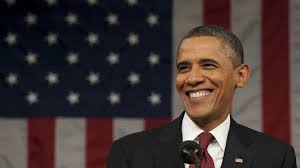
Barack Obama
The previous President, George W. Bush, had lied the nation into a needless and destructive war with Iraq by repeatedly claiming that:
- Saddam Hussein and Osama bin Laden had teamed up to bring on 9/11;
- Saddam was going to get a nuclear weapon; or
- Saddam already had a nuclear weapon and intended to use it against the United States.
That war cost the lives of 4,486 Americans and well over $1 trillion.
And Republicans had fully supported those expenditures—of lives and money.
And Bush—taking a “hands-off-business” attitude—had presided over the 2008 Wall Street “meltdown.” By the time Obama took office in 2009, the unchecked greed and stupidity of wealthy businessmen threatened to bankrupt the country.
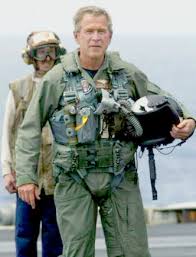
George W. Bush
But for the American Right, these weren’t crimes. They were simply incidents to be ignored or arrogantly explained away.
And there was always the predictable rants about the dangers of “socialized medicine.” (The fact that countries like France and Britain have had “socialized medicine” for decades and are still solvent and powerful has no meaning for these ideologues.)
But then President Obama sought to provide full medical coverage for all Americans, regardless of wealth.
And that—for the American Right—was a crime beyond forgiveness.
As President Obama’s best-known achievement, its destruction by the Supreme Court would discredit the reputation of its creator. And this would arm Republicans with a potent election-time weapon for making Obama a one-term President.
On June 28, 2012, the United States Supreme Court upheld the constitutionality of the Act, otherwise known as Obamacare.
Republicans expected this to be their day. The day when the Court struck down the ACA. It would be a day to celebrate—and to revel in the sheer ecstasy of their hatred for the country’s first black President.
Among those Right-wingers poised to celebrate on the morning of June 28 was Ohio Congresswoman Jean Schmidt.

Jean Schmidt
Wearing a white dress, she stood in front of the Supreme Court waiting to hear about the healthcare ruling—when the joyful news came: The Court had ruled the Act was not enforceable under the interstate commerce clause of the Constitution!
This was in fact true—and reported on CNN and Fox News. But it was not the whole story.
“Yes! Yes!” Schmidt screamed. “Oh, what else? Thank God! No, they struck down the individual mandate! They took it away! Yes!”
Her fascistic joy manifested itself in ear-splitting screeches and air punches. Her entire body rocked up and down, shuddering with the ecstasy of passion. She resembled, more than anything else, a woman caught up in the frenzy of an orgasm.
In this case, an orgasm of pure, undisguised hatred—
- for the Affordable Healthcare Act;
- for those millions of uninsured Americans needing healthcare coverage; and,
- above all, for the President himself.
It was a lust so demonic, so characteristic of the all-out, lethal hatred that Republicans aimed at Obama, that it had to be seen for its full, revolting quality to be felt.
Click here: Rep “Mean Jean” Schmidt Wigs Out Thinking Supreme Court Struck Down Health Care Reform – YouTube
But then came the bad news.
The Court had ruled that the Act was Constitutional under the power of the Congress to levy taxes. Thus, the hated individual mandate—requiring the wealthy to buy insurance—was legal after all.
There are three major reasons for Republicans’ vicious opposition to the Affordable Care Act:
- It was backed by and implemented under a black President;
- Republicans want to placate their “campaign contributors” (i.e., bribers) in the insurance and medical industries; and
- By making healthcare unavailable to poor and middle-class Americans, they expect to kill off, by illness and disability, millions of people they despise and consider disposable.
This last goal dovetails nicely with Republicans’ all-out assault on Social Security, Medicare and social services programs. By eliminating these social safety nets, Republicans intend to deprive their recipients of access to food, clothing and shelter.
If this seems outrageous, consider this:
When Nazi Germany invaded the Soviet Union in 1941, the Wehrmacht slaughtered at least 2.6 million captured Russians without firing a shot. They were deliberately fenced out in the cold without medical care or food.
And while Republicans attack their critics as Nazis, they have reached into the depths of Nazi history for many of their goals.
What Ronald Reagan once said about the leadership of the Soviet Union now applies to the leadership of his own party: “The only morality they recognize is what will further their cause, meaning they reserve unto themselves the right to commit any crime, to lie, to cheat.”
2016 PRESIDENTIAL ELECTION, 2020 PRESIDENTIAL ELECTION, 9/11 ATTACKS, AARON COPELAND, ABC NEWS, AFGHANISTAN, ALEXANDER SHUSTOROVICH, ALTERNET, ANDREW INTRATER, ANTI-COMMUNISM, ANTIWAR DEMONSTRATIONS, AP, ARMY-MCCARTHY HEARINGS, ARTHUR MILLER, ATOMIC BOMB, BILL CLINTON, BUZZFEED, CBS NEWS, CENTRAL AMERICA, CHAING KAI-SHEK, CHARLIE CHAPLIN, CIA, CINDY HYDE-SMITH, CNN, CROOKS AND LIARS, CUBAN MISSILE CRISIS, DAILY KOZ, DASHIELL HAMMETT, DELORES DEL RIO, DEPARTMENT OF HOMELAND SECURITY, DONALD TRUMP, DONALD TRUMP’S INAUGURAL COMMITTEE, DWIGHT D. EISENHOWER, EDWARD G. ROBINSON, EDWARD R. MURROW, ELMER BERNSTEIN, FACEBOOK, FBI, FEDERAL ELECTION COMMISSION, GEORGE C. MARSHALL, GEORGE H.W. BUSH, H.L. HUNT, HARRY S. TRUMAN, HILLARY CLINTON, HOUSE JUDICIARY COMMITTEE, HOWARD DA SILVA, HOWARD FAST, HOWARD HUGHES, INTERNET RESEARCH AGENCY, IRWIN SHAW, J. ROBERT OPPENHEIMER, JAMES COMEY, JIMMY CARTER, JOHN BIRCH SOCIETY, JOHN F. KENNEDY, JOHN GARFIELD, JOHN KASICH, JOHN MCCAIN, JOHN STEINBECK, JOSEPH R. MCCARTHY, JOSEPH STALIN, LEE GRANT, LEN BLAVATNIK, LILLIAN HELLMAN, LINDSEY GRAHAM, LLOYD BRIDGES, LUCILLE BALL, LYNDON B. JOHNSON, MAIN INTELLIGENCE DIRECTORATE, MAO TSE-TUNG, MARCO RUBIO, MITCH MCCONNELL, MITCH MCCONNELL’S SENATE LEADERSHIP FUN, MOTHER JONES, MOVEON, MSNBC, MUSLIMS, NATIONAL SECURITY AGENCY, NAZI GERMANY, NBC NEWS, NEWSWEEK, NORTH ATLANTIC TREATY ORGANIZATION (NATO), NPR, OFFICE OF THE DIRECTOR OF NATIONAL INTELLIGENCE, PBS NEWSHOUR, PETE SEEGER, POLITICO, RAW STORY, REPUBLICAN PARTY, REUTERS, RICHARD M. NIXON, ROBERT MUELLER, Ronald Reagan, RUTH GORDON, SALON, SCOTT WALKER, SEATTLE TIMES, SIMON KUKES, SLATE, SOVIET UNION, THE ATLANTIC, THE CHICAGO SUN-TIMES, THE CHICAGO TRIBUNE, THE DAILY BEAST, THE GUARDIAN, THE HILL, THE HUFFINGTON POST, THE LOS ANGELES TIMES, THE NATION, THE NEW YORK TIMES, THE WASHINGTON POST, TIME, TWITTER, U.S. NEWS & WORLD REPORT, UNITED STATES HOUSE OF REPRESNTATIVES, UNITED STATES SENATE, UPI, USA TODAY, VIETNAM WAR, VLADIMIR PUTIN, WIKILEAKS, WILLIAM L. SHIRER, WORLD WAR ii, ZERO MOSTEL
In Bureaucracy, Entertainment, History, Military, Politics, Social commentary on July 31, 2019 at 12:25 am
Upon taking office as President in 1981, Ronald Reagan decided to end the “stalemate” of “containing” Communism. He intended to “roll it back.”
American proxies fought Soviet proxies in Afghanistan and Central America, but the world escaped nuclear holocaust.
During the 1980s and 1990s, Republicans continued to accuse Democrats of being devious agents—or at least unwitting pawns—of “the Communist conspiracy.”
In 1992, President George H.W. Bush and the Republican establishment charged that Arkansas Governor Bill Clinton might be a KGB plant.
George H.W. Bush
Their “evidence”: During his tenure at Oxford University in 1969-70, Clinton had briefly visited Moscow.
After the Soviet Union’s collapse in 1991, Republicans found that accusing Democrats of being “Commies” didn’t carry the same weight.
So they turned to “domestic enemies” to rail—and run—against: Liberals, blacks, Hispanics, “uppity” women, war protesters, lesbians, gays, and—after 9/11—Muslims.
From 1945 to 2015, it was unthinkable for a Republican Presidential candidate to pay tribute to a Soviet dictator.
But that utterly changed when Donald J. Trump, a “reality TV” host with longstanding financial ties to Russian oligarchs, ran for President of the United States.
Donald Trump
Trump lavishly praised Russian President Vladimir Putin—and even invited him to directly interfere in the 2016 Presidential race.
The reason for the Trump-Putin bromance: Each had something to offer the other.
Putin wanted the United States to ditch the North Atlantic Treaty Organization (NATO) alliance, which had preserved Western Europe from Russian aggression since World War II. And Trump had often attacked America’s funding of NATO as a drain on the American economy.
And Trump wanted to be President. For this, Putin could supply Internet trolls to confuse voters with falsified news—and even the hacking of key voting centers.
And monies. These Russian monies were officially classified as “campaign contributions,” not bribes.
On July 22, 2016, Wikileaks released 19,252 emails and 8,034 attachments hacked from computers of the highest-ranking officials of the Democratic National Committee (DNC). Early reports traced the leak to Russian hackers.
On July 27, Trump said at a press conference in Doral, Florida: “Russia, if you are listening, I hope you are able to find the 33,000 emails that are missing [from Democratic Presidential candidate Hillary Clinton’s computer]. I think you will probably be rewarded mightily by our press.”
Hours later, the Main Intelligence Directorate in Moscow targeted Clinton’s personal office and hit more than 70 other Clinton campaign accounts.
This is treason—calling upon a foreign power, hostile to the United States, to interfere in its Presidential election.
Nor is Trump the only Republican receiving “help” from Putin. A network of Russian oligarchs—all of them answerable to Putin—has been increasingly contributing to top Republicans.
According to the Federal Election Commission:
One such major contributor is Len Blavatnik, who holds citizenship in both the United States and the United Kingdom. During the 2015-16 election cycle, he proved one of the largest donors to GOP Political Action Committees (PACs).
Blavatnik’s net worth is estimated at $20 billion. Before 2016, he donated to both Democrats and Republicans in meager amounts. But in 2016, he gave $6.35 million to GOP PACs.
Millions of dollars went to top Republican leaders—such as Senators Mitch McConnell (Kentucky), Marco Rubio (Florida) and Lindsey Graham (South Carolina).
Specifically, he contributed:
- A total of $1.5 million to PACs associated with Rubio.
- $1 million to Trump’s Inaugural Committee.
- $41,000 to both Republicans and Democrats in 2017.
- $1 million to McConnell’s Senate Leadership Fund.
- $3.5 million to a PAC associated with McConnell.
- $1.1 million to Unintimidated PAC, associated with Wisconsin Governor Scott Walker.
- $200,000 to the Arizona Grassroots Action PAC, associated with the late Arizona Senator John McCain.
- $250,000 to New Day for America PAC, associated with Ohio Governor John Kasich.
- $800,000 to the Security is Strength PAC, associated with Senator Lindsey Graham.
![]()
![]() Another Russian oligarch, Alexander Shustorovich, contributed $1 million to Trump’s Inaugural Committee.
Another Russian oligarch, Alexander Shustorovich, contributed $1 million to Trump’s Inaugural Committee.
Altogether, four Russian oligarchs—Blavatnik, Shustorovich, Andrew Intrater and Simon Kukes—contributed $10.4 million from the start of the 2015-16 election cycle through September 2017. Of this, 99% went to Republicans.
As Senate Majority Leader, Mitch McConnell participated in high-level intelligence briefings in 2016. From agencies such as the FBI, CIA and the code-cracking National Security Agency, he learned that the Russians were trying to subvert the electoral process.
In October, 2016, the Department of Homeland Security (DHS) and the Office of the Director of National Intelligence (DNI) issued a joint statement: The Russian government had directed the effort to subvert the 2016 Presidential election.
Two weeks later, McConnell’s PAC accepted a $1 million donation from Blavatnik.
On March 30, 2017, McConnell’s PAC accepted another $1 million from Blavatnik.
This is just 10 days after former FBI Director James Comey testified before the House Intelligence Committee about Russia’s efforts to subvert the 2016 election.
So, what has changed in the Republican Party? Essentially nothing.
Its enemies changed—from Russian Communists to American liberals—but its goal remains the same: The quest for absolute power.
When Americans feared Communism, Republicans depicted themselves as the only ones who could be trusted to protect the United States. Big contributions poured in from Right-wing billionaires like H.L. Hunt and Howard Hughes.
But when Republicans found they could enrich themselves and stay in power via Russian “campaign contributions,” they decided: Better Red than un-elected.
2016 PRESIDENTIAL ELECTION, 2020 PRESIDENTIAL ELECTION, 9/11 ATTACKS, AARON COPELAND, ABC NEWS, AFGHANISTAN, ALEXANDER SHUSTOROVICH, ALTERNET, ANDREW INTRATER, ANTI-COMMUNISM, ANTIWAR DEMONSTRATIONS, AP, ARMY-MCCARTHY HEARINGS, ARTHUR MILLER, ATOMIC BOMB, BILL CLINTON, BUZZFEED, CBS NEWS, CENTRAL AMERICA, CHAING KAI-SHEK, CHARLIE CHAPLIN, CIA, CINDY HYDE-SMITH, CNN, CROOKS AND LIARS, CUBAN MISSILE CRISIS, DAILY KOZ, DASHIELL HAMMETT, DELORES DEL RIO, DEPARTMENT OF HOMELAND SECURITY, DONALD TRUMP, DONALD TRUMP’S INAUGURAL COMMITTEE, DWIGHT D. EISENHOWER, EDWARD G. ROBINSON, EDWARD R. MURROW, ELMER BERNSTEIN, FACEBOOK, FBI, FEDERAL ELECTION COMMISSION, GEORGE C. MARSHALL, GEORGE H.W. BUSH, H.L. HUNT, HARRY S. TRUMAN, HILLARY CLINTON, HOUSE JUDICIARY COMMITTEE, HOWARD DA SILVA, HOWARD FAST, HOWARD HUGHES, INTERNET RESEARCH AGENCY, IRWIN SHAW, J. ROBERT OPPENHEIMER, JAMES COMEY, JIMMY CARTER, JOHN BIRCH SOCIETY, JOHN F. KENNEDY, JOHN GARFIELD, JOHN KASICH, JOHN MCCAIN, JOHN STEINBECK, JOSEPH R. MCCARTHY, JOSEPH STALIN, LEE GRANT, LEN BLAVATNIK, LILLIAN HELLMAN, LINDSEY GRAHAM, LLOYD BRIDGES, LUCILLE BALL, LYNDON B. JOHNSON, MAIN INTELLIGENCE DIRECTORATE, MAO TSE-TUNG, MARCO RUBIO, MITCH MCCONNELL, MITCH MCCONNELL’S SENATE LEADERSHIP FUN, MOTHER JONES, MOVEON, MSNBC, MUSLIMS, NATIONAL SECURITY AGENCY, NAZI GERMANY, NBC NEWS, NEWSWEEK, NORTH ATLANTIC TREATY ORGANIZATION (NATO), NPR, OFFICE OF THE DIRECTOR OF NATIONAL INTELLIGENCE, PBS NEWSHOUR, PETE SEEGER, POLITICO, RAW STORY, REPUBLICAN PARTY, REUTERS, RICHARD M. NIXON, ROBERT MUELLER, Ronald Reagan, RUTH GORDON, SALON, SCOTT WALKER, SEATTLE TIMES, SIMON KUKES, SLATE, SOVIET UNION, THE ATLANTIC, THE CHICAGO SUN-TIMES, THE CHICAGO TRIBUNE, THE DAILY BEAST, THE GUARDIAN, THE HILL, THE HUFFINGTON POST, THE LOS ANGELES TIMES, THE NATION, THE NEW YORK TIMES, THE WASHINGTON POST, TIME, TWITTER, U.S. NEWS & WORLD REPORT, UNITED STATES HOUSE OF REPRESNTATIVES, UNITED STATES SENATE, UPI, USA TODAY, VIETNAM WAR, VLADIMIR PUTIN, WIKILEAKS, WILLIAM L. SHIRER, WORLD WAR ii, ZERO MOSTEL
In Bureaucracy, Entertainment, History, Military, Politics, Social commentary on July 30, 2019 at 12:17 am
On July 24, former Special Counsel Robert S. Mueller III finally addressed Congress on Russia’s subversion of the 2016 Presidential election.
Mueller had spent almost two years uncovering links between Russian Intelligence agents and members of Donald Trump’s Presidential campaign.
“Over the course of my career, I’ve seen a number of challenges to our democracy,” Mueller declared to members of the House Judiciary Committee. “The Russian government’s effort to interfere in our election is among the most serious. As I said on May 29, this deserves the attention of every American.
“Many more countries are developing the capability to replicate what the Russians have done.
“It wasn’t a single attempt. They’re doing it as we sit here. And they expect to do it during the next campaign.”
Robert Mueller
In his report, Mueller documented years of meddling in American politics by the Internet Research Agency, which runs the Kremlin’s online disinformation efforts from its headquarters in St. Petersburg.
The Agency reached 126 million Americans through fake accounts on Facebook. Its messages communicated with unaware members of the Trump campaign, and even prompted real-life rallies that mobilized crowds of unwitting voters.
Hours later that same day, Senator Cindy Hyde-Smith (R-Mississippi) blocked the passage of three bills designed to tighten election security at the federal level. She claimed that Congress had already responded to election security needs for the 2020 Presidential election.
Senate Majority Leader Mitch McConnell (R-Kentucky) came to the Senate floor the next day to personally object to House-passed legislation backed by Democrats.
There was a time when Republicans saw—and portrayed—themselves as America’s foremost defenders against Communism.
This was particularly true during the early 1950s. Case in point: Wisconsin United States Senator Joseph R. McCarthy.
Elected to the Senate in 1946, he rose to national prominence on February 9, 1950, after giving a fiery speech in Wheeling, West Virginia:
“The State Department is infested with communists. I have here in my hand a list of 205—a list of names that were made known to the Secretary of State as being members of the Communist Party and who nevertheless are still working and shaping policy in the State Department.”
Joseph McCarthy
Americans were already growing increasingly fearful of Communism:
- Soviet dictator Joseph Stalin had not withdrawn the Red Army from the countries it had occupied in Eastern Europe during World War II.
- In 1948, the Soviet Union developed—and demonstrated—its own atomic bomb, an achievement U.S. scientists had claimed would not happen for at least a decade.
- In 1949, China fell to the triumphant armies of Mao Tse Tung. Generalissimo Chaing Kai Shek was driven from mainland China to the tiny island of Taiwan.
Anti-communism as a lever to political advancement sharply accelerated following McCarthy’s speech.
No American—no matter how prominent—was safe from the accusation of being a Communist or a Communist sympathizer—”a Comsymp” or “fellow traveler” in the language of the era.
Among those accused:
- Secretary of State George C. Marshall, who had overseen America’s strategy for defeating Nazi Germany and Imperial Japan.
- President Harry S. Truman.
- Playwrights Lillian Hellman and Arthur Miller.
- Actors Charlie Chaplin, Zero Mostel, Lloyd Bridges, Howard Da Silva, Edward G. Robinson and John Garfield.
- Composers Arron Copland and Elmer Bernstein.
- Physicist J. Robert Oppenheimer, who presided over the creation of America’s atomic bomb.
- Actresses Lee Grant, Delores del Rio, Ruth Gordon and Lucille Ball.
- Journalists Edward R. Murrow and William L. Shirer, who had chronicled the rise of Nazi Germany.
- Folksinger Pete Seeger.
- Writers Irwin Shaw, Howard Fast, John Steinbeck and Dashiell Hammett
Even “untouchable” Republicans became targets for such slander.
The most prominent of these: President Dwight D. Eisenhower—labeled ”a conscious, dedicated agent of the Communist Conspiracy” by Robert Welch, founder of the John Birch Society in 1958.
In 1953, McCarthy attacked the leadership of the United States Army as “a hotbed of traitors” and convened an inquiry through the Senate Permanent Subcommittee on Investigations.
But the hearings backfired, exposing McCarthy as a bullying demagogue. A Senate committee condemned his behavior as acting “contrary to senatorial ethics and tended to bring the Senate into dishonor and disrepute.”
Yet even without McCarthy, Republicans rode the issue of anti-Communism to victory from 1948 to 1992. “Respectable” anti-Communists—like Richard M. Nixon—depicted themselves as the only ones who could be trusted to safeguard America.
Republicans held the White House for eight years under Dwight D. Eisenhower, then lost it in 1960 to John F. Kennedy and again in 1964 to Lyndon B. Johnson.
By 1968, with the nation mired in Vietnam and convulsed by antiwar demonstrations and race riots, Americans turned once more to those who preyed upon their fears and hates.
They elected Richard Nixon, who promised to end the Vietnam war and attack “uppity” blacks and antiwar demonstrators—and, above all, “the Communist menace.”
The same strategy re-elected him in 1972.
Jimmy Carter won the Presidency in 1976 and lost it in 1980 to Ronald Reagan. And Republicans held the White House until 1992.
ABC NEWS, ADOLF HITLER, ALBANIA, ALTERNET, AP, BERLIN AIRLIFT, BULGARIA, BUZZFEED, CAMILLUS, CBS NEWS, CNN, CONTAINMENT, CROOKS AND LIARS, CZECHOSLOVAKIA, DAILY KOZ, EAST GERMANY, FACEBOOK, FALISCIA, FRANCE, FRANKLIN D. ROOSEVELT, GREAT BRITAIN, HARRY S. TRUMAN, HUNGARY, IRON CURTAIN, JOSEPH STALIN, MOTHER JONES, MOVEON, NAZI GERMANY, NBC NEWS, NEWSWEEK, NICCOLO MACHIAVELLI, NPR, POLAND, POLITICO, RAW STORY, REUTERS, ROMANIA, ROME, SALON, SEATTLE TIMES, SLATE, SOVIET UNION, THE ATLANTIC, THE CHICAGO SUN-TIMES, THE CHICAGO TRIBUNE, THE DAILY BEAST, THE DISCOURSES, THE GUARDIAN, THE HILL, THE HUFFINGTON POST, THE LOS ANGELES TIMES, THE NATION, THE NEW YORK TIMES, THE WASHINGTON POST, TIME, TWITTER, U.S. NEWS & WORLD REPORT, UNITED STATES, UPI, USA TODAY, WEST BERLIN, WORLD WAR ii, YUGOSLAVIA
In Bureaucracy, History, Military, Politics, Social commentary on May 1, 2019 at 12:03 am
Once again, it falls to Niccolo Machiavelli to reveal truths long forgotten—especially by those who subscribe only to the darkest arts.
In his most important book, The Discourses, he outlines the methods by which citizens of a republic can maintain their freedom.
In Book Three, Chapter 20, he offers this example of the power of humanity to win over even the most stubborn opponents:


Niccolo Machiavelli
Lorenzo Bartolini, CC0, via Wikimedia Commons
“Camillus was besieging the city of the Faliscians, and had surrounded it….A teacher charged with the education of the children of some of the noblest families of that city [to ingratiate himself] with Camillus and the Romans, led these children…into the Roman camp.
“And presenting them to Camillus [the teacher] said to him, ‘By means of these children as hostages, you will be able to compel the city to surrender.’
“Camillus not only declined the offer but had the teacher stripped and his hands tied behind his back….[Then Camillus] had a rod put into the hands of each of the children…[and] directed them to whip [the teacher] all the way back to the city.
“Upon learning this fact, the citizens of Faliscia were so much touched by the humanity and integrity of Camillus, that they surrendered the place to him without any further defense.
“This example shows that an act of humanity and benevolence will at all times have more influence over the minds of men than violence and ferocity. It also proves that provinces and cities which no armies…could conquer, have yielded to an act of humanity, benevolence, chastity or generosity.”
Americans put this lesson to use in 1948 in the skies over Berlin.
When Nazi Germany fell to the Allies in May, 1945, the country was divided into four zones of occupation—one for each of the occupying powers: The United States, Great Britain, France and the Soviet Union.
Within the fledgling administration of President Harry S. Truman, many believed that a new era of peace had dawned between America and Russia.
But then grim reality intruded.
Adolf Hitler had invaded the Soviet Union in 1941. As a result, at least 20 million Soviet men, women and children died violently.
To expel the invasion and destroy Nazi Germany, Russian armies had advanced across a series of Eastern European countries. With the war over, Soviet dictator Joseph Stalin decided to protect the Soviet Union from a future German invasion.
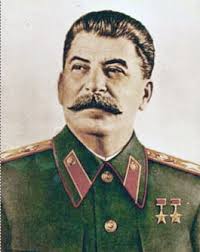
Joseph Stalin
His solution: Occupy Eastern Europe with Red Army units as a buffer between Germany and the Soviet Union. Poland, East Germany, Czechoslovakia, Romania, Bulgaria, Hungary, Albania and Yugoslavia.
Stalin had promised President Franklin Roosevelt that he would withdraw his armies from these countries once Germany was defeated. And he would allow them to choose whatever form of government they desired.
But Stalin had no intention of living up to his promises. And backing him up were 10 to 13 million Red Army soldiers. The entire United States Army had been reduced to 552,000 men by February 1948.
Liberating the captive nations of Eastern Europe—as General George S. Patton wanted to do—would have plunged the United States into full-scale war against its World War II ally.
And by 1945, the Red Army was a formidable enemy: Of the 4.3 million dead and missing casualties suffered by the Wehrmacht, 85% of them occurred on the dreaded “Eastern front.”
So there was nothing the United States could do—short of all-out war—to “roll back” the “Iron Curtain” that had swept over Eastern Europe.
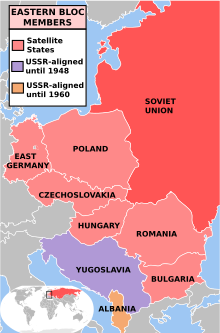
But Americans could—and did—draw a line in the sand. That line became known as the policy of “containment.”
And nowhere was the collision between the U.S.A and the U.S.S.R. more likely to ignite into full-scale war than in Berlin.
Between 1945 and 1948, the Soviets increased their pressure on Western forces occupying Berlin to leave the city. The Soviets already controlled East Germany; gaining control of the Western-held part of Berlin would likely be their first step toward overwhelming the rest of Germany.
And, after Germany, probably France—and as many other European countries as possible.
During the first two years of occupation the occupying powers of France, United Kingdom, United States, and the Soviet Union were not able to successfully negotiate a possible currency reform in Germany. Each of the Allies printed its own occupation currency.
Then, on June 20, 1948, the Bizonal Economic Council introduced the Deutsche mark to West Germany.
On June 24, 1945, the Soviet Union blocked the Western Allies’ railway, road, and canal access to the sectors of Berlin under Western control. This meant a cutoff of food and energy supplies to Berlin’s two and a half million residents.
The United States faced a monumental crisis:
- Should it abandon West Berlin—and thus tempt the Soviet Union into further aggression?
- Should it match the puny Western military forces—outnumbered 62 to 1—against the massive Soviet military presence?
- If it chose to fight in Berlin, would this lead to nuclear war?
Fortunately for the Allies—and West Germany—a third choice was available besides war and appeasement.
It became known as the Berlin Airlift.
ABC NEWS, ALTERNET, AP, BARACK OBAMA, BUZZFEED, CBS NEWS, CIA, CNN, CROOKS AND LIARS, DAILY KOZ, DEMOCRATIC NATIONAL COMMITTEE, DIRECTOR OF NATIONAL INTELLIGENCE, DONALD TRUMP, FACEBOOK, FBI, GEORGE W. BUSH, HACKING, HILLARY CLINTON, JAMES B. COMEY, JAMES R. CLAPPER, JEFF SESSIONS, KGB, MOTHER JONES, MOVEON, MSNBC, NATIONAL SECURITY AGENCY, NBC NEWS, NEWSWEEK, NPR, POLITICO, RAW STORY, REPUBLICAN PARTY, REUTERS, ROBERT S. MUELLER, RUSSIA, SALON, SEATTLE TIMES, SERGEY KISLYAK, SERGEY LAVROV, SLATE, SLOVENIA, SOVIET UNION, THE ATLANTIC, THE CHICAGO SUN-TIMES, THE CHICAGO TRIBUNE, THE CHICAO SUN-TIMES, THE DAILY BEAST, THE GUARDIAN, THE HILL, THE HUFFINGTON POST, THE LOS ANGELES TIMES, THE NATION, THE NEW YORK TIMES, THE WASHINGTON POST, TIME, TWITTER, U.S. NEWS & WORLD REPORT, UNITED STATES, UPI, USA TODAY, VLADIMIR PUTIN, WIKILEAKS, WORLD WAR ii
In Bureaucracy, History, Military, Politics, Social commentary on April 17, 2019 at 12:29 am
In June, 2001, President George W. Bush and Russian President Vladimir Putin met in Slovenia. During the meeting a truly startling exchange occurred.
Putin, a former KGB Intelligence officer, had clearly done his homework on Bush. When he mentioned that one of the sports Bush had played was rugby, Bush was highly impressed.
“I did play rugby,” gushed Bush. “Very good briefing.”

President George W. Bush and Vladimir Putin
But more was to come.
BUSH: Let me say something about what caught my attention, Mr. President, was that your mother gave you a cross which you had blessed in Israel, the Holy Land.
PUTIN: It’s true.
BUSH: That amazes me, that here you were a Communist, KGB operative, and yet you were willing to wear a cross. That speaks volumes to me, Mr. President. May I call you Vladimir?
Putin instantly sensed that Bush judged others—even world leaders—through the lens of his own fundamentalist Christian theology.
Falling back on his KGB training, Putin seized on this apparent point of commonality to build a bond. He told Bush that his dacha had once burned to the ground, and the only item that had been saved was that cross.
“Well, that’s the story of the cross as far as I’m concerned,” said Bush, clearly impressed. “Things are meant to be.”
Afterward, Bush and Putin gave an outdoor news conference.
“Is this a man that America can trust?” Associated Press correspondent Ron Foumier asked Bush.
“Yes,” said Bush. “I looked the man in the eye. I found him to be very straightforward and trustworthy. We had a very good dialogue.
“I was able to get a sense of his soul, a man deeply committed to his country and the best interests of his country. I wouldn’t have invited him to my ranch if I didn’t trust him.”
In short: Bush got played.
He believed that Putin was trying to lead Russia into a democratic future. He did not admire Putin as a dictator—nor want to be a similarly autocratic “President-for-Life.”
He didn’t constantly praise Putin, nor demonize American Intelligence agencies—such as the FBI, CIA, National Security Agency—when they contradicted what Putin told him.
Nor did he coerce or encourage House and Senate Republicans to defame the integrity of those Intelligence agencies.
From the end of World War II to the collapse of the Soviet Union in 1991, it was unthinkable for a Republican Presidential candidate to find common cause with a Soviet dictator.
But that utterly changed when Donald Trump won, first, the Republican Presidential nomination and, then, the White House.
Donald Trump
Trump has:
- Repeatedly praised Russian President Vladimir Putin, both during his Presidential candidacy and since taking office. In fact, Putin remains the only major public figure that Trump has never criticized.
- Repeatedly attacked United States’ membership in the North Atlantic Treaty Organization (NATO).
- Claimed the United States is paying an unfairly large portion of the monies needed to maintain this alliance—and he wants other members to contribute far more.
- Threatened that, if Russia attacked NATO members, he would decide whether to come to their aid—only after determining whether those nations have “fulfilled their obligations to us.” If he believed that they had not done so, he would tell them: “Congratulations, you will be defending yourself.”
On July 22, 2016, Wikileaks released 19,252 emails and 8,034 attachments hacked from computers of the highest-ranking officials of the Democratic National Committee (DNC). Early reports traced the leak to Russian hackers.
“Russia, if you are listening,” Trump said at a press conference in Doral, Florida, “I hope you are able to find the 33,000 emails that are missing—I think you will probably be rewarded mightily by our press.”
Hours later, the Main Intelligence Directorate in Moscow targets Clinton’s personal office and hits more than 70 other Clinton campaign accounts.
This was nothing less than treason—calling upon a foreign power, hostile to the United States, to interfere in its Presidential election.
On December 16, 2016, then-FBI Director James B. Comey and Director of National Intelligence James R. Clapper Jr. agreed with a CIA assessment that Russia intervened in the 2016 election in part to help Donald Trump win the White House.
Trump, however, has steadfastly denied any such role by Russia: “I think it’s ridiculous,” he told “Fox News Sunday.” “I think it’s just another excuse. I don’t believe it….No, I don’t believe it at all.”
Since becoming President, Trump has:
- Fired FBI Director James Comey for pursuing an investigation of “the Russia thing,”
- Told visiting Russian Foreign Minister Sergey Lavrov and Russian Ambassador Sergey Kislyak, the day after firing Comey: “I just fired the head of the F.B.I. He was crazy, a real nut job. I faced great pressure because of Russia. That’s taken off.”
- Repeatedly attacked his own Attorney General, Jeff Sessions, for not “protecting” him from agents pursuing the Russia investigation.
- Demanded that when he met Putin in Helsinki, Finland, no Americans be in the room with the two of them.
Bush was simply naive. Trump displays the classic hallmarks of an autocratic traitor.
9/11 ATTACKS, ABC NEWS, ALTERNATIVE ENERGY SOURCES, ALTERNET, AP, ARAB OIL EMBARGO, BBC, BUZZFEED, CBS NEWS, CHRISTIAN RIGHT, CNN, COLD WAR, CROOKS AND LIARS, DAILY KOS, DAILY KOZ, DONALD TRUMP, EGYPT, FACEBOOK, FOSSIL FUELS, GLOBAL WARMING, IRAN, IRAQ, ISLAM, ISRAEL, JAMAL KHASHOGGI, MECCA, MEDINA, MIDDLE EAST, MOHAMMED BIN SALMAN, MOTHER JONES, MOVEON, MSNBC, NAZI GERMANY, NBC NEWS, NEWSWEEK, NPR, Oil, OSAMA BIN LADEN, PBS NEWSHOUR, POLITICO, RAW STORY, REPUBLICANS, REUTERS, SALON, SAND CURTAIN, SAUDI ARABIA, SEATTLE TIMES, SECOND COMING, SHAH OF IRAN, SHIITE MUSLIMS, SLATE, SOVIET UNION, SUNNI MUSLIMS, TERRORISM, THE ATLANTIC, THE CHICAGO SUN-TIMES, THE CHICAGO TRIBUNE, THE DAILY BEAST, THE GUARDIAN, THE HILL, THE HUFFINGTON POST, THE LOS ANGELES TIMES, THE NATION, THE NEW YORK TIMES, THE WALL STREET JOURNAL, THE WASHINGTON POST, TIME, TRUMP WORLD TOWER, TURKEY, TWITTER, U.S. NEWS & WORLD REPORT, UNITED STATES, UPI, USA TODAY, VENEZUELA, WAHHABISM, WORLD WAR ii
In Bureaucracy, History, Military, Politics, Social commentary on October 23, 2018 at 1:09 am
This is an ideal time for the United States to pull the plug on its devil’s bargain relationship with Saudi Arabia.
Reason #1: The political assassination of Saudi dissident journalist Jamal Khashoggi, a key critic of Saudi King Mohammed bin Salman.
On October 2, Khashoggi walked into the Saudi Consulate in Istanbul to pick up a document allowing him to marry a Turkish woman. Video footage shows Khashoggi walking into the consulate; there is none of him leaving it.
He has not been seen since.
According to Turkish government officials:
- Fifteen Saudi agents flew into Istanbul.
- They waited for Khashoggi inside the consulate and murdered him within two hours of his arrival.
- The assassins used a bone saw to dismember Khashoggi’s corpse.

Jamal Khashoggi
[GFDL (http://www.gnu.org/copyleft/fdl.html)%5D, via Wikimedia Commons
Reason #2: Saudi Arabia is a weak ally.
Trump claims America needs Saudi Arabia as a counter-weight to the growing regional influence of Iran. But Saudi Arabia was unable to defend itself against Saddam Hussein’s Iraq in 1990, after the invasion and takeover of Kuwait.
This was, in fact, why Saudi-born Osama bin Laden decided to declare war on the United States.
He petitioned Saudi King Fahd bin Abdulazis al-Saud to let Saudis oppose any invasion by Iraq. He argued that “infidel” American soldiers stationed in the Kingdom would “pollute” Islam’s two great holy sites: Mecca and Medina.
Having fought against the Soviet Union in Afghanistan during the 1980s, bin Laden offered to help defend Saudi Arabia with his Arab legion.
The king refused—because he knew that, despite all the sophisticated military hardware he had bought from the United States, the Saudis were too militarily weak to resist an invasion.
Bin Laden left the country to wage fulltime war against the United States.
Osama bin Laden
Reason #3: Saudi Arabia is filled with Islamics who hate the United States as “the Great Satan.”
Fifteen of the 19 September 11, 2001 highjackers came from Saudi Arabia.
And Saudi Arabia is the birthplace of Wahhabism, a radical brand of Islam dedicated to “purifying” the world of “unbelievers.”
Reason #4: The only reason the United States cares about Saudi Arabia is that it’s the second-largest oil-producing country (after Venezuela) n the world.
Yet oil consumption threatens the future of the world through global warming. And it keeps America tethered to a regime that is fundamentally unstable and hostile to the West.
Reason #5: The United States can end its dependence on Saudi oil by embarking on a crash program to develop alternatives to oil.
Had this happened during the 1973 Arab oil embargo, the United States would now be energy-independent. America has the technology to do so; it lacks only the will.
Reason #6: Once the United States no longer needs fossil fuels, it can quit financing Middle East dictatorships.
This will end spending billions of dollars every year to prop up dictatorial regimes like those in Saudi Arabia, Iraq and Egypt. America will no longer supply big-ticket military hardware (like fighter planes and missiles) to potentially hostile Islamic regimes.
Reason #7: By withdrawing from the Middle East, the United States can free itself of the burden of acting as Israel’s permanent bodyguard.
Millions of Americans believe they are morally obligated to defend Israel owing to the barbarism of the Holocaust. But America was never a party to this, and has nothing to atone for.
Yet, for decades, the United States has been repeatedly dragged into the never-ending religious conflicts between Israelis and Islamics. Since both sides believe they are doing “God’s will,” there can be no substantial compromise by either.
Reason #8: The United States and its European allies can defend themselves against Islamic terrorism by erecting a “Sand Curtain” around the Middle East.
For 44 years—1947 to 1991—the United States and the Soviet Union were locked in a Cold War. Essentially, the United States drew a ring around the Soviet Union—including those nations its armies had seized following the defeat of Nazi Germany in 1945.
The United States said, in effect: “We can’t liberate the countries you’re now occupying”—because that would have triggered a nuclear World War III. “But we won’t allow you to occupy and enslave any other countries. And if you try to do so, it will mean total war.”
America could withdraw all of its forces from the Middle East—but keep a good portion stationed in Europe.

It could then publicly announce: “From now on, you are the masters of your own destinies—so long as what you do affects only the Middle East.
“We recognize that barbarism and violence have always been a part of life in the Middle East. And we don’t expect this to change.
“We realize you will destroy as many of your own citizens as you can—because they’re Jewish or Christians, or because Sunni Muslims and Shiite Muslims hate each other.
“Just don’t threaten citizens living outside your territories. In short: Europe and the United States are strictly off-limits to you.
“And if you aim your aggression at either, we will consider this an act of war and use all the weapons at our disposal—including nuclear ones—to wipe you from the face of the Earth.“
ABC NEWS, ALTERNET, AP, BARACK OBAMA, BUZZFEED, CBS NEWS, CIA, CNN, CROOKS AND LIARS, DAILY KOZ, DEMOCRATIC NATIONAL COMMITTEE, DIRECTOR OF NATIONAL INTELLIGENCE, DONALD TRUMP, FACEBOOK, FBI, GEORGE W. BUSH, HACKING, HILLARY CLINTON, JAMES B. COMEY, JAMES R. CLAPPER, JEFF SESSIONS, JOE SCARBOROUGH, KGB, MORNING JOE, MOTHER JONES, MOVEON, MSNBC, NATIONAL SECURITY AGENCY, NBC NEWS, NEWSWEEK, NPR, POLITICO, RAW STORY, REPUBLICAN PARTY, REUTERS, ROBERT S. MUELLER, ROD ROSENSTEIN, RUSSIA, SALON, SEATTLE TIMES, SERGEY KISLYAK, SERGEY LAVROV, SLATE, SLOVENIA, SOVIET UNION, THE ATLANTIC, THE CHICAGO SUN-TIMES, THE CHICAGO TRIBUNE, THE CHICAO SUN-TIMES, THE DAILY BEAST, THE GUARDIAN, THE HILL, THE HUFFINGTON POST, THE LOS ANGELES TIMES, THE NATION, THE NEW YORK TIMES, THE WASHINGTON POST, TIME, TWITTER, U.S. NEWS & WORLD REPORT, UNITED STATES, UPI, USA TODAY, VLADIMIR PUTIN, WIKILEAKS, WORLD WAR ii
In Bureaucracy, History, Law Enforcement, Politics, Social commentary on July 16, 2018 at 12:20 am
In June, 2001, President George W. Bush and Russian President Vladimir Putin met in Slovenia. During the meeting a truly startling exchange occurred.
Putin, a former KGB Intelligence officer, had clearly done his homework on Bush. When he mentioned that one of the sports Bush had played was rugby, Bush was highly impressed.
“I did play rugby,” gushed Bush. “Very good briefing.”
President George W. Bush and Vladimir Putin
But more was to come.
BUSH: Let me say something about what caught my attention, Mr. President, was that your mother gave you a cross which you had blessed in Israel, the Holy Land.
PUTIN: It’s true.
BUSH: That amazes me, that here you were a Communist, KGB operative, and yet you were willing to wear a cross. That speaks volumes to me, Mr. President. May I call you Vladimir?
Putin instantly sensed that Bush judged others—even world leaders—through the lens of his own fundamentalist Christian theology.
Falling back on his KGB training, Putin seized on this apparent point of commonality to build a bond. He told Bush that his dacha had once burned to the ground, and the only item that had been saved was that cross.
“Well, that’s the story of the cross as far as I’m concerned,” said Bush, clearly impressed. “Things are meant to be.”
Afterward, Bush and Putin gave an outdoor news conference.
“Is this a man that America can trust?” Associated Press correspondent Ron Foumier asked Bush.
“Yes,” said Bush. “I looked the man in the eye. I found him to be very straightforward and trustworthy. We had a very good dialogue.
“I was able to get a sense of his soul, a man deeply committed to his country and the best interests of his country. I wouldn’t have invited him to my ranch if I didn’t trust him.”
In short: Bush got played.
He believed that Putin was trying to lead Russia into a democratic future. He did not admire Putin as a dictator—nor want to be a similarly autocratic “President-for-Life.”
He didn’t constantly praise Putin, nor demonize American Intelligence agencies—such as the FBI, CIA, National Security Agency—when they contradicted what Putin told him.
Nor did he coerce or encourage House and Senate Republicans to defame the integrity of those Intelligence agencies.
From the end of World War II to the collapse of the Soviet Union in 1991, it would have been unthinkable for a Republican Presidential candidate to find common cause with a Soviet dictator.
But that utterly changed when Donald Trump won, first, the Republican Presidential nomination and, then, the White House.
Donald Trump
Trump has repeatedly praised Russian President Vladimir Putin, both during his Presidential candidacy and since taking office. In fact, Putin remains the only major public figure that Trump has never criticized.
Perhaps his most infamous defense of Putin came on the December 18, 2015 edition of MSNBC’s “Morning Joe.”
The host, Joe Scarborough, was upset by Trump’s praise for Putin: “Well, I mean, [he’s] also a person who kills journalists, political opponents, and invades countries. Obviously that would be a concern, would it not?”
TRUMP: He’s running his country, and at least he’s a leader. Unlike what we have in this country.
On July 22, 2016, Wikileaks released 19,252 emails and 8,034 attachments hacked from computers of the highest-ranking officials of the Democratic National Committee (DNC). Early reports traced the leak to Russian hackers.
“Russia, if you are listening,” Trump said at a press conference in Doral, Florida, “I hope you are able to find the 33,000 emails that are missing—I think you will probably be rewarded mightily by our press.”
This was nothing less than treason—calling upon a foreign power, hostile to the United States, to interfere in its Presidential election.
On December 16, 2016, then-FBI Director James B. Comey and Director of National Intelligence James R. Clapper Jr. agreed with a CIA assessment that Russia intervened in the 2016 election in part to help Donald Trump win the White House.
Trump, however, has steadfastly denied any such role by Russia: “I think it’s ridiculous,” he told “Fox News Sunday.” “I think it’s just another excuse. I don’t believe it….No, I don’t believe it at all.”
Since becoming President, Trump has:
- Fired FBI Director James Comey for pursuing an investigation of “the Russia thing,”
- Told visiting Russian Foreign Minister Sergey Lavrov and Russian Ambassador Sergey Kislyak, the day after firing Comey: “I just fired the head of the F.B.I. He was crazy, a real nut job. I faced great pressure because of Russia. That’s taken off.”
- Repeatedly attacked his own Attorney General, Jeff Sessions, for not “protecting” him from agents pursuing the Russia investigation.
- Threatened to fire Rod J. Rosenstein, the deputy attorney general, who oversees Special Counsel Robert Mueller’s probe of Russian subversion of the 2016 election.
- Intended to fire Mueller during the summer of 2017, but was talked out of it by aides fearful it would unleash calls for his impeachment.
- Demanded that when he meets Putin in Helsinki, Finland, no Americans be in the room with the two of them.
Bush was simply naive. Trump displays the classic hallmarks of an autocratic traitor.
1968 PRESIDENTIAL RACE, ABC NEWS, ADOLF HITLER, ALTERNET, AP, BERNARD LAW MONTGOMERY, BUZZFEED, CBS NEWS, CNN, COMING APART: AMERICA IN THE 1960S, CROOKS AND LIARS, D-DAY, DAILY KOZ, DWIGHT D. EISENHOWER, ERWIN ROMMEL, EUGENE MCCARTHY, FACEBOOK, HUBERT HUMPHERY, JOHN F. KENNEDY, LYNDON B. JOHNSON, MOTHER JONES, MOVEON, MSNBC, NAZI GERMANY, NBC NEWS, NEWSWEEK, NORMAN COTA, NPR, POLITICO, RAW STORY, REUTERS, ROBERT F. KENNEDY, SALON, SEATTLE TIMES, SIRHAN SIRHAN, SLATE, THE ATLANTIC, THE CHICAGO SUN-TIMES, THE CHICAGO TRIBUNE, THE DAILY BEAST, THE GUARDIAN, THE HILL, THE HUFFINGTON POST, THE LOS ANGELES TIMES, THE NATION, THE NEW YORK TIMES, THE WASHINGTON POST, THIRD REICH, TIME, TWITTER, U.S. ARMY RANGERS, U.S. NEWS & WORLD REPORT, UPI, USA TODAY, VIETNAM WAR, WILLIAM L. O'NEILL, WORLD WAR ii
In History, Military, Politics, Social commentary, Uncategorized on June 4, 2018 at 10:21 am
“For it is the doom of men that they forget.”
—Merlin, in “Excalibur”
June 6—a day of glory and tragedy.
The glory came 74 years ago—on Tuesday, June 6, 1944.
On that morning, Americans awoke to learn—from radio and newspapers—that their soldiers had landed on the French coast of Normandy.

In Supreme Command of the Allied Expeditionary Force: American General Dwight D. Eisenhower. Overall command of ground forces was given to British General Bernard Law Montgomery.
Operation Overlord, the Allied invasion to liberate France from Nazi Germany, proved one of the pivotal actions of World War II.
It opened shortly after midnight, with an airborne assault of 24,000 American, British, Canadian and Free French troops. This was followed at 6:30 a.m. by an amphibious landing of Allied infantry and armored divisions on the French coast.
Field Marshal Erwin Rommel—the legendary “Desert Fox”—commanded the German forces. For him, the first 24 hours of the battle would be decisive.
“For the Allies as well as the Germans,” he warned his staff, “it will be the longest day.”
The operation was the largest amphibious invasion in history. More than 160,000 troops landed—73,000 Americans, 61,715 British and 21,400 Canadians.

Omaha Beach – June 6, 1944
Initially, the Allied assault seemed likely to be stopped at the water’s edge—where Rommel had always insisted it must be. He had warned that if the Allies established a beachhead, their overwhelming advantages in numbers and airpower would eventually prove irresistible.
German machine-gunners and mortarmen wreaked a fearful toll on Allied soldiers. But commanders like U.S. General Norman Cota led their men to victory through a storm of bullets and shells.
Coming upon a group of U.S. Army Rangers taking cover behind sand dunes, Cota demanded: “What outfit is this?”
“Rangers!” yelled one of the soldiers.
“Well, Goddamnit, then, Rangers, lead the way!” shouted Cota, inspiring the soldiers to rise and charge into the enemy.
The command also gave the Rangers the motto they carry to this day.
The allied casualty figures for D-Day have been estimated at 10,000, including 4,414 dead. By nationality, the D-Day casualty figures are about
- 2,700 British
- 946 Canadians
- and 6,603 Americans.
The total number of German casualties on D-Day isn’t known, but is estimated at 4,000 to 9,000.
Allied and German armies continued to clash throughout France, Belgium and Germany until May 7, 1945, when Germany finally surrendered.
But those Americans who had taken part in D-Day could be proud of having dealt a fatal blow to the evil ambitions of Adolf Hitler’s Third Reich.
So much for the glory of June 6. Now for the tragedy—which occurred 50 years ago, on Thursday, June 6, 1968.
Twenty-four years after D-Day, Americans awoke to learn—mostly from TV—that New York Senator Robert F. Kennedy had died at 1:44 a.m. of an assassin’s bullet.
He had been campaigning for the Democratic Presidential nomination, and had just won the California primary on June 4.
This had been a make-or-break event for Kennedy, a fierce critic of the seemingly endless Vietnam war.
He had won the Democratic primaries in Indiana and Nebraska, but had lost the Oregon primary to Minnesota Senator Eugene McCarthy.
If he could defeat McCarthy in California, Kennedy could force his rival to quit the race. That would lead to a showdown between him and Vice President Hubert Humphery for the nomination.
(President Lyndon B. Johnson had withdrawn from the race on March 31—just 15 days after Kennedy announced his candidacy on March 16.)
After winning the California and South Dakota primaries, Kennedy gave a magnaminous victory speech in the ballroom of the Ambassador Hotel in Los Angeles:

Robert F. Kennedy, only moments from death
“I think we can end the divisions within the United States….We are a great country, an unselfish country, and a compassionate country. And I intend to make that my basis for running over the period of the next few months.”
Then he entered the hotel kitchen—where Sirhan Sirhan, a 24-year-old Palestinian from Jordan, opened fire with a .22 revolver.
Kennedy was hit three times—once fatally in the back of the head. Five other people were also wounded.
Kennedy’s last-known words were: “Is everybody all right?” and “Jack, Jack”—the latter clearly a reference to his beloved older brother, John Fitzgerald Kennedy.
Almost five years earlier, that brother—then President of the United States—had been assassinated in Dallas on November 22, 1963.
Then Robert Kennedy lost consciousness—forever, dying in a hospital bed 24 hours later.
Kennedy had been a U.S. Attorney General (1961-1964) and Senator (1964-1968). But it was his connection to President Kennedy for which he was best-known.
His assassination—coming so soon after that of JFK—convinced many Americans there was something “sick” about the nation’s culture.
One of the best summaries of Robert Kennedy’s legacy was given in Coming Apart: An Informal History of America in the 1960′s, by historian William L. O’Neil.

“He aimed so high that he must be judged for what he meant to do, and through error and tragic accident, failed at…..He will also be remembered as an extraordinary human being who, though hated by some, was perhaps more deeply loved by his countrymen than any man of his time.
“That, too, must be entered into the final account, and it is no small thing. With his death, something precious vanished from public life.”


 Bureaucracybuster's Blog
2016 PRESIDENTIAL ELECTION, 2020 PRESIDENTIAL ELECTION, 9/11 ATTACKS, AARON COPELAND, ABC NEWS, AFGHANISTAN, ALEXANDER SHUSTOROVICH, ALTERNET, ANDREW INTRATER, ANTI-COMMUNISM, ANTIWAR DEMONSTRATIONS, AP, ARMY-MCCARTHY HEARINGS, ARTHUR MILLER, ATOMIC BOMB, BILL CLINTON, BUZZFEED, CBS NEWS, CENTRAL AMERICA, CHAING KAI-SHEK, CHARLIE CHAPLIN, CIA, CINDY HYDE-SMITH, CNN, CROOKS AND LIARS, CUBAN MISSILE CRISIS, DAILY KOZ, DASHIELL HAMMETT, DELORES DEL RIO, DEPARTMENT OF HOMELAND SECURITY, DONALD TRUMP, DONALD TRUMP’S INAUGURAL COMMITTEE, DWIGHT D. EISENHOWER, EDWARD G. ROBINSON, EDWARD R. MURROW, ELMER BERNSTEIN, FACEBOOK, FBI, FEDERAL ELECTION COMMISSION, GEORGE C. MARSHALL, GEORGE H.W. BUSH, H.L. HUNT, HARRY S. TRUMAN, HILLARY CLINTON, HOUSE JUDICIARY COMMITTEE, HOWARD DA SILVA, HOWARD FAST, HOWARD HUGHES, INTERNET RESEARCH AGENCY, IRWIN SHAW, J. ROBERT OPPENHEIMER, JAMES COMEY, JIMMY CARTER, JOHN BIRCH SOCIETY, JOHN F. KENNEDY, JOHN GARFIELD, JOHN KASICH, JOHN MCCAIN, JOHN STEINBECK, JOSEPH R. MCCARTHY, JOSEPH STALIN, LEE GRANT, LEN BLAVATNIK, LILLIAN HELLMAN, LINDSEY GRAHAM, LLOYD BRIDGES, LUCILLE BALL, LYNDON B. JOHNSON, MAIN INTELLIGENCE DIRECTORATE, MAO TSE-TUNG, MARCO RUBIO, MITCH MCCONNELL, MITCH MCCONNELL’S SENATE LEADERSHIP FUN, MOTHER JONES, MOVEON, MSNBC, MUSLIMS, NATIONAL SECURITY AGENCY, NAZI GERMANY, NBC NEWS, NEWSWEEK, NORTH ATLANTIC TREATY ORGANIZATION (NATO), NPR, OFFICE OF THE DIRECTOR OF NATIONAL INTELLIGENCE, PBS NEWSHOUR, PETE SEEGER, POLITICO, RAW STORY, REPUBLICAN PARTY, REUTERS, RICHARD M. NIXON, ROBERT MUELLER, Ronald Reagan, RUTH GORDON, SALON, SCOTT WALKER, SEATTLE TIMES, SIMON KUKES, SLATE, SOVIET UNION, THE ATLANTIC, THE CHICAGO SUN-TIMES, THE CHICAGO TRIBUNE, THE DAILY BEAST, THE GUARDIAN, THE HILL, THE HUFFINGTON POST, THE LOS ANGELES TIMES, THE NATION, THE NEW YORK TIMES, THE WASHINGTON POST, TIME, TWITTER, U.S. NEWS & WORLD REPORT, UNITED STATES HOUSE OF REPRESNTATIVES, UNITED STATES SENATE, UPI, USA TODAY, VIETNAM WAR, VLADIMIR PUTIN, WIKILEAKS, WILLIAM L. SHIRER, WORLD WAR 11, WORLD WAR ii, ZERO MOSTEL
REPUBLICANS: “I’D RATHER BE RUSSIAN–AND STAY ELECTED”–PART TWO (END)
In Bureaucracy, History, Military, Politics, Social commentary on November 5, 2019 at 12:10 amFrom 1945 to 2015, it was unthinkable for a Republican Presidential candidate to pay tribute to a Soviet dictator.
But that utterly changed when Donald J. Trump, a “reality TV” host with longstanding financial ties to Russian oligarchs, ran for President of the United States.
Donald Trump
The reason for the Trump-Putin bromance: Each had something to offer the other.
Putin wanted the United States to ditch the North Atlantic Treaty Organization (NATO) alliance, which had preserved Western Europe from Russian aggression since World War II. And Trump had often attacked America’s funding of NATO as a drain on the American economy.
And Trump wanted to be President. For this, Putin could supply Internet trolls to confuse voters with falsified news—and even the hacking of key voting centers.
And monies. These Russian monies were officially classified as “campaign contributions,” not bribes.
Special Counsel Robert S. Mueller III Mueller spent almost two years uncovering links between Russian Intelligence agents and members of Donald Trump’s Presidential campaign.
On July 24, he addressed Congress on Russia’s subversion of the 2016 Presidential election.
“Over the course of my career, I’ve seen a number of challenges to our democracy,” Mueller declared to members of the House Judiciary Committee.
“The Russian government’s effort to interfere in our election is among the most serious. As I said on May 29, this deserves the attention of every American.
“It wasn’t a single attempt. They’re doing it as we sit here. And they expect to do it during the next campaign.”
Robert Mueller
In his report, Mueller documented years of meddling in American politics by the Internet Research Agency, which runs the Kremlin’s online disinformation efforts from its headquarters in St. Petersburg.
The Agency reached 126 million Americans through fake accounts on Facebook. Its messages communicated with unaware members of the Trump campaign, and even prompted real-life rallies that mobilized crowds of unwitting voters.
Hours later that same day, Senator Cindy Hyde-Smith (R-Mississippi) blocked the passage of three bills designed to tighten election security at the federal level. She claimed that Congress had already responded to election security needs for the 2020 Presidential election.
Senate Majority Leader Mitch McConnell (R-Kentucky) came to the Senate floor the next day to personally object to House-passed legislation backed by Democrats.
Nor is Trump the only Republican receiving “help” from Putin. A network of Russian oligarchs—all of them answerable to Putin—has been increasingly contributing to top Republicans.
These Russian monies are officially classified as “campaign contributions,” not bribes—which, in fact, they are.
According to the Federal Election Commission:
One such major contributor is Len Blavatnik, who holds citizenship in both the United States and the United Kingdom. During the 2015-16 election cycle, he proved one of the largest donors to GOP Political Action Committees (PACs).
Blavatnik’s net worth is estimated at $20 billion. Before 2016, he donated to both Democrats and Republicans in meager amounts. But in 2016, he gave $6.35 million to GOP PACs.
Millions of dollars went to top Republican leaders—such as Senators Mitch McConnell (Kentucky), Marco Rubio (Florida) and Lindsey Graham (South Carolina).
Specifically, he contributed:
Altogether, four Russian oligarchs—Blavatnik, Shustorovich, Andrew Intrater and Simon Kukes—contributed $10.4 million from the start of the 2015-16 election cycle through September 2017. Of this, 99% went to Republicans.
As Senate Majority Leader, Mitch McConnell participated in high-level intelligence briefings in 2016. From agencies such as the FBI, CIA and the code-cracking National Security Agency, he learned that the Russians were trying to subvert the electoral process.
In October, 2016, the Department of Homeland Security (DHS) and the Office of the Director of National Intelligence (DNI) issued a joint statement: The Russian government had directed the effort to subvert the 2016 Presidential election.
Two weeks later, McConnell’s PAC accepted a $1 million donation from Blavatnik.
On March 30, 2017, McConnell’s PAC accepted another $1 million from Blavatnik.
This is just 10 days after former FBI Director James Comey testified before the House Intelligence Committee about Russia’s efforts to subvert the 2016 election.
So, what has changed in the Republican Party? Essentially nothing.
Its enemies changed—from Russian Communists to American liberals. But its goal remains the same: The quest for absolute power.
When Americans feared Communism, Republicans depicted themselves as the only ones who could be trusted to protect the United States. Big contributions poured in from Right-wing billionaires like H.L. Hunt and Howard Hughes.
But then Republicans found they could enrich themselves and stay in power via Russian “campaign contributions.” So long as they did Putin’s bidding, the rubles would roll in.
So for a party of power-drunk would-be dictators, the decision was simple: Better Red than un-elected.
Share this: