Posts Tagged ‘THE ATLANTIC’
ABC NEWS, ADOLF HITLER, ALTERNET, AP, BBC, BUZZFEED, CBS NEWS, CNN, DAILY KOS, DIMITRI SHOSTAKOVICH, DONALD TRUMP, FACEBOOK, FBI, GREAT TERROR, JAMES COMEY, JEFF SESSIONS, JOSEPH STALIN, KEITH SCHILLER, MIKE FLYNN, MIKHAIL TUKHACHEVESKY, MOTHER JONES, MOVEON, NAZI GERMANY, NBC NEWS, NEWSWEEK, NICCOLO MACHIAVELLI, NIKITA KHRUSHCHEV, NIKOLAI ZHILAYEV, NPR, POLITICO, RAW STORY, REUTERS, ROBERT MUELLER 111, ROD ROSENSTEIN, RUSSIAN ESPIONAGEky, SALON, SEATTLE TIMES, SENATE INTELLIGENCE COMMITTEE, SERGEY KISLYAK, SERGEY LAVOV, SLATE, SOVIET UNION, THE ATLANTIC, THE CHICAGO SUN-TIMES, THE CHICAGO TRIBUNE, THE DAILY BEAST, THE DISCOURSES, THE GUARDIAN, THE HILL, THE HUFFINGTON POST, THE LOS ANGELES TIMES, THE NEW YORK TIMES, THE WALL STREET JOURNAL, THE WASHINGTON POST, TIME, TWITTER, U.S. NEWS & WORLD REPORT, UPI, USA TODAY, WEHRMACHT, WORLD WAR 11
In Bureaucracy, History, Law, Law Enforcement, Military, Politics, Social commentary on December 26, 2018 at 12:16 am
Nikolai Sergeyvich Zhilayev (pronounced Zill-lay-ev) was a Russian musicologist and the teacher of several 20th-century Russian composers.
He was also an icon of courage in a country infested with cowards and stool pigeons.
Among his friends—to his ultimate misfortune—was Mikhail Tukhachevsky, the former military hero now falsely condemned and executed as a traitor by Soviet dictator Joseph Stalin.
In 1938, Zhilayev (November 18, 1881 – January 20, 1938) also became a casualty of what has become known as The Great Terror.
In his posthumously-published memoirs, Testimony, Dimitri Shostakovich, his pupil and friend, described how Zhilayev faced his end with a calmness that awed even the NKVD (the predecessor to the KGB) secret police sent to arrest him.
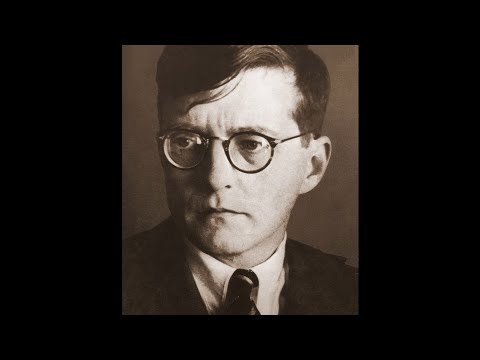
Dimitri Shostakovich
“He had a large picture of Tukhachevsky in his room, and after the announcement that Tukhachevsky had been shot as a traitor to the homeland, Zhilayev did not take the picture down.
“I don’t know if I can explain how heroic a deed that was….As soon as the next poor soul was declared an enemy of the people, everyone destroyed in a panic everything connected with that person….
“And naturally, photographs flew into the fire first, because if someone informed on you, reported that you had a picture of an enemy of the people, it meant certain death.
“Zhilayev wasn’t afraid. When they came for him, Tukhachevsky’s prominently hung portrait amazed even the executioners.”
“What, it’s still up?” one of the secret police asked.
“The time will come,” Zhilayev replied, “when they’ll erect a monument to him.”
As, in fact, has happened.
Meanwhile, Stalin has been universally condemned as one of history’s greatest tyrants.

Mikhail Tukhachevsky appears on a 1963 Soviet Union postage stamp
Third hero—James Brien Comey (December 14, 1960)
Comey served as United States Attorney (federal prosecutor) for the Southern District of New York (2002-2003).
As United States Deputy Attorney General (2003-2005), he opposed the warrantless wiretapping program of the George W. Bush administration. He also argued against the use of water boarding as an interrogation method.
In 2005, he entered the private sector as General Counsel and Senior Vice President for Lockheed Martin, the biggest contractor for the Department of Defense.
On July 29, 2013, the United States Senate voted 93 -1 to confirm Comey as director of the FBI, the seventh in its history.

James B. Comey
He directed the FBI from his appointment in 2013 by President Barack Obama until his firing on May 9 by President Donald Trump.
In a move that Joseph Stalin would have admired, Trump gave no warning of his intentions. Instead, he sent Keith Schiller, his longtime bodyguard, to the FBI with a letter announcing Comey’s dismissal.
Trump had three reasons for firing Comey:
- Comey had refused to pledge his personal loyalty to Trump. Trump had made this “request” during a private dinner at the White House in January. After refusing to make that pledge, Comey told Trump that he would always be honest with him. But that didn’t satisfy Trump’s demand that the head of the FBI act as his personal secret police chief.
- Trump had tried to coerce him into dropping the FBI’s investigation into former National Security Adviser Mike Flynn, for his secret ties to Russia and Turkey. Comey had similarly resisted that demand.
- Comey had recently asked the Justice Department to fund an expanded FBI investigation into contacts between Trump’s 2016 Presidential campaign and Russian Intelligence agents.
As a Presidential candidate and President, Trump:
- Steadfastly denied those revelations;
- Repeatedly attacked the “fake news” media reporting these revelations. Chief among his targets: CNN, The New York Times and The Washington Post; and
- Attacked the Intelligence agencies responsible for America’s security.
On May 10—the day after firing Comey—Trump met in the Oval Office with Russian Foreign Minister Sergey Lavov and Russian Ambassador Sergey Kislyak.
Kislyak is reportedly a top recruiter for Russia’s SVR foreign intelligence agency. He has been closely linked with Jeff Sessions, now Attorney General, and fired National Security Adviser Mike Flynn.
“I just fired the head of the FBI,” Trump told the two dignitaries. “He was crazy, a real nut job. I faced great pressure because of Russia. That’s taken off.”
During that meeting he gave the Russians sensitive Intelligence on ISIS that had been supplied by Israel.
Two days later, on May 12, Trump tweeted a threat to the fired FBI director: “James Comey better hope that there are no ‘tapes’ of our conversations before he starts leaking to the press.”
But shortly afterward, reports surfaced that Comey had written memos to himself immediately after his private meetings with Trump.
He had also told close aides that Trump was trying to pressure him into dropping the investigation into close ties between Russian Intelligence agents and Trump campaign staffers.
As for Trump’s threat of having secret tapes: Like Trump’s claim that he could prove that Barack Obama wasn’t an American citizen, this, too, proved to be a lie.
And Comey’s firing led directly to a result Trump did not anticipate: Acting Attorney General Rod Rosenstein yielded to demands from Democrats and appointed former FBI Director Robert Mueller III as a special prosecutor to investigate those ties.
ABC NEWS, ADOLF HITLER, ALTERNET, AP, BBC, BUZZFEED, CBS NEWS, CNN, DAILY KOS, DIMITRI SHOSTAKOVICH, DONALD TRUMP, FACEBOOK, FBI, GREAT TERROR, JAMES COMEY, JEFF SESSIONS, JOSEPH STALIN, KEITH SCHILLER, MIKE FLYNN, MIKHAIL TUKHACHEVESKY, MOTHER JONES, MOVEON, NAZI GERMANY, NBC NEWS, NEWSWEEK, NICCOLO MACHIAVELLI, NIKITA KHRUSHCHEV, NIKOLAI ZHILAYEV, NPR, POLITICO, RAW STORY, REUTERS, ROBERT MUELLER III, ROD ROSENSTEIN, RUSSIAN ESPIONAGEky, SALON, SEATTLE TIMES, SENATE INTELLIGENCE COMMITTEE, SERGEY KISLYAK, SERGEY LAVOV, SLATE, SOVIET UNION, THE ATLANTIC, THE CHICAGO SUN-TIMES, THE CHICAGO TRIBUNE, THE DAILY BEAST, THE DISCOURSES, THE GUARDIAN, THE HILL, THE HUFFINGTON POST, THE LOS ANGELES TIMES, THE NEW YORK TIMES, THE WALL STREET JOURNAL, THE WASHINGTON POST, TIME, TWITTER, U.S. NEWS & WORLD REPORT, UPI, USA TODAY, WEHRMACHT, WORLD WAR 11
In Bureaucracy, History, Law, Law Enforcement, Military, Politics, Social commentary on December 25, 2018 at 2:02 am
…A truly great man is ever the same under all circumstances. And if his fortune varies, exalting him at one moment and oppressing him at another, he himself never varies, but always preserves a firm courage, which is so closely interwoven with his character that everyone can readily see that the fickleness of fortune has no power over him.
The conduct of weak men is very different. Made vain and intoxicated by good fortune, they attribute their success to merits which they do not possess. And this makes them odious and insupportable to all around them. And when they have afterwards to meet a reverse of fortune, they quickly fall into the other extreme, and become abject and vile.
—Niccolo Machiavelli, The Discourses
Three heroes, two villains.
Two of the heroes are Russian; the third is an American.
The villains: One Russian (actually, Georgian); one American.
First up—in order of disappearance: Mikhail Nikolayevich Tukhachevsky (pronounced too-ka-chev-sky)
Tukhachevsky (February 4, 1893 – June 12, 1937) was a leading Soviet military leader and theoretician from 1918 to 1937.
He commanded the Soviet Western Front during the Russian-Polish War (1920-21) and served as Chief of Staff of the Red Army (1925-1928).
He fought to modernize Soviet armament, as well as develop airborne, aviation and mechanized forces. Almost singlehandedly, he created the theory of deep operations for Soviet forces.

Mikhail Tukhachevsky
All of these innovations would reap huge dividends when the Soviet Union faced the lethal fury of Adolf Hitler’s Wehrmacht.
In 1936, Tukhachevsky warned Soviet dictator Joseph Stalin that Nazi Germany might attack without warning—and ignite a long and murderous war.
Stalin—the son of a Georgian cobbler—resented Tukhachevsky’s coming from a noble family. A monumental egomaniac, he also hated that Tukhachevesky’s fame rivaled his own.
Warned of the approaching German danger, Stalin shouted: “What are you trying to do—frighten Soviet authority?”
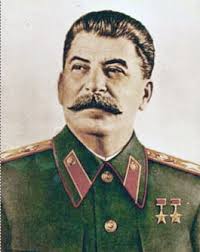
Joseph Stalin
The attack that Tukhachevsky warned against came five years later—on June 22, 1941, leaving at least 20 million Russians dead.
But Tukhachevsky wasn’t alive to command a defense.
The 1930s were a frightening and dangerous time to be alive in the Soviet Union. In 1934, Stalin, seeing imaginary enemies everywhere, ordered a series of purges that lasted right up to the German invasion.
An example of Stalin’s paranoia occurred one day while the dictator walked through the Kremlin corridors with Admiral Ivan Isakov. Officers of the NKVD (the predecessor to the KGB) stood guard at every corner.
“Every time I walk down the corridors,” said Stalin, “I think: Which one of them is it? If it’s this one, he will shoot me in the back. But if I turn the corner, the next one can shoot me in the face.”
In 1937-38, the Red Army fell prey to Stalin’s paranoia.
Its victims included:
- Three of five marshals (five-star generals);
- Thirteen of 15 army commanders (three- and four-star generals);
- Fifty of 57 army corps commanders; and
- One hundred fifty-four out of 186 division commanders.
And heading the list of those marked for death was Marshal Mikhail Tukhachevsky.
Arrested on May 22, 1937, he was interrogated and tortured. As a result, he “confessed” to being a German agent plotting to overthrow Stalin and seize power.
On his confession, which survives in the archives, his bloodstains can clearly be seen.
On June 11, the Soviet Supreme Court convened a special military tribunal to try Tukhachevsky and eight generals for treason.
It was a sham: The accused were denied defense attorneys, and could not appeal the verdict—-which was foregone: Death.
In a Russian version of poetic justice, five of the eight generals who served as Tukhachevsky’s judges were themselves later condemned and executed as traitors.
Within hours of the verdict, Tukhachevsky was summoned from his cell and shot once in the back of the head.
From 1937 until 1956, Tukhachevsky was officially declared a traitor and fifth-columnist.
Then, on February 25, 1957, Soviet Premier Nikita Khrushchev delivered his bombshell “Secret Speech” to the 20th Congress of the Communist Party of the Soviet Union.
In this, he denounced Stalin (who had died in 1953) as a ruthless tyrant responsible for the slaughter of millions of innocent men, women and children. He condemned Stalin for creating a “personality cult” around himself, and for so weakening the Red Army that Nazi Germany was able to easily overrun half of the Soviet Union from 1941 to 1943.
On January 31, 1957, Tukhachevsky and his co-defendants were declared innocent of all charges and were “rehabilitated.”
Today, he is once again—rightly—considered a Russian hero and military genius. And Stalin is universally—and rightly—seen as a blood-stained tyrant.
Next hero: Nikolai Sergeyvich Zhilayev (pronounced Zill-lay-ev)
Zhilayev (November 18, 1881 – January 20, 1938) was a Russian musicologist and the teacher of several 20th-century Russian composers. Among these: Dimitri Shostakovich.
Zhilayev, a member of the Russian Academy of Art-Sciences, taught at the Moscow Conservatory. Among his friends–to his ultimate misfortune–was Mikhail Tukhachevsky.
In 1938, he, too, became a casualty of what has become known as The Great Terror.
In his posthumously-published memoirs, Testimony, Shostakovich, his pupil and friend, described how Zhilayev faced his end with a calmness that awed even the NKVD (the predecessor to the KGB) secret police sent to arrest him.
2016 PRESIDENTIAL ELECTION, ABC NEWS, ADOLF HITLER, ALBERT SPEER, ALTERNET, AP, BBC, BRETT MCGURK, BUZZFEED, CBS NEWS, CIA, CNN, DAILY KOS, DONALD TRUMP, DONLAD TRUMP, FACEBOOK, FBI, ISLAMIC STATE OF IRAQ AND SYRIA (ISIS), JAMES COMEY, JAMES MATTIS, JEFF SESSIONS, JIMMY CARTER, MOTHER JONES, MOVEON, NAZI GERMANY, NBC NEWS, NEWSWEEK, NPR, PBS NEWSHOUR, POLITICO, RAW STORY, REPUBLICAN PARTY, REPUBLICANS, REUTERS, RICHARD NIXON, ROBERT MEULLER, ROD ROSENSTEIN, SALON, SEATTLE TIMES, SLATE, SYRIA, THE ATLANTIC, THE CHICAGO SUN-TIMES, THE CHICAGO TRIBUNE, THE DAILY BEAST, THE GUARDIAN, THE HILL, THE HUFFINGTON POST, THE LOS ANGELES TIMES, THE NEW YORK TIMES, THE PRESS, THE WALL STREET JOURNAL, THE WASHINGTON POST, THIRD REICH, TIME, TWITTER, U.S. NEWS & WORLD REPORT, UNITED STATES HOUSE OF REPRESENTATIVES, UNITED STATES SENATE, UPI, USA TODAY, VLADIMIR PUTIN, WALTER SHAUB
In Bureaucracy, History, Law Enforcement, Military, Politics, Social commentary on December 24, 2018 at 12:21 am
On July 6, 2017, Walter Shaub, who had been director of the Office of Government Ethics since 2013, resigned his position.
He did so after repeatedly clashing with President Donald Trump over the latter’s conflicts-of-interest vis-a-vis his tangled financial holdings.
Summing up the ethical legacy of Trump’s life and administration, Shaub noted:
“When this is over, when the lights are turned back on, it will become clear that there were only two kinds of people: Those who stood against Trump’s corruption, cruelty and degradation of American values, and those who enabled him.”
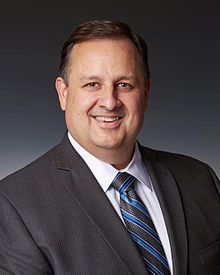
Walter Shaub
Since Trump took office as the 45th President of the United States on January 20, 2017, Americans have seen him steadily move toward his goal of absolute power.
Among these moves:
- Firing FBI Director James Comey for pursuing an investigation into Russian subversion of the 2016 election.
- Repeatedly attacking—and ultimately firing—his own Attorney General, Jeff Sessions, for not quashing the Russia investigation.
- Relentlessly attacking the free press as “the enemy of the American people.”
- Brutally attacking Federal judges whose rulings displease him.
- Repeatedly urging Deputy Attorney General Rod Rosenstein to vengefully prosecute Hillary Clinton, his 2016 rival for the Presidency.
- Refusing to accept the findings of the FBI, CIA and NSA that Russian Intelligence agents intervened in the 2016 election to ensure his victory.
- Siding with Russian dictator Vladimir Putin’s claim that Russia did not subvert that election.
- Shutting down the Federal Government to extortionately force Democrats to vote $5 billion for his “border wall” along the U.S.-Mexican border.
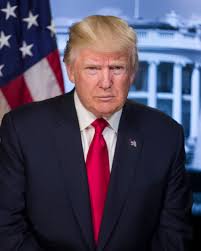
Donald Trump
Republicans don’t fear that Trump will trash the institutions that Americans have cherished for more than 200 years.
What Republicans fear is that he will finally cross one line too many—like firing Special Counsel Robert Mueller. And that the national outrage following this will force them to launch impeachment proceedings against him.
But it isn’t even Trump they most fear will be destroyed.
What they most fear losing is their own precious hold on nearly absolute power in Congress and the White House—and the privileges that accompany it.
If Trump is impeached and convicted, he will become a man no one any longer fears. He will be a figure held up to ridicule and condemnation.
Like Richard Nixon.
And, like Nixon, his fall will be followed by that of other Republicans.
Republicans vividly remember what happened after Nixon was forced to resign on August 9, 1974: Democrats, riding a wave of reform fever, swept Republicans out of the House and Senate—and Jimmy Carter into the White House.
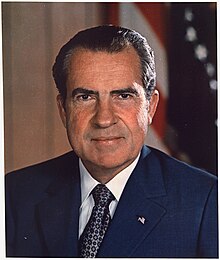
Richard Nixon
And Republicans fear history will repeat itself.
If Republicans are conflicted—whether to continue supporting Trump or desert him—the reason is the same: How can I hold onto my power and all the privileges that go with it?
Years from now, historians will compare the Trump era to that of the Third Reich—where sadists and opportunists sought power at the expense of their fellow citizens, and a handful of decent and courageous patriots dared to stand against them.
Only men like James Comey and James Marttis and Brett McGurk will emerge as heroes worthy of remembrance—and imitation.
On May 9, 2017, Comey was fired as FBI director for refusing to pledge his personal loyalty to Trump—and for daring to pursue an investigation into Russia’s subversion of the 2016 Presidential election.
James Comey
On December 20, 2018, Mattis officially notified Trump that he would resign as Secretary of Defense by March 1. The reason: Trump’s surprise announcement that he would pull all United States forces troops from Syria, where they have directed fighting against forces of the Islamic State of Iraq and Syria (ISIS).
And on December 21, Brett McGurk, Trump’s envoy to coalition forces fighting ISIS, submitted his own resignation—for the same reason.
For Trump, perhaps the most outrageous insult came on December 22, when Comey noted on Twitter: “To a president without any external ethical framework, folks who resign on principle must be confusing.”
Addressing GOP cowardice in refusing to stand up to Trump, Comey had publicly stated on December 17:
“Republicans used to understand that the actions of a president matter, the words of a president matter, the rule of law matters, and the truth matters. Where are those Republicans today?
“At some point, someone has to stand up and in the fear of Fox News and fear of their base, and fear of mean tweets, stand up for the values of this country and not slink away into retirement.”
* * * * *
As the Third Reich crumbled, Adolf Hitler sought to punish the German people for losing the war he had started.
He ordered the destruction of everything still remaining—industries, ships, harbors, communications, roads, mines, bridges, stores, utility plants, food stuffs.
Fortunately for Germany, one man—Minister of Armaments Albert Speer—broke ranks with his Fuehrer.
Risking death, he blocked such destruction or persuaded influential military and civilian leaders to disobey the order as well.
As a result, those targets slated for destruction were spared.
America still awaits its own Albert Speer to come forward and save its liberties from a racist, vindictive and treasonous President installed by American Fascists and KGB computer-hackers.
ABC NEWS, ALTERNET, ANTI-COMMUNISM, AP, BUZZFEED, CBS NEWS, CIA, CNN, COLLUSION, COMMUNISM, CROOKS AND LIARS, DAILY KOZ, DEMOCRATIC PARTY, DONALD TRUMP, DONALD TRUMP JUNIOR, FACEBOOK, FBI, FOX NEWS, G.O.P., GRU (RUSSIAN MILITARY INTELLIGENCE), HILLARY CLINTON, INTELLIGENCE, ISLAMIC STATE OF IRAQ AND SYRIA (ISIS), JAMES B. COMEY, JAMES COMEY, JARED KUSHNER, MAIN INTELLIGENCE DIRECTORATE, MICHAEL FLYNN, MOSSAD, MOTHER JONES, MOVEON, NATIONAL SECURITY AGENCY, NBC NEWS, NEWSWEEK, NPR, PAUL MANAFORT, POLITICO, RAW STORY, REPUBLICAN PARTY, REUTERS, ROGER STONE, RUSSIA, SALLY YATES, SALON, SEATTLE TIMES, SERGEY KISLYAK, SERGEY LAVROV, SLATE, STATE OF THE UNION, STATE OF THE UNION ADDRESS, THE ATLANTIC, THE CHICAGO SUN-TIMES, THE CHICAGO TRIBUNE, THE DAILY BEAST, THE GUARDIAN, THE HILL, THE HUFFINGTON POST, THE LOS ANGELES TIMES, THE NATION, THE NEW YORK TIMES, THE WASHINGTON POST, TIME, TREASON, TRUMP TOWER MEETING, TWITTER, U.S. CONSTITUTION, U.S. NEWS & WORLD REPORT, UNITED STATES CONSTITUTION, UPI, USA TODAY, VLADIMIR PUTIN
In Bureaucracy, History, Military, Politics, Social commentary on December 21, 2018 at 12:08 am
According to President Donald Trump, Democrats are guilty of treason.
Their crime? Refusing to stand and applaud him during his State of the Union message in January, 2018.
On February 5, he told a crowd in Cincinnati: “They were like death and un-American. Un-American. Somebody said, ‘treasonous.’ I mean, Yeah, I guess why not? Can we call that treason? Why not? I mean they certainly didn’t seem to love our country that much.”
For Trump, to love the United States, you must first prove that you love him.
But Article Three of the United States Constitution defines treason as:
“Treason against the United States, shall consist only in levying War against them, or in adhering to their Enemies, giving them Aid and Comfort. No Person shall be convicted of Treason unless on the Testimony of two Witnesses to the same overt Act, or on Confession in open Court.”
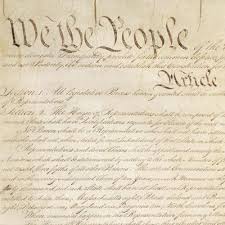
United States Constitution
In short: Actions such as colluding with a foreign power hostile to the United States (such as Russia) to subvert America’s democratic election process.
By that standard, Donald Trump stands rightly accused of a crime that traditionally carries the penalty of death.
Example #1: The infamous June, 2016 meeting at Trump Tower starring Donald Trump’s son, Donald, Jr.; Trump’s son-in-law, Jared Kushner; and Trump’s then-campaign manager, Paul Manafort—and two Russian lobbyists who wanted the United States to end its sanctions against Russia for human rights abuses.
The meeting’s purpose: To obtain from Russian Intelligence agents “dirt” on Trump’s opponent, Hillary Clinton.
Example #2: On July 27, 2016, Trump said at a press conference in Doral, Florida: “Russia, if you are listening, I hope you are able to find [Hillary Clinton’s] 33,000 emails that are missing—I think you will probably be rewarded mightily by our press.”
Hours later, the Main Intelligence Directorate in Moscow targeted Hillary Clinton’s personal office and hit more than 70 other Clinton campaign accounts,
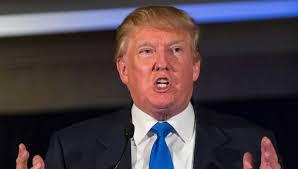
Donald Trump
Example #3: On December 16, 2016, then-FBI Director James B. Comey and Director of National Intelligence James R. Clapper Jr. agreed with a CIA assessment that Russia intervened in the 2016 election in part to help Donald Trump win the White House.
Trump, however has steadfastly denied any such role by Russia.
On July 16, 2018, he attended a press conference in Helsinki, Finland, with Russian President Vladimir Putin. There he blamed American Intelligence agencies—such as the FBI, CIA and National Security Agency—instead of Putin for Russia’s subversion of the 2016 Presidential election: “I have President Putin. He just said it’s not Russia. I will say this: I don’t see any reason why it would be.”
Example #4: On May 9, 2017, Trump fired FBI Director James Comey for investigating Russia’s subversion of the 2016 Presidential race. His motive: To end that investigation before it reached him.
The next day, meeting with Russian Foreign Minister Sergey Lavrov and Russian Ambassador Sergey Kislyak in the Oval Office, Trump said: “I just fired the head of the FBI. He was crazy, a real nut job. I faced great pressure because of Russia. That’s taken off.”
On May 11, during an interview with NBC’s Lester Holt, Trump admitted: “And, in fact, when I decided to just do it, I said to myself, I said: ‘You know, this Russia thing with Trump and Russia is a made up story, it’s an excuse by the Democrats for having lost an election that they should’ve won.’”
Example #5: During that same meeting, Trump gave the Russian officials highly classified Israeli Intelligence about an Islamic State plot to turn laptops into concealable bombs.
At first, the White House denied Trump had done so. Then Trump admitted in a tweet: “As President I wanted to share with Russia (at an openly scheduled W.H. meeting) which I have the absolute right to do, facts pertaining … to terrorism and airline flight safety.
Example #6: Trump has surrounded himself with men who had close ties to Russian dictator Vladimir Putin. Among these:
- Paul Manafort – His former campaign manager. His longstanding ties to pro-Russian politicians in Ukraine lead directly to Putin.
- Roger Stone – Self-confessed dirty trickster and former business partner of Manafort. Stone had extensive contacts with hacker Guccifer 2.0, whom the CIA, NSA and FBI believe was actually a front for GRU, Russian military intelligence.
- Michael T. Flynn – Former United States Army lieutenant general and director of the Defense Intelligence Agency. A leading Trump supporter during the 2016 Presidential campaign, he was rewarded with the post of National Security Adviser when Trump took office.

Michael T. Flynn
- On February 13, 2017, The Washington Post reported that Acting Attorney General Sally Yates had warned Trump in late January that Flynn had lied about his contacts with Kislyak–and that he could be blackmailed by Russian Intelligence. Flynn was forced to resign that same day.
- In December, 2015, he had appeared on Russia Today, the news network that serves as “the Kremlin’s principal international propaganda outlet.” For this he received more than $45,000 as a “speaking fee.”
- At the gala where Flynn received the fee, he sat next to Putin for dinner.
The Republican party—which for 50 years claimed to be America’s defender against Communism—has now fervently embraced a man with demonstrated ties to a Communist dictator.
9/11 ATTACKS, ABC NEWS, ADOLF HITLER, AFGHANISTAN, AL QAEDA, ALTERNET, AP, BASHAR AL-ASSAD, BUZZFEED, CARLOS THE JACKAL, CBS NEWS, CHINA, CNN, CONGRESS, CROOKS AND LIARS, DAILY KOZ, FACEBOOK, HARRY S. TRUMAN, HIZBOLLAH, IRAQ, ISLAM, ISRAEL, MOTHER JONES, MOVEON, MSNBC, NAZI GERMANY, NBC NEWS, NEWSWEEK, NPR, OSAMA BIN LADEN, PBS NEWSHOUR, POLITICO, RAW STORY, RELIGION, REUTERS, RUSSIA, SALON, SEATTLE TIMES, SHIITE MUSLIMS, SLATE, SUNNI MUSLIMS, SYRIA, TERRORISM, THE ATLANTIC, THE CHICAGO SUN-TIMES, THE CHICAGO TRIBUNE, THE DAILY BEAST, THE GUARDIAN, THE HILL, THE HUFFINGTON POST, THE LOS ANGELES TIMES, THE NATION, THE NEW YORK TIMES, THE SYRIAN OBSERVATORY FOR HUMAN RIGHTS, THE WASHINGTON POST, THE WORLD POST, TIME, TWITTER, U.S. NEWS & WORLD REPORT, UPI, USA TODAY, VLADIMIR PUTIN, WORLD WAR 1
In Bureaucracy, History, Military, Politics, Social commentary on December 20, 2018 at 12:04 am
The headline in the February 6, 2016 edition of The World Post read: “Geneva III: The Stillborn Conference and the Endemic Failure of the International Community.”
Then came the waterworks:
“While approaching the fifth anniversary of the Syrian civil war on March 15 — which claimed more than 300,000 lives, approximately 700,000 wounded, 4 million fled the country, and another 6 million displaced within Syria — the international community has failed to put an end to bloodshed in this war-torn country.”
The Syrian conflict began on March 15, 2011, triggered by protests demanding political reforms and the ouster of dictator Bashar al-Assad.
According to the Syrian Observatory for Human Rights—which is safely located in Great Britain—the total number of dead is now more than 310,000.

And who does the Observatory—and The World Post-–blame for this Islamic self-slaughter?
The West, of course:
“The silence of the International community for the war crimes and crimes against humanity committed in Syria encourages the criminals to kill more and more Syrian people because they have not found anyone that deter them from continuing their crimes that cause to wound more than 1,500,000 people; some of them with permanent disabilities, make hundreds of thousands children without parents, displace more than half of Syrian people and destroy infrastructure, private and public properties.”
Got that? It’s the duty of non-Muslims to bring civilized behavior to Islamics.
And why are all these murderers eagerly slaughtering one another?
Because of a Muslim religious dispute that traces back to the fourth century.
Yes, it’s Sunni Muslims, who make up a majority of Islamics, versus Shiite Muslims, who comprise a minority.
Each group considers the other takfirs—that is, “apostates.” And, in Islam, being labeled an apostate can easily get you murdered.
On April 23, 2016, the United Nations estimated that 400,000 Syrians had died in the war.
There is, however, an optimistic way to view this conflict:
- Put another way: 400,000 potential or actual Islamic terrorists will never pose a threat to the United States or Western Europe.
- The United States cannot be held in any way responsible for it.
In fact, it’s in America’s best interests that this conflict last as long as possible and spread as widely as possible throughout the Islamic community.
Here are four reasons why:
First: In Syria, two of America’s most deadly enemies are waging war on each other.
Yes, it’s Hizbollah (Party of God) vs. Al-Qaeda (The Base).
Hizbollah is comprised of Shiite Muslims. A sworn enemy of Israel, it has kidnapped scores of Americans suicidal enough to visit Lebanon and truck-bombed the Marine barracks in Beirut in 1983, killing 299 Americans.

Flag of Hizbollah
Al Qaeda—which gave us 9/11—is comprised of Sunni Muslims. It considers Shiites as heretics and seeks their extermination. It has attacked the mosques and gatherings of liberal Muslims, Suffis and other non-Sunnis. And despite the death of its creator, Osama bin Laden, in 2011, it still seeks to destroy the United States.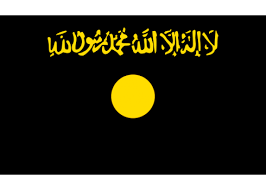
Flag of Al Qaeda
Second: Since 1979, Syria has been listed by the U.S. State Department as a sponsor of terrorism.
Among the terrorist groups it supports: Hizbollah and Hamas. For many years, Syria provided a safe-house in Damascus for Illich Ramirez Sanchez—the notorious international terrorist known as Carlos the Jackal.
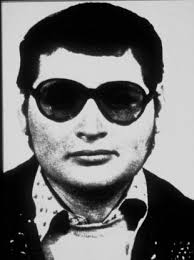
Illich Ramirez Sanches “Carlos the Jackal”
Third: China and Russia are supporting the Assad dictatorship—and the brutalities it commits against its own citizens.
This reflects badly on them—not the United States. And any move by the United States to directly attack the Assad regime could ignite an all-out war with Russia and/or China.
What happens if Russian and American forces start trading salvos? Or if Russian President Vladimir Putin orders an attack on America’s ally, Israel, in return for America’s attack on Russia’s ally, Syria?
It was exactly that scenario—Great Powers going to war over conflicts between their small-state allies—that triggered World War I.
Fourth: While Islamic nations like Syria, Iraq and Afghanistan wage war within their own borders, they will lack the resources—and incentive—to attack the United States.
Every dead Hizbollah and Al-Qaeda and ISIS member makes the United States that much safer. So does the death of every sympathizer of Hizbollah, Al-Qaeda and ISIS.
The peoples of the Middle East have long memories for those who commit brutalities against them. In their veins, the cult of the blood feud runs deep.
When Al-Qaeda blows up civilians in Beirut, their relatives will urge Hizbollah to take brutal revenge. And Hizbollah will do so. Similarly, when Hizbollah does, those who support Al-Qaeda will demand even more brutal reprisals against Hizbollah.

Al-Qaeda terrorists–now taking aim at Hezbollah terrorists
No American could instill such hatred in Al-Qaeda for Hizbollah—or vice versa. This is entirely a war of religious and sectarian hatred.
In fact, this conflict could easily become the Islamic equivalent of “the Hundred Years War” that raged from 1337 to 1453 between England and France.
When Adolf Hitler invaded the Soviet Union in 1941, then-Senator Harry S. Truman said: “I hope the Russians kill lots of Nazis—and vice versa.”
That should be America’s position whenever its sworn enemies start killing off each other. Americans should welcome such self-slaughters, not become entrapped in them.
ABC NEWS, ALTERNET, AP, BUZZFEED, CBS NEWS, CHUCK SCHUMER, CNN, CROOKS AND LIARS, CUBA, DAILY KOZ, DONALD TRUMP, FACEBOOK, FIDEL CASTRO, HENRY CABOT LODGE, JOHN F. KENNEDY, JOSEPH R. MCCARTHY, JOSEPH STALIN, MOTHER JONES, MOVEON, MSNBC, NANCY PELOSI, NBC NEWS, NEWSWEEK, NIKITA KHRUSHCHEV, NPR, PBS NEWSHOUR, POLITICO, RAW STORY, REUTERS, RICHARD NIXON, ROBERT F. KENNEDY, SALON, SEATTLE TIMES, SLATE, THE ATLANTIC, THE CHICAGO SUN-TIMES, THE CHICAGO TRIBUNE, THE DAILY BEAST, THE GUARDIAN, THE HILL, THE HUFFINGTON POST, THE LOS ANGELES TIMES, THE NATION, THE NEW YORK TIMES, THE WASHINGTON POST, TIME, TWITTER, U.S. NEWS & WORLD REPORT, UPI, USA TODAY, WILLIAM TECUMSEH SHERMAN
In Bureaucracy, History, Politics, Social commentary on December 19, 2018 at 12:13 am
On September 26, 1960, Robert F. Kennedy gave some brutal—and effective—advice to his brother, Democratic United States Senator John F., who was about to debate Republican Vice President Richard M. Nixon.
Said RFK, who was managing his brother’s campaign: “Kick him in the balls, Jack.”
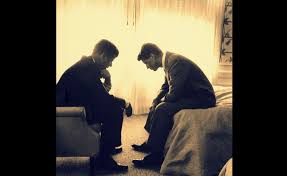
John F. Kennedy and Robert F. Kennedy
As a result, Kennedy came out fighting—and stayed on the offensive throughout the debate. At one point, he said flat-out that the United States should overthrow the year-old Cuban regime of Fidel Castro.
Nixon knew there was a secret CIA plan under way to do just that, but couldn’t afford to say so in public. So he came out hard against such a proposal, saying it would alienate American allies throughout the Caribbean.
Nixon had been warned by Henry Cabot Lodge, his Vice Presidential running mate, to tone down his “assassin image.”
During the 1950s, as a colleague of Red-baiting Senator Joseph R. McCarthy, Nixon had made himself immune from the damning charge of “soft on Communism.”
And yet, pitted against a surprisingly aggressive Kennedy, he came off as decidedly second-best in standing up to Soviet premier Nikita Khrushchev, the successor of Joseph Stalin.
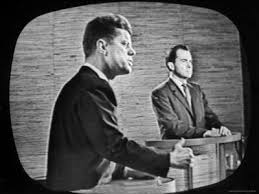
The Kennedy-Nixon Debate
Commentators generally agreed that Nixon lost that first debate—the most-watched of the four. And it may have proved fatal to his electoral chances that year.
“Kick him in the balls, Jack.“
It’s advice that current Democrats have only now begun applying.
Case in point: The December 11 Oval Office meeting of President Donald Trump, House Minority Leader Nancy Pelosi (D-CA) and Senate Minority Leader Charles Schumer. And, true to his love of publicity, Trump makes sure it’s televised live.

Nancy Pelosi
Trump opens with on a positive note: “We’ve actually worked very hard on a couple of things that are happening. Criminal justice reform…[Republican Kentucky U.S. Senator] Mitch McConnell and the group, we’re going to be putting it up for a vote. We have great Democrat support, great Republican support.”
But he soon moves to the matter he truly cares about: Demanding $5 billion to create a wall along the U.S.-Mexican border: “And one way or the other, it’s going to get built. I’d like not to see a government closing, a shutdown. We will see what happens over the next short period of time.”
“One way or the other”—“so doer so”—was a favorite phrase of Adolf Hitler’s, meaning: If he couldn’t bully his opponents into surrendering, he would use violence.
PELOSI: I think the American people recognize that we must keep government open, that a shutdown is not worth anything, and that you should not have a Trump shutdown. You have the Senate. You have the House of Representatives. You have the votes. You should pass it right now.
Trump claims he can get “Wall” legislation passed in the House but admits he doesn’t have the 60 votes he needs in the Senate.
PELOSI: Well, the fact is you can get it started that way.
Trump then contradicts himself: “The House we can get passed very easily, and we do.”
PELOSI: Okay, then do it.
Trump keeps insisting that “the House would give me the vote if I wanted it.”
PELOSI: Well, let’s take the vote and we’ll find out.
SCHUMER: We do not want to shut down the government. You have called 20 times to shut down the government….We want to come to an agreement. If we can’t come to an agreement, we have solutions that will pass the House and Senate right now, and will not shut down the government. And that’s what we’re urging you to do. Not threaten to shut down the government because you can’t get your way.

Charles Schumer
TRUMP: We need border security. And I think we all agree that we need border security.
SCHUMER: Yes, we do.
TRUMP: The wall is a part of border security. You can’t have very good border security without the wall.
PELOSI: That’s simply not true. That is a political promise. Border security is a way to effectively honor our responsibilities.
By “political promise,” Pelosi means this is an appeal Trump made to his hardcore base. which he expects to re-elect him.
SCHUMER: And the experts say you can do border security without a wall, which is wasteful and doesn’t solve the problem.
TRUMP: It totally solves the problem.
Schumer then goads Trump into taking responsibility for closing down the government if he doesn’t get funding for his border wall.
TRUMP: I’ll take it. You know what I’ll say: Yes, if we don’t get what we want, one way or the other…I will shut down the government. Absolutely.
Thus, Schumer guarantees that any government shutdown during the Christmas season will be blamed on Trump.
During the Civil War, General William Tecumseh Sherman said of his Confederate enemies: “They cannot be made to love us, but they may be made to fear us.”
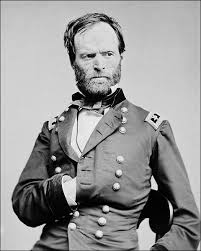
General William Tecumseh Sherman
The same is equally true today.
In short: Stand up to bullies. Odds are they will respect you more for it—and you will earn your own self-respect.
ABC NEWS, ADMIRAL IVAN ISAKOV, ADOLF HITLER, ALBERT SPEER, ALTERNET, ANDREW MCCABE, ANTHONY SCARAMUCCI, AP, BETTE DAVIS, BOB WOODWARD, BUZZFEED, CBS NEWS, CHEKA, CIA, CNN, COUNTER-SURVEILLANCE, CROOKS AND LIARS, DAILY KOZ, DAVID SHULKIN, DEMOCRATIC PARTY, DON MCGAHN, DONALD TRUMP, DR. BRENDA FITZGERALD, FACEBOOK, FBI, FSB, GARY COHN, GENRIKH YAGODA, GINA HASPEL, H.R. MCMASTER, HEINRICH HIMMLER, HERMANN GOERING, HOPE HICKS, HOUSE OF REPRESENTATIVES, JAMES COMEY, JEFF SESSIONS, JOE BIDEN, JOHN BOLTON, JOHN KELLY, JOHN MCCAIN, JOSEPH STALIN, KATIE WALSH, KELLY SADLER, KGB, LAVRENTY BERIA, LINDSEY GRAHAM, MICHAEL DUBKE, MICHAEL FLYNN, MIKE PENCE, MIKHAIL TUKHACHEVSKY, MOTHER JONES, MOVEON, MSNBC, NBC NEWS, NEWSWEEK, NICCOLO MACHIAVELLI, NICK AYERS, NIKKI HALEY, NIKOLAI YEZHOV, NKVD, NPR, OMAROSA MANIGAULT-NEWMAN, PAUL MANAFORT, PBS NEWSHOUR, POLITICO, PREET BHARARA, RAW STORY, REINCE PRIBUS, REPUBLICAN PARTY, REUTERS, REX TILLERSON, ROB PORTER, ROBERT S. MUELLER, SALLY YATES, SALON, SARAH SANDERS, SCOTT PRUITT, SEAN SPICER, SEATTLE TIMES, SEBASTIAN GORKA, SERGEY KISLYAK, SERGEY LAVROV, SLATE, SOVIET UNION, SS, STEVE BANNON, STORMY DANIELS, SURVEILLANCE, THE APPRENTICE, THE ATLANTIC, THE CHICAGO SUN-TIMES, THE CHICAGO TRIBUNE, THE DAILY BEAST, THE GUARDIAN, THE HILL, THE HUFFINGTON POST, THE LOS ANGELES TIMES, THE NATION, THE NEW YORK TIMES, THE PRINCE, THE WASHINGTON POST, TIME, TOM BOSSERT, TOM PRICE, TWITTER, U.S. NEWS & WORLD REPORT, UPI, USA TODAY, WALTER SHAUB, WILBUR ROSS
In Bureaucracy, History, Law, Law Enforcement, Military, Politics, Social commentary on December 18, 2018 at 1:16 am
The first year of Donald Trump’s White House has seen more firings, resignations, and reassignments of top staffers than any other first-year administration in modern history. His Cabinet turnover exceeds that of any other administration in the last 100 years.
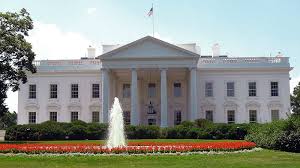
The White House
With the administration rapidly approaching its halfway pint—January 20, 2019—it’s time to size up its litany of casualties.
This listing, however, does not tell the full story. Among those who resigned from the Trump administration—and the real reasons why:
- Dr. Brenda Fitzgerald – Resigned as director of the Center of Disease Control after Politico reported that she had bought stock in Japan Tobacco while serving as CDC director.
- Omarosa Manigault-Newman – Met Trump as a contestant on “The Apprentice,” where he fired her on three different shows. She moved into the White House with him as Director of Communications for the White House Office of Public Liaison. She became disillusioned with him during 2017 and began taping her conversations with him and other government officials. When she learned she had been fired she reportedly had to be literally dragged from the White House.
- Tom Price – The Secretary of Health and Human Services ran up a $1 million cost to taxpayers for private planes and military jets for travel within the United States and trips to Asia, Africa and Europe.
- Commerce Secretary Wilbur Ross – Trump told him: “I don’t trust you. I don’t want you doing any more negotiations….You’re past your prime.”
- Sean Spicer – Resigned in anger after Trump chose Anthony Scaramucci as White House Communications Director. The reason: Trump kept him in the dark about events Spicer needed to know—such as an interview that Trump arranged with the New York Times—and which ended disastrously for Trump.
- Walter Shaub – Resigned as the director of the Office of Government Ethics in July after clashing with Trump over the President’s conflicts-of-interest vis-a-vis his financial holdings.
- Hope Hicks – White House Communications Director, resigned one day after testifying before the House Intelligence Committee. She claimed she had told “white lies” for Trump but hadn’t lied about anything important relating to the investigation of Russian subversion of the 2016 election.
- Chief of Staff Reince Priebus – Suffered repeated humiliations by Trump—such a being ordered to kill a fly that was buzzing about.
- On another occasion, Trump told an associate that Priebus was “like a little rat. He just scurries around.”
- On July 28, 2017, Priebus resigned.
- Chief of Staff John Kelly – Trump similarly ridiculed Priebus’ replacement, a former Marine Corps general. Kelly tried to limit the number of advisers who had unrestricted access to Trump—and thus bring discipline to his schedule.
- Instead of being grateful, Trump became furious. Kelly told colleagues: “He’s an idiot. It’s pointless to try to convince him of anything. He’s gone off the rails. We’re in Crazytown. I don’t even know why any of us are here. This is the worst job I’ve ever had.”
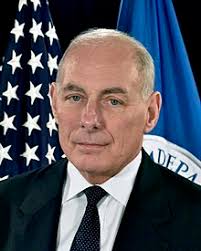
John Kelly
On December 8, 2018, Trump announced that: “John Kelly will be leaving at the end of the year, we will be announcing who will be taking John’s place, it may be on an interim basis, in the next day or two.”
This had been expected for months. Reportedly, Kelly and Trump were no longer on speaking terms.
Trump’s apparent first choice for Kelly’s replacement: Nick Ayers, who had served as Vice President Mike Pence’s chief of staff for more than a year.
Trump pushed Ayers to commit to two years, but he declined.
Ayers told Trump he had young children, and wanted to return to his home state of Georgia. He offered to temporarily serve as chief of staff, but Trump demanded a two-year commitment, and talks fell apart.
Finally, Trump found a replacement for Kelly: Mick Mulvaney, who has served as director of the Office of Management and Budget. He intends to keep his position at OMB while serving as Trump’s chief of staff.
As 2018 rapidly comes to an end, the Trump administration will come under increased pressure on two fronts:
- The Special Counsel’s investigation of Russian subversion of the 2016 Presidential election: Robert Mueller is slowly closing the net on the highest-ranking members of the Trump administration—such as Michael Flynn and Paul Manafort. These will almost certainly lead to Trump himself.
- On January 3, the House of Representatives will become a Democratically-controlled body. Trump will face unprecedented opposition—and major investigations of his past and current actions. It’s likely that the House Intelligence Committee will go after his long-hidden tax returns—which may well prove his longstanding financial ties to Russian oligarchs.
The White House is one of the most stressful places to work. Constant deadlines keep staffers working days on end. Travel is frequent. And anyone can be dismissed in an instant, since all employees work “at the pleasure of the President.”
These events will bring increased fear and stress to those who still remain in the White House. This, in turn, will ensure increased mass firings and/or resignations from the White House.
As aging stage actress Margo Channing (Bette Davis) warns in All About Eve: “Fasten your seatbelts, it’s going to be a bumpy ride.”
ABC NEWS, ADMIRAL IVAN ISAKOV, ADOLF HITLER, ALBERT SPEER, ALTERNET, ANDREW MCCABE, ANTHONY SCARAMUCCI, AP, BETTE DAVIS, BOB WOODWARD, BUZZFEED, CBS NEWS, CHEKA, CIA, CNN, COUNTER-SURVEILLANCE, CROOKS AND LIARS, DAILY KOZ, DAVID SHULKIN, DEMOCRATIC PARTY, DON MCGAHN, DONALD TRUMP, DR. BRENDA FITZGERALD, FACEBOOK, FBI, FSB, GARY COHN, GENRIKH YAGODA, GINA HASPEL, H.R. MCMASTER, HEINRICH HIMMLER, HERMANN GOERING, HOPE HICKS, HOUSE OF REPRESENTATIVES, JAMES COMEY, JEFF SESSIONS, JOE BIDEN, JOHN BOLTON, JOHN KELLY, JOHN MCCAIN, JOSEPH STALIN, KATIE WALSH, KELLY SADLER, KGB, LAVRENTY BERIA, LINDSEY GRAHAM, MICHAEL DUBKE, MICHAEL FLYNN, MIKE PENCE, MIKHAIL TUKHACHEVSKY, MOTHER JONES, MOVEON, MSNBC, NBC NEWS, NEWSWEEK, NICCOLO MACHIAVELLI, NICK AYERS, NIKKI HALEY, NIKOLAI YEZHOV, NKVD, NPR, OMAROSA MANIGAULT-NEWMAN, PAUL MANAFORT, PBS NEWSHOUR, POLITICO, PREET BHARARA, RAW STORY, REINCE PRIBUS, REPUBLICAN PARTY, REUTERS, REX TILLERSON, ROB PORTER, ROBERT S. MUELLER, SALLY YATES, SALON, SARAH SANDERS, SCOTT PRUITT, SEAN SPICER, SEATTLE TIMES, SEBASTIAN GORKA, SERGEY KISLYAK, SERGEY LAVROV, SLATE, SOVIET UNION, SS, STEVE BANNON, STORMY DANIELS, SURVEILLANCE, THE APPRENTICE, THE ATLANTIC, THE CHICAGO SUN-TIMES, THE CHICAGO TRIBUNE, THE DAILY BEAST, THE GUARDIAN, THE HILL, THE HUFFINGTON POST, THE LOS ANGELES TIMES, THE NATION, THE NEW YORK TIMES, THE PRINCE, THE WASHINGTON POST, TIME, TOM BOSSERT, TOM PRICE, TWITTER, U.S. NEWS & WORLD REPORT, UPI, USA TODAY, WALTER SHAUB, WILBUR ROSS
In Bureaucracy, History, Law, Law Enforcement, Military, Politics, Social commentary on December 17, 2018 at 12:26 am
The first year of Trump’s White House has seen more firings, resignations, and reassignments of top staffers than any other first-year administration in modern history. His Cabinet turnover exceeds that of any other administration in the last 100 years.
With the Trump administration rapidly approaching its halfway point—January 20, 2019—it’s time to size up its litany of casualties.
Among these:
FIRED:
- Preet Bharara – U.S. Attorney for the Southern District of New York
- Sally Yates – Assistant United States Attorney General
- James Comey – FBI Director
- Rex Tillerson – Secretary of State
- Andrew McCabe – FBI Deputy Director
- Jeff Sessions – United States Attorney General
RESIGNED:
- Katie Walsh – Deputy White House Chief of Staff
- Michael T. Flynn – National Security Adviser
- Walter Shaub – Office of Government Ethics Director
- Michael Dubke – Communications Director
- Sean Spicer – Press Secretary
- Reince Priebus – Chief of Staff
- Anthony Scaramucci – Communications Director
- Steve Bannon – Chief Strategist
- Sebastian Gorka – Deputy Assistant to the President
- Tom Price – Secretary of Health and Human Services
- Omarosa Manigault-Newman – Director of Communications for White House Office of Public Liaison
- Dr. Brenda Fitzgerald – Director of the Center for Disease Control and Prevention
- Rob Porter – White House Staff Secretary
- Hope Hicks – White House Communications Director
- Gary Cohn – Director of the National Economic Council
- H.R. McMaster – National Security Adviser
- Tom Bossert – Homeland Security Adviser
- Scott Pruitt – Director, Environmental Protection Agency
- Don McGahn – White House Counsel
- Nikki Haley – United States Ambassador to the United Nations
- David Shulkin – Secretary of the Veterans Administration
This listing, however, does not tell the full story.
Among those who were fired—and the real reasons why:
- Jeff Sessions – Fired as Attorney General because he refused to quash Special Counsel Robert S. Mueller’s probe into proven connections between Russian Intelligence agents and high-ranking members of Trump’s Presidential campaign.
- On the day after the November, 2018 mid-term elections, Trump fired him.
- James Comey – Fired as FBI Director because he refused to pledge his personal loyalty to Trump. Trump also hoped to end the FBI’s investigation of links between Russian Intelligence agents and members of his 2016 Presidential campaign.
- Trump later admitted to Russian Foreign Minister Sergey Lavrov and Russian Ambassador Sergey Kislyak: “I just fired the head of the FBI….I faced great pressure because of Russia. That’s taken off.”
- Don McGahn – Resigned as White House Counsel after repeatedly clashing with Trump about the best strategy for dealing with Mueller’s investigation.
- Tom Bossert – Trump’s Homeland Security Adviser, was fired by John Bolton, the new National Security Adviser.
- Sally Yates – Fired by Trump as Acting Attorney General for her aggressive pursuit of Michael Flynn’s treasonous contacts with Russian Intelligence officials during the 2016 Presidential campaign. She had also refused to uphold Trump’s executive order on immigration and denounced it as unlawful.
- Preet Bharara – Fired by Trump as United States Attorney for the Southern District of New York. Although an Obama appointee, Trump had initially asked him to stay on—and then abruptly fired him. The possible reason: He was known as one of Wall Street’s fiercest watchdogs and a widely respected prosecutor. Trump believes that corporations should be immune from their crimes—and, as President, has worked to confer such immunity upon them.
- Rex Tillerson – Trump’s Secretary of State, was fired without warning while on a trip to Africa. The reason: In 2017, word leaked to the press that Tillerson had called Trump “a moron.”
- Steve Bannon – Although he officially resigned, Trump fired his Fascistic chief strategist after Bannon heatedly clashed with other members of the White House.
- Anthony Scaramucci – Although he officially resigned, he was in fact fired by Trump at the urging of John Kelly. The reason: An obscenity-laced interview with The New Yorker, where he attacked members of the Trump administration—most notably Bannon.
Among those who resigned—and the real reasons why:
- Scott Pruitt – Although he technically resigned as head of the Environmental Protection Agency, he was in effect fired. He was under several federal ethics investigation for lavish spending, conflicts of interests with corporate lobbyists, and enlisting his official government staffers to run personal errands.
- Rob Porter – The White House Staff Secretary resigned after after two of his ex-wives accused him of physical and emotional abuse.
- Michael Flynn – Although he officially resigned, he was in fact fired as National Security Adviser. The reason: He had discussed, with Russian Ambassador Sergey Kislyak, ending the Obama administration’s sanctions against Russia. Then he lied about it to Vice President Mike Pence. When these facts became public, Flynn was sent packing.
ABC NEWS, ADMIRAL IVAN ISAKOV, ADOLF HITLER, ALBERT SPEER, ALTERNET, ANDREW MCCABE, ANTHONY SCARAMUCCI, AP, BETTE DAVIS, BOB WOODWARD, BUZZFEED, CBS NEWS, CHEKA, CIA, CNN, COUNTER-SURVEILLANCE, CROOKS AND LIARS, DAILY KOZ, DAVID SHULKIN, DEMOCRATIC PARTY, DON MCGAHN, DONALD TRUMP, DR. BRENDA FITZGERALD, FACEBOOK, FBI, FSB, GARY COHN, GENRIKH YAGODA, GINA HASPEL, H.R. MCMASTER, HEINRICH HIMMLER, HERMANN GOERING, HOPE HICKS, HOUSE OF REPRESENTATIVES, JAMES COMEY, JEFF SESSIONS, JOE BIDEN, JOHN BOLTON, JOHN KELLY, JOHN MCCAIN, JOSEPH STALIN, KATIE WALSH, KELLY SADLER, KGB, LAVRENTY BERIA, LINDSEY GRAHAM, MICHAEL DUBKE, MICHAEL FLYNN, MIKE PENCE, MIKHAIL TUKHACHEVSKY, MOTHER JONES, MOVEON, MSNBC, NBC NEWS, NEWSWEEK, NICCOLO MACHIAVELLI, NICK AYERS, NIKKI HALEY, NIKOLAI YEZHOV, NKVD, NPR, OMAROSA MANIGAULT-NEWMAN, PAUL MANAFORT, PBS NEWSHOUR, POLITICO, PREET BHARARA, RAW STORY, REINCE PRIBUS, REPUBLICAN PARTY, REUTERS, REX TILLERSON, ROB PORTER, ROBERT S. MUELLER, SALLY YATES, SALON, SARAH SANDERS, SCOTT PRUITT, SEAN SPICER, SEATTLE TIMES, SEBASTIAN GORKA, SERGEY KISLYAK, SERGEY LAVROV, SLATE, SOVIET UNION, SS, STEVE BANNON, STORMY DANIELS, SURVEILLANCE, THE APPRENTICE, THE ATLANTIC, THE CHICAGO SUN-TIMES, THE CHICAGO TRIBUNE, THE DAILY BEAST, THE GUARDIAN, THE HILL, THE HUFFINGTON POST, THE LOS ANGELES TIMES, THE NATION, THE NEW YORK TIMES, THE PRINCE, THE WASHINGTON POST, TIME, TOM BOSSERT, TOM PRICE, TWITTER, U.S. NEWS & WORLD REPORT, UPI, USA TODAY, WALTER SHAUB, WILBUR ROSS
In Bureaucracy, History, Law, Law Enforcement, Politics, Social commentary on December 14, 2018 at 12:06 am
In January, 2018, the White House banned the use of personal cell phones in the West Wing. The official reason: National security.
The real reason: To stop staffers from leaking to reporters.
More ominously, well-suited men roam the halls of the West Wing, carrying devices that pick up signals from phones that aren’t government-issued. “Did someone forget to put their phone away?” one of the men will ask if such a device is detected. If no one says they have a phone, the detection team start searching the room.
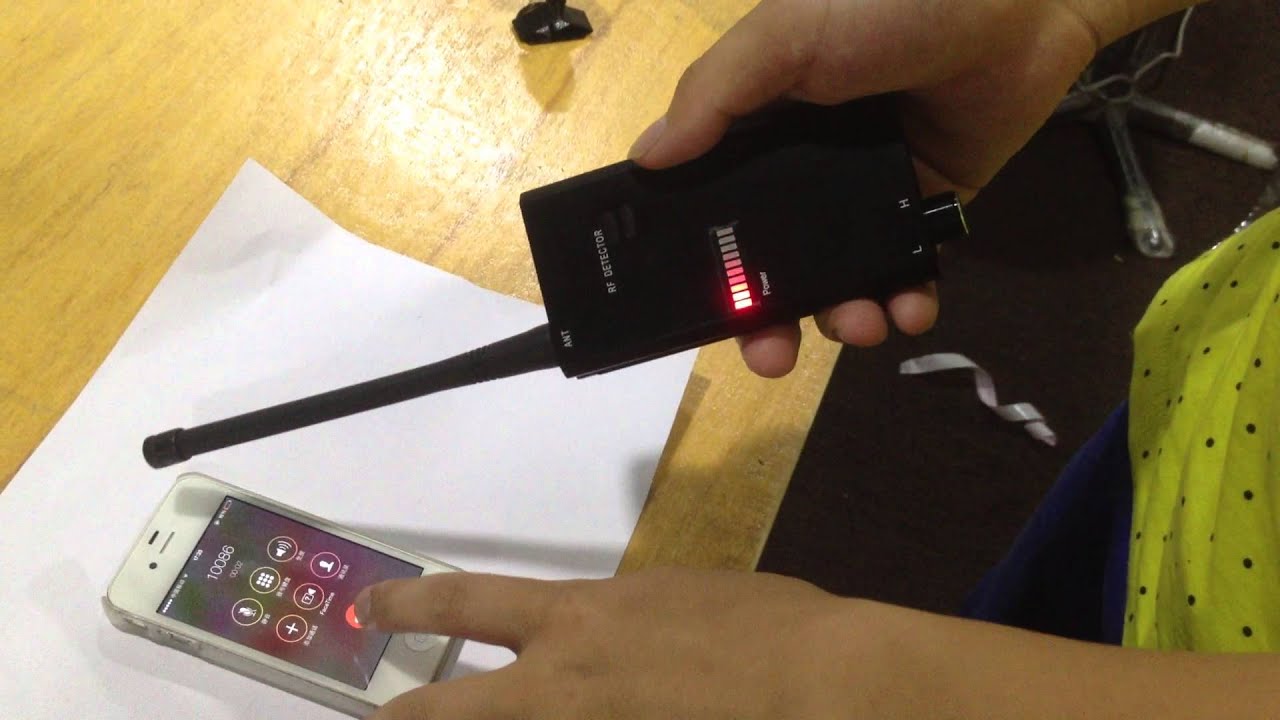
Phone detector
The devices can tell which type of phone is in the room.
This is the sort of behavior Americans have traditionally—and correctly—associated with dictatorships
In his memo outlining the policy, Chief of Staff John Kelly warned that anyone who violated the phone ban could be punished, including “being indefinitely prohibited from entering the White House complex.”
Yet even these draconian methods may not end White House leaks.
White House officials still speak with reporters throughout the day and often air their grievances, whether about annoying colleagues or competing policy priorities.
Aides with private offices sometimes call reporters on their desk phones. Others get their cell phones and call or text reporters during lunch breaks.
According to an anonymous White House source: “The cellphone ban is for when people are inside the West Wing, so it really doesn’t do all that much to prevent leaks. If they banned all personal cellphones from the entire [White House] grounds, all that would do is make reporters stay up later because they couldn’t talk to their sources until after 6:30 pm.”
Other sources believe that leaks won’t end unless Trump starts firing staffers. But there is always the risk of firing the wrong people. Thus, to protect themselves, those who leak might well accuse tight-lipped co-workers.
Within the Soviet Union (especially during the reign of Joseph Stalin) fear of secret police surveillance was widespread—and absolutely justified.
Among the methods used to keep conversations secret:
- Turning on the TV or radio to full volume.
- Turning on a water faucet at full blast.
- Turning the dial of a rotary phone to the end—and sticking a pencil in one of the small holes for numbers.
- Standing six to nine feet away from the hung-up receiver.
- Going for “a walk in the woods.”
- Saying nothing sensitive on the phone.
The secret police (known as the Cheka, the NKVD, the MGB, the KGB, and now the FSB) operated on seven working principles:
- Your enemy is hiding.
- Start from the usual suspects.
- Study the young.
- Stop the laughing.
- Rebellion spreads like wildfire.
- Stamp out every spark.
- Order is created by appearance.
Trump has always ruled through bribery and fear. He’s bought off (or tried to) those who might cause him trouble—like porn actress Stormy Daniels. And he’s threatened or filed lawsuits against those he couldn’t or didn’t want to bribe—such as contractors who have worked on various Trump properties.
But Trump can’t buy the loyalty of employees working in an atmosphere of hostility—which breeds resentment and fear. And some of them are taking revenge by sharing with reporters the latest crimes and follies of the Trump administration.
The more Trump wages war on the “cowards and traitors” who work most closely with him, the more some of them will find opportunities to strike back. This will inflame Trump even more—and lead him to seek even more repressive methods against his own staffers.
This is a no-win situation for Trump.
The results will be twofold:
- Constant turnovers of staffers—with their replacements having to undergo lengthy background checks before coming on; and
- Continued leaking of embarrassing secrets by resentful employees who stay.
Trump became famous on “The Apprentice” for telling contestants: “You’re fired.”
Since taking office as President, he has bullied and insulted even White House officials and his own handpicked Cabinet officers. This has resulted in an avalanche of firings and resignations.
The first year of Trump’s White House has seen more firings, resignations, and reassignments of top staffers than any other first-year administration in modern history. His Cabinet turnover exceeds that of any other administration in the last 100 years.
With the Trump administration rapidly approaching its halfway point—January 20, 2019—it’s time to size up its litany of casualties.
The list is impressive—but only in a negative sense.
ABC NEWS, ADMIRAL IVAN ISAKOV, ADOLF HITLER, ALBERT SPEER, ALTERNET, ANDREW MCCABE, ANTHONY SCARAMUCCI, AP, BETTE DAVIS, BOB WOODWARD, BUZZFEED, CBS NEWS, CHEKA, CIA, CNN, COUNTER-SURVEILLANCE, CROOKS AND LIARS, DAILY KOZ, DAVID SHULKIN, DEMOCRATIC PARTY, DON MCGAHN, DONALD TRUMP, DR. BRENDA FITZGERALD, FACEBOOK, FBI, FSB, GARY COHN, GENRIKH YAGODA, GINA HASPEL, H.R. MCMASTER, HEINRICH HIMMLER, HERMANN GOERING, HOPE HICKS, HOUSE OF REPRESENTATIVES, JAMES COMEY, JEFF SESSIONS, JOE BIDEN, JOHN BOLTON, JOHN KELLY, JOHN MCCAIN, JOSEPH STALIN, KATIE WALSH, KELLY SADLER, KGB, LAVRENTY BERIA, LINDSEY GRAHAM, MICHAEL DUBKE, MICHAEL FLYNN, MIKE PENCE, MIKHAIL TUKHACHEVSKY, MOTHER JONES, MOVEON, MSNBC, NBC NEWS, NEWSWEEK, NICCOLO MACHIAVELLI, NICK AYERS, NIKKI HALEY, NIKOLAI YEZHOV, NKVD, NPR, OMAROSA MANIGAULT-NEWMAN, PAUL MANAFORT, PBS NEWSHOUR, POLITICO, PREET BHARARA, RAW STORY, REINCE PRIBUS, REPUBLICAN PARTY, REUTERS, REX TILLERSON, ROB PORTER, ROBERT S. MUELLER, SALLY YATES, SALON, SARAH SANDERS, SCOTT PRUITT, SEAN SPICER, SEATTLE TIMES, SEBASTIAN GORKA, SERGEY KISLYAK, SERGEY LAVROV, SLATE, SOVIET UNION, SS, STEVE BANNON, STORMY DANIELS, SURVEILLANCE, THE APPRENTICE, THE ATLANTIC, THE CHICAGO SUN-TIMES, THE CHICAGO TRIBUNE, THE DAILY BEAST, THE GUARDIAN, THE HILL, THE HUFFINGTON POST, THE LOS ANGELES TIMES, THE NATION, THE NEW YORK TIMES, THE PRINCE, THE WASHINGTON POST, TIME, TOM BOSSERT, TOM PRICE, TWITTER, U.S. NEWS & WORLD REPORT, UPI, USA TODAY, WALTER SHAUB, WILBUR ROSS
In Bureaucracy, History, Law, Law Enforcement, Politics, Social commentary on December 13, 2018 at 12:36 am
In his infamous treatise, The Prince, Niccolo Machiavelli warns that it is safer to be feared than loved. And he lays out his reason thusly:
“From this arises the question whether it is better to be loved than feared, or feared more than loved. The reply is, that one ought to be both feared and loved, but as it is difficult for the two to go together, it is much safer to be feared than loved….
“And men have less scruple in offending one who makes himself loved than one who makes himself feared; for love is held by a chain of obligations which, men being selfish, is broken whenever it serves their purpose; but fear is maintained by a dread of punishment which never fails.”
But Machiavelli immediately follows this up with a warning about the abuses of fear:
“Still, a prince should make himself feared in such a way that if he does not gain love, he at any rate avoids hatred: for fear and the absence of hatred may well go together….”
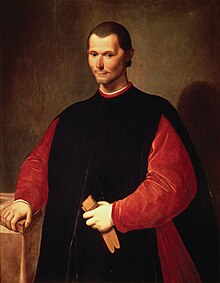

Niccolo Machiavelli
It’s a warning that someone should have given President Donald Trump long ago.
Not that he would have heeded it.
On May 10, 2018, The Hill reported that White House Special Assistant Kelly Sadler had joked derisively about Arizona United States Senator John McCain.
McCain, a Navy pilot during the Vietnam war, was shot down over Hanoi on October 26, 1967, and captured. He spent five and a half years as a POW in North Vietnam—and was often brutally tortured. He wasn’t released until March 14, 1973.
Recently, he had opposed the nomination of Gina Haspel as director of the CIA.
The reason: In 2002, Haspel had operated a “black” CIA site in Thailand where Islamic terrorists were often waterboarded to make them talk.
For John McCain, waterboarding was torture, even if it didn’t leave its victims permanently scarred and disabled.
Aware that the 81-year-old McCain was dying of brain cancer, Sadler joked to intimates about the Senator’s opposition to Haspel: “It doesn’t matter. He’s dying anyway.”
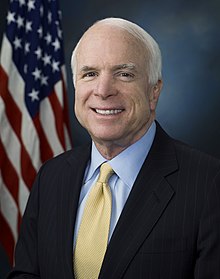
John McCain
Leaked to CNN by an anonymous White House official, Sadler’s remark sparked fierce criticism—and demands for her firing.
South Carolina Republican Senator Lindsey Graham, a close friend of McCain, said: “Ms. Sadler, may I remind you that John McCain has a lot of friends in the United States Senate on both sides of the aisle. Nobody is laughing in the Senate.”
“People have wondered when decency would hit rock bottom with this administration. It happened yesterday,” said former Vice President Joe Biden.
“John McCain makes America great. Father, grandfather, Navy pilot, POW hero bound by honor, an incomparable and irrepressible statesman. Those who mock such greatness only humiliate themselves and their silent accomplices,” tweeted former Massachusetts governor and 2012 Republican presidential candidate Mitt Romney.
Officially, White House Press Secretary Sarah Huckabee Sanders refused to confirm or deny Sadler’s joke: “I’m not going to get into a back and forth because people want to create issues of leaked staff meetings.”
Unofficially, Sanders was furious—not at the joke about a dying man, but that someone had leaked it. After assailing the White House communications team, she pouted: “I am sure this conversation is going to leak, too. And that’s just disgusting.”

Sarah Huckabee Sanders
No apology has been offered by any official at the White House—including President Trump.
In fact, Senior White House communications adviser Mercedes Schlapp reportedly expressed her support for Sadler: “I stand with Kelly Sadler.”
On May 11—the day after Sadler’s comment was reported—reporters asked Sanders if the tone set by Trump had caused Sadler to feel comfortable in telling such a joke.
“Certainly not!” predictably replied Sanders, adding: “We have a respect for all Americans, and that is what we try to put forward in everything we do, but in word and in action, focusing on doing things that help every American in this country every single day.”
On May 14 Trump revealed his “respect” for “all Americans”—especially those working in the White House.
“The so-called leaks coming out of the White House are a massive over exaggeration put out by the Fake News Media in order to make us look as bad as possible,” Trump tweeted.
“With that being said, leakers are traitors and cowards, and we will find out who they are!”
In a move that Joseph Stalin would have admired, Trump ordered an all-out investigation to find the joke-leaker.
In January, 2018, the White House had banned the use of personal cell phones in the West Wing. The official reason: National security.
The real reason: To stop staffers from leaking to reporters.
Officials now have two choices:
- Leave their cell phones in their cars, or,
- When they arrive for work, deposit them in lockers installed at West Wing entrances. They can reclaim their phones when they leave.
Several staffers huddle around the lockers throughout the day, checking messages they have missed. The lockers buzz and chirp constantly from 6 a.m. to 8 p.m. Monday through Friday.


 Bureaucracybuster's Blog
ABC NEWS, ADOLF HITLER, ALTERNET, AP, BBC, BUZZFEED, CBS NEWS, CNN, DAILY KOS, DIMITRI SHOSTAKOVICH, DONALD TRUMP, FACEBOOK, FBI, GREAT TERROR, JAMES COMEY, JEFF SESSIONS, JOSEPH STALIN, KEITH SCHILLER, MIKE FLYNN, MIKHAIL TUKHACHEVESKY, MOTHER JONES, MOVEON, NAZI GERMANY, NBC NEWS, NEWSWEEK, NICCOLO MACHIAVELLI, NIKITA KHRUSHCHEV, NIKOLAI ZHILAYEV, NPR, POLITICO, RAW STORY, REUTERS, ROBERT MUELLER 111, ROD ROSENSTEIN, RUSSIAN ESPIONAGEky, SALON, SEATTLE TIMES, SENATE INTELLIGENCE COMMITTEE, SERGEY KISLYAK, SERGEY LAVOV, SLATE, SOVIET UNION, THE ATLANTIC, THE CHICAGO SUN-TIMES, THE CHICAGO TRIBUNE, THE DAILY BEAST, THE DISCOURSES, THE GUARDIAN, THE HILL, THE HUFFINGTON POST, THE LOS ANGELES TIMES, THE NEW YORK TIMES, THE WALL STREET JOURNAL, THE WASHINGTON POST, TIME, TWITTER, U.S. NEWS & WORLD REPORT, UPI, USA TODAY, WEHRMACHT, WORLD WAR 11
HEROES WORTH CELEBRATING: PART TWO (END)
In Bureaucracy, History, Law, Law Enforcement, Military, Politics, Social commentary on December 26, 2018 at 12:16 amNikolai Sergeyvich Zhilayev (pronounced Zill-lay-ev) was a Russian musicologist and the teacher of several 20th-century Russian composers.
He was also an icon of courage in a country infested with cowards and stool pigeons.
Among his friends—to his ultimate misfortune—was Mikhail Tukhachevsky, the former military hero now falsely condemned and executed as a traitor by Soviet dictator Joseph Stalin.
In 1938, Zhilayev (November 18, 1881 – January 20, 1938) also became a casualty of what has become known as The Great Terror.
In his posthumously-published memoirs, Testimony, Dimitri Shostakovich, his pupil and friend, described how Zhilayev faced his end with a calmness that awed even the NKVD (the predecessor to the KGB) secret police sent to arrest him.
Dimitri Shostakovich
“He had a large picture of Tukhachevsky in his room, and after the announcement that Tukhachevsky had been shot as a traitor to the homeland, Zhilayev did not take the picture down.
“I don’t know if I can explain how heroic a deed that was….As soon as the next poor soul was declared an enemy of the people, everyone destroyed in a panic everything connected with that person….
“And naturally, photographs flew into the fire first, because if someone informed on you, reported that you had a picture of an enemy of the people, it meant certain death.
“Zhilayev wasn’t afraid. When they came for him, Tukhachevsky’s prominently hung portrait amazed even the executioners.”
“What, it’s still up?” one of the secret police asked.
“The time will come,” Zhilayev replied, “when they’ll erect a monument to him.”
As, in fact, has happened.
Meanwhile, Stalin has been universally condemned as one of history’s greatest tyrants.
Mikhail Tukhachevsky appears on a 1963 Soviet Union postage stamp
Third hero—James Brien Comey (December 14, 1960)
Comey served as United States Attorney (federal prosecutor) for the Southern District of New York (2002-2003).
As United States Deputy Attorney General (2003-2005), he opposed the warrantless wiretapping program of the George W. Bush administration. He also argued against the use of water boarding as an interrogation method.
In 2005, he entered the private sector as General Counsel and Senior Vice President for Lockheed Martin, the biggest contractor for the Department of Defense.
On July 29, 2013, the United States Senate voted 93 -1 to confirm Comey as director of the FBI, the seventh in its history.
James B. Comey
He directed the FBI from his appointment in 2013 by President Barack Obama until his firing on May 9 by President Donald Trump.
In a move that Joseph Stalin would have admired, Trump gave no warning of his intentions. Instead, he sent Keith Schiller, his longtime bodyguard, to the FBI with a letter announcing Comey’s dismissal.
Trump had three reasons for firing Comey:
As a Presidential candidate and President, Trump:
On May 10—the day after firing Comey—Trump met in the Oval Office with Russian Foreign Minister Sergey Lavov and Russian Ambassador Sergey Kislyak.
Kislyak is reportedly a top recruiter for Russia’s SVR foreign intelligence agency. He has been closely linked with Jeff Sessions, now Attorney General, and fired National Security Adviser Mike Flynn.
“I just fired the head of the FBI,” Trump told the two dignitaries. “He was crazy, a real nut job. I faced great pressure because of Russia. That’s taken off.”
During that meeting he gave the Russians sensitive Intelligence on ISIS that had been supplied by Israel.
Two days later, on May 12, Trump tweeted a threat to the fired FBI director: “James Comey better hope that there are no ‘tapes’ of our conversations before he starts leaking to the press.”
But shortly afterward, reports surfaced that Comey had written memos to himself immediately after his private meetings with Trump.
He had also told close aides that Trump was trying to pressure him into dropping the investigation into close ties between Russian Intelligence agents and Trump campaign staffers.
As for Trump’s threat of having secret tapes: Like Trump’s claim that he could prove that Barack Obama wasn’t an American citizen, this, too, proved to be a lie.
And Comey’s firing led directly to a result Trump did not anticipate: Acting Attorney General Rod Rosenstein yielded to demands from Democrats and appointed former FBI Director Robert Mueller III as a special prosecutor to investigate those ties.
Share this: