On December 21, 1949, Joseph Vissarionovich Djugashvili turned 70. And millions of Russians feverishly competed to out-do one another in singing his praises.
These celebrations weren’t prompted by love—but fear.
For the man being so honored was internationally known by a far different name: Stalin, which in Russian means: “Man of Steel.”
He had lived up to it: For almost 30 years, through purges and starvation caused by enforced collections of farmers’ crops, he had slaughtered 20 to 60 million people.
Joseph Stalin
The British historian, Robert Payne, described these rapturous events in his classic 1965 biography, The Rise and Fall of Stalin:
“The guns blazed in salute, the processions marched across the Red Square, and huge balloons bearing the features of a younger Stalin climbed into the wintry sky.
“The official buildings were draped in red, the color of happiness. From all over the country came gifts of embroidered cloth, tapestries and carpets bearing his name or his features.
“Ornamental swords, cutlasses, tankards, cups, everything that might conceivably please him, were sent to the Kremlin, and then displayed in the State Museum of the Revolution….Poets extolled him in verses, He was the sun, the splendor, the lord of creation.
“The novelist Leonid Lenov…foretold the day when all the peoples of the earth would celebrate his birthday; the new calendar would begin with the birth of Stalin rather than with the birth of Christ.”
Lavrenti P. Beria, Stalin’s sinister and feared secret police chief, oozed: “Millions of fighters for peace and democracy in all countries of the world are closing their ranks still firmer around Comrade Stalin.”
Lavrenti P. Beria
“With a feeling of great gratitude, turning their eyes to Stalin,” gushed Central Committee Secretary Georgi Malenkov, “the peoples of the Soviet Union, and hundreds of millions of peoples in all countries of the world, and all progressive mankind, see in Comrade Stalin their beloved leader and teacher….”
“The mighty voice of the Great Stalin, defending the peace of the world, has penetrated into all corners of the globe,” enthused Defense Commissar Kliment Voroshilov.
“Without Comrade Stalin’s special care,” extolled Trade and Supply Minister Anastas Mikoyan, “we would have never have had a network of meat combines equipped with the latest machinery, canneries and sugar refineries, a fishing industry….”
Foreign Minister Vyacheslav Molotov: “The gigantic Soviet army created during [World War II] was under the direct leadership of Comrade Stalin and built on the basis of the principles of Stalinist military science.”
So those Americans with a sense of history were alarmed and disgusted upon watching President Donald J. Trump—also 70—convene his first full Cabinet meeting since taking office on January 20.
Donald Trump
On June 12, polls showed that only 36% of Americans approved of his conduct. But from his Cabinet members, Trump got praise traditionally lavished on dictators like Stalin and North Korea’s Kim Jong On.
While the Cabinet members sat around a mahogany table in the West Wing of the White House, Trump instructed each one to say a few words about the good work his administration was doing.
“Start with Mike,” ordered Trump, referring to Vice President Mike Pence.
“It is the greatest privilege of my life to serve as the vice president to a president who is keeping his word to the American people,” Pence dutifully said.
Mike Pence
Then Attorney General Jeff Sessions gushed: “It’s an honor to be able to serve you.”
“My hat’s off to you,” oozed Energy Secretary Rick Perry, referring to Trump’s decision to withdraw from the Paris climate agreement.
Secretary of Agriculture Sonny Perdue flattered: “I just got back from Mississippi. They love you there.”
“What an incredible honor it is to lead the Department of Health and Human Services at this pivotal time under your leadership,” fawned Tom Price. “I can’t thank you enough for the privilege that you’ve given me, and the leadership you’ve shown.”
Secretary of Labor Alex Acosta raved: “I’m deeply honored and I want to thank you for keeping your commitment to the American workers.”
“Thank you for coming over to the Department of Transportation,” eulogized Elaine Chao, its secretary. “I want to thank you for getting this country moving again, and also working again.”
“On behalf of the entire senior staff around you, Mr. President,” brown-nosed Reince Prebus, Trump’s chief of staff, “we thank you for the opportunity and the blessing you’ve given us to serve your agenda and the American people, and we’re continuing to work very hard every day to accomplish those goals.”
Mick Mulvaney, director of the Office of Management and Budget, groveled: “At your direction, we were able to also focus on the forgotten men and women who are paying taxes, so I appreciate your support on pulling that budget together.”
On June 8, former FBI Director James Comey had testified before the Senate Select Committee on Intelligence.
Among the charges he aimed at Trump: The President had demanded a pledge of personal loyalty in return for Comey’s keeping his job.
This would have made Comey his secret police chief.
Comey had refused to give this. And Trump had fired him.
Trump publicly denied this.
Then came the June 12 Cabinet meeting—and all the proof anyone needed.
In June, 1948, Soviet dictator Joseph Stalin was determined to drive the Western occupying powers out of Berlin—and of West Germany.
On June 19, the Soviet Union blocked the Western Allies’ railway, road, and canal access to the sectors of Berlin under Western control.
At that time, West Berlin had only 36 days’ worth of food and 45 days’ worth of coal. And the United States had only 8,973 Americans stationed in Berlin. British forces totaled 7,606, and French forces 6,100.
Russian forces in Berlin and East Germany outnumbered them 62 to 1.
The United States seemed to face a choice between all-out war with the Soviet Union—or appeasing its growing aggression in Eastern Europe.
Fortunately, a third choice was found. It became known as the Berlin Airlift.
This was carried out primarily by the United States and Great Britain. Other Western powers taking part in this operation included France, Australia, Canada, New Zealand and South Africa.
Starting on June 24, 1948, the Berlin Airlift aimed to supply the city’s two and a half million residents with food and energy supplies.
There was no guarantee that such an operation could succeed–at least, not in the long run. Since 1903, airplanes had been used to carry out surveillance, engage in dogfights or bomb cities. But airlifts—flying supplies to stranded people—had proven dismal failures.
At first, the Berlin Airlift worked haphazardly. Pilots flew themselves to exhaustion to meet the needs of those they had relentlessly bombed just three years ago.
Then Major General William “Willie the Whip” Tunner took charge—and brought a totally mechanized approach to the drops:
Pilots must fly strictly by instruments, even when visibility was excellent.
Planes could no longer circle over Berlin. Each plane would have only one chance to land in Berlin—or must return to its base if it missed its approach.
Every 90 seconds, a plane was to take off or land.
Just keeping Berliners alive demanded 4,000 tons of supplies each day. Each plane was thus overloaded by 10 tons. Pilots flew literally round the clock. When fog rolled in that winter, visibility was reduced to zero. Twenty-eight Americans died in crashes.
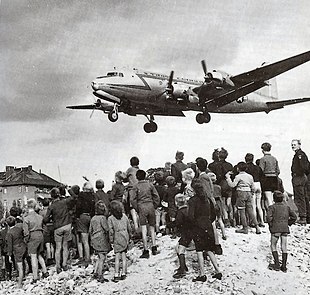
A Douglas C-54 Skymaster lands at Berlin’s Templehof Airport
Germans were impressed with American efficiency, but knew that, in the eyes of most of their American occupiers, they were pariahs. They had waged an aggressive war and exterminated millions of helpless men, women and children in concentration camps.
They were glad the Allies were keeping them alive, but felt they were pawns in a global chess game between the United States and the Soviet Union.
Then fate took a hand.
An Army Air Force pilot named Gail “Hal” Halvorsen impulsively decided to drop a series of small, hand-made parachutes of candies to Berlin’s children.
When General Tunner learned of this, he instantly realized its worth as a morale booster to Berliners. He ordered Halvorsen to continue the drops.
Gail “Hal” Halvorsen
Other pilots followed Halvorsen’s example. Soon Berlin’s children were lining up by the thousands, hoping to grab one of the candy-filled parachutes made from handkerchiefs or strips of clothing.
When the press learned of the drops, the story became a worldwide sensation. Back in the United States, Americans mailed literally tons of candy to Germany for distribution to Berlin’s children.
“The candy bombers” became the most beloved Americans in Berlin. And Halvorsen became the most beloved of them all. On October 3, 1948, when his plane landed in Berlin during a pouring storm, 700 children greeted him on the tarmac for “Lieutenant Gail Halvorsen Day.”
Among the letters he received from Berlin’s children:
Dear Uncle Wiggly Wings,
When yesterday I came from school, I had the happiness to get one of your sweet gifts….You cannot think how big the joy was….My brother and parents stood about me when I opened the strings and fetched out all the chocolate.
Dear Candy Bomber,
…How lucky I was last Sunday. I played at a ruin with some friends of mine opposite our house. Suddenly we saw about ten white parachutes coming out of the sky! One of them set down on the roof of our house. There were three stripes chocolate in the parachute….I want to thank you for your love to the German kids….
From 10-year-old Helma Lurch came this tribute:
Take care of yourself, and remember us children and we will remember you our whole life.
Adults as well as children responded emotionally to the candy drops—and “the candy bombers” responsible for them. When a plane crashed, killing two American lieutenants, residents of the neighborhood memorialized them with a plaque: “Once we were enemies yet you now gave your lives for us. We are doubly in your debt.”
The Airlift ended on May 12, 1949, when Stalin finally accepted defeat and ended the blockade.
“As [Halvorsen] came to represent the Airlift and America to the Berliners,” writes Andrei Cherney in his definitive book, The Candy Bombers, “through him America became a country that cared enough about the defeated Germans to…deliver candy to children, an act without any…ulterior motive, a gift of plain compassion.”
In 1948, that act forged a solid bond—which still exists—between Germany and the United States.
Once again, it falls to Niccolo Machiavelli to reveal truths long forgotten—especially by those who subscribe only to the darkest arts.
In his most important book, The Discourses, he outlines the methods by which citizens of a republic can maintain their freedom.
In Book Three, Chapter 20, he offers this example of the power of humanity to win over even the most stubborn opponents:
Niccolo Machiavelli
“Camillus was besieging the city of the Faliscians, and had surrounded it….A teacher charged with the education of the children of some of the noblest families of that city [to ingratiate himself] with Camillus and the Romans, led these children…into the Roman camp.
“And presenting them to Camillus [the teacher] said to him, ‘By means of these children as hostages, you will be able to compel the city to surrender.’
“Camillus not only declined the offer but had the teacher stripped and his hands tied behind his back….[Then Camillus] had a rod put into the hands of each of the children…[and] directed them to whip [the teacher] all the way back to the city.
“Upon learning this fact, the citizens of Faliscia were so much touched by the humanity and integrity of Camillus, that they surrendered the place to him without any further defense.
“This example shows that an act of humanity and benevolence will at all times have more influence over the minds of men than violence and ferocity. It also proves that provinces and cities which no armies…could conquer, have yielded to an act of humanity, benevolence, chastity or generosity.”
Americans put this lesson to use in 1948 in the skies over Berlin.
When Nazi Germany fell to the Allies in May, 1945, the country was divided into four zones of occupation—one for each of the occupying powers: The United States, Great Britain, France and the Soviet Union.
Within the fledgling administration of President Harry S. Truman, many believed that a new era of peace had dawned between America and Russia.
But then grim reality intruded.
Adolf Hitler had invaded the Soviet Union in 1941. As a result, at least 20 million Soviet men, women and children died violently.
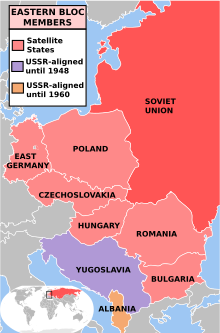
To expel the invasion and destroy Nazi Germany, Russian armies had advanced across a series of Eastern European countries. With the war over, Soviet dictator Joseph Stalin decided to protect the Soviet Union from a future German invasion.
Joseph Stalin
His solution: Occupy Eastern Europe with Red Army units as a buffer between Germany and the Soviet Union. Poland, East Germany, Czechoslovakia, Romania, Bulgaria, Hungary, Albania and Yugoslavia.
Stalin had promised President Franklin Roosevelt that he would withdraw his armies from these countries once Germany was defeated. And he would allow them to choose whatever form of government they desired.
But Stalin had no intention of living up to his promises. And backing him up were 10 to 13 million Red Army soldiers. The entire United States Army had been reduced to 552,000 men by February 1948.
Liberating the captive nations of Eastern Europe—as General George S. Patton wanted to do—would have plunged the United States into full-scale war against its World War II ally.
And by 1945, the Red Army was a formidable enemy: Of the 4.3 million dead and missing casualties suffered by the Wehrmacht, 85% of them occurred on the dreaded “Eastern front.”
So there was nothing the United States could do—short of all-out war—to “roll back” the “Iron Curtain” that had swept over Eastern Europe.
But Americans could—and did—draw a line in the sand. That line became known as the policy of “containment.”
And nowhere was the collision between the U.S.A and the U.S.S.R. more likely to ignite into full-scale war than in Berlin.
Between 1945 and 1948, the Soviets increased their pressure on Western forces occupying Berlin to leave the city. The Soviets already controlled East Germany; gaining control of the Western-held part of Berlin would likely be their first step toward overwhelming the rest of Germany.
And, after Germany, probably France—and as many other European countries as possible.
During the first two years of occupation the occupying powers of France, United Kingdom, United States, and the Soviet Union were not able to successfully negotiate a possible currency reform in Germany. Each of the Allies printed its own occupation currency.
Then, on June 20, 1948, the Bizonal Economic Council introduced the Deutsche mark to West Germany.
On June 24, 1945, the Soviet Union blocked the Western Allies’ railway, road, and canal access to the sectors of Berlin under Western control. This meant a cutoff of food and energy supplies to Berlin’s two and a half million residents.
The United States faced a monumental crisis:
Should it abandon West Berlin—and thus tempt the Soviet Union into further aggression?
Should it match the puny Western military forces—outnumbered 62 to 1—against the massive Soviet military presence?
If it chose to fight in Berlin, would this lead to nuclear war?
Fortunately for the Allies—and West Germany—a third choice was available besides war and appeasement.
In July, 2016, an Associated Press/GfK poll found that half of Americans saw then-Republican Presidential candidate Donald Trump as “racist”—and only 7% of blacks viewed him favorably.
Among the reasons for this:
His enthusiastic support by racist white supremacist organizations such as the Ku Klux Klan and the American Nazi Party.
His “birther” attacks on President Barack Obama as a non-citizen from Kenya—and thus ineligible to hold the Presidency.
His attacks on the Black Lives Matter movement and calling on his supporters at rallies to rough up minority protesters.
To counter this, Trump appointed as his Director of African-American Outreach a woman with absolutely no credible ties to the black community: Omarosa Manigault.
He did so just hours before the opening of the first night of the Republican National Convention.
Donald Trump
Manigault is best known as the villain of Trump’s reality-TV show, “The Apprentice”—where she was fired on three different seasons. Her credentials include a Ph.D. in communications, a preacher’s license, and topping TV Guide’s list of greatest reality TV villains in 2008.
During the Clinton administration she held four jobs in two years, and was thoroughly disliked in all of them.
“She was asked to leave [her last job] as quickly as possible, she was so disruptive,” said Cheryl Shavers, the former Under Secretary for Technology at the Commerce Department. “One woman wanted to slug her.”
In February, 2016, she appeared on a segment on Maria Bartiromo’s Fox Business show. Fox panelist Tamera Holder said that she would like Trump more if he expressed support for Black Lives Matter or put forward a plan to improve inner cities.
Manigault argued that the topic of the discussion should be limited to Trump’s criticism of the Iraq war. In doing so, she mispronounced Holder’s first name.
Then occurred this exchange:
Holder: “It’s Tamara.”
Manigault: “It’s the same difference, boo. You want to come on with big boobs, then you deal with the pronunciation of your name.”
“Wait a second,” Bartiromo interrupted. “Why are you bringing up Tamara’s boobs?”
Manigault: “Because she started going back talking about, ‘Oh, you were a Democrat and you supported Hillary Clinton.’ If you want to get personal, we can get personal.”
Holder: “Wait, how does who you support have to do with the size of my boobs? Considering that this is how I was born. I mean, I’m sorry.”
Manigault: “I’m sorry, I should have called you a boob. Can we talk about Donald Trump?”
Manigault wasn’t bothered that blacks regarded Trump so poorly in polls: “My reality is that I’m surrounded by people who want to see Donald Trump as the next president of the United States who are African-American.”
And, in September, 2016, she famously predicted: “Every critic, every detractor will have to bow down to President Trump. It’s everyone who’s ever doubted Donald, who ever disagreed, who ever challenged him. It is the ultimate revenge to become the most powerful man in the universe.”
Omarosa Manigault
When Trump moved into the White House on January 20, 2017, Manigault moved in with him as his director of communications for the Office of Public Liaison.
In June, she invited the Congressional Black Caucus (CBS) to visit the White House. And she signed the invitation: “The Honorable Omarosa Manigault.” This is not a title given to political aides. And it’s not used by those referring to themselves.
The arrogance offended some members of the CBS, which declined the invitation.
In August, Manigault appeared at the National Association of Black Journalists convention in New Orleans. She was a panelist on a discussion about losing loved ones to violence. When the moderator, Ed Gordon, asked her about Trump’s policies and not her personal history with losing family members through violence, Manigault got into a shouting match with him.
On December 13, she was told that she would be leaving the White House on January 20, 2018–one year from the day she had arrived there. She reportedly asked Ivanka Trump to intervene on her behalf, but the request was denied.
Deciding to go right to the top, she headed for the Trump’s private quarters. There she tripped an alarm—which brought guards and White House Chief of Staff John Kelly to the scene.
An enraged Kelly ordered her ejected from the White House.
Multiple sources report that she had to be physically restrained and escorted—cursing and screaming—from the Executive Mansion.
Early reports said the Secret Service did the escorting, but the agency denied this: “Our only involvement in this matter was to deactivate the individual’s pass which grants access to the complex.”
Next day—December 14—Manigault appeared on “Good Morning America.” The woman who had been Trump’s ambassador to blacks now sang a different tune: “There were a lot of things that I observed during the last year that I was very unhappy with, that I was very uncomfortable with.
“I have seen things that made me uncomfortable, that have upset me, that have affected me deeply and emotionally, that has affected my community and my people. And when I can tell my story, it is a profound story that I know the world will want to hear.”
J. Edgar Hoover was appointed director of the Federal Bureau of Investigation in 1924. His 48-year reign ended only with his death on May 2, 1972.
Niccolo Machiavelli advised would-be princes to be both loved and feared. Hoover took this to heart—and ensured that he was both.
To gain love, he shamelessly advertised himself as the Nation’s foremost guardian against crime and espionage–especially the Communist variety.
He did so through
A relentless series of interviews with favored journalists and book authors;
“Authoring” several ghostwritten books; and
Sponsoring comic books, radio programs and even a high-rated TV series to tout the glories of the FBI.
Millions of Americans believed that only Hoover and his ace G-men stood between them and the threat of crime and/or Communist subversion.
J. Edgar Hoover
Members of the House and Senate Judiciary Committees supposedly oversee the operations of the Justice Department—of which the FBI is the biggest part. Yet they competed with one another to fawn over Hoover and his agency and to give him even greater appropriations than he asked for.
But it wasn’t just popularity that kept Hoover in power for almost a half-century. While he reveled in feeling loved by the public, he did not rely entirely on this as a guarantee of longevity.
“In large measure, Hoover’s power rested on the information he had squirreled away in his secret files,” wrote investigative journalist David Wise in his 1976 bestseller, The American Police State.
“Put simply, the famous Director of the FBI, the cereal boxtop, G-man hero of generations of American youth, was a blackmailer. Hoover collected and filed away facts, tidbits, gossip, scandal and dark secrets that gave him leverage over members of Congress, the Cabinet, even Presidents.”
“He has a file on everybody,” a terrified President Richard Nixon told White House Counsel John Dean.
It was the major reason why Nixon—and Presidents John F. Kennedy and Lyndon B. Johnson—never dared fire him.
Hoover learned, for example, of the sexual relationship between JFK and “party girl” Judith Campbell. Aside from the politically explosive matter of Kennedy’s adultery, Campbell was also bedding Sam Giancana, the most notorious Mafia boss in Chicago.
Fearing that his superior, Attorney General Robert Kennedy, meant to fire him, Hoover, in 1962, let President Kennedy know that he was in on the secret. Hoover quit worrying about involuntary retirement after that.
John F. Kennedy, J. Edgar Hoover and Robert F. Kennedy
Similarly, LBJ told aides he would never fire Hoover: “It’s better to have him inside the tent pissing out, than outside the tent pissing in.”
Now, fast forward to Special Prosecutor Robert Mueller’s assignment to investigate well-documented links between Russian Intelligence agents and members of Donald Trump’s 2016 Presidential campaign.
On May 9, President Trump fired FBI Director James Comey for doing the same thing. When Mueller was appointed to continue that investigation, Trump made clear his anger at the decision.
Since May, Trump, his shills in Congress and Right-wing Fox News have relentlessly attacked Mueller’s integrity and investigative methods.
This despite the fact that Mueller was appointed by Republican President George W. Bush and served with an impeccable reputation for 12 years as FBI director (2001-2013).
From the outset of Mueller’s investigation, there have been widespread fears that Trump would fire him, just as he did Comey.
On December 15, Rep. Jackie Spier (D-Calif.) said: “The rumor on the Hill when I left yesterday was that the President was going to make a significant speech at the end of next week. And on December 22, when we are out of D.C., he was going to fire Robert Mueller.”
A member of the House Intelligence Committee, Spier said that Trump was trying to shut down Congress’ own investigation of Russian interference in the 2016 election.
So: How should Robert Mueller respond?
Two methods are open to him.
The first is to follow the straight-arrow path he has always traveled: Keep pressing on with his investigation and wait to see what happens. And if Trump fires him, hope that, somehow, the probe goes on.
The second is to summon up the ghost of J. Edgar Hoover.
As described by William C. Sullivan, Hoover’s one-time number-three man and the director of his Intelligence Division:
William C. Sullivan
“The moment he would get something on a Senator, he would send one of his errand boys up and advise the Senator that we’re in the course of an investigation and by chance happened to come up with this data on your daughter.
“But we wanted you to know know—we realize you would want to know it. But don’t have any concern—no one will ever learn about it. Well, Jesus, what does that tell the Senator? From that time on, the Senator’s right in his pocket.”
Reports have circulated that many of those Congress members now demanding Mueller’s firing are recipients of financial (and possibly intelligence) support from the Kremlin.
Perhaps it’s time for Mueller to send one of his own “errand boys” up to Capitol Hill for a quiet exchange with such leaders.
Once they realize how much they stand to lose by backing a Kremlin-owned President, they may well change their tunes.
A battle of truly cosmic proportions is about to rage.
In one corner is the dreaded Zika virus, which prevents the brain of a fetus from developing properly—and for which there is no vaccine.
And in the other corner are self-appointed Right-wing “guardians of morality” who refuse to provide abortion services—even in cases of rape and incest.
For the moment, Brazil is the epicenter of the Zika outbreak. But it is certain to expand to other nations, as the virus—carried by mosquitoes—continues to spread across the globe.
Mosquito
Brazil is investigating the potential link between Zika infections and more than 4,000 suspected cases of microcephaly, which causes babies to be born with abnormally small heads and a host of birth defects.
Another affected country is Columbia. On February 7, 2016, its president, Juan Manuel Santos, announced that 25,645 Columbians were infected with Zika—of which 3,177 were pregnant women.
Zika virus victim (left)
Zika cases have been confirmed in 73 countries and territories in the Americas.
The barest facts about this epidemic are nightmarish—especially for any woman who is pregnant.
An estimated 80 percent of those infected—male and female—show no symptoms, and those that do have a mild illness, with a fever, rash and red eyes.
Babies so affected are born with an abnormally small head resulting in developmental problems, such as retardation, blindness and deafness.
The virus can be transmitted directly by mosquitoes; by mothers to fetuses; by men to their sexual partners; by saliva during deep kissing; and by blood transfusions.
There is no vaccine to prevent infection with the Zika virus–and no cure for it once you’ve been infected.
The United States Centers for Disease Control (CDC) has issued the following guidelines for protection against the virus:
The best way to prevent diseases spread by mosquitoes is to protect yourself and your family from mosquito bites.
Wear long-sleeved shirts and long pants.
Stay in places with air conditioning or window and door screens to keep mosquitoes outside.
Use insect repellents that are registered by the Environmental Protection Agency for their effectiveness.
If using sunscreen, apply sunscreen before applying insect repellent.
Sleep under a mosquito bed net if you are overseas or outside and can’t protect yourself from mosquito bites.
But while mosquitoes are responsible for the first half of this nightmarish scenario, responsibility for the second half lies with Right-wing attitudes toward abortion.
In Columbia, abortion became legal only in 2006—and only under the following circumstances:
The pregnancy poses a danger to the life or health of the mother.
The presence of life-threatening fetal malformations.
The pregnancy resulted from rape, incest or non-consensual artificial insemination.
Prior to 2006, abortion in Columbia was illegal without exception.
Faced with the Zika epidemic, Columbia’s government has announced that pregnant women who carry the virus are eligible for abortion services.
Yet many Columbian women struggle to find abortion providers even when they meet strict legal requirements. The result: Illegal abortions are widespread.
According to the CDC, by December 6, 2017:
5,601 symptomatic Zika virus disease cases reported within the United States.
The number of Zika cases among travelers visiting or returning to the United States will likely increase.
5,324 cases resulted from travelers returning from affected areas.
226 cases were acquired through presumed local mosquito-borne transmission.
51 cases were acquired via other routes, including sexual intercourse, laboratory transmission and person-to-person through an unknown route.
As the Zika toll inevitably rises within the United States, there will be increasing demands by women to obtain abortion services.
And the Republican party will increasingly strive to deny those services—as the following quotes attest:
“Once a child does exist in your womb, I’m not going to assume a right to kill it just because the child’s host (some refer to them as mothers) doesn’t want it.”—Virginia U.S. Senator Steve Martin (2014).
“If it’s a legitimate rape, the female body has ways to try to shut that whole thing down.”—Former Congressman Todd Akin (2012).
Richard Mourdock
“I struggled with it myself for a long time, but I came to realize life is that gift from God. And I think even when life begins in that horrible situation of rape, that is something that God intended to happen.”—Former Republican U.S. Senate Candidate Richard Mourdock (2012)
“Texas was in a long period of drought until Governor [Rick] Perry signed the fetal pain bill. It rained that night. Now God has his hold on California.”—California Republican Assemblywoman Shannon Grove. (2015)
“….We assert the sanctity of human life and affirm that the unborn child has a fundamental right to life which cannot be infringed.”—2016 Republican Party platform
The most important reason why Republicans oppose abortion: There is a ready source of votes for politicians wanting to ban it.
Since Ronald Reagan’s 1980 race, all major Republican Presidential candidates have appeased this voting bloc.
But as the toll from the Zika virus continues to rise, anti-abortionists will face pressure even from within their own ranks.
Many of their own wives and daughters (and, in some cases, mistresses) carrying Zika-infected fetuses will demand the right to terminate such pregnancies.
And then the battle over abortion rights will enter an entirely new dimension.
During the 1917 Russian Revolution, Leon Trotsky acted as a key lieutenant to Vladimir Lenin. Trotsky organized the Red Army and successfully resisted all attempts to overthrow the fledgling Communist government.
One of Trotsky’s bitterest enemies was Joseph Stalin, another intimate of Lenin’s. When Lenin died in 1924, Stalin outmaneuvered Trotsky for leadership of the Soviet Union.
Long before he ordered Trotsky’s assassination in 1940, Stalin turned his former rival into an official non-person. Trotsky was:
Airbrushed from photos showing him sitting or standing close to Lenin.
Written out of Soviet history textbooks.
Depicted, in print and documentary films, as seeking to overturn the Revolution—and assassinate Stalin.
Stalin made certain his image in Soviet history was entirely different.
In the 1930s, he was portrayed as the modest, all-wise, energetic builder of a new Communist world.
After 1945, he was depicted as the architect of the Soviet victory over Nazi Germany during World War II.
No “historian” dared mention that:
For almost 30 years, through purges and starvation caused by enforced collections of farmers’ crops, he had slaughtered 20 to 60 million people.
His wholesale purges of the Red Army in the 1930s had made the country vulnerable to the German attack in 1941.
His 1939 “nonaggression” pact with Germany had almost destroyed Russia. In this he and Hitler secretly divided Poland between them. The subsequent German invasion of Poland, on September 1, 1939, directly triggered World War II.
Joseph Stalin
After Stalin died on March 5, 1953, his status in Soviet history suddenly changed.
Thousands of his portraits—displayed on streets and in buildings throughout the Soviet Union—suddenly came down.
In 1956, his successor, Nikita Khrushchev, secretly denounced him as a psychotic butcher and bungler who had almost wrecked the country.
So those Americans with a sense of history were undoubtedly stunned at President Donald J. Trump’s reaction to the defeat of Republican Senatorial candidate Roy Moore on December 12.
Donald Trump
Unfortunately for Trump, Moore carried heavy political baggage:
He had twice been removed as a Justice from the Alabama Supreme Court.
He had blamed 9/11 not on Islamic terrorists but on “America’s turning away from God.”
He had said the United States should eliminate all but the first 10 Constitutional amendments. This would remove those amendments forbidding slavery and guaranteeing civil rights for blacks and women.
Worst of all, Moore was haunted by allegations that, as a prosecutor during his 30s, he had made sexual advances toward at least eight teenage girls.
Many Republicans openly urged Moore to withdraw. They saw him as a nightmarish embarrassment to their party should he win the election.
Roy Moore
Even the President’s favorite daughter, Ivanka Trump, said: “There is a special place in hell for people who prey on children.”
But that didn’t stop Trump supporting Moore full-tilt against his Democratic opponent, former United States Attorney Doug Jones. Jones had convicted Ku Klux Klan members for bombing a black church in 1963.
On December 4, Trump tweeted:
“Democrats refusal to give even one vote for massive Tax Cuts is why we need Republican Roy Moore to win in Alabama. We need his vote on stopping crime, illegal immigration, Border Wall, Military, Pro Life, V.A., Judges 2nd Amendment and more. No to Jones, a Pelosi/Schumer Puppet!”
During a December 8 campaign rally in Pensacola, Florida, near the state line with Alabama, Trump said:
“Get out and vote for Roy Moore. Do it. Do it. We cannot afford, the future of this country cannot afford to lose the seat.”
“We need somebody in that Senate seat who will vote for our Make America Great Again agenda, which involves tough on crime, strong on borders, strong on immigration.”
On December 8, Trump tweeted:
“LAST thing the Make America Great Again Agenda needs is a Liberal Democrat in Senate where we have so little margin for victory already. The Pelosi/Schumer Puppet Jones would vote against us 100% of the time. He’s bad on Crime, Life, Border, Vets, Guns & Military. VOTE ROY MOORE!”
As the December 12 election drew close, Trump made a robocall on Moore’s behalf:
“Hi, this is President Donald Trump and I need Alabama to go vote for Roy Moore. It is so important. We’re already making America great again. I’m going to make America safer, and stronger, and better than ever before, but we need that seat and we need Roy voting for us.”
Then—for Trump—the unthinkable happened: Moore lost. Jones received 49.9% of the vote; Moore got 48.4%.
Suddenly, Trump was rewriting history.
During the Republican Senatorial primary in August, Trump had backed Moore’s opponent, Luther Strange. Now he tweeted:
“The reason I originally endorsed Luther Strange (and his numbers went up mightily), is that I said Roy Moore will not be able to win the General Election. I was right! Roy worked hard but the deck was stacked against him!”
And, in another tweet, he stated: “Congratulations to Doug Jones on a hard fought victory. The write-in votes played a very big factor, but a win is a win. The people of Alabama are great, and the Republicans will have another shot at this seat in a very short period of time. It never ends!”
A joke Russians once shared now applies to Donald Trump: “The trouble with writing history in the Soviet Union is you never know what’s going to happen yesterday.”
Kim Jong-Un: Secretive, ruthless, egomaniacal, erratic at best, certifiably insane at worst. Commanding the world’s fourth-largest army—and a growing arsenal of nuclear weapons.
Given a lack of CIA “assets” within North Korea, the United States government has been forced to accept any scraps of reliable information it can get on Kim’s regime.
As a result, the White House, Pentagon and State Department may be forced to turn to another source in predicting Kim Jong-Un’s coming moves—and fate.
His name: Gaius Suetonius Tranquillus—better known as Suetonius.
Suetonius, a historian and citizen of ancient Rome, chronicled the lives of the first twelve Caesars of imperial Rome: Julius Caesar, Augustus, Tiberius, Caligula, Claudius, Nero, Galba, Otho, Vitellius, Vespasian, Titus and Domitian.
His compilation of these biographies, The Twelve Caesars, is still available today.
Gaius Caligula was the fourth Roman to assume the title of Emperor and Caesar. His reign began in 37 A.D. and ended—violently—four years later.
Gaius Caligula
His full name was Gaius Julius Caesar Augustus Germanicus. “Caligula”—“Little Boots”—was a nickname bestowed on him as a child by his father’s soldiers.
Accompanying his father, Germanicus, on military campaigns, Gaius often dressed up as a soldier to “drill” the troops, who loved his enthusiasm for military life.
Tiberius, the third Roman emperor, adopted Germanicus as his heir, and many Romans considered him as Rome’s Alexander the Great because of his virtuous character and military prowess. Many wanted him to succeed Tiberius when the emperor died.
But Germanicus died first, under mysterious circumstances. Some blamed illness, others believed he had been poisoned. Tiberius was widely suspected of having murdered a potential rival. And few mourned when Tiberius himself died in 19 A.D.
Upon Tiberius’ death, Caligula became emperor. The Romans welcomed his ascension due to their memory of his father, Germanicus.
His reign began well. He recalled those who had been banished from Rome by Tiberius, and publicly announced that “he had no ears for informers,” according to Suetonius.
He allowed judges unrestricted jurisdiction, without appeal to himself. To lighten the duties of jurors, he added a fifth division to the previous four. He also tried to restore the suffrage to the people by reviving the custom of elections.
He completed the public works which had been half-finished under Tiberius: the temple of Augustus and the theatre of Pompey.
But then Caligula underwent a change in character. Suetonius claimed that he suffered from an affliction that made him suddenly fall unconscious. The historian believed that Caligula knew that something was wrong with him.
He became increasingly egomaniacal. Among the titles he gave himself: “Child of the Camp,” “Father of the Armies,” and “Greatest and Best of Caesars.”
Eventually, he came to believe himself divine.
Without warning, he ordered one of his soldiers to execute his brother Tiberius. He drove his father-in‑law, Silanus, to commit suicide by cutting his throat with a razor.
Tiberius’ “crime” had been Caligula’s suspicion that he had taken an antidote against poison. “There is no antidote against Caesar!” Caligula is said to have raged.
In fact, Tiberius had taken medicine for a chronic cough.
Silanus died because he had not followed Caligula when he put to sea in stormy weather. Caligula believed he had remained behind hoping to take possession of Rome if he perished in the storm.
Actually, Silanus suffered from sea-sickness and wanted to avoid the discomforts of the voyage.
Caligula committed incest with all his sisters, and “at a large banquet he placed each of them in turn below him, while his wife reclined above.”
When his favorite sister, Drusilla, died, he announced a season of public mourning, making it a capital crime to laugh, bathe, or dine with one’s parents, wife, or children.
Having violated his sisters, he eagerly violated the wives of others.
At one wedding, he ordered that the bride be taken to his own house, and within a few days divorced her. Two years later he banished her, suspecting that she had returned to her former husband.
At gladiatorial games, he sometimes matched decrepit gladiators against wild beasts, and had sham fights between men who were “conspicuous for some bodily infirmity.”
Objecting to the expense of cattle to feed wild beasts for a gladiatorial show, he selected criminals to be devoured.
On other occasions, he shut up the storehouses for threshed grain and condemned the people to hunger.
“Let them hate me, so long as they fear me,” he often said. But hatred can override fear.
Just this happened among several members of his own security force, the Praetorian Guard. Caligula had repeatedly mocked Cassius Chaerea, one of its officers, for his weak voice, and assailed his masculinity.
On January 22, 41 A.D., Chaerea and other guardsmen attacked Caligula in an underground corridor of a gladiatorial arena and repeatedly stabbed him to death.
Upon hearing reports that Caligula was dead, Romans feared to rejoice: Had he started the rumor to discover who wanted him dead? Only when they were certain did they give themselves over to unbridled joy.
If history truly repeats itself, Kim Jong-Un has good reason to be afraid.
Officials at the Pentagon and State Department constantly scramble for information that will enable them to penetrate the designs of North Korean dictator Kim Jong-Un.
And with good reason: His country possesses nuclear weapons, and is headed by a leader who’s erratic at best and certifiably insane at worst.
According to the Pentagon, North Korea had enough plutonium stored up to create a minimum of six nuclear weapons. Other estimates were as high as 10 to 16 nuclear weapons.
And since Donald Trump entered the White House, he has been engaged in an increasingly tense exchange of insults with the North Korean dictator.
Kim Jong-Un
Kim Jong-Un is the third Kim to rule North Korea since 1948. The first was his grandfather, Kim II-sung, who seized power and ruled absolutely until his death in 1994.
By ordering the invasion of South Korea in 1950, he provoked American intervention and ignited the Korean War (1950-1953), which ended in stalemate.
He was succeeded by his son, Kim Jong-il, who ruled from 1994 to 2011. That regime was marked by widespread famine, partially due to economic mismanagement, suppression of human rights and the export of state terrorism.
As was the case with his father, Kim Jong-il’s reign ended only with his death in 2011. He was immediately succeeded by his son, Kim Jong-Un.
At Kim Jong-il’s memorial service, the eulogy seemed as much for his son as for the departed “Dear Leader”:
“Respected Comrade Kim Jong-un is our party, military and country’s supreme leader who inherits great comrade Kim Jong-il’s ideology, leadership, character, virtues, grit and courage.”
Born on January 8, 1983, Kim Jong-Un owes everything to an act of genetics—his being the son of an absolute dictator.
This alone has enabled him to hold a series of exalted titles:
First Secretary of the Workers’ party of Korea; the Chairman of the Central Military Commission;
Chairman of the National Defense Commission;
The Supreme Commander of the Korean People’s Army; and
Presidium member of the Politburo of the Workers’ Party of Korea.
On December 30, 2011—only 13 days after his father died—Kim Jong-Un was formally appointed as the Supreme Commander of the Korean People’s Army.
North Korean military rally
In April, 2012, the Fourth Party Conference named him to the newly-created post of First Secretary of the Workers’ Party of Korea. He was promoted to the rank of Marshal in the army in July, 2012.
Given a lack of CIA “assets” within North Korea, the United States government has been forced to accept any scraps of reliable information it can get on Kim’s regime.
It’s known, for example, that he is a man of immense egomania. Following his father’s death, the cult of personality around Kim Jong-Un’s went into high gear.
He was hailed as the “great successor to the revolutionary cause of self-reliance,” “outstanding leader of the party, army and people” and “respected comrade who is identical to Supreme Commander Kim Jong-il.”
He was “a great person born of heaven,” declared the Korean Central News Agency. And, not to be outdone, the ruling Workers’ Party announced: “We vow with bleeding tears to call Kim Jong-Un our supreme commander, our leader.”
In November 2012, satellite photos revealed a half-mile-long propaganda message carved into a hillside in Ryanggang Province, reading, “Long Live General Kim Jong-Un, the Shining Sun!”
In 2013, Kim was named the world’s 46th most powerful person by the Forbes list of The World’s Most Powerful People. This derives from his commanding the fourth-largest standing army in the world–and an arsenal of nuclear weapons.
On March 7, 2013, North Korea threatened to launch a “pre-emptive nuclear attack” upon the United States. North Korea has outlined its plans for target American cities for nuclear strikes, including Washington, D.C., and Los Angeles.
Then there are the purges—the motive for which may be Kim’s desire to erase all traces of his father’s rule.
By the end of 2013, three defense ministers and four chiefs of the army’s general staff had been replaced. Among those purged was his uncle, Jang Sung-taek—who is thought to have been executed by machine gun.
Other victims of Kim’s regime reportedly include members of Jang’s family:
His sister Jang Kye-sun;
Her husband and ambassador to Cuba, Jon Yong-jin;
Jang’s nephew and ambassador to Malaysia, Jang Yong-chol; and
The nephew’s two sons, who were also reportedly murdered.
On May 13, 2015, South Korea’s National Intelligence Service reported that Kim had ordered the execution of North Korea’s Minister of Defense, Hyon Yong Chol.
The charge: Treason. And for “showing disrespect” to Kim by talking back to him and falling asleep at a military event.
Chol was killed by anti-aircraft gunfire with hundreds watching at a shooting range at Pyongyang’s Kang Kon Military Academy in late April.
Nor has this been the only major execution for 2015. Reports claim that earlier this year, Kim had ordered the execution of 15 senior officials for challenging his authority.
Penetrating the secrets of a ruthless dictatorship is extremely difficult. And any information obtained can often be considered no better than gossip.
Given these limitations, the White House, Pentagon and State Department may be forced to turn to another source in predicting Kim Jong-Un’s coming moves—and fate.
His name: Gaius Suetonius Tranquillus–better known as Suetonius.
It’s the sort of outrage that could have easily been committed by the SS or KGB.
But, to the shame of the United States, it was committed by the Mesa Police Department.
Even more shamefully, the officer responsible for yet another killing of an unarmed man got to walk away from it.
In January, 2016, Daniel Shaver crawled on his hands and knees and begged for his life while facing six armed Arizona police officers.
One of the officers, Philip Brailsford, was carrying an AR-15 rifle with the phrase “You’re Fucked” etched into the weapon.
Shaver couldn’t see the etching. But the commands of Sergeant Charles Langley—captured on a police body camera—were clearly audible.
They were the type to be expected from a dictator literally holding the power of life and death over others: Humiliating and fear-inspiring.
Shaver, 26, on a work-related trip to Mesa from Granbury, Texas, had been doing rum shots with a woman he had met earlier that day. He had also been showing off a pellet gun he used to take out rodents in his work in pest control.
Daniel Shaver and his wife, Laney
At some point, a caller informed the Mesa Police Department that a man was pointing a rifle out of a fifth-floor window at a La Quinta Inn.
When officers arrived at the Inn, they ordered Shaver and the woman to come out of the hotel room. They did so and immediately complied with commands from Sergeant Langley.
Then occurred this exchange:
LANGLEY:Stop right there! Stop! Stop! Get on the ground both of you! Lay down on the ground. Lay down on the ground.
If you make a mistake, another mistake, there is a very severe possibility that you’re both going to get shot. Do you understand? Who else is in the room?
SHAVER: Nobody.
Philip Brailsford
[Langley then asked if they were sober enough to understand his commands. Both Shaver and the woman said they were.]
SHAVER: What—?
LANGLEY: Shut up. I’m not here to be tactful or diplomatic with you. You listen, you obey. For one thing: Did I tell you to move young man?
SHAVER: No.
LANGLEY:Put both hands on the top of your head and interlace your fingers. Take your feet and cross your left foot over your right foot.
Young man you’re not to move you’re to put your eyes down and look down at the carpet. You’re to keep your fingers interlaced behind your head. You’re to keep your legs crossed.
If you move we’re going to consider that a threat and we’re going to deal with it and you may not survive.
[Langley ordered the woman to crawl toward him. She did so and was handcuffed off-camera.]
LANGLEY: Young man listen to my instructions and do not make a mistake. You are to keep your legs crossed. Do you understand me?
SHAVER: Yes, sir.
LANGLEY:You are to put both of your hands palms down straight out in front of you push yourself up to a kneeling position. I said keep your legs crossed! I didn’t say this as a conversation.
[Shaver put his hands behind his back.]
LANGLEY (shouting): I said put your hands up hands in the air! You do that again, we’re shooting you do you understand?
SHAVER: Please do not shoot me.
LANGLEY: Then listen to my instructions!
SHAVER: I’m trying to do what you say—
LANGLEY:Don’t talk! Listen! Hands straight up in the air! Do not put your hands down for any reason. You think you’re gonna fall, you better fall on your face. Your hands go back into the small of your back or down we are going to shoot you. Do you understand me?
SHAVER: Yes, sir.
LANGLEY: Crawl towards me, crawl towards me.
Shaver started crawling toward Langley and Brailsford, sobbing. At one point, he reached back toward his pants leg—possibly to pull up his shorts.
Suddenly Brailsford opened fire so quickly it sounded like a single shot—although Shaver was struck five times.
Brailsford later claimed he believed that Shaver was reaching for a gun.
The video makes clear that Shaver was thoroughly covered by the officers. Any of them could have approached Shaver while he was prone and handcuffed him.
No gun was found on Shaver’s body. Two pellet rifles used in Shaver’s pest-control job were later found in the hotel room.
In May, 2016, Brailsford was charged with second-degree murder.
After deliberation for less than six hours over two days, jurors found Brailsford not guilty of second degree murder as well as of a lesser charge of reckless manslaughter.
“The justice system miserably failed Daniel (Shaver) and his family,” said Mark Geragos, an attorney for Shaver’s widow, Laney Sweet.
Brailsford was fired from the Mesa Police Department two months after the shooting.
Langley retired as a police officer and moved to the Philippines—where police death squads operate under orders from the country’s president, Rodrigo Duterte.
According to a Washington Post database, there were at least 963 fatal police shootings in 2016.
Steffen White’s Email: Sparta480@aol.com Former reporter, legal investigator and troubleshooter. Columnist at Bureaucracybuster.com. Fighting political and bureaucratic arrogance, incompetence and/or indifference.
When making complaints in writing, carefully review your email or letter before sending it. Remove any words that are vulgar or profane. Don't make sweeping accusations: "Your agency is a waste."
Don't attribute motives to people you've had problems with, such as: "The postal clerk refused to help me because he's a drunk." If the person actually appeared to be drunk, then be precise in your description: "As he leaned over the counter I could smell beer on his breath. Behind him, in a waste basket, I saw an empty bottle of Coors beer."
Show how the failure of the official to address your problem reflects badly on the company or agency: "This is not the level of service your ads would lead potential customers to expect."
If necessary, note any regulatory agencies that can make life rough for the company or agency if your complaint isn't resolved. For the phone company, for example, cite the FCC or the PUC. But do this only after you have stated you hope your complaint can be settled amicably and privately within the company.






 Bureaucracybuster's Blog
ABC NEWS, ALEX ACOSTA, ALTERNET, ANASTAS MIKOYAN, AP, BBC, BUZZFEED, CBS NEWS, CNN, DAILY KOS, DEPARTMENT OF AGRICULTURE, DEPARTMENT OF HEALTH AND HUMAN SERVICES, DEPARTMENT OF JUSTICE, DEPARTMENT OF LABOR, DEPARTMENT OF TRANSPORTATION, DONALD TRUMP, ELAINE CHAO, FACEBOOK, FBI, GEORGI MALENKOV, JAMES COMEY, JEFF SESSIONS, JOSEPH STALIN, KIM JONG ON, KLIMENT VOROSHILOV, LAVRENTI P. BERIA, MICK MULVANEY, MIKE PENCE, MOTHER JONES, MOVEON, NBC NEWS, NEWSWEEK, NIKKI HALEY, NPR, OFFICE OF MANAGEMENT AND BUDGET, POLITICO, RAW STORY, REINCE PRIEBUS, REUTERS, ROBERT PAYNE, SALON, SEATTLE TIMES, SLATE, SONNY PERDUE, SOVIET UNION, THE ATLANTIC, THE CHICAGO SUN-TIMES, THE CHICAGO TRIBUNE, THE DAILY BEAST, THE GUARDIAN, THE HILL, THE HUFFINGTON POST, THE LOS ANGELES TIMES, THE NEW YORK TIMES, THE RISE AND FALL OF STALIN, THE WALL STREET JOURNAL, THE WASHINGTON POST, TIME, TOM PRICE, TWITTER, U.S. NEWS & WORLD REPORT, UNITED NATIONS, UNITED STATES ATTORNEY GENERAL, UPI, USA TODAY, VYACHESLAV MOLOTOV
STALIN AND TRUMP: BROTHERS-IN-EGOS
In Bureaucracy, History, Politics, Social commentary on December 22, 2017 at 12:02 amOn December 21, 1949, Joseph Vissarionovich Djugashvili turned 70. And millions of Russians feverishly competed to out-do one another in singing his praises.
These celebrations weren’t prompted by love—but fear.
For the man being so honored was internationally known by a far different name: Stalin, which in Russian means: “Man of Steel.”
He had lived up to it: For almost 30 years, through purges and starvation caused by enforced collections of farmers’ crops, he had slaughtered 20 to 60 million people.
Joseph Stalin
The British historian, Robert Payne, described these rapturous events in his classic 1965 biography, The Rise and Fall of Stalin:
“The guns blazed in salute, the processions marched across the Red Square, and huge balloons bearing the features of a younger Stalin climbed into the wintry sky.
“The official buildings were draped in red, the color of happiness. From all over the country came gifts of embroidered cloth, tapestries and carpets bearing his name or his features.
“Ornamental swords, cutlasses, tankards, cups, everything that might conceivably please him, were sent to the Kremlin, and then displayed in the State Museum of the Revolution….Poets extolled him in verses, He was the sun, the splendor, the lord of creation.
“The novelist Leonid Lenov…foretold the day when all the peoples of the earth would celebrate his birthday; the new calendar would begin with the birth of Stalin rather than with the birth of Christ.”
Lavrenti P. Beria, Stalin’s sinister and feared secret police chief, oozed: “Millions of fighters for peace and democracy in all countries of the world are closing their ranks still firmer around Comrade Stalin.”
Lavrenti P. Beria
“With a feeling of great gratitude, turning their eyes to Stalin,” gushed Central Committee Secretary Georgi Malenkov, “the peoples of the Soviet Union, and hundreds of millions of peoples in all countries of the world, and all progressive mankind, see in Comrade Stalin their beloved leader and teacher….”
“The mighty voice of the Great Stalin, defending the peace of the world, has penetrated into all corners of the globe,” enthused Defense Commissar Kliment Voroshilov.
“Without Comrade Stalin’s special care,” extolled Trade and Supply Minister Anastas Mikoyan, “we would have never have had a network of meat combines equipped with the latest machinery, canneries and sugar refineries, a fishing industry….”
Foreign Minister Vyacheslav Molotov: “The gigantic Soviet army created during [World War II] was under the direct leadership of Comrade Stalin and built on the basis of the principles of Stalinist military science.”
So those Americans with a sense of history were alarmed and disgusted upon watching President Donald J. Trump—also 70—convene his first full Cabinet meeting since taking office on January 20.
Donald Trump
On June 12, polls showed that only 36% of Americans approved of his conduct. But from his Cabinet members, Trump got praise traditionally lavished on dictators like Stalin and North Korea’s Kim Jong On.
While the Cabinet members sat around a mahogany table in the West Wing of the White House, Trump instructed each one to say a few words about the good work his administration was doing.
“Start with Mike,” ordered Trump, referring to Vice President Mike Pence.
“It is the greatest privilege of my life to serve as the vice president to a president who is keeping his word to the American people,” Pence dutifully said.
Mike Pence
Then Attorney General Jeff Sessions gushed: “It’s an honor to be able to serve you.”
“My hat’s off to you,” oozed Energy Secretary Rick Perry, referring to Trump’s decision to withdraw from the Paris climate agreement.
Secretary of Agriculture Sonny Perdue flattered: “I just got back from Mississippi. They love you there.”
“What an incredible honor it is to lead the Department of Health and Human Services at this pivotal time under your leadership,” fawned Tom Price. “I can’t thank you enough for the privilege that you’ve given me, and the leadership you’ve shown.”
Secretary of Labor Alex Acosta raved: “I’m deeply honored and I want to thank you for keeping your commitment to the American workers.”
“Thank you for coming over to the Department of Transportation,” eulogized Elaine Chao, its secretary. “I want to thank you for getting this country moving again, and also working again.”
“On behalf of the entire senior staff around you, Mr. President,” brown-nosed Reince Prebus, Trump’s chief of staff, “we thank you for the opportunity and the blessing you’ve given us to serve your agenda and the American people, and we’re continuing to work very hard every day to accomplish those goals.”
Mick Mulvaney, director of the Office of Management and Budget, groveled: “At your direction, we were able to also focus on the forgotten men and women who are paying taxes, so I appreciate your support on pulling that budget together.”
On June 8, former FBI Director James Comey had testified before the Senate Select Committee on Intelligence.
Among the charges he aimed at Trump: The President had demanded a pledge of personal loyalty in return for Comey’s keeping his job.
This would have made Comey his secret police chief.
Comey had refused to give this. And Trump had fired him.
Trump publicly denied this.
Then came the June 12 Cabinet meeting—and all the proof anyone needed.
Share this: