Posts Tagged ‘RUSSIA’
2016 PRESIDENTIAL CAMPAIGN, 2018, ABC NEWS, AL QAEDA, ALEXANDER THE GREAT, ALTERNET, ANDREW G. MCCABE, BARACK OBAMA, BUZZFEED, CBS NEWS, CHIEF JUSTICE JOHN ROBERTS, CHINA, CIA, CNN, CONSERVATIVE POLITICAL ACTION CONFERENCE, DAILY KOS, DONALD TRUMP, FACEBOOK, FBI, FEDERAL JUDICIARY, FOX NEWS SUNDAY, GEORGE W. BUSH, INTELLIGENCE AGENCIES, JAMAL KHASHOGGI, JAMES COMEY, JAMES ROBART, JEFF SESSIONS, MATTHEW WHITTAKER, MOHAMMED BIN SALMAN, MOTHER JONES, MOVEON, NAVY SEALS, NBC NEWS, NEW YORK TIMES, NEWSWEEK, NINTH CIRCUIT COURT OF APPEALS, NPR, NSA, PLUTARCH, POLITICO, RAW STORY, REPUBLICAN DONORS, ROBERT MUELLER, ROD J. ROSENSTEIN, RUSSIA, RUSSIAN INTELLIGENCE, SALON, SLATE, SUPREME COURT, THE CHICAGO SUN-TIMES, THE CHICAGO TRIBUNE, THE DAILY BEAST, THE HUFFINGTON POST, THE LOS ANGELES TIMES, THE NEW YORK TIMES, THE PRESS, THE WALL STREET JOURNAL, THE WASHINGTON POST, TIME, TRUMP TOWER, TWITTER, U.S. NEWS & WORLD REPORT, USA TODAY, WILLIAM “RYAN” OWENS, WIRETAPPING, XI JINPING, YEMEN
In Bureaucracy, History, Law, Law Enforcement, Military, Politics, Social commentary on November 26, 2018 at 12:06 am
Since taking office as the Nation’s 45th President, Donald Trump has attacked or undermined one public or private institution after another. Among these:
- American Intelligence: Even before taking office, Trump refused to accept the findings of the FBI, CIA and NSA that Russian Intelligence agents had intervened in the 2016 election to ensure his victory.
- “I think it’s ridiculous,” he told “Fox News Sunday.” “I think it’s just another excuse. I don’t believe it….No, I don’t believe it at all.”
- And when FBI Director James Comey dared to pursue a probe into “the Russia thing,” Trump fired him without warning.
- On Thanksgiving Day, 2018, Trump said that the CIA hadn’t concluded that Saudi Crown Prince Mohammed bin Salman’s had ordered the murder of Washington Post journalist Jamal Khashoggi,
- This was a lie—the agency has reached such a conclusion, based on a recording provided by the Turkish government and American intelligence.
- American law enforcement agencies: Trump repeatedly attacked his own Attorney General, Jeff Sessions, for not “protecting” him from agents pursuing the Russia investigation.
- On November 7, the day after Democrats won a majority of House seats, Trump fired Sessions.
- He threatened to fire Rod J. Rosenstein, the deputy attorney general, who oversaw Special Counsel Robert Mueller’s investigation into Russian subversion of the 2016 election.
- He bypassed Rosenstein to appoint Matthew Whittaker acting Attorney General—thus giving him authority over the Mueller investigation. Whittaker had often—and publicly—criticized Mueller’s probe, calling for its termination.
- Trump intended to fire Mueller during the summer of 2017, but was talked out of it by aides fearful that it would set off calls for his impeachment.
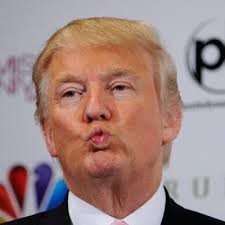
Donald Trump
- American military agencies: In February, 2017, Trump approved and ordered a Special Forces raid in Yemen on an Al Qaeda stronghold. The assault cost the life of Navy SEAL Chief Petty Officer William “Ryan” Owens.
- Disavowing any responsibility for the failure, Trump said: “This was a mission that was started before I got here. This was something they wanted to do. They came to me, they explained what they wanted to do—the generals—who are very respected, my generals are the most respected that we’ve had in many decades, I believe. And they lost Ryan.”
- The press: On February 17, 2017, Trump tweeted: “The FAKE NEWS media (failing @nytimes, @NBCNews, @ABC, @CBS, @CNN) is not my enemy, it is the enemy of the American People!”
- Seven days later, appearing before the Conservative Political Action Conference on February 24, Trump said: “I want you all to know that we are fighting the fake news. It’s fake, phony, fake….I’m against the people that make up stories and make up sources. They shouldn’t be allowed to use sources unless they use somebody’s name. Let their name be put out there.”

- The judiciary: On October 20, 2018, Trump attacked U.S. District Judge Jon S. Tigar as an “Obama judge.” Tigar had ruled that the administration must consider asylum claims no matter where migrants cross the U.S. border.
- On October 21, Supreme Court Chief Justice John Roberts told the Associated Press: “We do not have Obama judges or Trump judges, Bush judges or Clinton judges. What we have is an extraordinary group of dedicated judges doing their level best to do equal right to those appearing before them.”
- On Thanksgiving Day, 2018, Trump attacked Roberts—appointed by Republican President George W. Bush—on Twitter: “Sorry Chief Justice John Roberts, but you do indeed have ‘Obama judges,’ and they have a much different point of view than the people who are charged with the safety of our country.”
- Trump has repeatedly attacked Seattle US District Judge James Robart, who halted Trump’s first travel ban: “Just cannot believe a judge would put our country in such peril. If something happens blame him and court system. People pouring in. Bad!”
- President Barack Obama: For five years, Trump, more than anyone else, popularized the slander that President Barack Obama was born in Kenya—and was therefore not an American citizen.
- Even after Obama released the long-form version of his birth certificate—on April 27, 2011—Trump tweeted, on August 6, 2012: “An ‘extremely credible source’ has called my office and told me that @BarackObama‘s birth certificate is a fraud.”
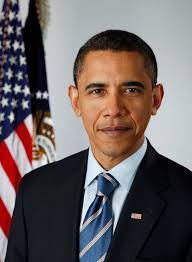
Barack Obama
- On March 4, 2017, in a series of unhinged tweets, Trump accused former President Obama of tapping his Trump Tower phones prior to the election: “Terrible! Just found out that Obama had my ‘wires tapped’ in Trump Tower just before the victory. Nothing found. This is McCarthyism!”
Trump was later forced to admit he had no evidence to back up his slanderous claims.
* * * * *
Donald Trump isn’t crazy, as many of his critics charge. He knows what he’s doing—and why.
He intends to strip every potential challenger to his authority—or his version of reality—of legitimacy with the public. If he succeeds, there will be:
- No independent press to reveal his failures and crimes.
- No independent law enforcement agencies to investigate his abuses of office.
- No independent judiciary to hold him accountable.
- No independent military to dissent as he recklessly hurtles toward a nuclear disaster.
- No candidate—Democrat or Republican—to challenge him for re-election in 2020.
- No candidate—Democrat or Republican—to challenge his remaining in office as “President-for-Life.”
2016 PRESIDENTIAL CAMPAIGN, ABC NEWS, ALEXANDER SHUSTOROVICH, ALTERNET, ANDREW INTRATER, AP, BUZZFEED, CBS NEWS, CHUCK GRASSLEY, CIA, CITIZENS UNITED, CNN, CROOKS AND LIARS, DAILY KOZ, DEPARTMENT OF HOMELAND SECURITY, DONALD TRUMP, FACEBOOK, FBI, FEDERAL ELECTIONS COMMISSION, FOX NEWS, HOUSE INTELLIGENCE COMMITTEE, JAMES COMEY, JEFF FLAKE, JEFF SESSIONS, JOHN KASICH, JOHN MCCAIN, LEN BLAVATNIK, LINDSEY GRAHAM, MARCO RUBIO, MATTHEW WHITAKER, MITCH MCCONNELL, MOTHER JONES, MOVEON, NATIONAL SECURITY AGENCY, NBC NEWS, NEWSWEEK, NPR, OFFICE OF THE DIRECTOR OF NATIONAL INTELLIGENCE, OLIGARCHS, PAUL RYAN, POLITICAL ACTION COMMITTEES (PACS), POLITICO, RAW STORY, REPUBLICAN PARTY, REUTERS, ROBERT MUELLER, ROD ROSENSTEIN, RUSSIA, SALON, SCOTT WALKER, SEATTLE TIMES, SENATE LEADERSHIP FUND, SIMON KUKES, SLATE, SUPREME COURT, THE ATLANTIC, THE CHICAGO SUN-TIMES, THE CHICAGO TRIBUNE, THE DAILY BEAST, THE GUARDIAN, THE HILL, THE HUFFINGTON POST, THE LOS ANGELES TIMES, THE NATION, THE NEW YORK TIMES, THE WASHINGTON POST, TIME, TRUMP INAUGURAL COMMITTEE, TWITTER, U.S. NEWS & WORLD REPORT, UPI, USA TODAY, VLADIMIR PUTIN
In Bureaucracy, History, Law Enforcement, Politics, Social commentary on November 19, 2018 at 12:06 am
Once you have decided on a treason,
Sign on with a man named Donald Trump.
And when you find your hatred is a reason,
Then on your country you can take a dump.
There really isn’t any need for worry,
Just do it and then go ahead and lie.
Like giving Russians secrets in the White House,
And that avoids those pests named “F.B.I.”
House and Senate Republicans have almost universally refused to to speak out against threats by President Donald Trump to fire Attorney General Jeff Sessions and/or Special Counsel Robert Mueller.
Or to take action to prevent or punish Trump for doing so.
On April 17, Republican Senate Majority Leader Mitch McConnell said he would not allow legislation to protect Mueller’s independent investigation into Russian subversion of the 2016 Presidential election to reach the Senate floor.

Mitch McConnell
“I’m the one who decides what we take to the floor. That’s my responsibility as majority leader. We’ll not be having this on the floor of the Senate,” the Kentucky Republican said in an interview on Fox News.
Earlier that day, Republican Speaker of the House Paul Ryan claimed that legislation to protect Mueller was “unnecessary.”
“It would not be in the President’s interest to [fire Mueller] and I think he knows that,” said the Wisconsin Congressman.
On November 14, McConnell rejected another chance to protect the Mueller investigation.
Republican Arizona United States Senator Jeff Flake introduced a bill to make it harder for the Trump to fire Mueller—and allow the special council to appeal his firing.
McConnell claimed such legislation was unnecessary—and that he hadn’t heard Trump or others say they want to shut down Mueller’s probe.
This, of course, totally ignored:
- On November 7, Trump fired Attorney General Jeff Sessions—for refusing to fire Mueller; and
- Appointed Sessions’ deputy, Matthew Whitaker, as acting Attorney General. Whitaker had publicly attacked the investigation and urged its suppression.
Why have so few Republicans dared to stand against Trump?
Because many House and Senate Republicans received millions of dollars in “campaign contributions” from Russian oligarchs who are answerable to Russian dictator Vladimir Putin.
‘Cause it’s treason by numbers, 1, 2, 3,
It’s as easy to do as your G.O.P.
It’s treason by numbers, 1, 2, 3,
It’s as easy to do as your G.O.P.
Now if you have a taste for turning traitor
And you find it’s really thrilling as can be,
Then pick up that phone and call the Kremlin
And soon you’ll have a bud named Vladimir P.
The following data comes from the Federal Elections Commission.
One major Russian contributor is Len Blavatnik, whose net worth is estimated at $20 billion. In 2016, he gave $6.35 million to GOP PACs.
In 2017, he gave millions of dollars to top Republican leaders:
- A total of $1.5 million to PACs associated with Senator Marco Rubio (Florida).
- $1 million to Trump’s Inaugural Committee.
- $1 million to McConnell’s Senate Leadership Fund.
- $3.5 million to a PAC associated with McConnell.
- $200,000 to the Arizona Grassroots Action PAC, associated with Arizona Senator John McCain.
- $800,000 went to the Security is Strength PAC, associated with Senator Lindsey Graham (South Carolina).
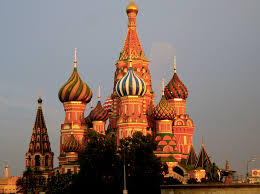
The Kremlin
Another Russian oligarch, Alexander Shustorovich, contributed $1 million to Trump’s Inaugural Committee.
A third oligarch, Andrew Intrater, contributed $250,000 to Trump’s Inaugural Committee.
And a fourth, Simon Kukes, contributed a total of $283,000, much of it to the Trump Victory Fund.
Yes, treason isn’t something that comes easy.
It’s an act that makes most people want to gag.
But you can earn those rubles that you long for
And the Right will back you up and wave the flag.
‘Cause it’s treason by numbers, 1, 2, 3,
It’s as easy to do as your G.O.P.
Treason by numbers, 1, 2, 3,
It’s as easy to do as your G.O.P.
McConnell participated in high-level intelligence briefings in 2016. The FBI, CIA and the code-cracking National Security Agency, warned that the Russians were trying to subvert the electoral process.

In October, 2016, the Department of Homeland Security (DHS) and the Office of the Director of National Intelligence (DNI) issued a joint statement: The Russian government had directed the effort to subvert the 2016 Presidential election.
Two weeks later, McConnell’s PAC accepted a $1 million donation from Blavatnik.
On March 30, 2017, McConnell’s PAC accepted another $1 million from Blavatnik. This was just 10 days after former FBI Director James Comey testified before the House Intelligence Committee about Russia’s efforts to subvert the 2016 election.
Billionaires don’t give huge sums to politicians without expecting to get something in return. And this is especially true—and frightening—when the contributors are linked to a former KGB agent like Vladimir Putin, whose aggressive intentions are increasingly on display.
Now you can join the list of Right-wing traitors
In history’s dark and evil hall of shame.
Their ranks are filled with greedy, racist haters.
At least the ones that we all know by name.
But if you can con you way into the White House
If you become the leader of the land,
Then treason is the sport of the elected,
And Republicans will give you a big hand.
‘Cause it’s treason by numbers, 1, 2, 3,
It’s as easy to do as your G.O.P.
Treason by numbers, 1, 2, 3,
It’s as easy to do
As your God-damned G.O.P.
2016 PRESIDENTIAL RACE, ABC NEWS, ALL THE KING’S MEN, ALTERNET, AP, BLUE BLOODS, BUZZFEED, CBS, CBS NEWS, CNN, CROOKS AND LIARS, DAILY KOZ, ERIC SCHNEIDERMAN, FACEBOOK, FBI, FRANK REAGAN, INDEPENDENT COUNSEL, J. EDGAR HOOVER, JAMES COMEY, JEFF SESSIONS, JUSTICE DEPARTMENT, MOTHER JONES, MOVEON, NBC NEWS, NEW YORK POLICE DEPARTMENT, NEWSWEEK, NPR, POLITICO, RAW STORY, REUTERS, ROBERT MUELLER, ROBERT PENN WARREN, RUSSIA, SALON, SEATTLE TIMES, SERGEI KISLYAK, SEXUAL ASSAULT, SLANDER, SLATE, THE ATLANTIC, THE CHICAGO SUN-TIMES, THE CHICAGO TRIBUNE, THE DAILY BEAST, THE GUARDIAN, THE HILL, THE HUFFINGTON POST, THE LOS ANGELES TIMES, THE NATION, THE NEW YORK TIMES, THE WASHINGTON POST, TIME, TOM SELLECK, TRUMP UNIVERSITY, TWITTER, U.S. NEWS & WORLD REPORT, UPI, USA TODAY, USA TODAY DONALD TRUMP, WILLIAM C. SULLIVAN
In Bureaucracy, History, Law, Law Enforcement, Politics, Social commentary on November 16, 2018 at 12:04 am
Since taking office as President, Donald Trump has openly waged war on his own Justice Department—and especially its chief investigative agency, the FBI.
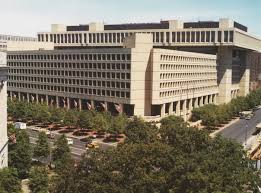
FBI headquarters
For example, he has:
- Fired James Comey, the FBI director pursuing an investigation into Russia’s subversion of the 2016 Presidential race to ensure Trump’s election.
- Threatened to fire Independent Counsel Robert S. Mueller, who continued that investigation after Trump fired Comey.
- Repeatedly attacked—verbally and on Twitter—his Attorney General, Jeff Sessions, for recusing himself from overseeing the Russia investigation. On November 7, Trump fired him.
- (Sessions did so after the press revealed that, during the 2016 race, he twice met secretly with Russian Ambassador Sergei Kislyak.)
- Repeatedly attacked the integrity of the FBI, raising the possibility of his firing more of its senior leadership for pursuing the Russia investigation.
- Forced House Republicans to release a memo falsely accusing the FBI of pursuing a vendetta against him.
But the FBI need not meekly accept such assaults.
A February 2, 2018 episode of the popular CBS police drama, “Blue Bloods,” offers a vivid lesson on bureaucratic self-defense against tyrants.
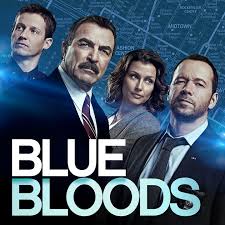
A shootout erupts in a crowded pub between a gunman and NYPD officers. Results: One dead gunman and one wounded bystander.
Problem: The bystander is an aide to New York Governor Martin Mendez.
Mendez visits One Police Plaze, NYPD headquarters, for a private chat with Commissioner Frank Reagan (Tom Selleck). From the outset, he’s aggressive, rude and threatening.
MENDEZ: I know you guys like to whitewash officer-involved shootings. That’s not going to happen here. I want the cop who shot my guy fired and charged.
REAGAN: If the grand jury indicts, my officer could be terminated.
MENDEZ: We all want to protect our people, but mine come first.
Governor Mendez leaves Commissioner Reagan’s office. Later, he returns:
MENDEZ: We’ve got a serious problem.
REAGAN: Why? The grand jury declined to indict my officer.
MENDEZ: Your cop fired into a crowded room.
REAGAN: She returned fire, took out the shooter and likely saved lives.
MENDEZ: What are you going to do?
REAGAN: Our Internal Affairs investigation supports the grand jury’s finding, so the case is closed.
MENDEZ: Either you fire this cop, or I’ll order the Attorney General to investigate every questionable police shooting in the past 10 years and hold public hearings out loud and lights up.
REAGAN: Everybody loves a circus.
MENDEZ: Except the guy who’s got to shovel up afterwards.
At the end of the episode, a third—and final—meeting occurs in a restaurant between Reagan and Mendez.
MENDEZ: Have you dumped the cop who shot my guy?
REAGAN: No.
MENDEZ: Bad news.
REAGAN: Depends on what you compare it to. It turns out that your aide wasn’t drinking alone the night he was shot.
MENDEZ: So what? He’s single.
REAGAN: He was with a married woman.
MENDEZ: That’s on her, not on him.
REAGAN: Except she is married to his boss, your Chief of Staff.
MENDEZ: Sheesh!
REAGAN: Turns out this has been going on for over a year.
MENDEZ: So what are we doing?
REAGAN: If this gets out, the circus comes to Albany [where the Governor has his office].
MENDEZ: Who else knows?
REAGAN: Right now it’s safe in the notebook of my lead detective. Whether or not it finds its way into an arrest report that’s subject to a Freedom of Information Act request—that’s a judgment call.
MENDEZ: Your judgment?
REAGAN: Yes.
MENDEZ: And if my investigation goes away?
REAGAN: Neither of us is shoveling up after the circus.
MENDEZ: I have your word on that?
REAGAN: Yes.
MENDEZ: You have a good evening, Commissioner.
J. Edgar Hoover, the legendary FBI director, used Realpolitik to ensure his reign for 48 years.
As William C. Sullivan, the onetime director of the FBI’s Domestic Intelligence Division, revealed after Hoover’s death in 1972:
“The moment [Hoover] would get something on a Senator, he’d send one of the errand boys up and advise the senator that ‘we’re in the course of an investigation, and we by chance happened to come up with this data on your daughter.
“‘But we wanted you to know this. We realize you’d want to know it.’ Well, Jesus, what does that tell the senator? From that time on, the senator’s right in his pocket.”
Donald Trump has long pursued a strategy of intimidation. But when people have refused to be cowed by his threats, he’s backed off.
During the 2016 Presidential campaign, more than a dozen women accused Trump of sexual misconduct, ranging from inappropriate comments to assault.
Trump responded: “The events never happened. Never. All of these liars will be sued after the election is over.”
Yet he hasn’t filed a single slander suit.
Similarly, when New York’s Attorney General Eric Schneiderman sued Trump for running a fraudulent university, Trump initially said he would fight the charge.
Instead, he settled the case by paying $25 million to compensate the 3,700 students Trump University had defrauded.
“You never have to frame anyone,” says Governor Willie Stark in Robert Penn Warren’s Pulitzer Prize-winning 1946 novel, All the King’s Men. “Because the truth is always sufficient.”
It’s time the FBI re-learned—and applied—that same lesson.
2016 PRESIDENTIAL ELECTION, ABC NEWS, AISNE-MARNE AMERICAN CEMETARY AND MEMORIAL, ALTERNET, AP, BILL MAULDIN, BUZZFEED, CBS NEWS, CIA, CNN, CROOKS AND LIARS, DAILY KOZ, DAVID FRUN, DONALD TRUMP, DRAFT DODGING, FACEBOOK, FBI, FRANCE, GENERAL LUCIAN K. TRUSCOTT, GEORGE W. BUSH, JOE DUNFORD, JOHN KELLY, MEMORIAL DAY, MOTHER JONES, MOVEON, MSNBC, NBC NEWS, NEWSWEEK, NICHOLAS SOAMES, NPR, OLD GLORY, POLITICO, RAW STORY, REUTERS, RUSSIA, SALON, SAVING PRIVATE RYAN, SEATTLE TIMES, SLATE, STEVEN SPIELBERG, THE ATLANTIC, THE CHICAGO SUN-TIMES, THE CHICAGO TRIBUNE, THE DAILY BEAST, THE GUARDIAN, THE HILL, THE HUFFINGTON POST, THE LOS ANGELES TIMES, THE NATION, THE NEW YORK TIMES, THE WASHINGTON POST, TIME, TWITTER, U.S. NEWS & WORLD REPORT, UPI, USA TODAY, VIETNAM WAR, VLADIMIR PUTIN, WINSTON CHURCHILL, WORLD WAR 1, WORLD WAR 11
In Bureaucracy, History, Military, Politics, Social commentary on November 13, 2018 at 12:23 am
Saving Private Ryan, Steven Spielberg’s 1998 World War II epic, opens with a scene of an American flag snapping in the wind.
Except that the brilliant colors of Old Glory have been washed out, leaving only black-and-white stripes and black stars.
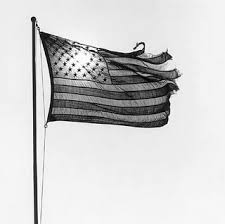
And then the movie opens—not during World war II but the present day.
Did Spielberg know something that his audience could only sense? Such as that the United States, for all its military power, has become a pale shadow of its former glory?
May 30, 1945, marked the first Memorial Day after World War II ended in Europe. On that day, the Sicily-Rome American Cemetery, near the town of Nettuno, held about 20,000 graves.
Most were soldiers who died in Sicily, at Salerno, or at Anzio. One of the speakers at the ceremony was Lieutenant General Lucian K. Truscott, Jr., the U.S. Fifth Army Commander.
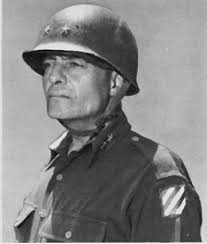
Lieutenant General Lucian K. Truscott, Jr.
Unlike many other generals, Truscott had shared in the dangers of combat, pouring over maps on the hood of his jeep with company commanders as bullets or shells whizzed about him.
When it came his turn to speak, Truscott moved to the podium. Then he turned his back on the assembled visitors—which included several Congressmen.
The audience he now faced were the graves of his fellow soldiers.
Among those who heard Truscott’s speech was Bill Mauldin, the famous cartoonist for the Army newspaper, Stars and Stripes. Mauldin had created Willie and Joe, the unshaved, slovenly-looking “dogfaces” who came to symbolize the GI.
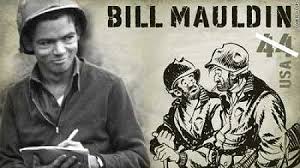
Bill Mauldin and “Willie and Joe,” the characters he made famous
It’s from Mauldin that we have the fullest account of Truscott’s speech that day.
“He apologized to the dead men for their presence there. He said that everybody tells leaders that it is not their fault that men get killed in war, but that every leader knows in his heart that this is not altogether true.
“He said he hoped anybody here through any mistake of his would forgive him, but he realized that he was asking a hell of a lot under the circumstances….
“Truscott said he would not speak of the ‘glorious’ dead because he didn’t see much glory in getting killed in your teens or early twenties.
“He promised that if in the future he ran into anybody, especially old men, who thought death in battle was glorious, he would straighten them out. He said he thought it was the least he could do.”
Then Truscott walked away, without acknowledging his audience of celebrities.
Fast forward 73 years later—to November 10, 2018.
President Donald J.Trump flies to Paris to commemorate the 100th anniversary of the end of WWI—November 11, 1918.
Upon arriving, he tweets: “I am in Paris getting ready to celebrate the end of World War One. Is there anything better to celebrate than the end of a war, in particular that one, which was one of the bloodiest and worst of all time?”
A scheduled event of his trip is a visit to the Aisne-Marne American Cemetery and Memorial, 50 miles outside Paris.
Nearly 2,300 war dead are buried there. And many of them perished in the same area during the summer of 1918.
Trump is scheduled to take his Marine 1 helicopter to the memorial site.
But, suddenly, he refuses to go.
The White House claims it’s “due to scheduling and logistical difficulties caused by the weather.”
The real reason: The appearance of gray skies and drizzle.
Canadian Prime Minister Justin Trudeau, German Chancellor Angela Merkel and French President Emmanuel Macron don’t allow rain to intimidate them.
Trump’s critics are quick to respond.
“They died with their face to the foe and that pathetic inadequate Donald Trump couldn’t even defy the weather to pay his respects to The Fallen,” says Nicholas Soames, Winston Churchill’s grandson and a member of the British Parliament.
And David Frun, a former speechwriter for President George W. Bush, tweets:
“It’s incredible that a president would travel to France for this significant anniversary – and then remain in his hotel room watching TV rather than pay in person his respects to the Americans who gave their lives in France for the victory gained 100 years ago tomorrow.”
Despite the rain, an American delegation led by Chief of Staff General John Kelly and Chairman of the Joint Chiefs of Staff General Joe Dunford still attend the event.
This marks only the latest in a series of embarrassing outrages committed by President Donald J. Trump, who has:
- Claimed that “bone spurs” made it impossible for him to serve his country during the Vietnam war.
- Equated his reckless sex life during the 1970s with the risks American soldiers faced in Vietnam.
- Relentlessly defended Russian dictator Vladimir Putin against all criticism, even as he’s slandered literally hundreds of his fellow citizens on Twitter.
- Rejected the findings by the FBI and CIA that Russia intervened in the 2016 election to help him win the White House.
- “Joked” that it would be “great” if the United States had a “President-for-Life”—like China.
Small wonder then, that, for many people, Old Glory has taken on a darker, washed-out appearance—in real-life as in film.
2016 PRESIDENTIAL CAMPAIGN, 2016 PRESIDENTIAL RACE, ABC NEWS, ACADEMY AWARDS, ALEXANDER SHUSTOROVICH, ALTERNET, ANDREW INTRATER, AP, ARCHIBALD COX, BARACK OBAMA, BENGHAZI INVESTIGATION, BEST ACTOR OSCAR, BUZZFEED, CBS NEWS, CHUCK GRASSLEY, CIA, CNN, CROOKS AND LIARS, DAILY KOZ, DAVID BROOKS, DEPARTMENT OF HOMELAND SECURITY, DEVIN NUNES, DONALD TRUMP, DONALD TRUMP JR., DONALD TRUMP’S INAUGURAL COMMITTEE, DWIGHT D. EISENHOWER, EMAILS INVESTIGATION, FACEBOOK, FBI, FEDERAL ELECTIONS COMMISSION, FOX NEWS, FRED ZINNEMANN, GARY COOPER, GEORGE W. BUSH, GRACE KELLY, HIGH NOON, HILLARY CLINTON, HOUSE INTELLIGENCE COMMITTEE, JACOB WOHL, JAMES COMEY, JARED KUSHNER, JEFF SESSIONS, JENNIFER TAUB, JOHN KASICH, JOHN MCCAIN, JOSEPH MCCARTHY, JOSEPH R. MCCARTHY, KGB, LEN BLAVATNIK, LESTER HOLT, LINDSEY GRAHAM, MARCO RUBIO, MARK SHIELDS, MICHAEL FLYNN, MITCH MCCONNELL, MOTHER JONES, MOVEON, MSNBC, NATIONAL SECURITY AGENCY, NBC NEWS, NEWSWEEK, NPR, OFFICE OF THE DIRECTOR OF NATIONAL INTELLIGENCE, PAUL MANAFORT, PAUL RYAN, PBS NEWSHOUR, PEW RESEARCH SURVEY, POLITICAL ACTION COMMITTEES (PACS), POLITICAL CONSULTANTS, POLITICO, PRINCETON UNIVERSITY, RAW STORY, REPUBLICAN PARTY, REPUBLICANS, REUTERS, RICHARD M. NIXON, ROBERT MUELLER III, ROBERT S. MUELLER 111, ROD ROSENSTEIN, RUDOLPH GIULIANI, RUSSIA, RUSSIAN OLIGARCHS, SALON, SCOTT WALKER, SEATTLE TIMES, SENATE INTELLIGENCE COMMITTEE, SENATE LEADERSHIP FUND, SERGEY KISLYAK, SERGEY LAVROV, SIMON KUKES, SLATE, SOVIET UNION, SUPREME COURT, TEX RITTER, THE ATLANTIC, THE CHICAGO SUN-TIMES, THE CHICAGO TRIBUNE, THE DAILY BEAST, THE GUARDIAN, THE HILL, THE HUFFINGTON POST, THE LOS ANGELES TIMES, THE NATION, THE NEW YORK TIMES, THE WASHINGTON POST, TIME, TRUMP INAUGURAL COMMITTEE, TRUMP TOWER, TWITTER, U.S. NEWS & WORLD REPORT, UNITED STATES DEPARTMENT OF JUSTICE, UNITED STATES DEPARTMENT OF STATE, UNITED STATES HOUSE OF REPRESENTATIVES, UNITED STATES MARINE CORPS, UNITED STATES SENATE, UNIVERSITY OF VIRGINIA LAW SCHOOL, UP, UPI, USA TODAY, USA TODAY DONALD TRUMP, USA TODAY HIGH NOON, VERMONT LAW SCHOOL, VIETNAM WAR, VLADIMIR PUTIN, WILL KANE
In Bureaucracy, History, Law, Law Enforcement, Military, Politics, Social commentary on November 12, 2018 at 12:44 am
On November 8, 2016, millions of racist, hate-filled Americans took “revenge” on the nation’s first black President—by deliberately voting a Russian-backed egomaniac and would-be dictator into the White House.
By doing so, they set in motion events that would lead Robert S. Mueller to assume the consequences—and burdens—of their brutal, Fascistic desires.
On April 27, 2018, the House Intelligence Committee, after a sham “investigation,” concluded there had been “no collusion” between Russian Intelligence agents and members of the Trump Presidential campaign.
Among the evidence ignored: The now-infamous meeting at Trump Tower, in June, 2016, between Donald Trump’s son, Donald Jr.; his son-in-law, Jared Kushner; and his then-campaign manager, Paul Manafort, with Russian Intelligence agents.
The reason for the meeting: The Russians claimed to have dirt to offer on Hillary Clinton.
The “no collusion” verdict was inevitable, since the committee was chaired by California’s Republican Representative Devin Nunes, a wholly-owned subsidiary of Trump. Nunes had even improperly shared “secret” committee documents with the President.

Devin Nunes
The Senate Intelligence Committee, on the other hand, agreed with the conclusions previously reached by the American Intelligence community (CIA, FBI, National Security Agency): The Russians had worked to subvert the American political process and elect Trump over Clinton.
March 17, 2018, marked one year since Special Counsel Robert Mueller began his investigation to uncover “any links and/or coordination between the Russian government and individuals associated with the campaign of President Donald Trump, and any matters that arose or may arise directly from the investigation.”
By October, 2018, Mueller had:
- Indicted 31 people—including 26 Russian nationals and four former Trump campaign advisers.
- Indicted three Russian companies.
- Obtained six guilty pleas.
- Unveiled Russians’ determination to elect Trump over Hillary Clinton.
- Revealed that former National Security Adviser Michael Flynn discussed removing sanctions against Russia with then-Russian ambassador, Sergey Kislyak, during the transition period.
- Discovered that Trump associates knew about Russian outreach efforts during the campaign.
By contrast:
- Republicans spent four years investigating the 2012 attack on the United States embassy in Benghazi, Libya. Their goal: To derail the presumed 2016 Presidential candidacy of then-Secretary of State Hillary Clinton. But no indictments followed.
- Republicans spent two years investigating Hillary Clinton’s use of a private email server while Secretary of State. Again, no indictments followed.
It’s past time for Republicans to remember the lesson taught by High Noon, the classic 1952 Western starring Gary Cooper and Grace Kelly.

Town marshal Will Kane (Cooper) has just married Amy Fowler (Kelly) a Quaker. It should be the happiest day of his life. But shortly after the ceremony, word comes that Frank Miller—a notorious murderer Kane once sent to prison—has been released.
Even worse, Miller—joined by three other killers—is coming into town on the noon train to kill Kane.
Kane’s first instinct is to flee: He and his wife get into a buggy and dash out of town. But then his sense of duty takes over. He returns to town, intending to recruit a posse.
But this proves impossible—everyone is scared to death of Miller and his gang. And everyone Kane approaches has a reason for not backing him up.
Even Amy—a fervent believer in non-violence—threatens to leave him if he stands up to Miller. She will be on the noon train leaving town—with or without him.
When the clock strikes noon, the train arrives, and Kane—alone—faces his enemies. He shoots and kills two of them.
Then, as he’s pinned down by the third, he gets some unexpected help—from his wife: Amy shoots the would-be killer in the back—only to be taken hostage by Miller himself.
Miller tells Kane to leave his concealed position or he’ll kill Amy. Kane steps into the open—and Amy claws at Miller’s face, buying Kane the time he needs to shoot Miller down.
The townspeople rush to embrace Kane and congratulate him. But he’s disgusted with their cowardice and holds them in total contempt.
Saying nothing, he drops the marshal’s star into the dirt. He and Amy then get into a buggy and leave town.
Fred Zinnemann, the film’s director, intended the movie as an attack on those frightened into silence by Joseph McCarthy, the infamous Red-baiting Senator from Wisconsin.
Will Kane fought to protect himself and his town from a gang of murderous outlaws.
Robert Mueller is fighting to discover the truth behind Russian subversion of the American political system.
The difference between these two conflicts is this: We know how Kane’s fight ended—with a good man defeating evil men.
We do not know if Mueller will ultimately triumph over his—and America’s—mortal enemies.
Robert Mueller—as a soldier, prosecutor, FBI director and now Special Counsel—took an oath to “support and defend the Constitution of the United States against all enemies, foreign and domestic.”
So did Donald Trump when he was inaugurated President. And so did every member of the House of Representatives and the Senate.
The difference between Robert Mueller, and the overwhelming majority of Republican Congressional members who continue to support Trump, is this: Mueller, like a compass pointing True North, has always stayed faithful to that oath.
2016 PRESIDENTIAL CAMPAIGN, 2016 PRESIDENTIAL RACE, ABC NEWS, ACADEMY AWARDS, ALEXANDER SHUSTOROVICH, ALTERNET, ANDREW INTRATER, AP, ARCHIBALD COX, BARACK OBAMA, BENGHAZI INVESTIGATION, BEST ACTOR OSCAR, BUZZFEED, CBS NEWS, CHUCK GRASSLEY, CIA, CNN, CROOKS AND LIARS, DAILY KOZ, DAVID BROOKS, DEPARTMENT OF HOMELAND SECURITY, DEVIN NUNES, DONALD TRUMP, DONALD TRUMP JR., DONALD TRUMP’S INAUGURAL COMMITTEE, DWIGHT D. EISENHOWER, EMAILS INVESTIGATION, FACEBOOK, FBI, FEDERAL ELECTIONS COMMISSION, FOX NEWS, FRED ZINNEMANN, GARY COOPER, GEORGE W. BUSH, GRACE KELLY, HIGH NOON, HILLARY CLINTON, HOUSE INTELLIGENCE COMMITTEE, JACOB WOHL, JAMES COMEY, JARED KUSHNER, JEFF SESSIONS, JENNIFER TAUB, JOHN KASICH, JOHN MCCAIN, JOSEPH MCCARTHY, JOSEPH R. MCCARTHY, KGB, LEN BLAVATNIK, LESTER HOLT, LINDSEY GRAHAM, MARCO RUBIO, MARK SHIELDS, MICHAEL FLYNN, MITCH MCCONNELL, MOTHER JONES, MOVEON, MSNBC, NATIONAL SECURITY AGENCY, NBC NEWS, NEWSWEEK, NPR, OFFICE OF THE DIRECTOR OF NATIONAL INTELLIGENCE, PAUL MANAFORT, PAUL RYAN, PBS NEWSHOUR, PEW RESEARCH SURVEY, POLITICAL ACTION COMMITTEES (PACS), POLITICAL CONSULTANTS, POLITICO, PRINCETON UNIVERSITY, RAW STORY, REPUBLICAN PARTY, REPUBLICANS, REUTERS, RICHARD M. NIXON, ROBERT MUELLER III, ROBERT S. MUELLER 111, ROD ROSENSTEIN, RUDOLPH GIULIANI, RUSSIA, RUSSIAN OLIGARCHS, SALON, SCOTT WALKER, SEATTLE TIMES, SENATE INTELLIGENCE COMMITTEE, SENATE LEADERSHIP FUND, SERGEY KISLYAK, SERGEY LAVROV, SIMON KUKES, SLATE, SOVIET UNION, SUPREME COURT, TEX RITTER, THE ATLANTIC, THE CHICAGO SUN-TIMES, THE CHICAGO TRIBUNE, THE DAILY BEAST, THE GUARDIAN, THE HILL, THE HUFFINGTON POST, THE LOS ANGELES TIMES, THE NATION, THE NEW YORK TIMES, THE WASHINGTON POST, TIME, TRUMP INAUGURAL COMMITTEE, TRUMP TOWER, TWITTER, U.S. NEWS & WORLD REPORT, UNITED STATES DEPARTMENT OF JUSTICE, UNITED STATES DEPARTMENT OF STATE, UNITED STATES HOUSE OF REPRESENTATIVES, UNITED STATES MARINE CORPS, UNITED STATES SENATE, UNIVERSITY OF VIRGINIA LAW SCHOOL, UP, UPI, USA TODAY, USA TODAY DONALD TRUMP, USA TODAY HIGH NOON, VERMONT LAW SCHOOL, VIETNAM WAR, VLADIMIR PUTIN, WILL KANE
In Bureaucracy, History, Law, Law Enforcement, Military, Politics, Social commentary on November 9, 2018 at 12:27 am
Altogether, four Russian oligarchs—Len Blavatnik, Alexander Shustorovich, Andrew Intrater and Simon Kukes––contributed $10.4 million from the start of the 2015-16 election cycle through September 2017. Of this, 99% went to Republicans.
As Senate Majority Leader, Kentucky United States Senator Mitch McConnell participated in high-level intelligence briefings in 2016. From agencies such as the FBI, CIA and the code-cracking National Security Agency, he learned that the Russians were trying to subvert the electoral process.
In October, 2016, the Department of Homeland Security (DHS) and the Office of the Director of National Intelligence (DNI) issued a joint statement: The Russian government had directed the effort to subvert the 2016 Presidential election.
Two weeks later, McConnell’s PAC accepted a $1 million donation from Blavatnik.
On March 30, 2017, McConnell’s PAC accepted another $1 million from Blavatnik. This was just 10 days after then-FBI Director James Comey testified before the House Intelligence Committee about Russia’s efforts to subvert the 2016 election.
Billionaires don’t give huge sums to politicians without expecting to get something in return. And this is especially true—and frightening—when the contributors are linked to a former KGB agent like Vladimir Putin, whose aggressive intentions are increasingly on display.
So Special Counsel Robert Mueller is facing increased hostility from Republicans who no doubt fear their own ownership by Moscow will become a focus of his investigation.
But there is another powerful reason why so many Republicans have closed ranks with Trump against him:
#2: Republicans fear enraging Trump’s fanatical base.
On August 30, 2017, an article in Salon sought to explain why President Donald Trump was so popular among his supporters.
Its headline ran: “Most Americans Strongly Dislike Trump, But the Angry Minority That Adores Him Controls Our Politics.”
It described these voters as representing about one-third of the Republican party:
“These are older and more conservative white people, for the most part, who believe he should not listen to other Republicans and should follow his own instincts….
“They like Trump’s coarse personality, and approve of the fact that he treats women like his personal playthings. They enjoy it when he expresses sympathy for neo-Nazis and neo-Confederate white supremacists.
“They cheer when he declares his love for torture, tells the police to rough up suspects and vows to mandate the death penalty for certain crimes. (Which of course the president cannot do.)
“…This cohort of the Republican party didn’t vote for Trump because of his supposed policies on trade or his threat to withdraw from NATO. They voted for him because he said out loud what they were thinking. A petty, sophomoric, crude bully is apparently what they want as a leader.”
And keeping that cohort constantly stirred up is the Right-wing Fox News Network. This is not a source of legitimate news but the propaganda arm of the Fascistic Right and the Republican party.
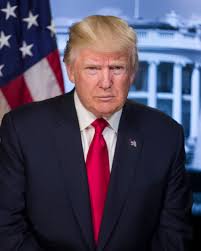
Donald Trump
On May 18, 2018, conservative New York Times columnist David Brooks offered this political commentary on The PBS Newshour: “I would just say, I observe politically, I do think if Trump fired Mueller tomorrow, the Republican Party would back him.
“Because I think FOX News has created a predicate. They have done thousands of surveys and investigations about Mueller as a political operative.”
And Brooks’ fellow political commentator, liberal syndicated columnist Mark Shields, echoed those sentiments: “At the same time, I think what we learned is that the defense of Donald Trump, led by himself and [his attorney] Rudy Giuliani, is to savage and torment, denigrate, vilify and libel Bob Mueller.
“Bob Mueller happens to be an American who turned down an eight-figure income to be a major corporate lawyer, instead became a public servant. He’s a man who volunteered and carries the wounds of battle from having been a Marine platoon leader in Vietnam.
“He is a public servant. He has not said a word. He has not given an interview. He has not leaked to anybody. And he stands vilified by Trump and Giuliani and their cohorts and their outriders. It is indefensible.
“And they are trying to exact the same damage upon the Justice Department of the country, the FBI and this country that Joe McCarthy did on the State Department, which has never fully recovered from his libelous attacks.”
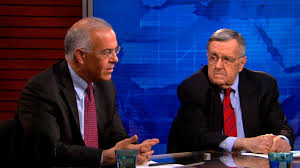
David Brooks and Mark Shields
According to a Pew Research Center survey, that one-third of Republicans who fanatically support Trump comprise only 16% of the population. That leaves 65% of Republicans who are revolted by Trump’s personality and behavior.
But that 65% of Republicans are being advised by GOP political consultants to vigorously support him.
“Your heart tells you that he’s bad for the country,” one anonymous consultant told the Salon reporter. “Your head looks at polling data among Republican primary voters and sees how popular he is.”
It’s precisely these hard-core Fascists who come out in mid-term elections—and they’re scaring the remaining 65% who make up the GOP establishment.
The highest priority of that establishment, after all, is to hold onto their privileged positions in the House and Senate. And anything that might jeopardize that—including what’s best for the country—can go hang.
2016 PRESIDENTIAL CAMPAIGN, 2016 PRESIDENTIAL RACE, ABC NEWS, ACADEMY AWARDS, ALEXANDER SHUSTOROVICH, ALTERNET, ANDREW INTRATER, AP, ARCHIBALD COX, BARACK OBAMA, BENGHAZI INVESTIGATION, BEST ACTOR OSCAR, BUZZFEED, CBS NEWS, CHUCK GRASSLEY, CIA, CNN, CROOKS AND LIARS, DAILY KOZ, DAVID BROOKS, DEPARTMENT OF HOMELAND SECURITY, DEVIN NUNES, DONALD TRUMP, DONALD TRUMP JR., DONALD TRUMP’S INAUGURAL COMMITTEE, DWIGHT D. EISENHOWER, EMAILS INVESTIGATION, FACEBOOK, FBI, FEDERAL ELECTIONS COMMISSION, FOX NEWS, FRED ZINNEMANN, GARY COOPER, GEORGE W. BUSH, GRACE KELLY, HIGH NOON, HILLARY CLINTON, HOUSE INTELLIGENCE COMMITTEE, JACOB WOHL, JAMES COMEY, JARED KUSHNER, JEFF SESSIONS, JENNIFER TAUB, JOHN KASICH, JOHN MCCAIN, JOSEPH MCCARTHY, JOSEPH R. MCCARTHY, KGB, LEN BLAVATNIK, LESTER HOLT, LINDSEY GRAHAM, MARCO RUBIO, MARK SHIELDS, MICHAEL FLYNN, MITCH MCCONNELL, MOTHER JONES, MOVEON, MSNBC, NATIONAL SECURITY AGENCY, NBC NEWS, NEWSWEEK, NPR, OFFICE OF THE DIRECTOR OF NATIONAL INTELLIGENCE, PAUL MANAFORT, PAUL RYAN, PBS NEWSHOUR, PEW RESEARCH SURVEY, POLITICAL ACTION COMMITTEES (PACS), POLITICAL CONSULTANTS, POLITICO, PRINCETON UNIVERSITY, RAW STORY, REPUBLICAN PARTY, REPUBLICANS, REUTERS, RICHARD M. NIXON, ROBERT MUELLER III, ROBERT S. MUELLER 111, ROD ROSENSTEIN, RUDOLPH GIULIANI, RUSSIA, RUSSIAN OLIGARCHS, SALON, SCOTT WALKER, SEATTLE TIMES, SENATE INTELLIGENCE COMMITTEE, SENATE LEADERSHIP FUND, SERGEY KISLYAK, SERGEY LAVROV, SIMON KUKES, SLATE, SOVIET UNION, SUPREME COURT, TEX RITTER, THE ATLANTIC, THE CHICAGO SUN-TIMES, THE CHICAGO TRIBUNE, THE DAILY BEAST, THE GUARDIAN, THE HILL, THE HUFFINGTON POST, THE LOS ANGELES TIMES, THE NATION, THE NEW YORK TIMES, THE WASHINGTON POST, TIME, TRUMP INAUGURAL COMMITTEE, TRUMP TOWER, TWITTER, U.S. NEWS & WORLD REPORT, UNITED STATES DEPARTMENT OF JUSTICE, UNITED STATES DEPARTMENT OF STATE, UNITED STATES HOUSE OF REPRESENTATIVES, UNITED STATES MARINE CORPS, UNITED STATES SENATE, UNIVERSITY OF VIRGINIA LAW SCHOOL, UP, UPI, USA TODAY, USA TODAY DONALD TRUMP, USA TODAY HIGH NOON, VERMONT LAW SCHOOL, VIETNAM WAR, VLADIMIR PUTIN, WILL KANE
In Bureaucracy, History, Law, Law Enforcement, Military, Politics, Social commentary on November 8, 2018 at 12:14 am
On May 17, 2017, Deputy Attorney General Rod Rosenstein appointed Robert S. Mueller III to serve as Special Counsel for the United States Department of Justice.
Rosenstein charged Mueller to investigate “any links and/or coordination between the Russian government and individuals associated with the campaign of President Donald Trump, and any matters that arose or may arise directly from the investigation.”
Since then, Trump, his shills in Congress and Right-wing Fox News have relentlessly attacked Mueller’s integrity and investigative methods.
From the outset of that investigation, there have been widespread fears that Trump would fire Mueller, just as he did FBI Director James Comey. Those fears increased over the weekend of March 17-18, 2018, when Trump spewed a series of angry tweets on Twitter:
- “The Mueller probe should never have been started in that there was no collusion and there was no crime. It was based on fraudulent activities and a Fake Dossier paid for by Crooked Hillary and the DNC, and improperly used in FISA COURT for surveillance of my campaign. WITCH HUNT!”
- “Why does the Mueller team have 13 hardened Democrats, some big Crooked Hillary supporters, and Zero Republicans? Another Dem recently added…does anyone think this is fair? And yet, there is NO COLLUSION!”
- “A total WITCH HUNT with massive conflicts of interest!”
In “High Noon,” Marshal Will Kane faced death at the hands of four cold-blooded killers.
For Mueller, the threat is different. Every day he conducts his investigation under the shadow of being fired by a President who has:
- Already fired an FBI director for investigating proven links between Trump’s 2016 Presidential campaign and Russian Intelligence agents;
- Repeatedly praised Russian dictator Vladimir Putin; and
- Who has “joked” about how great it would be if the United States, like China, had a “President-for-Life.”
Mueller faces another distressing possibility: Even if he’s allowed to complete his investigation, his final report might be suppressed by Trump under a claim of “executive privilege.”
And, on October 30, details emerged about a Right-wing plot to discredit the probe by falsely accusing Mueller of sexually abusing or harassing women.
The Special Counsel’s office issued the following statement: “When we learned last week of allegations that women were offered money to make false claims about the Special Counsel, we immediately referred the matter to the FBI for investigation.”
On October 29, Jacob Wohl, a Fox News contributor and Trump supporter, tweeted: “Several media sources tell me that a scandalous story about Mueller is breaking tomorrow. Should be interesting. Stay tuned!”
Then, on October 30, Jennifer Taub, a law professor at Vermont Law School, told The Atlantic that a man working for Surefire Intelligence, a private investigative agency, had offered to pay her if she could provide dirt on Mueller.
She didn’t respond and forwarded the information to the Special Counsel’s office.
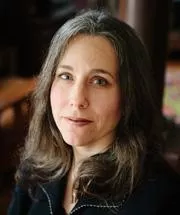
Jennifer Taub
Nor can Mueller, a lifelong Republican, count on protection from Republicans in the House and Senate.
Almost universally, they have refused to speak out against threats by Trump to fire him or deputy Attorney General Rod Rosenstein.
Or, more importantly, to take action to prevent or punish him for doing so.
On April 17, 2018, Republican Senate Majority Leader Mitch McConnell said he would not allow legislation to protect Robert Mueller’s independent investigation into Russian subversion of the 2016 Presidential election to reach the Senate floor.
Mitch McConnell
“I’m the one who decides what we take to the floor. That’s my responsibility as majority leader. We’ll not be having this on the floor of the Senate,” the Kentucky Republican said in an interview on Fox News.
Earlier that day, another Republican, Speaker of the House Paul Ryan, claimed that legislation to protect Mueller was “unnecessary.”
“It would not be in the President’s interest to [fire Mueller] and I think he knows that,” said the Wisconsin Congressman.
Why have so few Republicans dared to stand against Trump?
Two major reasons:
#1: Because many House and Senate Republicans received millions of dollars in “campaign contributions” from Russian oligarchs who are answerable to Russian dictator Vladimir Putin.
In short: Bribe monies.
The Kremlin
The following data comes from the Federal Elections Commission.
One major Russian contributor is Len Blavatnik. During the 2015-16 election cycle, he proved one of the largest donors to GOP Political Action Committees (PACs).
Blavatnik’s net worth is estimated at $20 billion. In 2016, he gave $6.35 million to GOP PACs.
In 2017, he gave millions of dollars to top Republican leaders—such as Senators Mitch McConnell, Marco Rubio (Florida) and Lindsey Graham (South Carolina). Specifically, Blavatnik contributed:
- A total of $1.5 million to PACs associated with Rubio.
- $1 million to Trump’s Inaugural Committee.
- $1 million to McConnell’s Senate Leadership Fund.
- $3.5 million to a PAC associated with McConnell.
- $1.1 million to Unintimidated PAC, associated with Wisconsin Governor Scott Walker.
- $200,000 to the Arizona Grassroots Action PAC, associated with Arizona Senator John McCain.
- $250,000 to New Day for America PAC, associated with Ohio Governor John Kasich.
- $800,000 went to the Security is Strength PAC, associated with Senator Lindsey Graham.
Another Russian oligarch, Alexander Shustorovich, contributed $1 million to Trump’s Inaugural Committee.
A third oligarch, Andrew Intrater, contributed $250,000 to Trump’s Inaugural Committee.
And a fourth, Simon Kukes, contributed a total of $283,000, much of it to the Trump Victory Fund.
2016 PRESIDENTIAL CAMPAIGN, 2016 PRESIDENTIAL RACE, ABC NEWS, ACADEMY AWARDS, ALEXANDER SHUSTOROVICH, ALTERNET, ANDREW INTRATER, AP, ARCHIBALD COX, BARACK OBAMA, BENGHAZI INVESTIGATION, BEST ACTOR OSCAR, BUZZFEED, CBS NEWS, CHUCK GRASSLEY, CIA, CNN, CROOKS AND LIARS, DAILY KOZ, DAVID BROOKS, DEPARTMENT OF HOMELAND SECURITY, DEVIN NUNES, DONALD TRUMP, DONALD TRUMP JR., DONALD TRUMP’S INAUGURAL COMMITTEE, DWIGHT D. EISENHOWER, EMAILS INVESTIGATION, FACEBOOK, FBI, FEDERAL ELECTIONS COMMISSION, FOX NEWS, FRED ZINNEMANN, GARY COOPER, GEORGE W. BUSH, GRACE KELLY, HIGH NOON, HILLARY CLINTON, HOUSE INTELLIGENCE COMMITTEE, JACOB WOHL, JAMES COMEY, JARED KUSHNER, JEFF SESSIONS, JENNIFER TAUB, JOHN KASICH, JOHN MCCAIN, JOSEPH MCCARTHY, JOSEPH R. MCCARTHY, KGB, LEN BLAVATNIK, LESTER HOLT, LINDSEY GRAHAM, MARCO RUBIO, MARK SHIELDS, MICHAEL FLYNN, MITCH MCCONNELL, MOTHER JONES, MOVEON, MSNBC, NATIONAL SECURITY AGENCY, NBC NEWS, NEWSWEEK, NPR, OFFICE OF THE DIRECTOR OF NATIONAL INTELLIGENCE, PAUL MANAFORT, PAUL RYAN, PBS NEWSHOUR, PEW RESEARCH SURVEY, POLITICAL ACTION COMMITTEES (PACS), POLITICAL CONSULTANTS, POLITICO, PRINCETON UNIVERSITY, RAW STORY, REPUBLICAN PARTY, REPUBLICANS, REUTERS, RICHARD M. NIXON, ROBERT MUELLER III, ROBERT S. MUELLER 111, ROD ROSENSTEIN, RUDOLPH GIULIANI, RUSSIA, RUSSIAN OLIGARCHS, SALON, SCOTT WALKER, SEATTLE TIMES, SENATE INTELLIGENCE COMMITTEE, SENATE LEADERSHIP FUND, SERGEY KISLYAK, SERGEY LAVROV, SIMON KUKES, SLATE, SOVIET UNION, SUPREME COURT, TEX RITTER, THE ATLANTIC, THE CHICAGO SUN-TIMES, THE CHICAGO TRIBUNE, THE DAILY BEAST, THE GUARDIAN, THE HILL, THE HUFFINGTON POST, THE LOS ANGELES TIMES, THE NATION, THE NEW YORK TIMES, THE WASHINGTON POST, TIME, TRUMP INAUGURAL COMMITTEE, TRUMP TOWER, TWITTER, U.S. NEWS & WORLD REPORT, UNITED STATES DEPARTMENT OF JUSTICE, UNITED STATES DEPARTMENT OF STATE, UNITED STATES HOUSE OF REPRESENTATIVES, UNITED STATES MARINE CORPS, UNITED STATES SENATE, UNIVERSITY OF VIRGINIA LAW SCHOOL, UP, UPI, USA TODAY, USA TODAY DONALD TRUMP, USA TODAY HIGH NOON, VERMONT LAW SCHOOL, VIETNAM WAR, VLADIMIR PUTIN, WILL KANE
In Bureaucracy, History, Law, Law Enforcement, Military, Politics, Social commentary on November 7, 2018 at 12:18 am
For more than a year, Democrats promised/threatened an upcoming “blue wave” aimed at the United States Senate and House of Representatives.
And now, on November 6, the results are in: Democrats have taken control of the House of Representatives.
But Republicans still hold control of the Senate.
Republicans won the House in 2010. And, in 2014, they won control of the Senate.
During 2018, the national news media predictably covered the midterm elections as a horse race, focusing strictly on: “Who’s ahead today?”
Meanwhile, behind-the-scenes, without fanfare, a 74-year-old man has assumed the burdens created when millions of racist, hate-filled Americans deliberately sent a Russian-backed egomaniac and would-be dictator to the White House.
That man is Robert Swan Mueller III.
Like “Will Kane,” the embattled marshal played by Gary Cooper in “High Noon,” he is not a young man—born on August 7, 1944. And, like Cooper’s Will Kane, he is tall, gray-haired and tight-lipped.
But while Cooper never saw military service, Mueller did. A 1966 graduate of Princeton University, he served as a Marine Corps infantry platoon commander during the Vietnam War.
Wounded in combat, among the military awards he received were:
- The Bronze Star Medal with Combat “V” for heroism (for saving a wounded Marine while under enemy fire).
- The Purple Heart Medal (awarded for wounds in combat).
- Two Navy and Marine Corps Commendation Medals with Combat “V”.
- Combat Action Ribbon.
- National Defense Service Medal.
Having given three years of his life (1968-1971) to the Marines, Mueller devoted the rest of his life to law enforcement.
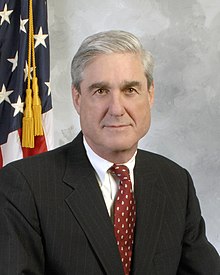
Robert Mueller
A 1973 graduate of the University of Virginia Law School, Mueller served as:
- United States Attorney for the District of Massachusetts (1986-1987);
- United States Assistant Attorney General for the Criminal Division (1990-1993);
- United States Attorney for the Northern District of California (1998-2001);
- United States Deputy Attorney General (January 20, 2001– May 10, 2001).
On September 4, 2001—seven days before Al Qaeda’s monstrous 9/11 attacks on Washington and New York—President George W. Bush appointed him director of the Federal Bureau of Investigation (FBI).
Widely praised for his integrity and effectiveness, he served his full 10-year term—the legal maximum.
But when President Barack Obama took office in 2009, he asked Mueller—a lifelong Republican—to stay on for an additional two years until a suitable replacement could be found.
Mueller agreed—and was succeeded by a fellow Justice Department colleague named James Comey.
Retiring from the FBI in 2013 at age 69, Mueller’s 27-year career as a dedicated law enforcer seemed at last to be over.
Then, on May 9, 2017, President Donald Trump fired Comey as FBI director. There were five reasons for this:
- Comey had refused to pledge his personal loyalty to Trump. Trump had made the “request” during a private dinner at the White House in January.
- Comey told Trump that he would always be honest with him. But that didn’t satisfy Trump’s demand that the head of the FBI act as his personal secret police chief—as was the case in the former Soviet Union.
- Trump had tried to coerce Comey into dropping the FBI’s investigation into former National Security Adviser Michael Flynn, for his secret ties to Russia and Turkey. Comey had similarly resisted that demand.
- Comey had recently asked the Justice Department to fund an expanded FBI investigation into well-documented contacts between Trump’s 2016 Presidential campaign and Russian Intelligence agents.
- The goal of that collaboration: To elect Trump over Hillary Clinton, a longtime foe of Russian President Vladimir Putin.

James Comey
On May 10—the day after firing Comey—Trump met in the Oval Office with Russian Foreign Minister Sergey Lavrov and Russian Ambassador Sergey Kislyak.
Kislyak is reportedly a top recruiter for Russia’s SVR foreign intelligence agency. He has been closely linked with Jeff Sessions, now Attorney General, and fired National Security Adviser Mike Flynn.
“I just fired the head of the F.B.I.,” Trump told the two dignitaries. “He was crazy, a real nut job. I faced great pressure because of Russia. That’s taken off.”
And on May 11, Trump, interviewed on NBC News by reporter Lester Holt, said: “And in fact when I decided to just do it, I said to myself, I said ‘you know, this Russia thing with Trump and Russia is a made-up story, it’s an excuse by the Democrats for having lost an election that they should have won.'”
A national firestorm erupted—unprecedented since President Richard M. Nixon had fired Watergate Special Prosecutor Archibald Cox on October 20, 1973.
To squelch it, Deputy Attorney General Rod Rosenstein moved quickly.
On May 17, 2017, he appointed Robert S. Mueller 111 to serve as Special Counsel for the United States Department of Justice.
Rosenstein charged Mueller to investigate “any links and/or coordination between the Russian government and individuals associated with the campaign of President Donald Trump, and any matters that arose or may arise directly from the investigation.”
Since then, Trump, his shills in Congress and Right-wing Fox News have relentlessly attacked Mueller’s integrity and investigative methods.
2016 PRESIDENTIAL CAMPAIGN, ABC NEWS, ADOLF HITLER, ALTERNET, AP, BARACK OBAMA, BULLYING, BURT LANCASTER, BUZZFEED, CBS NEWS, CIA, CNN, CROOKS AND LIARS, DAILY KOZ, DONALD TRUMP, FACEBOOK, FASCISM, FBI, HELSINKI PRESS CONFERENCE, HILLARY CLINTON, HUMAN RIGHTS CAMPAIGN (HRC), IMMIGRATION AND CUSTOMS ENFORCEMENT (ICE), JAMES COMEY, JEFF SESSIONS, JOHN F. KENNEDY, JUDGMENT AT NUREMBERG, LYING, MAIN INTELLIGENCE DIRECTORATE, MOTHER JONES, MOVEON, MSNBC, NAZI GERMANY, NBC NEWS, NEWSWEEK, NPR, PBS NEWSHOUR, POLITICO, RACISM, RAFAEL "TED" CRUZ, RAW STORY, REPUBLICANS, REUTERS, ROBERT S. MUELLER, RUSSIA, SALON, SEATTLE TIMES, SERGEY KISLYAK, SLATE, SPENCER TRACY, THE ATLANTIC, THE CHICAGO SUN-TIMES, THE CHICAGO TRIBUNE, THE DAILY BEAST, THE GUARDIAN, THE HILL, THE HUFFINGTON POST, THE LOS ANGELES TIMES, THE NATION, THE NEW YORK TIMES, THE WASHINGTON POST, TIME, TWITTER, U.S. NEWS & WORLD REPORT, UNITE THE RIGHT RALLY, UPI, USA TODAY, VLADIMIR PUTIN, WIRETAPPING
In Bureaucracy, Entertainment, History, Law Enforcement, Politics, Social commentary on October 24, 2018 at 12:12 am
Those who have seen the classic 1960 movie, “Judgment at Nuremberg,” will remember its pivotal moment.
That’s when Burt Lancaster, as Ernst Janning, the once distinguished German judge, confesses his guilt and that of Nazi Germany in a controlled, yet emotional, outburst.
Addressing the court—presided over by Chief Judge Dan Haywood (Spencer Tracy)—Janning explains the forces that led to the triumph of evil.

It’s not hard to imagine, in the future, an equally conscience-stricken member of the Donald Trump administration, standing before the bar of justice, making a similar statement:
“My counsel would have you believe we were not aware of the ICE concentration camps. Not aware. Where were we?
“Where were we when Trump began shrieking his hate across the country? When Trump called our free press ‘the enemy of the people’?
“Where were we when Trump openly praised Vladimir Putin and attacked those in the FBI, CIA and other Intelligence agencies sworn to protect us?
“Where were we when the victims of Trump’s hatred cried out in the night to us? Were we deaf? Dumb? Blind?
“My counsel says we were not aware of Trump’s treasonous collusion with Vladimir Putin—and his intention to betray American freedoms in exchange for the Presidency. He would give you the excuse we were misled by the lying rhetoric coming out of the White House.
“Does that make us any the less guilty? Maybe we didn’t know the details, but if we didn’t know, it was because we didn’t want to know.”
Consider Trump’s effect on:
Race relations:
- Since Trump’s election, attacks on non-whites by Right-wing—and white—Trump supporters have increased. According to The Human Rights Campaign (HRC), there has been a rapid increase in youth bullying during and since the 2016 campaign:
- “The bullying effects of the Trump presidency—dubbed the Trump effect—are devastating, particularly when it comes to bullying of minority groups, especially those who are easily identifiable and/or who are singled out by the president’s statements or actions.”
- On August 11-12, 2017, white supremacists from across the country gathered in Charlottesville, Virginia, for a “Unite the Right” rally. On August 13, a Nazi sympathizer rammed his car into a group of counter-protesters, killing a woman and injuring 19 other demonstrators.
- Refusing to condemn the Fascistic demonstrators, Trump said: “We condemn in the strongest possible terms this egregious display of hatred, bigotry and violence on many sides, on many sides.”
Donald Trump
The rule of law:
- On May 9, 2017, Trump fired FBI Director James Comey, who was conducting an FBI investigation into well-documented contacts between Trump’s 2016 Presidential campaign and Russian Intelligence agents.
- Trump has repeatedly and publicly attacked his own Attorney General, Jeff Sessions, for recusing himself from the above-mentioned investigation. (Sessions did so because of his own documented ties with Russian Ambassador Sergey Kislyak.)
- Trump has repeatedly attacked the integrity of Special Counsel Robert S. Mueller, who has continued the FBI’s probe into ties between Russia and Trump’s 2016 Presidential campaign.
- Trump has called on Sessions to investigate “all of the corruption” of Trump’s critics and those investigating him, including Hillary Clinton, James Comey, and Special Counsel Robert Mueller.
- In short: He wants to use the FBI as his private secret police against anyone who has ever criticized, investigated or run against him.
Trump as liar:
- From 2011 to 2016, Trump falsely accused Barack Obama as being born in Kenya, not—as evidence proves—Hawaii. This was an effort to de-legitimize Obama as President of the United States.
- During the 2016 Presidential campaign, Trump falsely accused the father of his political rival, Texas United States Senator Rafael “Ted” Cruz, of being a party to the assassination of President John F. Kennedy.
- After taking office Trump falsely accused former President Obama of illegally wiretapping him at Trump Tower.
- By August 1, 2018, the Washington Post reported that Trump had made 4,229 false or misleading statements since taking office.
Trump as traitor:
- Trump has repeatedly praised Russian President Vladimir Putin, both during his Presidential candidacy and since taking office. In fact, Putin remains the only major public figure that Trump has never criticized.
- On July 22, 2016, Trump said at a press conference in Doral, Florida: “Russia, if you are listening, I hope you are able to find the 33,000 emails that are missing [from Democratic Presidential candidate Hillary Clinton’s computer]. I think you will probably be rewarded mightily by our press.”
- Hours later, the Main Intelligence Directorate in Moscow targeted Clinton’s personal office and hit more than 70 other Clinton campaign accounts.
- On July 16, 2018, President Trump attended a press conference in Helsinki, Finland, with Russian President Vladimir Putin. There he sided with Putin against American Intelligence agencies—such as the FBI, CIA and National Security Agency—for Russia’s subversion of the 2016 Presidential election:
- “I have President Putin. He just said it’s not Russia. I will say this: I don’t see any reason why it would be, but I really do want to see the server.”
Since 1945, historians have brutally condemned the vicious and destructive reign of Adolf Hitler and those who supported him.
Future historians will condemn just as harshly the equally vicious and destructive reign of Donald Trump—and those who now support him.
ABC NEWS, AL QAEDA, ALTERNET, AMERICAN EXCEPTIONALISM, AP, BARACK OBAMA, BASHIR AL-ASSAD, BUZZFEED, CBS NEWS, CHILE, CNN, CROOKS AND LIARS, DAILY KOZ, FACEBOOK, HOUSE UN-AMERICAN ACTIVITIES COMMITTEE, HUMAN RIGHTS, IRAN, JOHN BOEHNER, JOHN MCCAIN, MOTHER JONES, MOVEON, MSNBC, NBC NEWS, NEWSWEEK, NICARAGUA, NPR, PBS NEWSHOUR, POLITICO, RAW STORY, REUTERS, RUSSIA, S.I. HAYAKAWA, SALON, SEATTLE TIMES, SLATE, SYRIA, THE ATLANTIC, THE CHICAGO SUN-TIMES, THE CHICAGO TRIBUNE, THE DAILY BEAST, THE GUARDIAN, THE HILL, THE HUFFINGTON POST, THE LOS ANGELES TIMES, THE NATION, THE NEW YORK TIMES, THE WALL STREET JOURNAL, THE WASHINGTON POST, TIME, TWITTER, U.S. NEWS & WORLD REPORT, UPI, USA TODAY, VLADIMIR PUTIN
In Bureaucracy, History, Military, Politics, Social commentary on October 17, 2018 at 12:21 am
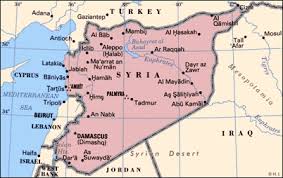
On September 11, 2013, the New York Times published an Op-Ed (guest editorial) from Russian President Vladimir Putin, entitled: “A Plea for Caution from Russia: What Putin Has to Say to Americans About Syria.”
No one should be surprised that Putin came out strongly against an American air strike on Syria.
Its “President” (i.e., dictator) Bashir al-Assad, is, after all, a close ally of Russia. Just as his late father and dictator, Hafez al-Assad, was a close ally of the Soviet Union until its collapse in 1991.
Putin, of course, is a former member of the KGB, the infamous secret police which ruled the Soviet Union from its birth in 1917 to its collapse in 1991.
He grew up under a Communist dictatorship and clearly wishes to return to that era, saying publicly: “First and foremost it is worth acknowledging that the demise of the Soviet Union was the greatest geopolitical catastrophe of the century.”
So it would be unrealistic to expect him to view the current “Syria crisis” the same way that President Barack Obama did.
(A “crisis” for politicians is any event that can be exploited to increase their own status—and thus power. Few politicians really care about the “human rights” of other nations—unless promoting this issue can empower themselves and/or their own nation.
(President Ronald Reagan, for example, often wailed about the Soviets’ oppression of the Polish union, Solidarity—while firing hundreds of unionized air traffic controllers who went on strike.)
(A “crisis” for the media is any event that can be exploited for higher ratings.)
In his September 11, 2013 guest editorial in the New York Times, Putin offered the expected Russian take on Syria:
- Poison gas was used in Syria.
- It wasn’t used by the Syrian Army.
- It was used by “opposition forces, to provoke intervention by their powerful foreign patrons.”
But it was the concluding paragraph that enraged American politicians the most—especially Right-wing ones. In it, Putin took exception with American “exceptionalism.”
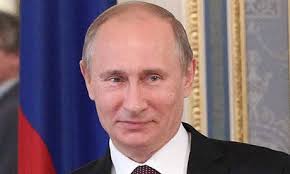
Vladimir Putin
This is the belief that the United States is unlike other nations. That it is unlike other nations in its innocence and steadfast dedication to human rights above all else.
Citizens of nations whose governments have been overthrown by the United States—such as Chile, Iran and Nicaragua—and replaced with brutal dictatorships would strongly disagree.
Referring to then-President Obama, Putin wrote:
“And I would rather disagree with a case he made on American exceptionalism, stating that the United States’ policy is ‘what makes America different. It’s what makes us exceptional.’
“It is extremely dangerous to encourage people to see themselves as exceptional, whatever the motivation.
“There are big countries and small countries, rich and poor, those with long democratic traditions and those still finding their way to democracy. Their policies differ, too.
“We are all different, but when we ask for the Lord’s blessings, we must not forget that God created us equal.”
Putin has never publicly shown any interest in religion. But by invoking “the Lord,” he was able to turn the Christian beliefs of his Western audience into a useful weapon.
“I was insulted,” then-House Speaker John Boehner (R-Ohio) told reporters when asked for his blunt reaction to the editorial.
“I have to be honest with you, I was at dinner, and I almost wanted to vomit,” said U.S. Senator Bob Menendez (D-New Jersey).
Putin had dared to question the self-righteousness of American foreign policy—and those who make it.
Making his case for war with Syria, Obama had said: “America is not the world’s policeman….
“But when, with modest effort and risk, we can stop children from being gassed to death, and thereby make our own children safer over the long run, I believe we should act.
“That’s what makes America different. That’s what makes us exceptional. With humility, but with resolve, let us never lose sight of that essential truth.”
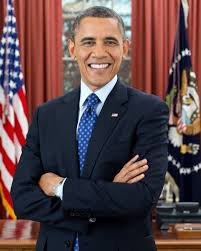
President Barack Obama
In short: Because we consider ourselves “exceptional,” we have the divine right to do whatever we want.
It’s not necessary to see Putin as a champion of democracy (he isn’t) to see the truth in this part of his editorial: “It is extremely dangerous to encourage people to see themselves as exceptional, whatever the motivation.”
From 1938 to 1969, the House Un-American Activities Committee sought to define what was “American” and what was “Un-American.” As if “American” stood for all things virtuous.
Whoever heard of an “Un-French Activities Committee”? Or an “Un-German” or “Un-British” one?
The late S.I. Hayakawa once made an observation that clearly applies to this situation.
Hayakawa was a professor of semantics (the study of meaning, focusing on the relation between words and what they stand for).
In his bestselling book, Language in Thought and Action, he observed that when a person hears a message, he has four ways of responding to it:
- Accept the speaker and his message.
- Accept the speaker but reject the message.
- Accept the message but reject the speaker.
- Reject the message and the speaker.
Americans might want to consider #3 in the recent case of Russian President Vladimir Putin.


2016 PRESIDENTIAL CAMPAIGN, 2018, ABC NEWS, AL QAEDA, ALEXANDER THE GREAT, ALTERNET, ANDREW G. MCCABE, BARACK OBAMA, BUZZFEED, CBS NEWS, CHIEF JUSTICE JOHN ROBERTS, CHINA, CIA, CNN, CONSERVATIVE POLITICAL ACTION CONFERENCE, DAILY KOS, DONALD TRUMP, FACEBOOK, FBI, FEDERAL JUDICIARY, FOX NEWS SUNDAY, GEORGE W. BUSH, INTELLIGENCE AGENCIES, JAMAL KHASHOGGI, JAMES COMEY, JAMES ROBART, JEFF SESSIONS, MATTHEW WHITTAKER, MOHAMMED BIN SALMAN, MOTHER JONES, MOVEON, NAVY SEALS, NBC NEWS, NEW YORK TIMES, NEWSWEEK, NINTH CIRCUIT COURT OF APPEALS, NPR, NSA, PLUTARCH, POLITICO, RAW STORY, REPUBLICAN DONORS, ROBERT MUELLER, ROD J. ROSENSTEIN, RUSSIA, RUSSIAN INTELLIGENCE, SALON, SLATE, SUPREME COURT, THE CHICAGO SUN-TIMES, THE CHICAGO TRIBUNE, THE DAILY BEAST, THE HUFFINGTON POST, THE LOS ANGELES TIMES, THE NEW YORK TIMES, THE PRESS, THE WALL STREET JOURNAL, THE WASHINGTON POST, TIME, TRUMP TOWER, TWITTER, U.S. NEWS & WORLD REPORT, USA TODAY, WILLIAM “RYAN” OWENS, WIRETAPPING, XI JINPING, YEMEN
TRUMP: WAGING WAR ON AMERICAN INSTITUTIONS
In Bureaucracy, History, Law, Law Enforcement, Military, Politics, Social commentary on November 26, 2018 at 12:06 amSince taking office as the Nation’s 45th President, Donald Trump has attacked or undermined one public or private institution after another. Among these:
Donald Trump
Barack Obama
Trump was later forced to admit he had no evidence to back up his slanderous claims.
* * * * *
Donald Trump isn’t crazy, as many of his critics charge. He knows what he’s doing—and why.
He intends to strip every potential challenger to his authority—or his version of reality—of legitimacy with the public. If he succeeds, there will be:
Share this: