Posts Tagged ‘NEWT GINGRICH’
9/11, ABC NEWS, ADOLF HITLER, AMERICANS FOR TAX REFORM, ANDERSON COOPER, ANTI-COMMUNISM, ARTHUR MILLER, BILL CLINTON, CBS NEWS, CENTER FOR SECURITY POLICY, CHINA, CHRIS MATTHEWS, CNN, DICK CHENEY, DWIGHT D. EISENHOWER, EDWARD R. MURROW, FACEBOOK, GEORGE H.W. BUSH, HARRY S. TRUMAN, HEINRICH HIMMLER, HERMAN CAIN, HERMAN GORING, HILLARY CLINTON, HUMA ABEDIN, JEWS, JIMMY CARTER, JOHN BIRCH SOCIETY, JOHN F. KENNEDY, JOHN STEINBECK, JOSEPH GOEBBELS, JOSEPH MCCARTHY, JOSEPH STALIN, KGB, LIZ CHENEY, LUCILLE BALL, LYNDON B. JOHNSON, MARY CHENEY, MICHELLE BACHMANN, MIKE HUCKABEE, MITT ROMNEY, MSNBC, MUSLIM BROTHERHOOD, MUSLIMS, NAZI GERMANY, NAZI PARTY, NBC NEWS, NEWT GINGRICH, PETE SEEGER, RED SCARE, REINHARD HEYDRICH, REPUBLICAN PARTY, RICHARD NIXON, RICK SANTORUM, Ronald Reagan, SAME-SEX MARRIAGE, SENATOR MIKE ENZI, SOVIET UNION, SS, THE AMERICAN CENTER FOR SECURITY POLICY, THE HUFFINGTON POST, THE LOS ANGELES TIMES, THE NEW YORK TIMES, THE WASHINGTON POST, TWITTER, WYOMING
In Bureaucracy, History, Politics, Social commentary on November 26, 2013 at 12:09 am
“All revolutions,” said Ernst Rohem, leader of Adolf Hitler’s brown-shirted thugs, the S.A., “devour their own children.”
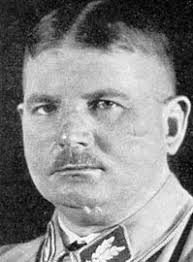
Ernst Rohem
Fittingly, he said this as he sat inside a prison cell awaiting his own execution.
On June 30, 1934, Hitler had ordered a massive purge of his private army, the S.A., or Stormtroopers. The purge was carried out by Hitler’s elite army-within-an-army, the Schutzstaffel, or Protective Squads, better known as the SS.
The S.A. Brownshirts had been instrumental in securing Hitler’s rise to Chancellor of Germany on January 30, 1933. They had intimidated political opponents and organized mass rallies for the Nazi Party.
But after Hitler reached the pinnacle of power, they became a liability.
Ernst Rohem, their commander, urged Hitler to disband the regular German army, the Reichswehr, and replace it with his own legions as the nation’s defense force.
Frightened by Rohem’s ambitions, the generals of the Reichswehr gave Hitler an ultimatum: Get rid of Rohem–or they would get rid of him.
So Rohem died in a hail of SS bullets–as did several hundred of his longtime S.A. cronies.
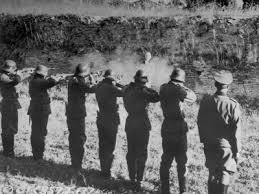
SS firing squad
Among the SS commanders supervising those executions was Reinhard Heydrich–a tall, blond-haired formal naval officer who was both a champion fencer and talented violinist.
Ultimately, he would become the personification of the Nazi ideal–”the man with the iron heart,” as Hitler eulogized at Heydrich’s funeral just eight years later.
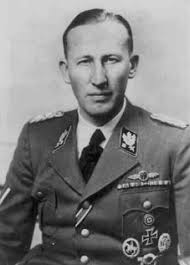
Reinhard Heydrich
Even so, Heydrich had a problem: He could never escape vicious rumors that his family tree contained a Jewish ancestor.
His paternal grandmother had married Reinhold Heydrich, and then Gustav Robert Suss. For unknown reasons, she decided to call herself Suss-Heydrich.
Since “Suss” was widely believed in Germany to indicate Jewish origin, the “stigma” of Jewish heritage attached itself to the Heydrich family.
Heydrich joined the SS in 1931 and quickly became head of its counterintelligence service. But his arrogance and overweening ambition created a great many enemies.
Only a year later, he became the target of an urgent investigation by the SS itself.
The charge: That he was part-Jewish, the ultimate sin in Hitler’s “racially pure” Nazi Germany.
The investigation cleared Heydrich, but the rumor of his “tainted” origins persisted, clearly tormenting the second most powerful man in the SS.
Even his superior, Heinrich Himmler, the Reichsfuhrer-SS, believed it.
When Heydrich was assassinated in 1942 by Czech assassins in Prague, Himmler attended his funeral.
He paid tribute to his former subordinate at the service–”You, Reinhard Heydrich, were a truly good SS-man.” But he could not resist saying in private:
“He was an unhappy man, completely divided against himself, as often happened with those of mixed race.”
Those who dare to harshly judge others usually find themselves assailed just as harshly.
A modern-day example is Liz Cheney, daughter of former Vice President Dick Cheney and now a candidate for U.S. Senator from Wyoming.
Liz is positioning herself as far more right-wing than her opponent, Republican U.S. Senator Michael Bradley “Mike” Enzi.
She has her work cut out for her: In March, 2007, Enzi was ranked by National Journal as the sixth-most conservative U.S. Senator.
Among his legislative priorities:
- Supporting partial privatization of Social Security
- Consistently voting against expanding Medicare.
- Voting against enrolling more children or the poor in public healthcare.

Mike Enzi
And Liz has a problem Enzi does not: Her sister, Mary, is not only a lesbian but legally married to another woman: Heather Poe.
This has led many Wyoming voters to wonder if Liz Cheney is far-Right enough to merit their support.
So Liz is going all-out to assure them that even though her sister leads a degenerate lifestyle, she, Liz, stands foursquare against legalizing gay marriage:
“I do believe it’s an issue that’s got to be left up to states. I do believe in the traditional definition of marriage.”

Liz Cheney
And, in another statement: “I am strongly pro-life and I am not pro-gay marriage.
“I believe the issue of marriage must be decided by the states, and by the people in the states, not by judges and not even by legislators, but by the people themselves.”
This stance has led to a heated rift between her and Mary.
“For the record, I love my sister, but she is dead wrong on the issue of marriage,” Mary Cheney wrote in a Facebook post in September.
“Freedom means freedom for everyone,” she continued. “That means that all families–regardless of how they look or how they are made–all families are entitled to the same rights, privileges and protections as every other.”
Adding to the complications: Their father, Dick Cheney—often ridiculed as “Darth Vader” for his own extreme Right-wing views—endorsed same-sex marriage in 2009.
But, as was true for officials in Nazi Germany, so is it true for Right-wing Republicans: It’s impossible to be too radical a Right-winger.
In the 1930s and 40s, it was politically—and personally—dangerous to be labeled “pro-Jewish” or “pro-Communist” in Hitler’s Germany.
And today it is equally dangerous—at least politically—to be labeled “pro-liberal” or “pro-gay” in the Republican Party.
2012 PRESIDENTIAL RACE, BAY OF PIGS, BERLIN WALL, BILL CLINTON, BRUCE GREENWOOD, CARLOS MARCELLO, CIA, CIVIL RIGHTS, CLIFF ROBERTSON, CUBAN MISSILE CRISIS, DAVID HALBERSTAM, FACEBOOK, FBI, FIDEL CASTRO, FRANK SINATRA, ICH BEN EIN BERLINNER SPEECH, INTERNET MOVIE DATABASE, J. EDGAR HOOVER, JAMES MARSDEN, JOHN F. KENNEDY, JOSEPH MCCARTHY, JOSEPH P. KENNEDY, LYNDON B. JOHNSON, MAFIA, MALCOM X, MARTIN LUTHER KING, MARTIN SHEEN, MOVIES, NEWT GINGRICH, NIKITA KHRUSHCHEV, NUCLEAR TEST BAN TREATY, PT-109, RICK PERRY, ROBERT F. KENNEDY, ROBERT S. MCNAMARA, SAM GIANCANA, SANTOS TRAFFICANTE, Sarah Palin, SATURDAY NIGHT LIVE, SOVIET UNION, THE BEST AND THE BRIGHTEST, THE BUTLER, THE MISSILES OF OCTOBER, THE RAT PACK, THIRTEEN DAYS, TWILIGHT ZONE, TWITTER, VIETNAM WAR, WILLIAM DEVANE, WILLIAM PETERSEN
In Bureaucracy, History, Law, Law Enforcement, Military, Politics, Social commentary on November 22, 2013 at 12:30 am
Fifty years ago this November 22, two bullets slammed into the neck and head of President John Fitzgerald Kennedy. It has been said that he left his country with three great legacies:
- The Nuclear Test Ban Treaty;
- The Apollo moon landing; and
- The Vietnam war.
Of these, the following can be said with certainty:
- The Test Ban Treaty has prevented atmosphereic testing–and poisoning–by almost all the world’s nuclear powers.
- After reaching the moon–in 1969–Americans quickly lost interest in space and have today largely abandoned plans for manned exploration.
- Under Presidents Lyndon Johnson and Richard Nixon, 58,000 Americans died in Vietnam; 153,303 were wounded; and billions of dollars were squandered in a hopeless effort to intervene in what was essentially a Vietnamese civil war. From 1965 to 1972, the war angrily divided Americas as had no event since the Civil War.
But there was a fourth legacy–and perhaps the most important of all: The belief that mankind could overcome its greatest challenges through rationality and perseverance.
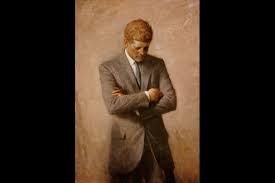
White House painting of JFK
At American University on June 10, 1963, Kennedy called upon his fellow Americans to re-examine the events and attitudes that had led to the Cold War. And he declared that the search for peace was by no means absurd:
“Our problems are man-made; therefore, they can be solved by man. And man can be as big as he wants. No problem of human destiny is beyond human beings.
“Man’s reason and spirit have often solved the seemingly unsolvable, and we believe they can do it again.”
Today, politicians from both parties cannot agree on solutions to even the most vital national problems.
On November 21, 2011, the 12 members of the “Super-Committee” of Congress, tasked with finding $1.2 trillion in cuts in government spending, threw up their hands in defeat.
President Kennedy speed-read several newspapers every morning. He nourished personal relationships with the press-–and not for entirely altruistic reasons. These journalistic relationships gave Kennedy additional sources of information and perspectives on national and international issues.
In 2012, Republican Presidential candidates celebrated their ignorance of both.
Former Godfather’s Pizza CEO Herman Cain famously said, “We need a leader, not a reader.” Thus he excused his ignorance of the reasons for President Barack Obama’s intervention in Libya.
Texas Governor Rick Perry showed similar pride in not knowing there are nine judges on the United States Supreme Court:
“Well, obviously, I know there are nine Supreme Court judges. I don’t know how eight came out my mouth. But the, uh, the fact is, I can tell you–I don’t have memorized all of those Supreme Ccourt judges. And, uh, ah–
“Here’s what I do know. That when I put an individual on the Supreme Court, just like I done in Texas, ah, we got nine Supreme Court justices in Texas, ah, they will be strict constructionists….”
In short, it’s the media’s fault if they ask you a question and your answer reveals your own ignorance, stupidity or criminality.
During the height of the Cuban Missile Crisis, Kennedy spoke with aides about a book he had just finished: Barbara Tuchman’s The Guns of August, on the events leading to World War 1.
He said that the book’s most important revelation was how European leaders had blindly rushed into war, without thought to the possible consequences. Kennedy told his aides he did not intend to make the same mistake-–that, having read his history, he was determined to learn from it.
Contrast that with today’s woeful historical ignorance among Republican Presidential candidates-–and those who aspire to be.
Consider Sarah Palin’s rewriting of history via “The Midnight Ride of Paul Revere”: “He warned the British that they weren’t going to be taking away our arms by ringing those bells and, um, making sure as he’s riding his horse through town to send those warning shots and bells that, uh, we were going to be secure and we were going to be free.”
In fact, Revere wasn’t warning the British about anything. Instead, he was warning his fellow Americans about an impending British attack–as his celebrated catchphrase “The British are coming!” made clear.
Republicans have attacked President Obama for his Harvard education and articulate use of language. Among their taunts: “Hitler also gave good speeches.”
And they resent his having earned most of his income as a writer of two books: Dreams From My Father and The Audacity of Hope. As if being a writer is somehow subversive.
When knowledge and literacy are attacked as “highfalutin’” arrogance, and ignorance and incoherence are embraced as sincerity, national decline lies just around the corner.
In retrospect, the funeral for President Kennedy marked the death of more than a rational and optimistic human being.
It marked the death of Americans’ pride in choosing reasoning and educated citizens for their leaders.

The Eternal Flame at the grave of President John F. Kennedy
2008 PRESIDENTIAL RACE, ABC NEWS, ANN COULTER, BARACK OBAMA, BILL CLINTON, CBS NEWS, CNN, COMMUNISM, EDWARD R. MURROW, FRANKLIN D. ROOSEVELT, GEORGE W. BUSH, GLENN BECK, HARRY S. TRUMAN, IRVING WALLACE, JOHN MCCAIN, JOSEPH MCCARTHY, MICHELLE BACHMANN, MITT ROMNEY, NBC NEWS, NEWT GINGRICH, OSAMA BIN LADEN, REPUBLICANS, RICHARD NIXON, RUSH LIMBAUGH, Sarah Palin, SEAN HANNITY, SPIRO AGNEW, THE LOS ANGELES TIMES, THE NEW YORK TIMES, THE WASHINGTON POST, TREASON
In Bureaucracy, History, Politics, Social commentary on October 28, 2013 at 12:00 am
In 1964, bestselling novelist Irving Wallace dared to imagine the then-unthinkable: The elevation of the first black President of the United States.
Wallace’s hero is Douglas Dilman, a moderate who tries to rule as a color-blind President. But he is repeatedly confronted with the brutal truth about himself–and his critics: He is black, and they cannot forgive him for it.

Irving Wallace
Dilman’s fictional Presidency is marked by white racists, black political activists, and an attempted assassination. Later, he is impeached on false charges for firing the racist Secretary of State.
Wallace’s1964 novel, The Man, appeared 44 years before Barack Obama’s election.
Fast-forward to the Presidency of Barack Obama and you find:
- In September, 2009, Joe Wilson (R-SC) yelled “You lie!” during Obama’s health care speech to Congress.
- In January, 2010, an effigy of President Barack Obama was found hanging from a building in Plains, Georgia.
- In December, 2011, Brent Bozell, who runs the right-wing Media Research Center, called Obama to “a skinny, ghetto crackhead.”
- In December, 2011, Rep. Jim Sensenbrenner (R-Wisc.), said of Michelle Obama: “She lectures us on eating right while she has a large posterior herself.”
- In January, 2012, Mitt Romney’s son, Matt, said his father might release his tax returns “as soon as President Obama releases his grades and birth certificate and sort of a long list of things.”
- In February, 2012, right-wing columnist Ann Coulter offered: “Voters with forty years of politically correct education are ecstatic to have the first Black president. They just love the idea even if we did get Flavor Flav instead of Thomas Sowell.”
- In May, 2012, a flatbed truck drove through new York holding a trailer with eight mannequin-like bodies hanging on nooses. One of the figures resembled President Obama, with a sign on the truck reading: “Obama Is Onboard, Find Out Why. Visit YouTube.com And Search Keyword PatriotPhipps.”

- In May, 2012, Patrick Lanzo, a bar owner in Paulding County, Georgia, posted a sign reading: “I do not support the nigger in the White House.” In 2009 he posted a sign that read, “Obama’s plan for health-care: nigger rig it.” Lanzo advertises his establishment as a “Klan bar.”
- Throughout the 2012 Presidential campaign, Newt Gingrich repeatedly called Obama “the greatest food stamp President in American history.”
- Obama has been portrayed as a shoeshine man, an Islamic terrorist and a chimp. The image of his altered face has been shown on a product called Obama Waffles in the manner of Aunt Jemima and Uncle Ben. He has been repeatedly depicted with a Hitler forelock and mustache.
- Among the protest signs they have brandished by Tea Party members: “Obama’s Plan: White Slavery,” “The American Taxpayers are the Jews for Obama’s Ovens,” and “Obama was Not Bowing [to the Saudi King] He was Sucking Saudi Jewels.”
- Other Tea Party posters: “Imam Obama Wants to Ban Pork” and “The Zoo Has An African Lion, and the White House Has a Lyin’ African.”
- Tea Partiers have chanted at Obama: “Bye, bye, Blackbird” and “Kenyan go home!”
- During the Republican-imposed government shutdown–October 1-17, 2013–Rep. Pete Sessions (R-Texas) told Obama: “I cannot even stand to look at you,” The incident occurred when Obama met with lawmakers to try to find a resolution to the shutdown.
- On October 13, 2013, anti-Obama protesters gathered at the World War II memorial in Washington, D.C. They weren’t protesting the government shutdown but the President who refused to cave in to Republican demands to de-fund the Affordable Care Act.
- One speaker was Larry Klayman of Freedom Watch, a Right-wing advocacy group. Said Klayman: “I call upon all of you to wage a second American nonviolent revolution, to use civil disobedience, and to demand that this president leave town, to get up, to put the Quran down, to get up off his knees, and to figuratively come out with his hands up,”
- On October 14, 2013, while Republicans were threatening to drive the country into bankruptcy by refusing to raise the debt ceiling, Sarah Palin posted on Facebook her “secret plan” to impeach President Obama:
- “It’s time for the president to be honest with the American people for a change. Defaulting on our national debt is an impeachable offense, and any attempt by President Obama to unilaterally raise the debt limit without Congress is also an impeachable offense.”
- In short: If the Republicans force the country into default, Obama should be impeached. And if the President finds a way to avoid default, he should be impeached.
- In October, 2013, Rep. Doug Lamborn (R-Colorado) said that being associated with President Obama would be similar to touching a “tar baby.” Specifically:
- “Even if some people say, well the Republicans should have done this or they should have done that, they will hold the president responsible. Now I don’t want to even have to be associated with him. It’s like touching a tar baby and you get, you get it, you know… you are stuck and you are part of the problem now and you can’t get away.”
Perhaps Irving Wallace believed that, by the millennium, America would be ready for a black President. If so, he sadly proved a far better author than prophet.
2008 PRESIDENTIAL RACE, ABC NEWS, ALTERNET, ANN COULTER, AP, BARACK OBAMA, BILL CLINTON, BUZZFEED, CBS NEWS, CNN, COMMUNISM, CROOKS AND LIARS, DAILY KOZ, EDWARD R. MURROW, FACEBOOK, FRANKLIN D. ROOSEVELT, GEORGE W. BUSH, GLENN BECK, HARRY S. TRUMAN, IRVING WALLACE, JOHN MCCAIN, JOSEPH MCCARTHY, MICHELLE BACHMANN, MITT ROMNEY, MOTHER JONES, MOVEON, NBC NEWS, NEWSWEEK, NEWT GINGRICH, NPR, OSAMA BIN LADEN, POLITICO, RAW STORY, REPUBLICANS, REUTERS, RICHARD NIXON, RUSH LIMBAUGH, SALON, Sarah Palin, SEAN HANNITY, SEATTLE TIMES, SLATE, SPIRO AGNEW, THE ATLANTIC, THE CHICAGO SUN-TIMES, THE CHICAGO TRIBUNE, THE DAILY BEAST, THE GUARDIAN, THE HILL, THE HUFFINGTON POST, THE LOS ANGELES TIMES, THE NATION, THE NEW YORK TIMES, THE WASHINGTON POST, TIME, TREASON, TWITTER, U.S. NEWS & WORLD REPORT, UPI, USA TODAY
In Bureaucracy, History, Politics, Social commentary on October 25, 2013 at 12:00 am
On March 9, 1954, Edward R. Murrow, the most respected broadcast journalist in America, assailed the “smear-and-fear” tactics of Wisconsin Republican Senator Joseph McCarthy.
The forum was Murrow’s highly-rated documentary series, “See It Now.” The truth of Murrow’s remarks has outlasted the briefness of that 30-minute program.
They could have been applied to the “lie and deny” methods of the Presidency of Richard M. Nixon.
And to the Red-baiting attacks made by Republicans against President Bill Clinton.
And to the ongoing character assaults made by right-wingers against President Barack Obama.
“We must not confuse dissent with disloyalty,” warned Murrow in that broadcast. “We must remember always that accusation is not proof and that conviction depends upon evidence and due process of law.
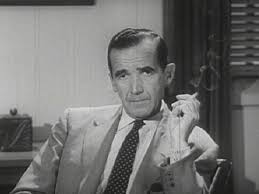
Edward R. Murrow
“We will not walk in fear, one of another. We will not be driven by fear into an age of unreason, if we dig deep in our history and our doctrine, and remember that we are not descended from fearful men—not from men who feared to write, to speak, to associate and to defend causes that were, for the moment, unpopular….
“We can deny our heritage and our history, but we cannot escape responsibility for the result. There is no way for a citizen of a republic to abdicate his responsibilities….
“We proclaim ourselves, as indeed we are, the defenders of freedom, wherever it continues to exist in the world. But we cannot defend freedom abroad by deserting it at home….
“Cassius was right. ‘The fault, dear Brutus, is not in our stars, but in ourselves.’”
After Obama announced the death of Osama Bin Laden, most of the Republican slander-peddlers momentarily fell silent.
Still, the legacy of hate and fear-mongering goes on.
There is a good reason for this: Republicans have found, repeatedly, that attacking the patriotism of their opponents is an effective vote-getter:
- It hurtled Dwight Eisenhower into the White House and Republicans into Congress in 1952 and 1956.
- It elected Richard Nixon President in 1968 and 1972.
- It gave control of the White House to Ronald Reagan in 1980 and 1984.
- It gave it to George H.W. Bush in 1988.
- And even though Bill Clinton won the Presidency in 1992, it gave Republicans control of the Congress in 1994.
- It gave the White House to George W. Bush in 2000 and 2004.
- It gave control of the House to Republicans in 2010, thus undermining the financial and healthcare reforms planned by Obama.
And since the 2008 election of Barack Obama as President, Republicans have coupled their traditional “Treason!” slander with both subtle and outright appeals to racism.
Most Republicans refuse to acknowledge this, but author Will Bunch has not been so reticent. In his 2010 book, The Backlash, he writes:
“…The year that had [conservatives] so terrified was 2050. In that year, according to the U.S. Census Bureau, the U.S. population would grow to some 399 million people–but only 49.8% would be white….”

This was given added weight by the 2008 election of Barack Obama:
“The Democratic upstart–and his legion of supporters among the nonwhite as well as the young–was a 9/11-sized jolt to the white masses already so worried about the cultural implications of immigration.
“The year 2050 suddenly wasn’t two generations away but right here knocking on the front door, with a dark face and that scary name: Barack Hussein Obama.
“Like a fire spreading across dry sagebrush, it took no effort for fear of The Other to leap from the Mexicans in front of the Wal-Mart to the man now inside the Oval Office.”
An author who predicted this very scenario was the best-selling novelist, Irving Wallace.
His 1964 novel, The Man, positing the ascent of the first black President, appeared 44 years before Obama’s election.
The plot: The President and Speaker of the House are killed in an overseas building collapse, and the Vice-President declines the office due to age and ill-health. As a result, Senate President pro tempore Douglas Dilman suddenly becomes the first black man to occupy the Oval Office.
His Presidency is marked by white racists, black political activists, and an attempted assassination. Later, he is impeached on false charges for firing the racist Secretary of State.

A moderate by nature, Dilman tries to rule as a color-blind President. But he is repeatedly confronted with the brutal truth about himself–and his critics: He is black, and they cannot forgive him for it.
Southern Senator Watson, upon learning that Dilman has succeeded to the Presidency, says: “The White House isn’t going to be white enough from now on.”
And Kay Eaton, who lusts for her husband, the Secretary of State, to become President, blames him for not pushing hard enough for it: “You’re just a kingmaker to a jigaboo.”
2008 PRESIDENTIAL RACE, ABC NEWS, ALTERNET, ANN COULTER, AP, BARACK OBAMA, BILL CLINTON, BUZZFEED, CBS NEWS, CNN, COMMUNISM, CROOKS AND LIARS, DAILY KOZ, EDWARD R. MURROW, FACEBOOK, FRANKLIN D. ROOSEVELT, GEORGE W. BUSH, GLENN BECK, HARRY S. TRUMAN, JOHN MCCAIN, JOSEPH MCCARTHY, MICHELLE BACHMANN, MITT ROMNEY, MOTHER JONES, MOVEON, NBC NEWS, NEWSWEEK, NEWT GINGRICH, NPR, OSAMA BIN LADEN, POLITICO, RAW STORY, REPUBLICANS, REUTERS, RICHARD NIXON, RUSH LIMBAUGH, SALON, Sarah Palin, SEAN HANNITY, SEATTLE TIMES, SLATE, SPIRO AGNEW, THE ATLANTIC, THE CHICAGO SUN-TIMES, THE CHICAGO TRIBUNE, THE DAILY BEAST, THE GUARDIAN, THE HILL, THE HUFFINGTON POST, THE LOS ANGELES TIMES, THE NATION, THE NEW YORK TIMES, THE WASHINGTON POST, TIME, TREASON, TWITTER, U.S. NEWS & WORLD REPORT, UPI, USA TODAY
In Bureaucracy, History, Politics, Social commentary on October 24, 2013 at 1:50 am
On May 7, 2012, GOP Presidential candidate Mitt Romney attended a town-hall meeting in Euclid, Ohio.
“We have a president right now who is operating outside the construction of our Constitution,” a female attendee told Romney.
As the audience applauded, she continued: “And I do agree he should be tried for treason.
“But I wanna know what you are going to be able to do to help restore balance between the three branches of government and what you’re going to be able to do to restore our Constitution in this country?”
Unlike John McCain, who in 2008 memorably corrected a woman who declared Obama was “an Arab,” Romney didn’t issue such a correction. Instead, he chose to simply address the question.
Since the end of World War 11, Republicans have regularly hurled the charge of “treason” against anyone who dared to run against them for office or think other than Republican-sponsored thoughts.
Republicans had been locked out of the White House from 1933 to 1952, during the administrations of Franklin D. Roosevelt and Harry S. Truman.
Determined to regain the Presidency by any means, they found that attacking the integrity of their fellow Americans a highly effective tactic.
During the 1950s, Wisconsin Senator Joseph R. McCarthy rode a wave of paranoia to national prominence. On February 9, 1950, he claimed:
“The State Department is infested with communists. I have here in my hand a list of 205—a list of names that were made known to the Secretary of State as being members of the Communist Party and who nevertheless are still working and shaping policy in the State Department.”
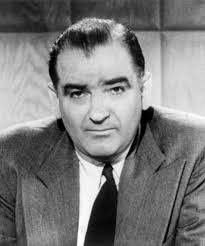
Joseph McCarthy
After four years of such frenzied attacks on Congress, the State Department and respected journalists such as Edward R. Murrow, McCarthy finally overstepped himself. He accused the United States Army of being an active hotbed for Communists.
At the Army-McCarthy hearings, McCarthy’s credibility was forever destroyed. He was finally censured by his fellow Senators and disappeared into anonymity, alcoholism and death in 1957.
The fact that McCarthy never uncovered one actual case of treason was conveniently overlooked during his lifetime.
And today, right-wing columnists like Ann Coulter try to rehabilitate his memory–just as right-wingers in Russia still try to rehabilitate the memory of Soviet dictator Joseph Stalin.
Nevertheless, the success of McCarthy’s treason-charged rhetoric proved too alluring for other Republicans to resist. Among those who have greatly profited from hurling similar charges are:
- President Richard Nixon
- His vice president, Spiro Agnew
- Former Speaker of the House Newt Gingrich
- Former Congressman Dick Armey
- President George W. Bush
- Vice Presidential candidate Sarah Palin
- Congresswoman Michelle Bachmann
- Rush Limbaugh
- Glenn Beck
- Sean Hannity
- Bill O’Reilly.
The election of Barack Obama pushed the “treason chorus” to new heights of infamy. With no political scandal (such as Bill Clinton’s affair with Monica Lewinsky) to fasten on, the bureaucracy of the Republican Party deliberately promoted the slander that Obama was not an American citizen.
From this there could be only one conclusion: That he was an illegitimate President, and should be removed from office.
During the 2008 Presidential campaign, Republicans charged that Obama was really a Muslim non-citizen who intended to sell out America’s security to his Muslim “masters.”
And this smear campaign continued throughout his Presidency.
To the dismay of his enemies, Obama–in the course of a single week–dramatically proved the falsity of both charges.
On April 27, 2011, he released the long-form of his Hawaii birth certificate.
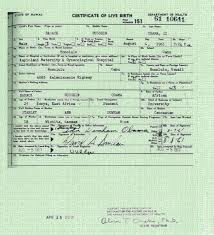
The long-form version of President Obama’s birth certificate
“We do not have time for this kind of silliness,” said Obama at a press conference, speaking as a father might to a roomful of spiteful children. “We have better stuff to do. I have got better stuff to do. We have got big problems to solve.
“We are not going to be able to do it if we are distracted, we are not going to be able to do it if we spend time vilifying each other…if we just make stuff up and pretend that facts are not facts, we are not going to be able to solve our problems if we get distracted by side shows and carnival barkers.”
And on May 1, he announced the solving of one of those “big problems”: Osama bin Laden, mastermind of the September 11, 2001 terrorist attacks, had been tracked down and shot dead by elite U.S. Navy SEALS in Pakistan.
Of course, Obama was only the latest Democratic President to be attacked as “unpatriotic.”
For more than a half-century, Republicans have accused their Democratic opponents of treason to gain and retain political power in America.
ABC NEWS, ADOLF HITLER, AFFORDABLE CARE ACT, BARACK OBAMA, BILL CLINTON, CBS NEWS, CNN, FACEBOOK, GOVERNMENT SHUTDOWN, MARLIN STUTZMAN, NBC NEWS, NEWT GINGRICH, OBAMACARE, THE NEW YORK TIMES, THE WASHINGTON POST, TWITTER
In Bureaucracy, History, Law on October 7, 2013 at 1:24 am
And the most glorious exploits do not always furnish us with the clearest discoveries of virtue or vice in men; sometimes a matter of less moment, an expression or a jest, informs us better of their characters and inclinations, than the most famous sieges, the greatest armaments, or the bloodiest battles whatsoever.
–Plutarch, Life of Alexander
In 1994, Newt Gingrich, then Speaker of the House of Representatives, shut down the Federal Government.
Officially, the reason was a budget impasse with President Bill Clinton. Unofficially–and in reality–the reason was altogether different:
Clinton had forced him to sit in the back of Air Force One on a trip to Israel for the funeral of former prime minister Yitzhak Rabinl.
“This is petty,” Gingrich confessed to startled reporters. “I’m going to say up front it’s petty, But I think it’s human.
“When you land at Andrews [Air Force Base, in Washington, D.C.] and you’ve been on the plane for 25 hours and nobody has talked to you and they ask you to get off by the back ramp . . . You just wonder, where is their sense of manners, where is their sense of courtesy?”
Gingrich’s childish verbal tirade was a public relations disaster for the Republicans. “Cry Baby,” screamed the New York Daily News, next to a picture of Gingrich in a diaper.

When House Democrats brought a poster-sized image of the cartoon onto the floor, the Republican majority forced them to remove it.
But the damage was done, and Republicans paid a fearful price for the shutdown and Gingrich’s candor about the reason for it.
Now, here we are, 19 years later, and, once again, the public–and, most especially, federal employees–are facing the hardships of another Republican-led government shutdown.
Once again, the official reason given by Republicans is: They want to save the country from the dangers of providing healthcare insurance to all Americans, not simply the wealthiest 1%.
To hear Republicans tell it, Obamacare–actually, the Affordable Care Act–will “destroy the medical system as we know it.”
The Act aims to:
-
Increase the quality and affordability of health insurance;
-
Lower the uninsured rate by expanding public and private insurance coverage;
-
Reduce the costs of healthcare for individuals and the government;
- Forbid insurance companies the right to deny coverage for “pre-existing conditions”; and
- Require employers with more than 50 employees to offer health insurance to their fulltime workers–or pay a large penalty.
Republicans also claim that it will bankrupt the country–although the Congressional Budget Office stated that the ACA will lower future deficits and Medicare spending.
After passing the House and Senate, the ACA was signed into law by President Baraco Obama on March 23, 2010.
On June 28, 202, the United States Supreme Court–whose Chief Justice, John Roberts, is a Republican–upheld the constitutionality of the ACA in the case,
Yet House Republicans continued searching for a way to stop the law from taking effect. By September, 2013, they had voted 42 times to repeal “Obamacare.”
But their efforts achieved nothing, since the Democratic-led Senate made it clear it would never go along with such legislation.
Finally, unable to legally overturn the Act or to legislatively repeal it, the House Republicans fell back on something much simpler.
Threats and fear.
Threats–of voting to shut down salaries paid to most Federal employees.
Most, because they themselves would continue to draw hefty salaries while they were denying them to FBI agents, air traffic controllers and members of the military, among others.
And fear–that would be generated throughout the Federal government, the United States and America’s international allies.
It was the my-way-or-else “negotiating” style of Adolf Hitler: Do-as-I-say-or-I-will-destroy-you.
When Obama and Senate Democrats refused to knuckle under to yet another Republican extortion effort, House Republicans made good on their threat.
They “shut down the government.”
Since then, Republicans have repeatedly claimed it is Obama and Senate Democrats who refuse to see reason and negotiate. By “negotiate,” they mean agree to Republican demands to de-fund “Obamacare.”
But now a Republican has given away the real reason for the shutdown.
“We’re not going to be disrespected,” Rep. Marlin Stutzman (R-Ind.) told the Washington Examiner. “We have to get something out of this. And I don’t know what that even is.”

Marlin Stutzman
With Newt Gingrich, the real reason for the government shutdown was his petty ego.
Of course, another major reason was his desire to bully President Clinton into gutting Republican-despised Federal programs to help the poor and middle-class.
Now, 19 years later, Republicans–as admitted by Martlin Stutzman–are out to get “respect.”
And they’re trying to get it the same way a thuggish gang leader tries to get it: By demanding: “Do what I say or I’ll kill you.”
At the end of World War II, Americans tried to cleanse West Germany of its former Nazi leaders and their supporters.
The thuggishness we are now witnessing will continue until, somehow, we cleanse our own government of those who “negotiate” Nazi-Republican style.
2012 PRESIDENTIAL RACE, BAY OF PIGS, BERLIN WALL, BILL CLINTON, BRUCE GREENWOOD, CARLOS MARCELLO, CIA, CIVIL RIGHTS, CLIFF ROBERTSON, CUBAN MISSILE CRISIS, DAVID HALBERSTAM, FACEBOOK, FBI, FIDEL CASTRO, FRANK SINATRA, ICH BEN EIN BERLINNER SPEECH, INTERNET MOVIE DATABASE, J. EDGAR HOOVER, JAMES MARSDEN, JOHN F. KENNEDY, JOSEPH MCCARTHY, JOSEPH P. KENNEDY, LYNDON B. JOHNSON, MAFIA, MALCOM X, MARTIN LUTHER KING, MARTIN SHEEN, MOVIES, NEWT GINGRICH, NIKITA KHRUSHCHEV, NUCLEAR TEST BAN TREATY, PT-109, RICK PERRY, ROBERT F. KENNEDY, ROBERT S. MCNAMARA, SAM GIANCANA, SANTOS TRAFFICANTE, Sarah Palin, SATURDAY NIGHT LIVE, SOVIET UNION, THE BEST AND THE BRIGHTEST, THE BUTLER, THE MISSILES OF OCTOBER, THE RAT PACK, THIRTEEN DAYS, TWILIGHT ZONE, TWITTER, VIETNAM WAR, WILLIAM DEVANE, WILLIAM PETERSEN
In Bureaucracy, History, Politics, Social commentary, Uncategorized on August 28, 2013 at 12:00 am
Fifty years ago this November 22, two bullets slammed into the neck and head of President John Fitzgerald Kennedy.
It has been said that he left his country with three great legacies:
- The Nuclear Test Ban Treaty;
- The Apollo moon landing; and
- The Vietnam war.
Of these, the following can be said with certainty:
- The Test Ban Treaty has prevented atmosphereic testing–and poisoning–by almost all the world’s nuclear powers.
- After reaching the moon–in 1969–Americans quickly lost interest in space and have today largely abandoned plans for manned exploration.
- Under Presidents Lyndon Johnson and Richard Nixon, 58,000 Americans died in Vietnam; 153,303 were wounded; and billions of dollars were squandered in a hopeless effort to intervene in what was essentially a Vietnamese civil war. From 1965 to 1972, the war angrily divided Americas as had no event since the Civil War.
But there was a fourth legacy–and perhaps the most important of all: The belief that mankind could overcome its greatest challenges through rationality and perseverence.

White House painting of JFK
At American University on June 10, 1963, Kennedy called upon his fellow Americans to re-examine the events and attitudes that had led to the Cold War.
And he declared that the search for peace was by no means absurd:
“Our problems are man-made; therefore, they can be solved by man. And man can be as big as he wants. No problem of human destiny is beyond human beings.
“Man’s reason and spirit have often solved the seemingly unsolvable, and we believe they can do it again.”
Today, politicians from both parties cannot agree on solutions to even the most vital national problems.
On November 21, 2011, the 12 members of the “Super-Committee” of Congress, tasked with finding $1.2 trillion in cuts in government spending, threw up their hands in defeat.
President Kennedy speed-read several newspapers every morning. He nourished personal relationships with the press-–and not for entirely altruistic reasons.
These journalistic relationships gave Kennedy additional sources of information-–and perspectives-–on national and international issues.
In 2012, Republican Presidential candidates celebrated their ignorance of both.
Former Godfather’s Pizza CEO Herman Cain famously said, “We need a leader, not a reader.” Thus he excused his ignorance of the reasons for President Barack Obama’s intervention in Libya.
Texas Governor Rick Perry showed similar pride in not knowing there are nine judges on the United States Supreme Court:
“Well, obviously, I know there are nine Supreme Court judges. I don’t know how eight came out my mouth. But the, uh, the fact is, I can tell you–I don’t have memorized all of those Supreme Ccourt judges. And, uh, ah–
“Here’s what I do know. That when I put an individual on the Supreme Court, just like I done in Texas, ah, we got nine Supreme Court justices in Texas, ah, they will be strict constructionists….
“That’s what Americans care about. Uh, they’re not looking for a robot that can, uh, spit out, uh, the name of every Supreme Court justice, or, ah, the the someone that’s gonna be perfect in, in, in every way.”
In short, it’s the media’s fault if they ask you a question and your answer reveals your own ignorance, stupidity or criminality.
During the height of the Cuban Missile Crisis, Kennedy spoke with aides about a book he had just finished: Barbara Tuchman’s The Guns of August, on the events leading to World War 1.
He said that the book’s most important revelation was how European leaders had blindly rushed into war, without thought to the possible consequences.
Kennedy told his aides he did not intend to make the same mistake-–that, having read his history, he was determined to learn from it.
What a complete contrast that is from today’s woeful historical ignorance among Republican Presidential candidates-–and those who aspire to be.
Consider Sarah Palin’s rewriting of history via “The Midnight Ride of Paul Revere”:
“He warned the British that they weren’t going to be taking away our arms by ringing those bells and, um, making sure as he’s riding his horse through town to send those warning shots and bells that, uh, we were going to be secure and we were going to be free.”
In fact, Revere wasn’t warning the British about anything. Instead, he was warning his fellow Americans about an impending British attack–as his celebrated catchphrase “The British are coming!” made clear.
Republicans have attacked President Obama for his Harvard education and articulate use of language. Among their taunts: “Hitler also gave good speeches.”
And they resent his having earned most of his income as a writer of two books: Dreams From My Father and The Audacity of Hope. As if being a writer is somehow subversive.
When knowledge and literacy are attacked as “highfalutin’” arrogance, and ignorance and incoherence are embraced as sincerity, national decline lies just around the corner.
In retrospect, the funeral for President Kennedy marked the death of more than a rational and optimistic human being. It marked the death of Americans’ pride in choosing reasoning and educated citizens for their leaders.
The Eternal Flame at the grave of President John F. Kennedy
ADOLF HITLER, BARACK OBAMA, BILL CLINTON, CNN'S "STARTING POINT", CZECHOSLAVAKIA, DEBT CEILING, ERNEST HEMINGWAY, EXTORTION, FACEBOOK, FASCISM, INDIANA REPUBLICAN PRIMARY, MEIN KAMPF, NAZI GERMANY, NEGOTIATING, NEVILLE CHAMBERLAIN, NEWT GINGRICH, PAP SMEARS, POLAND, REPUBLICAN PARTY, REPUBLICANS, RICHARD MOURDOCK, TWITTER, WARREN BUFFET, WORLD WAR ii
In Bureaucracy, History, Politics, Social commentary on August 9, 2013 at 1:07 am
Adolf Hitler is dead. But his my-way-or-else “negotiating” style lives on in today’s Republican party.
During the summer of 2011, Republicans refused to raise the debt ceiling unless Democrats agreed to massively cut social programs for the elderly, poor and disabled.
If Congress failed to raise the borrowing limit of the federal government by August 2, the date when the U.S. reached the limit of its borrowing abilities, it would have begun defaulting on its loans.
As Warren Buffett, CEO of Berkshire Hathaway, explained the looming economic catastrophe:
“If you don’t send out Social Security checks, I would hate to think about the credit meeting at S&P and Moody’s the next morning.
“If you’re not paying millions and millions and millions of people that range in age from 65 on up, money you promised them, you’re not a AAA,” said Buffett.
A triple-A credit rating is the highest possible rating that can be received.
And while Republicans demanded that the disadvantaged tighten their belts, they rejected any raising of taxes on their foremost constituency–the wealthiest 1%.
To raise taxes on the wealthy, they insisted, would be a “jobs-killer.” It would “discourage” corporate CEOs from creating tens of thousands of jobs they “want” to create.

Republicans knew this argument is a lie. And so did the editors of Time. The difference is, the editors of Time were willing to reveal the truth.
In its June 20, 2011 cover-story on “What U.S. Economic Recovery? Five Destructive Myths,” Rana Foroohar, the magazine’s assistant managing editor in charge of economics and business, delivered this warning:
Profit-seeking corporations can’t be relied on to ”make it all better.”
Wrote Foroohar:
“There is a fundamental disconnect between the fortunes of American companies, which are doing quite well, and American workers, most of whom are earning a lower hourly wage now than they did during the recession.
“The thing is, companies make plenty of money; they just don’t spend it on workers here.
“There may be $2 trillion sitting on the balance sheets of American corporations globally, but firms show no signs of wanting to spend it in order to hire workers at home.”
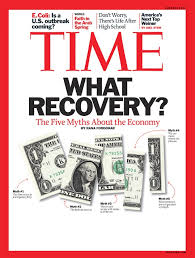
Yet there is also a disconnect between the truth of this situation and the willingness of Americans to face up to that truth.
The reason:
“The Republicans have pulled off a major (some would say cynical) miracle,” writes Foroohar.
They have convinced “the majority of Americans that the way to jump-start the economy is to slash taxes on the wealthy and on cash-hoarding corporations while cutting benefits for millions of Americans.
“It’s fun-house math that can’t work. We’ll need both tax increases and sensible entitlement cuts to get back on track.
“Yet surveys show 50% of Americans think that not raising the debt ceiling is a good idea — that you can somehow starve your way to economic growth.”
How have Republicans achieved this? By adopting the principles of propaganda laid down by no less an authority on lying than Adolf Hitler.
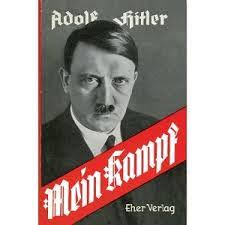
According to Mein Kampf-–”My Struggle”–-Hitler’s autobiography and political treatise:
- The great majority of a nation is ruled by sentiment rather than by sober reasoning.
- This sentiment, however, is not complex, but simple and consistent. It is not highly differentiated, but has only the negative and positive notions of love and hatred, right and wrong, truth and falsehood.
- Propaganda must not investigate the truth objectively and must present only that aspect of the truth which is favorable to its own side.
- The receptive powers of the masses are very restricted, and their understanding is feeble. On the other hand, they quickly forget.
- All effective propaganda must be confined to a few bare essentials and those must be expressed as far as possible in stereotyped formulas.
- These slogans should be persistently repeated until the very last individual has come to grasp the idea that has been put forward.
Following these principles, Republicans have proved hugely successful at persuading millions that truth is whatever their party claims it to be at any given moment.
“Fascism,” said author Ernest Hemingway, “is a lie told by bullies.” Thus, when Republicans couldn’t attain their goals by lying, they sought to do so by force–or at least the threat of it.
Republicans have repeatedly threatened to shut down the government unless their constantly escalating demands were met.
In November, 1995, Newt Gingrich, then Speaker of the House of Representatives, carried out his threat. Gingrich unwisely admitted that he did so because President Bill Clinton had put him in the back of Air Force One during a recent trip to Israel.
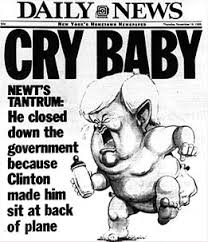
The shutdown proved a disaster for Republicans. Clinton was handily re-elected in 1996 and Gingrich suddenly resigned from Congress in 1998.
Still, the Republicans continued their policy of my-way-or-else. In April, 2011, the United States government almost shut down over Republican demands about subsidized pap smears.
ADOLF HITLER, BARACK OBAMA, BILL CLINTON, CNN'S "STARTING POINT", CZECHOSLAVAKIA, DEBT CEILING, ERNEST HEMINGWAY, EXTORTION, FACEBOOK, FASCISM, MEIN KAMPF, NAZI GERMANY, NEGOTIATING, NEVILLE CHAMBERLAIN, NEWT GINGRICH, PAP SMEARS, POLAND, REPUBLICAN PARTY, REPUBLICANS, RICHARD MOURDOCK, TWITTER, WARREN BUFFET, WORLD WAR ii
In Bureaucracy, History, Politics, Social commentary on August 8, 2013 at 1:00 pm
British Prime Minister Neville Chamberlain resolved to meet with Adolf Hitler, the German Fuehrer, to peacefully resolve the latest Nazi-created crisis.
Having conquered Austria, the German dictator now wanted Czechoslovakia.
And Chamberlain was determined to grant his every demand–so long as this meant avoiding a second world war.
The two European leaders met in Berchtesgaden on September 15, 1938.
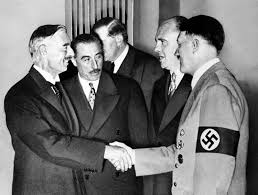
Neville Chamberlain, Adolf Hitler at Munich
During their talks, Chamberlain said he had come to discuss German grievances. But, he added, it was necessary in all circumstances to exclude the use of force.
Hitler appeared to be shocked that he could be accused of such intentions: “Force? Who speaks of force?“
Then, without warning, he switched to an aggressive mode. He accused the Czechs of having mobilized their army in May. They had mobilized—in response to the mobilization of the German army.
“I shall not put up with this any longer,” shouted Hitler. “I shall settle this question in one way or another. I shall take matters in my own hands!”
Suddenly, Chamberlain seemed alarmed—and possibly angry: “If I understood you right, you are determined to proceed against Czechoslovakia in any case. If this is so, why did you let me come to Berchtesgaden?
“In the circumstances, it is best for me to return at once. Anything else now seems pointless.”
Hitler was taken aback by the unexpected show of defiance. He realized he was about to lose his chance to bully the British into accepting his latest demands.
So he softened his tone and said they should consider the Sudetenland according to the principle of self-determination.
Chamberlain said he must immediately return to England to consult with his colleagues. Hitler appeared uneasy. But then the German translator finished the sentence: “…and then meet you again.” Hitler realized he still had a chance to attain victory without going to war.
Chamberlain agreed to the cession of the Sudetenland. Three days later, French Prime Minister Edouard Daladier did the same. No Czechoslovak representative was invited to these discussions.
Chamberlain met Hitler again in Godesberg, Germany, on September 22 to confirm the agreements. But Hitler aimed to use the crisis as a pretext for war.
He now demanded not only the annexation of the Sudetenland but the immediate military occupation of the territories. This would give the Czechoslovak army no time to adapt their defense measures to the new borders.
To achieve a solution, Italian dictator Benito Mussolini suggested a conference of the major powers in Munich.
On September 29, Hitler, Daladier and Chamberlain met and agreed to Mussolini’s proposal. They signed the Munich Agreement, which accepted the immediate occupation of the Sudetenland.
The Czechoslovak government had not been a party to the talks. Nevertheless, it promised to abide by the agreement on September 30.
It actually had no choice. It faced the threat of an immediate German invasion after being deserted by its pledged allies: Britain, France and the Soviet Union.
Chamberlain returned to England a hero. Holding aloft a copy of the worthless agreement he had signed with Hitler, he told cheering crowds in London: “I believe it is peace for our time.”
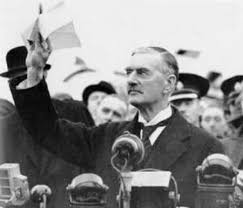
Neville Chamberlain
Winston Churchill knew better, predicting: “Britain and France had to choose between war and dishonor. They chose dishonor. They will have war.”
Hitler—still planning more conquests—also knew better. In March, 1939, the German army occupied the rest of Czechoslovakia.
Chamberlain would soon be seen as a naive weakling–even before bombs started falling on London.
Hitler next turned his attention–and demands–to Poland.
When his generals balked, warning that an invasion would trigger a war with France and Britain, Hitler quickly brushed aside their fears: “Our enemies are little worms. I saw them at Munich.”
Hitler ordered the invasion of Poland on September 1–unintentionally triggering World War II.
In time, historians and statesmen would regard Munich as an object lesson in the futility—and danger—in appeasing evil and aggression.
But for the postwar Republican party, Hitler’s my-way-or-else “negotiating” methods would become standard operating procedure.
During the summer of 2011, Republicans refused to raise the debt ceiling unless Democrats agreed to massively cut social programs for the elderly, poor and disabled.
If Congress failed to raise the borrowing limit of the federal government by August 2, the date when the U.S. reached the limit of its borrowing abilities, it would have begun defaulting on its loans.
As Warren Buffett, CEO of Berkshire Hathaway, explained the looming economic catastrophe:
“If you don’t send out Social Security checks, I would hate to think about the credit meeting at S&P and Moody’s the next morning.
“If you’re not paying millions and millions and millions of people that range in age from 65 on up, money you promised them, you’re not a AAA,” said Buffett.
A triple-A credit rating is the highest possible rating that can be received.
And while Republicans demanded that the disadvantaged tighten their belts, they rejected any raising of taxes on their foremost constituency–the wealthiest 1%.
ADOLF HITLER, BARACK OBAMA, BILL CLINTON, CNN'S "STARTING POINT", CZECHOSLAVAKIA, DEBT CEILING, ERNEST HEMINGWAY, EXTORTION, FACEBOOK, FASCISM, MEIN KAMPF, NAZI GERMANY, NEGOTIATING, NEVILLE CHAMBERLAIN, NEWT GINGRICH, PAP SMEARS, POLAND, REPUBLICAN PARTY, REPUBLICANS, RICHARD MOURDOCK, TWITTER, WARREN BUFFET, WORLD WAR ii
In Bureaucracy, History, Politics, Social commentary on August 7, 2013 at 1:08 pm
After winning the Indiana GOP United States Senate primary, Indiana Treasurer Richard Mourdock appeared on the May 9 edition of CNN’s “Starting Point.”
There occurred this exchange between Mourdock and the show’s host, Soledad O’Brien:
MOURDOCK: What I’ve said about compromise and bipartisanship is I hope to build a conservative majority in the United States Senate so that bipartisanship becomes Democrats joining Republicans to roll back the size of government, reduce the bureaucracy, lower taxes, and get America moving again. The stimulus plan hasn’t worked.

Richard Mourdock
O’BRIEN: So what I hear you say is that you’re not going to compromise. In fact, the only compromise you’ll do is really getting other people on the other side of the aisle to come to your side of the aisle, which, I guess, is the definition against compromise. You said this in the New York Times–
MOURDOCK: Well, it is the definition of political effectiveness.
Nazi dictator Adolf Hitler couldn’t have phrased it better.
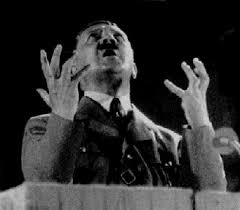
Adolf Hitler
Anyone wanting to understand how Republicans intend to apply such a philosophy need only consult history.
On February 12, 1938, two Chancellors—Adolf Hitler of Germany, and Kurt von Schuschnigg of Austria—met at Hitler’s retreat at Obersalzberg. At stake lay the future independence of Austria.
Although Austrian by birth, Hitler considered himself a German. Annexing Austria, he believed, would ensure its return to “the Great German motherland.”
HITLER: “I have only to give one command and all this comic stuff on the border will be blown to pieces overnight. You don’t seriously think you could hold me up, even for half an hour, do you?
“Who knows—perhaps you will find me one morning in Vienna like a spring storm. Then you will go through something! I’d like to spare the Austrians that.
“The S.A. [Hitler’s private army of Stormtroopers] and the [Condor] Legion [which had bombed much of Spain into rubble during the three-year Spanish Civil War] would come in after the troops and nobody–not even I–could stop them from wreaking vengeance.”
British historian Robert Payne noted in his 1973 biography, The Life and Death of Adolf Hitler: “Schuschnigg was not a coward, but he showed fear, and it was precisely this look of fear that Hitler was waiting for.
“He had worked out the program of intimidation very carefully. The thunder and lightning in the morning; then a period of calm, when the unsuspecting victim might believe he had relented; and then he would come in for the kill with such savage fury that there would be no resistance.”
After lunch, Hitler presented Schuschnigg with an ultimatum:
- Austria must join in an economic union with German.
- Austria must lift its ban on membership in the Nazi Party (which had assassinated the country’s previous Chancellor).
- Within three days there was to be a general amnesty of Nazi prisoners.
- Three key government ministries—of war, interior and finance—were to be given to members of the Nazi Party.
With these in their possession, the Nazis would be able to take over Austria in two to three weeks.
At first, Schuschnigg refused to sign. He explained that the Austrian constitution did not give him the power to sign it. But Hitler insisted—threatening to invade Austria otherwise.
Schuschnigg, a virtual prisoner of his host, facing the destruction of his country by a powerful and aggressive neighbor, signed. It marked—until the defeat of Germany in 1945–the end of Austria as an independent nation.
Seven months later, in September, 1938, Hitler gave another exhibition of his “negotiating” methods. This time, the target of his rage and aggression was Czechoslovakia.
So, once again, he opened “negotiations” with a lie: The Czechoslovak government was trying to exterminate 3.5 million Germans living in the “Sudetenland.”
This consisted of the northern, southwest and western regions of Czechoslovakia, inhabited mostly by ethnic Germans.
Then he followed this up with the threat of war: Germany would protect its citizens and halt such “oppression.”
For British Prime Minister Neville Chamberlain, the thought of another European war erupting less than 20 years after the end of World War I was simply unthinkable.
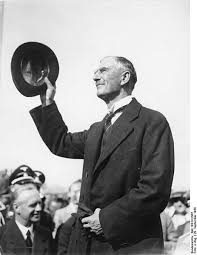
Neville Chamberlain
Something had to be done to prevent it. And he believed himself to be just the man to do it.
He quickly sent Hitler a telegram, offering to help resolve the crisis: “I could come to you by air and am ready to leave tomorrow. Please inform me of earliest time you can receive me, and tell me the place of the meeting. I should be grateful for a very early reply.”
Once again, another head-of-state was prepared to meet Hitler on his home ground. Again, Hitler took this concession as a sign of weakness. And Chamberlain’s use of such words as “please” and “grateful” only further convinced Hitler of another impending triumph.
 Bureaucracybuster's Blog
9/11, ABC NEWS, ADOLF HITLER, AMERICANS FOR TAX REFORM, ANDERSON COOPER, ANTI-COMMUNISM, ARTHUR MILLER, BILL CLINTON, CBS NEWS, CENTER FOR SECURITY POLICY, CHINA, CHRIS MATTHEWS, CNN, DICK CHENEY, DWIGHT D. EISENHOWER, EDWARD R. MURROW, FACEBOOK, GEORGE H.W. BUSH, HARRY S. TRUMAN, HEINRICH HIMMLER, HERMAN CAIN, HERMAN GORING, HILLARY CLINTON, HUMA ABEDIN, JEWS, JIMMY CARTER, JOHN BIRCH SOCIETY, JOHN F. KENNEDY, JOHN STEINBECK, JOSEPH GOEBBELS, JOSEPH MCCARTHY, JOSEPH STALIN, KGB, LIZ CHENEY, LUCILLE BALL, LYNDON B. JOHNSON, MARY CHENEY, MICHELLE BACHMANN, MIKE HUCKABEE, MITT ROMNEY, MSNBC, MUSLIM BROTHERHOOD, MUSLIMS, NAZI GERMANY, NAZI PARTY, NBC NEWS, NEWT GINGRICH, PETE SEEGER, RED SCARE, REINHARD HEYDRICH, REPUBLICAN PARTY, RICHARD NIXON, RICK SANTORUM, Ronald Reagan, SAME-SEX MARRIAGE, SENATOR MIKE ENZI, SOVIET UNION, SS, THE AMERICAN CENTER FOR SECURITY POLICY, THE HUFFINGTON POST, THE LOS ANGELES TIMES, THE NEW YORK TIMES, THE WASHINGTON POST, TWITTER, WYOMING
THE POLITICS OF SCAPEGOATING: PART ONE (OF THREE)
In Bureaucracy, History, Politics, Social commentary on November 26, 2013 at 12:09 am“All revolutions,” said Ernst Rohem, leader of Adolf Hitler’s brown-shirted thugs, the S.A., “devour their own children.”
Ernst Rohem
Fittingly, he said this as he sat inside a prison cell awaiting his own execution.
On June 30, 1934, Hitler had ordered a massive purge of his private army, the S.A., or Stormtroopers. The purge was carried out by Hitler’s elite army-within-an-army, the Schutzstaffel, or Protective Squads, better known as the SS.
The S.A. Brownshirts had been instrumental in securing Hitler’s rise to Chancellor of Germany on January 30, 1933. They had intimidated political opponents and organized mass rallies for the Nazi Party.
But after Hitler reached the pinnacle of power, they became a liability.
Ernst Rohem, their commander, urged Hitler to disband the regular German army, the Reichswehr, and replace it with his own legions as the nation’s defense force.
Frightened by Rohem’s ambitions, the generals of the Reichswehr gave Hitler an ultimatum: Get rid of Rohem–or they would get rid of him.
So Rohem died in a hail of SS bullets–as did several hundred of his longtime S.A. cronies.
SS firing squad
Among the SS commanders supervising those executions was Reinhard Heydrich–a tall, blond-haired formal naval officer who was both a champion fencer and talented violinist.
Ultimately, he would become the personification of the Nazi ideal–”the man with the iron heart,” as Hitler eulogized at Heydrich’s funeral just eight years later.
Reinhard Heydrich
Even so, Heydrich had a problem: He could never escape vicious rumors that his family tree contained a Jewish ancestor.
His paternal grandmother had married Reinhold Heydrich, and then Gustav Robert Suss. For unknown reasons, she decided to call herself Suss-Heydrich.
Since “Suss” was widely believed in Germany to indicate Jewish origin, the “stigma” of Jewish heritage attached itself to the Heydrich family.
Heydrich joined the SS in 1931 and quickly became head of its counterintelligence service. But his arrogance and overweening ambition created a great many enemies.
Only a year later, he became the target of an urgent investigation by the SS itself.
The charge: That he was part-Jewish, the ultimate sin in Hitler’s “racially pure” Nazi Germany.
The investigation cleared Heydrich, but the rumor of his “tainted” origins persisted, clearly tormenting the second most powerful man in the SS.
Even his superior, Heinrich Himmler, the Reichsfuhrer-SS, believed it.
When Heydrich was assassinated in 1942 by Czech assassins in Prague, Himmler attended his funeral.
He paid tribute to his former subordinate at the service–”You, Reinhard Heydrich, were a truly good SS-man.” But he could not resist saying in private:
“He was an unhappy man, completely divided against himself, as often happened with those of mixed race.”
Those who dare to harshly judge others usually find themselves assailed just as harshly.
A modern-day example is Liz Cheney, daughter of former Vice President Dick Cheney and now a candidate for U.S. Senator from Wyoming.
Liz is positioning herself as far more right-wing than her opponent, Republican U.S. Senator Michael Bradley “Mike” Enzi.
She has her work cut out for her: In March, 2007, Enzi was ranked by National Journal as the sixth-most conservative U.S. Senator.
Among his legislative priorities:
Mike Enzi
And Liz has a problem Enzi does not: Her sister, Mary, is not only a lesbian but legally married to another woman: Heather Poe.
This has led many Wyoming voters to wonder if Liz Cheney is far-Right enough to merit their support.
So Liz is going all-out to assure them that even though her sister leads a degenerate lifestyle, she, Liz, stands foursquare against legalizing gay marriage:
“I do believe it’s an issue that’s got to be left up to states. I do believe in the traditional definition of marriage.”
Liz Cheney
And, in another statement: “I am strongly pro-life and I am not pro-gay marriage.
“I believe the issue of marriage must be decided by the states, and by the people in the states, not by judges and not even by legislators, but by the people themselves.”
This stance has led to a heated rift between her and Mary.
“For the record, I love my sister, but she is dead wrong on the issue of marriage,” Mary Cheney wrote in a Facebook post in September.
“Freedom means freedom for everyone,” she continued. “That means that all families–regardless of how they look or how they are made–all families are entitled to the same rights, privileges and protections as every other.”
Adding to the complications: Their father, Dick Cheney—often ridiculed as “Darth Vader” for his own extreme Right-wing views—endorsed same-sex marriage in 2009.
But, as was true for officials in Nazi Germany, so is it true for Right-wing Republicans: It’s impossible to be too radical a Right-winger.
In the 1930s and 40s, it was politically—and personally—dangerous to be labeled “pro-Jewish” or “pro-Communist” in Hitler’s Germany.
And today it is equally dangerous—at least politically—to be labeled “pro-liberal” or “pro-gay” in the Republican Party.
Share this: