Posts Tagged ‘MAFIA’
ABC NEWS, CBS NEWS, FACEBOOK, MAFIA, MOVIES, NARCOTICS CORRUPTION, NBC NEWS, NYPD, POLICE CORRUPTION, PRINCE OF THE CITY, ROBERT LEUCI, RUDLOPH GIULIANI, SIDNEY LUMET, THE LOS ANGELES TIMES, THE NEW YORK TIMES, THE WASHINGTON POST, TREAT WILLIAMS, TWITTER
In Bureaucracy, History, Law, Law Enforcement, Social commentary on October 30, 2013 at 1:36 am
It’s a movie that appeared in 1981–making it, for those born in 2000, an oldie. And it wasn’t a blockbuster, being yanked out of theaters almost as soon as it arrived.
Yet “Prince of the City” remains that rarity–a movie about big-city police that
- Tells a dramatic (and true) story, and
- Offers serious truths for those who want to know how police and prosecutors really operate.
It’s based on the real-life case of NYPD Detective Robert Leuci (“Danny Ciello” in the film).
A member of the elite Special Investigating Unit (SIU) Ciello (played by Treat Williams) volunteers to work undercover against rampant corruption among narcotics agents, attorneys and bail bondsmen.
His motive appears simple: To redeem himself and the NYPD from the corruption he sees everywhere: “These people we take from own us.”
His only condition: “I will never betray cops who’ve been my partners.”
Assistant US Attorney Rick Cappalino assures Ciello: “We’ll never make you do something you can’t live with.”
As the almost three-hour movie unfolds, Ciello finds–to his growing dismay–that there are a great many things he will have to learn to live with.
Although he doesn’t have a hand in it, he’s appalled to learn that Gino Moscone, a former buddy, is going to be arrested for taking bribes from drug dealers.
Confronted by a high-ranking agent for the Drug Enforcement Agency, Moscone refuses to “rat out” his buddies.
Instead, he puts his service revolver to his head and blows out his brains.

Ciello is devastated, but the investigation–and film–must go on.
Along the way, he’s suspected by a corrupt cop and bail bondsman of being a “rat” and threatened with death. He’s about to be wasted in a back alley when his cousin–a Mafia member–suddenly intervenes.
The Mafioso tells Ciello’s would-be killers: “You’d better be sure he’s a rat, because people like him.”
At which point, the grotesquely fat bail bondsman–who has been demanding Ciello’s execution–pats Danny on the arm and says, “No hard feelings.”
It is director Sidney Lumet’s way of graphically saying: “Sometimes the bad guys can be good guys–and the good guys can be bad guys.”
Lumet makes it clear that police don’t always operate with the Godlike perfection of cops in TV and films. It’s precisely because his Federal backup agents lost him that Ciello almost became a casualty.
In the end, Ciello becomes a victim of the prosecutorial forces he has unleashed. Although he’s vowed to never testify against his former partners, Ciello finds this a promise he can’t keep.
Too many of the cops he’s responsible for indicting have implicated him of similar–if not worse–behavior.
He’s even suspected of being involved in the theft of 450 pounds of heroin (“the French Connection”) from the police property room.
A sympathetic prosecutor–Mario Vincente in the movie, Rudolph Giuliani in real-life–convinces Ciello that he must finally reveal everything he knows.
Ciello’s had originally claimed to have done “three things” as a corrupt narcotics agent. By the time his true confessions are over, he’s admitted to scores of felonies.
Ciello then tries to convince his longtime SIU partners to do the same.
One of them commits suicide. Another tells Ciello to screw himself: “I’m not going to shoot myself and I’m not going to rat out my friends.”
To his surprise, Ciello finds himself admiring his corrupt former partner for being willing to stand up to the Federal case-agents and prosecutors demanding his head.
The movie ends with a double dose of irony.
First: Armed with Ciello’s confessions, an attorney whom Ciello had successfully testified against appeals his conviction. But the judge rules these to be “collateral,” apart from the main evidence in the case, and affirms the conviction.
Second: Ciello is himself placed on trial–of a sort. A large group of assistant U.S. attorneys gathers to debate whether their prize “canary” should be indicted.
If he is, his confessions will ensure his conviction.
Some prosecutors argue forcefully that Ciello is a corrupt law enforcement officer who has admitted to more than 40 cases of perjury–among other crimes. How can the government use him to convict others and not address the criminality in his own past?
Other prosecutors argue that Ciello voluntarily risked his life–physically and professionally–to expose rampant police corruption. He deserves a better deal than to be cast aside by those who have made so many cases through his testimony.
Eventually, the U.S. Attorney for the Southern District of New York makes his decision: “The government declines to prosecute Detective Daniel Ciello.”
It is Lumet’s way of showing that the decision to prosecute is not always an easy or objective one.
The movie ends with Ciello now teaching surveillance classes at the NYPD Academy. A student asks: “Are you the Detective Ciello?”
“I’m Detective Ciello.”
“I don’t think I have anything to learn from you.”
Is Danny Ciello–again, Robert Leuci in real-life–a hero, a villain, or some combination of the two? It is with this ambiguity that the film ends–an ambiguity that each viewer must resolve for himself.
9/11, ABC NEWS, ABRAHAM LINCOLN, AL QAEDA, ANDREW JACKSON, BARACK OBAMA, BILL CLINTON, CBS NEWS, CNN, CUBAN MISSILE CRISIS, EMANCIPATION PROCLOMATION, EXTORTION, FACEBOOK, FBI, FEDERAL GOVERNMENT SHUTDOWN, FORD'S THEATER, FRANKLIN ROOSEVELT, FURLOUGHS, GEORGE H.W. BUSH, JOHN F. KENNEDY, JOSEPH MCCARTHY, MAFIA, MITT ROMNEY, MSNBC'S "HARDBALL", NBC NEWS, NEGOTIATING, OBAMACARE, PATRIOT ACT, R.I.CO. ACT, REPUBLICAN PARTY, REPUBLICANS, RICHARD NIXON, Secret Service, TED NUGENT, TERRORISM, THE AFFORDABLE CARE ACT, THE LOS ANGELES TIMES, THE NEW YORK TIMES THE WASHINGTON POST, TWITTER, UNITED STATES HOLOCAUST MEMORIAL, VIETNAM WAR MEMORIAL, WHITE HOUSE, WORLD WAR 11
In Bureaucracy, History, Politics on October 4, 2013 at 12:01 am
For a half-century, Republicans have been damning the very government they lust to control.
Consider this choice comment from Mitt Romney supporter Ted Nugent:
“I spoke at the NRA and will stand by my speech. It’s 100 percent positive. It’s about we the people taking back our American dream from the corrupt monsters in the federal government under this administration, the communist czars he [President Barack Obama] has appointed.”
Romney, of course, refused to disavow the slander Nugent cast over every man and woman working on behalf of the American people.
Romney and his fellow Republicans salivate at every vile charge they can hurl at the very government they lust to control.
As in the case of Senator Joseph McCarthy, no slander is too great if it advances their path to power.
But there are others–living or at least working in Washington, D.C.–who simply go about their jobs with quiet dedication. And they leave slanderous, self-glorifying rhetoric to Right-wing politicians.
One of these unsung heroes was Stephen Tyrone Johns, a security guard at the United States Holocaust Memorial Museum.

On June 10, 2009, Johns, 39, was shot and killed by James Wenneker von Brunn, a white supremist and Holocaust denier. Brunn was himself shot and wounded by two other security guards who returned fire.
While in jail awaiting his trial, von Brunn–who was 88–died on January 6, 2010.
To work in Washington, D.C., is to realize that this city ranks–with New York City–at the top of Al Qaeda’s list of targets.
No one knows this better than the agents of the United States Secret Service, who protect the President, Vice President, their families and the White House itself 24 hours a day.

Prior to 9/11, visiting the White House was assumed to be an American right. No longer.
Today, if you want to tour the Executive Mansion, you quickly learn there are only two ways to get in:
- Through a special pass provided by your Congressman; or
- By someone connected with the incumbent administration.
Congressmen, however, have a limited number of passes to give out. And most of these go to people who have put serious money into the Congressman’s re-election campaigns.
And the odds that you’ll know someone who works in the White House–and who’s willing to offer you an invitation–are even smaller than those of knowing a Congressman.
But even that isn’t enough to get you through the White House door.
You’ll have to undergo a Secret Service background check. And that requires you to submit the following information in advance of your visit:
- Name
- Date of birth
- Birthplace
- Social Security Number
And be prepared to leave a great many items at your hotel room. Among these:
- Cameras or video recorders
- Handbags, book bags, backpacks or purses
- Food or beverages, tobacco products, personal grooming items (i.e. makeup, lotion, etc.)
- Strollers
- Cell phones
- Any pointed objects
- Aerosol containers
- Guns, ammunition, fireworks, electric stun guns, mace, martial arts weapons/devices, or knives of any size
Visitors enter the White House–after showing a government-issued ID card such as a driver’s license–from the south side of East Executive Avenue.
After passing through the security screening room, they walk upstairs to the first door and through the East, Green, Blue, Red and State Dining rooms.
Secret Service agents quietly stand post in every room–unless they’re tasked with explaining the illustrious history of each section of the White House.
Like everyone else who lives/works there, the Secret Service fully appreciates the incredible sense of history that radiates throughout the building.
This is where
- Abraham Lincoln signed the Emancipation Proclomation;
- Franklin Roosevelt directed the United States to victory in World War II;
- John F. Kennedy stared down the Soviets during the Cuban Missile Crisis.
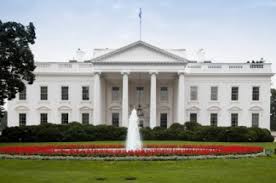
But even the generally unsmiling Secret Service agents have their human side.
While touring the East Wing of the White House, I asked an agent: “Is the East Room where President Nixon gave his farewell speech?” on August 9, 1974.
“I haven’t been programmed for that information,” the agent joked, inviting me to ask a question he could answer.
Another guest asked the same agent if he enjoyed being a Secret Serviceman.
To my surprise, he said that this was simply what he did for a living. His real passion, he said, was counseling youths.
“If you love something,” he advised, “get a job where you can do it. And if you can’t get a job you’re passionate about, get a job so you can pursue your passion.”
Of the more than 2.65 million civilian employees of the executive branch, more than 800,000 have been sent home without pay.
These men and women aren’t faceless “bureaucrats,” as Right-wingers would have people believe. They are hustands and wives, fathers and mothers. They have bills to pay, just like everyone else.
Many of them, such as agents of the FBI and Secret Service, have taken an oath to defend the United States Constitution–with their lives if necessary.
And they now face the dread of going for weeks or even months without a paycheck–as pawns in another Right-wing case of: “My way or no way.”
They deserve a better break–and so do all those who cherish liberty.
9/11, ABC NEWS, ABRAHAM LINCOLN, AL QAEDA, ANDREW JACKSON, BARACK OBAMA, BILL CLINTON, CBS NEWS, CNN, CUBAN MISSILE CRISIS, EMANCIPATION PROCLOMATION, EXTORTION, FACEBOOK, FBI, FEDERAL GOVERNMENT SHUTDOWN, FORD'S THEATER, FRANKLIN ROOSEVELT, FURLOUGHS, GEORGE H.W. BUSH, JOHN F. KENNEDY, JOSEPH MCCARTHY, MAFIA, MITT ROMNEY, MSNBC'S "HARDBALL", NBC NEWS, NEGOTIATING, OBAMACARE, PATRIOT ACT, R.I.CO. ACT, REPUBLICAN PARTY, REPUBLICANS, RICHARD NIXON, Secret Service, TED NUGENT, TERRORISM, THE AFFORDABLE CARE ACT, THE LOS ANGELES TIMES, THE NEW YORK TIMES THE WASHINGTON POST, TWITTER, UNITED STATES HOLOCAUST MEMORIAL, VIETNAM WAR MEMORIAL, WHITE HOUSE, WORLD WAR 11
In Bureaucracy, History, Law, Politics on October 3, 2013 at 12:06 am
Listen to almost any Republican and you’re almost certain to hear how much he hates and despises “Washington.”
To hear Right-wingers tell it, you might believe that “Washington” is:
- The capitol of an enemy nation;
- A cesspool of corrupt, power-hungry men and women slavering to gain dictatorial control over the life of every American;
- A center of lethal contagion which, like ancient Carthage, should be burned to the ground and its inhabitants destroyed or scattered.
All that prevents “Washington” from gaining absolute power–so claim Republicans–is the Republican Party.
But others who live or work in Washington, D.C. take a far different view of their city and the duties they perform.
These men and women will never call a press conference or rake in millions in “political contributions” (i.e., legalized bribes) for promising special privileges to special interests.
Many of them work for the National Park Service. Every national monument–and Washington is speckled with monuments–has several of these employees assigned to it.
Their duties are to protect the monuments and offer historical commentary to the public.
One such employee regularly addresses visitors to Ford’s Theater–known worldwide as the scene of President Abraham Lincoln’s assassination.
George (a pseudonym) opens his lecture by raising the question every member of the audience wants answered: How much of Ford’s Theater remains intact from the night of Lincoln’s murder–April 14, 1865?
And the answer is: Only the exterior of the building.
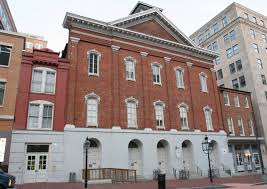
After Lincoln’s assassination, enraged Union soldiers converted the interior of the building into a military command center. That meant ripping out all the seats for spectators and the stage for actors.
The stage and seats–even the “Presidential Box” where Lincoln sat–have all been reproduced for a modern audience.
As George talks, you can tell that, for him, this is no typical day job. He realizes that, renovated or not, Ford’s Theater remains saturated with history. And he clearly feels privileged to share that history with others.
George explains that Presidential assassin John Wilkes Booth did not sneak into the theater. He didn’t have to–as a celebrity actor, he received the sort of favored treatment now accorded Lindsay Lohan.
Another monument where you will find Park Ranger guides is the Vietnam Veterans Memorial.
Completed in 1982, it receives about 3 million visitors a year. Adorning the Wall, in columns that seem to reach endlessly to the sky, are the names of the 58,195 soldiers who gave their lives during the Vietnam War.
That struggle–from 1961 to 1975–proved the most divisive American conflict since the Civil War.
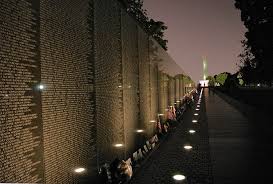
On the day I visited the memorial, groups of elementary schoolchildren passed by. They were jabbering loudly, seemingly oblivious to the terrible sacrifice the Wall was meant to commemorate.
But their adult chaperones realized its significance, and ordered the children to quiet down.
I asked a nearby Park Ranger: “Do you feel people now respond differently to the Wall, as we get further away from the Vietnam war?”
“No,” he answered. He felt that today’s visitors showed the same reverence for the monument and for the losses it had been created to honor as those who had first come in the early 1980s.
And it may well be true: I saw many tiny American flags and wreaths of flowers left at various points along the Wall, which stretches across 250 feet of land on the Mall.
When thinking about “Washington,” it’s essential to remember that this city–along with New York City–remains at the top of Al Qaeda’s target list.
Those who choose to live and/or work here do so in the potential shadow of violent death.
Anytime you enter a Federal building, be prepared to undergo a security check.
In most agencies–such as the Department of Agriculture–you simply place your bags or purses into an X-ray machine similar to those found at airports, and walk through a magnetometer. If no alarms sound, you collect your valuables and pass on through.
Such machines are, of course, nammed by armed security guards. And they stand sentinel at every conceivable Federal building–such as the Supreme Court, the Department of Justice, the Smithsonian Museum, the Pentagon and the U.S. Holocaust Memorial Museum.
These men and women must daily inspect the bodies and handbags of the 15 million people who visit Washington, D.C. annually, generating $5.24 billion dollar in revenues.
This means repeating the same screening gestures countless times–looking through X-ray machines at bags or coats, and running an electronic “wand” up and down those people whose clothing gives off signs of metallic objects.
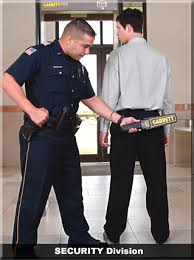
It also means projecting a smiling, friendly demeanor towards those same people–many of whom are in a rush and/or resent being electronically sniffed over.
And every security guard knows this: It’s only a matter of time before the next terrorist shows up.
On June 10, 2009, just that happened at the United States Holocaust Memorial.
9/11, ABC NEWS, ABRAHAM LINCOLN, AL QAEDA, ANDREW JACKSON, BARACK OBAMA, BILL CLINTON, CBS NEWS, CNN, CUBAN MISSILE CRISIS, EMANCIPATION PROCLOMATION, EXTORTION, FACEBOOK, FBI, FEDERAL GOVERNMENT SHUTDOWN, FORD'S THEATER, FRANKLIN ROOSEVELT, FURLOUGHS, GEORGE H.W. BUSH, JOHN F. KENNEDY, JOSEPH MCCARTHY, MAFIA, MITT ROMNEY, MSNBC'S "HARDBALL", NBC NEWS, NEGOTIATING, OBAMACARE, PATRIOT ACT, R.I.CO. ACT, REPUBLICAN PARTY, REPUBLICANS, RICHARD NIXON, Secret Service, TED NUGENT, TERRORISM, THE AFFORDABLE CARE ACT, THE LOS ANGELES TIMES, THE NEW YORK TIMES THE WASHINGTON POST, TWITTER, UNITED STATES HOLOCAUST MEMORIAL, VIETNAM WAR MEMORIAL, WHITE HOUSE, WORLD WAR 11
In Bureaucracy, History, Law, Politics on October 2, 2013 at 2:45 am
To hear many political pundits tell it, the shutdown of the Federal Government is the result of “political dysfunction,” as if everybody in Congress were tripping on LSD.
This is not only untrue but misleading.
The truth is that the shutdown is the result of yet another ruthless attempt by Right-wing Republicans to obtain absolute power.
When they can obtain it at the ballot box, they rule as though by divine right. When they can’t obtain it at election time, they try to obtain it through intimidation.
Thus, in 1992 and 1996, their Presidential candidates–President George H.W. Bush and Senator Bob Dole, respectively–couldn’t defeat Bill Clinton.
So Republicans mounted an inquisition into a failed land deal that occurred before Clinton was first elected President. This investigation spanned the length of the Clinton Presidency and produced no evidence or indictments of criminal activity.
It did, however, turn up the salacious news that Clinton had actually enjoyed several instances of oral sex courtesy of a libidinous White House intern named Monica Lewinsky.
Unable to defeat Clinton at election time, and unable to find any actual criminal wrongdoing on his part, Right-wing Republicans tried to drive him out of office by impeachment.
The effort failed, and Clinton stayed in the White House until his term expired in 2001.
Then, as now, it was members of the House of Representatives who were the driving force.
Now, fast forward to the present: Republicans have made it their mission to deprive millions of Americans of health care. They have voted 42 times to repeal or undermine the Affordable Care Act, better known as Obamacare.
And they have made its elimination the focus of their threats to shut down the government unless they get their way.
Yet, consider this: Whether they like it or not, the Affordable Care Act is now a law that was legally passed by both houses of Congress. It has been certified as Constitutional by no less than a Republican Chief Justice of the United States Supreme Court.
Under our system of government, that’s as legal as it gets.
But Republicans don’t care about legality when they’re pursuing absolute power over the lives of their fellow Americans.
Thus, they have carried out their threat to shut down the Federal Government since they couldn’t coerce Senate Democrats into de-funding “Obamacare.”
As a result:
- More than 800,000 federal workers have been sent home without pay;
- National parks and monuments have been closed;
- Some programs have been temporarily crippled–such as WIC, which provides nutritional food to poor mothers with infants; and
- Some members of “essential services” are still required to be on duty–such as the military and Federal law enforcement agencies–but without receiving paychecks.
Of course, this disgrace didn’t have to happen.
President Obama didn’t have to cave in to the latest Republican extortion demands to prevent such a shutdown.
He could have ordered his Attorney General, Eric Holder, to launch an FBI invesdtigation into terroristic threats made by Right-wingers to shut down the government.
Both the 1970 Racketeer Influenced Corrupt Organizations (RICO) Act and the USA Patriot Act provide remedies for punishing the sort of behavior engaged in by House Republicans.
RICO opens with a series of definitions of “racketeering activity” which can be prosecuted by Justice Department attorneys. Among those crimes: Extortion.

Extortion is defined as “a criminal offense which occurs when a person unlawfully obtains either money, property or services from a person(s), entity, or institution, through coercion.”
And if President Obama believed that RICO was not sufficient to deal with extortionate behavior, he could have relied on the Patriot Act of 2001, passed in the wake of 9/11.
In Section 802, the Act defines domestic terrorism. Among the behavior that is defined as criminal:
“Activities that…appear to be intended…to influence the policy of a government by intimidation or coercion [and]…occur primarily within the territorial jurisdiction of the United States.”
Demanding that the President de-fund Obamacare or face a potentially disastrous government shutdown clearly falls within the legal definition of “activities…intended…to influence the policy of a government by intimidation or coercion.”
If the FBI had determined that Federal laws against extortion and terrorism had been broken, the Justice Department could have convened criminal grand juries to indict those Republicans found as violators.
President Obama should have authorized this investigation as soon as Republicans started making terroristic threats. Thus, he would have served notice on his sworn enemies that he was no one to take lightly.
Knowing that they might well face indictment and prosecution for engaging in domestic terrorism would have frightened many Republicans into backing away from such behavior.
Those who persisted would have found themselves fighting desperately to stay out of prison. They would have had to pay huge fees to top-flight criminal attorneys.
They would have lived with, first, the threat of indictments hanging over their heads, and, once those indictments were returned, with the threat of conviction and imprisonment.
As a result, they would not have had time to make destroying the Presidency of Barack Obama their Number One priority.
But Obama forfeited all those advantages when he accused Republicans of “blackmail” and then refused to legally punish them for it.
ABC NEWS, ADOLF HITLER, ANDREW JACKSON, BARACK OBAMA, CBS NEWS, CHRIS MATTHEWS, CNN, CNN'S "STARTING POINT", CUBAN MISSILE CRISIS, DEBT CEILING, EXTORTION, FACEBOOK, GEORGE W. BUSH, HOUSE SPEAKER JOHN BOEHNER, JOHN F. KENNEDY, MAFIA, MSNBC'S "HARDBALL", MUNICH CONFERENCE, NBC NEWS, NEGOTIATING, NEVILLE CHAMBERLAIN, NICCOLO MACHIAVELLI, OBAMACARE, PAP SMEARS, PATRIOT ACT, PLANNED PARENTHOOD, R.I.CO. ACT, REPUBLICAN PARTY, REPUBLICANS, THE AFFORDABLE CARE ACT, THE LOS ANGELES TIMES, THE NEW YORK TIMES THE WASHINGTON POST, THE PRINCE, TWITTER, WINSTON CHURCHILL, WORLD WAR 11
In Bureaucracy, History, Law Enforcement, Politics, Social commentary on September 24, 2013 at 12:00 am
The 1938 Munich Conference taught an invaluable lesson in foreign affairs: Caving in to the demands of insatiable thugs leads to only more demands.
That was what British Prime Minister Nveille Chamberlain learned when he sought to appease Adolf Hitler, Germany’s war-intent Fuehrer.
Chamberlain believed that by giving in to Hitler’s demands for “the German part” of Czechoslavakia known as the Sudetenland he could avoid war.
On September 29, Chamberlain and French Prime Minister Edouard Daladier met with Hitler and signed the Munich Agreement, resulting in the immediate German occupation of part of Czechoslavakia.
The Czechoslovakian government had not been a party to the talks. Their “allies” had sold them out.
Chamberlain returned to England a hero. Holding aloft a copy of the worthless agreement he had signed with Hitler, he told cheering crowds in London: “I believe it is peace for our time.”
Winston Churchill knew better, predicting: “Britain and France had to choose between war and dishonor. They chose dishonor. They will have war.”
And so they did.
It is not too late for President Barack Obama to apply this lesson from history.
With the United States facing a disastrous government shutdown unless the President surrenders to the latest Republican extortion threats, Obama can:
- Invoke the Racketeer Influenced Corrupt Organizations Act (RICO) and/or the Patriot Act;
- Rally the American people against this criminal threat to the security of the Nation.
Second Option: Calling upon the American people for their support
President John F. Kennedy did just that–successfully–during the most deadly crisis of his administration.
Addressing the Nation on October 22, 1962, Kennedy shocked his fellow citizens by revealing that the Soviet Union had placed offensive nuclear missiles in Cuba.
After outlining a series of steps he had taken to end the crisis, Kennedy sought to reassure and inspire his audience. His words are worth remembering today:
“The path we have chosen for the present is full of hazards, as all paths are, but it is the one most consistent with our character and courage as a nation and our commitments around the world.
“The cost of freedom is always high, but Americans have always paid it. And one path we shall never choose, and that is the path of surrender or submission.”
Just as President Kennedy called on his fellow Americans for support against a foreign enemy, President Obama can rally his countrymen against an equally ruthless domestic enemy.
During such a national address, President Obama can reveal such blunt truths as:

- Republicans have adopted the same my-way-or-else “negotiating” stance as Adolf Hitler.
- Like the Nazis, they are determined to gain absolute power–or destroy the Nation they claim to love.
- They raised the debt ceiling seven times during the eight-year Presidency of George W. Bush.
- But now that a Democrat holds the White House, raising the debt ceiling is unacceptable.
- Despite Republican lies, we cannot revitalize the economy by slashing taxes on the wealthy and cash-hoarding corporations while cutting benefits for millions of average Americans.
- We will need both tax increases and sensible entitlement cuts to regain our economic strength.
- The Affordable Health Care Act frees Americans from the greed-fueled tyranny of the insurance industry.
- Americans who could never hope to obtain medical coverage–for themselves and their families–can now do so.
Finally, President Obama can end his speech by directly calling for the active support of his fellow Americans. Something like this:
“My fellow Americans, I have taken an oath to ‘preserve, protect and defend the Constitution of the United States.’
“But I cannot do this on my own. As citizens of a Republic, each of us carries that burden. We must each do our part to protect the land and the liberties we love.
“Tonight, I’m asking for your help.
“We stand on the edge of economic and social disaster. Therefore, I am asking each of you to stand up for America tonight–by demanding the recall of the entire membership of the Republican Party.
“As President John F. Kennedy said:
‘In your hands, my fellow citizens, more than mine, will rest the final success or failure of our course. Since this country was founded, each generation of Americans has been summoned to give testimony to its national loyalty.’
“This is the moment when each of us must decide–whether we will survive as a Republic, or allow ruthless political fanatics to destroy what has lasted and thrived for more than 200 years.”
President Obama has taken forceful action against America’s most ruthless foreign enemies—most notably, Osama bin Laden.
If the Nation is to survive, he must now act just as forcefully against America’s most ruthless domestic enemies.
Fortunately, there is still time for him to do so. The fact that he has not done so in the past does not rule out his doing so now.
He needs to only remember–and act on–the words of another American President–Andrew Jackson–who counseled: “One man with courage makes a majority.”
ABC NEWS, ADOLF HITLER, ANDREW JACKSON, BARACK OBAMA, CBS NEWS, CHRIS MATTHEWS, CNN, CNN'S "STARTING POINT", CUBAN MISSILE CRISIS, DEBT CEILING, EXTORTION, FACEBOOK, GEORGE W. BUSH, HOUSE SPEAKER JOHN BOEHNER, JOHN F. KENNEDY, MAFIA, MSNBC'S "HARDBALL", MUNICH CONFERENCE, NBC NEWS, NEGOTIATING, NEVILLE CHAMBERLAIN, NICCOLO MACHIAVELLI, OBAMACARE, PAP SMEARS, PATRIOT ACT, PLANNED PARENTHOOD, R.I.CO. ACT, REPUBLICAN PARTY, REPUBLICANS, THE AFFORDABLE CARE ACT, THE LOS ANGELES TIMES, THE NEW YORK TIMES THE WASHINGTON POST, THE PRINCE, TWITTER, WINSTON CHURCHILL, WORLD WAR 11
In Bureaucracy, History, Law Enforcement, Politics, Social commentary on September 23, 2013 at 12:10 am
Republicans are once again playing extortion politics–threatening to shut down the government unless they get their way.
And their way means abolishing The Affordable Care Act, otherwise known as Obamacare.
But this is a nightmare that doesn’t have to be.
There are, in fact, two ways to avoid it.
Assuming that President Obama doesn’t once again surrender to Republican extortion demands, he has two formidable weapons he can deploy:
First Option: RICO to the rescue
The Racketeer Influenced Corrupt Organizations (RICO) Act is a provision of the Organized Crime Control Act of 1970. It authorizes prosecution for acts performed as part of an ongoing criminal organization.
It has been applied to not only the Mafia but to individuals, businesses, political protest groups, and terrorist organizations. In short, a RICO claim can arise in almost any context.
Such as the one President Barack Obama faced in 2011 when Republicans threatened to destroy the credit rating of the United States unless their budgetary demands were met.
And such as the present case when Republicans are again threatening the security of the Nation with extortionate demands.
RICO opens with a series of definitions of “racketeering activity” which can be prosecuted by Justice Department attorneys. Among those crimes: Extortion.
Extortion is defined as “a criminal offense which occurs when a person unlawfully obtains either money, property or services from a person(s), entity, or institution, through coercion.”
The RICO Act defines “a pattern of racketeering activity” as “at least two acts of racketeering activity, one of which occurred after the effective date of this chapter and the last of which occurred within ten years…after the commission of a prior act of racketeering activity.”
And if President Obama believes that RICO is not sufficient to deal with extortionate behavior, he can rely on the USA Patriot Act of 2001, passed in the wake of 9/11.
In Section 802, the Act defines domestic terrorism. Among the behavior that is defined as criminal:
“Activities that…appear to be intended…to influence the policy of a government by intimidation or coercion [and]…occur primarily within the territorial jurisdiction of the United States.”
Demanding that the President de-fund Obamacare or face a potentially disastrous government shutdown clearly falls within the legal definition of “activities…intended…to influence the policy of a government by intimidation or coercion.”
The remedies for punishing such criminal behavior are now legally in place. President Obama need only direct the Justice Department to apply them.
President Obama can direct Attorney General Eric Holder to investigate whether Republican Congressman—and their Tea Party cohorts—have violated Federal anti-racketeering and/or anti-terrorism laws.
- Holder, in turn, can order the FBI to conduct such an investigation.
- If the FBI finds sufficient evidence that these laws had been violated, Holder can empanel criminal grand juries to indict those violators.
The fact that members of Congress would be criminally investigated and possibly indicted would not violate the separation-of-powers principle. Congressmen have in the past been investigated, indicted and convicted for various criminal offenses.
Such indictments and prosecutions–and especially convictions–would serve notice on current and future members of Congress that the lives and fortunes of American citizens may not be held hostage as part of a negotiated settlement.
On August 1, 2011, Chris Matthews, host of MSNBC’s “Hardball,” wrapped up his program with a search for “options” to avoid another round of Republican extortion tactics.
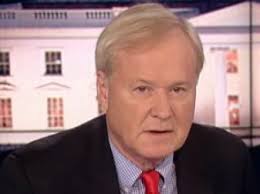
Chris Matthews
“I want to know what steps the president ‘could’ have taken to avoid this hostage-taking.
“…Is there another way than either buckling to the Republicans or letting the government and the country crash?
“How does he use the power of the presidency, the logic, emotion and basic patriotism of the people to thwart those willing to threaten, disrupt, even possibly destroy to get their way?”
The answer to his questions–then and now–is: Replace the law of fear with the rule of law.
Or, as Niccolo Machiavelli, the father of modern politics, instructed future leaders in The Prince:
“I conclude, therefore, with regard to being loved and feared, that men love at their own free will, but fear at the will of the prince, and that a wise prince must rely on what is in his power and not on what is in the power of others….”
Instead, in 2011, Obama surrendered to Republican extortion demands. As a result, the United States suffered a massive loss to its international credit rating.
But there was another way Obama could have stood up to Republican extortionists. And it remains available to him now–if only he has the courage to act.
ABC NEWS, ADOLF HITLER, ANDREW JACKSON, BARACK OBAMA, CBS NEWS, CHRIS MATTHEWS, CNN, CNN'S "STARTING POINT", CUBAN MISSILE CRISIS, DEBT CEILING, EXTORTION, FACEBOOK, GEORGE W. BUSH, HOUSE SPEAKER JOHN BOEHNER, JOHN F. KENNEDY, MAFIA, MSNBC'S "HARDBALL", MUNICH CONFERENCE, NBC NEWS, NEGOTIATING, NEVILLE CHAMBERLAIN, NICCOLO MACHIAVELLI, OBAMACARE, PAP SMEARS, PATRIOT ACT, PLANNED PARENTHOOD, R.I.CO. ACT, REPUBLICAN PARTY, REPUBLICANS, THE AFFORDABLE CARE ACT, THE LOS ANGELES TIMES, THE NEW YORK TIMES THE WASHINGTON POST, THE PRINCE, TWITTER, WINSTON CHURCHILL, WORLD WAR 11
In Bureaucracy, History, Law Enforcement, Politics, Social commentary on September 20, 2013 at 12:15 am
Republicans are once again playing extortion politics–threatening to shut down the government unless they get their way.
And their way means abolishing The Affordable Care Act, otherwise known as Obamacare.
They’re enraged that millions of uninsured Americans might receive medical care on a par with that given members of the House and Senate.
So on September 20, the House will vote on a short-term government funding bill that will include a provision to defund Obamacare.
That provision is a no-go for Senate Democrats and President Obama. If the House and Senate can’t work out a compromise, many functions of the federal government will be shut down indefinitely on Oct. 1.
Republicans have repeatedly threatened to shut down the government unless their constantly escalating demands were met.
In November, 1995, Newt Gingrich, then Speaker of the House of Representatives, carried out his threat. Gingrich unwisely admitted that he did so because President Bill Clinton had put him in the back of Air Force One during a recent trip to Israel.
The shutdown proved a disaster for Republicans. Clinton was handily re-elected in 1996 and Gingrich suddenly resigned from Congress in 1998.
Still, the Republicans continued their policy of my-way-or-else. In April, 2011, the United States government almost shut down over Republican demands about subsidized pap smears.
During a late-night White House meeting with President Barack Obama and key Congressional leaders, Republican House Speaker John Boehner made this threat:
His conference would not approve funding for the government if any money were allowed to flow to Planned Parenthood through Title X legislation.
Facing an April 8 deadline, negotiators worked day and night to strike a compromise–and finally reached one.
Three months later–on July 9–Republican extortionists again threatened the Nation with financial ruin and international disgrace unless their demands were met.

esident Obama had offered to make historic cuts in the federal government and the social safety net–on which millions of Americans depend for their most basic needs.
But House Speaker John Boehner rejected that offer. He could not agree to the tax increases that Democrats wanted to impose on the wealthiest 1% as part of the bargain.

John Boehner
As the calendar moved ever closer to the fateful date of August 2, Republican leaders continued to insist: Any deal that includes taxes “can’t pass the House.”
President Obama had previously insisted on extending the debt ceiling through 2012. But in mid-July, he simply asked congressional leaders to review three options with their members:
- The “Grand Bargain” choice—favored by Obama–would cut deficits by about $4 trillion, including spending cuts and new tax revenues.
- A medium-range plan would aim to reduce the deficit by about $2 trillion.
- The smallest option would cut between $1 trillion and $1.5 trillion, without increased tax revenue or any Medicare and Medicaid cuts.
And the Republican response?
Said Rep. Darrell Issa, chairman of the Oversight and Government Reform Committee: “Quite frankly, [Republican] members of Congress are getting tired of what the president won’t do and what the president wants.”
Noted political analyst Chris Matthews summed up the sheer criminality of what happened within the House of Representatives.
Speaking on MSNBC’s “Hardball,” on July 28–five days before Congress reached its August 2 deadline to raise the debt-ceiling–Matthews noted:
“The first people to bow to the demands of those threatening to blow up the economy were the Republicans in the House, the leaders. The leaders did what the followers told them to do: meet the demands, hold up the country to get their way.
“Those followers didn’t win the Senate, or the Presidency, just the House.
“But by using the House they were able to hold up the entire United States government. They threatened to blow things up economically and it worked.
“They said they were willing to do that–just to get their way–not by persuasion, not by politics, not by democratic government, but by threatening the destruction of the country’s finances.
“Right. So what’s next? The power grid? Will they next time threaten to close down the country’s electricity and communications systems?”
With the United States teetering on the brink of national bankruptcy, President Obama faced three choices:
- Counter Republican extortion attempts via RICO–the Racketeer Influenced Corrupt Oganizations Act.
- Make a “Cuban Missile Crisis”-style address to the American people, seeking to rally them against a criminal threat to the financial security of the Nation.
- Cave in to Republican demands.
Unfortunately for Obama and the Nation, he chose Number Three.
The results were easily predictable: Emboldened by success, the extortionists continue to make even greater demands.
But this is a nightmare that doesn’t have to be.
There are, in fact, two ways to avoid it:
- The President can order the Justice Department to prosecute Republican extortion attempts via RICO–the Racketeer Influenced Corrupt Organizations Act.
- The President can make a “Cuban Missile Crisis” style address to the American people, seeking to rally them against a criminal threat to the security of the Nation.
2012 PRESIDENTIAL RACE, BAY OF PIGS, BERLIN WALL, BILL CLINTON, BRUCE GREENWOOD, CARLOS MARCELLO, CIA, CIVIL RIGHTS, CLIFF ROBERTSON, CUBAN MISSILE CRISIS, DAVID HALBERSTAM, FACEBOOK, FBI, FIDEL CASTRO, FRANK SINATRA, ICH BEN EIN BERLINNER SPEECH, INTERNET MOVIE DATABASE, J. EDGAR HOOVER, JAMES MARSDEN, JOHN F. KENNEDY, JOSEPH MCCARTHY, JOSEPH P. KENNEDY, LYNDON B. JOHNSON, MAFIA, MALCOM X, MARTIN LUTHER KING, MARTIN SHEEN, MOVIES, NEWT GINGRICH, NIKITA KHRUSHCHEV, NUCLEAR TEST BAN TREATY, PT-109, RICK PERRY, ROBERT F. KENNEDY, ROBERT S. MCNAMARA, SAM GIANCANA, SANTOS TRAFFICANTE, Sarah Palin, SATURDAY NIGHT LIVE, SOVIET UNION, THE BEST AND THE BRIGHTEST, THE BUTLER, THE MISSILES OF OCTOBER, THE RAT PACK, THIRTEEN DAYS, TWILIGHT ZONE, TWITTER, VIETNAM WAR, WILLIAM DEVANE, WILLIAM PETERSEN
In Bureaucracy, History, Politics, Social commentary, Uncategorized on August 28, 2013 at 12:00 am
Fifty years ago this November 22, two bullets slammed into the neck and head of President John Fitzgerald Kennedy.
It has been said that he left his country with three great legacies:
- The Nuclear Test Ban Treaty;
- The Apollo moon landing; and
- The Vietnam war.
Of these, the following can be said with certainty:
- The Test Ban Treaty has prevented atmosphereic testing–and poisoning–by almost all the world’s nuclear powers.
- After reaching the moon–in 1969–Americans quickly lost interest in space and have today largely abandoned plans for manned exploration.
- Under Presidents Lyndon Johnson and Richard Nixon, 58,000 Americans died in Vietnam; 153,303 were wounded; and billions of dollars were squandered in a hopeless effort to intervene in what was essentially a Vietnamese civil war. From 1965 to 1972, the war angrily divided Americas as had no event since the Civil War.
But there was a fourth legacy–and perhaps the most important of all: The belief that mankind could overcome its greatest challenges through rationality and perseverence.

White House painting of JFK
At American University on June 10, 1963, Kennedy called upon his fellow Americans to re-examine the events and attitudes that had led to the Cold War.
And he declared that the search for peace was by no means absurd:
“Our problems are man-made; therefore, they can be solved by man. And man can be as big as he wants. No problem of human destiny is beyond human beings.
“Man’s reason and spirit have often solved the seemingly unsolvable, and we believe they can do it again.”
Today, politicians from both parties cannot agree on solutions to even the most vital national problems.
On November 21, 2011, the 12 members of the “Super-Committee” of Congress, tasked with finding $1.2 trillion in cuts in government spending, threw up their hands in defeat.
President Kennedy speed-read several newspapers every morning. He nourished personal relationships with the press-–and not for entirely altruistic reasons.
These journalistic relationships gave Kennedy additional sources of information-–and perspectives-–on national and international issues.
In 2012, Republican Presidential candidates celebrated their ignorance of both.
Former Godfather’s Pizza CEO Herman Cain famously said, “We need a leader, not a reader.” Thus he excused his ignorance of the reasons for President Barack Obama’s intervention in Libya.
Texas Governor Rick Perry showed similar pride in not knowing there are nine judges on the United States Supreme Court:
“Well, obviously, I know there are nine Supreme Court judges. I don’t know how eight came out my mouth. But the, uh, the fact is, I can tell you–I don’t have memorized all of those Supreme Ccourt judges. And, uh, ah–
“Here’s what I do know. That when I put an individual on the Supreme Court, just like I done in Texas, ah, we got nine Supreme Court justices in Texas, ah, they will be strict constructionists….
“That’s what Americans care about. Uh, they’re not looking for a robot that can, uh, spit out, uh, the name of every Supreme Court justice, or, ah, the the someone that’s gonna be perfect in, in, in every way.”
In short, it’s the media’s fault if they ask you a question and your answer reveals your own ignorance, stupidity or criminality.
During the height of the Cuban Missile Crisis, Kennedy spoke with aides about a book he had just finished: Barbara Tuchman’s The Guns of August, on the events leading to World War 1.
He said that the book’s most important revelation was how European leaders had blindly rushed into war, without thought to the possible consequences.
Kennedy told his aides he did not intend to make the same mistake-–that, having read his history, he was determined to learn from it.
What a complete contrast that is from today’s woeful historical ignorance among Republican Presidential candidates-–and those who aspire to be.
Consider Sarah Palin’s rewriting of history via “The Midnight Ride of Paul Revere”:
“He warned the British that they weren’t going to be taking away our arms by ringing those bells and, um, making sure as he’s riding his horse through town to send those warning shots and bells that, uh, we were going to be secure and we were going to be free.”
In fact, Revere wasn’t warning the British about anything. Instead, he was warning his fellow Americans about an impending British attack–as his celebrated catchphrase “The British are coming!” made clear.
Republicans have attacked President Obama for his Harvard education and articulate use of language. Among their taunts: “Hitler also gave good speeches.”
And they resent his having earned most of his income as a writer of two books: Dreams From My Father and The Audacity of Hope. As if being a writer is somehow subversive.
When knowledge and literacy are attacked as “highfalutin’” arrogance, and ignorance and incoherence are embraced as sincerity, national decline lies just around the corner.
In retrospect, the funeral for President Kennedy marked the death of more than a rational and optimistic human being. It marked the death of Americans’ pride in choosing reasoning and educated citizens for their leaders.

The Eternal Flame at the grave of President John F. Kennedy
BAY OF PIGS, BERLIN WALL, BILL CLINTON, BRUCE GREENWOOD, CARLOS MARCELLO, CIA, CIVIL RIGHTS, CLIFF ROBERTSON, CUBAN MISSILE CRISIS, DAVID HALBERSTAM, FACEBOOK, FBI, FIDEL CASTRO, FRANK SINATRA, HOUSE ASSASSINATIONS COMMITTEE, ICH BEN EIN BERLINNER SPEECH, INTERNET MOVIE DATABASE, J. EDGAR HOOVER, JACK RUBY, JAMES MARSDEN, JOHN F. KENNEDY, JOSEPH MCCARTHY, JOSEPH P. KENNEDY, KGB, LEE HARVEY OSWALD, LYNDON B. JOHNSON, MAFIA, MALCOM X, MARTIN LUTHER KING, MARTIN SHEEN, MOVIES, NIKITA KHRUSHCHEV, NUCLEAR TEST BAN TREATY, PT-109, ROBERT F. KENNEDY, ROBERT S. MCNAMARA, SAM GIANCANA, SANTOS TRAFFICANTE, SATURDAY NIGHT LIVE, SOVIET UNION, THE BEST AND THE BRIGHTEST, THE BUTLER, THE MISSILES OF OCTOBER, THE RAT PACK, THIRTEEN DAYS, TWILIGHT ZONE, TWITTER, VIETNAM WAR, WARREN COMMISSION, WILLIAM DEVANE, WILLIAM PETERSEN
In Bureaucracy, History, Politics, Social commentary on August 27, 2013 at 12:15 am
Elected to the House of Representatives in 1946, John F. Kennedy served six undistinguished years before being elected U.S. Senator from Massachussetts in 1952.
In 1956, his eloquence and political skill almost won him the Vice Presidential nomination at the Democratic National Convention. But the nominee, Adlai Stevenson, chose Tennessee Senator Estes Kefauver as his running mate.
Fortunately for Kennedy.
President Dwight D. Eisenhower, running for re-election, easily beat Stevenson.
Had Kennedy been on the ticket, his Catholic religion would have been blamed for the loss–and almost certainly prevented him from getting the Presidential nomination in 1960.
In 1957, his book, Profiles in Courage won the Pulitzer Prize for history.
From 1957 to 1960, Kennedy laid plans for a successful Presidential race. Many voters thought him too young and inexperienced for such high office.
But he used his TV debates with then-Vice President Richard Nixon to calm such fears, transforming himself overnight into a serious contender.
Many Americans identified with Kennedy as they had with film stars. In contrast with normally drab politicians, he seemed exciting and glamorous.
Since 1960, for millions of Americans, mere competence in a President isn’t enough; he should be charming and movie-star handsome as well.

John F. Kennedy after taking a swim at Santa Monica Beach, 1960
But charismatic politicians face the danger of waning enthusiasm.
Many people were growing disillusioned with Kennedy before he died. He had raised hopes that couldn’t be met–especially among blacks.
And many whites bitterly opposed his support of integration, believing that Kennedy was “moving too fast” in changing race relations.
Still, for millions of Americans, Kennedy represented a time of change.
“Let’s get this country moving again” had been his campaign slogan in 1960. He had demanded an end to the non-existent “missile gap” between the United States and Soviet Union.
And he had said that America should create full employment and re-evaluate its policies toward Africa, Latin America and Asia.
His youth, the grace and beauty of his wife and the oft-reported antics of his two young children–Caroline and John–added to the atmosphere that change was on the way.
But Kennedy was not so committed to change as many believed.
- As a Senator he had strongly opposed abolishing the Electoral College.
- He had made no outcry against the Red-baiting tactics of Senator Joseph R. McCarthy, a frequent dinner guest at the home of his father.
- As President, Kennedy never forgot that he had been elected by a margin of 112,881 votes. He often rationalized his refusal to tackle controversial issues by saying: “We’ll do it after I’m re-elected. So we’d better make damn sure I am re-elected.”
- He thought it absurd for the United States to refuse to recognize “Red”China, but didn’t try to change American foreign policy in that area.
Nevertheless, many historians believe that. by vocally supporting civil rights and healthcare for the elderly, Kennedy laid the groundwork for Lyndon Johnson’s legislative victories.
Perhaps no aspect of Kennedy’s Presidency has received closer study than his assassination.
Hundreds of books and thousands of articles have hotly debated whether he was murdered by a lone “nut” or a deadly conspiracy of powerful men.
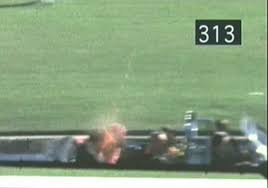
JFK’s assassination: The moment of impact
The murder has been the subject of two government investigations. The first, by the Warren Commission in 1964, concluded that an embittered ex-Marine and Marxist, Lee Harvey Oswald, acted alone in killing Kennedy.
Similarly, the Commission determined that nightclub owner Jack Ruby had killed Oswald on impulse, and not as the result of a conspiracy.
Millions of disbelieving Americans rejected the Warren Report–and named their own villains:
- the KGB;
- Anti-Castro Cubans;
- Vice President Lyndon B. Johnson;
- Right-wing businessmen and/or military leaders;
- Fidel Castro.
Each of these groups or persons had reason to hate Kennedy:
- The KGB–for Kennedy’s humiliation of the Soviet Union during the Cuban Missile Crisis.
- Anti-Castro Cubans–for JFK’s refusal to commit American military forces to overthrowing Castro at the Bay of Pigs invasion.
- Lyndon Johnson–lusting for power, he stood to gain the most from Kennedy’s elimination.
- Right-wing businessmen and/or military leaders–for believing that Kennedy had “sold out” the country to the Soviet Union.
- Fidel Castro–knowing the CIA was trying to assassinate or overthrow him, he had reason to respond in kind.
The second investigation, conducted in 1977-79 by the House Assassinstions Committee, determined that Oswald and a second, unknown sniper had fired at Kennedy. (Oswald was deemed the assassin; the other man’s shot had missed.)
The Chief Counsel for the Committee, G. Robert Blakey, believed New Orleans Mafia boss Carlos Marcello organized the assassination, owing to his hatred of Robert Kennedy for his war on the crime syndicates.
Still, 50 years after JFK’s assassination, no court-admissible evidence has come forward to convict anyone other than Oswald for the murder.
The impact of Kennedy’s death on popular culture remains great. Millions saw him as an American sccess story–a brilliant and courageous hero who had worked his way to the top.
But his sudden and violent end proved a shock for those who believed there was always a happy ending.
If so gifted–and protected–a man as John F. Kennedy could be so suddenly and brutally destroyed, no one else could depend on a secure future.
BAY OF PIGS, BERLIN WALL, BILL CLINTON, BRUCE GREENWOOD, CARLOS MARCELLO, CIA, CIVIL RIGHTS, CLIFF ROBERTSON, CUBAN MISSILE CRISIS, DAVID HALBERSTAM, FACEBOOK, FBI, FIDEL CASTRO, FRANK SINATRA, ICH BEN EIN BERLINNER SPEECH, INTERNET MOVIE DATABASE, J. EDGAR HOOVER, JAMES MARSDEN, JOHN F. KENNEDY, JOSEPH MCCARTHY, JOSEPH P. KENNEDY, LYNDON B. JOHNSON, MAFIA, MALCOM X, MARTIN LUTHER KING, MARTIN SHEEN, MOVIES, NIKITA KHRUSHCHEV, NUCLEAR TEST BAN TREATY, PT-109, ROBERT F. KENNEDY, ROBERT S. MCNAMARA, SAM GIANCANA, SANTOS TRAFFICANTE, SATURDAY NIGHT LIVE, SOVIET UNION, THE BEST AND THE BRIGHTEST, THE BUTLER, THE MISSILES OF OCTOBER, THE RAT PACK, THIRTEEN DAYS, TWILIGHT ZONE, TWITTER, VIETNAM WAR, WILLIAM DEVANE, WILLIAM PETERSEN
In Bureaucracy, History, Politics, Social commentary on August 26, 2013 at 12:05 am
Throughout his life, John F. Kennedy was lucky–both personally and politically.
Part of the secret lay in his physical presence. He was young and handsome, witty and articulate. He appeared zestful and athletic–despite a series of ailments, including Addison’s disease (a malfunction of the adrenal glands) and an injured back that required the use of a brace.
His wit was sophisticated and often self-depcrecating. Addressing an assembly of Nobel Prize winners at the White House, he said: “I think this is the most extraordinary collection of talent, of human knowledge, that has ever been gathered at the White House–with the possible exception of when Thomas Jefferson dined alone.”

JFK making a joke at a press conference
And his sense of humor often defused otherwise ticklish problems. During the 1960 Presidential race, he was sharply criticized for relying on his millionaire father for much of his funding. At a campaign rally, he deflected the charge with humor:
“I just received a telegram from my generous Daddy. It says: ‘Dear Jack: Don’t buy one more vote than necessary. I’ll be damned if I’m going to pay for a landslide.'”
Another controversey emerged when he named his brother, Robert, Attorney General. Critics charged that the appointment smacked of neoptism–and that Robert didn’t have enough legal gravitas to be the nation’s chief law enforcement offer.
“I see nothing wrong in giving Robert a little experience before he goes out to practice law,” he said at a press conference.
His highly-polished rhetoric–produced by wordsmiths such as Theodore Sorensen–dazzled audiences. His Inaugural Address was acclaimed by Democrats and even most Republicans.
Its signature line, “Ask not what your country can do for you, ask what you can do for your country” has become as famous as Abraham Lincoln’s “government of the people, by the people, for the people.”
His speeches often urged Americans to seek a higher cause than mere self-interest. Speaking of the role of the arts in a nation’s life, he said:
“It may be different elsewhere, but [in] democratic society…the highest duty of the writer, the composer, the artist is to remain true to himself and to let the chips fall where they may.”

Memorial at the Arlington gravesite for John F. Kennedy
But he could be blunt and profane in private.
“My father always told me all businessmen were sonsofbitches, but I never believed it till now,” he said in private when the steel companies made an inflationary price increase in 1962.
Like Richard Nixon, Kennedy installed a secret taping system in the White House. And, as with Nixon, this picked up many of his profanities. Unlike Nixon, however, Kennedy died before his secret taping system was discovered.
Kennedy impressed many journalists with his capacity for detail.
“He swallows and digests whole books in minutes. His eye seizes instantly on the crucial point of a long memorandum. He confounds experts with superior knowledge of their field,” wrote Games McGregor Burns in 1961.
Having briefly worked as a journalist (covering the opening of the United Nations Assembly in 1945) JFK understood and catered to the sensitivities of the Washington press corps. Using charm, wit, candor and selective accessibility, he cultivated his own favored group of reporters.
Critics charged that he was manipulating the media–and they were right.
Sometimes the manipulation was heavy-handed. He pressured The New York Times to censor its coverage of actions he intended to take–such as during the Bay of Pigs and the Cuban Missile Crisis.
But he failed to coerce the Times into removing David Halberstam, its Vietnam correspondent, whose highly critical articles cast doubt on the effectiveness of the American military commitment to Vietnam.
A major part of Kennedy’s appeal lay in his glamorous background. He was born–on May 29, 1917–into a large, robust family headed by wealthy and powerful financier Joseph P. Kennedy. He attended Princeton and Harvard, graduating from the latter with top honors.
During World War II he became a Naval hero in 1943 after a Japanese destroyer sliced his PT boat in half–by towing an injured shipmate to safety. Stranded on a South Pacific island, Kennedy persuaded a native to summon rescue help from the U.S. Navy.
Kennedy had no plans for a postwar political career. That had been assigned to his elder brother, Joseph P. Kennedy, Jr., by their ambitious father, who was determined to seat the first Irish Catholic President.
After learning of his younger brother’s heroism, Joseph volunteered for a dangerous Naval bombing mission. On August 12, 1944, he and a co-pilot flew an explosives-laden plane from England toward France.
While over the English Channel, they were supposed to parachute from the aircraft–after activating a remote control system to send the plane crashing into a German command center.
But the plane mysteriously exploded before the pilots could eject–and before the plane reached its target.
The death of his elder brother ended John F. Kennedy’s plans for a career as a writer. Joseph Kennedy, Sr., insisted that “Jack”assume the political career that the Kennedy patriarch had assigned for his dead brother.

 Bureaucracybuster's Blog
ABC NEWS, CBS NEWS, FACEBOOK, MAFIA, MOVIES, NARCOTICS CORRUPTION, NBC NEWS, NYPD, POLICE CORRUPTION, PRINCE OF THE CITY, ROBERT LEUCI, RUDLOPH GIULIANI, SIDNEY LUMET, THE LOS ANGELES TIMES, THE NEW YORK TIMES, THE WASHINGTON POST, TREAT WILLIAMS, TWITTER
THE TRUTH ABOUT COPS–AND A GREAT MOVIE
In Bureaucracy, History, Law, Law Enforcement, Social commentary on October 30, 2013 at 1:36 amIt’s a movie that appeared in 1981–making it, for those born in 2000, an oldie. And it wasn’t a blockbuster, being yanked out of theaters almost as soon as it arrived.
Yet “Prince of the City” remains that rarity–a movie about big-city police that
It’s based on the real-life case of NYPD Detective Robert Leuci (“Danny Ciello” in the film).
A member of the elite Special Investigating Unit (SIU) Ciello (played by Treat Williams) volunteers to work undercover against rampant corruption among narcotics agents, attorneys and bail bondsmen.
His motive appears simple: To redeem himself and the NYPD from the corruption he sees everywhere: “These people we take from own us.”
His only condition: “I will never betray cops who’ve been my partners.”
Assistant US Attorney Rick Cappalino assures Ciello: “We’ll never make you do something you can’t live with.”
As the almost three-hour movie unfolds, Ciello finds–to his growing dismay–that there are a great many things he will have to learn to live with.
Although he doesn’t have a hand in it, he’s appalled to learn that Gino Moscone, a former buddy, is going to be arrested for taking bribes from drug dealers.
Confronted by a high-ranking agent for the Drug Enforcement Agency, Moscone refuses to “rat out” his buddies.
Instead, he puts his service revolver to his head and blows out his brains.
Ciello is devastated, but the investigation–and film–must go on.
Along the way, he’s suspected by a corrupt cop and bail bondsman of being a “rat” and threatened with death. He’s about to be wasted in a back alley when his cousin–a Mafia member–suddenly intervenes.
The Mafioso tells Ciello’s would-be killers: “You’d better be sure he’s a rat, because people like him.”
At which point, the grotesquely fat bail bondsman–who has been demanding Ciello’s execution–pats Danny on the arm and says, “No hard feelings.”
It is director Sidney Lumet’s way of graphically saying: “Sometimes the bad guys can be good guys–and the good guys can be bad guys.”
Lumet makes it clear that police don’t always operate with the Godlike perfection of cops in TV and films. It’s precisely because his Federal backup agents lost him that Ciello almost became a casualty.
In the end, Ciello becomes a victim of the prosecutorial forces he has unleashed. Although he’s vowed to never testify against his former partners, Ciello finds this a promise he can’t keep.
Too many of the cops he’s responsible for indicting have implicated him of similar–if not worse–behavior.
He’s even suspected of being involved in the theft of 450 pounds of heroin (“the French Connection”) from the police property room.
A sympathetic prosecutor–Mario Vincente in the movie, Rudolph Giuliani in real-life–convinces Ciello that he must finally reveal everything he knows.
Ciello’s had originally claimed to have done “three things” as a corrupt narcotics agent. By the time his true confessions are over, he’s admitted to scores of felonies.
Ciello then tries to convince his longtime SIU partners to do the same.
One of them commits suicide. Another tells Ciello to screw himself: “I’m not going to shoot myself and I’m not going to rat out my friends.”
To his surprise, Ciello finds himself admiring his corrupt former partner for being willing to stand up to the Federal case-agents and prosecutors demanding his head.
The movie ends with a double dose of irony.
First: Armed with Ciello’s confessions, an attorney whom Ciello had successfully testified against appeals his conviction. But the judge rules these to be “collateral,” apart from the main evidence in the case, and affirms the conviction.
Second: Ciello is himself placed on trial–of a sort. A large group of assistant U.S. attorneys gathers to debate whether their prize “canary” should be indicted.
If he is, his confessions will ensure his conviction.
Some prosecutors argue forcefully that Ciello is a corrupt law enforcement officer who has admitted to more than 40 cases of perjury–among other crimes. How can the government use him to convict others and not address the criminality in his own past?
Other prosecutors argue that Ciello voluntarily risked his life–physically and professionally–to expose rampant police corruption. He deserves a better deal than to be cast aside by those who have made so many cases through his testimony.
Eventually, the U.S. Attorney for the Southern District of New York makes his decision: “The government declines to prosecute Detective Daniel Ciello.”
It is Lumet’s way of showing that the decision to prosecute is not always an easy or objective one.
The movie ends with Ciello now teaching surveillance classes at the NYPD Academy. A student asks: “Are you the Detective Ciello?”
“I’m Detective Ciello.”
“I don’t think I have anything to learn from you.”
Is Danny Ciello–again, Robert Leuci in real-life–a hero, a villain, or some combination of the two? It is with this ambiguity that the film ends–an ambiguity that each viewer must resolve for himself.
Share this: