Posts Tagged ‘KGB’
ABC NEWS, ALLEN DULLES, BRIDGE OF SPIES, CBS NEWS, CNN, COLD WAR, DWIGHT D. EISENHOWER, EAST GERMANY, FACEBOOK, FRANCIS GARY POWERS, JAMES DONOVAN, JOHN F. KENNEDY, JOSEPH MCCARTHY, KGB, NBC NEWS, RED SCARE, RUDOLPH ABEL, SOVIET UNION, STASI, STEVEN SPIELBERG, THE CHICAGO SUN-TIMES, THE CHICAGO TRIBUNE, THE LOS ANGELES TIMES, THE NEW YORK TIMES, THE WALL STREET JOURNAL, THE WASHINGTON POST, TOM HANKS, TWITTER, U-2
In Bureaucracy, Entertainment, History, Law, Law Enforcement, Military, Politics, Social commentary on March 21, 2016 at 12:01 am
“Bridge of Spies” vividly recaptures a now-forgotten time in American history.
It was the time of “the Cold War.” A time when:
- America was almost universally seen as “The Good Guy,” in contrast to “The Bad Guy” of the Soviet Union;
- The United States and the Soviet Union held each other at bay with arsenals of nuclear weapons;
- Wisconsin Senator Joseph R. McCarthy terrorized the nation, accusing anyone who disagreed with him of being a Communist–and leaving ruined lives in his wake;
- American TVs blared commercials warning that Soviet Premier Nikita Khrushchev had boasted: “We will bury you”; and
- Children and teenagers were taught in school that they could survive a nuclear attack through “duck and cover” drills. They were instructed to keep their bathtubs filled with water for safe drinking, in the event of a Soviet nuclear strike.
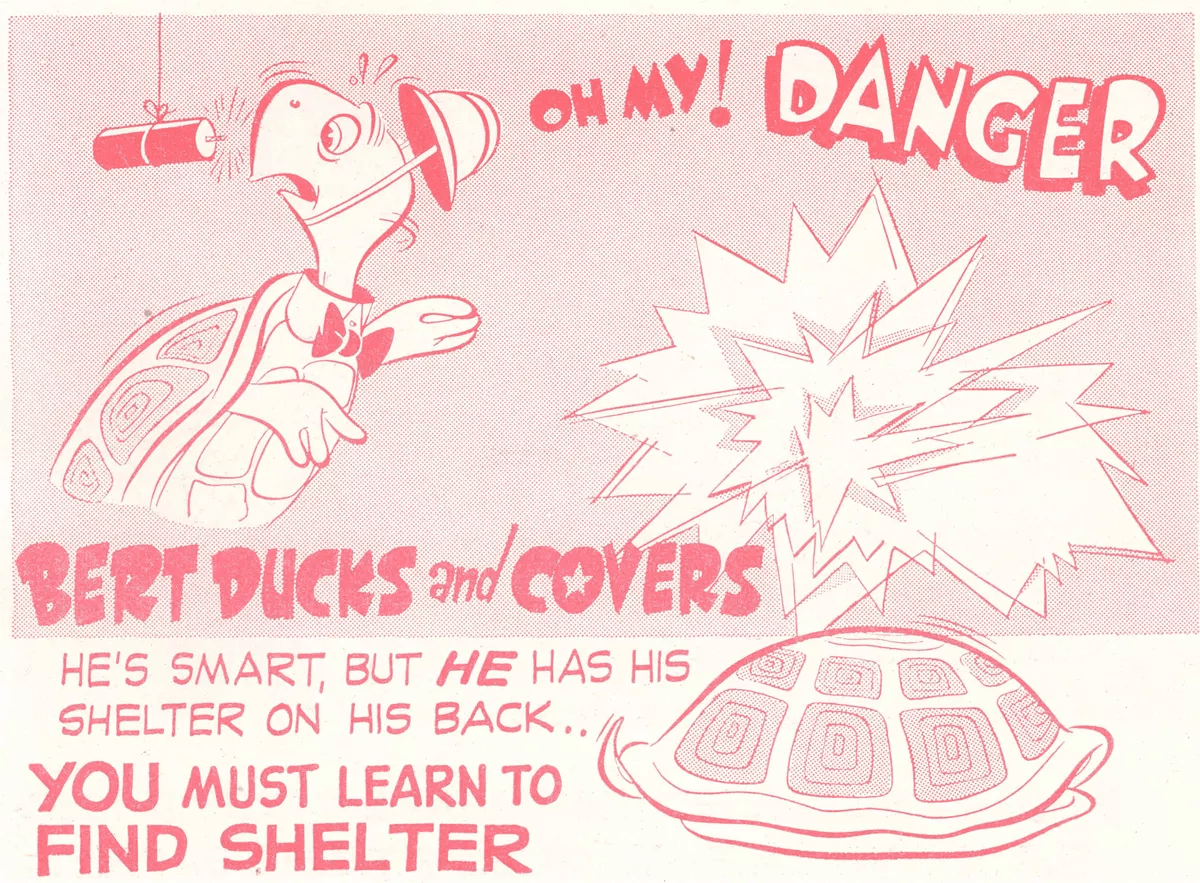
Bert the Turtle teaches schoolchildren to “Duck and Cover”
Yet even in this poisonous atmosphere of fear and denunciation, some men stood out as heroes–simply by holding fast to their consciences.
One of these was a New York insurance attorney named James B. Donovan (played by Tom Hanks). Asked by the Justice Department to defend arrested Soviet spy Rudolph Abel (Mark Rylance) Donovan did what no one expected.
He gave Abel a truly vigorous defense, arguing that the evidence used to convict him was the legally-tainted product of an invalid search warrant.
Upon Abel’s conviction and sentencing to 45 years’ imprisonment, Donovan again shocked the political and legal communities by appealing the case to the Supreme Court.
Donovan argued that Constitutional protections should apply to everyone–including non-Americans–tried in American courts. To do less made a mockery of the very freedoms we claimed to champion.
He lost by a vote of 5-4. But the arguments he made would resurface 50 years later when al-Qaeda suspects were hauled into American courts.

James B. Donovan
In 1961, Donovan was again called upon to render service by a Federal agency–this time the CIA. It wanted his help in negotiating the release of its spy, Francis Gary Powers, shot down over the Soviet Union in 1960 while flying a high-altitude U-2 spy plane.
Throughout “Bridge of Spies,” audiences learn some unsettling truths about how the American government–and governments generally– actually operate.
The first three of these were outlined in Part one of this series:
Truth #1: Appearance counts for more than reality.
Truth #2: Individual conscience can wreck the best-laid plans of government.
Truth #3: High-ranking government officials will ask citizens to take risks they themselves refuse to take.
Now for the remaining truths revealed in this movie.
Truth #4: Appeals to fear often prevail when appeals to humanity are ignored.
After crossing into East Germany, Donovan enters into negotiations with Wolfgang Vogel, a lawyer representing the East German government.
Vogel offers to exchange Frederic Pryor, an American economics graduate student seized by the East German secret police, for Abel. Donovan replies this is a deal-breaker; the United States (which is never mentioned during the negotiations) wants Powers, not Pryor.
Nevertheless, Donovan is equally concerned for Pryor, and adds him to the list of hostages to be released in return for Abel.
Then a new complication arises: The East German government that holds Pryor threatens to pull out. claiming to be insulted because Donovan did not inform them that the USSR was a party to the negotiation.
His reasoned, legal arguments having failed, Donovan resorts to a threat. He conveys a warning to the president of East Germany:
Abel has not yet revealed any Soviet secrets. But if this deal fails, he may well do so to earn favors from the United States government. And, in that case, the Soviets will blame you–Erich Honecker, the president of East Germany–for the resulting damage.
Where arguments based on humanity have failed, this one–based on fear–works. A prisoner-exchange is arranged.
Truth #5: Personal loyalty can supersede bureaucratic inventions.
On February 10, 1962, Donovan, Abel and several CIA agents arrive at the Glienicke Bridge, which connects East and West Germany. The Soviets have Powers, but not Pryor–who is to be released at Checkpoint Charlie, a crossing point between East and West Berlin.
Glienicke Bridge, the “Bridge of Spies”
The CIA agent in charge of the American delegation tells Abel he can cross into East Germany, even though Pryor has not been released.
But Abel has learned that Donovan has negotiated the release of not only Powers but Pryor. Out of loyalty to the man who has vigorously defended him, he waits on his side of the bridge until word arrives that Pryor has been released.
Then Abel crosses into East Germany while Powers crosses into the Western sector.
Donovan returns home. Before flying off to West Germany, he had told his wife he was going on a fishing trip in Scotland.
His wife and children learn the truth about the risks he ran and the success he attained only when a television newscast breaks the news:
Francis Gary Powers has been returned to the United States. And the man responsible is James Donovan, once the most reviled man in America for having defended a notorious Soviet spy.
ABC NEWS, ALLEN DULLES, BRIDGE OF SPIES, CBS NEWS, CIA, CNN, COLD WAR, DWIGHT D. EISENHOWER, EAST GERMANY, FACEBOOK, FRANCIS GARY POWERS, JOHN F. KENNEDY, JOSEPH MCCARTHY, KGB, NBC NEWS, RED SCARE, RUDOLPH ABEL, SOVIET UNION, STASI, STEVEN SPIELBERG, THE CHICAGO SUN-TIMES, THE CHICAGO TRIBUNE, THE LOS ANGELES TIMES, THE NEW YORK TIMES, THE WALL STREET JOURNAL, THE WASHINGTON POST, TOM HANKS, TWITTER, U-2
In Bureaucracy, Entertainment, History, Law, Law Enforcement, Military, Politics, Social commentary on March 18, 2016 at 12:01 am
Steven Spielberg’s new movie, “Bridge of Spies,” is that rarity among films: An intelligent mixture of history and drama, stripped of gratuitous sex and violence.
It’s also a film that accurately reveals unsettling truths about how government intelligence agencies really operate.

Truth #1: Appearance counts for more than reality.
The movie opens with the FBI’s arrest of KGB spy Rudolph Abel (Mark Rylance). The evidence against him is overwhelming. This–plus the “Red Scare” climate of 1957–will guarantee his conviction.
But the Eisenhower administration doesn’t want the upcoming trial to be seen as a hangman’s court. It must have the appearance of a fair proceeding.
So the Justice Department (through the Brooklyn Bar Association) asks a New York insurance attorney named James B. Donovan (Tom Hanks) to take on Abel’s defense. He’s expected to make a reasonably competent effort but not go all out on behalf of his client.
Truth #2: Individual conscience can wreck the best-laid plans of government.
Donovan has never handled a spy case before. And he has no delusions that Abel isn’t the spy he’s charged with being. But he’s determined to give Abel the same committed defense he would give to any other client.

Rudolph Abel (Mark Rylance) and James Donovan (Tom Hanks) in court
This comes as a shock to the prosecutors, the judge, his law firm and even his family.
A CIA agent approaches Donovan in a nearly deserted restaurant and asks him to reveal any secrets that might help win Abel’s conviction.
Donovan replies: “This conversation isn’t happening.”
“No, of course not,” replies the CIA agent, assuming Donovan is agreeing to keep the overture secret.
“No, I mean this conversation isn’t happening,” angrily says Donovan, who leaves the agent fuming.
Donovan becomes a pariah; his mailbox is stuffed with hate mail and one night a would-be drive-by killer riddles his house with bullets.
Abel is convicted and sentenced to 45 years’ imprisonment. But Donovan–again shocking everyone he knows–pursues an appeal up to the Supreme Court.
He argues that the evidence against Abel is tainted by an invalid search warrant. No American citizen could be convicted under such circumstances. And the Constitutional protections that hold true for Americans should hold equally true for non-Americans charged with crimes in American courts.
Donovan’s arguments will be heard a half-century later, when al-Qaeda suspects are hauled before American courts.
He puts on an impressive case on Abel’s behalf, but loses 5-4 at the Supreme Court.
That seems to be the end of Donovan’s relationship with Abel. But events soon dictate otherwise.
Before the judge could pronounce a death sentence on Abel, Donovan had argued that this might be a mistake. The day might come, he told the judge, when an American spy might fall into Soviet hands.
And then the United States would need to swap Abel to secure the release of its own agent.
The judge, moved by that argument, had given Abel a lengthy prison term instead.
That day comes sooner than anyone in the Pentagon expects.
On May 1, 1960, Francis Gary Powers, a former Air Force pilot, is flying a high-altitude U-2 plane above the Soviet Union for the CIA. The plane is equipped with state-of-the-art cameras, and Powers intends to photograph military sites and other important complexes.
Suddenly, a surface-to-air missile slams into the plane. Powers ejects before it crashes, but fails to commit suicide with a poison pin concealed in a phony silver dollar. He’s captured by the KGB and brutally interrogated, but maintains his silence.
At about the same time, Frederic Pryor, an American economics graduate student living in West Germany, visits his German girlfriend living in Soviet-dominated East Germany.
The Soviets are starting to build their infamous Berlin Wall, which will stop the flow of refugees from East to West. Pryor tries to bring his girlfriend and her father into West Berlin, but he’s stopped and arrested by agents of Stasi, the East German police, who accuse him of being a spy.
Meanwhile, the Soviet Union wants its spy, Abel, returned, before he can spell its secrets. In turn, the new Kennedy administration wants Powers returned, before he can be made to spill American secrets.
Truth #3: High-ranking government officials will ask citizens to take risks they themselves refuse to take.
In 1961, Donovan is once again sought out by the American government–this time by no less than CIA Director Allen Dulles.
And he’s asked to go where no official American representative can go–East Germany. His new assignment: Negotiate the exchange of Powers for Abel.
The CIA wants its spy back. And it’s willing to send Donovan into East Germany to negotiate his release. But it’s not willing to back him up if he’s arrested by Stasi, the notorious East German secret police.
The fiction must be maintained that Donovan is acting strictly on his own behalf, not that of the United States.
In such a case, Donovan could spend the rest of his life in a Communist prison cell.
ABC NEWS, ADOLF HITLER, BORIS YELTSIN, CBS NEWS, CNN, DONALD TRUMP, FACEBOOK, GEORGE W. BUSH, JOE SCARBOROUGH, JOSEPH STALIN, KGB, MISS TEEN USA, MISS UNIVERSE, MISS USA, MORNING JOE, MSNBC, NAZI GERMANY, NAZI PARTY, NBC NEWS, RED ARMY, REPUBLICAN PARTY, SOVIET UNION, THE LOS ANGELES TIMES, THE NEW YORK TIMES, THE WASHINGTON POST, TWITTER, VLADIMIR PUTIN, WEHRMACHT, WORLD WAR ii
In Bureaucracy, History, Politics, Social commentary, Uncategorized on December 22, 2015 at 12:06 am
Vladimir Putin admires Donald Trump. And Donald Trump admires Vladimir Putin.
To many people, it’s the ultimate odd-couple: The lifelong Communist and former KGB officer (Putin) walking arm-in-arm with the billionaire, publicity-hungry capitalist.
What could be going on here?
First Putin:
“He is a bright personality, a talented person, no doubt about it. It is not up to us to appraise his positive sides, it is up to the U.S. voters. but, as we can see, he is an absolute leader in the presidential race.
“He is saying that he wants to move to a different level of relations with Russia, to a closer, deeper one. How can we not welcome that? Of course, we welcome that.”
Now Trump:
“It is always a great honor to be so nicely complimented by a man so highly respected within his own country and beyond.”
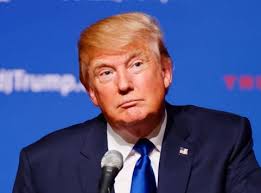
Donald Trump
Appearing on MSNBC’s “Morning Joe,” Trump said: “Sure, when people call you ‘brilliant,’ it’s always good. Especially when the person heads up Russia.”
The host, Joe Scarborough, was upset by Trump’s praise for Putin: “Well, I mean, [he’s] also a person who kills journalists, political opponents, and invades countries. obviously that would be a concern, would it not?”
TRUMP: He’s running his country, and at least he’s a leader. Unlike what we have in this country.
SCARBOROUGH: But again: He kills journalists that don’t agree with him.
TRUMP: I think our country does plenty of killing, also, Joe, so, you know. There’s a lot of stupidity going on in the world right now, Joe. A lot of killing going on. A lot of stupidity. And that’s the way it is.
SCARBOROUGH: I’m confused. So I mean, you obviously condemn Vladimir Putin killing journalists and political opponents, right?
TRUMP: “Oh sure, absolutely.
When Trump praised Putin as a leader–“unlike what we have in this country”–he no doubt meant President Barack Obama.
Ironically, it is Obama–not Trump–who has repeatedly been named in Gallup polls as the most admired man in America in each of the last seven years, beginning with 2008, the year he was elected president.
Although Trump didn’t mention former President George W. Bush, his insult applies–unintentionally but accurately–to Obama’s predecessor.
In June 2001, Bush and Vladimir Putin met in Slovenia. During the meeting a truly startling exchange occurred.
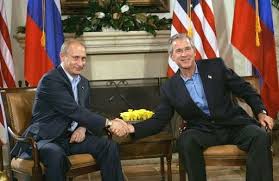
Vladimir Putin and George W. Bush
Putin, a former KGB Intelligence officer, had clearly done his homework on Bush. When he mentioned that one of the sports Bush had played was rugby, Bush was highly impressed.
“I did play rugby,” said Bush. “Very good briefing.”
Bush knew that Putin had worked for Soviet intelligence. So he should not have been surprised that the KGB had amassed a lengthy dossier on him.
But more was to come.
BUSH: Let me say something about what caught my attention, Mr. President, was that your mother gave you a cross which you had blessed in Israel, the Holy Land.
PUTIN: It’s true.
BUSH: That amazes me, that here you were a Communist, KGB operative, and yet you were willing to wear a cross. That speaks volumes to me, Mr. President. May I call you Vladimir?
Putin instantly sensed that Bush judged others–even world leaders–through the lens of his own fundamentalist Christian theology.
Falling back on his KGB training, Putin seized on this apparent point of commonality to build a bond. He told Bush that his dacha had once burned to the ground, and the only item that had been saved was that cross.
“Well, that’s the story of the cross as far as I’m concerned,” said Bush, clearly impressed. “Things are meant to be.”
Afterward, Bush and Putin gave an outdoor news conference.
“Is this a man that Americans can trust?” Associated Press correspondent Ron Fournier asked Bush.
“Yes,” said Bush. “I looked the man in the eye. I found him to be very straightforward and trustworthy. We had a very good dialogue.
“I was able to get a sense of his soul, a man deeply committed to his country and the best interests of his country. I wouldn’t have invited him to my ranch if I didn’t trust him.”
Of course, no one from the Right–including Trump–is now recalling such embarrasing words.
It’s far more politically profitable to pretend that all of America’s tensions with Russia began with the election of Barack Obama.
And that those tensions will vanish once another Rightist–and non-black–President enters the White House.
ABC NEWS, ADOLF HITLER, BORIS YELTSIN, CBS NEWS, CNN, DONALD TRUMP, FACEBOOK, JOE SCARBOROUGH, JOSEPH GOEBBELS, JOSEPH STALIN, KGB, MISS TEEN USA, MISS UNIVERSE, MISS USA, MORNING JOE, MSNBC, NAZI GERMANY, NAZI PARTY, NBC NEWS, RED ARMY, REPUBLICAN PARTY, SOVIET UNION, THE LOS ANGELES TIMES, THE NEW YORK TIMES, THE WASHINGTON POST, TWITTER, VLADIMIR PUTIN, WEHRMACHT, WORLD WAR ii
In Bureaucracy, Business, History, Military, Politics, Social commentary on December 21, 2015 at 12:21 am
Donald Trump and Vladimir Putin have been getting a lot of publicity lately–for how much they admire each other.
On the surface, this might seem surprising. Putin spent most of his adult life as a fervent member of the Communist Party, which swore eternal warfare against capitalism.
After joining the KGB in 1975, he served as one of its officers for 16 years, eventually rising to the level of Lieutenant Colonel. In 1991, he retired to enter politics in his native St. Petersburg (formerly Leningrad).

Vladimir Putin
This, in turn, brought him to the attention of Russian President Boris Yeltsin, who groomed Putin as his successor. When Yeltsin unexpectedly resigned on December 31, 1999, Putin became Acting President.
In 2000, he was elected President in his own right, despite widespread accusations of vote-rigging. He won re-election in 2004, but could not run for a third term in 2008 because of constitutionally-mandated term limits.
So Putin ran his handpicked successor, Dimitry Medvedev, as president. When Medvedev won, he appointed Putin as prime minister. In 2012, Putin again ran for president and won.
Trump, on the other hand, is the personification of capitalistic excess. He has been an author, investor, real estate mogul and television personality as former host of NBC’s “The Apprentice.”
The Trump Organization sponsors the Miss Universe, Miss USA and Miss Teen USA pageants.
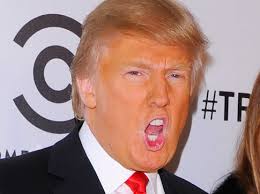
Donald Trump
He is notorious for stamping “Trump” on everything he acquires, most notably Trump Tower, a 58-story skyscraper at 725 Fifth Avenue in New York City.
On June 16, he declared himself a candidate for the Presidency in the 2016 election. Since July, he has consistently been the front-runner in public opinion polls for the Republican Party nomination.
So it came as a surprise to many in the United States when, on December 17, Putin described Trump as “a bright and talented person without any doubt,” adding that Trump is “an outstanding and talented personality.”
And he called Trump “the absolute leader of the presidential race.”
Trump, in turn, was quick to respond: “It is always a great honor to be so nicely complimented by a man so highly respected within his own country and beyond.”
Two months earlier, in October, Trump had said of Putin: “I think that I would probably get along with him very well.”
Appearing on MSNBC’s “Morning Joe,” Trump said: “Sure, when people call you ‘brilliant’ it’s always good. Especially when the person heads up Russia.”
The host, Joe Scarborough, was upset by Trump’s praise for Putin: “Well, I mean, it’s also a person who kills journalists, political opponents, and invades countries. Obviously that would be a concern, would it not?”
Trump: “He’s running his country, and at least he’s a leader. Unlike what we have in this country.”
Scarborough: “But again: He kills journalists that don’t agree with him.”
Trump: “Well, I think our country does plenty of killing also, Joe. You know. there’s a lot of stuff going on in the world right now, Joe. A lot of killing going on and a lot of stupidity…”
Absolute dictators like Vladimir Putin and would-be dictators like Donald Trump often gravitate toward each other. At least temporarily.
On January 30, 1933, anti-Communist Adolf Hitler became Chancellor of Germany. For the next six years, the Nazi press hurled insults at the Soviet Union.
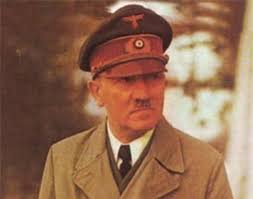

Adolf Hitler
And the Soviet press hurled insults at Nazi Germany.
Then, on August 23, 1939, Hitler’s foreign minister, Joachim von Ribbentrop, signed the Treaty of Non-aggression between Nazi Germany and the Union of Soviet Socialist Republics (U.S.S.R). Signing for the Soviet Union was its own foreign minister, Vyachelsav Molotov.
The reason: Hitler planned to invade Poland on September 1. He needed to neutralize the military might of the U.S.S.R. And only Soviet dictator Joseph Stalin could do that.
Democratic nations like France, Great Britain and the United States were stunned. But there had long been a grudging respect between the two brutal dictators.
On June 30, 1934, Hitler had ordered a bloody purge throughout Germany. Privately, Stalin offered praise: “Hitler, what a great man! This is the way to deal with your political opponents.”
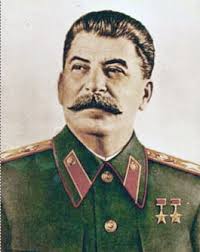
Joseph Stalin
Hitler was–privately–equally admiring of the series of purges Stalin inflicted on the Soviet Union. Even after he broke the non-aggression pact by invading the U.S.S.R. on June 22, 1941, he said:
“After the victory over Russia, it would be a good idea to get Stalin to run the country, with German oversight, of course. He knows better than anyone how to handle the Russians.”
In April, 1945, as he waited for victorious Russian armies to reach his underground bunker, Hitler confided to Joseph Goebbels, his propaganda minister, his major regret:
He should have brutally purged the officer corps of the Wehrmacht, as Stalin had that of the Red Army. Stalin’s purges had cleaned “deadwood” from the Russian ranks, and a purge of the German army would have done the same.
For Adolf Hitler, the lesson was clear: “Afterward, you rue the fact that you’ve been so kind.”
It’s the sort of sentiment that both Vladimir Putin and Donald Trump can appreciate.
ABC NEWS, CBS NEWS, CIA, CNN, DONALD TRUMP, FACEBOOK, FOX & FRIENDS, FOX NEWS, GREEN BERETS, HIZBOLLAH, HOSTAGE NEGOTIATION, ISLAMIC TERRORISM, KGB, KIDNAPPING, NBC NEWS, SOVIET UNION, SPECIAL WEAPONS AND TACTICS TEAMS (SWAT), THE CHICAGO SUN-TIMES, THE CHICAGO TRIBUNE, THE LOS ANGELES TIMES, THE NEW YORK TIMES, THE WALL STREET JOURNAL, THE WASHINGTON POST, TWITTER, U.S. NAVY SEALS, WILLIAM CASEY
In Bureaucracy, History, Law Enforcement, Military, Politics, Social commentary, Uncategorized on December 3, 2015 at 12:05 am
Donald Trump is a staunch anti-Communist. So it might seem surprising that he would favor a “hostage negotiation” method used by the KGB.
Yet that is what he proposed during a December 1 appearance on “Fox & Friends.”
There Trump offered his latest take on how to deal with the Islamic State of Iraq and Syria (ISIS).

Donald Trump
One of the hosts of the Fox News program asked him about minimizing civilian casualties. And Trump replied:
“I would do my best–absolute best. I mean, one of the problems that we have and one of the reasons we’re so ineffective is they’re using [civilians] as shields–it’s a horrible thing. They’re using them as shields. But we’re fighting a very politically correct war.
“And the other thing is with the terrorists, you have to take out their families. When you get these terrorists, you have to take out their families. They care about their lives, don’t kid yourself. But they say they don’t care about their lives. You have to take out their families.”
That was precisely the approach the KGB took in 1981 when “negotiating” with Islamic hostage-takers.
It’s in direct contrast to the methods used by American hostage-negotiators.
During the late 1960s and early 1970s, American law enforcement agencies began creating Special Weapons and Tactics (SWAT) teams. These units were armed with automatic weapons and trained to enter barricaded buildings. They were also given special training in hostage negotiation.
Their men came from the most physically and mentally fit officers of those departments. And the police departments whose SWAT teams were universally recognized as the best were the LAPD and NYPD.

The first commandment for American SWAT teams–local, state and Federal–is: Don’t try to enter a barricaded area unless (1) hostages’ lives are directly at risk; and (2) there is no other way to effect their rescue.
Even if hostages are murdered before a SWAT team arrives on the scene, officers will usually try to enter into negotiations with their captors. They will send in food and other comfort items in hopes of persuading the criminals to surrender peacefully.
These negotiations can last for hours or days–so long as police feel they have a chance of success.
But there is another way agencies can try to rescue hostages. It might be called, “The KGB Method.”
The KGB served as a combination secret police/paramilitary force throughout the 74-year life of the Soviet Union. Its name (“Commitee for State Security”) has changed several times since its birth in 1917: Cheka, NKVD, MGB and KGB.
After the collapse of the Soviet Union in 1991 and the formation of the Russian Federation, its name was officially changed to the FSB (Federal Security Service).
By any name, this is an agency known for its brutality and ruthlessness. The numbers of its victims literally run into the millions.
On September 30 1985, four attaches from the Soviet Embassy in Beirut, Lebanon, were kidnapped by men linked to Hizbollah (“Party of God”), the Iranian-supported terrorist group.
The kidnappers sent photos of the four men to Western news agencies. Each captive was shown with an automatic pistol pressed to his head.
The militants demanded that Moscow pressure pro-Syrian militiamen to stop shelling the pro-Iranian militia in Lebanon’s northern port city of Tripoli.
And they threatened to execute the four Soviet captives, one by one, unless this demand was met.
The Soviet Union began negotiations with the kidnappers, but could not secure a halt to the shelling of Tripoli.
Only two days after the kidnappings, the body of Arkady Katov, a 30-year-old consular secretary, was found in a Beirut trash dump. He had been shot through the head.
That was when the KGB took over negotiations.
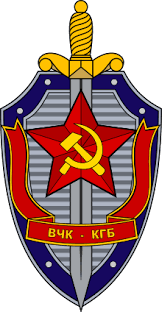
Insignia of the KGB
They kidnapped a man known to be a close relative of a prominent Hizbollah leader. Then they castrated him, stuffed his testicles in his mouth, shot him in the head, and sent the body back to Hizbollah.
With the body was a note: We know the names of other close relatives of yours, and the same will happen to them if our diplomats are not released immediately.
Soon afterward, the remaining three Soviet attaches were released only 150 yards from the Soviet Embassy.
Hizbollah telephoned a statement to news agencies claiming that the release was a gesture of “goodwill.”
In Washington, D.C., then-CIA Director William Casey decided that the Soviets knew the language of Hizbollah.
Click here: Hostages? No Problem Soviets Offer ‘How-to’ Lesson In Kidnapping – Philly.com
Both the United States and Israel–the two nations most commonly targeted for terrorist kidnappings–have elite Special Forces units.
Military hostage-rescue units operate differently from civilian ones. They don’t care about taking alive hostage-takers for later trials. The result is usually a pile of dead hostage-takers.
These Special Forces could be ordered to similarly kidnap the relatives of whichever Islamic terrorist leaders are responsible for the latest outrages.
Ordering such action would instantly send an unmistakable message to Islamic terrorist groups: Screw with us at your own immediate peril.
In the United States, such elite units as the U.S. Navy SEALS, Green Berets and Delta Force stand ready. They require only the orders.
ABC NEWS, BENJAMIN NETANYAHU, CBS NEWS, CIA, CNN, DELTA FORCE, FACEBOOK, FBI, GREEN BERETS, HIZBOLLAH, HOSTAGE NEGOTIATION, ISLAMIC TERRORISM, KGB, KIDNAPPING, NBC NEWS, SOVIET UNION, SPECIAL WEAPONS AND TACTICS TEAMS (SWAT), THE CHICAGO SUN-TIMES, THE CHICAGO TRIBUNE, THE LOS ANGELES TIMES, THE NEW YORK TIMES, THE WALL STREET JOURNAL, THE WASHINGTON POST, TWITTER, U.S. NAVY SEALS, WILLIAM CASEY
In Bureaucracy, History, Military, Politics, Social commentary on November 3, 2015 at 1:47 am
Retrieving hostages is always a difficult task.
The first concern is always: Saving the lives of the hostages taken.
The secondary concern–for American police agencies–is: Preserving the lives of the hostage-takers.
While some people question the point of taking pains for the lives of captors, there are several reasons for doing so.
The first is that if others are behind the hostage-taking, their identities will never be revealed without testimony from their confederates.
The second is that people who feel they have been marked for death are likely to go out in a blaze of glory–taking their hostages with them.
During the late 1960s and early 1970s, American law enforcement agencies began creating Special Weapons and Tactics (SWAT) teams. These units were armed with automatic weapons and trained to enter barricaded buildings. They were also given special training in hostage negotiation.
Their men came from the most physically and mentally fit officers of those departments. And the police departments whose SWAT teams were universally recognized as the best were the LAPD and NYPD.
At the Federal level, the FBI’s Hostage Rescue Team (HRT) stands as the go-to unit for other Federal law enforcement agencies. Created in 1982, its duties include:
- Apprehending barricaded subjects;
- Executing helicopter operations and rescue missions;
- Executing mobile assaults;
- Performing high-risk raids, searches, arrests, and warrants;
- Coordinating manhunt and rural operations; and
- Providing force protection for FBI personnel overseas.
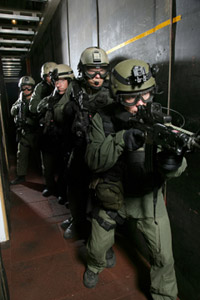
Hostage Rescue Team
The first commandment for American SWAT teams–local, state and Federal–is: Don’t try to enter a barricaded area unless (1) hostages’ lives are directly at risk; and (2) there is no other way to effect their rescue.
Even if hostages are murdered before a SWAT team arrives on the scene, officers will usually try to enter into negotiations with their captors. They will send in food and other comfort items in hopes of persuading the criminals to surrender peacefully.
These negotiations can last for hours or days–so long as police feel they have a chance of success.
But there is another way agencies can try to rescue hostages. It might be called, “The KGB Method.”
The KGB served as a combination secret police/paramilitary force throughout the 74-year life of the Soviet Union. Its name (“Commitee for State Security”) has changed several times since its birth in 1917: Cheka, NKVD, MGB and KGB.
After the collapse of the Soviet Union in 1991 and the formation of the Russian Federation, its name was officially changed to the FSB (Federal Security Service).
By any name, this is an agency known for its brutality and ruthlessness. The numbers of its victims literally run into the millions.
On September 30 1985, four attaches from the Soviet Embassy in Beirut, Lebanon, were kidnapped by men linked to Hizbollah (“Party of God”), the Iranian-supported terrorist group.
The kidnappers sent photos of the four men to Western news agencies. Each captive was shown with an automatic pistol pressed to his head.
The militants demanded that Moscow pressure pro-Syrian militiamen to stop shelling the pro-Iranian militia in Lebanon’s northern port city of Tripoli.
And they threatened to execute the four Soviet captives, one by one, unless this demand was met.
The Soviet Union began negotiations with the kidnappers, but could not secure a halt to the shelling of Tripoli.
Only two days after the kidnappings, the body of Arkady Katov, a 30-year-old consular secretary, was found in a Beirut trash dump. He had been shot through the head.
That was when the KGB took over negotiations.
Insignia of the KGB
They kidnapped a man known to be a close relative of a prominent Hizbollah leader. Then they castrated him, stuffed his testicles in his mouth, shot him in the head, and sent the body back to Hizbollah.
The KGB then informed the Hizbollah leader: We know the names of other close relatives of yours, and the same will happen to them if our diplomats are not released immediately.
Soon afterward, the remaining three Soviet attaches were released only 150 yards from the Soviet Embassy.
Hizbollah telephoned a statement to news agencies claiming that the release was a gesture of “goodwill.”
In Washington, D.C., then-CIA Director William Casey decided that the Soviets knew the language of Hizbollah.
Click here: Hostages? No Problem Soviets Offer ‘How-to’ Lesson In Kidnapping – Philly.com
Both the United States and Israel–the two nations most commonly targeted for terrorist kidnappings–have elite Special Forces units.
Military hostage-rescue units operate differently from civilian ones. They don’t care about taking alive hostage-takers for later trials. The result is usually a pile of dead hostage-takers.
These Special Forces could be ordered to similarly kidnap the relatives of whichever Islamic terrorist leaders are responsible for the latest outrages.
Ordering such action would instantly send an unmistakable message to Islamic terrorist groups: Screw with us at your own immediate peril.
In the United States, such elite units as the U.S. Navy SEALS, Green Berets and Delta Force stand ready. They require only the orders.
ABC NEWS, ALLEN DULLES, BRIDGE OF SPIES, CBS NEWS, CIA, CNN, DWIGHT D. EISENHOWER, EAST GERMANY, FACEBOOK, FRANCIS GARY POWERS, JOHN F. KENNEDY, JOSEPH R. MCCARTHY, KGB, NBC NEWS, RED SCARE, RUDOLPH ABEL, SOVIET UNION, STEVEN SPIELBERG, THE CHICAGO SUN-TIMES, THE CHICAGO TRIBUNE, THE LOS ANGELES TIMES, THE NEW YORK TIMES, THE WALL STREET JOURNAL, THE WASHINGTON POST, TOM HANKS, TWITTER, U-2
In Bureaucracy, History, Law, Military, Politics, Social commentary on October 27, 2015 at 12:01 am
“Bridge of Spies” vividly recaptures a now-forgotten time in American history.
It was the time of “the Cold War.” A time when:
- America was almost universally seen as “The Good Guy,” in contrast to “The Bad Guy” of the Soviet Union;
- The United States and the Soviet Union held each other at bay with arsenals of nuclear weapons;
- Wisconsin Senator Joseph R. McCarthy terrorized the nation, accusing anyone who disagreed with him of being a Communist–and leaving ruined lives in his wake;
- American TVs blared commercials warning that Soviet Premier Nikita Khrushchev had boasted: “We will bury you”; and
- Children and teenagers were taught in school that they could survive a nuclear attack through “duck and cover” drills. They were instructed to keep their bathtubs filled with water for safe drinking, in the event of a Soviet nuclear strike.
Bert the Turtle teaches schoolchildren to “Duck and Cover”
Yet even in this poisonous atmosphere of fear and denunciation, some men stood out as heroes–simply by holding fast to their consciences.
One of these was a New York insurance attorney named James B. Donovan (played by Tom Hanks). Asked by the Justice Department to defend arrested Soviet spy Rudolph Abel (Mark Rylance) Donovan did what no one expected.
He gave Abel a truly vigorous defense, arguing that the evidence used to convict him was the legally-tainted product of an invalid search warrant.
Upon Abel’s conviction and sentencing to 45 years’ imprisonment, Donovan again shocked the political and legal communities by appealing the case to the Supreme Court.
Donovan argued that Constitutional protections should apply to everyone–including non-Americans–tried in American courts. To do less made a mockery of the very freedoms we claimed to champion.
He lost by a vote of 5-4. But the arguments he made would resurface 50 years later when al-Qaeda suspects were hauled into American courts.
James B. Donovan
In 1961, Donovan was again called upon to render service by a Federal agency–this time the CIA. It wanted his help in negotiating the release of its spy, Francis Gary Powers, shot down over the Soviet Union in 1960 while flying a high-altitude U-2 spy plane.
Throughout “Bridge of Spies,” audiences learn some unsettling truths about how the American government–and governments generally–actually operate.
The first three of these were outlined in Part one of this series:
Truth #1: Appearance counts for more than reality.
Truth #2: Individual conscience can wreck the best-laid plans of government.
Truth #3: High-ranking government officials will ask citizens to take risks they themselves refuse to take.
Now for the remaining truths revealed in this movie.
Truth #4: Appeals to fear often prevail when appeals to humanity are ignored.
After crossing into East Germany, Donovan enters into negotiations with Wolfgang Vogel, a lawyer representing the East German government.
Vogel offers to exchange Frederic Pryor, an American economics graduate student seized by the East German secret police, for Abel. Donovan replies this is a deal-breaker; the United States (which is never mentioned during the negotiations) wants Powers, not Pryor.
Nevertheless, Donovan is equally concerned for Pryor, and adds him to the list of hostages to be released in return for Abel.
Then a new complication arises: The East German government that holds Pryor threatens to pull out. claiming to be insulted because Donovan did not inform them that the USSR was a party to the negotiation.
His reasoned, legal arguments having failed, Donovan resorts to a threat. He conveys a warning to the president of East Germany:
Abel has not yet revealed any Soviet secrets. But if this deal fails, he may well do so to earn favors from the United States government. And, in that case, the Soviets will blame you–Erich Honecker, the president of East Germany–for the resulting damage.
Where arguments based on humanity have failed, this one–based on fear–works. A prisoner-exchange is arranged.
Truth #5: Personal loyalty can supersede bureaucratic inventions.
On February 10, 1962, Donovan, Abel and several CIA agents arrive at the Glienicke Bridge, which connects East and West Germany. The Soviets have Powers, but not Pryor–who is to be released at Checkpoint Charlie, a crossing point between East and West Berlin.

Glienicke Bridge, the “Bridge of Spies”
The CIA agent in charge of the American delegation tells Abel he can cross into East Germany, even though Pryor has not been released.
But Abel has learned that Donovan has negotiated the release of not only Powers but Pryor. Out of loyalty to the man who has vigorously defended him, he waits on his side of the bridge until word arrives that Pryor has been released.
Then Abel crosses into East Germany while Powers crosses into the Western sector.
Donovan returns home. Before flying off to West Germany, he had told his wife he was going on a fishing trip in Scotland.
His wife and children learn the truth about the risks he ran and the success he attained only when a television newscast breaks the news:
Francis Gary Powers has been returned to the United States. And the man responsible is James Donovan, once the most reviled man in America for having defended a notorious Soviet spy.
ABC NEWS, ALLEN DULLES, BRIDGE OF SPIES, CBS NEWS, CIA, CNN, DWIGHT D. EISENHOWER, EAST GERMANY, FACEBOOK, FRANCIS GARY POWERS, JOHN F. KENNEDY, JOSEPH R. MCCARTHY, KGB, NBC NEWS, RED SCARE, RUDOLPH ABEL, SOVIET UNION, STEVEN SPIELBERG, THE CHICAGO SUN-TIMES, THE CHICAGO TRIBUNE, THE LOS ANGELES TIMES, THE NEW YORK TIMES, THE WALL STREET JOURNAL, THE WASHINGTON POST, TOM HANKS, TWITTER, U-2
In Bureaucracy, History, Law, Military, Politics, Social commentary on October 26, 2015 at 12:27 am
Steven Spielberg’s new movie, “Bridge of Spies,” is that rarity among films: An intelligent mixture of history and drama, stripped of gratuitous sex and violence.
It’s also a film that accurately reveals unsettling truths about how government agencies really operate.
Truth #1: Appearance counts for more than reality.
The movie opens with the FBI’s arrest of KGB spy Rudolph Abel (Mark Rylance). The evidence against him is overwhelming. This–plus the “Red Scare” climate of 1957–will guarantee his conviction.
But the Eisenhower administration doesn’t want the upcoming trial to be seen as a hangman’s court. It must have at least the appearance of a fair proceeding.
So the Justice Department (through the Brooklyn Bar Association) asks a New York insurance attorney named James B. Donovan (Tom Hanks) to take on Abel’s defense. He’s expected to make a reasonably competent effort but not go all out on behalf of his client.
Truth #2: Individual conscience can wreck the best-laid plans of government.
Donovan has never handled a spy case before. And he has no delusions that Abel isn’t the spy he’s charged with being. But he’s determined to give Abel the same committed defense he would give to any other client.
Rudolph Abel (Mark Rylance) and James Donovan (Tom Hanks) in court
This comes as a shock to the prosecutors, the judge, his law firm and even his family.
A CIA agent approaches Donovan in a nearly deserted restaurant and asks him to reveal any secrets that might help win Abel’s conviction.
Donovan replies: “This conversation isn’t happening.”
“No, of course not,” replies the CIA agent, assuming Donovan is agreeing to keep the overture secret.
“No, I mean this conversation isn’t happening,” angrily says Donovan, who leaves the agent fuming.
Donovan becomes a pariah; his mailbox is stuffed with hate mail and one night a would-be drive-by killer riddles his house with bullets.
Abel is convicted and sentenced to 45 years’ imprisonment. But Donovan–again shocking everyone he knows–pursues an appeal up to the Supreme Court.
He argues that the evidence against Abel is tainted by an invalid search warrant. No American citizen could be convicted under such circumstances; and the Constitutional protections that hold true for Americans should hold equally true for non-Americans charged with crimes in American courts.
Donovan’s arguments will be heard a half-century later, when al-Qaeda suspects are hauled before American courts.
He puts on an impressive case on Abel’s behalf, but loses 5-4 at the Supreme Court.
That seems to be the end of Donovan’s relationship with Abel. But events soon dictate otherwise.
Before the judge could pronounce a death sentence on Abel, Donovan had argued that this might be a mistake. The day might come, he told the judge, when an American spy might fall into Soviet hands.
And then the United States would need to swap Abel to secure the release of its own agent.
The judge, moved by that argument, had given Abel a lengthy prison term instead.
On May 1, 1960, Francis Gary Powers, a former Air Force pilot, is flying a high-altitude U-2 plane above the Soviet Union for the CIA. The plane is equipped with state-of-the-art cameras, and Powers intends to photograph military sites and other important complexes.
Suddenly, a surface-to-air missile slams into the plane. Powers ejects before it crashes, but fails to commit suicide with a poison pin concealed in a phony silver dollar. He’s captured by the KGB and brutally interrogated, but maintains his silence.
At about the same time, Frederic Pryor, an American economics graduate student living in West Germany, visits his German girlfriend living in Soviet-dominated East Germany.
The Soviets are starting to build their infamous Berlin Wall, which will stop the flow of refugees from East to West. Pryor tries to bring his girlfriend and her father into West Berlin, but he’s stopped and arrested by agents of Stasi, the East German police, who accuse him of being a spy.
Meanwhile, the Soviet Union wants its spy, Abel, returned, before he can spell its secrets. In turn, the new Kennedy administration wants Powers returned, before he can be made to spill American secrets.
Truth #3: High-ranking government officials will ask citizens to take risks they themselves refuse to take.
In 1961, Donovan is once again sought out by the American government–this time by no less than CIA Director Allen Dulles.
And he’s asked to go where no official American representative can go–East Germany. His new assignment: Negotiate the exchange of Powers for Abel.
The CIA wants its spy back. And it’s willing to send Donovan into East Germany to negotiate his release. But it’s not willing to back him up if he’s arrested by Stasi, the notorious East German secret police.
In such a case, Donovan could spend the rest of his life in a Communist prison cell.
ABC NEWS, ADOLF HITLER, ANCIENT ROME, CBS NEWS, CNN, ISLAMIC STATE OF IRAQ AND SYRIA, JORDAN, JOSEPH STALIN, KATYN FOREST MASSACRE, KGB, N.K.V.D., NAZI GERMANY, NBC NEWS, NICCOLO MACHIAVELLI, SOVIET UNION, THE CHICAGO SUN-TIMES, THE CHICAGO TRIBUNE, THE DISCOURSES, THE LOS ANGELES TIMES, THE NEW YORK TIMES, THE WASHINGTON POST, USA TODAY, WAR CRIMES, WORLD WAR ii
In History, Military, Politics on February 17, 2015 at 6:30 pm
The Islamic State of Iraq and Syria (ISIS) has been in the news a great deal lately–and for reasons most organizations try to avoid. Or at least cover up. It has been designated as a terrorist organization by
- Russia
- the United States
- Canada
- the European Union
- Australia
- Turkey
- the United Nations
- Indonesia
- the United Kingdom
- Saudi Arabia
- the United Arab Emerites
- Egypt
- India and
- Malaysia
It been condemned by such well-known human rights organizations as Amnesty International. And a major reason for this is the evidence of its brutalities that ISIS has proudly supplied. Among this evidence are its own Internet videos of
- the beheadings of soldiers, civilians, journalists, and aid workers;
- the burning of a captured Jordanian fighter pilot;
- demands for extortionate ransoms for kidnapped Japanese and American captives;
- the wholesale shooting of captured Iraqi soldiers; and
- the selling of captured children.
The release on February 3 of a video showing the barbaric “execution” of a captured Jordanian fighter pilot, Lt. Muath al-Kasaesbeh, underscored ISIS reputation for cruelty
Al Kasaesbeh, locked in a steel cage like an animal, could only watch stoically as an ISIS member ignited a trail of flammable liquid leading directly to him. The pilot stood upright throughout the ordeal until the flames at last consumed him.
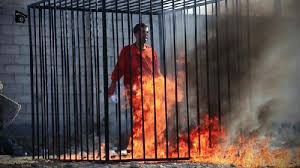
ISIS burning of captured Jordanian fighter pilot Muath al-Kasaesbeh
Terrorism experts believe that the elaborately-staged video was meant to weaken the morale of Jordan and other Sunni Arab members of the U.S.-led coalition against ISIS.
But it violated a fundamental rule of public relations: If you commit atrocities, do it secretly so you can deny it if the truth ever comes out.
That’s how the members of Soviet dictator Joseph Stalin’s dreaded secret police–the N.K.V.D.–the predecsssors to the later-named KGB–operated throughout their brutal history.
In 1939, when the Soviet Union seized the eastern half of Poland, the N.K.V.D. executed 22,000 Polish army officers in the dense Katyn forest.
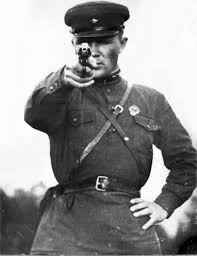
N.K.V.D. executioner
The government of Nazi Germany announced the discovery of mass graves in the forest in 1943. The Soviet Union furiously denied responsibility, claiming the victims had been executed by the Germans.
The Soviets continued to deny responsibility for the massacres until 1990, when the government finally admitted its guilt.
ISIS has turned out videos of its brutalities which film experts have declared are almost up to the quality of Hollywood spectaculars. But ISIS leaders have apparently forgotten–if they ever knew–the truth of the saying: “You can make a throne of bayonets, but you can’t sit on it.”
Niccolo Machiavelli, in his classic work, The Discourses, offered a telling example of how magnanimity can triumph over brutality.
Camillus was besieging the city of the Faliscians, and had surrounded it….A teacher charged with the education of the children of some of the noblest families of that city [to ingratiate himself] with Camillus and the Romans, led these children…into the Roman camp.
And presenting them to Camillus [the teacher] said to him, “By means of these children as hostages, you will be able to compel the city to surrender.”
Camillus not only declined the offer but had the teacher stripped and his hands tied behind his back….[Then Camillus] had a rod put into the hands of each of the children…[and] directed them to whip [the teacher] all the way back to the city.
Upon learning this fact, the citizens of Faliscia were so much touched by the humanity and integrity of Camillus, that they surrendered the place to him without any further defense.
This example shows that an act of humanity and benevolence will at all times have more influence over the minds of men than violence and ferocity. It also proves that provinces and cities which no armies…could conquer, have yielded to an act of humanity, benevolence, chastity or generosity.
What Machiavelli doesn’t say–but what history offers plenty of examples to substantiate–is this: The brutality of aggressors will be met–and sometimes overcome–with brutality by their past or intended victims.
Nowhere was this better proved than during the German invasion of the Soviet Union.
Without warning, three million German soldiers–backed up by overwhelming air and tank support–attacked their “ally” on June 22, 1941.
The Wehrmacht blitzed its way across Russia–to the gates of Moscow and as far south as Stalingrad on the Volga River. In its path it left devastated cities and at least 20 million dead Russians.
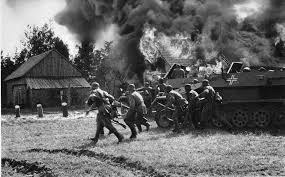
German soldiers moving into a burning Russian village
Russian women were gang-raped, then shot, or blown up with hand grenades. Tens of thousands of captured Russian soldiers were allowed to die of hunger, sickness and freezing cold behind barbed wire. Other captured POWs were brutally beaten, tortured and/or shot.
But then the tide of war turned and the Russians launched their own offensives in 1943. And they kept going–all the way to Berlin.
Russians raped tens of thousands of German women–and nailed others to barn doors. Cossacks cut off the raised hands of Germans trying to surrender. Tanks crushed retreating German soldiers and civilians unlucky enough to be in their path.
Thus do those who practice barbarism often find themselves being repaid with it–usually ten-fold.
9/11, ABC NEWS, ADOLF HITLER, AMERICANS FOR TAX REFORM, ANDERSON COOPER, ANTI-COMMUNISM, ARTHUR MILLER, BILL CLINTON, CBS NEWS, CENTER FOR SECURITY POLICY, CHINA, CHRIS MATTHEWS, CNN, DICK CHENEY, DWIGHT D. EISENHOWER, EDWARD R. MURROW, FACEBOOK, GEORGE H.W. BUSH, HARRY S. TRUMAN, HEINRICH HIMMLER, HERMAN CAIN, HERMAN GORING, HILLARY CLINTON, HUMA ABEDIN, JEWS, JIMMY CARTER, JOHN BIRCH SOCIETY, JOHN F. KENNEDY, JOHN STEINBECK, JOSEPH GOEBBELS, JOSEPH MCCARTHY, JOSEPH STALIN, KGB, LIZ CHENEY, LUCILLE BALL, LYNDON B. JOHNSON, MARY CHENEY, MICHELLE BACHMANN, MIKE HUCKABEE, MITT ROMNEY, MSNBC, MUSLIM BROTHERHOOD, MUSLIMS, NAZI GERMANY, NAZI PARTY, NBC NEWS, NEWT GINGRICH, PETE SEEGER, RED SCARE, REINHARD HEYDRICH, REPUBLICAN PARTY, RICHARD NIXON, RICK SANTORUM, Ronald Reagan, SAME-SEX MARRIAGE, SENATOR MIKE ENZI, SOVIET UNION, SS, THE AMERICAN CENTER FOR SECURITY POLICY, THE CHICAGO SUN-TIMES, THE CHICAGO TRIBUNE, THE HUFFINGTON POST, THE LOS ANGELES TIMES, THE NEW YORK TIMES, THE WALL STREET JOURNAL, THE WASHINGTON POST, TWITTER, USA TODAY, WYOMING
In Bureaucracy, History, Law, Politics, Social commentary on February 6, 2015 at 12:15 am
With the Soviet Union collapsed in 1991, the Republican Party went into a tailspin of dismay.
For almost 50 years, Republicans had conjured up The Red Bogeyman to scare voters into sending them to Congress and the White House.
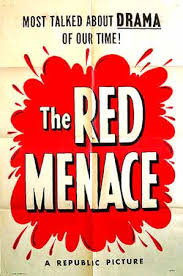
But now that the “workers’ paradise” had disappeared, Americans seemed to lose interest in the Communist Menace.
True, the People’s Republic of China remained, and its increasing economic clout would challenge the United States well into the 21st century. But Americans didn’t seem to fear the Red Chinese as they had the Red Russians.
What was the Republican Party to do to lure voters?
On September 11, 2001, the answer arrived–in two highjacked jetliners that crashed into the World Trade Center in New York and one that struck the Pentagon in Washington, D.C.
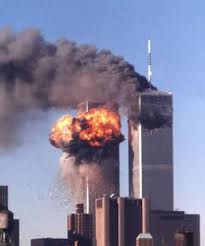
Exit The Red Bogeyman. Enter The Maniacal Muslim.
Consider:
- Mike Huckabee – “If the purpose of a church is to push forward the gospel of Jesus Christ, and then you have a Muslim group that says that Jesus Christ and all the people that follow him are a bunch of infidels who should be essentially obliterated, I have a hard time understanding that.”
- Herman Cain – ”I would not” appoint a Muslim in his administration.
- Newt Gingrich – “I am convinced that if we do not decisively win the struggle over the nature of America, by the time they [his grandchildren] are my age they will be in a secular atheist country, potentially one dominated by radical Islamists. …”
- Rick Santorum – On supporting the racial profiling of Muslims: “Obviously, Muslims would be someone you look at, absolutely.”
- Mitt Romney – “Based on the numbers of American Muslims in our population, I cannot see that a Cabinet position [for a Muslim] would be justified.”
And on July 13, Rep. Michelle Bachmann (R-Minn.) sent letters to the Inspectors General of the Departments of
- Defense;
- State;
- Justice; and
- Homeland Security.
“The purpose of these letters,” wrote Bachmann, was to “request a multi-department investigation into potential Muslim Brotherhood infiltration into the United States Government.”

Michelle Bachmann
Bachmann further asserted in her letter to the State Department that Huma Abedin, deputy chief of staff to Secretary of State Hillary Clinton, had ties to the Muslim Brotherhood.
And the evidence for this?
The Center for Security Policy’s claim that Abedin’s father (who died when she was a teenager), mother and brother are “connected” to the organization.
And what is the Center of Security Policy? A private organization subsidized by donors to neo-conservative causes.
In a separate letter, Bachmann demanded to know how Abedin received her security clearance.
Among the co-signers of Bachmann’s letter to the Inspectors General were:
- Rep. Trent Franks of Arizona, who has said abortion has done more harm to blacks than slavery;
- Rep. Lynn Westmoreland of Georgia, who called presidential candidate Barack Obama and his wife, Michelle, ”uppity”; and
- Rep. Louie Gohmert of Texas, who claims that terrorist organizations send pregnant women into the U.S. so that their children will be American citizens–who can enter and leave the country at will as they are trained to be terrorists abroad.
When pressed for their evidence of “a vast Muslim conspiracy,” right-wing accusers usually refuse to provide any.
An example of this occurred during an August 13, 2010 interview between Gohmert and CNN’s Anderson Cooper:
COOPER: What research? Can you tell us about the research?
GOHMERT: You are attacking the messenger, Anderson, you are better than this. You used to be good. You used to find that there was a problem and you would go after it.
COOPER: Sir, I am asking you for evidence of something that you said on the floor of the House.
GOHMERT: I did, and you listen, this is a problem. If you would spend as much time looking into the problem as you would have been trying to come after me and belittle me this week –
COOPER: Sir, do you want to offer any evidence? I’m giving you an opportunity to say what research and evidence you have. You’ve offered none, other than yelling.
Nor did Gohmert offer any evidence that evening.
Of course, the ultimate Republican Muslim slander is that President Barack Obama–a longtime Christian–is himself a Muslim.
No doubt Republicans feel totally safe in making these attacks, since Muslims comprise only 1% of the American population.
This has long been a hallmark of right-wing attacks–to go after a minority that cannot effectively defend itself.
Thus, Adolf Hitler attacked the Jews of Germany.
And Republicans have successively attacked blacks, Hispanics and gays–until each group became politically influential enough to defeat Republican candidates.
Today, most right-wing politicians at least grudgingly court all of these groups.
When Muslims become a significant political force in their own right, the Right will court them, too. And then move on to yet another helpless scapegoat to blame for America’s troubles.


.jpg)


 Bureaucracybuster's Blog
ABC NEWS, ALLEN DULLES, BRIDGE OF SPIES, CBS NEWS, CNN, COLD WAR, DWIGHT D. EISENHOWER, EAST GERMANY, FACEBOOK, FRANCIS GARY POWERS, JAMES DONOVAN, JOHN F. KENNEDY, JOSEPH MCCARTHY, KGB, NBC NEWS, RED SCARE, RUDOLPH ABEL, SOVIET UNION, STASI, STEVEN SPIELBERG, THE CHICAGO SUN-TIMES, THE CHICAGO TRIBUNE, THE LOS ANGELES TIMES, THE NEW YORK TIMES, THE WALL STREET JOURNAL, THE WASHINGTON POST, TOM HANKS, TWITTER, U-2
“BRIDGE OF SPIES” TELLS UGLY TRUTHS ABOUT GOVERNMENT: PART TWO (END)
In Bureaucracy, Entertainment, History, Law, Law Enforcement, Military, Politics, Social commentary on March 21, 2016 at 12:01 am“Bridge of Spies” vividly recaptures a now-forgotten time in American history.
It was the time of “the Cold War.” A time when:
Bert the Turtle teaches schoolchildren to “Duck and Cover”
Yet even in this poisonous atmosphere of fear and denunciation, some men stood out as heroes–simply by holding fast to their consciences.
One of these was a New York insurance attorney named James B. Donovan (played by Tom Hanks). Asked by the Justice Department to defend arrested Soviet spy Rudolph Abel (Mark Rylance) Donovan did what no one expected.
He gave Abel a truly vigorous defense, arguing that the evidence used to convict him was the legally-tainted product of an invalid search warrant.
Upon Abel’s conviction and sentencing to 45 years’ imprisonment, Donovan again shocked the political and legal communities by appealing the case to the Supreme Court.
Donovan argued that Constitutional protections should apply to everyone–including non-Americans–tried in American courts. To do less made a mockery of the very freedoms we claimed to champion.
He lost by a vote of 5-4. But the arguments he made would resurface 50 years later when al-Qaeda suspects were hauled into American courts.
James B. Donovan
In 1961, Donovan was again called upon to render service by a Federal agency–this time the CIA. It wanted his help in negotiating the release of its spy, Francis Gary Powers, shot down over the Soviet Union in 1960 while flying a high-altitude U-2 spy plane.
Throughout “Bridge of Spies,” audiences learn some unsettling truths about how the American government–and governments generally– actually operate.
The first three of these were outlined in Part one of this series:
Truth #1: Appearance counts for more than reality.
Truth #2: Individual conscience can wreck the best-laid plans of government.
Truth #3: High-ranking government officials will ask citizens to take risks they themselves refuse to take.
Now for the remaining truths revealed in this movie.
Truth #4: Appeals to fear often prevail when appeals to humanity are ignored.
After crossing into East Germany, Donovan enters into negotiations with Wolfgang Vogel, a lawyer representing the East German government.
Vogel offers to exchange Frederic Pryor, an American economics graduate student seized by the East German secret police, for Abel. Donovan replies this is a deal-breaker; the United States (which is never mentioned during the negotiations) wants Powers, not Pryor.
Nevertheless, Donovan is equally concerned for Pryor, and adds him to the list of hostages to be released in return for Abel.
Then a new complication arises: The East German government that holds Pryor threatens to pull out. claiming to be insulted because Donovan did not inform them that the USSR was a party to the negotiation.
His reasoned, legal arguments having failed, Donovan resorts to a threat. He conveys a warning to the president of East Germany:
Abel has not yet revealed any Soviet secrets. But if this deal fails, he may well do so to earn favors from the United States government. And, in that case, the Soviets will blame you–Erich Honecker, the president of East Germany–for the resulting damage.
Where arguments based on humanity have failed, this one–based on fear–works. A prisoner-exchange is arranged.
Truth #5: Personal loyalty can supersede bureaucratic inventions.
On February 10, 1962, Donovan, Abel and several CIA agents arrive at the Glienicke Bridge, which connects East and West Germany. The Soviets have Powers, but not Pryor–who is to be released at Checkpoint Charlie, a crossing point between East and West Berlin.
Glienicke Bridge, the “Bridge of Spies”
The CIA agent in charge of the American delegation tells Abel he can cross into East Germany, even though Pryor has not been released.
But Abel has learned that Donovan has negotiated the release of not only Powers but Pryor. Out of loyalty to the man who has vigorously defended him, he waits on his side of the bridge until word arrives that Pryor has been released.
Then Abel crosses into East Germany while Powers crosses into the Western sector.
Donovan returns home. Before flying off to West Germany, he had told his wife he was going on a fishing trip in Scotland.
His wife and children learn the truth about the risks he ran and the success he attained only when a television newscast breaks the news:
Francis Gary Powers has been returned to the United States. And the man responsible is James Donovan, once the most reviled man in America for having defended a notorious Soviet spy.
Share this: