bureaucracybusters

Posts Tagged ‘ABRAHAM LINCOLN’

MARCHING THROUGH TREASON–AGAIN: PART TWO: PART TWO (END)

In Bureaucracy, History, Law, Law Enforcement, Military, Politics, Social commentary on October 27, 2016 at 12:09 am

When Andrew Jackson, seventh President of the United States from 1829 to 1837, was close to death, he asked his doctor: “What act of my administration will be most severely condemned by future Americans?”

“Perhaps the removal of the bank deposits,” said the doctor–referring to Jackson’s withdrawal of U.S. Government monies from the first Bank of the United States.

That act had destroyed the bank, which Jackson had believed was a source of political corruption.

“Oh, no!” said Jackson.

“Then maybe the specie circular,” said the doctor. He was referring to an 1836 executive order Jackson had issued, requiring payment for government land to be in gold and silver.

“Not at all!” said Jackson.

Then, his eyes blazing, Jackson raged: “I can tell you. Posterity will condemn me more because I was persuaded not to hang John C. Calhoun as a traitor than for any other act in my life!”

John C. Calhoun had once been Vice President under Jackson and later a United States Senator from South Carolina. His fiery rhetoric and radical theories of “nullification” played a major part in bringing on the Civil War (1861-1865).

John C. Calhoun

Calhoun was an outspoken proponent of slavery, which he declared to be a “positive good” rather than a “necessary evil.” He supported states’ rights and nullification–by which states could declare null and void federal laws they deemed unconstitutional.

Historians have not condemned Jackson for failing to hang the senator. But perhaps he was right–and perhaps he should have hanged Calhoun.

It might have prevented the Civil War–or at least delayed its coming.

Over time, Southern states’ threats of “nullification” turned to threats of “secession” from the Union.

Jackson died in 1845–16 years before the Civil War erupted.

The resulting carnage slaughtered as many as 620,000 lives. More Americans died in that war than have been killed in all the major wars fought by the United States since.

When it ended, America was reinvented as a new, unified nation–and one where slavery was now banned by the 13th Amendment to the United States Constitution.

Equally important, the Federal Government had now set a precedent for using overwhelming military power to force states to remain in the Union.

But in 2012, within days of Barack Obama’s decisive winning of another four years as President, residents across the country raised the call of treason.

They did done so by filing secession petitions to the Obama administration’s “We the People” program, which is featured on the White House website.

States whose residents filed secession petitions included:

Alabama, Alaska, Arizona, Arkansas, California, Colorado, Connecticut, Delaware, Florida, Georgia, Hawaii, Idaho, Illinois, Indiana, Iowa, Kansas, Kentucky, Louisiana, Maine, Maryland, Massachusetts, Michigan, Minnesota, Mississippi, Missouri, Montana, Nebraska, New Hampshire, New Jersey, New Mexico, New York, Nevada, North Carolina, North Dakota, Ohio, Oklahoma, Oregon, Pennsylvania, Rhode Island, South Carolina, South Dakota, Tennessee, Texas, Utah, Virginia, Washington (state), West Virginia, Wisconsin and Wyoming.

The reason: Thousands–if not millions–of Americans couldn’t abide a moderately-liberal black man winning a second term as President.

Abraham Lincoln dedicated his Presidency–and sacrificed his life–to ensure the preservation of a truly United States.

And Robert E. Lee–the defeated South’s greatest general–spent the last five years of his life trying to put the Civil War behind him and persuade his fellow Southerners to accept their place in the Union.

But today avowed racists, Fascists and other champions of treason are working hard to destroy that union–and unleash a second Civil War.  

Yet no official in Washington, D.C.–from President Obama on down–has so far dared to openly confront this menace. This failure to do so has only emboldened Trump’s Fascistic supporters and dismayed those who would oppose them.

President Obama should follow Andrew Jackson’s example–before treasonous talk becomes treasonous action.  

He should make clear that if treasonous violence erupts during his last two months in office, he will act decisively to crush it, using whatever level of force is necessary.

President Obama should warn these 21st-century would-be traitors that the FBI and U.S. Marshals Service are prepared to combat any threats to national security.

And if these agencies aren’t sufficient, the United States Army, Navy, Air Force and Marines stand ready to send modern-day counterparts of Union General William Tecumseh Sherman to wherever they are needed.  

In 1864, Sherman’s 62,000 soldiers marched more than 650 miles in less than 100 days, ravaged Georgia, burned Atlanta to the ground–and ended the Civil War.

President Obama’s attitude should be: “Let them hate me, so long as they fear me.”

Sherman’s March through Georgia

Similarly, Hillary Clinton–if she is elected–should issue a similar statement: That her coming administration will not tolerate the outbreak of widespread violence from any section of the population, whatever the excuse.

And she should bluntly warn that “Marching Through Georgia” is a song that can be played wherever treason dares to show its face:

So we made a thoroughfare for freedom and her train
Sixty miles of latitude, three hundred to the main.
Treason fled before us, for resistance was in vain
While we were marching through Georgia.

MARCHING THROUGH TREASON–AGAIN: PART ONE (OF TWO)

In Bureaucracy, History, Law, Law Enforcement, Military, Politics, Social commentary on October 26, 2016 at 12:19 am

They cannot be made to love us, but they may be made to fear us.
–William Tecumseh Sherman speaking of the Southern Confederacy

If Hillary Clinton is elected President, she may soon face the same crisis that confronted Abraham Lincoln more than a century ago: Mass treason.

Americans haven’t even voted yet. But, already, hard-core supporters of Republican Presidential nominee Donald Trump believe a sinister international cabal has “rigged” the 2016 election for Clinton.  

There is absolutely no evidence for this–other than what Trump himself has loudly and repeatedly told them: That there is a massive conspiracy to take him down.  

At one town hall meeting where his Vice Presidential running mate, Mike Pence, appeared, a woman named Rhonda stood up and announced: “One of the things that I can tell you that a lot of us are scared of is this voter fraud.

“There’s a lot of out here saying that when we vote, we’re going to wear red. Our lives depend on this election. Our kids’ futures depend on this election.

“For me personally, if Hillary Clinton gets in, I myself am ready for a revolution.”  

In Cincinnati, a Trump supporter threatened to forcibly remove Clinton from the White House if she won the Presidential race: “I feel like Hillary needs to be taken out if she gets in the government. I’ll do everything in my power to take her out of power–which, if I have to be a patriot, I will.”

When asked if he was physically threatening Clinton, Dan Bowman, 50, told CNN: “I don’t know, is it?”

Officially, the Trump campaign claimed: “We reject violence in any form and will not allow it to be a part of our campaign.”

But on August 9, Trump told a rally in Wilmington, North Carolina that Clinton intended to abolish the Second Amendment: “If she gets to pick her judges, there’s nothing you can do, folks. Although the Second Amendment people–maybe there is, I don’t know.”   

The Clinton camp instantly saw it as a “dog-whistle” solicitation for political assassination. The Trump campaign issued a statement denying that he had meant any such thing.  

On July 19, Trump clinched the Republican Presidential nomination. By early August, Roger Stone, a longtime Right-wing political consultant and now Trump strategist, was already predicting “widespread voter fraud” in the coming election.  

This despite the fact that a 2014 Washington Post analysis of 14 years of voter fraud found 31 possible incidents of in-person voter fraud, comprised of approximately 241 fraudulent ballots.  

In an interview with the Right-wing Breitbart News website, Stone said:

“The first thing that Trump needs to do is begin talking about [voter fraud] constantly. If there’s voter fraud, this election will be illegitimate, the election of the winner will be illegitimate, we will have a constitutional crisis, widespread civil disobedience, and the government will no longer be the government.” 

Image result for Images of Roger Stone

Roger Stone

Stone added that Trump should keep drumming up his supporters against the “rigged” system, and promise that the government would be shut down if Clinton was pronounced the victor in November.  

“I think he’s gotta put them on notice that their inauguration will be a rhetorical, and when I mean civil disobedience, not violence, but it will be a bloodbath… We will not stand for it.” 

Yet no official in Washington, D.C.–from President Barack Obama on down–has so far dared to openly acknowledge–let alone confront–this menace.

If Hillary Clinton is elected President, she would do well to review how Andrew Jackson, America’s seventh President from 1829 to 1837, reacted to threats of secession.

Andrew Jackson

In 1830, South Carolina was threatening to secede from the Union. A South Carolina Congressman who was returning home visited Jackson and asked: “Do you have a message you want me to give to your friends in the state?”

Jackson questioned him about the recent mass meetings in Charleston.

The friend warned him that South Carolina’s fire-eaters believed “the Army and Navy aren’t big enough to collect a penny” of Federal taxes.

“Do they realize what their words mean?” asked Jackson.

“I’m afraid they do, General.”

“Then tell them from me that they can talk and write resolutions and print threats to their hearts’ content.

“But if one drop of blood is shed there in opposition to the laws of the United States, I will hang the first man I can lay my hands on engaged in such treasonable conduct, from the first tree I can reach.”

News of Jackson’s threat quickly spread throughout Washington, D.C.

Senator Robert Hayne of South Carolina told his fellow Senator, Thomas Hart Benton, of Missouri, that he couldn’t believe that Jackson would send an army to invade a sovereign state.

Benton replied: “I tell you, Hayne, when Jackson starts talking about hanging, they can begin to look for the ropes.”

Jackson later issued a proclamation to the people of South Carolina and threatened to hang Hayne’s successor, Senator John C. Calhoun. He also warned that he would himself lead an army into the state to enforce Federal law.

The treasonous rumblings stopped–for the moment.

“LINCOLN”: A MESSAGE FOR TODAY

In Bureaucracy, Entertainment, History, Law, Military, Politics, Social commentary on March 17, 2016 at 12:36 pm

Steven Spielberg’s Lincoln is more than a mesmerizing history lesson.

It’s a timely reminder that racism and repression are not confined to any one period or political party.

At the heart of the film: Abraham Lincoln (Daniel Day-Lewis) wants to win ratification of what will be the Thirteenth Amendment to the United States Constitution. An amendment that will forever ban slavery.

True, Lincoln, in 1862, had issued the Emancipation Proclamation. This—in theory—freed slaves held in the Confederate states that had seceded from the Union in 1861.

But Lincoln regards this as a temporary wartime measure. He fears that once the war ends, the Supreme Court may rule the Proclamation unconstitutional. This might allow Southerners to continue practicing slavery, even after losing the war.

To prevent this, Congress must pass an anti-slavery amendment. 

But winning Congressional passage of such an amendment won’t be easy.

The Senate had ratified its passage in 1864.  But the amendment must secure approval from the House of Representatives to become law.

And the House is filled with men–there are no women menmbers during the 19th century–who seethe with hostility.

Some are hostile to Lincoln personally. One of them dubs him a dictator–Abraham Africanus.” Another accuses him of shifting his positions for the sake of expediency.

Other members–white men all–are hostile to the idea of “equality between the races.” To them, ending slavery means opening the door to interracial marriage–especially marriage between black men and white women. 

Perhaps even worse, it means possibly giving blacks–or women–the the right to vote.

In fact, the possibility that blacks might win voting rights arises early in the movie.  Lincoln is speaking to a couple of black Union soldiers, and one of them is unafraid to voice his discontent. He’s upset that black soldiers are paid less than white ones–and that they’re led only by white officers.

He says that, in time, maybe this will change.  Maybe, in 100 years, he guesses, blacks will get the right to vote.

(To the shame of all Americans, that’s how long it will eventually take.  Not until the passage of the Voting Rights Act of 1965 will blacks be guaranteed legal protection against discriminatory voting practices.)

To understand the Congressional debate over the Thirteenth Amendment, it’s necessary to remember this: In Lincoln’s time, the Republicans were the party of progressives

The party was founded on an anti-slavery platform.  Its members were thus reviled as “Black Republicans.” And until the 1960s, the South was solidly Democratic.

Democrats were the ones defending the status quo–slavery–and opposing freed blacks in the South of Reconstruction and long afterward.  

In short, in the 18th century, Democrats in the South acted as Republicans do now. The South went Republican only after a Democratic President–Lyndon B. Johnson–rammed the Civil Rights Act of 1964 through Congress.

Watching this re-enactment of the 1865 debate in Lincoln is like watching the current Presidential campaign.  The same mentalities are at work:

  • Those (in this case, slave-owners) who already have a great deal want to gain even more at the expense of others. 
  • Those (slaves and freed blacks) who have little strive to gain more or at least hang onto what they have. 
  • Those who defend the privileged wealthy refuse to allow their “social inferiors” to enjoy similar privileges (such as the right to vote). 

During the 2012 Presidential race, Republicans tried to bar those likely to vote for President Barack Obama from getting into the voting booth.  But their bogus “voter ID” restrictions were struck down in courts across the nation. 

Listening to those opposing the amendment, one is reminded of Mitt Romney’s infamous comments about the “47%”:

“Well, there are 47% of the people who will vote for the president no matter what….

“Who are dependent upon government, who believe that–that they are victims, who believe that government has a responsibility to care for them, who believe that they’re entitled to healthcare, to food, to housing, to you name it.  But that’s–it’s an entitlement.  And the government should give it to them.” 

Put another way: “Who says people have a right to obtain medical care, food and housing?  If they can’t inherit unearned wealth the way I did, screw them.” 

In the end, it’s Abraham Lincoln who has the final word–and leaves his nation the better for it.  Through diplomacy and backroom dealings (trading political offices for votes) he wins passage of the anti-slavery amendment. 

The ownership of human chattel is finally an ugly memory of the American past. 

The movie closes with a historically-correct tribute to Lincoln’s generosity toward those who opposed him–in Congress and on the battlefield.  It occurs during Lincoln’s Second Inaugural Address:

“With malice toward none, with charity for all….To bind up the nation’s wounds.  To care for him who shall  have bourne the battle, and for his widow and his orphan….”  

This ending presents a vivid philosophical contrast with the increasingly mean-spirited rhetoric and policies of 2016’s Republican candidates for President–especially those of Donald Trump.  

Watching Lincoln, you realize how incredibly lucky America was as a nation to have had such leadership when it was most urgently needed.

.

SECRET SERVICE–FULLL SPEED AHEAD TO DISASTER: PART TWO (END)

In Bureaucracy, History, Law Enforcement, Politics on December 29, 2015 at 12:19 am

On the night of September 19, 2014, an Iraq war veteran, Omar Gonzales, jumped the White House fence, ran more than 70 yards across the north lawn, and sprinted just past the north portico White House doors.

Only then was he apprehended by Secret Service agents.

Gonzalez’ short-lived trespass onto White House grounds was one of 143 security breaches–or attempted breaches–at facilities protected by the United States Secret Service (USSS) during during the last 10 years.

Then, less than 24 hours after Gonzalez’s arrest, a second man was apprehended after he drove up to a White House gate and refused to leave.  This triggered a search of his vehicle by bomb technicians in full gear.  Other agents shut down nearby streets.  No bombs were found.

Asked for Obama’s reaction, White House spokesman Frank Benenati gave this boilerplate reply: “The president has full confidence in the Secret Service and is grateful to the men and women who day in and day out protect himself, his family and the White House.”

Yet not all is well in Presidential security.

A newly-released report by the House Oversight and Government Reform Committee found the Secret Service to be “in crisis.”

Related image

The White House

“Morale is down, attrition is up, misconduct continues and security breaches persist,” Rep. Jason Chaffetz, (R-Utah) publicly stated.

“Strong leadership from the top is required to fix the systematic mismanagement within the agency, and to restore it to its former prestige.”

But the blunt truth is that many of the problems now plaguing the USSS were on full display as early as 2009.

That was when well-known investigative reporter Ronald Kessler published his then-latest book, In the President’s Secret Service.

Kessler had previously pubilshed books outlining the inner workings of the White House, the CIA and the FBI.

Kessler praised the courage and integrity of Secret Service agents as a whole.  But he warned that the agency was risking the safety of many of its protectees, including President Obama.

He was particularly critical of SS management for such practices as:

  • Shutting off weapon-scanning magnetometers at rallies for Presidential candidates–and even for Presidents George W. Bush and Obama. 
  • During a speech Bush gave at Tbilisi, Georgia in 2005, an assailant threw a live hand grenade–which failed to explode–at him.  
  • Despite 9/11, Secret Service agents are still being trained to expect an attempt by a lone gunman—rather than a professional squad of terrorist assassins.
  • The Service’s Counter Assault Teams (CATs) have generally been cut back from five or six agents to tworendering them useless if a real attack occurred.
  • Salaries paid to USSS agents have not kept pace with reality. Veteran USSS men and women are now being offered up to four times their salary for moving to the private sector, and many are leaving the agency for that reason.

Secret Service agents protecting President Barack Obama

  • While Congress has greatly expanded the duties of this agency, Secret Service management has not asked for equivalent increases in funding and agents.
  • Many agents are leaving out of frustration that it takes “juice” or connections with top management to advance one’s career.
  • USSS agents are being trained with weapons that are outdated (such as the MP5, developed in the 1960s) compared to those used by other law enforcement agencies and the potential assassins they face (such as the M4–with greater range and armor-piercing capabilities).
  • The Service refuses to ask for help from other agencies to meet its manpower needs. Thus, a visiting head of state at the U.N. General Assembly will usually be assigned only three agents as protection.
  • The agency tells agents to grade themselves on their physical training test forms.  
  • Agents are supposed to be evaluated on their marksmanship skills every three months.  But some agents have gone more than a year without being tested.
  • Some agents are so overweight they can’t meet the rigorous demands of the job. As a result, they pose a danger to the people they’re supposed to be guarding.
  • The Secret Service inflates its own arrest statistics by claiming credit for arrests made by local police.
  • Congressional members who visit the agency’s Rowley Training Center in Laurel, Maryland, are treated to rehearsed scenarios of how the agency would deal with attacks. If agents were allowed to perform these exercises without rehearsals, Congressional members would see they make mistakes like anyone else.

Kessler closes his book with the warning: “Without….changes, an assassination of Barack Obama or a future president is likely.

“If that happens, a new Warren Commission will be appointed to study the tragedy. It will find that the Secret Service was shockingly derelict in its duty to the American people and to its own elite corps of brave and dedicated agents.”

And the effects will be not only momentary but long-term.  As Kessler writes:

“By definition, an assassination threatens democracy.

“If Abraham Lincoln had not been assassinated, Andrew Johnson, his successor, would not have been able to undermine Lincoln’s efforts to reunite the nation and give more rights to blacks during the Reconstruction period.

“If John F. Kennedy had not been assassinated, Lyndon Johnson likely never would have become President.  If Robert F. Kennedy had not been killed and had won the presidency, Richard Nixon might never have been elected.”

SECRET SERVICE–FULL SPEED AHEAD TO DISASTER: PART ONE (OF TWO)

In Bureaucracy, History, Law Enforcement, Politics on December 28, 2015 at 2:37 am

The United States Secret Service (USSS) is “in crisis”–a crisis that threatens President Barack Obama and his successors as President of the United States.

That’s the verdict of a review of the House Oversight and Government Reform Committee.

Since April, 2012, the agency has faced scandal–and scrutiny by the press and Committee. That was when reports first surfaced of agents buying the favors of prostitutes in Columbia.

Even more embarrassing for the USSS were a series of security breaches that potentially exposed President Barack Obama to danger.

As a result, during the last three years, three directors have headed the Secret Service. Numerous agents–including senior officials–have been disciplined, transferred or fired.

For decades, the Secret Service was seen by the press, public and other law enforcement agencies as an elite agency. And the Presidential Protection Detail (PPD) was seen as the most elite part of the agency.

No longer.

Secret Service agents guarding President Obama

Among the findings of the 438-page report:

  • The agency is understaffed and overworked.
  • Its staffing crisis started in 2011 owing to government-wide budget cuts demanded by Republicans.
  • The Secret Service has fewer employees today than it did in 2014, despite recommendations from an independent panel that staffing be increased.
  • There have been a number of undisclosed security breaches–such as in October, 2014, when an unauthorized woman gained access to a Congressional Hispanic Caucus event that Obama attended.
  • In February, two people gained access to the outer security perimeter of the White House.
  • There have been 143 security breaches–or attempted breaches–during the last 10 years at facilities protected by the agency.

“This report reveals that the Secret Service is in crisis,” Rep. Jason Chaffetz, (R-Utah) publicly stated.  “Morale is down, attrition is up, misconduct continues and security breaches persist.

“Strong leadership from the top is required to fix the systematic mismanagement within the agency, and to restore it to its former prestige.”

But the truth is that many of the problems now plaguing the U.S. Secret Service were on display long before the House issued its report.

On September 11, 2001, Secret Service agents literally grabbed Vice President Dick Cheney and hauled him from the White House to a secure facility beneath the Executive Mansion.

As for everyone else who worked in the White House, agents simply threw open the White House doors and ordered: “Run!”

“Women, take off your shoes!” agents shouted–so they could run faster. Frightened Presidential aides were told to remove their White House badges–just in case snipers were lurking nearby.

That was it.

With the World Trade Center and Pentagon in flames, and the White House seemingly next in line as a target, this was the sum total of protection offered White House staffers by the agency considered the elite in Federal law enforcement.

White House staffers fleeing on 9/11

Not knowing what to do, some aides walked home in a daze.

Click here: Amazon.com: Days of Fire: Bush and Cheney in the White House (9780385525190): Peter Baker: Books

(President George W. Bush was not in the White House at the time.  He was reading The Pet Goat to a group of children at Emma E. Booker Elementary School in Sarasota, Florida.)

Three days later, on September 14, Andy Card, Bush’s chief of staff, addressed White House staffers in Room 450 of the Eisenhower Executive Office Building, next to the West Wing.

Card said he understood that “this is not what any of you signed up for when you joined the White House staff.”  And he offered them the chance to resign without anyone–himself or the President–thinking any less of them.

When no one offered to leave, Card let a Secret Service agent offer security advice:

  • Vary your routines to and from work.
  • Watch out for any cars that might be following you.
  • Go to different restaurants for lunch.

At least one member of the audience, Bradford Berenson, an associate White House counsel, knew he wouldn’t be taking that advice.

Like most of the others at the meeting, his name was listed in the local phone book.  A terrorist wanting to kill him need only lurk outside Berenson’s home and open fire when he appeared.

Click here: 500 Days: Secrets and Lies in the Terror Wars: Kurt Eichenwald: 9781451669398: Amazon.com: Books

And that was it, as far as the Secret Service was concerned.

No offers of even temporary escorts by Secret Service agents. No offers to install “panic buttons” in their homes in case of emergency.

In essence: “We’re really glad you’ve decided to serve your country.  But don’t expect us to protect you.  You’re on your own.”

Fast forward 13 years later.

On the night of September 19, 2014, an Iraq war veteran, Omar Gonzales, jumped the White House fence, ran more than 70 yards across the north lawn, and sprinted just past the north portico White House doors.

Gonzalez appeared unarmed as he ran across the lawn–possibly one reason why Secret Service agents didn’t shoot him or release their service dogs to detain him. But he had a small folding knife with a three-and-one-half-inch serrated blade when he was apprehended.

According to a criminal complaint, when he was arrested he told Secret Service agents he was “concerned that the atmosphere was collapsing” and needed to contact the President “so he could get word out to the people.”

LESSONS FROM “LINCOLN”: PART TWO (END)

In Bureaucracy, History, Law, Politics, Social commentary on October 22, 2015 at 12:04 am

Argo was selected as Best Picture at the 2013 Academy Awards.  But it is Steven Spielberg’s Lincoln that will be cherished far longer.

Among the reasons for this:

  • Daniel Day-Lewis’ brilliant portrayal as Abraham Lincoln; and
  • Its timely depiction of a truth that has long been obscured by past and current Southern lies.

And that truth: From first to last, the cause of the Civil War was slavery.

According to The Destructive War, by Charles Royster, arguments over “states’ rights” or economic conflict between North and South didn’t lead 13 Southern states to withdraw from the Union in 1860-61.

It was their demand for “respect” of their “peculiar institution”–i.e., slavery.

“The respect Southerners demanded did not consist simply of the states’ sovereignty or of the equal rights of Northern and Southern citizens, including slaveholders’ right to take their chattels into Northern territory.

“It entailed, too, respect for their assertion of the moral superiority of slaveholding society over free society,” writes Royster.

It was not enough for Southerners to claim equal standing with Northerners; Northerners must acknowledge it.

But this was something that the North was increasingly unwilling to do. Finally, its citizens dared to elect Abraham Lincoln as President in 1860.

Lincoln and his new Republican party damned slavery-–and slaveholders-–as morally evil, obsolete and ultimately doomed. And they were determined to prevent slavery from spreading any further throughout the country.

Southerners found all of this intolerable.

The British author, Anthony Trollope, explained to his readers:

“It is no light thing to be told daily, by our fellow citizens…that you are guilty of the one damning sin that cannot be forgiven.

“All this [Southerners] could partly moderate, partly rebuke and partly bear as long as political power remained in their hands.”  [Italics added]

It is to Spielberg’s credit that he forces his audience to look directly at the real cause of the bloodiest conflict on the North American continent.

At the heart of Spielberg’s film: Abraham Lincoln (Daniel Day-Lewis) wants to win ratification of what will be the Thirteenth Amendment to the United States Constitution.  An amendment that will forever ban slavery.

But, almost four years into the war, slavery still has powerful friends–in both the North and South.

Many of those friends belong to the House of Representatives, which must ratify the amendment for it to become law.

Other members–white men all–are hostile to the idea of “equality between the races.”

To them, ending slavery means opening the door to interracial marriage–especially marriage between black men and white women. Perhaps even worse, it means possibly giving blacks–or women–the right to vote.

After the amendment wins ratification, Lincoln agrees to meet with a “peace delegation” from the Confederate States of America.

At the top of their list of concerns: If they persuade the seceded states to return to the Union, will those states be allowed to nullify the amendment?

No, says Lincoln.  He’s willing to make peace with the South, and on highly generous terms.  But not at the cost of allowing slavery to live on.

Too many men–North and South–have died in a conflict whose root cause is slavery.  Those lives must count for more than simply reuniting the Union.

For the Southern “peace commissioners,” this is totally unacceptable.

The South has lost thousands of men (260,000 is the generally accepted figure for its total casualties) and the war is clearly lost.  But for its die-hard leaders, parting with slavery is simply unthinkable.

Like Nazi Germany 80 years into the future, the high command of the South won’t surrender until their armies are too beaten down to fight any more.

The major difference between the defeated South of 1865 and the defeated Germany of 1945 is this: The South was allowed to build a beautiful myth of a glorious “Lost Cause,” epitomized by the Margaret Mitchell novel, Gone With the Wind.

In that telling, dutiful slaves are well-treated by kindly masters. Southern aristocrats wear white suits and their slender-waisted ladies wear long dresses, carry parisols and say “fiddle-dee-dee” to young, handsome suitors.

One million people attended the premier of the movie version in Atlanta on December 15, 1939.

The celebration featured stars from the film, receptions, thousands of Confederate flags, false antebellum fronts on stores and homes, and a costume ball.

In keeping with Southern racial tradition, Hattie McDaniel and the other black actors from the film were barred from attending the premiere. Upon learning this, Clark Gable threatened to boycott the event. McDaniel convinced him to attend.

When today’s Southerners fly Confederate flags and speak of “preserving our traditions,” they are actually celebrating their long-banned peculiar” institution.”

By contrast, post-World War II Germany outlawed symbols from the Nazi-era, such as the swastika and the “Heil Hitler” salute, and made Holocaust denial punishable by imprisonment.

America has refused to confront its own shameful past so directly.  But Americans can be grateful that Steven Spielberg has had the courage to serve up a long-overdue and much needed lesson in past–and still current–history.

LESSONS FROM “LINCOLN”: PART ONE (OF TWO)

In Bureaucracy, History, Law, Politics, Social commentary on October 21, 2015 at 1:12 am

Argo won for Best Picture at the 2013 Academy Awards ceremony. But, in the long run, it will be Lincoln who is deservingly remembered–and loved.

Argo focuses on a humiliating episode that most Americans would like to forget.  On November 4, 1979, at the climax of the Iranian revolution, militants stormed the U.S. embassy in Tehran, taking 52 Americans hostage.

But, in the midst of the chaos, six Americans managed to slip away and find refuge in the home of the Canadian ambassador. Knowing it was only a matter of time before the six were found and likely killed, a CIA “exfiltration” specialist offered a risky–and ultimately successful–plan to smuggle them out of the country.

While Argo wrings cheers from American audiences for the winning of this small victory, it cannot erase the blunt truth of the Iranian hostage crisis: For more than 14 months, American diplomats waited helplessly for release–while America proved unable to effect it.

By contrast, Steven Spielberg’s Lincoln celebrates a far greater victory: the final defeat of human slavery in the United States.

And it teaches lessons about the past that remain equally valide today–such as that racism and repression are not confined to any one period or political party.

At the heart of the film: Abraham Lincoln (Daniel Day-Lewis) wants to win ratification of what will be the Thirteenth Amendment to the United States Constitution. An amendment that will forever ban slavery.

True, Lincoln, in 1862, had issued the Emancipation Proclamation. This-–in theory-–freed slaves held in the Confederate states that were in rebellion against the United States Government.

But Lincoln regards this as a temporary wartime measure.

He fears that, once the war is over, the Supreme Court may rule the Proclamation unconstitutional. This might allow Southerners to continue practicing slavery, even after losing the war.

To prevent this, Congress must pass an anti-slavery amendment.

But winning Congressional passage of such an amendment won’t be easy.

The Senate had ratified its passage in 1864. But the amendment must secure approval from the House of Representatives to become law.

And the House is filled with men-–there are no women members during the 19th  century-–who seethe with hostility.

Some are hostile to Lincoln personally. One of them dubs him a dictator-–”Abraham Africanus.” Another accuses him of shifting his positions for the sake of expediency.

Other members–-white men all-–are hostile to the idea of “equality between the races.”

To them, ending slavery means opening the door to interracial marriage–especially marriage between black men and white women. Perhaps even worse, it means possibly giving blacks-–or women–-the right to vote.

Black soldiers in the Union Army

To understand the Congressional debate over the Thirteenth Amendment, it’s necessary to remember this: In Lincoln’s time, the Republicans were the party of progressives.

The party was founded on an anti-slavery platform.  Its members were thus reviled as “Black Republicans.”

And until the 1960s, the South was solidly DemocraticDemocrats were the ones defending the status quo–slavery–and opposing freed blacks in the South of Reconstruction and long afterward.

In short, in the 18th century, Democrats in the South acted as Republicans do now.

The South went Republican only after a Democratic President–Lyndon B. Johnson–rammed the Civil Rights Act of 1964 through Congress.

Watching this re-enactment of the 1865 debate in Lincoln is like watching a rerun of the 2012 Presidential campaign.  The same mentalities are at work:

  • Those (in this case, slave-owners) who already have a great deal want to gain even more at the expense of others.
  • Those (slaves and freed blacks) who have little strive to gain more or at least hang onto what they still have.
  • Those who defend the privileged wealthy refuse to allow their “social inferiors” to enjoy similar privileges (such as the right to vote).

During the 2012 Presidential race, the Republicans tried to bar those likely to vote for President Barack Obama from getting into the voting booth.  But their bogus “voter ID” restrictions were struck down in courts across the nation.

In the end, however, it is Abraham Lincoln who has the final word.  Through diplomacy and backroom dealings (trading political offices for votes) he wins passage of the anti-slavery amendment.

The movie closes with a historically-correct tribute to Lincoln’s generosity toward those who opposed him–in Congress and on the battlefield.

It occurs during Lincoln’s Second Inaugural Address: “With malice toward none, with charity for all….To bind up the nation’s wounds.  To care for him who shall have bourne the battle, and for his widow and his orphan….”

Listening to those words, one is reminded of Mitt Romney’s infamous comments about the “47%: “

Well, there are 47% of the people who…are dependent upon government, who believe that–-that they are victims, who believe that government has a responsibility to care for them, who believe that they’re entitled to healthcare, to food, to housing, to you name it.”

Watching Lincoln, you realize how incredibly lucky we were as a nation to have had such leadership when it was most needed.

REWRITING HISTORY: BUSH AND STALIN

In Bureaucracy, History, Politics, Social commentary on August 18, 2015 at 12:54 am

At one time, Americans believed that wholesale rewriting of history could happen only in the Soviet Union.

“The problem with writing about history in the Soviet Union,” went the joke, “is that you never know what’s going to happen yesterday.”

A classic example of this occurred within the Great Soviet Encyclopedia.

Lavrenti Beria had been head of the NKVD, the dreaded secret police, from 1938 to 1953. In 1953, following the death of Soviet dictator Joseph Stalin, Beria was arrested and executed on orders of his fellow Communist Party leaders.

Lavrenti Beria

But the Great Soviet Encyclopedia had just gone to press with a long article singing Beria’s praises.

What to do?

The editors of the Encyclopedia wrote an equally long article about “the Berring Straits,” which was to be pasted over the article about Beria, and sent this off to its subscribers.  An unknown number of them decided it was safer to paste accordingly.

In the 1981 film, “Excalibur,” Merlin warns the newly-minted knights of the Round Table: “For it is the doom of men that they forget.”

Forgetting our past is dangerous, but so is “understanding” it incorrectly.

In Texas, state-mandated “history” textbooks omit selected events and persons from the historical record–such as Thomas Jefferson and Martin Luther King.

This can be as lethal to the truth as outright lying.

Joseph Stalin, for example, ordered that school textbooks omit all references to the major role played by Leon Trotsky, his arch-rival for power, during the Russian Revolution.

Similarly, in Texas students are required to study Confederate President Jefferson Davis’ inaugural address alongside President Lincoln’s Gettysburg Address.

Such “teaching” should be seen for what it is: A thinly-veiled attempt to legitimize the most massive case of treason in United States history.

(The Civil War started on April 12, 1861, when Confederate artillery opened fire on Fort Sumter, a United States fort in Charleston Harbor. Fort Sumter surrendered 34 hours later.

(At least 800,000 Southerners took up arms against the legally elected government of the United States.)

The late broadcast journalist, Edward R. Murrow, would have referred to this practice as “giving Jesus and Judas equal time.”

Recently, Jeb Bush has entered the “Rewriting History for Americans” contest.

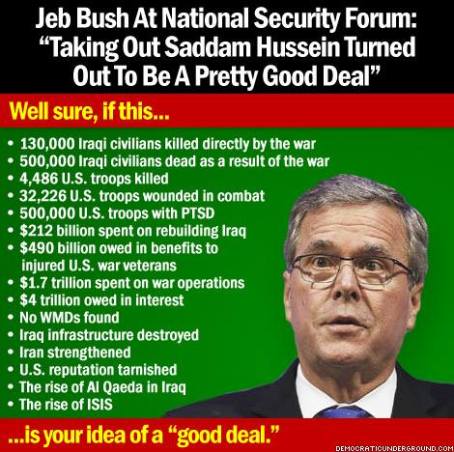
On August 13, speaking at a national security forum in Davenport, Iowa, he defended the unprovoked 2003 invasion of Iraq by his brother, President George W. Bush:

“I’ll tell you though, that taking out Saddam Hussein turned out to be a pretty good deal.”

And he went on to defend the 2007 troop “surge”, calling it “a great success that made Iraq safer.

“I’ve been critical and I think people have every right to be critical of decisions that were made.  In 2009, Iraq was fragile but secure. It was–its mission was accomplished in a way that there was security there.”

(Ironically, the phrase, “its mission was accomplished” proved an embarrassing reminder for the Bush family.

(A banner titled “Mission Accomplished” was displayed on the aircraft carrier USS Abraham Lincoln as George W. Bush announced–wrongly–that the war was over on May 1, 2003.)

Jeb Bush claimed that President Barack Obama had prematurely withdrawn troops from Iraq during his first term, thus allowing ISIS to “fill the void.”

One dissenter to Jeb Bush’s effort to rewrite his brother’s history is David Corn, Washington bureau chief for Mother Jones magazine.

Addressing Bush’s claims on the August 15 edition of The PBS Newshour, he said:

“I mean, I have to laugh a little bit, because I think he was setting a record for chutzpah.

“…It wasn’t until after his brother’s invasion of Iraq that you had something called al-Qaida in Iraq. And that was the group that morphed into ISIS.

“So ISIS is a direct result of the war in Iraq right there. And so he’s wrong on the history.

“But then he said what happened was that Obama and Hillary Clinton orchestrated this quick withdrawal after everything was secure.  Nothing was really secure in 2009-2010.

“…But it was George W. Bush in December 2008 who created the agreement with [Iraqi] Prime Minister [Nouri] [al-]Maliki that said that U.S. troops had to be out by 2011.

“And then Obama didn’t renegotiate that. And there is a lot of question as to whether he could even have, given the political situation in Baghdad itself.

“So Bush is totally–Jeb Bush is totally rewriting this.”

Click here: Brooks and Corn on Cuba as campaign issue

This is no small matter.  George W. Bush’s needless and unprovoked war on Iraq:

  • Cost the lives of 4,486 American soldiers.
  • Wounded another 32,226 troops.
  • Resulted in the deaths of an estimated 655,000 Iraqis.
  • Cost the American treasury at least $2 trillion.
  • Turned up no Weapons of Mass Destruction–Bush’s pretext for going to war.
  • Led to the rise of Al-Qaeda–and later ISIS–in Iraq.
  • Strengthened theocratic Iran by removing its major secularist opponent.

All of which simply proves, once again, that the past is never truly dead. It simply waits to be re-interpreted by each new generation–with some interpretations winding up closer to the truth than others.

Or, in this case, each new Presidential candidate of the Bush family.

ILLEGAL ALIENS = UNRELIABLE ALLIES

In Bureaucracy, History, Law, Law Enforcement, Politics, Social commentary on February 26, 2015 at 3:07 pm

Some Republicans–like Rep. Jason Chaffetz, R-Utah–want their new majorities in the House and Senate to make “producing legislation” a top priority.

But others will soon make the impeachment of President Barack Obama their top priority.

Here’s how it will happen.

“We now have the votes and we have the ability to call the agenda, so stop name-calling and let’s actually produce some legislation that helps jobs and the economy and moves our country forward,” Chaffetz said in an interview after Republicans captured the U.S. Senate on November 4, 2014.

https://www.google.com/imgres?imgurl=http://www.quotessays.com/images/jason-chaffetz-1.jpg&imgrefurl=http://www.quotessays.com/bio/jason-chaffetz.html&docid=3MJFI0cdmEdHuM&tbnid=eN2CsKEX89mpoM:&w=570&h=757&ei=UM5bVLnzIdLdoASoloLgCQ&ved=0CAIQxiAwAA&iact=c

Rep. Jason Chaffetz

“I think the country has figured that out, and they’ve given us the mandate to do it, and we better produce, or they’ll kick us out too.”

Obama has vowed to act unilaterally before year’s end to reduce the number of deportations and grant work permits to millions of illegal aliens living in the United States.

After promising to take executive action on immigration by the end of the summer of 2014, Obama delayed his plans until after the elections.  Democrats–especially Senators from conservative states–had warned him that such administrative moves could threaten their reelection.

https://www.google.com/imgres?imgurl=http://grumpyelder.com/wp-content/uploads/2012/01/illegal-immigrants.jpg&imgrefurl=http://grumpyelder.com/2012/01/the-we-cant-deport-all-12-million-illegal-aliens-scam/&docid=N4ERI9jdeY2G8M&tbnid=P-CXa1aFoyJcLM:&w=500&h=329&ei=BM9bVJrKD4jpoATqmIDwDA&ved=0CAIQxiAwAA&iact=c

Illegal aliens crossing American borders by the millions

But on November 4, most of those Democrats lost anyway, leaving immigration advocates–and their millions of illegal alien constituents–feeling that the delay was needless.

“What I’m not going to do is just wait,” the president said as immigration legislation that the Senate passed in June 2013 remained stalled in the House.

Kentucky’s U.S. Senator Mitch McConnell–who became Senate Majority Leader in January–warned that this would be an in-your-face affront to the new majority GOP:

https://www.google.com/imgres?imgurl=http://s3.amazonaws.com/dk-production/images/14762/large/a302bc9bea18eca2b87cd656e05105cb.jpg?1357627906&imgrefurl=http://kentuckysportsradio.com/main/mitch-mcconnell-is-about-to-come-on-ksr/&docid=UuX87ufrXGUUhM&tbnid=mIFfN17UeL3g3M:&w=512&h=393&ei=yNBbVLzJJsu5ogSEroDQCg&ved=0CAIQxiAwAA&iact=c

Mitch McConnell

“I think the president choosing to do a lot of things unilaterally on immigration would be a big mistake,” McConnell said. “It’s an issue that most of my members want to address legislatively and it’s like waving a red flag in front of a bull to say, ‘If you guys don’t do what I want, I’m going to do it on my own.’ …

“I hope he won’t do that because I do think it poisons the well for the opportunity to address a very important domestic issue.”

To which Obama responded: “I have no doubt that there will be some Republicans who are angered or frustrated by any executive action that I may take.

“Those are folks, I just have to say, who are also deeply opposed to immigration reform in any form and blocked the House from being able to pass a bipartisan bill.”

https://www.google.com/imgres?imgurl=http://a.abcnews.com/images/Politics/abc_obama_specreport_121114_wg.jpg&imgrefurl=http://abcnews.go.com/Politics/OTUS/transcript-obama-press-conference/story?id=17719993&docid=aHyTmgZZkmFu3M&tbnid=d6eKt5qgtY_TPM:&w=640&h=360&ei=ANJbVLDlGIG2oQTWpoGABQ&ved=0CAIQxiAwAA&iact=c

Barack Obama

Republicans could use spending bills to restrict or stop such executive action, by cutting appropriations to those agencies that would be tasked with carrying out Obama’s directives on immigration.

Several Republicans hold the deep-seated view that Obama already has been abusing his constitutional authority.

“Abuse of power” is an impeachable offense under the United States Constitution.  So making this assertion would provide Republicans with the weapon they’ve long sought to drive Obama from the White House.

Republicans, in fact, have a tainted history of using impeachment to remove a President who dared to thwart their agenda.

After the assassination of President Abraham Lincoln, in 1865, Republican President Andrew Johnson tried to carry out Lincoln’s humane policies to reunify the nation after the Civil War.

He issued a series of proclamations directing the former Confederate states to hold conventions and elections to re-form their civil governments. In response, Southern states returned many of their old leaders, and passed Black Codes to deprive freed slaves of many civil liberties.

https://www.google.com/imgres?imgurl=http://www.usnews.com/cmsmedia/48/6360399039911f92c124ef13176dcc/10467FS_DA_090409_worst-johnson.jpg&imgrefurl=http://www.usnews.com/news/history/articles/2007/02/16/worst-presidents-andrew-johnson&docid=SpfOJ2azMoXRhM&tbnid=Zbb7WgUNRBLe8M:&w=300&h=300&ei=XdJbVJDOIoH9oATYjYL4DA&ved=0CAIQxiAwAA&iact=c

Andrew Johnson

Congress refused to seat legislators from those states and advanced legislation to overrule the Southern actions.  Johnson vetoed their bills, and Congress overrode him, setting a pattern until he left the White House in 1869.

As the conflict grew between the executive and legislative branches of government, Congress passed the Tenure of Office Act, restricting Johnson in firing Cabinet officials.  Johnson then tried to fire Secretary of War Edwin Stanton–with whom he had an antagonistic relationship.

An enraged Congress impeached Johnson in the House of Representatives.  He avoided conviction and removal from office in the Senate–by one vote.

If President Obama tries to end-run Congress on immigration policy, history will likely repeat itself with another round of impeachment hearings.

It was Mitch McConnell who infamously vowed–immediately after Obama’s election in 2008–to make him “a one-term President.”

Moreover, there is actually no reason for Obama to risk his Presidency by granting the privileges of American citizenship to millions of illegal aliens.

Democrats–and especially Obama–had counted on millions of illegal aliens to retain Democratic control of the Senate.  But those masses of Hispanic voters never showed up at the polls, thus giving Republicans control of both houses of Congress.

If Obama practiced ruthless “Chicago politics” as charged by his enemies, his response would be: “You [illegal aliens] didn’t live up to your end.  Therefore, I have no further responsibility to you.”

Unfortunately for the President, he seems unable to break with his past of backing unpopular causes for little in return.

SECRET SERVICE: REFORMS URGENTLY NEEDED – PART TWO (END)

In Bureaucracy, History, Law Enforcement, Politics on February 20, 2015 at 12:46 am

The United States Secret Service is an agency in trouble.

  • On September 16, 2014, while on a trip to Atlanta’s Centers for Disease Control and Prevention, President Barack Obama was inside an elevator with a private security contractor who was armed with a pistol.  The Secret Service did not know he was armed until his supervisor, who fired him on the spot, requested his weapon.  A national database check revealed the contractor  had a criminal record with three convictions for assault and battery.
  • On September 27, 2014, an unidentified man posing as a member of Congress made his way into a secure area backstage at a Congressional Black Caucus Foundation awards dinner in Washington, D.C. where Obama was attending.

Asked for Obama’s reaction to a series of Secret Service foulups, White House spokesman Frank Benenati gave this boilerplate reply: “The president has full confidence in the Secret Service and is grateful to the men and women who day in and day out protect himself, his family and the White House.”

But by October 1, then-Director Julia Pierson was forced out of the agency and replaced by an interim director: Joseph Clancy, formerly head of the presidential protection detail.

But the blunt truth is that many of the problems now plaguing the U.S. Secret Service were on full display as early as 2009. That was when well-known investigative reporter Ronald Kessler published his latest book, In the President’s Secret Service.

Kessler had previously pubilshed books outlining the inner workings of the White House, the CIA and the FBI. Kessler praised the courage and integrity of Secret Service agents as a whole.

But he warned that the agency was risking the safety of many of its protectees, including President Obama. He was particularly critical of SS management for such practices as:

  • Shutting off weapon-scanning magnetometers at rallies for Presidential candidates–and even for Presidents George W. Bush and Obama. 
  • During a speech Bush gave at Tbilisi, Georgia in 2005, an assailant threw a live hand grenade–which failed to explode–at him.  
  • Despite 9/11, Secret Service agents are still being trained to expect an attempt by a lone gunman—rather than a professional squad of terrorist assassins.
  • The Service’s Counter Assault Teams (CATs) have generally been cut back from five or six agents to two, rendering them useless if a real attack occurred.
  • Salaries paid to SS agents have not kept pace with reality. Veteran SS men and women are now being offered up to four times their salary for moving to the private sector, and many are leavleaving the agency for that reason.

Secret Service agents protecting President Barack Obama

  • While Congress has greatly expanded the duties of this agency, Secret Service management has not asked for equivalent increases in funding and agents.
  • Many agents are leaving out of frustration that it takes “juice” or connections with top management to advance one’s career.
  • SS agents are being trained with weapons that are outdated (such as the MP5, developed in the 1960s) compared to those used by other law enforcement agencies and the potential assassins they face (such as the M4–with greater range and armor-piercing capabilities).
  • The Service refuses to ask for help from other agencies to meet its manpower needs. Thus, a visiting head of state at the U.N. General Assembly will usually be assigned only three agents as protection.
  • The agency tells agents to grade themselves on their physical training test forms. 
  • Agents are supposed to be evaluated on their marksmanship skills every three months.  But some agents have gone more than a year without being tested.
  • Some agents are so overweight they can’t meet the rigorous demands of the job.  As a result, they pose a danger to the people they’re supposed to be protecting.
  • The Secret Service inflates its own arrest statistics by claiming credit for arrests made by local police.
  • Congressional members who visit the agency’s James Rowley Training Center in Laurel, Maryland, are treated to rehearsed scenarios of how the agency would deal with attacks.  If agents were allowed to perform these exercises without rehearsals, Congress members would see they can and do make mistakes like everyone else.

Kessler closes his book with the warning: “Without….changes, an assassination of Barack Obama or a future president is likely.

“If that happens, a new Warren Commission will be appointed to study the tragedy. It will find that the Secret Service was shockingly derelict in its duty to the American people and to its own elite corps of brave and dedicated agents.”

And the effects will be not only momentary but long-term.  As Kessler writes: “By definition, an assassination threatens democracy.

“If Abraham Lincoln had not been assassinated, Andrew Johnson, his successor, would not have been able to undermine Lincoln’s efforts to reunite the nation and give more rights to blacks during the Reconstruction period.

“If John F. Kennedy had not been assassinated, Lyndon Johnson likely never would have become President.  If Robert F. Kennedy had not been killed and had won the presidency, Richard Nixon might never have been elected.”