Posts Tagged ‘2016 PRESIDENTIAL RACE’
2016 PRESIDENTIAL RACE, ABC NEWS, ABRAHAM LINCOLN, ALTERNET, AMERICABLOG, AP, BABY BOOMER RESISTANCE, BARACK OBAMA, BBC, BLOOMBERG NEWS, BUZZFEED, CBS NEWS, CIVIL RIGHTS ACT OF 1964, CIVIL WAR, CNN, CROOKS AND LIARS, DAILY KOS, DANIEL DAY-LEWIS, DONALD TRUMP, EMANCIPATION PROCLAMATION, FACEBOOK, FIVETHIRTYEIGHT, HARPER’S MAGAZINE, HUFFINGTON POST, LYNDON B. JOHNSON, MEDIA MATTERS, MITT ROMNEY, MOTHER JONES, MOVEON, MOVIES, MSNBC, NBC NEWS, NEW REPUBLIC, NEWSDAY, NEWSWEEK, NPR, PBS NEWSHOUR, POLITICO, POLITICUSUSA, RAW STORY, REUTERS, SALON, SEATTLE TIMES, SLATE, SLAVERY, STEVEN SPIELBERG, TALKING POINTS MEMO, THE ATLANTIC, THE CHICAGO SUN-TIMES, THE CHICAGO TRIBUNE, THE DAILY BEAST, THE DAILY BLOG, THE GUARDIAN, THE HILL, THE HUFFINGTON POST, THE INTERCEPT, THE LOS ANGELES TIMES, THE NATION, THE NEW REPUBLIC, THE NEW YORK TIMES, THE NEW YORKER, THE VILLAGE VOICE, THE WASHINGTON POST, THINKPROGRESS, THIRTEENTH AMENDMENT, TIME, TRUTHDIG, TRUTHOUT, TWITTER, U.S. NEWS & WORLD REPORT, UPI, VOTER ID LAWS, VOTING RIGHTS ACT OF 1965
In Bureaucracy, Entertainment, History, Law, Military, Politics, Social commentary on March 17, 2016 at 12:36 pm
Steven Spielberg’s Lincoln is more than a mesmerizing history lesson.
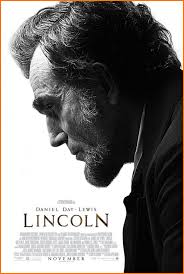
It’s a timely reminder that racism and repression are not confined to any one period or political party.
At the heart of the film: Abraham Lincoln (Daniel Day-Lewis) wants to win ratification of what will be the Thirteenth Amendment to the United States Constitution. An amendment that will forever ban slavery.
True, Lincoln, in 1862, had issued the Emancipation Proclamation. This—in theory—freed slaves held in the Confederate states that had seceded from the Union in 1861.
But Lincoln regards this as a temporary wartime measure. He fears that once the war ends, the Supreme Court may rule the Proclamation unconstitutional. This might allow Southerners to continue practicing slavery, even after losing the war.
To prevent this, Congress must pass an anti-slavery amendment.
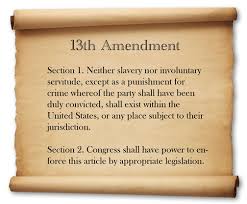
But winning Congressional passage of such an amendment won’t be easy.
The Senate had ratified its passage in 1864. But the amendment must secure approval from the House of Representatives to become law.
And the House is filled with men–there are no women menmbers during the 19th century–who seethe with hostility.
Some are hostile to Lincoln personally. One of them dubs him a dictator–Abraham Africanus.” Another accuses him of shifting his positions for the sake of expediency.
Other members–white men all–are hostile to the idea of “equality between the races.” To them, ending slavery means opening the door to interracial marriage–especially marriage between black men and white women.
Perhaps even worse, it means possibly giving blacks–or women–the the right to vote.
In fact, the possibility that blacks might win voting rights arises early in the movie. Lincoln is speaking to a couple of black Union soldiers, and one of them is unafraid to voice his discontent. He’s upset that black soldiers are paid less than white ones–and that they’re led only by white officers.
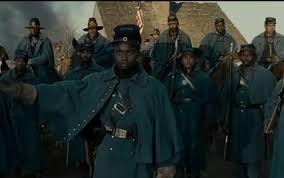
He says that, in time, maybe this will change. Maybe, in 100 years, he guesses, blacks will get the right to vote.
(To the shame of all Americans, that’s how long it will eventually take. Not until the passage of the Voting Rights Act of 1965 will blacks be guaranteed legal protection against discriminatory voting practices.)
To understand the Congressional debate over the Thirteenth Amendment, it’s necessary to remember this: In Lincoln’s time, the Republicans were the party of progressives.
The party was founded on an anti-slavery platform. Its members were thus reviled as “Black Republicans.” And until the 1960s, the South was solidly Democratic.
Democrats were the ones defending the status quo–slavery–and opposing freed blacks in the South of Reconstruction and long afterward.
In short, in the 18th century, Democrats in the South acted as Republicans do now. The South went Republican only after a Democratic President–Lyndon B. Johnson–rammed the Civil Rights Act of 1964 through Congress.
Watching this re-enactment of the 1865 debate in Lincoln is like watching the current Presidential campaign. The same mentalities are at work:
-
Those (in this case, slave-owners) who already have a great deal want to gain even more at the expense of others.
-
Those (slaves and freed blacks) who have little strive to gain more or at least hang onto what they have.
-
Those who defend the privileged wealthy refuse to allow their “social inferiors” to enjoy similar privileges (such as the right to vote).
During the 2012 Presidential race, Republicans tried to bar those likely to vote for President Barack Obama from getting into the voting booth. But their bogus “voter ID” restrictions were struck down in courts across the nation.
Listening to those opposing the amendment, one is reminded of Mitt Romney’s infamous comments about the “47%”:
“Well, there are 47% of the people who will vote for the president no matter what….
“Who are dependent upon government, who believe that–that they are victims, who believe that government has a responsibility to care for them, who believe that they’re entitled to healthcare, to food, to housing, to you name it. But that’s–it’s an entitlement. And the government should give it to them.”
Put another way: “Who says people have a right to obtain medical care, food and housing? If they can’t inherit unearned wealth the way I did, screw them.”
In the end, it’s Abraham Lincoln who has the final word–and leaves his nation the better for it. Through diplomacy and backroom dealings (trading political offices for votes) he wins passage of the anti-slavery amendment.
The ownership of human chattel is finally an ugly memory of the American past.
The movie closes with a historically-correct tribute to Lincoln’s generosity toward those who opposed him–in Congress and on the battlefield. It occurs during Lincoln’s Second Inaugural Address:
“With malice toward none, with charity for all….To bind up the nation’s wounds. To care for him who shall have bourne the battle, and for his widow and his orphan….”
This ending presents a vivid philosophical contrast with the increasingly mean-spirited rhetoric and policies of 2016’s Republican candidates for President–especially those of Donald Trump.
Watching Lincoln, you realize how incredibly lucky America was as a nation to have had such leadership when it was most urgently needed.
.
2000 PRESIDENTIAL RACE, 2012 PRESIDENTIAL RACE, 2016 PRESIDENTIAL RACE, ABC NEWS, AL GORE, BARACK OBAMA, CBS NEWS, CNN, DONALD TRUMP, ELECTORAL COLLEGE, FACEBOOK, GEORGE ORWELL, GEORGE W. BUSH, MARCO RUBIO, MEXICANS, MITT ROMNEY, MUSLIMS, NBC NEWS, NINETEEN-EIGHT-FOUR, POW'S, RAFAEL CRUZ, REPUBLICAN PARTY, THE CHICAGO SUN-TIMES, THE CHICAGO TRIBUNE, THE LOS ANGELES TIMES, THE WASHINGTON POST, TWITTER
In Bureaucracy, Business, History, Politics, Social commentary on March 9, 2016 at 2:14 pm
The Donald Trump-Mitt Romney bromance began with an insult, courtesy of Trump:
“He’d buy companies, he’d close companies. He’d get rid of jobs. I’ve built a great company. I’m a much bigger businessman and have a much, much bigger net worth. I mean, my net worth is many, many, many times Mitt Romney.”
Then Trump had a change of heart: “Mitt is tough. He’s smart. He’s sharp. He’s not going to allow bad things to continue to happen to this country that we all love. So, Governor Romney, go out and get ’em. You can do it.”
And Romney swooned with delight: “I’m so honored to have his endorsement. There are some things that you just can’t imagine in your life. This is one of them.”
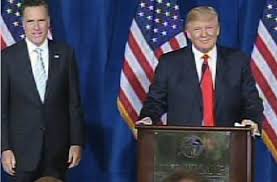
Mitt Romney and Donald Trump
But now the bromance is over, courtesy of a rousing, anti-Trump speech given by Romney at the University of Utah:
“Mr. Trump is directing our anger for less than noble purposes. He creates scapegoats of Muslims and Mexican immigrants, he calls for the use of torture and for killing the innocent children and family members of terrorists. He cheers assaults on protesters.
“He applauds the prospect of twisting the Constitution to limit First Amendment freedom of the press. This is the very brand of anger that has led other nations into the abyss.”
So how is Trump taking all this? “I don’t know what happened to him. You can see how loyal he is.
“He was begging for my endorsement. I could have said ‘Mitt, drop to your knees.’ He would have dropped to his knees.”
Fortunately for Trump, as his bromance with Romney has ended, another has emerged–with New Jersey Governor Chris Christie.
On February 26, Christie through his (political) weight behind Trump at a hastily-announced press conference in Fort Worth, Texas.
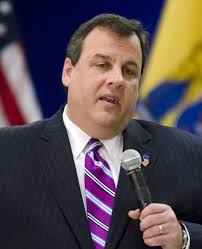
Chris Christie
Christie had not always been on such wonderful terms with the egocentric businessman. In fact, for months, the two had been rivals for the Presidency.
In a January speech before the New Hampshire primary, Christie said:
“Showtime is over. We are not electing an entertainer-in-chief. Showmanship is fun, but it is not the kind of leadership that will truly change America….
“If we are going to turn our frustration and anger with the D.C. insiders, the politicians of yesterday and the carnival barkers of today into something that will actually change American lives for the better, we must elect someone who has been tested.”
Then, without warning, Christie announced a sudden change of mind at a press conference in Fort Worth, Texas.
The previous night, Trump had been mauled by a surprisingly aggressive Marco Rubio during a CNN-hosted debate among the Presidential candidates. As a result, reporters gasped when Christie endorsed Trump and attacked Rubio:
“Part of his talking points now is to be entertaining and smile a lot now. Listen, it’s one act after another.”
Christie obviously felt it necessary to explain why he had gone from attacking Trump to promoting him:
“As a Republican I feel strongly about making sure that [Democratic front-runner] Hillary Clinton does not become president of the United states, and I believe Donald Trump is the best person–of those remaining–to do that.”
As for the attack made on Trump by former Massachusetts Governor Mitt Romney:
“I understand the things that Gov. Romney is saying, and he’s objected to. That’s his opinion, and I respect him as I always have, and he’s welcome to his view. I just happen to disagree with the conclusion that he comes to.”
By endorsing Trump, Christie became the first major establishment figure to validate the fitness of the former “reality TV star” to serve as President.
Considering Trump’s remaining opponents, it was not hard for Christie to reach that conclusion.
Texas United States Senator Rafael Cruz is an ideologue–and totally opposed to the pragmatic approach Christie brings to politics. And Christie genuinely dislikes Rubio.
In addition, Christie believed that Ohio Governor John Kasich–a moderate by Republican standards–could never secure his party’s Presidential nomination.
Ditto for neurosurgeon Ben Carson, who apparently believed his Right-wing party would elect another black man to succeed President Obama.
As for Trump: “This was an endorsement that really meant a lot. Chris is an outstanding man with an outstanding family, and this is the one endorsement that I’m really happy to get.”
While Christie and Trump share an innate aggressiveness and willingness to bully, that is not all they share.
In Never Enough, auhor Michael D’Antonio portrays Trump as a man with an insatiable appetite for wealth, attention, power, and conquest. The same can be said of Christie.
By taking on the role of Trump’s attack dog, Christie positions himself for the same role as vice presidential nominee. Or for a position such as Attorney General or Secretary of Homeland Security.
For those wishing to understand the realities of American political leaders, the best insight comes in a song popularized in George Orwell’s novel, 1984:
Under the spreading chestnut tree
I sold you and you sold me:
There lie they, and here lie we
Under the spreading chestnut tree.
2000 PRESIDENTIAL RACE, 2012 PRESIDENTIAL RACE, 2016 PRESIDENTIAL RACE, ABC NEWS, AL GORE, BARACK OBAMA, BLACKS, CBS NEWS, CHRIS CHRISTIE, CNN, DONALD TRUMP, ELECTORAL COLLEGE, FACEBOOK, GEORGE ORWELL, GEORGE W. BUSH, MARCO RUBIO, MEXICANS, MITT ROMNEY, MUSLIMS, NBC NEWS, NINETEEN-EIGHTY-0FOUR, POW'S, RAFAEL CRUZ, REPUBLICAN PARTY, THE CHICAGO SUN-TIMES, THE CHICAGO TRIBUNE, THE LOS ANGELES TIMES, THE NEW YORK TIMES, THE WASHINGTON POST, TWITTER
In Bureaucracy, Business, History, Politics, Social commentary on March 8, 2016 at 12:17 am
During the 2012 Presidential campaign, Donald Trump endorsed Mitt Romney as the Republican nominee to defeat President Barack Obama.
But that was before Trump decided to run for President in 2016. And the relationship between Trump and Romney has taken a considerably different turn.
On June 16, 2015, Trump declared his candidacy for the 2016 Republican Presidential nomination. Since then, he has been the first choice among the Republican base.
At first, he was dismissed as a bad joke–by Republican Presidential candidates as well as Democrats. Surely voters would reject a bombastic, thrice-married “reality show” host who had filed for corporate bankruptcy four times.
Yet from the outset Trump dominated the field–and a series of Republican debates. The other Republican candidates watched him with envy–and desperately tried to steal some of his limelight.
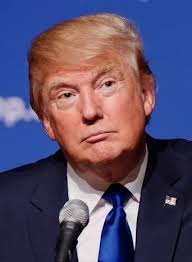
Donald Trump
Making one inflammatory statement after another, he offended one group of potential voters after another. These insults delighted his white, under-educated followers. But they alienated millions of other Americans who might have voted for him.
Among these:
- Mexicans: “They’re bringing drugs. They’re bringing crime. They’re rapists.” He’s also promised to “build a great, great wall on our southern border and I will have Mexico pay for that wall.”
- Blacks: Trump retweeted an image of a masked, dark-skinned man with a handgun and a series of alleged crime statistics, including: “Blacks killed by whites – 2%”; “Whites killed by blacks – 81%.” The image cites the “Crime Statistics Bureau – San Francisco”–an agency that doesn’t exist.
- Illegal Aliens: Trump has threatened to forcibly deport millions of mostly Mexican and Central American residents.
- Muslims: Trump has boasted he would ban them from entering the United States–and revive waterboarding of terrorist suspects. He would require Muslims to register with the Federal Government. And he would close “some mosques” if he felt they were being used by Islamic terrorists.
- POWs: Speaking of Arizona U.S. Senator John McCain: “He’s a war hero because he was captured. I like people who weren’t captured.” [Trump avoided military service–and Vietnam]
Many Republican members of Congress share–privately–Trump’s views on Hispanics, blacks and Muslims. But they realize that giving voice to such opinions can be politically suicidal.
Increasingly, the Republican party has become the bastion of aging white males. Even former President George W. Bush worked to win over Hispanics as Republican voters.
But the party’s increasingly strident anti-immigration rhetoric has alienated millions of Hispanics. And its open contempt for the nation’s first black President drove millions of blacks to the polls, where they handed Obama the White House–first in 2008, and again in 2012.
As a result, many Republicans now fear that Trump will gain their party’s Presidential nomination–and then lose in November, most likely to Hillary Clinton.
Even worse from their perspective: He might cost Republicans–who now dominate the House of Representatives and the Senate–one or both legislative bodies.
So many Republicans are now desperately trying to deny Trump the nomination. And one of these is Mitt Romney–the man Trump endorsed in 2012 as the best candidate to remove Obama from the White House.
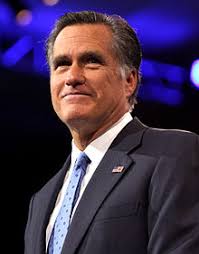
Mitt Romney
On March 3, in a speech at the University of Utah, Romney outlined why a Trump Presidency would be a disaster for the nation (not to mention the Republicans).
Among his comments:
“If we Republicans choose Donald Trump as our nominee, the prospects for a safe and prosperous future are greatly diminished….
“If Donald Trump’s plans were ever implemented, the country would sink into prolonged recession….
“Donald Trump is a phony, a fraud. His promises are as worthless as a degree from Trump University….
“But you say, wait, wait, wait, isn’t he a huge business success? Doesn’t he know what he’s talking about? No, he isn’t and no he doesn’t.
“Look, his bankruptcies have crushed small businesses and the men and women who work for them. He inherited his business, he didn’t create it.
“And whatever happened to Trump Airlines? How about Trump University? And then there’s Trump Magazine and Trump Vodka and Trump Steaks and Trump Mortgage. A business genius he is not….
“Now let me turn to national security and the safety of our homes and loved ones. Mr. Trump’s bombast is already alarming the allies and fueling the enmity of our enemies.
“Insulting all Muslims will keep many of them from fully engaging with us in the urgent fight against ISIS, and for what purpose? Muslim terrorists would only have to lie about their religion to enter the country….
“Now, I’m far from the first to conclude that Donald Trump lacks the temperament to be president.
“After all, this is an individual who mocked a disabled reporter, who attributed a reporter’s questions to her menstrual cycle, who mocked a brilliant rival who happened to be a woman due to her appearance, who bragged about his marital affairs, and who laces his public speeches with vulgarity.
“Donald Trump says he admires Vladimir Putin, at the same time he has called George W. Bush a liar. That is a twisted example of evil trumping good.”
Thus Mitt Romney on the man who once endorsed him for President. In the next column, we’ll see what Trump thinks of the man he once endorsed for President.
2000 PRESIDENTIAL RACE, 2012 PRESIDENTIAL ELECTION, 2016 PRESIDENTIAL RACE, ABC NEWS, AL GORE, BARACK OBAMA, BLACKS, CBS NEWS, CHRIS CHRISTIE, CNN, DONALD TRUMP, ELECTORAL COLLEGE, FACEBOOK, GEORGE ORWELL, GEORGE W. BUSH, MARCO RUBIO, MEXICANS, MITT ROMNEY, MUSLIMS, NBC NEWS, NINETEEN-EIGHTY-FOUR, POW'S, RAFAEL CRUZ, REPUBLICAN PARTY, THE CHICAGO SUN-TIMES, THE CHICAGO TRIBUNE, THE LOS ANGELES TIMES, THE NEW YORK TIMES, THE WASHINGTON POST, TWITTER
In Bureaucracy, Business, History, Politics, Social commentary on March 7, 2016 at 12:23 am
In 2011, Donald Trump, the egocentric businessman and “reality star” of NBC’s “The Apprentice,” was toying with the idea of running for President in 2012.
On April 17, 2011, Trump said this about Mitt Romney, a possible rival and the former Massachusetts governor and front-runner GOP candidate:
“He’d buy companies, he’d close companies. He’d get rid of jobs. I’ve built a great company. I’m a much bigger businessman and have a much, much bigger net worth. I mean, my net worth is many, many, many times Mitt Romney.
“Mitt Romney is a basically small-business guy, if you really think about it. He was a hedge fund. He was a funds guy. He walked away with some money from a very good company that he didn’t create. He worked there. He didn’t create it.”
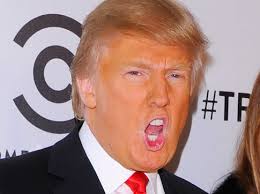
Donald Trump
Trump added that Bain Capital, the hedge fund where Romney made millions of dollars before running for governor, didn’t create any jobs. Whereas Trump claimed that he–Trump–had created “hundreds of thousands of jobs.”
So at least some observers must have been puzzled when Trump announced, on February 2, 2012: “It’s my honor, real honor and privilege, to endorse Mitt Romney” for President.
“Mitt is tough. He’s smart. He’s sharp. He’s not going to allow bad things to continue to happen to this country that we all love. So, Governor Romney, go out and get ’em. You can do it,” said Trump.
And Romney, in turn, had his own swooning-girl moment:
“I’m so honored to have his endorsement. There are some things that you just can’t imagine in your life. This is one of them.”
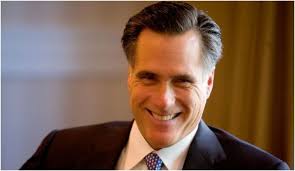
Mitt Romney
Throughout the 2012 Presidential race, Trump continued to “help” Romney–by repeatedly accusing President Barack Obama of not being an American citizen.
Had that been true, Obama would not have had the right to be President–since the Constitution says that only an American citizen can hold this position.
Of course, that was entirely what Trump wanted people to believe– that Obama was an illegitimate President, and deserved to be thrown out.
Come election night–and disaster for Romney–and Trump.
When it became clear that Romney was not going to be America’s 45th President, Trump went ballistic on Twitter.
Among his tweets:
- More votes equals a loss…revolution!
- Lets fight like hell and stop this great and disgusting injustice! The world is laughing at us.
- We can’t let this happen. We should march on Washington and stop this travesty. Our nation is totally divided!
- The phoney electoral college made a laughing stock out of our nation. The loser one!
- He lost the popular vote by a lot and won the election. We should have a revolution in this country!
To put Trump’s rants into real-world perspective:
According to Trump, the electoral process works when a Republican wins the Presidency. It only doesn’t work when a Democrat wins.
“We should march on Washington” conjures up images of another Fascist–Benito Mussolini–marching on Rome at the head of his Blackshirts to seize power.
“The phoney electoral college made a laughing stock out of our nation. The loser one!”
This is startling, on three counts:
First, the 2012 Republican Platform spoke lovingly about the need for preserving the Electoral College: “We oppose the National Popular Vote Interstate Compact or any other scheme to abolish or distort the procedures of the Electoral College.
“We recognize that an unconstitutional effort to impose ‘national popular vote’ would be a mortal threat to our federal system and a guarantee of corruption as every ballot box in every state would become a chance to steal the presidency.”
Second, the loser didn’t win: He lost. With votes still being counted (as of November 8) Obama got 60,652,238. Romney got 57,810,407.
Third, in 2000, Al Gore won the popular vote (50,999,897) to George W. Bush’s 50,456,002. But Bush trounced Gore in the Electoral College (271 to 266).
Still, that meant Bush–not Gore–would head the country for the next eight years. And that was perfectly OK with Right-wingers like Trump.
It was only when Obama won the Electoral College count by 332 to 206 that this was–according to Trump–a “travesty.”
And Trump’s solution if voters dare to elect someone other than Trump’s pet choice: “Revolution!”
This comes perilously close to advocating violent overthrow of the government. Otherwise known as treason–a crime traditionally punished by execution, or at least lengthy imprisonment.

Fast forward, to 2016–and the relationship between Trump and Romney looks considerably different.
On June 16, 2015, Trump declared his candidacy for the 2016 Republican Presidential nomination. Since then, he has been the first choice among the Republican base.
At first, he was dismissed as a bad joke–by Republican Presidential candidates as well as Democrats. Surely voters would reject a bombastic, thrice-married “reality show” host who had filed for corporate bankruptcy four times.
Yet from the outset Trump dominated the field–and a series of Republican debates. The other Republican candidates watched him with envy–and desperately tried to steal some of his limelight.
Making made one inflammatory statement after another, he offended one group of potential voters after another.
These insults delighted his white, under-educated followers. But they alienated millions of other Americans who might have voted for him.
2016 PRESIDENTIAL RACE, ABC NEWS, ADOLF HITLER, ALTERNET, AMERICABLOG, AP, BABY BOOMER RESISTANCE, BBC, BLACKS, BLOOMBERG NEWS, BUZZFEED, CBS NEWS, CLAUS VON STAUFFENBERG, CNN, CROOKS AND LIARS, DAILY KOS, DONALD TRUMP, FACEBOOK, FIVETHIRTYEIGHT, GEORGE C. WALLACE, HARPER’S MAGAZINE, HUEY LONG, HUFFINGTON POST, ILLEGAL ALIENS, JOHN KASICH, LATINOS, MARTIN NIEMOELLER, MEDIA MATTERS, MOTHER JONES, MOVEON, MSNBC, MUSLIMS, NAZI GERMANY, NBC NEWS, NEW REPUBLIC, NEWSDAY, NEWSWEEK, NPR, PBS NEWSHOUR, POLITICO, POLITICUSUSA, RAW STORY, REUTERS, ROBERT PAYNE, Ronald Reagan, SALON, SEATTLE TIMES, SLATE, SS, TALKING POINTS MEMO, THE ATLANTIC, THE CHICAGO SUN-TIMES, THE CHICAGO TRIBUNE, THE DAILY BEAST, THE DAILY BLOG, THE GUARDIAN, THE HILL, THE HUFFINGTON POST, THE INTERCEPT, THE LIFE AND DEATH OF ADOLF HITLER, THE LOS ANGELES TIMES, THE NATION, THE NEW REPUBLIC, THE NEW YORK TIMES, THE NEW YORKER, THE VILLAGE VOICE, THE WASHINGTON POST, THINKPROGRESS, TIME, TRUTHDIG, TRUTHOUT, TWILIGHT ZONE, TWITTER, U.S. NEWS & WORLD REPORT, UPI, WORLD WAR 11
In Bureaucracy, History, Military, Politics, Social commentary on March 2, 2016 at 12:02 am
On July 20, 1944, Colonel Claus Schenk von Stuaffenberg failed to assassinate Adolf Hitler with a bomb hidden in a briefcase.
He had carefully placed his briefcase near Hitler, who was standing next to a heavy oaken support of the conference table.
But after Stauffenberg left the room, Colonel Heinz Brandt, who stood next to Hitler, found the briefcase blocking his legs.
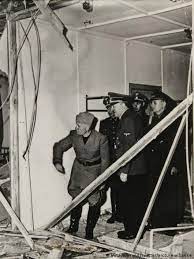
Hitler shows off the site of the explosion
So he moved it–to the other side of the heavy oaken support. When the bomb exploded, Hitler was partially shielded from its full blast. Brandt died, as did two other officers and a stenographer.
Not only did Hitler survive, but the plotters failed to seize the key broadcast facilities of the Reich.
This allowed Hitler to make a late-night speech to the nation, revealing the failed plot and assuring Germans that he was alive. And he swore to flush out the “traitorous swine” who had tried to kill him.
Among the first victims was the conspiracy’s leader, Colonel Claus von Stauffenberg. Standing before a makeshift firing squad at midnight, he cried: “Long live our sacred Germany!”
At least 7,000 persons were arrested by the Gestapo. According to records of the Fuehrer Conferences on Naval Affairs, 4,980 were executed.
If the conspiracy had succeeded and Germany had surrendered in July or August, 1944, World War II would have ended eight to nine months earlier. This would have meant:
- The Russians–who didn’t reach Germany until April, 1945–could not have occupied the Eastern part of the country.
- Millions of East Germans would have been spared the misery of living under Communist rule for 44 years.
- Many of the future conflicts between the United States and the Soviet Union over access to West Berlin and/or West Germany would have been prevented.
- Untold numbers of Holocaust victims would have survived because the concentration camps would have been shut down far earlier.
Thus, history can be altered by the appearance–or disappearance–of a single individual.
Which brings us back to Donald Trump.
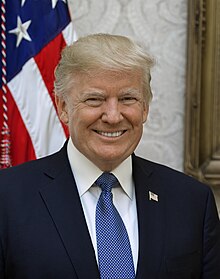
Donald Trump
Since declaring his candidacy for the Presidency on June 16, 2015, Trump has been the first choice among the Republican base.
At first, he was dismissed as a bad joke–by Republican Presidential candidates as well as Democrats. Surely voters would reject an egotistical, thrice-married, “reality show” host who had filed for corporate bankruptcy four times.
Yet from the outset Trump dominated the field–and a series of Republican debates. His fellow Republican candidates enviously watched him–and desperately tried to steal some of his limelight.
Making made one inflammatory statement after another, he offended one group of potential voters after another:
- Mexicans: “They’re bringing drugs. They’re bringing crime. They’re rapists.” He’s also promised to “build a great, great wall on our southern border and I will have Mexico pay for that wall.”
- Blacks: Trump retweeted an image of a masked, dark-skinned man with a handgun and a series of alleged crime statistics, including: “Blacks killed by whites – 2%”; “Whites killed by blacks – 81%.” The image cites the “Crime Statistics Bureau – San Francisco”–an agency that doesn’t exist.
- Illegal Aliens: Trump has threatened to forcibly deport millions of mostly Mexican and Central American residents.
- Muslims: Trump has boasted he would ban them from entering the United States–and revive waterboarding of terrorist suspects. He would require Muslims to register with the Federal Government. And he would close “some mosques” if he felt they were being used by Islamic terrorists.
- POWs: Speaking of Arizona U.S. Senator John McCain: “He’s a war hero because he was captured. I like people who weren’t captured.”
Niccolo Machiavelli, the father of modern politics, warned against hurling threats and insults: “For neither the one nor the other diminishes the strength of the enemy.
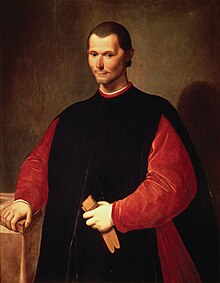
 Niccolo Machiavelli
“[Threats make] him more cautious, and [insults increase] his hatred of you, and [make] him more persevering in his efforts to injure you.”
But Trump revels in insulting anyone who dares to challenge him. He gleefully warns of the damage he will soon inflict on those who dare to oppose–or even criticize–him.
At the same time, he publicly exposes himself to a potential assassin virtually every day. And the mere presence of bodyguards is no guarantee against assassination.
Presidential candidate George C. Wallace was shot and paralyzed by a gunman while mingling with supporters in a Maryland shopping center in 1972. And President Ronald Reagan was shot and almost killed in 1981 while walking to his bulletproof limousine in Washington, D.C.
Both men were under protection by the U.S. Secret Service at the time.
* * * * *
In his bestselling 1973 biography, The Life and Death of Adolf Hitler, British historian Robert Payne harshly condemned the German people for the rise of the Nazi dictator:
“[They] allowed themselves to be seduced by him and came to enjoy the experience….[They] followed him with joy and enthusiasm because he gave them license to pillage and murder to their hearts’ content.”
There is a very real danger that millions of ignorant, hate-filled, Right-wing Americans will catapult Donald Trump–a man with an “odd psychology unleavened by kindness and charity”–into the Presidency.
And that this man–“who received no love, can give no love”–will assume all the awesome power that goes with that office.
If that happens, future historians–if there are any–may similarly condemn those Americans who stood by like “good Germans” and allowed their country to fall into the hands of a ruthless tyrant.
2016 PRESIDENTIAL RACE, ABC NEWS, ADOLF HITLER, ALTERNET, AMERICABLOG, AP, BABY BOOMER RESISTANCE, BBC, BLACKS, BLOOMBERG NEWS, BUZZFEED, CBS NEWS, CLAUS VON STAUFFENBERG, CNN, CROOKS AND LIARS, DAILY KOS, DONALD TRUMP, FACEBOOK, FIVETHIRTYEIGHT, GEORGE C. WALLACE, HARPER’S MAGAZINE, HUEY LONG, HUFFINGTON POST, ILLEGAL ALIENS, JOHN KASICH, LATINOS, MARTIN NIEMOELLER, MEDIA MATTERS, MOTHER JONES, MOVEON, MSNBC, MUSLIMS, NAZI GERMANY, NBC NEWS, NEW REPUBLIC, NEWSDAY, NEWSWEEK, NPR, PBS NEWSHOUR, POLITICO, POLITICUSUSA, RAW STORY, REUTERS, ROBERT PAYNE, Ronald Reagan, SALON, SEATTLE TIMES, SLATE, SS, TALKING POINTS MEMO, THE ATLANTIC, THE CHICAGO SUN-TIMES, THE CHICAGO TRIBUNE, THE DAILY BEAST, THE DAILY BLOG, THE GUARDIAN, THE HILL, THE HUFFINGTON POST, THE INTERCEPT, THE LIFE AND DEATH OF ADOLF HITLER, THE LOS ANGELES TIMES, THE NATION, THE NEW REPUBLIC, THE NEW YORK TIMES, THE NEW YORKER, THE VILLAGE VOICE, THE WASHINGTON POST, THINKPROGRESS, TIME, TRUTHDIG, TRUTHOUT, TWILIGHT ZONE, TWITTER, U.S. NEWS & WORLD REPORT, UPI, WORLD WAR ii
In Bureaucracy, History, Military, Politics, Social commentary on February 29, 2016 at 10:31 am
“When Fascism comes to America, it will be called anti-Fascism.”
–Huey Long, Louisiana Governor/Senator
In the “Twilight Zone” episode, “No Time Like the Past,” Paul Driscoll (Dana Andrews), a scientist in early 1960s America, uses a time machine to visit Nazi Germany on the eve of World War II.
He’s rented a motel room overlooking the balcony from where the Fuehrer, Adolf Hitler will soon make a speech. And he’s eager to watch that speech–through the lens of a telescopic-sighted rifle.
Just as he’s about to pull the trigger, there’s a knock at his door–by the maid. Driscoll hustles her out as soon as possible, then once again picks up his rifle. He–and viewers–can once again see Hitler through the cross-hairs of his weapon.
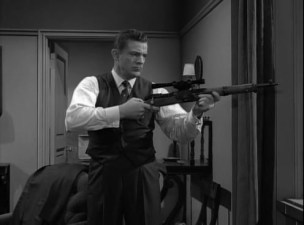
Paul Driscoll prepares to shoot Adolf Hitler
But instead of the anticipated shot, there’s another knock at his door–this time by the black-uniformed secret police, the SS. Driscoll knows the game is over, and disappears into the present just as the thugs break down his door.
And the audience is left to ponder how different the world would have been if Driscoll–or someone in Nazi Germany–had succeeded in assassinating the man whose wars would wipe out the lives of 50 million men, women and children around the globe.
At least one Republican candidate for President has dared to invoke the past of Nazi Germany in warning of the dangers of a Donald Trump Presidency. And to argue that Americans have a chance to prevent that past from returning.
In November, 2015, John Kasich, the governor of Ohio, was peddling a message of creating jobs, balancing the Federal budget and disdain for Washington, D.C.
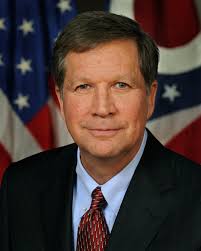
John Kasich
But he remained far behind in the polls, dropping 50% in support in just one month–from September to October. Meanwhile, Trump, the New York billionaire developer, was being backed by 25% of Republican primary voters.
So, with nothing to lose, Kasich decided to take off the gloves. He invoked the “N” word for Republicans: Nazi.
He authorized the creation of a TV ad that opened with ominous music–and the face of a snarling Donald Trump.
“I would like anyone who is listening to consider some thoughts that I’ve paraphrased from the words of German pastor Martin Niemoeller.”
The voice belonged to Tom Moe, a retired colonel in the U.S. Air Force–and a former Vietnam prisoner-of-war.
“You might not care if Donald Trump says Muslims must register with the government, because you’re not one,” continued Moe.
“And you might not care if Donald Trump says he’s going to round up all the Hispanic immigrants, because you’re not one.
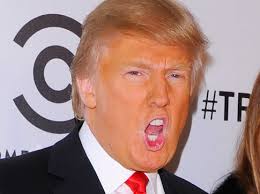
Donald Trump
“And you might not care if Donald Trump says it’s OK to rough up black protesters, because you’re not one.
“And you might not care of Donald Trump wants to suppress journalists, because you’re not one.
“But think about this:
“If he keeps going, and he actually becomes President, he might just get around to you. And you’d better hope that there’s someone left to help you.”
Martin Niemoeller (1892–1984) was a prominent Protestant pastor who had commanded a U-boat during World War 1. He became a bitter public foe of Adolf Hitler.
A staunch anti-Communist, he had initially supported the Nazis as Germany’s only hope of salvation against the Soviet Union.
But when the Nazis made the church subordinate to State authority, Niemoeller created the Pastors’ Emergency League to defend religious freedom.
For his opposition to the Third Reich, Niemoeller spent seven years in concentration camps.
With the collapse of the Reich in 1945, he was freed–and elected President of the Protestant church in Hesse and Nassau in 1947. During the 1960s, he was a president of the World Council of Churches.
He is best remembered for his powerful condemnation of the failure of Germans to protest the increasing oppression of the Nazis:
First they came for the Communists, but I was not a Communist, so I did not speak out.
Then they came for the Socialists, but I was not a Socialist, so I did not speak out.
Then they came for the trade unionists, but I was not a trade unionist, so I did not speak out.
Then they came for the Jews, but I was not a Jew, so I did not speak out.
And when they came for me, there was no one left to speak out for me.
Neither “Adolf Hitler” nor “Nazi Party” was mentioned during the one-minute Kassich video. But a furious Trump threatened to sue Kasich if he could find find anything “not truthful” within the ad.
So said the man who has called Mexican immigrants “rapists” and accused President Barack Obama of being a Muslim and an illegal alien.
The Kasich ad is by far the darkest attack so far made against Trump by any candidate–Republican or Democrat. And it raises a disturbing question:
If Donald Trump is America’s Adolf Hitler, who will be its Claus von Stauffenberg?
Colonel Claus Schenk von Stuaffenberg was the German army officer who, on July 20, 1944, tried to assassinate Adolf Hitler.
2016 PRESIDENTIAL RACE, ABC NEWS, APOLLO MOON LANDING, BARACK OBAMA, BARBARA TUCHMAN, CBS NEWS, CNN, COLD WAR, DONALD TRUMP, DREAMS FROM MY FATHER, EDUCATION, HERMAN CAIN, IGNORANCE, JOHN F. KENNEDY, LITERACY, NBC NEWS, NEVADA PRIMARY, NUCLEAR TEST BAN TREATY, REPUBLICANS, RICK PERRY, Sarah Palin, SOVIET UNION, THE AUDACITY OF HOPE, THE CHICAGO SUN-TIMES, THE CHICAGO TRIBUNE, THE GUNS OF AUGUST, THE LOS ANGELES TIMES, THE NEW YORK TIMES, THE WASHINGTON POST, VIETNAM WAR
In Bureaucracy, History, Politics, Social commentary on February 25, 2016 at 9:55 am
After winning the Republican Nevada primary with over 44% of the votes on February 23, Republican Presidential candidate Donald Trump gave the expected victory speech.
But it came with an unexpected moment:
“So we won the evangelicals. We won with young. We won with old. We won with highly educated. We won with poorly educated. I love the poorly educated. We’re the smartest people, we’re the most loyal people.”
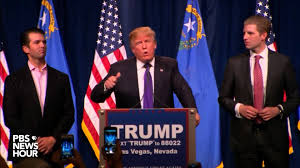
Donald Trump
“I love the poorly educated.”
As well he might: Polls have consistently shown that Trump relies on less-educated adults for his support.
Among Republicans, 71 percent of non-college graduates view Trump favorably, while 46 percent of college graduates support him.
In fact, appealing to the ignorant and uneducated has become a commonplace for politicians on the Right.
President John F. Kennedy speed-read several newspapers every morning. He nourished personal relationships with the press-–and not for altruistic reasons.
These journalistic relationships gave Kennedy additional sources of information and perspective on national and international issues.
But in 2012, Republican Presidential candidates celebrated their ignorance of both.
Herman Cain
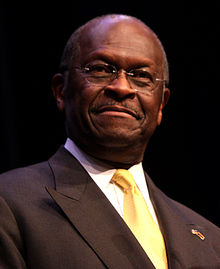
Former Godfather’s Pizza CEO Herman Cain famously said, “We need a leader, not a reader.” In doing so, he stole this line from the fictionalized “President Schwarzenegger” in The Simpsons Movie.
Thus he excused his ignorance of the reasons for President Barack Obama’s intervention in Libya.
Then-Texas Governor Rick Perry showed similar pride in not knowing there are nine judges on the United States Supreme Court:
“Well, obviously, I know there are nine Supreme Court judges. I don’t know how eight came out my mouth. But the, uh, the fact is, I can tell you–I don’t have memorized all of those Supreme Court judges. And, uh, ah–
“Here’s what I do know. That when I put an individual on the Supreme Court, just like I done in Texas, ah, we got nine Supreme Court justices in Texas, ah, they will be strict constructionists….”
In short, it’s the media’s fault if they ask you a question and your answer reveals your own ignorance, stupidity or criminality.
Then there was Sarah Palin’s rewriting of history via “The Midnight Ride of Paul Revere”:
“He warned the British that they weren’t going to be taking away our arms by ringing those bells and, um, making sure as he’s riding his horse through town to send those warning shots and bells that, uh, we were going to be secure and we were going to be free.”
In fact, Revere wasn’t warning the British about anything. He was warning his fellow Americans about an impending British attack–as his celebrated catchphrase “The British are coming!” made clear.
Republicans have attacked President Obama for his Harvard education and articulate use of language. Among their taunts: “Hitler also gave good speeches.”
And they resent his having earned most of his income as a writer of two books: Dreams From My Father and The Audacity of Hope. As if being a writer is somehow subversive.
When President Kennedy was assassinated on November 22, 1963, it was said that he left three great legacies to his country:
- The Nuclear Test Ban Treaty;
- The Apollo moon landing; and
- The Vietnam War.
But there was a fourth legacy–and perhaps the most important of all: The belief that mankind could overcome its greatest challenges through rationality and perseverance.

White House painting of JFK
At American University on June 10, 1963, Kennedy called upon his fellow Americans to re-examine the events and attitudes that had led to the Cold War. And he declared that the search for peace was by no means absurd:
“Our problems are man-made; therefore, they can be solved by man. And man can be as big as he wants. No problem of human destiny is beyond human beings.
“Man’s reason and spirit have often solved the seemingly unsolvable, and we believe they can do it again.”
Today, politicians from both parties cannot agree on solutions to even the most vital national problems.
On November 21, 2011, the 12 members of the “Super-Committee” of Congress, tasked with finding $1.2 trillion in cuts in government spending, threw up their hands in defeat.
During the height of the Cuban Missile Crisis, Kennedy spoke with aides about a book he had just finished: Barbara Tuchman’s The Guns of August, on the events leading to World War 1.
He said that the book’s most important revelation was how European leaders had blindly rushed into war, without thought to the possible consequences.
Kennedy told his aides he did not intend to make the same mistake-–that, having read his history, he was determined to learn from it.
When knowledge and literacy are attacked as “highfalutin’” arrogance, and ignorance and incoherence are embraced as sincerity, national decline and collapse lie just around the corner.
2008 PRESIDENTIAL RACE, 2012 PRESIDENTIAL RACE, 2016 PRESIDENTIAL RACE, ABC NEWS, ANCHOR BABY, BARACK OBAMA, BILL CLINTON, BIRTHERS, CBS NEWS, CITIZENSHIP, CNN, DONALD TRUMP, FACEBOOK, ILLEGAL ALIENS, immigration, NBC NEWS, RAFAEL "TED" CRUZ, REPUBLICANS, THE CHICAGO SUN-TIMES, THE CHICAGO TRIBUNE, THE HUFFINGTON POST, THE LOS ANGELES TIMES, THE NEW YORK TIMES, THE U.S. SUPREME COURT, THE WASHINGTON POST, TWITTER, USA TODAY
In Bureaucracy, History, Law, Politics, Social commentary on February 1, 2016 at 12:01 am
Yes, like a toxic waste plant that spews out poison every four years, it’s Presidential primary time for the Republican party.
And its two most radical and ruthless candidates for President are flinging slime with gusto.
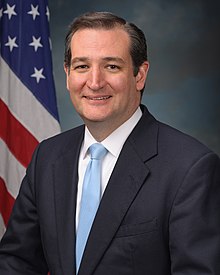
Rafael “Ted” Cruz, the United States Senator from Texas, has accused his rival, billionaire businessman Donald Trump, of having “New York values.”
And during the January 14th Republican Presidential debate in South Carolina, he defined these as:
“Everyone understands that the values in New York City are socially liberal, pro-abortion, pro-gay marriage and focus on money and the media.”
Among Right-wingers, “liberal,” “pro-abortion” and “pro-gay” are the ultimate in insults.
But Donald Trump was quick to respond with an explosive charge of his own: Rafael Cruz is not an American citizen–and therefore not eligible to be President.
What made this accusation so effective was Cruz’ having been born outside the United States–in Calgary, Alberta, Canada, to an American mother and a Cuban father.
Rafael “Ted” Cruz
The U.S. Constitution specifically states that “No person except a natural born citizen…shall be eligible to the office of President.”
Cruz has argued that because his mother was an American, he became an American citizen at birth. But courts have never ruled on the issue of what constitutes a “natural-born” citizen.
And, at a campaign event in Nashua, New Hampshire, Trump smacked Cruz with an even more incendiary attack:
“Ted Cruz may not be a US citizen, right? But he’s an anchor baby. No, Ted Cruz is an anchor baby in Canada. But Canada doesn’t accept anchor babies.”
“Anchor baby” is a Politically Incorrect term for usually poor, non-white aliens entering the United States to have a child born on American soil, which grants automatic citizenship.
And if the child is a citizen, its parents stand an excellent chance of being allowed to stay.
Trump asserts that children born in the United States to illegal aliens are not American citizens, as they are today considered under the law.
Donald Trump
At first, the issue of Cruz’ eligibility seemed confined to Republican politicians and those likely to vote for them. But then others outside the Right began weighing in.
Mary McManamon, a Constitutional law professor at Widener University’s Delaware Law School, concluded in an Op-Ed for The Washington Post:
“Sen. Ted Cruz (R-Tex.) is not a natural-born citizen and therefore is not eligible to be president or vice president of the United States.”
How did this all start? With the ultimate target of Republican hatred–Barack Obama.
Ever since Obama became a Presidential candidate in 2008, Republicans have accused him of being ineligible to hold office.
Without a political scandal (such as Bill Clinton’s affair with Monica Lewinsky) to fasten on, the Republican party opted for slander: Obama was born in Kenya–not Honolulu–and thus was not an American citizen.
From this there could be only one conclusion: He would be an illegitimate President, and should be removed from office if elected.
And this smear campaign continued after he won the 2008 election. Right-wingers like Trump insisted that Obama “prove” his citizenship fitness to hold office.
During his first two years in office, Obama tried to ignore the charge.
But polls repeatedly showed that large segments of the country believed it. Finally, even Obama’s closest advisers warned him: You must address this and put it to rest.
So, on April 27, 2011, the President released the long-form version of his Hawaii birth certificate.
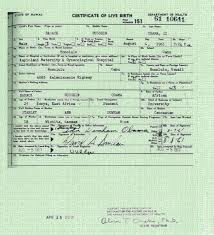
The long-form version of President Obama’s birth certificate
For the vast majority of Americans, this settled the issue. In 2012, to the fury of Republicans, Obama won a second, four-year term.
Fast forward to the 2016 Presidential race.
Donald Trump, seeking to destroy his foremost rival, lobs the “anchor baby” charge against Rafael Cruz.
To most Americans, this conjures up the image of poor Mexicans flooding across the United States border to apply for welfare.
It’s a highly effective way to inflame the elderly, white voters who make up the base of the Republican party.
But it’s also guaranteed to inflame millions of Hispanic Americans–those who are here legally as well as those who are here illegally.
The Republican party has long earned the hatred and distrust of most Hispanic Americans through its calls to “seal off the border” and deport Hispanic illegal aliens.
And, in 2012, millions of Hispanics gave President Obama a second term.
So long as Cruz stays in the race, Trump will continue to use the “birther” issue against him. And it will continue to dog him, as it did Obama.
But it will continue to anger most of the 55 millions Hispanics living within the United States.
The votes of elderly whites command the attention of Republican primary candidates. But Hispanic voters will play a decisive role in the general election.
Thus, Republicans may come to regret their use of the “birther” issue as they learn the truth of Shakespeare’s line: “The evil that men do lives after them.”
2016 PRESIDENTIAL RACE, ABC NEWS, ALTERNET, AMERICABLOG, AP, BABY BOOMER RESISTANCE, BBC, BLOOMBERG NEWS, BUZZFEED, CBS NEWS, CNN, CROOKS AND LIARS, DAILY KOS, DENNIS HASTERT, FACEBOOK, FAMILY RESEARCH COUNCIL, FIVETHIRTYEIGHT, HARPER’S MAGAZINE, HUFFINGTON POST, JEB BUSH, JOSH DUGGAR, MEDIA MATTERS, MIKE HUCKABEE, MOTHER JONES, MOVEON, MSNBC, NBC NEWS, NEW REPUBLIC, NEWSDAY, NEWSWEEK, NPR, PBS NEWSHOUR, POLITICO, POLITICUSUSA, RAW STORY, REPUBLICAN PARTY, REUTERS, RICK SANTORUM, SALON, SCOTT WALKER, SEATTLE TIMES, SLATE, TALKING POINTS MEMO, TED CRUZ, THE ATLANTIC, THE CHICAGO SUN-TIMES, THE CHICAGO TRIBUNE, THE DAILY BEAST, THE DAILY BLOG, THE GUARDIAN, THE HILL, THE HUFFINGTON POST, THE INTERCEPT, THE LOS ANGELES TIMES, THE NATION, THE NEW REPUBLIC, THE NEW YORK TIMES, THE NEW YORKER, THE VILLAGE VOICE, THE WASHINGTON POST, THINKPROGRESS, TIME, TRUTHDIG, TRUTHOUT, TWITTER, U.S. NEWS & WORLD REPORT, UPI, USA TODAY
In Bureaucracy, History, Law Enforcement, Politics, Social commentary on October 16, 2015 at 3:55 pm
Former House Speaker Dennis Hastert will plead guilty to lying to the FBI.
That announcement was made on October 15 by the office of the United States Attorney [Federal prosecutor] for Chicago.
Hastert, who was the Republican Speaker of the House of Representatives from 1999 to 2007, had been indicted on May 28 for violating federal banking laws and lying to the FBI.
He had tried to conceal $3.5 million in hush-money payments over several years to a man who was blackmailing him.

Dennis Hastert
The source of the blackmail: A homosexual—and possibly coerced—relationship with an underage student while Hastert was a teacher and wrestling coach at Yorkville High School, in Yorkville, Illinois–long before Hastert entered Congress in 1981.
Hastert wasn’t indicted for having had a sexual relationship with an underage student. The statute of limitations had long ago run out on that offense.
He was indicted for trying to evade federal banking laws and lying to the FBI.
According to the indictment, the FBI began investigating the cash withdrawals in 2013.
The Bureau wanted to know if Hastert was using the cash for criminal purposes or if he was the victim of a criminal extortion.
When questioned by the FBI, Hastert said he was storing cash because he didn’t feel safe with the banking system: “Yeah, I kept the cash. That’s what I’m doing.”
Thus, irony: By giving in to blackmail, Hastert:
- Lost $3.5 million;
- Unintentionally engineered his arrest and indictment; and
- Ensured that his darkest secret would be revealed.
There is a lesson to be learned here—one that longtime FBI Director J. Edgar Hoover well understood: Giving in to blackmail only empowers the blackmailer even more.
As William C. Sullivan, the onetime director of the FBI’s Domestic Intelligence Division, revealed after Hoover’s death in 1972:
“The moment [Hoover] would get something on a senator, he’d send one of the errand boys up and advise the senator that ‘we’re in the course of an investigation, and we by chance happened to come up with this data on your daughter.
“‘But we wanted you to know this. We realize you’d want to know it.’ Well, Jesus, what does that tell the senator? From that time on, the senator’s right in his pocket.”
Of course, hypocrites who lead double-lives are always vulnerable to blackmail. Enter Dennis Hastert.
During his tenure as House Speaker, Hastert pushed the anti-homosexual Defense of Marriage Act (DOMA) through the House. He also proposed a Constitutional amendment to annul same-sex marriages in states that allowed them.
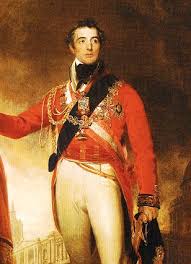
The only effective way of handling blackmail was demonstrated by Arthur Wellesley, known to history as the Duke of Wellington.
The Duke of Wellington
In 1815, he had defeated Napoleon at the battle of Waterloo, ending France’s longstanding threat to England. With that victory came the honors of a grateful nation.
Then, in December, 1824, Wellington found himself the target of blackmail by Joseph Stockdale, a pornographer and scandal-monger.
“My Lord Duke,” Stockdale write in a letter, “In Harriette Wilson’s memoirs, which I am about to publish, are various anecdotes of Your Grace which it would be most desirable to withhold….
“I have stopped the Press for the moment, but as the publication will take place next week, little delay can necessarily take place.”
Wilson was a famous London courtesan past her prime, then living in exile in Paris. She was asking Wellington to pay money to be left out of her memoirs.
From Wellington came the now-famous reply: “Publish and be damned!”
Wilson’s memoirs appeared in installments, naming half the British aristocracy and scandalizing London society.
And, true to her threat, she named Wellington as one of her lovers—and a not very satisfying one at that.
Wellington was a national hero, husband and father. Even so, his reputation did not suffer, and he went on to become prime minister.
Click here: Rear Window: When Wellington said publish and be damned: The Field Marshal and the Scarlet Woman – Voices
Dennis Hastert, former Speaker of the House, might now wish he had followed the example of the Duke of Wellington.
His reputation might have been trashed, but he wouldn’t have faced prosecution.
By choosing to give in to blackmail, Hastert destroyed his reputation and left himself open to prosecution for violating Federal currency laws.
Once he lied to FBI agents about the reason for his withdrawals, his choices came down to two: Confront the charges in open court, or plead guilty and avoid a trial.
By pleading guilty, Hastert avoids having to answer why he was willing to pay out $3.5 in blackmail monies.
But his reputation remains twice trashed—once under the stigma of sexual misconduct, and again under the stigma of a criminal conviction.
2016 PRESIDENTIAL RACE, ABC NEWS, ABRAHAM LINCOLN, ALAMO, CENSORSHIP, CHRISTIAN RIGHT, CIVIL WAR, CNN, COUNTDOWN, DAVY CROCKETT, EDWARD R. MURROW, FACEBOOK, GEORGE ORWELL, GEORGE W. BUSH, GETTYSBURG ADDRESS, HISPANICS, HISTORY, IRAQ WAR, JEB BUSH, JEFFERSON DAVIS, JIM BOWIE, JOSEPH STALIN, LAVRENTI BERIA, MARTIN LUTHER KING, MSNBC, RACHEL MADDOW, RELIGION, SCHOOLS, SLAVERY, SOVIET UNION, TEXAS, TEXTBOOKS, THE CHICAGO SUN-TIMES, THE CHICAGO TRIBUNE, THE HUFFINGTON POST, THE LOS ANGELES TIMES, THE NEW YORK TIMES, THE WASHINGTON POST, THOMAS JEFFERSON, TWITTER, USA TODAY
In Bureaucracy, History, Politics, Social commentary on August 18, 2015 at 12:54 am
At one time, Americans believed that wholesale rewriting of history could happen only in the Soviet Union.
“The problem with writing about history in the Soviet Union,” went the joke, “is that you never know what’s going to happen yesterday.”
A classic example of this occurred within the Great Soviet Encyclopedia.
Lavrenti Beria had been head of the NKVD, the dreaded secret police, from 1938 to 1953. In 1953, following the death of Soviet dictator Joseph Stalin, Beria was arrested and executed on orders of his fellow Communist Party leaders.
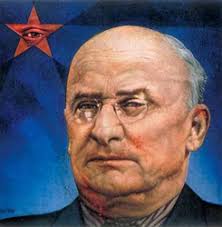
Lavrenti Beria
But the Great Soviet Encyclopedia had just gone to press with a long article singing Beria’s praises.
What to do?
The editors of the Encyclopedia wrote an equally long article about “the Berring Straits,” which was to be pasted over the article about Beria, and sent this off to its subscribers. An unknown number of them decided it was safer to paste accordingly.
In the 1981 film, “Excalibur,” Merlin warns the newly-minted knights of the Round Table: “For it is the doom of men that they forget.”
Forgetting our past is dangerous, but so is “understanding” it incorrectly.
In Texas, state-mandated “history” textbooks omit selected events and persons from the historical record–such as Thomas Jefferson and Martin Luther King.
This can be as lethal to the truth as outright lying.

Joseph Stalin, for example, ordered that school textbooks omit all references to the major role played by Leon Trotsky, his arch-rival for power, during the Russian Revolution.
Similarly, in Texas students are required to study Confederate President Jefferson Davis’ inaugural address alongside President Lincoln’s Gettysburg Address.
Such “teaching” should be seen for what it is: A thinly-veiled attempt to legitimize the most massive case of treason in United States history.
(The Civil War started on April 12, 1861, when Confederate artillery opened fire on Fort Sumter, a United States fort in Charleston Harbor. Fort Sumter surrendered 34 hours later.
(At least 800,000 Southerners took up arms against the legally elected government of the United States.)
The late broadcast journalist, Edward R. Murrow, would have referred to this practice as “giving Jesus and Judas equal time.”
Recently, Jeb Bush has entered the “Rewriting History for Americans” contest.
On August 13, speaking at a national security forum in Davenport, Iowa, he defended the unprovoked 2003 invasion of Iraq by his brother, President George W. Bush:
“I’ll tell you though, that taking out Saddam Hussein turned out to be a pretty good deal.”
And he went on to defend the 2007 troop “surge”, calling it “a great success that made Iraq safer.
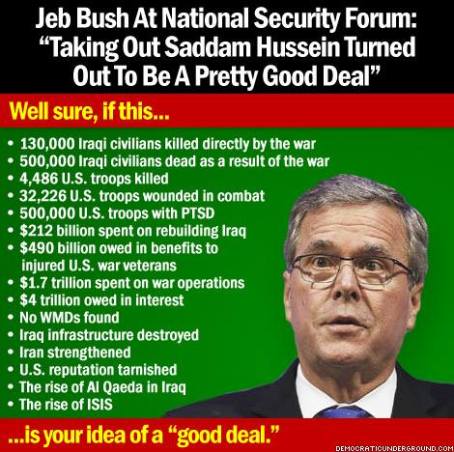
“I’ve been critical and I think people have every right to be critical of decisions that were made. In 2009, Iraq was fragile but secure. It was–its mission was accomplished in a way that there was security there.”
(Ironically, the phrase, “its mission was accomplished” proved an embarrassing reminder for the Bush family.
(A banner titled “Mission Accomplished” was displayed on the aircraft carrier USS Abraham Lincoln as George W. Bush announced–wrongly–that the war was over on May 1, 2003.)
Jeb Bush claimed that President Barack Obama had prematurely withdrawn troops from Iraq during his first term, thus allowing ISIS to “fill the void.”
One dissenter to Jeb Bush’s effort to rewrite his brother’s history is David Corn, Washington bureau chief for Mother Jones magazine.
Addressing Bush’s claims on the August 15 edition of The PBS Newshour, he said:
“I mean, I have to laugh a little bit, because I think he was setting a record for chutzpah.
“…It wasn’t until after his brother’s invasion of Iraq that you had something called al-Qaida in Iraq. And that was the group that morphed into ISIS.
“So ISIS is a direct result of the war in Iraq right there. And so he’s wrong on the history.
“But then he said what happened was that Obama and Hillary Clinton orchestrated this quick withdrawal after everything was secure. Nothing was really secure in 2009-2010.
“…But it was George W. Bush in December 2008 who created the agreement with [Iraqi] Prime Minister [Nouri] [al-]Maliki that said that U.S. troops had to be out by 2011.
“And then Obama didn’t renegotiate that. And there is a lot of question as to whether he could even have, given the political situation in Baghdad itself.
“So Bush is totally–Jeb Bush is totally rewriting this.”
Click here: Brooks and Corn on Cuba as campaign issue
This is no small matter. George W. Bush’s needless and unprovoked war on Iraq:
- Cost the lives of 4,486 American soldiers.
- Wounded another 32,226 troops.
- Resulted in the deaths of an estimated 655,000 Iraqis.
- Cost the American treasury at least $2 trillion.
- Turned up no Weapons of Mass Destruction–Bush’s pretext for going to war.
- Led to the rise of Al-Qaeda–and later ISIS–in Iraq.
- Strengthened theocratic Iran by removing its major secularist opponent.
All of which simply proves, once again, that the past is never truly dead. It simply waits to be re-interpreted by each new generation–with some interpretations winding up closer to the truth than others.
Or, in this case, each new Presidential candidate of the Bush family.


.jpg&imgrefurl=https%3A%2F%2Fen.wikipedia.org%2Fwiki%2FDonald_Trump&docid=oUQ97aEz8anNMM&tbnid=QsnpHu5vtl_y5M%3A&w=342&h=465&ved=0ahUKEwiz15vwz7DLAhVBWWMKHYU2CXkQxiAIAg&iact=c&ictx=1)


 Bureaucracybuster's Blog
2016 PRESIDENTIAL RACE, ABC NEWS, ABRAHAM LINCOLN, ALTERNET, AMERICABLOG, AP, BABY BOOMER RESISTANCE, BARACK OBAMA, BBC, BLOOMBERG NEWS, BUZZFEED, CBS NEWS, CIVIL RIGHTS ACT OF 1964, CIVIL WAR, CNN, CROOKS AND LIARS, DAILY KOS, DANIEL DAY-LEWIS, DONALD TRUMP, EMANCIPATION PROCLAMATION, FACEBOOK, FIVETHIRTYEIGHT, HARPER’S MAGAZINE, HUFFINGTON POST, LYNDON B. JOHNSON, MEDIA MATTERS, MITT ROMNEY, MOTHER JONES, MOVEON, MOVIES, MSNBC, NBC NEWS, NEW REPUBLIC, NEWSDAY, NEWSWEEK, NPR, PBS NEWSHOUR, POLITICO, POLITICUSUSA, RAW STORY, REUTERS, SALON, SEATTLE TIMES, SLATE, SLAVERY, STEVEN SPIELBERG, TALKING POINTS MEMO, THE ATLANTIC, THE CHICAGO SUN-TIMES, THE CHICAGO TRIBUNE, THE DAILY BEAST, THE DAILY BLOG, THE GUARDIAN, THE HILL, THE HUFFINGTON POST, THE INTERCEPT, THE LOS ANGELES TIMES, THE NATION, THE NEW REPUBLIC, THE NEW YORK TIMES, THE NEW YORKER, THE VILLAGE VOICE, THE WASHINGTON POST, THINKPROGRESS, THIRTEENTH AMENDMENT, TIME, TRUTHDIG, TRUTHOUT, TWITTER, U.S. NEWS & WORLD REPORT, UPI, VOTER ID LAWS, VOTING RIGHTS ACT OF 1965
“LINCOLN”: A MESSAGE FOR TODAY
In Bureaucracy, Entertainment, History, Law, Military, Politics, Social commentary on March 17, 2016 at 12:36 pmSteven Spielberg’s Lincoln is more than a mesmerizing history lesson.
It’s a timely reminder that racism and repression are not confined to any one period or political party.
At the heart of the film: Abraham Lincoln (Daniel Day-Lewis) wants to win ratification of what will be the Thirteenth Amendment to the United States Constitution. An amendment that will forever ban slavery.
True, Lincoln, in 1862, had issued the Emancipation Proclamation. This—in theory—freed slaves held in the Confederate states that had seceded from the Union in 1861.
But Lincoln regards this as a temporary wartime measure. He fears that once the war ends, the Supreme Court may rule the Proclamation unconstitutional. This might allow Southerners to continue practicing slavery, even after losing the war.
To prevent this, Congress must pass an anti-slavery amendment.
But winning Congressional passage of such an amendment won’t be easy.
The Senate had ratified its passage in 1864. But the amendment must secure approval from the House of Representatives to become law.
And the House is filled with men–there are no women menmbers during the 19th century–who seethe with hostility.
Some are hostile to Lincoln personally. One of them dubs him a dictator–Abraham Africanus.” Another accuses him of shifting his positions for the sake of expediency.
Other members–white men all–are hostile to the idea of “equality between the races.” To them, ending slavery means opening the door to interracial marriage–especially marriage between black men and white women.
Perhaps even worse, it means possibly giving blacks–or women–the the right to vote.
In fact, the possibility that blacks might win voting rights arises early in the movie. Lincoln is speaking to a couple of black Union soldiers, and one of them is unafraid to voice his discontent. He’s upset that black soldiers are paid less than white ones–and that they’re led only by white officers.
He says that, in time, maybe this will change. Maybe, in 100 years, he guesses, blacks will get the right to vote.
(To the shame of all Americans, that’s how long it will eventually take. Not until the passage of the Voting Rights Act of 1965 will blacks be guaranteed legal protection against discriminatory voting practices.)
To understand the Congressional debate over the Thirteenth Amendment, it’s necessary to remember this: In Lincoln’s time, the Republicans were the party of progressives.
The party was founded on an anti-slavery platform. Its members were thus reviled as “Black Republicans.” And until the 1960s, the South was solidly Democratic.
Democrats were the ones defending the status quo–slavery–and opposing freed blacks in the South of Reconstruction and long afterward.
In short, in the 18th century, Democrats in the South acted as Republicans do now. The South went Republican only after a Democratic President–Lyndon B. Johnson–rammed the Civil Rights Act of 1964 through Congress.
Watching this re-enactment of the 1865 debate in Lincoln is like watching the current Presidential campaign. The same mentalities are at work:
During the 2012 Presidential race, Republicans tried to bar those likely to vote for President Barack Obama from getting into the voting booth. But their bogus “voter ID” restrictions were struck down in courts across the nation.
Listening to those opposing the amendment, one is reminded of Mitt Romney’s infamous comments about the “47%”:
“Well, there are 47% of the people who will vote for the president no matter what….
“Who are dependent upon government, who believe that–that they are victims, who believe that government has a responsibility to care for them, who believe that they’re entitled to healthcare, to food, to housing, to you name it. But that’s–it’s an entitlement. And the government should give it to them.”
Put another way: “Who says people have a right to obtain medical care, food and housing? If they can’t inherit unearned wealth the way I did, screw them.”
In the end, it’s Abraham Lincoln who has the final word–and leaves his nation the better for it. Through diplomacy and backroom dealings (trading political offices for votes) he wins passage of the anti-slavery amendment.
The ownership of human chattel is finally an ugly memory of the American past.
The movie closes with a historically-correct tribute to Lincoln’s generosity toward those who opposed him–in Congress and on the battlefield. It occurs during Lincoln’s Second Inaugural Address:
“With malice toward none, with charity for all….To bind up the nation’s wounds. To care for him who shall have bourne the battle, and for his widow and his orphan….”
This ending presents a vivid philosophical contrast with the increasingly mean-spirited rhetoric and policies of 2016’s Republican candidates for President–especially those of Donald Trump.
Watching Lincoln, you realize how incredibly lucky America was as a nation to have had such leadership when it was most urgently needed.
.
Share this: