bureaucracybusters

Archive for the ‘Politics’ Category

THE CHICKEN KIEV IS COMING HOME TO ROOST

In Bureaucracy, History, Military, Politics, Social commentary on November 2, 2015 at 3:01 pm

On September 30, Russian President Vladimir Putin started launching airstrikes against Syria.

The objective: To bolster the dictatorship of Syrian President Bashar al-Assad, who is now caught up in civil war.

This began on March 15, 2011, triggered by protests demanding political reforms and the ouster of al-Assad.  More than 310,000 people have been killed in the fighting.

The Obama administration is worried about Russian intentions. And Republicans are furious, demanding that American military forces directly confront those of Russia.

Yet despite Right-wing alarms about Russia, there is no reason for alarm–by Americans.

Putin’s intervention in Syria’s civil war offers three possible outcomes for the United States.

And they’re all positive.

Vladimir Putin

First, the Russians will kill thousands of America’s sworn enemies.

Russians are well-known for their disregard for human life. During their invasion of Germany in 1945, Russian soldiers literally nailed civilians to barn doors, squashed them under their tanks, and raped countless women of all ages.

In Syria, they will slaughter everyone who gets in their way. Thus, they will kill far more of America’s Islamic enemies than even our own military–hamstrung by do-gooder “rules of engagement”–could possibly eliminate.

Second, Russia will replace the United States as “The Great Satan” in the eyes of most Islamics.  

The Soviet Union waged a ruthless war against Afghanistan from 1979 to 1989. Out of that war grew Al-Qaeda.  Millions of Islamics still hate Russians for their brutalities.

From 1999 to 2009, Russia fought a brutal war against Islamics in Chechnya. Chechens responded with terrorism across Russia.

Russia’s intervention in Syria will only harden its image as an enemy of Islam–even if it’s supporting one group of Islamics (the Assad regime) against others.

If Islamic terrorism starts raging throughout Russia, Putin may be forced to back down from his military moves against Syria and Ukraine.

Third, if Russian planes get shot down or Russian soldiers killed, Russia will suffer the casualties–not the United States.

The Soviet Union never fully recovered from its losses in Afghanistan–13,310 soldiers  killed, 35,478 wounded.

If Russia starts taking heavy losses in Syria or at home through terrorism, this could lead to widespread unrest.  Even Vladimir Putin could find himself in danger of being replaced.

And for Russia, the chicken Kiev has already come home to roost.

On October 31, Airbus A321, a Russian airliner, broke up in mid-air, then crashed in Egypt’s Sinai Peninsula, killing all 224 people on board.

The plane was carrying holidaymakers from the Red Sea resort of Sharm el-Sheikh to St Petersburg when it crashed into a mountainous area of central Sinai.

In Egypt, a militant group affiliated to the Islamic State of Iraq and Syria (ISIS) claimed that it had brought down the plane “in response to Russian airstrikes that killed hundreds of Muslims on Syrian land.”

At this point, it’s too early in the investigation to know whether this is true.

Egyptian analysts began examining the contents of the two “black box” recorders recovered from the airliner.  But this process could take days.

And there is more to determining what caused an airline crash than examining the contents of “black boxes.”

On July 17, 2014, Malaysia Airlines Flight 17 (MH17/MAS17) was traveling from Amsterdam to Kuala Lumpur when it crashed in Ukraine.  All 283 passengers and 15 crew on board were instantly killed.

Boeing 777-2H6ER 9M-MRD Malaysian (6658105143).jpg

Malaysia Airlines Flight 17

Not until October 13, 2015, did the Dutch Safety Board release a final report on their investigation into the incident. Its conclusion: The airliner was downed by a Buk surface-to-air missile launched from Eastern Ukraine by pro-Russian insurgents.

It could easily take a year for investigators to reach a verdict on the cause of the Airbus A321 disaster.

Meanwhile, the crash has already proved emotionally wrenching for Russians.

Flags across Russia are flying at half-staff and Russian Orthodox priests are conducting services to pray for its victims.

President Putin declared a nationwide day of mourning.  In St. Petersburg, home to most of the victims, authorities ordered the mourning to last for three days.

Many Russians no doubt already believe the plane was brought down by a surface-to-air missile.  And there is good reason for this.

American military officials have told Fox News that it “appears likely/probable” that U.S.-made Stinger missiles have fallen into the hands of ISIS combatants.

The Stinger is a shoulder-fired surface-to-air weapon. During the Soviet Union’s invasion of Afghanistan, the United States supplied huge numbers of these weapons to Afghan forces. They proved devastating against Russian planes and helicopters.

And how might have ISIS fighters acquired such a weapon? From American-supplied army bases they have occupied in recent days.

AQMI Flag.svg

 Flag of ISIS

There’s also the possibility that a bomb could have been smuggled aboard. 

Even if the investigation finds the plane wasn’t shot down or blown up, many Russians will blame Putin’s intervention for their loss.

And if the investigation finds that terrorists were responsible, there may well be major protests throughout Russia against Putin.

And if this loss is followed by others equally dramatic and costly, all bets are off for the long-term future of the Putin regime.

“BRIDGE OF SPIES” TELLS UNPLEASANT TRUTHS ABOUT GOVERNMENT: PART TWO (END)

In Bureaucracy, History, Law, Military, Politics, Social commentary on October 27, 2015 at 12:01 am

“Bridge of Spies” vividly recaptures a now-forgotten time in American history.

It was the time of “the Cold War.”  A time when:

  • America was almost universally seen as “The Good Guy,” in contrast to “The Bad Guy” of the Soviet Union;
  • The United States and the Soviet Union held each other at bay with arsenals of nuclear weapons;
  • Wisconsin Senator Joseph R. McCarthy terrorized the nation, accusing anyone who disagreed with him of being a Communist–and leaving ruined lives in his wake;
  • American TVs blared commercials warning that Soviet Premier Nikita Khrushchev had boasted: “We will bury you”; and
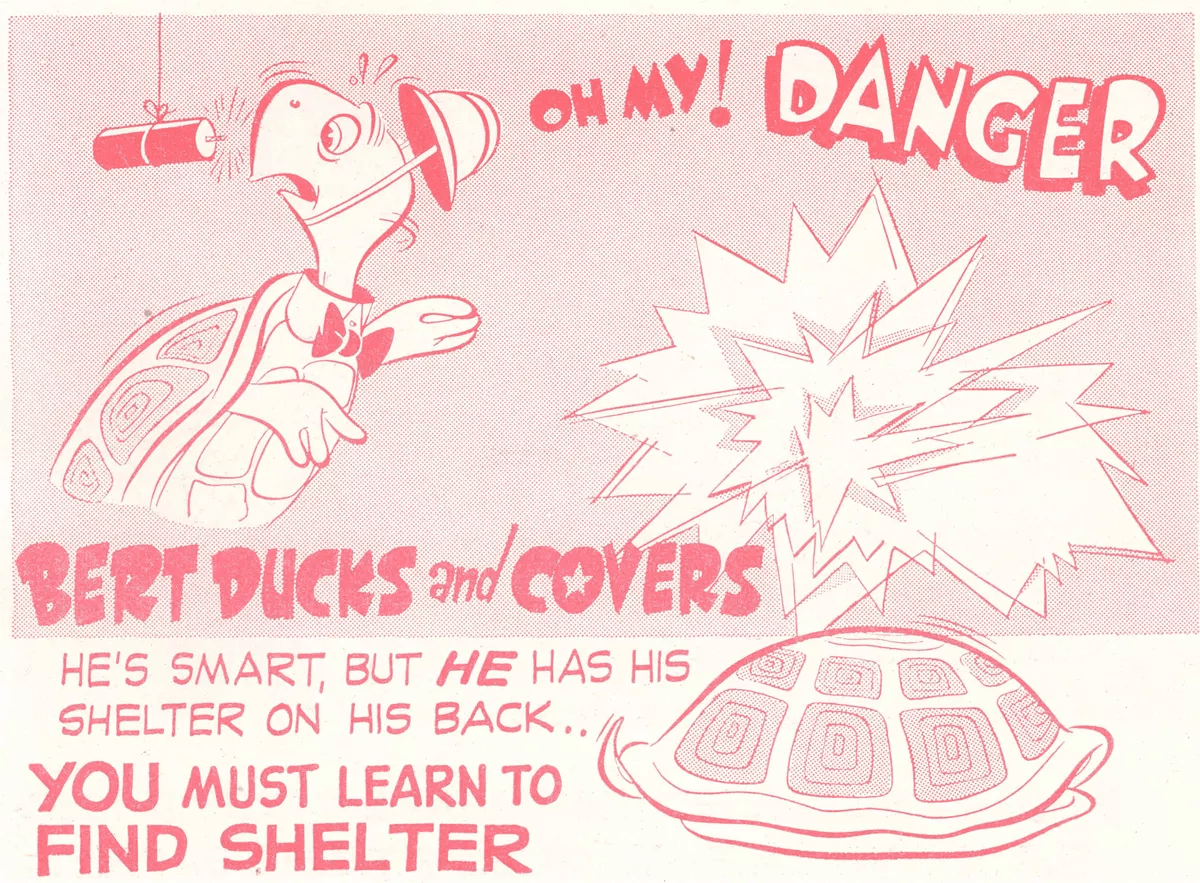
  • Children and teenagers were taught in school that they could survive a nuclear attack through “duck and cover” drills. They were instructed to keep their bathtubs filled with water for safe drinking, in the event of a Soviet nuclear strike.
Bert2.png (300×232)

Bert the Turtle teaches schoolchildren to “Duck and Cover”

Yet even in this poisonous atmosphere of fear and denunciation, some men stood out as heroes–simply by holding fast to their consciences.

One of these was a New York insurance attorney named James B. Donovan (played by Tom Hanks). Asked by the Justice Department to defend arrested Soviet spy Rudolph Abel (Mark Rylance) Donovan did what no one expected.

He gave Abel a truly vigorous defense, arguing that the evidence used to convict him was the legally-tainted product of an invalid search warrant.

Upon Abel’s conviction and sentencing to 45 years’ imprisonment, Donovan again shocked the political and legal communities by appealing the case to the Supreme Court.

Donovan argued that Constitutional protections should apply to everyone–including non-Americans–tried in American courts.  To do less made a mockery of the very freedoms we claimed to champion.

He lost by a vote of 5-4.  But the arguments he made would resurface 50 years later when al-Qaeda suspects were hauled into American courts.

James B. Donovan

In 1961, Donovan was again called upon to render service by a Federal agency–this time the CIA.  It wanted his help in negotiating the release of its spy, Francis Gary Powers, shot down over the Soviet Union in 1960 while flying a high-altitude U-2 spy plane.

Throughout “Bridge of Spies,” audiences learn some unsettling truths about how the American government–and governments generally–actually operate.

The first three of these were outlined in Part one of this series:

Truth #1: Appearance counts for more than reality.

Truth #2: Individual conscience can wreck the best-laid plans of government.

Truth #3: High-ranking government officials will ask citizens to take risks they themselves refuse to take.

Now for the remaining truths revealed in this movie.

Truth #4: Appeals to fear often prevail when appeals to humanity are ignored.

After crossing into East Germany, Donovan enters into negotiations with Wolfgang Vogel, a lawyer representing the East German government.

Vogel offers to exchange Frederic Pryor, an American economics graduate student seized by the East German secret police, for Abel. Donovan replies this is a deal-breaker; the United States (which is never mentioned during the negotiations) wants Powers, not Pryor.

Nevertheless, Donovan is equally concerned for Pryor, and adds him to the list of hostages to be released in return for Abel.

Then a new complication arises: The East German government that holds Pryor threatens to pull out. claiming to be insulted because Donovan did not inform them that the USSR was a party to the negotiation.

His reasoned, legal arguments having failed, Donovan resorts to a threat. He conveys a warning to the president of East Germany:

Abel has not yet revealed any Soviet secrets. But if this deal fails, he may well do so to earn favors from the United States government. And, in that case, the Soviets will blame you–Erich Honecker, the  president of East Germany–for the resulting damage.

Where arguments based on humanity have failed, this one–based on fear–works.  A prisoner-exchange is arranged.

Truth #5: Personal loyalty can supersede bureaucratic inventions.

On February 10, 1962, Donovan, Abel and several CIA agents arrive at the Glienicke Bridge, which connects East and West Germany. The Soviets have Powers, but not Pryor–who is to be released at Checkpoint Charlie, a crossing point between East and West Berlin.

    Glienicke Bridge, the “Bridge of Spies” 

The CIA agent in charge of the American delegation tells Abel he can cross into East Germany, even though Pryor has not been released.

But Abel has learned that Donovan has negotiated the release of not only Powers but Pryor. Out of loyalty to the man who has vigorously defended him, he waits on his side of the bridge until word arrives that Pryor has been released.

Then Abel crosses into East Germany while Powers crosses into the Western sector.

Donovan returns home. Before flying off to West Germany, he had told his wife he was going on a fishing trip in Scotland.

His wife and children learn the truth about the risks he ran and the success he attained only when a television newscast breaks the news:

Francis Gary Powers has been returned to the United States. And the man responsible is James Donovan, once the most reviled man in America for having defended a notorious Soviet spy.

“BRIDGE OF SPIES” TELLS UNPLEASANT TRUTHS ABOUT GOVERNMENT: PART ONE (OF TWO)

In Bureaucracy, History, Law, Military, Politics, Social commentary on October 26, 2015 at 12:27 am

Steven Spielberg’s new movie, “Bridge of Spies,” is that rarity among films: An intelligent mixture of history and drama, stripped of gratuitous sex and violence.

It’s also a film that accurately reveals unsettling truths about how government agencies really operate.

Truth #1: Appearance counts for more than reality.

The movie opens with the FBI’s arrest of KGB spy Rudolph Abel (Mark Rylance). The evidence against him is overwhelming. This–plus the “Red Scare” climate of 1957–will guarantee his conviction.

But the Eisenhower administration doesn’t want the upcoming trial to be seen as a hangman’s court.  It must have at least the appearance of a fair proceeding.

So the Justice Department (through the Brooklyn Bar Association) asks a New York insurance attorney named James B. Donovan (Tom Hanks) to take on Abel’s defense. He’s expected to make a reasonably competent effort but not go all out on behalf of his client.

Truth #2: Individual conscience can wreck the best-laid plans of government.

Donovan has never handled a spy case before. And he has no delusions that Abel isn’t the spy he’s charged with being. But he’s determined to give Abel the same committed defense he would give to any other client.

Rudolph Abel (Mark Rylance) and James Donovan (Tom Hanks) in court

This comes as a shock to the prosecutors, the judge, his law firm and even his family.

A CIA agent approaches Donovan in a nearly deserted restaurant and asks him to reveal any secrets that might help win Abel’s conviction.

Donovan replies: “This conversation isn’t happening.”

“No, of course not,” replies the CIA agent, assuming Donovan is agreeing to keep the overture secret.

“No, I mean this conversation isn’t happening,” angrily says Donovan, who leaves the agent fuming.

Donovan becomes a pariah; his mailbox is stuffed with hate mail and one night a would-be drive-by killer riddles his house with bullets.

Abel is convicted and sentenced to 45 years’ imprisonment. But Donovan–again shocking everyone he knows–pursues an appeal up to the Supreme Court.

He argues that the evidence against Abel is tainted by an invalid search warrant. No American citizen could be convicted under such circumstances; and the Constitutional protections that hold true for Americans should hold equally true for non-Americans charged with crimes in American courts.

Donovan’s arguments will be heard a half-century later, when al-Qaeda suspects are hauled before American courts.

He puts on an impressive case on Abel’s behalf, but loses 5-4 at the Supreme Court.

That seems to be the end of Donovan’s relationship with Abel.  But events soon dictate otherwise.

Before the judge could pronounce a death sentence on Abel, Donovan had argued that this might be a mistake. The day might come, he told the judge, when an American spy might fall into Soviet hands.

And then the United States would need to swap Abel to secure the release of its own agent.

The judge, moved by that argument, had given Abel a lengthy prison term instead.

On May 1, 1960, Francis Gary Powers, a former Air Force pilot, is flying a high-altitude U-2 plane above the Soviet Union for the CIA. The plane is equipped with state-of-the-art cameras, and Powers intends to photograph military sites and other important complexes.

Suddenly, a surface-to-air missile slams into the plane. Powers ejects before it crashes, but fails to commit suicide with a poison pin concealed in a phony silver dollar.  He’s captured by the KGB and brutally interrogated, but maintains his silence.

At about the same time, Frederic Pryor, an American economics graduate student living in West Germany, visits his German girlfriend living in Soviet-dominated East Germany.

The Soviets are starting to build their infamous Berlin Wall, which will stop the flow of refugees from East to West.  Pryor tries to bring his girlfriend and her father into West Berlin, but he’s stopped and arrested by agents of Stasi, the East German police, who accuse him of being a spy.

Meanwhile, the Soviet Union wants its spy, Abel, returned, before he can spell its secrets. In turn, the new Kennedy administration wants Powers returned, before he can be made to spill American secrets.

Truth #3: High-ranking government officials will ask citizens to take risks they themselves refuse to take.

In 1961, Donovan is once again sought out by the American government–this time by no less than CIA Director Allen Dulles.

And he’s asked to go where no official American representative can go–East Germany. His new assignment: Negotiate the exchange of Powers for Abel.

The CIA wants its spy back. And it’s willing to send Donovan into East Germany to negotiate his release. But it’s not willing to back him up if he’s arrested by Stasi, the notorious East German secret police.

In such a case, Donovan could spend the rest of his life in a Communist prison cell.

WHY SO MANY PEOPLE DISTRUST GOVERNMENT

In Bureaucracy, History, Law, Law Enforcement, Politics, Social commentary on October 23, 2015 at 12:40 am

In 2005, Rahinah Ibrahim, a Malaysian architect, was placed on the United States Government’s No-Fly list, operated by the Terrorist Screening Center.

It wasn’t because she was a member of Al Qaeda.  It happened because of an FBI screw-up.

The mess started in January 2005, when Ibrahim and her 14-year-old daughter arrived at the San Francisco Airport.  Their destination: Hawaii, to attend a conference trip sponsored by Stanford.

Ibrahim, still recovering from a recent hysterectomy, was in a wheelchair.

When she approached the United Airlines counter to check in, she was seized, handcuffed, thrown in the back of a police car and taken to a holding cell.

There she was interrogated.  During this, paramedics had to be summoned because she hadn’t taken her surgery medication.

Then, to her surprise, she was released–and told that her name had been removed from the No-Fly list.  She boarded a flight to Hawaii and attended the conference.

But in March 2005, the situation suddenly changed.

Having returned to Malasia, she bought a ticket to fly back to California to meet with her Stanford thesis adviser. But at the airport, she was banned from the flight.

She was told that her student visa had been revoked, and that she would longer be let into the United States.  When she asked why, authorities refused to give a reason.

She would not learn the answer for another eight years.

An FBI agent in San Jose, California, had conducted a background check on Ibrahim.  He hadn’t meant to place her on theNo-Fly list.

FBI Headquarters in Washington, D.C.

He had simply checked the wrong boxes on a form.  He didn’t even realize the mistake until nearly a decade later, during his deposition in 2013.

In fact, he filled out the form exactly the opposite way from the instructions provided on the form. He did so even though the form stated, “It is recommended that the subject NOT be entered into the following selected terrorist screening databases.”

Thus, Ibrahim was placed on the No-Fly list.

That was bad enough–but at least understandable. FBI agents are human, and can and do err like anyone else.

What is not understandable or tolerable is this:

After Ibrahim filed a lawsuit against the United States Government in 2006, the Justice Department ordered a coverup–to prevent word from leaking that one of its agents had made a mistake.

Moreover, Ibrahim was ordered by the Justice Department to not divulge to anyone that she was suing the United States Government–or the reason for the lawsuit.

Ibrahim is currently the dean of architecture at University Putra Malaysia.

Because the Justice Department refused to admit its mistake, attorneys working pro bono for Ibrahim incurred a reported $3.8 million in legal fees, as well as $300,000 in litigation costs.

In his recent decision on the case, U.S. District Judge William Alsup, based in San Francisco, called the agent’s error “conceded, proven, undeniable and serious.

Once derogatory information is posted to the Terrorist  Screening Database, it can propagate extensively through the  government’s interlocking complex of databases, like a bad credit  report that will never go away,” he wrote.

If only the Justice Department had readily admitted the mistake and quickly moved to correct it.  But the egos of Federal law enforcement agents and prosecutors effectively ruled out this option.

Robert Gates, who served as Secretary of Defense under Presidents George W. Bush and Barack Obama (2006-2011) had a completely different approach to dealing with mistakes.

In his 2014 autobiography, Duty, he writes of his determination to promote good relations between the Pentagon and the reporters who covered it.

In his commencement address at the Anapolis Naval Academy on May 25, 2007, he said:

“…the press, in my view [is] a critically important guarantor of our freedom.

“When it identifies a problem, the response of senior leaders should be to find out if the allegations are true.  And if so, say so, and then act to remedy the problem.

“If [the allegations are] untrue, then be able to document that fact.”

Millions of Americans not only distrust the Federal Government–they believe it is aggressively conspiring against them.

But the vast majority of Federal employees do not come to work intent on destroying the lives of their fellow Americans.

They spend most of their time carrying out routine, often mind-numbing tasks–such as filling out what seem like an endless series of forms.

But even where no malice is involved, their actions can have devastating consequences for innocent men and women.

Especially in cases where “national security” can be invoked to hide error, stupidity, or even criminality.

The refusal of the Justice Department to quickly admit the honest mistake of one of its agents prevented Ibrahim from boarding a commercial flight for seven years.

Federal agencies should follow the advice given by Robert Gates:  Admit your mistakes and act quickly to correct them. 

Unless this happens, the poisonous atmosphere of distrust between the Government and its citizens will only worsen.

LESSONS FROM “LINCOLN”: PART TWO (END)

In Bureaucracy, History, Law, Politics, Social commentary on October 22, 2015 at 12:04 am

Argo was selected as Best Picture at the 2013 Academy Awards.  But it is Steven Spielberg’s Lincoln that will be cherished far longer.

Among the reasons for this:

  • Daniel Day-Lewis’ brilliant portrayal as Abraham Lincoln; and
  • Its timely depiction of a truth that has long been obscured by past and current Southern lies.

And that truth: From first to last, the cause of the Civil War was slavery.

According to The Destructive War, by Charles Royster, arguments over “states’ rights” or economic conflict between North and South didn’t lead 13 Southern states to withdraw from the Union in 1860-61.

It was their demand for “respect” of their “peculiar institution”–i.e., slavery.

“The respect Southerners demanded did not consist simply of the states’ sovereignty or of the equal rights of Northern and Southern citizens, including slaveholders’ right to take their chattels into Northern territory.

“It entailed, too, respect for their assertion of the moral superiority of slaveholding society over free society,” writes Royster.

It was not enough for Southerners to claim equal standing with Northerners; Northerners must acknowledge it.

But this was something that the North was increasingly unwilling to do. Finally, its citizens dared to elect Abraham Lincoln as President in 1860.

Lincoln and his new Republican party damned slavery-–and slaveholders-–as morally evil, obsolete and ultimately doomed. And they were determined to prevent slavery from spreading any further throughout the country.

Southerners found all of this intolerable.

The British author, Anthony Trollope, explained to his readers:

“It is no light thing to be told daily, by our fellow citizens…that you are guilty of the one damning sin that cannot be forgiven.

“All this [Southerners] could partly moderate, partly rebuke and partly bear as long as political power remained in their hands.”  [Italics added]

It is to Spielberg’s credit that he forces his audience to look directly at the real cause of the bloodiest conflict on the North American continent.

At the heart of Spielberg’s film: Abraham Lincoln (Daniel Day-Lewis) wants to win ratification of what will be the Thirteenth Amendment to the United States Constitution.  An amendment that will forever ban slavery.

But, almost four years into the war, slavery still has powerful friends–in both the North and South.

Many of those friends belong to the House of Representatives, which must ratify the amendment for it to become law.

Other members–white men all–are hostile to the idea of “equality between the races.”

To them, ending slavery means opening the door to interracial marriage–especially marriage between black men and white women. Perhaps even worse, it means possibly giving blacks–or women–the right to vote.

After the amendment wins ratification, Lincoln agrees to meet with a “peace delegation” from the Confederate States of America.

At the top of their list of concerns: If they persuade the seceded states to return to the Union, will those states be allowed to nullify the amendment?

No, says Lincoln.  He’s willing to make peace with the South, and on highly generous terms.  But not at the cost of allowing slavery to live on.

Too many men–North and South–have died in a conflict whose root cause is slavery.  Those lives must count for more than simply reuniting the Union.

For the Southern “peace commissioners,” this is totally unacceptable.

The South has lost thousands of men (260,000 is the generally accepted figure for its total casualties) and the war is clearly lost.  But for its die-hard leaders, parting with slavery is simply unthinkable.

Like Nazi Germany 80 years into the future, the high command of the South won’t surrender until their armies are too beaten down to fight any more.

The major difference between the defeated South of 1865 and the defeated Germany of 1945 is this: The South was allowed to build a beautiful myth of a glorious “Lost Cause,” epitomized by the Margaret Mitchell novel, Gone With the Wind.

In that telling, dutiful slaves are well-treated by kindly masters. Southern aristocrats wear white suits and their slender-waisted ladies wear long dresses, carry parisols and say “fiddle-dee-dee” to young, handsome suitors.

One million people attended the premier of the movie version in Atlanta on December 15, 1939.

The celebration featured stars from the film, receptions, thousands of Confederate flags, false antebellum fronts on stores and homes, and a costume ball.

In keeping with Southern racial tradition, Hattie McDaniel and the other black actors from the film were barred from attending the premiere. Upon learning this, Clark Gable threatened to boycott the event. McDaniel convinced him to attend.

When today’s Southerners fly Confederate flags and speak of “preserving our traditions,” they are actually celebrating their long-banned peculiar” institution.”

By contrast, post-World War II Germany outlawed symbols from the Nazi-era, such as the swastika and the “Heil Hitler” salute, and made Holocaust denial punishable by imprisonment.

America has refused to confront its own shameful past so directly.  But Americans can be grateful that Steven Spielberg has had the courage to serve up a long-overdue and much needed lesson in past–and still current–history.

LESSONS FROM “LINCOLN”: PART ONE (OF TWO)

In Bureaucracy, History, Law, Politics, Social commentary on October 21, 2015 at 1:12 am

Argo won for Best Picture at the 2013 Academy Awards ceremony. But, in the long run, it will be Lincoln who is deservingly remembered–and loved.

Argo focuses on a humiliating episode that most Americans would like to forget.  On November 4, 1979, at the climax of the Iranian revolution, militants stormed the U.S. embassy in Tehran, taking 52 Americans hostage.

But, in the midst of the chaos, six Americans managed to slip away and find refuge in the home of the Canadian ambassador. Knowing it was only a matter of time before the six were found and likely killed, a CIA “exfiltration” specialist offered a risky–and ultimately successful–plan to smuggle them out of the country.

While Argo wrings cheers from American audiences for the winning of this small victory, it cannot erase the blunt truth of the Iranian hostage crisis: For more than 14 months, American diplomats waited helplessly for release–while America proved unable to effect it.

By contrast, Steven Spielberg’s Lincoln celebrates a far greater victory: the final defeat of human slavery in the United States.

And it teaches lessons about the past that remain equally valide today–such as that racism and repression are not confined to any one period or political party.

At the heart of the film: Abraham Lincoln (Daniel Day-Lewis) wants to win ratification of what will be the Thirteenth Amendment to the United States Constitution. An amendment that will forever ban slavery.

True, Lincoln, in 1862, had issued the Emancipation Proclamation. This-–in theory-–freed slaves held in the Confederate states that were in rebellion against the United States Government.

But Lincoln regards this as a temporary wartime measure.

He fears that, once the war is over, the Supreme Court may rule the Proclamation unconstitutional. This might allow Southerners to continue practicing slavery, even after losing the war.

To prevent this, Congress must pass an anti-slavery amendment.

But winning Congressional passage of such an amendment won’t be easy.

The Senate had ratified its passage in 1864. But the amendment must secure approval from the House of Representatives to become law.

And the House is filled with men-–there are no women members during the 19th  century-–who seethe with hostility.

Some are hostile to Lincoln personally. One of them dubs him a dictator-–”Abraham Africanus.” Another accuses him of shifting his positions for the sake of expediency.

Other members–-white men all-–are hostile to the idea of “equality between the races.”

To them, ending slavery means opening the door to interracial marriage–especially marriage between black men and white women. Perhaps even worse, it means possibly giving blacks-–or women–-the right to vote.

Black soldiers in the Union Army

To understand the Congressional debate over the Thirteenth Amendment, it’s necessary to remember this: In Lincoln’s time, the Republicans were the party of progressives.

The party was founded on an anti-slavery platform.  Its members were thus reviled as “Black Republicans.”

And until the 1960s, the South was solidly DemocraticDemocrats were the ones defending the status quo–slavery–and opposing freed blacks in the South of Reconstruction and long afterward.

In short, in the 18th century, Democrats in the South acted as Republicans do now.

The South went Republican only after a Democratic President–Lyndon B. Johnson–rammed the Civil Rights Act of 1964 through Congress.

Watching this re-enactment of the 1865 debate in Lincoln is like watching a rerun of the 2012 Presidential campaign.  The same mentalities are at work:

  • Those (in this case, slave-owners) who already have a great deal want to gain even more at the expense of others.
  • Those (slaves and freed blacks) who have little strive to gain more or at least hang onto what they still have.
  • Those who defend the privileged wealthy refuse to allow their “social inferiors” to enjoy similar privileges (such as the right to vote).

During the 2012 Presidential race, the Republicans tried to bar those likely to vote for President Barack Obama from getting into the voting booth.  But their bogus “voter ID” restrictions were struck down in courts across the nation.

In the end, however, it is Abraham Lincoln who has the final word.  Through diplomacy and backroom dealings (trading political offices for votes) he wins passage of the anti-slavery amendment.

The movie closes with a historically-correct tribute to Lincoln’s generosity toward those who opposed him–in Congress and on the battlefield.

It occurs during Lincoln’s Second Inaugural Address: “With malice toward none, with charity for all….To bind up the nation’s wounds.  To care for him who shall have bourne the battle, and for his widow and his orphan….”

Listening to those words, one is reminded of Mitt Romney’s infamous comments about the “47%: “

Well, there are 47% of the people who…are dependent upon government, who believe that–-that they are victims, who believe that government has a responsibility to care for them, who believe that they’re entitled to healthcare, to food, to housing, to you name it.”

Watching Lincoln, you realize how incredibly lucky we were as a nation to have had such leadership when it was most needed.

THE TRUTH IS ALWAYS SUFFICIENT: PART TWO (END)

In Bureaucracy, History, Politics, Social commentary on October 20, 2015 at 12:01 am

September 11, 2015, marked the 14th anniversary of the worst terrorist attack on United States soil.

Inevitably, this was a time to remember those 3,000 Americans whose lives were so cruelly snuffed out.

But it also marked a time to remember those who made this atrocity inevitable–by refusing to acknowledge and address the impending threat from Al-Qaeda.

For Republicans, it’s taboo to hold President George W. Bush accountable for this atrocity. That’s why Donald Trump’s daring to note that it happened on Bush’s watch was greeted with a Right-wing outcry.

And Democrats have been too cowardly to state this truth–a major reason for their losing the 2004 Presidential election.

But British historian Nigel Hamilton has chronicled the arrogance and indifference of those officials in his 2010 biography: American Caesars: Lives of the Presidents from Franklin D. Roosevelt to George W. Bush.

Hamilton noted that during the first eight months of the Bush Presidency, Richard Clarke, the national security advisor on terrorism, was forbidden to brief President Bush, despite the mounting evidence that al-Qaeda was planning to strike.

Richard Clarke

Even more vexing for Clarke: During his first eight months as President before September 11, Bush was on vacation 42% of the time, according to the Washington Post.

Clarke was certain that Osama bin Laden had arranged the USS Cole bombing in Aden on October 12, 2000.

For months, Clarke tried to convince others in the Bush Administration that Bin Laden was plotting another attack against the United States–either abroad or at home.

But Clarke could not prevail against the know-it-all arrogance of such higher-ranking Bush officials as Vice President Dick Cheney; Secretary of Defense Donald Rumsfeld; Rumsfeld’s deputy, Paul Wolfowitz; and National Security Advisor Condoleeza Rice.

Rice initially refused to hold a cabinet-level meeting on the subject.  Then she insisted the matter be handled only by a more junior Deputy Principals meeting in April, 2001, writes Hamilton.

Wolfowitz, the number-two man at the Department of Defense, said: “I don’t understand why we are beginning by talking about this one man, bin Laden.”

Even after Clarke outlined the threat posed by Al-Qaeda, Wolfowitz–whose real target was Saddam Hussein–said: “You give bin Laden too much credit.”

Wolfowitz insisted that bin Laden couldn’t carry out his terrorist acts without the aid of a state sponsor–namely, Iraq.

Wolfowitz, in fact, blamed Iraq for the 1993 bombing of the World Trade Center.  Clarke was stunned, since there was absolutely no evidence of Iraqi involvement in this.

“Al-Qaeda plans major acts of terrorism against the United States,” Clarke warned his colleagues.  He pointed out that, like Adolf Hitler, bin Laden had actually published his plans for future destruction.

Related image

Osama bin Laden

And he added: “Sometimes, as with Hitler in Mein Kampf, you have to believe that these people will actually do what they say they will do.”

Wolfowitz heatedly traded on his Jewish heritage to bring Clarke’s unwelcome arguments to a halt: “I resent any comparison between the Holocaust and this little terrorist in Afghanistan.”

Writing in outraged fury, Hamilton sums up Clarke’s agonizing frustrations:

  • Bush’s senior advisors treated their colleagues who had served in the Clinton administration with contempt.
  • President Bush, Vice President Dick Cheney, National Security Advisor Condoleeza Rice, Secretary of Defense Donald Rumsfeld and Deputy Defense Secretary Paul Wolfowitz seemed content to ignore the danger signals of an impending al-Qaeda attack.
  • This left only Secretary of State Colin Powell, his deputy Richard Armitage, Richard Clarke and a skeptical Treasury Secretary, Paul O’Neill, to wage “a lonely battle to waken a seemingly deranged new administration.”

Clarke alerted Federal Intelligence agencies that “Al-Qaeda is planning a major attack on us.” He asked the FBI and CIA to report to his office all they could learn about suspicious persons or activities at home and abroad.

Finally, at a meeting with Condoleeza Rice on September 4, 2001, Clarke challenged her to “picture yourself at a moment when in the very near future Al-Qaeda has killed hundreds of Americans, and imagine asking yourself what you wish then that you had already done.”

Apparently Rice couldn’t imagine such a scenario, because she took no action to prevent it. Nor did she urge anyone else to do so.

Seven days later, Al-Qaeda struck, and 3,000 Americans died horrifically–and needlessly.

Neither Bush, Cheney, Rice, Rumsfeld nor Wolowitz ever admitted their negligence. Nor would any of them be brought to account.

Disgustingly, these were the same officials who, afterward, posed as the Nation’s saviors–and branded anyone who disagreed with them as a traitor, practices the Right continues to exploit to this day.

Only Richard Clarke–who had vainly argued for stepped-up security precautions and taking the fight to Al-Qaeda–gave that apology.

On March 24, 2004, Clarke testified at the public 9/11 Commission hearings. Addressing relatives of victims in the audience, he said: “Your government failed you, those entrusted with protecting you failed you, and I failed you.”

It’s an admission that no other Republican has been willing to make.

And it remains an indictment that no Democrat has the courage to assert.

THE TRUTH IS ALWAYS SUFFICIENT: PART ONE (OF TWO)

In Bureaucracy, History, Politics, Social commentary on October 19, 2015 at 12:55 am

You don’t ever have to frame anybody, because the truth is always sufficient.
–Willie Stark, in All the King’s Men, by Robert Penn Warren

When one politician wants to truly hurt another, the weapon of choice is not lies. It’s the truth.

And on October 16, Republican Presidential candidate Donald Trump used that weapon to take down his opponent, Jeb Bush.

Trump was being interviewed by Bloomberg TV’s Stephanie Ruhle when she asked: Would you be able to comfort the nation in the event of a mass tragedy like 9/11 or  the 2012 shooting in Newtown, Connecticut?

And Trump, who always claims to be smarter, tougher and richer than anyone else, had a ready response:  “I think I have a bigger heart than all of them. I think I’m much more competent then all of them.”

So far, so ordinarily Trump. Then: “I mean, say what you want, the World Trade Center came down during his time.”

“Hold on,” said Ruhle, “you can’t blame George Bush for that.”

“He was President, okay? Blame him or don’t blame him, but he was President,” Trump said. “The World Trade Center came down during his reign.”

Three thousand Americans died during the September 11, 2001 terror attacks on the Pentagon and World Trade Center.

World Trade Center on 9/11/01

Holding Bush accountable for 9/11 has been taboo for Republicans–and has generally been avoided by cowardly Democrats.

Whereas Republicans have spent the last three years blaming President Barack Obama for the deaths of four Americans killed in the Libyan consulate attack.

Immediately after Trump’s remarks, the Right exploded.

Representative Peter King, Republican of New York, said that no one saw the 9/11 attacks coming and that blaming the former president was a cheap shot.

Speaking on Right-wing Fox Radio, King added: “I think Donald Trump is totally wrong there. That sounds like a Michael Moore talking point.”

And Jeb Bush rushed to his brother’s defense on Twitter: “How pathetic for @realdonaldtrump to criticize the president for 9/11. We were attacked & my brother kept us safe.”

Of course, Jeb didn’t account for those 3,000 Americans who died on 9/11.

Nor did he mention that, during his first eight months in office before September 11, George W. Bush was on vacation 42% of the time.

Fortunately, British historian Nigel Hamilton has dared to lay bare the facts of this disgrace. Hamilton is the author of several acclaimed political biographies, including JFK: Reckless Youth and Bill Clinton: Mastering the Presidency.

In 2007, he began research on his latest book: American Caesars: The Lives of the Presidents from Franklin D. Roosevelt to George W. Bush.

The inspiration for this came from a classic work of ancient biography: The Twelve Caesars, by Gaius Suetonius Tranquillus–known as Suetonius.

Suetonius, a Roman citizen and historian, had chronicled the lives of the first twelve Caesars of imperial Rome: Julius Caesar, Augustus, Tiberius, Caligula, Claudius, Nero, Galba, Otho, Vitellius, Vespasian, Titus and Domitian.

Hamilton wanted to examine post-World War II United States history as Suetonius had examined that of ancient Rome: Through the lives of the 12 “emperors” who had held the power of life and death over their fellow citizens–and those of other nations.

For Hamilton, the “greatest of American emperors, the Caesar Augustus of his time,” was Franklin D. Roosevelt, who led his country through the Great Depression and World War II.

His “”great successors” were Harry S. Truman, Dwight D. Eisenhower and John F. Kennedy–who, in turn, contained the Soviet Union abroad and presided over sustained economic prosperity at home.

By contrast, “arguably the worst of all the American Caesars” was “George W. Bush, and his deputy, Dick Cheney, who willfully and recklessly destroyed so much of the moral basis of American leadership in the modern world.”

Among the most lethal of Bush’s offenses: The appointing of officials who refused to take seriously the threat posed by Al-Qaeda.

And this arrogance and indifference continued–right up to September 11, 2001, when the World Trade Center and Pentagon became targets for destruction.

Among the few administration officials who did take Al-Qaeda seriously was Richard Clarke, the chief counter-terrorism adviser on the National Security Council.

Clarke had been thus appointed in 1998 by President Bill Clinton.  He continued in the same role under President Bush–but the position was no longer given cabinet-level access.

This put him at a severe disadvantage when dealing with other, higher-ranking Bush officials–such as Vice President Dick Cheney, Secretary of Defense Donald Rumsfeld, Rumsfeld’s deputy, Paul Wolfowitz and National Security Advisor Condoleeza Rice.

These turned out to be the very officials who refused to believe that Al-Qaeda posed a lethal threat to the United States.

“Indeed,” writes Hamilton, “in the entire first eight months of the Bush Presidency, Clarke was not permitted to brief President Bush a single time, despite mounting evidence of plans for a new al-Qaeda outrage.”  [Italics added]

THE “FAMILY VALUES” BUMBOY

In Bureaucracy, History, Law Enforcement, Politics, Social commentary on October 16, 2015 at 3:55 pm

Former House Speaker Dennis Hastert will plead guilty to lying to the FBI.

That announcement was made on October 15 by the office of the United States Attorney [Federal prosecutor] for Chicago.

Hastert, who was the Republican Speaker of the House of Representatives from 1999 to 2007, had been indicted on May 28 for violating federal banking laws and lying to the FBI.

He had tried to conceal $3.5 million in hush-money payments over several years to a man who was blackmailing him.

Dennis Hastert

The source of the blackmail: A homosexual—and possibly coerced—relationship with an underage student while Hastert was a teacher and wrestling coach at Yorkville High School, in Yorkville, Illinois–long before Hastert entered Congress in 1981.

Hastert wasn’t indicted for having had a sexual relationship with an underage student. The statute of limitations had long ago run out on that offense.

He was indicted for trying to evade federal banking laws and lying to the FBI.

According to the indictment, the FBI began investigating the cash withdrawals in 2013.

The Bureau wanted to know if Hastert was using the cash for criminal purposes or if he was the victim of a criminal extortion.

When questioned by the FBI, Hastert said he was storing cash because he didn’t feel safe with the banking system: “Yeah, I kept the cash. That’s what I’m doing.”

Thus, irony: By giving in to blackmail, Hastert:

  • Lost $3.5 million;
  • Unintentionally engineered his arrest and indictment; and
  • Ensured that his darkest secret would be revealed.

There is a lesson to be learned here—one that longtime FBI Director J. Edgar Hoover well understood: Giving in to blackmail only empowers the blackmailer even more.

As William C. Sullivan, the onetime director of the FBI’s Domestic Intelligence Division, revealed after Hoover’s death in 1972:

“The moment [Hoover] would get something on a senator, he’d send one of the errand boys up and advise the senator that ‘we’re in the course of an investigation, and we by chance happened to come up with this data on your daughter.

“‘But we wanted you to know this. We realize you’d want to know it.’ Well, Jesus, what does that tell the senator? From that time on, the senator’s right in his pocket.”

Of course, hypocrites who lead double-lives are always vulnerable to blackmail. Enter Dennis Hastert.

During his tenure as House Speaker, Hastert pushed the anti-homosexual Defense of Marriage Act (DOMA) through the House. He also proposed a Constitutional amendment to annul same-sex marriages in states that allowed them.

The only effective way of handling blackmail was demonstrated by Arthur Wellesley, known to history as the Duke of Wellington.

The Duke of Wellington

In 1815, he had defeated Napoleon at the battle of Waterloo, ending France’s longstanding threat to England.  With that victory came the honors of a grateful nation.

Then, in December, 1824, Wellington found himself the target of blackmail by Joseph Stockdale, a pornographer and scandal-monger.

“My Lord Duke,” Stockdale write in a letter, “In Harriette Wilson’s memoirs, which I am about to publish, are various anecdotes of Your Grace which it would be most desirable to withhold….

“I have stopped the Press for the moment, but as the publication will take place next week, little delay can necessarily take place.”

Wilson was a famous London courtesan past her prime, then living in exile in Paris.  She was asking Wellington to pay money to be left out of her memoirs.

From Wellington came the now-famous reply: “Publish and be damned!”

Wilson’s memoirs appeared in installments, naming half the British aristocracy and scandalizing London society.

And, true to her threat, she named Wellington as one of her lovers—and a not very satisfying one at that.

Wellington was a national hero, husband and father. Even so, his reputation did not suffer, and he went on to become prime minister.

Click here: Rear Window: When Wellington said publish and be damned: The Field Marshal and the Scarlet Woman – Voices

Dennis Hastert, former Speaker of the House, might now wish he had followed the example of the Duke of Wellington.

His reputation might have been trashed, but he wouldn’t have faced prosecution.

By choosing to give in to blackmail, Hastert destroyed his reputation and left himself open to prosecution for violating Federal currency laws.

Once he lied to FBI agents about the reason for his withdrawals, his choices came down to two: Confront the charges in open court, or plead guilty and avoid a trial.

By pleading guilty, Hastert avoids having to answer why he was willing to pay out $3.5 in blackmail monies.

But his reputation remains twice trashed—once under the stigma of sexual misconduct, and again under the stigma of a criminal conviction.

A NEW WAY TO VASTLY REDUCE CRIME

In Bureaucracy, History, Law, Law Enforcement, Politics, Social commentary on October 14, 2015 at 2:03 am

For decades, the rhetoric of the Cold War has carried over into the debate over policing.

“Hawks” on the Right have demanded a “hard” approach to law enforcement, emphasizing punishment.  “Doves” on the Left have pursued a “soft” line, stressing social programs and rehabilitation.

But it isn’t enough to be “hard” or “soft” in pursuing the goal of a safe, law-abiding society.  It’s necessary to be “smart” above all.

If you can’t eradicate evil, then you should try to direct at least some of its elements into a safer path.  This especially true for those effrots directed against violent criminal gangs.

According to the FBI:

  • Some 33,000 violent street gangs, motorcycle gangs, and prison gangs with about 1.4 million members are criminally active in the U.S. today.
  • Gangs are responsible for an average of 48 percent of violent crime in most jurisdictions and up to 90%  in several others.
  • Many are sophisticated and well organized; all use violence to control neighborhoods and boost their illegal money-making activities, which include robbery, drug- and gun-trafficking, fraud, extortion, and prostitution rings.
  • Their revenues climb into untold billions of dollars each year–all of it tax-free.

Click here: FBI — Gangs

These gangs aren’t going to disappear, no matter how many of their members die or wind up in prison.

The time has come to apply the time-tested principle so well known south of the border: “Pan o palo.”  Or: “Bread or stick.”

In short: Rewards or punishments.

As in a legalized competition for the title of “State Gang Champion.”  This would work as follows:

  • Each state should invite its resident gang members to take part in a series of competition for the title of “State Gang Champion.”
  • These would be modeled on competitions now existing within the National Football League–a series of playoffs to determine which two gangs will duke it out in the “Super Rumble.”
  • These competitions would be completely voluntary, thus eliminating any charges of State coersion.
  • They would be modeled on the country’s current mania for “Ultimate Warrior” contests for kickboxers and bare-kunckled fighters.
  • Contestants–as many as a score or more from at least two opposing gangs–would meet in a football-sized arena.
  • No firearms would be allowed.
  • Contestants could otherwise arm themselves with whatever weapons they desired–such as baseball bats, swords, axes, spears or chains.
  • Everyone who agreed to participate would automatically be granted immunity for whatever carnage they inflicted.
  • The object of these contests would be to officially determine which State gang was the “baddest” for the year.
  • Tickets could be purchased by fans looking for an afternoon’s festival of gore.
  • Television networks could–and no doubt would–vie for rights to film the events, just as they now do for “pay-for-view” wrestling or boxing matches.

Related image

A modern-day Coliseum

There are several reasons why many–if not most–gangs would want to participate in such contests.

  1. They would be able to eliminate members of rival gangs without risk of prosecution and imprisonment.
  2. They would be able to gauge–through the heat of combat–the toughness of their own associates.
  3. They would gain at least temporary stardom–just as successful gladiators did under the Roman Empire.
  4. The winning gang would gain official status as “The Baddest” gang in the State.

On the last point: Napoleon Bonaparte created the Order of the Legion of Honor, distributed 15,000 crosses to his soldiers and called his troops the “Grand Army.”

When someone criticized him for giving “toys” to his war-hardened veterans, Napoleon replied: “Men are ruled by toys.”

And for the State there would be gains as well:

  1. These contests would literally eliminate a great many gang members who cannot be removed any other way.
  2. Police and prosecutors could concentrate their limited resources on gangs that refused to participate or were deemed to pose a major threat.
  3. Millions of dollars in State revenues would be generated through ticket sales and the buying of pay-per-view rights.

Admittedly, many law-abiding citizens would be repulsed by the carnage that would result from implemting this proposal. But these are generally the people who disdain boxing or wrestling contests anyway.

But given our increasingly jaded and violence-prone society, most of them would eventually tolerate it as an effective way to simultaneously raise badly-needed tax revenues and reduce the size of criminal gangs.

Republican politicians would find this an especially attractive proposal, since it adheres to the two concepts dear to the hearts of all Right-wingers: Killing people and making money.

In short: With sufficient creativity and ruthlessness, it should be possible to reclaim control of our streets from the evils of gang violence.