Archive for the ‘Politics’ Category
2000 PRESIDENTIAL RACE, 2012 PRESIDENTIAL ELECTION, 2016 PRESIDENTIAL RACE, ABC NEWS, AL GORE, BARACK OBAMA, BLACKS, CBS NEWS, CHRIS CHRISTIE, CNN, DONALD TRUMP, ELECTORAL COLLEGE, FACEBOOK, GEORGE ORWELL, GEORGE W. BUSH, MARCO RUBIO, MEXICANS, MITT ROMNEY, MUSLIMS, NBC NEWS, NINETEEN-EIGHTY-FOUR, POW'S, RAFAEL CRUZ, REPUBLICAN PARTY, THE CHICAGO SUN-TIMES, THE CHICAGO TRIBUNE, THE LOS ANGELES TIMES, THE NEW YORK TIMES, THE WASHINGTON POST, TWITTER
In Bureaucracy, Business, History, Politics, Social commentary on March 7, 2016 at 12:23 am
In 2011, Donald Trump, the egocentric businessman and “reality star” of NBC’s “The Apprentice,” was toying with the idea of running for President in 2012.
On April 17, 2011, Trump said this about Mitt Romney, a possible rival and the former Massachusetts governor and front-runner GOP candidate:
“He’d buy companies, he’d close companies. He’d get rid of jobs. I’ve built a great company. I’m a much bigger businessman and have a much, much bigger net worth. I mean, my net worth is many, many, many times Mitt Romney.
“Mitt Romney is a basically small-business guy, if you really think about it. He was a hedge fund. He was a funds guy. He walked away with some money from a very good company that he didn’t create. He worked there. He didn’t create it.”
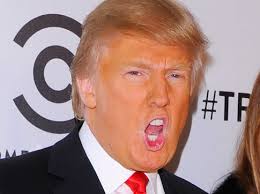
Donald Trump
Trump added that Bain Capital, the hedge fund where Romney made millions of dollars before running for governor, didn’t create any jobs. Whereas Trump claimed that he–Trump–had created “hundreds of thousands of jobs.”
So at least some observers must have been puzzled when Trump announced, on February 2, 2012: “It’s my honor, real honor and privilege, to endorse Mitt Romney” for President.
“Mitt is tough. He’s smart. He’s sharp. He’s not going to allow bad things to continue to happen to this country that we all love. So, Governor Romney, go out and get ’em. You can do it,” said Trump.
And Romney, in turn, had his own swooning-girl moment:
“I’m so honored to have his endorsement. There are some things that you just can’t imagine in your life. This is one of them.”
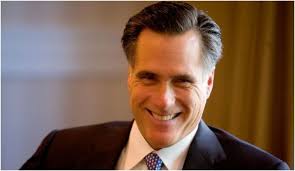
Mitt Romney
Throughout the 2012 Presidential race, Trump continued to “help” Romney–by repeatedly accusing President Barack Obama of not being an American citizen.
Had that been true, Obama would not have had the right to be President–since the Constitution says that only an American citizen can hold this position.
Of course, that was entirely what Trump wanted people to believe– that Obama was an illegitimate President, and deserved to be thrown out.
Come election night–and disaster for Romney–and Trump.
When it became clear that Romney was not going to be America’s 45th President, Trump went ballistic on Twitter.
Among his tweets:
- More votes equals a loss…revolution!
- Lets fight like hell and stop this great and disgusting injustice! The world is laughing at us.
- We can’t let this happen. We should march on Washington and stop this travesty. Our nation is totally divided!
- The phoney electoral college made a laughing stock out of our nation. The loser one!
- He lost the popular vote by a lot and won the election. We should have a revolution in this country!
To put Trump’s rants into real-world perspective:
According to Trump, the electoral process works when a Republican wins the Presidency. It only doesn’t work when a Democrat wins.
“We should march on Washington” conjures up images of another Fascist–Benito Mussolini–marching on Rome at the head of his Blackshirts to seize power.
“The phoney electoral college made a laughing stock out of our nation. The loser one!”
This is startling, on three counts:
First, the 2012 Republican Platform spoke lovingly about the need for preserving the Electoral College: “We oppose the National Popular Vote Interstate Compact or any other scheme to abolish or distort the procedures of the Electoral College.
“We recognize that an unconstitutional effort to impose ‘national popular vote’ would be a mortal threat to our federal system and a guarantee of corruption as every ballot box in every state would become a chance to steal the presidency.”
Second, the loser didn’t win: He lost. With votes still being counted (as of November 8) Obama got 60,652,238. Romney got 57,810,407.
Third, in 2000, Al Gore won the popular vote (50,999,897) to George W. Bush’s 50,456,002. But Bush trounced Gore in the Electoral College (271 to 266).
Still, that meant Bush–not Gore–would head the country for the next eight years. And that was perfectly OK with Right-wingers like Trump.
It was only when Obama won the Electoral College count by 332 to 206 that this was–according to Trump–a “travesty.”
And Trump’s solution if voters dare to elect someone other than Trump’s pet choice: “Revolution!”
This comes perilously close to advocating violent overthrow of the government. Otherwise known as treason–a crime traditionally punished by execution, or at least lengthy imprisonment.

Fast forward, to 2016–and the relationship between Trump and Romney looks considerably different.
On June 16, 2015, Trump declared his candidacy for the 2016 Republican Presidential nomination. Since then, he has been the first choice among the Republican base.
At first, he was dismissed as a bad joke–by Republican Presidential candidates as well as Democrats. Surely voters would reject a bombastic, thrice-married “reality show” host who had filed for corporate bankruptcy four times.
Yet from the outset Trump dominated the field–and a series of Republican debates. The other Republican candidates watched him with envy–and desperately tried to steal some of his limelight.
Making made one inflammatory statement after another, he offended one group of potential voters after another.
These insults delighted his white, under-educated followers. But they alienated millions of other Americans who might have voted for him.
ABC NEWS, ALAMO, ALTERNET, ANTONIO LOPEZ DE SANTA ANNA, AP, BUZZFEED, CBS NEWS, CNN, CROOKS AND LIARS, DAILY KOZ, DAVID CROCKETT, FACEBOOK, JAMES BOWIE, MEXICO, MOTHER JONES, MOVEON, MSNBC, NBC NEWS, NEWSWEEK, NPR, PBS NEWSHOUR, POLITICO, RAW STORY, REUTERS, SALON, SAM HOUSTON, SAN ANTONIO, SEATTLE TIMES, SLATE, SLAVERY, STEPHEN F. AUSTIN, TEXAS, TEXAS DECLARATION OF INDEPENDENCE, TEXAS REVOLUTION, THE ATLANTIC, THE CHICAGO SUN-TIMES, THE CHICAGO TRIBUNE, THE DAILY BEAST, THE GUARDIAN, THE HILL, THE HUFFINGTON POST, THE LOS ANGELES TIMES, THE NATION, THE NEW YORK TIMES, THE WASHINGTON POST, THERMOPYLAE, THREE HUNDRED SPARTANS, TIME, TWITTER, U.S. NEWS & WORLD REPORT, UPI, USA TODAY, WILLIAM BARRET TRAVIS
In Bureaucracy, History, Military, Politics on March 6, 2016 at 12:01 am
On the night before the final Mexican assault, one man escaped the Alamo to testify to the defenders’ courage. Or so goes the most famous story of the 13-day siege.
He was Louis Rose, a veteran of the Napoleonic wars and the dreadful 1812 retreat from Moscow. Unwilling to die in a hopeless battle, he slipped over a wall and sneaked through Mexican siege lines.
At Grimes County, he found shelter at the homestead of Abraham and Mary Ann Zuber. Their son, William, later claimed that his parents told him of Rose’s visit–and his story of Travis’ “line in the sand” speech.
In 1873, he published the tale in the Texas Almanac.
But many historians believe it is a fabrication. The story comes to us third-hand–from Rose to the Zubers to their son. And it was published 37 years after the Alamo fell.
Even if Travis didn’t draw a line in the sand, every member of the garrison, by remaining to stay, had crossed over his own line.
After a 12-day siege, Santa Anna decided to overwhelm the Alamo.
Some of his officers objected. They wanted to wait for bigger siege cannon to arrive–to knock down the Alamo’s three-feet-thick adobe walls. Without shelter, the defenders would be forced to surrender.
But Santa Anna insisted on an all-out assault: “Without blood and tears, there is no glory.”
The first assault came at about 5 a.m. on Sunday, March 6, 1836.
The fort’s riflemen–aided by 14 cannons–repulsed it. And the second assault as well.
But the third assault proved unstoppable. The Alamo covered three acres, and held at most 250 defenders–against 2,000 Mexican soldiers.
When the Mexicans reached the fort, they mounted scaling ladders and poured over the walls.
Travis was one of the first defenders to fall–shot through the forehead after firing a shotgun into the Mexican soldiery below.

Death of William Barrett Travis (waving sword)
Mexicans broke into the room where the ailing James Bowie lay.
In Three Roads to the Alamo, historian William C. Davis writes that Bowie may have been unconscious or delirious. Mistaking him for a coward, the soldiers bayoneted him and blew out his brains.
But some accounts claim that Bowie died fighting–shooting two Mexicans with pistols, then plunging his famous knife into a third before being bayoneted. Nearly every Alamo movie depicts Bowie’s death this way.

James Bowie’s death
As the Mexicans poured into the fort, at least 60 Texans tried to escape over the walls into the surrounding prairie. But they were quickly dispatched by lance-bearing Mexican cavalry.
The death of David Crockett remains highly controversial.
Baby boomers usually opt for the Walt Disney version: Davy swinging “Old Betsy” as Mexicans surround him. Almost every Alamo movie depicts him fighting to the death.

David Crockett’s Death
But Mexican Lieutenant Colonel Jose Enrique de la Pena claimed Crockett was one of seven Texans who surrendered or were captured and brought before Santa Anna after the battle. Santa Anna ordered their immediate execution, and they were hacked to death with sabers.
Only the 2004 remake of The Alamo has dared to depict this version. Although this version is now accepted by most historians, some still believe the de la Pena diary from which it comes is a forgery.
An hour after the battle erupted, it was over.
That afternoon, Santa Anna ordered the bodies of the slain defenders stacked and burned in three pyres.
Contrary to popular belief, some of the garrison survived:
- Joe, a black slave who had belonged to William B. Travis, the Alamo’s commander;
- Susanah Dickinson, the wife of a lieutenant killed in the Alamo, and her baby, Angelina;
- Several Mexican women and their children.
Also contrary to legend, the bravery of the Alamo defenders did not buy time for Texas to raise an army against Santa Anna. This didn’t happen until after the battle.
But their sacrifice proved crucial in securing Texas’ independence:
- The Alamo’s destruction warned those Texans who had not supported the revolution that they had no choice: They must win, die or flee their homes to the safety of the United States.
- It stirred increasing numbers of Americans to enter Texas and enlist in Sam Houston’s growing army.
- Santa Anna’s army was greatly weakened, losing 600 killed and wounded–a casualty rate of 33%.
- The nearly two-week siege bought time for the Texas convention to meet at Washington-on-the-Brazos and declare independence from Mexico.
On April 21, 1836, Santa Anna made a crucial mistake: During his army’s afternoon siesta, he failed to post sentries around his camp.
That afternoon, Sam Houston’s 900-man army struck the 1,400-man Mexican force at San Jacinto. In 18 minutes, the Texans–shouting “Remember the Alamo!”–killed about 700 Mexican soldiers and wounded 200 others.
The next day, a Texas patrol captured Santa Anna–wearing the uniform of a Mexican private. Resisting angry demands to hang the Mexican dictator, Houston forced Santa Anna to surrender control of Texas in return for his life.
The victory at San Jacinto won the independence of Texas. But the 13-day siege and fall of the Alamo remains the most famous and celebrated part of that conflict.
In 480 B.C., 300 Spartans won immortality at Thermopylae, a narrow mountain pass in ancient Greece, by briefly holding back an invading Persian army of thousands.
Although they died to the last man, their sacrifice inspired the rest of Greece to defeat its invaders.
Like Thermopylae, the battle of the Alamo proved both a defeat–and a victory.
2016 PRESIDENTIAL RACE, ABC NEWS, ADOLF HITLER, ALTERNET, AMERICABLOG, AP, BABY BOOMER RESISTANCE, BBC, BLACKS, BLOOMBERG NEWS, BUZZFEED, CBS NEWS, CLAUS VON STAUFFENBERG, CNN, CROOKS AND LIARS, DAILY KOS, DONALD TRUMP, FACEBOOK, FIVETHIRTYEIGHT, GEORGE C. WALLACE, HARPER’S MAGAZINE, HUEY LONG, HUFFINGTON POST, ILLEGAL ALIENS, JOHN KASICH, LATINOS, MARTIN NIEMOELLER, MEDIA MATTERS, MOTHER JONES, MOVEON, MSNBC, MUSLIMS, NAZI GERMANY, NBC NEWS, NEW REPUBLIC, NEWSDAY, NEWSWEEK, NPR, PBS NEWSHOUR, POLITICO, POLITICUSUSA, RAW STORY, REUTERS, ROBERT PAYNE, Ronald Reagan, SALON, SEATTLE TIMES, SLATE, SS, TALKING POINTS MEMO, THE ATLANTIC, THE CHICAGO SUN-TIMES, THE CHICAGO TRIBUNE, THE DAILY BEAST, THE DAILY BLOG, THE GUARDIAN, THE HILL, THE HUFFINGTON POST, THE INTERCEPT, THE LIFE AND DEATH OF ADOLF HITLER, THE LOS ANGELES TIMES, THE NATION, THE NEW REPUBLIC, THE NEW YORK TIMES, THE NEW YORKER, THE VILLAGE VOICE, THE WASHINGTON POST, THINKPROGRESS, TIME, TRUTHDIG, TRUTHOUT, TWILIGHT ZONE, TWITTER, U.S. NEWS & WORLD REPORT, UPI, WORLD WAR 11
In Bureaucracy, History, Military, Politics, Social commentary on March 2, 2016 at 12:02 am
On July 20, 1944, Colonel Claus Schenk von Stuaffenberg failed to assassinate Adolf Hitler with a bomb hidden in a briefcase.
He had carefully placed his briefcase near Hitler, who was standing next to a heavy oaken support of the conference table.
But after Stauffenberg left the room, Colonel Heinz Brandt, who stood next to Hitler, found the briefcase blocking his legs.
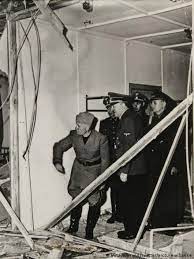
Hitler shows off the site of the explosion
So he moved it–to the other side of the heavy oaken support. When the bomb exploded, Hitler was partially shielded from its full blast. Brandt died, as did two other officers and a stenographer.
Not only did Hitler survive, but the plotters failed to seize the key broadcast facilities of the Reich.
This allowed Hitler to make a late-night speech to the nation, revealing the failed plot and assuring Germans that he was alive. And he swore to flush out the “traitorous swine” who had tried to kill him.
Among the first victims was the conspiracy’s leader, Colonel Claus von Stauffenberg. Standing before a makeshift firing squad at midnight, he cried: “Long live our sacred Germany!”
At least 7,000 persons were arrested by the Gestapo. According to records of the Fuehrer Conferences on Naval Affairs, 4,980 were executed.
If the conspiracy had succeeded and Germany had surrendered in July or August, 1944, World War II would have ended eight to nine months earlier. This would have meant:
- The Russians–who didn’t reach Germany until April, 1945–could not have occupied the Eastern part of the country.
- Millions of East Germans would have been spared the misery of living under Communist rule for 44 years.
- Many of the future conflicts between the United States and the Soviet Union over access to West Berlin and/or West Germany would have been prevented.
- Untold numbers of Holocaust victims would have survived because the concentration camps would have been shut down far earlier.
Thus, history can be altered by the appearance–or disappearance–of a single individual.
Which brings us back to Donald Trump.
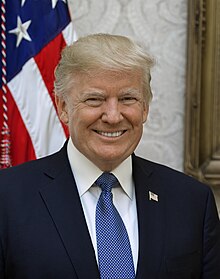
Donald Trump
Since declaring his candidacy for the Presidency on June 16, 2015, Trump has been the first choice among the Republican base.
At first, he was dismissed as a bad joke–by Republican Presidential candidates as well as Democrats. Surely voters would reject an egotistical, thrice-married, “reality show” host who had filed for corporate bankruptcy four times.
Yet from the outset Trump dominated the field–and a series of Republican debates. His fellow Republican candidates enviously watched him–and desperately tried to steal some of his limelight.
Making made one inflammatory statement after another, he offended one group of potential voters after another:
- Mexicans: “They’re bringing drugs. They’re bringing crime. They’re rapists.” He’s also promised to “build a great, great wall on our southern border and I will have Mexico pay for that wall.”
- Blacks: Trump retweeted an image of a masked, dark-skinned man with a handgun and a series of alleged crime statistics, including: “Blacks killed by whites – 2%”; “Whites killed by blacks – 81%.” The image cites the “Crime Statistics Bureau – San Francisco”–an agency that doesn’t exist.
- Illegal Aliens: Trump has threatened to forcibly deport millions of mostly Mexican and Central American residents.
- Muslims: Trump has boasted he would ban them from entering the United States–and revive waterboarding of terrorist suspects. He would require Muslims to register with the Federal Government. And he would close “some mosques” if he felt they were being used by Islamic terrorists.
- POWs: Speaking of Arizona U.S. Senator John McCain: “He’s a war hero because he was captured. I like people who weren’t captured.”
Niccolo Machiavelli, the father of modern politics, warned against hurling threats and insults: “For neither the one nor the other diminishes the strength of the enemy.
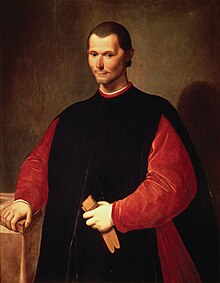
 Niccolo Machiavelli
“[Threats make] him more cautious, and [insults increase] his hatred of you, and [make] him more persevering in his efforts to injure you.”
But Trump revels in insulting anyone who dares to challenge him. He gleefully warns of the damage he will soon inflict on those who dare to oppose–or even criticize–him.
At the same time, he publicly exposes himself to a potential assassin virtually every day. And the mere presence of bodyguards is no guarantee against assassination.
Presidential candidate George C. Wallace was shot and paralyzed by a gunman while mingling with supporters in a Maryland shopping center in 1972. And President Ronald Reagan was shot and almost killed in 1981 while walking to his bulletproof limousine in Washington, D.C.
Both men were under protection by the U.S. Secret Service at the time.
* * * * *
In his bestselling 1973 biography, The Life and Death of Adolf Hitler, British historian Robert Payne harshly condemned the German people for the rise of the Nazi dictator:
“[They] allowed themselves to be seduced by him and came to enjoy the experience….[They] followed him with joy and enthusiasm because he gave them license to pillage and murder to their hearts’ content.”
There is a very real danger that millions of ignorant, hate-filled, Right-wing Americans will catapult Donald Trump–a man with an “odd psychology unleavened by kindness and charity”–into the Presidency.
And that this man–“who received no love, can give no love”–will assume all the awesome power that goes with that office.
If that happens, future historians–if there are any–may similarly condemn those Americans who stood by like “good Germans” and allowed their country to fall into the hands of a ruthless tyrant.
ABC NEWS, ADOLF HITLER, ALTERNET, AMERICABLOG, AP, BABY BOOMER RESISTANCE, BBC, BLACKS, BLOOMBERG NEWS, BUZZFEED, CBS NEWS, CLAUS VON STAUFFENBERG, CNN, CROOKS AND LIARS, DAILY KOS, DONALD TRUMP, FACEBOOK, FIVETHIRTYEIGHT, GEORGE C. WALLACE, HARPER’S MAGAZINE, HUEY LONG, HUFFINGTON POST, ILLEGAL ALILENS, JOHN KASICH, LATINOS, MARTIN NIEMOELLER, MEDIA MATTERS, MOTHER JONES, MOVEON, MSNBC, MUSLIMS, NAZI GERMANY, NBC NEWS, NEW REPUBLIC, NEWSDAY, NEWSWEEK, NPR, PBS NEWSHOUR, POLITICO, POLITICUSUSA, RAW STORY, REUTERS, ROBERT PAYNE, Ronald Reagan, SALON, SEATTLE TIMES, SLATE, SS, TALKING POINTS MEMO, THE ATLANTIC, THE CHICAGO SUN-TIMES, THE CHICAGO TRIBUNE, THE DAILY BEAST, THE DAILY BLOG, THE GUARDIAN, THE HILL, THE HUFFINGTON POST, THE INTERCEPT, THE LIFE AND DEATH OF ADOLF HITLER, THE LOS ANGELES TIMES, THE NATION, THE NEW REPUBLIC, THE NEW YORK TIMES, THE NEW YORKER, THE VILLAGE VOICE, THE WASHINGTON POST, THINKPROGRESS, TIME, TRUTHDIG, TRUTHOUT, TWILIGHT ZONE, TWITTER, U.S. NEWS & WORLD REPORT, UPI, WORLD WAR ii
In Bureaucracy, History, Military, Politics, Social commentary on March 1, 2016 at 12:15 am
On July 20, 1944, Colonel Claus Schenk von Stuaffenberg tried to assassinate Adolf Hitler.
He had served with the Wehrmacht in Poland (1939), France (1940) and the Soviet Union (1941).
While serving in Tunisa, he was seriously wounded on April 7, 1943, when Allied fighters strafed his vehicle. He lost his left eye, right hand and two fingers of his left hand after surgery.
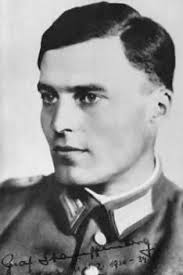
Colonel Claus Schenk von Stuaffenberg
Nevertheless, he now acted as the prime mover for the conspiracy among a growing number of German high command officers to arrest or assassinate Germany’s Fuehrer.
For most of these officers, the motive was craven: The “happy time’ of German victories was over. Germany was losing the war it had launched on the world in 1939–and now they feared the worst.
This was especially true now that the numerically superior forces of the Soviet Union had gone onto the offensive.
For Stauffenberg, there was another reason: His disgust at the horrors he had seen committed by his fellow Wehrmacht soldiers upon defenseless POW’s and civilians in Russia.
Thus, Stauffenberg–more than many Germans–knew firsthand the vengeance his country could expect if the “Thousand-Year Reich” fell.
Something must be done, he believed, to prove to the world that not all Germans–even members of the Wehrmacht–were criminals.
Most of the conspirators wanted to arrest Hitler and surrender to British and American forces–well before the much-feared Russians gained a toehold in Germany.
Stauffenberg didn’t want to arrest Hitler; he wanted to kill him. A live Hitler might eventually be rescued by his Nazi colleagues.
But Hitler was a closely-guarded target. He was surrounded by fanatical bodyguards who were expert marksmen. He often wore a bulletproof vest and a cap lined with three pounds of laminated steel.
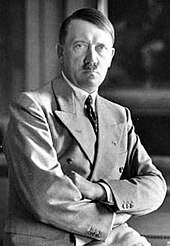
Adolf Hitler
Bundesarchiv, Bild 146-1990-048-29A / CC-BY-SA 3.0 [CC BY-SA 3.0 de (https://creativecommons.org/licenses/by-sa/3.0/de/deed.en)%5D
But his single greatest protection–he claimed–was an instinct for danger. He would suddenly change his schedule–to drop in where he was least expected. Or suddenly depart an event where he was expected to stay a long time.
On November 9, 1939, this instinct saved his life.
He had been set to give a long speech at a Munich beer hall before the “Old Fighters” of his storm troopers.
Sixteen years earlier on that day, in 1923, Hitler had led them in a disastrous attempt to overthrow the Bavarian government. Police had put down the effort, killing and wounding about a score of storm troopers in the process.
Hitler himself had later been arrested, tried and convicted for treason–and sentenced to a year’s imprisonment.
But instead of proving to be the end of Nazism, the “Beer Hall Putsch” turned Hitler into a national celebrity. And it launched his career as a legitimate, ultimately successful politician.
So Hitler was expected to speak to his longtime supporters for a long time that evening. Instead, he suddenly cut short his speech and left the beer hall. Forty-five minutes later, a bomb exploded inside a pillar–before which Hitler had been speaking.
Since then, a series of other assassination attempts had been made against Hitler. All of them involved time-bombs. And all of the would-be assassins were members of the German General Staff.
In one case, a bomb secretly stashed aboard Hitler’s plane failed to explode. In another, an officer who had a bomb strapped to himself unexpectedly found his scheduled meeting with Hitler called off. He had to rush into a bathroom to defuse the bomb before it went off.
So now it was the turn of von Stauffenberg. He would carry his bomb–hidden in a briefcase–into a “Hitler conference” packed with military officers.
But Stauffenberg didn’t intend to be a suicide bomber. He meant to direct the government that would replace that of the Nazis.
His bomb–also rigged with a time-fuse–would be left in the conference room while he found an excuse to leave. After the explosion, he would phone one of his fellow conspirators with the news.
Then, the coup–“Operation Valkyrie”–would be on.
Anti-Nazi conspirators would seize control of key posts of the government. The British and Americans would then be informed of Germany’s willingness to surrender. Provided, of course, that the vengeance-seeking Russians did not have a say in its postwar future.
The Wehrmacht and Schutzstaffel (SS) had killed millions of Russians. Many had died in combat. Others had been murdered as captives. Still more had been allowed to die by starvation and exposure to the notorious Russian winter.
So the Germans–both Nazi and anti-Nazi–knew what they could expect if soldiers of the Soviet Union reached German soil.
On July 20, 1944, Stauffenberg appeared at Hitler’s well-guarded military headquarters in East Prussia. Like all his other outposts, Hitler had named it–appropriately enough–“Wolf’s Lair.”

“Wolf’s Lair”
Stauffenberg entered the large, concrete building while the conference was in session. He placed his yellow briefcase next to Hitler–who was standing with his generals at a heavy oaken table. Then he excused himself to take an “urgent” phone call.
At 12:42 p.m. on July 20, 1944, Stauffenberg’s briefcase bomb erupted.
But, as if by a miracle, Hitler–and the Third Reich–survived.
2016 PRESIDENTIAL RACE, ABC NEWS, ADOLF HITLER, ALTERNET, AMERICABLOG, AP, BABY BOOMER RESISTANCE, BBC, BLACKS, BLOOMBERG NEWS, BUZZFEED, CBS NEWS, CLAUS VON STAUFFENBERG, CNN, CROOKS AND LIARS, DAILY KOS, DONALD TRUMP, FACEBOOK, FIVETHIRTYEIGHT, GEORGE C. WALLACE, HARPER’S MAGAZINE, HUEY LONG, HUFFINGTON POST, ILLEGAL ALIENS, JOHN KASICH, LATINOS, MARTIN NIEMOELLER, MEDIA MATTERS, MOTHER JONES, MOVEON, MSNBC, MUSLIMS, NAZI GERMANY, NBC NEWS, NEW REPUBLIC, NEWSDAY, NEWSWEEK, NPR, PBS NEWSHOUR, POLITICO, POLITICUSUSA, RAW STORY, REUTERS, ROBERT PAYNE, Ronald Reagan, SALON, SEATTLE TIMES, SLATE, SS, TALKING POINTS MEMO, THE ATLANTIC, THE CHICAGO SUN-TIMES, THE CHICAGO TRIBUNE, THE DAILY BEAST, THE DAILY BLOG, THE GUARDIAN, THE HILL, THE HUFFINGTON POST, THE INTERCEPT, THE LIFE AND DEATH OF ADOLF HITLER, THE LOS ANGELES TIMES, THE NATION, THE NEW REPUBLIC, THE NEW YORK TIMES, THE NEW YORKER, THE VILLAGE VOICE, THE WASHINGTON POST, THINKPROGRESS, TIME, TRUTHDIG, TRUTHOUT, TWILIGHT ZONE, TWITTER, U.S. NEWS & WORLD REPORT, UPI, WORLD WAR ii
In Bureaucracy, History, Military, Politics, Social commentary on February 29, 2016 at 10:31 am
“When Fascism comes to America, it will be called anti-Fascism.”
–Huey Long, Louisiana Governor/Senator
In the “Twilight Zone” episode, “No Time Like the Past,” Paul Driscoll (Dana Andrews), a scientist in early 1960s America, uses a time machine to visit Nazi Germany on the eve of World War II.
He’s rented a motel room overlooking the balcony from where the Fuehrer, Adolf Hitler will soon make a speech. And he’s eager to watch that speech–through the lens of a telescopic-sighted rifle.
Just as he’s about to pull the trigger, there’s a knock at his door–by the maid. Driscoll hustles her out as soon as possible, then once again picks up his rifle. He–and viewers–can once again see Hitler through the cross-hairs of his weapon.
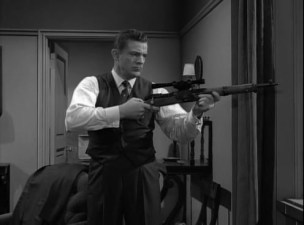
Paul Driscoll prepares to shoot Adolf Hitler
But instead of the anticipated shot, there’s another knock at his door–this time by the black-uniformed secret police, the SS. Driscoll knows the game is over, and disappears into the present just as the thugs break down his door.
And the audience is left to ponder how different the world would have been if Driscoll–or someone in Nazi Germany–had succeeded in assassinating the man whose wars would wipe out the lives of 50 million men, women and children around the globe.
At least one Republican candidate for President has dared to invoke the past of Nazi Germany in warning of the dangers of a Donald Trump Presidency. And to argue that Americans have a chance to prevent that past from returning.
In November, 2015, John Kasich, the governor of Ohio, was peddling a message of creating jobs, balancing the Federal budget and disdain for Washington, D.C.
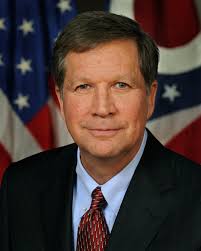
John Kasich
But he remained far behind in the polls, dropping 50% in support in just one month–from September to October. Meanwhile, Trump, the New York billionaire developer, was being backed by 25% of Republican primary voters.
So, with nothing to lose, Kasich decided to take off the gloves. He invoked the “N” word for Republicans: Nazi.
He authorized the creation of a TV ad that opened with ominous music–and the face of a snarling Donald Trump.
“I would like anyone who is listening to consider some thoughts that I’ve paraphrased from the words of German pastor Martin Niemoeller.”
The voice belonged to Tom Moe, a retired colonel in the U.S. Air Force–and a former Vietnam prisoner-of-war.
“You might not care if Donald Trump says Muslims must register with the government, because you’re not one,” continued Moe.
“And you might not care if Donald Trump says he’s going to round up all the Hispanic immigrants, because you’re not one.
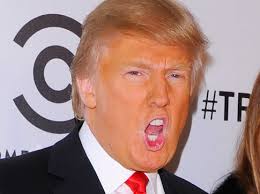
Donald Trump
“And you might not care if Donald Trump says it’s OK to rough up black protesters, because you’re not one.
“And you might not care of Donald Trump wants to suppress journalists, because you’re not one.
“But think about this:
“If he keeps going, and he actually becomes President, he might just get around to you. And you’d better hope that there’s someone left to help you.”
Martin Niemoeller (1892–1984) was a prominent Protestant pastor who had commanded a U-boat during World War 1. He became a bitter public foe of Adolf Hitler.
A staunch anti-Communist, he had initially supported the Nazis as Germany’s only hope of salvation against the Soviet Union.
But when the Nazis made the church subordinate to State authority, Niemoeller created the Pastors’ Emergency League to defend religious freedom.
For his opposition to the Third Reich, Niemoeller spent seven years in concentration camps.
With the collapse of the Reich in 1945, he was freed–and elected President of the Protestant church in Hesse and Nassau in 1947. During the 1960s, he was a president of the World Council of Churches.
He is best remembered for his powerful condemnation of the failure of Germans to protest the increasing oppression of the Nazis:
First they came for the Communists, but I was not a Communist, so I did not speak out.
Then they came for the Socialists, but I was not a Socialist, so I did not speak out.
Then they came for the trade unionists, but I was not a trade unionist, so I did not speak out.
Then they came for the Jews, but I was not a Jew, so I did not speak out.
And when they came for me, there was no one left to speak out for me.
Neither “Adolf Hitler” nor “Nazi Party” was mentioned during the one-minute Kassich video. But a furious Trump threatened to sue Kasich if he could find find anything “not truthful” within the ad.
So said the man who has called Mexican immigrants “rapists” and accused President Barack Obama of being a Muslim and an illegal alien.
The Kasich ad is by far the darkest attack so far made against Trump by any candidate–Republican or Democrat. And it raises a disturbing question:
If Donald Trump is America’s Adolf Hitler, who will be its Claus von Stauffenberg?
Colonel Claus Schenk von Stuaffenberg was the German army officer who, on July 20, 1944, tried to assassinate Adolf Hitler.
2016 PRESIDENTIAL RACE, ABC NEWS, APOLLO MOON LANDING, BARACK OBAMA, BARBARA TUCHMAN, CBS NEWS, CNN, COLD WAR, DONALD TRUMP, DREAMS FROM MY FATHER, EDUCATION, HERMAN CAIN, IGNORANCE, JOHN F. KENNEDY, LITERACY, NBC NEWS, NEVADA PRIMARY, NUCLEAR TEST BAN TREATY, REPUBLICANS, RICK PERRY, Sarah Palin, SOVIET UNION, THE AUDACITY OF HOPE, THE CHICAGO SUN-TIMES, THE CHICAGO TRIBUNE, THE GUNS OF AUGUST, THE LOS ANGELES TIMES, THE NEW YORK TIMES, THE WASHINGTON POST, VIETNAM WAR
In Bureaucracy, History, Politics, Social commentary on February 25, 2016 at 9:55 am
After winning the Republican Nevada primary with over 44% of the votes on February 23, Republican Presidential candidate Donald Trump gave the expected victory speech.
But it came with an unexpected moment:
“So we won the evangelicals. We won with young. We won with old. We won with highly educated. We won with poorly educated. I love the poorly educated. We’re the smartest people, we’re the most loyal people.”
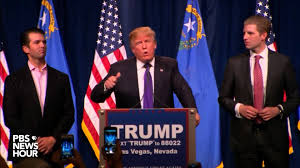
Donald Trump
“I love the poorly educated.”
As well he might: Polls have consistently shown that Trump relies on less-educated adults for his support.
Among Republicans, 71 percent of non-college graduates view Trump favorably, while 46 percent of college graduates support him.
In fact, appealing to the ignorant and uneducated has become a commonplace for politicians on the Right.
President John F. Kennedy speed-read several newspapers every morning. He nourished personal relationships with the press-–and not for altruistic reasons.
These journalistic relationships gave Kennedy additional sources of information and perspective on national and international issues.
But in 2012, Republican Presidential candidates celebrated their ignorance of both.
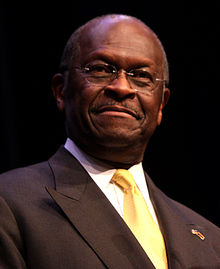
Herman Cain
Former Godfather’s Pizza CEO Herman Cain famously said, “We need a leader, not a reader.” In doing so, he stole this line from the fictionalized “President Schwarzenegger” in The Simpsons Movie.
Thus he excused his ignorance of the reasons for President Barack Obama’s intervention in Libya.
Then-Texas Governor Rick Perry showed similar pride in not knowing there are nine judges on the United States Supreme Court:
“Well, obviously, I know there are nine Supreme Court judges. I don’t know how eight came out my mouth. But the, uh, the fact is, I can tell you–I don’t have memorized all of those Supreme Court judges. And, uh, ah–
“Here’s what I do know. That when I put an individual on the Supreme Court, just like I done in Texas, ah, we got nine Supreme Court justices in Texas, ah, they will be strict constructionists….”
In short, it’s the media’s fault if they ask you a question and your answer reveals your own ignorance, stupidity or criminality.
Then there was Sarah Palin’s rewriting of history via “The Midnight Ride of Paul Revere”:
“He warned the British that they weren’t going to be taking away our arms by ringing those bells and, um, making sure as he’s riding his horse through town to send those warning shots and bells that, uh, we were going to be secure and we were going to be free.”
In fact, Revere wasn’t warning the British about anything. He was warning his fellow Americans about an impending British attack–as his celebrated catchphrase “The British are coming!” made clear.
Republicans have attacked President Obama for his Harvard education and articulate use of language. Among their taunts: “Hitler also gave good speeches.”
And they resent his having earned most of his income as a writer of two books: Dreams From My Father and The Audacity of Hope. As if being a writer is somehow subversive.
When President Kennedy was assassinated on November 22, 1963, it was said that he left three great legacies to his country:
- The Nuclear Test Ban Treaty;
- The Apollo moon landing; and
- The Vietnam War.
But there was a fourth legacy–and perhaps the most important of all: The belief that mankind could overcome its greatest challenges through rationality and perseverance.

White House painting of JFK
At American University on June 10, 1963, Kennedy called upon his fellow Americans to re-examine the events and attitudes that had led to the Cold War. And he declared that the search for peace was by no means absurd:
“Our problems are man-made; therefore, they can be solved by man. And man can be as big as he wants. No problem of human destiny is beyond human beings.
“Man’s reason and spirit have often solved the seemingly unsolvable, and we believe they can do it again.”
Today, politicians from both parties cannot agree on solutions to even the most vital national problems.
On November 21, 2011, the 12 members of the “Super-Committee” of Congress, tasked with finding $1.2 trillion in cuts in government spending, threw up their hands in defeat.
During the height of the Cuban Missile Crisis, Kennedy spoke with aides about a book he had just finished: Barbara Tuchman’s The Guns of August, on the events leading to World War 1.
He said that the book’s most important revelation was how European leaders had blindly rushed into war, without thought to the possible consequences.
Kennedy told his aides he did not intend to make the same mistake-–that, having read his history, he was determined to learn from it.
When knowledge and literacy are attacked as “highfalutin’” arrogance, and ignorance and incoherence are embraced as sincerity, national decline and collapse lie just around the corner.
ABC NEWS, ABORTION, ANTI-ABORTIONISTS, CBS NEWS, CENTERS FOR DISEASE CONTROL (CDC), CNN, COLUMBIA, DROUGHT, FACEBOOK, MOSQUITOES, NBC NEWS, RICHARD MOURDOCK, Ronald Reagan, TEPUBLICAN PARTY, THE CHICAGO SUN-TIMES, THE CHICAGO TRIBUNE, THE LOS ANGELES TIMES, THE NEW YORK TIMES, THE WASHINGTON POST, TODD AKIN, TWITTER, ZIKA VIRUS
In Bureaucracy, DOCTORS, History, Law, Politics, Social commentary on February 24, 2016 at 1:06 pm
A battle of truly cosmic proportions is about to rage.
In one corner is the dreaded Zika virus, which prevents the brain of a fetus from developing properly–and for which there is no vaccine.
And in the other corner are the self-appointed male “guardians of morality” who refuse to provide abortion services–even in cases of rape and incest.
For the moment, Columbia will be the epicenter of this conflict. But it is certain to expand to other nations, as the virus–carried by mosquitoes–continues to spread across the globe.

Mosquito
On February 7, Columbian President Juan Manuel Santos announced that 25,645 people are infected with Zika in Colombia–of which 3,177 are pregnant women.
And Brazil is investigating the potential link between Zika infections and more than 4,000 suspected cases of microcephaly, which causes babies to be born with abnormally small heads and a host of birth defects.

Zika virus victim (left)
Zika cases have been confirmed in 23 countries and territories in the Americas.
The barest facts about this epidemic are nightmarish–especially for any woman who is pregnant.
- An estimated 80 percent of those infected–male and female–show no symptoms, and those that do have a mild illness, with a fever, rash and red eyes.
- Babies so affected are born with an abnormally small head resulting in developmental problems, such as retardation, blindness and deafness.
- The virus can be transmitted directly by mosquitoes; by mothers to fetuses; by men to their sexual partners; by saliva during deep kissing; and by blood transfusions.
- There is no vaccine to prevent infection with the Zika virus–and no cure for it once you’ve been infected.
The United States Centers for Disease Control (CDC) has issued the following guidelines for protection against the virus:
- The best way to prevent diseases spread by mosquitoes is to protect yourself and your family from mosquito bites.
- Wear long-sleeved shirts and long pants.
- Stay in places with air conditioning or window and door screens to keep mosquitoes outside.
- Use insect repellents that are registered by the Environmental Protection Agency for their effectiveness.
- If using sunscreen, apply sunscreen before applying insect repellent.
- Sleep under a mosquito bed net if you are overseas or outside and can’t protect yourself from mosquito bites.
But while mosquitoes are responsible for the first half of this nightmarish scenario, responsibility for the second half lies with Right-wing attitudes toward abortion.
In Columbia, abortion became legal only in 2006–and only under the following circumstances:
- The pregnancy poses a danger to the life or health of the mother.
- The presence of life-threatening fetal malformations.
- The pregnancy resulted from rape, incest or non-consensual artificial insemination.
Prior to 2006, abortion in Columbia was illegal without exception.
Faced with the Zika epidemic, Columbia’s government has announced that pregnant women who carry the virus are eligible for abortion services.
Yet many Columbian women struggle to find abortion providers even when they meet strict legal requirements. The result: Illegal abortions are widespread.
Meanwhile, in the United States, the CDC stated on February 9:
- No local mosquito-born Zika virus disease cases have been reported within the United States, but there have been travel-associated cases among those who have visited other countries.
- The number of Zika cases among travelers visiting or returning to the United States will likely increase.
- Eighty percent of these cases will not be diagnosed.
- These “imported cases” could spread the virus in “some areas” of the United States.
And as the Zika toll inevitably rises within the United States, there will be increasing demands by women to obtain abortion services.
Meanwhile, the Republican party will increasingly strive to once again make abortion a criminal offense–as the following quotes attest:
- “Once a child does exist in your womb, I’m not going to assume a right to kill it just because the child’s host (some refer to them as mothers) doesn’t want it.”–Virginia U.S. Senator Steve Martin (2014).
- “If it’s a legitimate rape, the female body has ways to try to shut that whole thing down.”–Former Congressman Todd Akin (2012).
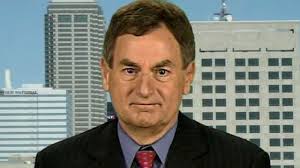
Richard Mourdock
- “I struggled with it myself for a long time, but I came to realize life is that gift from God. And I think even when life begins in that horrible situation of rape, that is something that God intended to happen.”–Former Republican U.S. Senate Candidate Richard Mourdock (2012)
- “Texas was in a long period of drought until Governor [Rick] Perry signed the fetal pain bill. It rained that night. Now God has his hold on California.”–California Republican Assemblywoman Shannon Grove. (2015)
- “We support a human life amendment to the Constitution and endorse legislation to make clear that the Fourteenth Amendment’s protections apply to unborn children.”–Republican Party’s 2012 Platform
There are several reasons why Republicans virulently oppose access to abortion. Without doubt, the most important is that there is an energized constituency for politicians wanting to ban it.
Every major Republican Presidential candidate since Ronald Reagan has tapped into this voting bloc. And each has found plenty of votes to be gotten from it.
But as the toll from the Zika virus continues to rise, anti-abortionists will face pressure even from within their own ranks.
Many of their own wives and daughters (and, in some cases, mistresses) carrying Zika-infected fetuses will demand the right to terminate such pregnancies.
And then the battle over abortion rights will enter an entirely new dimension.
ABC NEWS, ALAMO, ALTERNET, AMERICABLOG, ANDREW JACKSON, AP, BABY BOOMER RESISTANCE, BUZZFEED, CAMERON JUDD, CBS NEWS, CNN, CROCKETT OF TENNESSEE, CROOKS AND LIARS, DAILY KOZ, DAVID CROCKETT, DAVY CROCKETT: KING OF THE WILD FRONTIER, DONALD TRUMP, DRUDGE RETORT, FACEBOOK, FIVETHIRTYEIGHT, HARPER’S MAGAZINE, INDIAN WARS, JAMES BOWIE, MEDIA MATTERS, MITT ROMNEY, MOTHER JONES, MOVEON, MSNBC, NBC NEWS, NBCNEWS, NEWSWEEK, NPR, PBS NEWSHOUR, POLITICO, POLITICUSUSA, RAW STORY, REUTERS, SALON, SEATTLE TIMES, SLATE, TALKING POINTS MEMO, TEXAS REVOLUTION, THE ATLANTIC, THE CHICAGO SUN-TIMES, THE CHICAGO TRIBUNE, THE DAILY BEAST, THE DAILY BLOG, THE GUARDIAN, THE HILL, THE HUFFINGTON POST, THE LOS ANGELES TIMES, THE NATION, THE NEW REPUBLIC, THE NEW YORK TIMES, THE VILLAGE VOICE, THE WASHINGTON POST, THINKPROGRESS, TIME, TRUTHDIG, TRUTHOUT, TWITTER, TWO POLITICAL JUNKIES, U.S. NEWS & WORLD REPORT, UPI, USA TODAY, WALT DISNEY, WILLIAM BARRET, WONKETTE
In Business, History, Military, Politics, Social commentary on February 23, 2016 at 10:58 am
March 6, 2016, will mark the 180th anniversary of the fall of the Alamo, a crumbling former Spanish mission in the heart of San Antonio, Texas.
It’s one of those battles like Thermopylae that have passed from history into legend.
It’s been the subject of novels, movies, biographies, histories and TV dramas (most notably Walt Disney’s 1955 “Davy Crockett: King of the Wild Frontier”).

The Alamo
By Mattstone911 – Own work, CC BY-SA 3.0,
Perhaps the most extraordinary scene in any Alamo movie or book occurs in the 1993 novel, Crockett of Tennessee, by Cameron Judd.
And it is no less affecting for its being–-so far as we know–-entirely fictional.
It’s March 5, 1836–the last night of life for the Alamo garrison. The night before the 2,000 men of the Mexican Army hurl themselves at the former mission and slaughter its 200 “Texian” defenders.  The fort’s commander, William Barret Travis, has drawn his “line in the sand” and invited the garrison to choose: To surrender, to try to escape, or to stay and fight to the death.
And the garrison–except for one man–chooses to stay and fight.
For the garrison, immortality lies only hours away. Or does it?
An hour after deciding to stand and die in the Alamo, wrapped in the gloom of night, Crockett is seized with paralyzing fear.
“We’re going to die here,” he chokes out to his longtime friend, Persius Tarr. “You understand that, Persius? We’re going to die!” 
“I know, Davy. But there ain’t no news in that,” says Tarr. “We’re born to die. Every one of us. Only difference between us and most everybody else is we know when and where it’s going to be.”
“But I can’t be afraid–not me. I’m Crockett. I’m Canebrake Davy. I’m half-horse, half-alligator.”
“I know you are, Davy,” says Tarr. “So do all these men here. That’s why you’re going to get past this.
“You’re going to put that fear behind you and walk back out there and fight like the man you are. The fear’s come and now it’s gone. This is our time, Davy.”
“The glory-time,” says Crockett.
“That’s right, David. The glory-time.”
And then Tarr delivers a sentiment wholly alien to money-obsessed men like Mitt Romney and Donald Trump–who comprise the richest and most privileged 1% of today’s Americans.
“There’s men out there with their eyes on you. You’re the only thing keeping the fear away from them. You’re joking and grinning and fiddling-–it gives them courage they wouldn’t have had without you.
“Maybe that’s why you’re here, Davy–to make the little men and the scared men into big and brave men. You’ve always cared about the little men, Davy. Remember who you are.
“You’re Crockett of Tennessee, and your glory-time has come. Don’t you miss a bit of it.”
The next morning, the Mexicans assault the Alamo. Crockett embraces his glory-time-–and becomes a legend for all-time.

David Crockett (center) at the fall of the Alamo
David Crockett (1786-1836) lived–and died–a poor man. But this did not prevent him from trying to better the lives of his family and fellow citizens–and even his former enemies.

David Crockett
During the war of 1812, he served as a scout under Andrew Jackson. His foes were the Creek Indians, who had massacred 500 settlers at Fort Mims, Alabama–and threatened to do the same to Crockett’s family and neighbors in Tennessee.
As a Congressman from Tennessee, he championed the rights of poor whites. And he opposed then-President Jackson’s efforts to force the same defeated Indians to depart the lands guaranteed them by treaty.
To Crockett, a promise was sacred–whether given by a single man or the United States Government.
And his presence during the 13-day siege of the Alamo did cheer the spirits of the vastly outnumbered defenders. It’s a matter of historical record that he and a Scotsman named MacGregor often staged musical “duels” to see who could make the most noise.
It was MacGregor with his bagpipes against Crockett and his fiddle.
Contrast this devotion of Crockett to the rights of “the little men,” as Persius Tarr called them, with the attitude of Donald Trump, the front runner for the 2016 Republican Presidential nomination.

Donald Trump
On June 16, while announcing his candidacy, Trump said:
- “…I don’t need anybody’s money. It’s nice. I don’t need anybody’s money. I’m using my own money. I’m not using lobbyists, I’m not using donors. I don’t care. I’m really rich.”
- “I did a lot of great deals and I did them early and young, and now I’m building all over the world….”
- “So I have a total net worth, and now with the increase, it’ll be well-over $10 billion.”
- “But here, a total net worth of–net worth, not assets, not–a net worth, after all debt, after all expenses, the greatest assets–Trump Tower, 1290 Avenue of the Americas, Bank of America building in San Francisco, 40 Wall Street, sometimes referred to as the Trump building right opposite the New York–many other places all over the world. So the total is $8,737,540,000.”
Those who give their lives for others are rightly loved and remembered as heroes. Those who dedicate their lives solely to their wallets and egos are rightly soon forgotten.
2016 PRESIDENTIAL CAMPAIGN, ABC NEWS, ADOLF HITLER, ANNE FRANK, ANTONIN SCALIA, AUSCHWITZ, BARACK OBAMA, BERGEN-BELSEN, CBS NEWS, CNN, DONALD TRUMP, EVA SCHLOSS, FACEBOOK, HOLOCAUST, illegal immigration, ISIS, MEXICO, NAZI GERMANY, NBC NEWS, POPE FRANCIS, SUPREME COURT, SYRIAN REFUGEES, THE CHICAGO SUN-TIMES, THE CHICAGO TRIBUNE, THE LOS ANGELES TIMES, THE NEW YORK TIMES, THE WASHINGTON POST, TWITTER, VATICAN
In Bureaucracy, History, Politics, Social commentary on February 22, 2016 at 9:48 am
Ironically, Right-wingers, who support many of the same policies of Adolf Hitler, often attack liberals as Nazis–especially President Barack Obama.
But now a genuine authority on Fascism has come forward to assess the front-runner for the Republican Presidential nomination.
“If Donald Trump become[s] the next president of the US it would be a complete disaster. I think he is acting like another Hitler by inciting racism.”
So says Eva Schloss, the stepsister of Holocaust victim Anne Frank. As a survivor of Auschwitz, Schloss should know something about Nazis.

Eva Schloss
Now 86, Schloss met Anne in Amsterdam as a fellow refugee. Both their families had taken refuge there after fleeing Nazi Germany.
Anne Frank spent four years hiding in an attic and keeping a diary. But in 1944 she was discovered by the Nazis and sent to the Bergen-Belsen concentration camp.
She was 15 when she died there of typhus in March 1945. After the war, Eva Schloss’ mother, Fritzi, married Otto Frank, Anne’s father.

Anne Frank
Eva was detained at the same time as Anne and sent to Auschwitz. She survived when the camp was liberated on January 27,1945.
In a January 27th essay for Newsweek, Schloss warned of dire consequences if Donald Trump became President.
“During his U.S. presidential campaign he has suggested the ‘total and complete shutdown of Muslims entering the United States,’ as well as pledging to build a wall between the U.S. and Mexico to keep illegal immigrants out.”
She was 11 when her family immigrated to Belgium after Hitler forcibly Annexed Austria in 1938.
“We were treated as if we had come from the moon. I felt as if I wasn’t wanted and that I was different to everybody. It is even harder for today’s Syrian refugees who have a very different culture….
“I am very upset that today again so many countries are closing their borders,” said Schloss, who lives in London. “Fewer people would have died in the Holocaust if the world had accepted more Jewish refugees.”
And on February 18, Pope Francis also waded into the 2016 Presidential race with his own assessment of Trump.
The comment came in answer to a question by one of several reporters who were accompanying the Pope to Rome from a six-day trip to Mexico.
What, a reporter asked the Pontiff, did he think of Trump’s campaign pledge to build a wall along the entire length of the U.S.-Mexican border and expel millions of illegal aliens now living in the United States?
“A person who only thinks about building walls, wherever they are, and not in building bridges, is not Christian,” replied the Pope. “This is not the gospel.”
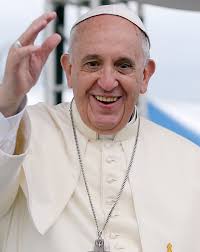
Pope Francis
Francis said he would “give the benefit of the doubt” to Trump because he had not heard Trump’s border plans independently.
But he added: “I say only that this man is not a Christian if he has said things like that.”
Trump, a Presbyterian, responded minutes later: “For a religious leader to question a person’s faith is disgraceful.”
Trump has repeatedly accused President Barack Obama–a self-described Christian–as a secret Muslim.
Donald Trump
On February 21, for example, he tweeted: “I wonder if President Obama would have attended the funeral of [Supreme Court] Justice [Antonin] Scalia if it were held in a mosque.”
Obama had paid tribute to Scalia at the Supreme Court on the day prior to the funeral. He declined to attend the service because his heavy security detail might disrupt the ceremony.
“I am proud to be a Christian,” added Trump, “and as president I will not allow Christianity to be consistently attacked and weakened.”
Nor did he stop there: “If and when the Vatican is attacked by the ISIS, which as everyone knows is ISIS’s ultimate trophy, I can promise you that the pope would have only wished and prayed that Donald Trump would have been president.
“ISIS would have been eradicated unlike what is happening now with our all talk, no action politicians.”
Trump thus implied that the Pope’s future security depended on the United States generally–and on Donald Trump in particular.
And he clearly ignored the fact that, since September, 2014, the United States Air Force has been bombing ISIS convoys in Iraq and Syria.
Trump has long been critical of the Pope’s stand on immigration.
As the Pope undertook his trip to Mexico, Trump told Fox Business Network that he didn’t think Francis understood “the danger of the open border we have with Mexico.
“I think Mexico got him to do it because they want to keep the border just the way it is,” he said. “They’re making a fortune, and we’re losing.”
A Vatican spokesman replied: “The pope always talks about migration problems all around the world, of the duties we have to solve these problems in a humane manner, of hosting those who come from other countries in search of a life of dignity and peace.”
For millions of Jews and Catholics, the election of 2016 may turn on how they answer the question: Am I serving the Lord–or the devil?
ABC NEWS, ATOMIC BOMB, CBS NEWS, CNN, DWIGHT SCHULTZ, FACEBOOK, FAT MAN AND LITTLE BOY, HARRY S. TRUMAN, IMPERIAL JAPAN, J. ROBERT OPPENHEIMER, JOSEPH R. MCCARTHY, LESLIE GROVES, MANHATTAN PROJECT, NAZI GERMANY, NBC NEWS, PAUL NEWMAN, PEARL HARBOR, THE CHICAGO SUN-TIMES, THE CHICAGO TRIBUNE, THE LOS ANGELES TIMES, THE NEW YORK TIMES, THE WASHINGTON POST, TWITTER, USA TODAY, WORLD WAR ii
In Bureaucracy, History, Military, Politics, Social commentary on February 19, 2016 at 12:01 am
The 1989 movie, Fat Man and Little Boy, provides useful insights into the real-life workings of bureaucracies.
In it, the brilliant and ambitious physicist, J. Robert Oppenheimer (played by Dwight Schultz) comes–too late–to realize he’s made a deal with the devil.
The same proved true for the J. Robert Oppenhemer of history.
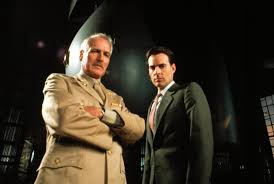
Paul Newman as General Leslie Groves and Dwight Schultz as J. Robert Oppenheimer
Hired by Army General Leslie Groves (played by Paul Newman) to ramrod construction of an atomic bomb, Oppenheimer has no qualms about using it against Nazi Germany.
It’s believed, after all, that German scientists are furiously pursuing work on such a weapon. The full horror of the extermination camps has not yet been revealed.
But “Oppie” and many other Jewish scientists working on the Manhattan Project can easily imagine the fate of Jews trapped within the borders of the Third Reich.
Then something unforeseen happens.
On May 8, 1945, the Third Reich collapses and signs unconditional surrender terms. Almost at the same time, the U.S. military learns that although German physicists had tried to make an atomic bomb, they never even got close to producing one.
So Oppenheimer finds himself still working to build the most devastating weapon in history–but now lacking the enemy he had originally signed on to destroy.
Meanwhile, the U.S. Government has invested nearly $2 billion in the Manhattan Project–at a time when $2 billion truly meant the equivalent of $1 trillion today. Is all that money to go for nothing?
What to do?
Oppenheimer doesn’t have to make that decision. It’s made for him—by Groves, by Groves’ superiors in the Army, and ultimately by the new President, Harry S. Truman. The bomb will be used, after all.
It will just be turned against the Japanese, who are even more hated by most Americans than the Germans. It doesn’t matter that:
- The Japanese lack the technological skill of the Germans to produce an atomic bomb.
- They are rapidly being pushed across the Pacific to their home islands.
- American bombers are incinerating Japanese cities at will.
- The Japanese are desperately trying to find a way to surrender without losing face.
What matters is that Pearl Harbor is still fresh in the minds of Americans generally and of the American military in particular. And that now that the Japanese are being pushed back into their home islands, they are fighting ever more fanatically to hold off certain defeat.
General Douglas MacArthur, who is scheduled to command the invasion of Japan, has estimated a million American casualties if this goes forward.
Oppenheimer, who has taught physics at the University of California at Berkeley, now finds himself being taught a lesson: That, once set in motion, bureaucracies–like objects–continue to move forward unless something intervenes to stop them.
And, in this case, there is no one willing to say: Stop.
So, on July 16, 1945, the first atomic bomb in history is detonated at Los Alamos, New Mexico.
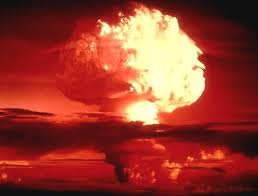
Atomic bomb test at Los Alamos: July 16, 1945
Then, on August 6, 1945, an American B-29 bomber drops “Little Boy” on Hiroshima. An estimated 80,000 people die instantly.
By the end of the year, injury and radiation bring total casualties to 90,000-140,000.
On August 9, it’s the turn of Nagasaki. Casualty estimates for the dropping of “Fat Man” range from 40,000 to 73,884, with another 74,909 injured, and another several hundred thousand diseased and dying due to fallout and other illness caused by radiation.
For Oppenheimer, the three years he has devoted to creating an atomic bomb will prove the pivotal event of his life.
He will be praised and damned as an “American Prometheus,” who brought atomic fire to man. Countless Americans–especially those who would have been ordered to invade Japan–will revere him as the man who brought the war to a quick end.
And countless Americans–and non-Americans–will condemn him as a man whose arrogance and ambition led him to arm mankind with the means of its own destruction.
Witnessing the first successful atomic explosion, Oppenheimer had been stunned by the sheer magnitude of destructiveness he had helped unleash. Quoting the Hindu holy book, the Bhagavad Gita, he murmured: “Now I am become Death, the shatterer of worlds.”
Faced with the massive toll of lives taken by the device he had created, Oppenheimer became convinced that the only hope for humanity lay in abolishing nuclear weapons.
He vigorously opposed the creation of a “super” hydrogen bomb. His advice was overruled, however, and construction of this went forward at the same pace that Oppenheimer had once driven others to create the atomic bomb.
The first test of this even more terrifying weapon occurred on November 1, 1952. By 1953, just as Oppenheimer had predicted, the Soviet Union had launched its own H-bomb test.
In a famous meeting with President Truman, Oppenheimer reportedly said, “Mr. President, I have blood on my hands.” Truman later claimed that he had offered Oppenheimer a handkerchief, saying, “Here, this will wash it off.”
It didn’t.
During the hysteria of the Joseph McCarthy witch-hunts, Oppenheimer found himself accused of being a Communist traitor. In 1954, he was stripped of his government security clearance.
Unable to prevent the military bureaucracy from moving relentlessly to use the atomic bomb, he could not halt the political bureaucracy from its own rush into cowardice and the wrecking of others’ lives.


.jpg&imgrefurl=https%3A%2F%2Fen.wikipedia.org%2Fwiki%2FPope_Francis'_visit_to_the_Philippines&docid=MrlhHX0IDhYhuM&tbnid=wAeMK3JqWfBmtM%3A&w=1297&h=1638&ved=0ahUKEwjmqo7njIvLAhVL6WMKHf_xBUYQxiAIAg&iact=c&ictx=1)

 Bureaucracybuster's Blog
2000 PRESIDENTIAL RACE, 2012 PRESIDENTIAL ELECTION, 2016 PRESIDENTIAL RACE, ABC NEWS, AL GORE, BARACK OBAMA, BLACKS, CBS NEWS, CHRIS CHRISTIE, CNN, DONALD TRUMP, ELECTORAL COLLEGE, FACEBOOK, GEORGE ORWELL, GEORGE W. BUSH, MARCO RUBIO, MEXICANS, MITT ROMNEY, MUSLIMS, NBC NEWS, NINETEEN-EIGHTY-FOUR, POW'S, RAFAEL CRUZ, REPUBLICAN PARTY, THE CHICAGO SUN-TIMES, THE CHICAGO TRIBUNE, THE LOS ANGELES TIMES, THE NEW YORK TIMES, THE WASHINGTON POST, TWITTER
TRUMPING–AND DUMPING: PART ONE (OF THREE)
In Bureaucracy, Business, History, Politics, Social commentary on March 7, 2016 at 12:23 amIn 2011, Donald Trump, the egocentric businessman and “reality star” of NBC’s “The Apprentice,” was toying with the idea of running for President in 2012.
On April 17, 2011, Trump said this about Mitt Romney, a possible rival and the former Massachusetts governor and front-runner GOP candidate:
“He’d buy companies, he’d close companies. He’d get rid of jobs. I’ve built a great company. I’m a much bigger businessman and have a much, much bigger net worth. I mean, my net worth is many, many, many times Mitt Romney.
“Mitt Romney is a basically small-business guy, if you really think about it. He was a hedge fund. He was a funds guy. He walked away with some money from a very good company that he didn’t create. He worked there. He didn’t create it.”
Donald Trump
Trump added that Bain Capital, the hedge fund where Romney made millions of dollars before running for governor, didn’t create any jobs. Whereas Trump claimed that he–Trump–had created “hundreds of thousands of jobs.”
So at least some observers must have been puzzled when Trump announced, on February 2, 2012: “It’s my honor, real honor and privilege, to endorse Mitt Romney” for President.
“Mitt is tough. He’s smart. He’s sharp. He’s not going to allow bad things to continue to happen to this country that we all love. So, Governor Romney, go out and get ’em. You can do it,” said Trump.
And Romney, in turn, had his own swooning-girl moment:
“I’m so honored to have his endorsement. There are some things that you just can’t imagine in your life. This is one of them.”
Mitt Romney
Throughout the 2012 Presidential race, Trump continued to “help” Romney–by repeatedly accusing President Barack Obama of not being an American citizen.
Had that been true, Obama would not have had the right to be President–since the Constitution says that only an American citizen can hold this position.
Of course, that was entirely what Trump wanted people to believe– that Obama was an illegitimate President, and deserved to be thrown out.
Come election night–and disaster for Romney–and Trump.
When it became clear that Romney was not going to be America’s 45th President, Trump went ballistic on Twitter.
Among his tweets:
To put Trump’s rants into real-world perspective:
According to Trump, the electoral process works when a Republican wins the Presidency. It only doesn’t work when a Democrat wins.
“We should march on Washington” conjures up images of another Fascist–Benito Mussolini–marching on Rome at the head of his Blackshirts to seize power.
“The phoney electoral college made a laughing stock out of our nation. The loser one!”
This is startling, on three counts:
First, the 2012 Republican Platform spoke lovingly about the need for preserving the Electoral College: “We oppose the National Popular Vote Interstate Compact or any other scheme to abolish or distort the procedures of the Electoral College.
“We recognize that an unconstitutional effort to impose ‘national popular vote’ would be a mortal threat to our federal system and a guarantee of corruption as every ballot box in every state would become a chance to steal the presidency.”
Second, the loser didn’t win: He lost. With votes still being counted (as of November 8) Obama got 60,652,238. Romney got 57,810,407.
Third, in 2000, Al Gore won the popular vote (50,999,897) to George W. Bush’s 50,456,002. But Bush trounced Gore in the Electoral College (271 to 266).
Still, that meant Bush–not Gore–would head the country for the next eight years. And that was perfectly OK with Right-wingers like Trump.
It was only when Obama won the Electoral College count by 332 to 206 that this was–according to Trump–a “travesty.”
And Trump’s solution if voters dare to elect someone other than Trump’s pet choice: “Revolution!”
This comes perilously close to advocating violent overthrow of the government. Otherwise known as treason–a crime traditionally punished by execution, or at least lengthy imprisonment.
Fast forward, to 2016–and the relationship between Trump and Romney looks considerably different.
On June 16, 2015, Trump declared his candidacy for the 2016 Republican Presidential nomination. Since then, he has been the first choice among the Republican base.
At first, he was dismissed as a bad joke–by Republican Presidential candidates as well as Democrats. Surely voters would reject a bombastic, thrice-married “reality show” host who had filed for corporate bankruptcy four times.
Yet from the outset Trump dominated the field–and a series of Republican debates. The other Republican candidates watched him with envy–and desperately tried to steal some of his limelight.
Making made one inflammatory statement after another, he offended one group of potential voters after another.
These insults delighted his white, under-educated followers. But they alienated millions of other Americans who might have voted for him.
Share this: