Archive for the ‘Law’ Category
2012 PRESIDENTIAL CAMPAIGN, 2016 PRESIDENTIAL CAMPAIGN, ABC NEWS, ABORTION, ADOLF HITLER, BIRTH CONTROL, BROWNSHIRTS, CBS NEWS, CNN, FACEBOOK, HEINRICH HIMMLER, HERMAN GORING, JEWS, KAREN SANTORUM, MSNBC, NAZI GERMANY, NAZI PARTY, NBC NEWS, REINHARD HEYDRICH, REPUBLICAN PARTY, RICK SANTORUM, S.A., SAME-SEX MARRIAGE, SS, THE CHICAGO SUN-TIMES, THE CHICAGO TRIBUNE, THE HUFFINGTON POST, THE LOS ANGELES TIMES, THE NEW YORK TIMES, THE WALL STREET JOURNAL, THE WASHINGTON POST, TWITTER, USA TODAY
In Bureaucracy, History, Law, Politics, Social commentary on June 16, 2015 at 12:04 am
“All revolutions,” said Ernst Rohem, leader of Adolf Hitler’s brown-shirted thugs, the S.A., “devour their own children.”
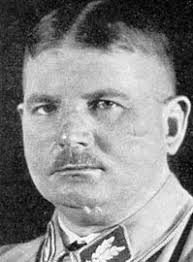
Ernst Rohem
Fittingly, he said this as he sat inside a prison cell awaiting his own execution.
On June 30, 1934, Hitler had ordered a massive purge of his private army, the S.A., or Stormtroopers. The purge was carried out by Hitler’s elite army-within-an-army, the Schutzstaffel, or Protective Squads, better known as the SS.
The S.A. Brownshirts had been instrumental in securing Hitler’s rise to Chancellor of Germany on January 30, 1933. They had intimidated political opponents and organized mass rallies for the Nazi Party.
But after Hitler reached the pinnacle of power, they became a liability.
Ernst Rohem, their commander, urged Hitler to disband the regular German army, the Reichswehr, and replace it with his own legions as the nation’s defense force.
Frightened by Rohem’s ambitions, the generals of the Reichswehr gave Hitler an ultimatum: Get rid of Rohem–or they would get rid of him.
So Rohem died in a hail of SS bullets–as did several hundred of his longtime S.A. cronies.
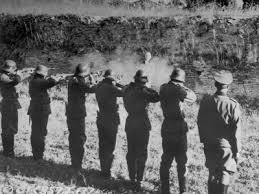
SS firing squad
Among the SS commanders supervising those executions was Reinhard Heydrich–a tall, blond-haired formal naval officer who was both a champion fencer and talented violinist.
Ultimately, he would become the personification of the Nazi ideal–”the man with the iron heart,” as Hitler eulogized at Heydrich’s funeral just eight years later.
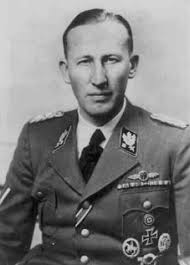
Reinhard Heydrich
Even so, Heydrich had a problem: He could never escape vicious rumors that his family tree contained a Jewish ancestor.
His paternal grandmother had married Reinhold Heydrich, and then Gustav Robert Suss. For unknown reasons, she decided to call herself Suss-Heydrich.
Since “Suss” was widely believed in Germany to indicate Jewish origin, the “stigma” of Jewish heritage attached itself to the Heydrich family.
Heydrich joined the SS in 1931 and quickly became head of its counterintelligence service. But his arrogance and overweening ambition created a great many enemies.
Only a year later, he became the target of an urgent investigation by the SS itself. The charge: That he was part-Jewish, the ultimate sin in Hitler’s “racially pure” Nazi Germany.
The investigation cleared Heydrich, but the rumor of his “tainted” origins persisted, clearly tormenting the second most powerful man in the SS. Even his superior, Heinrich Himmler, the Reichsfuhrer-SS, believed it.
When Heydrich was assassinated in 1942 by Czech commandos in Prague, Himmler attended his funeral. He paid tribute to his former subordinate at the service: ”You, Reinhard Heydrich, were a truly good SS-man.”
But he could not resist saying in private: “He was an unhappy man, completely divided against himself, as often happened with those of mixed race.”
Those who dare to harshly judge others usually find themselves assailed just as harshly.
A modern-day example is Rick Santorum, the former United States Senator from Pennsylvania (1995 – 2007) and a Republican candidate for President in 2012 and 2016.
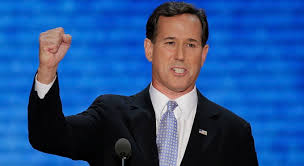
Rick Santorum
From his entry into politics, Santorum has been a fierce opponent of legalized abortion and even birth control. Among his comments on these issues:
- On why abortion should be illegal even in rape cases: “I believe and I think the right approach is to accept this horribly created–in the sense of rape–but nevertheless a gift in a very broken way, the gift of human life, and accept what God has given to you.”
- On criminal penalties for doctors who perform abortion: “I believe that, that any doctor who performs an abortion–that–I would advocate that any doctor that performs an abortion should be criminally charged for doing so.”
- On de-funding Planned Parenthood: “I can’t imagine any other organization with its roots as poisonous as the roots of Planned Parenthood getting federal funding of any kind. This is an organization that was founded on the eugenics movement, founded on racism.”
- On opposing birth control: “One of the things I will talk about [if elected President in 2012] that no President has talked about before is I think the dangers of contraception in this country, the whole sexual libertine idea. Many in the Christian faith have said, ‘Well, that’s okay. Contraception’s okay.’ It’s not okay, because it’s a license to do things in the sexual realm that is counter to how things are supposed to be.”
So it no doubt came as a shock to Santorum–and his anti-abortion supporters–when he found himself accused of being “soft” on abortion.
The attack came in the form of pink fliers appearing on car windshields at many South Carolina political events in January, 2012.
They were the work of Elizabeth Leichert, an anti-abortion activist.
Dated January 18, 2012, the flier read:
“Like many Christians I know, I was originally very attracted to Rick Santorum’s positions – especially on the Right to Life issue.
“But that was before I began digging into his record….
“Did you know Rick Santorum’s wife, Karen, had a six-year affair with an abortionist named Tom Allen?”
2016 PRESIDENTIAL RACE, ABC NEWS, ALTERNET, AP, BUZZFEED, CBS NEWS, CNN, CROOKS AND LIARS, DAILY KOZ, DENNIS HASTERT, FACEBOOK, FAMILY RESEARCH COUNCIL, JEB BUSH, JOSH DUGGAR, MIKE HUCKABEE, MOTHER JONES, MOVEON, MSNBC, NBC NEWS, NEWSWEEK, NPR, PBS NEWSHOUR, POLITICO, RAW STORY, REPUBLICAN PARTY, REUTERS, RICK SANTORUM, SALON, SCOTT WALKER, SEATTLE TIMES, SLATE, TED CRUZ, THE ATLANTIC, THE CHICAGO SUN-TIMES, THE CHICAGO TRIBUNE, THE DAILY BEAST, THE GUARDIAN, THE HILL, THE HUFFINGTON POST, THE LOS ANGELES TIMES, THE NATION, THE NEW YORK TIMES, THE WASHINGTON POST, TIME, TWITTER, U.S. NEWS & WORLD REPORT, UPI, USA TODAY
In Bureaucracy, History, Law, Politics, Social commentary on June 3, 2015 at 1:13 am
May was a cruel month for sexual perverts posing as “family values” patriots.
On May 21, Josh Duggar resigned as director of the Family Research Council, a Right-wing organization dedicated to fighting sexually-oriented issues such as same-sex marriage, abortion and pornography.
Duggar, 27, had owed his position to his status as the oldest son of Jim Bob and Michelle Duggar, of Tonitown, Arkansas.
Until his resignation, the Duggars were famous for popping out babies (19 at last count) and championing Right-wing “family values” causes.
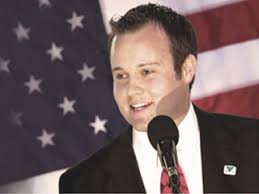
Josh Duggar, the “all-American” child molester
Then came the bombshell: On May 21, Josh Duggar issued a statement to People magazine explaining why he had resigned from the Family Research Council. He later published the statement on his Facebook page.
It read, in part:
“Twelve years ago, as a young teenager, I acted inexcusably for which I am extremely sorry and deeply regret. I hurt others, including my family and close friends. I confessed this to my parents who took several steps to help me address the situation.
“We spoke with the authorities where I confessed my wrongdoing, and my parents arranged for me and those affected by my actions to receive counseling. I understood that if I continued down this wrong road that I would end up ruining my life.”
What his statement didn’t say was this:
- In 2002-3, as a 14-15 year-old, Josh Duggar had fondled the breasts and vaginas of five underage girls–four of whom were his own sisters.
- Although his parents knew about his perverted activities, Jim Bob Duggar waited more than a year after Josh confessed before contacting the police.
- Police began investigating the abuse in 2006 when tipped by a family friend but concluded the statute of limitations had lifted.
- His father later took him to talk with a close family friend, an Arkansas state trooper. The trooper gave him a “stern talk,” but did not open a case. Nor was Duggar referred for criminal charges.
- The same state trooper was later arrested on child pornography charges and is now in prison serving a 56-year sentence.
- His resignation wasn’t prompted by a guilty conscience but by two days of media reports on this story.
As a result of these revelations, on May 22, The Learning Channel (TLC) canceled its high-rated “reality” series, 19 Kids and Counting, which had showcased the Duggar family since 2008.
The scandalous revelations have turned the reactionary, anti-abortion, anti-gay Duggars into comedic fodder for standup comedians, cartoonists and visitors to Twitter and Facebook.
One cartoon showed Josh Duggar saying, “I got a word named after me,” and holding a sign defining that word: “Duggar: To sexually abuse innocent victims while trumpeting your own moral superiority. Example: Hold my Bible while I duggar you.”
And on Comedy Central’s The Nightly Show, Larry Whitmore made Josh Duggar a target for dark humor:
“So you mean to tell me the family that goes around saying gay and trans people are pedophiles preying on America’s young people actually has a pedophile that preys on America’s young people? I hate pedophiles, but I love irony.”
And on Twitter, the criticism continued:
- “Josh Duggar says no child should feel the pain of being aborted. I say no child should feel the pain of being molested.”
- “So daddy Duggar is ok with his son molesting his daughters, but not ok with his daughters leaving for college. Misogyny at its greatest.”
- “In the Duggar family, you’re reprimanded for kissing before marriage but not for assaulting your siblings.”
- “Hope no gay wedding cakes were baked while Duggar was molesting girls because that would go against his religious beliefs.”
So far, the Duggars and TLC have taken the hits in public opinion. But Republican candidates and party officials may be next.
The family has been a magnet for Right-wingers owing to its staunchly anti-abortion and anti-gay stance. Add to this the Duggars’ claims to religious devotion and their clear disregard for birth control–and their being stars in “reality TV.”
And Josh Duggar has shown his gratitude for the fawning attention lavished upon him by these Right-wingers.
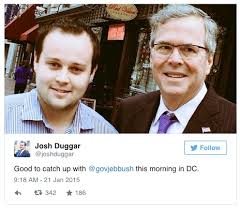
That gratitude–captured in a series of Tweets on Twitter–may prove highly embarrassing to the careers of many of these political figures.
Among those Tweets:
ABC NEWS, ABORTION, ANTI-ABORTIONISTS, CBS NEWS, CNN, FACEBOOK, MATT SCHAFER, MITT ROMNEY, NBC NEWS, PAUL RYAN, RUSH LIMBAUGH, SCOTT WALKER, TEXAS, TEXAS HOUSE OF REPRESENTATIVES, THE CHICAGO SUN-TIMES, THE CHICAGO TRIBUNE, THE LOS ANGELES TIMES, THE NEW YORK TIMES, THE WASHINGTON POST, TWITTER, U.S. SUPREME COURT, USA TODAY, WAR ON WOMEN
In Bureaucracy, Law, Politics, Social commentary on May 11, 2015 at 11:57 am
Republicans love fetuses.
In fact, they love them so much they’re willing to jeopardize the lives of pregnant women on their behalf.
On April 23, a Republican lawmaker in the Texas State House of Representatives offered an amendment that would force pregnant women to carry to term fetuses that can’t survive outside the womb.
The debate had started on a completely different subject–how to retool the State’s social safety net for the poor. But as usually happens when Republicans hold a majority in a legislature, the subject quickly turned to abortion–and how to ban it.
Rep. Matt Schafer (R-Tyler) proposed an amendment that would make it illegal for a woman to have an abortion after 20 weeks–even if a fetus has “a severe and irrevsersible abnormality.”

Matt Schafer
This would force a woman to carry a dead fetus to term, even if a doctor warned that this could endanger her life.
Schafer justified his proposal on the grounds that suffering has been “part of the human condition, since sin entered the world.”
A highly probable consequence of that suffering could be the death of a woman from sepsis–a whole-body inflammation caused by an infection–by carrying a nonviable fetus.
Schaefer’s amendment actually passed, but he removed it for full committee review after Trey Martinez Fischer, the House Democrat from San Antonio, filed a legislative point of order.
Rep. Jessica Farrar (D-Houston) had an entirely different take on the proposal.
She called this year’s state legislature the most misogynistic she’s seen in her 21 years as a state representative,
“Women are leaders of their families, whether some men in this room do not recognize that,” she said after her male Republican colleagues refused to support a bill that would expand access to breastfeeding.
Click here: Texas House Proposal Would Force People to Carry to Term Non-Viable Fetuses
Schafer’s is just the latest Republican to try to insert government into the vaginas of American women.
An earlier one was Scott Walker–the current governor of Wisconsin and a Koch brothers favorite for donations as a 2016 Presidential candidate.

Scott Walker
As a member of the Wisconsin State Assembly, Walker introduced AB 538 in September, 1997.
This would have allowed doctors to withhold from a woman information about a fetal disability while abortion was still an available option.
In short, doctors would have been allowed to lie to her.
At the time, if a health care provider withheld information about a fetal disability while abortion was still an available option, s/he could be liable for the child’s future medical expenses. But AB 538 would have changed that.
According to the proposed bill:
“This bill creates an immunity from a wrongful birth or wrongful life action for a person who commits an act or fails to commit an act and that act or omission results in the birth of a child because a woman did not undergo an abortion that she would have undergone had the person not committed the act or not failed to commit the act.”
AB 538 was not passed, ultimately dying in April 1998 without receiving a floor vote.
So Walker and 28 colleagues tried again in 2001.
They re-introduced the same legislation as AB 360. Although approved by the Orwellian-named “Family Law Committee,” it similarly failed to receive a floor vote.
In 1998, Walker introduced “conscience clause” legislation that would have allowed medical professionals to cite religious reasons in denying patients medical services such as contraception.
The bill failed to pass, so he introduced it again in 1999. This attempt also failed. In 2001, he introduced it a third time–when it similarly failed.
During the 2012 Presidential race, Right-wing broadcaster Rush Limbaugh furiously denied that Republicans were waging a “war on women,” as charged by Democrats.
On November 5, 2012, Limbaugh said on his program:
“Now, this War on Women. You know, it’s been fascinating to watch this in one regard, maddening, too.
“But supposedly [Former Massachusetts Governor Mitt] Romney and [Wisconsin Representative Paul] Ryan are gonna reverse Roe v. Wade and they’re gonna take contraception away from you, and that’s the essence of the War on Women.
“Romney, Ryan, Republicans are gonna take abortion away from you and they’re going to make sure that you don’t get contraception so that you have to get pregnant and you can’t get an abortion and therefore you have to stay home, stay in the kitchen.
“….Well, just as I said, reversing Roe v. Wade is nothing a president can do. A president cannot touch it. A president has no role in constitutional amendments.”
Click here: The Left’s War on Women Lies – The Rush Limbaugh Show
Limbaugh neglected to mention, however, that a President can appoint Justices to the United States Supreme Court–who could overrule Roe v. Wade.
He also failed to note that overturning Roe v. Wade–which legalized abortion in 1973–has been a top Republican goal for the last 42 years.
The coming 2016 race for President will doubtless see banning abortion take center stage in Republican agendas.
ABC NEWS, ABORTION, ADOLF HITLER, ARIZONA, BIRTH CONTROL, CBS NEWS, CNN, FACEBOOK, LEGISLATION, NAZI GERMANY, NBC NEWS, PLANNED PARENTHOOD, REPUBLICANS, RUSH LIMBAUGH, SUSAN G. KOMEN FOUNDATION, THE CHICAGO SUN-TIMES, THE CHICAGO TRIBUNE, THE LOS ANGELES TIMES, THE NEW YORK TIMES, THE WASHINGTON POST, THIRD REICH, TWITTER, USA TODAY, WAR ON WOMEN
In Bureaucracy, Business, History, Law, Politics, Social commentary on May 8, 2015 at 12:01 am
Adolf Hitler had greater respect for the privacy of women than Republican members of the Arizona legislature.
At the height of World War II, Dr. Hans Lammers, legal advisor to Adolf Hitler, issued this legal directive at the enraged order of his Fuhrer:
“In many [criminal] cases it will undoubtedly be necessary to determine whether there were sexual relations between two people or not.
“But if this much is known, it is wholly superfluous to probe for closer particulars as to how and where such sexual intercourse took place. The cross-examination of women in particular should cease!
“Every time that cross-examining police officials or judges keep probing for details as to the how and where of the sexual intercourse, the Fuhrer has gained the very clear impression that this is done for the same reason that the same intimate questions are asked in the Confessional box
“The Fuhrer wants clear instructions issued for the abolition of unnecessary cross-examination.”1
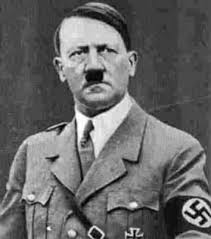
Adolf Hitler
By contrast, the Arizona legislature has introduced a bill that:
- Requires women who want their contraception covered by their health insurance to prove to their employers that they are taking it to treat medical conditions—not to prevent pregnancy; and
- Makes it legal for employers to fire a woman for using birth control to prevent pregnancy.
“The bill goes beyond guaranteeing a person’s rights to express and practice their faith,” Anjali Abraham, a lobbyist for the ACLU, told the Senate panel.
Instead, the legislation “lets employers prioritize their beliefs over the beliefs, the interests, the needs of their employees, in this case, particularly, female employees.”
Current Arizona law states that health plans covering other prescription medications must include contraception.
To override this requirement, the State House of Representatives passed House Bill 2625 in early March, 2012. The Senate Judiciary Committee endorsed it on March 12.
The full Senate has yet to vote on the legislation.
House Bill 2625 allows any employer to refuse to cover contraception that will be used “for contraceptive, abortifacient, abortion or sterilization purposes.”
If a woman wants the cost of her contraception covered, she must “submit a claim” to her employer providing evidence of a medical condition, such as endometriosis or polycystic ovarian syndrome, that can be treated with birth control.
Even more invasive, the law allows Arizona employers to fire a woman upon finding out that she took birth control to prevent pregnancy.
In short: While Adolf Hitler was outraged at public officials taking what he considered a prurient interest in a woman’s sex life, Arizona’s Republican legislators feel no such restraint.
“I believe we live in America,” said Majority Whip Debbie Lesko (R-Glendale), who sponsored the bill.
“We don’t live in the Soviet Union. So, government should not be telling the organizations or mom-and-pop employers to do something against their moral beliefs.”
In short, employers should be allowed to have Ayatollah-like power over the private sex-lives of their female employees.
The United States is not the Soviet Union. But if this bill is enacted, Arizona will bear a striking resemblance to Iran.

Debbie Lesko
This latest Republican effort should come as no surprise to anyone–least of all women.
Throughout 2011, Republicans attacked women’s reproductive rights–not simply access to legal abortion but even birth control.
The sheer number of laws proposed or enacted by Republicans at state and Federal levels–-to control the sex lives of American women–-is staggering.
At the state level:
- State legislators introduced more than 1,100 anti-abortion provisions and had enacted 135 of them by year’s end.
- Seven states either fully defunded or tried to defund Planned Parenthood, which provides basic health care, contraception, breast cancer and STD screenings to millions of low-income women each year.
At the Congressional level:
- Republicans used abortion and Planned Parenthood funding to extort Democratic concessions during budget negotiations and threatened to shut down the government.
- Republicans introduced mandatory ultrasound bills.
- Republicans tried to narrow the definition of rape to include only “forcible rape.” Under this change, a woman who was coerced, drugged or otherwise incapacitated by a rapist, would not be legally counted as a rape victim.
- Republicans barred the District of Columbia from using its own locally raised funds to help low-income women pay for abortions.
During the first two months of 2012:
- Virginia Republicans introduced a bill whose original language required women to undergo an invasive trans-vaginal ultrasound procedure 24 hours before having an abortion.
- A modified version of the bill–requiring women to receive trans-abdominal ultrasounds, was signed into law instead.
- With the connivance of House Republicans, Susan G. Komen for the Cure, the nation’s largest breast cancer charity, tried to pull cancer-screening grants from Planned Parenthood because some of its clinics provide abortions.
- The House Oversight Committee convened a hearing to deny contraceptive insurance coverage under the guise of “protecting religious liberty.” The Democrats’ one female witness, Sandra Fluke, was forbidden to speak at it.
- Right-wing broadcaster Rush Limbaugh and Foster Friess–Rick Santorum’s chief financial backer–publicly equated birth control use to sexual promiscuity.
- During his 2012 campaign for the Presidency, Rick Santorum pledged that, if elected, he would wage an all-out war on birth control: “It’s not okay. It’s a license to do things in a sexual realm that is counter to how things are supposed to be.”
And yet Republicans like Rush Limbaugh insist they are not waging a “war on women.”
The situation calls to mind a famous joke: A wife unexpectedly returns home and catches her husband in bed with another woman. Before she can speak, her husband demands: “Now, what are you going to believe–your own eyes, or what I’m telling you?”
__________
- David Irving, The War Path, Viking Press, 1978.
ABC NEWS, BALTIMORE POLICE DEPARTMENT, CBS NEWS, CNN, FACEBOOK, FREDDIE GRAY, MARILYN MOSBY, NBC NEWS, POLICE BRUTALITY, ROUGH RIDES, THE CHICAGO SUN-TIMES, THE CHICAGO TRIBUNE, THE LOS ANGELES TIMES, THE NEW YORK TIMES, THE WASHINGTON POST, TWITTER, USA TODAY
In Bureaucracy, Law, Law Enforcement, Social commentary on May 7, 2015 at 12:01 am
Freddie Gray’s tally of arrests came to at least 18.
But on April 12, he was arrested for what would be the final time.
That arrest would lead to Gray’s death and scandal for the Baltimore Police Department.
On May 2, the Baltimore Sun broke the story that, of the six policemen involved with Gray’s arrest, Brian Rice—the highest ranking officer—had seven guns confiscated by sheriff’s deputies in April, 2012.
He was also temporarily removed from duty–over concerns about his mental health.
Click here: Lieutenant Brian Rice charged in Freddie Gray death had weapons seized in 2012 – Baltimore Sun
But that was merely embarrassing. What happened on May 1 was life-changing.
Marilyn Mosby, Baltimore’s chief deputy prosecutor at the State’s Attorney office, publicly released the findings of her agency in the Gray case:
- “The knife was not a switchblade and is lawful under Maryland law.” [Police had claimed it wasa switchblade.]
- ” Lt. Rice, Officer Miller and Officer Nero failed to establish probable cause for Mr. Gray’s arrest as no crime had been committed by Mr. Gray. Accordingly Lt. Rice Officer MIller and Office Nero illegally arrested Mr. Gray.”
- ” Lt. Rice Officer Miller and Officer Nero loaded Mr. Gray into the wagon and at no point was he secured by a seatbelt while in the wagon contrary to a BPD [Baltimore Police Department] general order.”
- “…Mr. Gray suffered a severe and critical neck injury as a result of being handcuffed, shackled by his feet and unrestrained inside of the BPD wagon.”
- “Despite stopping for the purpose of checking on Mr. Gray’s condition, at no point did [Officer Goodson] seek nor did he render any medical assistance for Mr. Gray.”
- “Mr. Gray…requested help and indicated that he could not breathe. Officer Porter asked Mr. Gray if he needed a medic at which time Mr. Gray indicated at least twice that he was in need of a medic.”

Marilyn Mosby
- “…Despite Mr. Gray’s appeal for a medic, both officers [William Porter, Caesar Goodson] assessed Mr. Gray’s condition and at no point did either of them….render or request medical assistance.”
- “Sgt. [Alicia] White….spoke to the back of Mr. Gray’s head. When he did not respond, she did nothing further despite the fact that she was advised that he needed a medic. She made no effort to look or assess or determine his condition.”
- “Despite Mr. Gray’s seriously deteriorating medical condition, no medical assistance was rendered or summoned for Mr. Gray at that time by any officer.”
- “By the time Officer Zachary Novak and Sgt. White attempted to remove Mr. Gray from the wagon, Mr. Gray was no longer breathing at all.”
- “A medic was finally called to the scene where upon arrival, the medic determined Mr. Gray was now in cardiac arrest and was critically and severely injured.”
- “Mr. Gray was rushed to the University of Maryland Shock Trauma where he underwent surgery. On April 19, 2015, Mr. Gray succumbed to his injuries and was pronounced dead.”
- “The manner of death deemed homicide by the Maryland Medical Examiner is believed to be the result of a fatal injury that occurred while Mr. Gray was unrestrained by a seatbelt in custody of the Baltimore Police Department wagon.

After presenting her findings, Mosby then outlined the criminal charges her office was bringing against the officers involved:
- Officer Caesar Goodson Jr., 45: Second-degree depraved murder, manslaughter, second-degree assault, two counts of vehicular manslaughter charges and misconduct in office.
- Officer William Porter, 25:Involuntary manslaughter, second-degree assault and misconduct in office.
- Brian Rice, 41:Involuntary manslaughter, two counts of second-degree assault, two counts of misconduct in office and false imprisonment.
- Officer Edward Nero, 29: Two counts of second-degree assault, two counts of misconduct in office and false imprisonment.
- Officer Garrett Miller, 26: Two counts of second-degree assault, two counts of misconduct in office and one false imprisonment charge.
- Alicia White, 30:Involuntary manslaughter, second-degree assault and misconduct in office.
* * * * *
This case has polarized Baltimore–and America.
On the Left–and especially among blacks–are those who believe Gray was an innocent victim of police oppression.
“Even if he was guilty of dealing and using narcotics,” they say, “the anti-drug laws are a stupid waste of police resources.”
On the Right are those who steadfastly defend all police actions, including the most brutal and lawless.
“Even if the cops were guilty of brutality and/or negligence,” they say, “so what? A career criminal won’t ply his trade anymore.”
Both sides are wrong.
Until the anti-drug laws are repealed, they are legal and will continue to be enforced. Freddie Gray knew this better than most.
But police who employ illegal methods to enforce the law risk losing not only the cases they want to bring but their own careers as well.
And those officers who cause death or injury by unjustified brutality and/or negligence must be held accountable.
That has long been considered the difference between the FBI and the KGB.
There is a difference between supporting the legal actions of police—and living in a police state.
ABC NEWS, BALTIMORE POLICE DEPARTMENT, CBS NEWS, CNN, FACEBOOK, FREDDIE GRAY, MARILYN MOSBY, NBC NEWS, POLICE BRUTALITY, ROUGH RIDES, THE CHICAGO SUN-TIMES, THE CHICAGO TRIBUNE, THE LOS ANGELES TIMES, THE NEW YORK TIMES, THE WASHINGTON POST, TWITTER, USA TODAY
In Bureaucracy, Law, Law Enforcement, Social commentary on May 6, 2015 at 12:01 am
Leave out his name for a moment. Then consider the following:
His biography includes at least 18 arrests:
- July 16, 2007: Possession of a controlled dangerous substance with intent to distribute, unlawful possession of a controlled dangerous substance (2 counts)
- August 23, 2007: False statement to a peace officer, unlawful possession of a controlled dangerous substance
- August 28, 2007: Possession of marijuana
- August 29, 2007: Possession of a controlled dangerous substance with intent to distribute, violation of probation
- February 11, 2008: Unlawful possession of a controlled dangerous substance, possession of a controlled dangerous substance
- March 14, 2008: Possession of a controlled dangerous substance with intent to manufacture and distribute
- March 28, 2008: Unlawful possession of a controlled dangerous substance
- July 16, 2008: Possession of a controlled dangerous substance, possession with intent to distribute
- April 13, 2012: Possession of a controlled dangerous substance with intent to distribute, unlawful possession of a controlled dangerous substance, violation of probation
- September 28, 2013: Distribution of narcotics, unlawful possession of a controlled dangerous substance, second-degree assault, second-degree escape
- January 25, 2014: Possession of marijuana
- August 31, 2014: Illegal gambling, trespassing
- December 14, 2014: Possession of a controlled dangerous substance
- December 31, 2014: Possession of narcotics with intent to distribute
- January 14, 2015: Possession of a controlled dangerous substance, possession of a controlled dangerous substance with intent to distribute
- January 20, 2015: Fourth-degree burglary, trespassing
- March 13, 2015: Malicious destruction of property, second-degree assault
- March 20, 2015: Possession of a Controlled Dangerous Substance
His criminal record was one of drug charges and minor crimes. He was involved in 20 criminal court cases–five were still active at the time of his death.
In February 2009, he was sentenced to four years in prison for two counts of drug possession with intent to deliver and was paroled in 2011–after serving only two.
In 2012, he was arrested for violating parole but was not sent back to prison.
In 2013, he returned to prison for a month before being released again.
He was due in court on a drug possession charge on April 24.
Who was he?
He was Freddie Gray, the 25-year-old black man who spent seven days in a coma after he suffered injuries while in the custody of Baltimore police.
Click here: Freddie Gray Arrest Record, Criminal History & Rap Sheet

Freddie Gray
His last arrest came on April 12.
While being transported in a police van to the police station, Gray fell into a coma and was taken to a trauma center. He died on April 19, owing to a broken neck.
On April 21, the six Baltimore police officers involved in his arrest were temporarily suspended with pay while an investigation occurred.
According to the police account of Gray’s arrest:
On April 12, at 8:39 A.M. Lieutenant Brian W. Rice, Officer Edward Nero, and Officer Garrett E. Miller were patrolling on bicycles and “made eye contact” with Gray.
According to Miller, Gray, “unprovoked upon noticing police presence,” fled on foot.
After a brief foot chase, he was caught and arrested “without the use of force or incident,” according to Miller.
Miller further wrote that:
- He “noticed a knife clipped to the inside of his [Gray’s] front right pocket”; and
- Gray “did unlawfully carry, possess, and sell a knife commonly known as a switch blade knife, with an automatic spring or other device for opening and/or closing the blade within the limits of Baltimore City. The knife was recovered by this officer and found to be a spring assisted one hand operated knife.”
A witness to Gray’s arrest have since stated that the police were “folding” Gray. That is: One officer was bending Gray’s legs backwards, while another was pressing a knee into Gray’s neck.
A second witness claimed to have seen Gray being beaten with police batons.
On April 24, Baltimore Police Commissioner Anthony Batts said, “We know our police employees failed to get him medical attention in a timely manner multiple times.”
He also admitted that his officers had failed to buckle Gray in the van–standard police procedure–before he was transported to the police station.
News reports have raised the possibility that Gray was treated to a “rough ride”–where a handcuffed prisoner is placed without a seatbelt in a vehicle deliberately driven over rough roads at high speed as an unofficial punishment.

Inside a typical police van
And Gray had clearly had enough run-ins with the law to be known to police as a habitual criminal.
In fact, medical examiners reported Gray sustained more injuries by slamming around inside the van, “apparently breaking his neck; a head injury he sustained matches a bolt in the back of the van.”
But even worse findings were to come for the officers involved.
9/11, ABC NEWS, AL QAEDA, BARACK OBAMA, BATMAN, CBS NEWS, CNN, COLORADO, COLUMBINE HIGH SCHOOL SHOOTINGS, COP KILLER BULLETS, CRIME, ERIC HOLDER, FBI, FEDERAL ASSAULT WEAPONS BAN, GABRIELLE GIFFORDS, GEORGE ZIMMERMAN, GREEN BERETS, GUN CONTROL, JAMES HOLMES, MITT ROMNEY, NATIONAL RIFLE ASSOCIATION, NBC NEWS, NUCLEAR WEAPONS, OSAMA BIN LADEN, SECOND AMENDMENT, SELF-DEFENSE, SEPTEMBER 11 ATTACKS, STAND-YOUR-GROUND LAWS, TALIBAN, TERRORISM, THE DARK NIGHT, THE LOS ANGELES TIMES, THE NEW YORK TIMES, THE WASHINGTON POST, TRAVON MARTIN, TUSCON SHOOTINGS, U.S. CONSTITUTION, U.S. NAVY SEALS, VIRGINIA TECH SHOOTINGS, WAYNE LAPIERRE, WRONGFUL-DEATH LAWSUITS
In Bureaucracy, History, Law, Law Enforcement, Social commentary on May 5, 2015 at 12:20 am
The victims of the violence are black and white, rich and poor, young and old, famous and unknown. They are, most important of all, human beings whom other human beings loved and needed. No one–no matter where he lives or what he does–can be certain who will suffer from some senseless act of bloodshed. And yet it goes on and on.
–Robert F. Kennedy, April 4, 1968

Senator Robert F. Kennedy announcing the murder of Dr. Martin Luther King, Jr.
What should the surviving victims of the Aurora massacre do to seek redress?
And how can the relatives and friends of those who didn’t survive seek justice for those they loved?
Two things:
First, don’t count on politicians to support a ban on assault weapons.
Politicians–with rare exceptions–have only two goals:
- Get elected to office, and
- Stay in office.
And too many of them fear the economic and voting clout of the NRA to risk its wrath.
Consider Mitt Romney and President Barack Obama.
Both rushed to offer condolences to the surviving victims of the Aurora massacre. And both steadfastly refused to even discuss gun control–let alone support a ban on the type of assault weapons used by James Holmes.
On July 22–only two days after the Century 16 Theater slaughter–U.S. Senator Ron Johnson (R-Wis.) said: “The fact of the matter is there are 30-round magazines that are just common all over the place.
“You simply can’t keep these weapons out of the hands of sick, demented individuals who want to do harm. And when you try and do it, you restrict our freedom.”
That presumably includes the freedom of would-be mass murderers to carry out their fantasies.
Second, those who survived the massacre–and the relatives and friends of those who didn’t–should file wrongful death, class-action lawsuits against the NRA.
There is sound, legal precedent for this.
- For decades, the American tobacco industry peddled death and disability to millions and reaped billions of dollars in profits.
- The industry vigorously claimed there was no evidence that smoking caused cancer, heart disease, emphysema or any other ailment.
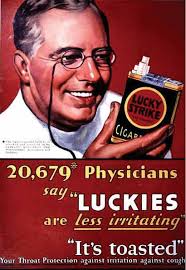
- Tobacco companies spent billions on slick advertising campaigns to win new smokers and attack medical warnings about the dangers of smoking.
- Tobacco companies spent millions to elect compliant politicians and block anti-smoking legislation.
- From 1954 to 1994, over 800 private lawsuits were filed against tobacco companies in state courts. But only two plaintiffs prevailed, and both of those decisions were reversed on appeal.
- In 1994, amidst great pessimism, Mississippi Attorney General Mike Moore filed a lawsuit against the tobacco industry. But other states soon followed, ultimately growing to 46.
- Their goal: To seek monetary, equitable and injunctive relief under various consumer-protection and anti-trust laws.
- The theory underlying these lawsuits was: Cigarettes produced by the tobacco industry created health problems among the population, which badly strained the states’ public healthcare systems.
- In 1998, the states settled their Medicaid lawsuits against the tobacco industry for recovery of their tobacco-related, health-care costs. In return, they exempted the companies from private lawsuits for tobacco-related injuries.
- The companies agreed to curtail or cease certain marketing practices. They also agreed to pay, forever, annual payments to the states to compensate some of the medical costs for patients with smoking-related illnesses.
The parallels with the NRA are obvious:
- For decades, the NRA has peddled deadly weapons to millions, reaped billions of dollars in profits and refused to admit the carnage those weapons have produced: “Guns don’t kill people. People kill people.” With guns.
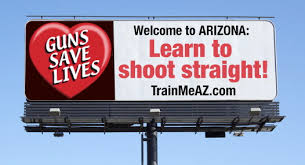
- The NRA has bitterly fought background checks on gun-buyers, in effect granting even criminals and the mentally ill the right to own arsenals of death-dealing weaponry.
- The NRA has spent millions on slick advertising campaigns to win new members and frighten them into buying guns.
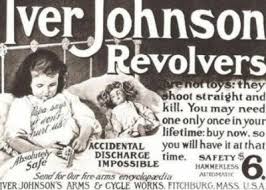
- The NRA has spent millions on political contributions to block gun-control legislation.
- The NRA has spent millions attacking political candidates and elected officials who warned about the dangers of unrestricted access to assault and/or concealed weapons.

- The NRA has spent millions pushing “Stand Your Ground” laws in more than half the states, which potentially give every citizen a “license to kill.”
- The NRA receives millions of dollars from online sales of ammunition, high-capacity ammunition magazines, and other accessories through its point-of-sale Round-Up Program–thus directly profiting by selling a product that kills about 30,288 people a year.
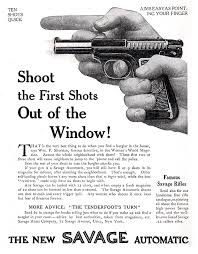
- Firearms made indiscriminately available through NRA lobbying have filled hospitals–such as those in Aurora–with casualties, and have thus badly strained the states’ public healthcare systems.
It will take a series of highly expensive and well-publicized lawsuits to significantly weaken the NRA, financially and politically.
The first ones will have to be brought by the surviving victims of gun violence–and by the friends and families of those who did not survive it. Only they will have the courage and motivation to take such a risk.
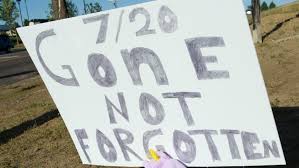
As with the cases first brought against tobacco companies, there will be losses. And the NRA will rejoice with each one.
But, in time, state Attorneys General will see the clear parallels between lawsuits filed against those who peddle death by cigarette and those who peddle death by armor-piercing bullet.
And then the NRA–like the tobacco industry–will face an adversary wealthy enough to stand up for the rights of the gun industry’s own victims.
Only then will those politicians supporting reasonable gun controls dare to stand up for the victims of such needless tragedies as the one in Aurora, Colorado.
9/11, ABC NEWS, AL QAEDA, BARACK OBAMA, BATMAN, CBS NEWS, CNN, COLORADO, COLUMBINE HIGH SCHOOL SHOOTINGS, COP KILLER BULLETS, CRIME, ERIC HOLDER, FBI, FEDERAL ASSAULT WEAPONS BAN, GABRIELLE GIFFORDS, GEORGE ZIMMERMAN, GREEN BERETS, GUN CONTROL, JAMES HOLMES, MITT ROMNEY, NATIONAL RIFLE ASSOCIATION, NBC NEWS, NUCLEAR WEAPONS, OSAMA BIN LADEN, SECOND AMENDMENT, SELF-DEFENSE, SEPTEMBER 11 ATTACKS, STAND-YOUR-GROUND LAWS, TALIBAN, TERRORISM, THE DARK NIGHT, THE LOS ANGELES TIMES, THE NEW YORK TIMES, THE WASHINGTON POST, TRAVON MARTIN, TUSCON SHOOTINGS, U.S. CONSTITUTION, U.S. NAVY SEALS, VIRGINIA TECH SHOOTINGS, WAYNE LAPIERRE, WRONGFUL-DEATH LAWSUITS
In Bureaucracy, History, Law, Law Enforcement, Social commentary on May 4, 2015 at 12:29 am
Among the major accomplishments of the National Rifle Association:
- In July, 2005, George Zimmerman was arrested for shoving a police officer during an underage drinking raid. The charges were dropped after he completed an alcohol education program. That same summer, his ex-fiancée filed a restraining order against him, alleging that Zimmerman hit her.
- Yet he was allowed to carry a loaded, hidden handgun as a Florida resident–thanks to the 2005 “Stand Your Ground” law the NRA had rammed through the legislature.
- Under that law: A Concealed Carry Permit is revoked only if a gun owner is convicted of a felony. It is not suspended if he’s being investigated for a felony. It is suspended only if he is actually charged.
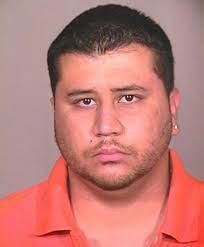
George Zimmerman
- On February 26, 2012, Zimmerman shot unarmed, 17-year-oldTrvon Martin, who was wearing a “hoodie.” A jury subsquently acquitted him, believing his claim of “self-defense.”
- In March, the NRA issued its own version of a “hoodie”–the Concealed Carry Hooded Sweatshirt, designed to hide firearms. Selling on the NRA’s website for $60 to $65, it is advertised thusly:
- “Inside the sweatshirt you’ll find left and right concealment pockets. The included Velcro®-backed holster and double mag pouch can be repositioned inside the pockets for optimum draw. Ideal for carrying your favorite compact to mid-size pistol, the NRA Concealed Carry Hooded Sweatshirt gives you an extra tactical edge, because its unstructured, casual design appears incapable of concealing a heavy firearm – but it does so with ease!” http://www.nrastore.com/nrastore/ProductDetail.aspx?c=11&p=CO+635&ct=e

- Anyone—including convicted criminals—can buy these “hide-a-gun” sweatshirts, putting both the public and law enforcers at deadly risk.
- The NRA often claims that law-abiding citizens defend themselves with guns millions of times every year. But the FBI has determined that, of the approximately 11,000 gun homicides every year, fewer than 300 are justifiable self-defense killings.
- The NRA supports loopholes that allow criminals to buy guns without background checks, or allow terrorists to buy all the AK-47s they desire.
- The NRA’s executive vice president, Wayne LaPierre, declared the NRA was “all in” to defeat Barack Obama in 2012. Yet the President had meekly signed legislation allowing guns to be brought into national parks and onto trains.
- High-capacity magazines were prohibited under the 1994 Federal Assault Weapons Ban–which expired in 2004. The NRA–aided by the Bush administration and Republicans generally–easily overcame efforts to renew the law.
- Political scientist Robert Spitzer, author of the book The Politics of Gun Control,notes that since the passage of the 1993 Brady Handgun Violence Prevention Act and the assault weapons ban in 1994, state and national laws have been drifting toward more open gun access:
- “In 1988, there were about 18 states that had state laws that made it pretty easy for civilians to carry concealed hand guns around in society. By 2011, that number is up to 39 or 40 states having liberalized laws, depending on how you count it, and the NRA has worked very diligently at the state level to win political victories there, and they’ve really been quite successful.”
- On January 8, 2011, Democratic Rep. Gabrielle Giffords was shot in the head while meeting with constituents outside a,Tucson, Arizona, grocery store. Also killed was Arizona’s chief U.S. District judge, John Roll, who had just stopped by to see his friend Giffords after celebrating Mass. The total number of victims: 6 dead, 13 wounded.
- “The NRA’s response to the Tucson shootings has been to say as little as possible and to keep its head down,” said Spitzer. “And their approach even more has been to say as little as possible and to simply issue a statement of condolence to the families of those who were injured or killed and to wait for the political storm to pass over and then to pick up politics as usual.”
- This is the standard NRA response to each continuing massacre.
- In the spring of 2012, the House Oversight Committee prepared to vote on whether to hold U.S. Attorney General Eric Holder in contempt for allegedly refusing to provide documents related to “Fast and Furious.” This was an undercover operation launched by the Bush administration to track firearms being sold to Mexican drug cartels.
- The NRA notified Congressional members that how they voted would reflect how the NRA rated them in “candidate evaluations” for the November elections. This amounted to blatant extortion, since the NRA had long accused Holder of having an “anti-gun” agenda.
Summing up the still-current state of gun politics in America, the April 21, 2012 edition of The Economist noted:
“The debate about guns is no longer over whether assault rifles ought to be banned, but over whether guns should be allowed in bars, churches and colleges.”
That is precisely the aim of the NRA–an America where anyplace, anytime, can be turned into the O.K. Corral.
So what should the surviving victims of the Aurora massacre do to seek redress? And how can the relatives and friends of those who didn’t survive seek justice for those they loved?
9/11, ABC NEWS, AL QAEDA, BARACK OBAMA, BATMAN, CBS NEWS, CNN, COLUMBINE HIGH SCHOOL SHOOTINGS, COP KILLER BULLETS, CRIME, ERIC HOLDER, FBI, FEDERAL ASSAULT WEAPONS BAN, GABRIELLE GIFFORDS, GEORGE ZIMMERMAN, GREEN BERETS, GUN CONTROL, JAMES HOLMES, MITT ROMNEY, NATIONAL RIFLE ASSOCIATION, NBC NEWS, NUCLEAR WEAPONS, OSAMA BIN LADEN, SECOND AMENDMENT, SELF-DEFENSE, SEPTEMBER 11 ATTACKS, STAND-YOUR-GROUND LAWS, TALIBAN, TERRORISM, THE DARK NIGHT, THE LOS ANGELES TIMES, THE NEW YORK TIMES, THE WASHINGTON POST, TRAVON MARTIN, TUSCON SHOOTINGS, U.S. CONSTITUTION, U.S. NAVY SEALS, VIRGINIA TECH SHOOTINGS, WAYNE LAPIERRE, WRONGFUL-DEATH LAWSUITS
In Bureaucracy, History, Law, Law Enforcement, Social commentary on May 1, 2015 at 12:07 am
On July 20, 2012, James Holmes slaughtered 12 Aurora, Colorado, moviegoers and critically wounded another 58.
On May 4, 2015, he finally goes on trial.
Even his attorneys admit he staged the masscare.
Of course, they’re claiming he was insane at the time and thus not responsible for his actions. And certainly not deserving of the death penalty.
But there is another culprit whose presence at the trial makes it the proverbial elephant in the room.
The National Rifle Association (NRA).
Like Al Qaeda, the NRA promotes violence on an unprecedented scale. Yet there are profound differences in the way Americans view these organizations.
Consider:
On September 11, 2001, Islamic terrorists snuffed out the lives of 3,000 Americans in New York, Washington, D.C. and Pennsylvania.

The World Trade Center under attack on 9/11
For more than ten years, the United States–through its global military and espionage networks–has relentlessly hunted down most of those responsible for that September carnage.
On May 1, 2011, U.S. Navy SEALS invaded Osama bin Laden’s fortified mansion in Abbottabad, Pakistan–and shot Al Qaeda’s leader dead.

Navy SEALS
Turning from foreign death-dealers to domestic ones: According to the Brady Campaign to Prevent Gun Violence:
Every day–365 days a year:
- 270 people in America, 47 of them children and teens, are shot in murders, assaults, suicides, accidents and police intervention;
- 87 people die from gun violence, 33 of them murdered;
- 8 children and teens die from gun violence;
- 183 people are shot, but survive their gun injuries;
- 38 children and teens are shot, but survive their gun injuries.
And what does all of this add up to?
- In one year, almost 100,000 people in America are shot in murders, assaults, suicides, accidents, or by police intervention.
- Over a million Americans have been killed with guns since 1968, when Dr. Martin Luther King, Jr. and Robert F. Kennedy were assassinated.
- U.S. homicide rates are 6.9 times higher than rates in 22 other populous high-income countries combined, despite similar non-lethal crime and violence rates. The firearm homicide rate in the U.S. is 19.5 times higher.
- Gun violence impacts society in numerous ways: medical costs; costs of the criminal justice system; security precautions; and reductions in quality of life owing to fear of gun violence.
- An estimated 41% of gun-related homicides would not occur under the same circumstances had no guns been present.
(This average annual estimated composite picture of gun violence is based on death certificates and estimates from emergency room admissions.)
And who, more than anyone (including the actual killers themselves) has made all this carnage possible?
The National Rifle Association, of course.
But unlike the leadership of Al Qaeda, that of the NRA is not simply known, but celebrated. Its director, Wayne LaPierre, is courted as a rock star by Democrats and Republicans seeking NRA endorsements–and campaign contributions.

Wayne LaPierre
He frequently appears as an honored guest at testimonial dinners and political conventions.
The largest of the 13 national pro-gun groups, the NRA has nearly 4 million members, who focus most of their time lobbying Congress for unlimited “gun rights.”
The NRA claims that its mission is to “protect” the Second Amendment to the United States Constitution, which states:
“A well regulated Militia, being necessary to the security of a free State, the right of the people to keep and bear Arms, shall not be infringed.”
NRA members conveniently ignore the first half of that sentence: “A well regulated Militia, being necessary to the security of a free State….”
For the NRA, the Second Amendment is the Constitution, and the rest of the document is a mere appendage.
At the time Congress ratified the Constitution in 1788, the United States was not a world power.
A mere 26 years later, the British seized and burned Washington, D.C., after repeatedly defeating American armies. On the frontier, settlers had to defend themselves against hostile Indians and marauding bandits.
Only after World War II did the country maintain a powerful standing army during peacetime.
But World War II ended 70 years ago, and today the United States is a far different country than it was in 1788:
- It boasts a nuclear arsenal that can turn any country into nuclear ash–anytime an American President decides to do so.
- It boasts an Army, Navy, Air Force and Marine Corps that can target any enemy, anywhere in the world.
- Its Special Forces–Green Berets, Delta Force and Navy SEALs–are rightly feared by international terrorists.
- American Intelligence has come a long way since 9/11. The FBI’s top priority is to prevent another such terrorist attack, not simply investigate it afterward.
- And waging war on criminals generally are about 836,787 full-time sworn local/state/Federal law enforcement officers.
If a criminal flees or conducts business across state lines, powerful Federal law enforcement agencies–such as the FBI and Drug Enforcement Administration–can put him out of business.
But apparently the NRA hasn’t gotten the word.
- The NRA has steadfastly defended the right to own Teflon-coated “cop killer” bullets,” whose only purpose is to penetrate bullet-resistant vests worn by law enforcement officers.

“Cop-killer” bullets
- The NRA and its lobbying arm, the Institute for Legislative Action, is responsible for the “stand-your-ground” ordinances now in effect in more than half the states. These allow for the use of deadly force in self-defence, without any obligation to attempt to retreat first.
- The NRA rushed to the defense of accused murderer George Zimmerman, the self-appointed “community watchman” who ignored police orders to stop following 17-year-old Trayvon Martin and ended up shooting him.
- Police did not initially charge Zimmerman because of Florida’s “Stand-Your-Ground” law, which the NRA had rammed through the legislature.
9/11, ABC NEWS, AL QAEDA, BARACK OBAMA, BATMAN, CBS NEWS, CNN, COLORADO, COLUMBINE HIGH SCHOOL SHOOTINGS, COP KILLER BULLETS, CRIME, ERIC HOLDER, FBI, FEDERAL ASSAULT WEAPONS BAN, GABRIELLE GIFFORDS, GEORGE ZIMMERMAN, GREEN BERETS, GUN CONTROL, JAMES HOLMES, MITT ROMNEY, NATIONAL RIFLE ASSOCIATION, NBC NEWS, NUCLEAR WEAPONS, OSAMA BIN LADEN, SECOND AMENDMENT, SELF-DEFENSE, SEPTEMBER 11 ATTACKS, STAND-YOUR-GROUND LAWS, TALIBAN, TERRORISM, THE DARK NIGHT, THE LOS ANGELES TIMES, THE NEW YORK TIMES, THE WASHINGTON POST, TRAVON MARTIN, TUSCON SHOOTINGS, U.S. CONSTITUTION, U.S. NAVY SEALS, VIRGINIA TECH SHOOTINGS, WAYNE LAPIERRE, WRONGFUL-DEATH LAWSUITS
In Business, History, Law, Law Enforcement, Social commentary on April 30, 2015 at 9:01 am
It had happened it before–all too many times before:
- Midnight vigils for the victims of yet another spree-killer.
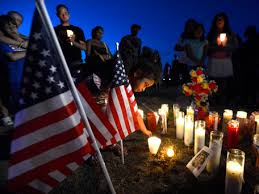
- Makeshift memorials of flowers, candles and teddy bears.
- Grief counselors for students at elementary, junior high and high schools.
- And, of course, the inevitable question: “Why?”
And Americans had seen it all before–-too many times before:
- After the San Ysidro McDonald’s shootings, 1984: 21 dead, 19 wounded.
- After the 101 California Street shootings in San Francisco, 1993: 9 dead, 6 injured.
- After the Columbine High School shootings in Colorado, 1999: 15 dead, 21 wounded.
- After the Virginia Tech shootings, 2007: 32 dead, 23 wounded.
- After the Tucson shootings, 2011: 6 dead, 13 wounded.
And then, on July 20, 2012, came the massacre at the Century 16 Theater in Aurora, Colorado: 12 dead, 58 wounded.
People who wanted nothing more than to see a movie they were eagerly anticipating: The latest addition to the hugely popular “Batman” franchise: The Dark Knight Rises.
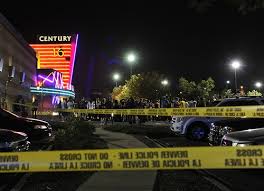
The scene of the crime: The Century 16 Theater in Aurora, Colorado
Snuggled into their seats, some eating popcorn or candy, others sipping sodas. None of them expecting that the violence on the screen would suddenly consume them in real-life.
It was a scene of which nightmares are made:
- A sudden eruption of smoke and fire as a tear-gas canister explodes.
- A lone gunman–brandishing a Smith & Wesson AR-15 semi-automatic rifle, a 12-gauge Remington Model 870 shotgun, and a G23 .40 caliber Smith & Wesson Glock pistol.
- First he blasts the ceiling with a shotgun, and then opens fire on the audience, stopping only to reload his weapon.
- He begins aiming at the back of the room, and then targets people who are scrambling to escape in the aisles.
- Some bullets penetrate the wall of the cinema and injure people in an adjoining theater, where the same film is being screened.
- Adding to the nightmarish quality of the scene: The appearance of the gunman–dressed all in black: a ballistic helment, vestand leggings; a throat protector; a groin protector; a gas mask; and black tactical gloves.
As terrible as the massacre was, it could have been worse.
Police arrived in about 90 seconds and arrested the shooter, James Holmes, in the parking lot of the Century 16 Theater he had just ravaged.
Still, the statistics were terrible enough:
- Twelve people–several of them heroes who died shielding others with their bodies–would never return to those who loved them.
- Of the 58 wounded, an unknown number would be physically scarred for life.
- Some would never fully recover from their injuries.
- They would not be able to walk. Or see. Or use their arms or hands.
- Almost all those who were in that theater–-even those who escaped without a scratch-–would be emotionally tormented for months or years to come.
- Some would never escape those moments of murderous insanity.
It’s possible that Holmes, then 24, an honors graduate of the University of California Riverside, became that most lethal specimen: The genius who slides into madness.
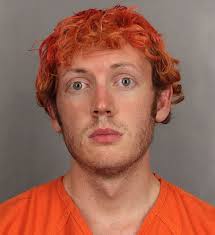
James Holmes
Holmes moved to the University of Colorado School of Medicine in Aurora in May, 2011, to pursue a PhD in neuroscience.
He had always excelled in his studies, but in early 2012, his grades took a sharp decline. In June, he told the college that he was going to drop out.
Meanwhile, he was amassing an arsenal of weapons and ammunition.
He bought two Glock pistols, a semi-automatic rifle and a shotgun over the last two months from local gun stores and 6,000 rounds of ammunition via the Internet–-all purchased legally under state law.
In early July, 2012, Holmes ordered the paramilitary bulletproof clothing and gas mask that he intended to wear on his rampage.
Finally, he dyed his hair a shocking red-orange and rigged his university apartment with trip-wires and homemade booby-traps. When he was arrested, he told police: “I am the Joker.”
Commentators immediately began asking: Why did Holmes choose to snuff out the lives and dreams of so many people?
But a better question is: “How did he do it?”
It may never be finally known why he did it. But the answer to how makes clear a fundamental truth:
He could not have done it without access to the awesome firepower he was legally able to purchase:
- The AR-15 semi-automatic rifle is designed for easy reloading. “Even without the grand-sized mag[azine]s, many people who are practiced can reload in 1½ to 2 seconds,” said Steven Howard, a Michigan attorney and security and firearms expert.

And who has made all of this mayhem not only possible but politically invincible?
Who ultimately bears responsibility not only for those murdered and maimed at an Aurora theater but for the almost 100,000 people who are killed or wounded every year from gun violence?
Your friends at the National Rifle Association.


2012 PRESIDENTIAL CAMPAIGN, 2016 PRESIDENTIAL CAMPAIGN, ABC NEWS, ABORTION, ADOLF HITLER, BIRTH CONTROL, BROWNSHIRTS, CBS NEWS, CNN, FACEBOOK, HEINRICH HIMMLER, HERMAN GORING, JEWS, KAREN SANTORUM, MSNBC, NAZI GERMANY, NAZI PARTY, NBC NEWS, REINHARD HEYDRICH, REPUBLICAN PARTY, RICK SANTORUM, S.A., SAME-SEX MARRIAGE, SS, THE CHICAGO SUN-TIMES, THE CHICAGO TRIBUNE, THE HUFFINGTON POST, THE LOS ANGELES TIMES, THE NEW YORK TIMES, THE WALL STREET JOURNAL, THE WASHINGTON POST, TWITTER, USA TODAY
ABORTING AMBITION: PART ONE (OF TWO)
In Bureaucracy, History, Law, Politics, Social commentary on June 16, 2015 at 12:04 am“All revolutions,” said Ernst Rohem, leader of Adolf Hitler’s brown-shirted thugs, the S.A., “devour their own children.”
Ernst Rohem
Fittingly, he said this as he sat inside a prison cell awaiting his own execution.
On June 30, 1934, Hitler had ordered a massive purge of his private army, the S.A., or Stormtroopers. The purge was carried out by Hitler’s elite army-within-an-army, the Schutzstaffel, or Protective Squads, better known as the SS.
The S.A. Brownshirts had been instrumental in securing Hitler’s rise to Chancellor of Germany on January 30, 1933. They had intimidated political opponents and organized mass rallies for the Nazi Party.
But after Hitler reached the pinnacle of power, they became a liability.
Ernst Rohem, their commander, urged Hitler to disband the regular German army, the Reichswehr, and replace it with his own legions as the nation’s defense force.
Frightened by Rohem’s ambitions, the generals of the Reichswehr gave Hitler an ultimatum: Get rid of Rohem–or they would get rid of him.
So Rohem died in a hail of SS bullets–as did several hundred of his longtime S.A. cronies.
SS firing squad
Among the SS commanders supervising those executions was Reinhard Heydrich–a tall, blond-haired formal naval officer who was both a champion fencer and talented violinist.
Ultimately, he would become the personification of the Nazi ideal–”the man with the iron heart,” as Hitler eulogized at Heydrich’s funeral just eight years later.
Reinhard Heydrich
Even so, Heydrich had a problem: He could never escape vicious rumors that his family tree contained a Jewish ancestor.
His paternal grandmother had married Reinhold Heydrich, and then Gustav Robert Suss. For unknown reasons, she decided to call herself Suss-Heydrich.
Since “Suss” was widely believed in Germany to indicate Jewish origin, the “stigma” of Jewish heritage attached itself to the Heydrich family.
Heydrich joined the SS in 1931 and quickly became head of its counterintelligence service. But his arrogance and overweening ambition created a great many enemies.
Only a year later, he became the target of an urgent investigation by the SS itself. The charge: That he was part-Jewish, the ultimate sin in Hitler’s “racially pure” Nazi Germany.
The investigation cleared Heydrich, but the rumor of his “tainted” origins persisted, clearly tormenting the second most powerful man in the SS. Even his superior, Heinrich Himmler, the Reichsfuhrer-SS, believed it.
When Heydrich was assassinated in 1942 by Czech commandos in Prague, Himmler attended his funeral. He paid tribute to his former subordinate at the service: ”You, Reinhard Heydrich, were a truly good SS-man.”
But he could not resist saying in private: “He was an unhappy man, completely divided against himself, as often happened with those of mixed race.”
Those who dare to harshly judge others usually find themselves assailed just as harshly.
A modern-day example is Rick Santorum, the former United States Senator from Pennsylvania (1995 – 2007) and a Republican candidate for President in 2012 and 2016.

Rick Santorum
From his entry into politics, Santorum has been a fierce opponent of legalized abortion and even birth control. Among his comments on these issues:
So it no doubt came as a shock to Santorum–and his anti-abortion supporters–when he found himself accused of being “soft” on abortion.
The attack came in the form of pink fliers appearing on car windshields at many South Carolina political events in January, 2012.
They were the work of Elizabeth Leichert, an anti-abortion activist.
Dated January 18, 2012, the flier read:
“Like many Christians I know, I was originally very attracted to Rick Santorum’s positions – especially on the Right to Life issue.
“But that was before I began digging into his record….
“Did you know Rick Santorum’s wife, Karen, had a six-year affair with an abortionist named Tom Allen?”
Share this: