Archive for the ‘Law Enforcement’ Category
2016 PRESIDENTIAL ELECTION, 2020 TRUMP PRESIDENTIAL CAMPAIGN, ABC NEWS, ALTERNET, AP, BREITBART NEWS, BUZZFEED, CBS NEWS, CELEBRITY APPRENTICE, CIA, CNN, CROOKS AND LIARS, DAILY KOZ, DAVID BROOKS, DEMOCRATIC NATIONAL COMMITTEE, DEPARTMENT OF JUSTICE, DIRECTOR OF NATIONAL INTELLIGENCE, DONALD TRUMP, DONALD TRUMP JUNIOR, FACEBOOK, FBI, FERGUS CULLEN, GOOD MORNING AMERICA, HILLARY CLINTON, JAMES B. COMEY, JAMES R. CLAPPER, JARED KUSHNER, JEFF FLAKE, JOHN ALLEN NEWMAN, JOHN KELLY, LARA TRUMP, MAGNITSKY ACT, MARK SHIELDS, MEET THE PRESS, MICHAEL HAYDEN, MICHELLE OBAMA, MIKE PENCE, MOTHER JONES, MOVEON, MSNBC, NATALIA VESELITSKAYA, NATIONAL SECURITY AGENCY, NBC NEWS, NEWSWEEK, NICCOLO MACHIAVELLI, NPR, OMAROSDA MANIGAULT-NEWMAN, PAUL MANAFORT, PBS NEWSHOUR, PHILIP KLEIN, POLITICO, RAW STORY, REPUBLICAN NATIONAL CONVENTION, REPUBLICAN PARTY, REUTERS, RINAT AKHMETSHIN, ROBERT MUELLER, ROGER STONE, RUSSIA, RUSSIAN INTELLIGENCE, SALON, SARAH HUCKABEE SANDERS, SEATTLE TIMES, SECOND AMENDMENT, Secret Service, SLATE, THE APPRENTICE, THE ATLANTIC, THE CHICAGO SUN-TIMES, THE CHICAGO TRIBUNE, THE DAILY BEAST, THE GUARDIAN, THE HILL, THE HUFFINGTON POST, THE LOS ANGELES TIMES, THE NATION, THE NEW YORK TIMES, THE PRINCE, THE WASHINGTON EXAMINER, THE WASHINGTON POST, THREATS, TIME, TRUMP TOWER, TWITTER, U.S. NEWS & WORLD REPORT, UPI, USA TODAY, VIOLENCE, VLADIMIR PUTIN, WHITE HOUSE SITUATION ROOM, WIKILEAKS
In Bureaucracy, History, Law, Law Enforcement, Politics, Social commentary on August 20, 2018 at 12:42 am
Throughout the 2016 Presidential election, then-First Lady Michelle Obama famously exhorted: “When they go low, we go high!”
Inspiring, yes. But it didn’t prevent Republican Presidential nominee Donald Trump from employing Russian Intelligence officers and computer-hackers to win the election.
On June 9, 2016, high-ranking members of his campaign met with Russian Intelligence agents at Trump Tower.
The purpose: To obtain derogatory information about Democratic Presidential nominee Hillary Clinton.
Among those attending:
- Trump’s son, Donald Trump, Jr.;
- His son-in-law, Jared Kushner;
- His then-campaign manager, Paul Manafort;
- At least two lobbyists with ties to Russian dictator Vladimir Putin, including Russian lawyer Natalia Veselnitskaya; and
- Rinat Akhmetshin, a former Soviet counterintelligence officer suspected of “having ongoing ties to Russian Intelligence.”

Trump Tower
(By Jorge Láscar from Australia)
This was nothing less than treason—meeting with officials of a hostile foreign power to manipulate an American Presidential election.
After The New York Times broke the story, Trump “helped” his son draft a false statement to explain the purpose of the meeting.
On July 8, 2017, Donald Trump, Jr., issued the following statement: “It was a short introductory meeting. I asked Jared and Paul to stop by. We primarily discussed a program about the adoption of Russian children that was active and popular with American families years ago and was since ended by the Russian government.”
Confronted with overwhelming evidence, President Trump tweeted on August 5, 2018:
“Fake News reporting, a complete fabrication, that I am concerned about the meeting my wonderful son, Donald, had in Trump Tower. This was a meeting to get information on an opponent, totally legal and done all the time in politics – and it went nowhere. I did not know about it!”
On July 22, 2016, Trump said at a press conference in Doral, Florida: “Russia, if you are listening, I hope you are able to find the 33,000 emails that are missing [from Hillary Clinton’s personal email server]. I think you will probably be rewarded mightily by our press.”
Thus, Trump called upon a foreign power, hostile to the United States, to interfere in its Presidential election.
Hours later, the Main Intelligence Directorate in Moscow targeted Clinton’s personal office and hit more than 70 other Clinton campaign accounts.
Donald Trump
On December 16, 2016, then-FBI Director James B. Comey and Director of National Intelligence James R. Clapper Jr. agreed with a CIA assessment that Russia intervened in the 2016 election in part to help Donald Trump win the White House.
“When they go low, we go high” did not deter Trump from threatening his Republican and Democratic opponents with violence.
No other candidate—Republican or Democrat—had ever made such repeated and brutal use of threats of physical assault in pursuing the Presidency.
- On March 16, 2016, he warned Republicans that if he didn’t win the GOP nomination in July, his supporters would literally riot: “I think you’d have riots. I think you would see problems like you’ve never seen before. I think bad things would happen. I really do. I wouldn’t lead it, but I think bad things would happen.”
- An ABC reporter summed this up as: “The message to Republicans was clear on [March 16[: ‘Nice convention you got there, shame if something happened to it.'”
- Republicans clearly saw this as a threat: Paul Ryan, their Speaker of the House, said on March 17: “Nobody should say such things in my opinion because to even address or hint to violence is unacceptable.”
- Philip Klein, the managing editor of the Washington Examiner, wrote on the eve of the Republican National Convention in July: “Political commentators now routinely talk about the riots that would break out in Cleveland if Trump were denied the nomination, about how his supporters have guns and all hell could break loose, that they would burn everything to the ground. It works to Trump’s advantage to not try too hard to dispel these notions.”
- On August 9, Trump told a rally in Wilmington, North Carolina: “Hillary [Clinton] wants to abolish, essentially abolish, the Second Amendment. If she gets to pick her [Supreme Court] judges, nothing you can do folks. Although the Second Amendment people, maybe there is, I don’t know.”
- “Well, let me say if someone else said that outside of the hall, he’d be in the back of a police wagon now, with the Secret Service questioning him,” said Michael Hayden, former head of the CIA and National Security Agency (NSA).
Making threats against anyone under protection by the U.S. Secret Service is a felony. Yet Donald Trump was never held legally accountable by the Justice Department.

Threats of this type continued to be made by Trump supporters right up to the day of the election.
- On July 29, Roger Stone, a notorious Right-wing political consultant acting as a Trump strategist, told Breitbart News: “The first thing Trump needs to do is begin talking about [voter fraud] constantly. If there’s voter fraud, this election will be illegitimate, the election of the winner will be illegitimate, we will have a constitutional crisis, widespread civil disobedience, and the government will no longer be the government.”
- At a town hall meeting where Trump’s Vice Presidential nominee Mike Pence appeared, a woman named Rhonda said: “For me personally, if Hillary Clinton gets in, I myself am ready for a revolution.”
9/11, ABC NEWS, ALTERNET, AP, ARTHUR M. CUMMINGS, BUZZFEED, CBS NEWS, CHRISTIANITY, CNN, COLUMBIA UNIVERSITY, CROOKS AND LIARS, DAILY KOZ, FACEBOOK, FBI, HARVARD UNIVERSITY, ISLAM, LEBANON, MOTHER JONES, MOVEON, MSNBC, MUNICH OLYMPICS MASSACRE, NBC NEWS, NEWSWEEK, NPR, POLITICAL CORRECTNESS, POLITICO, RACIAL PROFILING, RAW STORY, RELIGION, REUTERS, SALON, SAMUEL P. HUNTINGTON, SEATTLE TIMES, SLATE, TERRORISM, THE ATLANTIC, THE CHICAGO SUN-TIMES, THE CHICAGO TRIBUNE, THE CLASH OF CIVILIZATIONS, THE DAILY BEAST, THE GUARDIAN, THE HILL, THE HUFFINGTON POST, THE LOS ANGELES TIMES, THE NATION, THE NEW YORK TIMES, THE SPECTATOR, THE WASHINGTON POST, TIME, TWITTER, U.S. NEWS & WORLD REPORT, UPI, USA TODAY, WINSTON CHURCHILL, WORLD TRADE CENTER
In Bureaucracy, History, Law Enforcement, Politics, Social commentary on August 10, 2018 at 2:02 am
There is a famous joke about racial profiling that’s long made the rounds of the Internet. It appears in the guise of a “history test,” and offers such multiple-choice questions as:
In 1972 at the Munich Olympics, athletes were kidnapped and massacred by:
- Olga Korbut
- Sitting Bull
- Arnold Schwarzenegger
- Muslim male extremists mostly between the ages of 17 and 40
In 1979, the US embassy in Iran was taken over by:
- Lost Norwegians
- Elvis
- A tour bus full of 80-year-old women
- Muslim male extremists mostly between the ages of 17 and 40
During the 1980s a number of Americans were kidnapped in Lebanon by:
- John Dillinger
- The King of Sweden
- The Boy Scouts
- Muslim male extremists mostly between the ages of 17 and 40
In 1983, the US Marine barracks in Beirut was blown up by:
- A pizza delivery boy
- Pee Wee Herman
- Geraldo Rivera
- Muslim male extremists mostly between the ages of 17 and 40
On September 11, 2001, four airliners were hijacked. Two were used as missiles to take out the World Trade Center; one crashed into the Pentagon; and the other was diverted and crashed by the passengers. Thousands of people were killed by:
- Bugs Bunny, Wiley E. Coyote, Daffy Duck and Elmer Fudd
- The Supreme Court of Florida
- Mr. Bean
- Muslim male extremists mostly between the ages of 17 and 40
* * * * *
It’s well to remember the bitter truth behind this joke, especially in light of comments by Arthur M. Cummings, the FBI’s executive assistant director for national security.
Cummings has no use for such Politically Correct terms as “man-caused disasters” in referring to terrorism. Nor does he shrink from terms such as “jihadists” or “Islamists.”
“Of course Islamists dominate the terrorism of today,” he says bluntly. “I had this discussion with the director of a very prominent Muslim organization here [Washington, D.C.]. And he said ‘Why are you guys always looking at the Muslim community?’
“I can name the homegrown cells, all of whom are Muslim, all of whom are seeking to kill Americans,” replied Cummings. “It’s not the Irish. It’s not the French. It’s not the Catholics. It’s not the Protestants. It’s the Muslims.”
One man who did foresee the present conflicts with stunning clarity—and had the courage to say what has since become Politically Incorrect—was Samuel P. Huntington.

Samuel P. Huntington
A political scientist, Huntington taught government at Harvard University (1950-1959, then at Columbia University (1959-1962). He returned to Harvard in 1963, and remained there until his death in 2008.
The author of nine books, in 1996 he published his most influential one: The Clash of Civilizations and the Remaking of World Order. Its thesis was that, in the post-Cold War world, people’s cultural and religious identities would be the primary sources of conflict.
Among the points he makes:
- Modernization does not mean Westernization.
- Economic progress has come with a revival of religion.
- Post-Cold War politics emphasize ethnic nationalism over ideology.
- Civilizations are fundamentally differentiated from each other by centuries-old history, language, culture, tradition, and, most important, religion.
- As the world becomes smaller, different civilizations increasingly interact. These intensify civilization consciousness and the awareness of differences between civilizations.
- Economic modernization and social change separate people from age-old identities (such as hometowns and familiar neighbors). Religion has replaced this gap, providing a basis for identity, socialization and commitment that transcends national boundaries and unites civilizations.
- The West, at the peak of its power, is confronting non-Western countries that increasingly have the desire, will and resources to shape the world in non-Western ways.
- Cultural characteristics and differences are less mutable and hence less easily compromised and resolved than political and economic ones.
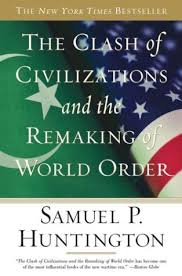
The most controversial part of The Clash of Civilizations focuses on Islam. Huntington points out, for example, that Muslim countries are involved in far more inter-group violence than others.
And he warns that the West’s future conflicts with Islamic nations will be rooted in the Islamic religion:
“Islam’s borders are bloody and so are its innards. The fundamental problem for the West is not Islamic fundamentalism. It is Islam, a different civilisation whose people are convinced of the superiority of their culture and are obsessed with the inferiority of their power.”
Huntington argues that civilizational conflicts are “particularly prevalent between Muslims and non-Muslims.” Among the reasons for these conflicts: Both Islam and Christianity have similarities which heighten conflicts between their followers:
- Both seek to convert others.
- Both are “all-or-nothing” religions; each side believes that only its faith is the correct one.
- The followers of both Islam and Christianity believe that people who violate the base principles of their religion are idolators and thus damned.
Other reasons for the Western-Islamic clash are:
- The Islamic revival, which began in the 1970s and is manifested in greater religious piety and in a growing adoption of Islamic culture, values, dress, separation of the sexes, speech and media censorship.
- Western universalism—the belief that all civilizations should adopt Western values—infuriates Islamic fundamentalists.
These are not differences that will disappear—overnight or even over the span of several centuries. Nor will they be sweet-talked away by Politically Correct politicians, however well-meaning.
2016 PRESIDENTIAL RACE, ABC NEWS, ADRIANNE ZUCKER, ALTERNET, AP, BILL CLINTON, BILLY BUSH, BUZZFEED, CBS NEWS, CNN, CROOKS AND LIARS, DAILY KOZ, DAYS OF OUR LIVES, DONALD TRUMP, FACEBOOK, GAIUS CALIGULA, GAIUS SUETONIUS TRANQUILLUS, HILLARY CLINTON, IVANKA TRUMP, MICHELE BACHMANN, MOTHER JONES, MOVEON, MSNBC, NBC NEWS, NEWSWEEK, NPR, POLITICO, RAW STORY, REPUBLICAN PARTY, REUTERS, ROMAN EMPIRE, SALON, SEATTLE TIMES, Secret Service, SEXUAL HARASSMENT, SLATE, THE ATLANTIC, THE CHICAGO SUN-TIMES, THE CHICAGO TRIBUNE, THE DAILY BEAST, THE GUARDIAN, THE HILL, THE HUFFINGTON POST, THE LOS ANGELES TIMES, THE NATION, THE NEW YORK TIMES, THE TWELVE CAESARS, THE WALL STREET JOURNAL, THE WASHINGTON POST, TIME, TODAY, TWITTER, U.S. NEWS & WORLD REPORT, UPI, USA TODAY
In Bureaucracy, History, Law, Law Enforcement, Military, Politics, Social commentary on August 8, 2018 at 12:07 am
The first six months of Gaius Caligula’s reign were successful and popular.
After that, wrote his biographer, Gaius Suetonius Tranquillus: “So much for Caligula as emperor; we must now tell of his career as a monster.”

Gaius Caligula
Among his litany of crimes, according to Suetonius:
“He forced parents to attend the executions of their sons, sending a litter for one man who pleaded ill health, and inviting another to dinner immediately after witnessing the death, and trying to rouse him to gaiety and jesting by a great show of affability.
“He had the manager of his gladiatorial shows and beast-baitings beaten with chains in his presence for several successive days, and would not kill him until he was disgusted at the stench of his putrefied brain.”
Donald Trump has never been charged with murder. But during his second Presidential debate with Democratic nominee Hillary Clinton, he previewed the dangers of a Trump Justice Department: “If I win I am going to instruct my attorney general to get a special prosecutor to look into your situation.”
Donald Trump
Nor did he limit himself to making threats against Democrats. On March 16, 2016, he warned Republicans that if he didn’t win the GOP nomination in July, his supporters would literally riot: “I think you’d have riots. I think you would see problems like you’ve never seen before. I think bad things would happen. I really do. I wouldn’t lead it, but I think bad things would happen.”
That Republicans clearly saw this as a threat is undeniable. Paul Ryan, their Speaker of the House, said: “Nobody should say such things in my opinion because to even address or hint to violence is unacceptable.”
Caligula’s egomania soon reached psychotic heights.
- He gave himself several surnames: “Pious,” “Child of the Camp,” “Father of the Armies,” and “Greatest and Best of Caesars.”
- Flattered that he had risen higher than princes and kings, he began to believe himself a god.
- He appeared at the temple of Castor and Pollux to be worshiped as Jupiter Latiaris.
- He also set up a special temple to his own godhead.
Trump’s egomania is literally stamped on his properties. Of the 515 entities he owns, 268 of them—52%—bear his last name. He often refers to his properties as “the swankiest,” “the most beautiful.”
Among the references he’s made to himself:
- “My fingers are long and beautiful, as, it has been well documented, are various other parts of my body.”
- “I think the only difference between me and the other candidates is that I’m more honest and my women are more beautiful.”
- “My Twitter has become so powerful that I can actually make my enemies tell the truth.”
- “My IQ is one of the highest–and you all know it.”
When Caligula wasn’t ordering wholesale Stalin-like purges–ranging from Roman aristocrats to slaves–he was setting new records for debauchery.
According to the Roman historian Gaius Suetonius Tranquillus: “He lived in habitual incest with all his [three] sisters, and at a large banquet he placed each of them in turn below him, while his wife reclined above. Of these he is believed to have violated Drusilla when he was still a minor.”
Trump has never been charged with incest, but he’s repeatedly made sexually inappropriate comments about his daughter, Ivanka:
- “Yeah, she’s really something, and what a beauty, that one. If I weren’t happily married and, ya know, her father …”
- When Trump appeared on the Dr. Oz Show, he was joined on stage by Ivanka. After they kissed, Dr. Oz said: “It’s nice to see a dad kiss his daughter.” Trump: “I kiss her every chance I get.” The remark was edited before the show aired.
- When asked how he would react if Ivanka, a former teen model, posed forPlayboy, Trump replied: “I don’t think Ivanka would do that, although she does have a very nice figure. I’ve said if Ivanka weren’t my daughter, perhaps I’d be dating her.”
- “You know who’s one of the great beauties of the world, according to everybody? And I helped create her. Ivanka. My daughter, Ivanka. She’s 6 feet tall, she’s got the best body.”
I
Ivanka Trump
For all his cruelty and egomania, the trait that finally destroyed Caligula was his joy in humiliating others.
His fatal mistake was to taunt Cassius Chaerea, a member of his own bodyguard. Caligula considered Chaerea effeminate because of a weak voice and mocked him with names like “Priapus” and “Venus.”
On January 22 41 A.D. Chaerea and several other bodyguards hacked Caligula to death with swords before other guards could save him.
Among the groups Trump gratuitously insulted during the 2016 Presidential race:
- Latinos
- Asians
- Muslims
- Blacks
- The Disabled
- Women
- Prisoners-of-War
- Journalists
- Celebrities
- Ordinary citizens
The number of people, places and institutions Trump has insulted is so extensive The New York Times compiled a list of 273 of them.
Before taking office as President, Trump added to this list the United States Secret Service. He did so by keeping his longtime private security force, and combining its members with the elite federal agency.
By marginalizing the Secret Service, he clearly sent the insulting message: You’re not good enough, and I don’t trust you.
It remains to be seen if Trump suffers the final fate of Caligula.
2016 PRESIDENTIAL RACE, ABC NEWS, ADRIANNE ZUCKER, ALTERNET, AP, BILL CLINTON, BILLY BUSH, BUZZFEED, CBS NEWS, CNN, CROOKS AND LIARS, DAILY KOZ, DAYS OF OUR LIVES, DONALD TRUMP, FACEBOOK, GAIUS CALIGULA, GAIUS SUETONIUS TRANQUILLUS, HILLARY CLINTON, IVANKA TRUMP, MICHELE BACHMANN, MOTHER JONES, MOVEON, NBC NEWS, NEWSWEEK, NPR, POLITICO, RAW STORY, REPUBLICAN PARTY, REUTERS, ROMAN EMPIRE, SALON, SEATTLE TIMES, Secret Service, SEXUAL HARASSMENT, SLATE, THE ATLANTIC, THE CHICAGO SUN-TIMES, THE CHICAGO TRIBUNE, THE DAILY BEAST, THE GUARDIAN, THE HILL, THE HUFFINGTON POST, THE LOS ANGELES TIMES, THE NATION, THE NEW YORK TIMES, THE TWELVE CAESARS, THE WALL STREET JOURNAL, THE WASHINGTON POST, TIME, TODAY, TWITTER, U.S. NEWS & WORLD REPORT, UPI, USA TODAY
In Bureaucracy, History, Law, Law Enforcement, Military, Politics, Social commentary on August 7, 2018 at 12:21 am
Donald Trump has reigned as the 45th President of the United States since January 20, 2017.
But even many Republicans secretly believe he’s better-suited for the role of Gaius Caligula. It was Caligula who, as the mad emperor of Rome, once said: “Bear in mind that I can treat anyone exactly as I please.”

Gaius Caligula
On October 7, 2016, The Washington Post leaked a video of Donald Trump making sexually predatory comments about women.
The remarks came during a 2005 exchange with Billy Bush, then the host of Access Hollywood (and now host of Today).
The two were traveling in an Access Hollywood bus to the set of the soap opera Days of Our Lives, where Trump was to make a cameo appearance.
Neither Trump nor Bush could be seen during the exchange–the video focuses entirely on the bus. But the audio came in clearly–and, for Trump, damningly:
Donald Trump: You know and I moved on her actually. You know she was down on Palm Beach. I moved on her and I failed. I’ll admit it. I did try and fuck her. She was married.
Unknown: That’s huge news.
Trump: No, no, Nancy. No this was—and I moved on her very heavily, in fact, I took her out furniture shopping. She wanted to get some furniture. I said I’ll show you where they have some nice furniture.
I took her out furniture. I moved on her like a bitch, but I couldn’t get there, and she was married. Then all of a sudden I see her, she’s now got the big phony tits and everything. She’s totally changed her look.
[At that point, they spot Adrianne Zucker, the starring actress in Days in Our Lives.]
Donald Trump
Bush: Sheesh, your girl’s hot as shit. In the purple. Yes! The Donald has scored. Whoa, my man!
Trump: Look at you. You are a pussy. Maybe it’s a different one.
Bush: It better not be the publicist. No, it’s her. It’s—
Trump: Yeah, that’s her. With the gold. I better use some Tic Tacs just in case I start kissing her. You know I’m automatically attracted to beautiful—I just start kissing them. It’s like a magnet. Just kiss. I don’t even wait. And when you’re a star they let you do it. You can do anything.
Bush: Whatever you want.
Trump: Grab them by the pussy. You can do anything.
When the Washington Post broke the story on October 7, the reaction was immediate—and explosive.
This was not a testosterone-fueled teenager fantasizing about making love with a girl he adored.
This was a 70-year-old man bragging about having used deceit to try to lure a married woman into bed. And about having used his celebrity status to force himself on other women.
“Grab them by the pussy. You can do anything.”
Gaius Caligula himself couldn’t have said it better.
Caligula lived 29 years and ruled Rome three years, 10 months and eight days. When he died, his reign of depravity and terror died with him.
Today, millions of Americans fear a similar fate will sweep their country under Donald Trump.
Caligula’s life spanned August 31, 12 A.D. to January 24, 41 A.D. His chief biographer was Gaius Suetonius Tranquillus.

Trump was born on June 14, 1946.
Caligula became Emperor in 37 A.D. after succeeding the Emperor Tiberius, his uncle who had adopted him as a son after his father died.
Trump was elected President on November 8, 2016, after winning 304 electoral votes to 227 for his Democratic opponent, Hillary Clinton.
Trump began his real estate career at his father’s real estate and construction company. He rose to wealth and fame after his father, Fred, gave him control of the business in 1971.
Caligula’s reign began well—and popularly. He gave Tiberius a magnificent funeral—then recalled to Rome all those whom Tiberius had banished, and ignored all charges that Tiberius had leveled against them.
He gave bonuses to the military and destroyed lists of those Tiberius had declared traitors. He allowed the magistrates unrestricted jurisdiction, without appeal to himself.
Similarly, soon after acquiring the family business, Trump set out to build his own empire—hotels, golf courses, casinos, skyscrapers across North and South America, Europe and Asia. He named many of them after himself.
He appeared at the Miss USA pageants, which he owned from 1996 to 2015. He hosted and co-produced The Apprentice, an NBC reality television series from 2004 to 2015.
The ancient historians describe Caligula as a noble and enlightened ruler during the first six months of his reign. But in October 37 A.D. he fell seriously ill or perhaps was poisoned.
Caligula soon recovered but emerged a changed man. He began laying claim to divine majesty, and killing or exiling anyone he saw as a threat. He ordered a tribune to murder his brother Tiberius, and drove his father-in‑law Silanus to cut his throat with a razor.
He favorite method of execution was to have a victim tortured with many slight wounds. His infamous order for this: “Strike so that he may feel that he is dying.”
Trump hasn’t been charged with murder. Yet he has repeatedly boasted: “Get even with people. If they screw you, screw them back 10 times as hard. I really believe it.”
ABC NEWS, ALCOHOLISM, ALTERNET, AP, BUMS, BUZZFEED, CBS NEWS, CNN, CROOKS AND LIARS, DAILY KOZ, DEBBIE STABENOW, DEPARTMENT OF EDUCATION, DRUG ADDICTION, DRUG ENFORCEMENT ADMINISTRATION, FACEBOOK, FIREARMS, HOMELESSNESS, IRAQ, LIBERTARIAN PARTY, MENTAL ILLNESS, MOTHER JONES, MOVEON, MSNBC, NBC NEWS, NEWSWEEK, NPR, POLICE, POLITICO, RAW STORY, REUTERS, SALON, SEATTLE TIMES, SHOTGUNS, SLATE, THE ATLANTIC, THE CHICAGO SUN-TIMES, THE CHICAGO TRIBUNE, THE DAILY BEAST, THE GUARDIAN, THE HILL, THE HUFFINGTON POST, THE LOS ANGELES TIMES, THE NATION, THE NEW YORK TIMES, THE WASHINGTON POST, TIME, TRANSPORTATION SECURITY ADMINISTRATION, TWITTER, U.S. NEWS & WORLD REPORT, UNITED STATES SENATE, UPI, USA TODAY, USA TODAY BRIAN ELLISON
In History, Law, Law Enforcement, Politics, Social commentary on August 2, 2018 at 12:04 am
Brian Ellison is running for the position of United States Senator from Michigan. And unlike other political candidates, he has taken a unique position on homelessness.
Some politicians want to outlaw homeless encampments. Others want to spend billions on low-cost housing for this population.
Ellison, instead, wants to arm bums with guns. Specifically, with pump-action shotguns.
“Get us a group of 20 homeless people that we could train, help them understand how the shotgun works, how to maintain it, how to fire it,” Ellison told Newsweek. “And equip them with a shotgun, a sling and some shells so they can protect themselves.”

Brian Ellison
Actually, the shotgun was not Ellison’s first choice of weaponry for his intended beneficiaries.
“Frankly I think the ideal weapon would be a pistol,” he told The Guardian, “but due to the licensing requirements in the state we’re going to have a hard enough time getting homeless people shotguns as it is.
“Getting them pistols is probably next to impossible. The pistols need to be registered, people have to have addresses.”
But “open-carrying a long gun is completely legal. So we thought that pump-action shotguns were a suitable alternative to a pistol.”

Winchester Model 1912-gauge pump-action shotgun
Ellison is a Libertarian. He’s also a former Army soldier who served in Iraq.
Apparently that experience didn’t teach him that when too many people have guns, no one is safe.
Ellison’s opponent is Democratic incumbent Debbie Stabenow.
Besides providing shotguns to thousands of rootless people, Ellison wants to abolish the Drug Enforcement Administration and the Transportation Security Administration, and localize the Department of Education.
“I’m basically entirely opposed to any government program,” said Ellison.
Unless it’s a government program to arm bums with guns.
This population can be roughly divided into four categories:
- Druggies
- Drunks
- Mental cases and
- Bums.
The homeless are “constantly victims of violent crime,” says Ellison, who believes that giving them firearms would provide a deterrent.
It would also provide a real incentive for tax-paying citizens to hand over their money the moment a shotgun-carrying DDMB confronts them on the street.
Of course, Ellison has an answer for this: He would try to “pre-qualify” DDMBs as suitable candidates to own firearms:
“The first thing that we’re gonna do is ask them if they think this is something that would benefit them. We’re certainly not trying to force anything on anybody.”
Except, of course, on those citizens being hit on daily—sometimes hourly—by DDMBs for money.
Naturally, ammunition would be provided—at state expense—for the shotguns. This would come in five- or six-shell magazines.
Ellison said that more shells would be provided if the owners legitimately used their guns to defend themselves.
But if they used their ammo for “shooting cans in somebody’s private property” then they would not be given more shells.
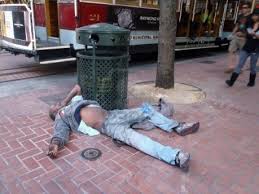
A potential beneficiary of Ellison’s “guns for bums” program
Ellison isn’t worried that is intended beneficiaries might use the guns for murder or robbery: “Well, are you worried about the police being armed with military weapons? I am.
“The world we live in is a scary world, where the police who used to dress in short-sleeved shirts and carry a revolver now have long rifles with scopes and bulletproof vests and armoured vehicles.
“And quite frankly that scares me much more than a homeless person trying to defend themselves with a shotgun.”
This, of course, ignores the fact that police are pre-qualified with firearms—and every shooting by officers in a big-city police department is thoroughly investigated.
Their firearms are turned in for investigation. And the officers who used them can be disciplined and even prosecuted if a police chief and/or prosecutor believes the shooting was improper or illegal.
And who would make such lethal weaponry available to street people?
“There are a lot of charities out there that help to provide the homeless with food, housing, job training, all kinds of stuff,” said Ellison. “There’s not a charity out there that helps them learn how to protect themselves. What’s going to drive this is popular support.”
Just how many DDMBs could receive Ellison’s special gift? In Michigan, there are more than 56,000 of them.
Ellison remarked that the population is “constantly victims of violent crime” in his state.
His website page opens with: “LIBERTARIANISM MEANS ALL OF YOUR FREEDOMS ALL OF THE TIME.” And it outlines his core beliefs:
“We as a people must admit that the many laws, regulations, and policies established over the years in an effort to ‘promote social welfare’ have failed in their stated purpose. These laws and regulations now represent the greatest threat to our natural rights, and must be repealed.
“Abroad, we must change how we engage the rest of the world, leading by example, not force of arms….Imperialism was not the intent of our founders nor is it the desire of the majority of Americans.”
“In order to move forward in these beliefs,” says his website, “we must remember that while our ideology is our core, we must also be practical and reasonable in their implementation.”
Yet many voters may well decide that arming bums with guns isn’t “practical and reasonable.”
A.G. SULZBERGER, ABC NEWS, ALTERNET, AP, BUZZFEED, CBS NEWS, CIA, CNN, CROOKS AND LIARS, DAILY KOZ, DEMOCRATIC PARTY, FACEBOOK, FBI, GEORGE ORWELL, JAMES COMEY, JUSTICE DEPARTMENT, MEDIA, MOTHER JONES, MOVEON, MSNBC, NBC NEWS, NEWSWEEK, NPR, PEGGY NOONAN, POLITICO, RAW STORY, REPUBLICAN PARTY, REUTERS, ROBERT S. MUELLER, Ronald Reagan, SALON, SEATTLE TIMES, SLATE, THE ATLANTIC, THE CHICAGO SUN-TIMES, THE CHICAGO TRIBUNE, THE DAILY BEAST, THE GUARDIAN, THE HILL, THE HUFFINGTON POST, THE LOS ANGELES TIMES, THE NATION, THE NEW YORK TIMES, THE WASHINGTON POST, TIME, TWITTER, U.S. NEWS & WORLD REPORT, UPI, USA TODAY, USA TODAY DONALD TRUMP
In Bureaucracy, History, Law Enforcement, Politics, Social commentary on August 1, 2018 at 12:10 am
Donald Trump has repeatedly claimed that he is a victim of “fake news.”
But future historians will note how often the media ignored the foremost reality of their time: That the United States was led by a psychopathic dictator.
This is true even for CNN, the network that Trump clearly hates the most.
Consider this line from a May 22, 2018 CNN essay on Trump vs. the press by David Gergen:
“Instead of raging on about ‘fake news,’ the President would do well to read Peggy Noonan [a Ronald Reagan speechwriter turned author] on Reagan and focus on building his character.”
So what’s wrong with this?
Trump is 72 years old. George Orwell wrote that, by age 50, every man has the face he deserves. By age 72, every man has the character he has spent his life being. And Trump’s life has been dedicated to inflating his wallet and his ego.
He isn’t going to radically change at this point—especially if he believes himself “a very stable genius.”
Donald Trump
Then there’s this gem from a July 30, 2018 story: “Trump Opens Window Into His Rage With Mueller Attack.”
This focused on a tweetstorm Trump launched against Special Counsel Robert Mueller just two days before Mueller prosecuted Paul Manafort, Trump’s former campaign chairman.
Among those tweets:
“Is Robert Mueller ever going to release his conflicts of interest with respect to President Trump, including the fact that we had a very nasty & contentious business relationship, I turned him down to head the FBI (one day before appointment as S.C.) & Comey is his close friend.”
And:
“…Also, why is Mueller only appointing Angry Dems, some of whom have worked for Crooked Hillary, others, including himself, have worked for Obama….And why isn’t Mueller looking at all of the criminal activity & real Russian Collusion on the Democrats side-Podesta, Dossier?”
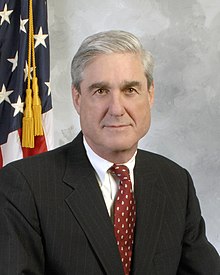
Robert Mueller
CNN characterized this cascade of libel as a “trio of tweets…packed with inaccuracies and misrepresentations.”
An accurate description would have been: “Lies.”
Or consider these comments from Arthur Gregg Sulzberger, the publisher of the New York Times, after a meeting between him and Trump:
“I told him that although the phrase ‘fake news’ is untrue and harmful, I am far more concerned about his labeling journalists ‘the enemy of the people.’ I warned that this inflammatory language is contributing to a rise in threats against journalists and will lead to violence.
“I repeatedly stressed that this is particularly true abroad, where the president’s rhetoric is being used by some regimes to justify sweeping crackdowns on journalists. I warned that it was putting lives at risk, that it was undermining the democratic ideals of our nation, and that it was eroding one of our country’s greatest exports: a commitment to free speech and a free press.”

Arthur Gregg Sulzberger
So what is wrong with these comments?
Like the saccharine that floods the airways at Christmastime, they reek of a deliberate suspension of reality. That’s when even the most cynical TV news reporters feel compelled to ask, around the anchor desk: “Gee, Jim, do you really think there could be peace on Earth, good will to men?”
And the answer, of course, is: Yes—in a science fiction movie.
Similarly, to appeal to Trump’s “better angels” on behalf of the news media is an exercise in futility—and insanity.
This is a man who has said—proudly: “Get even with people. If they screw you, screw them back 10 times as hard. I really believe it.”
A 2016 analysis by USA Today found that for 30 years, Trump and his businesses had been involved in 3,500 legal cases in U.S. federal courts and state court. This is not a man who, at heart, is a peacemaker.
Nor is he a man who has any respect for truth. The Washington Post has reported that during his first 298 days in the White House, Trump said or tweeted 1,628 lies or misleading statements. This makes for an average of 5.5 lies a day.
To expect—as Sulzberger apparently did—that Trump has any regard for such Constitutional niceties as freedom of the press is beyond rationality.
Trump has furiously attacked the institutions that Americans have long cherished—such as:
- An independent judiciary
- A free press
- Intelligence agencies (such as the FBI and CIA) charged with protecting the country against subversion
- An incorruptible Justice Department.
Donald Trump isn’t crazy. Nor does he abuse power by well-meaning accident.
He knows exactly what he’s doing—and why.
He intends to strip every potential challenger to his authority—or his version of reality—of legitimacy with the public. If he succeeds, there will be:
- No independent press to reveal his failures and crimes.
- No independent law enforcement agencies to investigate his abuses of office.
- No independent judiciary to hold him accountable.
- No independent military to dissent as he recklessly hurtles toward a nuclear disaster.
- No candidate—Democrat or Republican—to challenge him for re-election in 2020.
- No candidate—Democrat or Republican—to challenge his remaining in office as “President-for-Life.”
Yet the media—including CNN—has refused to brand Trump as the liar and dictator he clearly is.
2016 PRESIDENTIAL CAMPAIGN, ABC NEWS, ALTERNET, ANTHONY SCARAMUCCI, AP, BARACK OBAMA, BBC, BUZZFEED, CBS NEWS, CIA, CLINTON WATTS, CNN, CYBERWARFARE, DAILY KOS, DEMOCRATIC NATIONAL COMMITTEE, DIRECTOR OF NATIONAL INTELLIGENCE, DONALD TRUMP, DONALD TRUMP JUNIOR, ERIC TRUMP, ERIK PRINCE, ESPIONAGE, EUROPEAN UNION (EU), FACEBOOK, FBI, GEORGE PAPADOPOULOS, GRU, HILLARY CLINTON, JAMES B. COMEY, JAMES R. CLAPPER, JARED KUSHNER, JEFF SESSIONS, MICHAEL COHEN, MICHAEL T. FLYNN, MIKE PENCE, MOSCOW PROJECT, MOTHER JONES, MOVEON, NBC NEWS, NEWSWEEK, NORTH ATLANTIC TREATY ORGANIZATION (NATO), NPR, PAUL MANAFORT, POLITICO, RAW STORY, REUTERS, REX TILLERSON, RICK GATES, ROBERT S. MUELLER, RUSSIA, SALLY YATES, SALON, SEATTLE TIMES, SLATE, THE ATLANTIC, THE CHICAGO SUN-TIMES, THE CHICAGO TRIBUNE, THE DAILY BEAST, THE GUARDIAN, THE HILL, THE HUFFINGTON POST, THE LOS ANGELES TIMES, THE NEW YORK TIMES, THE WALL STREET JOURNAL, THE WASHINGTON POST, TIME, TWITTER, U.S. NEWS & WORLD REPORT, U.S. SENATE SELECT COMMITTEE ON INTELLIGENCE, UPI, USA TODAY, VLADIMIR PUTIN, WIKILEAKS
In Bureaucracy, History, Law Enforcement, Military, Politics, Social commentary on July 26, 2018 at 12:08 am
More than a year and a half after taking office, President Donald Trump remains haunted by “the Russian connection.”
Throughout 2016, the CIA, FBI and National Security Agency (NSA) found numerous ties between officials of the Trump Presidential campaign and Russian Intelligence agents.
And many of those he has appointed to office have strong ties to the government of Russian President Vladimir Putin.
One of these was Secretary of State Rex Tillerson. In 2013, as the chief executive of ExxonMobil, he was presented with the 2013 Order of Friendship award. He had just signed deals with the state-owned Russian oil company Rosneft. Its chief, Igor Sechin, is a loyal Putin lieutenant.

Rex Tillerson
Another such official is Attorney General Jeff Sessions. During the 2016 campaign, Sessions—then serving as a surrogate for Donald Trump’s campaign—twice spoke with Russian Ambassador Sergey Kislyak.
But during his Senate nomination hearings, Sessions denied that he had had “communications with the Russians” during the campaign.
The discovery of numerous contacts between Trump campaign officials and Russian Intelligence agents led the FBI to investigate Russia’s efforts to subvert the 2016 Presidential election. That investigation is still ongoing.
So did the House and Senate Intelligence Committees.
On March 30, 2017, Clinton Watts, an expert on cyber warfare, testified before the U.S. Senate Select Committee on Intelligence. As part of his testimony, he presented a prepared statement on “Disinformation: A Primer In Russian Active Measures And Influence Campaigns.”

FROM WATTS’ STATEMENT: Russia certainly seeks to promote Western candidates sympathetic to their worldview and foreign policy objectives. But winning a single election is not their end goal.
Russian Active Measures hope to topple democracies….from the inside out [by] creating political divisions….
[Their ultimate goals are] the dissolution of the European Union and the break up of the North American Treaty Organization (NATO).
Achieving these two victories against the West will allow Russia to reassert its power globally and pursue its foreign policy objectives bilaterally through military, diplomatic and economic aggression.
On July 22, 2016, Wikileaks released 19,252 emails and 8,034 attachments hacked from computers of the highest-ranking officials of the Democratic National Committee (DNC). Early reports traced the leak to Russian hackers.
On July 27, at a press conference in Doral, Florida, Trump declared: “Russia, if you are listening, I hope you are able to find the 33,000 emails that are missing—I think you will probably be rewarded mightily by our press.”
This was nothing less than treason—calling upon a foreign power, hostile to the United States, to interfere in its Presidential election.
On numerous occasions, Trump has fiercely denied any Russian connections. For example:
July 27, 2016: “I mean I have nothing to do with Russia. I don’t have any jobs in Russia. I’m all over the world but we’re not involved in Russia.”
January 11, 2017: “Russia has never tried to use leverage over me. I HAVE NOTHING TO DO WITH RUSSIA – NO DEALS, NO LOANS, NO NOTHING!”
February 7, 2017: “I don’t know [Russian President Vladimir] Putin, have no deals in Russia, and the haters are going crazy.”
Yet, in 2008, Donald Trump, Jr. said at a New York real estate conference: “In terms of high-end product influx into the US, Russians make up a pretty disproportionate cross-section of a lot of our assets. Say, in Dubai, and certainly with our project in SoHo, and anywhere in New York. We see a lot of money pouring in from Russia.”
And Trump’s son, Eric, has been quoted as saying in 2014: “Well, we don’t rely on American banks. We have all the funding we need out of Russia. We’ve got some guys that really, really love golf, and they’re really invested in our programs. We just go there all the time.”
The Moscow Project is an initiative of the Center for American Progress Action Fund. Its objective: “Analyzing the facts behind Trump’s collusion with Russia and communicating the findings to the public.”
According to its March 21, 2018 report (updated on July 10): “In total, we have learned of 80 contacts between Trump’s team and Russia linked operatives, including at least 23 meetings.
“And we know that at least 24 high-ranking campaign officials and Trump advisors were aware of contacts with Russia-linked operatives during the campaign and transition. None of these contacts were ever reported to the proper authorities. Instead, the Trump team tried to cover up every single one of them….
“The Trump campaign issued at least 15 blanket denials of contacts with Russia, all of which have been proven false.”
Members of the Trump team who had contacts with Russians during the campaign or transition include:
- Michael Cohen
- Roger Stone
- Donald Trump Jr.
- Jeff Sessions
- Paul Manafort
- Jared Kushner
- Carter Page
- Michael Flynn
- Erik Prince
- George Papadopoulos
- Anthony Scaramucci
- Rick Gates
Flynn and Papadopoulos have pleaded guilty to making false statements about their contacts with Russians to investigators.
Manafort faces trial for money-laundering relating to his work for the government of Putin-supported government of Ukraine.
In July, Special Counsel Robert S. Mueller charged 12 officers of the GRU, Russia’s military intelligence agency, with crimes committed to the high-profile hacking and leaking emails from the Democratic National Committee during the 2016 campaign.
As trials begin and indicted men begin to sweat, expect more revelations to come.
2016 PRESIDENTIAL CAMPAIGN, ABC NEWS, ALTERNET, ANTHONY SCARAMUCCI, AP, BBC, BUZZFEED, CBS NEWS, CIA, CLINTON WATTS, CNN, CYBERWARFARE, DAILY KOS, DEMOCRATIC NATIONAL COMMITTEE, DIRECTOR OF NATIONAL INTELLIGENCE, DONALD TRUMP, DONALD TRUMP JUNIOR, ERIC TRUMP, ERIK PRINCE, ESPIONAGE, EUROPEAN UNION (EU), FACEBOOK, FBI, GEORGE PAPADOPOULOS, GRU, JAMES B. COMEY, JAMES R. CLAPPER, JARED KUSHNER, JEFF SESSIONS, MICHAEL COHEN, MICHAEL T. FLYNN, MOSCOW PROJECT, MOTHER JONES, MOVEON, NBC NEWS, NEWSWEEK, NORTH ATLANTIC TREATY ORGANIZATION (NATO), NPR, PAUL MANAFORT, POLITICO, RAW STORY, REUTERS, REX TILLERSON, RICK GATES, ROBERT S. MUELLER, RUSSIA, SALON, SEATTLE TIMES, SLATE, THE ATLANTIC, THE CHICAGO SUN-TIMES, THE CHICAGO TRIBUNE, THE DAILY BEAST, THE GUARDIAN, THE HILL, THE HUFFINGTON POST, THE LOS ANGELES TIMES, THE NEW YORK TIMES, THE WALL STREET JOURNAL, THE WASHINGTON POST, TIME, TWITTER, U.S. NEWS & WORLD REPORT, U.S. SENATE SELECT COMMITTEE ON INTELLIGENCE, UPI, USA TODAY, VLADIMIR PUTIN, WIKILEAKS
In Bureaucracy, History, Law Enforcement, Military, Politics, Social commentary on July 25, 2018 at 12:09 am
On July 16, President Donald Trump attended a press conference in Helsinki, Finland, with Russian President Vladimir Putin.
There he blamed American Intelligence agencies—such as the FBI, CIA and National Security Agency—instead of Putin for Russia’s subversion of the 2016 Presidential election.
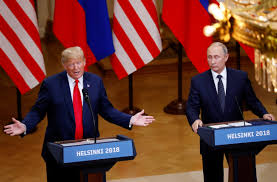
Donald Trump, Vladimir Putin in Helsinki
“Just now President Putin denied having anything to do with the election interference in 2016,” Associated Press Reporter Jonathan Lemire said to Trump. “Every U.S. intelligence agency has concluded that Russia did. My first question for you, sir, is who do you believe?”
Trump chose to attack Democrats and the FBI as partners in a conspiracy: “You have groups that are wondering why the FBI never took the server, why haven’t they taken the server? Why was the FBI told to leave the office of the Democratic National Committee?
“…Where is the server? I want to know where is the server and what is the server saying….
“I have President Putin. He just said it’s not Russia. I will say this: I don’t see any reason why it would be, but I really do want to see the server.”
Clinton Watts is a consultant and researcher on cyberwarfare. He has served as
- An FBI Special Agent on a Joint Terrorism Task Force (JTTF);
- The Executive Officer of the Combating Terrorism Center at West Point (CTC); and
- As a consultant to the FBI’s Counter Terrorism Division (CTD) and National Security Branch (NSB).
In a statement he prepared for the U.S. Senate Select Committee on Intelligence, Watts outlined cyberwarfare measures that Russia used to subvert the 2016 Presidential campaign.
He delivered this on March 30. 2017. Part of this reads as follows:
Through the end of 2015 and start of 2016, the Russian influence system….began pushing themes and messages seeking to influence the outcome of the U.S. Presidential election.
Russia’s overt media outlets and covert trolls sought to sideline opponents on both sides of the political spectrum with adversarial views toward the Kremlin. The final months leading up to the election have been the predominate focus of Russian influence discussions to date.
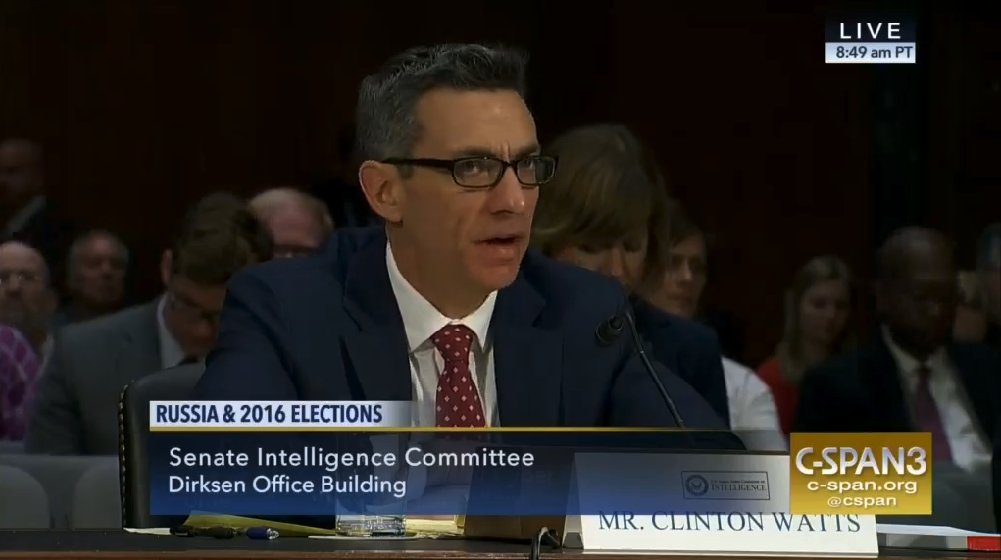
Clinton Watts
However, Russian Active Measures were in full swing during both the Republican and Democratic primary season and may have helped sink the hopes of candidates more hostile to Russian interests long before the field narrowed.
The final piece of Russia’s modern Active Measures surfaced in the summer of 2016 as hacked materials from previous months were strategically leaked.
On 22 July 2016, Wikileaks released troves of stolen communications from the Democratic National Committee and later batches of campaign emails. Guccifer 2.0 and DC Leaks revealed hacked information from a host of former U.S. government officials throughout July and August 2016.
For the remainder of the campaign season, this compromising material powered the influence system Russia successfully constructed in the previous two years.
Meanwhile, Donald Trump—as the Republican nominee for President—steadfastly refused to acknowledge the efforts of Vladimir Putin’s government to ensure his election:
October 24, 2016: “I have nothing to do with Russia, folks, I’ll give you a written statement.”
December 11, 2016 “They have no idea if it’s Russia or China or somebody. It could be somebody sitting in a bed some place. I mean, they have no idea.”
On December 16, 2016, then-FBI Director James B. Comey and Director of National Intelligence James R. Clapper Jr. agreed with a CIA assessment that Russia intervened in the 2016 election in part to help Donald Trump win the White House.
Even after the release of this Intelligence statement, Trump continued to deny that Russia had played a role in his election.
On February 16, 2017, as President, he tweeted: “The Democrats had to come up with a story as to why they lost the election, and so badly (306), so they made up a story – RUSSIA. Fake news!”
FROM WATTS’ STATEMENT: This pattern of Russian falsehoods and social media manipulation of the American electorate continued through Election Day and persists today.
Many of the accounts we watched push the false Incirlik story in July now focus their efforts on shaping the upcoming European elections, promoting fears of immigration or false claims of refugee criminality.
They’ve not forgotten about the United States either. This past week, we observed social media campaigns targeting Speaker of the House Paul Ryan hoping to foment further unrest amongst U.S. democratic institutions, their leaders and their constituents.
As we noted two days before the Presidential election in our article describing Russian influence operations, Russia certainly seeks to promote Western candidates sympathetic to their worldview and foreign policy objectives.
But winning a single election is not their end goal. Russian Active Measures hope to topple democracies through the pursuit of five complementary objectives:
- Undermine citizen confidence in democratic governance;
- Foment and exacerbate divisive political fractures;
- Erode trust between citizens and elected officials and democratic institutions;
- Popularize Russian policy agendas within foreign populations;
- Create general distrust or confusion over information sources by blurring the lines between fact and fiction.
From these objectives, the Kremlin can crumble democracies from the inside out creating political divisions resulting in two key milestones:
- The dissolution of the European Union and
- The break up of the North American Treaty Organization (NATO).
2016 PRESIDENTIAL CAMPAIGN, ABC NEWS, ALEXANDER SHUSTOROVICH, ALTERNET, ANDREW INTRATER, AP, BBC, BUZZFEED, CBS NEWS, CIA, CITIZENS UNITED, CNN, CROOKS AND LIARS, DAILY KOS, DAILY KOZ, DONALD TRUMP, FACEBOOK, FBI, FOX NEWS, JOHN MCCAIN, LEN BLAVATNIK, LINDSEY GRAHAM, MARCO RUBIO, MITCH MCCONNELL, MOTHER JONES, MOVEON, NATIONAL SECURITY AGENCY, NBC NEWS, NEWSWEEK, NPR, OLIGARCHS, POLITICAL ACTION COMMITTEES (PACS), POLITICO, RAW STORY, REPUBLICAN PARTY, REPUBLICANS, REUTERS, RICHARD NIXON, ROBERT MUELLER, ROD ROSENSTEIN, Ronald Reagan, RUSSIA, SALON, SEATTLE TIMES, SIMON KUKES, SLATE, SOVIET UNION, SUPREME COURT, THE ATLANTIC, THE CHICAGO SUN-TIMES, THE CHICAGO TRIBUNE, THE DAILY BEAST, THE GUARDIAN, THE HILL, THE HUFFINGTON POST, THE LOS ANGELES TIMES, THE NATION, THE NEW YORK TIMES, THE WALL STREET JOURNAL, THE WASHINGTON POST, TIME, TWITTER, U.S. NEWS & WORLD REPORT, UPI, USA TODAY, VLADIMIR PUTIN
In Bureaucracy, History, Law, Law Enforcement, Military, Politics, Social commentary on July 24, 2018 at 12:06 am
A Pew Research Center survey released on August 29, 2017, found that 36% of Americans approved of President Donald Trump. Most other polling rated his approval between 35 and 40%.
About Republicans, the survey found:
- Just over two-thirds agreed with his positions;
- 19% didn’t like his conduct;
- 46% said they had mixed feelings;
- 34% liked the way he behaved as President.
When asked what they liked most about Trump’s Presidency, those who approved of his performance cited his personality and conduct four times more often than his policies.
Donald Trump
On August 30, 2017, an article in Salon tackled this group head-on: “Most Americans Strongly Dislike Trump, But the Angry Minority That Adores Him Controls Our Politics.”
It described these voters as representing about one-third of the Republican party:
“These are older and more conservative white people, for the most part, who believe he should not listen to other Republicans and should follow his own instincts….
“They like Trump’s coarse personality, and approve of the fact that he treats women like his personal playthings. They enjoy it when he expresses sympathy for neo-Nazis and neo-Confederate white supremacists.
“They cheer when he declares his love for torture, tells the police to rough up suspects and vows to mandate the death penalty for certain crimes. (Which of course the president cannot do.)
“…This cohort of the Republican party didn’t vote for Trump because of his supposed policies on trade or his threat to withdraw from NATO. They voted for him because he said out loud what they were thinking. A petty, sophomoric, crude bully is apparently what they want as a leader.”

Supporters giving the Nazi “Sieg Heil” salute to Trump
According to the Pew survey, they only comprise 16% of the population. That leaves 65% of Republicans who are revolted by Trump’s personality and behavior. But they are being advised by GOP political consultants to vigorously support him.
“Your heart tells you that he’s bad for the country,” one anonymous consultant told the Salon reporter. “Your head looks at polling data among Republican primary voters and sees how popular he is.”
It’s precisely these hard-core Fascists who come out in mid-term elections—and they’re scaring the remaining 65% who make up the GOP establishment.
That’s one reason why the vast majority of Republicans continue to fanatically support Trump: They fear he will turn his hate-filled base on them.
But there’s a second reason why Republicans back Trump—especially against Special Counsel Robert S. Mueller’s probe of Russia’s subversion of the 2016 election.
Many House and Senate Republicans have received millions of dollars in “campaign contributions” from Russian oligarchs who are answerable to Russian dictator Vladimir Putin.
In 2017, for example, Russian oligarch Len Blavatnik gave millions of dollars to top Republican leaders—such as Senators Mitch McConnell, Marco Rubio and Lindsey Graham.
Altogether, four Russian oligarchs—Blavatnik, Alexander Shustorovich, Andrew Intrater and Simon Kukes––contributed $10.4 million from the start of the 2015-16 election cycle through September 2017.
Of this, 99% went to Republicans—including Senator John McCain and Governors John Kasich and Scott Walker.
And, thanks to the Supreme Court’s 2010 Citizens United decision, the donations are entirely legal.
Republicans don’t fear that Trump will destroy the institutions that Americans have long cherished—such as:
- An independent judiciary
- A free press
- An incorruptible Justice Department
- Intelligence agencies (such as the FBI and CIA) charged with protecting the country against subversion.
Trump has furiously attacked all of these—and Republicans have either said nothing or rushed to his defense.
Republicans don’t fear that he has all but destroyed decades of solid relations between the United States and longtime allies, such as Canada and Great Britain.
Republicans don’t even fear that he will sell out the Nation to Russian president Vladimir Putin.
The American Intelligence community—the FBI, CIA and National Security Agency—has unanimously determined that Russia subverted the 2016 Presidential election. But Trump—who has repeatedly praised Putin—has repeatedly denied it.

What Republicans fear is that Trump will finally cross one line too many—like firing Special Counsel Robert Mueller.
And that the national outrage following this will force them to launch impeachment proceedings against him.
But it isn’t even Trump they most fear will be destroyed.
What they most fear losing is their own hold on nearly absolute power in Congress and the White House.
If Trump is impeached and possibly indicted, he will become a man no one any longer fears. He will be a figure held up to ridicule and condemnation—like Richard Nixon.
And his Congressional supporters will be branded as losers along with him.
Republicans vividly remember what happened after Nixon was forced to resign in disgrace on August 9, 1974: Democrats, riding a wave of reform fever, swept Republicans out of the House and Senate—and Jimmy Carter into the White House.
If Republicans are conflicted about supporting Trump, their dilemma boils down to this:
- Can I hold onto my power—and all the privileges that go with it—by supporting Trump? Or:
- Can I hold onto my power—and privileges—by deserting him?
This is how Republicans define morality today.
2016 PRESIDENTIAL ELECTION, ABC NEWS, ABRAHAM LINCOLN, ALTERNET, AP, BUZZFEED, CBS NEWS, CIA, CNN, COMMUNISM, CROOKS AND LIARS, DAILY KOZ, DONALD TRUMP, DONALD TRUMP JUNIOR, ERIC TRUMP, ESPIONAGE, FACEBOOK, FBI, G.O.P., IVANKA TRUMP, KGB, KREMLIN, MOTHER JONES, MOVEON, MSNBC, NATIONAL SECURITY AGENCY, NBC NEWS, NEWSWEEK, NPR, POLITICO, RAW STORY, REPUBLICANS, REUTERS, ROBERT S. MUELLER, RUSSIA, RUSSIAN CONNECTION, SALON, SEATTLE TIMES, SLATE, THE ATLANTIC, THE CHICAGO SUN-TIMES, THE CHICAGO TRIBUNE, THE DAILY BEAST, THE GUARDIAN, THE HILL, THE HUFFINGTON POST, THE LOS ANGELES TIMES, THE NATION, THE NEW YORK TIMES, THE WASHINGTON POST, TIME, TREASON, TWITTER, U.S. NEWS & WORLD REPORT, UPI, USA TODAY, VLADIMIR PUTIN
In Bureaucracy, History, Humor, Law, Law Enforcement, Politics, Social commentary on July 20, 2018 at 12:25 am
On July 16, President Donald Trump attended a press conference in Helsinki, Finland, with Russian President Vladimir Putin.
There he blamed American Intelligence agencies—such as the FBI, CIA and National Security Agency—instead of Putin for Russia’s subversion of the 2016 Presidential election.
Meanwhile, Republicans—many of whom have taken contributions from Russia—continue to overwhelmingly support Trump. As a result, millions of Americans now correctly believe treason flourishes not only in the White House but throughout Congress.![]()
TRUMPY TRAITOR
(To be sung to the tune, “Rockin’ Robin”)
He Tweets in the White House all the day long
Screamin’ and a-schemin’ and a-doin’ what’s wrong.
All the Special Agents in the FBI
Hope he goes to prison till the day he’ll die.
Trumpy Traitor (tweet tweet)
Trumpy Traitor (tweet tweet)
Go Trumpy Traitor
‘Cause they’re gonna bust your ass tonight.
Every act of treason, every act of crime—
America has never seen a bigger slime.
Bob Mueller’s ready, the cops are closin’ in
To put a grand finale to your reign of sin.
Trumpy Traitor (tweet tweet)
Trumpy Traitor (tweet tweet)
Go Trumpy Traitor
‘Cause they’re gonna bust your ass tonight.
Well, Eric’s getting ready for his next big steal
While Daddy hugs Ivanka—who lets out a squeal.
Don Junior’s got the Russians coming once again—
It’s party-time for traitors and their lives of sin.
He Tweets in the White House all the day long
Screamin’ and a-schemin’ and a-doin’ what’s wrong.
Handing out secrets to the KGB
The biggest Right-wing traitor that you’ll ever see.
Trumpy Traitor (tweet tweet)
Trumpy Traitor (tweet tweet)
Go Trumpy Traitor
‘Cause they’re gonna bust your ass tonight.
Well, Eric’s getting ready for his next big steal
While Daddy hugs Ivanka—who lets out a squeal.
Don Junior’s got the Russians coming once again—
It’s party-time for traitors and their lives of sin.
He Tweets in the White House all the day long
Screamin’ and a-schemin’ and a-doin’ what’s wrong.
Handing out secrets to the KGB
The biggest Right-wing traitor that you’ll ever see.
Trumpy Traitor (tweet tweet)
Trumpy Traitor (tweet tweet)
Go Trumpy Traitor
‘Cause they’re gonna bust your ass tonight.
* * * * *
THE RUSSIAN CONNECTION
(To be sung to the tune of “The Rainbow Connection”)
Why are there so many
Tales about Russians
And Right-wingers taking bribes?
Russians are Commies
And have lots of rubles
For traitors with something to hide.
So I’ve been told
And some choose to believe it.
It’s clear as the old KGB.
Someday we’ll find it
The Russian Connection–
The bribers, the traitors–you’ll see.
Abraham Lincoln is watching and asking:
“How much more slime must there be?”
What’s so amazing is we just sit gazing
While traitors destroy liberty.
Someday we’ll find it
The Russian Connection–
The bribers, the traitors–you’ll see.
All of them under its spell
We know that it’s probably treason.
Why are we waiting
To throw out the traitors?
Let’s send them all straight to Hell.
Is this the money
That calls forth the traitors?
Their defenders are called G-O-P.
I’ve heard it too many times
To ignore it.
We are supposed to be free.
Someday we’ll find it
The Russian Connection–
The bribers, the traitors–you’ll see.
* * * * *
(To be sung to the tune of “Murder By Numbers”)
Once you have decided on a treason,
Sign on with a man named Donald Trump.
And when you find your hatred is a reason,
Then on your country you can take a dump.
There really isn’t any need for worry,
Just do it and then go ahead and lie.
Like giving Russians secrets in the White House,
And that avoids those pests named “F.B.I.”
‘Cause it’s treason by numbers, 1, 2, 3.
It’s as easy to do as your G.O.P.
It’s treason by numbers, 1, 2, 3.
It’s as easy to do as your G.O.P.
Now if you have a taste for turning traitor
And you find it’s really thrilling as can be,
Then just pick up that phone and call the Kremlin
And soon you’ll have a bud named Vladimir P.
Yes, treason isn’t something that comes easy.
It’s an act that makes most people want to gag.
But you can earn those rubles that you long for,
And the Right will back you up and wave the flag.
‘Cause it’s treason by numbers, 1, 2, 3.
It’s as easy to do as your G.O.P.
Treason by numbers, 1, 2, 3.
It’s as easy to do as your G.O.P.
Now you can join the list of Right-wing traitors
In history’s dark and evil hall of shame.
Their ranks are filled with greedy, racist haters.
At least the ones that we all know by name.
But if you con you way into the White House,
If you become the leader of the land,
Then treason is the sport of the elected,
And Republicans will give you a big hand.
‘Cause it’s treason by numbers,
1-2-3.
It’s as easy to do as your G.O.P.
Treason by numbers,
1-2-3.
It’s as easy to do
As your God-damned G.O.P.
.jpg)


2016 PRESIDENTIAL ELECTION, 2020 TRUMP PRESIDENTIAL CAMPAIGN, ABC NEWS, ALTERNET, AP, BREITBART NEWS, BUZZFEED, CBS NEWS, CELEBRITY APPRENTICE, CIA, CNN, CROOKS AND LIARS, DAILY KOZ, DAVID BROOKS, DEMOCRATIC NATIONAL COMMITTEE, DEPARTMENT OF JUSTICE, DIRECTOR OF NATIONAL INTELLIGENCE, DONALD TRUMP, DONALD TRUMP JUNIOR, FACEBOOK, FBI, FERGUS CULLEN, GOOD MORNING AMERICA, HILLARY CLINTON, JAMES B. COMEY, JAMES R. CLAPPER, JARED KUSHNER, JEFF FLAKE, JOHN ALLEN NEWMAN, JOHN KELLY, LARA TRUMP, MAGNITSKY ACT, MARK SHIELDS, MEET THE PRESS, MICHAEL HAYDEN, MICHELLE OBAMA, MIKE PENCE, MOTHER JONES, MOVEON, MSNBC, NATALIA VESELITSKAYA, NATIONAL SECURITY AGENCY, NBC NEWS, NEWSWEEK, NICCOLO MACHIAVELLI, NPR, OMAROSDA MANIGAULT-NEWMAN, PAUL MANAFORT, PBS NEWSHOUR, PHILIP KLEIN, POLITICO, RAW STORY, REPUBLICAN NATIONAL CONVENTION, REPUBLICAN PARTY, REUTERS, RINAT AKHMETSHIN, ROBERT MUELLER, ROGER STONE, RUSSIA, RUSSIAN INTELLIGENCE, SALON, SARAH HUCKABEE SANDERS, SEATTLE TIMES, SECOND AMENDMENT, Secret Service, SLATE, THE APPRENTICE, THE ATLANTIC, THE CHICAGO SUN-TIMES, THE CHICAGO TRIBUNE, THE DAILY BEAST, THE GUARDIAN, THE HILL, THE HUFFINGTON POST, THE LOS ANGELES TIMES, THE NATION, THE NEW YORK TIMES, THE PRINCE, THE WASHINGTON EXAMINER, THE WASHINGTON POST, THREATS, TIME, TRUMP TOWER, TWITTER, U.S. NEWS & WORLD REPORT, UPI, USA TODAY, VIOLENCE, VLADIMIR PUTIN, WHITE HOUSE SITUATION ROOM, WIKILEAKS
WHY OMAROSA WINS AND LIBERALS LOSE: PART ONE (OF FIVE)
In Bureaucracy, History, Law, Law Enforcement, Politics, Social commentary on August 20, 2018 at 12:42 amThroughout the 2016 Presidential election, then-First Lady Michelle Obama famously exhorted: “When they go low, we go high!”
Inspiring, yes. But it didn’t prevent Republican Presidential nominee Donald Trump from employing Russian Intelligence officers and computer-hackers to win the election.
On June 9, 2016, high-ranking members of his campaign met with Russian Intelligence agents at Trump Tower.
The purpose: To obtain derogatory information about Democratic Presidential nominee Hillary Clinton.
Among those attending:
Trump Tower
(By Jorge Láscar from Australia)
This was nothing less than treason—meeting with officials of a hostile foreign power to manipulate an American Presidential election.
After The New York Times broke the story, Trump “helped” his son draft a false statement to explain the purpose of the meeting.
On July 8, 2017, Donald Trump, Jr., issued the following statement: “It was a short introductory meeting. I asked Jared and Paul to stop by. We primarily discussed a program about the adoption of Russian children that was active and popular with American families years ago and was since ended by the Russian government.”
Confronted with overwhelming evidence, President Trump tweeted on August 5, 2018:
“Fake News reporting, a complete fabrication, that I am concerned about the meeting my wonderful son, Donald, had in Trump Tower. This was a meeting to get information on an opponent, totally legal and done all the time in politics – and it went nowhere. I did not know about it!”
On July 22, 2016, Trump said at a press conference in Doral, Florida: “Russia, if you are listening, I hope you are able to find the 33,000 emails that are missing [from Hillary Clinton’s personal email server]. I think you will probably be rewarded mightily by our press.”
Thus, Trump called upon a foreign power, hostile to the United States, to interfere in its Presidential election.
Hours later, the Main Intelligence Directorate in Moscow targeted Clinton’s personal office and hit more than 70 other Clinton campaign accounts.
Donald Trump
On December 16, 2016, then-FBI Director James B. Comey and Director of National Intelligence James R. Clapper Jr. agreed with a CIA assessment that Russia intervened in the 2016 election in part to help Donald Trump win the White House.
“When they go low, we go high” did not deter Trump from threatening his Republican and Democratic opponents with violence.
No other candidate—Republican or Democrat—had ever made such repeated and brutal use of threats of physical assault in pursuing the Presidency.
Making threats against anyone under protection by the U.S. Secret Service is a felony. Yet Donald Trump was never held legally accountable by the Justice Department.
Threats of this type continued to be made by Trump supporters right up to the day of the election.
Share this: