bureaucracybusters

Archive for the ‘Bureaucracy’ Category

A NEW WAY TO COMBAT TERRORISM: PART TWO (END)

In Bureaucracy, History, Politics on May 20, 2013 at 12:00 am

Within investigative agencies such as the FBI and CIA, there are divisions specializing in two types of Intelligence:

Tactical Intelligence: This concerns matters that are of immediate importance. Examples: Al Qaeda is planning to set off a bomb at a particular place, or a top Islamic terrorist is due to arrive at a particular plce on such-and-such date.

Strategic Intelligence: This concerns matters that are of long-term importance. Examples: How does Al Qaeda recruit new members?  How does it launder its money?

For too long, Intelligence agencies have followed the “buy and bust” example of local and Federal narcotics enforcement agencies. That is: They have gone for the quick arrest of smalltime criminals while ignoring the operating processes of criminal organizations.

To actively combat Islamic terrorism, the American Intelligence community must thoroughly understand the enemy it is facing. Thus, that community should create a corps of experts specializing in:

(1) Islamic religion (2) Islamic history (3) Islamic culture.

Granted, only timely tactical intelligence will reveal Al Qaeda’s latest plans for destruction.

But no matter how adept Islamic terrorists prove at concealing their momentary aims, they cannot conceal the insights and long-term objectives of the religion, history and culture which have scarred and molded them.

While accumulating such intelligence, one question above all others should be kept constantly in mind: “How can we turn this religion / history / culture into a weapon against the terrorists we face?”

To demonstrate how the American Intelligence community could effectively apply such intelligence:

Cultural Intelligence: A U.S. News & World Report story has noted that Palestinian suicide-bombers have been deterred by the Israelis’ use of police dogs.

For religious and cultural reasons, Muslims consider dogs defiled—and defiling—creatures. Islamic terrorists fear that blowing up themselves near a dog risks mingling their blood with that of the dead or wounded animal—thus forfeiting their opportunity to enter Paradise and claim those 72 willing virgins.

Historical Intelligence: The age-old ethnic conflicts between majority Sunni and minority Shiite Muslims are now on lethal display in Iraq. The FBI and CIA can successfully exploit these when recruiting informants or fomenting rivalries among terrorist groups.

These are similar to the animosities once existing between American Indian tribes, such as the Pawnee and Cheyenne. Veteran Army officers used these hatreds to recruit warriors of opposing Indian tribes to scout against warriors of their longtime enemies.

Religious Intelligence: Contrary to politically-correct pundits, it is not only social or economic inequalities which inspire Islamic terrorists, but the Koran itself. Within its pages are numerous exhortations to wage war on “kaffirs” or “unbelievers.”

Dying for Allah is not seen as a waste of life. In fact, the Koran encourages it. Muhammad commands in Surah [chapter] 4:74: “To him who fighteth in the cause of Allah—whether he is slain or gets victory—soon shall we give him a reward of great (value).”

The American Intelligence community must become as intimately familiar with the mindset of its Islamic enemies as the best frontier Army officers became with the mindset of the Indians they fought.

General George A. Custer once freed several white female captives by threatening to hang the chiefs of the tribes responsible. The Indians scorned death by knife or gunshot.

But they feared that the spirit of a hanged man remained forever trapped within his body, thus preventing him from reaching the Happy Hunting Ground. And Custer, knowing this, put this intelligence to effective, life-saving use.

American Intelligence agencies must learn what our Islamic enemies most seek, most prize, and—above all—most hate and fear. Then these agencies must ruthlessly apply that knowledge in defense of America’s survival.

Ali Soufan was one of the few FBI agents intimately familiar with Arabic culture and language at the time of 9/11.  In his 2011 book, The Black Banners: The Inside Story of 9/11 and the War Against al-Qaeda, he sums up the importance of “knowing your enemy.”

People ask what is the most important weapon we have against al-Qaeda, and I reply, “Knowledge.”

….As Sun Tzu wrote in The Art of War, when we know our enemy’s strengths and weaknesses, and at the same time we know our capabilities–that’s when we are best-placed to achieve victory.

…Our greatest successes against al-Qaeda have come when we understood how they recruited, brainwashed and operated, and used our knowledge to outwit and defeat them. 

Our failures have come when we instead let ourselves be guided by ignorance, fear and brutality.

A NEW WAY TO COMBAT TERRORISM: PART ONE (OF TWO)

In Bureaucracy, History, Politics on May 17, 2013 at 1:25 am

It’s long past time to re-think the role that inflexible bureaucracies have played–and continue to play–in the so-called “war on terror.”

In fact, a good place to start would be scrapping that phrase.

“Terrorism” is not and never has been an end in itself. It is, instead, a means to an end, nearly always used by organizations unable to field conventional armies.

“Terror,” as such, can never be eliminated. But those who practice it can be targeted for destruction.

Thus, a more accurate–if politically incorrect–title for the conflict now raging between the United States and its Islamic enemies would be: “The War on Islamic Aggression.”

It’s true that not all Islamics are terrorists. But it’s equally true that most of the terrorists now threatening America are Islamics.

Bureaucracies are, by their very nature, conservative institutions. They may start out as innovators, but, over time, techniques that were new and fresh become old and brittle.

What worked in the past against one problem fails to work when pitted against an entirely new challenge.

Since 1981, the United States has been on the defensive against Islamic terrorism. As noted investigative journalist Bob Woodward warned in a 2001 Frontline documentary:

“These terrorist incidents–they [American Intelligence agencies] used the tools that were available, but it was never in a coherent way.

“I know from talking to those people at the time, it was always, ‘Oh, we’ve got this crisis. We’re dealing with the Achille Lauro now,’ or ‘We’re dealing with Quaddafi,’ or ‘We’re dealing with Libyan hit squads,’ or ‘We’re dealing with Beirut.’

“And it never- they never got in a position where they said, ‘You know, this is a real serious threat,’ not just episodically, but it’s going to be a threat to this country throughout the administration, future administrations.

“We need to organize to fight it. It can’t be a back-bench operation for the FBI and the CIA. It’s got to be somebody’s issue, so it’s on their desk every day. What do we know? What’s being planned? What are the threats out there?”

It’s time for the United States to cast aside its hidebound, case-by-case approach to fighting Islamic aggression. It’s time for American Intelligence to recognize that the secrets to defeating Islamic terrorism lie within the history, culture and religion of the enemies we face.

In Warriors of God: Richard the Lionheart, Saladin and the Third Crusade [Doubleday, 2001] James Reston, Jr. demonstrates that the past is truly prologue for the soldiers of Islam.

Suicide Warriors: Rashid al-Din Sinan, known as “The Old Man of the Mountain,” was the head of the Assassins. He was imam to a cadre of young men, known as fidai, who swore personal allegiance to him.

Once, to prove the devotion of his followers to a Crusader leader, Sinan gave a quick hand signal to two fidai high in a tower. At once, both leaped to their death in the ravine below. Sinan then asked the Crusader if he would like to see another such example of loyalty; the Frank said this wasn’t necessary, that he was convinced.

Promises of Paradise: “Assassins” is derived from “hashish.” During the fidai indoctrination ceremony, a devotee was given a potion laced with cannabis, put to sleep, and then transported to a beautiful garden.

When he awoke, he believed he was being given a glimpse of the Paradise to come. He would extend his hand and receive a dagger–and instructions for murder: “Go and slay so-and-so, and when you return, my angels will bear you into Paradise.”

Sunnis vs. Shiites: Sinan–from Basra–belonged to the Shi’ite (minority) branch of Islam. Even in the twelfth century, the rivalry between Shi’ism and Sunnism was intense. Sinan blamed Saladin for defeating and erasing the Shi’ite Fatamid Caliphate of Cairo and imposing Sunnism in its place. Sinan ordered two attempts on the life of Saladin himself.

The first failed when the assassins were intercepted and killed only a few feet from Saladin. The second almost succeeded: Posing as one of the Sultan’s bodyguards, the assailant slashed at Saladin’s head.

Bleeding and terrified, Saladin fought off his attacker until his guards intervened. Saladin survived only because he wore a mailed headdress beneath his turban.

Saladin quickly negotiated a non-aggression pact with Sinan

“The Enemy of My Enemy is My Friend”: The Latin Christians were not Sinan’s greatest enemy. This honor was reserved for the Muslim viziers in Aleppo and Mosul. As a result, Sinan reached an accommodation with the Templers.

The Assassins and the military monks understood each other well, for they had much in common: Both groups were luxury-spurning religious fanatics.

On occasion, the two went to war: After a boundary dispute in 1154, the Assassins murdered Raymond II of Tripoli; in return, the Templers butchered a number of Muslims.

After that, an accommodation was reached. For a time, the Assassins paid the Templers a hefty tribute to be left alone.

CHENEY LIES DESCRIBE 9/11, NOT BENGHAZI: PART TWO (END)

In Bureaucracy, History, Politics on May 16, 2013 at 12:00 am

According to former Vice President Dick Cheney, President Barack Obama is trying to “cover up” the nature of a terrorist attack on the American embassy in Benghazi, Libya, on September 11, 2012.

He made this accusation while appearing on the right-wing Sean Hannity radio program on May 13.

Yet, perhaps unwittingly, Cheney’s accusations say at least as much about the failures of the Bush Administration to prevent 9/11–and its deliberate efforts to lie the United States into a needless war with Iraq.

CHENEY ON BENGHAZI:  There was never any doubt about what was happening here.  And the whole notion, they have gone through this process trying to get to the truth, they did exactly the opposite.

You say this, too, you start out with the truth as reported by the intelligence community, and then you turn it into a total distortion once the political types in the White House and some senior folks at the State Department get their hands on it.

THE RECORD ON 9/11/IRAQ:   Among the lies told by high-ranking Bush Administration officials to persuade Americans that Iraq posed an immediate threat to national security:

  • Iraq had sought uranium from Niger, in west Africa;
  • Thousands of aluminum tubes imported by Iraq could be used in centrifuges to create enriched uranium;
  • Iraq had up to 20 long-range Scud missiles, prohibited under UN sanctions;
  • Iraq had massive stockpiles of chemical and biological
  • Iraq had massive stockpiles of chemical and biological agents, including nerve gas, anthrax and botulinum toxin;
  • Saddam Hussein had issued chemical weapons to front-line troops who would use them when US forces crossed into Iraq.

Specifically:

August 26, 2002: Cheney told the Veterans of Foreign Wars, “There is no doubt that Saddam Hussein now has weapons of mass destruction. There is no doubt he is amassing them to use against our friends, against our allies and against us.”

Related image

Dick Cheney

September 8, 2002: National Security Advisor Condoleeza Rice said on CNN: ”There is certainly evidence that al Qaeda people have been in Iraq. There is certainly evidence that Saddam Hussein cavorts with terrorists.”

September 18, 2002: Rumsfeld told the House Armed Services Committee, “We do know that the Iraqi regime has chemical and biological weapons. His regime has amassed large, clandestine stockpiles of chemical weapons—including VX, sarin, cyclosarin and mustard gas.”

October 7, 2002: Bush declared in a nationally televised speech in Cincinnati that Iraq “possesses and produces chemical and biological weapons. It is seeking nuclear weapons.”

January 7, 2003: Rumsfeld told a Pentagon news briefing, “There’s no doubt in my mind but that they currently have chemical and biological weapons.” This certainty was based on contemporary intelligence, he said, not the fact that Iraq had used chemical weapons in the 1980s.

Related image

Donald Rumsfeld

February 8, 2003: Bush said in his weekly radio address: “We have sources that tell us that Saddam Hussein recently authorized Iraqi field commanders to use chemical weapons—the very weapons the dictator tells us he does not have.”

March 16, 2003: Cheney declared on NBC’s “Meet the Press”: “We believe [Saddam Hussein] has, in fact, reconstituted nuclear weapons.”

March 30, 2003: On ABC’s “This Week” program, 10 days into the war, Rumsfeld said: “We know where they [weapons of mass destruction] are.”

CHENEY ON BENGHAZI:  Remember when they were doing the bin Laden raid, you got pictures all over the place of the President sitting in the Situation Room and monitoring the take-down of Osama Bin Laden.  This was exactly the opposite of that.

THE RECORD ON 9/11/IRAQ:  Remember when–on May 1, 2003–President Bush landed a Lockheed S-3 Viking aboard the U.S.S. Abraham Lincoln?  How, to sailors’ cheers, he announced the end of major combat operations in the Iraq War?  How, above him, a huge banner read: “Mission Accomplished”?

George W. Bush claiming the Iraq war is over

And remember how guerrilla warfare increased in Iraq–and the majority of military and civilian casualties occurred after the speech?  Remember how administration officials grew increasingly testy and evasive in their interviews and press conferences? 

Remember how they suddenly quit talking about all those “weapons of mass destruction” that hadn’t been found in Iraq?

CHENEY ON BENGHAZI:  There were a lot of questions that need to be asked about the military chain of command….We have especially-trained units that practice this thing all the time.  They are very good at it and they are champing at the bit to go….Why weren’t they deployed ready to go to take action….?

THE RECORD ON 9/11:  When the first plane struck the World Trade Center, President Bush was reading My Pet Goat to a group of elementary schoolchildren in Sarasota County, Florida.  Even after being told that a second plane had hit the Center, Bush continued reading to the children for another seven minutes.

No armed Air Force planes were stationed between New York and Washington.  The CIA and the National Security Agency–the nation’s code-cracking center–stood totally vulnerable to aerial attack.  So did the Congress.

At the White House, Secret Service agents threw open the doors and told “ordinary” staffers to evacuate and fend for themselves.  Those officials considered worth protecting–such as Cheney and National Security Advisor Condoleeza Rice–were hustled into a secure, bomb-proof chamber.

HOW TO BE A SMARTER EXECUTIVE: PART TWO (END)

In Bureaucracy, Business, History, Self-Help on May 14, 2013 at 12:00 am

I returned, and saw under the sun, that the race is not to the swift, nor the battle to the strong, neither yet bread to the wise, nor yet riches to men of understanding, nor yet favour to men of skill; but time and chance happeneth to them all.

–Ecclesiastes 9:11

It is one thing to gain executive power, and another to hold onto it.  It is altogether different to use it wisely and justly.

Many are the dictators who have ruled long, but not justly–such as Porfiro Diaz, whose 30-year regime was ended by the Mexican Revolution in 1911.

And many are those who wanted to rule justly but could not face up to the harsh realities of power.  One of these was Francisco Madero, who democratically succeeded Diaz–but was soon betrayed and executed by Victoriana Huerta, one of his own generals.

In Part One, I outlined a number of timeless suggestions by Niccolo Machiavelli, the Florentine statesman and patriot (1469-1527) for attaining and wisely employing executive power.

Niccolo Machiavelli

Many of this nation’s corporate executives and officials manning local, state and Federal agencies (including the Presidency) would do well to pay close attention to his advisories.  Among these:

  • EVALUATING A SUBORDINATE: For a prince to be able to know a minister there is this method which never fails.  When you see the minister think more of himself than of you, and in all his actions seek his own profit, such a man will never be a good minister, and you can never rely on him.  For whoever has in hand the state of another man must never think of himself but of the prince, and not mind anything but what relates to him.
  • TREATMENT OF SUBORDINATES: And on the other hand, the prince, in order to retain his fidelity, ought to think of his minister, honoring and enriching him, doing him kindnesses and conferring on him favors and responsible tasks, so that the great favors and riches bestowed on him cause him not to desire other honors and riches, and the offices he holds make him fearful of changes.  When princes and their ministers stand in this relation to each other, they can rely the one upon the other; when it is otherwise, the result is always injurious either for one or the other of them.
  • TAKING COUNSEL: There is no way of guarding oneself against flattery than by letting men understand that they will not offend you by speaking the truth.  But when every one can tell you the truth, you lose their respect.
  • A prudent prince must therefore take a third course, by choosing for his counsel wise men, and giving them alone full liberty to speak the truth to him, but only of those things that he asks and of nothing else.
  • MAKING DECISIONS: But he must be a great asker about everything and hear their opinions, and afterwards deliberate by himself in his own way, and in these counsels and with each of these men comport himself so that every one may see that the more freely he speaks, the more he will be acceptable.  Beyond these he should listen to no one, go about the matter deliberately, and be determined in his decisions.
  • SEEK THE TRUTH:  A prince, therefore, ought always to take counsel, but only when he wishes, not when others wish.  On the contrary, he ought to discourage absolutely attempts to advise him unless he asks it.  But he ought to be a great asker, and a patient hearer of the truth about those things of which he has inquired.  Indeed, if he finds that anyone has scruples in telling him the truth he should be angry.
  • UNWISE PRINCES CANNOT BE WISELY ADVISED: And since some think that a prince who gains the reputation of being prudent is so considered, not by his nature but by the good counselors he has about him, they are undoubtedly deceived.  It is an infallible rule that a prince who is not wise himself cannot be well advised, unless by chance he leaves himself entirely in the hands of one man who rules him in everything, and happens to be a very prudent man. In this case, he may doubtless be well governed, but it would not last long, for the governor would in a short time deprive him of the state.
  • FORTUNE: I think it may be true that fortune is the ruler of half our actions, but that she allows the other half or thereabouts to be governed by us.
  • I would compare her to an impetuous river that, when turbulent, inundates the plains, casts down trees and buildings, removes earth from this side and places it on the other; every one flees before it, and everything yields to its fury without being able to oppose it.
  • Still, when it is quiet, men can make provisions against it by dykes and banks, so that when it follows it will either go into a canal or its rush will not be so wild and dangerous.

LEGALIZING BUMHOOD

In Bureaucracy, Law Enforcement, Politics, Social commentary on May 9, 2013 at 1:30 am

Look–out on the street!

It’s a bum!

It’s a drunk!

It’s Untermensch!

Yes, it’s Untermensch–strange visitor from an unknown pesthole who came to your neighborhood with powers and abilities far below those of normal men.

Untermensch!  Who can pollute the streets of mighty cities, hoist beer bottles in his bare hands.

And who, disguised as an innocent victim of oppression, fights a never-ending battle for booze, drugs and the welfare way.

* * * * *

The California Legislature is about to make the streets safe for DDMBs.

That’s Druggies, Drunks, Mentals and Bums, as they’re known to many of the first responders like paramedics and police who are forced to deal with them.  Or as “the homeless,” to those of Politically Correct persuasion.

Under a measure introduced in April by Assemblyman Tom Ammiano (D-San Francisco), DDMBs would be legally allowed to sleep and sit in public places and accost hard-working citizens for unearned money.

The bill has already passed the Assembly Judiciary Committee on a 7-2 vote, and must be approved by at least one other committee before possibly going to the full Assembly.

Titled “The Homeless Person’s Bill of Rights and Fairness Act,” it was first introduced on December 5, 2012.

The measure states that every person has a right to use public spaces, regardless of housing status.  Among the “rights” the bill would create:

  • “The right to rest in a public space in the same manner as any other person without being subject to criminal or civil sanctions, harassment, or arrest by law enforcement, public or private security personnel….because he or she is homeless, as long as that rest does not maliciously or substantially obstruct a passageway.”
  • “The right to decline admittance to a public or private shelter or any other accommodation, including social services programs, for any reason he or she sees fit, without being subject to criminal or civil sanctions, harassment, or arrest from law enforcement, public or private security personnel….”
  • “The right to assistance of counsel if a county chooses to initiate judicial proceedings under any law set forth in Section 53.5….  The county where the citation was issued shall pay the cost of providing counsel….”
  • “Every local government and disadvantaged unincorporated community within the state shall have sufficient health and hygiene centers available 24 hours a day, seven days a week, for use by homeless people. These facilities may be part of the Neighborhood Health Center Program.”
  • “The right to solicit donations in public spaces in the same manner as any other person without being subject to criminal or civil sanctions, harassment, or arrest by law enforcement, public or private security personnel…because he or she is homeless.”
  • “‘Harassment’ [of DDMBs] means a knowing and willful course of conduct by law enforcement, public or private security personnel…directed at a specific person that a reasonable person would consider as seriously alarming, seriously annoying, seriously tormenting, or seriously terrorizing a person.”

“Seriously alarming” and “seriously annoying” behavior by DDMBs–such as aggressively demanding money from passersby–would, of course, not be considered illegal.

The bill further states: “Any person whose rights have been violated under this part may enforce those rights in a civil action.

“The court may award appropriate injunctive and declaratory relief, restitution for loss of property or personal effects and belongings, actual damages, compensatory damages, exemplary damages, statutory damages of one thousand dollars ($1,000) per violation, and reasonable attorneys’ fees and costs to a prevailing plaintiff.”

In short, the aim of the bill is three-fold:

  1. To arm society’s undesirables with the full force of law to demand unearned monies from those who actually work for a living;
  2. To arm them with the right to infest, with their psychotic behavior, drug/alcohol addiction and often disease-carrying belongings, any public place they choose; and
  3. To put hard-working, law-abiding “squares” on the defensive in protecting themselves against the filth, aggressiveness and risk of injury from such DDMBs.

In recent years, several cities concerned about the number of undesirables occupying public spaces have passed local ordinances banning them from sitting and lying on streets and sidewalks.

These include Los Angeles, Santa Cruz, Palo Alto and San Francisco (where it is unenforced).

Ammiano’s bill would forbid police from enforcing ordinances regarding resting in public places unless a county has provided sufficient support to such undesirables.

The legislation has as so far received little attention from the media.

For citizens who don’t want their children–and themselves–constantly menaced by

  • psychotic/alcoholic/drug-addicted bums,
  • their feeces/urine, and
  • their stolen shopping carts filled with filthy, bedbug-infested possessions

there is still time to make their views known.

“BRANDING” AND BARBARISM: PART ONE (OF THREE)

In Bureaucracy, Business, Law, Politics, Social commentary on May 6, 2013 at 12:07 am

Would you agree to be permanently mutilated in return for a 15% commission raise by your employer?

Rapid Reality, a New York-based residential real estate brokerage firm, made that offer to its 800 employees, and nearly 40 of them agreed to permanently ink themselves with the company logo.

“I don’t see myself going anywhere, and if I have it on my arm, it’ll force me to keep going and working hard,” Brooklyn-based broker Adam Altman said in a Rapid Realty video  while getting the tattoo. “It’s there for life. Rapid for life, yo.”

Rapid Realty tattoos

And who came up with this new idea in employer barbarism?  Why, no less than Anthony Lolli, the founder of the comopany.

“They wear it like a badge of honor,” said Lolli. “They get a lot of respect from the other agents with the amount of commitment that they have.”

Lolli claimed that the new tatoos help brokers close deals because clients “love the fact there’s someone who’s 100% dedicated to the business.”

Bragging about his brainchild, Lolli tweeted:  “Talk about marketing–they’re walking billboards!”

Click here: Rapid Realty discusses company tattoos – YouTube

For thousands of years, slaves in the ancient world were branded with the mark of their master.  So were slaves in America before the Civil War finally ended 300 years of slaveocracy throughout the South.

During the 20th century, the Nazis tattooed each arriving inmate to their ever-expanding series of extermination camps such as Treblinka and Auschwitz.

Concentration camp inmate tattoo

Behind the practice of branding has always been the equation of “Who/Whom?”  As in: “Who can do What to Whom?”  The one who does the branding is the Conqueror; the one being branded is the Vanquished.

The same holds true for the work-slaves of American corporations as it did for those of the ancient Romans and 20th-century Nazis.

Behind this is the fear American employees justifiably have that, no matter how well or faithfully they work, their employer will cast them into the street.  And, if he does, it will most likely be to pocket their salaries for himself.

The Thirteenth Amendment was supposed to end slavery within the United States.  But the corrupting financial  power of corporate America has turned American workers into so many wage-slaves.

All of which serves as another reason why the United States needs an Enployers Responsibility Act (ERA).

If passed by Congress and vigorously enforced by the U.S. Department of Justice and Labor, an ERA would ensure full-time, permanent and productive employment for millions of capable, job-seeking Americans.

And it would achieve this without raising taxes or creating controversial government “make work” programs.

Such legislation would legally require employers to demonstrate as much initiative for hiring as job-seekers are now expected to show in searching for work.

An Employers Responsibility Act would simultaneously address the following evils for which employers are directly responsible:

  • The loss of jobs within the United States owing to companies’ moving their operations abroad—solely to pay substandard wages to their new employees.
  • The mass firings of employees which usually accompany corporate mergers or acquisitions.
  • The widespread victimization of part-time employees, who are not legally protected against such threats as racial discrimination, sexual harassment and unsafe working conditions.
  • The refusal of many employers to create better than menial, low-wage jobs.
  • The widespread employer practice of extorting “economic incentives” from cities or states in return for moving to or remaining in those areas.  Such “incentives” usually absolve employers from complying with laws protecting the environment and/or workers’ rights.
  • The refusal of many employers to provide medical and pension benefits—nearly always in the case of part-time employees, and, increasingly, for full-time, permanent ones as well.
  • Rising crime rates, due to rising unemployment.

Among its provisions:

(1) American companies that close plants in the United States and open others abroad would be forbidden to sell products made in those foreign plants within the United States.

This would protect both American and foreign workers from employers seeking to profit at their expense. American workers would be ensured of continued employment. And foreign laborers would be protected against substandard wages and working conditions.

Companies found violating this provision would be subject to Federal criminal prosecution. Guilty verdicts would result in heavy fines and lengthy imprisonment for their owners and top managers.

(2) Large companies (those employing more than 100 persons) would be required to create entry-level training programs for new, future employees.

These would be modeled on programs now existing for public employees, such as firefighters, police officers and members of the armed services. Such programs would remove the employer excuse, “I’m sorry, but we can’t hire you because you’ve never had any experience in this line of work.” After all, the Air Force has never rejected an applicant because, “I’m sorry, but you’ve never flown a plane before.”

This Nation has greatly benefited from the humane and professional efforts of the men and women who have graduated from public-sector training programs. There is no reason for the private sector to shun programs that have succeeded so brilliantly for the public sector.

IS THERE A HITLER IN YOUR CEO?

In Bureaucracy, Business, Politics, Social commentary on May 3, 2013 at 12:35 am

Would-be CEOs and Fuehrers, listen up: Character is destiny.

Case in point: The ultimate Fuehrer and CEO, Adolf Hitler.

Ever since he shot himself in his underground Berlin bunker on April 30, 1945, historians have fiercely debated: Was der Fuehrer a military genius or an imbecile?

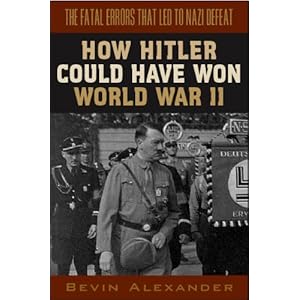
With literally thousands of titles to choose, the average reader may feel overwhelmed. But if you’re looking for an understandable, overall view of Hitler’s generalship, an excellent choice would be How Hitler Could Have Won World War II by Bevin Alexander.

How Hitler Could Have Won World War II

Among “the fatal errors that led to Nazi defeat” (as proclaimed on the book jacket) were:

  • Wasting hundreds of Luftwaffe pilots, fighters and bombers in a half-hearted attempt to conquer England.
  • Ignoring the pleas of generals like Erwin Rommel to conquer Syria, Iraq and Saudi Arabia–thus giving Germany control of most of the world’s oil.
  • Attacking his ally, the Soviet Union, while still at war with Great Britain.
  • Needlessly turning millions of Russians into enemies rather than allies by his brutal and murderous policies.
  • Declaring war on the United States after the Japanese attacked Pearl Harbor. (Had he not done so, Americans would have focused all their attention on conquering Japan.)
  • Refusing to negotiate a separate peace with Soviet dictator Joseph Stalin–thus granting Germany a large portion of captured Russian territory in exchange for letting Stalin remain in power.
  • Insisting on a “not one step back” military “strategy” that led to the unnecessary surrounding, capture and/or deaths of hundreds of thousands of German servicemen.

As the war turned increasingly against him, Hitler became ever more rigid in his thinking. He demanded absolute control over the smallest details of his forces. This, in turn, led to astounding and needless losses in German soldiers.

One such incident was immortalized in the 1962 movie, The Longest Day, about the Allied invasion of France known as D-Day.

On June 6, 1944, Rommel ordered the panzer tanks to drive the Allies from the Normandy beaches. But these could not be released except on direct order of the Fuehrer.

As Hitler’s chief of staff, General Alfred Jodl, informed Rommel: The Fuehrer was asleep–and, no, he, Jodl, would not wake him.

By the time Hitler awoke and issued the order, it was too late.

Nor could he accept responsibility for the policies that were clearly leading Germany to certain defeat. Hitler blamed his generals, accused them of cowardice, and relieved many of the best ones from command.

Among those sacked was Heinz Guderian, creator of the German panzer corps–and thus responsible for its highly effective “blitzkrieg” campaign against France in 1940.

Heinz Guderian

Another was Erich von Manstein, designer of the strategy that defeated France in six weeks–something Germany couldn’t do during the four years of World War 1.

Erich von Manstein

Finally, on April 29, 1945–with the Russians only blocks from his underground bunker in Berlin–Hitler dictated his “Last Political Testament.” Once again, he refused to accept responsibility for unleashing a war that would ultimately consume 50 million lives:

“It is untrue that I or anyone else in Germany wanted war in 1939. It was desired and instigated exclusively by those international statesmen who either were of Jewish origin or worked for Jewish interests.”

Hitler had launched the war with a lie–that Poland had attacked Germany, rather than vice versa. And he closed the war–and his life–with a final lie.

All of which, once again, brings us back to Niccolo Machiavelli, the father of political science.

In his classic book, The Discourses, he wrote at length on the best ways to maintain liberty within a republic. In Book Three, Chapter 31, Machiavelli declares: “Great Men and Powerful Republics Preserve an Equal Dignity and Courage in Prosperity and Adversity.”

It is a chapter that Adolf Hitler would have done well to read.

“…A truly great man is ever the same under all circumstances. And if his fortune varies, exalting him at one moment and oppressing him at another, he himself never varies, but always preserves a firm courage, which is so closely interwoven with his character that everyone can readily see that the fickleness of fortune has no power over him.

“The conduct of weak men is very different. Made vain and intoxicated by good fortune, they attribute their success to merits which they do not possess, and this makes them odious and insupportable to all around them.

“And when they have afterwards to meet a reverse of fortune, they quickly fall into the other extreme, and become abject and vile.

“Thence it comes that princes of this character think more of flying in adversity than of defending themselves, like men who, having made a bad use of prosperity, are wholly unprepared for any defense against reverses.”

Stay alert to signs of such character flaws among your own business colleagues–and especially your superiors. They are the warning signs of a future catastrophe.

WHY REGULAR JOBS PROGRAMS DON’T WORK

In Bureaucracy, Business, Politics, Self-Help, Social commentary on May 2, 2013 at 12:18 am

Imagine this: A future President seeks to disband the FBI—and offer bribes to career criminals to not rob, rape and murder. And to sell his proposal, he chooses as his slogan: “Let criminals be criminals.”

If that sounds impossible, consider this: Politicians on both the Right and Left have adopted just that mindset toward holding corporate employers accountable for their criminal greed and irresponsibility.

Case in point: The Obama administration has signaled that it may adopt a Georgia program that allows businesses to train jobless workers for two months without having to pay them.

Its supporters claim the program—Georgia Works—lets workers get their foot in the door and reduces businesses’ hiring risks. Unions assert that it exploits workers and violates federal labor laws.

The drawbacks to this program:

  • It’s only open to workers receiving unemployment insurance benefits.
  • Businesses have no obligation to hire participating workers.

Mississippi, in turn, has launched the Subsidized Transition Employment Program and Services. Funded with left-over stimulus dollars, it initially covers 100 percent of an employee’s wages, gradually reducing the subsidy for every 160 hours worked.

Its drawbacks:

  • It lasts only four months—from August to December, 2011.
  • Businesses will be excluded from the program if funds are exhausted or the September 30 enrollment deadline has passed.
  • Only 80 companies had signed up for the program by early September.

Then there’s the Minnesota solution. Instead of adopting Senator Al Franken’s proposal to use public monies to subsidize wages, Congress enacted the Hiring Incentives to Restore Employment Act. This gave businesses $13 billion worth of tax credits for hiring unemployed workers.

The drawbacks to this effort:

  • The measure has not been evaluated.
  • It does not require employers to hire.

In Connecticut, another jobs program, Platform to Employment, puts workers through a four-week training period followed by an eight-week tryout at a participating business.

During the tryouts, the employees’ wages are paid by The Workplace, Inc., a private company which raised enough funds to support 100 jobs starting this fall.

The drawbacks to this are:

  • Employers get, in effect, free labor.
  • Only those who have already exhausted 99 weeks of unemployment benefits are eligible.
  • Employers have no obligation to hire participating workers.
  • The funds will create only 100 jobs.
  • Employers are not required to participate in the program.

Meanwhile, the unemployment rate keeps steadily rising. In 2007, 228,000 people were unemployed for 99 weeks or longer, according to the Bureau of Labor Statistics.

Today more than 2 million Americans have been unemployed for at least 99 weeks—the cutoff point for unemployment insurance in the hardest-hit states.

And the longer a person is out of work, the less likely s/he is to find an employer willing to hire.

What all these “job creating” programs have in common is this: They apply plenty of carrots–but absolutely no sticks.

Bribes–in the form of tax credits or tax breaks–are liberally applied to entice employers to behave like patriots instead of parasites. But for employers whose refusal to hire condemns their country to economic catastrophe–there are no penalties whatsoever.

A policy based only on carrots is a policy of bribery. A policy based only on sticks is one of coercion. Some people can’t be bribed, and some can’t be coerced. But nearly everyone is open to a policy of rewards and punishments.

Thus, corporations across the country are now sitting atop $2 trillion in profits. But their CEOs are using those monies for:

  • Enriching themselves, their bought-off politicians, their families—and occasionally their mistresses.
  • Buying up other corporate rivals.
  • Creating or enlarging companies outside the United States.

In short, the one expense they refuse to underwrite is hiring their fellow Americans.

This is because:

  • They want to pay their un-American employees far lower wages than would be tolerated by employees within the United States.
  • They want to escape American employee-protection laws–such as those mandating worker’s compensation or forbidding sexual harassment.
  • They want to escape American consumer-protection laws–such as those banning the sale of lead-contaminated products (a hallmark of Chinese imports).
  • They want to escape American laws protecting the environment–such as those requiring safe storage of dangerous chemicals.

They want, in short, to enrich themselves at the direct expense of their country.

In decades past, this used to be called treason.

Yet no major political figure–on the Left or Right–has so far dared to blame employers for selling out their country and destroying its economic prosperity.

No job-seeker, however well-qualified and -motivated, can hire himself onto an employer who refuses to hire.

But corporate CEOs–and their paid political stooges–continue to blame the unemployed for being unable to find employers willing to honor their integrity, qualifications and initiative.

Related image

Americans generally–and the unemployed and under-employed in particular–must hold corporate America accountable for its criminal greed and irresponsibility.

Until they do, the United States will continue to sink further into decline–economically, socially and politically.

WHEN THE KGB COMES CALLING

In Bureaucracy, History, Humor, Law Enforcement, Social commentary on April 24, 2013 at 12:00 am

A day after bombs ravaged the Boston Marathon, Russian President Vladimir Putin offered his country’s assistance in investigating this latest Islamic outrage.

Putin said in a condolences note published on the Kremlin’s website that the international community should unite to fight terrorism.

Vladimir Putin

Putin said Russia “would be ready to provide assistance” to U.S. authorities with the probe into the bombings at the Boston marathon.

Fortunately, the FBI, Bureau of Alcohol, Tobacco and Firearms (ATF) and Boston police were able, within a week, to identify and kill/arrest the two brothers responsible for killing three people and injuring about 180 more.

But suppose President Obama had taken Putin up on his offer?

Officially, the KGB (“Committee for State Security”) no longer exists.  It was abolished by then-Soviet President Mikhail Gorbachev following the agency’s unsuccessful coup against him in August, 1991.

But its legacy lives on in the renamed FSB (Federal Security Service).

The KGB was formed in 1954, the year after the death of Joseph Stalin, Russia’s 20th century version of Ivan the Terrible.  (Previously, the state secret police had been known, first, as the Cheka–“Extraordinary Commission”– and then as the NKVD.)

Regardless of its name, the agency relentlessly pursued its twin goals: Brutally repressing political oppression at home and spying on its enemies abroad.

Through the reins of Nikita Khrushchev, Leonid Brezhniev, Yuri Andropov, Constitin Chernenko and Mikhail Gorbachev, the KGB acted as “the sword and shield of Russia.”  Among its tens of thousands of members was Vladimir Putin.

Even the worst abuses of J. Edgar Hoover’s FBI pale in comparison to those of the KGB, which ran its own prisons, routinely tortured and murdered men and women, and conducted espionage abroad.

The agency remained impervious to control except by its Kremlin masters–who were the ones directing its worst atrocities.

So it’s intriguing to imagine how the KGB would have reacted to the bombings at the Boston Marathon.

Perhaps the best way to do this is to see the KGB–oops, FSB–through the eyes of its former victims: The ussians themselves.

Unable to protest the abuses of the all-powerful police, Russians–in secret, and only among their most-trusted friends and family members–struck back with humor of the blackest sort

  • Q. Why do the KGB operate in groups of three? A. One who can read, one who can write and one to keep an eye on the two intellectuals.
  • A KGB officer tells the next-of-kin that her father committed suicide.  Woman: How did he die?  KGB: Skull fracture.  Woman:  How did it happen?  KGB: He wouldn’t drink the poison.
  • A Russian teacher asks her class, “Who wrote ‘The Communist Manifesto’?”  A boy says, “I don’t know, but it wasn’t me.”  The teacher thinks he’s being flippant, so she sends him home.  The boy tells his father, who complains to a friend who’s a KGB agent.  “Don’t worry,” says the KGB man, “I’ll find out who really wrote it.”  The KGB agent drives to the home of the teacher’s apartment.  The teacher asks, “Why have you woken me up?”  The KGB officer says: “It wasn’t the boy.  His father has confessed.” 
  • A man owns a parrot–until one day it disappears.  The owner rushes to the nearest KGB office.  “Why come to us?  It’s none of our affair,” says the KGB official.  “I just wanted you to know,” says the man, “that if it turns up, I don’t happen to share its opinions.”
  • A KGB agent spots an old man reading a book and asks what it’s about. “I’m learning Hebrew,” says the man, “because it’s the language of Heaven.  When I die, I want to talk to God.”  The KGB man says, “But suppose when you die you go to Hell?”  The old man says: “I already know Russian.”
  • The Egyptian government announces that an unidentified mummy has been found, and asks the world’s best archaeologists to help solve the mystery.  In response, the Soviet Union sends its top archaeologist–accompanied by two KGB guards to ensure he doesn’t defect.  The three men enter the tomb and, three days later, emerge.  “It’s Ramses III,” says the archaeologist.  “How did you figure it out?” asks a reporter.  And one of the KGB guards says, “The bastard finally confessed.”
  • A man knocks at the door of his neighbor’s apartment, yelling: “Quick, get up, get dressed!”  From inside he can hear screams of fear.  “Don’t worry,” he says, “it’s nothing serious.  I’m not from the KGB.  I just wanted to tell you your flat is on fire.”
  • A Russian boy asks his father, “Will there still be a KGB when we achieve Full Communism?”  And his father replies: “No, by then people will have learned how to arrest themselves.”
  • A delegation comes to the Kremlin to visit Leonid Brezhniev.  When they leave, Brezhniev can’t find his  cigarette case.  He telephones the head of the KGB and says, “Find out of one of the delegates took my case.”  Later, Brezhniev finds it under a table.  He calls the KGB director and says, “I found my case.  You can let the delegates go.”  “It’s too late for that,” says the KGB director, adding: “Half the delegates admitted they took your case, and the other half died under questioning.”

ENTITLEMENT, TEXAS STYLE

In Bureaucracy, Business, Law, Law Enforcement, Politics on April 23, 2013 at 12:01 am

Ted Cruz voted against federal aid for victims of Hurricane Sandy–three times.

But the United States Senator from Texas quickly announced he would seek “all available resources” to assist victims of the April 17 explosion at a fertilizer plant in West, McLennan County, Texas.

The blast killed 13 people, wounded about 200 others, and caused extensive damages to surrounding homes.

Last October, Hurricane Sandy killed about 150 people and caused an estimated $75 billion in damage across the Northeast.

The Republican legislator stood foursquare against the Sandy Aid Relief bill, claiming that it was loaded with “pork”:

“Hurricane Sandy inflicted devastating damage on the East Coast, and Congress appropriately responded with hurricane relief,” said Cruz.

“Unfortunately, cynical politicians in Washington could not resist loading up this relief bill with billions in new spending utterly unrelated to Sandy.

“Emergency relief for the families who are suffering from this natural disaster should not be used as a Christmas tree for billions in unrelated spending, including projects such as Smithsonian repairs, upgrades to National Oceanic and Atmospheric Administration airplanes, and more funding for Head Start.

“This bill is symptomatic of a larger problem in Washington–an addiction to spending money we do not have. The United States Senate should not be in the business of exploiting victims of natural disasters to fund pork projects that further expand our debt.”

Another Republican, Rep. Bill Flores, who represents West,  McLennan County, also voted against the Sandy relief package.  But this didn’t stop him from requesting federal aid for the disaster in his home district.

U.S. Senator Ted Cruz (R-Texas)

But, according to PolitiFact, “A big portion of the $17 billion in ‘immediate’ assistance, more than $5 billion, went to replenish FEMA’s disaster relief fund, which may fund relief from future disasters.”

Furthermore, Rick Ungar, writing at Forbes, pointed out that the “pork” came from having to bribe red state Republicans–including Texas–to get the package passed over their filibuster:

“However, as it turns out, the pork portions of the Senate bill were not earmarked to benefit Democratic members of the upper chamber of Congress….

“The answer can be found in a quick review of the states that are set to benefit from the Senate’s extra-special benevolence—states including Alabama, Mississippi, Texas and Louisiana.”

In fact, according to a September 29, 2011 article in iWatch News: Texas had the most FEMA-declared disasters since the start of 2009:

“Eleven Republican U.S. senators who represent the states with the most FEMA-declared disasters since the start of 2009 voted against a bill designed to keep the agency’s disaster relief fund from running out of cash.”

“The top two states, Texas and Oklahoma, combined for more than a quarter of the Federal Emergency Management Agency’s declared disasters since Jan. 1, 2009.”

Click here: As FEMA funds run out, senators from states with most disasters oppose funding bill  The Center for Public Integrity

Yet the hypocrisy doesn’t end there.

“The nation’s number one resource is its workers,” said Keith Wrightson, safety expert at Public Citizen, a nonprofit consumer advocacy group. “But the agency that’s charged with protecting them is not given the resources to do it. I think it’s worrisome for the nation.”

The West Fertilizer Company facility hadn’t been inspected by the Labor Department’s Occupational Safety and Health Administration (OSHA) since 1985, when the company was fined $30. Why did the facility go for almost 30 years without further inspections from OSHA?

As a small employer, the fertilizer facility may have been exempt from some forms of OSHA scrutiny.  Years ago, Congress attached a rider to agency funding that forbids OSHA to perform inspections of workplaces with 10 or fewer employees and whose industries have low injury rates.

Lawmakers reason that small businesses shouldn’t have to shoulder the same costs of compliance as larger ones.

But smaller worksites aren’t necessarily less dangerous.  According to safety advocates, small companies often  have fewer resources to invest in worker safety and, with less government oversight, even less incentive.

On April 20, the damning news broke in a Reuters story:

“The fertilizer plant that  exploded on Wednesday, obliterating part of a small Texas town  and killing at least 14 people, had last year been storing 1,350 times the amount of ammonium nitrate that would normally trigger  safety oversight by the U.S. Department of Homeland Security (DHS).”

Explosion at as fertilizer plant in West, McLennan County, Texas

Yet a source told Reuters that West Fertilizer, the company that owns the plant, did not tell DHS about the potentially explosive fertilizer as it is required to do.

The DHS is a major regulator of ammonium nitrate–which can also be used in bomb making.  Thus, it was left totally unaware of the potential danger posed by the plant..

Fertilizer plants and depots must report to the DHS when they hold 400 lb or more of the substance. Filings this  year with the Texas Department of State Health Services, which  weren’t shared with DHS, show the plant had 270 tons of it on hand last year.

In short, this situation offers the ultimate combination of disaster-producing circumstances:

  • A state with lax regulation of corporate businesses.
  • A plant crammed full of highly explosive materials.
  • Hypocritical U.S. Senators callously ignoring the hardships nature inflicts on other states while greedily demanding the lion’s share of emergency resources for their own constituents.
  • A state–Texas–whose governor has openly threatened secession greedily sucking at the tit of the otherwise despised Federal Government.