bureaucracybusters

Posts Tagged ‘TOM HANKS’

“BRIDGE OF SPIES” TELLS UGLY TRUTHS ABOUT GOVERNMENT: PART ONE (OF TWO)

In Bureaucracy, Entertainment, History, Law, Law Enforcement, Military, Politics, Social commentary on March 18, 2016 at 12:01 am

Steven Spielberg’s new movie, “Bridge of Spies,” is that rarity among films: An intelligent mixture of history and drama, stripped of gratuitous sex and violence.

It’s also a film that accurately reveals unsettling truths about how government intelligence agencies really operate.

Truth #1: Appearance counts for more than reality.

The movie opens with the FBI’s arrest of KGB spy Rudolph Abel (Mark Rylance). The evidence against him is overwhelming. This–plus the “Red Scare” climate of 1957–will guarantee his conviction.

But the Eisenhower administration doesn’t want the upcoming trial to be seen as a hangman’s court. It must have the appearance of a fair proceeding.

So the Justice Department (through the Brooklyn Bar Association) asks a New York insurance attorney named James B. Donovan (Tom Hanks) to take on Abel’s defense. He’s expected to make a reasonably competent effort but not go all out on behalf of his client.

Truth #2: Individual conscience can wreck the best-laid plans of government.

Donovan has never handled a spy case before. And he has no delusions that Abel isn’t the spy he’s charged with being. But he’s determined to give Abel the same committed defense he would give to any other client.

Rudolph Abel (Mark Rylance) and James Donovan (Tom Hanks) in court

This comes as a shock to the prosecutors, the judge, his law firm and even his family.

A CIA agent approaches Donovan in a nearly deserted restaurant and asks him to reveal any secrets that might help win Abel’s conviction.

Donovan replies: “This conversation isn’t happening.”

“No, of course not,” replies the CIA agent, assuming Donovan is agreeing to keep the overture secret.

“No, I mean this conversation isn’t happening,” angrily says Donovan, who leaves the agent fuming.

Donovan becomes a pariah; his mailbox is stuffed with hate mail and one night a would-be drive-by killer riddles his house with bullets.

Abel is convicted and sentenced to 45 years’ imprisonment. But Donovan–again shocking everyone he knows–pursues an appeal up to the Supreme Court.

He argues that the evidence against Abel is tainted by an invalid search warrant. No American citizen could be convicted under such circumstances. And the Constitutional protections that hold true for Americans should hold equally true for non-Americans charged with crimes in American courts.

Donovan’s arguments will be heard a half-century later, when al-Qaeda suspects are hauled before American courts.

He puts on an impressive case on Abel’s behalf, but loses 5-4 at the Supreme Court.

That seems to be the end of Donovan’s relationship with Abel. But events soon dictate otherwise.

Before the judge could pronounce a death sentence on Abel, Donovan had argued that this might be a mistake. The day might come, he told the judge, when an American spy might fall into Soviet hands.

And then the United States would need to swap Abel to secure the release of its own agent.

The judge, moved by that argument, had given Abel a lengthy prison term instead.  

That day comes sooner than anyone in the Pentagon expects.

On May 1, 1960, Francis Gary Powers, a former Air Force pilot, is flying a high-altitude U-2 plane above the Soviet Union for the CIA. The plane is equipped with state-of-the-art cameras, and Powers intends to photograph military sites and other important complexes.

Suddenly, a surface-to-air missile slams into the plane. Powers ejects before it crashes, but fails to commit suicide with a poison pin concealed in a phony silver dollar. He’s captured by the KGB and brutally interrogated, but maintains his silence.

At about the same time, Frederic Pryor, an American economics graduate student living in West Germany, visits his German girlfriend living in Soviet-dominated East Germany.

The Soviets are starting to build their infamous Berlin Wall, which will stop the flow of refugees from East to West. Pryor tries to bring his girlfriend and her father into West Berlin, but he’s stopped and arrested by agents of Stasi, the East German police, who accuse him of being a spy.

Meanwhile, the Soviet Union wants its spy, Abel, returned, before he can spell its secrets. In turn, the new Kennedy administration wants Powers returned, before he can be made to spill American secrets.

Truth #3: High-ranking government officials will ask citizens to take risks they themselves refuse to take.

In 1961, Donovan is once again sought out by the American government–this time by no less than CIA Director Allen Dulles.

And he’s asked to go where no official American representative can go–East Germany. His new assignment: Negotiate the exchange of Powers for Abel.

The CIA wants its spy back. And it’s willing to send Donovan into East Germany to negotiate his release. But it’s not willing to back him up if he’s arrested by Stasi, the notorious East German secret police.  

The fiction must be maintained that Donovan is acting strictly on his own behalf, not that of the United States.

In such a case, Donovan could spend the rest of his life in a Communist prison cell.


“BRIDGE OF SPIES” TELLS UNPLEASANT TRUTHS ABOUT GOVERNMENT: PART TWO (END)

In Bureaucracy, History, Law, Military, Politics, Social commentary on October 27, 2015 at 12:01 am

“Bridge of Spies” vividly recaptures a now-forgotten time in American history.

It was the time of “the Cold War.”  A time when:

  • America was almost universally seen as “The Good Guy,” in contrast to “The Bad Guy” of the Soviet Union;
  • The United States and the Soviet Union held each other at bay with arsenals of nuclear weapons;
  • Wisconsin Senator Joseph R. McCarthy terrorized the nation, accusing anyone who disagreed with him of being a Communist–and leaving ruined lives in his wake;
  • American TVs blared commercials warning that Soviet Premier Nikita Khrushchev had boasted: “We will bury you”; and
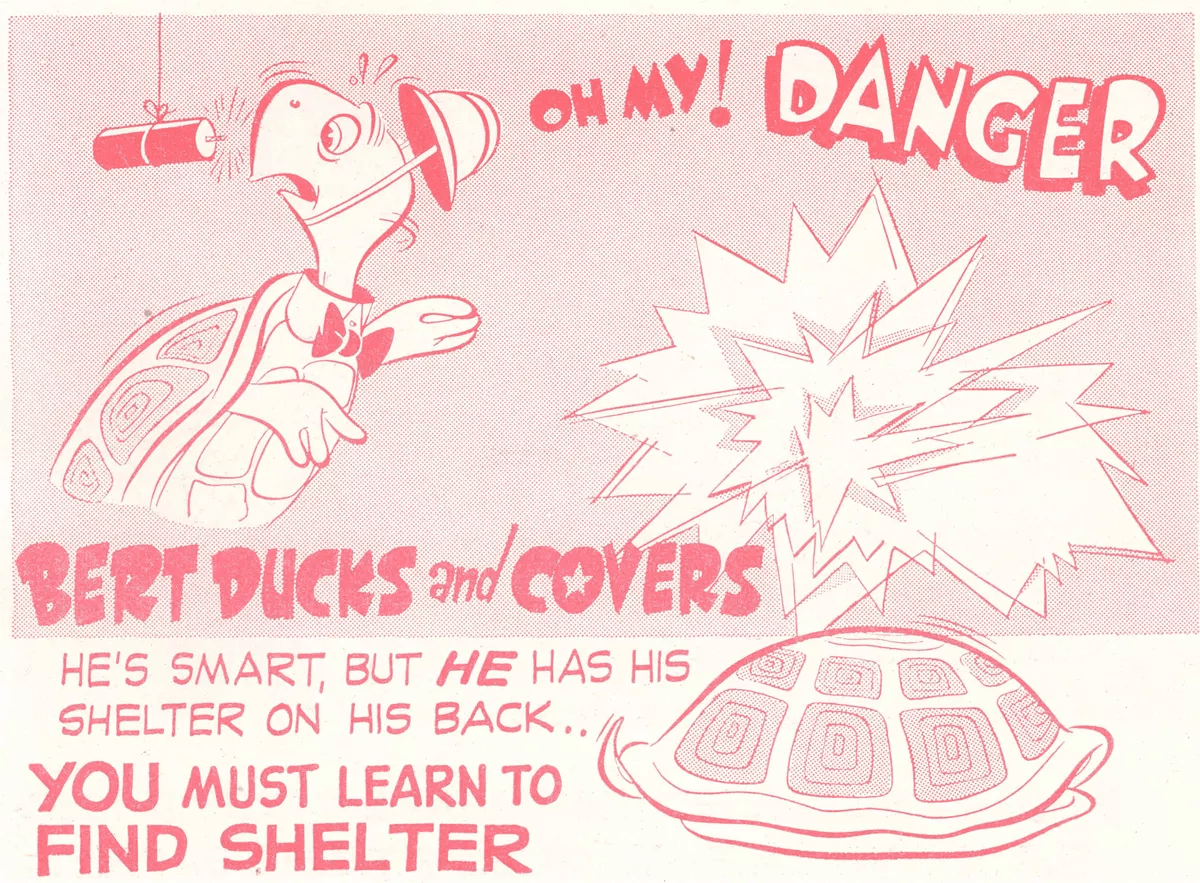
  • Children and teenagers were taught in school that they could survive a nuclear attack through “duck and cover” drills. They were instructed to keep their bathtubs filled with water for safe drinking, in the event of a Soviet nuclear strike.
Bert2.png (300×232)

Bert the Turtle teaches schoolchildren to “Duck and Cover”

Yet even in this poisonous atmosphere of fear and denunciation, some men stood out as heroes–simply by holding fast to their consciences.

One of these was a New York insurance attorney named James B. Donovan (played by Tom Hanks). Asked by the Justice Department to defend arrested Soviet spy Rudolph Abel (Mark Rylance) Donovan did what no one expected.

He gave Abel a truly vigorous defense, arguing that the evidence used to convict him was the legally-tainted product of an invalid search warrant.

Upon Abel’s conviction and sentencing to 45 years’ imprisonment, Donovan again shocked the political and legal communities by appealing the case to the Supreme Court.

Donovan argued that Constitutional protections should apply to everyone–including non-Americans–tried in American courts.  To do less made a mockery of the very freedoms we claimed to champion.

He lost by a vote of 5-4.  But the arguments he made would resurface 50 years later when al-Qaeda suspects were hauled into American courts.

James B. Donovan

In 1961, Donovan was again called upon to render service by a Federal agency–this time the CIA.  It wanted his help in negotiating the release of its spy, Francis Gary Powers, shot down over the Soviet Union in 1960 while flying a high-altitude U-2 spy plane.

Throughout “Bridge of Spies,” audiences learn some unsettling truths about how the American government–and governments generally–actually operate.

The first three of these were outlined in Part one of this series:

Truth #1: Appearance counts for more than reality.

Truth #2: Individual conscience can wreck the best-laid plans of government.

Truth #3: High-ranking government officials will ask citizens to take risks they themselves refuse to take.

Now for the remaining truths revealed in this movie.

Truth #4: Appeals to fear often prevail when appeals to humanity are ignored.

After crossing into East Germany, Donovan enters into negotiations with Wolfgang Vogel, a lawyer representing the East German government.

Vogel offers to exchange Frederic Pryor, an American economics graduate student seized by the East German secret police, for Abel. Donovan replies this is a deal-breaker; the United States (which is never mentioned during the negotiations) wants Powers, not Pryor.

Nevertheless, Donovan is equally concerned for Pryor, and adds him to the list of hostages to be released in return for Abel.

Then a new complication arises: The East German government that holds Pryor threatens to pull out. claiming to be insulted because Donovan did not inform them that the USSR was a party to the negotiation.

His reasoned, legal arguments having failed, Donovan resorts to a threat. He conveys a warning to the president of East Germany:

Abel has not yet revealed any Soviet secrets. But if this deal fails, he may well do so to earn favors from the United States government. And, in that case, the Soviets will blame you–Erich Honecker, the  president of East Germany–for the resulting damage.

Where arguments based on humanity have failed, this one–based on fear–works.  A prisoner-exchange is arranged.

Truth #5: Personal loyalty can supersede bureaucratic inventions.

On February 10, 1962, Donovan, Abel and several CIA agents arrive at the Glienicke Bridge, which connects East and West Germany. The Soviets have Powers, but not Pryor–who is to be released at Checkpoint Charlie, a crossing point between East and West Berlin.

    Glienicke Bridge, the “Bridge of Spies” 

The CIA agent in charge of the American delegation tells Abel he can cross into East Germany, even though Pryor has not been released.

But Abel has learned that Donovan has negotiated the release of not only Powers but Pryor. Out of loyalty to the man who has vigorously defended him, he waits on his side of the bridge until word arrives that Pryor has been released.

Then Abel crosses into East Germany while Powers crosses into the Western sector.

Donovan returns home. Before flying off to West Germany, he had told his wife he was going on a fishing trip in Scotland.

His wife and children learn the truth about the risks he ran and the success he attained only when a television newscast breaks the news:

Francis Gary Powers has been returned to the United States. And the man responsible is James Donovan, once the most reviled man in America for having defended a notorious Soviet spy.

“BRIDGE OF SPIES” TELLS UNPLEASANT TRUTHS ABOUT GOVERNMENT: PART ONE (OF TWO)

In Bureaucracy, History, Law, Military, Politics, Social commentary on October 26, 2015 at 12:27 am

Steven Spielberg’s new movie, “Bridge of Spies,” is that rarity among films: An intelligent mixture of history and drama, stripped of gratuitous sex and violence.

It’s also a film that accurately reveals unsettling truths about how government agencies really operate.

Truth #1: Appearance counts for more than reality.

The movie opens with the FBI’s arrest of KGB spy Rudolph Abel (Mark Rylance). The evidence against him is overwhelming. This–plus the “Red Scare” climate of 1957–will guarantee his conviction.

But the Eisenhower administration doesn’t want the upcoming trial to be seen as a hangman’s court.  It must have at least the appearance of a fair proceeding.

So the Justice Department (through the Brooklyn Bar Association) asks a New York insurance attorney named James B. Donovan (Tom Hanks) to take on Abel’s defense. He’s expected to make a reasonably competent effort but not go all out on behalf of his client.

Truth #2: Individual conscience can wreck the best-laid plans of government.

Donovan has never handled a spy case before. And he has no delusions that Abel isn’t the spy he’s charged with being. But he’s determined to give Abel the same committed defense he would give to any other client.

Rudolph Abel (Mark Rylance) and James Donovan (Tom Hanks) in court

This comes as a shock to the prosecutors, the judge, his law firm and even his family.

A CIA agent approaches Donovan in a nearly deserted restaurant and asks him to reveal any secrets that might help win Abel’s conviction.

Donovan replies: “This conversation isn’t happening.”

“No, of course not,” replies the CIA agent, assuming Donovan is agreeing to keep the overture secret.

“No, I mean this conversation isn’t happening,” angrily says Donovan, who leaves the agent fuming.

Donovan becomes a pariah; his mailbox is stuffed with hate mail and one night a would-be drive-by killer riddles his house with bullets.

Abel is convicted and sentenced to 45 years’ imprisonment. But Donovan–again shocking everyone he knows–pursues an appeal up to the Supreme Court.

He argues that the evidence against Abel is tainted by an invalid search warrant. No American citizen could be convicted under such circumstances; and the Constitutional protections that hold true for Americans should hold equally true for non-Americans charged with crimes in American courts.

Donovan’s arguments will be heard a half-century later, when al-Qaeda suspects are hauled before American courts.

He puts on an impressive case on Abel’s behalf, but loses 5-4 at the Supreme Court.

That seems to be the end of Donovan’s relationship with Abel.  But events soon dictate otherwise.

Before the judge could pronounce a death sentence on Abel, Donovan had argued that this might be a mistake. The day might come, he told the judge, when an American spy might fall into Soviet hands.

And then the United States would need to swap Abel to secure the release of its own agent.

The judge, moved by that argument, had given Abel a lengthy prison term instead.

On May 1, 1960, Francis Gary Powers, a former Air Force pilot, is flying a high-altitude U-2 plane above the Soviet Union for the CIA. The plane is equipped with state-of-the-art cameras, and Powers intends to photograph military sites and other important complexes.

Suddenly, a surface-to-air missile slams into the plane. Powers ejects before it crashes, but fails to commit suicide with a poison pin concealed in a phony silver dollar.  He’s captured by the KGB and brutally interrogated, but maintains his silence.

At about the same time, Frederic Pryor, an American economics graduate student living in West Germany, visits his German girlfriend living in Soviet-dominated East Germany.

The Soviets are starting to build their infamous Berlin Wall, which will stop the flow of refugees from East to West.  Pryor tries to bring his girlfriend and her father into West Berlin, but he’s stopped and arrested by agents of Stasi, the East German police, who accuse him of being a spy.

Meanwhile, the Soviet Union wants its spy, Abel, returned, before he can spell its secrets. In turn, the new Kennedy administration wants Powers returned, before he can be made to spill American secrets.

Truth #3: High-ranking government officials will ask citizens to take risks they themselves refuse to take.

In 1961, Donovan is once again sought out by the American government–this time by no less than CIA Director Allen Dulles.

And he’s asked to go where no official American representative can go–East Germany. His new assignment: Negotiate the exchange of Powers for Abel.

The CIA wants its spy back. And it’s willing to send Donovan into East Germany to negotiate his release. But it’s not willing to back him up if he’s arrested by Stasi, the notorious East German secret police.

In such a case, Donovan could spend the rest of his life in a Communist prison cell.

WHAT THE MAJOR HAS TO TELL US

In Entertainment, History, Military, Politics, Social commentary on April 11, 2014 at 12:10 am

Major Dundee is a 1965 Sam Peckinpah Western focusing on a Union cavalry officer (Charlton Heston) who leads a motley troop of soldiers into Mexico to rescue three children kidnapped by Apaches.

Along the way they liberate Mexican villagers and clash with French lancers trying to establish the Austrian Archduke Maximillian 1 as emperor of Mexico.

The Wild Bunch is universally recognized as Peckinpah’s greatest achievement.  It has certainly had a far greater impact on audiences and critics than Major Dundee.  According to Heston, this was really the movie Peckinpah wanted to make while making Dundee, but he couldn’t quite get his hands around it.

As a result, Dundee’s virtues have been tragically overlooked.  It has a larger cast of major characters than Bunch, and these are men you can truly like and identify with:

  • The charm of Benjamin Tyreen (Richard Harrs), a Confederate lieutenant forced into Union service;
  • The steady courage of Sergeant Gomez;
  • The quiet dignity of Aesop (Brock Peters), a black soldier;
  • The quest for maturity in a young, untried bugler Tim Ryan (Michael Anderson, Jr.);
  • The on-the-job training experience of Lt. Graham (Jim Hutton); and
  • The stoic endurance of Indian scout Sam Potts (James Coburn).

These men are charged with a dangerous and dirty mission, and do it as well as they can, but you wouldn’t fear inviting them to meet your family.

Major Dundee | Rotten Tomatoes

Major Dundee (Charlton Heston)

That was definitely not the case with The Wild Bunch, four hardened killers prepared to rip off anyone, anytime, and leave a trail of bodies in their wake.  The only place where you would have felt safe seeing them, in real-life, was behind prison bars.

The Wild Bunch

Dundee is an odyssey movie, in the same vein as Saving Private Ryan.  Both films start with a battle, followed by the disappearance of characters who need to be searched for and brought back to safety.

Just as Dundee assembles a small force to go into Mexico, so, too, does Captain John Miller (Tom Hanks) do the same, with his hunting ground being France.

Dundee’s men retrieve the kidnapped children and survive a near-fatal battle with Indians.  Miller’s men twice clash with the Germans before finding their quarry, James Ryan.

Before Dundee can return to the United States, he must face and defeat a corps of French soldiers.  Before Miller can haul Ryan back to safety, he must repulse a German assault.

Both groups of soldiers–Dundee’s and Miller’s–are transformed by their experiences in ways neither group could possibly articulate.  (Miller, being a highly literate schoolteacher, would surely do a better job of this than the tight-jawed Dundee.)

Dundee’s soldiers return to a United States that’s just ended its Civil War with a Union victory–and the death of slavery.  Miller’s soldiers return to a nation that is now a global superpower.

Of course, Ryan was fortunate in having Steven Spielberg as its director.  With his clout, there was no question that Ryan would emerge as the film he wanted.

Peckinpah lacked such clout.  And he fought with everyone, including the producer, Jerry Bressler, who ultimately held the power to destroy his film.  This guaranteed that his movie would emerge far differently than he had envisioned.

In 2005, an extended version of Dundee was released, featuring 12 minutes of restored footage.  (Much of the original footage was lost after severe cuts to the movie.)

In this, we fully see how unsympathetic a character the martinet Dundee really is.  Owing to Heston’s record of playing heroes, it’s easy to overlook Dundee’s arrogance and lethal fanaticism and automatically view him as a hero.  If he is indeed that, he is a hero with serious flaws.

And his self-imposed mission poses questions for us today:

  • Where is the line between professional duty and personal fanaticism?
  • How do we balance the success of a mission against its potential costs–especially if they prove appalling?
  • At what point–if any–does personal conscience override professional obligations?

Whether intentionally or not, in Major Dundee, Peckinpah laid out a microcosm of the American history that would immediately follow the Civil War.

Former Confederates and Unionists would forego their regional animosities and fight against a recognized mutual enemy—the Indians.  This would prove a dirty and drawn-out war, shorn of the glory and (later) treasured memories of the Civil War.

Just as Dundee’s final battle with French lancers ended with an American victory won at great cost, so, too, would America’s forays into the Spanish-American War and World Wars 1 and 11 prove the same.

Ben Tyreen’s commentary on the barbarism of French troops (“Never underestimate the value of a European education”) would be echoed by twentieth-century Americans uncovering the horrors of Dachau and Buchenwald.

America would learn to project its formidable military power at great cost.  Toward the end of the movie, Teresa Santiago (Senta Berger), the ex-patriot Austrian widow, would ask Dundee: “But who do you answer to?

It is a question that still vividly expresses the view of the international community as this superpower colossus hurtles from one conflict to the next.

THE PIRATES OF LIMBAUGH

In Entertainment, History, Military, Politics, Social commentary on December 20, 2013 at 3:34 pm

On April 8, 2009, four Somali pirates boarded the Maersk Alabama when it was located 240 miles southeast of the Somalian port city of  Eyl.

The ship, en route to Mombasa, Kenya, was carrying 17,000 tons of cargo, including 5,000 tons of relief supplies for Kenya, Somalia, and Uganda.

As the pirates boarded the ship, the crew members locked themselves in the engine room.  To buy time for his crewmen, the captain, Richard Phillips, surrendered to the pirates.

Captain Richard Phillips

The crew later overpowered one of the pirates, and sought to exchange their captive for Phillips.  The crew released the  pirate, but the other three pirates refused to release Phillips.

The pirates left with Philips in a lifeboat which carried ten days of food rations, water and basic survival supplies.

On April 8, the destroyer USSS Bainbridge and the frigate USSS Halyburton were dispatched to the Gulf of Aden to deal with the hostage situation, and reached Maersk Alabama early on April 9.

On April 9, a standoff began between the Bainbridge and the pirates in the Maersk Alabama’s lifeboat, where they continued to hold Phillips hostage

On April 12, marksmen from SEAL Team 6 simultaneously opened fire with telescopic-sighted assault rifles and killed the three pirates on the lifeboat.

The SEALS believed Phillips faced an immediate threat of execution, having received a report that one of the pirates was pointing an AK-47 at his back.

The SEALS, known for their legendary marksmanship, took out all three pirates with shots to the head.

Phillips was rescued in good condition.

The vast majority of Americans rejoiced.  The Maersk Alabama had been the first American cargo ship to be hijacked in 200 years.  And the encounter had ended with the ship and crew safe and its captain rescued without injury.

But not everyone was happy about the outcome.  Naturally, the pirates infesting the Somali coastline were infuriated at this setback.

But, surprisingly, there were some Americans who felt more sympathetically toward the Somali pirates than the man who had ordered Phillips’ rescue: President Barack Obama.

One of these was Rush Limbaugh, the American Right’s chief spokesman.

Rush Limbaugh

The Rush Limbaugh Show airs throughout the U.S. on over 400 stations and is the highest-rated talk-radio program in the United States. When Limbaugh speaks, his “dittohead” audience listens—and acts as he decrees.

On April 14, 2009, Limbaugh gave his take on the rescue of Captain Richard Phillips:

“The Somali pirates, the merchant marine organizers who took a US merchant captain hostage for five days were inexperienced youths, the defense secretary, Roberts Gates, said yesterday, adding that the hijackers were between 17 and 19 years old.

“Now, just imagine the hue and cry had a Republican president ordered the shooting of black teenagers on the high seas….

“They were kids. The story is out, I don’t know if it’s true or not, but apparently the hijackers, these kids, the merchant marine organizers, Muslim kids, were upset.

“They wanted to just give the captain back and head home because they were running out of food.  They were running out of fuel, they were surrounded by all these US Navy ships, big ships, and they just wanted out of there. That’s the story.

“But then when one of them put a gun to the back of the captain, Mr. Phillips, then bam, bam, bam. There you have it, and three teenagers shot on the high seas at the order of President Obama.”

And there you have it–an American Fascist making common cause with the heirs of Blackbeard and Henry Morgan.

Click here: President Obama Ordered the Killing of Three Black Muslim Kids – The Rush Limbaugh Show

In Julius Caesar, William Shakespeare lets Marcus Brutus give his reason for murdering Caesar, his onetime friend: “Not that I loved Caesar less, but that I loved Rome more.”

Limbaugh and his Rightist stooges could have said they opposed the rescue mission for a similar reasono: “Not that we loved the Somali pirates, but that we hate Obama more.”

Consider the comment Congresswoman Michelle Bachmann (R-Minn.) made on an Iowa radio program on October 3, 2011.

One caller, “Donna,” told Bachmann that the president was a “walking nightmare” who was “blowing up our country.”

“I would vote for Charles Manson before this guy,” she said. “But I’m pulling for you big time, all the way, go Michele!”

“Thank you for saying that,” Bachmann replied.

Thus, Bachmann–who supposedly represented the democratic system–chose as her hero a convicted psychopathic murderer over a legally-elected President.

The rescue of Richard Phillips has been dramatized in the 2013 movie, “Captain Phillips,” starring Tom Hanks in the title role.

Audiences cheered at the climatic moment when the three pirates met their deserved fate.

But what they didn’t see depicted was Limbaugh’s Greek chorus for the Right–and the sheer hatred he and they have for anyone who doesn’t share their Fascistic views.

The ordeal of Captain Phillips and the crew of the Maersk Alabama is over.  But the heirs of Blackbeard  still roam the seas near Somalia.

And the heirs of Francisco Franco, Adolf Hitler and Benito Mussolini still conspire to remake America in their own Rightist image.