bureaucracybusters

Posts Tagged ‘THE DISCOURSES’

THE DANGERS OF TIMIDITY

In Bureaucracy, History, Law, Law Enforcement, Politics, Social commentary on April 23, 2014 at 1:00 am

President Barack Obama–or at least Neil Kornze, the director of the Federal Bureau of Land Management (BLM)–has some serious lessons to learn about the uses of power.

For more than 20 years, Cliven Bundy, a Nevada cattle rancher, has refused to pay fees for grazing cattle on public lands, some 80 miles north of Las Vegas.

BLM says Bundy now owes close to $1 million. He says his family has used the land since the 1870s and doesn’t recognize the federal government’s jurisdiction.

In 2013, a federal judge ordered Bundy to remove his livestock. He ignored the order, and in early April, 2014, BLM agents rounded up more than 400 of his cattle.

Over the weekend of April 12-13, armed militia members and states’ right protesters showed up to challenge the move.

US Bureau of Land Management (BLM) | Tethys

Bureau of Land Management logo 

Rather than risk violence, the BLM did an about-face and released the cattle.

Right-wing bloggers and commentators have portrayed the incident as a victory over Federal tyranny.

According to Alex Jones’ Infowars.com: “Historic!  Feds Forced to Surrender to American Citizens.”

Right-wingers have depicted Bundy as a put-upon Everyman being “squeeaed” by the dictatorial Federal government.

They have deliberately ignored a number of inconvenient truths–such as:

  • He claims that his grazing rights were established in 1880 when his ancestors settled the land where his ranch sits.
  • But the Nevada constitution–adopted in 1864 as a condition of statehood–contradicts Bundy’s right to operate as a law unto himself.
  • The constitution says: “The people inhabiting said territory do agree and declare, that they forever disclaim all right and title to the unappropriated public lands lying within said territory, and that the same shall be and remain at the sole and entire disposition of the United States.”
  • In 1934,  the Taylor Grazing Act gave existing ranchers permits allowing them to run their herds on federal land.
  • In turn, ranchers paid user fees, which were lower than what most private landowners would have charged.
  • In 1993, the Federal government launched an effort to protect the endangered desert tortoise.
  • Certain grasslands were placed off-limits for grazing, and the government bought out the permits of some ranchers.
  • Among others, Bundy refused to sell and kept grazing his cattle on restricted federal land without a permit.
  • Amidst mounting fees and fines, Bundy repeatedly slugged it out in court against government lawyers.  He lost.
  • In 1998, a federal judge permanently barred him from letting his cattle graze on protected federal land.
  • In early April, 2014, BLM agents–charged with overseeing grazing rights–began rounding up Bundy’s cattle to remove them from federal property.

Bundy’s family and other ranchers–backed up by a motley assortment of self-declared militiamen armed with rifles and pistols–confronted the agents.

Fearing another Waco–regarded by Right-wing Americans as a second Alamo–the BLM agents backed down and released Bundy’s cattle.  And then retreated.

While Right-wingers hail this as a victory for “states’ rights,” the truth is considerably different.

Bundy’s refusal to recognize the federal government’s jurisdiction amounts to: “I will recognize–and obey–only those laws that I happen to agree with.”

And the BLM’s performance offers a texbook lesson on how not to promote respect for the law–or for those who enforce it.

As Niccolo Machiavelli, the father of modern political science warned more than 500 years ago in The Prince:

[A ruler] is rendered despicable by being thought changeable, frivolous, effeminate, timid and irresolute—which [he] must guard against as a rock of danger…. 

[He] must contrive that his actions show grandeur, spirit, gravity and fortitude. 

As to the government of his subjects, let his sentence be irrevocable, and let him adhere to his decisions so that no one may think of deceiving or cozening him.

Niccolo Machiavelli

In his master-work, The Discouorses, he outlines the consequences of allowing lawbreakers to go unpunished:

...Having established rewards for good actions and penalties for evil ones, and having rewarded a citizen for conduct who afterwards commits a wrong, he should be chastised for that without regard to his previous merits….

For if a citizen who has rendered some eminent service to the state should add to the reputation and influence which he has thereby acquired the confident audacity of being able to commit any wrong without fear of punishment, he will in a little while become so insolent and overbearing as to put an end to all power of the law.

The conduct of the agents of BLM has violated that sage counsel on all counts.

BLM agents should have expected trouble from Right-wing militia groups–and come fully prepared to deal with it.

The FBI and the U.S. Marshals Service, for example, have created SWAT teams to deal with those who threaten  violence against the Federal Government.

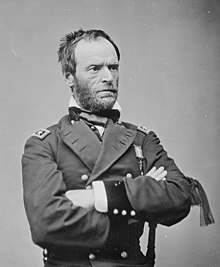
Civil War General William Tecumseh Sherman had a formula for dealing with domestic terrorists of his own time.

Writing to his commander, Ulysses S. Grant, about the best way to treat Confederate guerrillas, he advised:

Black-and-white photograph of Sherman in uniform with his arms folded in front of him

General Willilam Tecumseh Sherman

“They cannot be made to love us, but they may be made to fear us.  We cannot change the hearts of those people of the South.

“But we can make war so terrible that they will realize the fact that . . . they are still mortal and should exhaust all peaceful remedies before they fly to war.”

OBAMA LOSES, MACHIAVELLI RULES

In Bureaucracy, History, Military, Politics on September 19, 2013 at 12:00 am

I was thoroughly glad to see the era of George W. Bush come to an end.  He had, I believed, become a terrible liability for America–in both foreign and domestic policy.

In foreign affairs, America had become entrapped in a totally needless war in Iraq.  And by authorizing the use of torture, he had turned the United States into a pariah nation in the eyes of much of the civilized world.

Domestically, he had allowed the sheer greed and arrogance of America’s most powerful corporations to push the nation to the brink of bankruptcy.

So during the early weeks of President Barack Obama’s first term, I sent him a gift: My favorite selections from the two major works of Niccolo Machiavelli: The Prince and The Discourses.

Niccolo Machiavelli

I hoped that, on at least some occasions, the new President would find useful advice in the wisdom of the father of political science.

Unfortunately, such has not been the case.

For example:

United Nations officials estimate that more than 6,000 people have died in Syria since fighting erupted in 2011 against the regime of dictator Bashir al-Assad.

During that time, the world made no move to intervene–for a series of excellent reasons.  Among these:

  • Since 1979, Syria has been listed by the U.S. State Department as a sponsor of terrorism.
  • There are no “good Syrians” for the United States to support.  There is a civil war between rival terrorist groups.
  • Among these: Hezbollah and Hamas (pro-Assad); and Al Qaeda (anti-Assad).

This was the position of the United States as well.

Meanwhile, President Obama said on several occasions that if Assad used chemical weapons against his enemies, that would be “a red line in the sand.”

Then, on August 21, the Assad regime was accused of using chemical weapons in Damascus suburbs to kill more than 1,400 civilians.

On August 30, the Obama administration said it had “high confidence” that Syria’s government carried out the chemical weapons attack.

Having boxed himself in, Obama felt he had to make good on his threat–even if it risked the lives of those flying combat missions over Syria’s formidable air defenses.

He sent Secretary of State John Kerry before TV cameras to express America’s moral outrage at Syria’s use of chemical weapons.

And he positioned six American warships close to the Syrian coast.

On August 31, Obama announced that he would seek Congressional authorization before attacking Syria.  Obama said he was “prepared to give that order” to strike Syria because:

  • Syria’s use of chemical weapons “risks making a mockery of the global prohibition on the use of chemicals weapons,” and
  • It put U.S. regional allies that share a border with Syria in danger.

It looked as though the United States was about to plunge into its third Middle East war in 12 years.

Then Russian President Vladimir Putin offered his own suggestion for averting war: Syria would agree to put its stocks of chemical weapons under United Nations control.

On September 14, the United States and Russia announced in Geneva that they reached a deal that provided a path for Obama to avoid the air strikes he had promised to launch against Syria.

Suddenly, Obama asked congressional leaders to delay votes on authorizing military action in Syria while the diplomatic process worked itself out.

As “Tonight” show host Jay Leno put it: Obama gave a speech calling for war–and then the rebuttal.

So what does Niccolo Machiavelli have to do with any of this?

In Chapter 19 of The Prince, his guide to successful rulership, he outlines “That We Must Avoid Being Despised and Hated.”

“The prince must…avoid those things which will make him hated or despised.  And whenever he succeeds in this, he will have done his part, and will find no danger in other vices….

“He is rendered despicable by being thought changeable, frivolous, effeminate, timid and irresolute—which a prince must guard against as a rock of danger….

“[He] must contrive that his actions show grandeur, spirit, gravity and fortitude.  As to the government of his subjects, let his sentence be irrevocable, and let him adhere to his decisions so that no one may think of deceiving or cozening him.”

By making a vigorous case for going to war with Syria, and then suddenly reversing himself, Obama has managed to offend everyone:

  • Right-wingers–who hoped to see America plunge into another Middle East war.
  • Liberals–who didn’t want to repeat the 2003 Iraqi war disaster.
  • Syrian rebels–who expected a full-scale American intervention to bring them to power.
  • The Assad regime–which no doubt believes Obama was bluffing.

Unfortunately, history is not a VHS tape that can be rewound.  No one–including Obama–gets a second chance to make a first impression.

By repeatedly showing timidity toward Republicans, Obama had forfeited credibility as a leader to be feared by his domestic Right-wing enemies.

President Theodore Roosevelt famously said: “I have always lived by a South African proverb: Speak softly and carry a big stick, and you will go far.”

By speaking loudly and then putting his big stick aside, Obama forfeited credibility among his foreign enemies.

IS THERE A HITLER IN YOUR CEO?

In Bureaucracy, History, Military, Social commentary on September 2, 2013 at 12:01 am

Each Labor Day, American politicians offer lip-service tribute to those millions of American workers who make corportate profits a reality.

But no one ever says anything about those over-pampered, over-paid CEOs who all too often take credit for the work done by those millions of American workers.

Too many CEOs have–consciously or not–patterened themselves after the ultimate CEO: Adolf Hitler.

Ever since he shot himself in his underground Berlin bunker on April 30, 1945, historians have fiercely debated:  Was der Fuehrer a military genius or an imbecile?

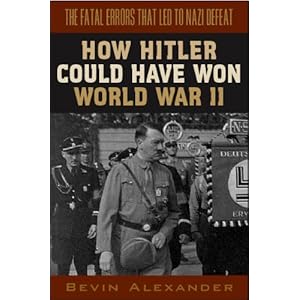
With literally thousands of titles to choose, the average reader may feel overwhelmed.  But if you’re looking for an understandable, overall view of Hitler’s generalship, an excellent choice would be How Hitler Could Have Won World War II by Bevin Alexander.

How Hitler Could Have Won World War II

Among “the fatal errors that led to Nazi defeat” (as proclaimed on the book jacket) were:

  • Wasting hundreds of Luftwaffe pilots, fighters and bombers in a half-hearted attempt to conquer England.
  • Ignoring the pleas of generals like Erwin Rommel to conquer Syria, Iraq and Saudi Arabia–thus giving Germany control of most of the world’s oil.
  • Attacking his ally, the Soviet Union, while still at war with Great Britain.
  • Needlessly turning millions of Russians into enemies rather than allies by his brutal and murderous policies.
  • Declaring war on the United States after the Japanese attacked Pearl Harbor.  (Had he not done so, Americans would have focused all their attention on conquering Japan.)
  • Refusing to negotiate a separate peace with Soviet dictator Joseph Stalin–thus granting Germany a large portion of captured Russian territory in exchange for letting Stalin remain in power.
  • Insisting on a ”not one step back” military “strategy” that led to the unnecessary surrounding, capture and/or deaths of hundreds of thousands of German servicemen.

As the war turned increasingly against him, Hitler became ever more rigid in his thinking.  He demanded absolute control over the smallest details of his forces.  This, in turn, led to astounding and needless losses in German soldiers.

One such incident was immortalized in the 1962 movie, The Longest Day, about the Allied invasion of France known as D-Day.

On June 6, 1944, Rommel ordered the panzer tanks to drive the Allies from the Normandy beaches.  But these could not be released except on direct order of the Fuehrer.

As Hitler’s chief of staff, General Alfred Jodl, informed Rommel: The Fuehrer was asleep–and, no, he, Jodl, would not wake him.

By the time Hitler awoke and issued the order, it was too late.

Nor could he accept responsibility for the policies that were clearly leading Germany to certain defeat.  Hitler blamed his generals, accused them of cowardice, and relieved many of the best ones from command.

Among those sacked was Heinz Guderian, creator of the German panzer corps–and thus responsible for its highly effective “blitzkrieg” campaign against France in 1940.

Heinz Guderian

Another was Erich von Manstein, designer of the strategy that defeated France in six weeks–something Germany couldn’t do during the four years of World War 1.

Erich von Manstein

Finally, on April 29, 1945–with the Russians only blocks from his underground bunker in Berlin–Hitler dictated his “Last Political Testament.”  Once again, he refused to accept responsibility for unleashing a war that would ultimately consume 50 million lives:

“It is untrue that I or anyone else in Germany wanted war in 1939.  It was desired and instigated exclusively by those international statesmen who either were of Jewish origin or worked for Jewish interests.”

Hitler had launched the war with a lie–that Poland had attacked Germany, rather than vice versa.  And he closed the war–and his life–with a final lie.

All of which, once again, brings us back to Niccolo Machiavelli, the father of political science.

In his classic book, The Discourses, he wrote at length on the best ways to maintain liberty within a republic.  In Book Three, Chapter 31, Machiavelli declares: “Great Men and Powerful Republics Preserve an Equal Dignity and Courage in Prosperity and Adversity.”

It is a chapter that Adolf Hitler would have done well to read.

“…A truly great man is ever the same under all circumstances.  And if his fortune varies, exalting him at one moment and oppressing him at another, he himself never varies, but always preserves a firm courage, which is so closely interwoven with his character that everyone can readily see that the fickleness of fortune has no power over him.

“The conduct of weak men is very different.  Made vain and intoxicated by good fortune, they attribute their success to merits which they do not possess, and this makes them odious and insupportable to all around them. 

And when they have afterwards to meet a reverse of fortune, they quickly fall into the other extreme, and become abject and vile.  

“Thence it comes that princes of this character think more of flying in adversity than of defending themselves, like men who, having made a bad use of prosperity, are wholly unprepared for any defense against reverses.”

Stay alert to signs of such character flaws among your own business colleagues–and especially your superiors.  They are the warning signs of a future catastrophe.

GIVING ADVICE–SAFELY

In History, Politics, Self-Help on May 10, 2013 at 12:12 am

On the rare occasion when most people think of Niccolo Machiavelli, the image of the devil comes to mind.

Niccolo Machiavelli

In fact, “The Old Nick” became an English term used to describe Satan and slander Machiavelli at the same time.

The truth, however, is more complex. Machiavelli was a passionate Republican, who spent most of his adult life in the service of his beloved city-state, Florence.

The years he spent as a diplomat were tumultuous ones for Italy–with men like Pope Julius II and Caesare Borgia vying for power and plunging Italy into one bloodbath after another.

Machiavelli is best-known for his writing of The Prince, a pamphlet on the arts of gaining and holding power. Its admirers have included Benito Mussolini and Joseph Stalin.

But his longer and more thoughtful work is The Discourses, in which he offers advice on how to maintain liberty within a republic. Among its admirers were many of the men who framed the Constitution of the United States.

Also contrary to what most people believe about Machiavelli, he did not advocate evil for its own sake. Rather, he recognized that sometimes there is no perfect–or perfectly good–solution to a problem.

Sometimes it’s necessary to take stern–even brutal–action to stop an evil (such as a riot) before it becomes widespread.

His counsel remains as relevant today as it did during his lifetime (1469 – 1527)–especially for politicians.

But plenty of ordinary citizens can also benefit from the advice he has to offer–such as those who are asked to give advice to more powerful superiors.

Machiavelli warns there is danger in urging rulers to take a particular course of action:

“For men only judge of matters by the result, all the blame of failure is charged upon him who first advised it, while in case of success he receives commendations. But the reward never equals the punishment.”

This puts would-be counselors in a difficult position: “If they do not advise what seems to them for the good of the republic or the prince, regardless of the consequences to themselves, then they fail of their duty.

“And if they do advise it, then it is at the risk of their position and their lives, for all men are blind in this, that they judge of good or evil counsels only by the results.”

Thus, Machiavelli warns that an advisor should “take things moderately, and not to undertake to advocate any enterprise with too much zeal, but to give one’s advice calmly and modestly.”

The person who asked for the advice may follow it, or not, as of his own choice, and not because he was led or forced into it by the advisor.

Above all, the advisor must avoid the danger of urging a course of action that runs “contrary to the wishes of the many.”

“For the danger arises when your advice has caused the many to be contravened. In that case, when the result is unfortunate, they all concur in your destruction.”

Or, as President John F. Kennedy famously said after the disastrous invasion of Cuba at the Bay of Pigs in April, 1961: “Victory has a hundred fathers and defeat is an orphan.”

By “not advocating any enterprise with too much zeal,” the advisor gains two advantages:

“The first is, you avoid all danger.

“And the second consists in the great credit which you will have if, after having modestly advised a certain course, your counsel is rejected, and the adoption of a different course results unfortunately.”

Finally, the time to give advice is before a catastrophe occurs, not after. Machiavelli gives a vivid example of what can happen if this rule is ignored.

King Perseus of Macedon had gone to war with Paulus Aemilius–and suffered a humiliating defeat. Fleeing the battlefield with a handful of his men, he later bewailed the disaster that had overtaken him.

Suddenly, one of his lieutenants began to lecture Perseus on the many errors he had committed, which had led to his ruin.

“Traitor,” raged the king, turning upon him, “you have waited until now to tell me all this, when there is no longer any time to remedy it—” And Perseus slew him with his own hands.

Niccolo Machiavelli sums up the lesson as this:

“Thus was this man punished for having been silent when he should have spoken, and for having spoken when he should have been silent.”

Be careful that you don’t make the same mistake.