On November 9, 1923, Nazi Party Fuhrer Adolf Hitler tried to overthrow the government in Munich, Bavaria.
About 2,000 Nazis marched to the center of Munich, where they confronted heavily-armed police. A shootout erupted, killing 16 Nazis and four policemen.
Hitler was injured during the clash, but managed to escape. Two days later, he was arrested and charged with treason.
Put on trial, he found himself treated as a celebrity by a judge sympathetic to Right-wing groups. He was allowed to brutally cross-examine witnesses and even make inflammatory speeches.
At the end of the trial, he was convicted of treason and sentenced to five years’ imprisonment. Of this he served only nine months before being pardoned.
Hitler used his time in Landsberg Prison, in Bavaria, to write his infamous book, Mein Kampf-–“My Struggle.” Part autobiography, part political treatise, it laid out his future plans—for a revitalized Germany and the conquest of other nations.
Adolf Hitler leaving Landsberg Prison, December, 20, 1924
Published in 1925, it was long ignored by all but the most fanatical Nazis. But as Hitler gained increasing numbers of votes in a series of elections, many people—inside and outside Germany—began paying attention to its contents.
By 1939 it had sold 5,200,000 copies and had been translated into 11 languages.
Most of those who bought the book never read it. Its style was bombastic, repetitious and illogical. The first edition contained grammatical errors, reflecting a self-educated man.
Few who read it took Hitler’s intentions seriously. Comedians portrayed him as a wildly gesturing crank who screamed constantly.
Hitler made no effort to hide his program for Germany under his rule. His candor led many people to believe he was a lunatic who could be safely ignored.
He was especially insistent on the need for eliminating world Jewry and conquering the Soviet Union.
On the former topic he wrote: “The nationalization of our masses will succeed only when, aside from all the positive struggle for the soul of our people, their international poisoners are exterminated.
“If at the beginning of the war and during the war twelve or fifteen thousand of these Hebrew corrupters of the nation had been subjected to poison gas, such as had to be endured in the field by hundreds of thousands of our very best German workers of all classes and professions, then the sacrifice of millions at the front would not have been in vain.”
A mere 17 years later, Hitler’s “Thousand-Year Reich” would translate those words into horrific action in a series of extermination camps equipped with gas chambers.
Hitler was equally insistent that Germany needed to find Lebensraum—“Living space”—in the east. And by “east” he meant “Russia.”
Specifically: “And so we National Socialists consciously draw a line beneath the foreign policy tendency of our pre-War period. We take up where we broke off six hundred years ago.
“We stop the endless German movement to the south and west, and turn our gaze toward the land in the east. At long last we break off the colonial and commercial policy of the pre-War period and shift to the soil policy of the future.
“If we speak of soil in Europe today, we can primarily have in mind only Russia and her vassal border states.”
Hitler finally attained power on January 30, 1933. He realized that Germany was not yet strong enough to impose its will on other nations. So he set out on a secret crash program to make Germany the strongest military power in Europe.
In 1936, he set out on his “mission of Providence”:
March, 1936: Ordering German troops to reoccupy the demilitarised zone between France and Germany (the Rhineland), in violation of the Versailles Treaty, which ended World War 1.
July, 1936: Sending troops to Spain to support the Fascist army of General Francisco Franco.
March 12, 1938: Occupying Austria and “unifying” it with Germany (the “Anschluss“).
September 29, 1938: Bullying British Prime Minister Neville Chamberlain into surrendering Czechoslovakia’s Sudetenland districts to Germany.
September 1, 1939: Ordering the invasion of Poland, which unintentionally launched World War II.
June 22, 1941: Ordering the invasion of the Soviet Union.
1941: Secretly ordering “the Final Solution of the Jewish Question,” resulting in the extermination of at least six million Jews.
Only after Hitler set out to conquer, first Europe, then the Soviet Union, did his victims and intended victims realize that Mein Kampf had given them a deadly warning. A warning too many of them had refused to heed.
By the time World War II ended:
Fifty million men, women and children were died—most of them dying in agony.
The Soviet Union, having crushed Nazi Germany, become a world power.
Poland and eastern Europe—once captives of Nazi Germany—now found themselves captives of the Soviet Union.
The United States, untouched by the war, emerged as the world’s superpower—and the only country strong enough to contain the Soviet Union.
But Adolf Hitler isn’t the only would-be dictator to give ample warning of his murderous intentions.
And, like most Germans in the Weimar Republic, which preceded Nazi Germany, most Americans refuse to take that warning seriously.
From October 10 to 12, attendees of the American Priority Conference at the Trump National Doral Miami resort got a treat that was supposed to be kept secret.
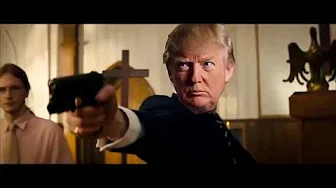
They got to watch a series of Right-wing videos featuring graphic acts of violence against those President Donald Trump hates. One of these, “The Trumpsman,” featured a digitized Trump shooting, stabbing and setting fire to such liberals as:
Former President Bill Clinton
Former Vice President Joe Biden
Former Democratic Presidential candidate Hillary Clinton
Democratic Speaker of the House Nancy Pelosi
Former President Barack Obama
Vermont United States Senator Bernie Sanders
Even Republicans who have dared to disagree with Trump—such as Utah Senator Mitt Romney and the late Arizona Senator John McCain—met a brutal end.
Legitimate news media—such as CBS, BBC, ABC, CNN, The New York Times and The Washington Post—were also depicted as among Trump’s victims.
The New York Times broke the news of the video’s showing. Since then, the American Priority Conference has rushed to disavow it—and the firestorm of outrage it set off.
So has the Trump White House.
And America’s major news media have demanded that Trump strongly condemn the video.
If Donald Trump had a history of truthfulness and humanity, his denouncing the video would prove highly believable. But he has neither.
He is a serial liar—TheWashington Post noted on August 12 that, since taking office on January 20, 2017, Trump has made more than 12,000 false or misleading claims.
As for his reputation as a humanitarian:
As a Presidential candidate, Trump repeatedly used Twitter to attack hundreds of real and imagined enemies in politics, journalism, TV and films.
From June 15, 2015, when he launched his Presidential campaign, until October 24, 2016, Trump fired almost 4,000 angry, insulting tweets at 281 people and institutions that had somehow offended him.
And he has continued to do so since taking office on January 20, 2017. The New York Times calculates that, as of January 2019, Trump had insulted 551 people (including private citizens), places, and institutions on Twitter, ranging from politicians to journalists and news outlets to entire countries.
Donald Trump
Summing up Trump’s legacy of hatred, longtime Republican Presidential adviser David Gergen said:
“Trump unleashed the dogs of hatred in this country from the day he declared he was running for president, and they’ve been snarling and barking at each other ever since. It’s just inevitable there are going to be acts of violence that grow out of that.”
So any Trump statement claiming that he strongly condemns the video should rightly be discounted as mere propaganda.
The video was first uploaded on YouTube in 2018 by a account named TheGeekzTeam. The GeekzTeam is a frequent contributor to MemeWorld, a pro-Trump website. Its creator was prominent Twitter user Carpe Donktum.
MemeWorld, embarrassed that its Right-wing porn has become a national scandal, now claims:
“The Kingsman video is CLEARLY satirical and the violence depicted is metaphoric. No reasonable person would believe that this video was a call to action or an endorsement of violence towards the media. The only person that could potentially be ‘incited’ by this video is Donald Trump himself, as the main character of the video is him. THERE IS NO CALL TO ACTION.”
Of course, that was not how the Right reacted in 2017 when comedian Kathy Griffin posed for a photograph holding up what was meant to look like Trump’s bloody, severed head.
A furious Right-wing backlash cost her gigs as a comedian and made her the target of a Secret Service investigation into whether she was a credible threat. She even had to buy metal detectors to post at her appearances at comedy clubs: “There were all kinds of incidents. A guy came at me with a knife in Houston.”
Cindy McCain, widow of Senator John McCain, wasn’t buying the Right’s disavowals, tweeting: “Reports describing a violent video played at a Trump Campaign event in which images of reporters & @John McCain are being slain by Pres Trump violate every norm our society expects from its leaders & the institutions that bare their names. I stand w/ @whca in registering my outrage”.
Nor was Democratic Presidential candidate Beto O’Rourke: “This video isn’t funny. It will get people killed.”
* * * * *
The video was produced by Rightists who believed it reflected what Donald Trump would do to his enemies if only he could get away with it. And given his near-constant calls for violence against his critics, they were absolutely correct.
But the video’s critics are wrong to call for its suppression.
On the contrary—it should be seen for what it is: The Mein Kampf of Donald Trump and his fanatical followers, in and outside the Republican party.
Like Adolf Hitler’s autobiography, it depicts the future America can expect if the Right gains the power to live out its murderous fantasies.
And the fantasy Right-wingers prize most: The brutal extermination of everyone who refuses to submit to their Fascistic tyranny.
The hour is late and the clock is ticking as the Right conspires to give Trump this power as “President-for-Life.”
It now remains to be seen if enough Americans are willing to stand fast against the brutal intentions of these specialists in evil.
And the most glorious episodes do not always furnish us with the clearest discoveries of virtue or vice in men.Sometimes a matter of less moment, an expression or a jest, informs us better of their characters and inclinations than the most famous sieges, the greatest armaments, or the bloodiest battles.”
—Plutarch, Alexander the Great
It’s in “The Church of Fake News” that President Donald Trump finally revenges himself upon his many enemies.
He walks down an aisle, reaches into his suit jacket pocket, pulls out a .45 automatic—which seems to have an endless magazine—and opens fire on:
Democratic Representative Adam Schiff, chairman of the House Intelligence Committee
Former President Bill Clinton
Democratic Representative Maxine Waters
Utah United States Senator Mitt Romney
Black Lives Matter
Former Vice President Joe Biden
Liberal activist George Soros
Former Democratic Presidential Nominee Hillary Clinton
Democratic Speaker of the House Nancy Pelosi and
Former President Barack Obama.
Nor does he spare his longtime “enemies” in the legitimate news media, such as:
CNN
The Washington Post
BBC
ABC
MSNBC Anchor Rachel Maddow
The New York Times
PBS
NBC
and Politico
Trump has, after all, slandered journalists as “the enemy of the American people.” And he has called news stories documenting his crimes and follies “fake news.”
Nor in the video is he limited to using a firearm.
He lights the head of Vermont United States Senator Bernie Sanders on fire.
He stabs to death the late Arizona Senator John McCain.
He stabs TV personality Rosie O’Connell in the face.
The clip ends with Trump driving a stake into the head of someone whose face bears the CNN logo. Then he stands and smiles as he looks around.
This video carnage was made possible by TheGeekzTeam, which digitally placed Trump’s head over the main character (played by Colin Firth) in the 2015 spy thriller The Kingsman: The Secret Service as he shoots his way through a crowd of possessed churchgoers.
“The Trumpsman” was shown along with other videos at the Trump National Doral Miami resort as part of the American Priority Conference, held from October 10-12.
It’s part of a growing genre of pro-Trump memes that routinely earn thousands of views on sites like YouTube and Twitter. Many superimpose the faces of Trump and his chief supporters slaughtering Democrats, liberal celebrities and/or members of the media.
Once The New York Times broke the story, the event’s organizer, Alex Phillips, sought to avoid responsibility for the showing. He hurriedly claimed that the “unauthorized video” was shown “in a side room.”
“Content was submitted by third parties and was not associated with or endorsed by the conference in any official capacity,” Phillips told the Times.
“American Priority rejects all political violence and aims to promote a healthy dialogue about the preservation of free speech. This matter is under review.”
The organization issued a statement calling it “shocking” that the Times didn’t cover any of the sanctioned events at the conference.
In other words, public relations events that were meant to be seen by the press, as opposed to events that were not meant to be seen.
Yet this was only one of several Right-wing videos screened at the event. C.J. Ciaramella, a journalist for Reason magazine, filmed a room where these were being screened.
Among the speakers at the conference:
Republican Representative Matt Gaetz
Donald Trump, Jr.
Former Trump campaign manager Corey Lewandowski
Professional Right-wing dirty-trickster Roger Stone
Former White House Press Secretary Sarah Huckabee Sanders
NRA spokeswoman Dana Loesch
Reaction from the legitimate news media was immediate.
CNN: “The president and his family, the White House, and the Trump campaign need to denounce it immediately in the strongest possible terms. Anything less equates to a tacit endorsement of violence and should not be tolerated by anyone.”
White House Correspondents Association:“All Americans should condemn this depiction of violence directed toward journalists and the President’s political opponents. We have previously told the President his rhetoric could incite violence. Now we call on him and everybody associated with this conference to denounce this video and affirm that violence has no place in our society.””
CBS News: “This video, and the rhetoric increasingly used against the media, puts journalists in danger, prevents open and honest debate about the issues, and undermines democracy.”
If Donald Trump had a history of truthfulness and humanity, his denouncing the video would prove highly believable.
But Trump has neither.
An August 12 Washington Post story noted that, since taking office on January 20, 2017, Trump has made more than 12,000 false or misleading claims.
Among his lies: Accusing former President Barack Obama of illegally wiretapping him—without offering a shred of evidence to back up that accusation.
Even worse: On July 25, 2019, Trump tried to coerce the president of Ukraine to manufacture “evidence” to discredit former Vice President Joe Biden, his Democratic rival for the Presidency in 2020. And shortly after that revelation became public, he publicly invited China to “investigate the Bidens”—Biden and his son, Hunter, for the same reason.
So much for his trustworthiness.
We’ll examine his reputation as a humanitarian in Part Two.
Since taking office as the Nation’s 45th President, Donald Trump has attacked or undermined one public or private institution after another. Among these:
American Intelligence: Even before taking office, Trump refused to accept the findings of the FBI, CIA and NSA that Russian Intelligence agents had intervened in the 2016 election to ensure his victory.
“I think it’s ridiculous,” he told “Fox News Sunday.” “I think it’s just another excuse. I don’t believe it….No, I don’t believe it at all.”
And when FBI Director James Comey dared to pursue a probe into “the Russia thing,” Trump fired him without warning.
On Thanksgiving Day, 2018, Trump said that the CIA hadn’t concluded that Saudi Crown Prince Mohammed bin Salman’s had ordered the murder of Washington Post journalist Jamal Khashoggi,
This was a lie—the agency has reached such a conclusion, based on a recording provided by the Turkish government and American intelligence.
American law enforcement agencies: Trump repeatedly attacked his own Attorney General, Jeff Sessions, for not “protecting” him from agents pursuing the Russia investigation.
On November 7, the day after Democrats won a majority of House seats, Trump fired Sessions.
He threatened to fire Rod J. Rosenstein, the deputy attorney general, who oversaw Special Counsel Robert Mueller’s investigation into Russian subversion of the 2016 election.
He bypassed Rosenstein to appoint Matthew Whittaker acting Attorney General—thus giving him authority over the Mueller investigation. Whittaker had often—and publicly—criticized Mueller’s probe, calling for its termination.
Trump intended to fire Mueller during the summer of 2017, but was talked out of it by aides fearful that it would set off calls for his impeachment.
Donald Trump
American military agencies:In February, 2017, Trump approved and ordered a Special Forces raid in Yemen on an Al Qaeda stronghold. The assault cost the life of Navy SEAL Chief Petty Officer William “Ryan” Owens.
Disavowing any responsibility for the failure, Trump said: “This was a mission that was started before I got here. This was something they wanted to do. They came to me, they explained what they wanted to do—the generals—who are very respected, my generals are the most respected that we’ve had in many decades, I believe. And they lost Ryan.”
The press: On February 17, 2017, Trump tweeted: “The FAKE NEWS media (failing@nytimes, @NBCNews, @ABC, @CBS, @CNN) is not my enemy, it is the enemy of the American People!”
Seven days later, appearing before the Conservative Political Action Conference on February 24, Trump said: “I want you all to know that we are fighting the fake news. It’s fake, phony, fake….I’m against the people that make up stories and make up sources. They shouldn’t be allowed to use sources unless they use somebody’s name. Let their name be put out there.”
The judiciary: On October 20, 2018, Trump attacked U.S. District Judge Jon S. Tigar as an “Obama judge.” Tigar had ruled that the administration must consider asylum claims no matter where migrants cross the U.S. border.
On October 21, Supreme Court Chief Justice John Roberts told the Associated Press: “We do not have Obama judges or Trump judges, Bush judges or Clinton judges. What we have is an extraordinary group of dedicated judges doing their level best to do equal right to those appearing before them.”
On Thanksgiving Day, 2018, Trump attacked Roberts—appointed by Republican President George W. Bush—on Twitter: “Sorry Chief Justice John Roberts, but you do indeed have ‘Obama judges,’ and they have a much different point of view than the people who are charged with the safety of our country.”
Trump has repeatedly attacked Seattle US District Judge James Robart, who halted Trump’s first travel ban: “Just cannot believe a judge would put our country in such peril. If something happens blame him and court system. People pouring in. Bad!”
President Barack Obama:For five years, Trump, more than anyone else, popularized the slander that President Barack Obama was born in Kenya—and was therefore not an American citizen.
Even after Obama released the long-form version of his birth certificate—on April 27, 2011—Trump tweeted, on August 6, 2012: “An ‘extremely credible source’ has called my office and told me that @BarackObama‘s birth certificate is a fraud.”
Barack Obama
On March 4, 2017, in a series of unhinged tweets, Trump accused former President Obama of tapping his Trump Tower phones prior to the election: “Terrible! Just found out that Obama had my ‘wires tapped’ in Trump Tower just before the victory. Nothing found. This is McCarthyism!”
Trump was later forced to admit he had no evidence to back up his slanderous claims.
* * * * *
Donald Trump isn’t crazy, as many of his critics charge. He knows what he’s doing—and why.
He intends to strip every potential challenger to his authority—or his version of reality—of legitimacy with the public. If he succeeds, there will be:
No independent press to reveal his failures and crimes.
No independent law enforcement agencies to investigate his abuses of office.
No independent judiciary to hold him accountable.
No independent military to dissent as he recklessly hurtles toward a nuclear disaster.
No candidate—Democrat or Republican—to challenge him for re-election in 2020.
No candidate—Democrat or Republican—to challenge his remaining in office as “President-for-Life.”
Since taking office as the Nation’s 45th President, Donald Trump has attacked or undermined one public or private institution after another. Among these:
American Intelligence: Even before taking office, Trump refused to accept the findings of the FBI, CIA and NSA that Russian Intelligence agents had intervened in the 2016 election to ensure his victory.
“I think it’s ridiculous,” he told “Fox News Sunday.” “I think it’s just another excuse. I don’t believe it….No, I don’t believe it at all.”
And when FBI Director James Comey dared to pursue a probe into “the Russia thing,” Trump fired him without warning.
On Thanksgiving Day, 2018, Trump said that the CIA hadn’t concluded that Saudi Crown Prince Mohammed bin Salman’s had ordered the murder of Washington Post journalist Jamal Khashoggi,
This was a lie—the agency has reached such a conclusion, based on a recording provided by the Turkish government and American intelligence.
American law enforcement agencies: Trump repeatedly attacked his own Attorney General, Jeff Sessions, for not “protecting” him from agents pursuing the Russia investigation.
On November 7, the day after Democrats won a majority of House seats, Trump fired Sessions.
He threatened to fire Rod J. Rosenstein, the deputy attorney general, who oversaw Special Counsel Robert Mueller’s investigation into Russian subversion of the 2016 election.
He bypassed Rosenstein to appoint Matthew Whittaker acting Attorney General—thus giving him authority over the Mueller investigation. Whittaker had often—and publicly—criticized Mueller’s probe, calling for its termination.
Trump intended to fire Mueller during the summer of 2017, but was talked out of it by aides fearful that it would set off calls for his impeachment.
Donald Trump
American military agencies:In February, 2017, Trump approved and ordered a Special Forces raid in Yemen on an Al Qaeda stronghold. The assault cost the life of Navy SEAL Chief Petty Officer William “Ryan” Owens.
Disavowing any responsibility for the failure, Trump said: “This was a mission that was started before I got here. This was something they wanted to do. They came to me, they explained what they wanted to do—the generals—who are very respected, my generals are the most respected that we’ve had in many decades, I believe. And they lost Ryan.”
The press: On February 17, 2017, Trump tweeted: “The FAKE NEWS media (failing@nytimes, @NBCNews, @ABC, @CBS, @CNN) is not my enemy, it is the enemy of the American People!”
Seven days later, appearing before the Conservative Political Action Conference on February 24, Trump said: “I want you all to know that we are fighting the fake news. It’s fake, phony, fake….I’m against the people that make up stories and make up sources. They shouldn’t be allowed to use sources unless they use somebody’s name. Let their name be put out there.”
The judiciary: On October 20, 2018, Trump attacked U.S. District Judge Jon S. Tigar as an “Obama judge.” Tigar had ruled that the administration must consider asylum claims no matter where migrants cross the U.S. border.
On October 21, Supreme Court Chief Justice John Roberts told the Associated Press: “We do not have Obama judges or Trump judges, Bush judges or Clinton judges. What we have is an extraordinary group of dedicated judges doing their level best to do equal right to those appearing before them.”
On Thanksgiving Day, 2018, Trump attacked Roberts—appointed by Republican President George W. Bush—on Twitter: “Sorry Chief Justice John Roberts, but you do indeed have ‘Obama judges,’ and they have a much different point of view than the people who are charged with the safety of our country.”
Trump has repeatedly attacked Seattle US District Judge James Robart, who halted Trump’s first travel ban: “Just cannot believe a judge would put our country in such peril. If something happens blame him and court system. People pouring in. Bad!”
President Barack Obama:For five years, Trump, more than anyone else, popularized the slander that President Barack Obama was born in Kenya—and was therefore not an American citizen.
Even after Obama released the long-form version of his birth certificate—on April 27, 2011—Trump tweeted, on August 6, 2012: “An ‘extremely credible source’ has called my office and told me that @BarackObama‘s birth certificate is a fraud.”
Barack Obama
On March 4, 2017, in a series of unhinged tweets, Trump accused former President Obama of tapping his Trump Tower phones prior to the election: “Terrible! Just found out that Obama had my ‘wires tapped’ in Trump Tower just before the victory. Nothing found. This is McCarthyism!”
Trump was later forced to admit he had no evidence to back up his slanderous claims.
* * * * *
Donald Trump isn’t crazy, as many of his critics charge. He knows what he’s doing—and why.
He intends to strip every potential challenger to his authority—or his version of reality—of legitimacy with the public. If he succeeds, there will be:
No independent press to reveal his failures and crimes.
No independent law enforcement agencies to investigate his abuses of office.
No independent judiciary to hold him accountable.
No independent military to dissent as he recklessly hurtles toward a nuclear disaster.
No candidate—Democrat or Republican—to challenge him for re-election in 2020.
No candidate—Democrat or Republican—to challenge his remaining in office as “President-for-Life.”
“And the most glorious episodes do not always furnish us with the clearest discoveries of virtue or vice in men.
“Sometimes a matter of less moment, an expression or a jest, informs us better of their characters and inclinations than the most famous sieges, the greatest armaments, or the bloodiest battles.”
So warned the ancient historian, Plutarch, in the introduction to his biography of Alexander the Great.
It’s well to keep this warning in mind when recalling the story of 17-year-old Tyler Linfesty, now known as “Plaid Shirt Guy.”
On September 6, Linfesty, a high school senior, attended President Donald Trump’s campaign rally in Billings, Montana. He had wanted to see the President of the United States speak in his home state.
And, much to his surprise, he was randomly chosen by the Trump campaign for “VIP status.” He would be seated directly behind Trump.
But this came with a warning: “You have to be enthusiastic, you have to be clapping, you have to be cheering for Donald Trump.”
Before he attended the rally, Trump staffers urged him to wear a “Make America Great Again” cap, but he refused.
Owing to his varied facial expressions and his plaid shirt, he quickly became known on the Internet as “Plaid-Shirt Guy.”
Tyler Linfesty
Then, while the rally was still going, Linfesty was approached by a Trump minion who said: “I’m gonna replace you.”
He hadn’t been heckling Trump. Nor had he held up an anti-Trump sign.
So why was he suddenly ejected?
Without being given a reason, Linfesty was forced to come up with one himself. And his best guess: He didn’t cheer when Trump made statements he disagreed with.
He had applauded those parts of Trump’s speech he did agree with—such as opposition to NAFTA. He also agreed with Trump’s claim that the 2016 Democratic presidential nomination was stolen from Vermont Senator Bernie Sanders.
But there were parts of Trump’s speech he disagreed with—such as Trump’s claim that his “tax reform law” benefits the middle class.
(It doesn’t—its foremost beneficiaries comprise the top 1%.)
Thus, Linfesty looked skeptical when Trump said it was harder to win the Electoral College than the popular vote.
(It isn’t. A candidate need only win those states with the most electoral votes. He needn’t win the popular vote—just as Trump failed to win it against Hillary Clinton by nearly three million votes.)
Donald Trump
And when Trump said he could have won the popular vote, Linfesty turned to several people near him and mouthed “What?”
As Linfesty explained to CNN’s Don Lemon: “I had to be real with myself. I’m not going to pretend to support something I don’t support.”
Apparently this was too much for those staging the rally.
“I saw this woman walking toward me on the left,” Linfesty told the BillingsGazette. “She just said to me, ‘I’m going to replace you.’ I just walked off. I knew I was getting out for not being enthusiastic enough, but I decided not to fight it.”
But being removed from the Trump speech was not the end for Linfesty.
He was then detained by the United States Secret Service.
“Some Secret Service guys escorted me into this backroom area, and they just sat me down for 10 minutes,” said Linfesty. The agents looked at his ID, then released him—and told him not to return.
The Secret Service is charged with protecting the President (and, in a lesser-known duty, protecting the national currency). It is not charged with regulating the free speech rights of Americans.
It is, in short, not supposed to operate as the dreaded, black-uniformed SS of Nazi Germany.
Ironically, earlier that morning, Trump had tweeted a thank-you to North Korea’s brutal dictator Kim Jong-Un.
The reason: Kim had said he had “unwavering faith in President Trump.”
Thus, a dictator who flatters Trump gets treated to praise, while an American exercising his right to free speech faces possible arrest.
Speaking to the Gazette, Linfesty said: “I didn’t really have a plan. I was just going to clap for things I agreed with and not clap for things I didn’t agree with.”
And he insisted to CNN’s Don Lemon that his facial expressions had been honest: “I would have made those faces if anyone were to say that to me. I was not trying to protest, those were just my actual, honest reactions.
“Each time I see one of these rallies I see somebody behind Donald Trump clapping and cheering and being super enthusiastic and I’ve always wondered myself, ‘Are those people being really genuine?’”
Two months to the day after Linfesty’s ordeal, Democrats recaptured the House of Representatives, but failed to win a majority in the Senate. The next day, Trump fired Attorney General Jeff Sessions.
Since May, 2017, Trump had brutally insulted Sessions for refusing to suppress Special Counsel Robert Mueller’s probe of Russia’s subversion of the 2016 Presidential election.
The Linfesty episode—coupled with the firing of Sessions—bodes ill for Americans who expect Federal law enforcement to operate in a fair and incorruptible manner.
And the most glorious exploits do not always furnish us with the clearest discoveries of virtue or vice in men; sometimes a matter of less moment, an expression or a jest, informs us better of their characters and inclinations, than the most famous sieges, the greatest armaments, or the bloodiest battles whatsoever.
—Plutarch, “Life of Alexander”
In a closed-door speech to Republican donors on March 3, 2018, President Donald Trump proved the accuracy of Plutarch’s observation.
He praised China’s President, Xi Jinping, for recently assuming full dictatorial powers: “He’s now president for life. President for life. No, he’s great. And look, he was able to do that. I think it’s great. Maybe we’ll have to give that a shot some day.”
The statement was greeted with cheers and laughter by Republican donors.
And, in making that unguarded statement, Trump perhaps has revealed his ultimate intention: To overthrow America’s constitutional government.
Since taking office as the Nation’s 45th President, Donald Trump has attacked or undermined one public or private institution after another.
Donald Trump
Among these:
American Intelligence: Even before taking office, Trump refused to accept the findings of the FBI, CIA and NSA that Russian Intelligence agents had intervened in the 2016 election to ensure his victory.
“I think it’s ridiculous,” he told “Fox News Sunday.” “I think it’s just another excuse. I don’t believe it….No, I don’t believe it at all.”
And when FBI Director James Comey dared to pursue a probe into “the Russia thing,” Trump fired him without warning.
American law enforcement agencies: Trump has repeatedly attacked his own Attorney General, Jeff Sessions, for not “protecting” him from agents pursuing the Russia investigation.
He repeatedly attacked the integrity of Deputy FBI Director Andrew G. McCabe until the latter resigned.
He has threatened to fire Rod J. Rosenstein, the deputy attorney general, Rod J. Rosenstein, who oversees Special Counsel Robert Mueller’s investigation into Russian subversion of the 2016 election.
He intended to fire Mueller during the summer of 2017, but was talked out of it by aides fearful that it would set off calls for his impeachment.
American military agencies:In February, 2017, Trump approved and ordered a Special Forces raid in Yemen on an Al Qaeda stronghold. The assault cost the life of Navy SEAL Chief Petty Officer William “Ryan” Owens.
Disavowing any responsibility for the failure, Trump said: ““This was a mission that was started before I got here. This was something they wanted to do. They came to me, they explained what they wanted to do–the generals–who are very respected, my generals are the most respected that we’ve had in many decades, I believe. And they lost Ryan.”
The press: On February 17, 2017, Trump tweeted: “The FAKE NEWS media (failing@nytimes, @NBCNews, @ABC, @CBS, @CNN) is not my enemy, it is the enemy of the American People!”
Seven days later, appearing before the Conservative Political Action Conference on February 24, Trump said: “I want you all to know that we are fighting the fake news. It’s fake, phony, fake….I’m against the people that make up stories and make up sources. They shouldn’t be allowed to use sources unless they use somebody’s name. Let their name be put out there.”
The judiciary: Trump has repeatedly attacked Seattle US District Judge James Robart, who halted Trump’s first travel ban.
In one tweet, Trump claimed: “Just cannot believe a judge would put our country in such peril. If something happens blame him and court system. People pouring in. Bad!”
At Trump’s bidding, White House aide Stephen Miller attacked the Ninth Circuit Court of Appeals: “We have a judiciary that has taken far too much power and become, in many cases, a supreme branch of government.”
President Barack Obama:For five years, Trump, more than anyone else, popularized the slander that President Barack Obama was born in Kenya—and was therefore not an American citizen.
Even after Obama released the long-form version of his birth certificate—on April 27, 2011—Trump tweeted, on August 6, 2012: “An ‘extremely credible source’ has called my office and told me that @BarackObama‘s birth certificate is a fraud.”
Barack Obama
On March 4, 2017, in a series of unhinged tweets, Trump accused former President Obama of tapping his Trump Tower phones prior to the election: “Terrible! Just found out that Obama had my ‘wires tapped’ in Trump Tower just before the victory. Nothing found. This is McCarthyism!”
Trump was later forced to admit he had no evidence to back up his slanderous claims.
* * * * *
Donald Trump isn’t crazy, as many of his critics charge. He knows what he’s doing—and why.
He intends to strip every potential challenger to his authority—or his version of reality—of legitimacy with the public. If he succeeds, there will be:
No independent press to reveal his failures and crimes.
No independent law enforcement agencies to investigate his abuses of office.
No independent judiciary to hold him accountable.
No independent military to dissent as he recklessly hurtles toward a nuclear disaster.
No candidate—Democrat or Republican—to challenge him for re-election in 2020.
No candidate—Democrat or Republican—to challenge his remaining in office as “President-for-Life.”
In the 1992 courtroom drama, “A Few God Men,” Jack Nicholson, as Marine Colonel Nathan Jessup, utters a line that has since become famous.
When his prosecutor, Lieutenant Daniel Kaffee (Tom Cruise) demands the truth about the murder of a fellow Marine, Jessup shouts: “You can’t handle the truth!”
Jack Nicholson in “A Few Good Men”
Apparently, many of those who work in the television news business feel the same way about their audience.
[WARNING:This column contains some words that some readers may find offensive. Read on at your own risk.]
On February 9, 2016, businessman Donald Trump scored a new blow at his Rafael “Ted” Cruz, his closest rival for the Republican Presidential nomination.
Speaking at a rally in Manchester, New Hampshire, Trump attacked Cruz, the United States Senator from Texas, for being unwilling to support the widespread use of torture against America’s Islamic enemies.
“He’s a pussy!” yelled a woman in the crowd.
Apparently a certain portion of the attendees didn’t hear–or misheard–the insult. So Trump–pretending to be shocked–repeated it for them:
“She said–I never expect to hear that from you again! She said: ‘He’s a pussy.’ That’s terrible.”
“What kind of people do I have here?” joked Trump, clearly playing to the boisterous crowd.
Donald Trump
The incident went viral on social media. But all the major TV news outlets–for ABC, CBS, CNN and NBC–bleeped the word and/or coyly referred to it as “the P-word.”
It was as if they assumed their viewers would of course know what had been said despite the networks’ censorship of it. And if viewers didn’t already know what the woman–and Trump–had said, the networks weren’t going to enlighten them.
Of course, “the P-word” could just as easily have been “prick” or “pervert.” So it’s understandable that many viewers might have thought a very different word had been used.
No doubt the networks hoped to avoid offending large numbers of viewers.
But when the use of certain words becomes central to a news story, editors and reporters should have the courage to reveal just what was said. It should then be up to the audience to decide if the language was offensive–and, if so, if its user deserves condemnation.
The evening news is–supposedly–aimed at voting-age adults. And adults need–and deserve–the hard truth about the world they live in. Only then do they have a chance to reform it–if, in fact, they decide it needs reforming.
Those who wanted to learn–rather than guess–what Trump had repeated had to turn to the Internet or to a handful of news source such as Vox: Policy and Politics.
In their defense, the networks could argue that the Federal Communications Commission, which regulates radio and television, does not usually permit the word “pussy” to be aired between 6 am and 10 pm.
On the other hand, immediately after the 9/11 terror attacks, all the major TV networks endlessly replayed the destruction of the World Trade Center, with the resulting deaths of hundreds of men and women.
Censorship, then, tends to center on two types of subject material:
Sex, or “obscenity,” which is sex-related; and
Race, meaning racial slurs that would offend some minority group.
An example of race-related censorship occurred during the short-lived administration of President Gerald R. Ford.
During a lull in the 1976 Republican convention, entertainer Pat Boone asked Earl Butz, then Secretary of Agriculture: Why was the party of Lincoln having so much trouble winning black votes for its candidates?
“I’ll tell you what the coloreds want,” said Butz. “It’s three things: first, a tight pussy; second, loose shoes; and third, a warm place to shit.”
Earl Butz
Unknown to Butz, a Rolling Stone reporter was standing nearby. When his comments became public, Butz was quickly forced to resign.
Meanwhile, most TV and print media struggled to protect their audiences from the truth of Butz’ racism. Many newspapers simply reported that Butz had said something too obscene to print. Some invited their readers to contact the editors if they wanted more information.
TV newsmen generally described Butz’ firing as stemming from “a racially-offensive remark,” which they refused to explain.
In short: A high-ranking government official had been fired, but audiences were not allowed to judge whether his language justified that termination.
Forty years later, TV news viewers were again prevented from reaching their own conclusions about Trump’s repetition of the slur aimed at his rival.
Nor is there any guarantee that such censorship will not occur again.
Censoring the truth has always been a hallmark of dictatorships. It has no place in a democracy–despite the motives of those doing the censoring.
The ancient historian, Plutarch, sounded a warning that remains timely:
“And the most glorious exploits do not always furnish us with the clearest discoveries of virtue or vice in men; sometimes a matter of less moment, an expression or a jest, informs us better of their characters and inclinations, than the most famous sieges, the greatest armaments, or the bloodiest battles whatsoever.”
In a democracy, citizens must be alert for those tell-tale expressions or jests. And this demands that the media, in turn, have the courage to bring those truths to their attention.
The ancient historian, Plutarch, warned: “And the most glorious episodes do not always furnish us with the clearest discoveries of virtue or vice in men.
“Sometimes a matter of less moment, an expression or a jest, informs us better of their characters and inclinations than the most famous sieges, the greatest armaments, or the bloodiest battles.”
On August 15, President Donald Trump gave just such an example.
He did so by equating Nazis, Ku Klux Klamsmen and other white supremacists with those who protested against them in Charlottesville, Virginia, over the weekend of August 12-13.
Donald Trump
“I think there is blame on both sides,” said Trump in an impromptu press conference in the lobby of Trump Tower, in Manhattan, New York.
“I will tell you something. I watched those very closely, much more closely than you people [news media] watched it. And you had a group on one side that was bad and you had a group on the other side that was also very violent. And nobody wants to say that. But I’ll say it right now.
“You had a group on the other side [those opposing the white supremacists] that came charging in without a permit and they were very, very violent….
“Well, I do think there’s blame. Yes, I think there is blame on both sides. You look at both sides. I think there is blame on both sides. And I have no doubt about it. And you [news media] don’t have doubt about it either.”
Apparently, some of Trump’s fellow Republicans do doubt there was blame on both sides.
“There’s no moral equivalency between racists & Americans standing up to defy hate& bigotry. The President of the United States should say so,” tweeted Arizona Senator John McCain.
“Through his statements yesterday,” said South Carolina Senator Lindsay Graham, “President Trump took a step backward by again suggesting there is moral equivalency between the white supremacist neo-Nazis and KKK members who attended the Charlottesville rally and people like Ms. Heyer. I, along with many others, do not endorse this moral equivalency.”
Heather Heyer was the 32-year-old paralegal who was killed on August 13 when a car plowed into a crowd protesting a white supremacist “Unite the Right” rally in Charlottesville. Nineteen others were injured in the incident.
“Mr. President, you can’t allow #WhiteSupremacists to share only part of blame. They support idea which cost nation & world so much pain,” Florida’s Senator Marco Rubio tweeted.
And Arizona’s other Senator, Jeff Flake, tweeted: “We can’t accept excuses for white supremacy & acts of domestic terrorism. We must condemn. Period.”
Ohio Governor John Kasich, who had opposed Trump as a Presidential candidate in 2016, said on NBC’s “Today Show”:
“This is terrible. The President of the United States needs to condemn these kinds of hate groups. The President has to totally condemn this. It’s not about winning an argument.”
John Kasich
During the Presidential primaries, Kasich had run an ad comparing Trump to Germany’s Fuhrer, Adolf Hitler:
“And you might not care if Donald Trump says he’s going to round up all the Hispanic immigrants, because you’re not one.
“And you might not care if Donald Trump says it’s OK to rough up black protesters, because you’re not one.
“And you might not care if Donald Trump wants to suppress journalists, because you’re not one.
“But think about this:
“If he keeps going, and he actually becomes President, he might just get around to you. And you’d better hope that there’s someone left to help you.”
That point was forcibly driven home on the night of August 11.
That was when hundreds of torch-bearing Nazis, Ku Klux Klansmen and other white supremacists marched on the University of Virginia campus.
Their faces twisted with hatred, they repeatedly shouted:
“You will not replace us!”
“Jews will not replace us!”
“Blood and soil!”
“Whose streets? Our streets!”
For the vast majority of Americans, such scenes had existed only in newsreel footage of torch-bearing columns of Nazi stormtroopers flooding the streets of Hitler’s Germany.
The fall of Nazi Germany came 72 years ago—on May 7, 1945. Today, veterans of World War II are rapidly dying off.
But their sons and daughters are still alive to pass on, secondhand, the necessary for standing up to such barbarism.
And so can films like “Saving Private Ryan” and “Schindler’s List.”
At the end of “Saving Private Ryan,” a dying Captain John H. Miller (Tom Hanks) tells Private James Ryan (Matt Damon) whose life he has saved: “Earn this.”
A dying Captain Miller tells Ryan: “Earn this.”
Returning to Miller’s burial site in France decades later, an elderly Ryan speaks reverently to the white cross over Miller’s grave:
“Every day I think about what you said to me that day on the bridge. I tried to live my life the best that I could. I hope that was enough. I hope that, at least in your eyes, I’ve earned what all of you have done for me.”
Those are sentiments wasted on those who mounted the “Unite the Right” rally in Charlottesville.
And they are equally wasted on a President who condemns those who stand up to Fascism.
The ancient historian, Plutarch, warned: “And the most glorious episodes do not always furnish us with the clearest discoveries of virtue or vice in men.
“Sometimes a matter of less moment, an expression or a jest, informs us better of their characters and inclinations than the most famous sieges, the greatest armaments, or the bloodiest battles.”
It’s well to keep this warning in mind when judging the character of Rick Perry, the former Texas governor who is now Secretary of Energy for the Trump administration.
Five years ago, he was a candidate for President himself.
Anita Perry, his wealthy wife, wanted voters to know she sympathized with the plight of the unemployed.
Anita and Rick Perry
For her, unemployment meant that her son, Griffin, had resigned from his job at Deutsche Bank to campaign for his father.
“He resigned from his job two weeks ago because he can’t go out and campaign with his father because of SEC regulations,” she said in a Pendleton, S.C. diner on October 14, 2011.
The Securities and Exchange Commission had recently adopted stricter rules for investment advisers undertaking political activity.
Anita Perry’s comment came in response to a question from a middle-aged voter who had lost his six-figure job and now worked as a handyman.
“My son lost his job because of this administration,” she added.
Griffin Perry
Blaming the Obama administration is, of course, second-nature for those on the radical right. But Anita Perry may have forgotten that, on October 13, 2011, she said that her son had eagerly resigned.
She recalled that her husband assembled the family to discuss his run for the Presidency last May.
“So, our son Griffin Perry is 28. He loves politics, and he just couldn’t wait. He said ‘Dad, I’m in! I’m in! I’ll do whatever you need me to do. I’ll resign my job. I’ll do what you need me to do.’” she said in a speech at North Greenville University.
Anita Perry might have considered that there is a difference between voluntarily resigning from a job and being involuntarily fired from it.
And she might have consoled herself with the truth that, having a family fortune and the income of his attorney-wife to rely on, Griffin Perry wasn’t in danger of standing in a breadline anytime soon.
So why would Anita Perry stoop to mingling with those she considers her social inferiors? And why would she pour out her woes to people she would otherwise cross the street to avoid?
Simple. She needed them. Or, to be more accurate: She needed their votes.
True, her husband was hauling in huge campaign donations that dwarfed those of his rivals. But money can’t vote.
And with an estimated 14 to 25 million Americans unemployed, the Perrys had to reach beyond the minority of voters who would qualify for their country-club membership.
Of course, the voluntary resignation of her son wasn’t the only complaint Anita Perry had to make.
“We are being brutalized by our opponents, and our own party,” she told a South Carolina audience on October 13, 2011. “So much of that is, I think they look at him, because of his faith.
“He is the only true conservative–well, there are some true conservatives. And they’re there for good reasons. And they may feel like God called them, too. But I truly feel like we are here for that purpose.”
Actually, it was Rick Perry–through his surrogate spokesman-pastor, Robert Jeffress–who had repeatedly attacked the Mormon religion of his then-campaign rival, Mitt Romney.
Jeffress told reporters at the Values Voter Summit in Washington he believed Mormonism was a “cult.” While Perry has said he didn’t agree with the charge, he refused to repudiate the remarks–or support–of the influential Baptist pastor.
It was the same strategy favored by demagogues like President Richard Nixon: The “respectable” Nixon took the high road, while ordering his subordinate, Vice President Spiro Agnew, to attack the patriotism of anyone who dared disagree with him.
Why is all of this important?
Because the priorities of the leader of an organization usually determine the priorities of that organization. And those priorities, in turn, derive from the character of that leader.
So consider the character traits that Perry has so far revealed:
He used surrogates to attack the religion of his opponents.
He holds his own religious beliefs sacred.
He sought to slash programs for the poor.
He piled up millions of dollars for himself.
His family believes he has been chosen by God to redeem the nation from becoming “soft” and “Godless.”
His family believes themselves entitled to ignore laws that are supposed to govern allAmericans.
It’s fascinating to imagine the verdict Plutarch would deliver on American politics today. After all, he did shrewdly analyze the ruthless political maneuverings of such despots as Alexander and Julius Caesar.
No doubt, would-be despots like Donald Trump and his self-righteous cronies like Rick Perry would find Plutarch’s verdicts highly upsetting.
And Americans who believe in liberty would find those verdicts incredibly frightening.
Steffen White’s Email: Sparta480@aol.com Former reporter, legal investigator and troubleshooter. Columnist at Bureaucracybuster.com. Fighting political and bureaucratic arrogance, incompetence and/or indifference.
When making complaints in writing, carefully review your email or letter before sending it. Remove any words that are vulgar or profane. Don't make sweeping accusations: "Your agency is a waste."
Don't attribute motives to people you've had problems with, such as: "The postal clerk refused to help me because he's a drunk." If the person actually appeared to be drunk, then be precise in your description: "As he leaned over the counter I could smell beer on his breath. Behind him, in a waste basket, I saw an empty bottle of Coors beer."
Show how the failure of the official to address your problem reflects badly on the company or agency: "This is not the level of service your ads would lead potential customers to expect."
If necessary, note any regulatory agencies that can make life rough for the company or agency if your complaint isn't resolved. For the phone company, for example, cite the FCC or the PUC. But do this only after you have stated you hope your complaint can be settled amicably and privately within the company.





 Bureaucracybuster's Blog
ABC NEWS, ADAM SCHIFF, ADOLF HITLER, ALEX PHILLIPS, ALTERNET, AMERICA’S VOICE, AMERICABLOG, AMERICAN PRIORITY CONFERENCE, AP, AUSTRIA, BABY BOOMER RESISTANCE, BARACK OBAMA, BBC, BERNIE SANDERS, BILL CLINTON, BLACK LIVES MATTER, BUZZFEED, CBS NEWS, CHINA, CINDY MCCAIN, CIVIL WAR, CNN, COLIN FIRTH, COREY LEWANDOWSKI, CROOKS AND LIARS, CZECHOSLOVAKIA, DAILY KOZ, DANA LOESCH, DEMOCRATS, DONALD TRUMP, DONALD TRUMP JUNIOR, EUGENE SCOTT, FACEBOOK, FBI, FINAL SOLUTION, FIVETHIRTYEIGHT, FRANCISCO FRANCO, GEORGE SOROS, HILLARY CLINTON, HUNTER BIDEN, JOE BIDEN, JOHN MCCAIN, MATT GAETZ, MEIN KAMPF, MITT ROMNEY, MOTHER JONES, MOVEON, MSNBC, NANCY PELOSI, NATIONAL RIFLE ASSOCIATION, NAZI GERMANY, NBC NEWS, NEVILLE CHAMBERLAIN, NEWSWEEK, NINA BURLEIGH, NPR, PBS, PBS NEWSHOUR, PLUTARCH, POLAND, POLITICO, POLITICUSUSA, RACHEL MADDOW, RAW STORY, REPUBLICANS, REUTERS, ROGER STONE, ROSIE O’DONNELL, SALON, SARAH HUCKABEE SANDERS, SEATTLE TIMES, SLATE, SOVIET UNION, SPAIN, TALKING POINTS MEMO, THE ATLANTIC, THE CHICAGO SUN-TIMES, THE CHICAGO TRIBUNE, THE DAILY BEAST, THE DAILY BLOG, THE GEEKZTEAM, THE GUARDIAN, THE HILL, THE HUFFINGTON POST, THE KINGSMAN (MOVIE), THE LOS ANGELES TIMES, THE NATION, THE NEW YORK TIMES, THE TRUMPSMAN (VIDEO), THE WASHINGTON POST, THINKPROGRESS, TIME, TREASON, TRUTHDIG, TWITTER, U.S. NEWS & WORLD REPORT, UKRAINE, UNITED STATES, UPI, USA TODAY, VERSALLIES TREATY, VOLODYMR ZELENSKI, WEIMAR REPUBLIC, WHITE HOUSE CORRESPONDENTS ASSOCIATION, WORLD WAR 11
DONALD TRUMP’S “MEIN KAMPF” COMES TO VIDEO: PART ONE (OF TWO)
In Bureaucracy, History, Military, Politics, Social commentary on October 21, 2019 at 12:14 amOn November 9, 1923, Nazi Party Fuhrer Adolf Hitler tried to overthrow the government in Munich, Bavaria.
About 2,000 Nazis marched to the center of Munich, where they confronted heavily-armed police. A shootout erupted, killing 16 Nazis and four policemen.
Hitler was injured during the clash, but managed to escape. Two days later, he was arrested and charged with treason.
Put on trial, he found himself treated as a celebrity by a judge sympathetic to Right-wing groups. He was allowed to brutally cross-examine witnesses and even make inflammatory speeches.
At the end of the trial, he was convicted of treason and sentenced to five years’ imprisonment. Of this he served only nine months before being pardoned.
Hitler used his time in Landsberg Prison, in Bavaria, to write his infamous book, Mein Kampf-–“My Struggle.” Part autobiography, part political treatise, it laid out his future plans—for a revitalized Germany and the conquest of other nations.
Adolf Hitler leaving Landsberg Prison, December, 20, 1924
Published in 1925, it was long ignored by all but the most fanatical Nazis. But as Hitler gained increasing numbers of votes in a series of elections, many people—inside and outside Germany—began paying attention to its contents.
By 1939 it had sold 5,200,000 copies and had been translated into 11 languages.
Most of those who bought the book never read it. Its style was bombastic, repetitious and illogical. The first edition contained grammatical errors, reflecting a self-educated man.
Few who read it took Hitler’s intentions seriously. Comedians portrayed him as a wildly gesturing crank who screamed constantly.
Hitler made no effort to hide his program for Germany under his rule. His candor led many people to believe he was a lunatic who could be safely ignored.
He was especially insistent on the need for eliminating world Jewry and conquering the Soviet Union.
On the former topic he wrote: “The nationalization of our masses will succeed only when, aside from all the positive struggle for the soul of our people, their international poisoners are exterminated.
“If at the beginning of the war and during the war twelve or fifteen thousand of these Hebrew corrupters of the nation had been subjected to poison gas, such as had to be endured in the field by hundreds of thousands of our very best German workers of all classes and professions, then the sacrifice of millions at the front would not have been in vain.”
A mere 17 years later, Hitler’s “Thousand-Year Reich” would translate those words into horrific action in a series of extermination camps equipped with gas chambers.
Hitler was equally insistent that Germany needed to find Lebensraum—“Living space”—in the east. And by “east” he meant “Russia.”
Specifically: “And so we National Socialists consciously draw a line beneath the foreign policy tendency of our pre-War period. We take up where we broke off six hundred years ago.
“We stop the endless German movement to the south and west, and turn our gaze toward the land in the east. At long last we break off the colonial and commercial policy of the pre-War period and shift to the soil policy of the future.
“If we speak of soil in Europe today, we can primarily have in mind only Russia and her vassal border states.”
Hitler finally attained power on January 30, 1933. He realized that Germany was not yet strong enough to impose its will on other nations. So he set out on a secret crash program to make Germany the strongest military power in Europe.
In 1936, he set out on his “mission of Providence”:
Only after Hitler set out to conquer, first Europe, then the Soviet Union, did his victims and intended victims realize that Mein Kampf had given them a deadly warning. A warning too many of them had refused to heed.
By the time World War II ended:
But Adolf Hitler isn’t the only would-be dictator to give ample warning of his murderous intentions.
And, like most Germans in the Weimar Republic, which preceded Nazi Germany, most Americans refuse to take that warning seriously.
Share this: