Posts Tagged ‘PBS NEWSHOUR’
2016 PRESIDENTIAL CAMPAIGN, ABC NEWS, ALTERNET, AMERICAN NAZI PARTY, AP, BARACK OBAMA, BILL CLINTON, BILL MAHER, BLACKS, BOMBINGS, BRANDON VICTOR DIXON, BUZZFEED, CBS NEWS, CNN, CROOKS AND LIARS, DAILY KOZ, DAVID GERGEN, DONALD TRUMP, FACEBOOK, GREG GIANFORTE, HAMILTON (MUSICAL), HENRY 11, HENRY II, HILLARY CLINTON, JOE SCARBOROUGH, JOHN F. KENNEDY, JOHN GIELGUD, KU KLUX KLAN, MIKE PENCE, MOTHER JONES, MOVEON, MSNBC, NBC NEWS, NEWSWEEK, NPR, PBS NEWSHOUR, POLITICO, RAFAEL "TED" CRUZ, RAW STORY, REUTERS, SALON, SEATTLE TIMES, SLATE, THE ATLANTIC, THE CHICAGO SUN-TIMES, THE CHICAGO TRIBUNE, THE DAILY BEAST, THE GUARDIAN, THE HILL, THE HUFFINGTON POST, THE LOS ANGELES TIMES, THE NATION, THE NEW YORK TIMES, THE WASHINGTON POST, THOMAS BECKET, TIME, TWITTER, U.S. NEWS & WORLD REPORT, UPI, USA TODAY, VICTOR DIXON, WHITE SUPREMACISTS
In Bureaucracy, History, Politics, Social commentary on November 6, 2018 at 12:06 am
David Gergen is a longtime Republican who has advised Presidents Richard Nixon, Gerald Ford, Ronald Reagan and Bill Clinton. He is now a senior political analyst for CNN.
Summing up Trump’s legacy of hatred, Gergen said:
“Trump unleashed the dogs of hatred in this country from the day he declared he was running for president, and they’ve been snarling and barking at each other ever since. It’s just inevitable there are going to be acts of violence that grow out of that.”
Gergen made that statement on October 24, 2018—the day that pipe bombs were mailed to:
- Former President Barack Obama
- Former President Bill Clinton
- Former First Lady and United States Senator Hillary Clinton
- Former Attorney General Eric Holder
- Congresswoman Maxine Waters
- Billionaire George Soros
- Former Vice President Joe Biden
- Actor Robert De Niro
- Former CIA Director John Brennan
- Former Chairwoman of the Democratic National Committee Debbie Wasserman Schultz
All of these intended victims had one thing in common: All of them had been brutally and repeatedly attacked by President Donald Trump.
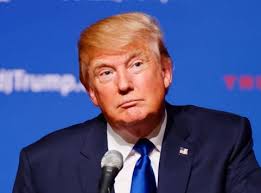
Donald Trump
Watching coverage of the pipe-bomb mailings on CNN, a viewer might be forgiven for mistaking this thinking this network for Fox News.
One commentator after another said, in effect, “The President doesn’t understand the power of his words—and that they can lead unstable people to violent action.”
On the contrary: Trump thoroughly understands the power of his words.
Syndicated columnist Mark Shields and New York Times columnist David Brooks addressed this issue on the May 27, 2016 edition of the PBS Newshour.
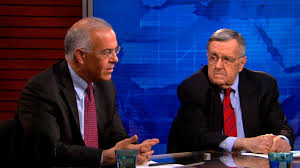
David Brooks and Mark Shields
MARK SHIELDS: “Donald Trump gratuitously slandered Ted Cruz’s wife. He libeled Ted Cruz’s father for being potentially part of Lee Harvey Oswald’s assassination of the president of the United States, suggesting that he was somehow a fellow traveler in that.
“This is a libel. You don’t get over it.”
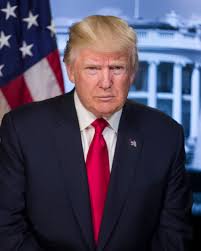
Donald Trump
DAVID BROOKS: “Trump, for all his moral flaws, is a marketing genius. And you look at what he does. He just picks a word and he attaches it to a person. Little Marco [Rubio], Lyin’ Ted [Cruz], Crooked Hillary [Clinton].
“And that’s a word. And that’s how marketing works. It’s a simple, blunt message, but it gets under.
“It sticks, and it diminishes. And so it has been super effective for him, because he knows how to do that. And she [Hillary Clinton] just comes with, ‘Oh, he’s divisive.’”
Hillary Clinton wasn’t the only Presidential candidate who proved unable to cope with Trump’s gift for insult. His targets—and insults—included:
- Former Texas Governor Rick Perry: “Wears glasses to seem smart.”
- Former Florida Governor Jeb Bush: “Low Energy Jeb.”
- Vermont U.S. Senator Bernie Sanders: “Crazy Bernie.”
- Ohio Governor John Kasich: “Mathematically dead and totally desperate.”
Trump fully understands the power of threats—and has made liberal use of them against both Republicans and Democrats.
On March 16, 2016, he warned Republicans that if he didn’t win the GOP nomination in July, his supporters would literally riot: “I think you’d have riots. I think you would see problems like you’ve never seen before. I think bad things would happen. I really do. I wouldn’t lead it, but I think bad things would happen.”
An NBC reporter summed it up as: “The message to Republicans was clear: ‘Nice convention you got there, shame if something happened to it.’”
Two years later, on August 27, 2018, Trump, meeting with Right-wing Christian leaders at the State Dining Room of the White House, warned of “violence” if Democrats won control of Congress in the upcoming midterm elections: “There is violence. When you look at Antifa—these are violent people.”
Trump also understands the value of having subordinates make inflammatory statements that serve his purposes.
On July 29, 2016, Roger Stone, a notorious Right-wing political consultant and Trump strategist, told Breitbart News: “The first thing Trump needs to do is begin talking about [voter fraud] constantly. If there’s voter fraud, this election will be illegitimate, the election of the winner will be illegitimate, we will have a constitutional crisis, widespread civil disobedience, and the government will no longer be the government.”
In short: This is not a case of careless language that is simply misinterpreted, with tragic results.
Donald Trump fully understands the constituency that he is trying to reach: Those masses of alienated, uneducated Americans who live only for their guns and hardline religious beliefs—and who can be easily manipulated by perceived threats to either.
He is the ultimate narcissist: “The show is Trump, and it is sold-out performances everywhere,” Trump told Playboy magazine in a 1990 interview.
After the bombing attempts, Trump stated: “In these times we have to unify.” But he is by nature a combative divider, not a conciliator. He is a nihilist, appealing to hatred, offering only destruction.
He’s 72, has often boasted of the joys of getting even, and he’s not going to change now.
As first-mate Starbuck says of Captain Ahab in Herman Melville’s classic novel, Moby Dick: “He is a champion of darkness.”
2016 PRESIDENTIAL CAMPAIGN, ABC NEWS, ALTERNET, AMERICAN NAZI PARTY, AP, BARACK OBAMA, BILL CLINTON, BILL MAHER, BLACKS, BOMBINGS, BRANDON VICTOR DIXON, BUZZFEED, CBS NEWS, CNN, CROOKS AND LIARS, DAILY KOZ, DAVID GERGEN, DONALD TRUMP, FACEBOOK, GREG GIANFORTE, HAMILTON (MUSICAL), HENRY 11, HENRY II, HILLARY CLINTON, JOE SCARBOROUGH, JOHN F. KENNEDY, JOHN GIELGUD, KU KLUX KLAN, MIKE PENCE, MOTHER JONES, MOVEON, MSNBC, NBC NEWS, NEWSWEEK, NPR, PBS NEWSHOUR, POLITICO, RAFAEL "TED" CRUZ, RAW STORY, REUTERS, SALON, SEATTLE TIMES, SLATE, THE ATLANTIC, THE CHICAGO SUN-TIMES, THE CHICAGO TRIBUNE, THE DAILY BEAST, THE GUARDIAN, THE HILL, THE HUFFINGTON POST, THE LOS ANGELES TIMES, THE NATION, THE NEW YORK TIMES, THE WASHINGTON POST, THOMAS BECKET, TIME, TWITTER, U.S. NEWS & WORLD REPORT, UPI, USA TODAY, WHITE SUPREMACISTS
In Bureaucracy, History, Law Enforcement, Politics, Social commentary on November 5, 2018 at 12:18 am
England’s King Henry II became infamous for his quick temper.
It was Henry who screamed, “Will no one rid me of this meddlesome priest?” And soon afterward, four of his barons rushed to Canterbury Cathedral and murdered Archbishop Thomas Becket.
Becket and Henry had been close friends for years. On the battlefield, Becket had routed Henry’s enemies in France.
And Henry had rewarded Becket’s loyalty by appointing him Chancellor of England.
But then Henry decided to negate the expanding power of the Catholic Church by appointing Becket Archbishop of Canterbury.

It was a mistake. The previously worldly Becket took his new duties seriously—and became the church’s foremost defender in England.
Henry believed it was a betrayal—and never forgave Becket.
Unable to convict the archbishop on trumped-up charges, Henry gave vent to his rage—and Becket died in a hail of sword-thrusts by the King’s barons.
Fast-forward to 2018—and America’s own version of Henry II (or Henry VIII): Donald Trump.
According to the The New York Times, during the 2016 Presidential campaign, Trump aimed nearly 4,000 tweets at 281 different targets.
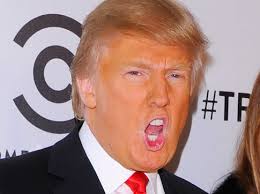
Donald Trump
His Twitter assaults often dominated entire news cycles for days on end.
As President-elect, he continued these assaults—such as the one on November 18, 2016.
On that evening, Vice President-elect Mike Pence attended a Broadway performance of the hit musical “Hamilton.”
After the curtain call, the actor Brandon Victor Dixon—who played Aaron Burr—respectfully addressed Pence:
“We are the diverse America who are alarmed and anxious that your new administration will not protect us, our friends, our children, our parents, or defend us and uphold our inalienable rights. But we truly hope that this show has inspired you to uphold our American values and to work on behalf of all of us.”
Dixon—who is black—was rightly alarmed.
Trump had received the open and enthusiastic support of the Ku Klux Klan, American Nazi Party and other white supremacist groups. Since his election, white thugs had assaulted blacks and other non-whites across the country.
Trump’s reaction to Dixon’s plea came in two Twitter rants:
“Our wonderful future V.P. Mike Pence was harassed last night at the theater by the cast of Hamilton, cameras blazing. This should not happen!”
And: “The Theater must always be a safe and special place. The cast of Hamilton was very rude last night to a very good man, Mike Pence. Apologize!”
Trump clearly didn’t care if some of his 55.3 million Twitter followers decided—like Henry’s barons—to “rid” him of “this meddlesome actor.” Or the whole “meddlesome cast” of “Hamilton.”
According to an October 16, 2018 story on CNN: Since taking office in January 2017, Trump has directly insulted, attacked or otherwise maligned more than 100 individuals on Twitter.
On February 17, 2017, Trump tweeted: “The FAKE NEWS media (failing @nytimes, @NBCNews, @ABC, @CBS, @CNN) is not my enemy, it is the enemy of the American People!”
On July 2, 2017, Trump tweeted a video showing him punching a man with the CNN logo superimposed on his head during a WWE wrestling match.
And on August 15, 2017, the President retweeted a cartoon photo of a “Trump Train” running over a CNN reporter.

Then there are his “hillbilly Nuremberg rallies,” as comedian Bill Maher put it.
During his 2016 run for the Presidency, Trump said at a rally in Cedar Rapids, Iowa: “If you see somebody getting ready to throw a tomato, knock the crap out of them, would you? Seriously, OK? Just knock the hell … I promise you I will pay for the legal fees. I promise, I promise.”
And on August 9, 2016, Trump told a rally in Wilmington, North Carolina: “Hillary [Clinton] wants to abolish, essentially abolish, the Second Amendment. If she gets to pick her [Supreme Court] judges, nothing you can do folks. Although the Second Amendment people, maybe there is, I don’t know.”
Thus, Trump encouraged gun fanatics to assassinate Clinton.
On October 18, 2018, appearing at a rally in Missoula, Montana, Trump celebrated Montana United States Senator Greg Gianforte’s 2017 physical assault on a reporter: “Any guy that can do a body slam, he is my type!”
From the outset of his campaign for President, Trump gave his opponents—Republican and Democrat—a series of disparaging nicknames. Among these:
- “Crooked Hillary” Clinton
- “Lyin’ Ted” Cruz
- “Psycho Joe” Scarborough
Besides inciting violence against his critics and opponents, Trump has repeatedly attacked their integrity and patriotism.
Trump mocked the wife of United States Senator Rafael “Ted” Cruz. He claimed that Cruz’s father had been a party to the assassination of President John F. Kennedy.
Throughout his run for President, Trump’s followers aimed the chant, “Lock her up!” at Democratic candidate Hillary Clinton. Yet Clinton has never been tried for a crime, let alone convicted of one.
At his rallies as President, Trump still encourages his followers to shout this chant.
Summing up Trump’s legacy of hatred, longtime Republican Presidential adviser David Gergen said:
“Trump unleashed the dogs of hatred in this country from the day he declared he was running for president, and they’ve been snarling and barking at each other ever since. It’s just inevitable there are going to be acts of violence that grow out of that.”
ABC NEWS, ALTERNET, AP, APACHES, BROCK PETERS, BUZZFEED, CBS NEWS, CHARLTON HESTON, CIVIL WAR, CNN, CROOKS AND LIARS, DAILY KOZ, FACEBOOK, INDIAN WARS, INDIANS, JAMES COBURN, JIM HUTTON, MAJOR DUNDEE, MEXICO, MICHAEL ANDERSON JR., MOTHER JONES, MOVEON, MOVIES, MSNBC, NBC NEWS, NEWSWEEK, NPR, PBS NEWSHOUR, POLITICO, RAW STORY, REUTERS, RICHARD HARRIS, SALON, SAM PECKINPAH, SAVING PRIVATE RYAN, SEATTLE TIMES, SLATE, SPANISH-AMERICAN WAR, STEVEN SPIELBERG, THE ATLANTIC, THE CHICAGO SUN-TIMES, THE CHICAGO TRIBUNE, THE DAILY BEAST, THE GUARDIAN, THE HILL, THE HUFFINGTON POST, THE LOS ANGELES TIMES, THE NATION, THE NEW YORK TIMES, THE WASHIGNTON POST, THE WASHINGTON POST, THE WILD BUNCH, TIME, TOM HANKS, TWITTER, U.S. NEWS & WORLD REPORT, UPI, USA TODAY, WESTERNS, WORLD WAR 1, WORLD WAR 11
In Entertainment, History, Military, Politics, Social commentary on November 2, 2018 at 12:06 am
Major Dundee is a 1965 Sam Peckinpah Western focusing on a Union cavalry officer (Charlton Heston) who leads a motley troop of soldiers into Mexico to rescue three children kidnapped by Apaches.
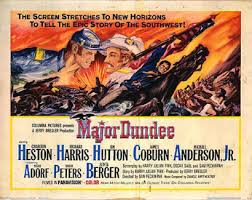
Along the way they liberate Mexican villagers and clash with French lancers trying to establish Mexico as a French colony under would-be emperor Archduke Maximilian 1.
The Wild Bunch is universally recognized as Peckinpah’s greatest achievement. It has certainly had a far greater impact on audiences and critics than Major Dundee. According to Heston, this was really the movie Peckinpah wanted to make while making Dundee, but he couldn’t quite get his mind around it.
As a result, Dundee’s virtues have been tragically overlooked. It has a larger cast of major characters than Bunch, and these are men an audience can truly like and identify with:
- The charm of Benjamin Tyreen (Richard Harris), a Confederate lieutenant forced into Union service;
- The steady courage of Sergeant Gomez;
- The quiet dignity of Aesop (Brock Peters), a black soldier;
- The quest for maturity in young, untried bugler Tim Ryan (Michael Anderson, Jr.);
- The on-the-job training experience of impetuous Lt. Graham (Jim Hutton); and
- The stoic endurance of Indian scout Sam Potts (James Coburn).
These men are charged with a dangerous and dirty mission, and do it as well as they can, but you wouldn’t fear inviting them to meet your family.
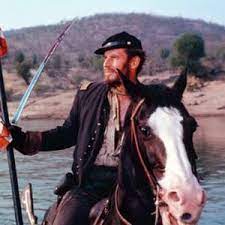
Major Dundee (Charlton Heston)
That was definitely not the case with The Wild Bunch, four hardened killers prepared to rip off anyone, anytime, and leave a trail of bodies in their wake. The only place where you would have felt safe seeing them, in real-life, was behind prison bars.
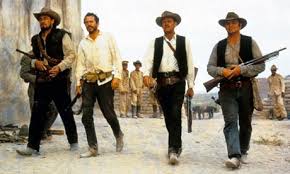
The Wild Bunch
Dundee is an odyssey movie, in the same vein as Saving Private Ryan. Both films start with a battle, followed by the disappearance of characters who need to be searched for and brought back to safety.
Just as Dundee assembles a small force to go into Mexico, so, too, does Captain John Miller (Tom Hanks) do the same, with his hunting ground being France.
Dundee’s men retrieve the kidnapped children and survive a near-fatal battle with Indians. Miller’s men twice clash with the Germans before finding their quarry, James Ryan.
Before Dundee can return to the United States, he must face and defeat a corps of French soldiers. Before Miller can haul Ryan back to safety, he must repulse a German assault.
Both groups of soldiers—Dundee’s and Miller’s—are transformed by their experiences in ways neither group could possibly articulate. (Miller, being a highly literate schoolteacher, would surely do a better job of this than the tight-jawed Dundee.)
Dundee’s soldiers return to a United States that’s just ended its Civil War with a Union victory—and the death of slavery. Miller’s soldiers return to a nation that is now a global superpower.
Of course, Ryan was fortunate in having Steven Spielberg as its director. With his clout, there was no question that Ryan would emerge as the film he wanted.
Peckinpah lacked such clout. And he fought with everyone, including the producer, Jerry Bressler, who ultimately held the power to destroy his film. This guaranteed that his movie would emerge far differently than he had envisioned.
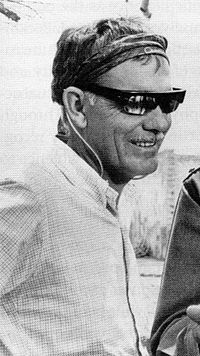
Sam Peckinpah
In 2005, an extended version of Dundee was released, featuring 12 minutes of restored footage. (Much of the original footage was lost after severe cuts to the movie.)
In this new version, we fully see how unsympathetic a character the martinet Dundee really is. Owing to Heston’s career of playing heroes—such as Moses and El Cid—it’s easy to overlook Dundee’s arrogance and lethal fanaticism and automatically view him as a hero.
If he is indeed that, he is a hero with serious flaws.
And his self-imposed mission poses questions for us today:
- Where is the line between professional duty and personal fanaticism?
- How do we balance the success of a mission against its potential costs—especially if they prove appalling?
- At what point—if any—does personal conscience override professional obligations?
Whether intentionally or not, in Major Dundee, Peckinpah laid out a microcosm of the American history that would immediately follow the Civil War.
Former Confederates and Unionists would forego their regional animosities and fight against a recognized mutual enemy—the Indians. This would prove a dirty and drawn-out war, stripped of the glory and (later) treasured memories of the Civil War.
Just as Dundee’s final battle with French lancers ended with an American victory won at great cost, so, too, would America’s forays into the Spanish-American War and World Wars 1 and 11 prove the same.
Ben Tyreen’s commentary on the barbarism of French troops (“Never underestimate the value of a European education”) would be echoed by twentieth-century Americans uncovering the horrors of Dachau and Buchenwald.
And America would learn to project its formidable military power at great cost. Toward the end of the movie, Teresa Santiago (Senta Berger), the ex-patriot Austrian widow, would ask Dundee: “But who do you answer to?”
It is a question that still vividly expresses the view of the international community as this superpower colossus hurtles from one often-disastrous conflict to the next.
2016 PRESIDENTIAL CAMPAIGN, ABC NEWS, ADOLF HITLER, ALTERNET, AP, BORDER WALL, BRETT KAVANAUGH, BUZZFEED, CBS NEWS, CHRISTINE BLASEY FORD, CIA, CNN, CROOKS AND LIARS, DAILY KOZ, DEMOCRATS, DONALD TRUMP, EL SALVADOR, FACEBOOK, FRANZ HALDER, GUATEMALA, HERMANN GORING, HONDURAS, illegal immigration, immigration, ISTANBUL, JAMAL KHASHOGGI, JAMES COMEY, JON TESTER, MARINUS VAN DER LUBBE, MATT ROSENDALE, MIGRANT CARAVAN, MOTHER JONES, MOVEON, MSNBC, NATIONAL STUDENT ASSOCIATION, NAZI GERMANY, NBC NEWS, NEWSWEEK, NPR, PAUL VON HINDENBURG, PBS NEWSHOUR, POLITICO, RAW STORY, REICHSTAG FIRE, REICHSTAG FIRE DECREE, REPUBLICANS, REUTERS, ROBERT S. MUELLER, SALON, SAUDI ARABIA, SAUDI CONSULATE, SEATTLE TIMES, SLATE, TERRORISM, THE ATLANTIC, THE CHICAGO SUN-TIMES, THE CHICAGO TRIBUNE, THE DAILY BEAST, THE GUARDIAN, THE HILL, THE HUFFINGTON POST, THE LOS ANGELES TIMES, THE NATION, THE NEW YORK TIMES, THE RISE AND FALL OF THE THIRD REICH (BOOK), THE WASHINGTON POST, TIME, TWITTER, U.S. NEWS & WORLD REPORT, UNITED STATES SUPREME COURT, UPI, USA TODAY, WEIMAR REPUBLIC, WILLIAM L. SHIRER
In Bureaucracy, History, Law, Law Enforcement, Politics, Social commentary on October 25, 2018 at 12:15 am
The parallels between the Nazi party and the administration of Donald Trump continue to mount.
On January 30, 1933, Adolf Hitler was appointed Chancellor of Germany. Less than one month later, a fire gave him unprecedented control over the country.
At about 9 p.m. on February 27, a fire erupted within the Reichstag building, home of the German parliament. By 11:30, the Berlin Fire Department had put out the fire—but most of the building had already been gutted.

Reichstag fire
The next day, at Hitler’s request, President Paul von Hindenburg signed the Reichstag Fire Decree into law, citing Article 48 of the Weimar Republic Constitution.
This suspended most civil liberties in Germany, including:
- Freedom of speech
- Freedom of the press
- The right to free association and public assembly
- Habeas corpus and
- Secrecy of the mails and telephone.
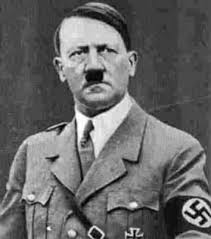
Adolf Hitler
These rights were not restored until Nazi Germany collapsed in May, 1945.
Marinus van der Lubbe, a Duitch council communist, was found near the building and claimed that he, acting alone, had set the fire. He was convicted of setting the fire and sent to the guillotine on January 10, 1934.
The Nazis charged that Van der Lubbe was part of a Communist conspiracy to burn down the Reichstag and seize power.
Many foreign journalists—such as William L. Shirer (later author of The Rise and Fall of the Third Reich) believed the Nazis had set the fire. This suspicion was given added weight during the Nuremberg war crimes trials.
General Franz Halder, who had often clashed with Hitler over military strategy, stated in an affidavit that Hermann Goering, Hitler’s right-hand man, had boasted about setting the fire:
“On the occasion of a lunch on the Führer’s birthday [on April 20] in 1943, the people around the Führer turned the conversation to the Reichstag building and its artistic value.
“I heard with my own ears how Goering broke into the conversation and shouted: ‘The only one who really knows about the Reichstag building is I, for I set fire to it.’ And saying this he slapped his thigh.”
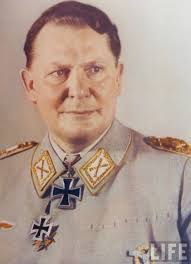
Herman Goering
Goering dismissed Halder’s accusation as “utter nonsense.”
Now, fast forward to 2018—and a caravan of 7,000 migrants from Honduras, Guatemala and, El Salvador determinedly heading for the United States border.
Their goal: To illegally enter the United States, claiming they are victims of poverty and violence.
For President Donald Trump, this comes at an ideal time. He has made illegal immigration his Number One hot button issue. And he needs one.
- He is currently under investigation by Special Counsel Robert Mueller for documented ties between his 2016 Presidential campaign and Russian Intelligence agents.
- His nominee for the United States Supreme Court, Brett Kavanaugh, was confirmed despite being charged as an alleged rapist.
- He has hurled numerous slanders against women—including the woman, Christine Blasey Ford, who accused Kavanaugh of trying to rape her at a party in 1982.
- On October 2, Saudi journalist Jamal Khashoggi was brutally murdered at the Saudi consulate in Istanbul, Turkey. Instead of voicing outrage at this butchery, Trump sided with the patently false claims of the Saudi regime.
Donald Trump
On October 18, Trump appeared at a campaign rally at Missoula, Montana, on behalf of Republican Matt Rosendale against Democratic Senator Jon Tester.
Trump—never one to tell the truth when a lie seems better—charged:
- “Democrats are paying members of the caravan to try and get into the United States to harm Republicans in the midterms.”
- “But a lot of money has been passing to people to come up and try and get to the border by Election Day, because they think that’s a negative for us. Number one, they’re being stopped. And number two, regardless, that’s our issue.”
- “The one thing, they stick together, but they wanted that caravan and there are those that say that caravan didn’t just happen. It didn’t just happen. A lot of reasons that caravan, 4,000 people.”
He has offered absolutely no proof to back up any of these slanders.
But there is another possibility to explain the timing of the caravan: That Republican—or at least Right-wing—operatives have funneled money and organizational support to its organizers.
For the moment, there is no proof that the Right is involved.
But there’s also no proof that it isn’t.
And the CIA is notorious for secretly financing a large number of “left-wing” organizations that exist to discredit left-wing interests. Among these: The National Student Association in the United States and many socialist European unions.
Just as it suited Adolf Hitler’s purposes for the Reichstag to catch fire, so, too, does it suit Trump’s to have a caravan of thousands of Central Americans marching toward the United States border:
- He’s using the caravan to stir up the Republican base in the midterm elections.
- He’s using the caravan to divert attention from his and his party’s embarrassing actions.
- He has accused Democrats of somehow organizing the caravan
- He’s charged that gang members and Middle Eastern terrorists are among its members.
- He’s using the caravan to rally support for stricter immigration laws, including funding for his border wall.
Thus, Democrats have nothing to gain by sponsoring hordes of marchers. But the Right has plenty.
2016 PRESIDENTIAL CAMPAIGN, ABC NEWS, ADOLF HITLER, ALTERNET, AP, BARACK OBAMA, BULLYING, BURT LANCASTER, BUZZFEED, CBS NEWS, CIA, CNN, CROOKS AND LIARS, DAILY KOZ, DONALD TRUMP, FACEBOOK, FASCISM, FBI, HELSINKI PRESS CONFERENCE, HILLARY CLINTON, HUMAN RIGHTS CAMPAIGN (HRC), IMMIGRATION AND CUSTOMS ENFORCEMENT (ICE), JAMES COMEY, JEFF SESSIONS, JOHN F. KENNEDY, JUDGMENT AT NUREMBERG, LYING, MAIN INTELLIGENCE DIRECTORATE, MOTHER JONES, MOVEON, MSNBC, NAZI GERMANY, NBC NEWS, NEWSWEEK, NPR, PBS NEWSHOUR, POLITICO, RACISM, RAFAEL "TED" CRUZ, RAW STORY, REPUBLICANS, REUTERS, ROBERT S. MUELLER, RUSSIA, SALON, SEATTLE TIMES, SERGEY KISLYAK, SLATE, SPENCER TRACY, THE ATLANTIC, THE CHICAGO SUN-TIMES, THE CHICAGO TRIBUNE, THE DAILY BEAST, THE GUARDIAN, THE HILL, THE HUFFINGTON POST, THE LOS ANGELES TIMES, THE NATION, THE NEW YORK TIMES, THE WASHINGTON POST, TIME, TWITTER, U.S. NEWS & WORLD REPORT, UNITE THE RIGHT RALLY, UPI, USA TODAY, VLADIMIR PUTIN, WIRETAPPING
In Bureaucracy, Entertainment, History, Law Enforcement, Politics, Social commentary on October 24, 2018 at 12:12 am
Those who have seen the classic 1960 movie, “Judgment at Nuremberg,” will remember its pivotal moment.
That’s when Burt Lancaster, as Ernst Janning, the once distinguished German judge, confesses his guilt and that of Nazi Germany in a controlled, yet emotional, outburst.
Addressing the court—presided over by Chief Judge Dan Haywood (Spencer Tracy)—Janning explains the forces that led to the triumph of evil.

It’s not hard to imagine, in the future, an equally conscience-stricken member of the Donald Trump administration, standing before the bar of justice, making a similar statement:
“My counsel would have you believe we were not aware of the ICE concentration camps. Not aware. Where were we?
“Where were we when Trump began shrieking his hate across the country? When Trump called our free press ‘the enemy of the people’?
“Where were we when Trump openly praised Vladimir Putin and attacked those in the FBI, CIA and other Intelligence agencies sworn to protect us?
“Where were we when the victims of Trump’s hatred cried out in the night to us? Were we deaf? Dumb? Blind?
“My counsel says we were not aware of Trump’s treasonous collusion with Vladimir Putin—and his intention to betray American freedoms in exchange for the Presidency. He would give you the excuse we were misled by the lying rhetoric coming out of the White House.
“Does that make us any the less guilty? Maybe we didn’t know the details, but if we didn’t know, it was because we didn’t want to know.”
Consider Trump’s effect on:
Race relations:
- Since Trump’s election, attacks on non-whites by Right-wing—and white—Trump supporters have increased. According to The Human Rights Campaign (HRC), there has been a rapid increase in youth bullying during and since the 2016 campaign:
- “The bullying effects of the Trump presidency—dubbed the Trump effect—are devastating, particularly when it comes to bullying of minority groups, especially those who are easily identifiable and/or who are singled out by the president’s statements or actions.”
- On August 11-12, 2017, white supremacists from across the country gathered in Charlottesville, Virginia, for a “Unite the Right” rally. On August 13, a Nazi sympathizer rammed his car into a group of counter-protesters, killing a woman and injuring 19 other demonstrators.
- Refusing to condemn the Fascistic demonstrators, Trump said: “We condemn in the strongest possible terms this egregious display of hatred, bigotry and violence on many sides, on many sides.”
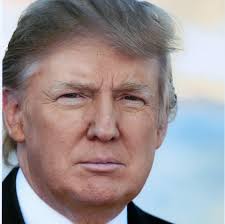
Donald Trump
The rule of law:
- On May 9, 2017, Trump fired FBI Director James Comey, who was conducting an FBI investigation into well-documented contacts between Trump’s 2016 Presidential campaign and Russian Intelligence agents.
- Trump has repeatedly and publicly attacked his own Attorney General, Jeff Sessions, for recusing himself from the above-mentioned investigation. (Sessions did so because of his own documented ties with Russian Ambassador Sergey Kislyak.)
- Trump has repeatedly attacked the integrity of Special Counsel Robert S. Mueller, who has continued the FBI’s probe into ties between Russia and Trump’s 2016 Presidential campaign.
- Trump has called on Sessions to investigate “all of the corruption” of Trump’s critics and those investigating him, including Hillary Clinton, James Comey, and Special Counsel Robert Mueller.
- In short: He wants to use the FBI as his private secret police against anyone who has ever criticized, investigated or run against him.
Trump as liar:
- From 2011 to 2016, Trump falsely accused Barack Obama as being born in Kenya, not—as evidence proves—Hawaii. This was an effort to de-legitimize Obama as President of the United States.
- During the 2016 Presidential campaign, Trump falsely accused the father of his political rival, Texas United States Senator Rafael “Ted” Cruz, of being a party to the assassination of President John F. Kennedy.
- After taking office Trump falsely accused former President Obama of illegally wiretapping him at Trump Tower.
- By August 1, 2018, the Washington Post reported that Trump had made 4,229 false or misleading statements since taking office.
Trump as traitor:
- Trump has repeatedly praised Russian President Vladimir Putin, both during his Presidential candidacy and since taking office. In fact, Putin remains the only major public figure that Trump has never criticized.
- On July 22, 2016, Trump said at a press conference in Doral, Florida: “Russia, if you are listening, I hope you are able to find the 33,000 emails that are missing [from Democratic Presidential candidate Hillary Clinton’s computer]. I think you will probably be rewarded mightily by our press.”
- Hours later, the Main Intelligence Directorate in Moscow targeted Clinton’s personal office and hit more than 70 other Clinton campaign accounts.
- On July 16, 2018, President Trump attended a press conference in Helsinki, Finland, with Russian President Vladimir Putin. There he sided with Putin against American Intelligence agencies—such as the FBI, CIA and National Security Agency—for Russia’s subversion of the 2016 Presidential election:
- “I have President Putin. He just said it’s not Russia. I will say this: I don’t see any reason why it would be, but I really do want to see the server.”
Since 1945, historians have brutally condemned the vicious and destructive reign of Adolf Hitler and those who supported him.
Future historians will condemn just as harshly the equally vicious and destructive reign of Donald Trump—and those who now support him.
9/11 ATTACKS, ABC NEWS, ALTERNATIVE ENERGY SOURCES, ALTERNET, AP, ARAB OIL EMBARGO, BBC, BUZZFEED, CBS NEWS, CHRISTIAN RIGHT, CNN, COLD WAR, CROOKS AND LIARS, DAILY KOS, DAILY KOZ, DONALD TRUMP, EGYPT, FACEBOOK, FOSSIL FUELS, GLOBAL WARMING, IRAN, IRAQ, ISLAM, ISRAEL, JAMAL KHASHOGGI, MECCA, MEDINA, MIDDLE EAST, MOHAMMED BIN SALMAN, MOTHER JONES, MOVEON, MSNBC, NAZI GERMANY, NBC NEWS, NEWSWEEK, NPR, Oil, OSAMA BIN LADEN, PBS NEWSHOUR, POLITICO, RAW STORY, REPUBLICANS, REUTERS, SALON, SAND CURTAIN, SAUDI ARABIA, SEATTLE TIMES, SECOND COMING, SHAH OF IRAN, SHIITE MUSLIMS, SLATE, SOVIET UNION, SUNNI MUSLIMS, TERRORISM, THE ATLANTIC, THE CHICAGO SUN-TIMES, THE CHICAGO TRIBUNE, THE DAILY BEAST, THE GUARDIAN, THE HILL, THE HUFFINGTON POST, THE LOS ANGELES TIMES, THE NATION, THE NEW YORK TIMES, THE WALL STREET JOURNAL, THE WASHINGTON POST, TIME, TRUMP WORLD TOWER, TURKEY, TWITTER, U.S. NEWS & WORLD REPORT, UNITED STATES, UPI, USA TODAY, VENEZUELA, WAHHABISM, WORLD WAR ii
In Bureaucracy, History, Military, Politics, Social commentary on October 23, 2018 at 1:09 am
This is an ideal time for the United States to pull the plug on its devil’s bargain relationship with Saudi Arabia.
Reason #1: The political assassination of Saudi dissident journalist Jamal Khashoggi, a key critic of Saudi King Mohammed bin Salman.
On October 2, Khashoggi walked into the Saudi Consulate in Istanbul to pick up a document allowing him to marry a Turkish woman. Video footage shows Khashoggi walking into the consulate; there is none of him leaving it.
He has not been seen since.
According to Turkish government officials:
- Fifteen Saudi agents flew into Istanbul.
- They waited for Khashoggi inside the consulate and murdered him within two hours of his arrival.
- The assassins used a bone saw to dismember Khashoggi’s corpse.

Jamal Khashoggi
[GFDL (http://www.gnu.org/copyleft/fdl.html)%5D, via Wikimedia Commons
Reason #2: Saudi Arabia is a weak ally.
Trump claims America needs Saudi Arabia as a counter-weight to the growing regional influence of Iran. But Saudi Arabia was unable to defend itself against Saddam Hussein’s Iraq in 1990, after the invasion and takeover of Kuwait.
This was, in fact, why Saudi-born Osama bin Laden decided to declare war on the United States.
He petitioned Saudi King Fahd bin Abdulazis al-Saud to let Saudis oppose any invasion by Iraq. He argued that “infidel” American soldiers stationed in the Kingdom would “pollute” Islam’s two great holy sites: Mecca and Medina.
Having fought against the Soviet Union in Afghanistan during the 1980s, bin Laden offered to help defend Saudi Arabia with his Arab legion.
The king refused—because he knew that, despite all the sophisticated military hardware he had bought from the United States, the Saudis were too militarily weak to resist an invasion.
Bin Laden left the country to wage fulltime war against the United States.
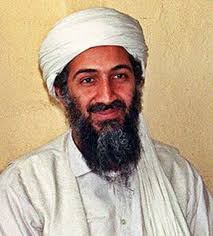
Osama bin Laden
Reason #3: Saudi Arabia is filled with Islamics who hate the United States as “the Great Satan.”
Fifteen of the 19 September 11, 2001 highjackers came from Saudi Arabia.
And Saudi Arabia is the birthplace of Wahhabism, a radical brand of Islam dedicated to “purifying” the world of “unbelievers.”
Reason #4: The only reason the United States cares about Saudi Arabia is that it’s the second-largest oil-producing country (after Venezuela) n the world.
Yet oil consumption threatens the future of the world through global warming. And it keeps America tethered to a regime that is fundamentally unstable and hostile to the West.
Reason #5: The United States can end its dependence on Saudi oil by embarking on a crash program to develop alternatives to oil.
Had this happened during the 1973 Arab oil embargo, the United States would now be energy-independent. America has the technology to do so; it lacks only the will.
Reason #6: Once the United States no longer needs fossil fuels, it can quit financing Middle East dictatorships.
This will end spending billions of dollars every year to prop up dictatorial regimes like those in Saudi Arabia, Iraq and Egypt. America will no longer supply big-ticket military hardware (like fighter planes and missiles) to potentially hostile Islamic regimes.
Reason #7: By withdrawing from the Middle East, the United States can free itself of the burden of acting as Israel’s permanent bodyguard.
Millions of Americans believe they are morally obligated to defend Israel owing to the barbarism of the Holocaust. But America was never a party to this, and has nothing to atone for.
Yet, for decades, the United States has been repeatedly dragged into the never-ending religious conflicts between Israelis and Islamics. Since both sides believe they are doing “God’s will,” there can be no substantial compromise by either.
Reason #8: The United States and its European allies can defend themselves against Islamic terrorism by erecting a “Sand Curtain” around the Middle East.
For 44 years—1947 to 1991—the United States and the Soviet Union were locked in a Cold War. Essentially, the United States drew a ring around the Soviet Union—including those nations its armies had seized following the defeat of Nazi Germany in 1945.
The United States said, in effect: “We can’t liberate the countries you’re now occupying”—because that would have triggered a nuclear World War III. “But we won’t allow you to occupy and enslave any other countries. And if you try to do so, it will mean total war.”
America could withdraw all of its forces from the Middle East—but keep a good portion stationed in Europe.

It could then publicly announce: “From now on, you are the masters of your own destinies—so long as what you do affects only the Middle East.
“We recognize that barbarism and violence have always been a part of life in the Middle East. And we don’t expect this to change.
“We realize you will destroy as many of your own citizens as you can—because they’re Jewish or Christians, or because Sunni Muslims and Shiite Muslims hate each other.
“Just don’t threaten citizens living outside your territories. In short: Europe and the United States are strictly off-limits to you.
“And if you aim your aggression at either, we will consider this an act of war and use all the weapons at our disposal—including nuclear ones—to wipe you from the face of the Earth.“
2016 PRESIDENTIAL ELECTION, ABC NEWS, ALTERNET, AP, BERNIE SANDERS, BRETT KAVANAUGH, BUZZFEED, CBS NEWS, CHRISTINE BLASEY FORD, CNN, CROOKS AND LIARS, DAILY KOZ, DEMOCRATIC NATIONAL COMMITTEE, DONALD TRUMP, FACEBOOK, HILLARY CLINTON, IVANKA TRUMP, JAMAL KHASHOGGI, MARCO RUBIO, MOHAMMED BIN SALMAN, MOTHER JONES, MOVEON, MSNBC, NBC NEWS, NEWSWEEK, NPR, PBS NEWSHOUR, POLITICO, RAW STORY, REPUBLICANS, REUTERS, SALON, SAUDI ARABIA, SEATTLE TIMES, SLATE, THE ATLANTIC, THE CHICAGO SUN-TIMES, THE CHICAGO TRIBUNE, THE DAILY BEAST, THE GUARDIAN, THE HILL, THE HUFFINGTON POST, THE LOS ANGELES TIMES, THE NATION, THE NEW YORK TIMES, THE WASHINGTON POST, TIME, TRUMP WORLD TOWER, TURKEY, TWITTER, U.S. NEWS & WORLD REPORT, UNITED STATES SUPREME COURT, UPI, USA TODAY
In Bureaucracy, Business, History, Law Enforcement, Military, Politics, Social commentary on October 18, 2018 at 12:03 am
Once again, the self-righteous cry of “American exceptionalism” is being taken up by members of the United States Congress.
That is: Americans prize morality over money in international relationships.
It’s a myth the historical record won’t support.
The reason for the self-righteous outrage: The disappearance of Saudi dissident Jamal Khashoggi.
He had worked in the Saudi embassies in Washington and London, establishing himself as an unofficial spokesman for the Saudi royal family.
His independent streak and empathy for the Western perspective made him a uniquely important, well-liked contact for foreign journalists and diplomats seeking to understand the royal perspective.
Then, in 2017, Mohammed bin Salman became crown prince, and quickly consolidated power over the kingdom.
Khashoggi’s independent streak made him unwelcome there, so he moved to Virginia and became a columnist for The Washington Post. He also became the crown prince’s chief critic in the West.
On October 2, Khashoggi walked into the Saudi Consulate in Istanbul to pick up a document.
Khashoggi’s marriage had ended under the strain of his voluntary exile from Saudi Arabia. He had since become engaged to a Turkish woman. He thus needed to obtain a document attesting to his divorce from the Saudi authorities so he could remarry in Turkey. The wedding was scheduled for the following day.
Jamal Khashoggi
[GFDL (http://www.gnu.org/copyleft/fdl.html)%5D, via Wikimedia Commons
Turkish authorities have released video footage of Khashoggi walking into the consulate; they say there is none of him leaving it. The Saudis insist that he left the consulate safely, but have not offered any evidence to support this claim.
Turkish officials speaking anonymously say their government has detailed evidence to prove the following:
- That 15 Saudi agents flew into Istanbul on two private jets.
- The airline company has close ties to the crown prince and Saudi Interior Ministry.
- The agents waited for Khashoggi inside the consulate and murdered him within two hours of his arrival.
- The assassins used a bone saw to dismember Khashoggi’s corpse.
These reports have ignited an explosion of “American exceptionalism” among members of Congress—including Republicans.
“I believe the Trump administration will do something,” Florida United States Senator Marco Rubio said. “The president has said that. But, if he doesn’t, Congress will. That, I can tell you with 100 percent certainty.”
And Vermont Senator Bernie Sanders said: “I think one of the strong things that we can do is not only stop military sales, not only put sanctions on Saudi Arabia, but most importantly, get out of this terrible, terrible war in Yemen led by the Saudis.”
Fueling Republicans’ declared outrage: President Donald Trump’s heated defense of the Saudis—with whom he’s long had a financially profitable relationship.
“They buy all sorts of my stuff,”‘ Trump said in July 2015. “All kinds of toys from Trump. They pay me millions and hundreds of millions.”
Donald Trump
Among those “toys”:
- In June 2001, he sold the 45th floor of Trump World Tower to the Kingdom of Saudi Arabia for $4.5 million, according to a publicly filed deed for the transaction.
- In August 2015, two months after he launched his presidential campaign, Trump registered eight limited-liability companies that appeared tied to possible deals in the country, according to public records. All of the companies contained “Jeddah,” the name of a Saudi Arabian port city, in their title.
- In 2015, Trump’s daughter Ivanka told Hotelier Middle East, “Dubai is a top priority city for us. We are looking at multiple opportunities in Abu Dhabi, in Qatar, in Saudi Arabia, so those are the four areas where we are seeing the most interest. We haven’t made a final decision in any of the markets but we have many very compelling deals in each of them.”
Of course, Trump is now claiming a higher motive for siding with the Saudis. He doesn’t want to scuttle a major defense deal he made with Saudi Arabia in May, 2017:
“I don’t like the concept of stopping an investment of $110 billion into the United States because you know what they’re going to do, they’re going to take that money and spend it in Russia or China,”
And the next day, Trump said he had spoken with Saudi King Salman: “The king firmly denied any knowledge of it. … It sounded to me like these could have been rogue killers, who knows?”
This is comparable to Trump’s refusal, during his first debate with Hillary Clinton in September, 2016, to admit Russian hacking of the 2016 Democratic National Committee: “It could be Russia, but it could also be China. It could also be lots of other people. It also could be somebody sitting on their bed that weighs 400 pounds.”
“Here we go again with you know you’re guilty until proven innocent. I don’t like that,” said Trump on October 16.
“We just went through that with [Supreme Court nominee] [Brett] Kavanaugh and he was innocent all the way as far as I’m concerned.”
Factual note: Although confirmed as a Supreme Court Justice, Kavanaugh was not proven innocent. The FBI was not allowed to interview Kavanaugh and Christine Blasey Ford, the woman who accused him of attempted rape 36 years ago.
ABC NEWS, AL QAEDA, ALTERNET, AMERICAN EXCEPTIONALISM, AP, BARACK OBAMA, BASHIR AL-ASSAD, BUZZFEED, CBS NEWS, CHILE, CNN, CROOKS AND LIARS, DAILY KOZ, FACEBOOK, HOUSE UN-AMERICAN ACTIVITIES COMMITTEE, HUMAN RIGHTS, IRAN, JOHN BOEHNER, JOHN MCCAIN, MOTHER JONES, MOVEON, MSNBC, NBC NEWS, NEWSWEEK, NICARAGUA, NPR, PBS NEWSHOUR, POLITICO, RAW STORY, REUTERS, RUSSIA, S.I. HAYAKAWA, SALON, SEATTLE TIMES, SLATE, SYRIA, THE ATLANTIC, THE CHICAGO SUN-TIMES, THE CHICAGO TRIBUNE, THE DAILY BEAST, THE GUARDIAN, THE HILL, THE HUFFINGTON POST, THE LOS ANGELES TIMES, THE NATION, THE NEW YORK TIMES, THE WALL STREET JOURNAL, THE WASHINGTON POST, TIME, TWITTER, U.S. NEWS & WORLD REPORT, UPI, USA TODAY, VLADIMIR PUTIN
In Bureaucracy, History, Military, Politics, Social commentary on October 17, 2018 at 12:21 am
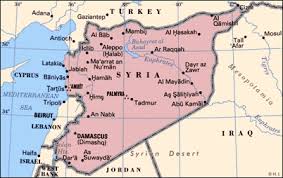
On September 11, 2013, the New York Times published an Op-Ed (guest editorial) from Russian President Vladimir Putin, entitled: “A Plea for Caution from Russia: What Putin Has to Say to Americans About Syria.”
No one should be surprised that Putin came out strongly against an American air strike on Syria.
Its “President” (i.e., dictator) Bashir al-Assad, is, after all, a close ally of Russia. Just as his late father and dictator, Hafez al-Assad, was a close ally of the Soviet Union until its collapse in 1991.
Putin, of course, is a former member of the KGB, the infamous secret police which ruled the Soviet Union from its birth in 1917 to its collapse in 1991.
He grew up under a Communist dictatorship and clearly wishes to return to that era, saying publicly: “First and foremost it is worth acknowledging that the demise of the Soviet Union was the greatest geopolitical catastrophe of the century.”
So it would be unrealistic to expect him to view the current “Syria crisis” the same way that President Barack Obama did.
(A “crisis” for politicians is any event that can be exploited to increase their own status—and thus power. Few politicians really care about the “human rights” of other nations—unless promoting this issue can empower themselves and/or their own nation.
(President Ronald Reagan, for example, often wailed about the Soviets’ oppression of the Polish union, Solidarity—while firing hundreds of unionized air traffic controllers who went on strike.)
(A “crisis” for the media is any event that can be exploited for higher ratings.)
In his September 11, 2013 guest editorial in the New York Times, Putin offered the expected Russian take on Syria:
- Poison gas was used in Syria.
- It wasn’t used by the Syrian Army.
- It was used by “opposition forces, to provoke intervention by their powerful foreign patrons.”
But it was the concluding paragraph that enraged American politicians the most—especially Right-wing ones. In it, Putin took exception with American “exceptionalism.”
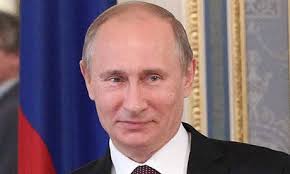
Vladimir Putin
This is the belief that the United States is unlike other nations. That it is unlike other nations in its innocence and steadfast dedication to human rights above all else.
Citizens of nations whose governments have been overthrown by the United States—such as Chile, Iran and Nicaragua—and replaced with brutal dictatorships would strongly disagree.
Referring to then-President Obama, Putin wrote:
“And I would rather disagree with a case he made on American exceptionalism, stating that the United States’ policy is ‘what makes America different. It’s what makes us exceptional.’
“It is extremely dangerous to encourage people to see themselves as exceptional, whatever the motivation.
“There are big countries and small countries, rich and poor, those with long democratic traditions and those still finding their way to democracy. Their policies differ, too.
“We are all different, but when we ask for the Lord’s blessings, we must not forget that God created us equal.”
Putin has never publicly shown any interest in religion. But by invoking “the Lord,” he was able to turn the Christian beliefs of his Western audience into a useful weapon.
“I was insulted,” then-House Speaker John Boehner (R-Ohio) told reporters when asked for his blunt reaction to the editorial.
“I have to be honest with you, I was at dinner, and I almost wanted to vomit,” said U.S. Senator Bob Menendez (D-New Jersey).
Putin had dared to question the self-righteousness of American foreign policy—and those who make it.
Making his case for war with Syria, Obama had said: “America is not the world’s policeman….
“But when, with modest effort and risk, we can stop children from being gassed to death, and thereby make our own children safer over the long run, I believe we should act.
“That’s what makes America different. That’s what makes us exceptional. With humility, but with resolve, let us never lose sight of that essential truth.”
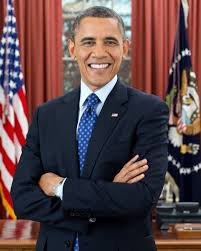
President Barack Obama
In short: Because we consider ourselves “exceptional,” we have the divine right to do whatever we want.
It’s not necessary to see Putin as a champion of democracy (he isn’t) to see the truth in this part of his editorial: “It is extremely dangerous to encourage people to see themselves as exceptional, whatever the motivation.”
From 1938 to 1969, the House Un-American Activities Committee sought to define what was “American” and what was “Un-American.” As if “American” stood for all things virtuous.
Whoever heard of an “Un-French Activities Committee”? Or an “Un-German” or “Un-British” one?
The late S.I. Hayakawa once made an observation that clearly applies to this situation.
Hayakawa was a professor of semantics (the study of meaning, focusing on the relation between words and what they stand for).
In his bestselling book, Language in Thought and Action, he observed that when a person hears a message, he has four ways of responding to it:
- Accept the speaker and his message.
- Accept the speaker but reject the message.
- Accept the message but reject the speaker.
- Reject the message and the speaker.
Americans might want to consider #3 in the recent case of Russian President Vladimir Putin.
ABC NEWS, ALTERNET, AMERICAN EMPIRE, AP, BILL CLINTON, BUREAUCRACY, BUZZFEED, CBS NEWS, CHRIS MATHEWS, CNN, CROOKS AND LIARS, DAILY KOZ, DONALD TRUMP, DWIGHT EISENHOWER, FACEBOOK, FBI, FRANKLIN D. ROOSEVELT, GEORGE H.W. BUSH, GEORGE W. BUSH, GERALD R. FORD, HARRY S. TRUMAN, JEB BUSH, JIMMY CARTER, JOHN F. KENNEDY, LYNDON B. JOHNSON, MOTHER JONES, MOVEON, MSNBC, NBC NEWS, NEWSWEEK, NIGEL HAMILTON, NPR, PBS NEWSHOUR, POLITICO, RAW STORY, REPUBLICAN PARTY, REUTERS, SALON, SEATTLE TIMES, SLATE, SUETONIUS, SYRIAN CIVIL WAR, SYRIAN REFUGEES, TERRORISM, THE ATLANTIC, THE CHICAGO SUN-TIMES, THE CHICAGO TRIBUNE, THE DAILY BEAST, THE GUARDIAN, THE HILL, THE HUFFINGTON POST, THE LOS ANGELES TIMES, THE NATION, THE NEW YORK TIMES, THE TWELVE CAESARS, THE WASHINGTON POST, TIME, TWITTER, U.S. NEWS & WORLD REPORT, UPI, USA TODAY
In Bureaucracy, History, Military, Politics, Social commentary on October 16, 2018 at 12:45 am
September 11, 2018, marked the 17th anniversary of the worst terrorist attack on United States soil.
Inevitably, this was a time to remember the 3,000 Americans whose lives were so cruelly snuffed out.
But it also should have marked a time to remember those who made this atrocity inevitable—by refusing to acknowledge and address the impending threat from Al-Qaeda.
For Republicans, it’s taboo to hold President George W. Bush accountable for this atrocity. That’s why Donald Trump’s daring to note that it happened on Bush’s watch was greeted with a Right-wing outcry.
And Democrats have been too cowardly to state this truth—a major reason for their losing the 2004 Presidential election.
But British historian Nigel Hamilton has chronicled the arrogance and indifference of those officials in his 2010 biography: American Caesars: Lives of the Presidents from Franklin D. Roosevelt to George W. Bush.
Hamilton noted that during the first eight months of the Bush Presidency, Richard Clarke, the national security adviser on terrorism, was forbidden to brief President Bush, despite the mounting evidence that al-Qaeda was planning to strike.
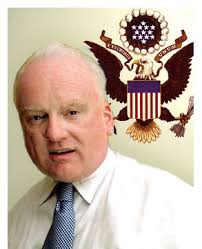
Richard Clarke
Even more vexing for Clarke: During his first eight months as President before September 11, Bush was on vacation 42% of the time, according to the Washington Post.
Clarke was certain that Osama bin Laden had arranged the USS Cole bombing in Aden on October 12, 2000.
For months, Clarke tried to convince others in the Bush Administration that Bin Laden was plotting another attack against the United States—either abroad or at home.
But Clarke could not prevail against the know-it-all arrogance of such higher-ranking Bush officials as Vice President Dick Cheney; Secretary of Defense Donald Rumsfeld; Rumsfeld’s deputy, Paul Wolfowitz; and National Security Adviser Condoleeza Rice.
Rice initially refused to hold a cabinet-level meeting on the subject. Then she insisted the matter be handled only by a more junior Deputy Principals meeting in April, 2001, writes Hamilton.
Wolfowitz, the number-two man at the Department of Defense, said: “I don’t understand why we are beginning by talking about this one man, bin Laden.”
Even after Clarke outlined the threat posed by Al-Qaeda, Wolfowitz—whose real target was Saddam Hussein—said: “You give bin Laden too much credit.”
Wolfowitz insisted that bin Laden couldn’t carry out his terrorist acts without the aid of a state sponsor—namely, Iraq. Wolfowitz, in fact, blamed Iraq for the 1993 bombing of the World Trade Center.
Clarke was stunned, since there was absolutely no evidence of Iraqi involvement in this.“Al-Qaeda plans major acts of terrorism against the United States,” Clarke warned his colleagues.
He pointed out that, like Adolf Hitler, bin Laden had actually published his plans for future destruction.
Osama bin Laden
And Clarke added: “Sometimes, as with Hitler in Mein Kampf, you have to believe that these people will actually do what they say they will do.”
Wolfowitz heatedly traded on his Jewish heritage to bring Clarke’s unwelcome arguments to a halt: “I resent any comparison between the Holocaust and this little terrorist in Afghanistan.”
Writing in outraged fury, Hamilton sums up Clarke’s agonizing frustrations:
- Bush’s senior advisers treated their colleagues who had served in the Clinton administration with contempt.
- President Bush, Vice President Dick Cheney, National Security Adviser Condoleeza Rice, Secretary of Defense Donald Rumsfeld and Deputy Defense Secretary Paul Wolfowitz seemed content to ignore the danger signals of an impending Al-Qaeda attack.
- This left only Secretary of State Colin Powell, his deputy Richard Armitage, Richard Clarke and a skeptical Treasury Secretary, Paul O’Neill, to wage “a lonely battle to waken a seemingly deranged new administration.”
Clarke alerted Federal Intelligence agencies that “Al-Qaeda is planning a major attack on us.” He asked the FBI and CIA to report to his office all they could learn about suspicious persons or activities at home and abroad.
Finally, at a meeting with Condoleeza Rice on September 4, 2001, Clarke challenged her to “picture yourself at a moment when in the very near future Al-Qaeda has killed hundreds of Americans, and imagine asking yourself what you wish then that you had already done.”
Apparently Rice couldn’t imagine such a scenario, because she took no action to prevent it. Nor did she urge anyone else to do so.
Seven days later, Al-Qaeda struck, and 3,000 Americans died horrifically—and needlessly.
Neither Bush, Cheney, Rice, Rumsfeld nor Wolowitz ever admitted their negligence. Nor would any of them be brought to account.
Disgustingly, these were the same officials who, afterward, posed as the Nation’s saviors—and branded anyone who disagreed with them as a traitor.
These are practices the Republican Right continues to exploit to this day.
Only Richard Clarke—who had vainly argued for stepped-up security precautions and taking the fight to Al-Qaeda—gave that apology.
On March 24, 2004, Clarke testified at the public 9/11 Commission hearings. Addressing relatives of victims in the audience, he said: “Your government failed you, those entrusted with protecting you failed you, and I failed you.”
It’s an admission that no other Republican has been willing to make. And it remains an indictment that no Democrat has had the courage to assert.
ABC NEWS, ALTERNET, AMERICAN EMPIRE, AP, BILL CLINTON, BUREAUCRACY, BUZZFEED, CBS NEWS, CHRIS MATHEWS, CNN, CROOKS AND LIARS, DAILY KOZ, DONALD TRUMP, DWIGHT EISENHOWER, FACEBOOK, FBI, FRANKLIN D. ROOSEVELT, GEORGE H.W. BUSH, GEORGE W. BUSH, GERALD R. FORD, HARRY S. TRUMAN, JEB BUSH, JIMMY CARTER, JOHN F. KENNEDY, LYNDON B. JOHNSON, MOTHER JONES, MOVEON, MSNBC, NBC NEWS, NEWSWEEK, NIGEL HAMILTON, NPR, PBS NEWSHOUR, POLITICO, RAW STORY, REPUBLICAN PARTY, REUTERS, SALON, SEATTLE TIMES, SLATE, SUETONIUS, SYRIAN CIVIL WAR, SYRIAN REFUGEES, TERRORISM, THE ATLANTIC, THE CHICAGO SUN-TIMES, THE CHICAGO TRIBUNE, THE DAILY BEAST, THE GUARDIAN, THE HILL, THE HUFFINGTON POST, THE LOS ANGELES TIMES, THE NATION, THE NEW YORK TIMES, THE TWELVE CAESARS, THE WASHINGTON POST, TIME, TWITTER, U.S. NEWS & WORLD REPORT, UPI, USA TODAY
In Bureaucracy, History, Military, Politics, Social commentary on October 15, 2018 at 12:12 am
You don’t ever have to frame anybody, because the truth is always sufficient.
–Willie Stark, in All the King’s Men, by Robert Penn Warren
When one politician wants to truly hurt another, the weapon of choice is not lies. It’s the truth.
And on October 16, 2015, then-Republican Presidential candidate Donald Trump used that weapon to take down his opponent, Jeb Bush, former governor of Florida.
Trump was being interviewed by Bloomberg TV’s Stephanie Ruhle when she asked: Would you be able to comfort the nation in the event of a mass tragedy like 9/11 or the 2012 elementary school shooting in Newtown, Connecticut?
And Trump, who always claims to be smarter, tougher and richer than anyone else, had a ready response: “I think I have a bigger heart than all of them. I think I’m much more competent then all of them.”
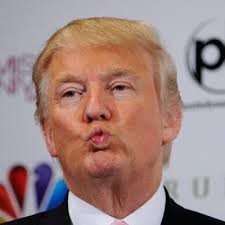
Donald Trump
So far, just what you would expect from Trump. Then:
“I mean, say what you want, the World Trade Center came down during his time.”
“Hold on,” said Ruhle, “you can’t blame George Bush for that.”
“He was President, okay? Blame him or don’t blame him, but he was President,” Trump said. “The World Trade Center came down during his reign.”
Three thousand Americans died during the September 11, 2001 terror attacks on the Pentagon and World Trade Center.
But holding Bush accountable for 9/11 is taboo for Republicans—and avoided by cowardly Democrats.
Whereas Republicans spent four years blaming President Barack Obama for the deaths of four Americans killed in an American consulate in Benghazi, Libya.
Immediately after Trump’s remarks, the Right exploded.
Representative Peter King, Republican of New York, said that no one saw the 9/11 attacks coming and that blaming the former president was a cheap shot.
Speaking on Right-wing Fox Radio, King added: “I think Donald Trump is totally wrong there. That sounds like a Michael Moore talking point.”
And Jeb Bush rushed to his brother’s defense on Twitter: “How pathetic for @realdonaldtrump to criticize the president for 9/11. We were attacked & my brother kept us safe.”
Of course, “my brother” didn’t keep safe those 3,000 Americans who died on 9/11.
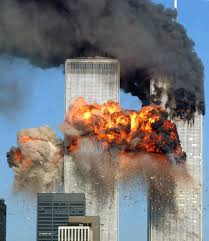
The World Trade Center on September 11, 2001
Nor did Jeb mention that, during his first eight months in office before September 11, George W. Bush was on vacation 42% of the time.
Fortunately, British historian Nigel Hamilton has brutally laid bare the facts of this needless tragedy.
Hamilton is the author of several acclaimed political biographies, including JFK: Reckless Youth and Bill Clinton: Mastering the Presidency.
In 2007, he began research on his 2010 book: American Caesars: The Lives of the Presidents from Franklin D. Roosevelt to George W. Bush.
The inspiration for this came from a classic work of ancient biography: The Twelve Caesars, by Gaius Suetonius Tranquillus—known as Suetonius.
Suetonius, a Roman citizen and historian, had chronicled the lives of the first 12 Caesars of Imperial Rome: Julius Caesar, Augustus, Tiberius, Caligula, Claudius, Nero, Galba, Otho, Vitellius, Vespasian, Titus and Domitian.
Hamilton wanted to examine post-World War II United States history as Suetonius had examined that of ancient Rome: Through the lives of the 12 “emperors” who had held the power of life and death over their fellow citizens—and those of other nations.

For Hamilton, the “greatest of American emperors, the Caesar Augustus of his time,” was Franklin D. Roosevelt, who led his country through the Great Depression and World War II.
His “”great successors” were Harry S. Truman, Dwight D. Eisenhower and John F. Kennedy—who, in turn, contained the Soviet Union abroad and presided over sustained economic prosperity at home.
By contrast, “arguably the worst of all the American Caesars” was “George W. Bush, and his deputy, Dick Cheney, who willfully and recklessly destroyed so much of the moral basis of American leadership in the modern world.”
(Hamilton’s book appeared before Donald Trump reached the Oval Office—and made George W. Bush look like a statesman.)
Among the most lethal of Bush’s offenses: The appointing of officials who refused to take seriously the threat posed by Al-Qaeda.And this arrogance and indifference continued—right up to September 11, 2001, when the World Trade Center and Pentagon became targets for destruction.
The only major administration official who did take Al-Qaeda seriously was Richard Clarke, the chief counter-terrorism adviser on the National Security Council.
Clarke had been thus appointed in 1998 by President Bill Clinton. He continued in the same role under President Bush—but the position was no longer given cabinet-level access.
This put him at a severe disadvantage when dealing with other, higher-ranking Bush officials—such as Vice President Dick Cheney, Secretary of Defense Donald Rumsfeld, Rumsfeld’s deputy, Paul Wolfowitz and National Security Adviser Condoleeza Rice.
These proved to be the officials who refused to believe that Al-Qaeda posed a lethal threat to the United States.
After 9/11, they wrapped themselves in the flag and posed as America’s saviors.
“Indeed,” writes Hamilton, “in the entire first eight months of the Bush Presidency, Clarke was not permitted to brief President Bush a single time, despite mounting evidence of plans for a new al-Qaeda outrage.” [Italics added]


2016 PRESIDENTIAL CAMPAIGN, ABC NEWS, ALTERNET, AMERICAN NAZI PARTY, AP, BARACK OBAMA, BILL CLINTON, BILL MAHER, BLACKS, BOMBINGS, BRANDON VICTOR DIXON, BUZZFEED, CBS NEWS, CNN, CROOKS AND LIARS, DAILY KOZ, DAVID GERGEN, DONALD TRUMP, FACEBOOK, GREG GIANFORTE, HAMILTON (MUSICAL), HENRY 11, HENRY II, HILLARY CLINTON, JOE SCARBOROUGH, JOHN F. KENNEDY, JOHN GIELGUD, KU KLUX KLAN, MIKE PENCE, MOTHER JONES, MOVEON, MSNBC, NBC NEWS, NEWSWEEK, NPR, PBS NEWSHOUR, POLITICO, RAFAEL "TED" CRUZ, RAW STORY, REUTERS, SALON, SEATTLE TIMES, SLATE, THE ATLANTIC, THE CHICAGO SUN-TIMES, THE CHICAGO TRIBUNE, THE DAILY BEAST, THE GUARDIAN, THE HILL, THE HUFFINGTON POST, THE LOS ANGELES TIMES, THE NATION, THE NEW YORK TIMES, THE WASHINGTON POST, THOMAS BECKET, TIME, TWITTER, U.S. NEWS & WORLD REPORT, UPI, USA TODAY, VICTOR DIXON, WHITE SUPREMACISTS
TRUMP: INCITING VIOLENCE, ESCAPING RESPONSIBILITY: PART TWO (END)
In Bureaucracy, History, Politics, Social commentary on November 6, 2018 at 12:06 amDavid Gergen is a longtime Republican who has advised Presidents Richard Nixon, Gerald Ford, Ronald Reagan and Bill Clinton. He is now a senior political analyst for CNN.
Summing up Trump’s legacy of hatred, Gergen said:
“Trump unleashed the dogs of hatred in this country from the day he declared he was running for president, and they’ve been snarling and barking at each other ever since. It’s just inevitable there are going to be acts of violence that grow out of that.”
Gergen made that statement on October 24, 2018—the day that pipe bombs were mailed to:
All of these intended victims had one thing in common: All of them had been brutally and repeatedly attacked by President Donald Trump.
Donald Trump
Watching coverage of the pipe-bomb mailings on CNN, a viewer might be forgiven for mistaking this thinking this network for Fox News.
One commentator after another said, in effect, “The President doesn’t understand the power of his words—and that they can lead unstable people to violent action.”
On the contrary: Trump thoroughly understands the power of his words.
Syndicated columnist Mark Shields and New York Times columnist David Brooks addressed this issue on the May 27, 2016 edition of the PBS Newshour.
David Brooks and Mark Shields
MARK SHIELDS: “Donald Trump gratuitously slandered Ted Cruz’s wife. He libeled Ted Cruz’s father for being potentially part of Lee Harvey Oswald’s assassination of the president of the United States, suggesting that he was somehow a fellow traveler in that.
“This is a libel. You don’t get over it.”
Donald Trump
DAVID BROOKS: “Trump, for all his moral flaws, is a marketing genius. And you look at what he does. He just picks a word and he attaches it to a person. Little Marco [Rubio], Lyin’ Ted [Cruz], Crooked Hillary [Clinton].
“And that’s a word. And that’s how marketing works. It’s a simple, blunt message, but it gets under.
“It sticks, and it diminishes. And so it has been super effective for him, because he knows how to do that. And she [Hillary Clinton] just comes with, ‘Oh, he’s divisive.’”
Hillary Clinton wasn’t the only Presidential candidate who proved unable to cope with Trump’s gift for insult. His targets—and insults—included:
Trump fully understands the power of threats—and has made liberal use of them against both Republicans and Democrats.
On March 16, 2016, he warned Republicans that if he didn’t win the GOP nomination in July, his supporters would literally riot: “I think you’d have riots. I think you would see problems like you’ve never seen before. I think bad things would happen. I really do. I wouldn’t lead it, but I think bad things would happen.”
An NBC reporter summed it up as: “The message to Republicans was clear: ‘Nice convention you got there, shame if something happened to it.’”
Two years later, on August 27, 2018, Trump, meeting with Right-wing Christian leaders at the State Dining Room of the White House, warned of “violence” if Democrats won control of Congress in the upcoming midterm elections: “There is violence. When you look at Antifa—these are violent people.”
Trump also understands the value of having subordinates make inflammatory statements that serve his purposes.
On July 29, 2016, Roger Stone, a notorious Right-wing political consultant and Trump strategist, told Breitbart News: “The first thing Trump needs to do is begin talking about [voter fraud] constantly. If there’s voter fraud, this election will be illegitimate, the election of the winner will be illegitimate, we will have a constitutional crisis, widespread civil disobedience, and the government will no longer be the government.”
In short: This is not a case of careless language that is simply misinterpreted, with tragic results.
Donald Trump fully understands the constituency that he is trying to reach: Those masses of alienated, uneducated Americans who live only for their guns and hardline religious beliefs—and who can be easily manipulated by perceived threats to either.
He is the ultimate narcissist: “The show is Trump, and it is sold-out performances everywhere,” Trump told Playboy magazine in a 1990 interview.
After the bombing attempts, Trump stated: “In these times we have to unify.” But he is by nature a combative divider, not a conciliator. He is a nihilist, appealing to hatred, offering only destruction.
He’s 72, has often boasted of the joys of getting even, and he’s not going to change now.
As first-mate Starbuck says of Captain Ahab in Herman Melville’s classic novel, Moby Dick: “He is a champion of darkness.”
Share this: