On July 20, 1944, Colonel Claus Schenk von Stuaffenberg tried to assassinate Adolf Hitler.
He had served with the Wehrmacht in Poland (1939), France (1940) and the Soviet Union (1941).
While serving in Tunisa, he was seriously wounded on April 7, 1943, when Allied fighters strafed his vehicle. He lost his left eye, right hand and two fingers of his left hand after surgery.
Colonel Claus Schenk von Stuaffenberg
Nevertheless, he now acted as the prime mover for the conspiracy among a growing number of German high command officers to arrest or assassinate Germany’s Fuehrer.
For most of these officers, the motive was craven: The “happy time’ of German victories was over. Germany was losing the war it had launched on the world in 1939–and now they feared the worst.
This was especially true now that the numerically superior forces of the Soviet Union had gone onto the offensive.
For Stauffenberg, there was another reason: His disgust at the horrors he had seen committed by his fellow Wehrmacht soldiers upon defenseless POW’s and civilians in Russia.
Thus, Stauffenberg–more than many Germans–knew firsthand the vengeance his country could expect if the “Thousand-Year Reich” fell.
Something must be done, he believed, to prove to the world that not all Germans–even members of the Wehrmacht–were criminals.
Most of the conspirators wanted to arrest Hitler and surrender to British and American forces–well before the much-feared Russians gained a toehold in Germany.
Stauffenberg didn’t want to arrest Hitler; he wanted to kill him. A live Hitler might eventually be rescued by his Nazi colleagues.
But Hitler was a closely-guarded target. He was surrounded by fanatical bodyguards who were expert marksmen. He often wore a bulletproof vest and a cap lined with three pounds of laminated steel.
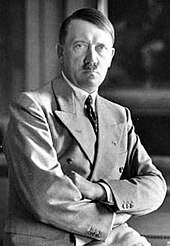
Adolf Hitler
Bundesarchiv, Bild 146-1990-048-29A / CC-BY-SA 3.0 [CC BY-SA 3.0 de (https://creativecommons.org/licenses/by-sa/3.0/de/deed.en)%5D
But his single greatest protection–he claimed–was an instinct for danger. He would suddenly change his schedule–to drop in where he was least expected. Or suddenly depart an event where he was expected to stay a long time.
On November 9, 1939, this instinct saved his life.
He had been set to give a long speech at a Munich beer hall before the “Old Fighters” of his storm troopers.
Sixteen years earlier on that day, in 1923, Hitler had led them in a disastrous attempt to overthrow the Bavarian government. Police had put down the effort, killing and wounding about a score of storm troopers in the process.
Hitler himself had later been arrested, tried and convicted for treason–and sentenced to a year’s imprisonment.
But instead of proving to be the end of Nazism, the “Beer Hall Putsch” turned Hitler into a national celebrity. And it launched his career as a legitimate, ultimately successful politician.
So Hitler was expected to speak to his longtime supporters for a long time that evening. Instead, he suddenly cut short his speech and left the beer hall. Forty-five minutes later, a bomb exploded inside a pillar–before which Hitler had been speaking.
Since then, a series of other assassination attempts had been made against Hitler. All of them involved time-bombs. And all of the would-be assassins were members of the German General Staff.
In one case, a bomb secretly stashed aboard Hitler’s plane failed to explode. In another, an officer who had a bomb strapped to himself unexpectedly found his scheduled meeting with Hitler called off. He had to rush into a bathroom to defuse the bomb before it went off.
So now it was the turn of von Stauffenberg. He would carry his bomb–hidden in a briefcase–into a “Hitler conference” packed with military officers.
But Stauffenberg didn’t intend to be a suicide bomber. He meant to direct the government that would replace that of the Nazis.
His bomb–also rigged with a time-fuse–would be left in the conference room while he found an excuse to leave. After the explosion, he would phone one of his fellow conspirators with the news.
Then, the coup–“Operation Valkyrie”–would be on.
Anti-Nazi conspirators would seize control of key posts of the government. The British and Americans would then be informed of Germany’s willingness to surrender. Provided, of course, that the vengeance-seeking Russians did not have a say in its postwar future.
The Wehrmacht and Schutzstaffel (SS) had killed millions of Russians. Many had died in combat. Others had been murdered as captives. Still more had been allowed to die by starvation and exposure to the notorious Russian winter.
So the Germans–both Nazi and anti-Nazi–knew what they could expect if soldiers of the Soviet Union reached German soil.
On July 20, 1944, Stauffenberg appeared at Hitler’s well-guarded military headquarters in East Prussia. Like all his other outposts, Hitler had named it–appropriately enough–“Wolf’s Lair.”
“Wolf’s Lair”
Stauffenberg entered the large, concrete building while the conference was in session. He placed his yellow briefcase next to Hitler–who was standing with his generals at a heavy oaken table. Then he excused himself to take an “urgent” phone call.
At 12:42 p.m. on July 20, 1944, Stauffenberg’s briefcase bomb erupted.
But, as if by a miracle, Hitler–and the Third Reich–survived.


.jpg)
 Bureaucracybuster's Blog
ABC NEWS, APALACHIN RAID, BUSINESS, CBS NEWS, CEO, CLYDE TOLSON, CNN, ELECTRONIC SURVEILLANCE, FACEBOOK, FBI, FEDERAL BUREAU OF NARCOTICS, HARRY ANSLINGER, ILLEGAL ALILENS, IMMIGRATION AND CUSTOMS ENFORCEMENT (ICE), IRAN-CONTRA, J. EDGAR HOOVER, MAFIA, MEYER LANSKY, NBC NEWS, OLIVER NORTH, ROBERT F. KENNEDY, Ronald Reagan, THE CHICAGO SUN-TIMES, THE CHICAGO TRIBUNE, THE LOS ANGELES TIMES, THE NEW YORK TIMES, THE WASHINGTON POST, TOP HOODLUM PROGRAM, TWITTER, WAL-MART, WILLIAM E. ROEMER, WIRETAPPING, WIRETAPS
“A TEAM PLAYER”: PART TWO (END)
In Bureaucracy, Business, History, Law, Law Enforcement, Politics, Social commentary on April 11, 2016 at 12:04 amIn 1959, J. Edgar Hoover, the legendary director of the FBI, declared war on the Mafia.
He set up a Top Hoodlum Program and encouraged his agents to use wiretapping and electronic surveillance (“bugging”) to make up for lost time and Intelligence.
But Hoover also imposed a series of restrictions that could destroy an agent’s professional and personal life.
William E. Roemer, Jr., assigned to the FBI’s Chicago field office, was one of the first agents to volunteer for such duty.
In his memoirs, Man Against the Mob, published in 1989, Roemer laid out the dangers that went with such work:
If he had been arrested by the Chicago Police Department and identified as an FBI agent, Roemer would have:
Given the huge risks involved, many agents, unsurprisingly, wanted nothing to do with “black bag jobs.”
The agents who took them on were so committed to penetrating the Mob that they willingly accepted Hoover’s dictates.
In 1989, Roemer speculated that former Marine Lieutenant Colonel Oliver North had fallen victim to such a “Mission: Impossible” scenario: “The secretary will disavow any knowledge of your actions….”
In 1986, Ronald Reagan’s “arms-for-hostages” deal known as Iran-Contra had been exposed.
To retrieve seven Americans taken hostage in Beirut, Lebanon, Reagan had secretly agreed to sell some of America’s most sophisticated missiles to Iran.
During this operation, several Reagan officials–including North–diverted proceeds from the sale of those missiles to fund Reagan’s illegal war against the Sandinistas in Nicaragua.
In Roemer’s view: North had followed orders from his superiors without question. But when the time came for those superiors to step forward and protect him, they didn’t.
They let him take the fall.
Roemer speculated that North had been led to believe he would be rescued from criminal prosecution. Instead, in 1989, he was convicted for
That is how many employers expect their employees to act: To carry out whatever assignments they are given and take the blame if anything goes wrong.
Take the case of Wal-Mart Stores, Inc., the world’s biggest retailer.
In March, 2005, Wal-Mart escaped criminal charges when it agreed to pay $11 million to end a federal probe into its use of illegal aliens as janitors.
Agents from Immigration and Customs Enforcement (ICE) raided 60 Wal-Mart stores across 21 states in October, 2003. The raids led to the arrest of 245 illegal aliens.
Federal authorities had uncovered the cases of an estimated 345 illegal aliens contracted as janitors at Wal-Mart stores.
Many of the workers worked seven days or nights a week without overtime pay or injury compensation. Those who worked nights were often locked in the store until the morning.
According to Federal officials, court-authorized wiretaps revealed that Wal-Mart executives knew their subcontractors hired illegal aliens.
Once the raids began, Federal agents invaded the company’s headquarters in Bentonville, Ark., seizing boxes of records from the office of a mid-level executive.
Click here: Wal-Mart Settles Illegal Immigrant Case for $11M | Fox News
Of course, Wal-Mart admitted no wrongdoing in the case. Instead, it blamed its subcontractors for hiring illegal aliens and claiming that Wal-Mart hadn’t been aware of this.
Which, of course, is nonsense.
Just as the FBI would have had no compunctions about letting its agents take the fall for following orders right from the pen of J. Edgar Hoover, Wal-Mart meant to sacrifice its subcontractors for doing precisely what the company’s executives wanted them to do.
The only reason Wal-Mart couldn’t make this work: The Feds had, for once, treated corporate executives like Mafia leaders and had tapped their phones.
Click here: Wal-Mart to review workers – Business – EVTNow
Which holds a lesson for how Federal law enforcement agencies should treat future corporate executives when their companies are found violating the law.
Instead of seeing CEOs as “captains of industry,” a far more realistic approach would be giving this term a new meaning: Corrupt Egotistical Oligarchs.
A smart investigator/prosecutor should always remember:
Widespread illegal and corrupt behavior cannot happen among the employees of a major government agency or private corporation unless:
That’s something to remember the next time a scandal hits a major corporation or government agency.
Share this: