Posts Tagged ‘FIDEL CASTRO’
9/11 ATTACKS, ABC NEWS, AFGHANISTAN, AL QAEDA, ALTERNET, AMERICABLOG, AP, BABY BOOMER RESISTANCE, BARACK OBAMA, BLOOMBERG, BOLIVIA, BUZZFEED, CBS NEWS, CIA, CNN, COMMUNISM, CROOKS AND LIARS, CUBA, CUBAN MISSILE CRISIS, DAILY KOZ, DRUDGE REPORT, ERNESTO "CHE" GUEVARA, FIDEL CASTRO, FIVETHIRTYEIGHT, GEORGE W. BUSH, GREEN BERETS, HARPER’S MAGAZINE, HUFFINGTON POST, IRAQ, ISLAM, JOHN F. KENNEDY, MEDIA MATTERS, MOTHER JONES, MOVEON, MSNBC, NAVY SEALS, NBC NEWS, NEWSWEEK, NIKITA KHRUSHCHEV, NPR, OSAMA BIN LADEN, PAKISTAN, PBS NEWSHOUR, POLITICO, POLITICUSUSA, RAW STORY, REUTERS, SALON, SEATTLE TIMES, SLATE, SOVIET UNION, TALIBAN, TALKING POINTS MEMO, THE ATLANTIC, THE CHICAGO SUN-TIMES, THE CHICAGO TRIBUNE, THE DAILY BEAST, THE DAILY BLOG, THE GUARDIAN, THE HILL, THE HUFFINGTON POST, THE LOS ANGELES TIMES, THE NATION, THE NEW REPUBLIC, THE NEW YORK TIMES, THE VILLAGE VOICE, THE WASHINGTON POST, THINKPROGRESS, TIME, TRUTHDIG, TRUTHOUT, TWITTER, TWO POLITICAL JUNKIES, U.S. NEWS & WORLD REPORT, UPI, USA TODAY, WONKETTE
In Bureaucracy, History, Military, Politics on May 4, 2023 at 12:05 am
Ernesto “Che” Guevara was dead.
But that wasn’t enough for the Bolivian government that had authorized his execution. His corpse was disappear from the face of the earth.
On October 10, 1967, Guavara’s body was flown to nearby Vallegrande, where photographs were taken of him lying on a concrete slab in the laundry room of the Nuestra Senora de Malta.

Che Guevara in death
Several witnesses were called in to confirm that it was indeed Guevara. As hundreds of local residents filed past the corpse, many of them felt Guevara resembled images of a bearded, long-haired Jesus Christ. Some of them even surreptitiously clipped locks of his hair as divine relics.
After a military doctor amputated his hands, Bolivian army officers transferred Guevara’s body to an undisclosed location. The government refused to say whether his remains had been buried or cremated.
Che’s hands were preserved in formaldehyde and sent to Buenos Aires, Argentina, for fingerprint identification. (His prints were on file with the Argentine police.)
On October 15, Fidel Castro acknowledged that Guevara was dead and proclaimed three days of public mourning throughout Cuba.
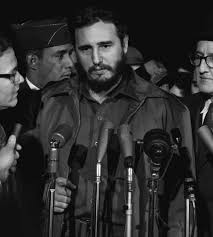
Fidel Castro
Che, in one sense, was lucky to die as he did—and when he did. He was only 39, but he was already running to fat and increasingly troubled by his lifelong asthma.
His Don Quixote-like venture into Bolivia had proven a failure from first to last. Peasants didn’t flock to his banner; in fact, some of them betrayed his movements to the Bolivian army.
And 24 years after Guevara’s execution, Communism, his secular religion, died a violent death in its birthplace—the Soviet Union. It wasn’t killed off by invading capitalist forces, but thrown off by the Russian people themselves.
Nor would Che be pleased with the course of “revolutionary” events in Cuba. Until the death of the Soviet Union, the island remained dependent on what amounted to Soviet welfare.
Since then, Cubans have supported themselves by turning their island into a privileged playground for the rich—especially rich Americans.
On October 17, 1997—30 years after their deaths—Guevara and six of his fellow combatants were buried with full military honors in a specially built mausoleum in Santa Clara, Cuba. It was there in 1958 that he had commanded the decisive military victory of the Cuban Revolution.
Having described, in Part One, how Ernesto “Che” Guevara met his end, it’s time to examine how Osama bin Laden earned his 72 willing virgins.
After the September 11, 2001 attacks on the Pentagon and the World Trade Center, the United States quickly established that bin laden had plotted them.
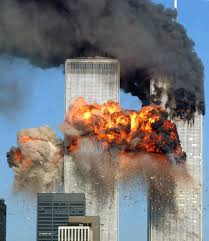
World Trade Center on 9/11/01
But bin Laden was then living in Afghanistan and protected by its Islamic rulers, the Taliban. President George W. Bush gave the Taliban an ultimatum: Surrender bin Laden—or else.
The Taliban refused.
On October 7, 2001, the United States’ new allies, the Northern Alliance, supported by American airstrikes, began a ground campaign against the Taliban.
Taliban resistance quickly vanished. Bin Laden retreated to Tora Bora, a series of bunkers in a mountainous region near the Pakistani border. With the mountains literally shaking under a rain of “bunker-busting” bombs, bin Laden decided to move on.
Suddenly, in December, 2001, he seemed to vanish from the earth.
Reports circulated that he was living in a cave in the no-man’s-land lying between Afghanistan and Pakistan.
Strangely, the Bush administration lost interest in locating him. Increasing numbers of American troops were quietly transferred from Afghanistan to staging areas near Iraq–for Bush’s long-planned overthrow of its dictator, Saddam Hussein.
Only when Barack Obama took office as President in 2009 was the CIA ordered to make finding bin Laden its top priority. Over the next two years, CIA agents sifted through a conflicting series of reports about bin Laden’s possible whereabouts.
Finally, the agency tracked a courier linked to bin Laden to a large, high-walled compound in Abbottabad, Pakistan.
On April 28, 2011, President Obama authorized a U.S. military raid on the compound, dubbed “Operation Neptune Spear.” On May 1, 2011, two teams of 12 U.S. Navy SEALS, working with the CIA, traveled in two helicopters to the compound.
The helicopters were specially outfitted to emit little noise. But an accident resulted when the tail rotor of one helicopter grazed the compound’s stone wall.
The damaged aircraft was “hard-landed” and then destroyed on-site to protect its technological secrets. Back-up forces were immediately available, and another helicopter was brought in to retrieve the commandos and relevant captured documents.
All combined, a total of 79 commandos and a dog (believed to have explosive-detection training) were involved in the raid.
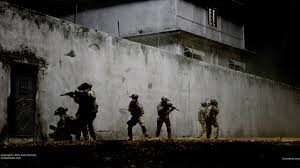
SEALS attacking bin Laden’s compound in the 2012 movie, “Zero Dark Thirty”
Abu Ahmed al-Kuwaiti, bin Laden’s courier, opened fire on the SEALS from the guesthouse with an AK-47 assault rifle. He and his wife were killed by return fire.
A male relative of the courier was shot and killed by the SEALS before he could reach a weapon lying nearby.
Bin Laden’s 22-year-old son rushed toward the SEALS on the staircase of the main house. SEAL gunfire instantly killed him.
Osama bin Laden, standing at the top of a staircase, retreated into his room—where SEALS followed and shot him in the head and chest.
9/11 ATTACKS, ABC NEWS, AFGHANISTAN, AL QAEDA, ALTERNET, AMERICABLOG, AP, BABY BOOMER RESISTANCE, BARACK OBAMA, BLOOMBERG, BOLIVIA, BUZZFEED, CBS NEWS, CIA, CNN, COMMUNISM, CROOKS AND LIARS, CUBA, CUBAN MISSILE CRISIS, DAILY KOZ, DRUDGE REPORT, ERNESTO "CHE" GUEVARA, FIDEL CASTRO, FIVETHIRTYEIGHT, GEORGE W. BUSH, GREEN BERETS, HARPER’S MAGAZINE, HUFFINGTON POST, IRAQ, ISLAM, JOHN F. KENNEDY, MEDIA MATTERS, MOTHER JONES, MOVEON, MSNBC, NAVY SEALS, NBC NEWS, NEWSWEEK, NIKITA KHRUSHCHEV, NPR, OSAMA BIN LADEN, PAKISTAN, PBS NEWSHOUR, POLITICO, POLITICUSUSA, RAW STORY, REUTERS, SALON, SEATTLE TIMES, SLATE, SOVIET UNION, TALIBAN, TALKING POINTS MEMO, THE ATLANTIC, THE CHICAGO SUN-TIMES, THE CHICAGO TRIBUNE, THE DAILY BEAST, THE DAILY BLOG, THE GUARDIAN, THE HILL, THE HUFFINGTON POST, THE LOS ANGELES TIMES, THE NATION, THE NEW REPUBLIC, THE NEW YORK TIMES, THE VILLAGE VOICE, THE WASHINGTON POST, THINKPROGRESS, TIME, TRUTHDIG, TRUTHOUT, TWITTER, TWO POLITICAL JUNKIES, U.S. NEWS & WORLD REPORT, UPI, USA TODAY, WONKETTE
In Bureaucracy, History, Military, Politics, Social commentary on May 3, 2023 at 12:11 am
They both had beards. They both saw military action. They both passionately hated the United States. And they both died in a hail of bullets.
And immediately after their deaths, both seemed to disappear from the face of the earth.
Ernesto “Che” Guevara and Osama bin Laden.
Two men who inspired widespread admiration among their supporters—and fear among their enemies.
Guevara, an Argentinian doctor-turned-Cuban revolutionary, sought to destroy the United States’ power to fight Communism. Bin Laden sought to destroy its power to intervene in the Middle East.
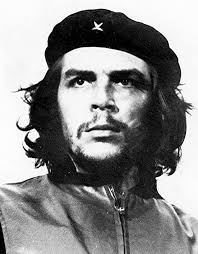
Ernesto “Che” Guevara
Guevara’s most optimistic hope was that Americans would eventually see the error of their capitalistic ways and convert to Communism. His last words were: “Tell Fidel [Castro] that he will soon see a triumphant revolution in America.”
But he was prepared to fight to the death–as indeed he did—to force revolutionary change upon the United States.
For Bin Laden, the cause was Islam, not Communism. His most optimistic hope was that Christian and Jewish Americans would eventually convert to Islam.
But if that didn’t happen, he, too, was prepared to attack Americans anywhere and in any way he could—as his private diary and documents have revealed.
Guevara died on October 9, 1967, at the hands of a CIA-directed operation run by the Bolivian army.
Bin Laden, creator of the Al-Qaeda (“The Base”) terrorist network, met his end on May 1, 2011, during a raid by U.S. Navy SEALS on his compound in Pakistan.
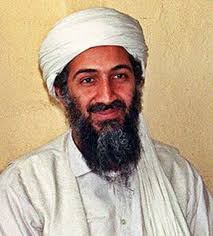
Osama bin Laden
One man—Guevara—has since attained secular sainthood in the eyes of millions of Communists and their sympathizers.
The other—bin Laden—has attained instant “martyr” status in the eyes of untold numbers of Islamic terrorists and their sympathizers.
In November, 1962, during an interview with the Communist newspaper, the London Daily Worker, Guevara raged against the Soviet Union’s recent withdrawal of nuclear missiles from Cuba.
Those “thirteen days” of the Cuban Missile Crisis that October had brought the world to the brink of nuclear destruction.
“If the missiles had remained, we would have used them against the very heart of the United States, including New York,” said Guevara.
“We must never establish peaceful coexistence. We must walk the path of victory even if it costs millions of atomic victims.”
Similarly, until the end of his life, bin Laden demanded more attacks like the one on September 11, 2001, that snuffed out the lives of 3,000 Americans.
This brought him into conflict with other Al-Qaeda members who wanted to launch assaults on more vulnerable targets outside the United States.
Guevara died as he had lived—violently.
In late October, 1966, he slipped out of Cuba. On November 3, he secretly arrived in La Paz, Bolivia, intent on re-staging the Cuban revolution among the Bolivian peasantry.

But the peasants showed no interest in his aims and in fact reported his movements to the Bolivian army.
The army, in turn, was being advised by United States Green Berets under the direction of the CIA.
On October 7, 1967, an informant tipped off the Bolivian Special Forces to the location of Guevara’s guerrilla camp in the Yuro ravine.
On October 8, they encircled the area with 1,800 soldiers. In the shootout that followed, Guevara was wounded and taken prisoner while leading a detachment.
His rifle broken by a lucky shot, a twice-wounded Guevara shouted: “Do not shoot! I am Che Guevara and worth more to you alive than dead.”
Quickly informed of Guevara’s capture, the Bolivian government debated his fate: Should he be immediately executed or placed on trial?
On the morning of October 9, Bolivian President Rene Barrientos ordered that Guevara be executed. Barrientos feared that placing him on trial would create an international media circus and/or render Bolivia vulnerable to efforts to free him.
The Bolivian government planned to declare that Guevara had been killed in action during a clash with the nation’s armed forces. Special instructions were thus issued.
These came from Felix Rodrieguez, a CIA agent acting as advisor to the Bolivians.
The executioner would be Mario Teran, a Bolivian army sergeant who had lost three of his friends in an earlier firefight with Guevara’s band of guerrillas.
Rodriguez ordered Teran to aim carefully to make it appear that Guevara had been killed in action.
To his surprise, Rodriguez found himself highly impressed with Guevara’s courage. When informed of his imminent execution, Guevara blanched, then quickly got control of himself.
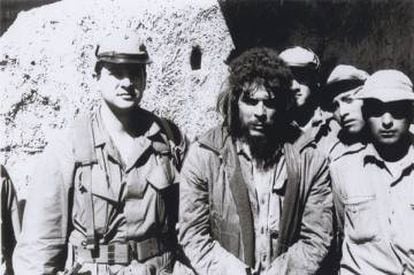
Felix Rodriguez, left, Che, center
“It is better like this,” he said. “I should never have been captured alive.”
Rodriguez asked if he had any messages for his family. Guevara replied: “Tell Fidel [Castro, the president/dictator of Cuba] that he will soon see a triumphant revolution in America.
“And tell my wife to remarry and try to be happy.”
When Sergeant Teran entered the hut, Guevara told his executioner: “I know you’ve come to kill me. Shoot, coward! You are only going to kill a man!”
Teran hesitated, then opened fire with his semiautomatic rifle, hitting Guevara in his arms and legs.
Guevara writhed on the ground, apparently biting one of his wrists to avoid crying out. Teran then fired several more times, finally killing him with a shot in the chest.
ABC NEWS, ADOLF HITLER, ADVICE, ALTERNET, AMERICABLOG, AP, BABY BOOMER RESISTANCE, BAY OF PIGS, BBC, BENITO MUSSOLINI, BLOOMBERG NEWS, BUZZFEED, CAESARE BORGIA, CBS NEWS, CNN, CORPORATIONS, CROOKS AND LIARS, CUBA, DAILY KOS, DAILY KOZ, FACEBOOK, FIDEL CASTRO, FIVETHIRTYEIGHT, FLORENCE, HARPER’S MAGAZINE, HUFFINGTON POST, JOHN F. KENNEDY, JOSEPH STALIN, KING PERSEUS OF MACEDON, MEDIA MATTERS, MOTHER JONES, MOVEON, MSNBC, NAZI-SOVIET "NON-AGGRESSION PACT", NBC NEWS, NEW REPUBLIC, NEWSDAY, NEWSWEEK, NICCOLO MACHIAVELLI, NPR, PBS NEWSHOUR, POLITICO, POLITICS, POLITICUSUSA, POPE JULIUS 11, RAW STORY, REUTERS, SALON, SEATTLE TIMES, SLATE, TALKING POINTS MEMO, THE ATLANTIC, THE CHICAGO SUN-TIMES, THE CHICAGO TRIBUNE, THE DAILY BEAST, THE DAILY BLOG, THE DISCOURSES, THE GUARDIAN, THE HILL, THE HUFFINGTON POST, THE INTERCEPT, THE LOS ANGELES TIMES, THE NATION, THE NEW REPUBLIC, THE NEW YORK TIMES, THE NEW YORKER, THE PRINCE, THE SS, THE VILLAGE VOICE, THE WASHINGTON POST, THINKPROGRESS, THIRD REICH, TIME, TRUTHDIG, TRUTHOUT, TWITTER, U.S. NEWS & WORLD REPORT, UKRAINE, UPI, USA TODAY, VLADIMIR PUTIN, VOLODYMYR ZELENSKY, WEHRMACHT, WORLD WAR 11
In Bureaucracy, Business, History, Military, Politics, Social commentary on October 28, 2022 at 12:11 am
Ask the average person, “What do you think of Niccolo Machiavelli?” and he’s likely to say: “The devil.”
In fact, “The Old Nick” became an English term used to describe Satan and slander Machiavelli at the same time.

Niccolo Machiavelli
The truth, however, is more complex. Machiavelli was a passionate Republican, who spent most of his adult life in the service of his beloved city-state, Florence.
The years he spent as a diplomat were tumultuous ones for Italy—with men like Pope Julius II and Caesare Borgia vying for power and plunging Italy into one bloodbath after another.
Florence, for all its wealth, lacked a strong army, and thus lay at the mercy of powerful enemies, such as Borgia. Machiavelli often had to use his wits to keep them at bay.
Machiavelli is best-known for his writing of The Prince, a pamphlet on the arts of gaining and holding power. Its admirers have included Benito Mussolini and Joseph Stalin.
But his longer and more thoughtful work is The Discourses, in which he offers advice on how to maintain liberty within a republic. Among its admirers were many of the men who framed the Constitution of the United States.
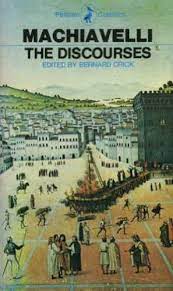

Most people believe that Machiavelli advocated evil for its own sake.
Not so. Rather, he recognized that sometimes there is no perfect—or perfectly good—solution to a problem.
Sometimes it’s necessary to take stern—even brutal—action to stop an evil (such as a riot) before it becomes widespread:
“A man who wishes to make a profession of goodness in everything must inevitably come to grief among so many who are not good. And therefore it is necessary for a prince, who wishes to maintain himself, to learn how not to be good, and to use this knowledge and not use it, according to the necessity of the case.”
His counsel remains as relevant today as it did during his lifetime (1469 – 1527). This is especially true for politicians—and students of political science.
But plenty of ordinary citizens can also benefit from the advice he has to offer—such as those in business who are asked to give advice to more powerful superiors.
Machiavelli warns there is danger in urging rulers to take a particular course of action: “For men only judge of matters by the result, all the blame of failure is charged upon him who first advised it, while in case of success he receives commendations. But the reward never equals the punishment.”
This puts would-be counselors in a difficult position: “If they do not advise what seems to them for the good of the republic or the prince, regardless of the consequences to themselves, then they fail to do their duty.
“And if they do advise it, then it is at the risk of their position and their lives, for all men are blind in thus, that they judge of good or evil counsels only by the results.”
Thus, Machiavelli warns that an adviser should “take things moderately, and not to undertake to advocate any enterprise with too much zeal, but to give one’s advice calmly and modestly.”
The person who asked for the advice may follow it, or not, as of his own choice, and not because he was led or forced into it by the adviser.
Above all, the adviser must avoid the danger of urging a course of action that runs “contrary to the wishes of the many.
“For the danger arises when your advice has caused the many to be contravened. In that case, when the result is unfortunate, they all concur in your destruction.”
Or, as President John F. Kennedy famously said after the disastrous invasion of Cuba at the Bay of Pigs in April, 1961: “Victory has a hundred fathers and defeat is an orphan.”
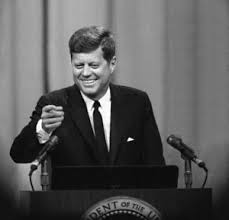
John F. Kennedy
By “not advocating any enterprise with too much zeal,” the adviser gains two advantages:
“The first is, you avoid all danger.
“And the second consists in the great credit which you will have if, after having modestly advised a certain course, your counsel is rejected, and the adoption of a different course results unfortunately.”
Finally, the time to give advice is before a catastrophe occurs, not after. Machiavelli gives a vivid example of what can happen if this rule is ignored.
King Perseus of Macedon had gone to war with Paulus Aemilius—and suffered a humiliating defeat. Fleeing the battlefield with a handful of his men, he later bewailed the disaster that had overtaken him.
Suddenly, one of his lieutenants began to lecture Perseus on the many errors he had committed, which had led to his ruin.
“Traitor,” raged the king, turning upon him, “you have waited until now to tell me all this, when there is no longer any time to remedy it—” And Perseus slew him with his own hands.
Niccolo Machiavelli sums up the lesson as this:
“Thus was this man punished for having been silent when he should have spoken, and for having spoken when he should have been silent.”
Be careful that you don’t make the same mistake.
ABC NEWS, ALTERNET, AMERICAN TABLOID, AP, ASSASSINATION, BUZZFEED, CBS NEWS, CIA, CNN, COMMUNISM, CROOKS AND LIARS, CUBA, CUBAN MISSILE CRISIS, DAILY KOZ, DWIGHT D. EISENHOWER, FACEBOOK, FBI, FIDEL CASTRO, FLORIDA, FULGENCIO BATISTA, GUAM, GUS RUSSO, JAMES ELLROY, JOE BIDEN, JOHN F. KENNEDY, JOHNNY ROSELLI, LEE HARVEY OSWALD, LIVE BY THE SWORD, LYNDON B. JOHNSON, MAFIA, MOTHER JONES, MOVEON, NBC NEWS, NEWSWEEK, NEWT GINGRICH, NIKITA KHRUSHCHEV, NORTH KOREA, NPR, NUCLEAR WAR, POLITICO, RAW STORY, REUTERS, ROBERT F. KENNEDY, SALON, SAM GIANCANA, SEATTLE TIMES, SLATE, THE ATLANTIC, THE CHICAGO SUN-TIMES, THE CHICAGO TRIBUNE, THE DAILY BEAST, THE GUARDIAN, THE HILL, THE HUFFINGTON POST, THE LOS ANGELES TIMES, THE NATION, THE NEW YORK TIMES, THE WASHINGTON POST, TIME, TWITTER, U.S. NEWS & WORLD REPORT, UKRAINE, UP, UPI, USA TODAY, VLADIMIR PUTIN, WARREN COMMISSION
In Bureaucracy, History, Law, Law Enforcement, Military, Politics, Social commentary on October 21, 2022 at 12:10 am
“John and Robert Kennedy knew what they were doing. They waged a vicious war against Fidel Castro—a war someone had to lose.”
And the loser turned out to be John F. Kennedy.
So writes investigative reporter Gus Russo in Live By the Sword: The Secret War Against Castro and the Death of JFK, published in 1998.
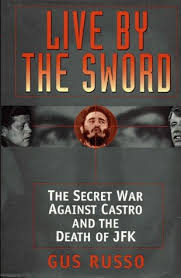
In what is almost certainly the definitive account of the assassination of President John F. Kennedy, Russo reaches some startling—but highly documented—conclusions:
- Lee Harvey Oswald assassinated Kennedy.
- He did it alone.
- Oswald, a former Marine, was a committed Marxist–whose hero was Castro.
- The CIA’s ongoing campaign to overthrow and/or assassinate Castro was an open secret throughout the Gulf.
- Oswald visited New Orleans in the spring of 1963.
- There he learned that Castro was in the crosshairs of the CIA.
- Oswald told his Russian-born wife, Marina: “Fidel Castro needs defenders. I’m going to join his army of volunteers.”
- Jack Ruby, a Dallas nightclub owner, murdered Oswald because he was distraught over Kennedy’s death.
- Ruby was not part of a Mafia conspiracy to silence Oswald.
- Skeptics of the Warren Commission—which concluded that Oswald had acted alone—asked the wrong question: “Who killed Kennedy?”
- They should have asked: “Why was he killed?”
- The answer–according to Russo: “The Kennedys’ relentless pursuit of Castro and Cuba backfired in tragedy on that terrible day in November, 1963.”
Another book well worth reading about America’s Cuban obsession during the early 1960s is American Tabloid, by James Ellroy.
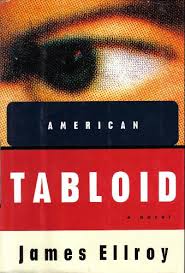
Although a novel, it vividly captures the atmosphere of intrigue, danger and sleaziness that permeated that era in a way that dry, historical documents never can.
“The 50’s are finished,” reads its paperback dust jacket. “Zealous young lawyer Robert Kennedy has a red-hot jones to nail Jimmy Hoffa. JFK has his eyes on the Oval Office.
“J. Edgar Hoover is swooping down on the Red Menace. Howard Hughes is dodging subpoenas and digging up Kennedy dirt. And Castro is mopping up the bloody aftermath of his new Communist nation….
“Mob bosses, politicos, snitches, psychos, fall guys and femmes fatale. They’re mixing up a Molotov cocktail guaranteed to end the country’s innocence with a bang.”
Among the legacies of America’s twisted romance with anti-Castro Cubans:
- Following the JFK assassination, there was a coverup.
- Its purposes: To protect the reputation of the United States government–and that of its newly-martyred President.
- Thus, the CIA and FBI concealed the CIA-Mafia assassination plots from the Warren Commission assigned to investigate Kennedy’s murder.
- Other government officials participating in the coverup included Attorney General Robert F. Kennedy and President Lyndon B. Johnson.
- Ironically, this secrecy ignited the widespread—and false—belief that the President had died at the hands of a government conspiracy.
- Robert Kennedy feared that his relentless pursuit of Castro might have led Castro to “take out” JFK first.
- Fearing his own assassination if he continued Kennedy’s efforts to murder Castro, President Johnson ordered the CIA to halt its campaign to overthrow and/or assassinate the Cuban leader.
- The huge Cuban community throughout Florida—and especially Miami—continues to exert a blackmailing influence on American politics.
- Right-wing politicians from Richard Nixon to Donald Trump have reaped electoral rewards by catering to the demands of this hate-obsessed voting block.
- These Cuban ex-patriots hope that the United States will launch a full-scale military invasion of the island to remove Castro.
The Cuban Missile Crisis was the deadliest moment of the Cold War, when the world stood only minutes away from nuclear Armageddon.
That crisis stemmed from America’s twisted obsession with Cuba, an obsession that continues today.
Sixty years after that crisis, the world wonders: Is nuclear war about to erupt?
And, once again, that decision lies in the hands of two men—Vladimir Putin and Joe Biden—out of a world population of more than seven billion.
Since launching a war on Ukraine on February 24, Putin has seen his initial victories turn sour.
By July, after five months of fierce Ukrainian resistance, the Russians were stymied as they tried to conquer the remainder of Donbas. In late August, Ukraine launched a counteroffensive in the southern region of Kherson.
By September, Ukrainian forces recaptured much of the northeastern Kharkiv region, including the city of Izium, which the Russians had been using as a logistics hub.
On September 21, Putin announced the partial mobilization of 300,000 military reservists. All male citizens below 60 are now eligible to be drafted. This led at least 194,000 Russian men to seek refuge in such neighboring countries as Turkey, Georgia, Kazakhstan and Mongolia.
That same day, Putin warned that Russia commands a nuclear arsenal. He did not say whether he would turn it against Ukraine or NATO countries, including the United States.
Even if nukes were used only against Ukraine, the final result could be a full-scale nuclear war.
Interviewed on CNN, President Joe Biden described Putin thus: “I think he is a rational actor who has miscalculated significantly.”
Nikita Khrushchev, facing a choice of humiliation or Armageddon during the Cuban Missile Crisis, chose humiliation—so his country could live another day.
It remains to be seen if Vladimir Putin is willing to make the same decision.
ABC NEWS, ALTERNET, AMERICAN TABLOID, AP, ASSASSINATION, BUZZFEED, CBS NEWS, CIA, CNN, COMMUNISM, CROOKS AND LIARS, CUBA, CUBAN MISSILE CRISIS, DAILY KOZ, DONALD TRUMP, DWIGHT D. EISENHOWER, FACEBOOK, FBI, FIDEL CASTRO, FLORIDA, FULGENCIO BATISTA, GUAM, GUS RUSSO, JAMES ELLROY, JOE BIDEN, JOHN F. KENNEDY, JOHNNY ROSELLI, LEE HARVEY OSWALD, LIVE BY THE SWORD, LYNDON B. JOHNSON, MAFIA, MOTHER JONES, MOVEON, NBC NEWS, NEWSWEEK, NIKITA KHRUSHCHEV, NORTH KOREA, NPR, NUCLEAR WAR, POLITICO, RAW STORY, REUTERS, ROBERT F. KENNEDY, SALON, SAM GIANCANA, SEATTLE TIMES, SLATE, THE ATLANTIC, THE CHICAGO SUN-TIMES, THE CHICAGO TRIBUNE, THE DAILY BEAST, THE GUARDIAN, THE HILL, THE HUFFINGTON POST, THE LOS ANGELES TIMES, THE NATION, THE NEW YORK TIMES, THE WASHINGTON POST, TIME, TWITTER, U.S. NEWS & WORLD REPORT, UKRAINE, UP, UPI, USA TODAY, VLADIMIR PUTIN, WARREN COMMISSION
In Bureaucracy, History, Law, Law Enforcement, Military, Politics, Social commentary on October 20, 2022 at 12:10 am
On October 22, 1962, President John F. Kennedy went on nationwide TV to announce the discovery of the missiles and his blockade of Cuba.
He warned that any nuclear missile launched from Cuba against any nation would be regarded as an attack on the United States by the Soviet Union—and would trigger “a full retaliatory response” upon the U.S.S.R.
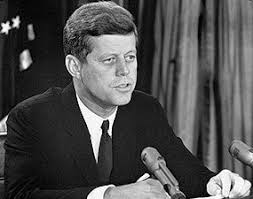
John F. Kennedy address the nation
And he demanded that the Soviets remove all of their offensive weapons from Cuba: “The cost of freedom is always high, but Americans have always paid it. And one path we shall never choose, and that is the path of surrender or submission.”
On October 26, the United States raised the readiness level of SAC forces to DEFCON 2—the step just short of war. For the only time in U.S. history, B-52 bombers were dispersed to various locations and made ready to take off, fully equipped, on 15 minutes’ notice.
Other measures taken included:
- One-eighth of America’s 1,436 bombers were on airborne alert.
- About 145 intercontinental ballistic missiles stood on ready alert.
- Air Defense Command redeployed 161 nuclear-armed interceptors to 16 dispersal fields within nine hours with one-third maintaining 15-minute alert status.
- Twenty-three nuclear-armed B-52 were sent to orbit points within striking distance of the Soviet Union.
An invasion date was set for October 29. But the Kennedy Administration—and the American military—didn’t know that the Russian soldiers guarding the missiles had been armed with tactical nuclear weapons.
Had the Marines gone in, those mini-nukes would have been used. And a fullscale nuclear exchange between the United States and the Soviet Union would have almost certainly followed.
At the height of the crisis, Attorney General Robert F. Kennedy offered a solution.
Khrushchev had sent two teletypes to Kennedy. The first had agreed to remove the missiles, but the second had demanded that the United States remove its own missiles from Turkey, which bordered the Soviet Union.
Robert Kennedy’s solution: The administration should ignore the second message—and announce that it had accepted Khrushchev’s offer to remove the missiles.
After this announcement was made, President Kennedy said to his advisors: “It can go either way now.”
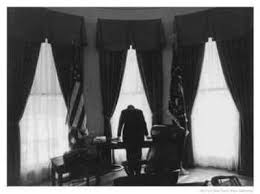
John F. Kennedy
The crisis ended on October 28. Under enormous pressure, Khrushchev agreed to remove the missiles from Cuba.
Behind his decision lay a secret promise by the Kennedy administration to remove its obsolete nuclear missiles from Turkey. And a public pledge to not invade Cuba.
On the night the crisis ended, there occurred a prophetic exchange between the two Kennedy brothers.
JFK: “Maybe this is the night I should go to the theater”—a reference to Abraham Lincoln’s fatal attendance of Ford’s Theater at the end of the Civil War.
RFK: “If you go, I want to go with you.”
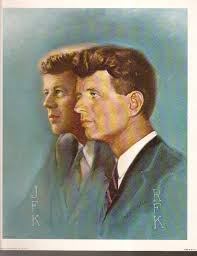
John F. and Robert F. Kennedy
But President Kennedy was not finished with Castro. While continuing the campaign of sabotage throughout Cuba, the Kennedys were preparing something far bigger: A fullscale American invasion of the island.
On October 4, 1963, the Joint Chiefs of Staff submitted its latest version of the invasion plan, known as OPLAN 380-63. Its timetable went:
- January, 1964: Infiltration into Cuba by Cuban exiles.
- July 15, 1964: U.S. conventional forces join the fray.
- August 3, 1964: All-out U.S. air strikes on Cuba.
- October 1, 1964: Full-scale invasion to install “a government friendly to the U.S.”
During the Cuban Missile Crisis, Robert Kennedy—referring to the 1941 Japanese attack on Pearl Harbor—had resisted demands for a “sneak attack” on Cuba by saying: “I don’t want my brother to be the Tojo of the 1960s.”
Now the Kennedys planned such an attack on Cuba just one month before the November, 1964 Presidential election.
Then fate—in the unlikely figure of Lee Harvey Oswald—intervened.
On November 22, 1963, while the President rode through Dallas in an open-air automobile, a rifle-wielding assassin opened fire. He scored two hits on Kennedy—in the back of the neck and head. The second wound proved instantly fatal.
The nation and the world were shocked—and plunged into deep mourning.
But for some of those who had waged a secret, lethal war against Fidel Castro for the previous two years, Kennedy’s death—at least in retrospect—didn’t come as a surprise.
Robert Kennedy, in particular, spent the remaining years of his life agonizing over the possibility that his highly personal war against Castro had backfired.
That Castro, fed up with the CIA’s assassination plots against him, had retaliated with one of his own.
Robert Kennedy’s fears and guilt were compounded by the fact that, while waging war on Castro, he had waged an equally ruthless crusade against organized crime.
And some of the mobsters he had done his best to put into prison had played a major role in the CIA’s efforts to “hit” Castro. Had the Mafia—believing itself the victim of a double-cross—put out a “contract” on JFK instead?
“John and Robert Kennedy knew what they were doing. They waged a vicious war against Fidel Castro—a war someone had to lose.”
And the loser turned out to be John F. Kennedy.
So writes investigative reporter Gus Russo in Live By the Sword: The Secret War Against Castro and the Death of JFK, published in 1998.
ABC NEWS, ALTERNET, AMERICAN TABLOID, AP, ASSASSINATION, BUZZFEED, CBS NEWS, CIA, CNN, COMMUNISM, CROOKS AND LIARS, CUBA, CUBAN MISSILE CRISIS, DAILY KOZ, DONALD TRUMP, DWIGHT D. EISENHOWER, FACEBOOK, FBI, FIDEL CASTRO, FLORIDA, FULGENCIO BATISTA, GUAM, GUS RUSSO, JAMES ELLROY, JOE BIDEN, JOHN F. KENNEDY, JOHNNY ROSELLI, LEE HARVEY OSWALD, LIVE BY THE SWORD, LYNDON B. JOHNSON, MAFIA, MOTHER JONES, MOVEON, NBC NEWS, NEWSWEEK, NIKITA KHRUSHCHEV, NORTH KOREA, NPR, NUCLEAR WAR, POLITICO, RAW STORY, REUTERS, ROBERT F. KENNEDY, SALON, SAM GIANCANA, SEATTLE TIMES, SLATE, THE ATLANTIC, THE CHICAGO SUN-TIMES, THE CHICAGO TRIBUNE, THE DAILY BEAST, THE GUARDIAN, THE HILL, THE HUFFINGTON POST, THE LOS ANGELES TIMES, THE NATION, THE NEW YORK TIMES, THE WASHINGTON POST, TIME, TWITTER, U.S. NEWS & WORLD REPORT, UKRAINE, UP, UPI, USA TODAY, VLADIMIR PUTIN, WARREN COMMISSION
In Bureaucracy, History, Law, Law Enforcement, Military, Politics, Social commentary on October 19, 2022 at 12:10 am
In April, 1961, the CIA tried to overthrow the Communist regime of Cuba’s “Maximum Leader,” Fidel Castro, at the Bay of Pigs.
When that failed, President John F. Kennedy ordered Castro’s removal through a campaign of sabotage and assassination.
These covert operatives became known within the CIA as the Special Group, and were ultimately supervised by Robert F. Kennedy, the President’s brother and Attorney General.
The war against Castro became known within the CIA as Operation Mongoose.
But not everyone in the CIA was enthusiastic about the “get Castro” effort.
“Everyone at CIA was surprised at Kennedy’s obsession with Fidel,” recalled Sam Halpern, who was assigned to the Cuba Project. “They thought it was a waste of time. We all knew [Fidel] couldn’t hurt us. Most of us at CIA initially liked Kennedy, but why go after this little guy?
“One thing is for sure: Kennedy wasn’t doing it out of national security concerns. It was a personal thing. The Kennedy family felt personally burnt by the Bay of Pigs and sought revenge.”
It was all-out war. Among the tactics used:
- Hiring Cuban gangsters to murder Cuban police officials and Soviet technicians.
- Sabotaging mines.
- Paying up to $100,000 per “hit” for the murder or kidnapping of Cuban officials.
- Using biological and chemical warfare against the Cuban sugar industry.
“Bobby (Kennedy) wanted boom and bang all over the island,” recalled Halpern. “It was stupid. The pressure from the White House was very great.”
Among that “boom and bang” were a series of assassination plots against Castro, in which the Mafia was to be a key player.
Chicago Mobster Johnny Rosselli proposed a simple plan: Through its underworld connections in Cuba, the Mafia would recruit a Cuban in Castro’s entourage, such as a waiter or bodyguard, who would poison him.
The CIA’s Technical Services division produced a botulinus toxin which was then injected into Castro’s favorite brand of cigars. The CIA also produced simpler botulinus toxin pills that could be dissolved in his food or drink.
But the deputized Mafia contacts failed to deliver any of the poisons to Castro.
Rosselli told the CIA that the first poisoner had been discharged from Castro’s employ before he could kill him, and the back-up agent got “cold feet.”
Other proposals or attempts included:
- Planting colorful seashells rigged to explode at a site where Castro liked to go skindiving.
- Trying to arrange for his being presented with a wetsuit impregnated with noxious bacteria and mold spores, or with lethal chemical agents.
- Attempting to infect Castro’s scuba regulator with tuberculous bacilli.
- Trying to douse his handkerchiefs, tea and coffee with other lethal bacteria.
Americans would rightly label such methods as ”terrorist” if another power used them against the United States today. And that was how the Cuban government saw the situation.
So Castro appealed to Nikita Khrushchev, leader of the Soviet Union, for assistance.

Fidel Castro

Nikita Khrushchev
Khrushchev was quick to comply: “We must not allow the communist infant to be strangled in its crib,” he told members of his inner circle.
By October, 1962, the Soviet Union had sent more than
- 40,000 soldiers,
- 1,300 field pieces,
- 700 anti-aircraft guns,
- 350 tanks and
- 150 jets
to Cuba to deter another invasion.
Most importantly, Khrushchev began supplying Castro with nuclear-tipped ballistic missiles.
Their discovery, on October 15, 1962, ignited the single most dangerous confrontation of the 50-year Cold War.
Suddenly, the United States and the Soviet Union—bristling with nuclear weapons—found themselves on the brink of nuclear war.
At the time, Kennedy officials claimed they couldn’t understand why Khrushchev had placed nuclear missiles in Cuba. “Maybe Khrushchev’s gone mad” was a typical public musing.
None of these officials admitted that JFK had been waging a no-holds-barred campaign to overthrow the Cuban government and assassinate its leader.
On October 16, the next day, President Kennedy was informed of the missile installations. He immediately convened a group of his 12 most important advisors, which became known as Ex-Comm, for Executive Committee.
Then followed seven days of guarded and intense debate by Kennedy and his advisors. Some of the participants—such as Air Force General Curtis LeMay—urged an all-out air strike against the missile sites.
Others—such as Adlai Stevenson, the United States delegate to the United Nations—urged a reliance on quiet diplomacy.
It was Secretary of Defense Robert S. McNamara who suggested a middle course: A naval blockade—a “quarantine” in Kennedy’s softened term—around Cuba. This would hopefully prevent the arrival of more Soviet offensive weapons on the island.
Finally, the President decided to to impose a naval blockade.
On October 22, Kennedy went on nationwide TV to announce the discovery of the missiles and his blockade of Cuba.
He warned that any nuclear missile launched from Cuba against any nation would be regarded as an attack on the United States by the Soviet Union—and would trigger “a full retaliatory response” upon the U.S.S.R.
John F. Kennedy address the nation
And he demanded that the Soviets remove all of their offensive weapons from Cuba:
“The path we have chosen for the present is full of hazards, as all paths are, but it is the one most consistent with our character and courage as a nation and our commitments around the world.”
ABC NEWS, ALTERNET, AMERICAN TABLOID, AP, ASSASSINATION, BUZZFEED, CBS NEWS, CIA, CNN, COMMUNISM, CROOKS AND LIARS, CUBA, CUBAN MISSILE CRISIS, DAILY KOZ, DONALD TRUMP, DWIGHT D. EISENHOWER, FACEBOOK, FBI, FIDEL CASTRO, FLORIDA, FULGENCIO BATISTA, GUAM, GUS RUSSO, JAMES ELLROY, JOE BIDEN, JOHN F. KENNEDY, JOHNNY ROSELLI, LEE HARVEY OSWALD, LIVE BY THE SWORD, LYNDON B. JOHNSON, MAFIA, MOTHER JONES, MOVEON, NBC NEWS, NEWSWEEK, NIKITA KHRUSHCHEV, NORTH KOREA, NPR, NUCLEAR WAR, POLITICO, RAW STORY, REUTERS, ROBERT F. KENNEDY, SALON, SAM GIANCANA, SEATTLE TIMES, SLATE, THE ATLANTIC, THE CHICAGO SUN-TIMES, THE CHICAGO TRIBUNE, THE DAILY BEAST, THE GUARDIAN, THE HILL, THE HUFFINGTON POST, THE LOS ANGELES TIMES, THE NATION, THE NEW YORK TIMES, THE WASHINGTON POST, TIME, TWITTER, U.S. NEWS & WORLD REPORT, UKRAINE, UP, UPI, USA TODAY, VLADIMIR PUTIN, WARREN COMMISSION
In Bureaucracy, History, Law, Law Enforcement, Military, Politics, Social commentary on October 18, 2022 at 12:10 am
On September 21, his troops facing disaster on Ukrainian battlefields, Russian President Vladimir Putin threatened to use nuclear weapons to resolve the conflict.
Whether he would use them strictly against Ukraine—or NATO countries, including the United States—he didn’t say.
Privately, President Joe Biden responded: “We have not faced the prospect of Armageddon since Kennedy and the Cuban missile crisis.”
Interviewed by CNN, Biden said: “I think he is a rational actor who has miscalculated significantly.”
The Cuban Missile Crisis occurred 60 years ago, during the Presidency of John F. Kennedy.
On January 1, 1959, Fidel Castro swept triumphantly into Havana after a two-year guerrilla campaign against Cuban dictator Fulgencio Batista.
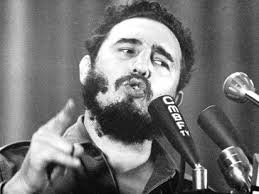
Fidel Castro
Almost immediately, hundreds of thousands of Cubans began fleeing to America. The first émigrés were more than 215,000 Batista followers. The exodus escalated, peaking at approximately 78,000 in 1962.
Between 1962 and 1979, hundreds of thousands of Cubans entered the United States under the Attorney General’s parole authority.
By 2008, more than 1.24 million Cubans were living in the United States, mostly in South Florida, where the population of Miami was about one-third Cuban. Their sheer numbers transformed the state’s political, economic and cultural life. And not entirely for the better.
Many of these Cubans viewed themselves as political exiles, rather than immigrants, hoping to eventually return to Cuba after its Communist regime fell from power.
The large number of Cubans in South Florida, particularly in Miami’s “Little Havana,” allowed them to preserve their culture and customs to a degree rare for immigrant groups.
With so many discontented immigrants concentrated in Florida, they became a potential force for politicians to court.
And the issue guaranteed to sway their votes was unrelenting hostility to Castro. Unsurprisingly, most of their votes went to right-wing Republicans.
John F. Kennedy was the first President to face this dilemma.
During the closing months of the administration of President Dwight D. Eisenhower, the CIA had begun training Cuban exiles for an invasion of their former homeland.
The exiles’ goal: To do what Castro had done—seek refuge in the mountains and launch a successful anti-Castro revolution.
But word of the coming invasion quickly leaked: The exiles were terrible secret-keepers. (A joke at the CIA went: “A Cuban thinks a secret is something you tell to only 300 people.”)
Kennedy insisted the invasion must appear to be an entirely Cuban enterprise. He refused to commit U.S. Marines and Air Force bombers.
The invaders landed on April 17, 1961 at the Bay of Pigs—and were quickly overwhelmed, with hundreds of the men taken prisoner.
Kennedy publicly took the blame for its failure: “Victory has a hundred fathers but defeat is an orphan.” But privately he seethed, and ordered the CIA to redouble its efforts to remove Castro at all costs.
To make certain his order was carried out, he appointed his brother, Robert—then Attorney General—to oversee the CIA’s “Castro removal” program.
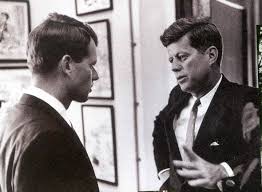
Robert F. Kennedy and John F. Kennedy
It’s here that America’s obsession with Cuba entered its darkest and most disgraceful period.
The CIA and the Mafia entered into an unholy alliance to assassinate Castro—each for its own benefit:
The CIA wanted to please Kennedy.
The mobsters wanted to regain its casino and brothel holdings that had made Cuba their private playground in pre-Castro times. They also hoped to use their pose as patriots to win immunity from future prosecution.
The CIA supplied poisons and explosives to various members of the Mafia. It was then up to the mobsters to assassinate Castro.
The CIA asked Johnny Roselli, a mobster linked to the Chicago syndicate, to go to Florida in 1961 and 1962 to organize assassination teams of Cuban exiles. They were to infiltrate their homeland and assassinate Castro.
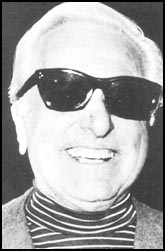
Johnny Roselli
Rosselli called upon two other crime figures: Chicago Mafia boss Sam Giancana and Santos Trafficante, the Costra Nostra chieftain for Tampa, for assistance.

Sam Giancana
Giancana, using the name “Sam Gold” in his dealings with the CIA, was meanwhile being hounded by the FBI on direct orders of Attorney General Robert Kennedy.
The mobsters were authorized to offer $150,000 to anyone who would kill Castro and were promised any support the Agency could yield.
Giancana was to locate someone who was close enough to Castro to be able to drop pills into his food. Trafficante would serve as courier to Cuba, helping to make arrangements for the murder on the island.
Rosselli was to be the main link between all of the participants in the plot.
The available sources disagree on what actually happened. Some believe that the Mob made a genuine effort to “whack” Fidel.
Others are convinced the mobsters simply ran a scam on the government. They would pretend to carry out their “patriotic duty” while in fact making no effort at all to penetrate Castro’s security.
The CIA’s war against Castro was known as Operation Mongoose–the mongoose being a traditional enemy of the cobra. And those entrusted with this assignment were known as the Special Group.
“We were hysterical about Castro at about the time of the Bay of Pigs and thereafter,” Secretary of Defense Robert S. McNamara later testified before Congress about these efforts. “And there was pressure from JFK and RFK to do something about Castro.”
ABC NEWS, ALTERNET, AMERICABLOG, AP, BABY BOOMER RESISTANCE, BARACK OBAMA, BAY OF PIGS, BUZZFEED, CBS NEWS, CNN, CORONAVIRUS, CROOKS AND LIARS, CUBA, DAILY KOZ, DAVID BROOKS, DONALD TRUMP, DRUDGE RETORT, DWIGHT D. EISENHOWER, EBOLA, FACEBOOK, FIDEL CASTRO, FIVETHIRTYEIGHT, FULGENCIO BATISTA, GALLUP POLL, GEORGE W. BUSH, HARPER’S MAGAZINE, JOHN F. KENNEDY, MEDIA MATTERS, MOTHER JONES, MOVEON, MSNBC, NBC NEWS, NEWSWEEK, NPR, PBS NEWSHOUR, POLITICO, POLITICUSUSA, RAW STORY, REUTERS, SALON, SEATTLE TIMES, SLATE, TALKING POINTS MEMO, THE ATLANTIC, THE CHICAGO SUN-TIMES, THE CHICAGO TRIBUNE, THE DAILY BEAST, THE DAILY BLOG, THE GUARDIAN, THE HILL, THE HUFFINGTON POST, THE LOS ANGELES TIMES, THE NATION, THE NEW REPUBLIC, THE NEW YORK TIMES, THE VILLAGE VOICE, THE WASHINGTON POST, THINKPROGRESS, TIM ZIEMER, TIME, TOLUSE OLORUNNIPA, TRUTHDIG, TRUTHOUT, TWITTER, TWO POLITICAL JUNKIES, U.S. NEWS & WORLD REPORT, UPI, USA TODAY, WASHINGTON WEEK IN REVIEW, WHITE HOUSE PANDEMIC OFFICE, WONKETTE, YAMICHE ALCINDOR
In Bureaucracy, History, Medical, Politics, Social commentary on September 8, 2022 at 12:53 am
On March 13, 2020, then-President Donald Trump addressed a subject he clearly resented being asked: His gutting of an early-warning medical system set up to confront pandemics.
In 2014, following the Ebola outbreak in West Africa, President Barack Obama created the White House Pandemic Office, run by the White House’s National Security Council (NSC).
Heading it was Rear Admiral Tim Ziemer. Under President George W. Bush, he had successfully fought malaria overseas. His topflight team of infectious disease and public health experts was creating a national bio-defense strategy.
Their goal: Coordinate agencies to make the United States more resilient to the threat of epidemics and biological warfare.
In May, 2018, Trump ordered the NSC’s global health security unit shut down. The reason: Trump’s pathological jealousy of and hatred for Obama.
On March 13, 2020, at a White House press conference, Yamiche Alcindor, the PBS Newshour’s White House Correspondent, dared to ask Trump:
“My first question is: You said that you don’t take responsibility, but you did disband the White House Pandemic Office and the officials that were working in that office left this administration abruptly. So, what responsibility do you take to that?
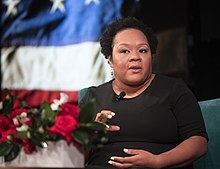
Yamiche Alcindor
“And the officials that worked in that office said that you—that the White House—lost valuable time because that office was disbanded. What do you make of that?”
Then followed this exchange:
TRUMP: Well, I just think it’s a nasty question, because what we’ve done is—and Tony had said numerous times that we saved thousands of lives because of the quick closing. And when you say me, I didn’t do it. We have a group of people.
ALCINDOR: It’s your administration.
TRUMP: I could ask, perhaps—my administration, but I could perhaps ask Tony about that, because I don’t know anything about it. I mean, you say we did that. I don’t know anything about it.
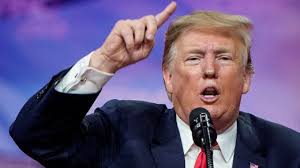
Donald Trump
ALCINDOR: You don’t know about the—
TRUMP: We’re spending—
ALCINDOR: — About the reorganization that happened in the National Security Council?
TRUMP: No, I don’t know. It’s the—it’s the administration, perhaps they do that. You know, people let people go. You know, you used to be with a different newspaper than you are now. You know, things like that happen.
Trump’s refusal to accept responsibility for the greatest crisis of his tenure as President flagrantly contrasts with how President John F. Kennedy responded to a similar crisis.
On April 17, 1961, the U.S. Navy landed 1,400 CIA-trained Cuban exiles on Cuba to overthrow the Communist government of Fidel Castro. Landing at the Bay of Pigs, they were supposed to head into the mountains—as Castro himself had done against the dictatorship of Fulgencio Batista in 1956—and raise the cry of revolution.
When the invaders surged onto the beaches, they found Castro’s army waiting for them. Many of the invaders were killed on the spot. Others were captured.
It was a major public relations setback for the newly-installed Kennedy administration, which had raised hopes for a change in American-Soviet relations.
Kennedy, trying to abort widespread criticism, publicly took the blame for the setback: “There’s an old saying that victory has a hundred fathers and defeat is an orphan….I’m the responsible officer of the Government.”
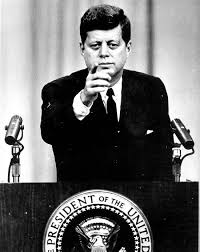
John F. Kennedy press conference
Ironically, the crisis—and his taking responsibility for it—hugely increased Kennedy’s popularity. The national Gallup Poll reported that 83 percent of Americans approved of the job he was doing as President.
To a White House aide, Kennedy half-joked: “It’s just like Eisenhower—the worse I do, the more popular I get.”
By contrast, Trump’s “handling” of the Coronavirus plague brought him the worst reviews of his Presidency.
Conservative New York Times columnist David Brooks attacked Trump in terms usually reserved for serial killers. On the March 13, 2020 edition of The PBS Newshour, he said:
“This is what happens when you elect a sociopath as president, who doesn’t care, who has treated this whole thing for the past month as if it’s about him. ‘How do people like me?’ Minimizing the risks. ‘Does the stock market reflect well on me?’ And he hasn’t done the things a normal human being would do, which was to, let’s take precautions….
“And he’s incapable of that. And he’s even created an information distortion field around him.”
And Toluse Olorunnipa, White House reporter for The Washington Post, said: “He likes having powerful people around him to praise what he’s done. He tried to get them all up to the podium to talk about how great of a response he has provided, and I think that’s—trying to get that co-signed from CEOs and powerful people is a key part of his presidency.”
Kimberly Atkins, senior Washington news correspondent for WBUR, Boston’s NPR News Station: “We have seen the president not only be all over the place but his instinct was to try to downplay it [Coronavirus] because he saw it as a political threat—to say that people would get better….
“Even today he’s saying, ‘We have everything under control. We have this website that people can go to and find out where they can get tested.’ The website isn’t even done yet.”
2016 PRESIDENTIAL CAMPAIGN, 2016 PRESIDENTIAL ELECTION, 2020 PRESIDENTIAL ELECTION, ABC NEWS, ADOLF HITLER, ALTERNET, AMERICABLOG, AP, ARMED SERVICES, ARTICLES OF IMPEACHMENT, BABY BOOMER RESISTANCE, BARACK OBAMA, BLOOMBERG, BUZZFEED, CBS NEWS, CIA, CLAUS VON STAUFFENBERG, CNN, CROOKS AND LIARS, DAILY KOZ, DONALD TRUMP, FACEBOOK, FBI, FIDEL CASTRO, FIVETHIRTYEIGHT, GESTAPO, HARPER’S MAGAZINE, IMPEACHMENT, JACOBO ARBENZ, JAMES B. COMEY, JAMES MATTIS, JOHN KASICH, JOHN MCCAIN, JOSEPH BIDEN, JUSTICE DEPARTMENT, KIM JONG ON, MARK ESPER, MARTIN NIEMOELLER, MEDIA MATTERS, MOHAMMED MOSADDEGH, MOTHER JONES, MOVEON, MSNBC, MUSLIMS, NATIONAL SECURITY AGENCY, NAZI GERMANY, NBC NEWS, NEWSWEEK, NPR, PBS NEWSHOUR, POLITICO, POLITICUSUSA, RAW STORY, REPUBLICANS, REUTERS, SALON, SEATTLE TIMES, SERGEY KISLYAK, SERGEY LAVROV, SLATE, TALKING POINTS MEMO, THE ATLANTIC, THE CHICAGO SUN-TIMES, THE CHICAGO TRIBUNE, THE DAILY BEAST, THE DAILY BLOG, THE GUARDIAN, THE HILL, THE HOLOCAUST, THE HUFFINGTON POST, THE LOS ANGELES TIMES, THE NATION, THE NEW REPUBLIC, THE NEW YORK TIMES, THE PENTAGON, THE PRESS, THE SS, THE VILLAGE VOICE, THE WASHINGTON POST, THINKPROGRESS, THIRD REICH, TIME, TRUTHDIG, TRUTHOUT, TWENTY-FIFTH AMENDMENT, TWILIGHT ZONE, TWITTER, TWO POLITICAL JUNKIES, U.S. NEWS & WORLD REPORT, UNITED STATES CONSTITUTION, UNITED STATES HOUSE OF REPRESENTATIVES, UNITED STATES SECRET SERVICE, UNITED STATES SENATE, UPI, USA TODAY, VLADIMIR PUTIN, VOTER FRAUD, WHERMACHT, WONKETTE, WORLD WAR 11
In History, Military, Politics, Social commentary on August 25, 2022 at 12:15 am
On July 20, 1944, members of the Wehrmacht high command failed to assassinate Adolf Hitler with a bomb hidden in a briefcase.
Mass arrests quickly followed.
Among the first victims discovered and executed was the conspiracy’s leader, Colonel Claus von Stauffenberg. Standing before a makeshift firing squad at midnight, he cried: “Long live our sacred Germany!”
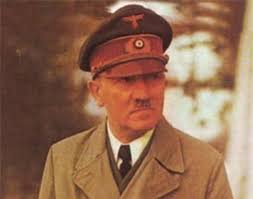
Adolf Hitler
At least 7,000 persons were arrested by the Gestapo. According to records of the Fuehrer Conferences on Naval Affairs, 4,980 were executed.
Had the conspiracy succeeded, history would have turned out differently:
Thus, history can be altered by the appearance—or disappearance—of a single individual.
Which brings us back to Donald Trump.
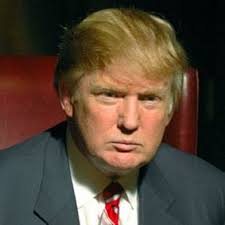
Donald Trump
Just as Germans did nothing to stop Adolf Hitler’s inexorable march toward war—and the destruction of millions of lives and Germany itself—so, too, did Americans seem paralyzed to put an end to the equally self-destructive reign of the man often dubbed “Carrot Caligula.”
- Trump’ could have been non-violently removed via the Twenty-Fifth Amendment to the United States Constitution. This allows the Vice President and a majority of the Cabinet to recommend the removal of the President when he is “unable to discharge the powers and duties of his office.” The Vice President then becomes President.
- No Cabinet members dared to invoke this.
- When Trump praised North Korea’s dictator Kim Jong-On or attacked Vietnam POW John McCain, House and Senate Republicans stayed silent. When he falsely charged massive voter fraud, they stayed silent or loudly parroted his lies.
- On February 5, 2020, the Republican-dominated Senate—ignoring the overwhelming evidence against him—acquitted Trump on both impeachment articles: Obstruction of Congress and abuse of power.
- Pentagon generals stood mute as Trump repeatedly sided with Russian dictator Vladimir Putin against the FBI, CIA and National Security Agency—and even gave classified CIA Intelligence to Russian Foreign Minister Sergey Lavrov and Ambassador Sergey Kislyak.
- High-ranking field marshals in Hitler’s Wehrmacht held their tongues when he insulted them. So did American generals when Trump belittled their intelligence and even patriotism.
- The CIA overthrew Iranian prime minister Mohammad Mosaddegh, in 1953 and Guatemalan president Jacobo Árbenz in 1954. It repeatedly tried—unsuccessfully—to assassinate and/or overthrow Cuban dictator Fidel Castro. But it made no effort to halt the ongoing treachery of Donald Trump.
- When Trump arbitrarily decided to remove American forces from Syria and Afghanistan, Secretary of Defense James Mattis resigned in protest in 2018. But then he was simply replaced by Mark Esper.
- Despite the fact that many of these men regularly came into contact with Trump, not one of them apparently plotted his removal.
- Similarly, Trump repeatedly attacked the integrity of the men and women of the FBI—even firing its director, James Comey, for daring to investigate Russia’s subversion of the 2016 election. If its armed agents—steeped in Federal criminal law—built a case for Trump’s indictment and prosecution, it has never come to light.
- Neither did any of his armed Secret Service agents register the slightest protest, despite his arrogant behavior toward them. He forced them to work without pay during his 35-day government shutdown in 2018. They also had to accompany him to COVID-infected states—both during the Presidential campaign and afterward. Many of them became stricken with this often fatal disease as a result.
On November 3, 2020, 81,255,933 Democratic voters elected former Vice President Joseph Biden the 46th President of the United States. Trump, running for a second term, got 74,196,153 votes.
Yet almost two months after the election, Trump refused to concede, insisting that he won—and repeatedly claiming falsely that he was the victim of massive vote fraud.
This toxic lie has been feverishly embraced by millions of Right-wingers, robbing the Biden administration of its deserved legitimacy.
This refusal to acknowledge the outcome initially denied Biden access to the money, information-sharing and machinery traditionally accorded the President-elect. Trump himself was the beneficiary of such assistance in 2016, after his win over Democratic nominee Hillary Clinton.
Only on November 23 was Biden acknowledged as the winner by the General Services Administration, as the Trump administration finally began the formal transition process.
Trump’s refusal to accept reality posed an unprecedented danger to democracy: No presidential candidate had ever refused to concede defeat once all the votes were counted and legal challenges resolved.
By refusing to commit to a peaceful transfer of power, Trump took on the classic mantle of of a dictator.
Historians have uncovered at least 42 assassination plots against Adolf Hitler. That resistance movement has earned honor for its members, many of whom died heroically for standing firm against a brutal tyrant.
To its eternal shame, the same cannot be said of America during the reign of Donald Trump.
2016 PRESIDENTIAL CAMPAIGN, 2016 PRESIDENTIAL ELECTION, 2020 PRESIDENTIAL ELECTION, ABC NEWS, ADOLF HITLER, ALTERNET, AMERICABLOG, AP, ARMED SERVICES, ARTICLES OF IMPEACHMENT, BABY BOOMER RESISTANCE, BARACK OBAMA, BLOOMBERG, BUZZFEED, CBS NEWS, CIA, CLAUS VON STAUFFENBERG, CNN, CROOKS AND LIARS, DAILY KOZ, DONALD TRUMP, FACEBOOK, FBI, FIDEL CASTRO, FIVETHIRTYEIGHT, GESTAPO, HARPER’S MAGAZINE, IMPEACHMENT, JACOBO ARBENZ, JAMES B. COMEY, JAMES MATTIS, JOHN KASICH, JOHN MCCAIN, JOSEPH BIDEN, JUSTICE DEPARTMENT, KIM JONG ON, MARK ESPER, MARTIN NIEMOELLER, MEDIA MATTERS, MOHAMMED MOSADDEGH, MOTHER JONES, MOVEON, MSNBC, MUSLIMS, NATIONAL SECURITY AGENCY, NAZI GERMANY, NBC NEWS, NEWSWEEK, NPR, PBS NEWSHOUR, POLITICO, POLITICUSUSA, RAW STORY, REPUBLICANS, REUTERS, SALON, SEATTLE TIMES, SERGEY KISLYAK, SERGEY LAVROV, SLATE, TALKING POINTS MEMO, THE ATLANTIC, THE CHICAGO SUN-TIMES, THE CHICAGO TRIBUNE, THE DAILY BEAST, THE DAILY BLOG, THE GUARDIAN, THE HILL, THE HOLOCAUST, THE HUFFINGTON POST, THE LOS ANGELES TIMES, THE NATION, THE NEW REPUBLIC, THE NEW YORK TIMES, THE PENTAGON, THE PRESS, THE SS, THE VILLAGE VOICE, THE WASHINGTON POST, THINKPROGRESS, THIRD REICH, TIME, TRUTHDIG, TRUTHOUT, TWENTY-FIFTH AMENDMENT, TWILIGHT ZONE, TWITTER, TWO POLITICAL JUNKIES, U.S. NEWS & WORLD REPORT, UNITED STATES CONSTITUTION, UNITED STATES HOUSE OF REPRESENTATIVES, UNITED STATES SECRET SERVICE, UNITED STATES SENATE, UPI, USA TODAY, VLADIMIR PUTIN, VOTER FRAUD, WHERMACHT, WONKETTE, WORLD WAR 11
In Bureaucracy, History, Military, Politics, Social commentary on August 24, 2022 at 12:10 am
On July 20, 1944, Colonel Claus Schenk von Stuaffenberg tried to assassinate Adolf Hitler.
He had served with the Wehrmacht in Poland (1939), France (1940) and the Soviet Union (1941).
While serving in Tunisa, he was seriously wounded on April 7, 1943, when Allied fighters strafed his vehicle. He lost his left eye, right hand and two fingers of his left hand after surgery.
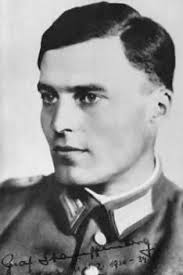
Colonel Claus Schenk von Stuaffenberg
Nevertheless, he now acted as the prime mover for the conspiracy among a growing number of German high command officers to arrest or assassinate Germany’s Fuehrer.
For most of these officers, the motive was craven: The “happy time’ of German victories was over. Germany was losing the war it had launched on the world in 1939–and now they feared the worst.
This was especially true now that the numerically superior forces of the Soviet Union had gone onto the offensive.
For Stauffenberg, there was another reason: His disgust at the horrors he had seen committed by his fellow Wehrmacht soldiers upon defenseless POW’s and civilians in Russia.
Thus, Stauffenberg—more than many Germans—knew firsthand the vengeance his country could expect if the “Thousand-Year Reich” fell.
Something must be done, he believed, to prove to the world that not all Germans—even members of the Wehrmacht—were criminals.
Most of the conspirators wanted to arrest Hitler and surrender to British and American forces—well before the much-feared Russians gained a toehold in Germany.
Stauffenberg didn’t want to arrest Hitler; he wanted to kill him. A live Hitler might eventually be rescued by his Nazi colleagues.
But Hitler was a closely-guarded target. He was surrounded by fanatical bodyguards who were expert marksmen. He often wore a bulletproof vest and a cap lined with three pounds of laminated steel.
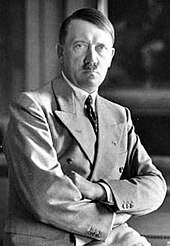
Adolf Hitler
Bundesarchiv, Bild 146-1990-048-29A / CC-BY-SA 3.0 [CC BY-SA 3.0 de (https://creativecommons.org/licenses/by-sa/3.0/de/deed.en)%5D
But his single greatest protection–he claimed—was an instinct for danger. He would suddenly change his schedule—to drop in where he was least expected. Or suddenly depart an event where he was expected to stay a long time.
On November 9, 1939, this instinct saved his life. He was expected to give a long speech at a Munich beer hall before the “old Fighters” of his brown-shirted storm troopers.
Instead, he suddenly cut short his speech and left the beer hall. Forty-five minutes later, a bomb exploded inside a pillar—before which Hitler had been speaking.
Since then, a series of other assassination attempts had been made against Hitler. All of them involved time-bombs. And all of the would-be assassins were members of the German General Staff.
In one case, a bomb secretly stashed aboard Hitler’s plane failed to explode. In another, an officer who had a bomb strapped to himself unexpectedly found his scheduled meeting with Hitler called off. He had to rush into a bathroom to defuse the bomb before it went off.
So now it was the turn of von Stauffenberg. He would carry his bomb—hidden in a briefcase—into a “Hitler conference” packed with military officers.
But Stauffenberg didn’t intend to be a suicide bomber. He meant to direct the government that would replace that of the Nazis.
His bomb—also rigged with a time-fuse—would be left in the conference room while he found an excuse to leave. After the explosion, he would phone one of his fellow conspirators with the news.
Then, the coup—“Operation Valkyrie”—would be on.
Anti-Nazi conspirators would seize control of key posts of the government. The British and Americans would then be informed of Germany’s willingness to surrender. Provided, of course, that the vengeance-seeking Russians did not have a say in its postwar future.
The Wehrmacht and Schutzstaffel (SS) had killed millions of Russians. Many had died in combat. Others had been murdered as captives. Still more had been allowed to die by starvation and exposure to the notorious Russian winter.
So the Germans—both Nazi and anti-Nazi—knew what they could expect if soldiers of the Soviet Union reached German soil.
On July 20, 1944, Stauffenberg appeared at Hitler’s well-guarded military headquarters in East Prussia. Like all his other outposts, Hitler had named it—appropriately enough—“Wolf’s Lair.”

“Wolf’s Lair”
Stauffenberg entered the large, concrete building while the conference was in session. He placed his yellow briefcase next to Hitler—who was standing with his generals at a heavy oaken table. Then he excused himself to take an “urgent” phone call.
After Stauffenberg left the room, Colonel Heinz Brandt, standing next to Hitler, found the briefcase blocking his legs. So he moved it—to the other side of the heavy oaken support, partially shielding Hitler from the blast..
At 12:42 p.m. on July 20, 1944, Stauffenberg’s briefcase bomb erupted.
Brandt died, as did two other officers and a stenographer.
Hitler not only survived, but the plotters failed to seize the key broadcast facilities of the Reich.
This allowed Hitler to make a late-night speech to the nation, revealing the failed plot and assuring Germans that he was alive. And he swore to flush out the “traitorous swine” who had tried to kill him.
He soon proved as bad as his word.

 Bureaucracybuster's Blog
9/11 ATTACKS, ABC NEWS, AFGHANISTAN, AL QAEDA, ALTERNET, AMERICABLOG, AP, BABY BOOMER RESISTANCE, BARACK OBAMA, BLOOMBERG, BOLIVIA, BUZZFEED, CBS NEWS, CIA, CNN, COMMUNISM, CROOKS AND LIARS, CUBA, CUBAN MISSILE CRISIS, DAILY KOZ, DRUDGE REPORT, ERNESTO "CHE" GUEVARA, FIDEL CASTRO, FIVETHIRTYEIGHT, GEORGE W. BUSH, GREEN BERETS, HARPER’S MAGAZINE, HUFFINGTON POST, IRAQ, ISLAM, JOHN F. KENNEDY, MEDIA MATTERS, MOTHER JONES, MOVEON, MSNBC, NAVY SEALS, NBC NEWS, NEWSWEEK, NIKITA KHRUSHCHEV, NPR, OSAMA BIN LADEN, PAKISTAN, PBS NEWSHOUR, POLITICO, POLITICUSUSA, RAW STORY, REUTERS, SALON, SEATTLE TIMES, SLATE, SOVIET UNION, TALIBAN, TALKING POINTS MEMO, THE ATLANTIC, THE CHICAGO SUN-TIMES, THE CHICAGO TRIBUNE, THE DAILY BEAST, THE DAILY BLOG, THE GUARDIAN, THE HILL, THE HUFFINGTON POST, THE LOS ANGELES TIMES, THE NATION, THE NEW REPUBLIC, THE NEW YORK TIMES, THE VILLAGE VOICE, THE WASHINGTON POST, THINKPROGRESS, TIME, TRUTHDIG, TRUTHOUT, TWITTER, TWO POLITICAL JUNKIES, U.S. NEWS & WORLD REPORT, UPI, USA TODAY, WONKETTE
A TALE OF TWO KILLINGS: PART ONE (OF THREE)
In Bureaucracy, History, Military, Politics, Social commentary on May 3, 2023 at 12:11 amThey both had beards. They both saw military action. They both passionately hated the United States. And they both died in a hail of bullets.
And immediately after their deaths, both seemed to disappear from the face of the earth.
Ernesto “Che” Guevara and Osama bin Laden.
Two men who inspired widespread admiration among their supporters—and fear among their enemies.
Guevara, an Argentinian doctor-turned-Cuban revolutionary, sought to destroy the United States’ power to fight Communism. Bin Laden sought to destroy its power to intervene in the Middle East.
Ernesto “Che” Guevara
Guevara’s most optimistic hope was that Americans would eventually see the error of their capitalistic ways and convert to Communism. His last words were: “Tell Fidel [Castro] that he will soon see a triumphant revolution in America.”
But he was prepared to fight to the death–as indeed he did—to force revolutionary change upon the United States.
For Bin Laden, the cause was Islam, not Communism. His most optimistic hope was that Christian and Jewish Americans would eventually convert to Islam.
But if that didn’t happen, he, too, was prepared to attack Americans anywhere and in any way he could—as his private diary and documents have revealed.
Guevara died on October 9, 1967, at the hands of a CIA-directed operation run by the Bolivian army.
Bin Laden, creator of the Al-Qaeda (“The Base”) terrorist network, met his end on May 1, 2011, during a raid by U.S. Navy SEALS on his compound in Pakistan.
Osama bin Laden
One man—Guevara—has since attained secular sainthood in the eyes of millions of Communists and their sympathizers.
The other—bin Laden—has attained instant “martyr” status in the eyes of untold numbers of Islamic terrorists and their sympathizers.
In November, 1962, during an interview with the Communist newspaper, the London Daily Worker, Guevara raged against the Soviet Union’s recent withdrawal of nuclear missiles from Cuba.
Those “thirteen days” of the Cuban Missile Crisis that October had brought the world to the brink of nuclear destruction.
“If the missiles had remained, we would have used them against the very heart of the United States, including New York,” said Guevara.
“We must never establish peaceful coexistence. We must walk the path of victory even if it costs millions of atomic victims.”
Similarly, until the end of his life, bin Laden demanded more attacks like the one on September 11, 2001, that snuffed out the lives of 3,000 Americans.
This brought him into conflict with other Al-Qaeda members who wanted to launch assaults on more vulnerable targets outside the United States.
Guevara died as he had lived—violently.
In late October, 1966, he slipped out of Cuba. On November 3, he secretly arrived in La Paz, Bolivia, intent on re-staging the Cuban revolution among the Bolivian peasantry.
But the peasants showed no interest in his aims and in fact reported his movements to the Bolivian army.
The army, in turn, was being advised by United States Green Berets under the direction of the CIA.
On October 7, 1967, an informant tipped off the Bolivian Special Forces to the location of Guevara’s guerrilla camp in the Yuro ravine.
On October 8, they encircled the area with 1,800 soldiers. In the shootout that followed, Guevara was wounded and taken prisoner while leading a detachment.
His rifle broken by a lucky shot, a twice-wounded Guevara shouted: “Do not shoot! I am Che Guevara and worth more to you alive than dead.”
Quickly informed of Guevara’s capture, the Bolivian government debated his fate: Should he be immediately executed or placed on trial?
On the morning of October 9, Bolivian President Rene Barrientos ordered that Guevara be executed. Barrientos feared that placing him on trial would create an international media circus and/or render Bolivia vulnerable to efforts to free him.
The Bolivian government planned to declare that Guevara had been killed in action during a clash with the nation’s armed forces. Special instructions were thus issued.
These came from Felix Rodrieguez, a CIA agent acting as advisor to the Bolivians.
The executioner would be Mario Teran, a Bolivian army sergeant who had lost three of his friends in an earlier firefight with Guevara’s band of guerrillas.
Rodriguez ordered Teran to aim carefully to make it appear that Guevara had been killed in action.
To his surprise, Rodriguez found himself highly impressed with Guevara’s courage. When informed of his imminent execution, Guevara blanched, then quickly got control of himself.
Felix Rodriguez, left, Che, center
“It is better like this,” he said. “I should never have been captured alive.”
Rodriguez asked if he had any messages for his family. Guevara replied: “Tell Fidel [Castro, the president/dictator of Cuba] that he will soon see a triumphant revolution in America.
“And tell my wife to remarry and try to be happy.”
When Sergeant Teran entered the hut, Guevara told his executioner: “I know you’ve come to kill me. Shoot, coward! You are only going to kill a man!”
Teran hesitated, then opened fire with his semiautomatic rifle, hitting Guevara in his arms and legs.
Guevara writhed on the ground, apparently biting one of his wrists to avoid crying out. Teran then fired several more times, finally killing him with a shot in the chest.
Share this: